Selling a condo is different from selling a detached house for one simple reason: you do not sell one asset, you sell two. The first is the unit itself, meaning the space inside your walls and the rights that come with it. The second is a share in a building, a budget, a board and a set of rules that you do not control but that every buyer, lender and insurer will study before they trust your deal.
That second asset is where most surprises hide. A buyer can fall in love with your kitchen and still walk away because the reserve fund looks thin, a special assessment is on the horizon, or the lender will not finance units in the building. None of that has anything to do with how well you kept your own space. It has to do with paperwork, governance and timing, and most of it sits in files that someone other than you has to produce.
This guide is the cornerstone of our library on condos, HOAs, rentals and specialty properties. It explains how selling a condo really works: which documents matter, how monthly fees and assessments change what buyers will pay, how financing rules for the whole project can help or hurt, and what a buyer is entitled to review. It also shows you how to build a realistic net-proceeds picture, who to ask for what, and which decisions belong before you list rather than after an offer lands.
We stay neutral on agents, flat-fee services, attorneys and cash buyers, because the right choice depends on your building, your state and your goals. We also keep every number labelled as an example, because condo costs vary enormously from one association to the next. What you will get is a way of thinking, a set of questions, and a verification roadmap you can follow at your own pace.
Key takeaways
- You are selling the unit and the building’s health. Buyers and lenders judge the association’s finances, rules, insurance and litigation record almost as closely as they judge your unit.
- Start the association paperwork early. Resale or disclosure packages are produced by the board or a management company, deadlines and fees vary by state and by governing documents, and delays here can stall a sale.
- Dues and assessments belong in your pricing logic. A buyer’s monthly payment includes the fee, so a higher fee or a pending special assessment can change what the market will accept for the same unit.
- The whole project can block a mortgage. Some loan programs review the building, not just the buyer, so cash buyers and some loan types may fit better when a building has problems.
- Build your net proceeds from real quotes. Payoff, broker terms, association fees, transfer charges, prorations and closing costs are specific to your contract and your association, never a universal percentage.
- Rules vary by state and by building. Verify with your declaration, your state real estate commission, a title company or a real estate attorney before relying on anything general, including this guide.
Selling a condo starts with the building, not only your unit
People who have sold a house before sometimes assume that selling a condo will follow the same script. Most of it does, which is reassuring. The differences cluster around the association, and learning them in advance is the most useful preparation for selling a condo that you can do.
Walk into almost any conversation about listing a house and the topics are price, repairs and staging. Walk into the same conversation about a condo and a fourth topic quickly takes over: the association. It decides what you may disclose, what you must hand over, whether a buyer needs approval, whether you can rent the unit while it sits on the market, and sometimes whether you can even hang a lockbox.
That is why a sensible plan begins by separating what you control from what you merely influence. You control price, presentation, the timing of your listing and how responsive you are. You only influence the speed of the association’s paperwork, the contents of its budget and the opinion a lender forms about the project. Good planning means working hard on the first list and building slack into the second.

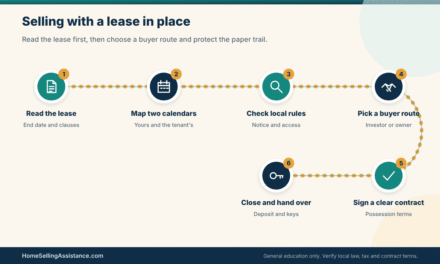
The roadmap above shows the stages most condo sales pass through, from collecting your own documents to the day the buyer’s lender funds the loan. Notice how many stages depend on a third party. Keep that picture in mind as you read, because it explains why an experienced condo seller starts early on the association file and treats the unit’s cosmetic prep as the easier half of the work.
Owners often ask whether selling a condo is harder than selling a house. It is not harder so much as different. Selling a condo adds a third party, the association, to a process that otherwise involves you, a buyer and a few professionals, and that third party keeps its own calendar. Plan around it and the process feels ordinary. Ignore it and the same process can feel like a string of unexplained delays.
A helpful habit is to treat selling a condo as two parallel projects that meet at the closing table. One project is the unit: price, preparation, photographs, showings. The other is the building file: documents, fees, approvals and answers to questions that only the association can give. Assign each project an owner and a rough finish date, even if the owner is simply you.
Define your goal, your deadline, and what you actually own
Clarity about ownership is the first real task in selling a condo, and it is also the one most likely to be skipped. Spend an hour on it now, and the rest of selling a condo gets easier.
Before you talk to anyone, write down three things in plain language: what you want from the sale, when you need it done, and what exactly you own. The first two are personal. The third surprises more people than you would expect, because owning a condo is not a single bundle of rights the way owning a lot and a house usually is.
A condominium typically means you own your unit outright, often measured from the interior surfaces of the walls, plus an undivided share of the common elements such as the roof, hallways, grounds, structure and amenities. Beyond that, the details live in documents. Parking may be assigned, deeded or simply a license. A storage locker may convey with the unit or be a separate item. A balcony may be yours to use but belong to the association to repair.
Your goal matters because it decides how much friction you can tolerate. If you want the highest price and have months to spare, you can fix small issues, wait for the right buyer and let an association review run its course. If you need a firm closing date because you are buying elsewhere, you will value certainty, clean paperwork and a buyer whose financing is not exposed to a building-level problem.
Constraints deserve the same honesty. Maybe a co-owner has to sign. Maybe the unit is rented and a lease runs for another year. Maybe you owe more than you expect, or the association has recorded a lien for unpaid dues. Each of these changes who you can sell to and how fast, and each is far easier to handle when you discover it on day one instead of in the middle of a contract.
If you take only one habit from this guide, make it this: write down what you know and what you only assume. Many problems in selling a condo come from an assumption that nobody checked, such as which parking space is yours, whether a storage cage conveys, or whether the fee you remember is still current.
Evidence to gather: deed, declaration, and your latest dues statement
Start with three documents you can usually find in an afternoon. The first is your deed, which shows how title is held, who must sign, and how the unit is described. The second is a copy of the declaration, sometimes called the master deed or covenants, conditions and restrictions, along with the bylaws and current rules. If you never received them at purchase, ask the association or management company. They are the rulebook for everything else.
The third document is your current statement from the association. It should show your regular fee, how often you pay it, any assessment still being collected, and whether you have a balance. Check it against your own bank records. A late fee you forgot, a fine you never saw or an assessment installment that you thought was finished can all appear on a payoff or resale statement later, when they are far more awkward to explain.
Add your mortgage statement, your most recent property tax bill and your homeowner’s policy for the interior of the unit. Those four or five papers give any professional you consult a quick, accurate picture. They also let you sketch a first rough net sheet, which is the best antidote to guessing. Our broader seller checklist before listing covers the general file every seller should assemble, and the condo-specific papers sit on top of it.
Finally, note anything that makes your unit unusual. Does it have a private roof deck, a garage space with a separate tax bill, a rental history, a recent renovation done without association sign-off, or a window or balcony change that the rules restrict? Unapproved alterations are a classic complication. It is much better to raise them with the board or a professional before a buyer’s inspector or lender spots them.
That is also a reminder that sellers rarely lose time through one big event. They lose it through small waits that stack. A deliberate order of operations is among the cheapest tools available to anyone selling a condo on a deadline, and it costs nothing but a few phone calls on the first day.
A scenario, an exception, and your next step: the owner who needs to move in ninety days
Picture an owner who has accepted a job in another city and wants to close within about three months. This is an example, not a prediction. In week one she gathers her documents and discovers that her association uses a management company that quotes its resale package as taking several business days, with an extra fee for rush handling. She asks for the quote in writing and learns the board must also approve any rental during a sale.
The exception in her case is a pending vote on a roof project. Nobody knows yet whether the board will levy an assessment. She does not guess. She asks the manager for the most recent meeting minutes and the board’s draft budget, then reads them with her listing professional so the pricing conversation starts from facts. She also decides in advance how she would respond if the assessment is approved during the sale.
Her next step is simple and repeatable for any owner in a hurry: order the association package early, share the unknowns with her professional, and set the listing date around the paperwork rather than the other way round. Starting the clock on the slowest item first is the main thing that protects a tight timeline when selling a condo under pressure.
Map the main ways of selling a condo
No single route is best for everyone. The routes below are different ways of selling a condo, and each one rewards a different kind of owner. Read them as options to compare, not as a ladder to climb.
Once you know your goal and your documents, look at the routes available. The same set of choices exists as for any home: a traditional listing with an agent, a for-sale-by-owner approach, a sale to a cash buyer or investor, and in some places an auction or a sale arranged inside the building. What changes for a condo is how each route interacts with association approval, buyer financing and the number of comparable units nearby.
A traditional listing puts your unit in the multiple listing service and in front of the widest pool of buyers. Because many condo buyers rely on mortgages, that pool is also the group most exposed to project-level financing rules. A listing professional who works in your building or complex will usually know how the management company behaves, how long its documents take and which lenders have recently closed loans there. That local knowledge is worth asking about directly.
Selling without an agent can work well for an owner with time, strong pricing instincts and a willingness to handle paperwork. It is not simpler for a condo, though, because the association package, disclosure duties and buyer-agent compensation questions still apply. Our guide on for-sale-by-owner paperwork explains what a seller handling the file alone has to produce, and much of it carries over to condos.
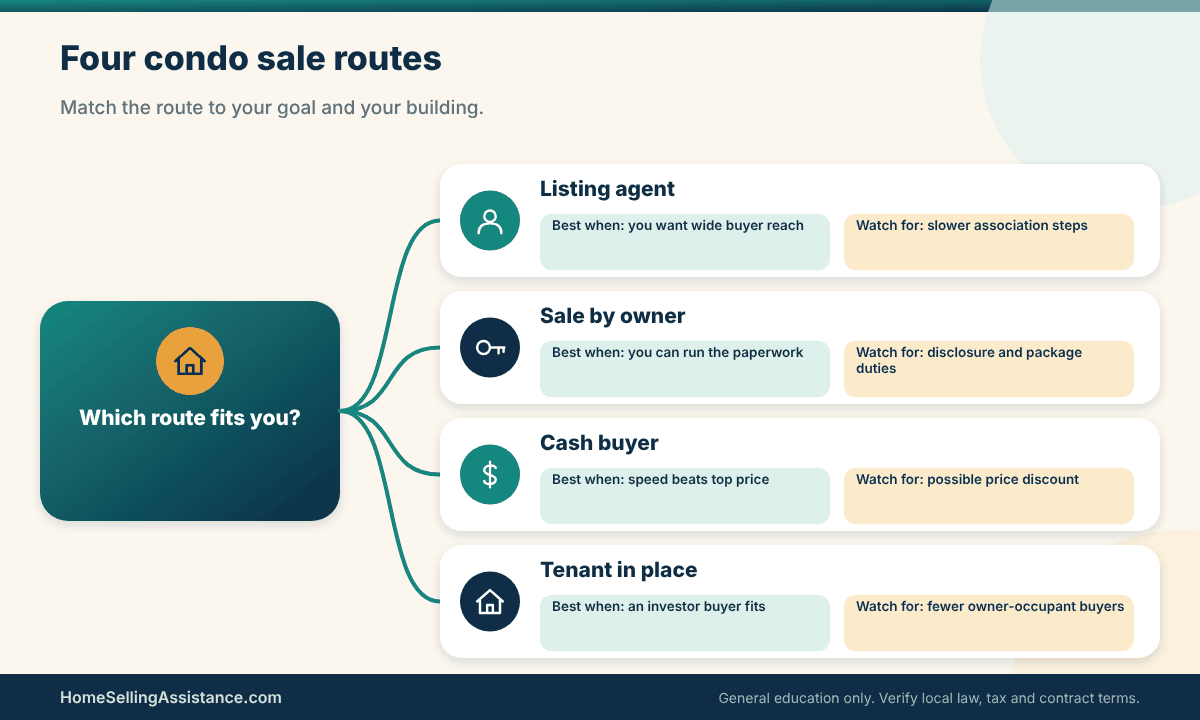
The diagram above compares the paths most condo owners weigh. Read it as a way to choose which questions to ask, not as a ranking. A cash buyer or investor may offer speed and fewer financing risks, usually at a trade-off in price. A conventional listing may reach more buyers and also carry more contingencies. A direct sale to a neighbor, a tenant or a family member can be smooth, but still needs a proper contract, disclosures and title work.
Because compensation of listing and buyer agents is now negotiable and must be put in writing, you should also decide before you sign anything how you want to handle that conversation. Our overview on how to choose a listing agent covers the questions to ask, and the same questions apply whether the agent knows condos or not. Add one more: ask how many units they have sold in your specific building and how those deals closed.
Whichever route you favor, give the building a vote in the decision. A path that looks fastest on paper can slow down if the association is slow, and a path that looks slow can speed up if your building has an easy review. Experienced professionals who focus on selling a condo in your complex can often tell you which description fits your building.
Evidence to gather: how each path treats HOA approval and buyer financing
These questions are best asked before you commit to a route. Evidence collected early is cheap; evidence collected after you have signed a listing agreement or a contract is expensive. Selling a condo rewards the owner who asks first.
For each path you are considering, gather three kinds of evidence. First, how does the association treat a new owner? Some buildings simply record the transfer and collect a fee. Others require an application, a board interview, a background or credit check, or an acknowledgment of the rules. Your declaration and the management company can tell you which applies, and that process can set a minimum timeline no matter who buys.
Second, what financing has recently worked in the building? Ask your listing professional or a local lender how recent buyers financed and whether any loans were turned down because of the project. This is a conversation, not a statistic, so treat the answer as a lead to verify. If most recent sales were cash, that tells you something. If lenders have been declining the project, it tells you something more important.
Third, what do comparable sales say? Look for units of similar size, floor, view and condition in the same building or very close by, sold recently under similar terms. Pay attention to how those sellers handled the association’s fees and any assessment, because a comparable that sold before a fee increase may no longer be a fair guide. Our article on the difference between a comparative market analysis and an appraisal explains what each tool can and cannot tell you.
Finally, ask how the route you favor handles a contract that falls apart. A listing may allow you to take a backup offer, a topic we cover in how a seller can use a backup offer. A private sale might leave you starting over. A cash buyer might have a short inspection window but also a clear exit. Knowing the fallback in advance is part of choosing the path, not an afterthought.
Notice what the two owners did not do. They did not pick a route first and look for facts to justify it later. They asked what each route would cost in dollars, time and risk for a unit like theirs. That discipline, more than any single tactic, is what keeps selling a condo from turning into a series of reactions.
A scenario and your next step: choosing between a listing and a quick sale
Imagine two owners in the same mid-size building. The first has months of flexibility and a unit with a renovated bath. The second inherited a unit last year, lives out of state and wants to be done. They are not in the same position, and the best route for each is probably different, which is the entire point of mapping paths before picking one.
The first owner leans toward a traditional listing and asks about association timing, comparable renovated units and likely buyer financing. The second asks for a few written offers from cash buyers and also asks one local agent for an opinion of value, then compares net numbers side by side. Neither choice is automatically right. Both owners are better off because they compared actual figures rather than headlines.
If you resemble the second owner, our guide to cash offers for a house explains how to compare them fairly, including the questions that expose weak funding. If you resemble the first, your next step is to ask for a pricing opinion built on recent sales in the building and a written plan for handling the association’s paperwork, then decide whether the effort of a traditional listing matches your timeline when selling a condo in a building like yours.
What moves price, timing, risk, and net proceeds when selling a condo
Pricing logic for selling a condo has one extra rule that houses rarely need: always ask what the building adds or subtracts. Owners who price from the unit alone are often surprised, because selling a condo means the building shares the stage.
In a detached-house sale, price is driven mostly by location, size, condition and the mood of the market. In condo sales those factors still count, but a second layer sits on top of them. Monthly fees, upcoming assessments, the strength of the reserve fund, the building’s insurance, the presence of lawsuits and the rules about rentals all alter how a buyer calculates affordability and risk. Two identical units can sell at different prices purely because their buildings differ.
It helps to think of every condo buyer as running two calculations at once. One asks whether they like the unit and can afford the purchase price. The other asks whether the building is a sound place to own for years, and what it may cost them beyond the mortgage. Your job as a seller is not to spin the second calculation but to make it easy to answer accurately, because uncertainty tends to be priced harshly.
If you want to see how condo issues connect to the wider process, our guide on how to sell a house covers the general flow, and our collection on condos, HOAs and specialty properties collects the deeper articles for this part of the library. Think of this page as the hub that ties them together.
Before looking at each variable in detail, it is useful to look at common seller situations side by side. The table below pairs each situation with the key fact that drives it, a practical action you can take, the trade-off that action carries, and the document or source to check. It is designed for conversations with your listing professional, attorney or title company, not as a substitute for them, and every situation in it will play out differently depending on your state and your building.
| Situation | Key fact | Practical action | Trade-off | Source or document |
|---|---|---|---|---|
| Special assessment voted, not yet fully paid | Responsibility at closing depends on contract and local custom | Get the exact amount and schedule in writing, then decide on payoff or credit | Paying early lowers buyer worry but reduces your cash | Board minutes, assessment notice, purchase contract |
| Building has a low reserve balance | Buyers and lenders may read it as future-cost risk | Ask for the reserve study and budget, then price with that context | Honest pricing may mean a lower number or a longer market time | Reserve study, financial statements |
| Lender may question the project | Project-level rules can block certain loan types | Ask a condo-experienced lender early, and consider cash-buyer outreach | Cash offers can be faster but may carry a discount | Lender project review, association questionnaire |
| Unit is currently rented | Lease terms and rental rules can limit showings and buyer type | Read the lease and rules, then pick between vacant delivery and investor sale | Waiting for vacancy costs time, selling tenanted narrows buyers | Lease, declaration, local landlord-tenant rules |
| Fees or special charges at transfer | Transfer, move, capital contribution or approval fees can apply | Request the fee schedule and decide who pays in the contract | Offering to pay can win a deal but trims proceeds | Declaration, management company fee sheet |
| Unapproved alterations in the unit | Buyers and lenders may question permits and board sign-off | Ask the board and your professional how to document or reverse the change | Fixing it costs time and money, ignoring it can derail a contract | Rules, permits, board correspondence |
To use the table, find the row closest to your situation and read it left to right. Start with the key fact, because that is what you must verify. Then look at the action and the trade-off as two sides of the same coin; most condo choices cost something to gain something. Finally, collect the listed source before you decide. If your situation is not in the table, the same five questions work for it: what is the fact, what can I do, what does it cost, what could go wrong, and what proves it?
A worked example: the rented unit and the investor buyer. This one shows how a single fact in the table, a tenant in the unit, plays out in practice.
Take an owner who has been renting out a condo to a tenant on a year-long lease with eight months remaining. The owner wants to sell. If the sale is a traditional owner-occupant listing, showings will need advance notice, the tenant’s cooperation matters, and the buyer will often want possession at closing, which the lease may not allow. Many owner-occupant buyers will simply pass on a unit that cannot be delivered vacant.
An investor, on the other hand, may value the existing lease and the steady tenant. That narrows the buyer pool but can produce a clean sale with no possession issue. Local landlord-tenant law governs notice and entry, and it differs widely, so the owner should read the lease and check state and local rules before promising anything. Our guide on selling a tenant-occupied property walks through the tenant side in more detail.
The owner’s next step is to ask the association whether it limits or restricts rentals, because some buildings have caps or minimum lease terms that can also affect an investor’s willingness to buy. Then compare two scenarios on paper: a vacant sale after the lease ends versus a tenanted sale now. For a longer look at the investor side, see selling a rental property with a lease. Doing that comparison is a core part of selling a condo that has a tenant in it.
A note on fair housing. One more rule applies to everyone in the building.
One more variable deserves a short, careful note. Federal fair housing law prohibits discrimination in housing based on protected characteristics, and this applies to sellers, agents and associations alike. In practical terms, you should never steer buyers, screen them out or describe a building based on the kind of people who live there. Describe the unit and the building by facts: size, features, rules, fees, amenities and location.
If a buyer’s agent or a board member makes a comment that sounds like it crosses that line, do not repeat it or act on it. Talk to your listing professional or an attorney. You can read the federal overview at HUD’s fair housing and equal opportunity pages, and many states and cities have additional protections. Keeping your marketing factual and consistent is the simplest way to stay on solid ground.
If you remember one idea from this section, make it the idea of the second calculation. A buyer considering your unit is also considering the building, and selling a condo well means helping that calculation come out accurately. Surprises, not bad news, are what damage price. Known facts can be priced. Unknown facts get priced at a discount.
Building health, financing rules, and buyer variables
Most buyers do not read governing documents for pleasure, yet their advisers do. When selling a condo, assume that the documents will be read closely by someone, and prepare accordingly.
Three variables dominate most condo negotiations: the finances of the association, the financing rules that apply to the project, and who the likely buyers are. They interact. A building with strong reserves and few delinquencies tends to be easy to finance, which widens the buyer pool, which supports price. A building with weak finances narrows all three at once.
Association finances are best understood through a few plain questions. Is the regular fee set at a level that actually covers the building’s expenses, or is the board holding it down and likely to raise it later? Does the association hold meaningful reserves for big, predictable repairs such as roofs, elevators, paving and facade work? Are many owners behind on dues? A buyer who sees a budget that looks artificially tight will often assume a future increase or assessment.
Financing rules for the project are the second variable. Some mortgage programs look at the building as well as the borrower, and they commonly consider things like the share of units that are owner-occupied, the share of owners who are delinquent, how much money is set aside for repairs, whether the association is involved in litigation, and whether insurance meets program standards. Exact standards differ by loan program and change over time, so never assume your building passes or fails. Ask a lender who works with condos regularly.
The third variable is the likely buyer. First-time buyers with small down payments are often most sensitive to fees and to project approval. Investors may care about rental rules and caps. Downsizers may care about elevators, security and community life. Cash buyers can sometimes skip lender project review altogether, which is one reason they can behave differently in a building with financing complications. Understanding which group your unit appeals to helps you target your marketing and anticipate objections.
Condition and presentation still matter, of course. A well-kept unit photographs better, shows better and invites fewer repair requests. Our guide on home staging for sellers applies in full to a condo, with one twist: small spaces reward editing. Clear surfaces, good lighting and a clear sense of how furniture fits do more in a unit than they might in a large house, and photographs of shared amenities can help buyers picture life in the building.

The decision tree above shows one of the most disruptive building-level events: a buyer’s lender declines the project. Notice that the first branch is not panic but diagnosis. Which requirement failed, is it fixable, and does the contract give anyone a way out? Sellers who understand these branches before the problem appears are calmer and faster, and they protect their price better because they negotiate from a plan.
Reading these documents is not busywork. A seller who has read the budget, the minutes and the insurance summary can answer a buyer’s question in a minute instead of a week, and that responsiveness builds trust. Trust is a quiet advantage when selling a condo, because buyers who feel informed negotiate less anxiously.
Evidence to read: budget, reserve study, minutes, and insurance
You do not need to become an accountant, but you should read the same documents buyers will. Begin with the current operating budget and the most recent financial statements. Look for whether income roughly matches spending, how much the association holds in reserves, and whether there are loans. A loan for a big repair is not automatically bad. It does, however, mean part of the monthly fee is going to debt service, and buyers will ask.
Next, look for a reserve study if one exists. A reserve study is a professional estimate of the building’s major components, their remaining useful life and the money needed to replace them. Not every association has a current one, and requirements about studies vary by state. If yours does not, tell your professional, because buyers may ask why. A missing or years-old study is not a verdict, but it is a flag that buyers’ advisers will notice.
Then read the meeting minutes for the last year or two. Minutes reveal things budgets hide: complaints about leaks, discussions of structural or safety inspections, debates about assessments, disputes with a contractor, insurance renewals that jumped, or votes on rule changes. Buyers and their lawyers often read minutes closely. If something in them would worry you as a buyer, it is better to understand it now and prepare an honest, factual response.
Finally, ask for a certificate or summary of the association’s insurance. Many associations carry a master policy covering the structure and common areas, and owners carry their own policy for the interior, belongings and liability. What the master policy covers, such as whether it is written to the bare walls or includes fixtures, differs from building to building, and your declaration usually says who is responsible for what. Buyers’ lenders often ask for proof of coverage. If the master policy has a large deductible or recent claims, expect questions.
The same logic applies to any building-level cost you know about, whether a roof, a boiler, an elevator or a facade. When selling a condo with a known project on the horizon, the question is never whether buyers will notice. They will. The question is whether you will have already worked out how you want to respond.
A scenario: the pending special assessment
Assessments are among the most discussed topics in selling a condo, so it pays to understand them thoroughly. A single clear paragraph in your notes, covering the amount, the schedule and the treatment you propose, will serve you during selling a condo better than an hour of memory and worry.
Suppose the board has voted to repair a parking structure and has told owners it will levy a special assessment, payable in installments over a couple of years. This is an illustration with no real figures. You list your unit. A buyer’s agent asks whether the assessment will be paid in full at closing, who will pay the remaining installments and whether the amount is final.
Those three questions deserve clear answers before you hear them. First, find out how your association treats assessments that are voted but not yet due. Second, check your declaration and any state rules about who owes what on the date of transfer, since custom varies widely. Third, check your contract language. Buyers and sellers sometimes agree that the seller pays a voted assessment in full, sometimes that the buyer assumes it with a price credit, and sometimes something in between.
Your next step is to bring the numbers into your pricing work rather than hide them. An assessment is a cost that someone will bear, and if you price as though it does not exist, buyers will fill in the gap with a discount. If you price with it in mind and are prepared to offer a credit or a payoff, you keep control of the conversation. If a lien or unpaid assessment is already attached, our article on selling when an HOA lien is in play covers the specific mechanics.
Cost conversations feel uncomfortable, so many owners postpone them. We suggest the opposite. Do the arithmetic early, while you still have options, because the choices that protect your net, such as timing, credits and who orders what, are easier before a contract exists. Honest numbers make selling a condo feel less like a gamble and more like a plan.
Costs, taxes, logistics, and your priorities
Every line on a closing statement has a source. Learning those sources is what turns the cost side of selling a condo from a mystery into a checklist, and a checklist is something you can manage.
Net proceeds are the number that actually matters, and condo sales add line items that a house sale may not have. Alongside the familiar entries, such as your mortgage payoff, compensation agreed with brokers, title and escrow charges, recording fees and prorated property taxes, you may see association charges: a fee for the resale package, a transfer or approval fee, a move-out deposit, a capital contribution, and the final proration of regular dues.
Not every building charges all of these, and the amounts vary a great deal, which is why we never give a single figure. The honest approach is to collect quotes. Ask the management company for its fee schedule in writing. Ask your title or escrow company for an estimated settlement statement. Ask your lender for a payoff quote. Then add them up. Our guide to seller closing costs explains the standard categories, and HOA resale fees for sellers goes deeper on the association side.
It also helps to remember that some costs are negotiable and some are not. The association’s fees are usually set by its governing documents and are not negotiable with you, although who pays them under your purchase contract often is. Compensation for agents is negotiable and must be written down. Repair credits depend on the inspection. Seeing which items you can influence tells you where to spend negotiating energy.
Taxes deserve a careful, brief mention. Selling a primary residence may allow an exclusion of part of the gain under federal rules: up to $250,000 for a single filer or $500,000 for married couples filing jointly, if you meet the ownership and use tests, which generally require that you owned and lived in the home for at least two of the five years before the sale. Details, exceptions and limits apply. Read IRS Publication 523 and talk to a tax professional about your own facts.
If the condo was a rental or a second home, different rules may apply, and past depreciation can matter. Our overview of the home sale capital gains exclusion explains the basics for a main home. We do not predict tax outcomes here, because they depend on your history, your records and the year of sale. What we can say is that good records of what you paid, improvements you made and what you will actually receive give any adviser a head start.
Logistics can be as important as dollars. Elevators may need to be reserved for move-out, and there may be hours when moving is allowed. The association may require a deposit, a certificate of insurance from movers, or a final inspection of common areas. Garage remotes, fobs, mailbox keys, pool passes and parking permits all need to be returned or transferred. Planning these early prevents last-minute friction on closing day.
Your priorities should shape every one of these choices. A seller who values a fast, quiet exit may happily pay a fee to avoid a delay. A seller who values every dollar may spend weeks collecting documents and negotiating credits. Neither is wrong. The mistake is not knowing which seller you are, because then each new cost feels like an emergency rather than a trade you chose.

The waterfall graphic above shows the general shape of a condo sale, from the contract price down to what reaches you. Real numbers will differ, and some bars may be missing in your case. Use it as a template: for each step, find out who provides the quote, when it will be final, and whether it can change between contract and closing, as a payoff or proration often can.
You can build a first draft of your own sheet in about an hour. Use a spreadsheet or a sheet of paper, and mark each line as a quote, an estimate or a guess. Over the first weeks of selling a condo, convert guesses into quotes one by one. By the time an offer arrives, almost every line should be a real figure.
Numbers to build: an illustrative net sheet for a condo
Net sheets feel technical, yet they are just subtraction. The skill in selling a condo is not the arithmetic but the habit of keeping the sheet current, so that every new quote changes your picture of the sale immediately.
Here is an invented example to show the mechanics. Assume a contract price of $300,000, which is a round number chosen for easy arithmetic and not a typical price. Assume a mortgage payoff of $170,000, agent compensation as agreed in the listing contract of $14,000, title, escrow and recording charges of $3,000, association package and transfer fees of $600, a dues proration charge of $250, and a repair credit of $1,000. All of these are made up.
Start with $300,000 and subtract the payoff, leaving $130,000. Subtract the $14,000 for agent compensation, leaving $116,000. Subtract the $3,000 for title and closing charges, leaving $113,000. Subtract the association fees of $600 and the $250 proration, leaving $112,150. Subtract the $1,000 repair credit, and the estimated net is $111,150, before any taxes you may owe and before any assessment payoff or lien.
Now stress-test the sheet. Suppose a special assessment balance of $4,000 has to be paid at closing under your contract. Your net drops to $107,150. Suppose the buyer asks for a $3,000 price reduction after the appraisal. Your net moves again, and your payoff and compensation may not shrink in proportion. Seeing these effects on paper is the whole value of the exercise, and you can read more about assembling your own in our guide to home sale net proceeds.
A few cautions apply. First, the sheet is only as good as its inputs, so replace each guess with a real quote as soon as you have one. Second, dues are usually prorated to the closing date, so the sign can go either way depending on whether you have paid ahead. Third, taxes and prorations follow local custom and your contract, so read the settlement statement carefully when it arrives. If a figure does not match your sheet, ask why before closing, not after.
Finally, remember what the sheet leaves out: moving costs, repairs you may do before listing, staging, the cost of carrying the unit while it sits on the market, and any overlap with a new home. A true comparison between routes should include those. A faster sale at a lower price can beat a slower sale at a higher price once you count another few months of dues, taxes, insurance and utilities on a unit you no longer want.
The point of all this detail is not to make you anxious about small fees. It is to make sure that nothing at the closing table surprises you. Sellers who understand how dues, fees and credits work are rarely upset by them, and selling a condo becomes less about defending numbers and more about checking them.
A scenario: the closing-date proration and the move-out rules
Consider a seller who closes on the twentieth of the month. The regular dues were paid on the first for the entire month. At closing, the settlement statement typically shows a credit to the seller for the portion of the month after closing, because the buyer will enjoy those days. Whether this is done by the escrow company, the management company or a direct adjustment between the parties depends on local practice and the contract.
Now add a twist. The association collects a one-time capital contribution from each incoming owner, and the contract does not say who pays. The buyer’s agent assumes the seller does. The seller assumes the buyer does. Each has a defensible reading, and each may be right in a different state or building. Sorting this out in the offer stage is far better than at the closing table, where surprises tend to become arguments.
Move-out logistics create a similar pattern. If the building requires a reserved elevator slot and a refundable deposit, the seller should book early, and the deposit should be accounted for in the net sheet. The next step for any seller is to ask the manager three questions in writing: which fees apply at transfer, who is customarily responsible for each under the declaration, and what the process is for the move itself. This keeps selling a condo predictable even in strict buildings.
Lastly, if your unit is in a development that resembles a neighborhood of attached homes, with an HOA rather than a classic condo association, many of the same fees and documents apply, though the legal form differs. Our article on selling a house with an HOA covers that structure, including the resale package, violations and closing steps, and it pairs well with this guide for owners whose property blurs the line.
A verification roadmap for selling a condo
Think of verification as the quality-control stage of selling a condo. Nothing here is exotic. It is the habit of confirming facts before relying on them, and it suits selling a condo because so many facts sit with other people.
By now you have seen that a condo sale is a stack of facts, each owned by a different party. The final part of this guide turns that stack into a roadmap you can check off. The idea is simple: for every claim you will make to a buyer, and every number that will appear on a settlement statement, know where the proof comes from, who can confirm it, and how long that takes.
Verification is not about distrust. It is about avoiding two kinds of costly mistakes. The first is saying something that turns out to be wrong, such as quoting last year’s fee or assuming a parking space conveys. The second is waiting for something that takes longer than you expected, such as a resale package or lender project review. A seller who verifies early can usually fix both before they cost money.
The sections below cover the documents and professionals you are likely to need, then which decisions belong before listing and which can wait until you have an offer. Keep in mind that state law and your own governing documents come first. Anything general we say here is a starting point for questions to ask, not a ruling on your sale.
Before the documents, it helps to see the whole sale as a relay with handoffs. The table below lays out the typical stages of a condo transaction. For each stage it names what you as the seller are responsible for, what depends on the buyer or on a professional, the kind of deadline to watch for, and a sensible fallback if something goes wrong. Specific timelines come from your contract and state law, so we describe the type of deadline rather than quoting a number of days.
| Stage | Seller responsibility | Buyer or professional dependency | Deadline to watch | Fallback |
|---|---|---|---|---|
| Prepare the file | Gather deed, payoff, fee statement and governing documents | Management company supplies building records | Before listing, and before the first offer | Order early, and note any slow documents to the listing professional |
| List and show | Price with building facts, keep the unit ready, respect building rules | Agent and photographer, board rules on access | Listing agreement term | Adjust price or presentation after honest feedback |
| Offer and contract | Compare net terms, define who pays fees and assessments | Buyer’s agent, lender pre-approval, attorney review where used | Offer expiration and acceptance dates | Counter, or hold a backup offer if your contract allows |
| Association review | Deliver the package, cooperate with any board approval | Management company, board, buyer’s review period | Package delivery and review windows | Written extension, or discuss credits for any concerns found |
| Inspection and appraisal | Allow access, respond to repair requests | Inspector, appraiser, buyer’s lender | Contingency dates in the contract | Negotiate credits, re-price, or re-list under the contract terms |
| Loan approval | Respond to document requests, stay available | Lender underwriting, project review for the building | Financing contingency and rate-lock dates | Extension, a different financing route, or a backup buyer |
| Closing and after | Review the settlement statement, sign, hand over keys and fobs | Title or escrow, recorder, lender funding | Closing date and recording | Short extension, then confirm payoff and keep records |
You can use the table in two ways. Early in the process, read down the seller column to see the full workload and decide what to delegate. Later, when something stalls, read across the row for that stage to see who owns the next move and what your fallback is. A stall often looks like a mystery until you notice it sits in the buyer or professional column and not in yours.
Who owns each handoff, and what to ask them. A table only helps if you can act on it, so here is how.
For every handoff, there is a question that saves time. To the management company: when will the package be delivered, what is the rush fee, and is any board approval needed for this buyer? To the buyer’s agent: has the lender confirmed the building is eligible for the loan, and is the rate lock tied to a date? To the title or escrow officer: what is the estimated settlement statement, and when will payoff figures be requested?
To your own agent or attorney, ask what the contract says about each deadline and who may extend it. To your lender, ask how long the payoff quote remains valid and whether a per-day interest figure applies if closing slips. These are small questions that cost nothing and routinely prevent a day-before-closing scramble. They also keep you in the role of a seller who runs the file, not one who is run by it.
Where possible, ask for answers in writing and keep them in one folder. If an answer matters, such as a fee amount, a deadline or a permission, an email is better than a remembered phone call. It protects you, and it protects the other side too, since misunderstandings are the usual cause of friction. Calm, specific, written questions are a quiet advantage in any condo deal.
When the building or lender raises a red flag. Sometimes verification itself produces unwelcome news.
The association may disclose a pending lawsuit, a structural concern or a high delinquency rate. The lender may decline the project. An inspector may find a problem that sits in common elements rather than in your unit. None of these means your sale is over, but each needs a deliberate response rather than a reflex.
First, identify who owns the problem. A leak in the unit is yours. A leak from the roof or a shared pipe may be the association’s. Second, identify what the buyer is entitled to under your contract and state law, including any right to cancel. Third, check whether another buyer type would see the situation differently. A cash buyer may accept a risk that a mortgage lender will not. Our guide to options after a low appraisal shows how similar logic works when valuation, not the building, is the obstacle.
Throughout, stay factual and consistent in what you tell people. Do not downplay, and do not speculate beyond the documents. If a buyer asks about a known problem, a truthful answer, ideally reviewed by your professional, protects you far better than a vague one. Many red flags can be managed with price, credits, timing or a different buyer, but only if you address them early and in the open.
A good test of whether you are ready is to imagine a buyer’s agent calling tomorrow with five questions about the building. Could you answer them, or would you know exactly who to ask? Being ready to answer is one of the clearest signs that selling a condo is under control, and it is something you can build in a weekend.
Documents and professionals to involve
Adding professionals costs money, so add them for a reason. When selling a condo, the reasons that usually justify help are legal questions, contract drafting, tax questions and anything that involves a dispute with the association.
Most condo sellers deal with a small cast. Your listing professional, if you use one, coordinates marketing and negotiation. The association’s manager or secretary produces the building documents. A title or escrow company, or in some states an attorney, handles the closing. Your lender provides the payoff. A buyer brings their own agent and lender, and the lender may order an appraisal and a project review. Occasionally you will also need a tax professional or a surveyor.
It is worth deciding early whether you want a real estate attorney involved. In some states, attorneys routinely close residential sales and review contracts. In others, closings are handled by title companies and escrow officers, and attorneys appear mostly when something is unusual. A lawyer can be especially useful with disputes over assessments, unapproved alterations, co-owner questions or unusual governing documents. Our comparison of a listing agent and a real estate attorney explains what each does.
The association package deserves special attention because it is the most common source of delay. Different states use different names, such as resale certificate, disclosure package, estoppel letter or status letter, and they set different rules about what must be included, how quickly it must be delivered, who may charge for it and how much. Never assume your neighbor’s experience applies. Ask the management company, check your state’s rules, and confirm with your title company.
Many packages contain similar core items: the declaration, bylaws and rules, the current budget, recent financial statements, a statement of your account, information on assessments, a summary of insurance, details of any pending litigation, and sometimes a lender questionnaire that the association completes. Buyers usually receive these items, and in many places they get a window to review them and, depending on the state and contract, to cancel if they are unhappy.

The checklist above groups the documents into ownership, money and building records. Treat it as your working file. Print or save each item as you collect it, note the date, and note who gave it to you. If you later have to prove that you delivered a document on a certain day, a simple log of what was sent, when, and to whom can settle the question in seconds.
Be careful with communications. Closing and association fees involve real money, and fraudsters know it. Criminals sometimes impersonate title companies, agents or management companies and send altered wiring instructions or fake payment requests. Always confirm payment instructions by calling a phone number you already know to be genuine, never one from the email in question. The Consumer Financial Protection Bureau and the FBI’s Internet Crime Complaint Center publish guidance on closing-related scams.
Keep the request list short and specific, and send it to a named person. Vague requests invite vague answers, which slow selling a condo further. If the manager responds with partial documents, thank them, ask for the rest by date, and log what you received so nothing falls through the cracks.
Documents to request and who orders them
Requests work best when they are specific. The goal when selling a condo is a complete file in your hands before the first offer, because a complete file means a buyer’s questions get answered instead of becoming reasons to hesitate.
Make a short request list and send it in writing, even if you start with a phone call. Ask the management company for the declaration and amendments, the bylaws, current rules and regulations, the most recent budget and year-end financial statement, the latest reserve study if one exists, the last twelve months of board minutes, the insurance certificate and the fee schedule for resale and transfer. Ask also whether the association is party to any lawsuit, and whether any assessments are planned or approved.
From your own side, order a payoff statement from your lender, a copy of your deed and any title policy you hold, and your latest tax bill. If your title company offers a preliminary title report, ask for it, because it flags liens, easements and recording issues that could surprise you. Our guide on seller disclosure requirements explains the separate duty to disclose known issues, which differs from the association package.
If the building was constructed before 1978, remember that federal law requires sellers of most such housing to provide a lead-based paint disclosure and an informational pamphlet before a buyer is bound. You can read the rule at the EPA’s real estate disclosure page, and our article on lead paint disclosure for sellers adds detail. Ask your professional whether any exemption could apply to your situation before assuming it does.
Finally, ask who orders what. In some places the seller requests the association package and pays for it. In others the buyer’s side orders it directly. Contracts differ on who pays. Do not leave this to chance. A clause that says who orders the package, who pays, and the deadline for delivery is one of the most useful lines in a condo purchase contract, and a professional can help you draft or review it.
If you are curious how a delay like this plays out across the whole schedule, our home selling timeline explains how stages overlap. For anyone selling a condo, the safest assumption is that the association’s calendar is slower than yours, and the safest response is to start its work first.
A scenario: the resale package that arrives late
Imagine you accept an offer, and the contract gives the buyer a set number of days after receiving the association package to review it. You ordered the package on day two. The manager says it will take longer than quoted because of a staffing gap. The buyer’s review clock has not started, because it runs from receipt, and the buyer’s lender wants the lender questionnaire before issuing final approval.
Each delay compounds. The buyer’s rate lock, which may be set for a fixed period, begins to tick. The buyer’s appraisal may be waiting. The closing date approaches. This is a good example of why ordering early matters, and also why contracts should state clear dates and what happens if a date slips. A short written extension, agreed by both parties, is usually better than silence and hope.
Your next step in a case like this is to escalate politely and in writing. Ask the manager for a firm date, ask whether a rush option exists and what it costs, and tell your agent or attorney so they can warn the buyer’s side. If the delay threatens the contract, ask your professional what remedies your state allows. Avoid threatening the association, which rarely helps. Honesty and a paper trail do more for selling a condo on schedule than pressure does.
There is an emotional side to these choices that deserves a mention. Selling a condo often means leaving a community, a routine or a first home, and decisions made while sentimental can be expensive. Pricing from memory, refusing reasonable credits or delaying a listing out of reluctance all cost money. A written plan helps you act on facts.
What to settle before listing and what can wait for an offer
Sequencing is an underrated skill. Experienced owners selling a condo tend to front-load decisions that affect everything else and defer the ones that depend on a specific buyer, and that rhythm keeps selling a condo from feeling like a scramble.
Sellers often feel they must decide everything at once. You do not. A useful rule is to settle before listing anything that changes how you price, whom you can sell to or how fast you can respond, and to leave for the offer stage anything that depends on a specific buyer’s terms. This split keeps your launch clean while leaving room to negotiate once real numbers arrive.
Before listing, the decisions that matter most are your goal and deadline, your route to market, your price strategy, the state of association paperwork, and your plan for any known issue such as an assessment, a rental or an alteration. Settling these means your listing description, your photos, your showing rules and your pricing all tell one consistent story, and you will not be improvising when the first call arrives.
After an offer arrives, you can decide the specifics: whether to accept, counter or hold, how to split fees that the contract does not already assign, whether to grant a credit, and how to handle the buyer’s timeline. Our guide on the home selling timeline sketches how these decisions line up with the calendar, and inspection contingencies from the seller’s side explains one of the key post-offer steps.
It is also worth deciding in advance what you will not do. Maybe you will not accept an offer with a financing contingency that runs longer than a set number of days. Maybe you will not pay a fee that your declaration assigns to the buyer. Maybe you will not release a deposit without professional advice. Writing these limits down before emotions rise makes them easier to hold, and it makes your agent or attorney more effective.
Think too about what kind of unit you actually have. Some owners believe they are selling a condo and discover that the property is more like a townhouse in an HOA, a co-op share, a unit in a rental building or a manufactured home in a park. The legal form changes everything from title to financing. If you are unsure, ask your title company to confirm how the property is held, because the answer decides which rules and documents apply.
If your unit is empty while you sell, other issues appear. Insurance, security, utilities and the chance of vandalism or a burst pipe affect you and your neighbors, and some associations have rules for vacant units. Our guide on selling a vacant house covers the practical side, and it applies to a vacant condo too, with the added consideration that a problem in your unit can damage someone else’s.
Likewise, if you own something that only resembles a condo, other guides in the library may fit better. A park-model or similar structure may be covered in our guide to selling a manufactured home. A small building with several rental apartments belongs with selling a multifamily property. And an owner who is really selling a lot, perhaps with a unit not yet built, may need the comparison of land and house sales instead.
Two more specialty cases come up. Condo owners in rural or resort areas sometimes deal with wells, septic systems or access roads that are shared, which brings up the questions in our rural home guide. And owners of units with rooftop or shared solar systems should read the guide on selling with solar panels to understand ownership, leases and transfers, because those agreements may not convey automatically.
If you work through these five questions before launch, you will have done most of the thinking that selling a condo requires. What remains is execution: responding quickly, keeping records and checking each figure as it firms up. Execution is far easier when the decisions behind it were made calmly.
Decisions that belong before the first showing
Think of this as a pre-launch review. First, confirm who owns the unit and who must sign. Second, get your payoff estimate and your association fee schedule, and sketch a net sheet. Third, read the declaration for rules on leasing, signs, lockboxes, showings, moving and alterations. Fourth, decide your pricing approach with at least one local opinion built on recent sales in your building. Fifth, decide how you will handle the association package and who will order it.
Next, consider whether a pre-listing inspection makes sense. Inspectors cover only your unit and what is visible of the common elements, but their report can reveal small problems you can fix and reduce surprises later. Our article on a pre-listing home inspection weighs the pros and cons, including the point that a known problem may have to be disclosed. Whether it suits you depends on your unit’s age, your budget and your risk tolerance.
Then prepare the unit itself. Declutter, deep clean, repair small things that shout neglect, and consider lighting and paint. Shoot good photographs, and plan how to present building amenities fairly and accurately. In a small space, every item is visible, so edit more than you think necessary. Save any gimmick for later and spend effort first on what buyers consistently notice: light, cleanliness, layout, storage and the sense that the unit has been cared for.
Finally, set your communication plan. Decide who will speak to the association, who will receive offers, and how quickly you will respond. Choose a method for signing and sharing documents that keeps everyone on the same page. If you are working with an agent, put important points in writing, including how compensation and any buyer-agent arrangement will be handled, since these must be clear and documented before showings begin. A short, honest plan before launch prevents most avoidable stress.
There is also a lesson about timing in how offers arrive. Good units sometimes attract interest immediately, and selling a condo with a ready file lets you respond while that interest is warm. A seller who needs days to find a document may lose momentum, while a prepared seller can accept, counter or decline with confidence.
A scenario: the offer arrives before the paperwork is ready
Imagine a well-priced condo that attracts an offer on its first weekend. The seller had planned to order the association package after finding a buyer, thinking it would save money. Now the buyer is asking when the documents will arrive, the buyer’s lender is asking for the questionnaire, and the contract has a review period that cannot start until the package is delivered.
Nothing here is a disaster, but it shows the cost of postponing the slow item. The seller can still act. Order the package immediately, ask about rush options, and tell the buyer’s agent the expected date honestly. Consider asking whether the buyer will accept a contract clause that starts review on delivery and caps the number of days. Keep the paper trail clean, and stay in touch with the manager daily if need be.
The lesson is not that every seller must order everything before listing. Some choose to wait for an offer, either to avoid a fee or because documents go stale. The lesson is to make that choice knowingly, with the expected delay in mind and a plan for it. Making these trade-offs deliberately, rather than by default, is what separates a smooth experience of selling a condo from a stressful one. If you want to see how costs line up across the whole process, our category on closing costs and net proceeds collects the relevant guides.
Quick scenario
A seller lists a one-bedroom condo, orders the association package on day one, and keeps a net sheet updated as each quote arrives. When an offer comes in, the buyer asks for a credit toward a voted assessment. Because the seller already knows the exact balance and what the contract says, a counter takes an hour, not a week. Preparation did not guarantee a result, but it removed the guesswork.
Frequently asked questions about selling a condo
How long does selling a condo usually take?
There is no universal number, because the timeline depends on your market, your pricing, buyer financing and the association’s speed. Condo sales often include extra steps, such as delivering an association package and sometimes a board review or lender project review. Those steps can add days or weeks if they start late. The most reliable way to shorten your own timeline is to begin the association paperwork before you list, which is the single most useful habit in selling a condo.
What documents do I need before selling a condo?
At minimum, gather your deed, mortgage payoff information, recent tax bill, latest association statement, and the declaration, bylaws and rules. Expect to request budgets, financial statements, meeting minutes, insurance information and any assessment details from the association. Your state may require a specific resale or disclosure package, so ask the management company and your title company what applies. Missing documents are the most common cause of avoidable delay in selling a condo.
Who pays the HOA transfer and resale package fees when selling a condo?
It varies by state, by governing documents and by your purchase contract. In some places the seller customarily pays for the package, in others the buyer pays, and some fees are split. The best approach is to ask the management company for its fee schedule and to state in the contract who pays each item. Do not assume that custom in your area matches the building next door.
What happens to a special assessment when selling a condo?
The answer depends on whether the assessment has been voted, whether it is due yet, what your declaration says and what the contract provides. Some sellers pay an assessment in full at closing, some buyers assume remaining installments with a credit, and some deals split it. Find out the exact amount and schedule, then agree the treatment in writing. A professional should review any contract language about it before you finish selling a condo with that balance outstanding.
Can a buyer back out because of something in the HOA documents?
Often a buyer has a review period after receiving the association package, and depending on your state and contract they may be able to cancel or renegotiate if they are unhappy with what they find. The rules differ by state and by contract, so read the relevant clause carefully. This is another reason to know your building’s weak points early and price and disclose with them in mind throughout selling a condo.
Will a buyer’s lender reject my building when I am selling a condo?
It is possible, though not inevitable. Some mortgage programs review the project, looking at factors such as owner-occupancy, delinquencies, reserves, litigation and insurance, and the standards differ by program and change over time. Ask a lender who regularly finances condos in your area how your building has fared. If financing looks hard, a cash buyer may be an alternative, though compare net proceeds before deciding how to proceed with selling a condo.
Do I need an attorney when selling a condo?
It depends on your state and your situation. In some states attorneys customarily handle residential closings, and in others title companies do. An attorney can be especially helpful for assessments, liens, alterations, co-owners, trusts or estates, and unusual governing documents. If you are unsure, a short consultation with a local real estate attorney can tell you whether more help is worth it for selling a condo in your situation.
Can I go ahead with selling a condo that is currently rented?
Often yes, but the lease, local landlord-tenant law and the association’s rental rules all matter. You can sell to an investor with the tenant in place, or wait for the lease to end and sell vacant to any buyer type. Each path has trade-offs in price, speed and buyer pool. Read the lease carefully and get local advice before promising anything to the tenant or a buyer about selling a condo that is occupied.
How do I price fairly when selling a condo?
Start with recent sales of similar units in your building and nearby buildings, adjusting for floor, view, condition, parking and any differences in fees or assessments. Ask more than one professional for an opinion and ask them to show their comparable sales. Remember that monthly dues and pending assessments change what buyers can afford, so price with them in mind rather than ignoring them, since selling a condo means selling the monthly cost too.
What taxes might apply when selling a condo?
If the condo is your main home, federal rules may allow you to exclude a portion of your gain, up to certain limits, if you meet the ownership and use tests. Rental or second-home condos can be treated differently. State rules vary. Read the IRS guidance on selling your home and talk to a qualified tax professional about your own situation before you rely on any assumption about selling a condo and taxes.
Before you list
Selling a condo rewards the owner who starts with the building: read the governing documents, order the association paperwork early, build a net sheet from real quotes, and compare routes on facts rather than headlines. Whatever path you choose, keep a written trail and ask who owns each handoff. This guide is general education, not legal, tax or financial advice, and rules differ by state, building and contract, so confirm the details that matter with your declaration and licensed local professionals.