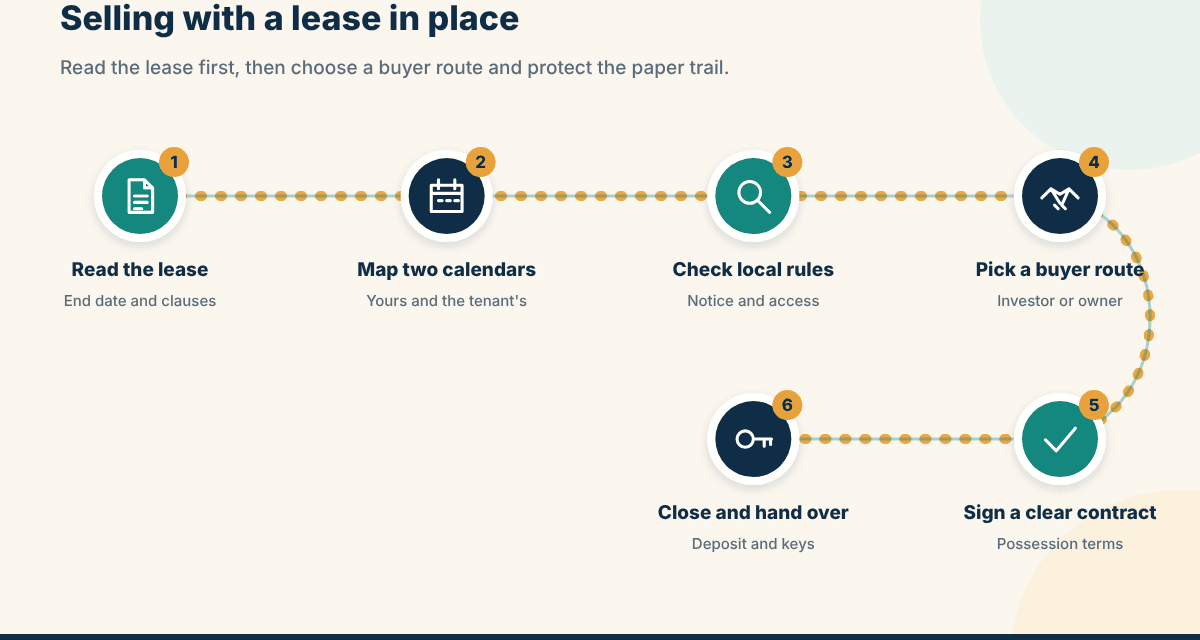
If you plan to sell rental property with lease terms still running, you are really choosing between two very different buyers: an investor who wants the tenant and the rent, and an owner-occupant who wants the keys and a clean, empty house. Those two buyers value the same building differently, move on different calendars and worry about different risks. The lease sits in the middle of that choice like a third party at the negotiating table.
Most landlords begin with a single question: can I list it now, or do I have to wait for the lease to end?
The honest answer is that it depends on the lease, on your state and sometimes your city, and on what kind of buyer you hope to attract. In plenty of places a lease keeps going after a sale and the new owner steps into the landlord’s shoes. In other places, local tenant protections or the lease wording change that picture. When you sell rental property with lease paperwork you have not reread in two years, surprises tend to show up at the worst moment, usually in the middle of an inspection period.
This guide on how to sell rental property with lease terms is part of our cluster on specialty property sales, and it sits beside our broader walkthrough of selling a condo, since many small rentals are condos or townhomes with their own association rules. Here we stay focused on the lease. We cover how to define your real goal, what facts can flip the decision, how an investor route compares with an owner-occupant route, and how to run a simple net-result test before you commit.
We stay neutral about agents, direct sales, cash buyers and every other route, because the right path belongs to your facts, not to a formula. Every dollar figure below is a round, labelled illustration. Anything that varies by state, county or contract is flagged so you know where to verify. None of this predicts your price or your closing date, and none of it is legal advice about your tenant.
Key takeaways
- The lease is a fact about the property, not a deal-breaker. It changes who your likely buyer is, how you schedule showings and when possession can happen, but it does not by itself stop you from selling.
- Investor buyers and owner-occupants are paid in different currencies. One values steady rent and a low-drama handover; the other values vacant possession and a house they can move into.
- Read the lease before you price or list. End date, renewal terms, rent, deposit, entry notice and any purchase-related clauses drive nearly every decision that follows.
- Compare routes by net result, not by headline price. Time, carrying costs, tenant-related concessions and contingency risk can outweigh a higher offer.
- Your tenant has rights that vary by state and city. Check local rules for notice, access and possession, and involve a qualified attorney before you ask a tenant to leave or sign anything new.
- Plan for the tax side early. Rental history can change how gain is treated, so ask a tax professional before you pick a closing date.
What you are really deciding when you sell rental property with lease terms in place
Before you call anyone, write down the decision in one plain sentence. For a landlord with a tenant under lease, that sentence usually sounds like this: “Do I sell with the tenant in place to someone who wants a rental, or do I time the sale around the tenant leaving for someone who wants to live here?” Everything else about how you sell rental property with lease terms in place hangs off that sentence, so it is worth getting it right.
Notice that the sentence has two moving parts, a buyer type and a possession date. You control some of both and none of the rest. You cannot decide who falls in love with the property, and you cannot unilaterally move a tenant’s rights. What you can do is choose which door to open first, gather the paperwork that makes either door easier, and avoid promises you cannot keep.
Landlords who sell rental property with lease terms in place often underestimate how much of the work is communication. The tenant needs to hear about the sale from you, in writing, before they hear it from a stranger at the door. The buyer needs accurate facts before they spend money on an inspection. Your agent or attorney needs the lease in hand before drafting anything. A calm, early, written approach makes almost every later step easier.
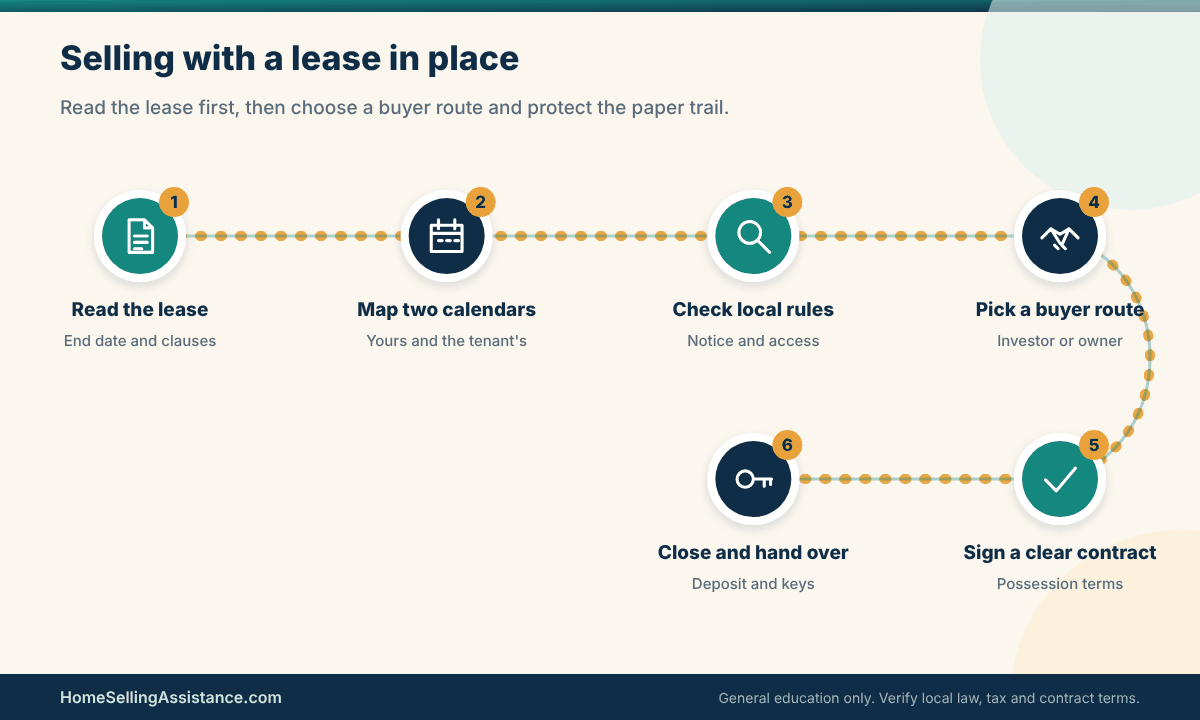
Goal, timeline, cash needs and the tenant’s calendar
Start with what you want from the sale. A plan to sell rental property with lease terms attached only makes sense once the goal is clear. Some landlords want the highest price and can wait a year. Others want out before the next capital expense, before a life change, or before a refinance resets. A landlord who needs cash in sixty days and a landlord who is happy to hold until the lease ends will rightly choose different ways to sell rental property with lease dates like these, even with identical houses.
Then lay the tenant’s calendar next to yours. The lease end date, any renewal window, the notice periods for either side and the rent due dates form a second timeline that you did not build but must live with. A good habit is to draw both timelines on one sheet of paper. Where they collide, you have a decision to make about how to sell rental property with lease dates that do not match your own.
There is a useful test for this stage. Imagine you hand a stranger a folder and ask them to explain, in five minutes, how you would sell rental property with lease terms like yours. If they cannot answer without calling you, the folder is incomplete. That is not a failure; it simply tells you which document to track down next, and that small habit saves a surprising amount of back and forth later.
Evidence to gather: the lease, the ledger and the payoff
Pull three things before anything else. First, the full signed lease with every addendum, including pet terms, parking or storage clauses and any renewal language. Second, a rent ledger showing what was actually paid and when, with the deposit amount and where it is held. Third, a current mortgage payoff quote if you have a loan, so you know the floor under your net proceeds.
Read the lease for dull but powerful details. Is it a fixed term or month to month? Does it say anything about a sale, such as a right of first refusal or a clause that ends the lease on transfer? Who handles repairs and how fast? What notice must you give before entering for a showing? You are not trying to become a tenant lawyer. You are trying to know what a buyer’s attorney will ask about on day two.
Finally, tally the carrying cost of waiting. Property taxes, insurance, maintenance reserves, any association dues and the mortgage interest keep running whether or not the tenant pays on time. A realistic monthly figure for what it costs you to hold the property is the number that makes “wait for the lease to end” a real option instead of a feeling. Our guide to home sale net proceeds shows how to turn those pieces into a bottom line before you sell rental property with lease income still coming in.
A scenario, an exception and your next step for the clock
Picture a landlord, call her Dana, with a twelve-month lease that has seven months left. She would like to be done before winter. If she lists now to an owner-occupant, she may face showing restrictions and a possession date seven months out, which many buyers cannot accept. If she markets to investors, the tenant staying put is a feature, not a flaw.
The exception is a tenant who wants to leave early, perhaps for a job or a new place. That changes the arithmetic, but any early departure should be agreed in writing and, where the amounts or terms are unusual, reviewed by an attorney so nobody believes a verbal “we will be out by spring.”
Your next step in a case like Dana’s, and in most plans to sell rental property with lease time left, is simple. Ask the tenant, politely and in writing, whether they have any plans, explain that the property may be sold, and learn the local notice rules before saying anything about moving out. Gathering information costs nothing and commits nobody.
Facts that could flip the decision
A few facts carry more weight than the rest. If your lease is below market rent, an investor may pay less and an owner-occupant may care little. If the lease is above market rent, the reverse can be true, since the income stream is part of what an investor buys. A month-to-month tenant gives you flexibility but gives an investor less comfort. A long lease with a reliable tenant can be the strongest selling point you have for the right buyer.
Local rules matter just as much when you sell rental property with lease protections in play. Some cities and states limit when or why a tenancy can be ended after a sale, and others leave more room. Because this is the part that most often changes the answer, treat it as a research task and not a guess.
It also helps to separate rules from habits. Rules come from statutes, ordinances and the signed lease. Habits come from how you and the tenant have behaved, such as accepting rent a few days late or agreeing to small repairs by text. Habits can matter, since a buyer will ask about them, but they do not replace the written terms. Keep the two apart when you describe the property to a buyer.
Evidence to check: state tenancy rules and the lease’s own clauses
Start with your state’s landlord-tenant statute and any local ordinance. Many state governments publish plain-language tenant and landlord handbooks, and local housing departments often explain notice periods and entry rules. Your state real estate commission can tell you what a licensee must disclose, and a landlord association or an attorney who handles tenancies can fill in local custom. You are looking for a short list of answers: how much notice is needed to enter, what happens to the lease on transfer, how the security deposit moves, and whether any sale-related tenant rights exist.
Then match those answers to your lease. Where the lease and the statute disagree, the statute often wins, but the details vary, so do not assume. If the lease contains a clause that looks like it addresses a sale, highlight it and ask an attorney what it means in your state before you list.
Also check any federal overlay that applies to the building itself. If the home was built before 1978, the EPA real estate lead disclosure rules apply to a sale, and you will want to tell your agent or attorney early so the paperwork is ready. For general disclosure questions, our overview of seller disclosure requirements explains how the layers fit together.
Scenario: the lease nobody remembered renewing
A surprisingly common wrinkle is the lease that quietly rolled over. Suppose the original one-year lease ended last spring, nobody signed a new one, and the tenant has been paying the same rent month to month ever since. Depending on your state, that may now be a periodic tenancy with its own notice rules, which can be shorter or longer than you expect.
The exception here runs both ways. A month-to-month status can make an owner-occupant timeline easier, since fewer months are locked in. It can also make an investor nervous, because the income can end with short notice. Neither reading is automatically right.
The next step is to find out what your lease actually says about holdover and renewal, confirm the tenancy type with your attorney or state resource, and then decide which buyer story is more honest. Whatever you decide, put the current terms in writing and give the buyer the same facts you rely on.
Two realistic ways to sell rental property with lease terms: the investor and the owner-occupant
With the goal and the facts on the table, you can compare the two main paths. In practice they are not pure opposites. Some owner-occupant buyers will accept a delayed move-in, and some investors want the building empty so they can renovate or re-rent at a new rate. Still, the two buyer types start from different assumptions, and starting from the right one saves weeks.
The table below is a working matrix, not a verdict. It reflects the usual patterns when owners sell rental property with lease terms in place. Use it to see where each path tends to be strong or weak when you sell rental property with lease obligations attached, then replace the generic cells with your own numbers and dates. The right-hand column tells you what to check before you trust the row.
| Factor | Option A: investor, tenant stays | Option B: owner-occupant, vacant | What to verify |
|---|---|---|---|
| Price and net proceeds | Value tied to rent and lease quality | Value tied to comparable owner-occupied sales | Local comps, rent level, your payoff |
| Time to close | Often follows a normal contract timeline | May wait for lease end or tenant move-out | Lease end date, state notice rules |
| Contingencies | Lease review, rent verification, inspection access | Financing, inspection, vacant-possession clause | Contract wording and buyer loan type |
| Seller workload | Tenant coordination, document package | Tenant exit, cleaning, repairs, staging | Who handles access and turnover |
| Execution risk | Tenant cooperation, payment history | Delayed move-out, damage, lost buyer | Written tenant agreements, deposit status |
| Carrying cost while waiting | Rent usually continues to arrive | Possible vacancy or gap in rent | Monthly holding cost versus rent |
Read the table across, not down, whenever you sell rental property with lease choices to weigh. A path that wins on price might lose on time, and a path that wins on time might cost you through vacancy. The goal is to know which column matters most to you before an offer arrives, because offers have a way of making every column look tempting at once.
One more point before the routes. People who sell rental property with lease agreements in place sometimes treat the investor path as the fallback and the owner-occupant path as the prize. That framing is not always fair. Depending on your market and the lease, the investor route can be the cleaner, faster and more certain one, and the owner-occupant route can be the one with the hidden costs. Judge each on its own facts.

Route one: sell to an investor with the tenant in place
Choosing this route to sell rental property with lease income intact means you are selling a small income-producing asset as much as a house. The buyer cares about the rent, the lease term, the tenant’s payment record, the condition of the systems and what it will cost to keep the property rented. They may also care about financing rules for non-owner-occupied purchases, which differ by lender and loan type.
The investor route can be quick and calm when the paperwork is tidy. It can be slow and tense when the lease is vague or the tenant is anxious. Because the tenant lives there, your showing plan matters more than it does for an empty house. We cover the vacant side of this in our companion piece on selling a vacant house, and the occupied side in selling a tenant-occupied house. If your building has several units, our guide to selling a multifamily property adds more context.
If you choose the investor route, think like a buyer for a moment. A buyer who plans to keep the tenant wants proof that the rent is real, that the tenant pays reliably and that nothing is hidden in the lease. The more clearly you can sell rental property with lease facts laid out, the less a cautious investor will need to discount for uncertainty. Clear facts are not a negotiation tactic. They are simply good manners with money attached.
Evidence for the investor route: rent roll, ledger and tenant statement
An investor will usually want a short package. It typically includes the signed lease, the payment ledger, the security deposit amount and location, a list of recent repairs and the utilities arrangement. Some buyers also ask the tenant to confirm the lease terms in a short signed statement, sometimes called an estoppel certificate or tenant acknowledgment. Whether you request one, and what the form says, is something to settle with your agent or attorney, because customs differ across states and property types.
Be careful about two things. Do not hand over anything you have not checked for accuracy, since a wrong rent figure can become a dispute later. And do not share more of the tenant’s personal information than necessary. A ledger with names, amounts and dates is normally enough; private details unrelated to the lease are not.
It also helps to know how the investor will model the numbers. Many will look at rent against price, at the age of the roof and heating system, and at how long the current tenant is likely to stay. You do not have to do their math, but you can give them clean inputs. A buyer who trusts your paperwork is a buyer who closes with fewer renegotiations.
Scenario, exception and next step for the investor path
To make this concrete, imagine a landlord named Marcus with a reliable tenant on a lease that runs fourteen more months. He lists the house with a note that the tenant will stay, and he allows showings at set times with proper notice. An investor offers a price close to what he expected and asks for the lease package and a short inspection window.
The exception is a tenant who will not allow showings or who is behind on rent. Then the investor path gets harder, because the buyer cannot see the house or is buying a collection problem. Marcus’s next step in that situation is to talk with his attorney about proper notice and access, not to push the tenant informally.
If things go smoothly, the contract may simply say the buyer takes the property subject to the existing lease. Marcus should still confirm how the deposit transfers and how rent due near closing will be prorated, since both are usually spelled out in the contract or in state rules. Our explainer on comparing an investor offer with listing the house goes deeper on the trade-offs of that buyer type.
Route two: sell to an owner-occupant on a vacant-possession timeline
Owner-occupants are buying a home, not an income stream, so a plan to sell rental property with lease time left needs extra care for them. They want to move in on a known date, they often use a mortgage, and many need the property to look and feel like a home. For them, a tenant’s belongings and a possession date they cannot control are real problems. The upside is a broader buyer pool and, in many markets, a stronger price signal from comparable owner-occupied sales.
The challenge is the calendar, and it is the main reason some sellers sell rental property with lease end dates in mind rather than listing at once. A lease that ends in four months asks the buyer either to wait or to find somewhere else. Some buyers will, particularly if a rent-back or delayed closing is on the table, but you should not assume it. A cleaner approach is to line up the lease end with your listing date so that a buyer sees a house that will be available on a believable day.
The owner-occupant route rewards patience and planning. A landlord who can sell rental property with lease dates lined up to the listing date gives buyers a believable story: the house will be empty on this day, in this condition. A landlord who lists first and sorts out the date later forces buyers to guess, and guessing buyers either offer less or walk away to a house with fewer question marks.
Evidence for the owner-occupant route: dates, access and condition
Here the evidence is about timing and condition. You want the exact lease end date, written proof of whether the tenant plans to renew or leave, and a plan for turnover: who cleans, who repairs, and who checks for damage that a lender’s appraiser or a buyer’s inspector might flag. A house that looks tired on photo day will invite a lower offer, regardless of who owns it.
If the tenant is cooperating, ask whether they will allow photos and a limited number of showings with notice. Some tenants are happy to help, especially if they are leaving anyway. Where the tenant is unwilling, you may have to wait for the lease to end before marketing the interior, which is a perfectly reasonable choice.
Keep fair housing in mind throughout. How you schedule showings and treat the tenant should not depend on anything about who they are. The HUD fair housing resources explain the basics, and our piece on fair housing for home sellers turns them into everyday habits.
Scenario, exception and next step for the owner-occupant path
Take a landlord named Priya, who decides to sell rental property with lease end three months away, and whose tenant has said they will move out when the lease ends in three months. She decides to prepare the house, schedule photos for after move-out, and list with a possession date a few weeks later. Buyers see an empty, clean house and can move in on a known date.
The exception is the tenant who decides to stay or asks for more time. In many places a tenant has rights that do not disappear because you want to sell, so Priya cannot assume the date. Her next step is to keep communication written, to confirm the tenant’s plans a few weeks before listing and again before accepting an offer, and to ask her attorney how the contract should handle a late move-out.
One practical safeguard is to avoid promising a possession date you do not control. A contract with a realistic window and a clear plan for what happens if the tenant is late is far better than a tight date that turns into a default. For the flexibility side of the calendar, our guide on offering a flexible closing date shows how sellers build room into the contract, and our category on condos, HOAs and specialty property sales collects related guides.
A net-result rule to sell rental property with lease terms and avoid regret
Headline offers are easy to compare and usually misleading when you sell rental property with lease terms in place. A better habit is to turn each offer into a rough net result: what lands in your account after the payoff, the costs, the credits you may have to give, and the months you carry the property. Then place a modest value on risk. You do not need a spreadsheet wizard’s precision. You need the same yardstick for each path so that the comparison is fair.
Here is the rule in plain words, for anyone who needs to sell rental property with lease terms and compare offers fairly. For each route, estimate the price you could reasonably expect, subtract the costs of selling and the cost of waiting, add any rent you will collect while you wait, and then ask how likely it is that the plan goes sideways and what that would cost. The route with the better net result and an acceptable downside is usually the right one, even when its headline price is lower.
People who sell rental property with lease complications sometimes feel they must find the single best strategy. That is rarely how it works. You are looking for a good enough route with an acceptable downside, chosen with eyes open. A decision rule helps because it replaces a vague worry with a short list of numbers and dates you can discuss with your agent, attorney and tax professional.
Price, time, cost and risk on one page
Put four lines on one page for each route: price, time, cost, risk. Under price, write the range you honestly think a buyer of that type would pay, using comparable sales for owner-occupant buyers and rent-based reasoning for investors. Under time, count the months from today to cash in hand. Under cost, list selling costs, repairs, turnover and holding costs. Under risk, write the one or two things most likely to go wrong and what each would cost in time or money.
This page will not be perfect. It will, however, make trade-offs visible. A route that looks ten thousand dollars better on price may turn out to cost six months of carrying expense, and a route that looks slower may include rent that offsets most of the wait. When you see it side by side, the choice often becomes obvious.
Evidence for the framework: build a rough net from real quotes
Use real numbers wherever you can when you sell rental property with lease income in the picture. Ask your lender for a payoff quote. Ask your agent, a title company or an attorney for a rough estimate of closing costs in your area. Check your lease for the rent and deposit. Look up your tax bill and insurance premium. Then sketch the picture, as in the illustration below, where the sale price steps down through the deductions that typically sit between a contract and your final proceeds.
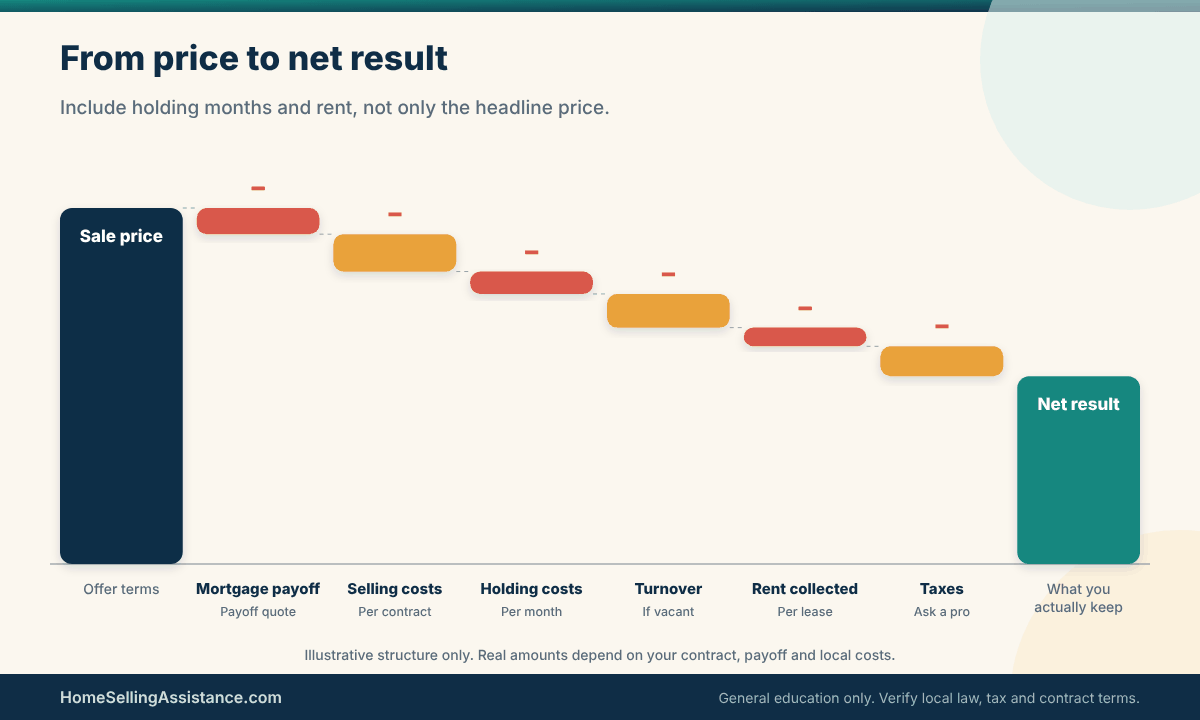
Here is a deliberately round, illustrative example, not a forecast. Suppose a house could sell for 300,000 dollars to an owner-occupant after the tenant leaves in five months, or for 288,000 dollars to an investor now with the tenant staying. Suppose selling costs are the same in both cases and the mortgage payoff is identical. Suppose holding costs are 1,800 dollars a month and, during the wait, rent of 1,900 dollars a month is collected for four of the five months and the fifth is vacant.
Under those made-up numbers, the owner-occupant route carries about 9,000 dollars of holding cost over five months and collects about 7,600 dollars of rent, so the wait costs a net of roughly 1,400 dollars before any turnover or repair cost. The 12,000 dollar price gap would then look attractive unless turnover, cleaning and a possible vacancy erode it. If turnover and a late move-out add several thousand dollars, the gap narrows. Change any of those inputs and the answer shifts, which is exactly why you should run your own.
Remember what the example leaves out. Taxes on the gain, depreciation you may have claimed, the cost of a delayed closing if the buyer’s rate lock expires, and the chance that the better offer never arrives are all real. The point is to learn the method, not to borrow the figures. For the tax side, see our guide on taxes when selling a former rental home and the IRS’s Publication 527 on residential rental property.
Scenario: when the higher offer is not the better one
Consider Elena, who gets two offers. One is higher but depends on the tenant being gone by a date that the lease does not support. The other is lower, accepts the tenant in place and closes on a normal schedule. If Elena values certainty and the date in the first offer is a coin flip, the lower offer may carry the better net result once risk is priced in.
The exception is that some higher offers include a flexible possession date or a rent-back that handles the gap. Read the terms, not just the number, and ask your agent or attorney how each clause would work if the tenant is late.
Her next step as she decides how to sell rental property with lease strings attached is to write a one-page comparison with the four lines, send it to her professional, and ask one question: which line am I most likely underestimating? Honest answers to that question usually come quickly. Our guide to home sale contingencies helps you read the clauses that sit behind each number.
When new evidence should change the plan
A plan made in week one to sell rental property with lease terms is a draft. New information arrives constantly: the tenant gives notice, an inspection finds something, a buyer’s lender wants a different document, or the market moves. The skill is not predicting these events but agreeing with yourself in advance on what would make you switch routes. Without that agreement, sellers tend to stay with a plan out of habit long after the facts have moved on.
Pick three or four triggers and write them down before you sell rental property with lease dates that could move. Examples include a tenant’s written notice of departure, a missed rent payment that turns into a pattern, an offer that explicitly depends on vacant possession, or a buyer’s financing that falls through. For each trigger, decide in advance what you will check and who you will call. A short list of triggers is more useful than a long strategy memo.
The table below shows how several common situations that arise when you sell rental property with lease terms tend to point toward one route or another, along with the trade-off and the fact that could change the call. Treat it as a way to sanity-check your thinking and not as a rule you must obey. Your state, your lease and your goals can all override a generic pattern.
| Situation | Route often favored | Reason | Trade-off | Fact that changes it |
|---|---|---|---|---|
| Long lease, reliable tenant | Investor, tenant stays | Income is the product | Smaller buyer pool | Rent far below market |
| Lease ends within a few months | Owner-occupant after move-out | Vacant date is believable | Turnover and vacancy cost | Tenant wants to renew |
| Month-to-month tenancy | Either, depending on goal | Flexible but less income security | Short notice both ways | Local notice rules |
| Tenant is cooperative and leaving | Owner-occupant | Showings and photos are easier | Timing depends on tenant | Written move-out date |
| Tenant is behind on rent | Investor, or fix first | Owner-occupants dislike the unknown | Buyer may discount for risk | Legal status of the arrears |
| Seller needs cash quickly | Investor or cash buyer | Fewer timing dependencies | Price may be lower | Proof of funds and terms |
| Property needs major repairs | Investor, as-is | Investors price in repair cost | Discount for condition | Inspection findings |
Use the table to sell rental property with lease choices in mind: find the row closest to your situation, reading across to the trade-off, and then checking the last column against your own facts. If the last column describes you, treat the row as a weak signal and look harder at the alternative. If your situation matches two rows, pick the one that points toward the route with more certainty, then test it against your net-result page.
Revisit the plan on a schedule, not only when something breaks. A short check every couple of weeks is plenty: has the tenant said anything new, has the market feedback changed, has a deadline moved? Landlords who sell rental property with lease terms still running tend to do best when they keep one running note of dates, promises and documents, because memory is a poor record when three different people are asking questions.
Evidence to watch: the signals that deserve a second look
Some signals deserve immediate attention. A tenant who says they are leaving should put it in writing, with a date, so you are not planning around a conversation. A buyer who asks for a short extension should explain why, and you should check whether the extension fits the tenant’s actual rights. An inspection that finds something serious may change both price and buyer pool, so consider whether the new facts favor an as-is investor offer.
Market signals count as well. If showings slow and feedback keeps mentioning the tenant’s belongings or the date, the owner-occupant route may not be working. If investors keep asking for rent verification and you have not provided it, you may be losing offers because of missing paperwork rather than price. Our overview of cash offers for a house and the guide on verifying a cash home buyer help you test unfamiliar offers before you rely on them.
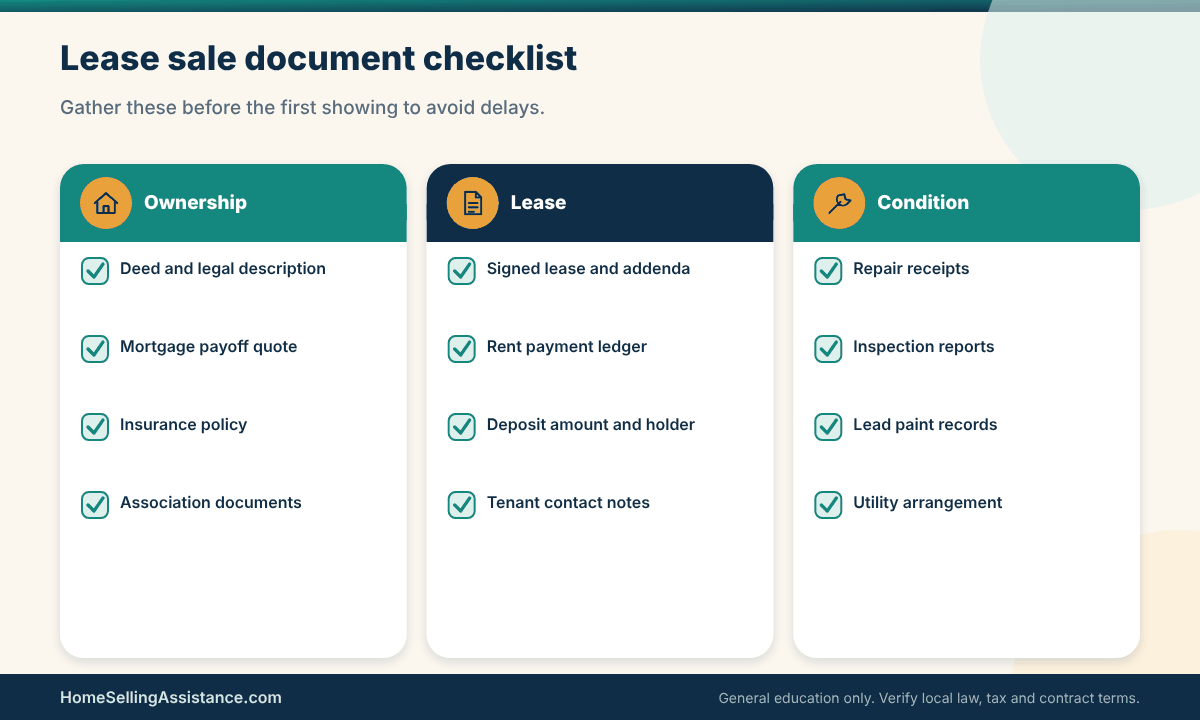
A simple checklist can keep the paperwork side from becoming a source of delay when you sell rental property with lease records to share. The illustration above groups the documents most buyers ask for into ownership, lease and money, and condition. Ticking those boxes early often matters more than any single negotiation tactic, since a prepared seller can answer questions the same day and keep momentum.
New evidence is not always bad news. A tenant who offers to extend the lease, a buyer who loosens a date, or a repair that turns out cheaper than feared can all improve your options. The discipline is the same either way: write the new fact down, update your page, and ask whether the other route now looks better. Sellers who sell rental property with lease flexibility built in tend to handle these changes with less stress.
Scenario: the tenant gives notice in the middle of a contract
Suppose you are under contract with an investor who expects the tenant to stay, and the tenant gives notice that they will leave in six weeks. For the investor, that may be a problem or an opportunity. Some will want to renegotiate, some will want to re-rent at a new price, and some will happily proceed.
The exception is a contract that says nothing about this possibility. Then you are in a conversation, not a clause. Your next step is to tell your agent or attorney immediately, share the notice with the buyer in a timely way, and avoid any private deal with the tenant that the contract or local law may not allow.
A good rule of thumb is that surprises shared early are cheaper than surprises discovered by the buyer. If the plan changes, update your net-result page with the new facts and see whether the other route now looks better. That might mean pivoting to an owner-occupant buyer, or it might mean staying the course with a modest concession. Our guide on rent-back agreements covers one tool sellers sometimes use to bridge a gap.
Quick scenario
A landlord has a tenant with five months left and two offers: an investor at a modest discount with a normal closing, and an owner-occupant at a higher price that needs the house empty on a date the lease does not guarantee. After running the four-line page, the landlord sees that the higher offer’s real value depends on one fact, whether the tenant will leave on time. A written, dated move-out from the tenant would strengthen the owner-occupant route; without it, the investor offer is the steadier choice.

The last illustration maps a fallback plan for the most stressful situation, a tenant who will not cooperate with showings or timing. It is not legal advice, and the steps you take must follow your lease and local law. Its purpose is to remind you that you have options other than pressure: wait for the lease to end, sell to an investor with the tenant in place, or involve an attorney for formal steps.
Frequently asked questions about sell rental property with lease
Can I sell rental property with lease terms still running, or do I have to wait?
In many places you can list and sell while a lease is in effect, and the buyer takes the property subject to that lease. Some states or cities add rules about notice, access or tenant protections after a sale, and your own lease may contain wording that matters. Check your state landlord-tenant rules and have an attorney read the lease if anything looks unusual.
Waiting is a choice, not a legal requirement in most situations, so you can sell rental property with lease time left if the numbers support it.
Does the tenant have to leave when I sell?
Not automatically. Whether a tenancy continues after a sale depends on the lease, the type of tenancy and local law, so this is a question for a qualified attorney or a state housing resource. If a buyer wants the property empty, that is a negotiation with the tenant and a matter for the contract, and any request should follow local notice rules. Never promise a buyer a vacant property when you sell rental property with lease rights attached, unless you have a lawful way to deliver it.
Who is the best buyer if I sell rental property with lease obligations attached?
There is no universal best buyer. Investors tend to value a reliable tenant and steady rent, while owner-occupants tend to value vacant possession and a clear move-in date. The better fit depends on your timeline, the lease end date, the condition of the property and how much risk you want to carry. Comparing a rough net result for each route is more useful than guessing.
Can I show the house to buyers while a tenant lives there?
Usually yes, but you must follow the entry notice rules in your lease and your state or city law, which vary. Give written notice, schedule at reasonable times and keep the number of visits manageable. Tenants who feel respected often cooperate, and some landlords offer a small thank-you for the inconvenience, which is worth discussing with an attorney if the amount is meaningful.
What happens to the security deposit when I sell?
Rules vary by state, and the contract and lease usually spell out the details. In many places the deposit must be transferred to the buyer or accounted for at closing, and the landlord remains responsible if it is mishandled. Ask your title company, agent or attorney how deposits are shown on the settlement statement and keep a written record of the amount and where it is held.
Will a tenant in place lower my price?
It can in some cases and raise it in others when you sell rental property with lease income attached. An owner-occupant may offer less for a house that cannot be moved into soon, while an investor may pay more for a lease with strong rent and a good payment history. Local comparable sales and the quality of the lease both matter. Do not rely on a general percentage; ask for an opinion based on your market and your lease.
How does selling a rental affect my taxes?
Rental history can change how gain is treated when you sell rental property with lease income behind you, including whether the home-sale exclusion applies in full, in part or not at all, and how depreciation is handled. The rules depend on your ownership and use history, so talk with a tax professional. The IRS explains the basics in Publication 523, and our article on the home sale capital gains exclusion explains the general exclusion rules.
Should I ask my tenant to leave early so I can sell?
You may, but the request should be voluntary, written and consistent with local law, and you should consider an attorney’s review before offering money or other terms. Pressure can create legal exposure and ill will that spills into showings. A clear, polite conversation about timing, with a dated agreement if the tenant agrees, is far safer than informal arrangements.
What documents will a buyer ask for if I sell rental property with lease paperwork in place?
Expect requests for the signed lease and addenda, a rent ledger, the deposit amount and location, recent repair records, utility arrangements and sometimes a tenant statement confirming the terms. Investors often ask for more than owner-occupants. Gathering these early keeps the contract moving and shows that you know how to sell rental property with lease records organized and shows that your information is reliable.
Could a buyer’s financing be a problem when the house is rented?
It can be. Lenders treat owner-occupied and investment purchases differently, and some loan programs have occupancy rules that interact with a tenant in place. Ask any buyer to share a pre-approval and confirm that the loan fits the planned use, and check the details with your agent or attorney. A buyer whose financing assumes vacant possession may not fit a lease that runs for months.
Choose the route, then protect the paper trail
To sell rental property with lease terms in place, pick the buyer story that matches your goal, check the lease and local rules, and compare routes by net result instead of headline price. Keep tenant communication written and respectful, and revisit your plan when new facts arrive. This article is general education, not legal, tax or financial advice, so confirm your situation with a qualified local attorney, tax professional and the official sources linked above.