Understanding CMA vs appraisal saves sellers from a surprisingly common mistake: treating two very different documents as if they were the same number wearing different clothes, and then feeling blindsided when they disagree.
A comparative market analysis, usually shortened to CMA, is an opinion of what your home could reasonably sell for, prepared by a real estate professional to help you choose a list price. An appraisal is a formal valuation, prepared by a state-licensed or certified appraiser, that usually exists because a lender wants to know whether the property supports the loan a buyer is requesting. One helps you sell. The other helps somebody else decide whether to lend.
That difference in audience explains almost everything else. A CMA can be quick, friendly and a little optimistic, because its job is to start a pricing conversation. An appraisal is slower, more standardized and written to be read by an underwriter, so it tends to be cautious. When the two numbers land far apart, neither one is automatically wrong. They were answering different questions for different readers, using the same pool of nearby sales.
This guide explains what each tool is, how each one is produced, what each costs you in time and control, and where each one tends to go wrong. You will also find a decision table, a scenario table and a set of questions to ask before you lean on either document. It sits inside our wider pricing library, so if you want the full pricing process, start with our guide on how to price a house to sell and come back here for this specific comparison.
Key takeaways
- They answer different questions. A CMA estimates a sensible list price for a seller; an appraisal estimates market value for a lender or another formal purpose.
- Neither is a guarantee. A CMA does not promise what buyers will pay, and an appraisal does not promise a contract will close at that figure.
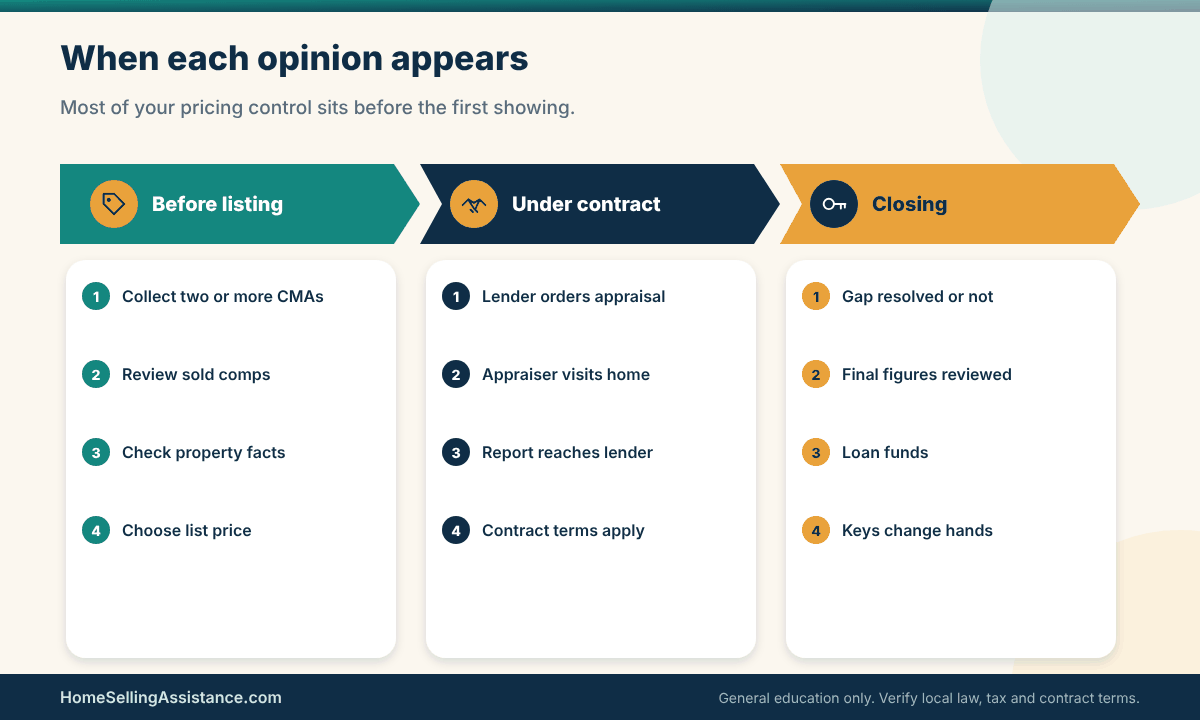
- Timing matters more than most sellers expect. A CMA belongs before you list. An appraisal usually arrives after you already have a buyer, when your leverage to change course is smaller.
- The same comps can tell two stories. Differences in adjustments, condition notes and market timing explain most gaps between a CMA and an appraisal.
- Your contract decides who carries the risk. Appraisal and financing language determines whether a low value is a renegotiation, a delay or a cancellation.
- There is no universal winner. Ordinary pricing usually calls for a CMA. Estates, divorces and disputes may call for an independent appraisal, sometimes both.
Before the detail, one note on tone. Nothing here is meant to push you toward or away from hiring an agent, paying for an independent appraisal or skipping either one. Both tools have honest uses and honest limits, and a seller who understands both is in a much stronger spot than one who relies on whichever number arrived first. Whichever side of the CMA vs appraisal question you land on, the goal is a decision you can explain.

CMA vs appraisal starts with two different questions
Before comparing speed, cost or accuracy, it helps to be precise about the question each document is trying to answer. A CMA asks, “At what price are buyers in this neighborhood likely to respond right now?” An appraisal asks, “What is the market value of this property as of a specific date, supported by evidence a lender can rely on?” Those sound similar. In practice they produce different habits, different formats and sometimes different numbers. Keeping the CMA vs appraisal distinction clear from the start prevents most later confusion.
Think of the CMA as a pricing tool and the appraisal as a risk tool. Pricing tools can lean on current activity, such as homes that just went under contract or sit unsold at a price that is clearly too high. Risk tools lean on closed sales, because a closed sale is a documented fact rather than a hope. That single design choice, how much weight goes to pending and active listings, explains many of the gaps sellers notice. That is the simplest mental model for CMA vs appraisal.
The two sections below take each tool in turn, starting with the CMA because it is the one you will meet first. Each section covers where the work comes from, what you should expect to see on paper, and one scenario that shows how things play out when a seller uses the tool for the wrong job.
What a comparative market analysis is built to tell you
A CMA is normally prepared by a listing agent or broker, often at no charge before you sign anything, and it is usually assembled from your local multiple listing service. It selects homes that resemble yours, sorts them into sold, pending and active groups, and uses the pattern to propose a price range. In many offices it also includes a suggested strategy, such as pricing at the top of the range to leave negotiating room or slightly below it to invite competing offers.
Because a CMA is a professional opinion and not a regulated valuation, its quality depends heavily on the person preparing it. A careful one explains why each comparable was chosen and what was adjusted. A thin one is a printout of nearby sales with a number circled at the bottom. You are entitled to ask which kind you are holding, and a good professional will welcome the question. Knowing that is central to CMA vs appraisal literacy.
Evidence to gather: the comps, the adjustments, and the story behind them
Start by asking for the actual comparable sales, not just the conclusion. For each one, you want the address, the closing date, the sale price, the size, the bedroom and bathroom count, the lot, the condition, and any seller help that was part of the deal. Seller credits matter because a home that sold for a stated price with a large credit to the buyer effectively sold for less than the headline figure.
Next, ask how the comps were chosen. Sales in the same subdivision, with similar age and style, closed in the last few months, generally tell a stronger story than a larger or newer home half a mile away. If the comps are older, ask why. In a slow area there may be nothing recent, and that is a legitimate answer. In a busy area, stale comps are a warning sign. A quick comps check is the first practical step in any CMA vs appraisal comparison.
Finally, ask what adjustments were made. A feature your home lacks, such as a garage or a finished basement, should move the comparable’s price in your favor or against it. Our deeper guide on how to adjust comps for home value walks through the logic. If nobody can explain how a garage was valued, treat the final range as a starting point and not a verdict.
A scenario, an exception, and your next step for CMA users
Picture a seller, call her Dana, who interviews three agents. One suggests a list price well above the other two. Dana is tempted, because a higher number feels like more money. Instead she asks each agent for the sold comparables behind the number. The high one rests on a single unusually strong sale and two active listings that have not sold. The two lower ones rest on five closed sales each, with consistent adjustments. The higher number was not dishonest, but it was less supported.
The exception is a truly unusual property, such as a home on acreage, a historic house or a custom build with few true matches. There, even a careful CMA is closer to educated judgment than arithmetic, and a second opinion or an appraisal can be worth the cost. Your next step is simple: collect at least two written CMAs, line up the comps side by side, and mark where they agree before you look at where they differ.
If you want a broader starting point before any professional visits, our article on how much your house is worth covers the free and low-cost ways sellers form a first estimate, and why automated online figures should be treated as a conversation starter and nothing more. A realistic first estimate makes the CMA vs appraisal conversation far less intimidating.
What an appraisal is built to tell a lender
An appraisal is a written valuation prepared by an appraiser who holds a state license or certification, and it follows professional standards that govern how evidence is gathered and reported. In a typical home sale with a mortgage, the lender, not the buyer or the seller, arranges it, often through an intermediary meant to keep the process independent from the people who benefit from a high number. Who pays is usually the buyer through loan costs, though your contract and loan type control the details.
The appraiser visits the property, measures and photographs it, notes its condition and updates, studies recent closed sales nearby, and reconciles those sales into an opinion of market value as of a specific date. The report is then delivered to the lender, who uses it to decide how much it is willing to lend against the property. Sellers are often not the primary recipients, and may need to ask the agents involved how to see the result.
Evidence to gather: the report, the comparable sales and the condition notes
If an appraisal exists for your home, whether ordered by a lender for your buyer or hired privately by you, read the whole report and not just the final value. The sales comparison section lists the closed sales the appraiser relied on, with adjustments shown in dollars. Compare those sales to the ones in your CMA. Overlap is reassuring. A completely different set deserves a polite question about why. Reading it closely turns a CMA vs appraisal disagreement into specific, answerable questions.
Look next at the condition and quality ratings, and at the notes on updates. An appraiser who rates a kitchen as dated, when your agent described it as refreshed, is telling you something about how comparable homes were rated. Also check the basic facts. Wrong square footage, a missing bathroom or an unrecorded addition can quietly pull a value down, and facts are the easiest thing to correct.
Finally, note the effective date and the intended use. An appraisal prepared for a specific buyer’s loan is written for that lender and that transaction. It is not automatically a marketing document you can hand to the next buyer, and different lenders have their own rules about reusing or transferring reports. Ask rather than assume. This detail often gets overlooked in CMA vs appraisal discussions.
A scenario, an exception, and your next step for appraisal timing
Imagine a seller, Marcus, who accepts an offer at a price his CMA supported. Two weeks later the buyer’s lender-ordered appraisal arrives below the contract price. Marcus had assumed the appraisal was a formality, so he now has a decision to make under time pressure, with the buyer’s financing on the line. That is the typical pattern: the appraisal arrives after the deal is made, not before.
The exception is the private, seller-ordered appraisal, sometimes called a pre-listing appraisal. It shifts the timing earlier, but it costs money and may not be accepted by a buyer’s lender. We cover whether that trade is worthwhile in our guide to a pre-listing appraisal. Your next step is to read your own contract’s appraisal language today, while nothing is urgent, so you know what a low value would trigger before it happens.
For sellers who want a quick vocabulary check, it also helps to separate three terms that people use loosely: list price, market value and appraised value. Our article on list price vs market value vs appraised value keeps those straight so the next conversation with a buyer or lender makes more sense.
Comparing CMA vs appraisal on money, time and control
Once you know what each document is for, the practical comparison gets easier. Sellers care about four things: how much they keep, how long it takes, how much say they have, and how much can go wrong. A CMA and an appraisal touch those four things at different moments in the sale, which is why the same seller can love one and dread the other. Looking at CMA vs appraisal through these four lenses keeps the comparison practical.
The short version is that a CMA is something you use, while an appraisal is something that happens to your sale. You can shop for a CMA, request a second one, argue with it and ignore it. An appraisal ordered by a buyer’s lender is largely outside your control, and its effect on your contract depends on what you already agreed to in writing. That asymmetry is the heart of the comparison. That asymmetry is the heart of the CMA vs appraisal comparison.
The table below puts the two side by side across the factors that move a seller’s decision. Read it as a general pattern, not a rulebook, because contracts, loan types and local practice change the details.
| Factor | CMA | Appraisal | Where it hurts or helps |
|---|---|---|---|
| Price and net proceeds | Guides list price; no effect on closing price by itself | Can cap the loan amount a buyer can use | A weak CMA misprices; a low appraisal reopens the deal |
| Time | Often within days of a request | Typically weeks from order to report | Appraisal delay can push closing dates |
| Contingencies | None attached | Often tied to an appraisal contingency | Contract wording sets your options |
| Control | High: you can seek several | Low when the lender orders it | You can still supply facts and recent comps |
| Workload | Light: meetings and review | Prep, access and a possible follow-up | Clean documents shorten the process |
| Execution risk | Overpricing or underpricing | Low value, delay or renegotiation | Plan the fallback before you list |
To use the matrix, circle the row that worries you most and read across. If your biggest concern is leaving money on the table, the CMA row matters most, because pricing happens there. If your biggest concern is a deal falling apart late, the contingency and execution rows matter most, and your attention belongs on the contract, not the opinion of value. The CMA vs appraisal matrix is a prompt for questions, not a verdict.
How each tool touches your price, net proceeds, schedule and workload
Your price, your net proceeds, your schedule and your workload are all connected, and a valuation tool nudges each of them. A list price based on a thin CMA can mean weeks of showings with no offers, followed by reductions that signal weakness. A list price based on solid closed comps may attract offers sooner and from a wider pool of buyers. The CMA shapes the front half of the sale. Seen this way, CMA vs appraisal is really about timing.
An appraisal shapes the back half. Even a well-priced home can come in below contract price if the appraiser weighs closed sales differently than the agents did, or if the market is moving quickly and the best comps are a few weeks stale. The risk is not that the appraiser is hostile. It is that the appraiser is required to support the number with evidence a lender can verify.
Numbers to run before you rely on either one
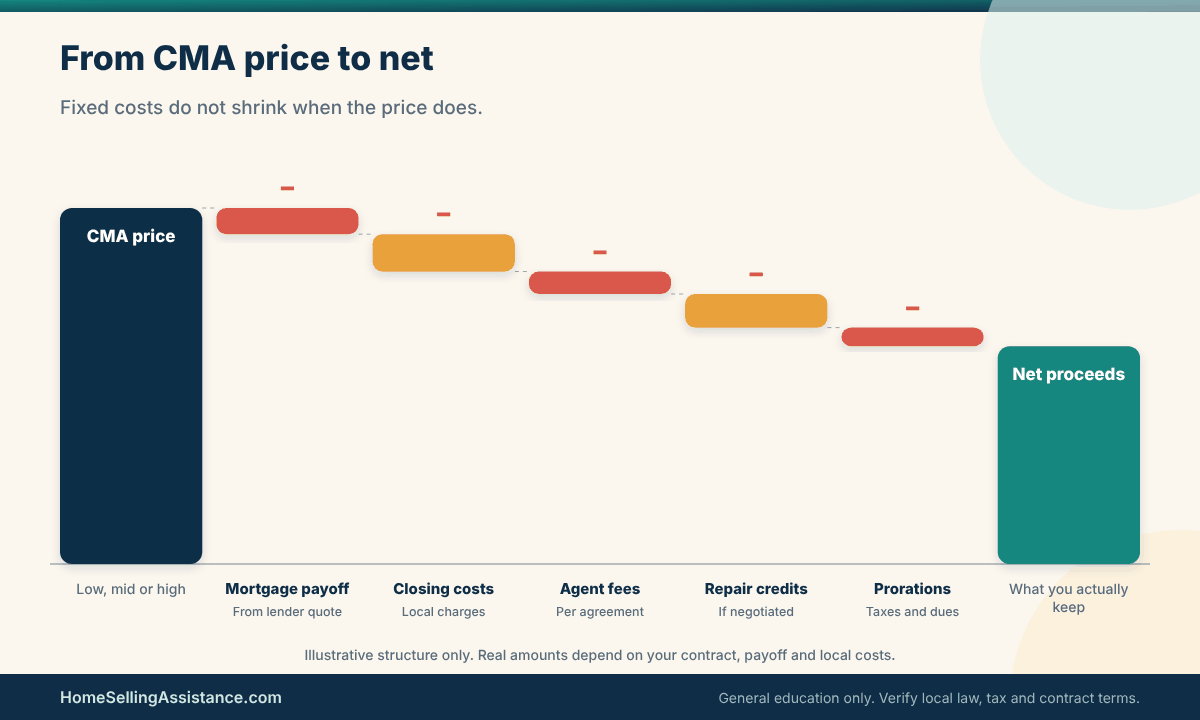
Run your net proceeds at three prices instead of one: the CMA’s low end, its midpoint and its high end. Subtract your mortgage payoff, estimated closing costs, any agent compensation you have agreed to, expected repair credits, prorations and any taxes that might apply. Our guide to home sale net proceeds shows how to build that worksheet. The goal is to see how much a price change really changes your take-home, since fixed costs do not shrink when the price does. This is where CMA vs appraisal stops being abstract and becomes a money question.
Here is an illustrative example using round numbers only. Suppose a CMA suggests a range from $380,000 to $400,000, and your payoff is $220,000. If costs and credits total $30,000 at either end, your estimated net swings from roughly $130,000 to $150,000. A $20,000 pricing gap becomes a $20,000 net gap because those costs stayed the same. That arithmetic is why the CMA deserves care.
Then run the appraisal what-if. If the buyer’s appraisal came in $10,000 under the contract price, what would you do? Would you lower the price, split the difference, ask the buyer to cover the gap, or relist? Deciding in advance, with real net figures in front of you, keeps you from making a rushed call in the middle of a closing countdown. Few steps in the CMA vs appraisal process are as valuable as this one.
A scenario where the cheaper opinion cost more
A seller, call him Luis, picked the agent whose CMA gave the highest number, partly because the agent was friendly and partly because the number felt good. The home sat for weeks. Showings dwindled. Eventually a price cut followed, then another, and the final sale landed below where a more modest first price would likely have attracted offers. Nothing illegal happened. The free opinion simply cost him time, and time cost him leverage.
The opposite mistake exists too. A seller who prices well below a defensible CMA to sell quickly may receive many offers and still lose money relative to a measured price, a topic we explore in our piece on underpricing a house as a strategy. The lesson is not that high or low is wrong. The lesson is that the CMA is only as useful as the evidence you demand from it.
If the market has already pushed back on your first price, you may be weighing reductions. Our guide to home price reduction strategy explains how to read buyer feedback so a cut is informed, not reflexive.
Where legal, financing and fallback risk actually sit
Risk is where a CMA and an appraisal really diverge. A CMA carries almost no legal weight. If it is off, the consequence is a pricing consequence, and you are free to adjust. An appraisal, on the other hand, interacts with contract terms and a buyer’s loan, so a low value can trigger rights and deadlines that you and the buyer agreed to earlier, sometimes in a form you skimmed. This is where CMA vs appraisal matters most for your peace of mind.
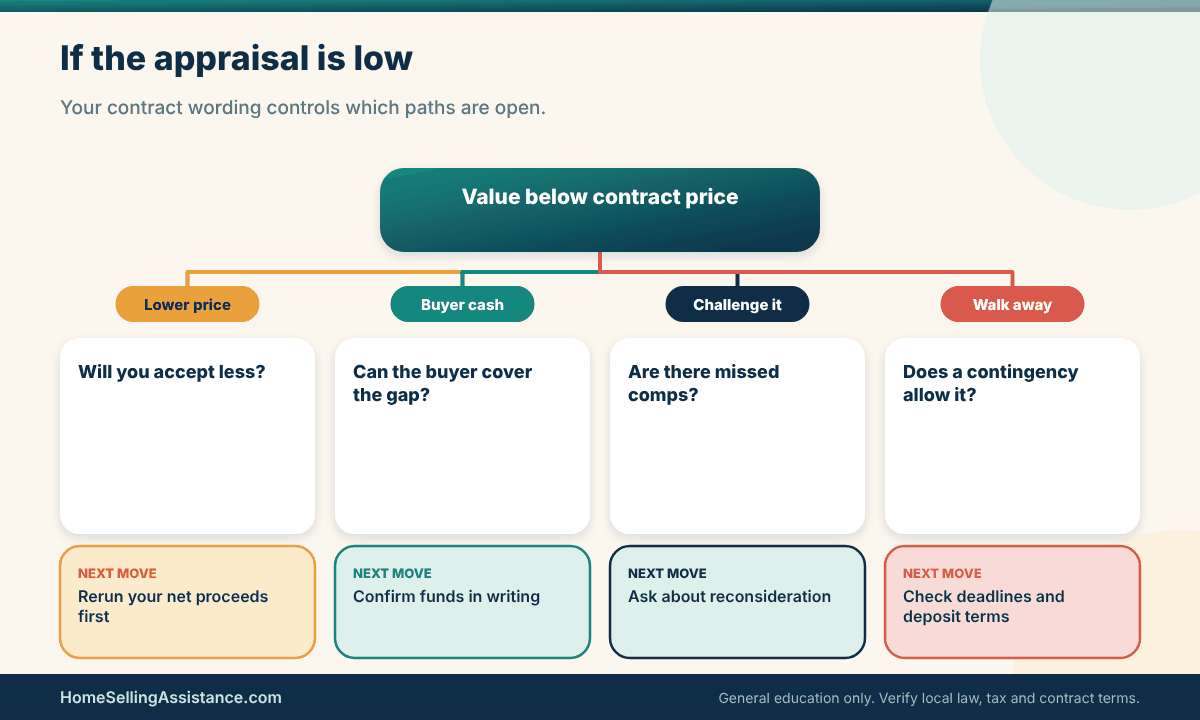
Financing risk also lives in the appraisal. A buyer’s loan amount is typically tied to the lesser of the purchase price and the appraised value, so a gap between the two has to be covered somehow. Common paths include the seller lowering the price, the buyer bringing more cash, both sides meeting in the middle, challenging the appraisal, or ending the contract if the terms allow. Which of those are open to you depends on your paperwork.
Documents that decide who bears the risk
Four documents deserve a careful read. First, the purchase contract, especially any appraisal contingency, financing contingency and gap language. Second, the buyer’s financing details, such as loan type, down payment and whether the buyer is relying on a sale of another home. Third, the listing agreement, which may speak to price changes and your cooperation with the process. Fourth, any addenda that modify deadlines. These papers are where CMA vs appraisal turns into contract reality.
An appraisal contingency generally lets a buyer renegotiate or exit if the value comes in below the price, within the window the contract sets. A buyer who waived it, or who agreed to cover a stated gap, has taken on more risk. A seller who agreed to a short window has less time than one with a generous window. For deeper reading, see our overview of home sale contingencies for sellers and the more focused appraisal gap guide. Understanding that wording is central to any CMA vs appraisal decision.
Government-backed loans can add their own condition standards on top of value, so a property with visible repair needs may face more than a number problem. Your agent, attorney or the buyer’s lender can explain which standards apply to a particular loan, and you should ask early instead of discovering it at the last moment.
A scenario with a low appraisal and a plan B
Take an illustrative case. A home is under contract at $450,000 and the lender’s appraisal comes back at $435,000. The buyer has offered no extra cash. The seller has four reasonable paths: accept a lower price, split the difference, request a reconsideration of value with stronger comps, or terminate if the contract permits. Each has a different effect on net proceeds, schedule and the chance of a clean closing.
A seller with a backup offer, or a willingness to relist, negotiates differently from a seller who has already bought another home and needs the money by a fixed date. That is why a fallback plan is part of the valuation conversation. Our article on low appraisal options for sellers goes further, and the process of requesting a reconsideration of value is worth knowing before you need it.
Your next step is to write down, before you list, the lowest net you would accept and the date by which you must close. Those two numbers make every later appraisal decision faster and calmer. Those two numbers are the anchor for any CMA vs appraisal decision you face later.
Using CMA vs appraisal by scenario instead of a universal winner
Anyone who tells you one of these tools is always better is selling something, even if only a simple opinion. The honest answer is that the right tool depends on the job. A seller preparing to list needs pricing evidence. A seller handling an estate, a divorce buyout or a dispute may need a valuation that an outsider will respect. A seller who already has a buyer needs to understand the appraisal that is coming. Different jobs, different tools. The CMA vs appraisal choice is a matter of fit, not rank.
The table below lays out several common situations, the route that tends to be favored, why, what you give up, and the one fact that could flip the answer. Treat it as a map for your conversation with a professional, not as advice for your specific property.
| Situation | Route favored | Reason | Trade-off | Fact that changes the choice |
|---|---|---|---|---|
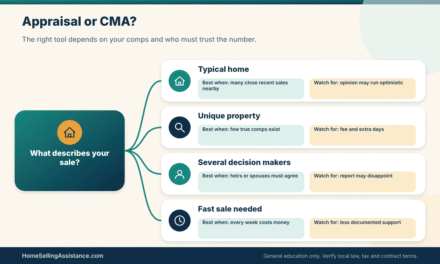
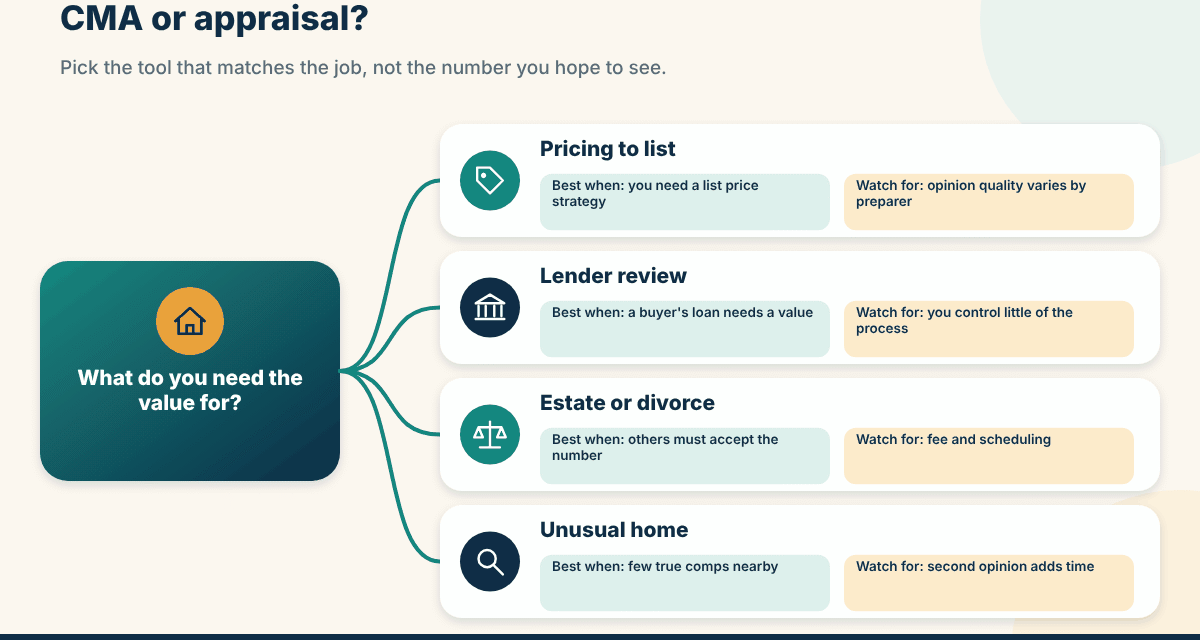
| Ordinary listing in an active market | CMA from two or more pros | Cheap, fast, current | Opinion quality varies | Few true comps nearby |
| Unique or rural property | CMA plus appraisal | Thin comps need a second view | Added cost and time | Appraiser knows the niche |
| Inherited home | Date-of-death appraisal | Documents value for records | Fee and scheduling | Tax or estate adviser requests it |
| Divorce buyout | Independent appraisal | Neutral number both sides trust | May differ from agent view | Both parties agree on a method |
| Offer already accepted | Prepare for lender appraisal | It is coming regardless | Little control left | Contract gap or contingency terms |
| Home not selling | Fresh CMA, then reassess | Market feedback updates price | Admitting the first price missed | Showing and offer data |
To use this table, find the row closest to your situation and read the last column first. That column names the fact most likely to change the answer, and it is usually something you can check this week: how many true comps exist, what your contract says, or whether a tax or legal adviser needs a formal number. Then read left to right to see the logic. Used this way, the CMA vs appraisal scenarios become a checklist of questions.
Scenario one: pricing to list in an ordinary market
In an ordinary sale, with a typical home, a reasonable number of nearby sales and no special complications, the CMA is the working tool. It is fast, it is usually free, and it reflects what buyers are doing this month instead of three months ago. You can collect several, compare them, and ask pointed questions. The appraisal will come later, from the buyer’s side, and your pricing choice is the best preparation for it. For this common case, the CMA vs appraisal answer is usually to start with the CMA.
The seller’s job here is not to find the highest number. It is to find the number that the evidence supports and that a lender’s appraiser is likely to be able to support as well. A list price that closed comps can defend tends to produce fewer surprises at the appraisal stage than one that relies mostly on hope and active listings. That mindset keeps CMA vs appraisal from turning into a contest between two numbers.
Evidence to gather: the pricing file you should build before listing
Create a simple file. Include two or three written CMAs from different professionals, the sold comps behind each, your own notes on what makes your home better or worse than each comp, and a printout or screenshot of any active and pending listings that compete directly. Add a record of improvements you have made, with dates and receipts where you have them, because they help explain why your home belongs at the upper or lower end of a range.
Add your own research on price per square foot, but treat it carefully. Averages can mislead when homes differ in layout, lot or condition. Our guide on price per square foot and home value explains when the metric helps and when it hides more than it shows. A single figure rarely survives contact with a real buyer’s tour.
Finally, note any known weaknesses, such as an older roof, a busy road or dated systems. An honest file is not a pessimistic file. It is the document you will lean on when a buyer’s agent pushes back, and it prepares you for questions an appraiser may ask on the same points.
A scenario, an exception, and your next step for a standard listing
Consider a seller, Priya, with a three-bedroom home in a neighborhood where several similar houses sold in recent months. Three agents give her ranges that overlap. She picks a list price inside the overlap, keeps the pricing file, and sets a review date two weeks after launch. Offers arrive, one is accepted, and the lender’s appraisal lands close to the contract price because the closed sales that supported her number are the same ones the appraiser used. The CMA vs appraisal outcome here was smooth because the evidence matched.
The exception is a fast-moving market, where the best comps may be only weeks old and conditions can shift between contract and appraisal. Even a careful CMA can trail the market by a few weeks, and the appraiser may rely on older closed sales. Your next step is to pair your CMA with a plain conversation, before listing, about how your contract handles a value that comes in lower than expected.
If your first price turns out to be too ambitious, our article on overpricing a house to sell explains the common patterns and how to recover without losing momentum.
Scenario two: an estate, a divorce or another dispute that needs a defensible number
Some situations are not really about choosing a list price. They are about creating a value that other people, such as co-owners, heirs, a court or an adviser, will accept as fair. In those cases, a CMA can feel too informal, since it comes from someone who may later earn a commission from the sale. A formal appraisal by an independent appraiser, hired for a defined purpose and date, offers more credibility and a cleaner paper trail. In these cases the CMA vs appraisal question is really about credibility.
This is also where purposes differ. An appraisal for a buyout, for an estate inventory or for tax records may be written as of a particular date and for a particular user. Tell the appraiser the intended use up front, since a report prepared for one purpose is not automatically right for another. Ask a tax professional or attorney which type and date your situation needs.
Evidence to gather: purpose, date, access and records
Before hiring an appraiser, write down the purpose, such as dividing proceeds in a divorce, documenting value at a date of death, or settling a disagreement among heirs. Then confirm the valuation date. A date-of-death appraisal looks backward, a current-value appraisal looks at today, and the two are not interchangeable. The IRS explains the importance of basis and fair market value in Publication 551 on basis of assets, and a tax professional can say how it applies to your facts. Clear purpose is the most overlooked part of the CMA vs appraisal decision here.
Gather the property’s records: deed, tax bill, prior surveys, improvement receipts and permits. Arrange access for the appraiser, including any outbuildings or finished areas. For shared ownership, agree in writing on who hires the appraiser, who pays, and whether everyone gets a copy. Small procedural agreements prevent large arguments later, particularly when emotions are high.
If you expect to sell afterward, keep the appraisal alongside your CMAs. They are not rivals. The appraisal documents a value for a purpose, and the CMA helps choose a list price that fits current buyer behavior. That is the practical resolution of CMA vs appraisal in these situations.
A scenario, an exception, and your next step for estates and divorces
Imagine two siblings who inherit a house. One thinks it is worth far more than the other does, and each has quoted a different agent’s CMA. Arguing about opinions goes nowhere. They agree to hire one independent appraiser for the value as of the date of death and later use a CMA to set the listing price. The first number settles records and fairness. The second guides the sale. Our article on inherited house cost basis adds detail.
In a divorce, a similar approach can help when one spouse keeps the home. A neutral appraisal can anchor the buyout figure, which is explored in our guide to divorce house buyout calculation. The exception is when both parties already trust a shared agent or an agreed method. Then a formal appraisal may be an expense with little added value, so ask before paying.
Your next step is to write the purpose in a single sentence and share it with the professional you hire. If the sentence is hard to write, you may not yet know which tool you need, and a short call with an attorney or tax adviser can clarify it.

One more point on using both tools together. Sellers sometimes assume they must pick a side. In practice, the two tools complement each other when the stakes are high or the property is unusual. A CMA gives you the pulse of the market and a pricing strategy. An appraisal gives you a defensible, dated, documented opinion. Used together, they let you spot gaps early and ask better questions of everyone involved. Seeing CMA vs appraisal as complementary is often the most useful shift in thinking.
For a broader view of the whole pricing process, including where valuation fits among staging, timing and negotiation, browse our home pricing and value library, and see how the appraisal stage connects to contracts in the contingencies, inspections and appraisals section.
It also helps to know the mistakes that show up most often, because a CMA vs appraisal misunderstanding rarely announces itself. The first is treating the CMA as a promise. Sellers hear a range, fix on the top number, and then feel cheated when offers cluster lower. The second is ignoring the contract until the appraisal arrives. A seller who has not read the appraisal language is negotiating blind. The third is assuming the appraiser is an adversary, when the appraiser is usually just following a process.
A fourth mistake is comparing the wrong things. A CMA built on list prices and an appraisal built on closed sales will often differ, and that CMA vs appraisal gap is not evidence of error on either side. Ask which sales each used. A fifth is skipping the facts check. Square footage, bedroom counts and recent improvements are the easiest inputs to get wrong and the easiest to correct, yet sellers often notice them only after a value has already come in low.
Rules and customs vary a great deal from one state and one county to the next. Whether a seller can see the lender’s appraisal, how quickly a contract must respond to a low value, whether attorneys are involved, and how appraisal contingencies are worded can all differ. Your state real estate commission, a local attorney or your title company can tell you which practices apply where you live. Treat any national description, including this one, as a map of the territory and not a survey of your lot.
One more principle belongs in any CMA vs appraisal discussion. Valuations should rest on the property and the market, not on who lives nearby or who owns the home. Fair housing law prohibits discrimination in housing transactions, and the HUD Fair Housing and Equal Opportunity office explains how to raise a concern. If a value or a pricing suggestion ever seems to rely on who lives in a neighborhood, ask for the property-based evidence behind it.
If you take only a few habits from this article, make them these. Get more than one CMA, and read the comps, not just the conclusion. Read your contract’s appraisal and financing terms before you list. Write down your lowest acceptable net and your latest acceptable closing date. Fix any factual errors in your property data early. And decide in advance what a low appraisal would make you do, so that choice is calm instead of rushed.
Last, remember that a CMA vs appraisal question is rarely a one-time decision. Markets move, offers change the picture, and a seller who rechecks the evidence at sensible intervals, such as after the first two weeks of showings or when an offer arrives, will usually make better choices than one who sets a number once and stops looking. Valuation is a conversation that continues until closing, and both tools have a turn to speak.
Quick scenario
A seller with an ordinary home collects two CMAs that overlap and lists inside the overlap. A buyer’s lender later orders an appraisal that comes in slightly under the contract price, and the contract already says how that gap is handled. Because the seller saw this coming, the conversation takes one phone call instead of a week of stress. Preparation, not prediction, is what separates a calm sale from a tense one.
Because so many sellers get stuck on the same few questions, here is a short list to carry into any meeting. Ask the agent preparing a CMA which sold homes carry the most weight and why. Ask what adjustments were made and how large they were. Ask how pending and active listings were treated. Ask how quickly the range would change if the market shifted. A thoughtful answer to those four questions tells you more than the number itself. Those questions make any CMA vs appraisal meeting more productive.
For the appraisal side, ask your agent or attorney three things. What does my contract say if the value comes in low? How long do I have to respond after the report is delivered? What documents, such as recent comps or proof of improvements, could support a reconsideration request? If you want a neutral reference on how appraisals fit into lending, the Consumer Financial Protection Bureau publishes plain-language material for people working through a mortgage transaction. Those answers complete your CMA vs appraisal preparation.
Finally, keep a realistic view of what either document can do. A CMA is a forecast made from the past, and an appraisal is a snapshot made for a lender. Neither one is a guarantee, and neither replaces the judgment of a seller who knows their own timeline, finances and tolerance for risk. Use both as inputs, never as verdicts, and let your contract and your net-proceeds worksheet make the final call. That is the plain truth behind CMA vs appraisal.
Frequently asked questions about CMA vs appraisal
What is the simplest way to explain CMA vs appraisal?
A CMA is a pricing opinion prepared to help a seller choose a list price. An appraisal is a formal valuation prepared by a licensed or certified appraiser, usually for a lender. The CMA is built from current market activity, while the appraisal leans on closed sales and professional reporting standards. Both use nearby sales, but they serve different readers.
Which comes first in a typical sale, the CMA or the appraisal?
The CMA almost always comes first, since you need a list price before you can market the home. The appraisal usually comes after a buyer’s offer is accepted and a lender is involved. That sequence is why many sellers feel surprised by an appraisal. Reading your contract before you list gives you a head start on what a low value would mean.
Can a CMA replace an appraisal for a buyer’s mortgage?
Generally no. A lender that is financing a purchase wants an independent valuation by a qualified appraiser, and a CMA is not designed to meet that requirement. Some transactions, such as cash purchases, may not involve a lender appraisal at all. Requirements vary by lender, loan type and contract, so ask the lender involved.
Why does an appraisal sometimes come in lower than the CMA?
Several reasons are common. The appraiser may weigh closed sales more heavily than pending or active listings, rate your home’s condition differently, or apply adjustments of a different size. The market may also have moved since the comps closed. In CMA vs appraisal gaps, small disagreements about condition and comps often explain most of the difference.
Who normally pays for an appraisal?
When a buyer finances a purchase, the buyer usually pays for the lender’s appraisal as part of loan costs, though your contract and local custom can change that. A seller who orders a private appraisal for pricing, an estate or a divorce typically pays for it personally. Always confirm who pays in writing so nobody is surprised at closing.
Can I challenge or question a low appraisal?
Often there is a process, commonly called a reconsideration of value, in which the lender or appraiser can review additional comparable sales or corrected facts. Rules differ by lender, and success is never guaranteed. Strong evidence, such as recent closed sales that were missed or a factual error in the report, helps far more than an argument about feelings. See our reconsideration guide for the details.
Should I order my own appraisal before listing?
Sometimes, not always. It can help with unusual properties, disputes among owners or sellers who want a documented number. It costs money, and a buyer’s lender may still order its own. Weigh the cost against how much uncertainty it would remove, and read our pre-listing appraisal article before deciding.
Is a CMA the same as a broker price opinion or an online estimate?
No. A CMA is usually prepared for a seller to guide pricing. A broker price opinion is typically requested by a lender or institution for its own purposes. Online estimates are computer-generated figures that may not account for condition or recent changes. Each has uses, but none is a licensed appraisal, and none should be treated as a guarantee.
Which is better for my situation, CMA vs appraisal?
It depends on the job. For ordinary pricing, a well-supported CMA is usually the practical choice. For estates, divorces, disputes or unusual homes, an independent appraisal may add credibility. Many sellers use both at different stages. Talk with a licensed professional about your facts, since this article is general education only.
Use the right valuation for the right job
The real value of understanding CMA vs appraisal is that it lets you stay calm when two numbers disagree. Price with a well-supported CMA, prepare for the appraisal that may follow, and know what your contract says before anyone asks you to decide. If you want to continue, our complete pricing guide ties these pieces together. This article is general education, not legal, tax or financial advice, and you should check local rules with a licensed professional.