Selling house with solar panels is a normal thing to do now, but it is not quite the same sale as a house without them, because the panels on your roof come with paperwork, and the paperwork decides what the buyer can actually receive.
Here is the part that surprises people. Two neighbors can have identical systems on identical roofs and face completely different closings. One owns the equipment outright and has nothing to hand over except a warranty folder. The other signed a twenty-year lease, owes a monthly payment to a company across the country, and cannot close until that company approves the buyer. From the street, you cannot tell which is which. Only the documents can. Planning ahead is the quietest advantage in selling house with solar panels.
We wrote this guide for sellers who are somewhere between “we have panels” and “we have a signed contract.” It walks through the three common arrangements (owned outright, financed with a loan, and leased or covered by a power purchase agreement), the way each one is usually handled at closing, the questions buyers and their lenders tend to ask, and the points where it is worth paying a professional to read the fine print.
It is part of our guide to selling a condo and other specialty properties, and many of the same habits apply there: gather the documents early, read the contract language, and do not promise what you cannot verify. Each section keeps the focus on selling house with solar panels in the real world, with plain language and honest limits.
One boundary before we start. This is general education. Solar contracts, utility rules, state incentives and lender guidelines differ widely and keep changing, so nothing here replaces your own contract, your solar provider’s written answers, or advice from a licensed attorney, tax professional or agent in your state.
Key takeaways
- Find out who owns the system first. Owned, loan-financed and leased panels are three different legal situations, and each one changes what you must pay off, transfer or disclose.
- A lease or power purchase agreement usually needs the buyer’s approval. The provider often runs a credit check, so start that conversation before you list rather than after you have an offer.
- Get written payoff or transfer figures. Ask the loan servicer or solar company for numbers in writing, with the dates they are good through, instead of relying on a phone call.
- Do not promise a price bump. Panels can add appeal for some buyers, but how much an appraiser or buyer credits them varies by market, system age and ownership structure.
- Disclose clearly and keep records. Production history, warranties, permits and utility agreements make buyers more comfortable and protect you from later arguments.
- Escalate early when liens or odd contracts appear. A recorded filing, a tax-bill assessment or a contract nobody can explain deserves a title company or attorney review.
Start by finding out what you actually own: selling house with solar panels begins with the paperwork
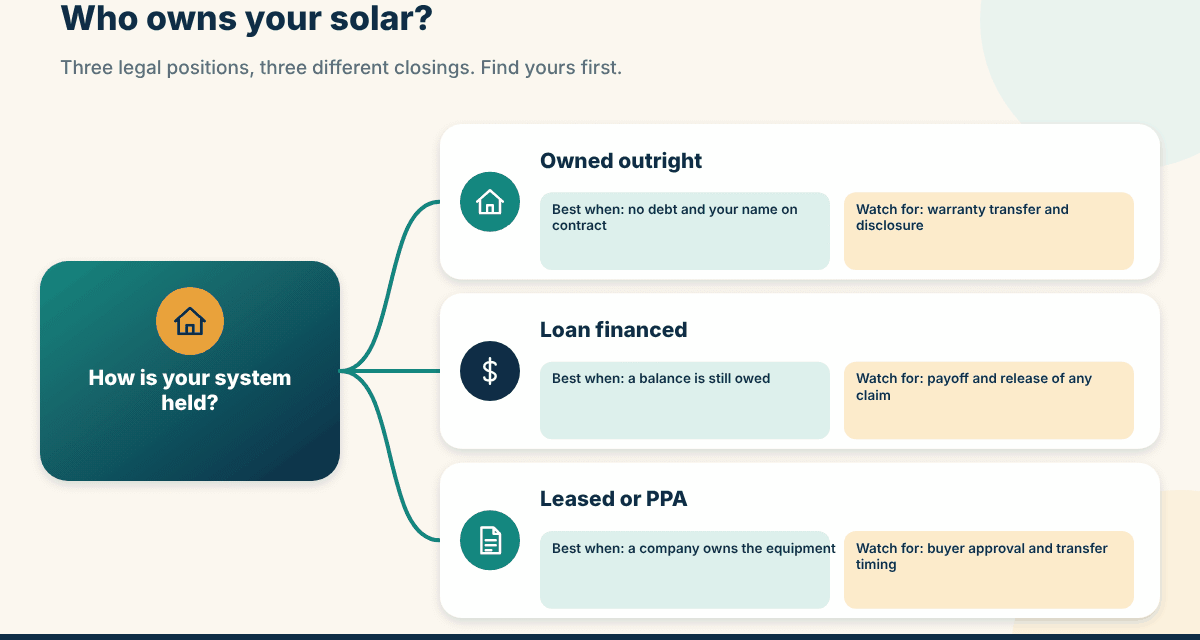
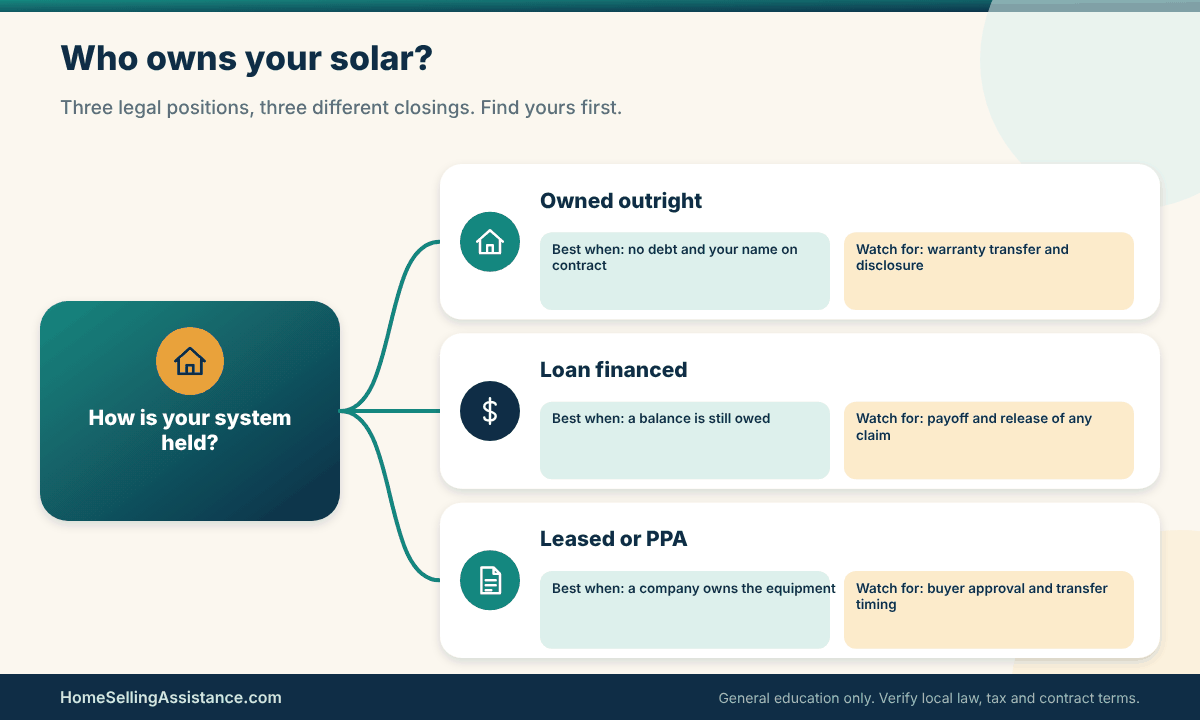
The picture above sketches the three situations most sellers fall into. Before you price the house, schedule photos or talk to an agent, work out which of those situations is yours. It sounds basic, yet plenty of sellers inherit a system from a previous owner, assume the roof panels came with the house, and later find a monthly bill they never knew about. Keep that picture handy while selling house with solar panels.
If you installed the system yourself, you probably remember how it was paid for. If you bought the home with panels already on it, you may have signed a transfer or assumption paperwork at your own closing, and that folder is the first place to look. If you cannot find it, the solar company or the lender will have a record under your name and address.
Who holds the rights: you, a lender, or a solar company
Think of the system as sitting in one of three legal positions. In the first, you own the panels, inverter and wiring free and clear. They are part of the house in the ordinary sense, and they pass to the buyer with the property unless your contract says otherwise. Nobody else has a claim, though a warranty may have conditions for transfer. Sorting out those positions is the first real task in selling house with solar panels.
In the second position, you own the system but you borrowed money to buy it. The loan may be a separate solar loan, a home equity loan, a line of credit, or an extra amount rolled into your mortgage. The lender has a claim on you, and in some cases on the property, until the balance is paid. How that claim is recorded depends on the loan type, and that matters at the title stage.
In the third position, you do not own the system at all. A solar company owns the equipment and either leases it to you for a fixed monthly payment or sells you the electricity it produces under a power purchase agreement, often shortened to PPA. Your right is a right to use the panels and receive the output. The company has the right to be paid, to maintain the system, and in many contracts to approve who takes over.
There are also hybrids. Some homeowners own the panels but lease the battery, or bought one array outright and later added a second financed one. Others live in places where an energy-efficiency assessment, sometimes called PACE financing, was attached to the property tax bill.
Those assessments are repaid through the tax bill and typically stay with the property, which changes the payoff conversation. Whether a PACE-style program exists in your area, and how it is treated at closing, depends on your state and county, so confirm locally. If any of that sounds like your house, mention it to your agent early, because selling house with solar panels gets harder when surprises arrive late.
For a plain answer on selling house with solar panels, remember this ordering of questions: who owns the equipment, who is owed money, who has to approve the transfer, and what has been recorded against the property. The rest of the process follows from those four answers.
Evidence to gather: the agreements, filings and utility letters
Start a single folder, paper or digital, and collect the original installation contract, any amendments, the loan or lease agreement, the most recent billing statement, and the interconnection or permission-to-operate letter from your electric utility. Add the building permit and the final inspection sign-off. If you are unsure whether you ever received those last two, the city or county building department can usually tell you what is on file for the address. Good records are what make selling house with solar panels feel routine rather than stressful.
Next, look for anything recorded against the property. Some solar companies and lenders record a notice in the county land records, often called a fixture filing or a UCC financing statement, to show they have an interest in equipment attached to the home. Not every provider does this, and not every county indexes it the same way, but a title search will surface it. Your title company, or the county recorder’s office, can tell you what is on record.
Finally, gather the practical items a buyer will ask for: twelve months or more of utility bills, the monitoring app login or screenshots of production history, panel and inverter model numbers, installation date, workmanship and equipment warranty documents, and any roof warranty that mentions the penetrations made for mounting. This is the same instinct we recommend in our list of documents needed to sell a house. Solar simply adds a few pages to the stack.
A practical note on honesty here. If a document is missing, say so in your own notes and then ask the source for a replacement copy. Do not guess at terms from memory. Lease escalators, buyout formulas and transfer fees are exactly the details people misremember, and a wrong guess repeated to a buyer can turn into a dispute later.
A scenario, an exception, and your next step for mixed ownership
Imagine a seller, Dana, who bought a house two owners ago. The listing said “solar included.” Dana assumed that meant she owned the panels. When she pulled the paperwork for her own sale, she found a transfer packet from her purchase: the panels belonged to a solar company under a lease that Dana had taken over, and a small recorded fixture filing still showed the company’s interest. The monthly lease payment had been coming out of her bank account for years without much thought.
Dana’s situation is common, and it is fixable. She was not in trouble. She simply learned early, which gave her options: ask the company what a buyout would cost, ask what a transfer to a buyer would involve, or price and market the house knowing the buyer would need approval. Had she learned this during the buyer’s inspection period, the same facts would have felt like a crisis. Sellers of homes in an HOA run into similar paper chases. Many sellers meet this exact surprise while selling house with solar panels for the first time.
The exception to watch for is a system that has been moved, resold or refinanced by the original installer. Solar companies do change hands, and loan servicers get sold. The name on your statement may not be the name on your contract. If the party you are paying cannot produce your agreement quickly, ask for the legal owner of the contract in writing before you rely on any figures.
Your next step, whatever your situation, is small and concrete. Write down the ownership position you believe applies, list each document that proves it, mark the ones you do not have, and request those from the provider this week. Everything later, from pricing to disclosure, gets easier once that folder exists. That folder is the backbone of selling house with solar panels.
Deadlines, payoff figures and transfer timing
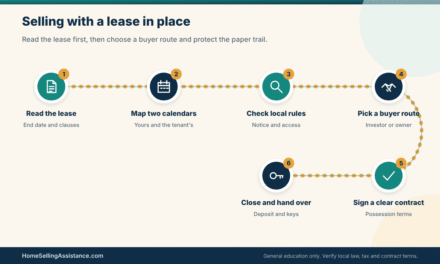
Solar providers and loan servicers do not operate on a seller’s schedule. A payoff statement may take several business days to produce. A lease transfer may involve an application, a credit review, a contract signature by the buyer and then an approval letter, and each step can have its own waiting period. Your purchase contract also has dates: an inspection window, a financing deadline, an appraisal date and a closing date. Timing is the hidden cost of selling house with solar panels, and it is rarely mentioned in listing advice.
The sellers who feel the most stress are the ones whose solar timeline and contract timeline collide. The cure is to run the two calendars side by side before you accept an offer. If the provider says a transfer typically takes a couple of weeks, and your buyer wants to close in three, you have a workable plan only if the buyer applies promptly.
If the provider quotes a month or more, you may need a longer closing, a buyout, or a clause that explains who is responsible for delays. A shared calendar is a small tool that pays off in selling house with solar panels.
Deadlines inside the solar documents matter too. Some leases have windows in which a buyout is allowed, notice periods for transfers, or conditions about how long before closing you must tell the company. Some loans allow prepayment at any time, and others may have fees. These details vary by contract, so treat any example in this article as an illustration and read your own paper.
Numbers to request: payoff, buyout and transfer fees
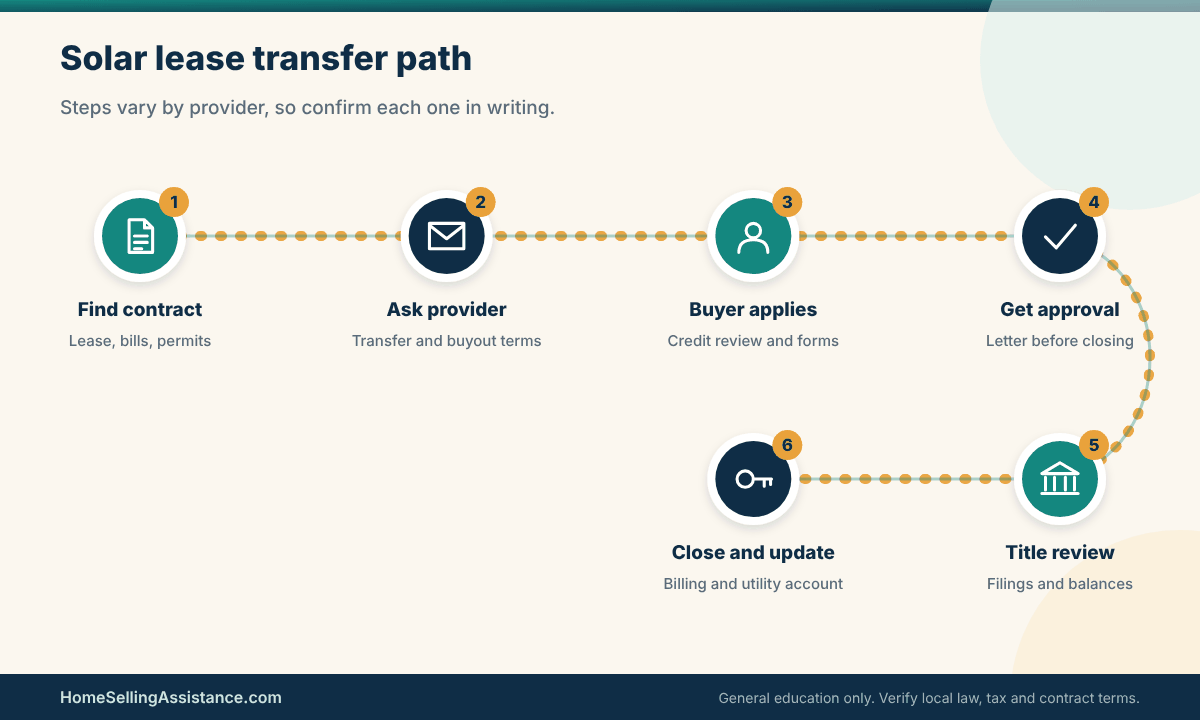
Ask for each of these in writing, and ask for the date through which the number is valid. For a loan, request a payoff statement that shows principal, accrued interest, any fees and a per-day amount if closing slips. For a lease or PPA, request two things separately: the cost to transfer the agreement to a buyer, if transfer is allowed, and the cost to buy out the contract, if a buyout is allowed. Collecting those figures is a core step in selling house with solar panels, since every other decision depends on them.
Then ask what else may be attached. Does the transfer carry an administrative fee? Does the company charge for a credit check or require a deposit from the new owner? Is there a minimum credit standard? Does the provider need to be paid anything that is overdue before it will approve a transfer? Is there a lien release or fixture-filing termination that follows payoff, and who files it?
Here is a deliberately simple illustration, using round numbers that are not real quotes. Suppose a loan payoff is quoted at 18,000 dollars, good through the twentieth of the month, with a per-day amount of a few dollars. If closing happens on the twenty-fifth, you need an updated figure. Missing that detail means a closing agent either scrambles to get a new statement or leaves a small balance behind, and neither is pleasant. A figure without a date is only a guess.
Finally, ask who will receive the payoff and how. Make sure the instructions come from a number or portal you verified yourself, not from an email that merely appeared in your inbox. Payoff wiring is a favorite target for fraudsters, and our guides on real estate wire fraud explain why you should always confirm instructions by phone using a number you already trust.
When the clock runs short: a worked scenario
Take a seller with a leased system and a buyer who wants to close in thirty days. The seller called the provider on day one of the listing, not day one of the contract, and learned that transfers require the buyer to complete an online application. When an offer arrived on a Friday, the seller’s agent attached a one-page note to the contract explaining the transfer process and asked the buyer’s agent to have their client apply within two business days. That kind of preparation is typical of sellers who handle selling house with solar panels smoothly.
The buyer applied on Monday. The provider approved by the end of the following week. The title company received the transfer confirmation and a written statement that nothing was past due. Closing went ahead on schedule, with a short addendum in the contract describing who would pay the transfer fee. Nobody had to guess.
Now picture the same house with no early call. The offer arrives, the seller phones the provider, and the provider says a transfer takes about three weeks after the buyer applies, and a buyout figure takes several business days to produce. The buyer’s lender is asking for lease paperwork to underwrite. The seller now has three clocks running and a closing date that may not be achievable.
What helps in that second case is a calm, written plan: ask the buyer for a reasonable extension of closing, offer a buyout as a fallback if the numbers work, and put the agreed responsibilities in an addendum. What does not help is ignoring the problem and hoping the provider will be quick. If the situation looks tangled, our overview of home sale contingencies shows how deadlines in a contract protect, or fail to protect, each side.
How the common outcomes play out when selling house with solar panels
Once you know which position you are in, you can model the outcomes. We think of it as two broad branches. On the first, every solar-related requirement is handled in time and in writing, so the buyer, the lender and the title company see a clean file. On the second, something is disputed, missed or quietly waived, and the sale slows down or changes shape. Modeling both branches in advance makes selling house with solar panels far less intimidating.
Before we walk through each branch, the matrix below puts the main issues in one place. It lists the issue, the document that controls it, what you as the seller must do or may choose, the timing to watch, and who can verify the local rules. Read it as a map of questions, not as a statement of what your state or contract requires. The matrix is a useful reference for selling house with solar panels at any stage.
| Issue | Controlling document or authority | Seller obligation or choice | Deadline to watch | Local verification |
|---|---|---|---|---|
| Owned system, no debt | Installation contract, warranties | Disclose, transfer warranty paperwork | Before listing and at inspection | Warranty terms, county permit file |
| Solar loan | Loan agreement, payoff statement | Pay off at closing or have buyer assume if allowed | Payoff good-through date | Servicer, title company |
| Lease or PPA transfer | Lease or PPA, provider policy | Request transfer, support buyer application | Provider approval time | Provider in writing, attorney |
| Buyout of leased system | Buyout clause, provider quote | Choose buyout instead of transfer | Quote expiry date | Provider, title company |
| Recorded fixture filing | County land records, title report | Resolve or release before or at closing | Title commitment review | County recorder, title agent |
| Utility interconnection | Utility permission letter, net-metering terms | Notify utility, confirm buyer eligibility | Before closing | Local utility, state regulator |
Use the matrix as a prompt list for your first call with the title company or your agent. If a row does not apply, cross it off. If you cannot say who controls a row, that is the row to investigate first. Notice that every row ends with a person or office you can ask, because local rules and utility practices vary too much for any article to settle them for you. A matrix like this is a handy companion when selling house with solar panels across different providers and counties.
When the solar term is satisfied cleanly
A clean outcome does not require luck. It requires that the party who holds the right has said yes in writing, that the numbers have been confirmed, and that the buyer’s side has the documents it asked for. In practice, that usually means a payoff or transfer approval is in the closing file well before the signing appointment, and any recorded interest has a plan for release. Clean files are the norm among sellers who treat selling house with solar panels as a project.
For an owned system, the clean outcome is mostly about information. The buyer receives the warranties, the monitoring access instructions, the permit sign-offs and a fair summary of what the system has produced. There is often no money moving at closing because of the panels, though a buyer’s appraiser may or may not give them weight. Even then, selling house with solar panels means telling the buyer what the equipment is and what covers it.
For a loan, the clean outcome is a payoff that clears at closing, a servicer that releases any recorded claim afterward, and a seller who keeps proof of both. For a lease or PPA, the clean outcome is either an approved transfer with the buyer taking over the payment obligations from a stated date, or a buyout paid at closing with the provider’s release in hand. Documentation like this keeps selling house with solar panels orderly.
What a clean file looks like at the closing table
A clean file has a short, boring checklist that a closing agent can confirm. For a payoff, it includes the lender’s written payoff letter with wiring or mailing instructions you verified, a per-day amount and a date. For a lease transfer, it includes the provider’s approval letter, the buyer’s signed assumption paperwork, confirmation of the effective date and a statement that the account is current. This is the practical heart of selling house with solar panels at the closing table.
For an owned system, it includes the warranty documents and a signed acknowledgment, usually through the purchase contract or a short addendum, that the equipment is included in the sale. Some sellers add a line stating whether any monitoring accounts or app logins will be transferred, and who will contact the manufacturer or installer to update the owner name on warranty records.
You should also leave room for the part that happens after closing. Providers often need a few days to update billing, and the utility may need to change the account holder. Agree in writing about who handles which call. If you remain the account holder on any monthly bill for a short period, ask the buyer to confirm in writing when the change will occur, and keep an eye on your statements until it does.
The most useful single habit is to ask the title or escrow officer, early, what they will need to see for the solar item. Closing offices have seen dozens of arrangements. They know which providers answer quickly, which ones demand a notarized form, and which county releases take longer. A short phone call with them can save you a week. For the broader mechanics of clearing debts at closing, see our guide on mortgage payoff when selling a house, which uses similar logic.
A paid-off system, a happy buyer, and one small snag
Consider a seller, Marcus, who financed his panels with a separate solar loan five years ago. He requested a payoff statement when he listed, kept it in a folder with the warranty documents, and mentioned the loan in the listing description, saying the balance would be paid at closing. A buyer made an offer, and the contract included a short clause about the payoff.
At closing, the payoff cleared. Then the small snag appeared. The servicer’s release of its recorded filing took longer than expected, and the buyer’s lender asked about it before funding the loan. Because Marcus had saved the payoff confirmation, the title company could forward it and note that the release was in process. Nothing collapsed, but a sloppier file would have cost days.
The lesson is not that every closing has a snag. It is that proof beats memory. Keep the payoff confirmation, the written release when it arrives, and the final statement showing a zero balance. If the release never comes, call the servicer, and if it still does not arrive, ask the title company how releases are chased in your county. That paper is also what you would hand an attorney if a question surfaced months later. The same discipline applies throughout selling house with solar panels.
Marcus also benefited from a modest mindset about value. He did not tell buyers the panels were worth a specific premium. He described what the system produced, when it was installed, what was under warranty and what the monthly utility bills had looked like. Buyers can do their own math. If you want to see how value claims interact with comparable sales, our article on how comps are adjusted shows why unusual features are harder to price than they look.
When the solar issue is disputed, missed or waived
The second branch starts when something is unclear, late or contested. A provider declines a buyer. A seller learns about a lien after the deadline to cancel. A buyer claims the panels were represented as owned when they are leased. Or both sides simply forget the solar item until the week of closing, when it is hardest to fix. Few sellers plan for this branch when selling house with solar panels, which is why it hurts.
Disputes tend to come from three places: a document nobody read closely, a verbal statement nobody wrote down, or a timing assumption that did not match reality. All three are avoidable. The goal in this section is not to frighten you but to show how these situations typically unfold, so you recognize them earlier and respond in writing. Knowing where trouble starts is half the work of selling house with solar panels safely.
Waivers deserve a word. Sometimes a buyer, to keep a deal moving, waives an inspection or an approval deadline. If they waive something that touches the solar system, such as the right to review lease terms, make sure the waiver is in writing and specific. A vague or verbal waiver does not protect you, and in many contracts a missed deadline does not automatically cancel anything. It usually changes who has leverage, so read the contract language itself.
Warning signs: how disputes usually surface
Look for these patterns. The buyer’s lender asks for a copy of a document you were not aware existed. The title report shows a recorded filing under a company name you do not recognize. The provider answers your transfer request with a request for a credit report on you, not the buyer. The utility says the net-metering arrangement belongs to the previous owner. Or the buyer’s agent says they were told the system was owned. Spotting such signs early is a quiet skill in selling house with solar panels.
Another sign is any statement about the system’s value that cannot be traced to a document. If the listing description says “fully paid solar” and your records say otherwise, correct it now. A wrong statement in marketing materials is much easier to fix before an offer than after one. Our guide to seller disclosure requirements explains why accuracy in what you say and write matters even when state forms are silent about solar.
If a tenant lives in the house, as covered in our guide to selling a tenant-occupied house, access for solar inspections also needs coordination. A subtler warning sign is silence. If you have asked a provider for a transfer quote twice and heard nothing, treat that as information. Escalate by asking for a supervisor, sending a written request by a trackable method, and telling your agent or closing office that you are waiting. Silence from the party that holds the right is one of the main reasons solar items run late.
Last, watch for pressure. Some sellers receive aggressive calls from companies offering to “take over” or “buy out” the solar contract, or from third parties claiming they can remove a lien quickly for a fee. Legitimate buyouts come from the contract holder named on your agreement. Anything else deserves verification, and you can report suspect offers through the Federal Trade Commission’s consumer site.
Three messy scenarios and how sellers handled them
First scenario: the lease the buyer will not take. A buyer loves the house but dislikes the lease escalator. The seller has two honest paths: negotiate a price or credit that reflects the buyer’s concern, or buy out the lease and sell the panels as owned. Each path costs something. Which is cheaper depends on the buyout number, the remaining term and how much the buyer values the system. The seller should ask the provider for a written buyout figure before negotiating, so the conversation uses real numbers.
Second scenario: the lien surprise. A title commitment lists a recorded filing from a solar company, but the seller believes the system was paid off two years ago. The seller should ask the company for a written paid-in-full letter and a release of the filing. If the company has been acquired or dissolved, the title company and an attorney may know how releases are handled locally. Meanwhile, the seller should tell the buyer’s side early, in writing, that the issue is being resolved.
Third scenario: the wrong description. An agent writes “owned solar” in a listing because a previous seller’s materials said so. The buyer, relying on that, learns later that the panels are leased. The buyer’s agent asks for a credit or threatens to walk. Here, the seller’s best move is prompt honesty: correct the record, offer the real documents, discuss options for fixing the situation, and let an attorney review any claim of misrepresentation. How the law treats such a mistake varies by state and by contract.
In all three, the pattern is the same. The seller who documents decisions and communicates in writing has more choices than the seller who improvises over the phone. If a dispute turns into a canceled contract, our guide on what happens when a deal falls through after inspection covers deposits, relisting and what to tell the next buyer. That is as true for selling house with solar panels as for any specialty sale.
Control the risk of selling house with solar panels in writing
Most problems with selling house with solar panels can be shrunk by one habit: put the solar facts and responsibilities on paper before anyone relies on them. That means accurate disclosures, a short written plan with the provider or lender, and contract language that says who does what and by when. It does not mean pages of legal jargon. A clear one-page addendum often does more than a long clause nobody reads.
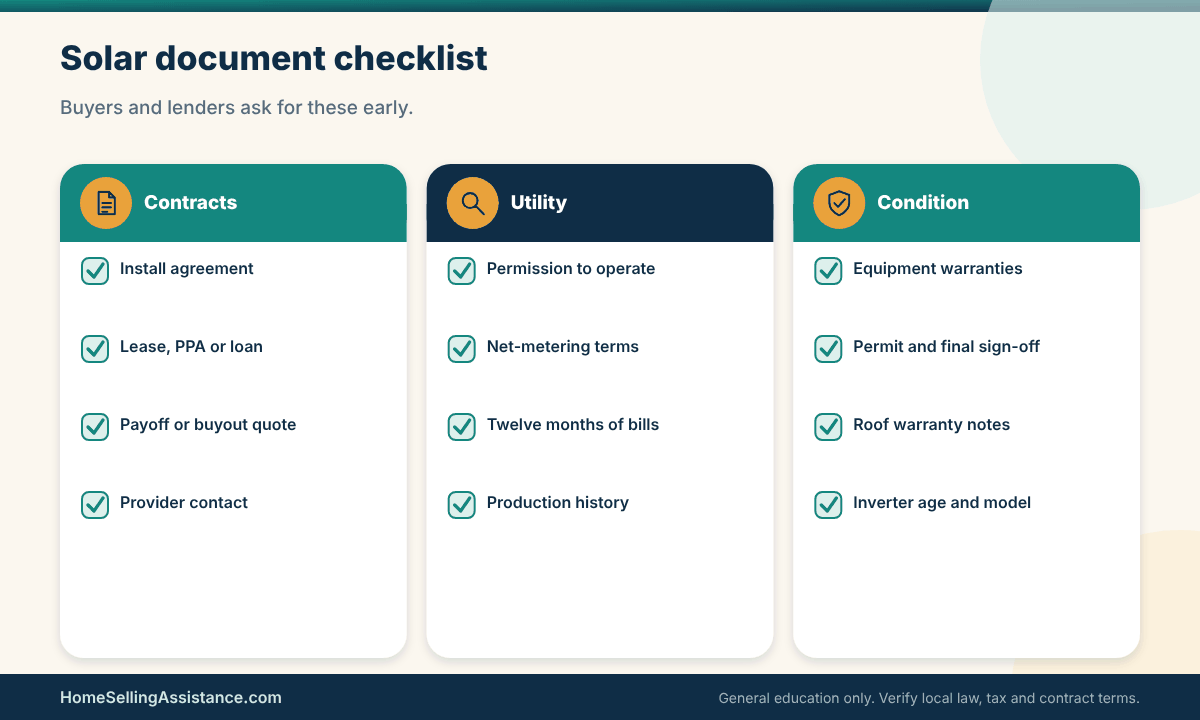
Buyers have their own list of worries, and it helps to know them in advance. They want to know what the monthly cost is and whether it rises, how long the system has left, whether the roof underneath is sound, whether their lender will accept the arrangement, whether their insurer will cover the equipment, and what happens if the inverter fails. If you can answer those from documents, you remove most of the friction. Knowing those worries in advance is part of selling house with solar panels well.
The picture below turns that list into a pre-listing checklist you can tick off. Treat it as a starting point, then add anything your own contracts call for. You do not need to finish every item before listing, but the earlier ones, such as ownership proof and payoff or transfer figures, are worth completing before the first showing. Preparation of this kind makes selling house with solar panels predictable.
Questions to settle before signing anything
Signing a listing agreement, a purchase contract, a lease transfer or a payoff authorization each carries its own consequences. The questions below apply to all of them. If you cannot answer one, pause and find out. A day spent on a question is cheaper than a week spent fixing an answer you guessed. Slow down at each signature while selling house with solar panels.
Start with the questions you should ask yourself. Do I know who legally owns the system? Do I know every amount I owe and to whom? Do I know whether the provider must approve a transfer, and how long that takes? Have I told my agent, if I have one, about the system in writing? Does the listing description match my documents? Is the roof under the panels old enough that a buyer might ask about replacement? Honest answers keep selling house with solar panels on a steady footing.
Then the questions to put to others. Ask your title or escrow officer what they will need to close with the solar item. Ask the provider about transfer fees, approval steps, buyer qualification and what happens to monitoring accounts. Ask your utility whether net-metering terms transfer to a new owner or must be reapplied for. Ask your insurer whether the panels are covered under your policy, because a buyer’s insurer may ask the same thing.
Checklist in prose: what to ask the solar company or lender
When you call or write to the provider, keep the message short and specific. Say that you plan to sell the home at a given address, that you are the account holder, and that you need these items in writing: the current balance or remaining contract term, the transfer procedure and fee, the buyout option and quote, any restrictions on the buyer, the typical approval time, the process for releasing any recorded filing, and a named contact who can answer follow-up questions. This short message is the workhorse of selling house with solar panels.
Rural properties, discussed in our guide to selling a rural home, may add ground-mounted arrays or well-pump circuits, so mention those too. Ask also about the system itself. Who handles repairs and monitoring during a transfer? Are there coverage terms that end when ownership changes, or that need to be reapplied for? Does the provider require access to the roof? If the roof needs repair or replacement during the term, who removes and reinstalls the panels, and who pays? These questions are less glamorous than price, but they are the ones that cause arguments later.
For a lender, ask whether the loan is secured by the home or the equipment, whether it can be paid early without a penalty, and what happens if you pay it off through closing. Ask whether any recorded claim will be released automatically and how you will receive proof. If the solar financing was added to your mortgage, you may simply pay it off with the mortgage payoff, which is a simpler path. Our guide on selling a house with a lien explains how title companies treat other recorded claims.
Ask for answers by email or letter, and save them. If a representative gives a verbal answer that matters, send a follow-up message summarizing what you heard and asking them to correct it if wrong. That small step has resolved many disagreements over what was promised. It also shows the buyer’s side that you handled things responsibly.
If the system is owned and you want to keep it, or exclude it from the sale, say so in writing. Panels are usually treated as part of the house because they are attached, but contracts differ and sellers sometimes carve out items. If you ever intend to remove the equipment, talk with your agent or attorney first, because removal affects the roof, the utility connection and the buyer’s expectations.
Scenario: a buyer’s agent asks for the lease contract
Imagine you receive an offer on a house with leased panels. The buyer’s agent emails: “Please send the full lease and the most recent bill. Our lender wants to review it.” You have a choice. You can scramble, or you can send a packet you prepared two weeks ago, with a cover note explaining what is attached and what steps remain. Offers like this arrive often when selling house with solar panels in a market where buyers know the questions.
The prepared seller sends the lease, the latest bill, the provider’s written transfer instructions, the name of the provider’s contact and a short note about expected timing. The buyer’s lender reviews the paperwork, perhaps asks a few follow-up questions, and the buyer decides with real information. If the buyer objects to a term, you can discuss price, credits or a buyout without panic.
The unprepared seller hunts for a lease that lives in an old email account, sends a blurry photo of a bill and tells the agent the provider will probably approve the transfer. When the lender asks for the full contract, the seller waits for the provider to reply. Days slip by, the buyer worries, and the inspection or financing deadline starts to press on the schedule.
This does not mean the first seller will have a perfect closing. Lenders vary in how they treat solar leases, and a buyer might still walk away or ask for concessions. But the prepared seller has set up a record of good faith and clear information, and that tends to calm negotiations. If your buyer is relying on financing, see our overview of financing contingencies from the seller’s side for how timelines and outs usually work.
Quick scenario
A seller lists a house and mentions “solar panels” in one line of the description. Three days later a buyer asks whether they are owned or leased. The seller does not know, because the contract is somewhere in a drawer. Instead of guessing, the seller says, “I will confirm in writing by tomorrow,” finds the contract, and sends the buyer a plain summary with attachments. That one honest sentence kept the conversation friendly and avoided a wrong answer.
Before moving on, a word on pricing. Many sellers ask whether to raise the list price because of the panels. A better question is how to present the facts so buyers and appraisers can judge for themselves. Ask your agent to compare nearby sales with and without solar where possible, and to explain how much weight those comparisons deserve. Value effects depend on the market, system age, whether it is owned, and how buyers feel about the roof. Anyone who gives you a confident universal number is guessing. Pricing is where selling house with solar panels most often goes wrong.
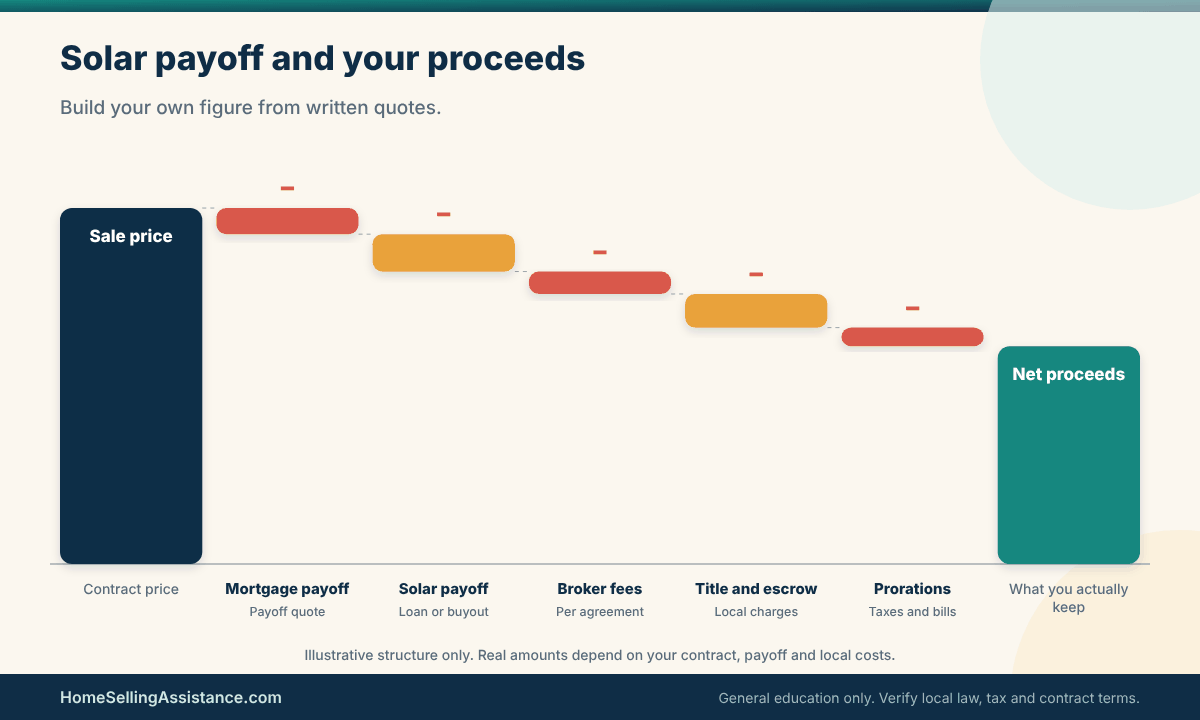
If you are working out what you would actually keep after the payoff, our guide to estimating home sale net proceeds shows how to build the figure from real quotes, and the solar payoff or buyout is simply one more line in that math.
When to bring in an attorney, agent or title company
Most sellers do not need an attorney for every solar sale, but some situations justify the cost. Others are better handled by a good agent or a title officer who has seen the pattern before. The point is to match the problem to the person. A question about a recorded filing belongs with the title company. A question about whether a contract clause shifts liability belongs with an attorney. A question about how buyers in your area react to leases belongs with a local agent. Knowing when to escalate is a skill in selling house with solar panels.
The table below sorts typical situations into options, risks, documents and escalation points. It is a way to decide who to call first, not a ruling on the outcome, because the outcome depends on your contract and your state. Use it with the matrix earlier in the article, and fill in the last column with real names and phone numbers before you list.
| Situation | Seller options | Main risk | Document to review | Escalate to |
|---|---|---|---|---|
| Leased panels, buyer hesitant | Negotiate, transfer, or buy out | Lost buyer or lower price | Lease, buyout quote | Agent, then attorney |
| Solar loan with recorded claim | Pay off at closing, confirm release | Delayed funding | Payoff letter, title commitment | Title company |
| Tax-bill assessment attached | Pay off or disclose and negotiate | Buyer lender objects | Assessment notice, tax bill | Title company, attorney |
| Owned system, old inverter | Disclose age, share warranty | Repair claim after closing | Warranty, service records | Agent |
| Roof replacement needed | Remove and reinstall panels, or credit | Cost and delay | Roof estimate, provider rules | Roofer, provider |
| Listing says owned but leased | Correct in writing, offer options | Misrepresentation claim | Listing text, lease | Attorney |
To use the table, find the row that most resembles your case and read across. If you see an unfamiliar risk, that is the signal to ask a professional before you sign anything. If your situation sits across two rows, as it often does with a roof that needs work and a lease that needs a transfer, handle the more time-sensitive item first. Roof work usually has the longest lead time. Treat it as a living page for selling house with solar panels as your situation develops.
Triggers that justify a professional’s time when selling house with solar panels
Some signals are worth a call right away. A recorded filing you cannot explain. A provider that will not confirm in writing who owns the contract. A PACE-style assessment that shows up on the tax bill. A buyer’s lender that rejects the lease structure. A claim that a statement in the listing was wrong. A contract you signed years ago that includes language about transfers, assignment, or notices you do not understand. Each is a common speed bump in selling house with solar panels.
Different professionals fit different triggers. The title company reads the public record and knows what must be cleared to deliver clean title. A real estate attorney reads contracts and advises on your rights and duties under your state’s law. An agent knows how local buyers treat leased and owned systems and can coordinate the timeline. A tax professional answers questions about credits, basis or gain, which we do not address here.
If your question is about the federal tax treatment of a sale in general, the IRS publishes Publication 523 on selling your home, and a tax professional can tell you how it applies to you. Choosing the right helper early keeps selling house with solar panels affordable.
If tax credits were claimed when the system was installed, ask a tax professional how that history interacts with a sale. The rules on residential energy credits have changed over time, and we do not want to guess at your situation. The same goes for state or utility rebates that came with conditions, such as notice requirements when the home is sold. Check the program paperwork for any clause about sale or transfer.
Owners of manufactured homes with rooftop panels should ask about structural and financing limits too. Cost is a fair concern. A short attorney consultation, or a flat-fee contract review where offered in your area, is usually small compared with the stakes of a sale. If you are working with an agent, ask whether the brokerage has experience with solar transfers and whether it has a transaction coordinator who tracks provider approvals.
Compensation arrangements are negotiable and should be written down, so ask what is included before you assume anything about who handles the paperwork. Professional help is a tool, not an admission of failure, in selling house with solar panels.
If the price of professional help feels hard to justify, a middle path is to order the title commitment early and read it with your agent. Surprises on title are the most expensive kind, and a commitment costs little compared with learning about a filing after you have signed a contract. Our guide to the title search for sellers explains what it shows and how to read it. It is a modest step that makes selling house with solar panels safer.
A last scenario and your final next step
Picture a seller, Priya, who inherited a house with panels from a parent. She does not know whether the system is owned. She finds a folder with a power purchase agreement, a stack of monthly statements and a letter from the utility. She is the executor, not an original party to the contract, and the provider asks for estate documents before it will talk to her. Her case shows how selling house with solar panels can combine with other special circumstances.
Priya has several things to sort out at once: her authority to act, the contract terms, the buyer’s reaction and the timeline. She does the sensible thing. She asks the estate’s attorney whether she can request information from the provider, sends the provider the paperwork it asks for, and asks for a written summary of transfer and buyout options. She tells the listing agent about the panels before the photos are taken, and she asks the title company to run the search early.
What she does not do is guess. She does not tell buyers the panels are paid for or promise a transfer will be approved. When a buyer asks about the monthly payment, she answers from the statement. Inherited homes bring extra layers of paperwork, so if that is your situation, our guides on selling an inherited house and an executor selling a house walk through authority and timing. Careful statements like these protect anyone selling house with solar panels.

Whatever your own scenario, here is the final next step. This week, write a one-page summary of your solar situation: ownership, amounts owed, provider contacts, documents in hand, documents missing, and the next three phone calls. Share it with your agent or closing office when you list. That page is the most valuable preparation you can make for selling house with solar panels, and it takes an hour. Do not skip it, even when selling house with solar panels feels simple.
If you are weighing other specialty-property questions at the same time, you can browse our collection of guides on condos, HOAs and specialty properties, and our disclosures and seller paperwork guides for the forms and statements that surround this decision.
Frequently asked questions about selling house with solar panels
Do I have to pay off my solar panels before selling?
It depends on how the system was financed and what your contract says. An owned system with no debt needs no payoff. A solar loan is commonly paid at closing from the sale proceeds, while a lease or power purchase agreement is usually transferred to the buyer or bought out. Ask the provider for written options and confirm the details with your title company.
Can a buyer take over my solar lease?
Often yes, but usually only with the provider’s approval. Many providers run a credit check on the buyer and require signed assumption paperwork before they release you. Approval is not guaranteed and timing varies, so ask the provider early about the process, any fees and the buyer’s qualification standards.
Does selling house with solar panels hurt my sale price?
Not necessarily, and it does not automatically help either. Some buyers like lower electric bills and the added feature, while others worry about lease terms, roof work or maintenance. The effect depends on your market, the age of the system, who owns it and how clearly you document it, so avoid promising any specific premium.
Will a buyer’s mortgage lender accept leased panels?
Lender policies differ, and some loan programs have their own guidelines about leased or financed systems. A lender may ask for the lease, the payment amount and the provider’s approval of the transfer. The buyer’s loan officer is the right person to answer this for their specific loan, so encourage the buyer to ask early.
What if my panels are on a recorded lien or fixture filing?
A recorded filing usually shows up in the title search and may need to be released at or before closing. The party that recorded it normally provides the release once the balance is paid or the contract is transferred. Your title company can explain how releases work in your county and what proof it will want.
Do the warranties transfer to the new owner?
It depends on the manufacturer, the installer and the wording of each warranty. Some transfer automatically with the home, and others require notice, a form or a fee within a set time. Read each warranty or call the issuer, and give the buyer copies so they can handle any required steps after closing.
What happens to my net-metering arrangement?
Net-metering and interconnection rules are set by your utility and state regulators, and they have changed in many places over time. In some areas the arrangement continues with a new owner, while in others the buyer must apply again or accept different terms. Ask your utility in writing before you describe the arrangement to buyers.
Should I disclose the panels even if no form asks about them?
Being open about them is the safest course, because buyers will see them and will ask. Disclosure forms and legal duties differ by state, so ask your agent or attorney what applies to you. Either way, provide accurate ownership, payment and warranty information and make sure your listing text matches your documents.
What if my roof needs replacing while I have a lease?
Many contracts require the panels to be removed and reinstalled, sometimes at the homeowner’s cost and with provider scheduling. Check your lease for roof clauses and ask the provider for a written procedure and estimate. Share what you learn with buyers, since an aging roof under panels is a common question.
Can I just remove the panels before listing?
For an owned system this is sometimes possible, but it may affect roof condition, utility connections, warranties and buyer expectations. For a leased system, removal is typically the provider’s job and may involve fees or contract consequences. Talk with your agent, the provider and an attorney before taking panels down.
A calmer way to approach your sale
Selling house with solar panels is less mysterious than it first looks. Find out who owns the system, ask for numbers in writing, line up the provider’s timeline with your contract’s dates, and tell buyers the truth in clear documents. When something odd appears, bring in the title company, an agent or an attorney before you sign. This article is general education, not legal, tax or financial advice, so confirm the details that matter for your home with qualified professionals in your state.