Learning how to choose listing agent candidates well comes down to one idea: you are not hiring a personality, you are hiring a pricing opinion, a marketing plan, a negotiator and a contract partner, and each of those four pieces can be checked before you sign anything. This guide walks through the whole decision, from your own goals to the interview questions, the written listing agreement and the paperwork you should verify, and it stays neutral about whether an agent is the right route for you at all.
Most sellers pick an agent the way they pick a restaurant on a trip: a friend mentioned a name, a yard sign looked familiar, a postcard arrived at the right moment. None of that is foolish, and a referral from someone who sold recently can be a good starting point. The trouble is that a referral tells you how a person felt about one transaction, while your sale will have its own price range, condition issues, timing pressure and risk tolerance. Keep that in mind each time you weigh how to choose listing agent finalists against one another.
So this article is built around decisions you can test. We will look at what you should know about yourself before you interview anyone, how the main selling routes differ, which parts of an agent’s pitch can be verified with real evidence, what the listing contract can and cannot protect you from, and which professionals and documents belong in your file. Whenever a rule varies by state, brokerage or local custom, we say so and point to the place where you can check it.
You will see a few round example figures along the way. They are labelled illustrative, they exist only to show how the arithmetic works, and they are not predictions or typical numbers for your market. Think of this page as a long conversation with someone who has watched many closings, wants you to ask better questions, and has no commission riding on your answer. This is a small habit, yet it sits at the center of how to choose listing agent partners with confidence.
Key takeaways
- Start with your goal, not the agent. Price, speed, certainty and effort pull in different directions, and the right agent for one goal can be the wrong one for another.
- Test the pricing opinion. Ask every finalist to show the closed sales behind a recommended price and to explain each adjustment, because a confident number without evidence is just a number.
- Judge marketing by specifics. A real plan names the photography, the channels, the timing, the showing rules and the reporting you will get, in writing.
- Compensation is negotiable and must be written down. Rules and customs differ by state and brokerage, so read the actual agreement and ask about every fee, not just the headline figure.
- The contract is the real relationship. Term length, cancellation rights, protection periods and who may talk to buyers matter more than the pitch meeting.
- Verify before you sign. Check the license, the brokerage, recent activity and the full paper trail, then compare at least three finalists on the same questions.

Start with your own goals before you meet a single agent
Before any interview, take an afternoon to work out what you want the sale to do for you. That sounds obvious, yet it is the step sellers skip most often, and it is the reason two people can interview the same agent and walk away with opposite impressions. One of them wanted the highest realistic price and had six months to wait. The other had a job start date, a purchase contract on the next house and no patience for a long marketing campaign.
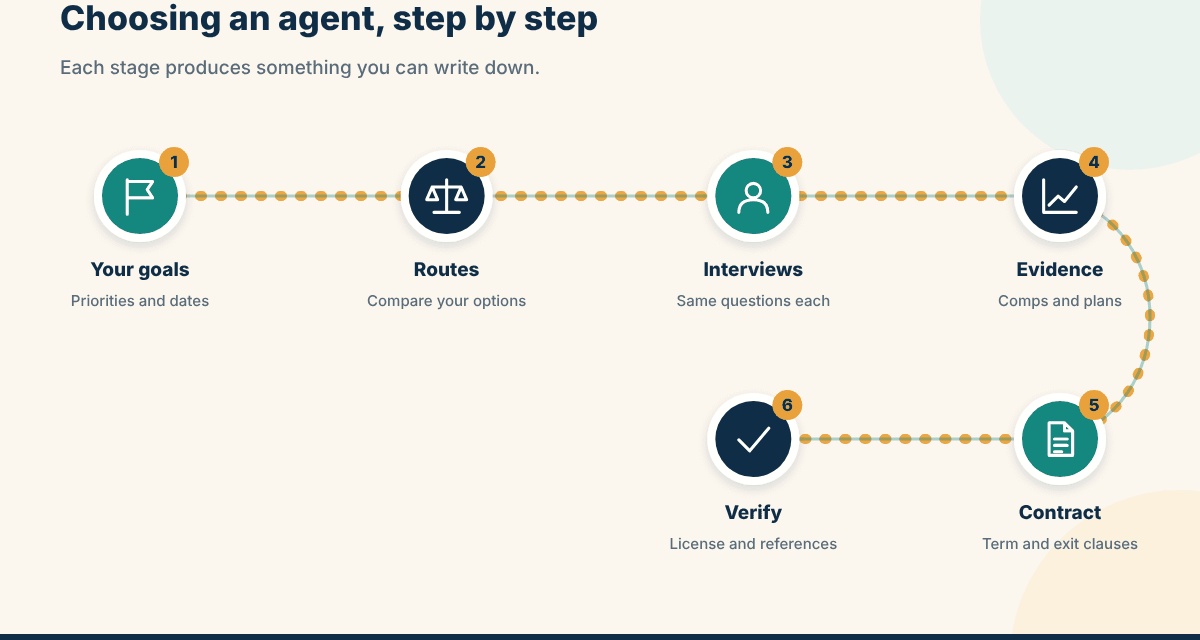
The roadmap above shows the order we suggest, and the sections below follow it. First you define the goal and the property facts. Then you compare the routes that exist. Then you test the finalists on pricing, marketing, negotiation, communication and contract terms. Last, you verify the paperwork. Each stage produces something you can write down, which keeps the final choice from resting on charm alone. Many sellers skip this step, and skipping it is the usual way that how to choose listing agent decisions go wrong.
How to choose listing agent finalists that fit your goal, constraints, and property
A useful way to frame how to choose listing agent finalists is to treat your goal as a filter rather than a wish. If you can only say “the most money possible,” every agent will agree with you, and the conversation will teach you nothing. If you can say “I need to close within a window, I will accept a somewhat lower price for a firm date, and I cannot do repairs,” the finalists have to show how their approach serves that exact set of trade-offs.
Write down four things in plain language. Your priority order among price, speed, certainty and effort. Your hard deadlines, such as a lease ending, a school start, a purchase closing or a relocation date. Your financial floor, meaning the lowest net amount that still lets you move forward after the loan payoff and costs. And your tolerance for disruption, including showings, open houses, photographers and the possibility of a price change.
Then describe the property honestly. Age, condition, deferred maintenance, unusual features, shared walls or association rules, any permit questions, and anything a buyer’s inspector would likely flag all belong on the page. An agent who has only seen your staged living room cannot tell you much. An agent who has heard the unglamorous version, including the sagging gutter and the unpermitted bathroom, can give a pitch worth listening to. Treat it as one more data point in how to choose listing agent candidates fairly.
Evidence to gather: your payoff, your floor, and your calendar
Start with the loan. Request a payoff letter or at least a current statement from every lender with a lien on the home, including any home equity line. Statements show a balance, but a payoff figure includes accrued interest and sometimes fees, so the two can differ by more than people expect. If you also have a lien from a contractor, a tax authority or an association, ask the relevant office for a written figure so nothing surprises you at the closing table.
Next, build a rough break-even picture. Take a hypothetical sale price, subtract the payoff, subtract an allowance for compensation and closing charges, and see what remains. The exact numbers will come later from quotes and the contract, and our guide to home sale net proceeds shows the method. At this stage you only need to know whether a lower-than-hoped price would still work for you. That single fact changes how you evaluate every pricing pitch. Seen this way, how to choose listing agent proposals becomes a question of evidence instead of charm.
Finally, put your calendar on paper. Note the earliest date you could realistically let people into the house, the latest date you must close, and any blackout periods for travel, medical needs or family events. Agents plan marketing backwards from timing, so a clear calendar lets them prove they can fit your plan. It also exposes pitches that quietly assume you have unlimited time or unlimited flexibility. Hold that thought as you continue with how to choose listing agent decisions.
One more fact belongs on this first page: what the sale must accomplish beyond cash. Some sellers need the proceeds to fund a down payment, and others need the house to be gone before a lease or a carrying cost becomes painful. Spelling that out is the first step of how to choose listing agent finalists honestly, because an agent can only plan around a need that has been stated out loud.
Many sellers also feel pressure from family, friends or a spouse who holds a strong opinion about price. Write those opinions down too. If a co-owner wants a particular number, the agent needs to hear it early, and you need to hear what the evidence says about it. Settling that conversation before the interviews keeps the whole process of how to choose listing agent candidates from turning into a debate about whose guess is right.
Finally, give yourself permission to change the plan. A goal sheet is a working document. If the first two interviews show that your timeline is unrealistic or that your repairs list will change the price conversation, update the page. Good sellers treat the sheet as something to revise with new facts, and they keep a dated copy of each version so they can remember why they chose what they chose. None of this is complicated, and all of it helps with how to choose listing agent options that suit you.
A scenario, an exception, and your next step
Picture a seller we will call Dana, using round illustrative numbers. Dana owes a balance that leaves comfortable equity at most plausible prices, but she must be out by a firm date because a new job begins in another state. Her priority order is certainty first, then price, then effort. When she interviews agents, she asks each one a single framing question: given my deadline, what would you do differently from a seller with no deadline?
The answers separate the field quickly. One agent explains a pricing approach built to attract offers early, a showing schedule concentrated in the first two weeks, and a plan for reviewing offers on a set date. Another repeats a generic pitch that never mentions her calendar. Neither answer proves skill, yet the first agent has shown that he listened, and the second has shown that the meeting was a script. Write the answer down, because how to choose listing agent finalists is easier when the facts sit on one page.
There is an exception worth knowing. Some sellers have no real deadline and a strong financial cushion, and for them patience is a legitimate strategy. If that is you, say so, because it changes what a good plan looks like. Your next step is simple: write your priority order and your three hard dates on one page, and bring that page to every interview so every agent answers the same question. It is worth repeating whenever you revisit how to choose listing agent finalists.
Notice what Dana did not do. She did not ask for a promised sale date or a promised price, because no honest agent can offer either. She asked for a plan shaped by her situation and judged the plan on how specific it was. That is a transferable habit, and it works whether your constraint is a deadline, a tight budget for preparation, an inherited property or a house you cannot easily show. It costs little to check, and it improves how to choose listing agent decisions more than most people expect.
Another way to use the same idea is to ask each agent to describe the sale that went worst for them and what they learned. Most thoughtful agents have a story, and the way it is told is revealing. Someone who blames the buyer, the market and the inspector for everything has told you something. Someone who describes a pricing error, a communication gap or a missed deadline, and explains what changed afterward, has shown a habit you want.
If you are selling with a partner, make sure both owners attend at least one interview, or share the same written summary afterward. Co-owners sometimes hear different promises from the same agent and discover the gap only after signing. A shared notes document, with each agent’s answers recorded in the same format, is among the simplest tools for good decisions, and it takes only a few minutes after each meeting. That detail alone can change how to choose listing agent finalists when two of them look similar.
Map the routes: full service, reduced service, flat fee, attorney-led, or on your own
Choosing an agent only makes sense after you know what else you could do. In most of the country a seller can hire a full-service listing agent, work with a brokerage that unbundles services, pay a flat fee for a listing placed on the local multiple listing service, rely heavily on a real estate attorney where that is customary, sell directly to a cash buyer or investor, or handle the sale personally. None of these is wrong in principle. Each moves cost, effort and risk to a different place.
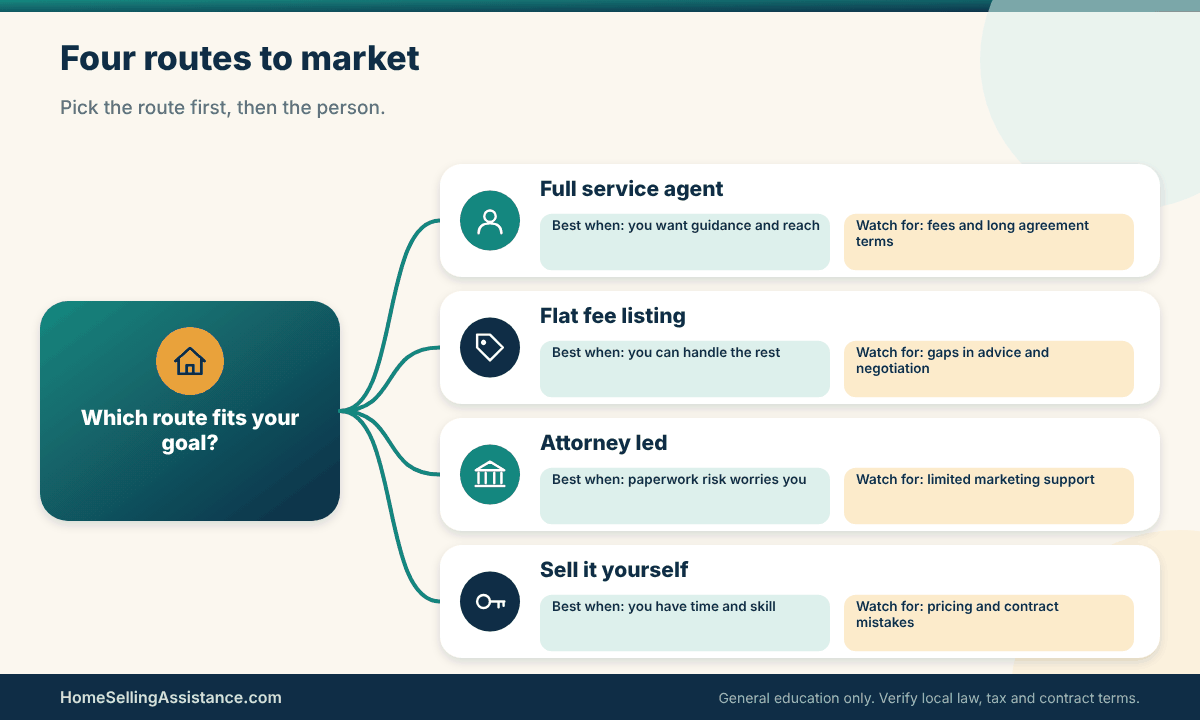
The diagram below compares the routes by the situation each one tends to suit and the trap each one tends to hide. Treat it as a map for questions, not a ranking. If you want a deeper look at going without an agent, our guides to selling for sale by owner and FSBO versus working with a Realtor walk through those routes without a thumb on the scale. Use the same test on every candidate so that how to choose listing agent comparisons stay fair.
Evidence to gather: what each route actually includes
The label on a service package tells you very little. “Full service” at one brokerage might include professional photography, a pricing analysis, a lockbox, a yard sign, a listing on the local database, negotiation, transaction coordination and help with inspection requests. At another it may include some of those, with photography or coordination as extras. Ask each candidate for a written list of what is included, what costs extra, and who actually performs each task. That small step quietly improves how to choose listing agent decisions.
That last question matters more than it sounds. In many offices the person who wins the listing is not the person who answers the phone, schedules the showings or chases the title company. A team model can work beautifully if the structure is clear, and it can feel like a bait and switch if you expected the senior agent to be at every step. Ask who your day-to-day contact will be, what their experience is, and what happens when your contact is away.
For the other routes, collect the same kind of facts. A flat-fee listing service should tell you exactly what the fee covers, whether it includes the database listing, how offers reach you, and who answers questions from buyer-side agents. Our overview of flat fee MLS listings for sellers lists the questions to put to those providers. An attorney-led route should come with a clear scope letter that tells you what the attorney will and will not do. You do not need special training to apply this to how to choose listing agent candidates.
If you want to see how service levels differ in practice, our comparison of a discount broker versus a full-service Realtor explains the usual trade-offs. The short version is that lower cost often means that you perform more of the work, and higher cost often means that the brokerage performs it. Neither is better by nature, and how to choose listing agent services depends on which tasks you are able and willing to take on yourself.
It also helps to know where an attorney fits. In some states a lawyer routinely prepares or reviews the contract, and in others the agent’s standard forms are used with little legal input. Our article on the listing agent versus a real estate attorney explains the difference in roles. An agent cannot give legal advice, and a lawyer is not usually a marketer, so many sellers end up using both. Remember it when how to choose listing agent proposals start to sound alike.
When you collect these service descriptions, put them in a single comparison grid of your own, with one row per task and one column per candidate. Photography, pricing analysis, open houses, offer review, inspection help, closing coordination and post-closing questions make a good starting list. Blank cells are informative. They show which tasks you would own if you hired that candidate, and they let you price your own time in a realistic way. The pattern repeats throughout how to choose listing agent decisions: ask, verify, then compare.
Scenario: when a different route beats a traditional listing
Consider a seller with a straightforward, well-maintained condo in a building with a steady flow of buyers. She is comfortable researching comparable sales, she has time for showings, and she is willing to learn the contract. For her, a reduced-service arrangement or a flat-fee listing with attorney review might serve her goals at lower cost. The trade-off is that she takes on pricing risk and negotiation work, and mistakes there can easily cost more than the compensation she saved.
Now consider a seller with an older house that has an unpermitted addition, a pending tax question and an elderly owner who cannot manage showings. A listing agent who knows how to sequence disclosures, vendors and buyer expectations may be worth considerably more to that seller, even at a higher cost. The same agent would add far less value to the condo seller. The route that wins depends on the property and the person, not on a universal ranking. If you remember one thing about how to choose listing agent proposals, make it this one.
There are also situations where neither route is the best first step. A seller facing a looming foreclosure deadline, a probate timeline or a divorce order may need an attorney or a housing counselor before an agent. A HUD-approved counselor can be reached through HUD’s counselor locator. Your next step here is to rank the routes against your one-page goal sheet and keep the top two in play, rather than deciding the route and the person at the same meeting.
One more caution about routes: the cheapest-looking path can become the costliest if it fails. A seller who tries a flat-fee listing, gets no traction and then hires a full-service agent after several weeks has not wasted everything, but the home now carries a longer history. That is not a reason to avoid the cheaper route. It is a reason to set a review date in advance and decide what you will do if the first approach is not working.
Our overview of flat-fee and FSBO guides collects the details. It is a practical filter for how to choose listing agent finalists when the pitches blur together.
Sellers also sometimes forget the cash buyer route when comparing. A direct purchase offer from an investor or a company that buys homes can be faster and simpler, and it usually comes at a discount to what a full marketing campaign might bring. Whether that trade is worth it depends on your priorities, and you can read about it in our guide to a cash offer for a house. Compare it honestly, with verified proof of funds, before you rule it in or out.
Once you have ranked the routes, say the ranking aloud to someone you trust. Explaining why you prefer one route exposes weak spots in your reasoning, and a friend or relative who asks naive questions can be useful here. The goal is not to find permission. The goal is to notice that you were about to skip a step. Then go on to the interviews knowing why you are asking each question. Sellers who do this tend to find how to choose listing agent decisions much less stressful.
What an agent can change: price, time, risk, and what you keep
An agent cannot change the market, the condition of your roof or the rate a buyer’s lender quotes. What a good one can change is the quality of the decisions made inside those limits: the price you start with, how the home is shown, how offers are compared, how problems are handled when an inspection or appraisal goes sideways. A weak one can quietly damage the same decisions. That is the reason how to choose listing agent candidates deserves more effort than most sellers give it.
This section covers the four skills that do the most work, which are pricing, marketing, negotiation and communication, and then the cost and contract side that determines what you keep. For each skill we describe what real evidence looks like, because the talking points are usually polished and the proof is where the differences show. Few details matter more for how to choose listing agent candidates in practice.
Judging how to choose listing agent skills in pricing, marketing, and negotiation
Pricing, marketing and negotiation are linked. A price that fits the evidence draws showings and strong offers, which gives the agent something to negotiate with. A price set to win the listing, or to flatter the seller, tends to produce a slow first month and a later reduction that buyers read as a warning sign. If you want the full mechanics, our guide on how to price a house to sell covers the method in depth. Here we focus on testing what an agent tells you.
Skill in each area can be examined. Ask the agent to show recent comparable sales in your neighborhood, explain what was adjusted and why, and describe where your house sits against active and pending listings. Ask for the marketing plan on paper. Ask how offers will be presented, how multiple offers will be handled, and what the agent has done when a buyer asked for repairs or a credit. Specific answers are a good sign. Vague answers deserve a follow-up question. That is the working logic behind how to choose listing agent finalists in a calm, orderly way.
Evidence to gather: comps, plans, and track records
Pricing evidence starts with closed sales, not asking prices. Ask each finalist for a short comparative market analysis before you decide, and treat the preparation as part of the audition. A solid analysis lists closed sales that are recent, nearby and similar, shows the adjustments for size, age, condition, lot and features, and also lists the active and pending homes you are competing against. If you want to understand what these reports can and cannot tell you, CMA versus appraisal explains the difference.
Marketing evidence is concrete too. Ask to see photographs the agent has shot or commissioned for recent listings, and judge them as a buyer scrolling on a phone would. Ask which channels are used beyond the local database, what the timing of the launch looks like, whether there is a plan for the first weekend, and what the agent does if showing activity is thin after two or three weeks.
A plan that includes a review date and decision rules is far more useful than one that promises exposure. Our guide to a listing agent marketing plan lists items to look for. A short written note on this point makes how to choose listing agent comparisons easier later.
Track record is the hardest evidence to read, because summary numbers can mislead. Closed-sale counts depend on price tier, area and whether the agent works alone or on a team. Instead of leaning on a single statistic, ask for a short list of recent listings similar to yours, how long each took to go under contract, whether the price changed, and what the agent would do differently. Then ask permission to call two of those clients. People will tell you far more on the phone than a brochure will.
When you review the comparative analyses, line them up in a single grid. Put the suggested list price, the lowest and highest closed sale used, the number of closed sales shown and the number of active competitors listed for each agent. Differences are normal, and they are the point. If one analysis uses sales from a different part of town or from last year, ask why. Looking closely at these differences is the heart of how to choose listing agent candidates on pricing skill.
Ask also how each agent would adjust the price after two or three weeks if showings were lower than expected, and what specific signs would trigger a change. Showing counts, online views, feedback themes and competing listings are all signals, and a thoughtful agent will name which ones matter most to them. An agent who says the price will not need to change is making a promise nobody can keep, and an agent who says it might and explains how is being honest. Think of it as a quick quality check on how to choose listing agent candidates.
Keep a short log of what each agent promised to send after the meeting and when it arrived. Prompt, complete follow-up is an everyday sample of the service you will get during the listing. Late or partial follow-up, particularly while the agent is trying to win your business, rarely improves after signing. This is a small test, but it costs you nothing, and it tends to predict the experience better than a polished presentation does.
Scenario: two pricing pitches, one honest, one flattering
Imagine two agents visit the same house. Agent A suggests a list price noticeably higher than the others, explains that the market is strong, and says offers will likely follow. Agent B suggests a lower figure, walks you through four closed sales, shows two active listings that would compete directly, and says your kitchen will probably draw a price comparison with the cheaper of those two. All numbers here are illustrative, but the pattern is common. It also keeps how to choose listing agent decisions tied to your own goal sheet.
Agent A’s pitch feels better and may even be right. The risk is that it is built to win your signature. A listing that sits tends to invite lower offers later and gives buyers a reason to ask what is wrong. Agent B’s pitch feels more cautious, but it shows work that you can check. You do not have to pick B. You do have to ask A for the sales behind the number, and to notice how the agent responds to being asked.
It is worth saying what a good version of Agent A looks like, because high prices are sometimes justified. A home with a rare feature, a unique lot or a recent renovation may deserve a bolder strategy, and a confident agent may be right. The question is whether the bolder plan comes with a defined review date and an agreed step down if the market disagrees. That structure turns ambition into a managed risk. It is one of the best practical signs when you are deciding how to choose listing agent proposals that stretch the price.
You can also ask each agent how they would explain a price reduction to you, and when. This question surfaces attitude. Some agents see a reduction as a failure and avoid raising it, while others treat it as a normal tool to be planned. Because a reduction almost tends to cost more when it comes late, an agent who raises it calmly and early is protecting your interests. Our article on price reduction strategy covers the mechanics.
Keep notes on the tone as well as the content. Did the agent listen to your concerns about the house, or talk past them? Did they treat your questions as an interruption, or as the point of the meeting? These impressions are subjective, but they matter, because you will work with this person through several stressful weeks. Combine them with the evidence, and give the evidence the greater weight. Plenty of sellers learn this lesson late, so build it into how to choose listing agent decisions now.
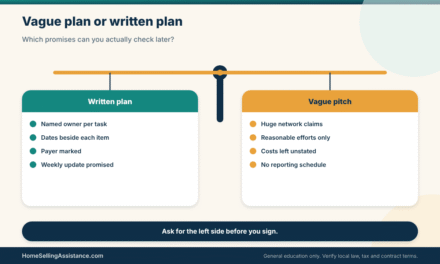
The picture below contrasts what a pitch built on evidence tends to look like with one built on persuasion. Use it as a quick screen during interviews. If you find yourself on the right-hand side, you have not found a bad agent necessarily, only a pitch that is not yet proven. Ask for more information, give the agent a chance to supply it, and see whether the follow-up arrives promptly and in writing. It fits neatly into how to choose listing agent decisions without adding much work.

Market conditions, communication, compensation, and the listing agreement: where the real costs sit
Your own list of criteria should shift with the circumstances of the sale. In a market where buyers compete, the agent’s skill at running a clean multiple-offer process matters most, and our guide to handling multiple offers as a seller explains what that involves. In a slower market, pricing discipline, marketing quality and patience matter more, and so does an agent who will tell you when to adjust. Condition, financing and contract terms push the weights around further. This is why the process of how to choose listing agent finalists rewards patience.
Condition is a good example. A house in strong shape can sell on photographs and price. A house with deferred maintenance needs an agent who will help you decide what to fix, what to disclose and what to leave for a credit negotiation. Financing matters because some buyers are stronger on paper than others, and an agent who can read a pre-approval letter, a proof-of-funds statement or a contingency list adds real protection. Buyer variables include how many buyers will bring their own agents and how the compensation question will be handled.
Local sales data and buyer pool signals.
Local evidence is the center of this section. Ask the agent how many homes like yours sold in the last several months, how many are currently active, and how fast the better-priced ones went under contract. You can verify some of that yourself on public listing sites and county records, and you should. A candidate who welcomes verification and even suggests where to look is demonstrating confidence. One who bristles at the question has told you something too. Put differently, how to choose listing agent proposals is mostly about asking for proof.
Ask about the likely buyer pool. Is your home the kind that attracts first-time buyers with loans that carry appraisal and condition requirements, move-up buyers with a home to sell, investors, or downsizers with cash? Each group behaves differently on timing, contingencies and inspections. An agent with real local experience can describe the pool without stereotyping anyone and can explain what that pool tends to ask for in contracts. Fair housing rules apply here, so a good agent describes the property and market, never the people. HUD explains those obligations at its fair housing pages.
Finally, ask how the agent reads current conditions without leaning on a universal rule. Be cautious about any claim that sounds like a law of the market, such as a fixed discount or premium that supposedly applies everywhere. Local conditions change by neighborhood, price tier and season. An agent who says “it depends, and here is what it depends on” is usually more reliable than one with a formula. Apply the same standard to every person you interview, and how to choose listing agent decisions get easier.
Seasonality is another variable that deserves a careful conversation. Some areas have clear busy and quiet periods, others barely notice the calendar, and still others are shaped by school years, employer cycles or weather. No national rule tells you when your neighborhood is strongest. Ask each candidate how local timing patterns affect your specific price tier, and ask for evidence from last year’s sales in your area. This is a reasonable part of how to choose listing agent partners with real local knowledge.
Interest rates and lending conditions affect buyers in ways that vary by price tier and loan type, so ask how current financing conditions are affecting buyers for homes like yours. A knowledgeable agent will describe the pattern in terms of what they are seeing in contracts: how often buyers need financing contingencies, how often appraisals are an issue, how many offers include concessions. These are observations to verify, not predictions, and a good agent knows the difference.
Finally, ask what the agent would do if the market shifted during your listing. Changes in rates, a nearby development announcement or a wave of new listings can alter conditions in weeks. A prepared agent will describe how often they check the market and what they would tell you. That kind of answer shows a monitoring habit, which is worth more than a confident forecast. It is another reason to treat how to choose listing agent decisions as an ongoing relationship.
A stale listing history and an anxious seller.
Suppose a seller had a prior listing that expired without an offer. The old agent is no longer returning calls, the photographs are dated, and buyers in the area have seen the listing sit. The new agent has two tasks: diagnose why the first attempt failed, and persuade the market to look again. Illustratively, the diagnosis might be price, condition, marketing or timing, and the cure differs for each. That is part of what makes how to choose listing agent finalists a skill you can practice.
A thoughtful candidate will ask to see the old listing, the showing feedback and the price history, and will say plainly which of the four causes looks most likely and what evidence supports that view. A less careful candidate will propose relisting with a fresh sign and new pictures, which treats a possible pricing problem as a presentation problem. Neither pitch guarantees an outcome. The first, though, shows the habit of looking at evidence before choosing a fix.
For your next step, write down which of the four causes you suspect and ask each finalist to respond to your theory. If they disagree with you, ask them to show why. Disagreement backed by data is valuable. Agreement with no analysis is just agreement. Whatever you hear, make sure the final recommendation and its reasoning come to you in writing, so you can compare it with what happens after the listing goes live. If a candidate resists a reasonable version of this request, note it as part of how to choose listing agent evidence.
Whatever theory you hold, test it against the facts the old listing left behind. Search the public record for the previous list price and any reductions, look at how many days it was active, and compare it with homes that sold nearby in the same window. If the old price now looks high compared with recent sales, the diagnosis is probably pricing. If the price looked fair and showings were low, photography and marketing deserve a hard look. This kind of detective work is a good model for how to choose listing agent partners.
It is also worth asking how a candidate would handle the stigma of a stale listing. Some agents suggest a new start with a fresh strategy, while others recommend waiting, changing the presentation or adjusting the price more sharply. There is no single correct answer, and what matters is whether the reasoning rests on the evidence from your listing rather than on a stock script. Ask for the reasoning in writing so you can review it later.
Lastly, protect yourself from a previous agreement that may still bind you. If the old listing agreement included a protection period, buyers who saw the home during that term could still trigger compensation after you sign with someone new. Read the old paperwork, and ask the new agent how such overlaps are handled in your state. If there is any doubt, a short consultation with a real estate attorney can save a costly dispute later. The more concrete the answer, the easier how to choose listing agent decisions become.
Communication is the skill sellers rate highest afterward and ask about least beforehand. Ask each agent how often you will hear from them, by what channel, and what a typical update contains. Ask who gives you showing feedback, how quickly questions are answered, and what the agent’s approach is when there is bad news. A promise of weekly updates is concrete. A promise of being “always available” is not, and few people can honor it. Think of it as insurance for how to choose listing agent decisions.
Compensation is the other half. Brokerage compensation is negotiable, and in the period since the industry’s recent settlements it is meant to be agreed in writing instead of assumed. Practices differ by brokerage and local market, so the agreement in front of you is the only reliable source. Our guides on seller real estate commission and on whether a seller pays the buyer’s agent cover the concepts. For the national association’s current statements, see NAR, and then check what your local brokerage actually does.
It is one reason we treat how to choose listing agent candidates as a research task, not a popularity contest.
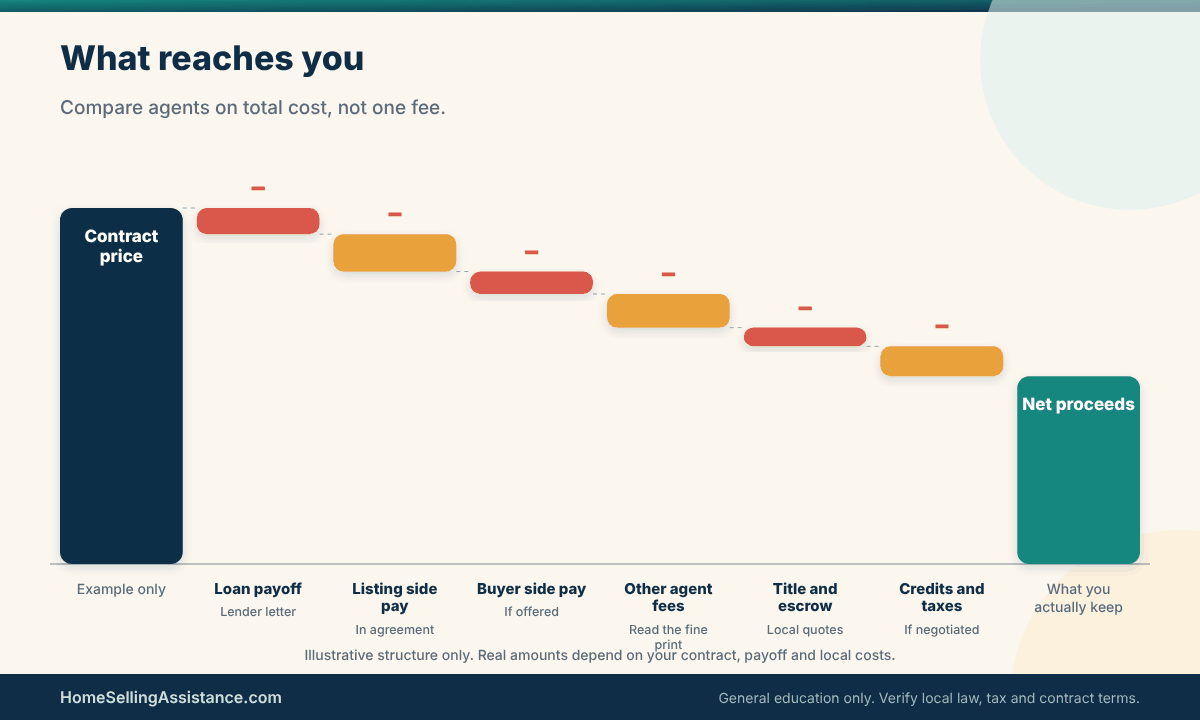
To see why the written terms matter so much, picture the money moving from a contract price to the amount that reaches you. The graphic below shows the typical order of deductions. Every sale has its own mix, and several of those bars may be small or absent for you. The exercise is to fill in each bar with a real quote before you compare agents, so a lower headline fee does not hide a higher total.
Evidence to gather: the listing agreement, line by line
Ask for a blank copy of the listing agreement before the interview ends, and read it at home without pressure. Look first at the type of agreement. An exclusive right to sell arrangement generally means the brokerage earns compensation if the property sells during the term no matter who finds the buyer, which our guide to the exclusive right to sell listing agreement unpacks. Other forms exist, and the names and details vary by state and brokerage. Keep your notes, since how to choose listing agent decisions often look different a week later.
Then read the term, which is the number of days the agreement lasts. A longer term gives the agent more time to recoup marketing costs and gives you less freedom to leave. Next, find the cancellation clause: what notice is required, whether there is a fee, and whether the brokerage must agree. Look for a protection period, sometimes called a tail, that keeps compensation payable if a buyer who saw the home during the term buys it after the term ends. Our article on cancelling a listing agreement explains how these clauses usually work.
Read what the agreement says about compensation to buyer-side brokers, administrative or transaction fees, marketing costs charged to you, who may hold the key and sign, and what your obligations are to disclose and cooperate. Anything unclear is a question for the agent, and for a real estate attorney if the stakes are high. The agreement is a contract. Offering to change a clause is normal, and agents regularly adjust terms for sellers who ask politely and early.
For a fuller walkthrough of the document itself, our guide to the listing agreement for sellers goes section by section. Use it next to the sample agreement, and mark every clause you do not understand. Keep in mind that a form you are handed may be a brokerage standard, and the idea that it cannot be changed is often a habit, not a rule. Asking is how you find out, and it is a basic part of how to choose listing agent terms you can live with.
Pay attention to what the agreement says about price changes, showing restrictions and which marketing items are included. Some agreements let the agent change the list price only with your written approval, which is a sensible protection. Others are silent, and silence leaves room for misunderstanding. If you have a hard rule, such as no open houses on certain days or no signage, put it in the agreement or an addendum so there is no question later. Good agents tend to welcome this, which makes it useful when you think about how to choose listing agent partners.
Finally, ask what happens if you decide to sell to someone you already know, such as a neighbor or relative. Many agreements treat that sale as covered, and compensation may still apply depending on the language. This is a common source of surprise, and it is far better to learn the answer at the kitchen table than at the closing table. Anything you are unsure about, take to an attorney before you sign. Take a moment to apply it to how to choose listing agent candidates before you sign.
Scenario: a slow-response complaint and the exit clause
Imagine a seller four weeks into a listing who has not received showing feedback, whose calls go to voicemail, and who finds out about a price comment from a neighbor rather than the agent. She wants out. Whether she can leave depends entirely on the paper she signed. If the agreement has a clear termination right after a short notice, the process is quick. If it requires the broker’s consent, the conversation moves to the managing broker. There is no single correct answer, but there is a more careful way to approach how to choose listing agent decisions.
The sensible order is to document the problem, speak to the agent directly, and ask for a written plan with dates. If nothing improves, contact the managing broker, since the brokerage, not the individual agent, is generally the party to the contract. Many disputes end with a mutual release or a reassigned agent. Some end with a fee or a protection period that still applies. Reading these clauses before signing is much cheaper than reading them in frustration.
A separate point is that you should keep records of every exchange when something is going wrong. Dates, times, brief summaries and copies of messages make it possible to explain the problem clearly to a managing broker or, if needed, to a state regulator. Most issues are solved long before that stage, but a calm and organized record helps the people trying to help you. It is part of how to choose listing agent relationships that remain workable under pressure.
Also keep in mind the difference between a service problem and a performance problem. A service problem, such as slow replies, is about how the agent works with you, and is often fixable with a direct conversation and a clear schedule. A performance problem, such as a persistent pricing mismatch, is about the plan itself, and may need a strategy discussion. Naming which one you face helps you ask for the right remedy. This kind of detail is what separates a careful approach to how to choose listing agent finalists from a hurried one.
If you do decide to leave, aim for a written mutual release rather than walking away informally. A signed release states that the agreement has ended, describes any remaining obligations such as a protection period, and avoids later disputes about compensation. Ask for it to be reviewed by an attorney if there is any question about fees. Quiet, documented endings tend to protect both sides and make your next listing smoother. This also shows why how to choose listing agent decisions reward preparation.
Your next step is to take the sample agreement from each finalist and mark three clauses: term, cancellation and protection period. Compare them side by side. If one candidate offers a shorter term or a clearer exit, that is worth weighing alongside everything else, since a good agent has little to fear from a fair exit clause. The table below pulls the main decision points together. When you are unsure, return to this point and rethink how to choose listing agent candidates from your goals.
The first table is a decision-support summary that links common seller situations to the fact that matters most, a practical action, the trade-off, and the document where you can verify it. Use it as a checklist when you compare finalists. Pick the row that looks most like your situation, do the action in the third column, and note the trade-off in the fourth before you settle on anyone. Even a quick pass improves how to choose listing agent decisions.
| Situation | Key fact | Practical action | Trade-off | Source or document |
|---|---|---|---|---|
| Firm move date | Timing shapes pricing and showings | Ask for a dated launch and review plan | Faster plan can mean a lower price | Written marketing plan |
| Agent suggests a high price | Price must match closed sales | Request the sales behind the number | Honest number may feel disappointing | Comparative market analysis |
| Agent offers a long term | Term limits your freedom to leave | Ask for a shorter term or clear exit | Agent may want time to recoup costs | Listing agreement |
| Agent is on a team | Daily contact may be someone else | Ask who handles each task | Team depth versus personal attention | Service description |
| Compensation looks fixed | It is negotiable and written down | Ask for every fee in writing | Lower fee may mean fewer services | Compensation section |
| Home needs repairs | Condition drives disclosure choices | Ask how repairs and credits are handled | Repair now versus credit later | Inspection and disclosure forms |
One more point on using the table: the rows are not scored, and no row is automatically a deal-breaker. A long term with an easy exit can be perfectly fair, and a lower fee with a clear scope can be a good fit. What the table does is turn a vague feeling into a named trade-off. Once a trade-off has a name, you can decide whether you accept it, negotiate it or walk away from it. Done early, it makes the later steps of how to choose listing agent decisions much simpler.
Turn your research into a verification roadmap for how to choose listing agent decisions
By this point you have a goal sheet, a short list of routes, a few agents who have pitched you, and a pile of impressions. The last stage of how to choose listing agent decisions is verification, which means turning impressions into facts and facts into a signed agreement you understand. Verification feels slow, and it is usually the cheapest hour of the whole process. A mistake found before signing costs a phone call. The same mistake found at closing can cost real money or a delayed move.
We split the work into two parts. The first is the set of documents and professionals that belong in your file. The second is a sorting exercise: what must be decided before the home goes live, and what can safely wait until an offer arrives. Together they give you a calendar you can follow, with a fallback for each stage, which the second table at the end of this section lays out in detail.
Documents and professionals to involve before you sign a listing agreement
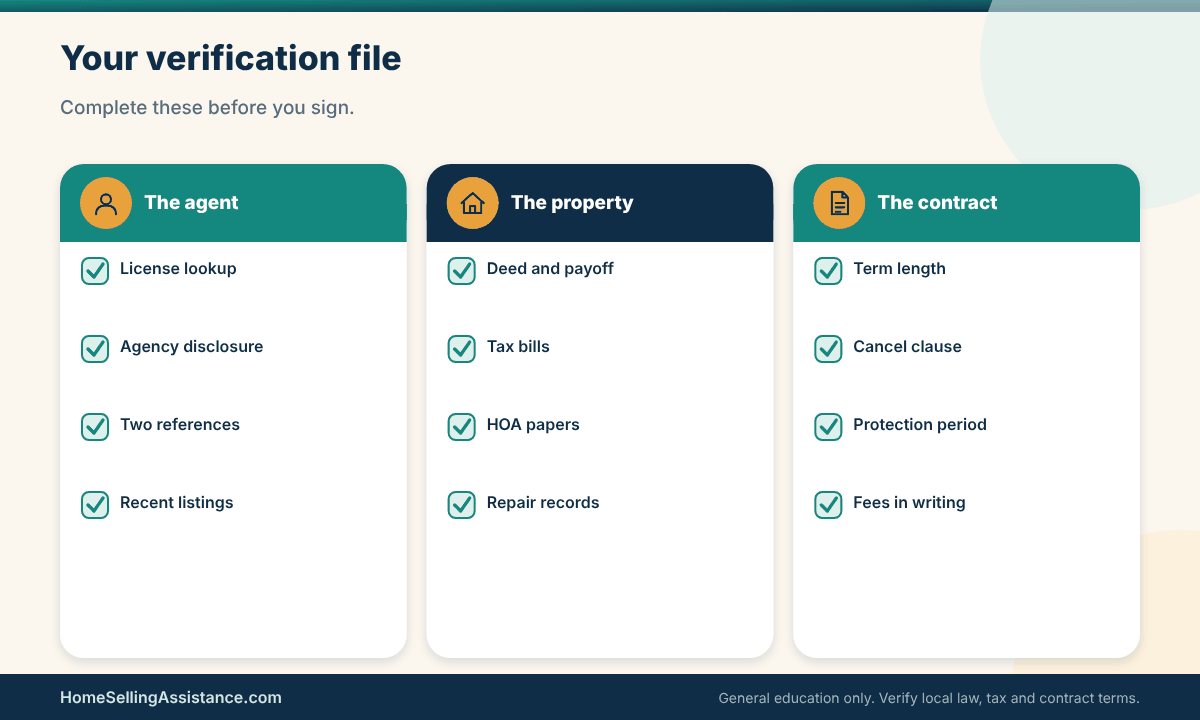
Think of your file as three folders. One holds proof about the agent: license, brokerage, references and recent activity. One holds proof about the property: ownership, loan, tax, association and condition papers. One holds the agreement itself, along with the marketing plan and any addenda. The graphic below lists what belongs in each, and a seller who has these ready tends to move through the first two weeks of a listing with fewer surprises. Revisit the point after each interview, because how to choose listing agent decisions benefit from a second look.
The professionals around you matter as much as the paper. Your agent is one of several people who touch the sale, along with a title or escrow company, possibly a real estate attorney, a lender on the buyer’s side, an inspector, an appraiser, and sometimes a tax professional or a housing counselor. Knowing how to choose listing agent partners includes knowing which of those other people you may need and when, so that the agent’s role does not quietly expand into advice that belongs to a lawyer or accountant.
Evidence to gather: license lookup, disclosures, and references
Begin with the license. Every state has a real estate regulator, often called a real estate commission or department, and most publish a lookup tool where you can search a name and confirm that a license is active, who the supervising broker is, and whether any public disciplinary action exists. Names of agencies and procedures differ from state to state, so search for your state’s real estate commission by name. This takes about five minutes per candidate and is worth doing even for someone a friend recommended.
Then ask for the brokerage’s required disclosures. Many states require agents to give consumers a written explanation of agency relationships, which describes whom the agent legally represents and what duties apply. Read it. It tells you whether the agent might represent both sides in some situations, a practice that is allowed in some states and restricted or prohibited in others, and what you would be asked to consent to.
Ask the agent plainly how that would work if the same office also represents a buyer for your house. It is a fair question for every finalist, and it sharpens how to choose listing agent decisions.
References and reviews come last, because they are the easiest to polish. Ask for two or three recent clients whose situations resemble yours, such as a house of similar age or a seller with a similar timeline. Ask those clients what happened when something went wrong, since that is when an agent’s habits show. Online reviews can help, but read them for specifics rather than stars. A review that mentions the inspection negotiation tells you more than ten that say “great agent.”
For the property folder, collect your deed or a copy of recorded ownership, your latest mortgage statement and payoff contact, property tax bills, any association documents and fee statements, repair receipts and permits, warranties, and past inspection reports. If you hold the title through a trust or an estate, add the governing papers. If lead paint could be present because the home was built before 1978, the federal rule explained at the EPA’s disclosure page applies, and a good agent should raise it without being asked.
A paper trail is also your defense against sloppy statements. If an agent says a permit was closed, a fee is waived or a service is included, the way to confirm it is a line in the agreement or an email. Verbal promises have a way of fading when the sign is already in the yard. Politely asking an agent to put a promise in writing is normal, and good agents do it without offense because they have heard the request many times.
It also protects the agent from the same misunderstanding. Few sellers ask, so asking can sharpen how to choose listing agent decisions noticeably.
While you are at the regulator’s site, look for educational material on consumer rights. Many state commissions publish plain-language guides to agency, disclosure and complaint processes. Reading one takes ten minutes and gives you a baseline for judging the agent’s explanations. It is a small but effective step in how to choose listing agent professionals who respect the rules of the state where your home is located.
Remember that a license check confirms status, not quality. An agent can be fully licensed with a clean record and still be a poor match for your property or your communication style. Likewise, a minor complaint from years ago does not necessarily rule someone out, and context matters. Treat the lookup as a gate you must pass, and the interview and references as the measure of fit. Keep it simple, and let it guide how to choose listing agent decisions.
You may also want to verify the brokerage itself, including its address, its supervising broker and how long it has operated. A strong agent in a poorly run office can still struggle to get you the support you need. Ask who reviews contracts, who handles trust accounts for deposits and what the brokerage does if the agent leaves. Those operational answers are easy to ask and rarely requested, which is why they are so informative. The answer will not settle everything, but it moves how to choose listing agent finalists forward.
A scenario, an exception, and your next step: a promising agent with a thin record
Suppose a newer agent impresses you more than the veterans did. The pricing analysis is thorough, the marketing plan is detailed, and the communication has been prompt. The catch is a short record of closed sales. The temptation is to dismiss that agent because of limited history. The better move is to ask what supports the work: who supervises, what a more experienced colleague will review, and how the brokerage handles a problem at the managing broker level.
A newer agent with strong supervision and real effort can serve a straightforward listing well. An agent with a long record can still be stretched across too many clients. Experience is evidence, not proof, and the reverse holds for inexperience. Where the home has complicated issues, such as title defects, tenants, estate authority or a unique property type, the depth of the support network matters more than any individual’s years in the business. It is a reasonable standard for how to choose listing agent finalists in any market.
There is an exception where the thin record should give you pause: if the agent cannot show you how a problem would be handled, and cannot name anyone who would review the pricing or contract work. In that case, ask for the managing broker to join a second meeting. Your next step is to write down the question you most want answered about each finalist and hold a second, shorter conversation focused only on that question, with a manager present when it makes sense.
Rules differ by state and brokerage, so confirm the details locally as part of how to choose listing agent decisions.
Compare that with the opposite case, an agent with a very long record who treats your listing as routine. Experience can breed efficiency, and it can also breed shortcuts. Watch for signs that the agent has not looked closely at your home, such as generic comments, a pitch that sounds identical to what you heard from a neighbor, or an analysis that ignores features you mentioned. Both ends of the experience scale need the same checks. It is a good reminder that how to choose listing agent finalists is a matter of evidence, not of reputation.
If your gut says to give a newer agent a chance, you can structure the arrangement to reduce risk. Ask for a shorter term, a defined review date, clear exit rights and a named senior contact for questions. A fair agent who is confident in the work will often agree. If the answer is a flat refusal to adjust any term, consider what that says about how future disagreements would go. You can use it again the next time how to choose listing agent questions come up.
Another approach is to ask both the thin-record agent and a veteran the same hard question, such as how they would handle a low appraisal, and compare the answers for depth. Often the differences are smaller than expected, and sometimes the newer agent has thought harder about the problem. Let the quality of the reasoning count for more than the years on the business card, and write down what you learn. A calm review of this point improves how to choose listing agent decisions for most sellers.
What to decide before listing, and what can wait until an offer arrives
Not every decision has the same deadline, and mixing them up is a common source of stress. Some choices, such as the price strategy, the listing agreement terms, the showing rules and disclosure paperwork, belong before the first photograph is taken. Others, such as which offer to accept, how to answer an inspection request or whether to agree to a particular closing date, cannot be decided in advance because they depend on facts that do not exist yet. The goal is to settle the first group fully and prepare frameworks for the second.
Preparation for the second group is a gift to your future self. If you decide in advance how you will weigh price against closing date, what you would accept in repair credits, and which contingencies you can live with, you can respond to offers calmly. A seller who has never thought about those trade-offs tends to react to the loudest number. Our guide on how to evaluate a home offer as a seller walks through the comparison method. Small items like this add up, and they are the real substance of how to choose listing agent decisions.
Evidence to gather: the pre-listing decision list and the deferred list
Make two lists on one page. On the first, write the decisions to settle before launch: your priority order, your pricing approach and review dates, the agreement term and cancellation terms, what compensation arrangement you are offering to buyer-side brokers if any, which repairs you will do, who will sign disclosures, and your showing rules for pets, security, notice and occupancy. These should be written, agreed with your agent, and kept where you can find them.
On the second list, write what you will decide only when facts arrive: how to compare multiple offers, whether to counter, how to respond to an inspection report, what to do if an appraisal comes in low, and how to handle a request to move the closing date. Next to each item, write the information you will need and who can supply it. That prompts you to line up a title company contact, an attorney’s phone number and a rough repair cost source in advance.
It rarely takes long, and it makes how to choose listing agent comparisons far more reliable.
You should also settle your communication rules before launch. Agree on how quickly offers will be forwarded to you, whether you want phone calls or messages for urgent items, who is authorized to speak with buyers directly, and how showing feedback will be shared. Put it in an email so there is a record. If something goes wrong later, a prior written expectation makes the conversation much easier for everyone involved. Our questions to ask a listing agent about price article includes a good set for this stage.
Keep this page flexible, because circumstances change. A buyer may ask for a long closing, a repair request may arrive earlier than expected, or a financing issue may show up late. Review the lists with your agent at each major step and move items from the deferred list to the decided list when facts arrive. This habit turns your preparation into a living tool and is one of the most practical parts of how to choose listing agent support that fits you.
It is wise to line up your outside professionals at this stage too. Find a title or escrow company you trust, ask whether an attorney is customary in your state, and get a few quotes for likely repair items so you can respond quickly to a request. If tax questions are on your mind, such as the home sale exclusion explained in IRS Publication 523, schedule a conversation with a qualified tax professional before an offer arrives. Add it to your checklist for how to choose listing agent finalists, and move on to the next item.
Pay attention to the order in which you tell different people things. If you are about to sign a purchase contract on your next home, or you have a lease ending, your agent should know before you sign the listing agreement, not after. Hidden deadlines are among the most common sources of tension between sellers and agents, and a single frank conversation at the start can prevent a lot of friction later. It is a simple and valuable habit to build.
Scenario: an offer arrives in week one and the decision list pays off
Imagine an offer arrives on the second day of a listing. It is slightly under the list price, but the buyer has a short financing contingency and a flexible closing date. The seller has never had to choose between a higher price with more risk and a lower price with more certainty, and the agent’s deadline for a response is tight. This is the moment when preparation separates calm decisions from panicked ones. Doing so keeps how to choose listing agent decisions grounded in facts you can verify.
A seller with a written priority order can see that certainty ranks above price in her plan, ask a handful of targeted questions about the buyer’s lender and funds, and respond in a few hours. A seller without that framework may either accept too fast or stall until the buyer walks. Neither outcome is certain, because buyers and markets vary, but the prepared seller has more control. Our guide to counteroffer strategy for sellers shows how to respond without losing a good buyer.
Your next step is to schedule a short call with your chosen agent before the listing goes live, walk through both lists, and ask the agent to point out anything missing. A thoughtful agent will welcome it. If the agent seems impatient with preparation, consider whether that reveals how they plan to treat your questions later. Preparation also gives you an easy way to measure the agent’s work: you can check each decision against the plan you made together. Most of all, it helps you stay in charge of how to choose listing agent decisions.
In the same spirit, practice a short decision routine for any offer. Read the full contract, not just the headline price. List the price, the financing type, the deposit, the contingencies, the closing date, the possession terms and any requests for credits. Rank the offer against your priority order, then ask your agent for a recommendation and the reasons. Writing the routine in advance makes it far easier to follow when the pressure is on, and it is a core piece of how to choose listing agent guidance that you can test in real time.
The same routine helps you judge your agent’s advice. If the recommendation lines up with your priority order and the reasoning is clear, you have a good signal. If it does not, ask why. A thoughtful agent will welcome the question and either explain or revise the view. An agent who pushes back sharply on a polite request for reasoning is showing you how disagreements may go later, and it is better to learn that now than after closing.
After the first offer has been handled, take a few minutes to review what you learned. Which parts of the plan worked, which assumptions were wrong and what would you change? Short reviews like this keep you in charge of the process. They also give you concrete evidence for the review date conversation about price and strategy, which is where many listings are won or lost. Treat the first week as a source of data, not just a test. Whatever you learn here feeds directly into how to choose listing agent decisions at signing time.
The second table below is a transaction map. It shows each stage from the interview through closing, what you are responsible for, what depends on the buyer or on other professionals, the usual deadline type, and a fallback if something slips. Real deadlines are set by your contract and local custom, so the cells describe types of deadlines rather than numbers. Use it to build your own calendar once you have a signed agreement and, later, a signed sale contract.
| Stage | Seller responsibility | Buyer or professional dependency | Deadline type | Fallback |
|---|---|---|---|---|
| Interviews | Share goals and property facts honestly | Agents prepare analyses and plans | Your own decision date | Interview one more finalist |
| Verification | Check license, references, agreement | Regulator lookup, brokerage forms | Before signing | Ask attorney to review the contract |
| Signing | Negotiate term and cancellation clauses | Brokerage approves changes | Before launch | Request a shorter term |
| Launch | Prepare home, sign disclosures, set showing rules | Photographer, agent, database entry | Agreed launch date | Delay launch to finish prep |
| Offers and negotiation | Compare terms against your priority order | Buyer agent, lender letters, funds proof | Offer response deadline | Counter or ask for more time |
| Inspection and appraisal | Respond to repair requests and value issues | Inspector, appraiser, lender | Contract contingency dates | Credit, repair, reprice or reopen |
| Closing | Review figures, sign, hand over keys | Title company, lender, attorney if used | Contract closing date | Extension or backup offer |
Read the table from left to right, and notice the fallback column. A fallback is not pessimism. It is the difference between a delay and a crisis, and the cheapest time to choose a fallback is before you need it. If the fallback for a stage is something you cannot afford, such as a long extension, that tells you where to build in a cushion.
Your agent should be able to name the most common slips at each stage and what usually fixes them in your area. That habit will serve you well beyond how to choose listing agent decisions, too.
Two more habits keep the calendar honest. First, ask your agent to send a short written summary after every major event, such as a showing weekend, an offer, an inspection or an appraisal. The summary should say what happened, what happens next and by when. Second, review the summary against the contract dates each week. Mismatches show up early that way. These habits are simple, and they are the practical end of how to choose listing agent partners who communicate in a form you can use.
If you want to explore more of the topics that follow from this choice, our collection of listing agent and commission guides goes deeper on each one. And if a different part of the process worries you more, such as the contract language, the real estate sales contract is a good next read, since the listing agreement and the sale contract work together and share many of the same defined terms. Taken together, these points make how to choose listing agent decisions manageable.
Safety is part of the calendar too. Be wary of any request to change wiring instructions or payment details by email, and confirm such requests by phone using a number you already know. The FBI’s Internet Crime Complaint Center describes how these scams work, and our guide to real estate wire fraud for sellers covers prevention. An agent who raises this topic unprompted is demonstrating the kind of care you want from someone handling your sale.
Frequently asked questions about how to choose listing agent
How many agents should I interview?
Three is a practical minimum for most sellers, because two can feel like a coin flip and three gives you a middle option. Interview more if the property is unusual or if your first three give you answers that all sound alike. Ask each the same questions in the same order, and request the same written materials. That keeps the comparison fair and shows you who follows through on small requests.
Is the agent who suggests the highest price the best choice?
Not automatically. A high suggested price can reflect real market knowledge, or it can reflect a wish to win your signature. The test is evidence: ask for the closed sales behind the number and the adjustments applied. If the support is solid, the high price may be right. If the support is thin, treat the number as an opening claim, not a finding.
Should I choose the agent with the lowest compensation?
Compensation is one factor, and it is negotiable and written into the agreement. A lower figure can be a good deal when the scope of service is clear, and a poor one when it comes with fewer services or extra fees. Compare the total cost under the same assumptions, using real quotes, and compare what you get for it. Practices differ by state and brokerage, so read the actual agreement.
What should a listing agreement include that I might miss?
Check the term, the cancellation process, any protection period, fees besides the headline compensation, the arrangement for buyer-side brokers, and what the brokerage must do in return. Also read the sections on key access, signage, photographs and use of your information. If anything is unclear, ask for a plain explanation in writing, and consider having a real estate attorney review it where that is customary or the stakes are high.
Can I cancel a listing agreement if I am unhappy?
It depends on the contract and your state. Some agreements include a clear termination right, while others require the broker’s consent or charge a fee. Document your concerns, talk to the agent, and then speak to the managing broker. Reading the cancellation clause before you sign is the best protection, since a clause is far easier to negotiate before the yard sign goes up.
Do I need a real estate attorney as well as an agent?
In some states attorneys are a standard part of closing, and in others they are used mainly for complications. An agent can explain the process, but only a licensed attorney can give legal advice about your rights. If your sale involves a trust, an estate, a divorce, a title problem or a contract clause you do not understand, an attorney review is a sensible step. Your state bar can help you find one.
How do I check an agent’s license and record?
Search for your state’s real estate commission or department and use its license lookup. You can usually confirm that the license is active, identify the supervising broker and see public disciplinary actions. Some states also list complaint outcomes. A clean lookup is not proof of skill, though a problem on the record is useful information.
What if the agent is part of a team?
Teams can work well, particularly for sellers who want several people handling photography, paperwork and showings. Ask who your primary contact will be, who handles each task, and what experience each person has. Get those details in writing so you are not surprised later. If the rainmaker pitches you and an assistant manages your sale, make sure that arrangement suits you before signing.
Are online reviews and rankings reliable?
They can offer clues, but they are easy to polish and hard to compare. Read the reviews for specifics, such as how the agent handled an inspection dispute or a delay, rather than counting stars. Treat rankings that rely on sales volume with caution, since volume depends on price tier, area and team size. A phone call with a recent client usually tells you more than a page of reviews.
What if I cannot decide between two good candidates?
Go back to your goal sheet and ask which agent’s plan fits your top priority most closely. Then compare the contracts: a shorter term, clearer exit and well-defined services can break a tie. You can also ask each finalist for one more written response to the same specific question. How to choose listing agent finalists fairly is partly about patience, and a short delay before signing is far cheaper than a poor fit.
A calm way to decide
Choosing a listing agent is a decision you can make with evidence instead of instinct, as long as you start with your own goals, compare finalists on the same questions, read the agreement before you sign, and verify what you are told. This article is general education, not legal, tax or financial advice, and rules about agency, compensation and contracts vary by state and brokerage, so check with your state real estate commission, a local attorney or your title company about your sale. Take your time, ask for it in writing, and trust the plan you can explain.