If your house was built before 1978, the lead paint disclosure seller duty is one of the few paperwork steps in a home sale that comes straight from federal law, and it applies whether you list with an agent, sell on your own, or accept a cash offer from a neighbor.
Most sellers have heard of the lead paint disclosure seller form but have never had to think about what is actually on it. A buyer or agent slides a one-page document across the table, you sign where the yellow tabs are, and everyone moves on. That works fine when the facts are simple. It works badly when you remember a repaint from 1995, when an old inspection report is sitting in a drawer, or when the contract you are using leaves out a piece the federal rule requires.
This article walks through what the federal rule asks of you, what it does not ask, how the buyer’s ten-day opportunity to inspect fits in, and how to keep a clean paper trail. It sits inside our wider library on seller disclosures and required paperwork, and it pairs with our cornerstone guide to seller disclosure requirements, which covers the other forms you may meet.
A caution before we start. This is general education, not legal advice. State rules, local customs and the exact wording of your contract all affect what you do. Where we give numbers, they are either stable federal rules or clearly labeled examples, and we will tell you how to confirm anything that depends on where you live.
Key takeaways
- The year decides the duty. A home built before 1978 falls under the federal rule for most sales, so a lead paint disclosure seller review starts with a reliable construction date, not a guess.
- You disclose what you know; you are not asked to test. Federal law requires sellers to share known lead-based paint information and any available records, but it does not require testing or removal.
- Several items go in the packet. The EPA pamphlet, the lead warning statement, your disclosure of what you know, a list of records, and signed acknowledgments all belong in the file.
- Buyers get a window to inspect. The federal default is ten days for a lead inspection or risk assessment, and the parties may agree in writing to a different period or waive it.
- Timing matters. The disclosure belongs before the buyer is bound by the contract, and the signed acknowledgment should be kept for the period federal rules require.
- Check local layers. States, cities and contracts can add to any lead paint disclosure seller duty, so confirm with your state agency, a title company or an attorney before you sign.
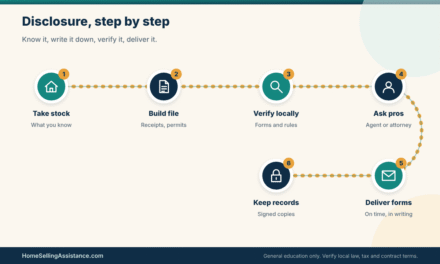
Here is the whole journey at a glance, from confirming the age of the house to keeping the signed record after closing. Each stop on this path gets its own section below.

Start with the house: does a lead paint disclosure seller duty apply to you?
The first job is to decide whether the lead paint disclosure seller rule reaches your sale at all. That sounds trivial, but sellers get tripped up by additions, rebuilt homes and units whose age is not obvious. A few careful minutes with your records can save a contract amendment later.
Who signs the lead paint disclosure and which document controls
Every owner who is selling signs. If title is held by two spouses, three siblings or a trust, each seller or the person with signing authority completes the seller portion. The buyer signs the purchaser acknowledgment, and the real estate agents involved, if any, sign a short certification that they informed the seller of the seller’s duties and that they have complied.
The controlling document is the federal disclosure language itself, usually built into your state’s standard contract or attached as a separate addendum. If your contract form says the lead paint addendum is “attached” and nothing is attached, the file is incomplete, even if everyone believes they covered it verbally.
Evidence to gather: construction year and ownership records
Start with the county assessor or recorder. Property tax records usually list a year built, though that figure is sometimes an estimate made decades ago. Cross-check it against your closing papers from when you bought, an older appraisal, building permits, and any plat or subdivision date. If the numbers disagree, write down which source you trust and why.
Then look at who actually holds title. The deed, a trust certificate, or letters from a probate court tell you whose signature belongs on the form. For an estate, our guide on an executor selling a house explains why the person signing may be a personal representative rather than the heirs. Assemble these papers before the first showing so the lead paint disclosure seller file never waits on a signature question.
Ownership records matter for a second reason: they show how long anyone in your chain of title has known the house. If you inherited it, bought it from a relative, or took it in a divorce settlement, the paperwork trail may be thinner than usual. That is normal, and it does not change the lead paint disclosure seller duty. It just means you will answer the “what do you know?” question from a shorter file.
If you cannot find the original construction date anywhere, a local building department can often tell you when the first permit for the structure was issued. A title company can sometimes pull older recorded plats. These small lookups cost little and tend to settle an argument that would otherwise rest on somebody’s memory.
A scenario, an exception, and your next step: the 1978 line
Picture a ranch house the county lists as built in 1979. Your original closing papers, though, show the builder’s permit was issued in 1976 and the house was finished in 1977. The tax roll is wrong, and the home sits on the covered side of the line. If you rely on the county year and skip the disclosure, you have a problem the buyer’s lender or agent may spot later.
The reverse happens too. A house with an older core and a large rebuilt addition may have parts from different decades. The federal rule looks at the housing as a whole, so mixed-age properties are worth a short call to your agent, title company or attorney. When the age is truly unclear, the cautious path is to complete the lead paint disclosure seller forms rather than argue about the date.
One more exception deserves a mention. The federal rule has a short list of housing types that fall outside it, and sellers sometimes assume they qualify when they do not. A cabin that is “basically a shed,” a duplex with one rented side, or a condo unit in an older building is not automatically exempt. Treat an exemption as something you confirm from the official text, not something you infer from the way the property feels.
Your next step is a two-line note in your file: the year you decided applies, and the source behind it. If a buyer’s agent later questions the date, you can answer in seconds. A lead paint disclosure seller who can point to a permit or a recorded plat is in a much calmer position than one who says the county probably has it wrong.
Federal rule, state add-ons and local practice
The federal lead paint disclosure seller rule is the floor. It applies nationwide to what the regulations call target housing, which means most residential housing built before 1978. Some states and cities add requirements on top, such as extra notices, certified inspections in certain rental contexts, or their own disclosure forms that mention lead alongside other conditions.
Think of it as layers. The federal layer says what must be disclosed and when. The state layer may add forms or enforcement. The local layer, such as a city program, may add inspection rules that matter more for rentals than for owner-occupied sales. Your contract usually blends them, but it does not always catch up with recent changes.
The graphic below sorts the common starting points into four situations, so you can see at a glance which path your house is likely to follow.

State differences show up in surprising places. One state may fold lead into a general property condition form, while another keeps it separate and adds a short health department notice. Cities with older housing stock sometimes run their own programs, which are more often aimed at rental units than at an owner’s sale, but they can still affect what a buyer expects to see.
You do not need to become an expert in every layer. You need to know which layers exist where you live and who can answer questions about them. Your state real estate commission, a local title company, and a real estate attorney are the usual three. Ask the same question of two of them if the answer matters, and write down what you heard.
Evidence to gather: the EPA and HUD source text
Go to the source rather than a summary. The Environmental Protection Agency keeps a plain-language page on the federal real estate lead disclosure rule, with the pamphlet, sample language and the list of exemptions. Read it once, top to bottom, and keep a printed copy with your listing papers.
Write down three things from it: whether your house is covered, which items you must provide, and what the buyer’s inspection period is. Then ask your agent, title company or attorney how your state’s standard form handles each of those. Where the answers do not match, trust the federal text for the floor and ask a professional about the rest.
The table below gathers the main issues into one place. Use it as a map of who controls what, then fill the last column with answers from your own state and county.
| Issue | Controlling document or authority | Seller obligation or choice | Deadline | Local verification |
|---|---|---|---|---|
| Is the home covered? | Federal rule for pre-1978 housing | Confirm build year and any exemption | Before listing | County assessor, permits, closing file |
| EPA pamphlet | Federal rule and EPA materials | Give buyer the current pamphlet | Before buyer is bound | Download current version from EPA |
| Known lead-based paint | Seller disclosure statement | Disclose what you know, or state you have no knowledge | Before buyer is bound | Ask attorney about extra state forms |
| Reports and records | Records you hold | Hand over available reports and list them | Before buyer is bound | Check old inspections and renovation files |
| Buyer inspection window | Federal default plus contract | Allow ten days, or sign a different agreed period or waiver | Set in the contract | Confirm contract wording with agent or attorney |
| Signed record | Acknowledgment pages | Keep copies for the required period | After closing | Ask title company who holds the file |
Read across a row to see the chain of responsibility. Read down a column, especially the last one, to see where a phone call or a click on an official site will turn a general rule into a firm answer for your sale.
Scenario: your state adds its own lead form
Suppose your state’s standard contract bundle includes a separate lead addendum that uses slightly different wording than the federal sample. Do not treat the state form as a replacement for the federal items. The usual approach is that the form carries the federal content, and the buyer still receives the pamphlet and the full acknowledgment.
If you are unsure, ask the person drafting your contract to confirm in writing that the form satisfies the federal rule. A title company or real estate attorney can usually answer that in a short call. That small check is much cheaper than an amended contract after the buyer has already moved into inspections and financing.
Seller-friendly habits help here. Keep a plain list of every form you sign in the order you sign it, and tick each one off the day it is completed. When a state addendum and the federal materials both appear, put them in the folder together, so a buyer, lender or attorney who asks about lead finds one tidy set instead of scattered pages. A tidy lead paint disclosure seller record also makes it easier to answer questions months after closing.
If you are working with an agent, ask them to walk you through the lead paint disclosure seller pages line by line at the listing appointment. A good agent will do this without fuss. If you are selling without one, a one-hour consultation with a real estate attorney to review your forms is a modest cost compared with the stress of reworking a signed contract.
Turn the federal rule into a seller workflow
Knowing the lead paint disclosure seller rule is one thing. Running it inside a real sale, with showings, offers, a lender and a closing date, is another. The workflow below keeps the lead paint disclosure seller steps in the same order as the rest of the transaction, so nothing gets handled at the last minute.
The picture shows three phases. Before listing is where you do the quiet preparation. Under contract is where the buyer’s window and your paperwork meet. Closing is where the file gets finished and stored.

The lead paint disclosure seller packet, step by step
Think of the lead paint disclosure seller packet as a small folder you could hand to any buyer without editing. It holds the federal pamphlet, the lead warning statement, your written disclosure, a list of any reports or records, and the signature and acknowledgment pages. Preparing it early means the first serious offer does not trigger a scramble.
Sequence matters in a lead paint disclosure seller workflow. The federal rule expects the buyer to receive the information before becoming obligated under the contract. In practice that means the packet goes out with, or before, the offer is accepted, not at the closing table. Many sellers put it in the listing documents so every buyer sees the same thing from the start.
A few practical habits keep the lead paint disclosure seller packet usable. Put the pamphlet on top, because buyers often ask for it first. Place the disclosure form next, with every blank filled in rather than left empty, since an empty field can read as either “no” or “forgot.” Then add the records list and any attached reports, and finish with the signature pages, so the folder reads in the same order the federal rule describes.
Resist the urge to improvise. Sellers sometimes want to add comments such as “paint looks fine to me.” Opinions about condition are different from knowledge of lead-based paint, and they can confuse the record. Stick to facts: what you know, what you have, and what you do not know.
Evidence to gather: what you actually know and what records you hold
Your disclosure rests on two honest questions. What do you know about lead-based paint or lead-based paint hazards in the home? And what reports, inspections, risk assessments or renovation records do you have that mention lead? Answer both from memory and paper, and write the answers down before you open the form.
Knowledge can come from many places: a prior inspection summary, a contractor’s note about old paint, a letter from a previous owner, a child’s elevated blood test result handled through a health department, or a renovation you supervised. Records can be as plain as a one-page lab report. If you hold something, the rule expects you to share it and list it. If you hold nothing, say so plainly on the form, which is a perfectly acceptable answer for many sellers.
Here is a short checklist graphic to keep beside you while you assemble the folder. It groups the items by what you provide, what you sign, and what you keep.

The word “knowledge” deserves a moment. It covers what you personally know and what you have been told in a way you believe. It does not mean you must investigate. If you have no reason to think lead-based paint or hazards are present beyond the age of the house, the honest statement is that you have no knowledge, and the form has a place for exactly that. The key is accuracy: say what is true today, and update it if the facts change.
What if you honestly cannot remember? A sensible approach is a quick search of your files and a call to anyone who worked on the house, then an honest answer based on what you find. If you still cannot resolve it, tell your agent or attorney and ask how to word the statement. Do not guess in either direction. A careful lead paint disclosure seller process prefers a documented “I looked and found nothing” to a casual “I think not.”
Scenario: a seller who knows nothing, and a seller who knows something
Take two sellers of similar 1960s houses. The first bought ten years ago, never saw a lead report, and has no knowledge of lead-based paint beyond the age of the home. She checks the box saying she has no knowledge and that she has no reports, hands over the pamphlet, and signs. That is a normal, honest completion.
The second seller remembers that a painter once scraped a porch and mentioned old paint underneath. He also has a renovation invoice that notes lead-safe work practices. He must disclose that knowledge and list the invoice as a record. Neither seller has to test or repair anything. The difference is only what each one knows and holds, and the form should show that difference accurately.
One more detail trips up sellers who rent rooms or units. If part of the home is tenant-occupied during the sale, the same disclosure duty applies to the sale, but showing the home and sharing the packet raises practical questions about access and notice. Our guide to selling a tenant-occupied house covers the lease side, and your attorney can help you line up the lead paint disclosure seller paperwork with any tenant notices your state requires.
Another common situation is the fixer-upper sold as-is. An “as-is” label shifts some repair expectations, but it does not erase the lead disclosure. If you are weighing that route, read our overview of selling a house as-is and keep the lead pages in the lead paint disclosure seller packet regardless.
Handing the packet to buyers, agents, title and attorneys
Once the lead paint disclosure seller packet exists, the next question is who gets it and how you prove it. The buyer is the first recipient. Agents on either side are the second, because the federal rule gives them their own duties to make sure the seller’s obligations are met. The title company or closing attorney is the third, since they often store the completed acknowledgment with the closing file.
Handoffs in a lead paint disclosure seller file go wrong in familiar ways. An email with the pamphlet gets lost in a long chain, a buyer signs a different version, or the addendum is in the contract folder but never initialed. Treat each handoff as a small event you can point to later: who received what, in what form, on what date.
Handoffs deserve a routine. When you send the packet by email, ask the recipient to reply with a short note confirming receipt, and save that reply. When you hand it over in person, have the buyer or agent initial a cover sheet that lists the contents. If the buyer is working with an agent, send the lead paint disclosure seller packet to the agent as well, because the agent has duties of their own under the rule and will want to confirm they have it.
Title companies and closing attorneys can help here too. Many collect the signed acknowledgment as part of their closing checklist, which is a useful second set of eyes. Ask them early whether they need anything from you, so your lead paint disclosure seller documents are in their hands well before the closing appointment.
Evidence to gather: acknowledgments, signatures and retention
Gather four proof points. First, the buyer’s signed acknowledgment that the buyer received the pamphlet and your disclosure. Second, the agent certifications where agents are involved. Third, the dates next to every signature. Fourth, the contract language that sets the buyer’s inspection period or records a waiver.
Federal rules expect sellers and agents to keep a copy of the signed acknowledgment for a set period after the sale. The commonly cited period is three years from the completion of the sale, which you can confirm on the EPA disclosure page. Ask your title company or agent who keeps the master copy, and save your own scan in a folder labeled with the property address and closing date.
The matrix below turns common sale situations into a quick decision aid. It is a way to see what is at stake and whom to call, not a ruling on your sale.
| Situation | Seller options | Risk | Document to review | Escalation point |
|---|---|---|---|---|
| You know of no lead paint issues | State that on the form and hand over the pamphlet | Wrong answer if you forgot a report | Old inspections, renovation files | Agent or title company |
| You have a prior lead report | Disclose it and attach or list it | Leaving it out can look like concealment | The report and the records list | Real estate attorney |
| Buyer wants a lead inspection | Allow it within the agreed period | Dispute over dates or access | Contract inspection clause | Agent or attorney |
| Buyer waives the window | Record the waiver in writing | A verbal waiver proves little later | Signed waiver language | Agent or closing attorney |
| Contract form lacks the lead pages | Add the federal addendum before signing | Incomplete paperwork at closing | Contract and addendum list | Title company or attorney |
| Seller is an estate or trust | Disclose what the signer knows and holds | Unclear signer authority | Letters, trust certificate | Probate or estate attorney |
If your situation sits in the last column more than the first, treat that as a signal to bring in a professional early. For an inspection-based sale, our overview of the inspection contingency from the seller’s side shows how the lead window can sit alongside the general inspection period.
It also helps to think through how a lead finding changes the rest of the transaction. If the buyer is financing, a lender may have its own requirements for the home’s condition, and an appraiser may note deteriorated paint. Those requirements belong to the lender and appraiser, not to the federal disclosure rule, so ask the buyer’s lender what they need rather than guessing. A flexible, written plan for dates keeps a financing timeline from slipping.
Whatever the outcome, keep a copy of the report, the dates and any written agreement about credits or repairs. If you agree to repair paint, use a contractor who is qualified under the federal lead-safe work rules for older homes, and ask for paperwork when the job is complete. That record becomes part of the story of the sale, and it supports the honest answers you gave on the lead paint disclosure seller forms.
Scenario: the buyer wants a lead inspection
A buyer under contract on a 1950s house asks to hire a certified professional to test for lead-based paint. This is exactly the opportunity the federal rule creates. You cannot refuse the window if your contract includes it, though the parties can agree to change the length or waive it in writing.
Your practical job is access and calendar. Offer reasonable times, ask who will be on the property, and keep the dates in writing. If the result comes back with findings, the buyer may ask for a repair credit, a price change, a specific fix, or to cancel under the contract’s terms. The rule does not tell you which answer to give. That is a negotiation, and it follows the same logic as any inspection response, a topic covered in our guide to inspection repair requests and your options.
One more practical point. Keep your tone steady and factual. A buyer’s lead inspection is not an accusation, and a seller who responds calmly usually keeps the deal on track. If a result looks unclear, ask for the written report, share it with your agent or attorney, and agree on the next step in writing before anyone starts work.
Notice what this scenario shows about sequencing. A seller facing a lead finding does not need to decide anything about the repair on day one. The first job is to acknowledge the request, confirm dates, keep an open channel with the buyer, and gather records. Many regrets in lead matters come from replying fast and vaguely rather than slowly and clearly. A calm written reply buys time to think and to consult a professional.
If your buyer is represented, route technical questions through the agents when that is your contract’s practice. If you are selling directly, keep the exchange in writing and polite. In either case, the lead paint disclosure seller file should show a steady pattern: a request, a response, a date, and a result.
Build a verification checklist for your lead paint disclosure seller file
Before you sign a listing agreement or a sales contract, run one last verification pass. The goal is simple: every statement on the form should trace back to a document, a conversation you can describe, or an honest “I do not know.” A short, orderly lead paint disclosure seller checklist keeps that pass from turning into a scavenger hunt.
Verification is also where fair treatment of buyers shows up. The same packet, the same pamphlet and the same answers should go to every buyer who asks, in line with the principles in our guide to fair housing for home sellers. Lead disclosure is about the condition of the home and what the seller knows.
It is never a reason to treat prospective buyers differently, and it should never be used to steer anyone toward or away from a home because of who they are, including whether they have children. The HUD fair housing resources explain the broader rules for sellers and advertisers.
Official sources and recorded documents to check
Two kinds of sources matter for any lead paint disclosure seller review. Official sources tell you what the rule requires: the EPA page, the current pamphlet, and your state’s real estate commission or health department materials. Recorded or stored documents tell you what is true about your house: permits, inspection reports, repair invoices, appraisals and prior disclosure forms from when you bought.
Keep them in two stacks. The first stack answers “what must I do?” The second answers “what do I know?” When a buyer or agent asks a question, you will know which stack holds the answer, and you will be less tempted to answer from memory alone.
Evidence to gather: pamphlet version, forms and prior reports
Begin with the pamphlet. The federal materials are updated from time to time, and your agent’s old printout or a forwarded PDF may not match the current edition. Download the current English version, and if the buyer prefers another language, check what the EPA offers on its disclosure page. Print a copy for the file and note the date you downloaded it.
Next, pull the forms. If you bought the home after a disclosure was handed to you, find the one you received, because it may mention lead, past remediation or a prior inspection. Look at your original closing folder for a home inspection report from your purchase. Even a decades-old report that mentions paint condition is information you may be expected to share if you still have it.
Finally, search for renovation records. Contractors working on pre-1978 homes are subject to separate federal lead-safe work rules, so an invoice may mention containment, cleaning or test results. If you remodeled before listing, our piece on a pre-listing home inspection explains how a report you commission yourself becomes part of what you may need to share. Keep copies of anything that might qualify and add it to the records list.
Official sources age as well. An agent’s cheat sheet from several years ago may not mention a recent change, and a social media post may state a rule too broadly. A good test is whether you can name the page you got the information from and the date you looked at it. If you cannot, spend five minutes confirming it on the agency’s own site before you rely on it in a negotiation.
Recorded documents deserve the same discipline. A recorded document is one filed with the county, such as a deed or a plat, while a stored document is one sitting in your files. Both are useful, but they answer different questions. County records show ownership and boundaries, while your own files show what you learned about the house over the years, including the parts relevant to lead.
Scenario: an old inspection report surfaces late
Imagine the buyer is under contract and you are cleaning out the garage. In a box of papers you find a home inspection from the year you bought, and one line says some exterior paint may contain lead and should be treated with care. You had forgotten it.
Do not tuck it back in the box. Tell your agent or attorney, share the report with the buyer, and update the list of records in writing. The earlier you disclose, the more options everyone has, including time for the buyer to decide whether to use the inspection period. Sellers who disclose late, quietly or only when asked create the very disputes the rule is meant to prevent.
A related habit is worth building. Whenever you find a new document, add a date and a note on where it came from. A simple log of “found, shared with, date” protects your credibility and gives your attorney a clean timeline if a question arises months after closing.
Consider how a buyer’s agent reads your packet. They look for the pamphlet, the lead warning language, the seller’s statement, the records list and the signatures. If any piece is missing, they will usually ask for it, but a missing piece can also signal a seller who is not organized, which can make a buyer wonder what else might be missing. A complete packet quietly builds trust.
Likewise, check that the packet matches your other disclosures. If your general condition form mentions old paint peeling on the porch, the lead paint disclosure seller pages should be consistent with it. Our article on material defects and seller disclosure explains how different disclosures should line up, and why contradictions are a common source of later disputes.
What must be current before you sign the sales contract
Lead paint disclosure seller paperwork goes stale. A pamphlet printed last spring, a disclosure written before a repair, or a contract template from a previous sale can all be out of step by the time you sign. The final pass is about freshness, not just completeness.
The question to ask on signing day is this: is every statement in this packet true as of today, and does every page in the contract reflect the deal we actually made? If the answer is yes on both counts, you are in a strong position. If either answer is no, stop and fix it before the pen moves.
Include a quick comparison with your listing materials. If the marketing description calls the house “meticulously maintained” and the disclosure mentions a prior paint concern, that is not necessarily a conflict, but make sure the two do not tell different stories. A candid, consistent record is easier to defend and easier for buyers to trust. Our guide to the seller disclosure versus the inspection report explains how these documents complement each other.
Finally, confirm logistics. Who will send the signed pages to the title company? Who will keep the master copy? How will the buyer’s inspection period appear in the transaction calendar? A two-minute email thread settling these questions is part of any careful lead paint disclosure seller review.
Evidence to gather: the final read-through list
Build a one-page list and tick it off in order. Confirm the construction year and the basis for it. Confirm the pamphlet is the current edition. Confirm that your disclosure matches what you know today, including anything you learned since you started preparing. Confirm that the records list matches the documents you are handing over.
Then check the contract. Does it include the lead warning statement? Does it show the buyer’s inspection period or a written waiver? Are all sellers’ names and signature lines correct? Are the acknowledgment pages dated? Our overview of the real estate sales contract from the seller’s side explains how these pieces fit with the rest of the agreement.
A graphic can help here. The decision tree below shows what to do if new lead information appears just before signing, which is a more common surprise than most sellers expect.

Some sellers like to build a signing-day habit. Bring a printed list, a pen, and a second person if you can, such as a spouse, a co-owner or your attorney. Read the lead pages aloud before signing. It feels slightly formal, but it catches blanks and wrong dates more reliably than skimming. If something looks off, pause. A short delay before signing is almost always cheaper than a correction afterward.
If you are signing electronically, check that every lead page is in the signing envelope and that each signature field is attached to the right person. Electronic signature platforms make it easy to send an incomplete package, and the platform will happily collect signatures on whatever you put in it. A final PDF download that you page through yourself is the best check.
Scenario: a contract rewritten at the last minute
Late in negotiations, an agent sends a revised contract after a fresh counteroffer. The price and dates changed, and the document set is now a new version. The lead pages from the earlier draft were attached to the old version, and nobody noticed that the new version arrived without them.
Catch this by comparing the page list on both versions before you sign. If a page is missing, ask for it to be added and for the signature lines to be re-dated. Do not rely on a promise to fix it at closing. A closing attorney or title officer can often spot the gap, but the cleanest fix is making sure the signed contract is complete the day it becomes binding.
Finally, take a photo or scan of every signed page before you leave the table, and ask your agent, attorney or title company to confirm in writing where the originals will be stored. If you are selling without an agent, our walkthrough of for sale by owner paperwork lists the other documents to collect alongside the lead paint disclosure seller paperwork.
As you finish, one last habit is worth adopting. After closing, put the whole lead packet, the final signed contract pages, the log of documents you found and shared, and your notes on sources into one folder, digital and paper. Years from now, a question from a buyer, a lender or an attorney is easier to handle when the full lead paint disclosure seller record is in one place and the dates line up.
If you take one message from this guide, let it be this: the rule is about information and timing, not about perfection. You are not asked to fix the past or promise the future. You are asked to share what you know, hand over what you have, give the buyer a fair chance to look, and keep the proof. Most sellers can do that comfortably with a little preparation and one or two good questions to the right professionals.
Quick scenario
A seller lists a 1968 split-level, hands every buyer the pamphlet and the disclosure, and records that she has no knowledge of lead paint and no reports. Midway through escrow, her brother mentions an older inspection from his own purchase of the same builder’s home down the street. That report is not hers and does not describe her house, so it is not hers to disclose, but the conversation is a good reason to double-check her own files once more. She does, finds nothing new, and notes the date of the check in her log.
Frequently asked questions about lead paint disclosure seller duties
What does a lead paint disclosure seller actually have to hand over?
For a covered home, the seller provides the EPA pamphlet, includes the lead warning statement in the contract, discloses any known lead-based paint or hazards, and lists or provides available records and reports. The seller and buyer then sign acknowledgments, and agents add their own certification. Your state form may add other items, so confirm the full set with your agent, attorney or title company.
Does the rule apply if I am selling without an agent?
Yes. The lead paint disclosure seller duty attaches to the seller of covered housing, not to the presence of an agent. If you are selling on your own, you handle the pamphlet, the disclosure and the signed acknowledgments yourself, which makes a clean packet even more valuable. A real estate attorney or title company can review your lead paint disclosure seller pages before you sign.
Do I have to test my house for lead paint before selling?
No. The federal rule for a lead paint disclosure seller asks you to disclose what you know and share records you have, not to commission testing or remove paint. A buyer may choose to test during the inspection opportunity, and you may choose to test first if you want more information, but neither is a federal requirement for the seller.
How long does the buyer have to inspect for lead?
For a lead paint disclosure seller, the federal default is ten days, and the parties can agree in writing to a different period or waive the opportunity altogether. The exact wording in your contract controls how the period starts and ends. Put any change in writing, because a spoken agreement is hard to prove later.
What if my house was built in 1978 or later?
The federal lead disclosure rule is aimed at housing built before 1978, so a newer home is generally outside it. Still, confirm the build year with reliable records, because county data can be wrong, and check whether your state or contract asks for any other disclosure. When in doubt, ask your agent or attorney.
Are there sales that are exempt from the federal rule?
Yes, the regulations list a few exemptions to the lead paint disclosure seller duty, such as certain zero-bedroom units, some housing for older or disabled residents, housing certified as lead-free, and sales like foreclosure sales. Because the details matter and can be misread, check the EPA page and ask a professional before assuming that your sale qualifies.
What if I remember something after the buyer has signed?
A lead paint disclosure seller who remembers something late should tell the agent or attorney promptly, share the information with the buyer in writing, and update your records list. Prompt, plain disclosure leaves the most room for everyone to respond. Waiting until closing, or hoping the issue never comes up, tends to create the kind of conflict the rule exists to avoid.
How long should I keep the signed paperwork?
Federal rules expect a lead paint disclosure seller to keep the signed acknowledgment for a set period after the sale, commonly cited as three years from completion. Keeping the whole lead packet with your closing records for longer costs you nothing and can answer questions later. Ask your title company who holds the official copy.
Can I be penalized for getting the form wrong?
For a lead paint disclosure seller, federal law gives agencies enforcement powers, including civil and criminal penalties, and buyers may have a right to sue for damages. The consequences depend on the facts and the law that applies, so do not rely on a general article for that answer. If you are worried about a past sale or a current mistake, speak with a real estate attorney.
Keep the paper trail simple
A clear lead paint disclosure seller file is mostly a matter of order: confirm the year, gather what you know, hand over the full packet before the contract binds, and keep the signed pages. This article is general education, not legal, tax or financial advice, so check your state rules and your actual contract with a licensed professional before you sign.