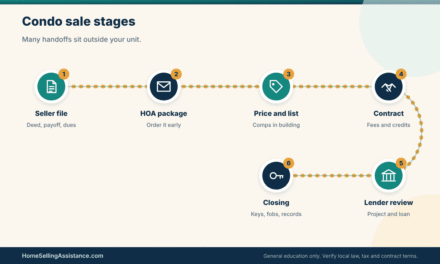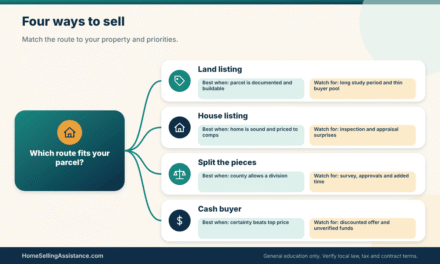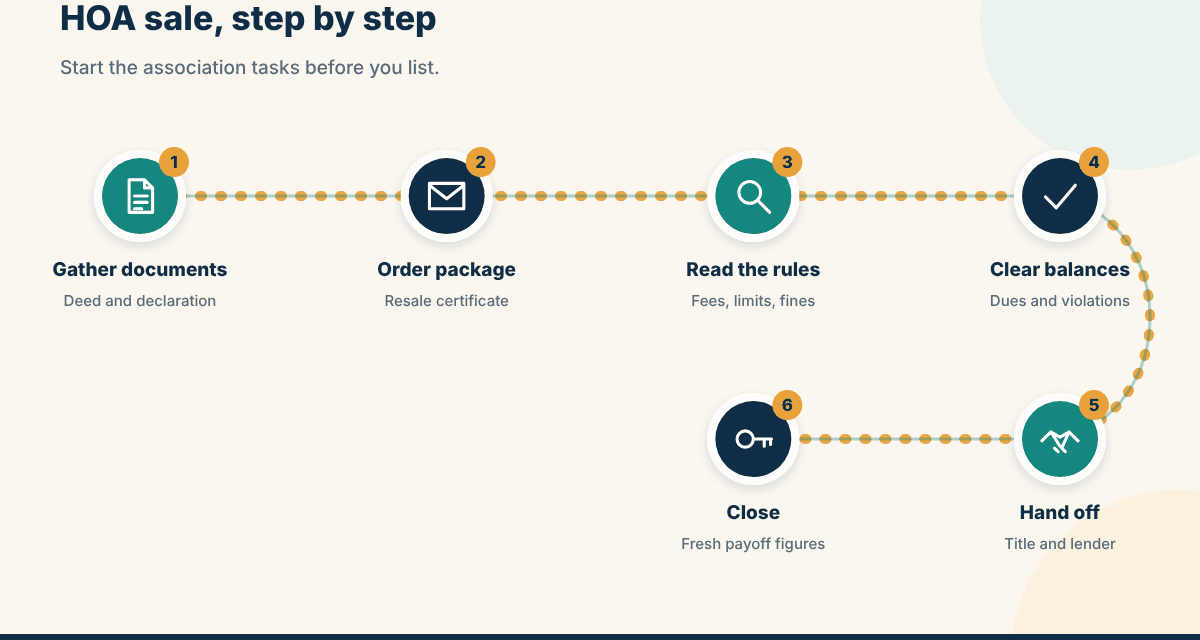
Anyone selling house with HOA membership attached to the deed is really running two sales at once: one to the buyer, and a quieter one to an association that holds paperwork, fees and sometimes a veto you did not know about. Most people selling house with HOA rules only discover the second sale when a title company asks for a document they have never heard of, a week before the closing date they promised to their own movers.
The surprise is understandable. A homeowners association is not a government, yet it can record liens, levy fines, charge fees at transfer and write rules that follow the property from owner to owner. Buyers read those rules with a magnifying glass, because they are about to inherit them. That means your listing, your price and your closing date are all affected by documents you may have filed in a drawer years ago and never opened again.
This guide walks through selling house with HOA obligations in the order they tend to show up: who actually controls the decision, what the resale package is and why it arrives late, how dues and assessments are split at closing, what to do about violations and liens, and which items must be current before you sign a contract. We keep the tone practical. Where a rule differs by state, community or contract, we say so and explain how to check it yourself.
We do not push any one route to market. A listing agent, a flat-fee service, an attorney-assisted private sale or a cash buyer can all work in a community with an association, and each one meets the same documents at the finish line. If you want the broader picture of how the whole sale hangs together, our cornerstone guide on selling a condo covers the shared-building version of many of these ideas.
Key takeaways
- Start with the recorded documents, not the website. The declaration, bylaws and current rules decide what you can sell, to whom, and on what terms, and the recorded version beats any summary a neighbor gives you.
- Order the resale package on day one. Names, fees and delivery times vary by state and by management company, and a late package is one of the most common reasons a closing slips.
- Dues are split by contract and custom. Prorations, transfer fees, capital contributions and unpaid balances land on different people in different places, so read your contract before assuming anything.
- Clear violations and balances before the buyer finds them. A fine, an unapproved change or an open assessment is far cheaper to settle quietly than to negotiate under a deadline.
- Disclose what you know. Pending assessments, disputes and known rule problems usually belong on the seller disclosure, and the exact form depends on your state.
- Check freshness before you sign. A ledger from last quarter, an expired insurance certificate or an old payoff figure can quietly change what you net.
Who really controls selling house with HOA: you, the deed, or the association
The first question in selling house with HOA membership is not about price. It is about authority. When you own a home in a planned community, three layers sit on top of one another: your deed, the association’s recorded documents, and the law of your state. Your contract with the buyer has to sit comfortably inside all three, and the order in which they matter can surprise you. This section sorts out who signs, which paper controls, and where federal and state rules enter.
Think of it as a map you draw before touching the listing. A few hours spent on it prevents the most expensive kind of delay, the kind where everyone has already agreed on a price and then discovers that a required step was skipped.
Whose name is on the deed and which documents set the rules
Start with the deed, because the deed tells you who is allowed to sign anything. If the title is held by one person, two spouses, a trust, a business entity or an estate, the people who must sign the listing agreement, the contract and the closing documents differ in each case. Selling house with HOA membership does not change that, but it adds a second set of papers that must line up with the first.
Then find the association’s own documents. Most communities have a declaration (sometimes called covenants, conditions and restrictions, or CC&Rs), bylaws, a set of rules and regulations, and a current budget. The declaration is recorded in the county land records and binds every owner. Bylaws and rules are usually held by the association and can be amended on a schedule the declaration describes. When two documents disagree, the declaration generally outranks the rules, though your state statute can outrank both.
Evidence to gather: deed, declaration, bylaws and current rules
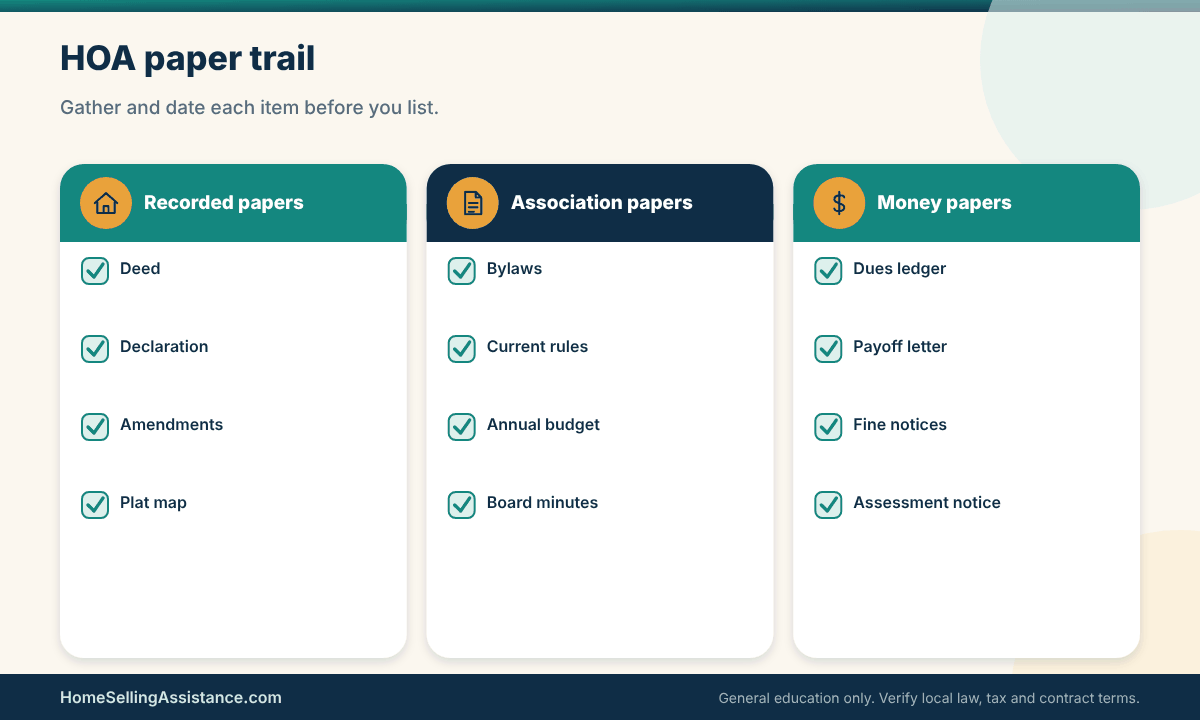
Pull a short stack of paper before you list. You need your recorded deed, the recorded declaration with every amendment, the bylaws, the rules in force today, the latest annual budget and the most recent dues statement. Your county recorder’s office can supply the recorded items, and your title company can often pull them for a modest fee. The management company or the association’s website may hold the rest, though a website copy can lag behind the recorded version.
As you read, mark five things with a highlighter: any limit on leasing or on who may buy, any transfer fee or capital contribution, any right of first refusal or buyer-approval step, any rule about signs and lockboxes, and the process for exterior changes. Those five topics produce most of the sale-day surprises, and each one tells you which task goes on your calendar and who needs to hear from you about it.
Keep a simple log of when you obtained each item and from whom. Later in this guide we return to freshness, and a dated log makes it easy to see what needs refreshing before a contract is signed.
Different property types add their own twists. If your house has rooftop panels, the association may have rules on installation and appearance, which our guide on selling a house with solar panels covers. If the home is empty, selling a vacant house explains upkeep and security. Either way, having selling house with HOA documents in hand makes those conversations shorter, and a buyer who sees a tidy file tends to trust the rest of your answers.
A scenario, an exception, and your next step for co-owners and trusts
Picture a home owned by two siblings who inherited it, with one living out of state. Both must sign the listing and the contract, and the association will want to know who the new owner of record is after closing. If one sibling cannot attend, a power of attorney or a mobile notary arrangement may work, but only if the title company and the association accept it. Ask both early rather than assuming.
A short list of questions helps here. Who holds title? Does anyone hold it as a trustee or personal representative? Is any owner unable to sign in person? Does the association have every owner’s correct name and mailing address on file? Answering these four questions at the start of selling house with HOA paperwork avoids duplicate signatures, rejected notarizations and the awkward moment when a manager cannot find the person who should receive the payoff request.
The exception is a home held in a trust. The trustee usually signs, not the individual who lives there, and the title company may ask for a certification or excerpts of the trust. Associations sometimes ask for the same thing before they release a resale package or approve a transfer.
Your next step in either case is a single phone call to the title or escrow office. Tell them how title is held, and ask which signatures and certificates they need. If ownership is complicated by an estate, a divorce or a lender issue, an attorney licensed in your state is the right escalation point, and our guides on an executor selling a house and what happens when a co-owner refuses to sell go deeper on those situations.
Federal law, state statutes and the HOA’s own rules
People often ask whether federal law governs HOAs. In everyday terms, only a thin layer does. Federal fair housing law applies to how you market and sell the home, and to how an association may treat buyers and residents. Federal lead-paint disclosure applies to homes built before 1978 regardless of any association. Beyond that, the heavy lifting on resale documents, fees, liens and disclosures is done by state statutes, the association’s own recorded documents and your contract.
Because state rules differ so much, the same fact can mean different things in two places. A state may require the association to deliver a resale certificate within a stated number of days, cap what it may charge, or require specific warnings in the package. Another state may say very little. The way to find out is to ask your state real estate commission, the title company that will handle your closing, or a local real estate attorney.
State differences show up in small details. One state may require the association to say whether a violation is open, another may require the seller to deliver a disclosure within a few days of contract, and a third may say almost nothing. A checklist copied from a different state can therefore mislead you. When selling house with HOA rules in your own state, use the state commission’s materials first and treat blog posts, including this one, as orientation only.
Where the federal layer stops and the state layer starts
Federal fair housing rules are the clearest federal piece. They prohibit discrimination in selling on the basis of protected characteristics, and they apply to you, to your agent, and to an association that screens buyers or applies rules unevenly. If you want the plain-language rule set, the HUD fair housing and equal opportunity pages explain it, and our guide to fair housing for home sellers turns it into seller habits.
The federal lead-paint disclosure rule is the second piece. If your house was built before 1978, you must provide the required disclosure and pamphlet no matter what the association says. The EPA’s real estate disclosure page lists the details. Everything else about selling house with HOA structures, from resale package timing to lien priority, comes from state law and recorded documents, so treat any universal claim you read online with suspicion.
Case study: selling house with HOA authority nobody asked about
Here is a composed example with round numbers, not a real file. A seller lists a detached home in a planned community and accepts an offer. Two days before closing, the buyer’s lender asks for an association questionnaire, and the title company asks for a payoff of a small unpaid fine. Nobody ordered a resale package because the seller believed an association only mattered for condos.
The package takes longer than expected, the closing date slips, and the buyer’s rate lock runs short. Nothing dramatic goes wrong, yet the seller spends several stressful days and pays a rush fee that an early order might have avoided. The lesson is not that associations are villains. It is that they run on their own calendar. If you are selling house with HOA authority over transfers, ask for the package the day you decide to list.
Compare that with a seller who spent an afternoon on the phone the week before listing. She asked the manager for the package, learned the community’s rule on lockboxes and yard signs, and discovered that the board met monthly, so any approval would take weeks, not days. When she listed, her agent knew the timetable. Selling house with HOA rules turned out to be far less stressful once the calendar was known before the first showing.
Neither seller was careless. The difference was only when the questions were asked. If you take one habit from this article, make it this: before you pick a listing date, list every outside party who must act, write down how long each usually takes, and add a cushion. Selling house with HOA oversight is a scheduling problem more often than a legal one. If you are unsure whether your property is a detached home or a condo-style unit, our selling a condo overview shows how the two differ.
From listing day to closing: the seller workflow for selling house with HOA
Once you know who signs and which papers apply, selling house with HOA oversight becomes a workflow. A handful of tasks must happen in a sensible order, and a few of them depend on outsiders who do not work on your timeline: a management company, a board volunteer, a title officer. The goal of this section is to put those tasks on a calendar so nobody is surprised.
Before the detail, here is the overview. The table below is a requirement and contract matrix. It lists the issues that come up most often when selling house with HOA rules in the background, shows which document or authority controls each one, and points to the place where you can verify the local answer. Deadlines are shown as ranges on purpose, because they come from state law, the declaration or your contract, not from a universal rule.
| Issue | Controlling document or authority | Seller obligation or choice | Deadline | Where to verify locally |
|---|---|---|---|---|
| Resale package | State statute, declaration, management contract | Request it early and pay the fee your contract assigns | Set by state or contract; varies | State real estate commission, title company |
| Unpaid dues or fines | Ledger, declaration, rules | Pay now or settle from proceeds at closing | No later than closing | Written payoff letter from the manager |
| Transfer or capital fee | Declaration, rules, sales contract | Confirm the amount and who pays it | Usually at closing | Recorded declaration, escrow officer |
| Special assessment | Board minutes, budget, resale certificate | Disclose it and allocate it in the contract | Before the contract is signed | Minutes, certificate, attorney if large |
| Leasing or buyer approval | Declaration, bylaws, state law | Disclose limits and follow any approval steps | Window named in the documents | Association manager, local attorney |
| Exterior changes | Architectural rules and committee records | Show approvals or seek approval after the fact | Before listing if possible | Committee file, written approvals |
Use the matrix as a worksheet, not a verdict. Print it, add a row for anything unusual in your community, and fill in the last column with a name and a date as you confirm each item. A blank cell in that final column is a task still waiting for you, and it is the right place to focus your energy this week.
A word on tone with the management office. Managers often handle dozens of homes, and a clear, polite request with your address, closing date and the exact document you need gets a faster answer than a vague plea. When you are selling house with HOA managers in the loop, thank them, put every request in writing and note the date. Small courtesies pay off when you need a favor later, such as a rush on a payoff letter.
Resale package, estoppel letter and disclosure steps
The resale package is the association’s official answer to the question, “What does this property owe and what rules come with it?” Some states call it a resale certificate, some an estoppel or status letter, and some split the information across several documents. The names matter less than the contents, which usually describe dues, assessments, balances, restrictions and the financial state of the community.
Your own seller disclosure is a separate document. It records what you know about the property, and in many states it asks specifically about association fees, assessments and disputes. Keep the two aligned, because a buyer will read them side by side. Our guide to seller disclosure requirements explains how state forms differ, and the category page on disclosures and seller paperwork collects the related topics.
Evidence to gather: what the package usually contains and what it costs
A typical package may include the declaration and amendments, bylaws, current rules, the budget, recent financial statements, a statement of the dues and how often they are due, a ledger showing your balance, details of any approved or pending special assessments, and information on insurance carried by the association. Some also include a reserve study or a summary of one, minutes from recent meetings, and a list of open violations on your property.
Fees for the package depend on your state, the management company and sometimes how fast you want it. Some places regulate the maximum, others do not, and rush charges are common. Your sales contract may say who pays. If it is silent, local custom and state law fill the gap, which is another reason to ask the title company early. Never accept a figure you cannot see in writing, and ask whether an update fee applies if closing slips.
When the package arrives, read it as the buyer will. Look at the dues, any assessment, any fine, and any rule that would surprise someone who has never lived in the community. Resolve what you can before showings, and be ready to explain the rest in plain language.
One more habit is to compare the package against your listing. If the listing says the dues include lawn care or water and the package says otherwise, fix the listing before a buyer notices. A mismatch between marketing and documents is an easy way to lose trust. When selling house with HOA services bundled into dues, describe them in the package’s own words, and update the listing if anything changes.
When the package arrives late: a scenario and a fix
Say you ordered the package three weeks before closing and the manager says it will take longer than the contract allows. First, ask for a firm date in writing and find out whether a rush option exists. Second, tell your agent or attorney and the buyer’s side right away, so nobody learns about the delay from a lender’s clock.
Third, check your contract for a delivery deadline and for any right the buyer has to cancel or review the package after receiving it. Many contracts give the buyer a window to read the association documents, and that window often starts only when the documents are delivered. A late package can therefore push back more than one date.
If the delay becomes serious, ask the buyer’s side whether a short written extension makes sense. Do not improvise verbal promises. A one-page amendment signed by everyone is boring and safe. If the delay seems to come from a dispute or an unpaid balance, a local attorney can often get the association’s attention faster than another email.
Lastly, keep the buyer informed without blame. A short note such as “The association has confirmed delivery by Thursday, and I will forward the package the day it arrives” protects goodwill. Buyers in this kind of sale are used to waiting on associations, and most prefer a plain update to silence.
The handoff between buyer, title company, management and attorney
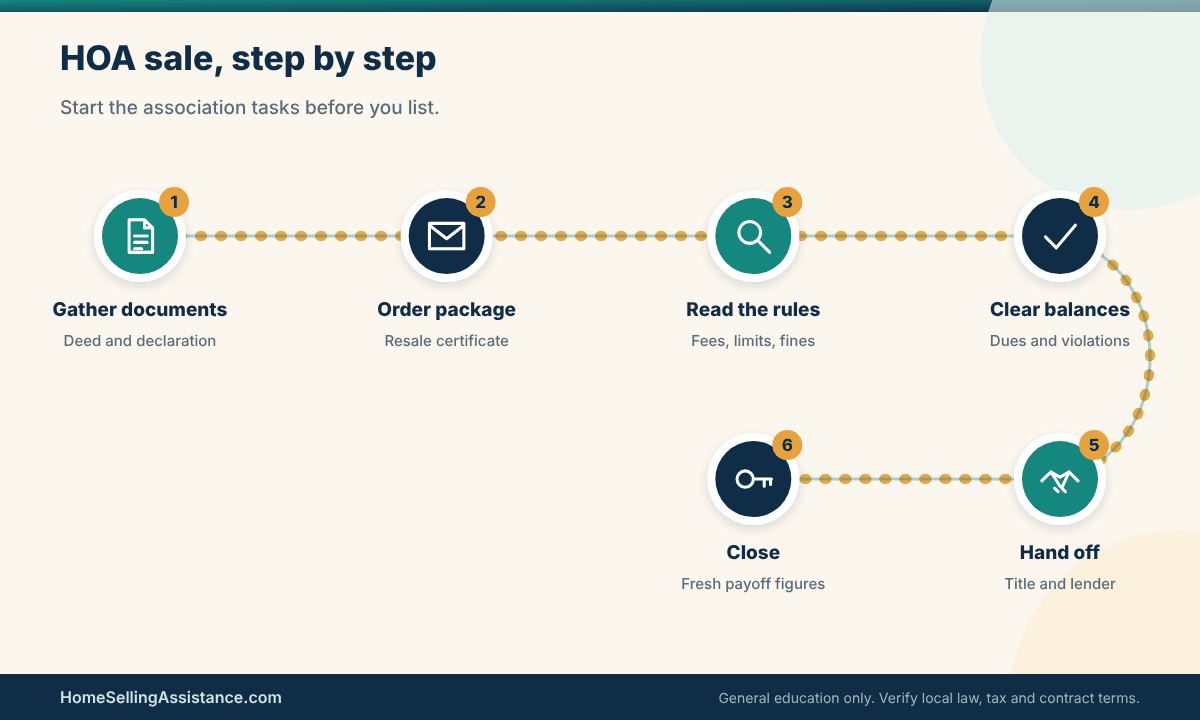
Selling house with HOA involvement puts more hands on the closing than a sale without one. The buyer’s agent wants documents, the lender wants a questionnaire, the title company wants a payoff and a transfer instruction, and the manager wants forms and fees. You are the one person who can answer all of them, so your job is to be easy to reach and quick with signatures.
The figure above shows the usual sequence from request to closing. Notice how many steps depend on third parties. That is why the earliest tasks, such as ordering the package and confirming the ledger, give you the best return on a little effort, and why a seller who waits for an accepted offer to start usually pays in stress or in rush fees.
Who talks to whom, and what each party needs from you
Give the title or escrow officer the management company’s contact details, the community’s legal name and your account number, and ask them to request the payoff and the transfer fees directly. That keeps the numbers consistent. Give your agent or attorney a copy of the package and the cover letter, since they will answer buyer questions about it.
The buyer’s lender may send a questionnaire to the association about owner-occupancy, delinquency, insurance and pending litigation. This typically goes through management, and you may be asked to sign an authorization. Respond quickly, because a stalled questionnaire can hold up loan approval, and it is outside your control once it leaves your hands.
Keep one running email thread, or one shared document, with the dates of each request. When someone asks, “Did you ever hear back from the manager?”, you can answer in ten seconds. Sellers who track this tend to stay calm, and calm sellers tend to negotiate better when something goes sideways.
If you are working without an agent, the handoff is more work but not a different kind of work. A flat-fee service or an attorney can handle documents, and you still coordinate with the manager. Our guide to selling for sale by owner explains the wider process. Selling house with HOA paperwork privately is perfectly possible, though it puts the calendar squarely in your hands.
Approval and transfer fees: an exception when selling house with HOA rules
Some communities charge a fee when ownership changes, and some require a capital contribution that goes into reserves. Others have buyer-approval steps or a right of first refusal that gives the association or neighbors a chance to step in. These features are less common in detached-home communities than in condo buildings, but they exist, and the recorded declaration is where to find them.
If your declaration includes any of them, tell your agent before you list and put the timeline in your calendar. Ask the manager how long approvals normally take, who receives the application, and whether a rejection can be appealed. Then check your contract to make sure the approval window fits inside your closing period.
Ask also whether the association charges for forms a buyer must complete, such as a move-in deposit or a pet registration. Those are usually buyer costs, but they affect a buyer’s budget and sometimes the offer. In an ordinary selling house with HOA transaction, a one-page summary of every fee a buyer will meet gives your agent a clean answer to a question nearly every buyer asks.
Fair housing rules still apply to approvals. A sensible association applies written criteria evenly, and you should never suggest or accept a preference based on a protected characteristic. If an approval process looks inconsistent or discriminatory, that is a question for a fair housing resource or a licensed attorney, not for you to settle quietly. The tenant-occupied house guide shows how leasing limits interact with a sale when renters are involved.
A verification checklist for selling house with HOA that you can finish before signing
Everything so far leads to one habit when selling house with HOA rules: verify before you promise. Sellers get into trouble not because associations are mysterious, but because a number or a rule was taken from memory, from a neighbor or from an old email. A short checklist, completed with real documents and dated, turns selling house with HOA rules from a source of anxiety into an ordinary set of tasks you can tick off.
The checklist has two halves. The first is about sources, meaning which official or recorded document answers each question. The second is about timing, meaning which facts must be current on the day you sign the contract and again close to the closing date. Along the way you will see how violations, liens and assessments are best handled, since those are the three items most likely to cost real money.
Recorded documents and official sources you can check yourself
An official or recorded source is a document someone with authority produced and dated, as opposed to a verbal answer. For selling house with HOA authority in play, your best sources are the county land records, the association’s own governing documents, the manager’s written ledger and payoff letter, board minutes, and your state’s statute or real estate commission guidance. Verbal answers help you plan, but only written ones belong in your file.
Before the detail, the second table lays out common scenarios. It is a decision aid for the situations that turn up most often, listing what a seller can do, what could go wrong, which document to read and when to bring in a professional. Treat the rows as prompts for a conversation with your agent, title officer or attorney, not as legal conclusions.
| Situation | Seller options | Risk | Document to review | Escalation point |
|---|---|---|---|---|
| Unpaid dues balance on the ledger | Pay now, or settle from proceeds at closing | Lien, delayed closing | Ledger, payoff letter | Manager, title officer |
| Open violation notice | Fix it, seek approval, or disclose and negotiate | Buyer renegotiation, lender questions | Violation letter, rules | Board, attorney |
| Special assessment in installments | Prepay, assign by contract, or price it in | Net proceeds change | Board minutes, resale certificate | Attorney if disputed |
| Association is in a lawsuit | Disclose and share what you know | Lender hesitation | Certificate, lender questionnaire | Attorney |
| Rental limit and an investor buyer | Verify the rule, disclose it, adjust the plan | Failed contract | Declaration, bylaws | Attorney, manager |
| Association slow to respond | Written request, rush fee, short extension | Missed deadlines | Contract, state statute | Real estate commission, attorney |
To use the table, find the row closest to your situation, read the document in the fourth column before you form an opinion, and decide in advance who you will call if the answer is unclear. If your situation is not on the list, write your own row. The act of naming the risk and the escalation point is itself useful, because it shows you which questions you cannot answer alone.
Pull the recorded declaration and read the parts that bite
Most declarations run long, and you do not need to read every page. Start with the table of contents and go to the sections on assessments, liens and enforcement, use restrictions, leasing, architectural control, insurance, and transfers or sales. Those sections show what the association can charge, what it can restrict, and what it can do if something goes unpaid. Read them slowly, and read the amendments too, since a later amendment can change an earlier rule.
Make a one-page summary in your own words with the section number beside each point, so that a buyer’s agent or your attorney can check it quickly. If a clause is unclear, do not guess what it means. Ask the manager for the association’s interpretation in writing, and ask an attorney if the answer affects money or the right to sell.
Read for dates as well as rules. A declaration may say that fees rise on a schedule, that rules can be amended by a vote, or that certain rights expire after a number of years. When selling house with HOA terms that change over time, describe them to your buyer’s agent as fact, never as a prediction. A buyer can judge the future, and your job is to describe the paper in front of you.
The county recorder can confirm what was recorded and when. A title search ordered by your closing company will reveal recorded liens against the property, including association liens, and our guide on the title search for a home sale explains what the search can and cannot show. For a deeper look at what a lien means when you are selling, see selling a house with an HOA lien.
Violations, liens and assessments: a scenario and where to escalate
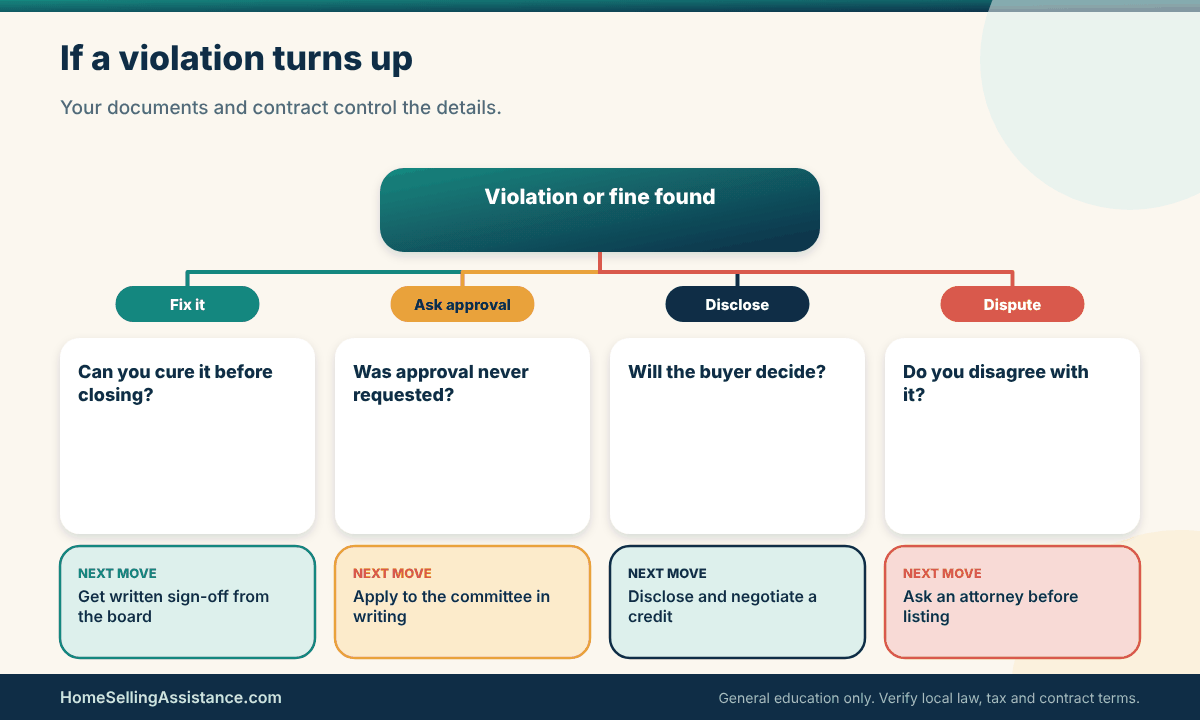
Imagine you receive a violation letter for a fence you built years ago without approval. You have three honest paths. You can remove or alter the fence to comply, you can ask the architectural committee for approval after the fact, or you can leave it, disclose it and let the buyer decide. Each path costs time or money, and the right one depends on the rule, the committee and your deadline.
Now add a fine that has been accruing. Some associations can record a lien for unpaid amounts, and some states let them enforce it in ways that surprise owners. The title company will want any such amount paid or paid from proceeds, and the manager will issue a payoff figure with a good-through date. Ask what the figure assumes about timing, since many accrue daily or monthly.
Escalate when the amount is large, when you dispute the charge, when the notice mentions legal action, or when the association’s behavior seems inconsistent. A local real estate attorney can read the declaration and your state’s statute together. Do not ignore a legal notice because you plan to sell soon, since a sale does not erase a dispute. If a sale becomes urgent because of hardship, our guide on how to sell a house before foreclosure covers the wider picture.
Keep records of anything you fix. Dated photos, written approvals and the final letter closing out a violation form a small evidence file that can settle a question in minutes. For selling house with HOA violations in the past, a closing letter from the board is more convincing to a buyer than a verbal assurance, and it protects you if the manager changes after you leave.
What has to be current before you sign the contract
Facts go stale quickly in a sale. A ledger is accurate on the day it prints. A payoff figure is good for a stated period. A board meeting can approve an assessment the week after your package was issued. The second half of the checklist is about dates: which information must be refreshed before you sign, and which must be refreshed again before closing.
The simplest rule for selling house with HOA paperwork is to treat each document as having a shelf life and to write that shelf life on your log. A rule that matters to a buyer, such as a leasing limit or a pending assessment, should be confirmed within days of contract signing. A number that moves, such as a balance or payoff, should be confirmed again just before closing. This habit costs a few emails and saves many sleepless nights.
Freshness dates for dues balances, ledgers and insurance
For dues, ask for a ledger with today’s date, and ask the manager to confirm the next due date and the amount. If dues are paid monthly, quarterly or annually, find out which payment is next, since prorations at closing depend on it. If you have prepaid for a period beyond the closing date, the contract or local custom usually decides whether you receive a credit, so check it rather than assume.
For insurance, the association’s master policy and your own homeowner policy are different things. Some communities require owners to carry specific coverage, and a lender may ask for evidence of the association’s coverage. Ask the manager for a current certificate if a buyer or lender requests one. An expired certificate can hold up a loan, which is a quiet delay you can prevent with one polite email.
Finally, confirm contact names. Managers change, management companies change, and a payoff request sent to a former company can disappear for days. Check the current contact on the association’s most recent notice, and confirm by phone if you have any doubt.
Build a short pre-closing routine. Three business days out, request an updated ledger and payoff. The day before, confirm that the title company has them. On closing morning, check your email for last-minute changes. The routine takes perhaps thirty minutes in total, yet it catches the most common late surprises in selling house with HOA deals: a changed balance, a missing signature and a payoff figure that expired overnight.
A last-week scenario, plus the exception for special assessments
Picture the week before closing. The title company calls to say the association has approved a special assessment at a meeting held after your package was issued. You did not know, because you were not at the meeting. What do you do? Ask the manager for the minutes and a letter describing the amount, payment schedule and whether it applies to the property at closing or to the next owner.
Then read your contract on assessments. Some contracts assign assessments approved before the contract date to the seller and later ones to the buyer. Others split them differently, or leave it to local custom. If the contract is silent or unclear, an attorney or experienced agent can explain how your area treats it, and the buyer’s side may agree to an amendment.
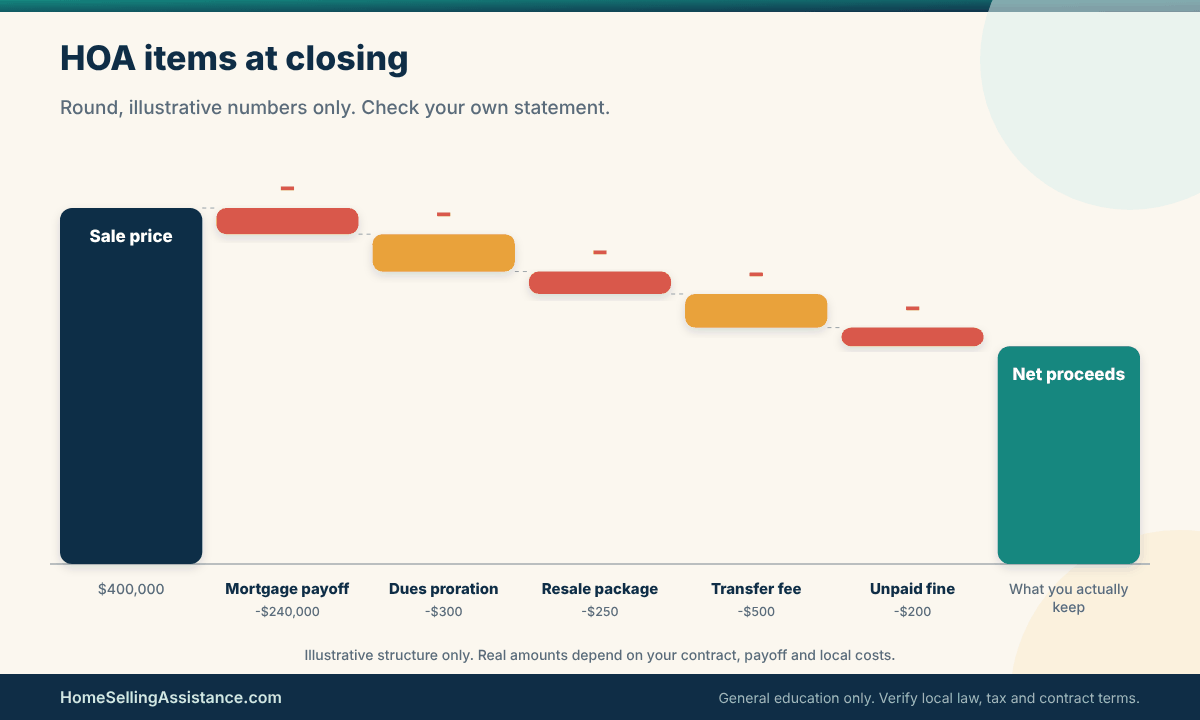
The exception is an assessment that is known but not yet approved. A board may discuss a roof, road or reserve shortfall for months, and a seller who knows about it may be expected to disclose it, depending on state rules. If you are unsure, include it in your disclosure notes and ask a professional, since disclosing too much costs far less than disclosing too little. For the money side, the category on condos, HOAs and specialty properties collects related guides.
Remember that buyers read the community’s finances too, so a seller who can say calmly where each number comes from earns trust. Selling house with HOA documents summarized on one page, with sources and dates, is a quiet advantage in any market, and it takes an evening to prepare.
Quick scenario
A seller lists on a Thursday, orders the resale package that same afternoon, and learns from the ledger that a small fine from last spring was never paid. She pays it by Friday, asks the manager for a fresh ledger, and tucks the zero-balance statement into her file. When the buyer’s lender sends its questionnaire two weeks later, nothing is outstanding. The whole fix took one phone call and, as she put it, one slightly embarrassing check. That is selling house with HOA paperwork done early.
Money is the other half of the story, and it deserves a plain explanation. At closing, your settlement statement will show items tied to the association: prorated dues, the resale package fee, any transfer fee, any unpaid balance and possibly a share of an assessment. Your contract decides who pays what, and local custom fills gaps. The picture below shows an illustrative path from sale price to proceeds so you can see where association items sit among the others.
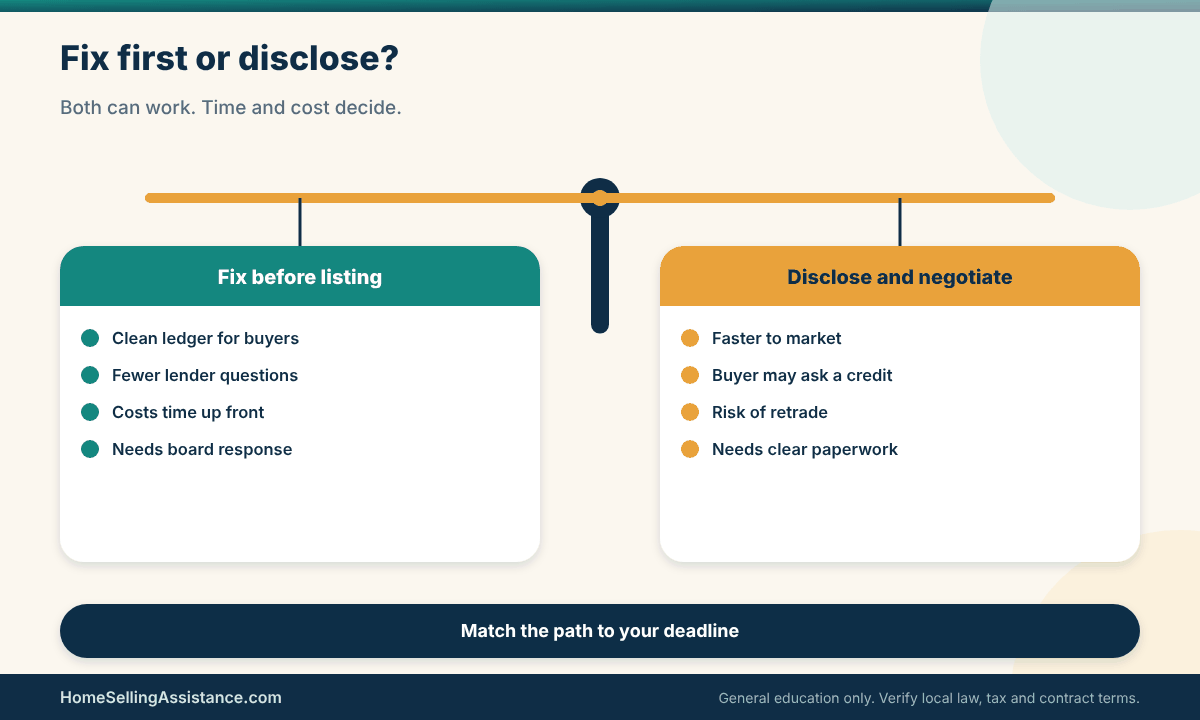
The figure uses round, made-up amounts to show structure only. Your own numbers will differ, and some lines may be zero. What matters is the habit of asking the title officer for a draft settlement statement early and checking every association line against a written source. Our guides on the seller closing statement and on HOA resale fees for sellers walk through those lines in more detail, and the Consumer Financial Protection Bureau publishes plain-language material on closing documents.
Tax questions about your gain are separate from the association items. Ordinary dues you paid while living in the home are a different category from the costs of selling, and a tax professional should confirm how your situation works. For the general rules on selling a main home, IRS Publication 523 is the place to start, and our guide to taxes when selling a home adds context.
Frequently asked questions about selling house with HOA
Do I always need a resale package when selling house with HOA rules attached to the property?
In many states a package or certificate is required or customary, and in others it is simply a practical necessity because the buyer, lender and title company all want the information. The name, content and deadline differ by state and by contract. Ask your title company or agent what applies where you live, and request the package before you list rather than after you accept an offer.
Who pays the resale package fee?
It depends on the sales contract, state law and local custom. In some areas the seller pays, in others the buyer does, and some contracts split it. Get the amount in writing, check the contract for an allocation, and ask whether an update fee applies if closing is delayed. Do not assume your agent’s last transaction reflects your contract.
What happens to my monthly dues at closing when selling house with HOA membership?
Dues are normally prorated so that you pay through the closing date and the buyer pays afterward. If you paid ahead, you may receive a credit, and if you are behind, the balance is usually paid from proceeds. The exact method depends on your contract and the way your association bills. Ask the title company to show the proration on a draft statement.
Can the association stop me from selling?
In most communities, an association cannot simply forbid a sale, though some have approval steps, rights of first refusal or rules about leasing and use that affect certain buyers. Whether those rules are enforceable depends on the recorded documents and your state. Read the declaration and ask a local attorney if anything looks like a restriction on transfer.
What if I have unpaid fines or a violation while selling house with HOA rules in force?
Deal with it before you list if you can. Pay or contest the fine, fix the issue or request approval, and ask for written confirmation of the result. If time is short, the title company may pay a balance from proceeds, but a dispute or a lien can slow the closing. Escalate larger or disputed amounts to a local attorney.
Do I have to disclose a special assessment when selling house with HOA fees rising?
State rules differ, but a known assessment that is approved or pending is the kind of fact buyers care about and disclosure forms often ask about. Even where the form is silent, hiding something known can cause problems after the sale. Share what you know, attach the minutes if you have them, and let your contract allocate the cost clearly.
How early should I start gathering documents for selling house with HOA paperwork?
Start before you list. Give yourself enough time to get the recorded declaration, the current rules, a fresh ledger and the package, plus a cushion for delays at the management office. A reasonable plan is to treat the association as a dependency with its own calendar, not as a step you can rush on closing week.
Does an HOA affect which buyers can get financing?
It can, because lenders may ask about delinquencies, owner-occupancy, insurance and litigation. Most detached-home communities pass without trouble, yet a community with serious financial or legal issues can complicate loans. Ask your agent how local lenders view your community, and keep your own records in order so questionnaires come back quickly.
Where can I check the rules for selling house with HOA communities in my state?
Your state real estate commission, the title or escrow company handling your sale and a licensed local attorney are the best starting points. State statutes are usually available online, though reading them without help can be confusing. For fair housing questions, the HUD resources linked above are a reliable federal starting point.
Should I hire an attorney for selling house with HOA complications?
If your situation involves a lien, a dispute, a lawsuit, a large assessment or a transfer restriction you do not understand, a local real estate attorney is worth considering. For a routine sale with a clean ledger, a good agent or title officer may be enough. Either way, rely on written documents and keep a dated file.
Before you sign anything
Selling house with HOA obligations is mostly a matter of order and paperwork: know who signs, read the recorded documents, order the resale package early, clear balances and violations, and refresh every number close to closing. This article is general education, not legal, tax or financial advice, and rules differ by state and community. Check each point against your own documents and a licensed local professional.