Selling tenant occupied house situations feel harder than ordinary listings because two sets of people have rights in the same building: you, as the owner, and the household that lives there under a lease or a rental agreement. The good news is that most of the friction comes from missing paperwork and unclear communication, not from the tenancy itself. This guide shows how the lease, the notices, the showings, the deposit and the buyer type fit together, and where local law decides what you may do.
Plenty of owners go through selling tenant occupied house plans every year, and they do it in different ways. Some keep the tenant in place and market the property to investors who want a rent-paying home from day one. Others negotiate a move-out date and sell the house empty to a buyer who plans to live in it. A few sell to a cash buyer who simply takes over the lease. None of those routes is automatically better. Each one trades speed, price, effort and legal risk differently.
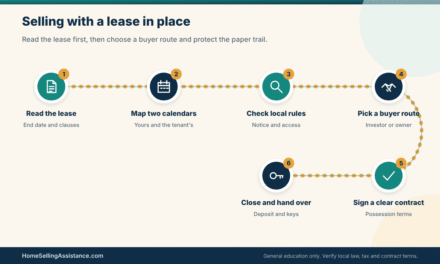
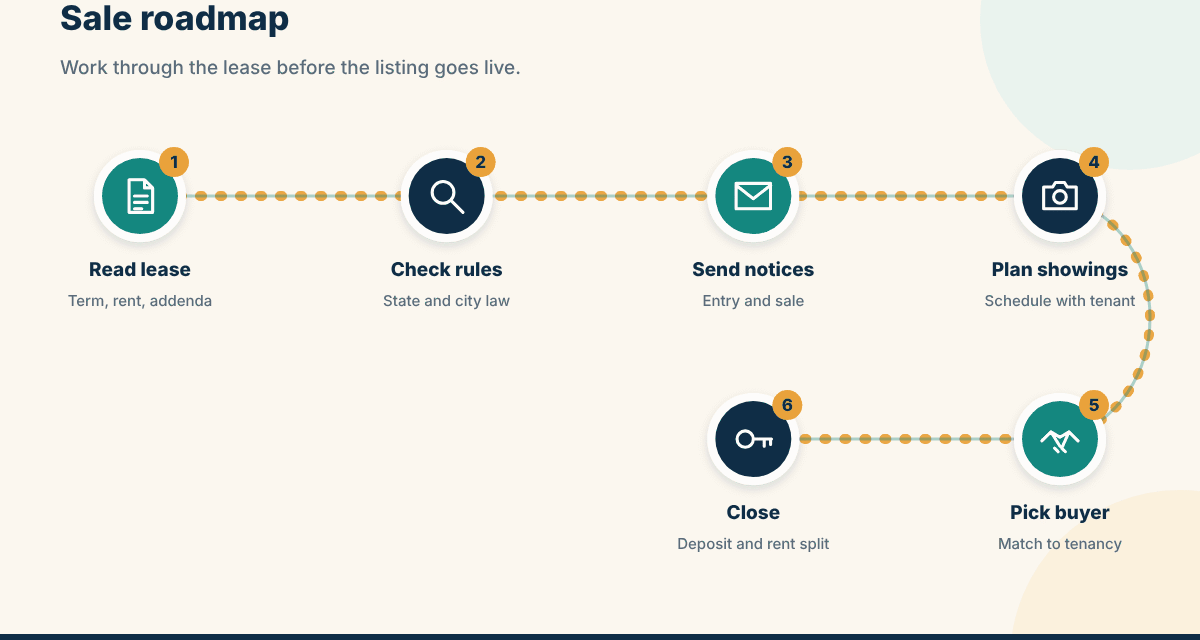
What stays constant is the order of operations. First you work out what you actually own and what the lease says. Then you check which rules apply at your address, because landlord-tenant law is mostly state and local. After that you plan notices, showings and the handoff of the deposit, and you choose a buyer type that fits the tenancy you have. We will go through each piece in plain language, with illustrative examples, and we will point out where a local attorney or title company should have the final word.
One caution before we start. This article is general education. It does not tell you what your lease means, what your city allows, or what your sale will net. Wherever a number appears, it is a round example, and wherever a rule matters, the reliable answer comes from the statute, the ordinance, the signed lease and a professional who practices where the house sits.
Key takeaways
- The lease is a contract that usually survives the sale. Unless it ends, is terminated lawfully, or local law says otherwise, the buyer often steps into your shoes as landlord.
- Tenancy law is local. Notice periods, entry rules, deposit handling and tenant protections vary by state, county and sometimes city, so verify before you promise anything.
- Showings need written notice and cooperation. A tenant who feels respected is the best marketing asset a rented listing can have.
- Deposits and prepaid rent must be accounted for. Both are reconciled at closing or transferred under rules that vary by state.
- Buyer type changes everything. Investors, owner-occupants and cash buyers each react differently to an occupied house, and their financing or plans shape the offer.
- Get documents current before you sign. A verified lease, a rent ledger and a tenant statement save closing-week surprises.
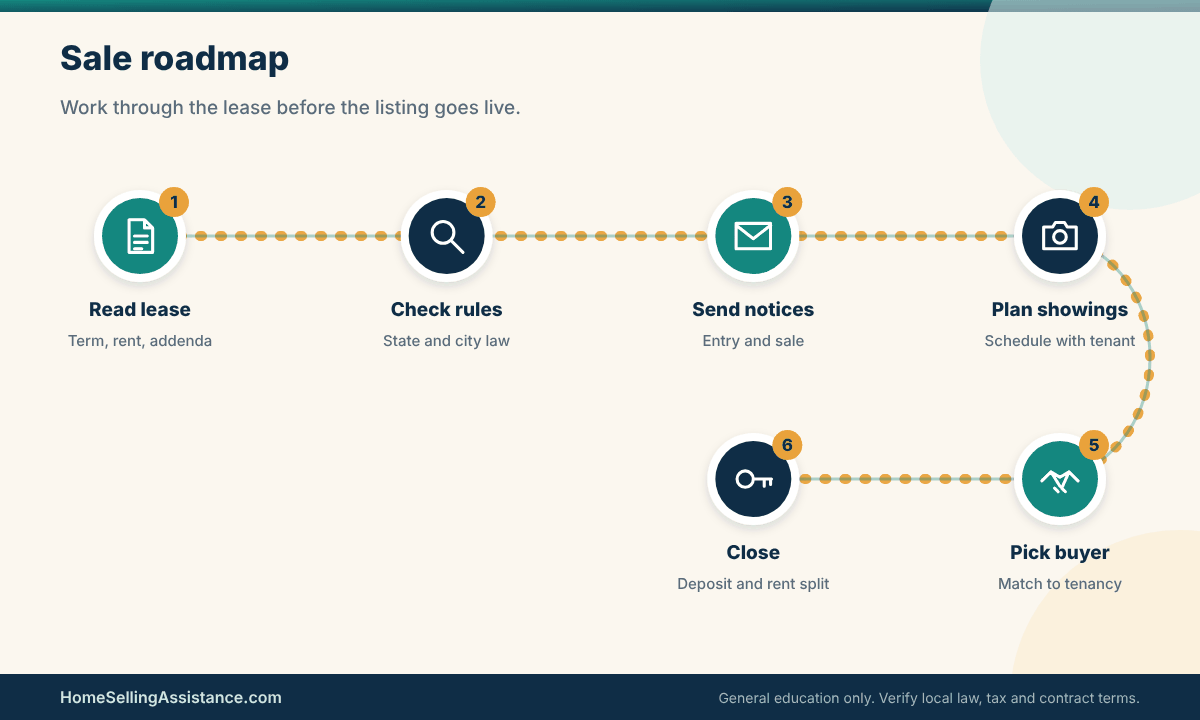
Anyone selling tenant occupied house property for the first time tends to underestimate the paperwork and overestimate the drama. In our experience, the sellers who do best are not the ones with the sharpest negotiating skills. They are the ones who sat down early, read the lease twice, and wrote down every question they could not answer. That habit is worth more than any marketing trick, because the answers shape every later choice.
Start by mapping who owns, who rents, and which rules apply
Before you talk to a single buyer about selling tenant occupied house plans, build a one-page map of the situation. It should say who holds title, who signed the lease, what the lease allows, and which government levels have something to say about it. This sounds basic, but in practice it is where most surprises hide. A house inherited by two siblings, a lease signed by a property manager, or an addendum nobody remembers can each change what you are free to do.
The map also protects you in conversations with buyers and agents about selling tenant occupied house terms. When someone asks whether the tenant can be asked to leave, you will not be guessing. You will be able to say what the document says, point to the rule you checked, and name the professional you consulted. That kind of clarity tends to calm a negotiation and keeps the focus on the actual terms of the deal.
Who owns the house, who signs, and which lease controls
The person or entity named on the recorded deed is usually the only party who can sign the sale contract. The tenant’s lease, on the other hand, may have been signed by you, a former owner, a relative, a management company or an LLC. Your first job is to confirm that those two lists match, and to identify the document that actually governs the tenancy today rather than the one you remember.
Evidence to gather: deed, lease, addenda, and rent records
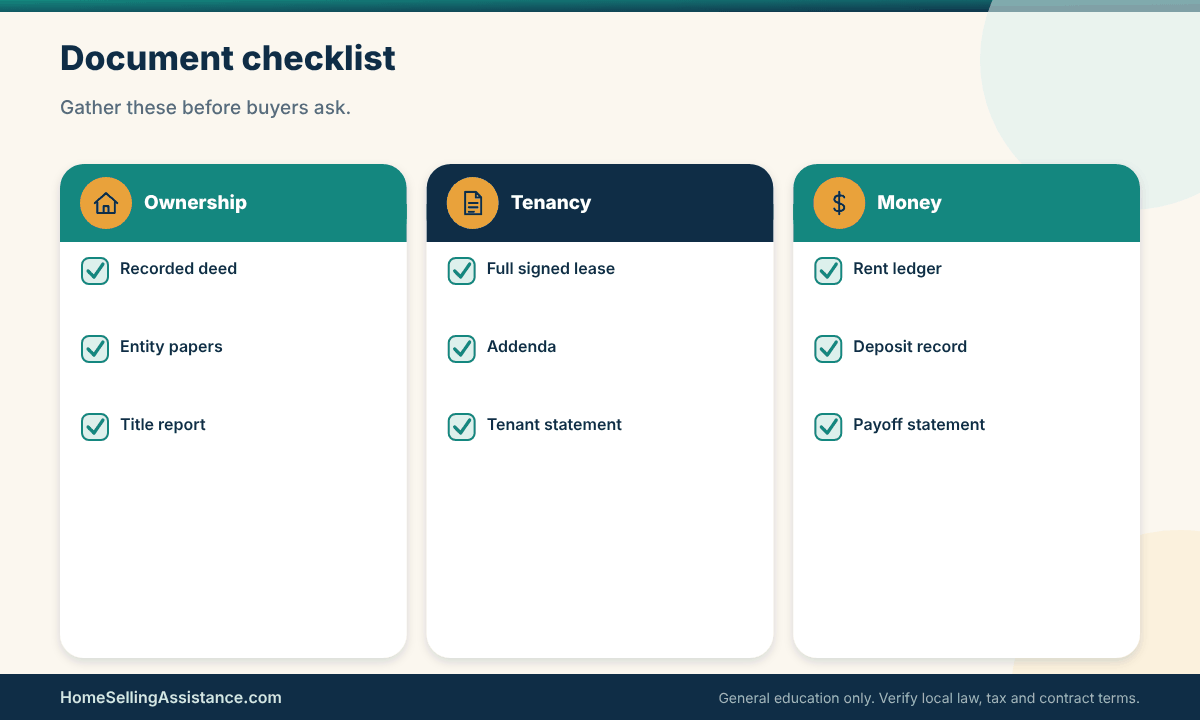
Start with the deed and any recorded trust or entity documents so you know exactly who must sign. Then collect the full lease, not just the first page. Look for the term, the rent amount, the renewal language, pet or occupancy addenda, any purchase option or right of first refusal, and clauses about the landlord entering or selling. Add the rent ledger, the security deposit record, and written notices you have sent or received.
If the lease has been renewed informally, gather proof of that too, such as emails or payment records. A lease that expired on paper often turns into a month-to-month tenancy by operation of local law, and that detail affects timing. Keep copies in one folder, because your agent, your attorney, the title company and the buyer will all ask for the same set within days of an offer.
A scenario, an exception, and your next step with unsigned or verbal leases
Imagine you let a friend of a friend move in two years ago on a handshake, with rent paid by transfer each month. There is no written lease. That is still a tenancy in most places, and it still carries rights, but it is far harder to explain to a buyer or lender. Buyers cannot price what they cannot read.
The usual next step is to put the arrangement in writing with the tenant’s agreement, ideally with a local attorney checking the language. An exception may apply if the occupant is a family member or a guest rather than a tenant, since local definitions differ. If the occupant disputes the terms, treat that as a legal question first and a marketing question second.
A useful test is to ask whether you could explain the plan for selling tenant occupied house paperwork to a stranger in two minutes. If you cannot say who owns the property, who is renting it, what the lease says about the sale and which rules apply locally, you are not ready to list yet. Spend a week closing those gaps first, and the listing will go more smoothly.
Federal rules, state tenancy law, and local ordinances in selling tenant occupied house deals
People often ask whether there is one law that governs selling tenant occupied house transactions. There is not. A handful of federal rules touch the topic, but the heart of landlord-tenant law sits at the state level, and many cities and counties add their own layers on top. The practical effect is that two owners in neighboring towns can face very different requirements for the same lease.
Where to confirm the rules that apply to your address
Start with the federal pieces that are stable and widely applicable. Fair housing law applies to how you treat tenants and prospective buyers, and the HUD fair housing resources explain the basics. For houses built before 1978, federal lead-based paint disclosure rules apply to sales and to rentals, and the EPA real estate disclosure page describes the requirement.
After that, look to your state. Your state real estate commission, the state attorney general’s tenant resources, and a local landlord-tenant attorney are better guides than any national article. Then check the city or county for rent rules, registration programs, required notices, or tenant purchase rights. Write down what you find, with the date and the source, so you can show your work later.
A scenario: the city rule nobody mentioned
Picture an owner who lists a rented house, accepts an offer, and then learns that the city requires a specific written notice to tenants whenever a rental property is offered for sale. The notice was never sent. The buyer’s lender, the title company and the tenant all notice at once, and the closing slips while everyone sorts it out.
The fix is simple but needs to happen before listing: ask the municipal housing office, or a local attorney, whether any sale-related tenant notice, registration or purchase-opportunity rule exists. Not every place has one. Asking costs a phone call, and it can spare the sale from a delay that nobody planned for.
If you are curious how the broader process works when the house is part of a larger community, the cornerstone guide on selling a condo covers the association side of specialty sales, and the category page for condos, HOAs and specialty property sales lists the related articles.
Turn the lease into a seller workflow for selling tenant occupied house listings
Once you know what the lease says and which rules apply, the next step is to convert that knowledge into a sequence of actions. A workflow keeps selling tenant occupied house plans from turning into a string of last-minute texts to the tenant. It also gives your agent, if you use one, a clear script: who gets notified, when, in what form, and what the tenant is asked to do.
The matrix below pulls the main issues for selling tenant occupied house plans into one place. Treat it as a planning aid rather than a legal reference, because every row has to be filled in with facts from your own lease and your own jurisdiction. The point of the table is to show you the questions to answer, not to answer them for you.
| Issue | Controlling document or authority | Seller obligation or choice | Deadline | Local verification |
|---|---|---|---|---|
| Lease term and renewal | Signed lease and addenda | Keep tenant in place or negotiate an earlier move-out | Lease end date | State rules on month-to-month and termination |
| Showing access | Lease entry clause plus state or city entry rules | Give written notice, schedule around the tenant | Before each visit | Required notice period in your state |
| Security deposit | Lease and state deposit statute | Transfer or account for it at closing | Closing or as law requires | State deposit handling and buyer liability |
| Prepaid and unpaid rent | Rent ledger and sale contract | Prorate rent between you and the buyer | Closing date | Title company or attorney instructions |
| Lead paint disclosure | Federal rule for pre-1978 housing | Disclose known hazards and provide the pamphlet | Before contract | EPA guidance and state add-ons |
| Tenant notice of sale | State statute or city ordinance | Send any required written notice | Varies by place | City housing office or attorney |
| Buyer takes subject to lease | Sale contract and lease assignment | Deliver lease copy and estoppel if requested | Inspection or due diligence period | Contract form and local custom |
To use the matrix, copy it into a note and fill in the last two columns with real dates and citations. Anything you cannot fill in is a question for your agent, your attorney or the local housing office. Revisit the table every time the lease or the offer changes, because a single new addendum can shift three rows at once.
Think of the workflow as three lanes that run side by side. The tenant lane covers notices, showings and the lease. The buyer lane covers disclosures, offers and due diligence. The closing lane covers deposits, prorations and the final accounting. When selling tenant occupied house plans stay organized across all three lanes, nothing important is left to chance, and you can answer a question from any party in a single call.
Notices, showings, and disclosures to tenants and buyers
In selling tenant occupied house plans, showings are where the tenancy meets the marketing plan. A listing photographer, a buyer’s inspector and a dozen visitors will all walk through a space someone calls home. How you handle that access determines whether the tenant supports the sale quietly, tolerates it, or makes it difficult. Written notice, flexible scheduling and a bit of kindness go further than any clause in the lease.
Paper trail to build: notices, entry logs, and written disclosures
Many states require advance written notice before a landlord or agent enters a rented home, and the length and format vary by state and sometimes by city. Read the entry clause in the lease, compare it with the local rule, and follow whichever is stricter unless your attorney says otherwise. Keep a simple log with the date, time, purpose and who entered, so you can show a pattern of reasonable access if anyone questions it.
Disclosures run in two directions. You owe buyers the disclosures your state requires for the property, including any federal lead-based paint steps for older housing. You also owe the tenant honest information about what the sale may mean for the lease. Put both in writing, keep copies, and avoid promises you cannot control, such as saying the new owner will never raise the rent.
A short cover note to the tenant often helps. Explain that the house is being sold, that the lease continues unless told otherwise in writing, how showings will be scheduled, and who to call with questions. A calm, factual message prevents rumors and makes it easier to ask for small favors later, like tidying up before photos.
Strong communication is the quiet engine of selling tenant occupied house efforts. A tenant who hears about each step in advance, in writing and in a friendly tone, is far more likely to keep the home presentable and to answer the door on schedule. A tenant who learns about a showing from a stranger on the porch is far more likely to push back, and local law may side with them.
A scenario: the tenant who will not allow photos
Suppose the tenant is happy to stay but does not want strangers photographing their belongings. That is a reasonable feeling, and the lease may or may not give you a right to insist. Pushing hard can damage cooperation just when you need it most.
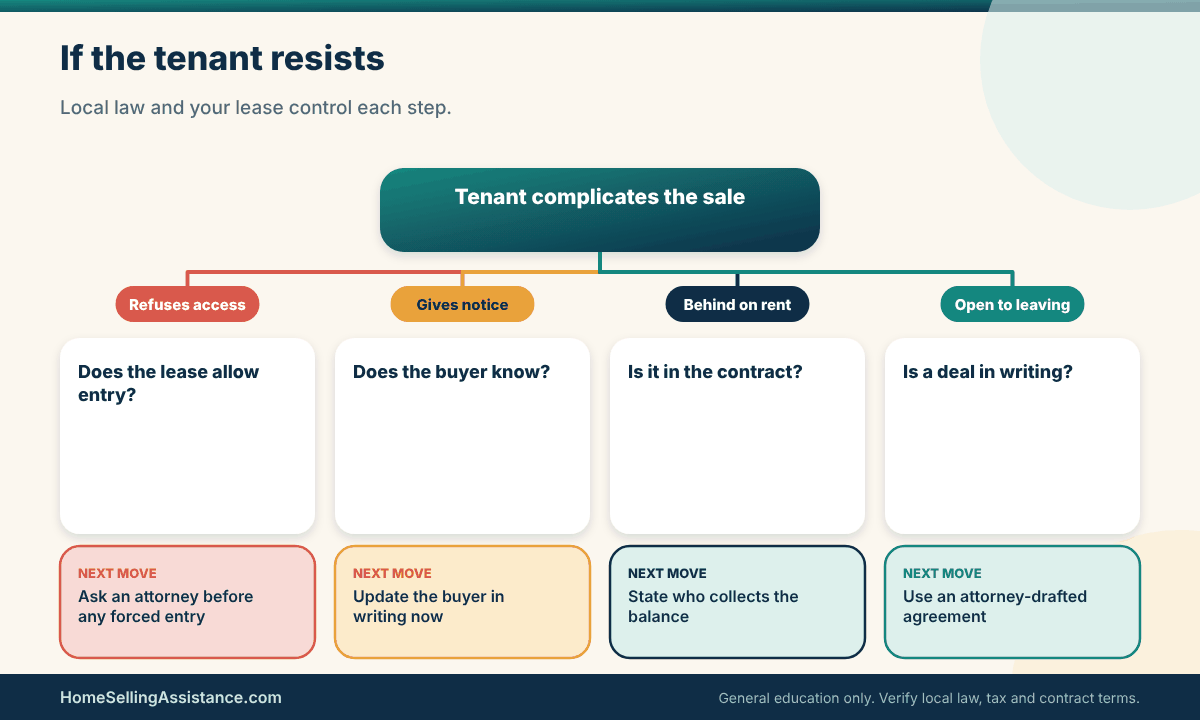
Common workarounds include using photos taken before the tenancy began, shooting only exterior and common areas, offering to schedule the photographer when the tenant is out with the tenant’s written consent, or marketing the property openly as an occupied rental with a floor plan instead of interior images. Investor buyers often care more about the lease and rent figures than the staging. If the tenant refuses all access, talk to your attorney before escalating, because local rules on entry can be strict.
Deposits, rent, buyer type, and the lease handoff
Money tied to the tenancy needs a clear home at closing when you are selling tenant occupied house property. The tenant’s security deposit belongs, in a legal sense, to the tenant, subject to the terms of the lease and state law. Prepaid rent and unpaid rent belong to whoever the sale contract says they belong to. Getting these numbers right early prevents the kind of argument that holds up a signing table.
Numbers to reconcile: deposit, prepaid rent, and prorations
Here is an illustrative example with round figures. Say monthly rent is $1,800, the security deposit held is $1,800, and the tenant has paid rent through the end of the month. If closing happens on the 20th, the sale contract or the closing instructions usually split that month’s rent so you keep the days you owned the house and the buyer receives the rest. These numbers are examples only, and the actual method depends on your contract, local custom and the title company.
The deposit works differently. Many states require the deposit to be transferred to the buyer, with the buyer then responsible to the tenant, while others have you account to the tenant directly or let a title company hold funds. Some require written notice to the tenant about who now holds the deposit. Ask your title company or attorney which method applies, and get the instruction in writing before closing day.
Do not forget unpaid rent, late fees and utilities. If the tenant owes back rent, decide whether you keep the right to collect it, whether the buyer assumes it, or whether it affects the price. State this explicitly in the contract. Silence leads to disagreement, and disagreement between a former and a new landlord rarely ends well for the tenant either.
It also helps to think about the tenant’s own timeline. Someone who rents a house has plans, jobs, school schedules and savings tied to the address. A sale puts those plans at risk even if the lease continues. Being straightforward about what you know, and about what you do not yet know, is part of selling tenant occupied house arrangements the decent way, and it often shortens the process.
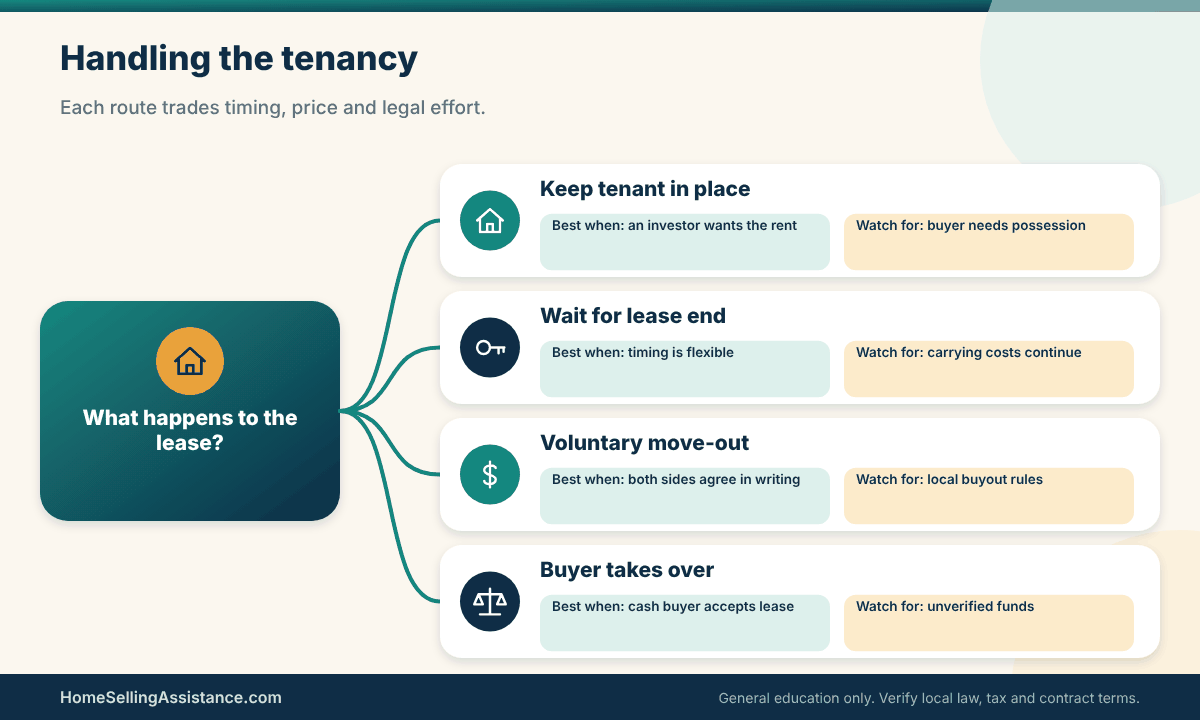
The graphic below shows how the main tenancy-related money items can appear on a closing statement. It is only a structure, so your own statement will have different lines and amounts depending on your contract and your local closing customs.
A scenario: a buyer who wants the house empty
Now imagine an offer from a family that wants to move in, with possession at closing. The tenant has six months left on a fixed-term lease. In many places a lease does not simply end because the owner sells, and a lawful termination may require specific notice, specific grounds, or the tenant’s agreement.
Your options usually include waiting for the lease to end, asking the buyer to accept a later closing, negotiating a voluntary move-out agreement with the tenant, or declining the offer. A voluntary agreement is sometimes called cash for keys and is a private deal in which the tenant agrees in writing to leave by a date, often with some payment or moving help. Have an attorney draft it, never pressure the tenant, and confirm that local law permits this kind of agreement.
The right answer for selling a rental property with a lease in place often depends on how much time the lease still has.
Whatever route you choose for selling tenant occupied house plans, remember that your sale contract should mirror reality. If the buyer is told the house will be vacant and it is not, the deal can unravel. If the buyer is told the tenant will stay and the tenant has already given notice, the buyer’s financing may change. Keep the contract, the lease and the tenant’s own statements aligned.
Finally, think about how selling tenant occupied house plans affect your net result. A tenant-occupied sale can shift costs in both directions: carrying costs may continue longer, rent keeps arriving, and repairs may be limited by access. If you want to see how these items interact with your bottom line, a walkthrough of home sale net proceeds is a useful companion.
Matching the buyer, the title company and the attorney to the tenancy. The tenancy you have should shape who you market to. Selling tenant occupied house listings to the wrong audience wastes weeks: an owner-occupant lender may balk at a lease that cannot end for a year, and an investor may walk away from a house with no lease and no rent history. The handoff to the title company and the attorney then turns the agreed terms into closing documents that reflect the lease accurately.
The figure below sketches the decision most sellers face early on. It compares keeping the tenant in place with selling the house empty, and it shows what each path asks from you. Look at it as a prompt for questions to put to your agent or attorney, not as a ranking of the two paths.
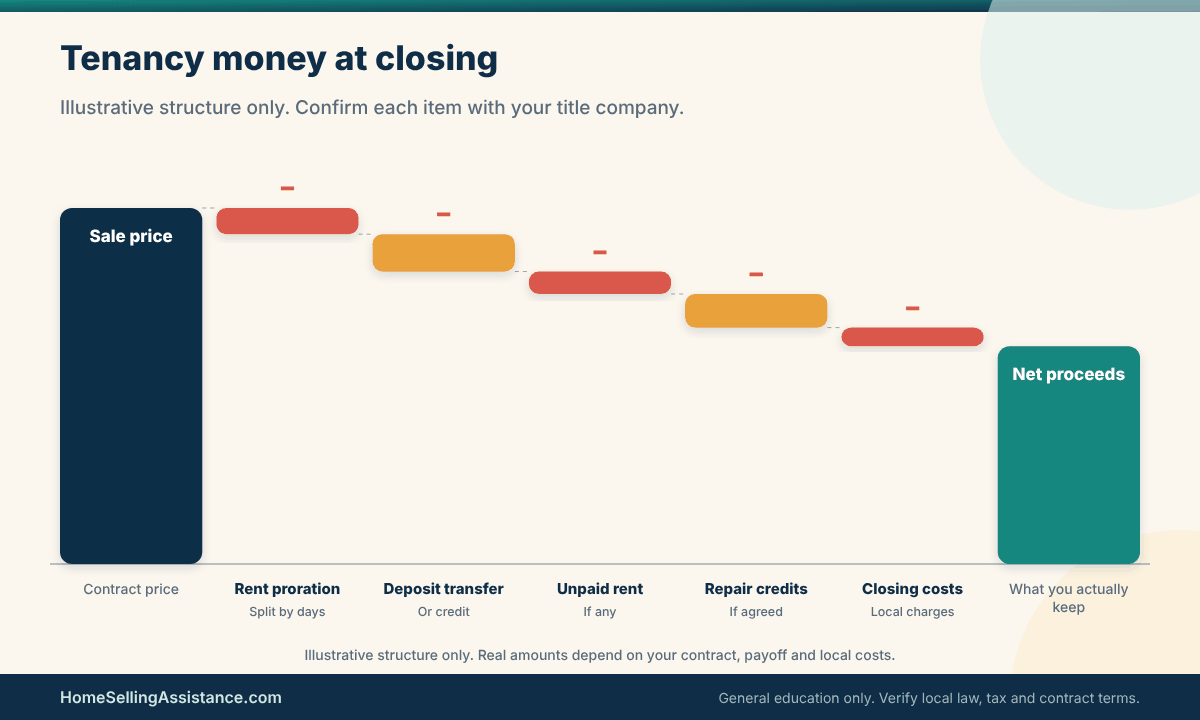
A lot of the stress in selling tenant occupied house deals comes from timing mismatches between the lease and the buyer. The lease has an end date, the buyer has a financing deadline, and the contract has a closing date. When those three line up, everything feels easy. When they do not, you need either flexibility or a creative solution, such as a rent-back arrangement, a short extension or a voluntary move-out.
Investor buyers, owner-occupants, and cash offers on a rented house
Three broad buyer types show up when you are selling tenant occupied house property. Investors value the lease, the rent history and the condition of the property. Owner-occupants value possession, so a lease that continues can be a dealbreaker. Cash buyers, whether investors or companies, value simplicity and speed and may be comfortable taking over the lease or negotiating a move-out themselves. Each group has strengths, and none is automatically the best fit.
Evidence to compare: lease terms, rent roll, and lender occupancy rules
Investors reviewing selling tenant occupied house listings tend to read the lease line by line. They want to know the rent, the term, the deposit, the history of on-time payments and any unusual clauses. Offering a clean packet that includes the lease, a rent ledger and a short, honest condition summary helps them price the house with fewer unknowns, and unknowns are usually what buyers discount.
Owner-occupants usually finance with loans that assume the buyer will live in the home, and many lenders ask the buyer to sign a statement of occupancy intent. Lender rules differ by program and by lender, so a buyer who needs possession soon may not be able to close on a house with a tenant who has months left. Ask the buyer’s lender early what they require, rather than assuming.
Cash buyers add speed but not necessarily certainty. Ask for proof of funds, and read the contract carefully for contingencies. For a broader look at how this route works, the cornerstone guide on a cash offer for a house as a seller explains common structures and cautions. Whatever the buyer type, make sure offers are compared on net terms and timing, not just headline price.
When you evaluate offers for selling tenant occupied house listings, read the contingencies as carefully as the price. A financing contingency, an inspection contingency and a possession contingency each give the buyer a way out, and each interacts with the lease differently. Ask your agent or attorney to walk you through the exit points for each offer so you understand what you would be committing to if you said yes.
Scenario: two offers, one with possession at closing
Say you receive two offers on a rented house. The first is a bit higher on paper and comes from a buyer who needs to move in at closing. The second is slightly lower and comes from an investor who will keep the tenant and close on a flexible date. Both numbers here are only an example of the shape of the decision.
The higher offer only works if the tenant leaves by closing, and you cannot promise that unless the lease or a signed agreement allows it. If the move-out falls through, you may face a failed closing, a renegotiation or a breach question. The second offer may carry less risk, but it may also net less. Neither is wrong. What matters is that you compare the risk and timing honestly with your agent and your attorney, and that you do not agree to deliver a vacant house you may not be able to deliver.
A related point involves fair treatment. Decisions about whether to renew, extend or end a tenancy around a sale must not be based on protected characteristics such as race, religion, national origin, sex, familial status or disability. The fair housing guide for home sellers explains the basics, and your attorney can help you apply them to the tenant relationship as well.
Title, escrow, and the legal handoff
After an offer on selling tenant occupied house plans is accepted, the closing team takes over. The title company or closing attorney reviews who owns the property, who has rights in it and how funds should move. A tenancy adds a few items to their list, including the lease, the deposit and any claims the tenant might have, so give them the full picture early and let them tell you what they need.
Documents the closing team will ask for
In selling tenant occupied house closings, expect requests for the full lease and addenda, the rent ledger, proof of how the deposit is held, and a recent statement of any unpaid rent. Many buyers also ask for an estoppel certificate, which is a short statement signed by the tenant confirming the rent, the term, the deposit and that there are no known disputes. Not every tenant must agree to sign one, and local practice varies, so build time into the schedule.
The sale contract often needs a lease assignment clause, which transfers your rights and duties as landlord to the buyer at closing. Some contracts also include a tenant notice letter that tells the tenant who the new landlord is and where to send rent. Ask the title company which forms they use locally. For a deeper look at how the search and policy stage works, see the article on the title search in a seller’s home sale.
Closing day for selling tenant occupied house sales should include a clear accounting. Rent prorations, the deposit transfer or credit, any repair credits and any payoff of a mortgage or lien belong on the settlement statement. Review it line by line before signing, and ask for corrections early. If you are unsure how the statement is organized, the walkthrough on the seller closing statement can help you read it.
An experienced closer can make selling tenant occupied house paperwork feel routine, but only if the information arrives early. Send the lease packet when the contract is signed rather than when the title officer asks twice. Respond to requests the same day, and keep a short list of open items. Small habits like these are what separate a calm closing from a frantic one, and they cost nothing.
Scenario: a lease that was never signed by the owner on record
Consider a house that was previously managed by a relative who signed the lease in their own name, even though title sits in yours. The tenant has paid rent for years and believes everything is in order. The buyer’s attorney spots the mismatch during due diligence.
This is not unusual in selling tenant occupied house cases, and it is usually fixable. The common solution is a short written ratification or new lease signed by the true owner and the tenant, so the buyer can see a clean chain. Your attorney may suggest additional steps, such as confirming how the deposit was handled by the relative. Raise the issue yourself before the buyer does, and the conversation tends to feel like diligence rather than a problem.
Quick scenario
An owner lists a rented house with 4 months left on the lease and shares a packet with the lease, ledger and a note to the tenant. The tenant agrees to scheduled showings with 24 hours of written notice, as the local rule and lease allow. An investor submits an offer that keeps the tenant, and the closing team handles the deposit and rent split in writing. The numbers are only an example, but the pattern of notice, packet and clear handoff is the part worth copying.
Build a selling tenant occupied house verification checklist before signing
By this point you have a map, a workflow and a buyer plan. The last stage is verification: proving to yourself, and to everyone else at the table, that the facts are current and the rules have been checked. A good verification checklist for selling tenant occupied house contracts is short enough to use and specific enough to catch the things that usually go wrong, such as an outdated lease copy or an unchecked local notice rule.
The scenario table below shows common situations sellers run into, along with the options, the risk, the document to review and the person to call. Use it to spot which row looks like your case, then read the matching document before you talk to a buyer. As with the earlier matrix, the table frames the questions and your local professional supplies the answers.
| Situation | Seller options | Main risk | Document to review | Escalate to |
|---|---|---|---|---|
| Fixed-term lease with months remaining | Sell with tenant in place or negotiate early move-out | Buyer needs possession and cannot wait | Lease term and renewal clauses | Landlord-tenant attorney |
| Month-to-month tenancy | Keep tenant or give lawful written notice | Notice defective or deemed retaliatory | Lease and state notice statute | Attorney or local housing office |
| Tenant refuses showings | Reschedule, offer incentives, market as occupied | Illegal entry claim or stalled listing | Lease entry clause, local entry rule | Attorney before any forced entry |
| Tenant behind on rent | Collect, assign claim or adjust price | Dispute over who is owed what | Rent ledger and notices sent | Attorney and title company |
| No written lease | Document the tenancy in writing | Buyer and lender cannot verify terms | Payment records and messages | Attorney before listing |
| Tenant holds purchase option | Honor option or negotiate a release | Contract breach or cloud on title | Lease addenda and recorded documents | Attorney and title company |
| Sale triggered by hardship or foreclosure | Review timing, tenant protections and lender steps | Missed tenant rights or deadlines | Lender notices, lease, local law | Attorney and HUD-approved counselor |
One practical way to use the table when selling tenant occupied house plans get complicated is to highlight your row and write beneath it the date you plan to speak to the listed professional. A scheduled conversation is much more likely to happen than a vague intention to ask someone eventually. If two rows apply at once, such as a fixed-term lease and a tenant behind on rent, work through the more serious risk first.
A good rule is to treat every verification item as a yes or no question with a document behind it. Is the lease complete? Yes, here is the signed copy. Was the notice delivered? Yes, here is the proof. Verification of this kind is the safest way of selling tenant occupied house contracts to a buyer who will check everything, because there is nothing left to take on trust.
Official sources and recorded documents
Anything you rely on while selling tenant occupied house property should come from an official source or a document you can hold in your hand. Forum posts, neighbors and well-meaning relatives are useful for ideas, but they are poor evidence. The checklist begins with the sources that carry authority: recorded deeds, the signed lease, statutes and ordinances, and written guidance from a government office or licensed professional.
Evidence to gather: recorded deed, liens, and statute citations
For selling tenant occupied house sales, pull a current copy of the recorded deed and note how the owner is named. Check county records or ask the title company whether any liens, easements or recorded leases show up. A recorded lease or memorandum of lease, if one exists, is especially important because it can affect what a buyer receives. Then record the specific statute or ordinance numbers you rely on for notices and deposits, along with the date you checked.
If you plan to give the tenant a notice, ask your attorney to confirm the form. If the property was purchased with a mortgage, ask your lender for a payoff statement and review whether the loan imposes any conditions on leasing or selling. Keep a printed or saved copy of every source so you can show later what you knew and when you knew it.
For tax questions, remember that a rented house may be treated differently from a primary home. The IRS explains the general rules in Publication 527 on residential rental property and in Publication 523 on selling your home, and a tax professional can say how they apply to you. Depreciation taken on a rental can affect the tax picture, so do not assume the home-sale exclusion covers everything.
If you are working with an agent, ask how many tenant-occupied sales they have handled and how they handled the lease, the notices and the deposit. If you are selling on your own, consider paying an attorney for a flat-fee review of the lease and the sale contract. Either way, selling tenant occupied house transactions reward people who ask direct questions early, long before the contract is signed.
Scenario: the recorded document nobody remembered
Imagine an owner who years ago signed a long-term lease with an option to buy and recorded a short notice of it. The owner has forgotten. The buyer’s title search finds the recorded notice, and the title company will not insure the sale until the issue is resolved.
The usual path involves reading the recorded document, confirming whether the option is still alive, and either honoring it or negotiating a written release signed by the tenant. This can take time, so the earlier a title search happens, the better. If you are not sure what records exist on your property, ordering a preliminary report before listing can reveal them while you still have room to adjust.
What must be current before signing
Documents age quickly when selling tenant occupied house property. A rent ledger that was accurate in March may be wrong by June, and a tenant who verbally promised to stay may have given notice by the time the contract is signed. Before you sign the sale contract, refresh anything the buyer will rely on, and make sure the version in the buyer’s hands matches the version in yours.
Final checks: lease copy, ledger, notices, and tenant statement
Before selling tenant occupied house property, confirm that the lease copy is complete and has every addendum. Update the rent ledger through the latest payment. Verify the deposit amount and where it is held. Reconfirm the tenant’s intentions in writing, and if the buyer wants an estoppel certificate, send the form well before the due diligence deadline. If any notice was required by law or by the lease, confirm that it was delivered and keep proof of delivery.
Review the contract for selling tenant occupied house terms with these facts in mind. It should state that the property is sold subject to the lease, or that it will be delivered vacant, and it should describe how the deposit, rent and utilities are handled. If your agent wrote the contract from a standard form, ask whether any local addendum for tenant-occupied property is available. Read the lead-paint disclosure and any state disclosure form for accuracy as well, since an older house with a rental history often has more to disclose.
Finally, check the practical details of selling tenant occupied house closings. Make sure keys, access codes and garage openers are accounted for, that the tenant knows who to contact after closing, and that utilities and insurance transfer smoothly. If the sale is driven by money stress, the HUD-approved housing counselor directory can connect you with free or low-cost guidance before you commit.
Do not skip the personal side of verification. Call the tenant, confirm their plans in a friendly way, and put the confirmation in an email or letter. A tenant who feels informed is more likely to cooperate with walk-throughs, estoppel certificates and move-out inspections, and cooperation is what makes selling tenant occupied house plans actually finish on schedule.
Scenario: the tenant gave notice the week before closing
Suppose the tenant told you in March they would stay through the summer, and the contract reflected that. Two weeks before closing the tenant gives written notice that they are leaving at the end of the month. This changes what the buyer is buying.
The right step is to tell your agent and your attorney immediately and to notify the buyer in writing as the contract requires. The buyer may be pleased if they wanted a vacant house, or worried if they were counting on the rent, and the contract may allow adjustments to the closing date or price. Concealing the change is the one choice that almost always leads to trouble. Honest updates keep options open and protect you from a later claim.
Throughout this checklist, notice how many items are about documents rather than opinions. That is on purpose. A seller with current paperwork is in a stronger position than a seller with strong opinions, and the same is true for selling a house with an HOA or selling a multifamily property, where the tenants, the rules and the buyers differ but the paperwork habits stay the same. For help picking the right professional to guide you, see the article on listing agent versus real estate attorney for sellers.
Frequently asked questions about selling tenant occupied house
Does the tenant have to move out when I sell?
Not automatically. In many places a valid lease continues after a sale, and the buyer becomes the new landlord unless the lease ends, is lawfully terminated, or the tenant agrees to leave. Rules differ by state and city, so ask a local landlord-tenant attorney what applies to your lease before you promise a buyer a vacant house.
Can I sell a house with a tenant in it?
Yes, and many owners do. Selling tenant occupied house listings usually means marketing to investors, or to buyers willing to wait for the lease to end, and the contract states that the property is sold subject to the lease. The tenancy affects price, timing and buyer pool, but it does not forbid a sale.
How much notice must I give before showings?
It depends on your state, your city and your lease. Many places require advance written notice before a landlord or agent enters, and the period varies. Follow the stricter of the lease and local law, keep a log of each visit, and ask your attorney if the tenant objects to access.
What happens to the security deposit?
The deposit is generally the tenant’s money held by the landlord, and state law governs how it moves in a sale. Some states require transfer to the buyer, others require you to account to the tenant, and some allow the title company to hold it. Settle the method in writing before closing and tell the tenant who holds it afterward.
Should I tell buyers the house is rented?
Yes, and early. Hiding a tenancy while selling tenant occupied house property invites failed closings and legal trouble, while clear disclosure lets the right buyers self-select. Provide the lease, rent history and a note on any known issues, and make sure the contract reflects whether the house will be sold subject to the lease or delivered vacant.
Do investors pay less for a rented house?
Not necessarily, and it varies by market, lease terms and buyer. Some investors value a rent-paying tenant and a lease in place, while others discount for uncertainty or condition. Rather than assume, compare actual offers on net terms and timing with the help of your agent, and avoid anyone who promises a fixed discount or premium in advance.
Can I offer the tenant money to leave?
Often yes, through a written voluntary agreement sometimes called cash for keys, but local rules vary and some places regulate buyouts. The tenant should never be pressured, and the agreement should state the move-out date, any payment and the condition of the unit. Have an attorney draft or review it, especially if selling tenant occupied house deals in your city involve rent control or tenant protections.
What about taxes when selling tenant occupied house property that was a rental?
A house that was rented may be taxed differently from a primary residence, and depreciation previously claimed can matter. The federal home-sale exclusion has ownership and use tests that a rental may not meet, so read the IRS publications and speak with a tax professional about your facts. No article can tell you the outcome for your return.
Do fair housing rules apply to selling tenant occupied house deals?
Yes. Treating tenants or prospective buyers differently because of a protected characteristic is prohibited under federal fair housing law, and states and cities may add more categories. Apply the same standards to everyone, document your decisions, and use HUD’s resources or an attorney if you are unsure how a rule applies.
Who should I hire first?
Many sellers start with a local landlord-tenant attorney to read the lease and confirm local rules, then add a listing agent with rental experience and a title company that has handled tenant-occupied closings. The order is a personal call, but getting the legal picture before listing usually avoids the costliest surprises.
A calm way to sell a rented house
Selling tenant occupied house arrangements goes best when you treat the tenant as a person with rights, the lease as a contract you can read, and the buyer as someone who deserves clear answers. Gather the documents, check the local rules, schedule the notices, and choose the buyer type that fits the tenancy you actually have. This article is general education, not legal, tax or financial advice, so confirm the details with a licensed attorney, tax professional and title company where the house is located.