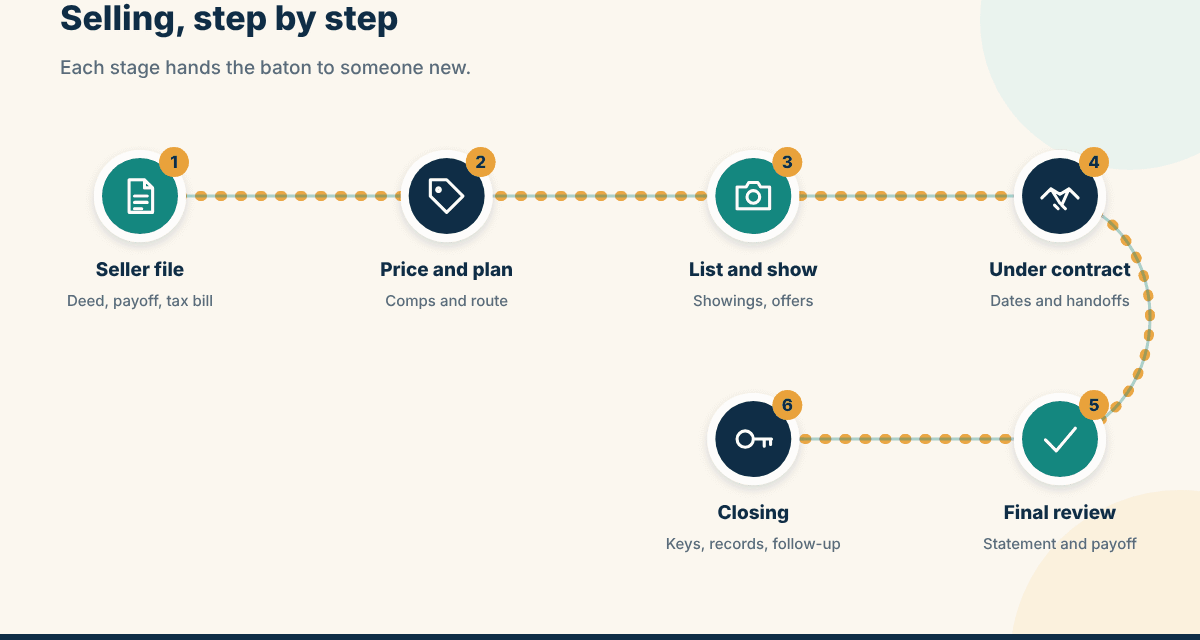
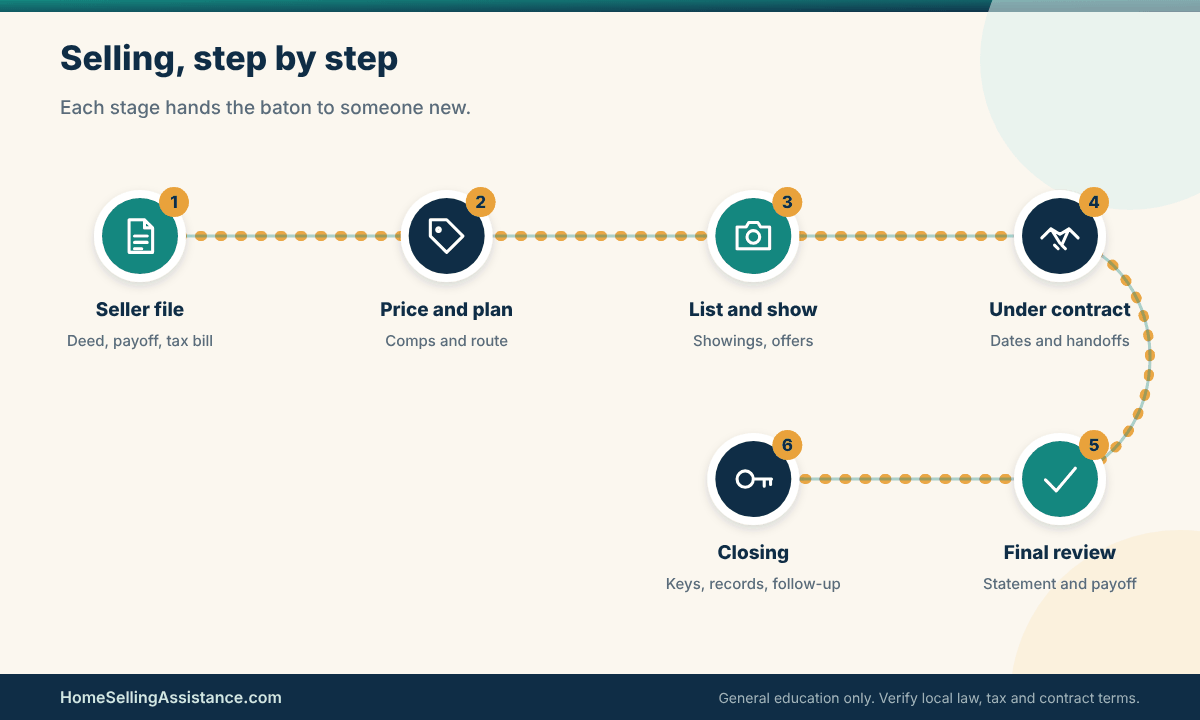
A realistic home selling timeline is not a calendar of fixed dates; it is a sequence of handoffs, each with its own owner, its own paperwork and its own deadline, and the sale only runs smoothly when you know who is holding the baton at every stage.
Most sellers picture the process as three events: put up a sign, accept an offer, collect a check. In practice there are dozens of small steps tucked between those events, and many of them depend on people who do not work for you, such as a lender’s underwriter, a title examiner, an appraiser, a county clerk or an HOA manager. When one of those steps slips, the date you were counting on slips with it.
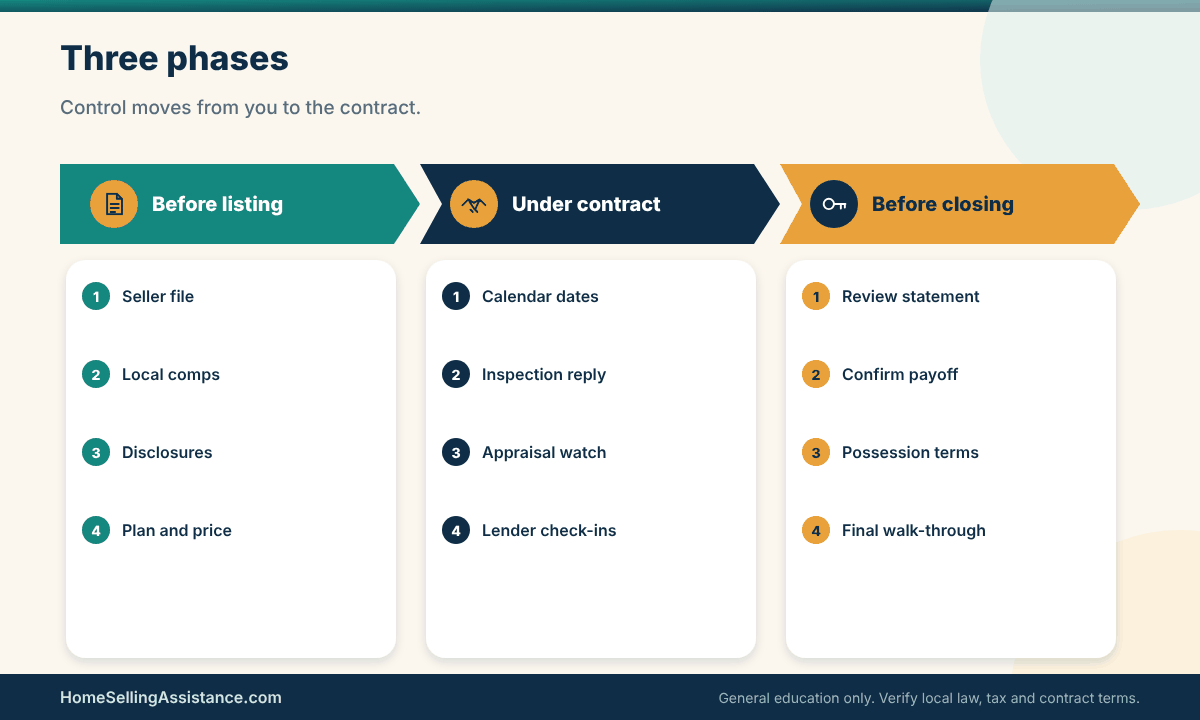
This guide follows the three stretches that matter most: what happens before listing, what happens once a buyer is under contract, and what has to be true before closing.
We will stay at the level of how the pieces fit together, and we will point you to deeper articles in our selling process and timeline library when a single step deserves its own page. If you want the full big-picture view first, start with our cornerstone guide on how to sell a house and come back here for the sequencing.
One honest warning before we begin. Every transaction is different, and so is every state. Disclosure forms, attorney involvement, escrow customs, the way earnest money is handled and the number of days a contingency lasts all vary by state, county and contract. Where this article gives example numbers, they are round figures meant to show how the arithmetic works, not predictions for your house.
Key takeaways
- Build the seller file first. Payoff figures, ownership papers, tax bills, HOA details and repair records decide how fast later steps can move, and gathering them is cheap compared with scrambling during escrow.
- A timeline is a chain of deadlines, not a single date. The contract controls the pace after acceptance, so read every date in it and put each one on a calendar the day you sign.
- Know who owns each handoff. Agent, lender, appraiser, title company, attorney and HOA each answer to different clocks, and you should know whom to call when one of them goes quiet.
- Plan for the contingency window. Inspection, appraisal and financing periods are where most surprises appear, so leave slack for them rather than promising your own next move too early.
- Confirm the final numbers in writing. Payoff, prorations, credits and possession terms should be reviewed before closing day, not on it.
- Keep records after the sale. Closing documents, improvement receipts and forwarding details protect you months and years later.
Build your home selling timeline from a seller file first
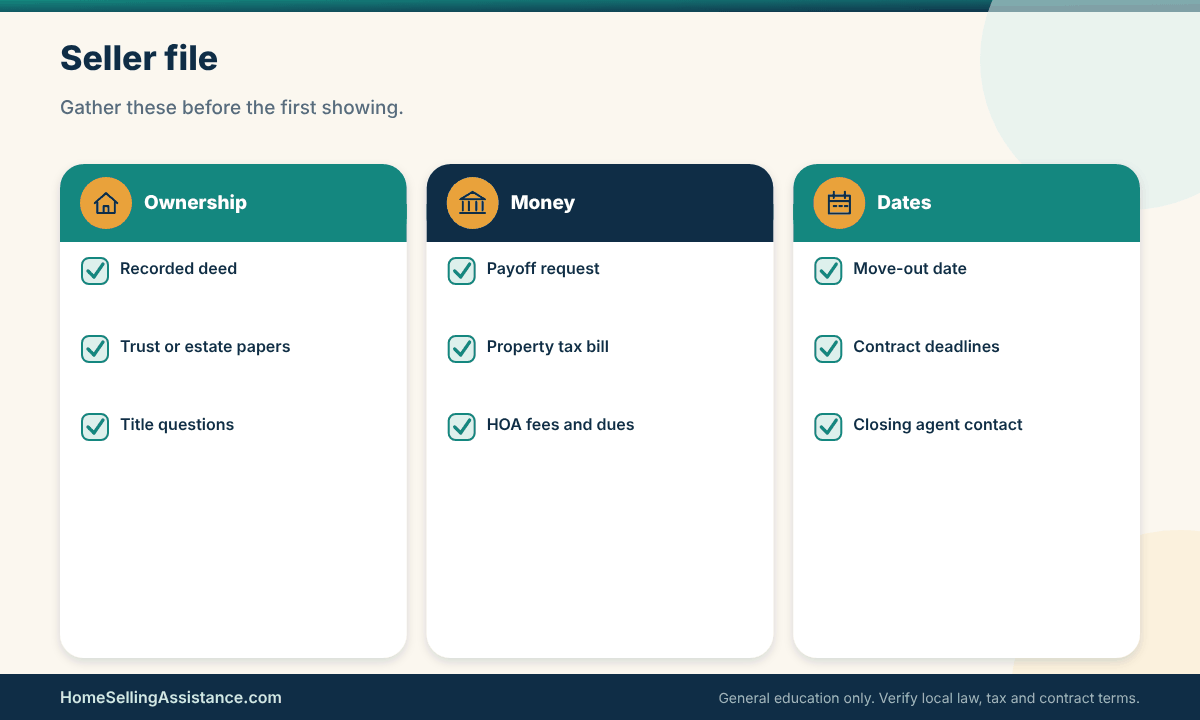
Before anyone takes a photograph or mentions a price, the most useful hour you can spend is on a plain folder, paper or digital, that holds everything a buyer, lender or title company will eventually ask you for. Sellers who do this early tend to feel calmer later, because the questions that arrive under contract are mostly questions they have already answered. That is how a sensible home selling timeline stays realistic.
The folder is also your first reality check. A seller file shows whether you can sign alone, whether a lien needs clearing, whether an HOA will take two weeks to produce its documents, and whether the roof you replaced years ago has paperwork to prove it. Each of those answers shifts the shape of your home selling timeline before a single showing is booked.
Documents, numbers, contacts, and deadlines that anchor the schedule
Think of four buckets. Documents prove who you are and what you own. Numbers describe what you owe and what the sale will cost. Contacts are the people you will need on short notice. Deadlines are the dates that already exist before you start, such as a lease end, a job start, a rate lock on the home you plan to buy or a school year. Each of these points shapes your home selling timeline in a small but real way.
Write the deadlines down first, because they are the only part of the plan that comes from your life instead of the market. A fixed move date does not change what buyers are willing to do, but it changes which tradeoffs make sense, such as accepting a slightly lower price for a cleaner contract or asking for a longer closing window.
Evidence to gather: payoff, deed, tax bill, HOA and permits
Start with ownership. You need a copy of your deed, ideally the one recorded with the county, because it shows how title is held.
If the home is in a trust, an LLC or two names, the people who sign the contract must match what the deed and any trust papers say. If your name has changed since you bought, or an owner has died, tell your title company early so they can describe what proof they will want. A written plan makes the home selling timeline easier to defend when pressure rises.
Next, the loan. A recent mortgage statement shows your servicer and an approximate balance, but it is not a payoff figure. The payoff is a separate number, good only through a stated date, that includes interest through that day and any fees.
You request it in writing from the servicer when you are ready, and the title or escrow company usually orders an updated one near closing. Do not use a statement balance to estimate what you will walk away with without understanding that gap. Our guide to mortgage payoff when selling a house shows how the pieces differ.
Then property taxes and assessments. Pull the latest bill and note the due dates, because taxes are normally split between you and the buyer by the closing date, and in some places they are paid in arrears while in others they are paid ahead. A bill that looks small may hide a special assessment or a rollback tax in certain areas, so read the whole page, not only the total. Keep this in mind whenever your home selling timeline feels crowded.
If the property sits in an HOA, ask the association for its governing documents and the contact that handles resale paperwork. Many associations charge for resale certificates and take days or weeks to prepare them, and the buyer’s lender often cannot finish its work until they arrive. That single vendor can quietly set your closing pace, so a request made at listing is far cheaper than a request made during escrow.
Finally, gather the physical history of the house: permits and final sign-offs for remodels, receipts for the roof, HVAC and water heater, warranties that may transfer, and any earlier inspection reports. These do not set a deadline, but they shape what you can honestly say on a disclosure form and how quickly you can answer a buyer’s questions.
A related list lives in our article on documents needed to sell a house. Seen this way, the home selling timeline is mostly a list of questions with owners and dates.
A scenario, an exception, and your next step for paperwork
Picture a seller we will call Dana, who assumes her condo’s paperwork is a formality. She lists on a Thursday and gets an offer by Sunday. On Monday the buyer’s lender asks for the association’s resale package. Dana calls the management office and learns it takes ten business days and a fee she did not know about. Her closing date was written at thirty days, so a third of the schedule is now spent waiting on one document.
The exception is that not every association is slow. Some produce documents in a day, and some states standardize the package. The lesson is not that every HOA is a bottleneck. It is that you do not know until you ask, and asking before you list costs one phone call. Small habits like this keep a home selling timeline from drifting.
Your next step, if you are in Dana’s position, is simple. Call the management company this week, ask what the resale package includes, what it costs, who pays, and how long it takes. Write the answers on the first page of your seller file. If you own a single-family home with no association, do the same exercise with your county recorder or your title company, asking what they need to confirm ownership and clear any lien.
If something in the file looks wrong, such as a name spelled differently on the deed and your mortgage, or an old lien that was paid but never released, tell your agent or attorney now. Title problems do not go away when ignored, and they are far easier to correct before a buyer is waiting. Our overview of the title search in a home sale explains what examiners look for. None of this changes the basic logic of a home selling timeline: know the owner, know the date.
Information still missing when you start planning
Even a careful seller starts with gaps. You may not know what the house will likely sell for, whether the buyer pool in your area is moving quickly or slowly, what repairs a buyer’s inspector will flag, or how long local title and recording offices are taking this season. None of that is a failure. The skill is to list the gaps honestly and decide who can fill each one, and by when.
A useful trick is to sort the unknowns into two groups: things you can find out this week, and things that only become known once a buyer shows up. A payoff request, an HOA package and a county tax record belong in the first group. A buyer’s financing strength and an appraiser’s opinion belong in the second, and you plan around them by building slack, not by guessing. Sellers who write this down usually find their home selling timeline far less stressful.
How to close gaps: who to call and what to request
For price and pace, ask a local agent or two for a comparative market analysis, and ask them to show you the sold homes behind it, with dates, not just the active listings. A single national number is not a local forecast. If you are curious how a rough value differs from an appraisal, our article on the CMA versus an appraisal lays out who produces each and why they can disagree.
For condition, consider whether a pre-listing inspection fits your situation. It costs money and it can reveal problems you then have to disclose or fix, but it also removes surprises from the negotiation. Some sellers prefer to wait and respond to a buyer’s inspection; others like to know first. Both are legitimate. We compare the choices in pre-listing home inspection. It is the kind of detail that can stretch or shrink a home selling timeline.
For legal and local rules, your best sources are the state real estate commission’s seller resources, a local real estate attorney, your title company and the county recorder. Ask three questions of whoever you consult: what disclosure forms apply here, who typically handles closing in this area, and what is the usual order of events after a contract is signed. The answer to the third question is, in effect, the local version of your home selling timeline.
For money, request a payoff quote, ask your servicer about any prepayment penalty or special fee, and ask a title company for a rough estimate of seller-side costs. Treat any early figure as a range.
If you need a structured way to turn those pieces into a number, our net proceeds guide walks through the arithmetic and shows why an early estimate and a final statement rarely match to the dollar. Add it to your own home selling timeline notes, with a date and a name next to it.
The table below puts the whole seller workflow in one view. Read it as a map of stages: each row names a stage or symptom you may notice, what you should have in hand, the action it triggers, the decision deadline that usually applies, and the next person who takes over.
| Stage or symptom | Information to gather | Action | Decision deadline | Next handoff |
|---|---|---|---|---|
| Thinking about selling | Goal, move date, rough equity picture | Write priorities; request payoff estimate | Before choosing a route to market | Agent, attorney or title contact |
| Preparing the file | Deed, tax bill, HOA package, permits | Order missing papers; flag title issues | Before photos and listing date | Listing agent or title company |
| Pricing | Sold comps, condition notes, local pace | Choose list price and strategy | Before going live | Marketing and showings |
| Offers arrive | Price, terms, financing, dates, contingencies | Accept, counter or decline | Offer expiration stated in writing | Escrow or closing attorney |
| Inspection period | Report, repair requests, seller records | Repair, credit, price change or refuse | Response date in contract | Buyer and buyer’s agent |
| Appraisal and financing | Appraisal result, lender conditions | Cooperate, supply documents, weigh options | Contingency dates in contract | Lender and title company |
| Final stretch | Payoff, prorations, closing figures | Review statement; arrange possession | Days before signing | Closing agent |
To use this table, copy the rows onto your own calendar and replace the generic deadline column with the actual dates from your contract and local custom. Where you cannot fill in a cell, you have found a gap, and the “next handoff” column tells you whom to ask. Our checklist-style article on the seller checklist before listing covers the earliest rows in more detail. Treat this as one more checkpoint in your home selling timeline.
When a gap turns into a delay: one example and a fix
Consider a seller named Marcus who owns a house with an older remodel. He lists without checking permits. The buyer’s inspector notices a finished basement and asks for the permit record. The county has none. Marcus now has to decide whether to apply for a retroactive permit, offer a credit, disclose the work and let the buyer decide, or cancel. Each option has different timing and cost, and each depends on local rules he has not yet read.
Had Marcus asked the county building department before listing, he would have faced the same problem, but at a moment when he controlled the pace. He could have chosen to resolve it, to disclose it plainly, or to price with it in mind. Waiting turned an information gap into a negotiation under a deadline. This is where an honest home selling timeline beats a hopeful one.
The fix is not complicated, and it generalizes. When you notice a gap, give it an owner and a date. If the owner is you, put a reminder on your calendar. If the owner is someone else, such as an HOA manager or a servicer, write down the date you asked and the date you were told to expect a reply. Follow up once, politely and in writing, when that date passes.
There is also an exception worth knowing. Sometimes you cannot close a gap before listing, for example when a buyer’s lender has requirements no one can predict. In that case, do not freeze.
State the gap in your plan, assume it may add several days, and shape your own commitments so that an extra week will not wreck your next move. Our article on offering a flexible closing date shows how that slack can also become a negotiating tool. Ask for the answer in writing so your home selling timeline rests on facts.
Move through a home selling timeline in order
Once the file is in decent shape, the sale becomes a series of gates. You do not need to rush through them, and you cannot skip any of them, but you can avoid carrying problems from one gate to the next. A condition issue you ignore at listing becomes a repair request at inspection. A pricing mistake becomes a low appraisal. A vague contract date becomes an argument over who missed a deadline.
The simplest way to hold the order in your head is in three stretches: before listing, under contract and before closing. The picture below shows how the work shifts between them, from decisions you control almost completely to dates that the contract and other people control. Slack like this is what keeps a home selling timeline from breaking.
Early action and decision points before and during listing
Before the listing goes live, you make four choices that echo through everything later: who will help you (an agent, an attorney, nobody, or a mix), how you will reach buyers, what price you will ask, and how ready the house needs to be. They are listed in that order because each constrains the next. A route to market affects how much help you have with pricing, and pricing affects how much preparation is worth doing.
We stay neutral on the first choice. A full-service listing agent, a flat-fee service, a real estate attorney, a cash buyer and a sale by owner each trade effort, cost, exposure and risk differently. What matters for your home selling timeline is that you decide deliberately and put the compensation terms in writing before you sign anything. Our guides on choosing a listing agent and the listing agreement describe what to compare. Every lesson here feeds back into how you read your own home selling timeline.
Evidence behind each early decision: comps, condition, route to market
Pricing evidence comes from sold homes similar to yours, in your neighborhood, within a recent window, adjusted for real differences such as size, condition, lot and updates. Active listings show what competitors hope to get; sold homes show what buyers actually paid. If sold prices are trailing asking prices in your area, or the average time on market is stretching, the evidence is telling you that buyers have leverage, whatever any headline says.
Be careful with online estimates. They can be a starting point, but they work from limited data and cannot see your kitchen or your foundation. Our piece on how to price a house to sell explains how to cross-check an estimate against local sales, and why the list price, market value and appraised value are three different numbers. That single habit improves almost any home selling timeline.
Condition evidence comes from walking the house as a buyer would. Look at the roof, the water heater, the HVAC age, the windows, signs of past leaks, and anything that smells, sticks or hums in a way it should not.
Decide which problems you will fix before listing, which you will disclose and price for, and which you will leave for negotiation. Not every repair earns its cost back, and some repairs matter mainly because a lender or insurer will not accept the house without them. We cover that sorting exercise in repairs before selling a house.
Route to market evidence is mostly about your own priorities. If you need the highest possible price and have time, exposure on the open market is a typical choice. If you need certainty and speed, a direct sale to an investor or buyer with proof of funds may fit, with the understanding that offers can come in lower and that funds should be verified.
If you want to understand that tradeoff, read our overview of the cash offer for a house. Neither path is wrong; each is a different mix of price, time, risk and effort. Make a note of it so the home selling timeline reflects what you actually learned.
Time evidence is the piece of a home selling timeline most sellers skip. Ask your agent or title company how many days listings in your price range have recently taken to go under contract, and how many more days closings have taken after that. Then add your own preparation time. That total, not a single optimistic example, is your planning range.
A scenario, an exception, and a next step before the first showing
Imagine a couple, Priya and Jon, who have to move for a job starting in about three months. They talk to two agents.
One suggests a price that matches several recent sales; the other suggests a figure noticeably higher “to leave room.” Neither is lying, but the choices lead to different timelines. The higher price may bring fewer showings and a price cut after a few weeks; the lower price may draw an early offer. This step rarely appears on generic lists, yet it often decides how a home selling timeline unfolds.
Priya and Jon decide that their job date matters more than squeezing the last bit of price. They write down that priority, ask each agent to explain how the plan would change if the house is not under contract by a certain date, and choose the approach that gives them a clear checkpoint. This is not the only sensible decision. Another couple with a flexible move date might choose the opposite.
The exception is a hot market where homes sell quickly regardless of strategy. Even then, the early decisions still shape your timeline, because a rushed process tends to skip documents and disclosures that return later as problems. Fast markets reward preparation, not the absence of it. It also keeps your home selling timeline understandable to everyone involved.
Your next step before the first showing is to write a one-page plan. Include your target move date, your price floor (the lowest number that still works), your preferred and acceptable contract terms, and the date by which you will reassess price if there is little activity.
Share it with whoever is helping you, so that everyone is working toward the same dates. A reassessment date written in advance makes it easier to adjust without panic. Our guide on price reduction strategy explains how to think about that checkpoint.
Also decide now how you will handle showings and offers. Will you require a pre-approval letter or proof of funds before showing the house? Will you set an offer review date, or respond as offers arrive? Will you accept backup offers?
These choices cost nothing to make in advance and a great deal to improvise. Fair housing law applies to everything you do here: treat every buyer the same way, and base your choices on price, terms and financial strength, never on who the buyer is. The federal HUD fair housing resources explain the basics. Adjust the home selling timeline now rather than after a deadline passes.
Finally, set up a communication routine for the home selling timeline. Decide how often you want updates, by what channel, and who is allowed to speak for you. Many timeline problems are really communication problems, such as a counteroffer that sat unread for a day or a showing request nobody answered. A short weekly call, plus quick replies on anything with a deadline, prevents most of them.
Handoffs, negotiations, and contingencies under contract
The moment you accept an offer, your home selling timeline changes character. Before acceptance, you steer. After acceptance, the contract steers, and your job is to meet your own obligations on time while watching the buyer’s. Each handoff in this stretch, from agent to escrow officer, from escrow to lender, from lender to appraiser, is a place where information can be lost or delayed. Revisit your home selling timeline whenever a new date appears in the paperwork.
Negotiation does not end at acceptance either. Inspection requests, appraisal shortfalls and financing hiccups bring new rounds of give and take, and each round has a clock. A seller who understands the contingency calendar can answer quickly and calmly. A seller who does not may let a response window lapse, which in some contracts is treated as agreement or as a waiver of rights. Our guide to home sale contingencies from the seller’s side explains the common types.
Contract dates to calendar: inspection, appraisal, financing, title
On the day you sign, read the contract for every date and every phrase that sounds like a deadline, such as “within five days of acceptance” or “no later than the closing date.” Count carefully whether the contract uses calendar days or business days, whether the clock starts on acceptance or on delivery of a document, and what happens on weekends and holidays.
Different contracts handle these details differently, and a form used in one state may not match the form used in another. Few things protect a home selling timeline as well as an early question.
The inspection period is usually the first big window. The buyer inspects, then sends a request, and you respond within a stated time. You might agree to repairs, offer a credit, reduce the price, or decline. Your decision should rest on the inspection findings, quotes from licensed contractors where relevant, and what the buyer can do if you refuse. Our articles on the inspection contingency and repair request options go step by step through the choices.
The appraisal is the next gate when the buyer uses a loan. The lender orders an appraisal to confirm that the property supports the loan amount. If the appraised value comes in below the contract price, the transaction can stall until the parties agree on what to do, which may include a price change, the buyer covering the difference, a challenge to the appraisal, or cancellation under the contract.
Nobody can promise an appraisal result. See low appraisal options for sellers for the paths. Good records turn a stressful home selling timeline into a manageable one.
The financing contingency, where present, gives the buyer a defined period to secure a loan. Underwriting can ask for additional documents even late in the process. As the seller you cannot control the lender, but you can ask your agent to check in on progress at set intervals and to confirm in writing when the buyer’s financing condition is satisfied or removed. The article on the financing contingency shows what that confirmation can look like.
Title work runs quietly in the background of every home selling timeline. The title company searches records, identifies liens, easements and ownership questions, and issues a commitment describing what must be fixed before closing. Judgments, unpaid contractor bills, old mortgages never formally released and missing heirs are examples of issues that can appear. If something does, it becomes a task with a deadline, and a clear description from the title officer tells you what proof is required. This is a practical way to test whether your home selling timeline is realistic.
Put each of those dates on a shared calendar, and add one reminder two days before each. When you wonder why a home selling timeline stretched, the answer is almost always that one of these windows was longer than expected or that a handoff was missed. The table below turns the same idea into a check you can run any time something feels off.
| Issue | Seller evidence | Buyer, agent or title input | Risk | Fallback |
|---|---|---|---|---|
| Repair request after inspection | Receipts, permits, contractor quotes | Inspection report and buyer’s specific list | Dispute that burns contingency days | Credit, partial repair or counter in writing |
| Appraisal below contract price | Comparable sales, upgrade list | Appraisal copy, lender’s review process | Stalled deal or price renegotiation | Price adjustment, buyer funds the gap or cancel |
| Slow or changing financing | Prompt document replies, access for lender | Lender status updates, conditions list | Missed closing date | Written extension, backup offer or relist |
| Title defect or lien | Payoff letters, release documents, ID proof | Title commitment and cure requirements | Closing cannot happen until cleared | Pay off at closing or cure before; extend date |
| HOA paperwork delay | Association contact and request date | Lender’s HOA questionnaire needs | Lender cannot finalize loan | Escalate to manager; extend closing by agreement |
| Move-out or possession conflict | Moving schedule, rent-back needs | Buyer’s possession expectation | Dispute over keys and daily costs | Written rent-back or adjusted closing date |
To use it, scan the “issue” column for what is happening now, gather the seller evidence listed, ask the people in the next column for their input in writing, and agree on the fallback before the deadline arrives. If you are unsure what a clause means, a local real estate attorney can read your actual contract; this article cannot. Share it with everyone who touches your home selling timeline.

A scenario with a repair request and a tight closing date
Take a seller we will call Elena. She accepts an offer with a closing date set at thirty days. Four days later the buyer’s inspector reports an aging water heater and a small roof leak. The buyer asks for a roof repair by a licensed contractor and a credit toward the water heater. Elena’s response window is five days, and her next home purchase closes in about the same time frame as her sale.
She gathers two quotes, checks what her own agent thinks the market will accept, and reads the contract to see whether the buyer could cancel if she refuses. She decides to repair the leak, since it could also affect the buyer’s insurance, and to offer a smaller credit for the water heater, which still works.
She puts the response in writing before the deadline, and she asks the buyer to confirm in writing that the inspection issues are resolved. Neither side got everything, yet the sale stayed on schedule. It is also a fair check on any home selling timeline someone else hands you.
The exception is when the buyer’s requests are large or the buyer seems to be using the inspection to renegotiate the price. Then your options widen: you could decline, counter with a modest credit, or consider a backup offer if you have one. Which path is best depends on your contract, your market and your own flexibility, and a professional who has seen your specific documents can help you weigh it. Our article on backup offers explains when they are worth keeping alive.
Your next step in a situation like this is to avoid answering in anger or in a rush. Read the request twice, ask for the full report instead of a summary, get quotes, check your deadlines, and write your response so that it clearly says what you agree to, what you decline and what you propose.
When the response is finalized, have both sides sign the amendment, because verbal understandings are hard to enforce and easy to misremember. Put another way, the home selling timeline is only as strong as its weakest handoff.
If the sale falls apart, do not treat the home selling timeline as ruined. Ask your agent or attorney about the contract’s terms for earnest money and relisting, notify any backup buyer as the contract allows, and review what you learned from the inspection, because the next buyer’s inspector will likely find the same items. Our guide on a deal falling through after inspection offers a calm way to restart.
Close the loop at the end of your home selling timeline
The last stretch of a home selling timeline feels like a sprint, yet it should be the quietest part if the earlier work was done. Contingencies are cleared or waived, the buyer’s loan is approved, the title company has what it needs. What remains is verifying that the numbers are right, that everyone agrees on possession, and that you will not be surprised by a charge or a missing signature. Revising the home selling timeline in writing keeps everyone aligned.
This is also where mistakes cost the most and are hardest to reverse, because money moves and ownership transfers on the same day. A few hours of calm review in the days before closing are worth more than any other hour in the whole process. If you want the broader view of costs, our closing costs and net proceeds category collects the deeper guides.
What to confirm in writing before closing day
The principle here is simple: anything you are relying on should exist in writing, from someone authorized to provide it. Spoken assurances from a friendly agent or a lender’s phone representative are useful for planning, but they are not evidence. Your closing statement, your payoff letter, your amendment signed by both parties and your possession agreement are evidence.
Ask your closing agent, whether an escrow officer or attorney, for a draft of the seller’s closing statement as early as they will provide one. Many offices can share a preliminary version several days before closing. Read it line by line and ask about anything you do not recognize, because correcting a number on Tuesday is easier than correcting it at the signing table.
Documents to verify: closing statement, payoff, possession terms
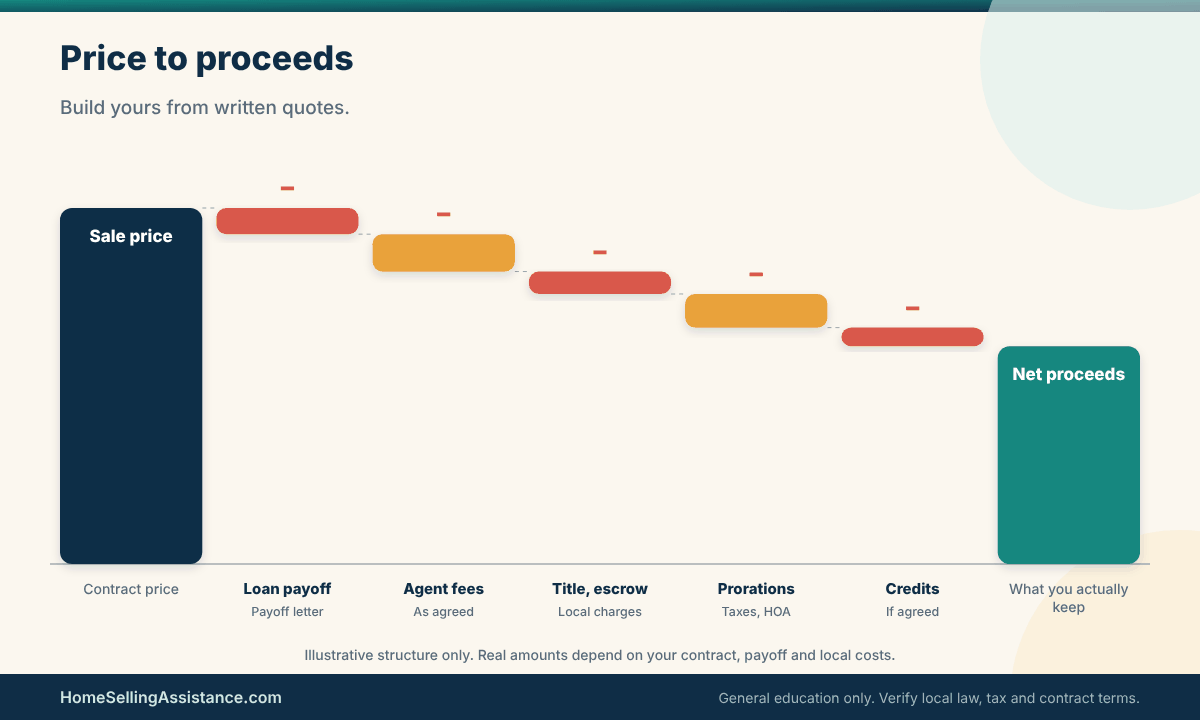
Start with the closing statement. Confirm the sale price matches the contract and any amendments. Confirm the commission or fee lines match what you agreed to in writing with your agent or service provider, and that any buyer-side compensation you agreed to appears as agreed, not as something added later. Check title, escrow and recording charges against the estimates you received, and ask who is paying for what under your contract and local custom.
Check the payoff next. The statement should show the payoff of every loan or lien secured by the property, including a home equity line if you have one, and the amounts should match written payoff letters that are still valid on the closing date. If closing moves by a few days, ask whether the payoff will change, since interest keeps accruing. Our article on the seller closing statement walks through each section.
Review prorations. Property taxes, HOA dues, utilities handled through the closing agent and sometimes fuel or rent are divided between you and the buyer as of the closing date.
Different areas use different methods, and some use a 360-day year while others use actual days. You do not need to master the method, but you should ask the closing agent to explain how the proration was calculated and verify that the tax figure matches the bill you have in your file. Our guide to property tax proration shows a worked example with round numbers.
Confirm any credits that were negotiated, such as repair credits or closing cost help, and check that they appear on the right side of the statement.
Confirm how and when you will receive your proceeds, whether by wire or check, and verify wiring instructions only through a phone number you already trust, never through a new email. The Federal Trade Commission and the FBI’s Internet Crime Complaint Center both publish warnings about wire fraud in closings, and you can read them at the FTC consumer site and at ic3.gov.
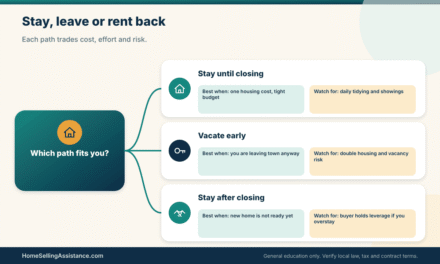
Finally, write down possession terms. If you will leave at closing, say so, with the time. If you will stay a few days or the buyer will move in early, a written rent-back or occupancy agreement should set the dates, the daily charge, who pays utilities, what happens if the date slips, and what condition the house must be in. Handshake deals here are a classic source of disputes. See rent-back agreements for sellers for what such an agreement often covers.
A scenario, an exception, and a next step for the final walk-through
Suppose a seller named Tom agreed to repair a stair railing and leave all window coverings. Two days before closing, the buyer’s agent schedules the final walk-through. Tom has fixed the railing but forgot he took down a set of curtains he liked. The buyer notices and is upset. Because the contract listed the curtains as included, the buyer could insist on them, and the issue now threatens a calm closing.
Tom’s best move is to fix it quickly: put the curtains back, or agree with the buyer in writing to a small credit or a replacement. The exception is when something comes up that is not mentioned in the contract at all, such as a fixture of unclear status. In that case, ask your agent or attorney how local custom treats it, and settle it in writing before the walk-through, not after.
Your next step is to use your walk-through as a final check of your own promises. List every repair, credit, inclusion and exclusion from the contract and amendments.
Make sure each one is done. Take dated photos of the finished repairs, and leave receipts, manuals and keys in an agreed place. If the buyer’s walk-through finds something unexpected, ask for the concern in writing and decide, with your agent or attorney, whether it is a real contract issue or a minor matter that a small goodwill gesture can resolve.
Also plan the practical side. Schedule utility shutoffs or transfers for the closing date, not before, because the buyer may need to verify that systems work. Arrange movers so that the house is empty and broom clean, as most contracts require. Collect every key, garage opener and code. If you expect a delay, tell the buyer’s side before they discover it, because early notice is a courtesy and, in many contracts, a requirement.
Records and follow-up after closing
Closing day is not quite the end. After the documents are signed and funds disbursed, there are loose threads: the deed must be recorded, the old loan must be marked satisfied, mail must find you, and tax reporting may need to happen. A short list of follow-up tasks protects you from the occasional problem that surfaces long after you have left the house.
Many of these tasks are handled by the title company or closing agent, but you should know what to expect and when. Ask at closing how long recording typically takes in your county, when the payoff to your lender will be sent, and when you should receive confirmation that the loan has been released. Keep the closing agent’s contact details with the rest of your records.
What to keep and for how long, in general terms
Keep your closing statement, the signed contract and all amendments, the deed or a recorded copy, and your payoff and release documents. Keep proof of any repairs and disclosures you provided, because a later dispute might turn on what you said and when. Also keep your records of what you paid for the house and improvements over the years, since they can matter for tax reporting.
On tax, the rules are federal and state, and they depend on facts such as how long you owned and lived in the home. The IRS explains the home sale exclusion, reporting and records in Publication 523, Selling Your Home, and the basis rules in Publication 551.
The federal exclusion for a qualifying main home is up to $250,000 for a single filer and $500,000 for joint filers who meet the ownership and use tests of two out of the last five years, but whether you qualify is a question for a tax professional looking at your facts. See also home sale tax records.
How long to keep records is a question with no single answer. A common cautious approach is to keep the documents that establish your basis and your sale for as long as you might need to support a tax return, plus a margin, and to keep the contract, disclosures and closing statement for several years in case of a dispute. Check with a tax adviser or your state’s guidance on the specific periods that apply to you.
A scenario and next step: late mail, utilities, tax questions
Picture a seller named Grace who closed on a Friday. Six weeks later she gets a letter from the county about a property tax installment, and a final utility bill she thought was settled. Neither is dramatic, but both could have been avoided or handled faster with a short post-closing routine.
Grace’s next steps are straightforward. She checks her closing statement to see whether the tax proration covered the period in question, and contacts the closing agent if it did not look right. She calls the utility company with the closing date to confirm the final reading. She files a change of address, sends her new address to the lender, tax authority and insurers, and checks that her homeowner’s insurance policy on the sold house was cancelled correctly and that any refund came back.
The exception is when something larger appears, such as a notice that the old mortgage still shows as open, or a buyer’s claim about a defect. In those cases, do not ignore the letter. Contact the closing agent about the release, and for defect claims, gather your disclosure documents and speak to an attorney. Quick, documented responses are almost always better than silence.
If you are moving into another home, update your records there too, and use what you learned. A calm, dated record of this sale will make the next one, or your tax return, much easier. If you are curious about the sequence of buying and selling together, our article on whether to sell first or buy first can help you plan overlap and temporary housing. For a view of the whole journey, return to our guide on how to sell a house.
Frequently asked questions about home selling timeline
What is a typical home selling timeline from decision to closing?
There is no single typical home selling timeline, because it depends on your preparation, your local market, how the buyer pays and the contract’s dates. A useful way to estimate it is to add three ranges: your preparation time, the time homes like yours recently took to go under contract, and the time local closings take after that.
Ask a local agent, attorney or title company for recent examples rather than relying on a national average. Treat the total as a range, not a promise.
Where should I start if I have not decided whether to sell?
Start with your goal and your numbers. Write down why you want to sell, when you need to move and what the lowest workable outcome looks like. Request a payoff estimate and gather your ownership and tax papers. That work costs little, keeps every option open, and gives you a realistic first draft of your home selling timeline before you commit to anything.
What usually causes delays after an offer is accepted?
The most common causes are slow financing paperwork, appraisal shortfalls, inspection disputes, title defects and missing HOA documents. Any of these can be ordinary, and none means the deal is doomed. Most of them are easier to handle when you respond quickly, keep documents ready and know the contract’s deadlines. Your agent or attorney can tell you which delays are common in your area.
How much of the schedule do I actually control?
You control most of the early stretch, including preparation, pricing choices, disclosures and how fast you answer questions. After acceptance, the contract and other professionals set much of the pace, but you still control your own response times and how organized your documents are. A home selling timeline gets shorter mostly through preparation and quick responses, not through pressure on other parties.
Should I fix problems before listing or wait for the inspection?
Both approaches are reasonable. Fixing known problems first can reduce surprises and keep negotiations calmer, while waiting preserves cash and lets the buyer’s findings guide you. The right answer depends on the cost, the type of buyer financing likely to be used, and what you must disclose. A local agent or contractor can help you decide which repairs are worth doing in your market.
What happens if the buyer’s loan or appraisal falls short?
The contract usually decides. Depending on its terms, the parties might renegotiate the price, extend the closing date, challenge an appraisal, or let the buyer cancel and recover a deposit. If you are in this spot, read the contingency language and ask your agent or attorney what rights each side has. Do not assume any outcome before reading your own documents.
Do I need an attorney, or can the agent handle everything?
It varies by state and by custom. In some places attorneys routinely handle closings; in others, title or escrow companies do. Agents cannot give legal advice, so if the contract raises a legal question, such as how to handle a defaulting buyer, an attorney is the right person to ask. Your state real estate commission can tell you what is required locally.
Can I plan my next purchase around my sale date?
You can plan around it, but you should not count on a single closing date. Build slack into your plans by asking for flexible possession, considering a short rent-back, or arranging temporary housing if needed. Overlapping closings can be done, but they carry risk if either side slips. Our guide on how long it takes to sell a house explains the tradeoffs.
What should I keep after closing?
Keep the signed contract, amendments, closing statement, deed copy, payoff and release confirmations, disclosures you provided and records of your purchase price and improvements. These help with tax reporting and with any later question about the sale. Ask a tax professional how long to hold specific documents in your situation, because the answer depends on your circumstances.
Where can I check rules for my state?
Begin with your state real estate commission, your county recorder or clerk, your title company and a local real estate attorney. Federal sources such as the IRS, EPA and HUD cover tax, lead paint disclosure and fair housing basics, but state and local rules fill in many of the details. When something affects your money or your rights, ask someone licensed to read your actual documents.
Make the schedule work for you
A good home selling timeline is less about speed than about knowing what comes next and who is responsible for it. Build your seller file, put every contract date on a calendar, keep your answers quick and in writing, and review the numbers before closing day. This article is general education, not legal, tax or financial advice. For decisions about your own sale, talk with a licensed real estate professional, an attorney or a tax adviser who can read your documents.