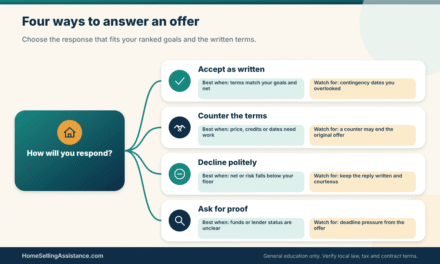
A backup offer house seller arrangement is a simple idea with a lot of fine print: you already have a signed contract on your home, and you agree in writing to a second buyer’s contract that sits in line behind it, ready to take over only if the first one ends. Whether that second position helps you or just adds paperwork depends on the contract, the buyer, the market and what you need from this sale.
Plenty of sellers meet the backup offer house seller question for the first time when they first hear the phrase from an agent in the middle of a showing weekend, usually when someone arrives with a good offer an hour after another one was accepted. The question lands fast. Do you turn the buyer away, or do you say yes to a contract that may never become real? There is no universal answer, and anyone who gives you one without reading your documents is guessing.
This guide is built to help you handle the backup offer house seller question calmly. We will look at what a backup contract is and is not, what you need to know about your primary contract before you sign anything second, how a written backup compares with the other paths, and how to run the numbers so you are judging net result and not just the headline price. Along the way you will see scripts, scenarios and a few places where sellers commonly stumble.
One note on scope. Real estate contracts, forms, notice rules and deposit handling vary by state and often by local custom, so this article stays general. Where something depends on your paperwork, we will say so and point you to who can confirm it: your agent, a real estate attorney, your title or escrow company, or your state real estate commission. For the wider picture of weighing any offer, our guide on how to evaluate a home offer as a seller is a good companion.
Key takeaways
- A backup contract is a real contract with a condition. It usually becomes active only if the first contract ends, and the exact trigger is written in the paperwork.
- Read the primary contract first. Its termination rights, deadlines and any limits on accepting other offers decide what you can safely sign second.
- A backup offer house seller decision is about net result. Compare price, time, concessions and risk together, not the sticker price alone.
- Backups protect time more than money. The biggest benefit is usually a shorter gap if the first deal fails, not a higher price.
- Clarity beats optimism. Written terms for the deposit, notice and promotion date prevent most backup disputes.
- Treat every buyer consistently. Apply the same terms and fair housing principles to every prospective buyer, primary or backup.

What a backup offer house seller really decides first
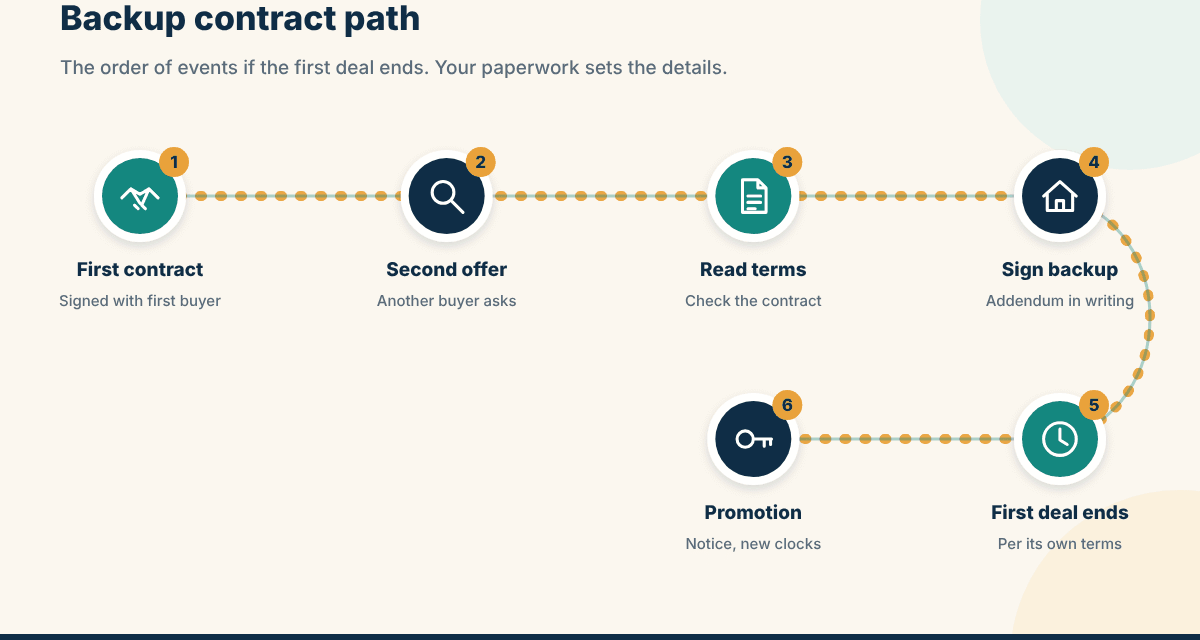
Before you compare dollar figures, it helps to be clear about the decision itself. A backup offer house seller is not choosing between two buyers, because the first buyer already has the contract. The real choice is whether to keep a second door open, on what terms, and at what cost to your flexibility. The picture above shows the usual order of events, from the first signed contract to the moment a backup might step forward.
That framing matters because it keeps you from two common errors. One is treating a backup as a free insurance policy, when it can carry obligations, deadlines and a deposit to manage. The other is dismissing it as clutter, when for some sellers a short, clean backup is the difference between relisting from scratch and closing a week or two late. The sections below help you tell which situation you are in.
Your goal, calendar, cash needs and risk tolerance
Start with yourself, not the buyer. A backup is a tool, and tools only make sense against a goal. For any backup offer house seller, goals come first. Some sellers need the highest possible net number and can wait. Others have a firm date because of a new job, a school year, a lease ending or a purchase of their own. Still others simply cannot stomach another round of showings. Each of those pushes the backup question in a different direction.
It also helps to separate what you want from what you can bear. You may want a big number, but if a failed first deal would leave you carrying two housing payments for two more months, your real risk tolerance is lower than your wish list suggests. Writing a few honest sentences about this, before the emotional pressure of a live negotiation, tends to produce better decisions than deciding in the moment.
Evidence to gather: the contract dates and your money commitments
Pull out the signed primary contract and mark the dates that actually matter: the inspection period, any financing or appraisal deadline, the date the buyer must remove contingencies, and the scheduled closing. Those dates are the window in which a first deal is most likely to wobble, which means they are also the window in which a backup is most likely to matter. A backup that cannot realistically move in until after your own deadlines pass may not be solving your problem.
Next, list the commitments that make a backup offer house seller plan worth the trouble, meaning anything that depends on closing. That might include a purchase contract of your own, a rate lock, a lease on a rental, movers, or a bridge loan. Put a rough monthly carrying cost beside them: mortgage payment, taxes, insurance, utilities, and upkeep for the house you are trying to sell.
An illustrative example, using round numbers only: if holding the home costs you a few thousand dollars a month, every extra month of delay has a real price, and a backup that shortens the gap deserves weight.
Finally, note how much flexibility you have in your own timeline. A seller who could comfortably close in four months has a very different appetite for a backup than a seller with a hard move date next month. If you are also buying, our article on flexible closing dates for sellers explains how timing choices ripple through both transactions.
A scenario and your next step: the seller with a purchase on the line
Picture a seller we will call Dana. She accepted an offer on Saturday and has her own contract to buy a smaller house, closing three weeks after hers. On Sunday morning a second buyer asks to submit a full-price offer with a similar closing date. Dana’s goal is not the highest number. It is avoiding a gap between her sale and her purchase, because a failed first deal would put her own purchase at risk.
For Dana, a backup offer house seller plan looks attractive because her biggest exposure is timing. Her next step would be to read her primary contract for any language about additional offers, ask her agent or attorney how a backup addendum would be worded in her state, and decide what deposit and deadlines the second buyer must accept. She would not simply say yes in the driveway. The steps are small, but doing them in order is what keeps a good instinct from turning into a messy one.
Now take a different seller, Marcus, who has no purchase pending and a primary buyer with a strong pre-approval and a short inspection window. Marcus, as a backup offer house seller with no deadline pressure, might reasonably decline a lower backup, thank the second buyer, and move on. Same house, same weekend, different goal and different risk. That contrast is the whole point of starting with your own situation: it tells you which questions deserve your attention and which are noise.
A quick script can help when the moment arrives. You might say to the agent: “Before we answer, please walk me through what our contract says about other offers, what a backup would require of us, and how long the second buyer would be tied up.” That is polite, it buys you an hour, and it signals that you want terms and not pressure.
Facts that could quietly change the decision
Even with a clear goal, a handful of facts can flip a backup offer house seller decision. Some live in your primary contract. Others sit with the buyers, the property or the local market. The trouble is that these facts rarely announce themselves, and a backup offer house seller who skips the checking step may discover a conflict only after signing. The checklist below gathers the items worth confirming before you agree to anything in second position.

Think of that backup offer house seller list as a pause button. You do not have to answer every item perfectly, but you should know which ones you cannot answer yet, because those are the ones to hand to your agent, attorney or title company. A short delay to confirm a deposit clause is cheap. A backup contract that conflicts with the primary contract is not.
Evidence to gather: what the primary contract allows and requires
Any backup offer house seller should read the primary contract for anything touching other offers, continued marketing, notices and termination. Some contracts expressly allow the seller to accept backup offers. Some say nothing. A few include language that restricts continued marketing for a period, or require the seller to keep the property off the market while contingencies are open. Which of these applies to you depends on the form your state or brokerage uses, so this is a question for the person who drafted or reviewed your contract.
Check also how the first contract ends. A buyer might terminate within a contingency period, the seller might terminate after a missed deadline and proper notice, or both sides might agree to cancel. Each route has its own paperwork and its own timing, and the backup usually depends on one of them being completed cleanly. If your contract requires written notice and a cure period before you can cancel, the backup buyer has to understand that those days exist.
Look at the deposit as well. Earnest money for the first deal belongs to the first deal, and who is entitled to it after a termination is governed by the contract, not by whether a backup is waiting. Our article on earnest money from the seller’s side covers how those rules usually work and why releasing money too early causes disputes. Never assume the first buyer’s deposit can be used to smooth over the second.
An exception to watch: the primary buyer who is slow but not in default
The trickiest backup offer house seller situation is not a collapsed first deal. It is a first buyer who is slow, nervous or asking for extensions, but who has not actually breached anything. A backup tempts you to nudge the first buyer out, and that is precisely where sellers get into trouble. If the first buyer is still within their rights under the contract, pressure, hints or an early cancellation attempt can create legal exposure.
The safer habit is to treat the first contract as fully alive until the paperwork says otherwise. Keep communication through your agent or attorney, respond to extension requests on their merits, and decide ahead of time what you would accept. For example, you might be happy to grant a short extension for an appraisal delay but unwilling to move a closing date past your own deadline. Those pre-set limits keep you from improvising under stress.
Also watch for the opposite problem: a backup buyer who starts asking about the first deal, hoping for details. You are not obliged to share the first buyer’s terms, and your agent or attorney can tell you what is appropriate to say. A sentence like “We are under contract, and we can talk about backup terms if you are comfortable with being second” is usually enough.
Comparing a signed backup with the other realistic paths
Now that your starting position is clear, it is time to compare the actual backup offer house seller paths. For most sellers who face this moment, there are really two families of choices. One is a formally signed backup contract. The other is everything short of that: staying in touch with a buyer informally, declining and waiting, or planning to return to the market if the first deal fails. Each carries a different mix of protection and obligation.
The scale below gives a quick visual of how those trade-offs balance. It is not a verdict, since your numbers may tilt it either way, but it shows the kinds of things to weigh. A written backup tends to buy speed and certainty at the cost of some paperwork and a bit of flexibility. The informal routes keep your hands free but leave you to rebuild momentum from scratch if the first deal falls through.

Option one: a written backup contract behind the first deal
With a written backup, the second buyer signs a purchase contract, usually with an addendum that explains its status. The addendum typically says the contract is subordinate to the first, describes how and when the backup is promoted to primary, and addresses the deposit and any deadlines that start only on promotion. The details differ widely, so the label alone tells you very little. What matters is the text your state or brokerage form actually uses.
The appeal of a written backup offer house seller arrangement is easy to see. If the first contract ends, you do not start over. You already have a buyer who has agreed on price, terms and a timeline, and who has presumably already done some of their own preparation. For a seller with a tight calendar, that continuity can be worth a lot, even if the backup price is a little lower than the primary.
The costs are quieter. You have another contract to manage, another set of dates to track and another person whose expectations matter. A backup buyer who waits weeks and then gets promoted into a house that has changed, or a market that has moved, may renegotiate or walk. A written backup lowers risk. It does not eliminate it.
Evidence to read: the backup addendum and deposit language
When you review a draft backup addendum as a backup offer house seller, look for a few specific things. First, how is the backup promoted? Is it automatic on termination of the first contract, or does the seller send a notice? Second, what happens to the backup buyer’s deadlines for inspection, financing and appraisal, and do they start on promotion or on the original signing date? Third, can the backup buyer withdraw while waiting, and if so, with what notice?
Next look at the deposit. Many forms have the backup buyer deliver earnest money at signing, held in escrow until promotion or release. Others delay the deposit until promotion. Which is better for you depends on how serious you want the backup to be and what your state permits. Ask the title or escrow company how a deposit for a contract in backup position would be held and returned, since those are practical questions they handle regularly.
Also check the price and closing date for the backup. A backup is allowed to be a different deal from the primary: lower price, longer close, different contingencies. If the dates in the backup start counting from the original signing and the first contract fails late, the backup may already be nearly expired. Our guide on how offer expiration works for sellers explains why deadlines deserve careful reading.
A scenario and next step: promoting the backup when the first deal ends
In a typical backup offer house seller story, the first buyer’s financing falls apart in week three, and the contract ends properly through written notice. Your agent immediately notifies the backup buyer’s agent in the way the addendum describes. Within a day or two, the backup contract is the active one, inspection and appraisal clocks begin according to the language, and the backup buyer is asked to confirm their deposit and lender status.
Notice what made that work: someone knew the addendum’s steps ahead of time, and the backup buyer was still interested and still qualified. A backup buyer’s lender can change its view in a few weeks, and a pre-approval letter can go stale. Your next step as a seller is to ask your agent to touch base with the backup buyer’s side every so often, within the terms of the contract, so surprises surface early.
If you want to know more about what typically goes wrong when financing fails, our article on what to do when a buyer’s financing falls through walks through the usual sequence. The short version is that a backup is most valuable in exactly these moments, as long as it is real and current when you need it.
Option two: no backup, a waitlist, or going back on the market
The other family of backup offer house seller choices has several members. You can decline the second buyer politely and carry on. You can keep a loose relationship with the interested buyer, an informal “call me if it falls through,” without a contract. Or you can decide that if the first deal ends, you will relist and start again. None of these require signatures, which is their appeal, and none of them guarantee anything, which is their weakness.
Informal interest tends to cool faster than people expect. Buyers who wanted your house on Sunday may have found another by the following Saturday, and a buyer who has not signed anything has no reason to wait. That does not make the informal route wrong. If your timeline is relaxed and your primary buyer looks solid, keeping things simple has its own value, and you avoid the work of managing a second contract.
Going back on the market has a cost structure of its own. A listing that falls out of contract can carry a question mark with new buyers, depending on how it is explained, and some of the early momentum is gone. On the other hand, a fresh start lets you reconsider price, terms and presentation with new information from the failed deal. Neither path is automatically better.
Evidence to weigh: the cost of the quiet days after a failed deal
To weigh a backup offer house seller choice honestly, estimate what a failed first deal would cost you in days. Start with how long the home was on the market before it went under contract, then add the time the failed contract consumed, then add the time to reprepare, relist and negotiate again. That total is the gap a backup would help you avoid. Use local data from your agent or your market’s listing service, not a national average, since your area may move faster or slower.
Now price those days. Use your monthly carrying cost for the home, and add any costs that your plan makes more painful: a rate lock that might expire, a purchase contract with a hard date, a lease you must extend. An illustrative example with round numbers: if carrying the home costs a couple of thousand dollars a month and a failed deal might add six to eight weeks, you can estimate what that delay could cost before deciding how much a backup is worth. These are your own numbers, so test them against real bills.
Remember that the quiet days are not purely financial. They include showings you must schedule again, the stress of uncertainty and the risk that the market shifts while you wait. Some sellers value those intangibles highly, others barely at all. Naming them aloud, even in a short conversation with your agent or family, helps you avoid pretending the decision is purely arithmetic.
A scenario and your next step: the informal interested buyer
In another backup offer house seller scenario, imagine a second buyer who loved the house, but who is hesitant to be second and says only, “Let me know if anything changes.” You have no contract and no deposit. A week later the first deal collapses. You call the second buyer, who has since made an offer elsewhere. You are back to the beginning, and the time you spent holding the line for them is gone.
That does not mean you should have signed something. If the buyer was not willing to commit, a backup might never have materialized anyway. But it shows the limit of informal arrangements: they depend on goodwill and timing, neither of which you control. If a buyer is serious, ask whether they are willing to put their interest in writing on reasonable terms. If they are not, you have learned something useful about how much weight to give their enthusiasm.
A next step for any seller in this position is to ask the agent to keep a clean record of everyone who asked about the home, without promising anything to anyone. That list can speed up a relisting. It also helps you apply the same standards to every interested buyer, which matters for both fairness and, under fair housing rules, for staying on the right side of the law. HUD’s fair housing resources explain the basics.
The table below puts the two backup offer house seller families side by side. It is a general decision matrix, not a rule: the cells will look different for your contract and market. Use it to decide which rows matter most to you, then check those rows against your actual paperwork before choosing.
| Factor | Option A: signed backup | Option B: no backup, relist if needed | What to check |
|---|---|---|---|
| Price and net proceeds | May be equal or lower than primary | Open to repricing after a fail | Backup price versus likely relist price |
| Time if first deal fails | Often shorter gap | Longer gap while you restart | Your carrying cost per month |
| Contingencies | Set in backup contract, clocks per addendum | New terms negotiated later | When backup deadlines begin |
| Workload | Second contract and dates to track | Lighter now, heavier after failure | Who manages notices and escrow |
| Execution risk | Backup buyer may withdraw or change | No buyer waiting at all | Withdrawal rights in the addendum |
| Flexibility | Some limits from signed terms | Hands remain free | Conflicts with primary contract |
To use the backup offer house seller table, pick the two or three rows that worry you most. If time is your main exposure, the second and third rows deserve the closest read. If you worry about being tied up, focus on flexibility and workload. Then ask your agent or attorney to confirm that the backup path described in the first column is actually available under your contract and local forms.
A net-result rule for any backup offer house seller decision
Once you know the paths, a backup offer house seller needs a way to choose among them that does not depend on mood. The most reliable habit is to compare net result: what you expect to keep after costs, how long it takes, how likely each path is to work and how much effort and exposure it involves. A backup offer house seller who runs even a rough version of this comparison tends to feel far calmer about the choice, because the reasoning is visible.
This is the same discipline we recommend when comparing any pair of offers, and it connects directly to the broader approach in our piece on choosing between the highest and the best offer. A backup just adds one more variable, which is the chance that the backup ever becomes the main deal. Keep that probability in mind as you read, because it is the part most sellers forget.
The price, time, cost and risk framework in plain numbers
The framework has four columns. Price is what the contract says. Time is how many weeks until you realistically hold the proceeds. Cost includes concessions, repairs, carrying costs and fees specific to that path. Risk is a plain-language estimate of how likely the deal is to close as written. You do not need precision. You need honest ranges and a note of which numbers you are sure about and which you are guessing.
The waterfall below shows how a sale price turns into a net figure. In a backup comparison, you build one such chain for the primary scenario and another for the scenario in which the backup is promoted. Seeing the deductions laid out visually reminds you that the backup’s lower sticker price may or may not mean a lower net result, because concessions, repairs and timing can move the bottom line in either direction.

Whatever your backup offer house seller figures, label them as estimates and update them when real quotes arrive. Payoff statements, closing cost estimates from your title company and any agreed credits are the sources to trust. If you want a refresher on turning a sale price into a take-home figure, our guide to calculating net proceeds from a home sale shows the usual steps in order.
Worked example with illustrative round figures
Here is a deliberately simple backup offer house seller example, with invented round numbers so the logic is easy to follow. Say the primary offer is 400,000 dollars with a financing contingency still open, and a backup offer is 390,000 dollars with a larger deposit and a shorter financing window. Assume the primary buyer asks for no concessions, while the backup buyer asks for a small repair credit of 3,000 dollars. These are not market figures. They exist only to show the method.
Primary, if it closes, nets you 400,000 before your normal costs. Backup, if promoted, nets 390,000 minus the 3,000 credit, so 387,000 before the same normal costs. The gap on paper is 13,000. Now add the time and risk columns. Suppose you judge the primary has a meaningful chance of failing, and a failure would cost you roughly two extra months of carrying costs plus a possible price reset if you had to relist.
If two months of carrying costs run about 5,000 dollars in this example, and a relisting might shave some value off the price, the backup begins to look less like a discount and more like a hedge. The key is that you are not asking, “Which number is bigger?” You are asking, “What does each scenario leave me with, and how likely is each one?” You may still decline the backup, and that is a fine outcome, but it will be a reasoned one.
Notice that you never needed to know the exact chance of the first deal failing. You only needed to decide whether the hedge was worth its cost under a range of beliefs. Try it with an optimistic and a pessimistic guess. If the answer stays the same in both, the decision is easy. If it flips, you are in the zone where reading the actual paperwork and talking to your agent matters most.
An exception: when a lower backup is still the better backup
A backup at a lower price can still be the smarter backup offer house seller choice, and sometimes a backup at the same price can be the worse one. Terms matter as much as price. A backup with a short timeline, strong funds and few contingencies may be more valuable than a higher backup that depends on the buyer selling their own home first. Our overview of contingencies from the seller’s perspective explains why a contingency can quietly change the quality of an offer.
Likewise, a backup buyer who needs a long closing may defeat the purpose if your reason for wanting a backup is speed. Match the backup’s strengths to your actual exposure. If the first deal is most likely to fail on financing, a backup with a verified cash position or a very strong lender letter addresses that exact weakness. If it is most likely to fail on inspection, a backup buyer who has already inspected may be more valuable.
Think also about the relationship between the two buyers’ agents and the process. A backup with a cooperative, responsive agent on the other side will promote more smoothly than one with a distracted team. You cannot control that, but you can notice it, and it belongs in the risk column even if it does not show up in the price.
When new evidence should change the plan
A backup offer house seller decision made at the start of a contract is not a promise. New information arrives constantly: an inspection report, an appraisal, a lender update, a change in the buyer’s job, a shift in your local market. The framework above should be rerun when something material changes, not once and filed away. Sellers who treat the backup decision as a living question usually respond faster and with less drama.
The tree below sketches a few common branch points. It starts with a signal that the first deal is slipping and sorts the next move by what the contract and the backup allow. The tree is a sketch for thinking. Your own contract’s notice language controls the actual steps, so use it to prepare questions for your agent or attorney, not as a script to follow on its own.

Evidence to gather: the signals worth rechecking
Some backup offer house seller signals deserve an immediate re-evaluation. A missed deadline by the first buyer, a request for repairs that the appraisal cannot support, a lender’s change in terms, or a gap in communication from the buyer’s side all raise the likelihood that the first deal will not close as written. Each of them also gives you information about what you should ask of your backup buyer, such as whether their funds and timeline are still on track.
Look at outside evidence too. If local inventory or interest rates have shifted since you signed, a backup’s price may now look better or worse than it did at the start. Your agent’s up-to-date read on comparable sales and recent activity, along with any dated national context from sources such as the National Association of Realtors, can help you judge, though national figures are never a substitute for your local market.
Finally, rechecking should include your own side. If your purchase of another home has become firmer or looser, if your carrying costs have changed, or if your tolerance for waiting has worn thin, those changes matter as much as anything the buyers do. A plan that suited you at signing may not suit you three weeks later, and that is perfectly normal.
A scenario and next step: the appraisal comes in light
Take a backup offer house seller case where the appraisal lands below the contract price. The first buyer asks you to reduce the price, and you are unsure. A backup offer house seller in this spot gets useful leverage from the existence of a backup, but only if the backup is real and the contract lets you use it. You might counter with a partial reduction, accept the buyer’s request, or hold firm and see whether the buyer closes the gap.
If you hold firm and the buyer ends the contract, the backup may step in, but its own appraisal risk is similar, since the house is the same. Smart sellers ask the backup buyer’s agent how their client would handle a similar valuation issue. Our guide to seller options after a low appraisal lays out the usual paths in more detail.
Your next step as a backup offer house seller in any of these cases is to write down the decision you are now facing, the numbers you used last time, and what has changed. Rerun the framework in ten minutes with a pencil. If the answer shifts, tell your agent or attorney, and ask what the contract requires before you act. That small habit prevents most avoidable mistakes in the middle of a live deal.
Because the right answer shifts with the situation, it helps to see a few common seller situations laid out together. The next table is a scenario guide. It names a situation, the route that usually fits it best, the reason, the cost of that route and the single fact that would change the choice. Treat each row as a prompt for a conversation with your agent or attorney, since a backup offer house seller case is only as good as the contract behind it.
| Situation | Route favored | Reason | Trade-off | Fact that changes the choice |
|---|---|---|---|---|
| Seller has a firm purchase date elsewhere | Signed backup | Shorter gap if first deal ends | More paperwork and deadlines | Backup closing date fits your purchase |
| First buyer is strong and already past inspection | Decline or stay informal | Low chance of failure | No fallback if surprise appears | Lender or appraisal update |
| First buyer needs to sell another home | Signed backup | Higher dependency risk | Backup may be lower in price | Status of the buyer’s own sale |
| Backup is much lower and loaded with contingencies | Decline | Little protection for the discount | Gap if first deal fails | Backup removes key contingencies |
| Slow market with few showings | Signed backup | Replacing a buyer takes time | Lower price may be locked in | Local days on market trend |
| Contract limits other offers | Ask counsel first | Avoid a conflict with signed terms | Possible delay in replying | Exact contract language |
To use this table, find the row closest to your own situation and read across it slowly. Then change one fact and see whether the route still holds. If your first buyer is strong but your own purchase date is firm, you sit between rows one and two, and the question becomes how much the safety is worth. Write that comparison down, in your own words, and keep it with your contract.
Quick scenario
A seller accepts a good offer on a Friday and receives a second offer on Saturday. Instead of answering yes or no, the seller asks the agent for three things in writing: what the primary contract says about other offers, the second buyer’s proposed backup terms, and a note from the title company on how a backup deposit would be held. By Monday the picture is clear, and the seller decides with facts, not pressure.
Some habits make any backup offer house seller plan easier to run. Keep one folder, paper or digital, for the backup offer house seller file: with the primary contract, the backup contract, every addendum and each notice sent or received. Keep a one-page calendar of dates from both contracts. Ask your agent to confirm in writing whenever a deadline passes, so there is a record of what was satisfied and what was waived. These small records protect you if memory or opinions differ later.
Communication deserves its own care in any backup offer house seller plan. Updates to the backup buyer should be accurate and limited to what you are allowed to share. You can say that the first contract remains in effect, that you will notify them in line with the addendum if anything changes, and that you appreciate their patience. You should not promise a date you cannot control, suggest the first deal is doomed, or compare the buyers’ terms to push one of them. Keeping the tone neutral protects both deals and your own credibility.
Fair treatment is part of every backup offer house seller process. Offers should be evaluated on terms such as price, financing, timeline and contingencies, and every buyer should receive the same information and the same opportunity to compete. HUD explains fair housing basics at its fair housing and equal opportunity pages, and your agent should be familiar with them. If something about how a buyer is being treated makes you uneasy, say so, and ask your state real estate commission or an attorney how to proceed.
Last, remember that sellers often over-think the odds and under-think the paperwork. A backup offer house seller who has read the addendum, confirmed the deposit handling and written down the promotion steps is usually in good shape, even if the numbers are imperfect. One who has agreed to a backup on a handshake or a text message is not. If you take one practical lesson from this section, make it this: if it matters, get it in writing and have a professional look at it.
If you want more help comparing offers once a backup offer house seller plan is on the table, our piece on handling multiple offers as a seller covers the negotiation side, and our overview of counteroffer strategy for sellers explains how to respond when terms need adjusting. You can browse more articles in our offers and negotiation category and our contingencies, inspections and appraisals category.
For the full framework behind this whole cluster, return to the main guide on evaluating a home offer as a seller, which ties price, terms, risk and timing into one decision process you can reuse on every offer, backup or otherwise.
Frequently asked questions about backup offer house seller decisions
What exactly is a backup offer on a house?
It is a second purchase contract that sits behind a first, signed contract and takes over only if the first one ends under its own terms. A backup offer house seller arrangement is usually documented with an addendum that explains how and when the backup is promoted. The wording differs by state and form, so the paperwork is what counts, not the nickname.
Can a backup offer house seller accept a second contract after signing the first?
In many places you can, but it depends on your primary contract and local practice. Some contracts allow continued marketing and backups, and some restrict them for a period. Before you agree to anything in second position, ask your agent or a real estate attorney to read the primary contract and confirm what it allows in your state.
Does a backup offer have to be at the same price as the first one?
No. A backup is its own contract, so price, closing date and contingencies can differ from the primary. A backup offer house seller should compare the net result of each path, including the chance that the backup is never needed, instead of looking at price alone. Terms and timing often matter as much as the number.
Does the backup buyer pay earnest money?
Practice varies. Some forms have the backup buyer deposit earnest money when signing, held in escrow, while others delay the deposit until the contract is promoted. Ask your title or escrow company how a deposit for a contract in backup position is held and returned, and do not use the first buyer’s deposit for any purpose the contract does not describe.
How does a backup offer become the main contract?
Usually when the first contract ends through a termination permitted by its terms, followed by notice to the backup buyer as the addendum describes. Some forms promote the backup automatically, and others require a seller’s written notice. The promotion date often starts the backup buyer’s inspection, financing and appraisal clocks, so know exactly which version your paperwork uses.
Can the backup buyer back out while waiting?
It depends on the addendum. Many allow a backup buyer to withdraw with written notice before promotion, because the buyer has not yet become the primary purchaser. Others set different rules. A backup offer house seller should read this clause carefully, since it tells you how dependable the second position really is when you most need it.
Is a backup offer house seller plan worth it if the first buyer looks solid?
Sometimes yes and sometimes no. If your timeline is relaxed, the first buyer is well qualified and the backup is much lower, you may reasonably decline. If you have a firm purchase date or a slow market, even a lower backup can be a useful hedge. Run the price, time, cost and risk comparison and see which way it points.
Could a backup offer house seller plan cause legal trouble with the first buyer?
It can if you break the first contract to favor the backup, for example by pressuring the first buyer out or ending the contract without proper grounds. Treat the primary contract as fully in force until it legitimately ends. Questions about your exposure are for an attorney licensed in your state, not for a general article like this one.
What should I say when a second buyer asks about being a backup?
A simple, neutral reply works well: you are under contract, you are open to discussing backup terms if the buyer understands they would be second, and your agent will share the terms available. Avoid sharing details of the first deal or promising dates. A calm, consistent response lets you keep your options without creating obligations you have not reviewed.
Who can confirm the backup rules for my state?
Your listing agent, a real estate attorney, your title or escrow company and your state real estate commission can all help. Ask them to point to the actual form language and any statute that applies. A backup offer house seller who gets answers tied to documents, not general impressions, will have a much firmer basis for the decision.
Before you say yes to second position
A backup offer house seller decision comes down to a few honest questions: what does the first contract allow, what do you need if it fails, and does the second buyer’s net result justify the extra paperwork? Take your time with those, get the key terms in writing and ask the right professional to read them. This article is general education, not legal, tax or financial advice, and your own contract and state rules come first.