

Seller identity fraud closing is what happens when someone other than the true owner, or someone pretending to be the owner, uses a seller’s name, signature, identification or contact details to move a property or its sale money, and the whole thing is built to look routine on closing day.
Most sellers never meet a seller identity fraud closing problem, and that is worth saying first so nobody walks away frightened. The great majority of closings run on ordinary paperwork, ordinary signatures and ordinary wire or check delivery. Still, the cases that do happen are painful, and they tend to share a pattern: a quiet property, a hurried timeline, a document that nobody questioned, and a communication channel that was never confirmed.
This guide to seller identity fraud closing explains the mechanics in plain language. You will see how an impostor tries to pass as an owner, what remote signing and notary rules are meant to accomplish, which of your details are most useful to a thief, and what to do if something already feels wrong. We stay general on purpose, because notary law, recording practice and closing customs differ from state to state and from company to company.
Think of this seller identity fraud closing overview as a field guide written by someone who has watched many closings. It is not legal, tax or financial advice, and it will not replace a conversation with your settlement agent or an attorney licensed where the property sits. It will, however, help you ask better questions and notice the moment a routine step stops being routine.
Key takeaways
- A seller identity fraud closing usually targets quiet properties. Vacant homes, land, second homes and properties with no mortgage give a thief the most room, because nobody is watching the title or answering the door.
- Remote signing is a tool, not a risk by itself. What matters is who verifies identity, how, and whether you can confirm the process through a company you found on your own.
- Your identity is more than your name. Date of birth, prior addresses, mortgage details and even listing photos can help someone answer the questions meant to keep them out.
- Never confirm wire details or closing secrets from an email, text or inbound call. Call a number you already trust, and ask the settlement agent how changes are verified.
- Speed matters after a suspicion. Contact your bank, the settlement agent and an attorney quickly, keep every record, and report to the proper agencies without sending more money or information.
Spotting seller identity fraud closing risks before they reach you
You cannot protect against seller identity fraud closing schemes if you cannot picture them. So this first section describes the shape of the problem: what a fraudulent sale looks like when it works, what it leaves behind, and which parts of your own life supply the raw material. None of this is meant to make you suspicious of every professional you meet. It is meant to make the unusual moment easy to recognize.
Two broad versions exist. In the first, an impostor poses as the owner to sell a property the real owner has no idea is on the market. In the second, a thief inserts themselves into a genuine sale and tries to redirect the money, a version that overlaps with the wire and email schemes covered in our guide to real estate wire fraud for sellers. This article focuses mostly on the first.
The picture below shows the usual path of a seller identity fraud closing, from first contact to a recorded deed, and where an alert owner gets chances to interrupt it.

What a stolen-seller-identity sale looks like from the inside
Picture a vacant lot, or a house the owner inherited and has not visited in two years. Someone finds the owner’s name in public records, builds a story, and contacts a real estate office or an investor with a believable offer to sell. They may use a fake or altered ID, a spoofed phone number, a free email address that resembles the owner’s name, and a very low price designed to remove hesitation.
The buyer on the other side is often entirely real. A genuine investor or buyer sees a bargain, a motivated seller who cannot meet in person, and a title company that has not yet noticed anything wrong. The impostor pushes for speed, prefers email, and avoids video calls or meetings. That pressure to keep everything remote and quick is the most consistent thread in a seller identity fraud closing, and it is also the easiest one to watch for.
From the real owner’s side, the first sign is often silence. You may learn about the sale only when a tax bill goes to a stranger, a neighbor mentions new activity, or a county notice arrives. By then a deed may already be signed, notarized and recorded. Reversing that is possible in many places, but it usually involves a lawyer, a title insurer and real time, which is why catching the pattern earlier matters so much.
Evidence to gather: what the public record shows about your property
Start with facts you can check yourself. Most counties keep a recorder, clerk or register of deeds office where a deed, mortgage or lien shows up with a date and a name. Many offer online search, and some offer a free alert service that emails you when a new document is recorded against your name or parcel. Availability varies by county, so look at your county recorder’s website or call the office to ask what exists.
Pull your current deed and write down how your name appears on it, including middle initials and suffixes. Look at the legal description, the parcel number and any recorded mortgage. If you own the property free and clear, a clean record is reassuring, but it also means no lender is monitoring things for you. Our overview of title and deed fraud for homeowners goes deeper, since a seller identity fraud closing often ends in a forged deed, and it covers on recorder alerts and what a suspicious entry looks like.
Keep a simple file with your deed copy, your title policy if you have one, a recent tax bill and the contact details of the title company that handled your purchase. If you ever need to prove you are the rightful owner, those papers will be the first thing a lawyer or insurer asks for. Creating the file now takes twenty minutes. Creating it in a panic takes days.
A scenario, an exception, and your next step for vacant and free-and-clear homes
Here is a short illustrative example, with invented details. An owner lives abroad for work and rents nothing out. The house sits empty with no mortgage. A person claiming to be the owner contacts a local investor, offers a below-market price, and says a notary visit is impossible because of travel. The investor’s title company asks for a remote signing and receives ID images by email.
The exception worth knowing is that many legitimate owners do sell from abroad, and there are proper ways to do it, including consular notarization, authorized attorneys and approved remote platforms. Distance alone proves nothing. What matters is whether the identity checks are strong and whether anyone has reached the real owner through a channel that did not come from the person asking to sell.
Your next step, if you own a quiet property, is practical: sign up for recorder alerts if your county offers them, confirm your tax bill mailing address is current, and tell a trusted neighbor or property manager to contact you if they see unexpected activity. Our guide to vacant home security while selling covers the physical side of the same watchfulness.
Which of your details a seller identity fraud closing scheme depends on
A seller identity fraud closing scheme needs more than a name. To pass a title company’s questions, they need a bundle: a date of birth, a Social Security number or part of one, prior addresses, the name of your mortgage servicer, sometimes the amount of your last payment. Each item alone looks harmless, which is how seller identity fraud closing attempts get started. Together they can answer the knowledge-based questions that some identity checks rely on.
Property-specific details matter as well. Legal descriptions, parcel numbers and purchase history are public. A thief who combines them with a leaked email account or a data-broker profile can create a very persuasive file, and a persuasive file is what makes a title officer feel comfortable moving forward.
That is the real lesson for seller identity fraud closing prevention. The defense is not hiding everything, which is impossible, but knowing which details are doing the heavy lifting and treating those with extra care. We return to that idea in the second major section, where the “never share” list lives. For a wider look at what sellers expose by default, see our home seller privacy checklist.
Evidence to gather: where your personal details already sit in the open
Spend a quiet half hour doing what a seller identity fraud closing thief would do. Search your own name together with your city and your property address. Look at people-search and data-broker sites, which often list age ranges, relatives and past addresses. Check your county assessor’s page, which usually shows owner name, mailing address and sale history. Note what you find without judging it.
Then check the places you control. A public social media profile can reveal a birth date, a mother’s maiden name in a relative’s tag, a pet’s name or a hometown, all of which double as common security answers. An old listing, if you are a repeat seller, may still show interior photos, a lockbox code in the background or a spreadsheet on a desk.
Finally, look at your email. A reused password that appeared in a past breach is one of the cheapest ways into a seller’s life. Free breach-lookup services exist, and changing a password takes minutes. The Federal Trade Commission publishes practical recovery steps at consumer.ftc.gov if you believe your information has already been misused.
A scenario: the listing photos that answered the security questions
Consider another invented example. A seller lists a home and posts forty photos. One shows a kitchen bulletin board with a school calendar, a pharmacy card and a handwritten note with a utility account number. A fraudster would not need all of it. A single account number, plus a leaked birth date from an old breach, could be enough to pass a casual phone verification with a service provider.
The fix for this seller identity fraud closing leak is boring and effective. Before photos go live, walk through each room as if you were a stranger and remove papers, mail, prescription bottles, family calendars, laptops and anything with a name or number. Check mirrors and glass doors for reflections. Photographers and agents usually appreciate the extra tidying, since a clean frame photographs better anyway.
If you realize afterward that something sensitive was visible, ask whoever manages the listing to replace the image, then treat the exposed item as compromised. A utility account number can be changed or protected with a new PIN, and an exposed document can be monitored. It is far easier to act on one known leak than to wonder later where the information came from.
Reducing seller identity fraud closing exposure before you sign anything
Once you can see the pattern, you can build habits against seller identity fraud closing attempts. This section is about controls you set up before the transaction speeds up, because after an offer is accepted, calendars compress and shortcuts start to look attractive. The goal of seller identity fraud closing prevention is to decide in a calm week what you will and will not do in a rushed one.
The two halves are verification and restraint. Verification means the people and processes that confirm you are you, and that you are in control of the sale. Restraint means the short list of items you refuse to hand over through weak channels, no matter how official the request sounds. Together they close most of the doors a seller identity fraud closing attempt tries first.
Verification controls: remote signing, ID checks, and notaries
Notarization exists to answer one question: is the person signing this document really who they claim to be, and are they signing willingly? A traditional notary checks your government ID in person, watches you sign and records the act in a journal. Rules for how that works in a seller identity fraud closing defense, what ID is acceptable and what the notary must record differ by state, so treat any description here as a general outline.
Remote online notarization, often shortened to RON, moves that meeting onto a secure video session. Many states now authorize it, though not all, and the specifics vary. Platforms commonly use credential analysis, which inspects the ID image for signs of tampering, along with identity proofing questions and a recorded session. Some states require the notary to keep an audio-video recording for a set period. A mobile notary, by contrast, travels to you for an in-person signing.
None of these methods is automatically safer than another. A careful in-person notary can catch a fake ID, and a well-run remote platform can too. A rushed or careless version of either can miss one. What you want is a process you can describe, a company you can verify and a signing you personally arranged, not one that arrived by link from an unknown party. A real estate sales contract usually spells out who selects the closing company, so read that section early.
The scale below weighs in-person signing against remote online signing on the points sellers usually care about, so you can see what each method asks of you and where each can go wrong.

Evidence to gather: how your state and title company handle notarization
Begin with two phone calls using numbers you found on your own. First, call the title or escrow company handling your sale and ask how they verify a seller’s identity, whether they allow remote online notarization in your transaction, and what they do when a seller cannot attend in person. A good company answers these questions without irritation, and the answers tell you a lot.
Second, look up your state’s rules. The notary regulator is usually the secretary of state, though titles differ. Their website normally explains what ID a notary may accept, whether remote notarization is permitted and how to confirm a notary’s commission is active. Many states offer a public lookup so you can confirm that the person who stamped a document is actually licensed.
Write down what you learn: the company name, the person you spoke with, the date and the process they described. If a later email contradicts it, perhaps by suggesting a different platform, a different notary or a signing link you did not ask for, you will have a record to compare against. That small habit makes impersonation attempts easier to spot.
A scenario: choosing between in-person, mobile, and online signing
Imagine you are selling from another state and cannot attend the closing table. You have roughly four reasonable options, and the right one depends on your situation. Name them to the settlement agent and ask which are available for your property type and state: signing at a local office near you, a mobile notary visit to your home, a remote online session, or a signing under a properly prepared power of attorney.
The power of attorney deserves special caution. It lets another person sign for you, which is useful for deployed service members or people with medical limits, but it is also a favorite tool of fraud because it hands over authority in one document. Many title companies scrutinize them closely and may want the original, a recorded copy or direct contact with the person who signed it. Ask an attorney before granting one.
A sensible default for most distant sellers worried about seller identity fraud closing is a mobile notary or a remote session scheduled by you, with the title company confirming your identity on a phone call to a number you gave them early. Whichever method you pick, keep the confirmation emails, the notary’s name and the session time. If your situation involves complicated authority, such as an estate or a trust, ask for an attorney’s guidance before signing.
What you never share and never assume during a sale
The second half of restraint is a list of items that should almost never travel by email, text or an unexpected phone call. Full Social Security numbers, bank login details, one-time passcodes from your phone, wire instructions you did not originate and photos of your ID sent to anyone you have not independently verified all belong on that list.
That does not mean you will never hand over an ID. A title company will legitimately need to verify who you are. The difference is the channel. Providing ID through a secure portal your settlement agent set up, after you confirmed the company by phone, is a different act from replying to an email that says “send a photo of your license to finalize the file.”
Equally important are assumptions. Do not assume an email is genuine because it quotes your address or your agent’s name, because that information is easy to find. Do not assume a closing date change is real because it comes with urgency. Do not assume a polite voice on the phone belongs to the company on the caller ID. Our piece on real estate email phishing aimed at sellers shows how convincing these messages can be.
The checklist below groups the items that should stay private until you have verified the other side, the ones that need a callback first and the ones that are safe through a secure portal.
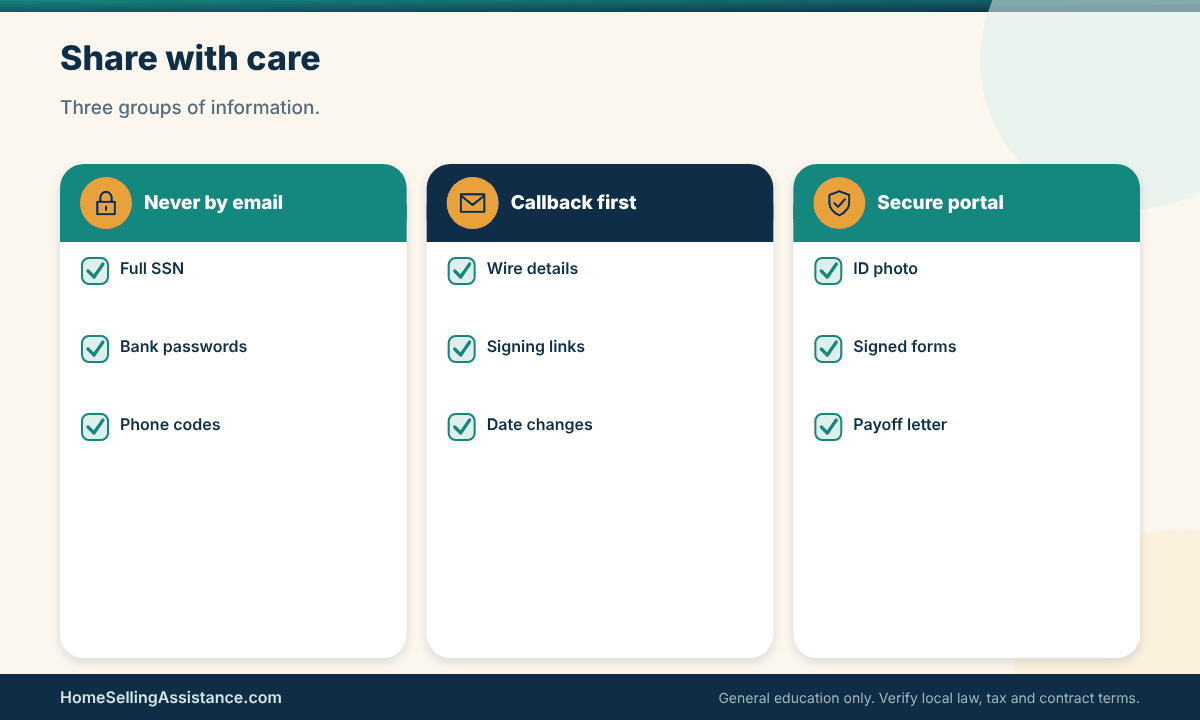
Evidence to gather: the short list of items no one needs by email
Create a one-page list now and keep it with your closing papers. Under the heading “Never by email or text,” write: full Social Security number, bank or brokerage passwords, authentication codes, a photo of both sides of your driver’s license unless sent through a portal you verified, and any change to where your proceeds should be sent. Under “Only after I call back on a known number,” write: wire details, payoff figures, signing links and closing-time changes.
Share the list with a spouse, co-owner or anyone who helps you with the sale. A seller identity fraud closing often succeeds on the weakest link, and the weakest link is often a well-meaning family member who answers a call while you are at work. A short conversation about the rules ahead of time can prevent a long recovery afterward.
The Consumer Financial Protection Bureau offers plain-language material about closing documents and common scams at consumerfinance.gov, and it is worth skimming before your closing date approaches. Having heard the warnings once, you are far more likely to recognize them when they arrive in a real message.
A scenario: the urgent request that sounded exactly right
Here is a fictional but realistic moment. Two days before closing, you receive an email that appears to come from the title company: “Our notary had to cancel. Please use this link to complete a remote signing today and send a clear photo of your ID and a voided check so we can finalize your proceeds.” The sender’s name matches, the address looks plausible, and the deadline feels real.
Nothing in it is impossible, which is exactly why this seller identity fraud closing tactic works. A legitimate company could reschedule a signing. What should stop you is the combination: a new link, a request for ID, a banking detail and a deadline, all through one message. Any one of those might be fine. All four together call for a pause and a phone call.
Call the company using the number from your contract or their official website, not the one in the email. Ask whether the notary really canceled and whether they sent that link. If they did not, forward the message to them, do not click anything, and consider the steps in the response section below. If they did, you have lost five minutes and gained certainty.
The table below pulls the main seller identity fraud closing ideas together as a matrix. Each row pairs a threat or claim with the evidence worth checking, a safe action, what you keep private and who to bring in if the problem is real. Use this seller identity fraud closing matrix as a quick reference during the sale, not as a script, because your facts and your state’s rules will shape the details.
| Threat or claim | Evidence to check | Safe action | Never share | Escalation |
|---|---|---|---|---|
| Someone offers to buy your vacant property but refuses calls or video | Recorder history, tax records, who first contacted whom | Treat it as unverified; deal only through a company you chose | ID images, deed copies, utility details | Title company, then local police if impersonation is likely |
| Email asks you to sign through a new remote link | Sender address, link domain, whether you scheduled it | Call the title company on a known number first | Photo of ID, codes, passwords | Settlement agent, then email provider and the FTC |
| Caller says your closing date or payoff changed | Your contract and prior emails from the real company | Hang up and call back on the number in your file | Account numbers, last-four digits, security answers | Settlement agent and your lender or servicer |
| Someone presents a power of attorney in your name | Who prepared it, whether you signed, notary details | Contact the notary and an attorney before any funds move | Original documents, signature samples | Real estate attorney and the recorder’s office |
| Notary stamp or commission looks wrong | State notary lookup, commission dates, journal entry | Ask the title company to re-verify before recording | Nothing further until confirmed | State notary regulator and the title insurer |
| Proceeds instructions change late | Original instructions in your signed closing file | Verify by phone; prefer methods you set in advance | New bank details sent by email or text | Your bank, settlement agent and, if funds moved, law enforcement |
To use the matrix, find the row that resembles your situation and read left to right: what is being claimed, what you can verify yourself, what to do first, what to keep to yourself and who to call if the check fails. Rows are examples, not a complete list, and your settlement agent may have different procedures. When the safe action and your instinct disagree, follow the safe action and ask a professional to help.
Responding to a suspected seller identity fraud closing without making it worse
Suppose the controls above did not stop everything, or you simply received a message that feels off. In a seller identity fraud closing, the first hour matters, and so does what you avoid doing in it. People who suspect a seller identity fraud closing often make two mistakes: they go silent out of embarrassment, or they reply to the suspicious party to “ask what is going on.” Both help the wrong side.
A calmer seller identity fraud closing sequence works better. Stop the flow of money and information, confirm facts through channels you already trust, then bring in the professionals who can act: your bank, your settlement agent, an attorney and, where a crime may have occurred, law enforcement. Each step in a seller identity fraud closing response has a reason, and we walk through them below. The picture shows the rough order of the first hour, the first day and the first week.

Confirming everything through contact channels you already trust
The central rule of a suspected seller identity fraud closing is simple to state and hard to follow under stress: verify through a channel you already had before the message arrived. That means the phone number on your signed contract, the website you reached by typing the company name yourself, the office address on your earlier paperwork, or the number a friend or your agent gave you weeks ago.
It does not mean the phone number in the suspicious email, the “verification” link, the reply-to address or a number the caller offers to “transfer you to.” Scammers frequently prepare for the verification call by providing a friendly second number that someone on their team answers. A call to the wrong number feels exactly like a call to the right one.
Also use more than one channel when a seller identity fraud closing is possible. If your settlement agent confirms by phone that a document is genuine, ask them to also note it in writing to the email you used on day one. Those two confirmations, taken together, are very difficult for an impostor to fake. A small extra step beats a large loss, and your closer will rarely mind the request.
Evidence to gather: a verification log you can build in ten minutes
Open a simple note or notebook, and write down every professional involved in the sale: the settlement or escrow officer, the listing agent if you have one, your attorney if you hired one, the lender or servicer on your current mortgage, and the notary. Next to each name, record the phone number and email address from your earliest paperwork. Add the date you first received it.
Whenever a message arrives that asks you to act, check it against that list. Does the sender address match exactly, character by character? Did the company ever mention using that platform before? Is the person asking for something new, such as changed bank details or an extra document? Write one line in the log for each suspicious message, with the time and what you did.
That seller identity fraud closing record helps in three ways. It slows you down, which defeats urgency. It gives your bank, attorney or investigators a clean timeline. And it makes you the calm person in a messy moment, which is exactly the role you want. If you need help sorting what to keep, our guide to documents needed to sell a house lists the core papers worth having in one place.
A scenario, an exception, and your next step: the callback that went wrong
Consider a short invented story. A seller gets a text saying her title officer has “updated the closing portal” and includes a link. She grows suspicious and calls the number in the text. A pleasant voice confirms the message is real and offers to walk her through the portal. She nearly proceeds, until she remembers that the number was not one she already had.
She hangs up, finds the title company’s number on her signed contract and calls. The real officer says no portal update was sent and thanks her for checking. The exception is worth remembering: sometimes the real company does text links, or does change platforms. When it does, the answer comes back through your known number, and the real staff member can explain exactly why.
The next step for you, to prepare for any seller identity fraud closing, is to put your contract’s contact page where you can find it fast, ideally printed or saved in a note. In a stressful moment, nobody wants to hunt through an inbox for a phone number. Having it ready turns a risky pause into a thirty-second call. Compare this habit with the one in our guide to choosing between a wire and a check for seller proceeds, which uses the same verification logic for the money itself.
Escalating to the bank, settlement agent, police, insurer, or attorney
If you believe a seller identity fraud closing attempt is real, or that money or a deed has already been affected, different people can help with different pieces. No single call fixes everything, so think in layers. Each layer protects something specific, and the order below is a practical outline rather than a rule, because your facts will decide which comes first.
If money is in motion, call your bank first, because wire recalls and holds depend heavily on speed. Ask to speak with the fraud or wire department, say that you suspect a fraudulent transfer or compromised instructions, and ask what documentation they need. Banks differ in what they can do, and outcomes are never certain, but quick contact gives the best chance of limiting damage.
Then contact the settlement or title company, because they hold the transaction file and can pause a closing, flag a document or alert the recording office. Next, consider an attorney licensed where the property sits, especially if a deed may have been recorded. A title insurance carrier may also need notice if you hold an owner’s policy. Finally, report the matter to law enforcement and the federal complaint channels.
Evidence to gather: what banks, agents and investigators ask to see
Preparing before you call about a seller identity fraud closing makes each conversation shorter. Gather the suspicious emails or texts with full headers if you can, but do not delete the originals. Take screenshots of anything that might vanish. Note the times, phone numbers, names used and any amounts or account details requested. If a transfer occurred, find the confirmation number, the date and the receiving bank information.
For identity concerns, collect proof that you are the true owner: your deed copy, a recent tax bill, government ID and a title policy if you have one. Banks and attorneys will want to see how your real signature and details compare with the fraudulent documents. Put everything in one folder, digital if possible, with a short written timeline in plain sentences.
Federal reporting options exist for internet-enabled crime. The FBI’s Internet Crime Complaint Center accepts reports at ic3.gov, and the Federal Trade Commission collects identity theft reports and recovery plans through its consumer site. Filing does not guarantee any particular result, but reports create a record that banks, insurers and local police often ask for, and they help investigators see patterns across cases.
A scenario, an exception, and your next step: when the deed has already moved
Here is a harder illustrative seller identity fraud closing case. An owner receives a county notice showing a deed recorded in a name he does not recognize, for a property he never agreed to sell. There is no wire to recall, because he never touched the transaction. What he faces is a title problem, a possible crime and a potential buyer who believes they purchased the home legitimately.
The exception is that not every strange recorded document is fraud. Sometimes a clerical error, a family transfer or a refinance explains it. So his first move is to obtain certified copies from the recorder, then to speak with an attorney experienced in title disputes, then to notify his title insurer. Do not confront the buyer or any listed party directly, since that can complicate evidence and safety.
Your next step in a seller identity fraud closing like this one is to move in the order evidence, advice, notice and reports, rather than the order of anger. Laws about voiding fraudulent deeds, protecting good-faith purchasers and recovering costs differ widely by state, which is exactly why a local lawyer matters. Our overview of title searches in a home sale explains how clouded title surfaces.
Beyond the first calls, a few quieter protections are worth considering after any seller identity fraud closing scare. Placing a fraud alert or credit freeze with the major credit bureaus is free in the United States and limits new accounts opened in your name. Changing passwords, turning on app-based multifactor authentication and reviewing email forwarding rules close the doors a thief may still hold open.
Insurance can matter in a seller identity fraud closing too, though coverage varies. An owner’s title policy may address certain forgery and impersonation claims, depending on its terms and exclusions. Homeowner’s policies rarely cover title fraud directly, and some identity-theft endorsements cover only recovery costs. Read your actual policies or ask the carrier what applies. Do not assume a claim will be accepted, and do not assume it will be denied. Keep copies of every claim number and every conversation.
The decision tree below turns this seller identity fraud closing section into a path you can follow. It starts with the question that matters most, whether money or a deed has moved, and branches to the people who can help with each situation. Use it as a reminder of order rather than a replacement for advice from a lawyer who knows your facts.

One more point about emotional pressure. People who discover a seller identity fraud closing attempt often feel foolish, as if they should have noticed. Skilled fraud is designed to survive careful people. Professionals get fooled too, which is why strong processes beat individual vigilance. If you find yourself embarrassed, remember that speed, not perfection, determines how much damage is limited, and call someone today.
Finally, share what you learn about any seller identity fraud closing attempt. Telling your title company how the attempt reached you helps them protect the next seller. Telling relatives who co-own the property helps them avoid the same trap. A simple note to your county recorder or a neighborhood association about suspicious activity around vacant homes can also help others in the same area keep watch.
To tie seller identity fraud closing guidance to real-world timing, the next table lays out common transaction scenarios in order. Each row names the situation, the warning sign that should catch your attention, the verification channel to use, what you should do in response and the record to preserve. Real closings vary, so adapt the rows to your contract and your closing company’s procedures.
| Situation | Warning sign | Verification channel | Seller response | Record to preserve |
|---|---|---|---|---|
| Buyer or investor contacts you about a property you never listed | Pressure to decide fast, vague answers about who they represent | Look up the company yourself and call its published number | Decline to share documents until verified; involve your attorney if serious | Messages, caller details, dates |
| Title company asks for ID by email | Request arrives outside the secure portal you were told about | Call the officer on your contract’s number | Use only the confirmed portal or in-person delivery | Email, call note, portal confirmation |
| Signing moved to a remote session at the last minute | New platform, new notary, unusual deadline | Settlement agent by phone, plus written confirmation | Proceed only after the agent confirms the details | Session link, notary name, appointment time |
| Power of attorney offered to sign for an absent owner | Document you did not create, or notary you cannot reach | Notary’s commission lookup and an attorney | Pause the sale; do not accept uncertified copies | Copy of the document, notary details |
| Proceeds instructions change after you submitted them | Message urges a new account because of a bank problem | Your original instructions and a callback to the company | Refuse changes by email; re-confirm by phone with documentation | Both versions of instructions, timestamps |
| Recorder notice shows a deed you do not recognize | Unknown grantee, unfamiliar notary, no sale on your side | County recorder for certified copies | Contact an attorney and your title insurer promptly | Certified copies, notice, tax bills |
| Call from someone claiming to be your lender about payoff | Asks for codes or says the payoff must be wired elsewhere | Servicer number on your statement | Hang up and call back; share nothing on the first call | Call log, statement copy, payoff letter |
Use this second seller identity fraud closing table as a rehearsal. Read a row and ask what you would do if it happened tomorrow. If your answer includes a phone number you already have, a person you already know and a record you will keep, the row is covered. If it does not, that is the part of your seller identity fraud closing plan to strengthen this week, while the sale is still calm.
Quick scenario
A seller gets an email from “the closing office” asking her to confirm her identity by sending a license photo and last four digits of her account. She does neither. She calls the number on her contract, learns the email was fake, forwards it to the company and reports it to the FTC. Total time spent: about fifteen minutes. Total money and identity details lost: none.
Frequently asked questions about seller identity fraud closing
What is seller identity fraud at closing, in simple terms?
It is a scheme in which someone poses as the true owner, or hijacks a real owner’s information, to sell property or redirect sale money. It can involve forged signatures, fake identification, a misused power of attorney or phishing messages. The goal is to make a fraudulent step look like normal closing paperwork before anyone checks.
Which properties face seller identity fraud closing attempts most often?
Seller identity fraud closing reports tend to involve vacant land, empty homes, second homes and properties without a mortgage, because nobody is monitoring them day to day. That does not mean occupied or mortgaged homes are immune. Treat any property that sits quiet or whose owner lives far away as worth extra attention and recorder monitoring.
Is remote online notarization safe for a seller identity fraud closing defense?
It can be, when it is run by a licensed notary on a reputable platform that checks identity carefully and records the session. Rules vary by state, and not every state allows it. Ask your title or escrow company how they verify identity remotely, and confirm that the session was arranged by you or by a company you independently verified.
Can I sign closing documents without going to the title office?
Often yes. Options include a mobile notary, a signing at a local office, a remote online session or, in some cases, a carefully prepared power of attorney. Availability depends on your state, your property and the company handling the closing. Ask early so nobody improvises a shortcut at the last minute.
Should I give my title company a copy of my ID?
Usually they need to verify who you are, so some form of ID is normal. The safe version is delivering it through a secure portal or in person after you confirmed the company by phone. Be cautious about sending ID photos in reply to an unexpected email or text, even if the message looks official.
How can I tell whether a notary is legitimate?
Many states publish a notary lookup through the secretary of state or a similar office, which shows whether a commission is active. Check the name, commission number and dates against the stamp on the document. If anything looks inconsistent, ask the settlement agent to verify before the document is recorded, and consider speaking with an attorney.
What should I do first if I suspect seller identity fraud closing activity?
Stop communicating with the suspicious party, preserve every message and call your settlement agent using a number you already trust. If money moved, call your bank immediately. Then consider an attorney licensed in your state, notify any title insurer and file reports with local police and federal channels such as the FTC and IC3.
Can a fraudulent deed be reversed?
In many places a deed signed through forgery or impersonation can be challenged, but the process, the timeline and the treatment of good-faith buyers differ by state. Recovery usually involves certified recorder copies, a lawyer and sometimes court action or title insurance. No outcome is guaranteed, which is why early advice and fast evidence collection matter.
Do I need a lawyer for a seller identity fraud closing problem?
Not for every worry, but if a deed was recorded, a power of attorney is involved or significant money moved, a real estate attorney licensed where the property sits is a sensible call. Many offer short initial consultations. This article is general education, and an attorney can tell you what applies to your facts.
How do I keep my information safe before I list?
Remove personal papers from listing photos, use strong unique passwords with multifactor authentication, set up recorder alerts if your county offers them and decide in advance which items you will never send by email. A short written plan, shared with co-owners, goes a long way toward making seller identity fraud closing attempts fail.
A calm way to finish your sale
Seller identity fraud closing attempts rely on speed, secrecy and a channel you did not choose. You can take away all three with a few small habits: verify through numbers you already own, keep a short list of what you never send, and call the right people early. This article is general education, not legal, tax or financial advice, so confirm details with your settlement agent and an attorney licensed where your property is located.
For more safety guidance, browse the fraud and seller safety library and return to our home sale fraud and seller safety guide whenever you need it.


