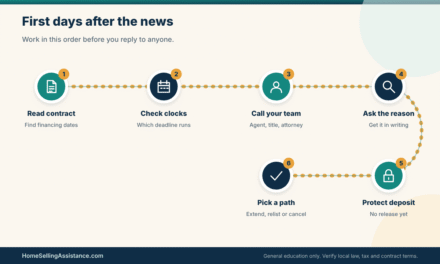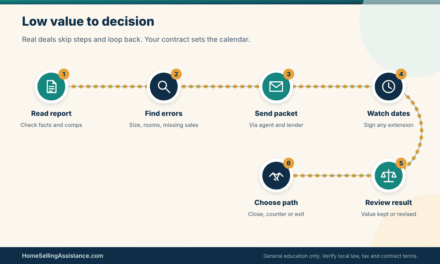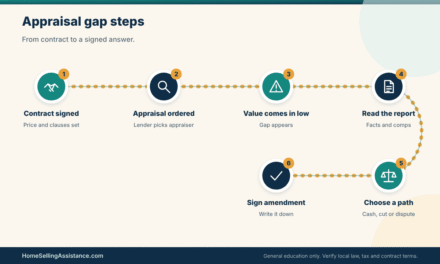
If you are the inspection contingency seller on a signed purchase contract, the next ten days or so can feel like waiting for a grade you cannot influence. A buyer is walking through your house with a flashlight, a ladder and a stranger who writes reports for a living, and the contract in your drawer says that what they find might change the price, the repairs, or whether the deal survives at all.
The good news is that you have more control than it feels like. An inspection contingency is not a verdict on your house. It is a set of contract terms that give the buyer a defined window to investigate, a defined way to respond to what they learn, and a defined set of consequences if they stay silent. Each of those terms can be read, calendared and planned around before the inspector ever arrives.
This guide is written for the inspection contingency seller’s side of the table. We will look at who actually holds the rights in the clause, how deadlines and remedies work, what tends to happen when an inspection comes back clean or messy, and which questions to settle before you sign anything. Where money is involved, the numbers are round illustrations, not predictions. Where law is involved, we explain how rules vary and show you how to check them for your state.
If you want the bigger picture first, our cornerstone guide on home sale contingencies from the seller’s side covers inspection, appraisal, financing and sale-of-buyer-home clauses together. Here we stay with the inspection piece and go deeper.
Key takeaways
- The contract, not the inspector, sets the rules. Every inspection contingency seller outcome traces back to written dates, notice methods and remedies in your signed documents.
- Silence can matter as much as a repair list. Many contracts treat a missed buyer deadline as acceptance or waiver, while others treat it as an automatic termination. Read yours closely and calendar both sides.
- You usually choose among a handful of responses. Agree, offer a credit, counter partially, or decline, then watch what the buyer can do next.
- Cancellation rights belong to the buyer in most forms, but they have edges. The edges, such as notice, scope and deposit handling, are where disputes start.
- Put every agreement in writing. Verbal handshakes about repairs and credits tend to be forgotten, misremembered or contested at closing.
What an inspection contingency seller actually signs up for
Before you worry about what an inspector might find, it helps to separate two things that people constantly blur together. One is the inspection itself, a physical examination of the property. The other is the contingency, a contract clause that decides what the examination is allowed to change. You can hold a perfectly sound house and still lose a deal over a badly understood clause, and you can hold a tired house and close comfortably because the paperwork was clear.
In this section we look at two questions that settle most disagreements later on. First, who holds which right and who carries which obligation. Second, which deadlines and remedies turn those rights into actual consequences. If you can answer both from your own contract in plain words, you are already ahead of most sellers, and your inspection contingency seller decisions will rest on text instead of guesses.
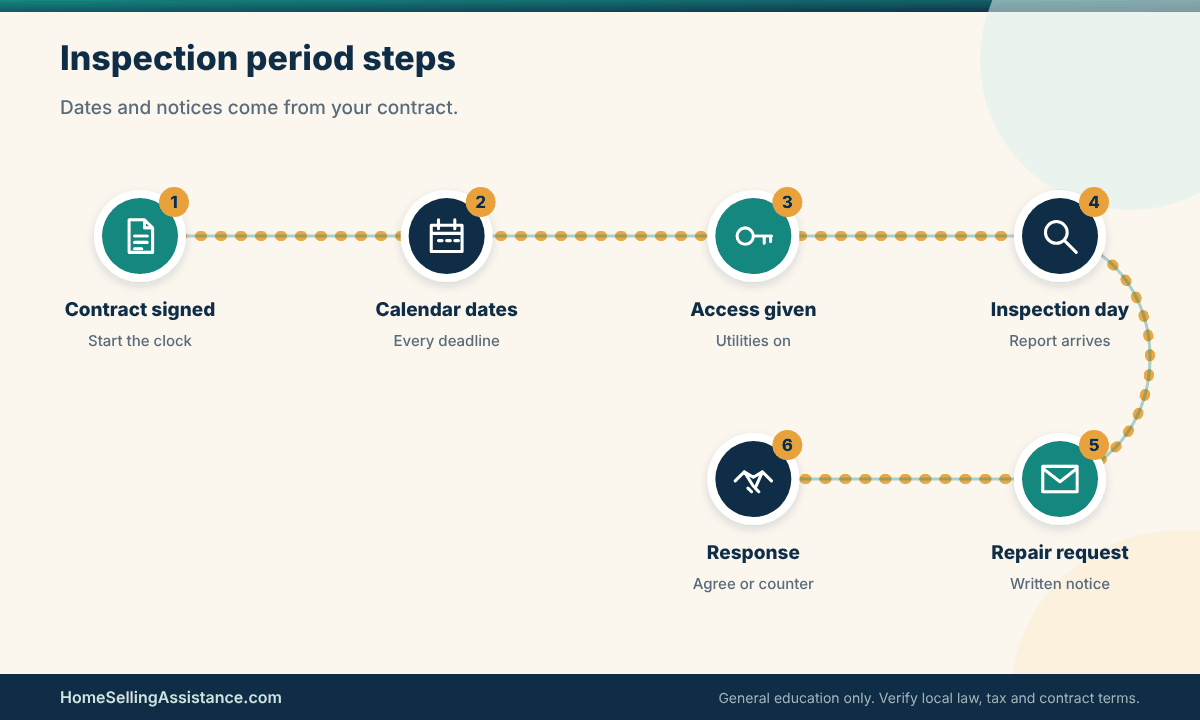
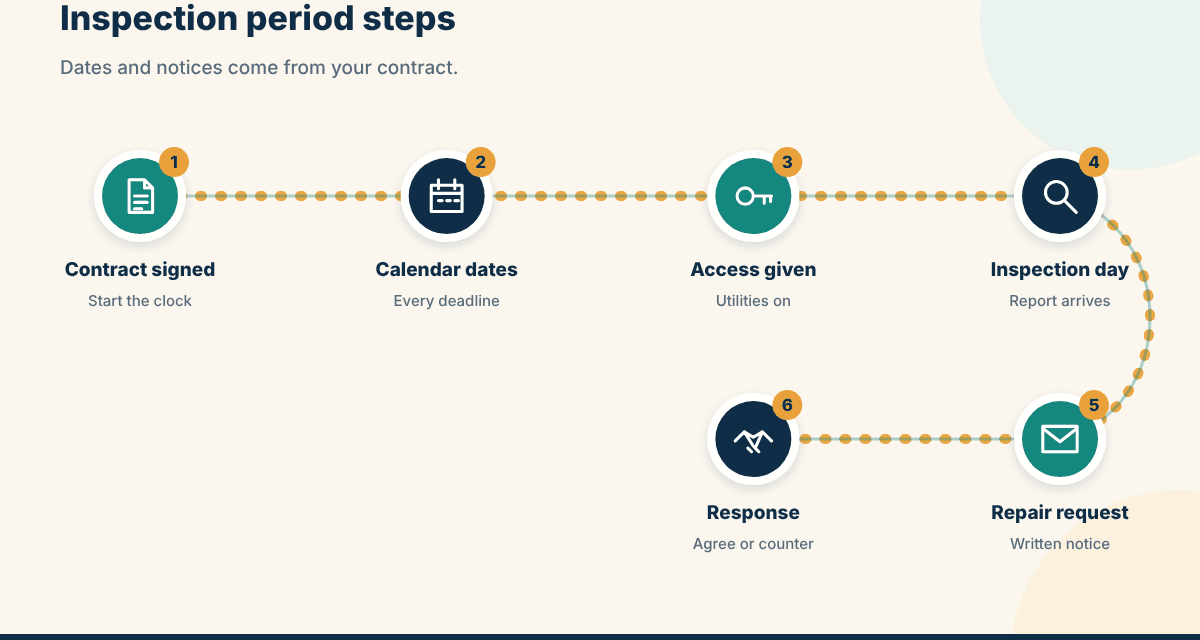
The roadmap above shows the usual sequence from contract signature to the end of the inspection period. Forms and local customs shift the details, so treat it as a map of the terrain, not a promise about your timetable.
Who holds the right to inspect, and who carries the obligations
In most residential purchase contracts, the buyer holds the right to inspect and the right to respond. The seller holds the obligation to provide reasonable access and to keep the property in the condition described in the contract until closing. That split sounds tidy, but it hides several smaller duties that catch sellers off guard, so it is worth walking through them one at a time.
An inspection contingency seller typically has to allow entry at reasonable times, make sure utilities are on, and open up the places an inspector needs to reach, such as attics, crawl spaces, electrical panels and outbuildings. The buyer, for their part, usually has to schedule within the allowed period and communicate any objections in the way the contract requires.
Evidence to gather: the clauses that assign rights and duties
Pull out your signed purchase agreement and every addendum, and read four things before the inspection happens. Start with the definition of the inspection period: how it is measured, whether in calendar days or business days, and what event starts the clock. Some contracts start it on the date both parties sign, while others start it on delivery of a signed copy, and that difference alone can move a deadline by a day or more.
Next, find the scope language. Some forms limit the buyer to the general home inspection, while others allow specialty testing such as sewer scope, radon, wood-destroying insects, mold or structural review. Then find the access clause, which describes utilities, pets, locked areas and the notice you must receive before each visit.
Finally, look for the sentence that tells an inspection contingency seller what the buyer may do with the results. It may say terminate, request repairs, request credits, or simply proceed. That sentence is the heart of the clause, and it is the one most sellers skim. Highlight it, and write the deadline beside it in the margin.
If you used an agent, ask them for a one-page summary of these four items in plain language. If you are selling without one, consider paying a real estate attorney for a short document review, since the cost is usually small next to the amounts at stake. Our guide to the real estate sales contract from the seller’s perspective explains how to read the rest of the agreement.
A scenario, an exception, and your next step when rights overlap
Picture a seller, Dana, whose contract gives the buyer ten calendar days for inspection and a further three days to send a repair request. Dana assumes the buyer therefore has thirteen days to walk away. Her agent reads the contract again and finds that the termination right actually expires at the end of the ten-day period unless a written repair request is delivered, which then extends the buyer’s decision window while negotiation runs.
That is an illustration only, since forms differ widely. The lesson is that Dana’s guess was based on how she imagined the clause, not on what it said. An exception also lurks in most forms: some rights, such as lead-based paint testing on older homes, run on their own federal clock. The U.S. Environmental Protection Agency explains the federal lead-based paint disclosure rules for pre-1978 housing, including the buyer’s default opportunity to test, which the parties may adjust in writing.
Your next step, if inspection contingency seller roles in your contract feel unclear, is simple. Write down each right in a sentence beginning with the name of the party, such as “Buyer may …” or “Seller must …”, then confirm those sentences with your agent or attorney before the inspector arrives.
One more duty deserves a mention. Between the signed contract and closing, the house is generally expected to stay in the condition it was in when the buyer agreed to purchase it, ordinary wear aside. An inspection contingency seller who skips routine upkeep, removes fixtures that were included in the sale or lets a small leak run can create new problems that the buyer will find at the final walk-through.
That is why many experienced sellers treat the inspection period as a good time to fix small annoyances quietly, such as a dripping faucet or a sticking door, as long as the work is allowed by the contract and documented. Quiet fixes shorten repair lists, and a shorter list means fewer chances for an inspection contingency seller to end up arguing over trivia.
Deadlines, remedies and the repair-request clock
Rights are only as strong as the deadlines that police them. A contingency that never expires would let a buyer hold your house hostage indefinitely, which is why every well-drafted form sets an end date and tells you what happens when it arrives. Understanding that ending is the single most useful thing an inspection contingency seller can do, because it tells you when your own risk drops.
Think of the deadline as a door that closes in stages. First the buyer’s right to inspect ends, then the right to ask for repairs ends, then your window to answer ends, and finally the buyer’s right to terminate ends. Some contracts compress those stages into one date, and others spread them across several. A careful inspection contingency seller learns which version applies and writes each date down, because assuming a single end date is one of the most common ways to miscount.
Remedies are the other half. A remedy is what the contract allows after a trigger event: a termination, a repair negotiation, a price change, a deposit refund. Some forms spell remedies out in a numbered list, while others scatter them through several paragraphs and addenda, which makes a careful read even more worthwhile.
Evidence to gather: dates, notice methods and deposit language
Build a simple inspection contingency seller calendar with every date that touches the inspection. Include the day the contract was fully signed, the inspection deadline, the repair-request deadline, the seller response deadline, the buyer reply deadline, and the date the inspection contingency is considered satisfied or waived. If the contract uses business days, mark weekends and any holidays so you do not miscount.
Then read the notice clause. Many contracts say that notices count only when delivered in a specific way, such as in writing, by email to a stated address, or through a transaction platform. A repair request sent by text may or may not count, and a seller response sent to the wrong address may be treated as never sent.
Finally, find the deposit language. The earnest money held by the title company, escrow agent or brokerage is normally returned or released according to the contract, and a buyer who cancels properly within the contingency period generally has a stronger claim to its return. Our guide to earnest money from the seller’s side explains how deposits are held and what disputes look like.
A scenario, an exception, and your next step on a tight clock
Imagine a contract signed on a Friday that gives the buyer seven calendar days for inspection and says the seller has three days after receiving a repair request to respond. The buyer’s inspector arrives on day six, the report arrives on day seven, and the repair request lands late that evening. Your response window now runs across a weekend, and the contract may not stretch for weekends.
An exception to watch is the “deemed” language. Some contracts say that if the seller does not respond within the response period, the request is considered declined. Others say it is considered accepted. The same silence yields opposite results depending on the sentence, so read it before you decide to sleep on a request.
Your next step on a tight clock, for any inspection contingency seller, is to answer in writing, even if the answer is “we need two more days.” Ask for a short written extension signed by both parties, since an informal agreement to wait is a common source of later disputes. If the buyer declines to extend, respond within the original window with your best position and keep a copy of the sent message. For a deeper look at the reply itself, our companion article on seller options after an inspection repair request goes through each choice.
Since so many moving parts sit inside one clause, a side-by-side inspection contingency seller matrix helps. The table below lists the issues an inspection contingency seller meets most often, the document that normally controls each, what the seller must or may do, the usual kind of deadline, and where to verify the local rule. Treat the entries as categories to look for, not as statements of what your state requires.
| Issue | Controlling document | Seller obligation or choice | Typical deadline type | Verify locally with |
|---|---|---|---|---|
| Buyer access for inspection | Purchase agreement access clause | Allow reasonable entry, utilities on | Inside the inspection period | Your agent or attorney |
| Repair or credit request | Inspection addendum or contingency paragraph | Agree, counter or decline in writing | Fixed days after request received | State real estate commission forms |
| Buyer termination right | Contingency clause and notice section | Prepare for it; confirm notice was proper | End of the inspection period | Attorney or title company |
| Deposit release after cancellation | Earnest money clause and escrow instructions | Sign release only after reading terms | Set by contract or escrow rules | Escrow or title agent |
| Lead-based paint testing, pre-1978 homes | Federal disclosure form and contract addendum | Provide disclosure and known reports | Default opportunity period unless changed | EPA and HUD guidance, your agent |
| Known defects found by inspector | State disclosure form and inspection report | Update disclosures if rules require it | Before closing; varies by state | State statute or attorney |
To use the matrix, copy it into a notes file and fill in every cell from your own documents. Where a cell stays blank because you cannot find the answer, that blank is your first question for your agent, attorney or title company. A completed matrix also doubles as a one-page briefing if you need to bring in a professional at short notice.
The matrix also reveals patterns. If several rows point to the same addendum, that document is your real rulebook, and it deserves a second read. If several rows say “varies by state,” you know where local help will matter most. A thoughtful inspection contingency seller uses the matrix the way a pilot uses a checklist: not because the steps are mysterious, but because skipping one under pressure is easy.
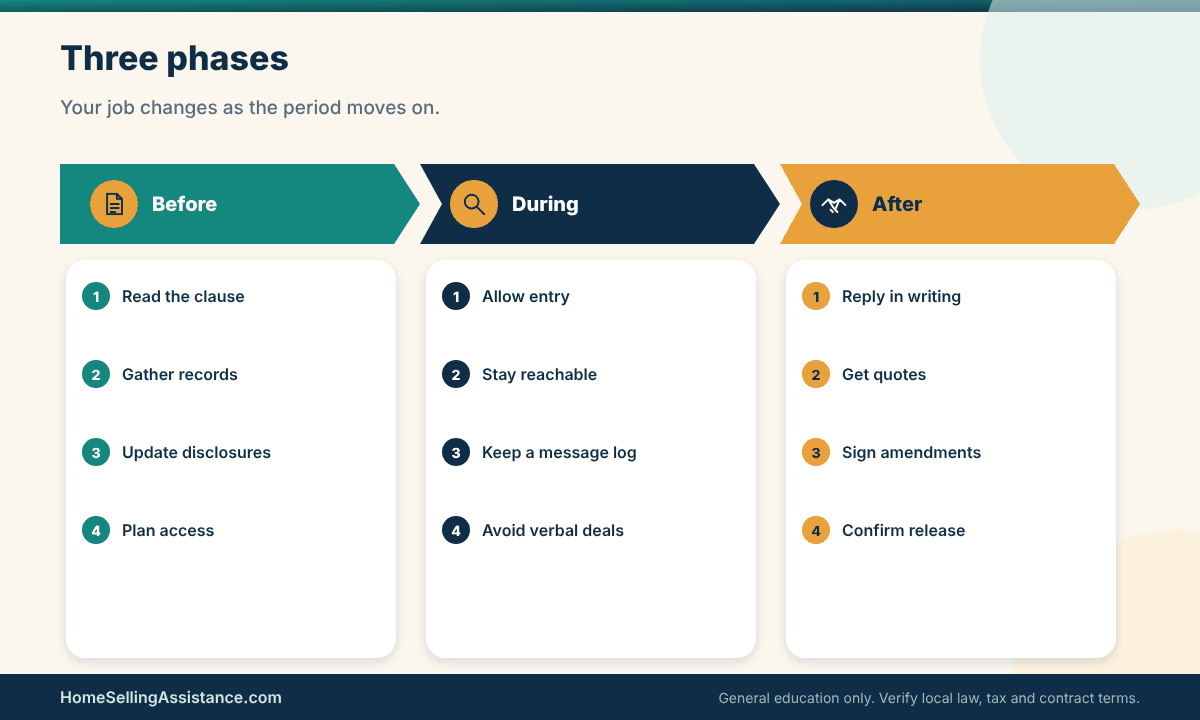
The inspection period tends to run on a rhythm, and it helps to see it as three phases rather than a single event. The next graphic breaks the period into before, during and after the inspector’s visit, with the tasks that usually belong to the seller in each phase.
Modeling the outcomes an inspection contingency seller meets
Once the inspection report exists, your options narrow and your choices become more concrete. Most outcomes fall into two families. In the first, the inspection period ends with the contingency satisfied, either because the buyer is content or because you and the buyer agreed on repairs and credits. In the second, something goes sideways: the parties disagree, a deadline is missed, or a contingency is waived in a way that changes who bears risk.
Modeling both families before you receive the report is a calming exercise for any inspection contingency seller. It does not predict anything, but it lets you decide your limits while you are calm, instead of at ten at night with a deadline on the screen. Each scenario below uses round illustrative numbers and a simple frame: what happened, what the contract probably says, what you could do, and what to document.
When the inspection period ends cleanly for the inspection contingency seller
A clean ending does not necessarily mean a perfect report. Almost every house has findings, and many buyers accept a list of small items without asking for anything. A clean ending usually means one of three things: the buyer proceeds without requests, the parties agree on a repair or credit package and sign it, or the buyer waives the remaining contingency in writing.
Whichever route applies, the paperwork afterward matters. A signed amendment or addendum is what turns a conversation into an obligation, and the closing agent will often want a copy to prepare the settlement statement correctly.
Evidence to gather: the signed release, amendment and receipts
An inspection contingency seller should ask their agent, or the buyer’s agent if there is none, for a written confirmation that the contingency is satisfied, waived or removed. Some forms include a specific “removal of contingency” document, while others rely on the buyer’s silence once the period ends. A written confirmation is better than silence because it fixes the date and removes doubt later.
If you agreed to repairs, collect the paperwork that proves they were done. That usually means invoices from licensed contractors, permits where required, photographs before and after, and any warranty documents. Some contracts require repairs to be done by a licensed professional and some allow work by the owner, so check the wording before you pick up a tool.
If you agreed to a credit, find out how it will appear. Credits often show up on the settlement statement as a reduction of the seller’s proceeds or as a buyer closing-cost contribution, and lenders sometimes limit how credits can be used. A short email to the buyer’s lender through the agents can confirm that the structure fits. Our guide to repair credits versus seller repairs compares the two paths more fully.
A scenario, an exception, and your next step after a smooth inspection
Consider a seller who receives a repair request listing eleven items. Eight are small, such as a loose handrail, a missing outlet cover and a dripping hose bib. Two are mid-sized, such as an aging water heater and a cracked window seal. One is a roof flashing issue. For illustration, imagine the seller agrees to the small items, offers a round credit of a few hundred dollars toward the mid-sized ones, and proposes a roofer’s estimate on the flashing.
The buyer accepts in writing within the response window, and an addendum is signed. That is a smooth ending, but an exception remains. If the buyer’s lender later flags a safety item, such as a missing railing on a deck, the appraisal or loan conditions may require repairs that were never part of your agreement.
Your next step in this case, as an inspection contingency seller, is to keep communicating after the addendum, not to relax. Ask the buyer’s agent to share lender requirements as soon as they arrive, keep invoices organized, and look at our article on low appraisal seller options so you recognize the next potential speed bump.
When the inspection contingency is disputed, missed or waived
Not every inspection ends in agreement. Sometimes the buyer asks for far more than you expected. Sometimes a deadline slips past without either side noticing. Sometimes the buyer waives the contingency at the start, perhaps to make a stronger offer, and the inspection becomes informational only. Each of those situations changes who carries the risk, and each calls for a slightly different response.
The word “disputed” matters to an inspection contingency seller. A dispute does not mean the deal is lost. It means both sides have stated positions that do not match. The contract decides how long you can stay in that state before somebody must act.
Evidence to gather: the report, quotes and the paper trail
When a dispute begins, gather facts before feelings. Get a complete copy of the inspection report, not just the summary page, and note which findings are described as safety items, which as maintenance and which as cosmetic. Inspectors vary in tone, and some reports read alarmingly even when the underlying issue is routine, so get at least one independent estimate for any large item.
Request quotes from licensed contractors in the relevant trade. A written estimate from a roofer, plumber or electrician anchors the conversation far better than competing opinions about how bad something looks. Keep a log of every message, call and date, and save emails and texts in one folder.
If the buyer waived the contingency up front, find the waiver language and read it carefully, since waivers range from a complete surrender of inspection-based termination rights to a narrow waiver of only repair requests. Our guide on what to do when a deal falls through after inspection covers the stages that follow when a dispute does not resolve.
A scenario, an exception, and your next step when the buyer pushes hard
Suppose a buyer’s inspector flags an older electrical panel and a possible drainage problem. The buyer sends a request asking you to replace the panel, regrade the yard and reduce the price by an amount that feels arbitrary. The contract says the buyer may terminate by the end of the period if the seller does not agree. Your agent tells you that you have three options: accept, counter or decline.
For illustration, a thoughtful counter might agree to have a licensed electrician evaluate the panel and fix any items that the evaluation calls unsafe, offer a modest round credit toward drainage work, and decline the price reduction. That response treats the buyer’s concerns as real without accepting every demand.
An exception to keep in mind is that a buyer’s termination right, once its window has opened, often does not depend on whether the request was reasonable. In many forms the buyer may simply walk away within the period. That is why your counter should be sent early and in writing, with a clear expiry time.
Your next step as an inspection contingency seller is to decide your lowest acceptable package before replying and write it down, along with a walk-away point that reflects your timeline, your costs of relisting and your next purchase. If the deal ends, our article on keeping a backup offer explains how to stay ready.
Scenarios blur together when you are living through them, so a second inspection contingency seller table helps. The one below lists common contract situations, the options a seller usually has, the main risk of each, the document to review and the point at which to escalate to a professional. It describes categories of situation, not legal conclusions, and your contract may treat any row differently.
| Situation | Seller options | Main risk | Document to review | Escalate when |
|---|---|---|---|---|
| Buyer sends a long repair list | Agree, credit, partial counter, decline | Buyer terminates inside the window | Inspection addendum | Request exceeds what you can afford |
| Buyer silent as deadline passes | Ask for written confirmation of status | Misreading deemed acceptance or deemed termination | Deadline and notice paragraphs | Parties read the clause differently |
| Inspection contingency waived by buyer | Proceed, keep disclosures current | Buyer disputes condition later | Waiver language and disclosures | Buyer claims undisclosed defects |
| Report reveals possible safety hazard | Get specialist evaluation, share findings | Delay and lender conditions | Report, lender requirements | Hazard affects insurability or financing |
| Buyer cancels and demands deposit | Review release terms before signing | Losing a deposit claim you were entitled to | Earnest money clause | Cancellation notice looks late or improper |
| Repairs agreed but not completed | Finish, document, or offer a credit | Closing delayed or reopened | Signed addendum, receipts | Buyer refuses to close over quality |
Read the table from left to right, as a question you ask yourself. What exactly happened? What can I choose? What is the worst realistic outcome of each choice? Where is the sentence in my contract that controls it? When would I rather pay for advice than guess? Rows that you cannot answer from your own documents are exactly the ones to raise before they become urgent.
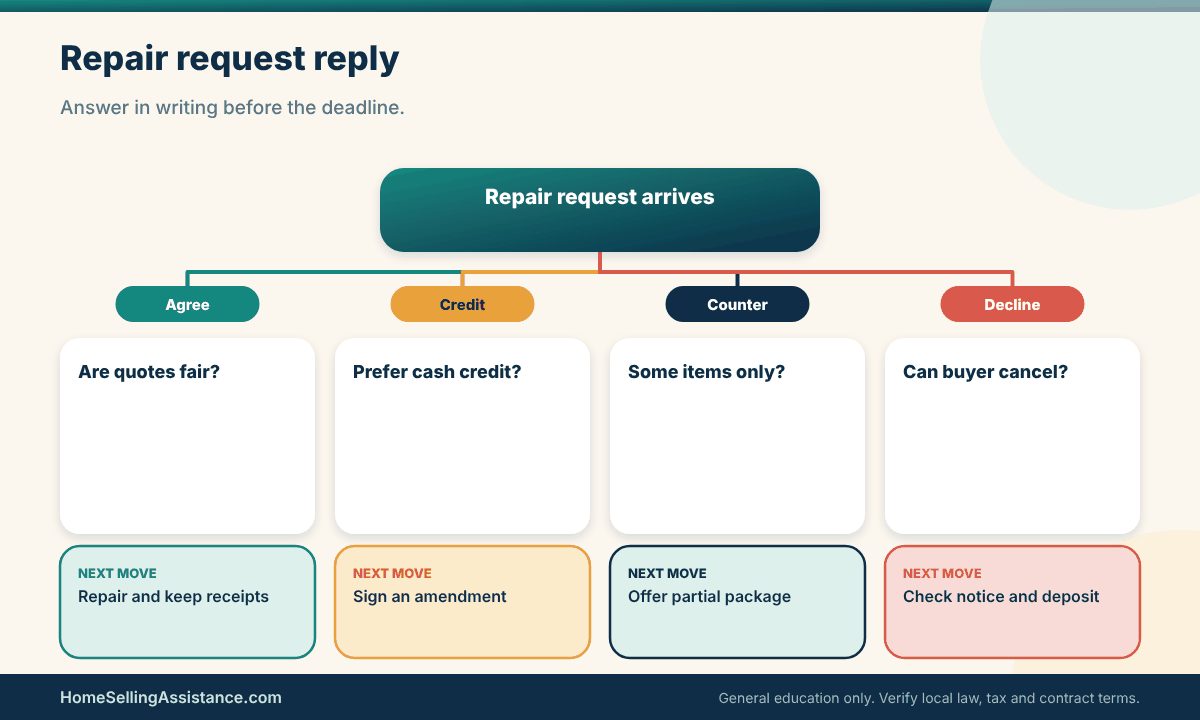
Decisions after an inspection often feel like a branching path, and a picture of the branches can help you keep your head. The tree below lays out the four typical replies to a repair request and the question you should settle before choosing each.
Controlling inspection contingency seller risk in writing
The most dependable protection against a bad inspection outcome is a clear contract written before the inspection exists. Once you have received an offer, you can still shape terms in the counteroffer. Once the contract is signed, you can still shape how disputes are handled through amendments, written extensions and clear notices. At every stage, the principle is the same: whatever matters should be in writing, dated, and delivered the way the contract says.
The two sections below turn that principle into practice. The first covers questions to settle before you sign. The second explains when it is smart to bring in a professional, and which kind. Neither replaces the advice of a licensed professional who has read your actual documents.
It also helps to remember that terms are negotiable until signature, even when they arrive on a pre-printed form. A buyer’s agent may propose a long inspection period or broad termination language, and the inspection contingency seller may counter with a shorter period, a requirement for written notice or a limit on which defects count. Counters like these are ordinary, and a reasonable buyer expects them. Our companion article on the home sale contingency from the seller’s perspective shows how those counters fit with the rest of the contract.
Questions an inspection contingency seller should settle before signing
Offers reach every inspection contingency seller with pressure attached, and the pressure usually pushes you toward the headline price. The inspection terms live in the fine print, where you can quietly give up leverage without noticing. Before you accept or counter, take a few quiet minutes with the contract and ask yourself a short set of questions, then make sure the answers are written down, not assumed.
These are not trick questions. They are the same ones an experienced agent or attorney would raise, and many sellers find that simply asking them changes the tone of the negotiation in a helpful way. Our cornerstone article on home sale contingencies for sellers gives a wider list that includes appraisal and financing terms.
Evidence to gather: a pre-signing checklist of clauses and records
Start with length, the first inspection contingency seller question. How many days does the buyer have, and does the period start on signature or on delivery? A shorter period gives you faster certainty, while a longer one gives the buyer more time to find problems, so neither is automatically better. The right answer depends on your timeline and on how comfortable you feel about your house’s condition.
Ask what the buyer may do at the end of the period. Can they terminate for any reason, or only for defects above a stated size? Must they offer you a chance to respond before terminating? Does the contract say whether a repair request extends the period? Each answer changes your negotiating position.
Check the paper trail you control. Do you have maintenance records, past inspection reports, permits and warranties ready to share? Is your disclosure form current and honest? Our article on seller disclosure versus inspection report explains how those documents interact, and a prior report from a pre-listing home inspection can reduce surprises. Sellers who prepared well often face shorter repair lists.
Last, picture the worst case. If the buyer cancels on the last day, can you relist quickly? Is your next purchase or move tied to this closing date? That honest look at your own constraints is what should set the limits of what you are willing to repair or credit.
A scenario, an exception, and your next step before you sign
Imagine two offers on the same home. The first has a slightly higher price, a long inspection period and language that lets the buyer terminate for any reason. The second has a slightly lower price, a shorter inspection period and a requirement that the buyer name specific defects in writing before terminating. For illustration, assume the price difference is a few thousand dollars.
Which is better? There is no universal answer. A seller with a tight move date might value the shorter, more structured period. A seller with a flexible schedule and a trusted house history might happily accept the longer one. What matters is that the decision is informed, not that it matches a rule of thumb.
An exception is competitive markets, where buyers sometimes shorten or waive inspection rights to stand out. A waiver can look attractive, but it does not erase your disclosure duties, and it does not stop a buyer from raising a claim later if you failed to disclose something known. Your next step as an inspection contingency seller is to compare offers on terms as well as price, and our guide to counteroffer strategy for sellers shows how to respond to terms you do not love.
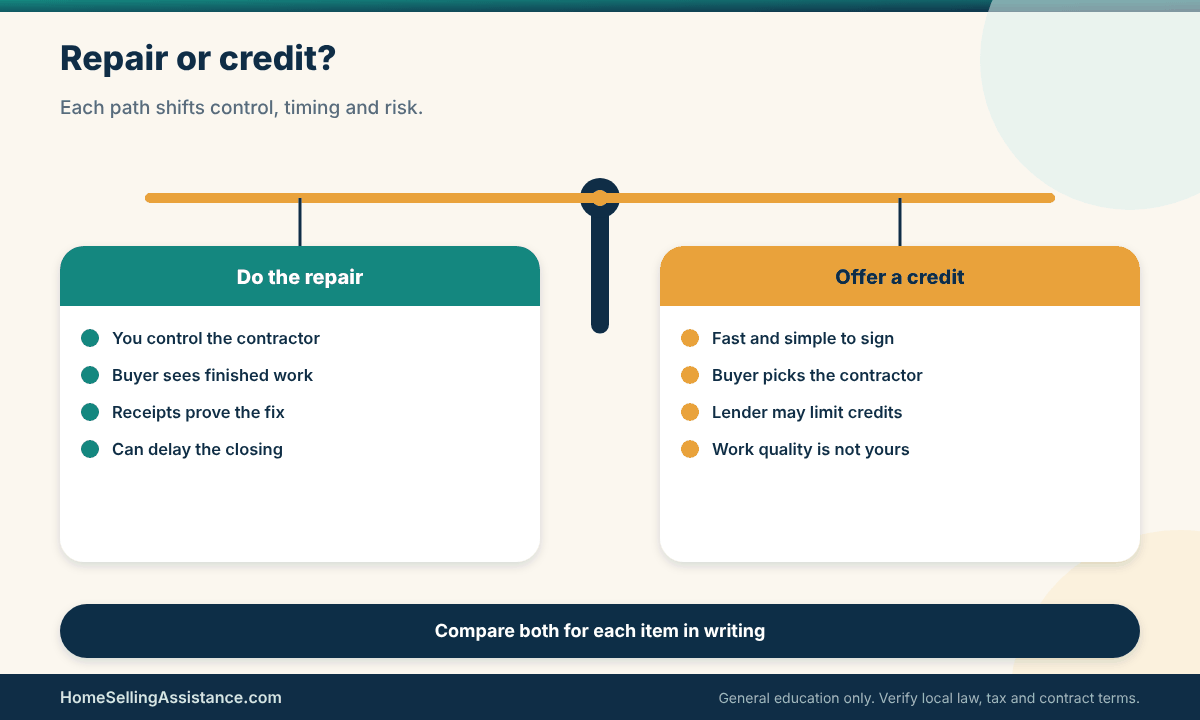
When you weigh a repair against a credit, it also helps to see the trade-offs side by side. The scale graphic below sets the strengths of doing the work yourself against the strengths of offering a credit, so you can see how each choice shifts control, timing and risk.
When an inspection contingency seller should call an attorney, agent or title professional
Most inspection periods pass without any need for legal help, and the typical inspection contingency seller never meets a lawyer about them. A few do not, and recognizing those early saves more money than almost any other habit. The triggers below are not rules of law, just common signals that a short paid conversation will be cheaper than a long unpaid argument later.
Who you call depends on the question. An agent understands local forms, customs and the other side’s likely behavior. An attorney interprets contract language, notice and remedies and can speak to your rights. A title or escrow officer handles deposits, releases and what the closing agent will require. In some states an attorney is part of nearly every sale, while in others they appear only when something goes wrong, so ask locally.
A useful rule of thumb is to escalate on ambiguity, not on drama. An angry email from a buyer is rarely a legal event, while a calm email asking whether a deadline has passed can be one. When the written words of the contract stop answering your question, the inspection contingency seller is in the position where professional advice earns its fee. Before that point, a clear calendar, tidy records and prompt written replies will carry you through most inspection periods.
Evidence to gather: what to bring to a professional conversation
Walk in with a short inspection contingency seller packet. Include the signed contract and every addendum, the full inspection report, the buyer’s repair request, your response, any contractor quotes and a timeline of messages. If a deposit is in dispute, add the escrow instructions and any release form you were asked to sign.
Prepare three specific questions in writing. For example: Does my contract treat silence after the deadline as acceptance or termination? Am I allowed to decline all repairs and still hold the buyer to the contract? Would signing this release give up a claim to the deposit? Specific questions get specific answers and keep the billable time short.
Check credentials, too. Attorneys are licensed by the state bar, and agents and brokers are licensed by the state real estate commission, which usually offers an online lookup. For general consumer information about mortgage closings and contracts, the Consumer Financial Protection Bureau publishes plain-language resources, and the National Association of Realtors shares general practice information, though neither can advise on your specific contract.
A scenario, an exception, and your next step on a dispute that will not settle
Imagine a buyer cancels and asks you to sign a release so the deposit returns. You believe the cancellation came after the contingency expired, and the release you are handed says both parties give up all claims. If you sign it casually, you may waive a right you did not mean to waive. If you refuse without understanding your options, you may freeze the deposit for weeks.
That is exactly where a short attorney review pays for itself. The attorney may find that the notice was late, that it was valid, or that a compromise release is sensible. For illustration, many disputes settle with a partial release or a split of the deposit, but outcomes depend on contract, state law and facts, and nobody can promise one.
An exception is a small deposit and a clean cancellation, where signing a standard escrow release may be perfectly reasonable. Your next step as an inspection contingency seller is to ask the escrow or title officer to explain the release in plain words, then decide whether a legal review is worth the cost. Our guide on the financing contingency from the seller’s view covers a neighboring contingency that creates many of the same disputes.
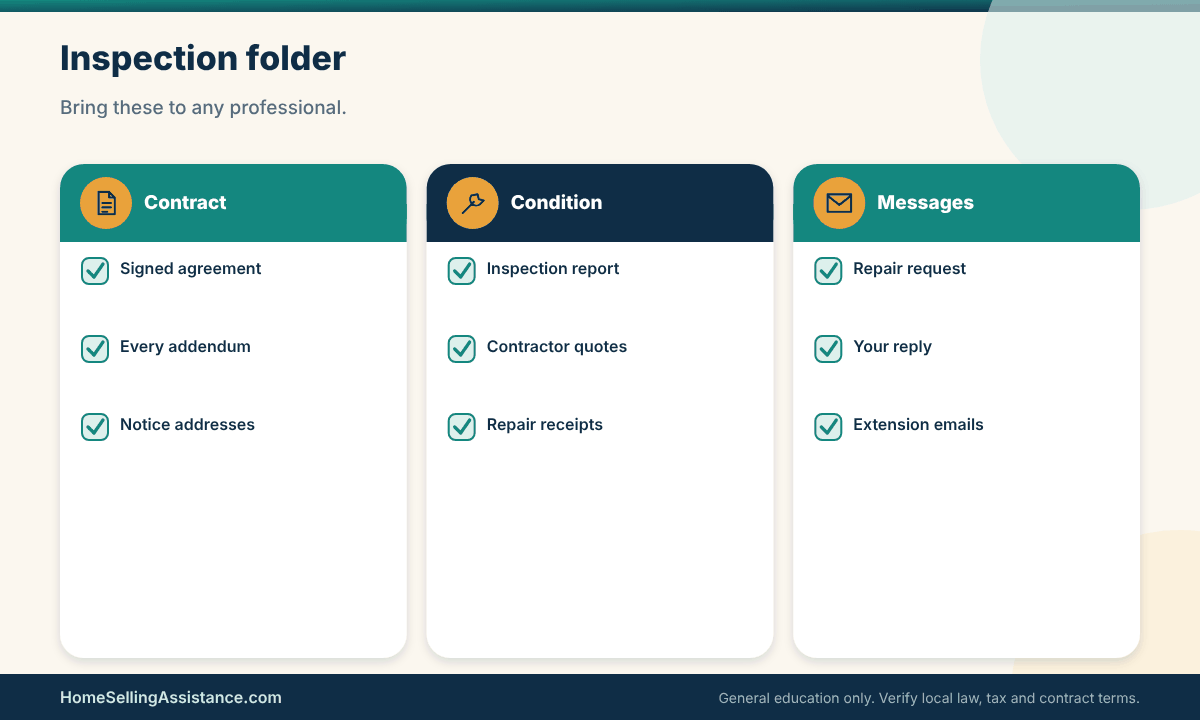
The checklist above collects the documents that make every one of these conversations shorter. If you can produce them in one folder, whatever professional you call can focus on advice instead of searching for facts. You can also browse more articles in the contingencies, inspections and appraisals category, and see how repair choices connect to resale value in the repairs and selling as-is category.
Quick scenario
A seller receives a repair request on Thursday with a Saturday deadline. She emails her agent, confirms the deadline in the contract, asks the buyer for a one-day written extension, gets two contractor quotes by Friday afternoon, and sends a counter that includes one repair, one credit and one decline, each tied to a quote. The buyer replies Sunday. Nothing about this was dramatic, and that is the point: calm sequence beats improvisation.
Frequently asked questions about inspection contingency seller terms
What does an inspection contingency mean for a seller?
It means the buyer’s obligation to buy depends on the property passing the buyer’s inspection within a defined period. The contract spells out what the buyer may do with the results, such as terminate, request repairs or proceed. An inspection contingency seller is therefore bound to the deal only in a conditional way until that period ends. After it ends, the buyer is generally more committed, though the exact effect depends on your contract.
Do I have to make repairs the buyer requests?
In most residential contracts, the seller is not required to agree to every request. You can usually accept, counter, offer a credit or decline. The catch is that the buyer may then have the right to terminate within the period. Whether declining is wise depends on your timeline, the market, and whether the buyer can walk away. Your contract and local practice decide the details.
Can a buyer cancel after the inspection period ends?
Usually not for inspection reasons, since the contingency has expired, but other contingencies may remain, such as appraisal or financing. Some contracts also allow cancellation for specific reasons, like undisclosed material defects, under state law. An inspection contingency seller should not assume the door is fully closed without confirming in writing that the period has ended and nothing else was extended.
What happens if I miss a deadline to respond?
It depends on the contract. Some forms treat silence as acceptance of the buyer’s request, others as a rejection, and others give the buyer a new option to terminate. Because the outcome can flip with a single sentence, calendar the response date the moment you receive a request. If you need more time, ask for a written extension signed by both parties.
Is a repair credit better than doing the repair myself?
Neither wins in every case. A credit gives you speed and control, while a repair can satisfy a buyer who values quality work and lets you manage the quote. Lenders sometimes limit credits, and some repairs must be done to meet loan or insurance conditions. Compare both options for the same item, and read our article on repair credits versus seller repairs for a longer look.
Do I need to disclose what the inspection finds?
Disclosure duties vary by state, and many states require sellers to disclose known material defects regardless of what an inspection says. Once a report names a defect, you generally know about it, which may affect what you must tell later buyers. Ask an attorney or your state’s real estate commission what applies where you live, and keep copies of every report you receive.
What if the buyer waived the inspection contingency?
A waiver usually removes the buyer’s right to cancel or request repairs based on inspection results. It does not usually remove your duty to disclose known defects or the buyer’s remedies for misrepresentation. If you are weighing an offer with a waiver, read the exact wording, because waivers range from complete to narrow. An inspection contingency seller benefits from asking an agent or attorney to explain the scope.
Who gets the earnest money if the buyer cancels?
The contract and escrow instructions control. A buyer who cancels correctly within a contingency period commonly has a strong claim to the deposit, while a buyer who cancels late may face a dispute. Escrow agents usually will not release funds without both parties’ agreement or a legal order, so disagreements can take time. Read our article on earnest money from the seller’s side before you sign any release.
Should I order my own inspection before listing?
Many sellers do, because it lets them learn about problems privately and decide how to handle them on their own schedule. It can also create a document you must consider for disclosures. The choice is a trade-off between knowledge and obligation. Our guide to the pre-listing home inspection weighs the pros and cons, and your agent or attorney can advise on local disclosure practice.
When should I talk to an attorney?
Consider one when the contract language is unclear, a deadline dispute arises, a deposit is contested or the buyer threatens legal action. A short review is often much cheaper than a prolonged dispute. In some states attorneys are routinely part of the process, and in others you may need to seek one out. A good inspection contingency seller plan includes knowing whom you would call before you need them.
Where this leaves you
A calm approach to the inspection contingency seller process is built from small habits: read the clause, calendar the dates, gather your documents, answer in writing and ask for help when the wording stops being clear. None of that requires you to predict what the inspector will find. This article is general education, not legal, tax or financial advice, and your contract, your state and your facts decide what applies to you. Before you act on a deadline, a deposit or a release, confirm the details with a licensed attorney, agent or title professional where you live.