Understanding your low appraisal seller options before the report arrives is the difference between a calm week of problem solving and a panicked weekend of phone calls, because a low appraisal rarely ends a sale on its own but it does force a decision, and that decision has a price tag, a calendar and a risk level attached to every path.
Here is the situation in plain terms. You accepted an offer. The buyer is using a mortgage. The lender hired an appraiser, the appraiser visited your house, and the written opinion of value came back lower than the contract price. Suddenly a number you thought was settled is in question, and the buyer’s lender may be unwilling to lend as much as the buyer planned to borrow.
Nothing about that is a verdict on your house or on you. An appraisal is one licensed professional’s opinion, formed from a handful of recent sales and a short visit, and it can be too cautious, too thin on comparable sales, or simply right. Which of those it is matters, because the best response to a shaky report is different from the best response to a fair one.
This article is part of our library on contingencies, inspections and appraisals, and it builds on the cornerstone guide to home sale contingencies from the seller’s side. We keep the focus narrow. You will see how to define what you actually want, which facts can flip the answer, how the main paths compare, and a simple net-result rule you can run with your own numbers.
One limit before we start. This is general education, not advice about your contract. Contingency wording, deadlines, deposit rules, attorney involvement and lender practices vary by state, by contract form and by loan program. Every dollar figure below is an illustrative round number that shows arithmetic, never a prediction about your property, your market or your buyer.
Key takeaways
- A low appraisal is a gap, not a verdict. It tells you where the lender’s number and the contract price disagree, and your low appraisal seller options are the different ways of closing or walking away from that disagreement.
- Read the report and the contract first. Whether the buyer has an appraisal contingency, how long it runs and what happens to the deposit decide which paths are even open to you.
- There are four broad routes. You can lower the price, split the gap with the buyer, ask for a reconsideration of value, or part ways and sell again, and each one trades net proceeds against time and risk.
- Compare paths by expected net, not by pride. Subtract credits, extra carrying costs and the chance of a failed closing from each path, then pick the result you can live with.
- New evidence should be allowed to change the plan. A better comparable sale, a lender switch or a hard move-out date can make a path that looked weak last week the sensible one today.
- Keep everything in writing and stay fair. Written amendments, equal treatment of buyers and no pressure on the appraiser protect you legally and practically.
Define the choice behind your low appraisal seller options
Before you compare low appraisal seller options, decide what a good outcome looks like for you. Sellers who skip this step tend to react to whatever the buyer’s agent suggests first, and the first suggestion is usually the one that costs the other side the least. A short, honest definition of your goal turns a messy negotiation into a set of trade-offs you can actually measure, and it makes your low appraisal seller options easier to rank.
This section covers two things. First, the personal facts that shape your decision: your goal, your calendar, your cash and your appetite for risk. Second, the outside facts that can change the answer even when your goals stay put, such as the loan program, the quality of the comparable sales and the exact words in your contract.
Goal, timeline, cash and risk tolerance before the appraisal lands
Most sellers have one of three goals when a low appraisal shows up. Some want the highest possible price and can wait. Some want certainty and a closing date because a next home, a job start or a school year depends on it. Others want a clean exit and will accept a lower number to stop the uncertainty. None of these is wrong, but each one points to different low appraisal seller options.
Timeline matters as much as price. If you are paying a mortgage on a house you have already moved out of, every extra week has a cost you can estimate. If you are still living comfortably in the home with no deadline, a delay costs you far less. Be specific about your last acceptable closing date, because that single date often decides which low appraisal seller options are still realistic.
Evidence to gather: the appraisal report, contract and your payoff
Start with four documents. Ask for a copy of the appraisal report through the buyer’s agent or the lender, since the appraisal belongs to the lender’s file and sellers do not always receive it automatically. Pull your signed purchase contract, any addenda and the appraisal contingency language. Get a current payoff statement for your mortgage. And collect your own list of improvements with dates and receipts.
The report tells you the appraised value, the comparable sales the appraiser used, the adjustments made to those sales and any condition or quality ratings. The contract tells you who can do what and by when. The payoff tells you how much room you have, because the equity you hold decides how much price you can give up without creating a problem at the closing table.
Here is a quick way to read the report like an editor. Look at the three to five comparable sales. Note how far away each sat, how recently each closed and how different each home was in size, age and condition. Then check whether the adjustments, which are dollar corrections for differences, look consistent. Inconsistent adjustments are where most reasonable disagreements start.
It also helps to understand what an appraisal is and is not before you weigh low appraisal seller options. It is a lender’s tool for protecting the loan, built around recent closed sales, and it is not the same as the price opinion your agent prepared before listing. Our comparison of a CMA and an appraisal explains why two reasonable professionals can land on different numbers, and why that gap shapes every one of the low appraisal seller options below.
The Consumer Financial Protection Bureau publishes plain-language material on appraisals and home loans at consumerfinance.gov, which is useful background for you and for your buyer. Lenders must follow federal and state rules on how appraisals are ordered and shared, so when you have a procedural question, such as who may contact the appraiser, ask the loan officer to explain the lender’s process in writing.

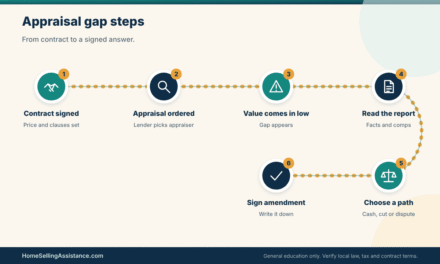
The roadmap above shows the usual sequence after an offer is accepted and a financed buyer’s lender orders the appraisal. Use it to find where you are on the timeline and which low appraisal seller options remain open. The contract deadlines attached to the appraisal step are the ones that most often decide your leverage, so mark them on your calendar the day you receive the report.
A scenario, an exception, and your next step on goals and deadlines
Picture a seller, call her Dana, with a signed contract at a round example price of $400,000. The report comes back at $385,000. Dana has already signed a lease on a rental starting in five weeks. Her mortgage balance is well below the contract price, so she has equity to spare. Her real goal is a closing within five weeks, not the last $15,000.
For Dana, a short renegotiation likely tops her list of low appraisal seller options, ahead of a long dispute, even if it costs some price. Change one fact and the answer shifts. If she had no move date and a strong second showing list, she might pursue a reconsideration of value first. The exception is a contract with a short appraisal window, which can force her hand before she can explore anything slowly.
Your next step is simple. Write down your last acceptable closing date, the lowest net amount you could accept and the number of weeks you could carry the home if the deal ended. Those three figures become the yardstick for every one of the low appraisal seller options that follow.
A word about emotions, because they are part of the evidence. A low appraisal feels personal, especially if you renovated, raised a family in the house or priced it based on what a neighbor reportedly received. Give yourself a day before answering the buyer. Sellers who respond within the hour often accept the first low appraisal seller options laid in front of them, and a day of thought rarely costs anything the contract does not already allow.
It also helps to name who is on your team. Your listing agent knows the market and the buyer’s agent. A real estate attorney, where you use one, understands the contract and deposit rules. Your lender or title company can answer payoff questions. Ask each person a different question, so that you collect facts from the person best placed to give them rather than three opinions on the same point.
Facts that could change your low appraisal seller options
Some facts sit outside your control but still reshape your low appraisal seller options. The main ones are the buyer’s financing type, the strength of the appraiser’s comparable sales, the details of your contract and the buyer’s finances beyond the loan. A thorough seller checks each one early, because each can open a door or close one without warning.
Think of these as the hidden variables in your decision. Two sellers with identical appraisal gaps and identical low appraisal seller options on paper can face very different outcomes if one buyer has plenty of cash reserves and a flexible agent, and the other is stretched to the limit on a low-down-payment loan. You cannot change those facts, but you can find out what they are.
Evidence to check: comparable sales, condition notes and loan type
Start with the comparable sales. Ask your own agent, or look at public sale records yourself, to see whether recent closings of similar homes support the contract price. If you believe the appraiser overlooked a better comparable, write down the address, sale date and why it fits. A relevant sale that closed within a few months and sits near your home is stronger evidence than a long list of loose matches.
Next, look for condition notes in the report. Appraisers sometimes mark deferred maintenance, safety concerns or unfinished work, and a lender may require repairs before it will fund the loan. That is a separate issue from value, and it can quietly add cost. Finally, ask the buyer’s loan officer which loan program applies, because government-backed and conventional loans have different appraisal rules, and the lender controls the process.
Last, learn whether the buyer’s agreement includes any appraisal gap language. Some contracts say the buyer will cover a stated amount of shortfall in cash. If yours does, the conversation may already be half finished. If your contract is silent, the discussion starts from scratch, and you should treat any verbal promise as worth nothing until it appears in a signed amendment.
A scenario with an exception: when the appraisal itself looks wrong
Consider a seller, Marcus, whose report relied on three comparable sales that were each smaller than his home and located across a busy road. A fourth sale, closer and more similar, was left out. His agent finds clear evidence of that sale and of a finished basement that the report mentions only briefly. Marcus has a real basis for asking the lender to look again.
The exception is important. A seller who simply dislikes the number does not have a basis. A reconsideration request works best when it points to specific, verifiable facts: a missed sale, a factual error such as the wrong square footage, or an improvement that was overlooked. Opinions about how nice the kitchen is rarely move an appraiser, and pressure is both ineffective and inappropriate.
Your next step is to list the facts you could prove in two columns: errors in the report and omissions from the report. If both columns are empty, spend your energy on the negotiation-based low appraisal seller options instead. If either has solid entries, the guide on reconsideration of value for sellers walks through how that request is usually made and what it can and cannot achieve.
Compare the realistic paths after a low appraisal
Once your goals and the outside facts are on paper, your low appraisal seller options come into focus. Most low appraisal seller options fall into two families. The first family keeps the current buyer and changes the deal: a lower price, a split of the gap, a buyer who pays the difference in cash, or a successful challenge to the number. The second family changes the buyer or ends the contract.
The picture below lays out four of the most common routes side by side. Each card shows when the path tends to fit and what to watch for. Treat it as a map of low appraisal seller options, not a ranking, because the best path depends on the goal, the calendar and the cash you defined in the previous section.

The next table compares the same low appraisal seller options on the dimensions that matter most to a seller: price and net proceeds, time and contingencies, workload and execution risk. Read across a row to see what a path really asks of you, then read down a column to see which path is strongest on the factor you care about most.
| Path | Price and net proceeds | Time and contingencies | Workload | Execution risk |
|---|---|---|---|---|
| Lower price to the appraised value | Lowest price, simple math | Usually fastest; financing stays on track | Low: one amendment | Low if the lender confirms |
| Split the gap with the buyer | Middle: buyer adds cash, you trim price | Short talks; dates may stay | Low to medium | Medium: buyer cash must be real |
| Buyer pays the gap in cash | Keeps contract price if accepted | Quick if funds are proven | Low: proof of funds | Medium: buyer may balk |
| Reconsideration of value | Could restore price; no promise | Adds days; may need an extension | Medium: evidence packet | Medium: value may stay |
| Second appraisal | Depends on result | Adds weeks; lender and contract dependent | Medium: scheduling, access | High: can come in the same or lower |
| Terminate and relist or call backup | Unknown until new offer | Longest; showings restart | High: new marketing | High: price may reset |
Use the table as a screening tool for your low appraisal seller options. If your priority is date certainty, the first three rows deserve most of your attention. If you are willing to trade time for a better price, the reconsideration and second-appraisal rows become interesting, with the warning that they can also backfire. The final row is your fallback and is worth knowing even if you never use it.
Option one: renegotiate the price or share the gap
The most common of all low appraisal seller options is a conversation about money. In a financed purchase, lenders generally base the loan on the lower of the purchase price or the appraised value. So if the contract price stays high while the appraisal stays low, the buyer has to bring the difference in cash, or the deal needs a new price. That is why renegotiation is usually the first stop.
Within renegotiation there is a spectrum. At one end, you accept the appraised value as the new price and the deal moves on. At the other end, the buyer covers the whole gap in cash and your price stays put. Most deals land somewhere between, with each side giving up part of the difference. How you get there depends on leverage, and leverage depends on the contract and the market.
Counteroffers matter here, because every proposal you send is legally a counteroffer that can end the buyer’s previous proposal. Our guide to counteroffer strategy for sellers explains how to keep a clean paper trail. The same discipline applies when the appraisal arrives close to an inspection response, since a repair request and a value gap can pile up in the same week. See how inspection repair requests interact with price talks.
The math and the paperwork behind a renegotiated price
Here is the arithmetic with round example numbers. Say the contract price is $400,000, the appraised value is $385,000 and the gap is $15,000. If you drop the price to $385,000, your net falls by the full $15,000 before any other effect. If you split the gap evenly, you reduce the price by $7,500 and the buyer adds $7,500 in extra cash. Your net falls by $7,500.
Other terms can shift too. A lower price may change what you owe in some transfer charges, depending on local rules. Seller credits for the buyer’s closing costs work differently, because some loan programs limit them, so ask the lender before offering one as a trade. Our guide on seller concessions in a home sale explains why a credit and a price cut are not the same thing for the buyer’s loan.
Put every change in a signed written amendment. A friendly text message from the buyer’s agent does not change the purchase contract. The amendment should state the new price, any cash the buyer will add, any changed dates and, if relevant, that the appraisal contingency is satisfied or removed. Many sellers keep the contingency alive until the lender confirms the loan amount, which is a sensible habit.
A scenario and the next step when the buyer agrees to share
Imagine a seller, Priya, whose buyer offers to meet halfway. On a $15,000 gap the buyer says they can add $5,000 more cash and asks Priya to lower the price by $10,000. Priya compares that with a straight price cut of $15,000. Her net is $5,000 better under the buyer’s proposal. She also wants a firm check on whether the buyer’s down payment really can grow by that amount.
So she asks for a short written update from the lender showing the new loan amount and cash to close, plus recent bank statements with account numbers hidden. This is a normal request, and it turns a verbal promise into evidence. If the buyer cannot produce it within a day or two, Priya treats the offer as less solid than it sounded and weighs the other paths again.
The exception to watch is a buyer who is already at the edge of their budget. Squeezing them for cash can sink the purchase. Your next step is to ask your agent or attorney how much room the buyer realistically has, then propose a split that you could accept as final. For deeper background on this exact problem, see our guide to the appraisal gap from the seller’s side.
One more point belongs here. Sellers sometimes assume that a low appraisal gives the buyer all the power. In reality, the buyer also faces a cost if the deal ends: lost time, a lost deposit in some cases, lost rate locks and the need to start a search again. A buyer who loves your house has reasons to keep the deal alive. Understanding that mutual cost helps you negotiate calmly, and it keeps your low appraisal seller options from shrinking to a single one.
Option two: challenge the value or change the buyer
The second family of low appraisal seller options takes more effort and carries more uncertainty. You can ask the lender to reconsider the value, you can ask for a different appraisal, or you can accept that this buyer and this price no longer fit together and move on. None of these low appraisal seller options is a trick. Each is a legitimate step, and each belongs in the right situation.
The key distinction is control. In a reconsideration, you control the quality of your evidence but not the decision. In a second appraisal, you control almost nothing, including the result. When you part ways, you control your next move but not the market response. Knowing where your control sits helps you choose among low appraisal seller options without wishful thinking.
Evidence a reconsideration request needs, and what it cannot do
A reconsideration of value is a request, usually made through the buyer’s loan officer, asking the appraiser or the lender’s review team to look again at specific facts. It is not a re-roll of the dice. Lenders have their own procedures and timelines, and the seller does not contact the appraiser directly in most situations, because appraiser independence rules exist to keep outside pressure from influencing the result.
What helps is a short, factual packet. Include recent closed sales that were missed, with addresses, dates and why they are comparable. Include corrections for any factual errors, such as the wrong bedroom count or square footage, supported by a floor plan or public record. Include documents for improvements, such as permits and receipts. Leave out opinions, emotion and any suggestion about the number the appraiser should reach.

The checklist above shows what a clean evidence packet usually holds. Expect to hand it to your agent, who passes it to the buyer’s side. What a reconsideration cannot do is guarantee a higher number, force the lender to act by a certain date, or override the lender’s rules. Plan for it to produce no change, and treat any increase as a bonus rather than a basis for your budget.
A scenario for terminating, relisting or calling a backup buyer
Now imagine a seller, Tom, whose buyer will not move off the contract price and cannot cover the gap, while the appraisal contingency is still active. Tom has two choices. He can cancel the contract under its terms, usually with a written notice and a deposit decision that follows the contract. Or he can let the buyer decide whether to cancel, which avoids a dispute but leaves him waiting.
If Tom kept a backup offer alive, his fallback is much stronger. Our guide to a backup offer when you sell a house explains how those arrangements work and why the order of notices matters. If there is no backup, relisting means new photos, new showings and a fresh round of price discovery, with extra carrying costs. A listing that has been under contract and fell through can also raise buyer questions.
Be careful about deposits. Who receives the earnest money after a low appraisal depends on the contingency wording, whether deadlines were met and any local rules, so read the contract and ask an attorney or your agent before assuming. Our overview of earnest money for sellers explains why a deposit dispute can drag on and what documents tend to resolve it. If an outside buyer pays cash instead of financing, the appraisal may not matter at all, though cash buyers still care about value.
A net-result decision rule for low appraisal seller options
You now have a list of low appraisal seller options. The last job is to choose one without letting the loudest voice in the conversation decide for you. A net-result rule does that. It asks you to convert every path into the same four ingredients, price, time, cost and risk, then compare the totals. The rule will not predict the future, but it keeps you honest about what each path really costs.
This section gives you a framework, then shows how to adjust it when new facts arrive. The first part is about arithmetic. The second part is about humility, because the best plan on Monday may not be the best plan on Friday, and a good decision process expects that.
A price, time, cost and risk framework you can run in an evening
The framework works for any set of low appraisal seller options, however many you are weighing. For each path, estimate the price you would receive, the days until closing, the extra costs you would carry or pay, and the chance that the path fails. Then convert the time and the risk into dollars so that the paths can be compared on one line. Rough estimates are fine as long as you label them as estimates.
The conversion is simple. Take your daily carrying cost, such as mortgage interest, taxes, insurance, utilities and upkeep, and multiply by the days a path is likely to add. Then think about failure. If a path has a one-in-four chance of collapsing, and collapse would cost you a lower sale price and extra weeks, multiply that cost by the chance. Keep the arithmetic visible so a partner, agent or attorney can challenge it.
Calculation: build each path’s expected net in four lines
Use four lines for each path. Line one is the price you would receive after any reduction. Line two subtracts credits and added costs, such as a seller credit or relisting expenses. Line three subtracts the carrying cost for the extra days. Line four subtracts the risk-weighted cost of failure. What remains is your expected net, a planning number rather than a promise.
The waterfall below shows the structure with generic labels. Notice how the largest deductions often are not the price reduction itself but the time and failure costs that come with a slower path. That is why a price cut that feels painful can still produce the better net, and why a proud hold-out can quietly cost more than it saves.

Keep two cautions in mind. First, your estimates of failure risk are judgments, so test them by asking how the answer changes if you are wrong by half. If the ranking of paths survives, you can trust it. If it flips, you need more evidence. Second, do not forget tax and legal effects that sit outside the framework. Our guide to home sale net proceeds shows the fuller list of items that reduce what you take home.
Scenario: running the framework with round example numbers
Here is a worked example with clearly illustrative round figures. The contract price is $400,000 and the appraised value is $385,000. Path A, accept $385,000 and close in three weeks. Path B, ask for a reconsideration and then renegotiate if it fails, likely closing in six weeks. Path C, cancel and relist, closing in perhaps eleven weeks at an unknown price. Assume carrying costs of $120 a day.
In this example, Path A nets $385,000 minus three weeks of carrying cost, about $2,520, with a low risk of failure. Path B might succeed at $400,000 or fall back to $385,000. Add three extra weeks of carrying cost, about $2,520 more, plus a moderate failure risk. Path C could return a higher or lower price, but adds eight extra weeks, about $6,720, and carries the highest risk. The comparison suggests that, among these low appraisal seller options, Path A is hard to beat unless your evidence is strong.
Change one input and the answer changes. If you had very strong comparable sales that the report ignored, Path B would look better. If your carrying costs were close to zero because you could wait comfortably, Path C would look better. If you want the cleanest read on how an appraised number differs from a list or market number, our article on list price, market value and appraised value is a helpful companion.
A simple discipline keeps the framework honest. Write your four-line estimate for each path on one page, date it and keep it. When new facts arrive, rewrite the page rather than editing it in your head. A written trail also helps an agent or attorney understand why you chose a path, and it prevents the common habit of remembering your first estimate as better than it was. Over a short, stressful period, that record is one of the most practical tools among your low appraisal seller options.
Remember the limits of any model like this. It cannot see a buyer’s private finances, a lender’s internal rules or a market shift that arrives next week. It will not tell you what a court or an arbitrator would do with a deposit dispute. Its job is narrower: to make sure that when you choose, you chose with the costs in view, and that you can explain the choice to yourself later without regret.
When new evidence should change the plan
A decision rule for low appraisal seller options is only useful if you update it. Low appraisal situations move quickly, and new facts show up: a lender confirms what the loan can bear, the buyer finds cash, a reviewer accepts or rejects a challenge, or another buyer calls. Each fact can change an estimate in your framework, and when estimates change, the ranking of paths may change too.
The danger is anchoring. Sellers who have spent a week fighting for one path often keep fighting after the evidence has turned. A better habit is to set decision checkpoints in advance, for instance after the lender answers a reconsideration request, and to agree with yourself and your advisers which results would make you switch paths.
Fairness runs through all of this. Whichever of your low appraisal seller options you choose, apply the same standards to every buyer and every appraiser, and never base a decision on a protected characteristic of a buyer, a neighbor or the appraiser. The U.S. Department of Housing and Urban Development explains these protections at hud.gov fair housing, and the National Association of Realtors publishes market information at nar.realtor that can help you understand local trends.
For more guides in this cluster, browse the contingencies, inspections and appraisals category. If you wonder whether a financed offer or an all-cash offer would have avoided the issue, our comparison of cash offers and financed offers for sellers lays out the trade-offs, and the idea of a pre-listing appraisal shows how some sellers try to avoid surprises in the first place.
Documents and signals that justify switching paths
Some signals are strong enough to justify a switch. A written lender decision on a reconsideration request is one. A written statement from the buyer’s loan officer that the loan will not fund at the contract price is another. A proof-of-funds document showing the buyer can cover the gap is a third. A looming contract deadline, such as the end of the appraisal contingency period, is a fourth, and perhaps the strongest.
Weaker signals deserve less weight. A verbal promise from an agent that the buyer will probably find the money is not evidence. A rumor about other interested buyers is not evidence either, unless an actual offer or backup contract exists. When you meet a weak signal, ask what document would prove it, and treat the path as unchanged until that document arrives.
Also watch the effect on neighboring risks. If the buyer is struggling to cover an appraisal gap, ask whether their loan approval is solid. Our guides on the financing contingency from the seller’s perspective and on what to do when buyer financing falls through cover the related problems you may face if the appraisal is only the first sign of trouble.
Scenario: a second appraisal, a lender change and a deadline
The following table collects common seller situations and the route that usually fits each one, with the reason, the trade-off and the fact that could flip the choice. Use it after you have run your own numbers, not instead of them, because low appraisal seller options mix in real life. Real situations mix several rows, and the last column tells you what to double-check before you commit.
| Situation | Route often favored | Reason | Trade-off | Fact that changes the choice |
|---|---|---|---|---|
| Fixed move date, ample equity | Accept a modest price cut or split the gap | Protects the calendar | Lower net price | Lender cannot confirm the new loan amount |
| Report missed a close, similar sale | Reconsideration of value | Specific evidence exists | Added days; no promise | Contract deadline too short |
| Buyer has large cash reserves | Ask buyer to cover the gap | Keeps price intact | Buyer may push for credits | Proof of funds cannot be shown |
| Thin equity, large payoff | Hold price; consider ending the deal | A cut could leave a shortfall | Longer time, relist cost | Payoff or fees smaller than expected |
| Backup offer in hand | Release the first buyer if talks stall | A ready alternative lowers risk | Backup terms may be weaker | Backup financing is untested |
| Cash buyer appears | Consider switching buyers | No lender appraisal needed | Cash offers may be lower | Funds not verified |
To use the table, find the row that most resembles your case, read the favored route as a starting hypothesis, then check the final column for the fact that would overturn it. If that fact is unknown, resolve it first. A route favored on paper can fail on one missing document, which is why careful sellers make verification their first task.
Now picture a seller, Elena, whose contract has five days left on the appraisal contingency. She submits a reconsideration packet and asks the buyer for a short extension in writing. The buyer agrees to three more days. The lender declines to change the value. Elena checks her pre-set checkpoint, switches to a split of the gap, and signs an amendment. Because she planned the switch in advance, she lost no more than a few days.

The tree above shows a fallback path you can adapt for this stage. It starts with the buyer’s response and branches into agreement, a stalled gap, a challenge in progress and a termination decision. Print it, add your low appraisal seller options to the margin, write your contract dates beside each branch and note who you would call first. A plan made calmly in advance beats improvising on the day a deadline arrives.
Quick scenario
A seller expects a $500,000 sale, receives a $480,000 appraisal and hears from the buyer within a day. The buyer offers to add $10,000 in cash if the seller lowers the price by $10,000. The seller runs the four-line framework, checks that the buyer’s lender will confirm the new loan figure in writing, and signs an amendment. The whole exchange takes two days, a pace that comes from having numbers ready before the call.
Frequently asked questions about low appraisal seller options
What are my main low appraisal seller options if the buyer is using a mortgage?
You can lower the price to the appraised value, split the shortfall with the buyer, ask the buyer to pay the difference in cash, request a reconsideration of value, or end the contract if the terms allow it. Which of these low appraisal seller options is open to you depends on your contract language and deadlines. Many sellers combine two low appraisal seller options, for example a short reconsideration request followed by a negotiated split.
Does a low appraisal mean my house is worth less than the contract price?
Not necessarily. An appraisal is one professional’s opinion based on a small set of recent sales, a short inspection and the assumptions available on the effective date. Another qualified appraiser could reach a different figure, which is why a challenge is one of the low appraisal seller options. Still, the lender relies on this report, so for loan purposes it carries weight even when you disagree with it.
Can I see the appraisal report?
The report belongs to the lender’s file and was ordered for the buyer’s loan. Federal rules generally require lenders to provide the buyer with a copy, and the buyer or the buyer’s agent can usually share it with you. If you do not receive it, ask your agent to request it, because you cannot judge the comparable sales or build a challenge without reading it.
Can I call the appraiser to argue about the number?
In most cases you should not. Appraiser independence rules exist so that sellers, agents and lenders do not pressure the appraiser toward a particular result. Any request should go through the loan officer as a documented reconsideration of value with specific facts. Direct pressure can backfire and may create a legal or licensing problem for others, so route communication properly.
How long does a reconsideration of value take?
There is no universal timeline. It depends on the lender, the appraisal management company and how quickly the appraiser responds. It can take a few days or longer, so ask the loan officer for an expected timeframe in writing. If your appraisal contingency deadline is near, ask the buyer for a short written extension before submitting the request.
Do I have to lower my price after a low appraisal?
No contract forces you to accept a price cut automatically, but your contract may let the buyer cancel if the appraisal comes in low. That is the leverage behind many price conversations. If you refuse and the buyer cannot or will not cover the gap, the deal may end. Weigh the cost of a cut against the cost of starting again when ranking your low appraisal seller options.
Who gets the earnest money if the deal ends after a low appraisal?
It depends on the contract, the exact contingency wording, whether deadlines were met and local practice. When the buyer cancels properly under an appraisal contingency, the deposit is often returned to the buyer, but that is not guaranteed. Ask a local attorney, your agent or the escrow or title company before you assume either outcome.
Is a second appraisal a good idea?
Sometimes, but it is a gamble. A second appraisal is usually ordered by the lender, costs money, takes time and can come in at the same figure or lower. Lenders also have rules about when they will allow one. Among low appraisal seller options it tends to make sense only when you have clear evidence that the first report contained errors or omissions that a new appraiser could fix.
What if the buyer is paying cash instead of using a loan?
A cash buyer is not bound by a lender’s appraisal, so the report may never arise. Some cash buyers still order one for their own comfort, and a purchase contract can still contain a value-related condition. If a cash buyer replaces a financed one, verify the funds and compare the price carefully with your net proceeds from the other paths.
Should I hire a lawyer or rely on my agent?
Your agent can explain the market and help negotiate, but contract interpretation and deposit disputes are legal questions. In states where attorneys routinely handle closings, involve yours early. Elsewhere, consider a consultation if the deadline is tight, the deposit is large or the buyer is threatening to cancel. This article is general education and cannot replace advice on your own contract.
Your next move after a low appraisal
A calm, written plan for your low appraisal seller options is the most useful thing you can bring to a low appraisal. Define your goal and last acceptable closing date, read the report and the contract, price each path with the four-line framework, and set a checkpoint for switching. Your low appraisal seller options are rarely as narrow as they feel on the first day. This article is general education, not legal, tax or financial advice; confirm contract details with a licensed professional in your state.