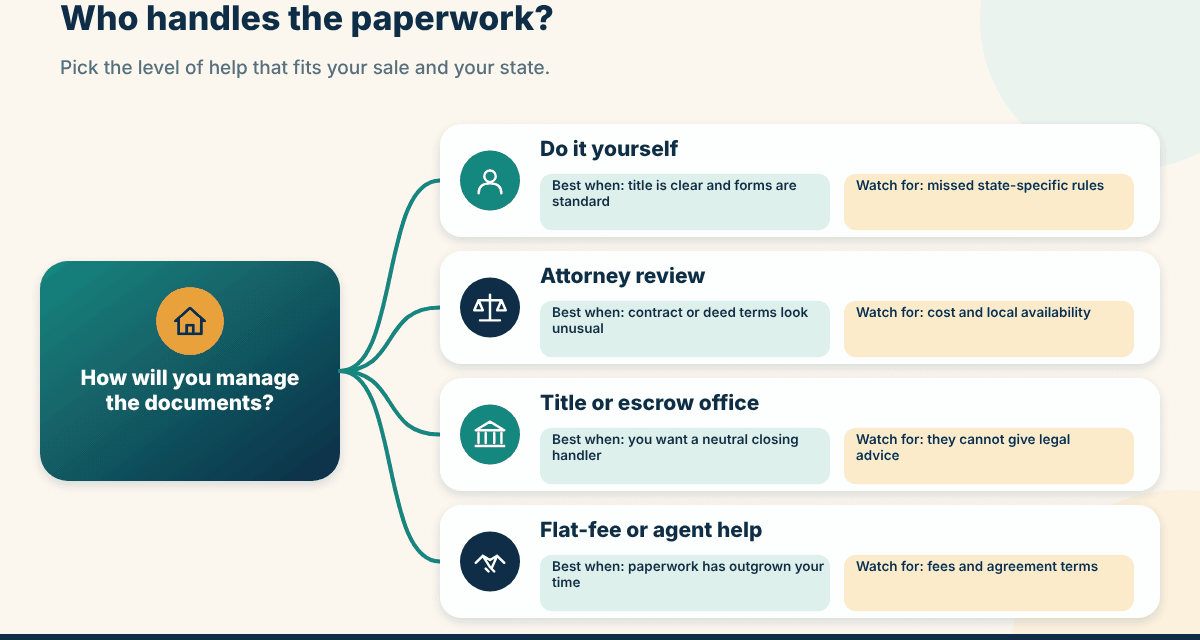
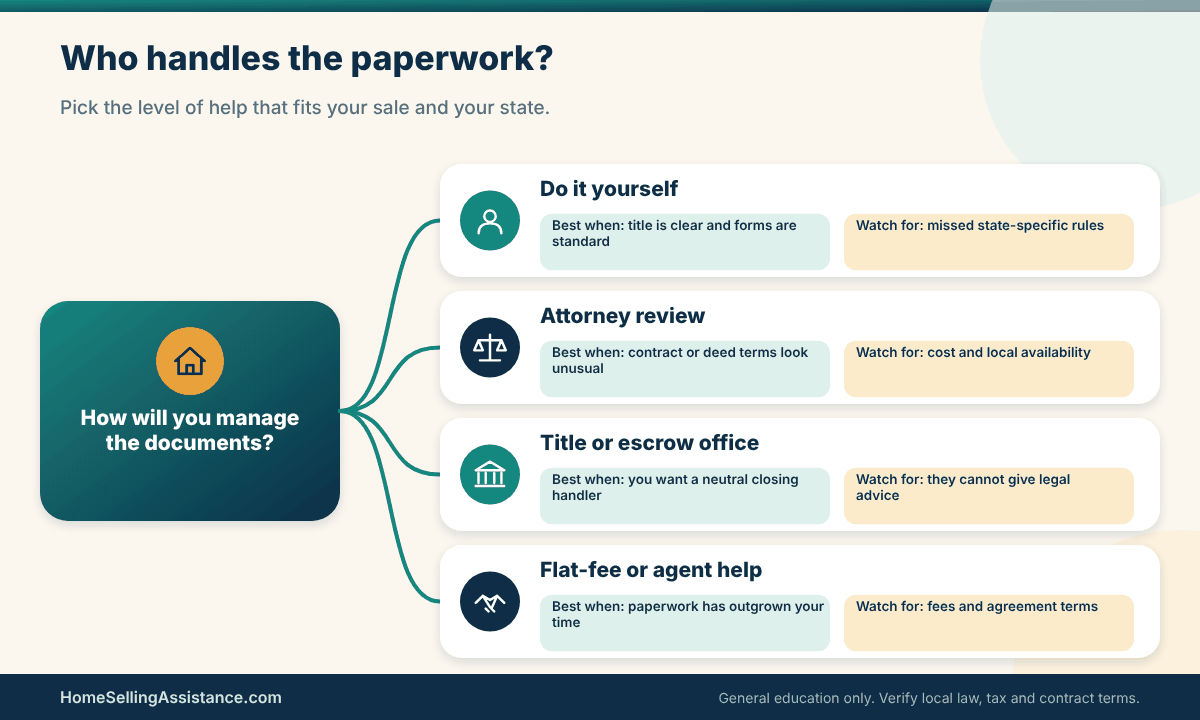
Good FSBO paperwork is what turns a handshake and a friendly buyer into a sale that actually closes, and when you sell without a listing agent, nobody else is assigned to make sure the right pages exist, say the right things and get signed in the right order.
That sounds heavier than it needs to. Most of the documents that make up FSBO paperwork are the same ones an agent-assisted sale uses: a disclosure statement, a purchase contract, a few addenda, a title commitment, closing instructions and a settlement statement. What changes is who is responsible for knowing which ones apply to your property and your state. If you skip a required form, you cannot blame the agent, because there is no agent.
This article is a map, not a legal opinion. It walks through who has to sign, which rules come from the federal government and which come from your state or county, how your FSBO paperwork moves from your desk to the buyer, the title company and sometimes an attorney, and how to verify that every page is current before a pen touches paper. If you want the bigger picture of selling without an agent first, our cornerstone guide on for sale by owner covers the whole process.
One honest caveat up front. Disclosure duties, contract forms, attorney involvement, escrow customs and recording rules vary a great deal from state to state and sometimes from county to county. Nothing here replaces your state real estate commission, a local real estate attorney or a title company. Think of it as a way to walk into those conversations knowing what to ask about your FSBO paperwork.
Key takeaways
- Start with ownership. Every name on the deed, and sometimes a spouse, trustee or personal representative, may have to sign before a buyer can rely on your FSBO paperwork.
- Federal rules are a floor. Lead-based paint disclosure for older homes and fair housing law apply nationwide, but most disclosure, contract and closing rules come from your state and local custom.
- The contract is the controlling document. Deadlines, deposits, contingencies and remedies live in the signed purchase agreement, so read it as a schedule, not as a formality.
- Hand-offs matter. The buyer, the buyer’s lender, the title or escrow company and any attorney each need specific documents from you, and delays usually start there.
- Verify, then sign. Confirm every form against an official or recorded source, and confirm that nothing in the package is out of date on the day you sign.
- Know when to bring in a professional. A flat-fee attorney review can cost far less than an unresolved FSBO paperwork mistake, though what is right for you depends on your state and your sale.
Before any form: who owns the house, where it sits, and which legal issue you are really facing
It is tempting to begin FSBO paperwork by downloading a purchase agreement template. Resist that for an hour. The first job in sorting out FSBO paperwork is to answer three plain questions: who legally owns this property, what jurisdiction’s rules apply to the sale, and is there anything unusual about the situation that changes the usual forms.
Those answers decide which documents you need, who must sign them, and whether a do-it-yourself approach is reasonable at all. A single owner with a paid-off house in a state that uses a standard published contract has a very different job from two divorcing owners, an estate, or a trust with a successor trustee.
Who owns the home, who has to sign, and which document controls the sale
Ownership is shown by the deed recorded in the county land records, not by whose name is on the utility bill or the mortgage statement. The deed also shows how title is held, for example as sole owner, as co-owners, as a married couple, or through a trust. That wording determines who has authority to sell and whose signature a buyer’s title company will insist on.
Beyond the deed, several documents can sit above or beside your purchase contract. A mortgage or deed of trust gives your lender rights that must be paid off at closing. A homeowners association may have governing documents that give it a right of first refusal or require a resale certificate. A divorce decree or probate order may limit what you can do. The signed purchase agreement controls the deal between you and the buyer, but it cannot override a defect in your authority to sell.
Evidence to gather: deed, mortgage statement, and authority papers
Pull a copy of your current vesting deed from the county recorder, clerk or register of deeds. Many counties let you search online, and the copy is usually inexpensive or free. Read how the owners are named and how title is held. Compare the spelling and middle names with your photo ID, because small mismatches create problems at closing that are tedious to repair.
Next, gather your most recent mortgage statement and a phone number for the payoff department. Add any home equity line, second mortgage, tax lien or judgment you know about. If a trust, estate, power of attorney or entity owns the home, collect the trust certificate, letters testamentary or administration, the recorded power of attorney, or the operating agreement. Title companies often want these early, and you can often save days by having them ready before a buyer appears.
Finally, find any HOA or condominium documents and note whether they mention transfer approval, resale certificates or fees. These do not replace your own FSBO paperwork, but they add pages the buyer will expect from you.
A scenario, an exception, and your next step on authority to sign
Here is an illustrative case. Two siblings inherited a house and a third sibling lives out of state. The deed was never updated, so the public record still shows the late parent. The two local siblings agree on a buyer and sign a purchase contract. The title company then explains that nobody currently has recorded authority to convey, and that an estate process may be needed first. The contract is not worthless, but closing cannot happen until authority is established.
The exception to watch for is any sale where someone other than the visible owner has a stake: a spouse in a state that protects marital interests, a co-owner who has not agreed, or an owner who lacks capacity. Your next step is simple. Before listing, call a title company or a local real estate attorney, describe how the deed reads, and ask one question: “Who must sign for this sale to close cleanly?”
Write the answer down. That sentence becomes the first line of your FSBO paperwork checklist, and it protects you from the most expensive kind of surprise, the one that appears after you have accepted an offer and stopped showing the house.
What the federal government requires and what your state or county decides
Sellers often assume there is one national rulebook for FSBO paperwork. There is not. Washington sets a small number of rules that apply everywhere, and then the states, and sometimes counties and cities, fill in nearly everything else. Knowing which layer a requirement comes from tells you where to look it up and how much room you have to negotiate.
At the federal level, two items matter for almost every residential seller. The first is lead-based paint disclosure for housing built before 1978, which involves a specific warning pamphlet, a disclosure of what you know, a lead-paint attachment to the contract, and a window for the buyer to test. The second is the Fair Housing Act, which governs how you advertise, show and negotiate. If you have questions on the first, our walkthrough on lead paint disclosure for sellers goes into detail.
For the rest of your FSBO paperwork, from the property condition disclosure form to attorney requirements, the standard contract, how earnest money is held, who prepares the deed, transfer taxes and recording steps, comes from state law, local custom or the parties’ own agreement. Our overview of seller disclosure requirements explains why that patchwork exists and how to read it.
Sources to check: EPA, HUD, your state commission, and the county
For the lead rule, go to the EPA’s page on lead-based paint real estate disclosure. It describes what sellers and landlords must provide and keep. For fair housing, the HUD Fair Housing and Equal Opportunity pages explain protected classes and what advertising and showing practices are off limits.
For state requirements, search for your state real estate commission or department of real estate and look for consumer guidance on selling without a broker. Some states publish required disclosure forms, others only describe the rules, and some leave it largely to contract. The county recorder or clerk explains recording requirements, deed formats and any local transfer fees. A city or county code office can tell you whether municipal inspections, certificates of occupancy or point-of-sale rules apply.
Keep notes on your FSBO paperwork as you go: the date you checked, the website, and the exact name of the form or rule. A page printed with a date at the top is a useful record if a question ever comes up later.
A scenario, an exception, and the next step when federal and local rules overlap
Picture an illustrative seller whose house was built in the 1960s. The state has its own property condition form, and that form asks about environmental hazards in general terms. The seller fills it in and assumes the job is done. But the federal lead rule is separate. It requires its own attachment, the pamphlet and the buyer’s opportunity to test, regardless of how the state form reads. Completing one does not satisfy the other.
The common exception is the seller who says “I know nothing about lead.” The federal rule still applies to the disclosure steps; what you report is what you actually know, including any reports you hold. The next step is to make a short list of every disclosure document that applies in layers: federal, state, local, HOA. Then confirm each one from its source rather than from a friend’s memory of their own sale years ago.
Now we can put the main pieces of FSBO paperwork side by side. The matrix below lists the issues that most often appear in a for-sale-by-owner file, what controls each one, what you are obliged or free to do, when timing matters, and where to verify. It uses general categories because the specifics vary. Use it as a prompt for your own research, and fill in the blanks with answers from your state and county.
| Issue | Controlling document or authority | Seller obligation or choice | Deadline | Where to verify locally |
|---|---|---|---|---|
| Property condition disclosure | State statute or form, or contract | Required, optional or limited, depending on state | Often before or soon after contract | State real estate commission or attorney |
| Lead-based paint (pre-1978 homes) | Federal EPA and HUD rule | Provide pamphlet, disclose known hazards, attach form | Before the buyer is bound by the contract | EPA real estate disclosure page |
| Purchase contract | Signed agreement plus any state-mandated terms | Choose form, negotiate terms, sign | Set in the contract itself | Attorney, title company or state-published forms |
| Authority to sell | Recorded deed, trust or court papers | Prove who can convey | Before closing, ideally before listing | County recorder and title company |
| Payoff and liens | Lender payoff letter, title commitment | Pay off or resolve at closing | Payoff quote is time-limited | Lender and title company |
| Deed and recording | State deed rules, county recorder | Sign a conforming deed, often notarized | At or right after closing | County recorder or clerk |
| HOA or condominium documents | Governing documents, resale certificate | Request and deliver required papers | HOA turnaround times vary | Association manager |
To use the matrix, copy it into a notebook and add a column called “confirmed” with the date and source. Any row that you cannot confirm from an official source stays flagged until a title officer, attorney or the agency itself answers. Rows with short or unusual deadlines deserve attention first, since a missed deadline is the paperwork problem hardest to undo.

The diagram above shows how FSBO paperwork typically moves through a sale, in order, from authority and disclosures before listing, through contract and deposit, to title work and closing. Notice that the first third of the process happens before a buyer exists. That is deliberate. Sellers who do the preparation up front rarely feel rushed once an offer arrives, and buyers notice when a seller can answer FSBO paperwork questions the same day they are asked.
If you are choosing between selling alone and hiring help, a comparison such as FSBO vs realtor can help you decide how much of this you want to carry yourself. Neither choice is wrong; FSBO paperwork exists in both, and the question is only who is accountable for it.
Turning the rules into a seller workflow you can actually follow
Knowing the rules is half the work of FSBO paperwork. The other half is turning them into a sequence you can run week by week, so that nothing waits on a signature you forgot to request. A workable FSBO paperwork routine has three stages: documents you prepare before listing, documents you exchange during negotiation, and documents you complete between contract and closing.
Stage one is quiet and unglamorous. Stage two is where most sellers feel pressure. Stage three is where most delays hide, because several outside parties are now involved and each one has its own turnaround time. If you plan all three stages on paper, you will spot conflicts early, such as a buyer deadline that falls before a payoff letter can reasonably arrive.
The disclosure, notice and approval steps in the order they usually happen
Begin your FSBO paperwork with disclosure. In states that require a seller property condition statement, you will complete it from your own knowledge of the house: roof, plumbing, electrical, drainage, past water intrusion, pests, additions and anything you have repaired. In states that follow a more buyer-beware tradition, you may have fewer written duties, though there is often still a duty not to hide known serious problems. Either way, answer the questions you are given honestly, and do not guess.
Then come notices and approvals that attach to the property rather than to you personally. An HOA may need to supply a resale package. A city may require an inspection or certificate. A lender may need to approve a sale price if the mortgage is underwater, which is a separate situation from an ordinary sale. Each of those can take days or weeks, so request them as early as the rules allow.
If your sale has a federal lead component, that pamphlet and attachment go in the package before the buyer commits. A related read, material defects and seller disclosure, explains how to think about problems that a reasonable buyer would want to know about.
Documents to prepare: disclosure form, lead attachment, and supporting records
Prepare a single folder for your FSBO paperwork, paper or digital, with the completed disclosure form, the lead pamphlet and signed attachment if they apply, and every record that backs up an answer you gave. Receipts for the roof, a contractor invoice for the water heater, a permit and final inspection for the finished basement, warranty cards, past inspection reports and any insurance claim paperwork all belong there.
Supporting records in your FSBO paperwork do two jobs. They save the buyer time, and they protect you, because they show what you knew and when. If a buyer later says nobody mentioned the old leak, a dated repair invoice and a clear disclosure line are far better than a conflicting memory. Add the date you delivered each document and how you delivered it, whether by email with read confirmation, by hand with a signed acknowledgment, or through the title company.
Last, check whether your state asks you to update the disclosure if something changes before closing. If a storm damages the roof after you signed, the update question matters.
A scenario, an exception, and the next step when a disclosure answer is unclear
Consider an illustrative seller who bought a house eight years ago and was told the finished basement “was done by the previous owner.” The disclosure asks whether work was done with permits. The seller honestly does not know. Writing “no problems” would be a guess, and so would “unpermitted.” Many forms offer an option such as “unknown” or “no knowledge,” and using it truthfully is usually better than inventing a certainty.
The exception is when you can cheaply find out. Calling the building department to ask whether permits exist for the address often takes one phone call or one online search. For a deeper look at the related issue, see selling a house with unpermitted work.
The next step is to treat every uncertain answer as a small research task with a deadline. Look up what you can, document what you cannot, and, if the answer could affect the buyer’s decision or your legal exposure, ask a local attorney how your state expects you to phrase it before the form goes out. That small habit is the center of careful FSBO paperwork.
Remember also that fair housing law shapes your FSBO paperwork indirectly. Your advertising, your showing rules and your handling of competing offers must not favor or exclude people based on protected characteristics. The overview on fair housing for home sellers and the HUD pages linked earlier are the right places to check before you write a listing description or set showing rules.
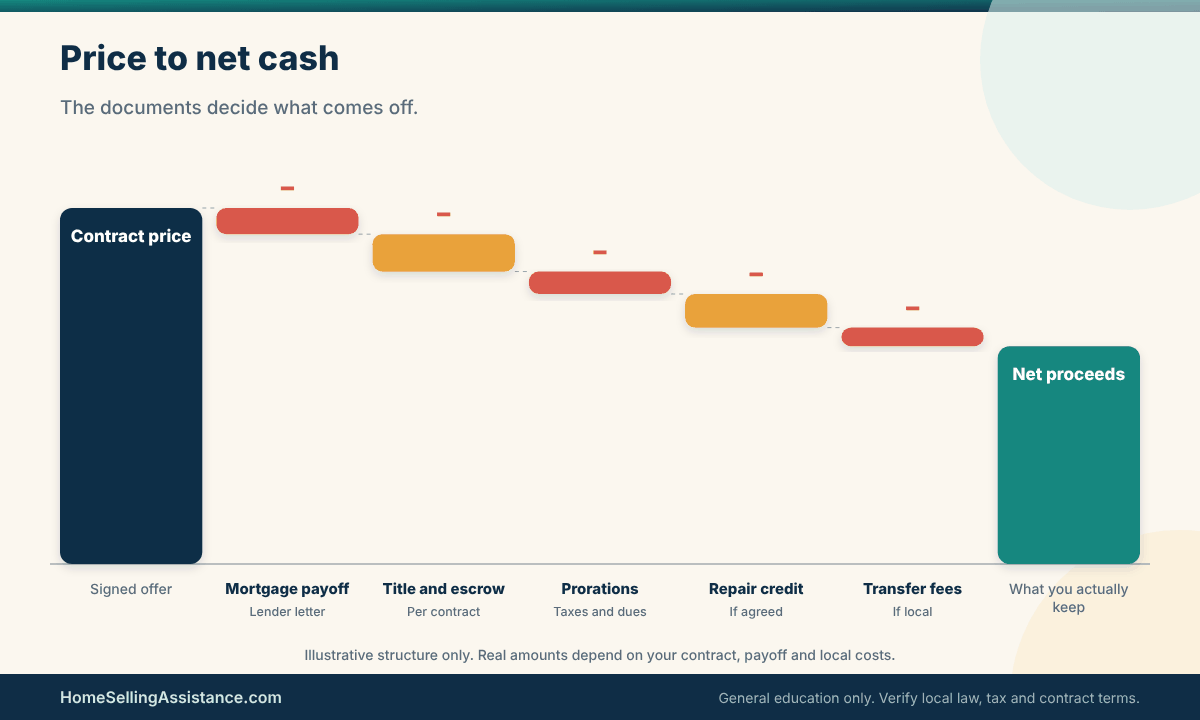
The picture above lays out how a sale price becomes net proceeds once you subtract the pieces that FSBO paperwork reveals: payoff, title and escrow charges, prorations, credits and any other costs the contract assigns to you. The figures vary for every sale, which is exactly why the documents matter. A contract that says who pays what, and when, is the thing that determines your final number, so read those clauses with a calculator beside you rather than leaving them for the closing table.
A short worked example helps. Suppose, purely as an illustration with round numbers, a contract price of 400,000 dollars and a mortgage payoff of 150,000 dollars. If title and escrow charges, prorations and a repair credit together came to 12,000 dollars, the seller’s cash before taxes would be 238,000 dollars. None of those figures is a prediction. They only show why each clause in the contract and each line on the settlement statement deserves a careful read. The explanation of the seller closing statement shows how to read those lines once they arrive.
The hand-off from your desk to the buyer, the title company, the HOA and any attorney
Once you have a buyer, your FSBO paperwork stops being a private project. Documents begin to travel. Your offer file goes to the buyer, who may have an agent, a lender, or both. The signed contract and the deposit go to a title or escrow company or, in some states, to an attorney’s office. Requests flow back to you, and each one has a clock on it.
Most disputes over FSBO paperwork trace back to unclear hand-offs: a document sent but never confirmed, a deposit sent to the wrong place, a deadline counted from the wrong day. The fix is dull but effective. Decide in advance who sends what to whom, in what form, and how you will prove it arrived.
The first hand-off is the offer itself. Whether you use a state-published form, a form an attorney prepared, or a template, the purchase contract should name the parties exactly as the deed does, describe the property by its legal description or address as the form requires, state the price and financing terms, set the deposit and who holds it, and list every contingency with its own date. Our guide to the real estate sales contract walks through the clauses sellers most often misread.
Evidence to gather: contract dates, deposit receipt, and title commitment
Create a one-page FSBO paperwork timeline the day the contract is fully signed. List the acceptance date, the deposit due date, the inspection period end, the financing and appraisal dates, the title objection period if any, the closing date and the possession date. Count each period exactly the way the contract defines it, including whether weekends and holidays count and what time of day a deadline expires.
Confirm the deposit. The buyer’s earnest money should go to the holder named in the contract, typically a title company, escrow office or attorney trust account, and you should receive written confirmation. If you want to understand how deposits work and when a seller may or may not claim one, read about earnest money from the seller’s side.
Then request the title commitment or preliminary report as soon as the title company opens the file. It lists who the record owner is, what liens and easements appear, and what must be cleared before closing. Compare it line by line with your own folder. A surprise there is easier to fix in week one than in the final week.
A scenario, an exception, and the next step when the buyer has an agent
Imagine an illustrative situation. You are selling on your own, and a buyer arrives with an agent. The agent sends you a form that mentions a buyer-broker compensation line. You never discussed that. Broker compensation is negotiable and must be written down in a clear agreement; nothing about it is automatic. Before you sign anything with that line in it, read what it says, decide whether you are willing to offer compensation to the buyer’s agent at all, and consider asking a local attorney how your state treats it.
The exception is a buyer who is unrepresented. Then the burden of explaining the forms falls on you in a different way, because you cannot give legal advice to the other side, and you should say so plainly and suggest they consult their own attorney. The next step either way is to put every promise in writing. For the full picture of how that conversation tends to go, see what to do when an FSBO buyer has an agent.
The second table moves FSBO paperwork from rules to situations. Use it when the file stops being routine, because the buyer wants something unusual, a document is missing, or the closing date is slipping. Each row names a common situation, the realistic choices you have, the risk attached, which document to open first and who to call when it is bigger than you can solve yourself.
| Situation | Seller options | Main risk | Document to review | Escalate to |
|---|---|---|---|---|
| Buyer asks for a repair credit after inspection | Agree, counter, or decline within the contract window | Missing the response date | Inspection clause and addendum | Attorney if terms are unclear |
| Title shows an unknown lien | Pay it off, dispute it, or delay closing | Closing cannot proceed | Title commitment | Title officer or attorney |
| Co-owner will not sign | Negotiate, buy out, or seek a legal remedy | No valid sale | Deed and any co-ownership agreement | Real estate attorney |
| Buyer wants a longer closing or early move-in | Accept with written terms, or refuse | Insurance and possession gaps | Possession addendum | Attorney and insurer |
| Pre-1978 home, no lead attachment signed | Complete the federal steps before binding | Rule violation | Lead pamphlet and attachment | EPA guidance, attorney |
| Buyer misses a deadline or deposit | Send written notice per the contract | Waiving rights by accident | Default and remedies clause | Attorney before declaring default |
| Wire instructions change by email | Stop, call a known number, verify | Funds sent to a fraudster | Escrow instructions on file | Title company, then law enforcement |
Read the table from left to right as a conversation. Name the situation, pick an option on purpose, understand the risk before you act, open the document that governs, and decide up front who you will call. If a row sends you to an attorney, do it before you reply to the other side, because an informal email can sometimes change what a formal contract says.

The checklist graphic above gathers the FSBO paperwork you will want in hand as the sale moves toward closing, grouped by ownership, money and property condition. Treat it as a living page. Tick items off, add the date, and keep copies somewhere you can find them at midnight when a title officer asks for one more page.
Three paperwork items deserve their own plan. Three items cause more last-minute stress than any others. The first is the possession and move-out arrangement. If you will rent back, or the buyer will move in early, the written terms should cover rent or occupancy charges, insurance, utilities, condition on handover and what happens if either side slips.
The second is the payoff letter. Your lender provides a figure good through a specific date, with a daily amount after that. Ask the title company to order it for you, and confirm that every lien, including any home equity line, is covered. A line of credit that stays open after payoff can leave a lien on record even after the sale.
The third is wire verification. Fraud aimed at home sales is common enough that the FBI’s Internet Crime Complaint Center publishes warnings about it. Any message that changes where money should go, or that arrives right before closing with new instructions, must be confirmed by phone using a number you already trusted. For more, read about real estate wire fraud for sellers.
After closing, finish the file. After closing, the deed is recorded, the lender is paid, and your proceeds arrive by wire or check on a timeline set by the closing office and local rules. Ask the title company to email you the final signed settlement statement, the recorded deed once available, and the payoff confirmation.
Keep your copies, along with the disclosure forms you gave, receipts for improvements and your purchase records, for as long as your tax adviser suggests. Basis and home-sale tax questions can come up years later, and IRS Publication 523 explains what records matter for selling your home. If you want a look at the logistics around that final day, our piece on the FSBO closing process covers it step by step.
A verification checklist for your FSBO paperwork, built from real sources
Everything so far leads to one habit for FSBO paperwork: verify before you rely. A form you found online may be outdated. A friend’s advice may reflect another state. A template may have been written for a market with different customs. The only dependable way to protect yourself is to tie each document to an official source or a recorded public record, and to date your check.
This section turns that habit into a checklist you can actually use. It has two parts. First, which sources count as official or recorded, and how to read them. Second, which items must be current on the day you sign, because FSBO paperwork that was right in March can be wrong by June. If you want a wider look at the order of operations for the whole sale, the cornerstone guide to selling a home without a listing agent pairs well with this page.
Official sources and recorded documents that prove what your FSBO paperwork says
Start by sorting your sources into three tiers. Tier one is the primary record: the recorded deed, the lender’s payoff letter, the title commitment, the HOA’s own governing documents and the statute or agency page itself. Tier two is professional interpretation: the title officer, the attorney, the state commission’s consumer staff. Tier three is everything else, including articles like this one, forums and templates. Use tier three to learn questions, never to settle answers.
When tiers disagree, higher tiers win. If a template says a notary is optional and the county recorder says a deed needs one, the recorder wins. If a blog says your state has no disclosure form and your state commission publishes one, use the form. That ordering keeps you out of most trouble without costing anything.
For a plain-language view of consumer protections around the mortgage payoff and closing side of a sale, the Consumer Financial Protection Bureau publishes educational material, and the FTC consumer site covers scams. Neither will tell you what your state form says, but both help you recognize problems that are not about forms at all.
Evidence to gather: a dated source log for every document in the file
Build a simple FSBO paperwork source log, one line per document. Write the document name, where the form or rule came from, the date you checked it, and what you confirmed. For example: “Property condition disclosure, state commission website, checked on the day I downloaded it, form revision date shown at bottom of page.” Do the same for the purchase contract, the lead attachment, any addenda, the deed form and the closing instructions.
Include a second column for who reviewed it: you, a title officer, or an attorney. Over time you will see which documents carry the most risk. Contract and deed forms usually deserve a professional look. A simple receipt folder usually does not.
Also log your communications. Keep emails and written notes with the buyer, the buyer’s agent if any, the title company and the lender. If a deadline is ever disputed, a clean record of what was sent and when is far more persuasive than a recollection.
One more habit helps. Save a copy of each blank form version you used, in addition to the signed copy. Forms get revised, and being able to show which edition you used can settle questions that would otherwise become arguments.
A scenario, an exception, and your next step when a source conflicts with your template
Say a seller downloads a purchase agreement template from a general-purpose website and a state-published form from the real estate commission. The two contain different inspection periods, and the template lacks a clause the state form requires. Which one controls? Whichever one the parties sign, but a signed form that omits a legally required term may create trouble that neither party intended.
The exception is a state that does not publish any form at all. In that case, an attorney-drafted agreement or a standard form used by local title companies is the common route. The next step is a short call to the title company you plan to use, asking: “What purchase agreement forms do you normally see for sales by owner here, and do you have any you would suggest?” Title offices see many deals and often know what works locally, even though they cannot give legal advice.
A flat-fee attorney review of the contract and deed is an option some sellers choose, and some states effectively require attorney involvement at closing. It is a reasonable place to spend a modest amount, especially if the buyer proposes unusual terms. Knowing how pricing decisions interact with your contract also helps; our article on how to price an FSBO home explains why the price you accept depends on terms as much as on the headline number.
What has to be current on the day you sign your FSBO paperwork
FSBO paperwork has a shelf life. The most careful seller still gets caught when a figure or a form that was accurate last month is stale this week. Before signing anything binding, whether the purchase contract, a counteroffer, an addendum or the closing documents, pause and ask what could have changed since you last looked.
Some items go stale quickly: payoff amounts include daily interest, so the figure has an expiry date. A buyer’s loan approval may depend on terms that shift. A title commitment is a snapshot, and new liens or judgments can appear before closing. Insurance, utilities and property tax proration figures may depend on bills that have not yet issued.
Other items go stale more slowly but matter just as much. A disclosure form can be outdated if you learn something new about the house. A form version can be superseded. Local requirements, such as point-of-sale inspections or certificates, can be added or changed by a city or county. And, as the broker compensation landscape has changed in recent years, any template that mentions compensation should reflect current practice, with every term in writing and clearly negotiable.
Evidence to gather: a signing-day currency check, item by item
On the morning of signing, run through a short series of questions. Is the contract form the current version from its official source? Do the names match the deed and the IDs? Is the property description correct? Does every date work with a real calendar, and does the closing date allow time for the payoff letter, the title work and the buyer’s loan? Are all addenda attached and referenced by name in the main agreement?
Then check the money side of your FSBO paperwork. Does the payoff figure match what the lender told you in writing within the last few days? Do the deposit amount and holder match the contract? Do any credits or repairs agreed in negotiation appear on the signed pages, not only in emails? A negotiated item that never made it into the contract is not guaranteed.
Finally, check the people. Confirm who will sign, whether anyone is signing under a power of attorney, and whether a notary or witness is required. If an agent represents the buyer, confirm in writing whether any compensation is being requested of you, and whether you agreed to it.
A scenario, an exception, and the next step when something changes before closing
An illustrative example: a week before closing, the buyer’s lender asks for a revised payoff letter because closing was moved by a few days. At the same time, the buyer’s inspection reveals nothing new, but a neighbor mentions that the fence line may be off by a few feet. You now have a payoff update, a possible boundary question and a disclosure to reconsider.
The exception to a quiet closing is any new fact that a buyer would reasonably care about. Your state may expect you to update disclosures, and silence can later be read as concealment. The next step is to tell the title company, ask whether a survey is available or advisable, and ask your attorney or the title officer whether the contract or the disclosure needs an update in writing. Do not fix it informally by phone.
If a buyer fails to meet a deadline, or if the buyer asks for more time, the answer should go into a written amendment signed by both sides, and not only into a friendly conversation. When your own plans shift in a way that makes the do-it-yourself route harder, consider reading about when to hire an agent after FSBO, or about the middle path in flat-fee MLS listings. Both are legitimate responses to an FSBO paperwork load that has grown beyond what you expected.
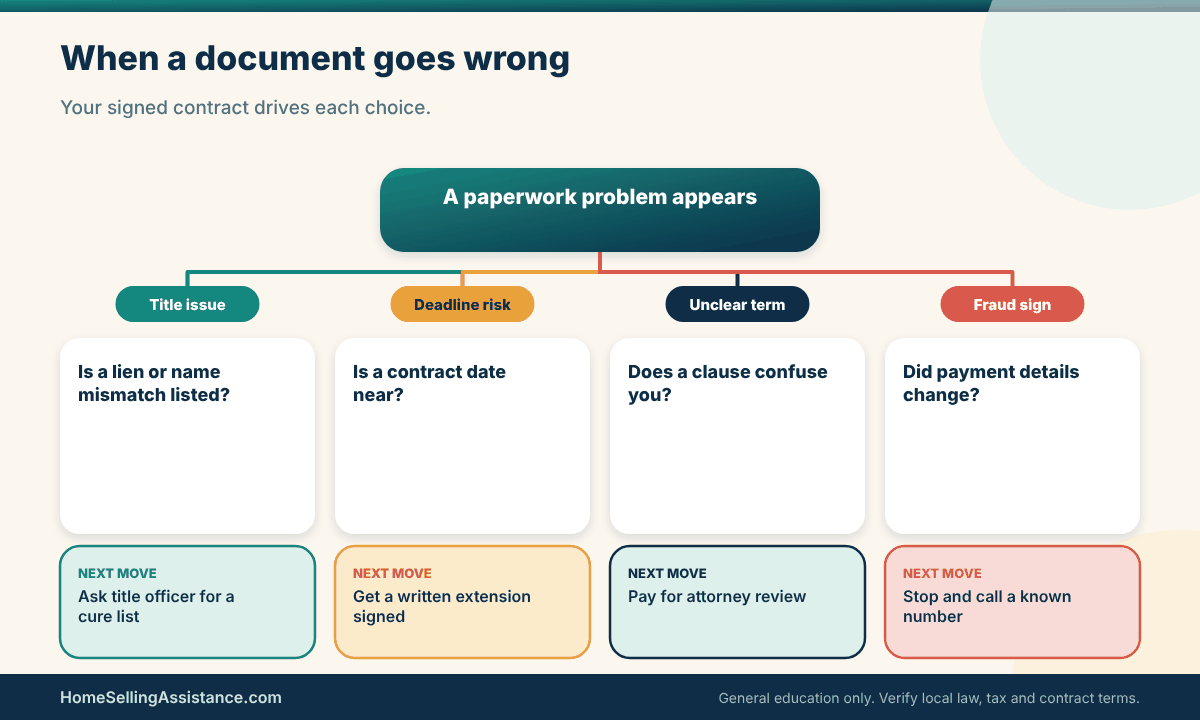
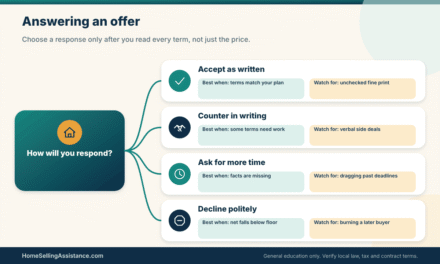
The decision tree above shows how to think about fallback options when FSBO paperwork goes wrong: is the issue inside a contingency window, has a deadline passed, is a backup offer in hand, or do you need more time through a written extension. The branches differ because the contract language differs, which is why the signed agreement, and not memory, should drive each choice. If a negotiation is also on the table, our companion article on how to negotiate an FSBO offer covers the offer side.
Last, a reminder that browsing category pages for more FSBO paperwork reading can help you find related reading. The disclosures and seller paperwork category groups our disclosure-focused guides, and the FSBO and flat-fee MLS category gathers the rest of this cluster. If your title search turns up questions, the guide to a title search for a home sale is a good next stop.
Quick scenario
Dana and Luis are selling a 1970s house they own together, and a buyer is paying with a mortgage. They gather their deed, payoff contact and repair receipts, complete the state disclosure and the lead attachment, and ask a title company which contract form is common locally. When the buyer asks for a repair credit, they check the inspection clause, answer inside the window and put the agreed amount in a signed addendum. No sale is certain to go smoothly, but each step leaves a paper trail they can point to.
Frequently asked questions about FSBO paperwork
What documents does a for-sale-by-owner seller usually need?
Most FSBO paperwork packages include a disclosure statement where your state requires one, a federal lead-based paint package for homes built before 1978, a purchase contract with addenda, a deed, payoff information, title and escrow instructions and a settlement statement. Your state may add transfer tax forms, tax certificates or local inspection certificates. The exact list depends on where the home is, so check your state real estate commission and your title company before you list.
Do I need an attorney to handle FSBO paperwork?
It depends on your state and on how complicated the sale is. Some states commonly involve attorneys in every closing, while others rarely do. Even where it is not required, many sellers pay for a limited review of the contract and deed because those two documents carry the most legal weight. A local attorney or the title company can tell you what is customary where you live.
Is a seller disclosure form required when I sell on my own?
Requirements vary widely. Some states mandate a written property condition disclosure, some provide a form but allow certain sellers to opt out, and some expect little in writing while still prohibiting concealment of known serious defects. Selling without an agent does not exempt you. Look up your state rules on the commission website, and ask an attorney if you are unsure how to answer a question on the form.
Where can I find a legitimate purchase contract for an FSBO sale?
Common sources include forms published by a state real estate commission or bar association where they exist, forms an attorney prepares for you, and forms your title company regularly sees. A generic online template may miss state-required language or local custom. Whichever you pick, compare it against official guidance and have a professional review it if you are not confident in the terms.
What federal rules apply to every FSBO paperwork package?
The two most common are the lead-based paint disclosure requirements for housing built before 1978, described on the EPA’s website, and the Fair Housing Act, explained by HUD. Federal rules also shape lender and settlement practices that affect your buyer. Most other requirements, including disclosure forms and contract terms, come from state law or custom, so do not assume there is a single national checklist.
Who holds the buyer’s deposit, and what is my role?
The contract names the holder, usually a title company, escrow office or attorney trust account, rather than the seller. Holding it yourself is generally unwise because disputes about who is entitled to it become harder to manage. Ask for written confirmation when the deposit arrives, and read the contract carefully before agreeing to release it or claim it.
What should I do if the title company finds a problem?
Ask for a written explanation of the problem and what is needed to clear it. Common examples are an old mortgage never released, a judgment, an unpaid tax bill or a name mismatch on the deed. Some can be resolved with a payoff letter or a corrected document, while others need an attorney. Tell the buyer promptly and put any change to the closing date in a signed amendment.
How can I tell whether an email or wire instruction is fake?
With FSBO paperwork, treat any change in payment or wiring instructions as suspicious until you verify it by phone using a number you already trusted, not one in the message. Be cautious of urgency, small differences in an email address and requests to keep things quiet. If you suspect fraud, contact your title company and report it through the FBI’s IC3 and the FTC. Speed matters when funds may be recovered.
How long should I keep my sale documents?
Keep the signed FSBO paperwork, including the contract, disclosures, settlement statement, deed copy and records of improvements and purchase costs for as long as your tax professional recommends, which is often several years after the sale. The IRS explains home-sale records in Publication 523. Store them in more than one place, and keep a copy of the blank forms you used in case a question about the version ever arises.
When should I stop doing the paperwork myself?
Consider help with FSBO paperwork when the title is unclear, a co-owner or estate is involved, the buyer proposes unusual terms, a dispute arises over deadlines or a deposit, or you feel you are guessing more than you are checking. Options range from a flat-fee attorney review to a flat-fee MLS service to a full-service agent. Choosing help is not a failure; it is a way to manage risk in your FSBO paperwork.
Paper first, then the sale
Careful FSBO paperwork is mostly patience: confirm who owns the home, learn which rules come from Washington and which from your state, hand each document to the right party, and check every page against a source you can name. Do that, and most of the scary moments become scheduled tasks. This article is general education, not legal, tax or financial advice, so use it to ask better questions of your state commission, title company and attorney, and then let their answers, not ours, decide what you sign.