Selling vacant house property sounds like the easy version of a home sale, because nobody is living there, nobody has to tidy up before showings, and the buyer can walk through at any hour, yet an empty house is also the property that most often goes wrong quietly while you are busy somewhere else.
A furnished, lived-in home sends small signals all day. Lights change, mail disappears, a car sits in the driveway, a neighbor waves. An empty one sends none of that. A slow leak can run for weeks, a lock can be copied, a thief can note which appliances are still inside, and a stranger with a convincing story can pretend to be you. None of this is meant to frighten you. It is simply the reason a vacant listing needs a slightly different plan. That gap in signals is the first thing to understand about selling vacant house property.
This guide covers the practical side of selling vacant house property: what your insurance may and may not cover once the house sits empty, which utilities to keep running, how to secure and maintain the place, how to handle showings without handing out keys carelessly, and how to spot the fraud patterns that target empty homes and the people who own them. It stays at the education level, because rules differ by state, by insurer and by contract.
If you are selling a condo, a tenant-vacated rental or an inherited home, parts of this will overlap with those guides, and we link to them where they help. You do not need a security consultant. You need a short list of habits, a few phone numbers written down in advance, and a clear sense of which questions to answer and which to refuse. We keep the tone practical, because the goal is a calm, documented sale rather than a perfect one. A realistic plan for selling vacant house property is built from habits, and habits are cheap.
Key takeaways
- Vacancy changes your insurance conversation. Many standard homeowners policies restrict or exclude certain losses once a home sits unoccupied past a period set in the policy, so ask your insurer in writing before the house empties.
- Keep the utilities and a routine of visits. Power, water and heat protect the house itself and make showings, inspections and appraisals possible, while a visit schedule catches small problems early.
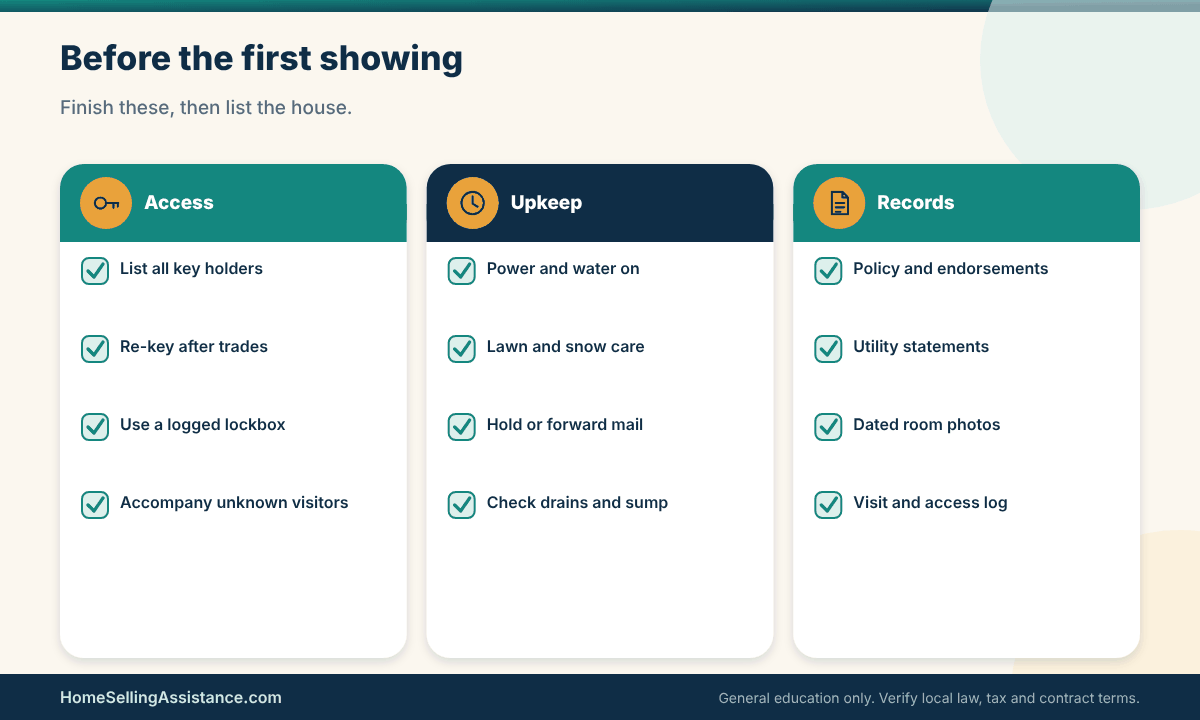
- Control who can enter. Use a logged lockbox or accompanied showings, change or re-key locks after trades and cleanouts, and never leave a key under a mat or in a fake rock.
- Empty homes attract impostors. Fake buyers, fake sellers, deed fraud and rushed wire instructions all target properties whose owners are far away, so verify every request through a contact you already trust.
- Share less than people ask for. Buyers, brokers and strangers do not need your alarm codes, your personal bank details or your travel schedule.
- Write everything down. Dated photos, utility statements, visit logs and call notes protect you if a claim, dispute or fraud report ever follows.
Before the detail, a note on scope. Throughout this article, “vacant” means that no one is living in the home and it holds little or no furniture. A staged house with a stylist’s furniture, a home with a tenant still in place, or a seasonal property with a caretaker each raise their own questions. Where those differ, we say so and point you to the matching guide, such as selling a tenant-occupied house. Everything below about selling vacant house property assumes that definition.
Why selling vacant house listings carry risks that occupied homes do not
The first job is to look honestly at what can go wrong. People tend to picture burglary and little else, and burglary is only one entry on a longer list. An empty house can suffer water damage nobody notices, pest activity, mold from stale humid air, a roof leak that stains a ceiling for a month, tampering with locks or utilities, dumping on the lot, and paperwork-level attacks in which someone claims an ownership or sale authority they do not have. Selling vacant house listings well starts with that honest inventory.
Some of these are physical, some are financial, and some are about identity. We separate them below so you can match each to a control later in the article. Think of this section as the “what are we protecting, and from what” step. It is easier to choose a lock, a policy rider or a verification habit when you know the exact bad outcome it is meant to prevent. Each control you add while selling vacant house property should answer one named risk.
What the bad outcome looks like when no one is home
Bad outcomes in a vacant sale usually arrive in one of three forms. The first is physical damage that grows because nobody sees it start. The second is loss of coverage, where a claim you assumed was routine meets a policy clause you never read. The third is a transaction problem, where a dishonest person inserts themselves between you and the buyer, the title company or your own money. These three forms show up again and again when selling vacant house property.
Physical damage is the most common and the least dramatic. A supply line under a sink weeps for three weeks. A water heater fails and the floor swells. A toilet seal lets go and the ceiling below stains. In an occupied home someone hears the drip or sees the puddle within a day, but a vacant house can sit wet for as long as your visit schedule allows, and the repair bill grows with every dry week that passes. It is the quiet cost that surprises people selling vacant house property most.
Cold weather adds a sharper version. If heat is shut off or set very low and the weather turns hard, water in supply lines can freeze, expand and split a pipe, and the damage often shows only after a thaw. Whether a given insurer pays for that loss can depend on what the policy says about vacancy, about maintaining heat, and about draining the system. We come back to the insurance wording shortly, because it is the hinge for several of these outcomes.
Security problems come next. An empty house with no cars, no lights and no routine can attract copper theft, fixture theft, vandalism or someone who simply wants a place to stay. A home that looks neglected from the street invites more of the same. Neighbors can help, but they are not security guards, and you should never ask them to take risks on your behalf. Plan for this early when selling vacant house property in a quiet neighborhood.
The third form, the transaction-level bad outcome, is the one that deserves the most care because it can cost the most. Fraudsters know that vacant properties are often owned by people who live elsewhere, who answer email slowly and who may be handling an estate, a relocation or a divorce at the same moment. Impersonation, forged listings and altered wire instructions all work better when the owner is hard to reach.
Liability can arise too. If a visitor is injured in an empty house, for example by a loose stair rail or a dark basement during a showing, questions about who was responsible and whether coverage applies may follow. Nobody can promise how such a claim would turn out, since it depends on state law, the facts and the policy. What you can do is reduce the chance of the claim and keep a record that shows you took reasonable care. Part of selling vacant house property sensibly is keeping that record.
Evidence to gather: how an empty house shows trouble early
Trouble rarely appears without leaving some evidence, and the evidence is easy to collect if you know where to look. Start with the utility accounts. A water bill that jumps in a house where nobody is showering suggests a leak or a running fixture. An electric bill that climbs unexpectedly can point to a failing appliance or unauthorized use. Many utilities now offer online usage graphs, and a quick weekly look takes two minutes. This habit is the cheapest protection available when selling vacant house property.
Next comes the walk-through. On each visit, look at ceilings for stains, check under sinks, smell the air near the basement stairs, and touch the walls near exterior doors for damp. Look for signs of entry: a window latch that was locked and is now open, scuff marks near a lockbox, or a back door that sticks differently than before. Take dated photos of each room, even when nothing looks wrong, because a baseline makes later comparison honest. A baseline is worth more than any single visit when selling vacant house property.
Third, keep your own paper trail of who has had access. A simple notebook or phone note listing each visitor, date, purpose and whether they were accompanied is enough. Add receipts for any trade work, and ask workers to confirm in writing when they locked up. If a loss does occur, an insurer, a buyer or a court may later ask what condition the house was in and who was inside, and a log answers both questions without guessing.
Finally, check your insurance documents now rather than after a loss. Find the declarations page, locate any section on vacancy or unoccupancy, and note the number of days and the types of losses it mentions. If the wording is unclear, ask the agent or carrier to explain it by email so you have the answer on record. Policy definitions differ, so a friend’s experience with a different insurer tells you very little about yours.
A scenario, an exception, and your next step
Here is an illustrative case, with invented details. A seller moves two states away for work and lists the old house empty. She turns the thermostat low to save money and plans to check in monthly. In a cold stretch a basement line splits, and the leak runs until the next visit. The insurer asks how long the house was unoccupied and whether heat was maintained, and the claim becomes a discussion about policy terms rather than a quick payment. The lesson for selling vacant house property is to ask before the problem, not after.
The exception is worth knowing too. Some policies treat a home that is actively listed and furnished differently from one that is bare, and some carriers will add a vacancy endorsement or write a separate vacant dwelling policy for an extra premium. A few sellers keep the house lightly furnished, partly for staging and partly to preserve an “occupied” status, though whether that satisfies a given policy is a question for the insurer, not for guesswork.
Your next step in a case like this is concrete. Call the insurance agent before the move, describe exactly what is happening, and ask three questions in writing: when does the policy treat the home as vacant, what is limited or excluded after that point, and what endorsement or alternative policy is available. Then decide with the answers in hand. If the cost of added coverage looks high, compare it with the cost of a single uncovered water loss.
If you are also weighing whether to keep the home at all, our guide on selling a house because of insurance costs looks at the other side of that decision. For now, the lesson is simple: the bad outcome you most want to avoid is not a dramatic one, but a slow, dull and expensive one, and the evidence that prevents it costs almost nothing to gather.
What an empty house quietly exposes
Beyond the building itself, a vacant listing exposes information and property that sellers do not always think of as exposed. The house holds your address history, perhaps old mail, appliance manuals, handwritten notes, and sometimes the remains of financial paper in a drawer. Meanwhile the listing exposes the house to a very wide audience, with photos, a floor plan and sometimes a lockbox code shared across many people. Selling vacant house property therefore means protecting information as well as walls.
Public records add another layer. Ownership, mortgage recordings and tax information often sit in county records that anyone can search, so a determined impostor can learn quite a lot about you without ever contacting you. That does not mean public records are the enemy, since they are also how title companies protect buyers. It means you should assume an outsider can know your name, your lender and your parcel number, and plan your verification habits accordingly. Plan your verification habits around that fact while selling vacant house property.
Physical property inside is the more obvious exposure. Built-in fixtures, light fittings, appliances you are including in the sale, and any items you meant to remove can all be taken, damaged or claimed. Disputes over what stays and what goes are among the most common irritations between sellers and buyers, and an empty house with no inventory makes those disputes harder to resolve. A short inventory helps a lot when selling vacant house property.
Information exposure also includes your schedule. A seller who posts about a long trip, tells every caller that the house is empty all week, or lets a sign advertise “vacant, owner out of town” is handing out useful facts. Even a well-meaning agent or contractor can pass details along. The safest posture is to say what a buyer needs to know, which is the condition of the home and the closing timeline, and to keep your own movements private. Keep your schedule private while selling vacant house property.
There is also a quieter category: utility and account data. Utility accounts, alarm accounts and smart-home apps often hold your name, phone number and payment method. If you hand an alarm code or app login to many people and never change it, you have given each of them a standing key to something that is tied to you. We return to that when we cover what never to share, because it is a habit sellers rarely think about until something happens.
Where the exposure is documented
It helps to know where each piece of exposure actually lives, so you can check it yourself. For ownership and lien information, the place to look is your county recorder or county clerk, whose website often lets you search by name or parcel. Look up your own property occasionally. You are checking that the recorded owner and recorded mortgages match what you expect, and that nothing unfamiliar, such as a deed or lien you never signed, has appeared.
For listing exposure, review the listing yourself the way a stranger would. Read the remarks, look at every photo, and check whether any image shows house numbers, mail, a security panel, a safe, a visible code on a keypad, or personal photos on the walls. Ask your listing agent or the platform to remove anything you would not want a stranger to study. If you are marketing the property yourself, our guide on showing safety for owners who sell without an agent adds practical habits. These checks take ten minutes and suit anyone selling vacant house property.
For contract exposure, read what you actually sign. A purchase contract, a listing agreement and a lockbox or access agreement may say who is permitted to enter, with what notice, and who bears responsibility for damage during access. If a clause is unclear, a local real estate attorney can explain it for a modest fee. The goal is to know in advance whether your contract lets a buyer’s inspector or appraiser re-enter the house, and on what terms. Read access language carefully when selling vacant house property.
For consumer-protection guidance on impersonation scams, the Federal Trade Commission’s consumer site publishes plain explanations of how fake-identity and payment scams work, and it is a sensible place to refresh your instincts before a closing. Nothing there is specific to your house, but it teaches the pattern, and the pattern matters more than any single script.
A walk-through scenario and what to do next
Picture another invented example. A seller inherits a house from a relative, clears it out and lists it empty. Three weeks later a neighbor mentions that someone has been seen in the yard. The seller drives over, finds the back door unlocked, and notices that the stove and a light fixture are gone. Nothing about this was exotic. The locks were never changed after relatives and cleaners had keys, and no one logged who still had access. Cases like this are common when selling vacant house property after an estate cleanout.
Her next steps would be the usual calm sequence. Photograph everything before touching anything, call the local police non-emergency line to file a report if a crime appears to have occurred, and notify the insurer promptly in line with the policy’s notice terms. She would then re-key the locks, tell the listing agent about the incident, and ask the agent to update showing instructions. If items were part of the sale, she would also tell the buyer, if one is under contract, plainly and early.
What she would not do is hide the incident from the agent or later buyers, or quietly replace the missing items and say nothing. Whether a loss like this must be disclosed depends on state law and the contract, so the safe move is to ask the agent or an attorney how your state treats it. For inherited properties more broadly, see our notes on cleaning out an inherited house before the sale, which covers key control during a cleanout.
The wider lesson from this scenario is that exposure is mostly a matter of loose ends: keys nobody tracked, codes nobody changed, items nobody counted. Each loose end is cheap to close on day one and expensive to close after something has gone missing. That is the logic behind the next major section, where we turn these risks into a short, ordered set of controls. That is why selling vacant house property rewards simple, early habits.
Cutting the risk before you list: a practical plan for selling vacant house property
Once you know the bad outcomes, the controls follow almost automatically. Insurance addresses the loss that follows damage, utilities and maintenance prevent the damage, access controls limit who can cause it, and verification habits protect you from the paperwork-level attacks. Good sellers do not buy every gadget. They pick a few controls from each group, write them down, and repeat them until the house closes.
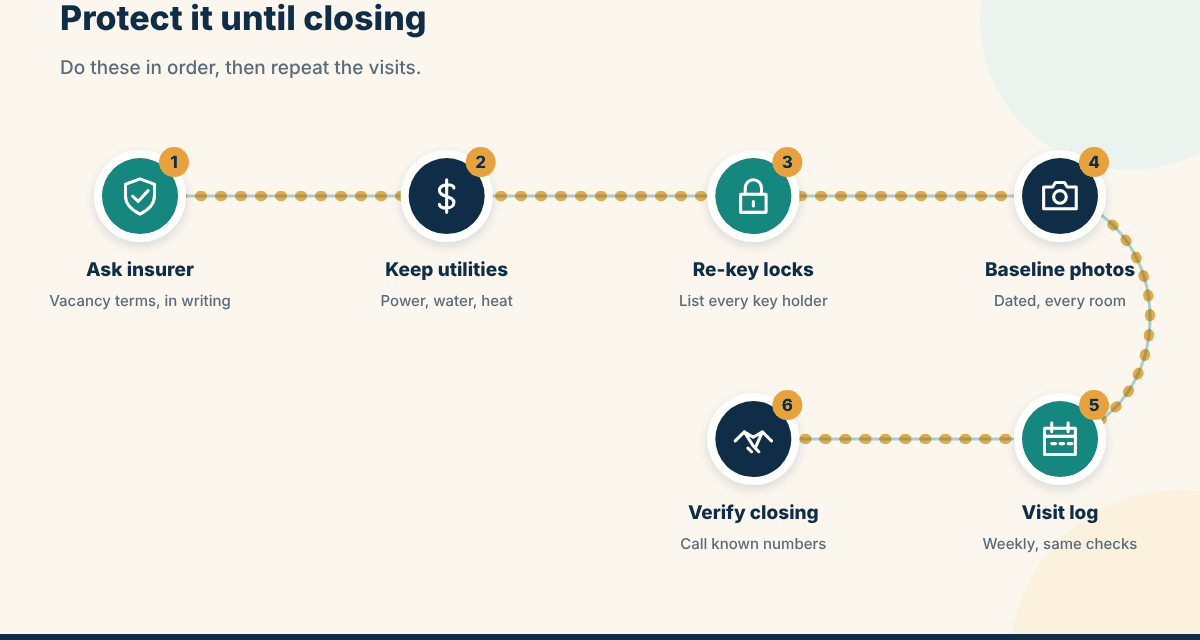
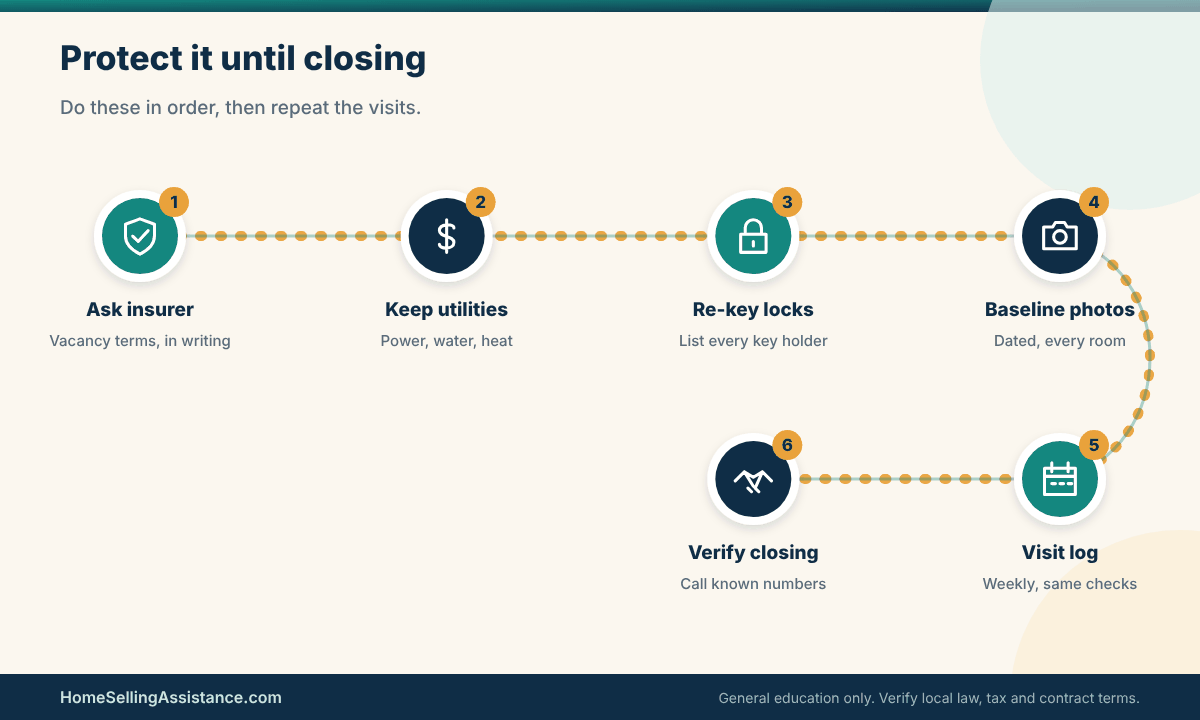
The order matters. Handle insurance first, because some decisions, such as turning off the heat or changing your occupancy, can change the coverage you hold. Handle utilities and security second, because showings, photos and inspections all depend on them. Handle verification habits third, before the first serious offer arrives and the emotional pressure to move fast starts. Our companion guide on vacant home security while the house is for sale expands on the security layer if you want more depth. Sequence is half the work of selling vacant house property safely.
One more principle before the details. Controls should be proportionate to the house and to your situation. A tidy bungalow two miles from where you live and a large empty house hundreds of miles away are different problems, and the second deserves a caretaker, a more frequent schedule and perhaps a vacancy policy. Spend where the risk is highest, and do not feel guilty about skipping measures that fit a different house. Proportion keeps selling vacant house property affordable.

Insurance, utilities and security controls that actually hold up
Three questions anchor this layer. Will my insurance still respond if the house sits empty? Are the utilities on, so the home is maintained and showable? And who can get inside, and how will I know? The answers fit together. Insurance without maintenance invites a denied claim, maintenance without access control invites theft, and access control without a record of visits leaves you guessing when a problem shows up. These questions frame every decision about selling vacant house property that follows.
On insurance, the word to learn is “vacancy,” and its cousin “unoccupancy.” Many policies draw a line between a home that is unoccupied but still furnished and one that is vacant and bare, and they may limit coverage for specific perils, such as vandalism, glass breakage, water damage or theft, after the home has been vacant for the period named in the policy. The period, the perils and the exceptions vary by insurer and by state, so only your actual policy can answer. Understanding that vocabulary is basic homework for selling vacant house property.
When you call, ask about the policy’s conditions in plain terms. Does the policy require heat to be maintained? Does it require the water to be shut off and the lines drained if the heat is off? Does listing the house for sale alter anything? Is there a vacancy permit, an endorsement or a separate vacant dwelling form, and what does it cost? Ask for any answer by email, and keep the reply with your listing documents.
Do not cancel your homeowners policy early because you expect to close soon. Closing dates slip, and a lapse in coverage on a house you still own leaves you exposed to the full cost of any loss. If you have a mortgage, your lender may also require continuous coverage and may buy its own, usually more expensive, policy if yours lapses. Keep the policy until the deed has recorded and your agent or attorney confirms the sale is final. Continuous coverage is a quiet rule of selling vacant house property.
Utilities come next. In most cases the sensible default is to keep electricity, water and a basic level of heating or cooling active until closing, with gas as needed for the furnace and water heater. Buyers, inspectors and appraisers need working power and water to test systems, and a house without them often stalls an inspection. You can lower usage by turning the water heater to a vacation setting, if the manual allows, rather than switching things off entirely. Working systems make selling vacant house property easier at every stage.
Heat deserves its own sentence. In cold climates, the setting that keeps pipes from freezing is a decision to make with a plumber or the insurer, not a number to copy from a forum post. In hot, humid climates, running air conditioning or at least a dehumidifier setting can slow mold growth, and our article on selling a house with mold explains why moisture in a closed house is such a common headache.
Maintenance is the bridge between utilities and security. Schedule lawn care and snow removal, because an unkempt exterior is the loudest sign that no one is around and it also affects how buyers feel about the property. Keep gutters clear if you can, check the sump pump if there is one, run water in rarely used drains, and replace smoke detector batteries. Ask your agent whether the contract or local rules require specific upkeep for a listed home. Basic upkeep is part of selling vacant house property, not an optional extra.
Security can be modest and still effective. Good deadbolts, window locks that work, exterior lighting on a timer, and a visible but ordinary appearance from the street already deter casual trouble. Some sellers add a camera or a smart lock with a code log, and some use a monitored alarm. If you do, remember that cameras can raise privacy questions, particularly inside a home, and laws about recording vary, so keep any camera to exterior or clearly notified use and check local rules first. Modest, consistent security suits most people selling vacant house property.
Mail and deliveries are small but telling. A mailbox that overflows or flyers piled on the porch announce vacancy as clearly as a sign. Ask the post office about forwarding or holding mail, ask a neighbor or a caretaker to pick up deliveries, and consider stopping newspapers or circulars. If you share the property with others, such as co-heirs, agree on who handles this so it does not fall through the cracks. Small signals matter when selling vacant house property from a distance.
The following matrix puts the main threats, the evidence to check, the safe response, what you should not share and where to escalate in one place. Use it as a quick reference when something odd happens, rather than as a script, because your situation will always add details no table can hold.
| Threat or claim | Evidence to check | Safe action | Never share | Escalate to |
|---|---|---|---|---|
| Water leak or frozen pipe in the empty house | Utility usage, stains, dated photos | Shut off water, call plumber, notify insurer | Your travel plans | Insurer, licensed plumber |
| Break-in, theft or vandalism | Forced entry marks, missing fixtures, visit log | Do not enter alone, photograph, report | Alarm codes, key locations | Police, insurer, listing agent |
| Caller says the policy covers anything while vacant | Your declarations page and endorsements | Ask the carrier for written terms | Policy number to unknown callers | Your insurance agent |
| Stranger claims to own or rent the property | County records, your deed, lease requests | Do not argue, document, send to counsel | Keys or access codes | Attorney, police |
| Buyer asks to enter alone before closing | Contract access terms, agent approval | Offer an accompanied visit | Lockbox code outside the agent | Listing agent or attorney |
| Email changes your payout or wire details | Original instructions from the title company | Call a known number to confirm | Bank account or ID numbers | Title company, your bank, IC3 |
To use the matrix well, read across a row rather than down a column. If something looks off, start with the evidence column, because a fact you can check beats a feeling. Then take the safe action before sharing anything. The last column is not a punishment list, it simply names who has the authority and the records to help, so you can pick up the phone without spending a day deciding whom to call.
Evidence to check: policy wording, utility accounts and lock records
Three document types carry most of the evidence in this layer, and each is worth printing or saving as a PDF. The first is the insurance policy with its declarations page and any endorsements. Highlight the vacancy or unoccupancy language, the notice requirements after a loss, and any condition about heat or water. Keep your agent’s emailed explanations alongside it, since a verbal reassurance does not bind a carrier the way written wording does. Together they form the paper trail that supports selling vacant house property.
The second is the set of utility statements. Download the last several months, then each month until closing. A baseline for a lived-in house tells you what normal looked like, and a later drop confirms usage fell as expected. A spike signals a problem. If you ever need to argue that you maintained the property, steady accounts showing power, water and heat in service are quiet, strong evidence that you did. Steady accounts help when selling vacant house property and a question about upkeep arises.
The third is your access record. List every key or code, who holds it, and when it was last changed. Include contractors, cleaners, relatives, previous tenants and anyone who ever had a garage opener. If you cannot say who holds every key, the safest answer is to re-key. A locksmith visit costs little next to the uncertainty, and a changed lock gives you a clear date after which only the current list could have entered.
Add one more habit that costs nothing. Whenever you visit, record the date, the time you arrived, what you did and what you noticed, even if the note is two lines. Take a timestamped photo of the thermostat, the main water valve position and the front door on arrival. These breadcrumbs sound fussy until the day an insurer or a buyer asks what the house looked like last month, and then they are worth far more than their effort.
When the controls conflict: three situations and a way through
Controls sometimes pull against each other, and it is worth thinking through the common collisions. Saving money on heat can conflict with protecting pipes. Keeping a lockbox for convenient showings can conflict with tight key control. Leaving the lights on for security can conflict with a policy condition or a neighbor’s patience. None of these has a universal answer, but each has a sensible way of reasoning through it. Expect a few such trade-offs when selling vacant house property.
On the heat question, compare costs honestly. A modest utility bill is predictable, while a burst pipe in an empty house is not. If you want to save, ask whether draining the system and shutting off the water, with the insurer’s written approval, is cleaner than running low heat. Some homes and some policies suit one approach better than the other, and a plumber who knows your area can tell you which.
On the lockbox question, a convenient lockbox serves showings, but the access log matters more than the box. Prefer systems that log each entry and tie it to a licensed agent, change the code after a busy stretch of showings, and decline any request to share the code with unaccompanied parties. If you sell without an agent, accompanied showings are the cautious default, and our guide to open houses versus private showings weighs the trade-offs.
On the lighting question, motion-activated and timer lighting suit most situations, because it looks natural and shows the house is watched. If a policy or an association rule says something specific, follow it. When two goals genuinely conflict and you cannot settle it yourself, take the question to the insurer, the agent or, for rule questions, a local attorney, and write down the answer before acting on it.
What never to share and what never to assume while selling vacant house property
The second layer is about discipline, not hardware. Plenty of damage in vacant sales comes from sellers who said too much to the wrong person or assumed too much about the right one. A good rule of thumb is that information should travel only as far as the task requires. A buyer needs the condition of the house, not your passwords. A broker needs your goals and timeline, not your full financial picture. A caller needs nothing until you verify them. Discipline is cheap, and selling vacant house property rewards it.
Start with what never to share. Alarm codes, smart-lock codes and garage keypad numbers belong to you and to people you personally authorize, one at a time, with the code changed afterward. Bank account numbers, routing details, Social Security numbers and identity documents go only to the title or escrow company through a channel you initiated, never to an email asking you to “confirm” them. Your travel dates and the fact that nobody is home are private too. Treat that list as fixed while selling vacant house property.
Then the assumptions. Do not assume that an email from “the title company” is from the title company because the logo looks right. Do not assume that a buyer’s agent has authority to enter alone because they mention a contract. Do not assume that a neighbor, relative or former tenant returned every key. Do not assume that your insurer’s silence means you are covered. Do not assume that a deadline in an urgent message is real, since urgency is the scammer’s favorite tool.
Two further assumptions cause trouble. One is that a vacant home means a motivated seller, which invites low-ball and pressure tactics. You can be calm and still serious. The other is that an empty house can be sold “as is” without any disclosure, which depends on state law. For paperwork questions, see our guide to seller disclosure requirements, and remember that rules vary, so a local professional’s view matters.
There is a fairness angle as well. Showing practices and conversations with prospective buyers should treat everyone alike, and a vacant house is no exception. Do not use the empty status as a reason to ask personal questions about a visitor’s family, background or circumstances, and do not let anyone steer you toward or away from a buyer on those grounds. The HUD fair housing resources explain the principles in plain language.
Where these rules of thumb come from
These rules are not folklore. Consumer-protection agencies describe the same pattern again and again. Fraud usually begins with contact the victim did not initiate, adds urgency, asks for something hard to reverse such as a wire or a code, and discourages checking with anyone else. The remedy is equally steady: stop, step away from the channel the message arrived on, and confirm through a number or address you obtained yourself. They apply directly to selling vacant house property.
The FBI’s Internet Crime Complaint Center collects reports of online fraud, including real estate payment diversion, and its public material explains how email takeovers lead to altered instructions. The CFPB’s consumer site at consumerfinance.gov publishes closing-related guidance for homeowners. Read either before a closing, and you will recognize the vocabulary when it shows up in your own inbox.
Insurance rules of thumb come from policy language itself, which is why the advice is always to read yours. The key words are “vacant,” “unoccupied,” “conditions,” “exclusions,” “endorsements” and “notice.” If a term is not defined in a way you understand, ask. Keep in mind that insurers have different definitions of vacancy, and that a state’s insurance department can explain consumer rights, even though it cannot interpret your specific policy for you.
Finally, security discipline is simply access control borrowed from workplaces: grant the least access for the shortest time, log it, and revoke it afterward. That works for a lockbox, a smart-lock code, a spare key and an email password alike. Once you think of access as something you lend rather than give, most of the individual decisions in this section become easy. Lending access is a healthy mindset for selling vacant house property.
Two sellers, two assumptions, two different endings
Consider two invented sellers listing similar empty houses. The first tells every inquiring broker, “I’m out of the country until the end of the month, so just use the code, it’s 4-4-2-1, and the alarm is the same.” The second tells the agent, “Please schedule through the lockbox system, and call me if you see anything odd.” Both sellers meant well, but only one has a code whose use is tracked and a plan for changing it. The contrast is typical of selling vacant house property in practice.
A few weeks later, both homes see an odd visit at an off hour. The first seller has no record of who entered, no way to know whether the code spread, and an alarm code shared widely. The second can ask the agent for the access log, change the code in minutes, and tell the insurer exactly what happened. The break-in rates did not differ. The record keeping did, and that changes how quickly the problem is solved.
Now a transaction example. A “buyer” emails the first seller, offering a quick cash purchase with a closing in days, provided the seller sends proof of ownership, a copy of photo ID and a few bank details for a deposit. The seller’s instinct is to answer fast. The better instinct is to refuse the documents, ask for the buyer’s agent or attorney contact, and check everything through the listing agent or the title company.
The takeaway is not that sellers should be suspicious of everyone. Most buyers and agents are honest. The takeaway is that a few calm rules, applied evenly, remove the need to judge each person’s character. You do not have to decide whether a stranger is lying if the process never asks you to trust them with something you cannot get back. If you later sell a unit or specialty home, see selling a house with an HOA for similar process-first thinking. Process, not suspicion, protects people selling vacant house property.
Responding without making things worse while selling vacant house property
Even careful sellers eventually get a strange email, a worrying phone call or a message from a neighbor. What you do in the first hour usually matters more than what you do in the first week. The instinct to answer quickly, pay quickly or confront someone directly is natural, and it is also the instinct that fraud and panic both exploit. A planned response keeps you steady, keeps your records clean and keeps the people with actual authority in the loop. Expect a few such moments while selling vacant house property.
Think of the response in two steps. First, verify who is really contacting you, using channels you already trust. Second, if something is genuinely wrong, escalate to the right institution with your records in hand. Skipping the first step wastes the second, because reports built on unverified claims are slow and confusing. Skipping the second leaves you carrying a problem that banks, insurers, title companies and police are set up to handle. The same two steps work for nearly every surprise in selling vacant house property.
If you take only one habit from this article, make it this: pause before you respond to anything that asks you to act, pay, sign, share or let someone in. A pause of ten minutes costs nothing and ends most scams, because they depend on speed. It also gives you time to find your records, call a trusted person and decide calmly. Honest parties tolerate a pause. Dishonest ones push back against it, and that push is itself information. That pause is the best single tool for selling vacant house property.
Verifying people and requests through contact channels you already trust
Known-channel verification means this: when a message asks you to do something important, you stop, set the message aside, and reach the supposed sender by a phone number or email address that you found independently. Not the number in the message, not the “reply” button, not a link inside it. Use the contact on the signed contract, the title company’s own website that you typed in yourself, the agent’s number from your listing agreement, or your bank’s number on your card. This habit is central to selling vacant house property when owners live elsewhere.
The same method works for people. If a caller says they are an agent with a buyer, ask for their name, brokerage and license number, then look the brokerage up and call its main line. If someone says they are from the title company, call the number on your contract. If a contractor says the owner authorized work, check with the person who actually signed. Real professionals expect this and are often glad you did it. Impostors tend to improvise, delay or become impatient.
Electronic channels deserve extra care. Email accounts can be hacked, so a message from a familiar address is not proof of anything if it asks for a change in money instructions. Text messages and caller ID can be faked. Phone calls where the caller supplies a “callback number” are just a different route to the same impostor. The rule stays constant: confirm important requests in a second, independent channel that you chose, and never act on the first one alone. Email is the most common route for scams aimed at selling vacant house property.
Take particular care with anything involving money. Payout instructions, deposit details, wire information and “corrected” account numbers are the highest-value targets, and the best protection is to confirm them by voice, using a number from your signed paperwork, before any funds move. Our guide on real estate wire fraud aimed at sellers describes how those attacks are staged, and choosing between a wire and a check for your proceeds weighs the payout options. Payment instructions deserve the most care in selling vacant house property.
The channel rule also covers authority questions. If someone claims to have a right to enter or occupy, to represent you, or to have purchased your property, do not argue and do not hand over keys. Ask them to send their claim in writing to your attorney or your listing agent, and tell them you will respond through that channel. This keeps you polite and safe, and it keeps the discussion where documents, not pressure, decide the outcome.
A final point on verification: record each check. Write the date, the number you called, the name of the person you spoke with and what they confirmed. A two-line note is plenty. When memory fades or a dispute arises, a contemporaneous note carries weight that a vague recollection does not, and the habit of writing it also slows you down just enough to think. Good notes make selling vacant house property less stressful.
The next table pulls common transaction situations into one view, each paired with the warning sign to watch for, the verification channel to use, a calm seller response and the record to preserve. Treat the examples as patterns, not as an exhaustive list, and remember that your contract, your state and your title company will add specifics.
| Situation | Warning sign | Verification channel | Seller response | Record to preserve |
|---|---|---|---|---|
| Cash buyer offers a closing in days, no showing | Pressure, vague funds, refuses to meet | Listing agent, title company, proof of funds via closer | Slow the pace, request documents through the closer | Offer, emails, call notes |
| Email says wire instructions have changed | New account, urgency, odd sender address | Call number on your signed contract | Do not send, report the message | Original and changed instructions |
| Someone you never met says they own the house | No documents, threats, claims of a lease | County records, your attorney | Do not hand over keys, refer to counsel | Messages, photos, recorded deed |
| Agent wants to show the house alone with the code | Unknown brokerage, no license, no appointment | State license lookup, brokerage main line | Offer accompanied showing or decline | Request, license check, log entry |
| Contractor says the owner approved unlisted work | No contract, cash demand, new locks installed | The person who signed the agreement | Stop work, re-key, document the condition | Contract, photos, receipts |
| Caller offers to stop a foreclosure or pay for the house, for a fee | Up-front fee, pressure to sign quickly | HUD-approved counselor, your lender, an attorney | Sign nothing, ask for everything in writing | Paperwork offered, call notes |
You can use this table as a rehearsal sheet. Read one row each week before you visit the house, and say the seller response aloud. It feels silly, and it works, because the words come easily when the real call arrives. If a situation does not fit any row, apply the same logic: find the warning sign, pick an independent channel, respond calmly, and write it down. Rehearsal helps anyone selling vacant house property.

Evidence to use: how to confirm a contact in practice
Let us make the verification step concrete. Suppose you receive an email that appears to come from your closing agent saying the escrow account has changed and asking you to confirm your personal details for the payout. Do not reply to it or click anything. Open your original contract, find the phone number, and call the closing office. Ask whether they sent that message, and ask them to confirm any account details orally against your records. This applies to selling vacant house property as much as to any other sale.
For licensed professionals, you can usually check a license on your state real estate commission’s website, and the commission can tell you whether the person is active and in good standing. For attorneys, a state bar’s online directory serves the same purpose. For title and escrow companies, your agent or lender can confirm that the company is the one named in the contract. Each of these checks takes only a few minutes.
For property ownership claims, go to the county recorder or clerk. Search the parcel, review recent recordings, and confirm that no transfer or lien appears that you did not sign. Some counties offer free fraud alerts that email you when a document is recorded against your name or parcel, and it is worth asking whether yours does. A quick call to the recorder’s office will tell you what protection exists locally.
If you cannot confirm a contact, treat that as an answer. A person who cannot be reached through any independent channel has not earned your trust, however friendly or knowledgeable they sound. Closings can be postponed and offers can lapse, and a legitimate buyer will usually accept the delay. A lost afternoon is a small price compared with a diverted payout, which can be difficult or impossible to recover. Patience is a legitimate strategy when selling vacant house property.
A scenario, an exception and the next step
An invented scenario shows how this works. A seller living abroad receives a message from “her buyer’s agent” with a request to use a particular lockbox code for an early inspection. The message is polite, specific and a little urgent. She forwards it to her listing agent and asks whether the request is real. The listing agent calls the buyer’s brokerage, learns that the inspection was never scheduled, and the request disappears.
The exception is that real people occasionally do contact you directly, such as a buyer’s agent who found your number on the listing, or a title officer who calls to confirm a signing time. That does not make them suspicious, and you need not treat honest callers as criminals. It means you can say, kindly, “Let me call you back through the number on my contract,” and do exactly that. If they are who they claim, the call goes through in two minutes.
Your next step after any odd contact, whether or not you think it was fraud, is to tell your listing agent or closing contact. Professionals in the transaction can only protect you from patterns they know about, and a message that was meant for you may also be hitting the buyer or the agent. Sharing it costs nothing and sometimes prevents harm for someone else. If you are working without an agent, report it to the title company handling your closing. That habit protects more than your own selling vacant house property plans.
Escalating to the bank, title company, police, insurer or attorney
Verification handles suspicion. Escalation handles a problem that has actually happened. The right institution depends on the kind of problem, and sellers often lose time by calling the wrong one first, so a short map is useful. Money problems go to your bank and the title or escrow company. Crimes go to the police. Losses to the house go to the insurer. Questions of ownership, authority or liability go to an attorney. Knowing whom to call is part of selling vacant house property with confidence.
If money has moved, speed is the single most important factor. Call your bank’s fraud line immediately, using the number on your card or statement, and tell them you may have sent funds in response to a fraudulent request. Ask whether the transfer can be recalled. Then call the title or escrow company, since they may be able to alert the receiving bank and others in the transaction. Report the incident to the Internet Crime Complaint Center as well, keeping the confirmation number. Speed is the one thing that matters most here when selling vacant house property.
If you believe a crime occurred at the house, such as a break-in, theft or someone living there without permission, contact local law enforcement, preferably through the non-emergency line unless anyone is in danger. Do not confront anyone and do not go inside alone if you suspect a person is present. If someone claims a right to occupy, police may treat it as a civil matter that needs a court process, so an attorney may be the next call, and the rules differ widely by state.
For physical losses, notify your insurer promptly and follow the notice terms in your policy, because late notice can complicate a claim. Take photographs before cleaning, keep damaged items if the insurer asks, and make only the emergency repairs needed to prevent further damage, such as shutting off the water or covering a broken window. Ask the adjuster what documentation they want. Nobody can promise what a claim will pay, and your policy language decides the outcome.
For ownership, authority or liability questions, a local real estate attorney is the right professional. If you suspect someone has recorded a deed or lien against your property, or someone is claiming to have purchased it, our article on title and deed fraud for homeowners explains the warning signs, and an attorney can explain what remedies your state offers. You can also browse the wider fraud and seller safety section for related guides.
A few other contacts are worth keeping handy. If a caller is pressuring you about foreclosure or hardship, the HUD housing counselor directory lists approved counselors who can talk through options, often at low or no cost. If the sale involves a condo or a managed community, the association manager may need to know about a security incident. And if you work with a listing agent, the agent’s brokerage has a managing broker who can step in on conduct issues.
Evidence to gather before you escalate
Whoever you call, you will be asked for roughly the same things, so assemble them once. Prepare a short timeline with dates and times, what you saw, what you did and who you spoke to. Save screenshots of messages with full headers if you can, though a forwarded copy is better than nothing. Gather the contract, the title company’s contact details, your listing agreement, and the declarations page of your insurance policy. Having this packet ready makes selling vacant house property less stressful.
Preserve, do not delete. It is tempting to delete suspicious emails or clean up an incident site, and both can hurt later. Keep the original messages, keep copies of any documents the other person sent, and photograph the house before repairs. If a bank account was involved, write down the account details, the amount and the exact time of any transfer. Investigators and insurers work from details, and details fade quickly.
Change your own security as part of the response. Reset passwords on email, banking and any smart-home or alarm accounts, turn on multi-factor authentication where it is offered, and check your email’s forwarding rules and sign-in history for anything you did not create. If someone had a key or a code, change it. A fraud report is stronger when you can say that you secured your accounts the same day. Do this the same day if you can when selling vacant house property.
Finally, tell the people in your transaction. Your listing agent, the buyer’s side and the title company should hear about a security or fraud incident from you early, in a calm and factual message. Hiding it feels easier and rarely helps. Whether a physical incident must be disclosed to a buyer depends on state law and contract terms, which is a fair question to put to your agent or attorney, with your records beside you.
A scenario, an exception and where to go from here
Imagine a seller who learns, two days before closing, that a message from “the title office” changed the payout account. She had called the title office after reading a warning, and learned that the message was fake. Because she confirmed first, nothing was lost, and she forwarded the message to the title company and the listing agent. They told the buyer’s agent and tightened their own checks, and the closing went ahead on schedule with a corrected process.
Now the unhappy variation. A different seller replied to the same kind of message and sent the money before checking. She calls the bank within the hour, gets the fraud team involved, informs the title company and files an online report. Nobody can promise the funds will return, because recoveries depend on timing and on whether the receiving account still holds the money. But a prompt, organized response improves the odds more than any slow or scattered one.
There is an exception worth noting: some losses may not be recoverable at all, or may be disputed between institutions, and that can feel unfair. If you are facing that, an attorney can explain what rights you may have under your state’s law and your contracts, and a consumer-protection office may offer guidance. Counselors, bank fraud teams and attorneys do not work miracles, but they are better equipped than you are to find the available paths.
Whatever happens, do not let embarrassment stop you from reporting. Sophisticated criminals fool experienced professionals, and the stigma is part of what keeps these crimes under-reported. A prompt report helps you and may help the next seller. Once the immediate response is done, you can return to the ordinary business of marketing the house, and the next section answers the questions sellers most often raise at that stage. Reporting is a normal step in selling vacant house property, not an admission of failure.

Frequently asked questions about selling vacant house property
Will my homeowners insurance still cover the house if it sits empty?
It depends on the policy. Many policies restrict certain losses, such as vandalism, water damage or theft, after the home has been vacant for the period the policy names, and the details differ by insurer and state. Before you move out, ask your agent or carrier in writing how they define vacancy, what changes, and whether an endorsement or vacant dwelling policy is available. Keep the answer with your records.
Should I turn off the utilities when selling vacant house property?
Usually not completely. Buyers, inspectors and appraisers generally need power and water to test the home, and heat or cooling protects the structure. You can often reduce usage with a vacation setting on the water heater or a modest thermostat setting. In freezing climates, ask a plumber and your insurer whether to maintain heat or drain the system, and get the guidance in writing.
How often should I visit an empty house?
There is no universal number, because it depends on the weather, the age of the house and the terms of your policy. Many sellers pick a regular rhythm, often weekly, and ask a trusted local person to cover gaps. What matters is consistency and a log: date, time, what you checked and what you saw. Some insurers also ask about inspection frequency, so read your policy.
Is it safe to use a lockbox on a vacant home?
A lockbox can work well when it records each entry, is tied to licensed agents and has its code changed after busy periods. It works poorly when the code is passed around freely. If you sell without an agent, accompanied showings are the cautious option. Whichever you choose, ask who can open it, how entries are logged and how quickly you can revoke access.
Do I have to disclose a break-in or water damage that happened while the house was empty?
That depends on state law, your contract and what the problem was. Rules about what counts as a material fact vary quite a bit. The safest approach is to tell your listing agent promptly, keep repair records, and ask the agent or a local attorney how your state treats it. Concealing a known problem can create larger trouble than the problem itself.
What fraud risks are specific to vacant houses?
Empty properties and absentee owners attract impersonation, in which someone poses as the owner or a buyer, fake documents, pressure for fast closings, and altered payment instructions near closing. The common thread is a request you did not start, wrapped in urgency. Verify through a contact you found yourself, and read our guide on title and deed fraud for the warning signs.
Can I let a buyer or inspector enter the house alone?
Most sellers prefer not to, and many contracts and local practices expect an agent to be present. If your agreement allows unaccompanied access, confirm the person’s identity and license with the brokerage, record the entry and change any code afterward. When in doubt, offer an accompanied visit. A serious buyer will usually agree, and it costs you nothing but a little scheduling.
What should I do if someone claims they have a right to live in the property?
Do not hand over keys, argue or try to remove anyone yourself. Take dated photos from outside, write down what was said, and contact a local real estate or landlord-tenant attorney, since the rules differ by state. Police may treat occupancy disputes as civil matters. Check county records to confirm you are the recorded owner, and keep the results.
Who should I call first if I think I sent money to a scammer?
Call your bank’s fraud line right away, using the number on your card or statement, and ask whether a recall is possible. Then tell the title or escrow company and file a report with the FBI’s Internet Crime Complaint Center. Speed matters more than anything else. Nobody can promise recovery, but quick, organized action gives you the best chance.
Does a vacant house sell for less than a lived-in one?
Nobody can answer that as a rule, because prices depend on the local market, condition and how the house is presented. An empty house can show well or feel cold and hard to picture, and some sellers use staging to help buyers visualize the space. Ask a local agent for recent comparable sales and honest feedback, and avoid anyone who promises a particular price.
Before you hand over the keys
Selling vacant house property does not require fear, only a small set of habits: confirm your insurance in writing, keep the utilities and a visit log going, control and record every key and code, and verify any important request through a number you chose. If you do those four things, most problems become small and most scams die on contact. For related situations, our guides on selling a condo and selling a manufactured home may help.
This article is general education, not legal, tax or financial advice, so check your state’s rules and talk with a licensed local professional about your own situation.