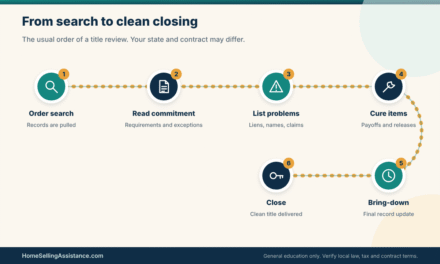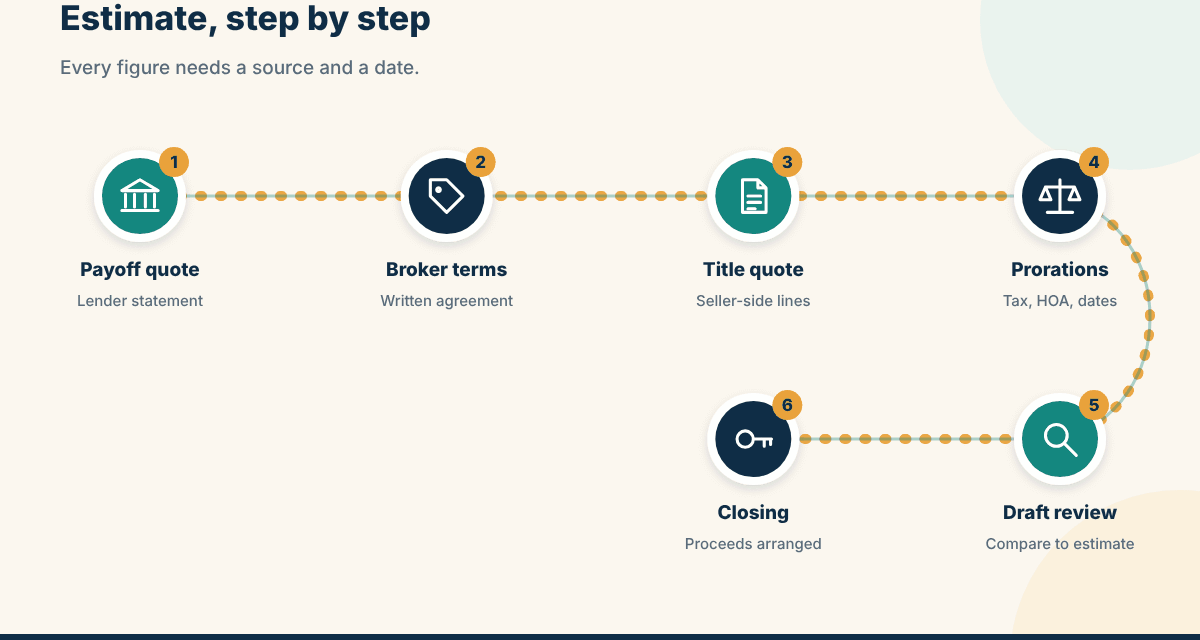
Understanding seller closing costs is mostly a matter of replacing one tempting shortcut, a single percentage of the sale price, with a short list of real line items that you can check against paperwork before anyone asks you to sign. This guide shows you how to build that list, what moves each line up or down, who can confirm each number, and which decisions belong before you list rather than after you have an offer.
If you have searched for the answer already, you have probably met a confident range that supposedly applies to every sale in the country. It does not. What you owe at the closing table depends on your payoff, the way your contract assigns fees, the customs of your state and county, the structure of your title insurance, any taxes or liens attached to the property, and the concessions you negotiated along the way. Two neighbors who sell on the same day can leave with very different amounts.
That is why this cornerstone guide treats the seller closing costs estimate as a build, not a guess. We will go through the main categories of cost, explain the logic behind each, show illustrative worked examples with round numbers that are clearly not predictions, and give you scripts for the questions that get you real figures from the people who produce them. Nothing here replaces your contract, your title company or an attorney, and we say so plainly where it matters.
The article is the hub for our closing-costs series. Where a topic deserves its own deep treatment, such as a home sale net proceeds worksheet, a seller closing statement walk-through or the timing of when the seller gets money after closing, we point you there and keep this page focused on the big picture and the method.
Key takeaways
- There is no universal percentage for seller closing costs. Any single figure you see online blends different states, price points, loan balances and contract terms that may not look like yours.
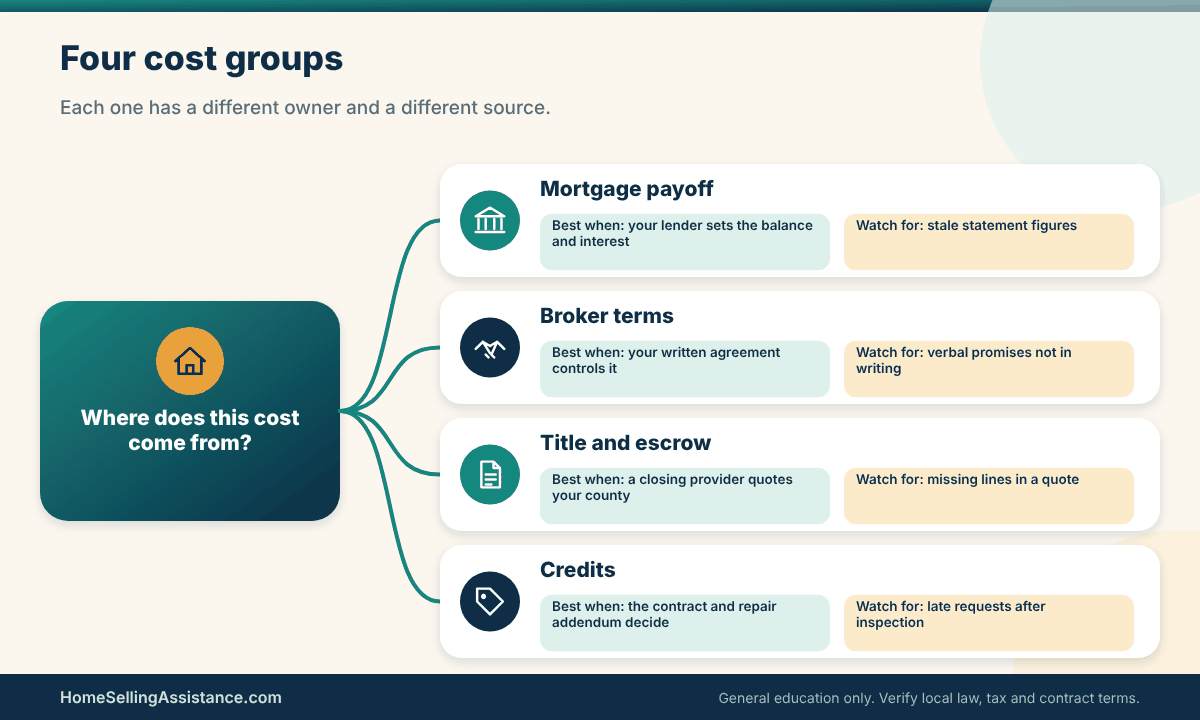
- Build the seller closing costs estimate from line items. Payoff, broker compensation, title and escrow charges, transfer-related taxes, prorations, credits to the buyer and any liens each have their own source document and their own person who can confirm them.
- Your contract decides who pays what. Local custom fills gaps, but the signed purchase agreement and any amendments are what the settlement agent actually follows.
- Some costs are fixed early and some are not. Payoff and broker terms can be quoted before listing; credits, repairs and prorations usually crystallize only after you have a buyer.
- Verify before you rely. Ask for written quotes, compare the final statement to your seller closing costs estimate line by line, and confirm wiring instructions by phone using a number you already trust.
- This is general education. Rules differ by state and transaction, so use a licensed professional for advice about your own sale.
Seller closing costs start with the decision, not the settlement jargon
Before any line item makes sense, you need to know what question the seller closing costs estimate is meant to answer. A seller deciding whether to sell at all needs a rough range. A seller choosing between two offers needs an apples-to-apples comparison of what each would leave in the bank. A seller about to buy another home needs a conservative figure they can rely on for the down payment. Each of those purposes tolerates a different level of precision.
The jargon around closing is a second obstacle. Words like escrow, settlement, disbursement, payoff, proration and recording get used loosely, and the same fee can appear under different names depending on who prepared the document. Throughout this guide we use plain labels and tell you what the technical term means the first time it matters.
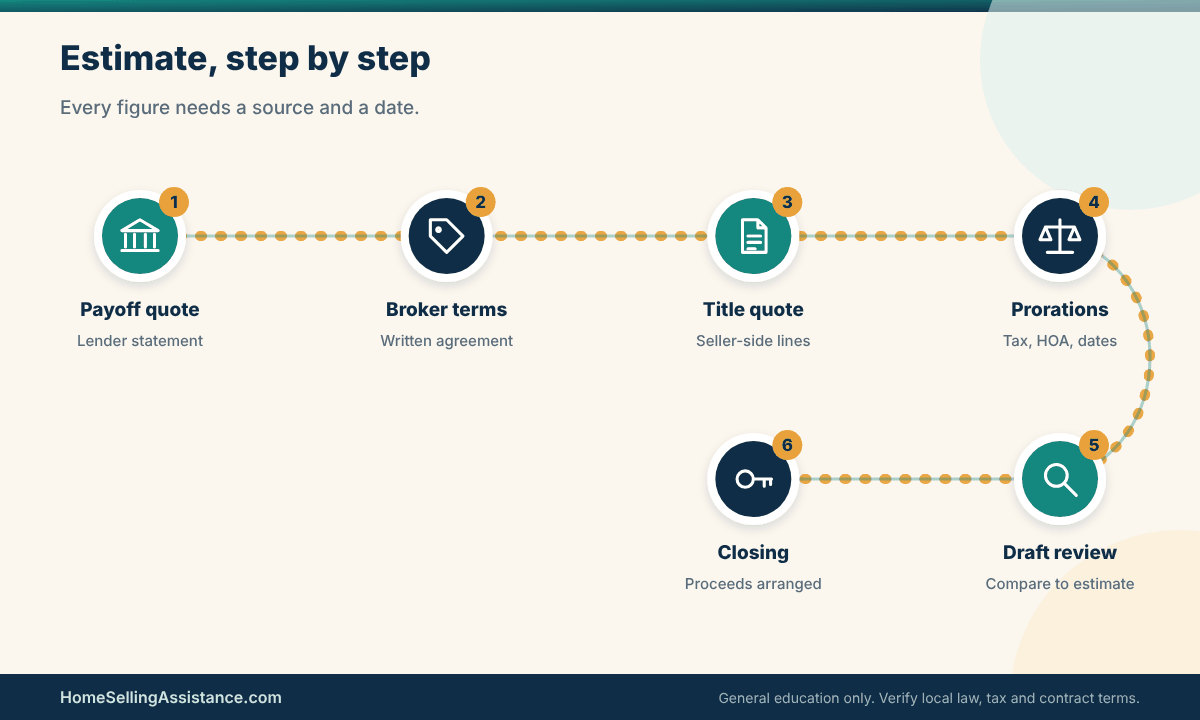
Define what your seller closing costs estimate has to accomplish
The most useful first step costs nothing. Write down, in a sentence or two, what you intend to do with the proceeds and when you need them. That sentence tells you whether a ballpark is enough or whether you should invest effort in firm quotes. It also exposes constraints that change the cost picture, such as a loan you must pay off by a certain date or a purchase closing the same afternoon.
Think of your seller closing costs estimate as having three layers. The first layer is what you already know or can learn within a day: your approximate loan balance, your property tax bill, your HOA dues if any. The second layer needs a phone call or an email: payoff statements, title quotes, association fees. The third layer depends on a future buyer: credits, repair outcomes and the closing date that drives prorations.
Evidence to gather: the five numbers behind any estimate
Almost every seller closing costs estimate rests on five numbers, and you can collect most of them in an afternoon. The first is your expected sale price range, which should come from current comparable sales rather than from a listing portal’s automatic estimate. The second is your mortgage payoff, which is the balance plus interest accrued through closing, not the figure on last month’s statement.
The third number is the broker compensation you have agreed to, or expect to agree to, written down in a listing agreement or a negotiated offer of compensation to a buyer’s broker. The fourth is the sum of title, escrow, recording and transfer-related charges for your county, which a title or escrow company can quote. The fifth is your credits budget: the amount you are willing to give for repairs, rate buydowns or other concessions.
Collect each figure with its source attached. A number you cannot trace to a statement, a quote or a contract clause is an assumption, and it is fine to use assumptions, but label them as such. Our documents needed to sell a house checklist covers the paperwork that supplies most of these inputs, and the seller closing cost calculator method article shows how to turn the five numbers into a seller closing costs worksheet.
One more habit helps: record the date next to every number. A payoff quote has a shelf life, a tax bill is replaced when a new assessment arrives, and a broker proposal changes when you negotiate. Dated figures let you spot stale inputs the moment the real statement shows up, instead of discovering the gap on closing day.
A scenario, an exception, and your next step for the seller who needs a fixed number
Picture a seller we will call Dana, who needs a specific amount on closing day to complete a purchase in another city. Dana’s agent offers a broad range for expenses, but the range is too wide to plan around. Dana asks for a line-item estimate instead, with a payoff quote ordered early and a title company’s fee quote for the county. The result is a narrower window and a clear list of what could still move it.
Now the exception. Suppose Dana’s buyer asks for a credit after the inspection. A figure that looked settled becomes variable again. The honest answer is that credits are the least predictable part of any estimate, so a seller who needs certainty should reserve a cushion for them or try to resolve the repair question before the closing statement is drafted.
Dana’s next step is simple and applies to you too: ask for the seller closing costs estimate in writing, mark which lines are firm and which are projected, and recheck the projected ones whenever the contract changes. This turns an anxious guess into something you can maintain. If you want a related walk-through of how a payoff fits in, read about mortgage payoff when selling a house before you request your first quote.
Map the selling paths that change your seller closing costs
The route you take to a buyer changes which costs exist at all. A conventional listing with a licensed broker usually involves a compensation agreement. A for-sale-by-owner sale may remove a listing-side fee but can still involve an offer of compensation to a buyer’s broker, plus legal and document costs you would otherwise not see. A direct cash sale may trim fees but reflect a lower price. An auction brings its own fee structure.
The point is not that one path is cheaper. It is that you should compare paths on what you keep and what you carry in risk and time, not on the headline price or the headline fee alone. Our guide on how to sell a house compares the routes in more detail; here we focus on how each one reshapes the cost list.
Evidence to gather: what each route puts on the cost sheet
For each route you are considering, ask the same set of questions and write the answers side by side. Who is paid, by whom, and when? Is the compensation written into an agreement or an offer? Which closing-table charges are likely to be the same across routes, such as payoff and recording, and which differ? Which costs are paid before closing, such as photography or listing fees, rather than deducted from proceeds?
With a traditional listing, request the listing agreement in draft and read the compensation clause and the protection-period clause, which can matter if a deal falls apart and you later sell to someone who first saw the home during the listing. With a for-sale-by-owner approach, ask a title company or attorney what documents they will prepare and what they charge for each. Our article on seller real estate commission explains how compensation is structured without assuming any particular rate.
With a cash buyer or an iBuyer, request a written offer that shows every deduction, including any service fee, repair adjustment and closing charge, then compare the net figure to a realistic list-and-close scenario. For an auction, read the terms about buyer premiums and reserve rules. In every case, treat a fee that is described only verbally as unconfirmed until you see it on paper.
Keep the comparison honest by using the same sale-price assumption only when the routes truly produce the same price. A discounted but quicker sale may deserve a lower price assumption, while a longer marketing period deserves a line for carrying costs such as the mortgage, utilities and insurance during the extra weeks. Seller closing costs are one part of the comparison, not the whole of it.
A scenario, an exception, and your next step for choosing between routes
Imagine two sellers with similar houses. One lists with a broker and expects several weeks of marketing, and the other accepts a direct cash offer that closes quickly. On paper the second seller avoids a broker fee. Yet the cash offer is lower, and it includes a service charge and a repair deduction. When both sellers lay out their full statements, the gap in what they keep is smaller or larger than they expected, depending on the price difference.
The exception to watch for is any route where costs are not disclosed until late. A buyer who proposes to lower the price after an inspection, or an intermediary who adds a fee at the table, changes your net after you have committed. Insist on seeing the complete fee schedule in the offer or agreement, and ask when each charge becomes final.
Your next step is to build one estimate per route, using the same line items, and note where each figure comes from. If a line says only “fees,” ask what is inside it. You can later cross-check against the home sale net proceeds approach, which many sellers find clarifies the difference between the price on the contract and the money in the account.
What changes price, time, risk and seller closing costs
Four moving parts shape every sale: the price you accept, the time it takes, the risk that something goes wrong, and the money that ends up in your account. Seller closing costs sit inside the last of those, but they also react to the other three. A faster closing can compress some costs and inflate others. A higher price can raise percentage-based fees. A riskier contract, with several open contingencies, can add holdbacks, extensions or repair credits.
This section explains the variables that push seller closing costs around, grouped the way a seller actually experiences them: first the market and buyer side, then the cost, legal and tax side. Each group ends with practical ways to check your own numbers instead of trusting a rule of thumb.
Market, condition, financing and buyer variables that reshape seller closing costs
Sellers often assume closing costs are a fixed overhead, like a toll. In practice they are partly a negotiation outcome. When competition among buyers is strong, sellers tend to have more room to decline credits. When buyers have more choices, requests for concessions become more common. Neither is a rule, and local conditions change quickly, so ask a broker for recent, local examples rather than relying on national narratives.
Property condition works the same way. A house with deferred maintenance gives a buyer reasons to ask for repair credits, and a clean inspection reduces those requests. Financing matters because some loan programs limit what a seller may contribute and require particular inspections or appraisals. The buyer’s lender, not you, sets those boundaries, so your agent or attorney should check them before you agree to anything.
Evidence to gather: contract terms, loan program limits and local custom
The strongest evidence for how seller closing costs will be split is the draft or signed purchase agreement. Look for the clauses on who pays title insurance, escrow or settlement fees, transfer taxes or recording charges, and association fees. Check the section on seller credits and any cap the buyer’s loan type might impose. Where the contract is silent, local custom fills the gap, and a title company or attorney in your county can tell you what custom looks like there.
Also gather the buyer’s financing details early. You are entitled to ask your agent what type of loan the buyer expects to use and whether the offer includes a request for seller-paid costs. A buyer’s lender may require repairs to certain safety or condition items before closing, and those can show up as seller costs even when you never planned for them. We cover the underlying contract mechanics in our real estate sales contract for sellers guide.
Pay attention to dates as well. Many costs and prorations are tied to the closing date, so an extension, a rent-back or an earlier funding date changes the arithmetic. Keep a simple calendar of every date in the contract and note which lines move if each date moves. This habit prevents the quiet error of using a figure that was correct for a closing date that no longer exists.
A scenario, an exception, and your next step when the buyer asks for help with costs
Suppose you receive a strong offer that includes a request for the seller to pay part of the buyer’s closing costs. The offer price looks attractive, but the request reduces your net. The way to compare it with a lower offer that includes no such request is to run both through the same line-item estimate and see which leaves more. Our guide to seller concessions in a home sale shows how to think about those trade-offs.
The exception is when the concession is really a substitute for a price reduction. Sometimes a buyer’s lender or tax situation makes a credit more valuable to them than a lower price, and sometimes the reverse. You do not need to decode the buyer’s finances. You need to know your own bottom line, and the clean way to do that is to calculate what you keep under each version.
Your next step is to ask your agent or attorney to draft a side-by-side comparison of any competing offers, with every credit and fee shown. If the comparison reveals that the higher price loses to a cleaner offer once credits are included, you have made a decision based on facts. If it does not, you can accept with confidence that you saw the whole picture.
The table below organizes the situations that most often push seller closing costs around. Read it as a prompt for conversations, not as a verdict: the key fact in each row is something to verify for your own sale, and the final column names the document where you can verify it.
| Situation | Key fact | Practical action | Trade-off | Source or document |
|---|---|---|---|---|
| Buyer requests help with costs | Credit reduces your net | Compare offers using full line items | Higher price may be offset by credit | Purchase offer and addenda |
| Inspection reveals repairs | Repair vs credit changes cost timing | Get contractor quotes before replying | Credit is simpler, repair may be cheaper | Inspection report, repair addendum |
| Mortgage still open | Payoff grows with daily interest | Order a payoff statement with a per-day figure | Earlier closing lowers interest, may rush other steps | Lender payoff statement |
| Property in an HOA | Association charges vary and have deadlines | Request resale documents early | Early requests cost time, late ones delay closing | HOA governing documents, demand statement |
| Unpaid taxes or lien found | Must be resolved for clear title | Ask the title company what it found and the release steps | Paying from proceeds is simple but reduces cash | Title commitment, lien release |
| Closing date moves | Prorations shift with the date | Recalculate every date-based line | Flexibility helps the buyer, may add carrying cost | Contract amendment, statement |
To use the table, pick the rows that match your sale and write the verification step next to each one with a due date. Rows that do not apply can be ignored. If a row applies and you cannot name the document, that is a signal to make a call before you commit to any estimate, because it usually means a number is still an assumption.
Costs, legal and tax issues, logistics and priorities behind seller closing costs
Beyond the market, a second group of variables comes from the property and from you. A sale involving a mortgage, a home equity line, a tax lien or an unpaid association assessment will have payoff and release steps that others do not. A sale by an estate, a trust or co-owners adds documents and sometimes court steps. A sale by a seller living out of state adds notary, courier and sometimes power-of-attorney considerations.
Legal and tax issues deserve careful language. Tax outcomes depend on your facts, and nothing here is advice about your situation. What we can say is that the IRS publishes plain-language guidance on selling a home in IRS Publication 523, and that closing-related reporting and withholding rules can affect what a settlement agent asks you to sign.
Evidence to gather: payoff statements, lien searches, tax bills and association documents
Start with the debts attached to the property. A payoff statement from each lender lists the principal, accrued interest and any fees through a stated date, usually with a per-day amount so the figure can be adjusted if closing moves. Ask whether the loan carries a prepayment charge, and ask how and when the lender will release its lien after payment. Title and escrow staff can tell you what they will require to confirm payoff.
Next, look at taxes and assessments. Property tax bills show amounts due and the periods they cover, which determines how much is prorated between you and the buyer. If you are in a community with special assessments, ask whether any are pending, since those can be treated differently from regular dues. Our article on property tax proration for sellers explains the mechanics and why customs differ across the country.
Then gather association documents. Condominium and HOA communities typically charge for resale certificates, document packages, transfer or capital contribution fees, and statements of dues. Who pays which charge depends on the governing documents, state law and the contract. We cover the details in HOA resale fees for sellers, and the practical advice is to request the package early because delivery times vary.
Finally, ask the title company for a preliminary look at the record. A title search is the examination of public records for ownership, liens and other matters that affect the right to transfer. Our guide to a title search for a seller’s home sale explains what it can surface. Finding a problem early is almost always cheaper than finding it in the last week.
A scenario, an exception, and your next step when a lien or an unexpected charge appears
Imagine you learn during the title search that an old contractor’s claim was recorded against the property years ago and never released. That is a lien, and it must usually be resolved before a buyer’s lender will close. The sensible reaction is not panic but sequence: confirm the claim is real, find out whether it was paid, and obtain a recorded release or arrange payoff from proceeds under the title company’s instructions.
The exception is a claim you dispute. In that case, the options narrow and the timeline matters. A title company may require a bond, an escrow holdback or a court order, depending on the situation and the state. This is a point where a local real estate attorney earns the fee, and where reading about how to sell a house with a lien gives you vocabulary before the first call.
Your next step is to treat any surprise as a numbered item with an owner and a date: who is verifying it, what document will prove it is resolved, and what it adds to seller closing costs if paid from proceeds. Surprises feel less threatening when they are on a list, and your seller closing costs estimate stays honest because the line is updated rather than ignored.
Taxes on the sale itself are a different subject from closing costs, although selling expenses can interact with the calculation of gain. For the broad picture, see our overview of taxes when selling a home, and for how fees reduce the amount realized, read about selling costs and capital gain on a home. Both are educational and neither replaces a tax professional.
Seller priorities decide which costs are worth paying.
Not every cost deserves the same attention. A fee you cannot influence, such as a recording charge set by a county, only needs to be accounted for. A cost you can negotiate or avoid deserves effort. And a cost that buys you something, like a title policy, a pre-listing repair or a qualified professional’s time, should be judged by what it protects, not simply by its size.
Sorting costs into three bins helps. Fixed costs are set by governments or lenders. Negotiable costs include broker compensation, credits and some third-party fees. Optional costs include things like staging, pre-inspections and home warranties. Seller closing costs usually contain items from all three bins, and knowing which bin a line belongs to tells you how much energy it merits.
Sort the lines: fixed, negotiable or optional.
Take your draft estimate and tag every line with F, N or O. Payoff, recording charges and government transfer taxes are normally fixed. Broker compensation, repair credits and certain service fees are typically negotiable. A home warranty or a pre-sale inspection is optional. If you cannot decide which bin a line belongs in, ask the person who produced the number whether it can change and what would change it.
For negotiable items, collect at least two data points. That might be two title company quotes, two written broker proposals, or two contractor bids for a repair you might perform instead of crediting. Comparison gives you leverage and also protects you from paying more than necessary out of unfamiliarity. Keep the quotes dated, since fee schedules and availability change.
For optional items, decide whether the spending supports your goal. A pre-listing inspection may reduce surprises and keep seller closing costs from rising later through repair credits, or it may simply create a list of items you then feel obliged to address. Both outcomes are possible. The useful question is whether you would act on the information, and the answer depends on your priorities and the condition of the home.
Trimming costs without cutting corners.
Consider a seller who wants to reduce expenses and starts by questioning every line. Some savings are real, such as comparing title quotes or negotiating a broker fee in writing. Others are false economies, such as skipping a title search or declining to review the buyer’s repair request. The difference is whether the cost protects against a larger, harder-to-fix problem.
The exception is a sale in a hurry. When time is short, paying for speed, such as expedited document delivery or a courier, may be sensible even though it is optional. A seller facing a deadline might reasonably accept a slightly higher expense to avoid a missed closing. Saving a small amount is not worth jeopardizing the sale.
Your next step is to decide your priority order before you start negotiating: certainty, speed, net proceeds or convenience. Write it down, and let it guide which lines you fight over. Seller closing costs are easier to manage when you know which ones matter to your actual goals, and which are simply the price of closing cleanly.
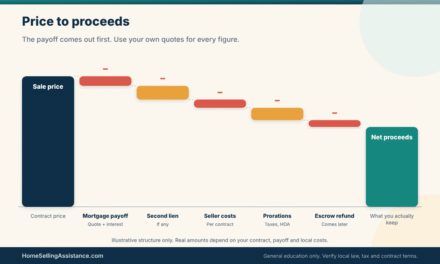
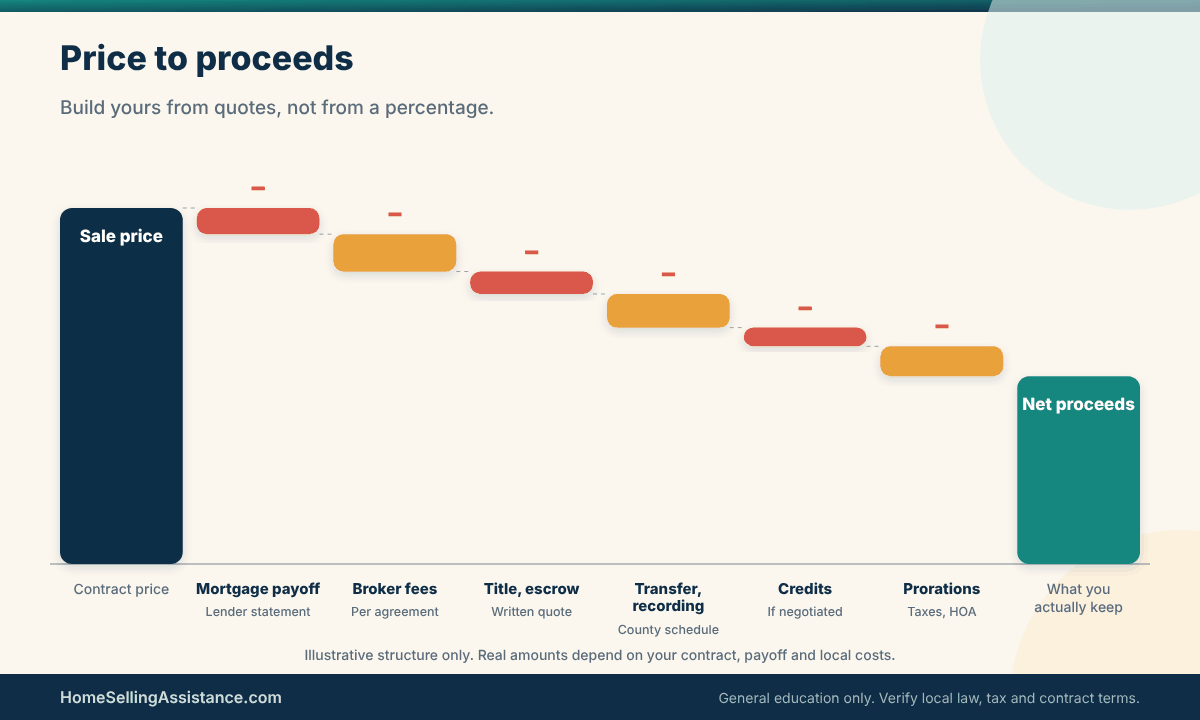
The waterfall picture below shows the general structure of the journey from sale price to money received. Notice that the deductions are different for every seller, and that credits and prorations can push in either direction.
Turn seller closing costs into a verification roadmap
An estimate is only as good as the checking behind it. This last major section converts everything above into a sequence you can follow: which documents to gather, which professionals can confirm which numbers, what to settle before you list, and what can wait until you have an offer. It also walks through the individual line items in more detail, because most surprises at the table come from lines nobody explained in advance.
Think of the roadmap as a conversation plan. Each line of your seller closing costs estimate has someone who can verify it, and each of those people can answer a short, specific question. Sellers who ask short, specific questions usually get short, specific answers, while sellers who ask “what will it all cost?” tend to get a range that feels reassuring and teaches nothing.
Documents and professionals that confirm your seller closing costs
Four kinds of people produce most of the numbers in a sale. The lender who holds your mortgage produces the payoff. The title or escrow company, or in some states an attorney, produces the fee schedule, the title work and the final statement. Your broker or agent produces the compensation terms and the marketing and negotiation record. An association manager, if you have one, produces the dues and transfer charges.
Each professional answers for their own lines only. A broker cannot promise what a county will charge to record a deed, and a title officer cannot tell you whether a buyer will ask for a credit. Matching each question to the right source saves time and reduces the risk of repeating a wrong figure that someone offered out of helpfulness rather than knowledge.
Evidence to gather: a line-by-line source list for your estimate
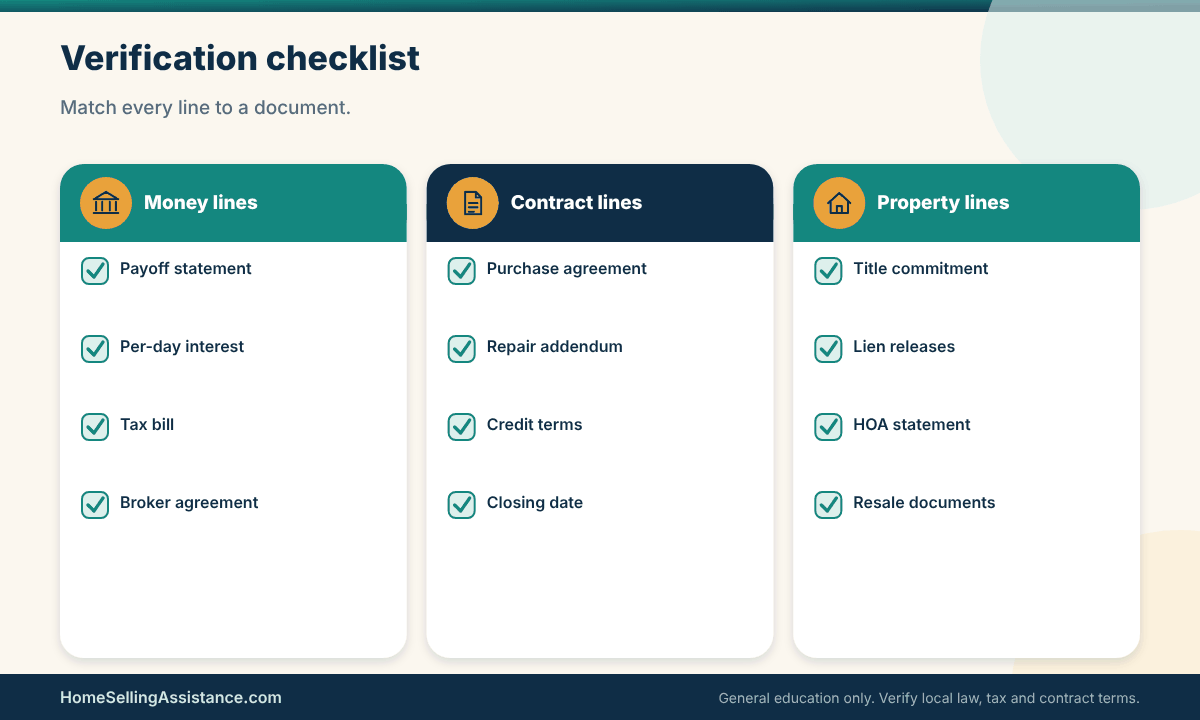
Here is how the most common lines usually break down. Mortgage payoff comes from the lender in writing and is dated. Broker compensation comes from your signed agreement and any negotiated change. Title insurance, escrow or settlement fees, and attorney fees come from the closing provider’s quote, and the quote should state which side pays under the contract. Recording and transfer charges come from the county or state schedule, usually relayed by the closing provider.
Prorations come from the tax bill, the association statement and the utility arrangements, calculated to the closing date. Credits come from the contract and any repair addendum. Liens and judgments come from the title commitment. Withholding or reporting items come from the settlement agent, who must follow federal and state requirements and can tell you which forms they will ask you to complete. When a line cannot be matched to a source, flag it.
Request a written estimate from the closing provider as soon as you have a contract, and ask them to label it as seller-side only. Then ask how it differs from the final statement. Providers commonly say that estimates can change with final payoff figures, tax data and last-minute amendments, so ask which lines they consider reliable and which they consider provisional. Our guide to the seller closing statement shows what the final document looks like and how to read it.
A practical tip for comparing quotes: ask for the total and for the list. Totals hide differences, and two providers can arrive at similar totals through very different lines. If one provider’s quote omits an item that the other includes, you might be comparing different scopes of service rather than different prices.
A scenario, an exception, and your next step when numbers from two sources disagree
Imagine your broker’s worksheet shows one total for title and escrow charges, and the title company’s written quote shows a different one. Neither person is necessarily wrong. The worksheet may have been built from a typical file, while the quote reflects your county, your lender’s requirements and your actual contract. In nearly every such case, the closing provider’s quote for your file should outrank a general estimate.
The exception is when the provider’s quote itself looks incomplete. If a line you expect is missing, such as an owner’s title policy charge or a lien release fee, ask whether it is absent because it does not apply or because it was overlooked. Asking costs a minute, and the answer may save you from a surprise at funding.
Your next step is to reconcile in writing. Send a short email to both parties naming the lines that differ and ask each to confirm the source. Keep the replies together with your seller closing costs estimate. This documentation habit also helps if you later need to compare the final statement with what you were told, and it supports a calm conversation if something changed along the way.
Here is how the roles typically fit around the calendar of a sale. Dates and responsibilities vary, and your contract controls, but the table gives you a map of who depends on whom and what to do if a step slips.
| Stage | Seller responsibility | Buyer or professional dependency | Typical deadline | Fallback |
|---|---|---|---|---|
| Before listing | Order payoff quote, gather tax and HOA papers | Lender, county, association | Before first showing | Use a dated estimate and refresh later |
| Offer review | Compare offers by net, not price alone | Agent or attorney prepares comparison | Before offer deadline | Ask for a short extension in writing |
| Under contract | Open title and escrow, request resale documents | Closing provider, HOA manager | Per contract dates | Escalate to broker or attorney |
| Inspection and appraisal | Decide repair, credit or decline | Buyer, inspector, appraiser, lender | Contingency deadlines | Counter in writing, check cancellation terms |
| Final review | Compare statement to estimate, confirm payoff | Closing provider, lender | Days before closing | Ask for corrected statement, delay if needed |
| Closing and funding | Sign, verify wire details, hand over keys | Buyer funds, title company disburses | Closing date | Confirm funding status by phone, reschedule if unfunded |
Use the table as a checklist for the calendar. For each stage, write the actual date from your contract next to the typical deadline, and name the individual person you will contact if the step slips. If your sale has an unusual structure, such as an estate seller or co-owners in different states, add rows that reflect the extra approvals.
Seller closing costs line by line: what to settle before listing and what can wait
Now we slow down and look at the main lines individually. The aim is not to list every possible fee, since that varies by place, but to explain the logic behind the usual suspects so you can recognize them and ask intelligent questions. Remember that who pays which line varies by state, by contract and by negotiation, so treat each description as a starting point for verification.
Many sellers are surprised to find that the largest items are not fees at all. Mortgage payoff, which is simply repaying your own debt, and prorations, which are mostly a fair division of bills, can be bigger than any charge. Fees in the strict sense, such as title and escrow services, recording and the like, usually make up a smaller part. Keep that in perspective when comparing quotes.
What to settle before you list. A handful of seller closing costs decisions are cheaper and calmer when made before the first showing. Compensation is the clearest example: you will sign a listing agreement, and the terms you accept there set a large part of your costs. Read it for the amount or method, what happens if you sell to a buyer you found yourself, how long the agreement lasts, and whether you can end it. Our guides to the listing agreement for sellers and the seller real estate commission go deeper.
The second early decision is your credits policy. Decide in advance how you will respond to requests for help with a buyer’s costs or for repairs. You do not need to announce it, but you should know your limit, because a seller who has thought it through negotiates more calmly than one who is deciding in the middle of a contingency period. It also helps to know whether you prefer to fix items yourself or credit the buyer, a trade-off explained in repair credit vs seller repair.
The third early decision is which closing provider you will use, if the choice is yours. In many places the buyer’s side picks or the contract names the title or escrow company, and in others the seller has a say. Ask your agent who selects, and if you have a choice, request quotes from more than one. Choosing in advance gives you time to compare fee schedules and to ask questions without a deadline pressing on every answer.
The fourth early decision is the paper trail. Order your payoff statement, locate your deed and any prior title policy, pull your last property tax bill, and, if you have an association, ask the manager what resale documents will be required and how long delivery takes. Early preparation lets you quote seller closing costs from facts instead of memory, and it often shortens the schedule once a contract exists.
What can wait until you have an offer. Plenty of numbers cannot be known before then, and trying to pin them down only creates false precision. The exact sale price, the buyer’s financing type, any requested credits, the closing date and therefore the prorations all depend on the contract. Likewise, the final payoff figure, the final association balance and the exact title charges are best confirmed once the closing date is set.
What you can do while waiting is prepare a template. Keep a seller closing costs worksheet with every line item, the source of each figure, a status column (firm, projected, unknown) and a date column. When an offer arrives, you update the seller closing costs worksheet rather than start from scratch. If you want a ready structure, our seller closing cost calculator method offers one that keeps assumptions visible.
Do not ignore the carrying costs during the waiting period. Until the sale closes, you still pay the mortgage, insurance, utilities and any association dues. Those are not closing costs in the formal sense, but they affect what you keep from the whole project, and they grow when a sale takes longer. An honest comparison of offers sometimes turns on a closing date that is a few weeks earlier or later.
A worked example with round numbers. The following example is illustrative only. The figures are invented to show the arithmetic and do not predict what any real sale would cost. Suppose a home is under contract at 400,000 dollars. The seller’s mortgage payoff through the closing date is 180,000. The seller has agreed in writing to a broker compensation amount that works out to a fixed sum of 20,000 in total. Title and escrow charges assigned to the seller are 2,500, recording and transfer-related charges are 1,500, and a prorated tax credit in the buyer’s favor is 1,000.
The seller also agreed to a repair credit of 3,000 after the inspection. Adding the deductions gives a total of 28,000, which includes the 20,000 in broker compensation, the 2,500 in title charges, the 1,500 in recording charges, the 1,000 proration and the 3,000 credit. Subtract those from 400,000 and then subtract the payoff of 180,000. The remaining figure, 192,000, is what the arithmetic suggests the seller would receive, before any tax considerations and subject to the final statement.
Notice what the example teaches. The two largest deductions are the payoff and the broker compensation, which are agreements and obligations rather than surprise fees. The line that moved most during the sale was the repair credit, a negotiated item. And if the closing date had slipped by a few weeks, the payoff interest and prorations would have changed. Seller closing costs, in the broad sense, are partly fixed by documents and partly shaped by decisions you make along the way.
Now compare two versions of the same sale. In version one, the seller declines the repair credit and instead completes the repair for 1,800 before closing. In version two, the seller grants the 3,000 credit. The first version leaves a bit more in the account, but it costs time and requires scheduling a contractor, and the buyer’s lender may still need to confirm the work. The second is simpler and costs more. Which is better depends on the seller’s priorities, which is exactly why priorities come first.
Quick scenario
A seller is told that closing costs on the sale will be a single percentage of the price. Instead, the seller asks the title company for a written, seller-side estimate and the lender for a payoff statement with a per-day figure. Two days later the seller has a seller closing costs worksheet with sources and dates, finds a lien release that needs to be recorded, and starts that process early. The estimate is no more exciting than a percentage, but every line can be checked.
Closing day review. The final statement is the document that records what actually happens to the money. Sellers should get a draft in advance, ideally a few days before closing, and compare it with their worksheet. Many closing providers will send it by email on request. If your provider only produces it at the table, ask whether a preliminary version is available. Reviewing numbers under time pressure leads to avoidable mistakes, while reviewing them in a quiet hour at home rarely does.
When you compare the statement to your seller closing costs worksheet, go in order. First, verify the sale price and the buyer’s name against your contract. Second, check that the payoff matches the lender’s current statement and that any per-day adjustment uses the right closing date. Third, confirm broker compensation against your agreement. Fourth, check title, escrow, recording and transfer lines against the written quote. Fifth, check each proration and each credit against the contract and its amendments.
Then look at what is not there. If you expected a lien payoff, an association payment or a credit that does not appear, ask why. Missing lines are harder to spot than wrong ones, and they matter because an unpaid obligation can come back after closing in the form of a demand or a delayed release. A short checklist that you tick off against the statement catches most such gaps.
Finally, ask how and when you will receive your money, and in what form. Most sellers receive proceeds by wire or by check, and the timing depends on the closing provider’s process, on when funds are received and recorded and on local rules about disbursement. Our article on when the seller gets money after closing explains the usual sequence and why same-day access is not always possible.
Protect yourself from payment fraud. Closing involves large transfers and many emails, which is why criminals target it. A common scheme sends a message that looks like it came from your title company or agent with changed wiring or payment instructions. Never act on emailed changes. Call a phone number you already know to be genuine, not one in the message, and verify before sending or receiving any funds. Our real estate wire fraud for sellers guide covers the warning signs in detail.
If you suspect you have been targeted, act quickly. The FBI’s Internet Crime Complaint Center at ic3.gov accepts reports of internet-enabled fraud, and the Federal Trade Commission publishes consumer guidance at consumer.ftc.gov. Contact your bank and the closing provider immediately if money may have moved, because speed can matter. We cannot promise any particular outcome, but delays rarely help.
A separate point concerns how you receive your own proceeds. Provide your account details only through channels the closing provider has confirmed, ideally in person or through a secure portal, and confirm by phone. If you prefer a check, ask about the timing and the cost of overnight delivery. Our comparison of seller proceeds by wire vs check lays out the trade-offs without assuming one is always better.
Common mistakes with seller closing costs. A few errors show up again and again. The first is anchoring on a percentage. A friend’s experience or an online range becomes the expected figure, and any real number that differs feels like an error. The cure is the line-item worksheet, because a seller closing costs worksheet explains differences instead of reacting to them.
The second mistake is using last month’s loan balance in place of a payoff statement. The third is forgetting association charges or treating them as the buyer’s problem without reading the governing documents. The fourth is agreeing to credits without comparing offers on a net basis. The fifth is waiting until closing day to read the statement. Each is avoidable with an early, written step.
The sixth mistake is assuming the sale price equals the deposit you will see. Between the price and the account sit payoff, compensation, charges, prorations and credits, plus any taxes or withholding the settlement agent must handle. The seventh is neglecting the paperwork after closing: keeping a copy of the final statement and related documents helps when you prepare your tax return, and the IRS explains what to document for a home sale in Publication 523.
Evidence to gather: payoff, broker compensation, title and escrow, transfer charges and prorations
Mortgage payoff is the first and often largest line. The balance on your statement is not the payoff, because interest accrues daily and the lender may add fees. Request a formal payoff statement and ask for the per-day amount. If you have a second loan or a home equity line, each needs its own statement and each may require its own release. Our deeper guide on paying off a mortgage when selling a house covers the sequence.
Broker compensation is next. Since the industry changed how compensation is discussed and documented, sellers should expect that what is paid to each broker is negotiable and must be put in writing, whether in the listing agreement or in an offer. Ask what you owe the listing broker, whether anything is offered to a buyer’s broker, and whether a buyer may ask you to cover some of their own agent’s charge as part of an offer. We explain the options in paying a buyer’s agent commission as a seller.
Title and escrow charges include the closing provider’s fee, any settlement or attorney fee, and the title insurance premium if the contract assigns it to the seller. In some regions the seller customarily buys the buyer’s owner policy, in others the buyer does, and in others the cost is split. Never assume your region follows a national pattern. The contract, backed up by a call to a local title company, tells you how it works for your sale.
Transfer and recording charges are government-imposed or government-related. Some states and localities charge a tax on the transfer of property, others charge only recording fees, and the party responsible varies. The amount may depend on price, on location or on both. Ask the closing provider to show these lines separately in the seller closing costs estimate so you can confirm them against the public schedule from the county recorder or state revenue office.
Prorations adjust the bills that cover a period spanning the closing date. Property taxes, association dues and sometimes utilities, rent or fuel are divided so each party pays for the days they own the home. Customs differ on whether taxes are paid in advance or in arrears, so the same closing date can produce a credit for you in one place and a charge in another. The property tax proration article walks through an illustrative example.
A scenario, an exception, and your next step for a line you cannot explain
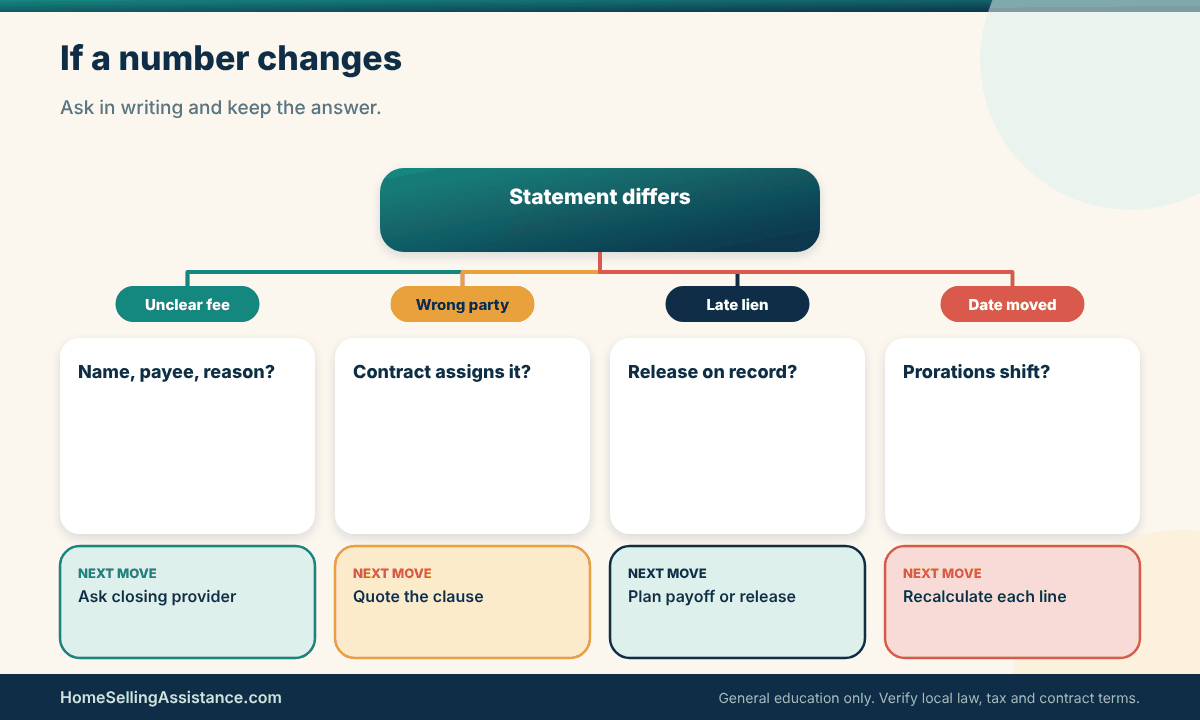
Suppose your draft statement includes a line you do not recognize, perhaps a courier fee, a document preparation charge or a release tracking fee. Small fees like these are common, and many are legitimate. But a legitimate fee should have a name, a payee and a reason. If you cannot get all three from the closing provider, that is a reason to ask again before you sign.
The exception is a charge that looks wrong because it was assigned to the wrong party. A fee that the contract places on the buyer should not appear on your side, and a credit you negotiated should appear where the contract says. Contracts and statements are written by different people at different times, and clerical mismatches happen. Pointing to the specific clause usually resolves them quickly.
Your next step is to highlight any unexplained line on the draft statement and send a short written question to the closing provider, quoting the clause or number. Ask for a revised statement if the answer changes anything. This gives you a record, keeps the tone factual and helps avoid the pressure of resolving questions at the table, when everyone is hurrying.
How seller closing costs vary by state and county. The same sale can produce a different list of charges depending on where the property sits. Some states close through escrow companies, others through attorneys, and others through title agents, and each model prices and describes its services differently. Some jurisdictions tax the transfer of real property, and some do not. Customs about who buys the owner’s title policy, who pays the escrow fee and how taxes are prorated differ even between neighboring counties.
For that reason, we avoid giving local numbers here and suggest a simple verification routine. Call a title or escrow company that regularly closes in your county and ask what seller-side charges it typically itemizes. Check your state’s real estate commission or department of real estate for consumer guidance. For transfer taxes and recording fees, the county recorder or state revenue office publishes schedules. A real estate attorney can explain statutes that affect seller closing costs in your state.
Be careful with cross-state comparisons. A relocating seller may hear that “closing costs” in the new state are lower or higher than in the old one. The two figures usually include different things, and the buyer-side and seller-side items are often blended together. Compare like with like by asking each provider for seller-side lines only, and by naming the same sale price in both requests.
Reporting and withholding that can touch your closing. Closing providers handle certain federal reporting. The settlement agent generally reports real estate sales to the IRS on a form called a 1099-S unless an exception applies, and may ask you for information or a certification to complete it. Sellers who are not US persons can face federal withholding rules under a law commonly called FIRPTA, and some states have their own withholding rules for non-resident sellers. These are general descriptions, and your closing provider or a tax professional can tell you what applies to you.
It helps to understand why these items appear on your radar at closing even though they are not fees. A withholding amount, if one applies, reduces the cash you receive at closing even though it may later be credited against taxes you owe. Because it changes the cash you see, treat any withholding as a line in your seller closing costs worksheet, labelled separately, and ask the closing provider to explain it.
For the tax outcome of the sale itself, such as whether any gain is excluded, review the home sale capital gains exclusion and the IRS’s guide in Publication 523. The well-known federal rule is that qualifying sellers who meet the ownership and use tests, generally two of the last five years, may exclude up to a stated amount of gain, and whether you qualify depends on your facts. A tax professional can apply the rule to you.
Special situations that change the cost list. Estates, divorces, co-owned homes, short sales and sales of rental property add documents, approvals and sometimes court steps. A personal representative selling an estate property may need to provide proof of authority, and closing providers often ask for specific papers before they can issue a title policy. Our article on estate home sale closing explains those documents, and the same logic applies to other multi-party sales.
When two or more owners are involved, each owner’s share of proceeds, each owner’s payoff obligations and each owner’s tax situation may differ. Ask the closing provider how they will handle disbursement and what each owner must sign. If owners disagree, an attorney is likely to be needed. The point for seller closing costs is that extra signers and approvals take time, and delays can alter prorations and payoff interest.
If your loan balance may exceed what the home will sell for, the structure of the transaction changes dramatically, because the lender must agree to accept less than the full payoff. That is a distinct process with its own rules, and nothing in this guide should be read as describing it fully. A HUD-approved housing counselor, found through HUD’s counselor directory, can explain options without charging for general counseling.
What to say: scripts for getting real numbers. Good questions are specific. To your lender, you might say, “Please send a written payoff statement for a closing date of the fifteenth, with the per-day interest figure and any fees, and tell me how and when you will release the lien.” This short request names the date, the document and the release step, which are the three things sellers most often miss.
To the title or escrow company, you might say, “Please send a seller-side estimate for this contract, with each charge on its own line and a note of which lines are firm and which are projected. Which charges does the contract assign to the seller?” To your broker, you might say, “Please show me a net comparison for each offer, with every credit and fee, using the same closing date.” Seller closing costs become much easier to understand when everyone answers the same question in the same format.
To an association manager, you might say, “What documents and fees are required for a resale, who pays each one under the governing documents, and how long does delivery take?” And to anyone who proposes a fee you do not recognize, you might say, “Can you tell me what this charge is for, who receives it and where it appears in the contract?” These questions are polite and unemotional, and they help both sides.
A week-by-week checkpoint list. Here is one way to pace the verification work once you are under contract. The steps are general and should be adjusted to your actual dates. In the first week, open title and escrow, order the payoff statement, request any association documents and calendar every contract deadline. This is when you ask for the first written seller-side estimate and compare it to your seller closing costs worksheet.
During the middle weeks, handle inspection and appraisal outcomes, decide on repairs or credits in writing, and update the seller closing costs worksheet whenever the contract changes. Watch the title work for liens or ownership questions, and respond promptly to requests for signatures or information. Seller closing costs can shift in these weeks more than at any other point, so keep the worksheet current instead of trusting an old figure.
In the final week, ask for the draft statement, compare it line by line, confirm the payoff and any per-day interest with the lender, verify the wiring or check arrangements by phone, and plan the final walk-through, utilities and keys. On closing day, bring identification and any documents the closing provider requested, and read before signing. If something is wrong, ask for a correction before you sign instead of afterward.
After closing: records and loose ends. Keep a copy of the final statement, the deed, the payoff confirmation and any lien release. These papers support your tax return, answer questions if a title issue surfaces later and help you confirm that your lender has recorded the satisfaction of its mortgage. Lien releases can take time to be recorded, so note the date you expect them and follow up if they do not arrive.
Cancel or transfer utilities and insurance as of the closing date, and confirm that your final property tax or association bills, if any, were handled in the proration. If you notice a mistake in the statement after closing, contact the closing provider right away, because early reports are easier to resolve. Understanding seller closing costs does not end at the table, but a clean file makes the rest simple.
Finally, consider what the experience taught you. If you will buy another property, the same method applies on the buyer side, with a different list of lines. If you will sell again someday, your worksheet becomes a template. And if friends ask what seller closing costs look like, you can honestly say that it depends, and then show them how to find out.
Reading the vocabulary on your statement. A glossary helps because the same seller closing costs can be labelled differently by different providers. Payoff means the amount needed to satisfy a loan in full on a stated date. A lien release is the recorded proof that a debt no longer attaches to the property. Escrow means a neutral party holds money and documents until conditions are met. Settlement is another word for the closing process, and disbursement is the act of paying out the funds.
Proration means dividing a recurring bill by days of ownership. A credit is an amount that reduces what one party owes, such as a repair credit to the buyer. A holdback is money the closing provider keeps temporarily because something remains unresolved, such as a final utility bill or a recording confirmation. If a statement uses a term you do not recognize, ask for the plain meaning, since seller closing costs are easier to check when the words are clear.
Seller closing costs when you sell without a listing broker. A sale by owner changes the cost list rather than removing it. You may avoid a listing-side fee, but you can still face compensation offered to a buyer’s broker, document preparation, attorney review, a flat-fee listing service and the usual payoff, title and recording lines. The question to ask is the same as for any route: what does each line cost, who is paid and what does it protect?
Because no broker is building the seller closing costs worksheet for you, your own estimate matters even more. Ask a title company or attorney early what they will prepare, what the seller-side lines look like and what must be recorded. Our overview of closing costs and net proceeds collects the related guides, and the sale-by-owner library in our guides on routes to market explains paperwork you might otherwise miss.
Planning cash for your next purchase. Many sellers are also buyers, and the timing of seller closing costs and proceeds can decide whether the next purchase works. If you plan to use proceeds for a down payment, build in a margin for the lines that can move, particularly credits, prorations and per-day payoff interest. A cushion costs nothing if it turns out unnecessary, and it can prevent a scramble if a figure rises.
Ask both closing providers whether the sale and purchase can be coordinated and whether funds will be available when the second closing needs them. Same-day closings depend on funding and recording steps that are not always under your control. Our guides on selling and buying at the same time cover the options, such as flexible closing dates and rent-back arrangements, and our flexible closing date article explains how timing flexibility affects cost.
Questions to ask about each type of cost. For every line in your seller closing costs worksheet, five questions are enough. What is this charge for? Who receives it? Which contract clause or public schedule supports it? Can it change before closing, and what would change it? What document will I receive that proves it was paid? Writing the answers beside each line turns a vague total into an auditable record.
Apply the questions especially to lines that arrive late, such as courier charges, release tracking fees and last-minute credits. Legitimate charges survive these questions easily, and ones that do not are worth a second look. You are not accusing anyone by asking. You are doing what any careful person does before signing a document that moves a large amount of money.
Why contingencies and earnest money matter to the estimate. Contract deadlines for inspection, appraisal and financing shape when credits and repairs are decided, and therefore when your seller closing costs stop moving. Earnest money, the deposit a buyer makes after signing, is usually credited toward the buyer’s side at closing, and the contract controls what happens to it if the deal ends. For background, see our guides to home sale contingencies and earnest money for sellers.
One practical rule follows. Treat your seller closing costs estimate as provisional until the last contingency has been removed or has expired, then refresh it. After that point the main remaining movers are the closing date, the final payoff and the proration inputs, which are easier to verify than a negotiation. Seller closing costs tend to settle quickly once the contract is firm, so a refresh at that moment is the most valuable of all.
Connecting costs to taxes and records. Your tax situation after a sale is a separate analysis from closing, but the paperwork overlaps. The closing statement is the main record of the amount realized and of selling expenses, and your records of purchase price and improvements form the other half of the picture. Our hub on home sale taxes collects the tax-side guides, and the adjusted basis article explains why improvement records matter.
If tax questions arise, a qualified tax professional can help, and the IRS publishes plain-language material in Publication 523. We keep this guide to the cost side because seller closing costs are the part you can verify before the sale, while tax outcomes depend on facts that may not be known until later.
A short list of professionals and what each can confirm. Your lender can confirm the payoff, any prepayment terms and the lien release process. Your closing provider can confirm the fee schedule, the title work, the statement and the disbursement method. Your listing broker can confirm compensation terms and negotiation history. An attorney can confirm what state law and your contract require, and a tax professional can address the effect of the sale on your return. Each is useful for specific seller closing costs questions and none can answer every one.
If you cannot tell whom to call, start with the closing provider, who sees the numbers from every side. They are neutral in principle and have no stake in your sale price, and they will usually tell you whom to contact for anything outside their scope. A single well-aimed call to them often does more for your confidence than hours of reading.
Frequently asked questions about seller closing costs
What are seller closing costs?
Seller closing costs are the charges, credits and deductions that come out of a seller’s side of the transaction at closing. They typically include the mortgage payoff, broker compensation, title and escrow charges, transfer or recording items, prorations and any credits to the buyer. Which items apply depends on your contract, your location and your property. The final statement from the closing provider is the document that shows them all.
Is there a standard percentage for seller closing costs?
No single percentage applies everywhere. Published ranges blend different states, price levels and contract structures, and many of the biggest lines, such as payoff, are not percentages at all. A fair estimate comes from adding actual line items with sources. If someone quotes you a percentage, ask what is included and what it is based on.
Who pays seller closing costs, the seller or the buyer?
The purchase contract assigns each cost, and local custom fills any gaps. Some charges customarily fall on the seller in one region and on the buyer in another. Credits negotiated during the sale can also shift costs between the parties. Check the contract and ask a local title company or attorney how custom works in your county.
Is the mortgage payoff part of seller closing costs?
Many sellers count it because it is deducted from the proceeds at closing, though strictly it is repayment of your own debt rather than a fee. Either way, it belongs in your estimate. The payoff differs from your statement balance because interest accrues daily, so ask your lender for a written payoff statement with a per-day amount for your expected closing date.
How can I estimate my seller closing costs before I list?
Collect five inputs: a sale price range based on current comparable sales, a payoff figure, your expected broker compensation, a title and escrow quote for your county, and a budget for credits. Then add prorations and any known liens or association charges. Mark each figure as firm, projected or unknown, and update it when you receive an offer. Our calculator method shows a format.
Can I negotiate seller closing costs?
Some of them, yes. Broker compensation, credits to the buyer and certain third-party fees are commonly negotiable, while taxes and government recording charges are not. Getting two written quotes for negotiable services is a practical way to compare. Any agreement to change a cost should be put in writing and reflected in the contract.
Will I get a statement showing the final numbers before closing?
Ask for one. Many closing providers can send a draft a few days in advance, though practice varies. Reviewing the draft at home against your worksheet is calmer than reviewing it at the table. If anything is unclear, ask for a corrected statement before you sign.
What if the final seller closing costs are higher than my estimate?
First find which lines differ and why. Common reasons are a changed closing date, a credit agreed after the estimate, an updated payoff or a lien that surfaced late. Compare the statement to the contract and ask the closing provider to explain any line you cannot match. If the contract does not support a charge, request a correction in writing.
When do I receive my money after closing?
Timing depends on when the buyer’s funds are received, when the transaction is recorded and how your closing provider disburses proceeds. Some sellers receive funds the same day by wire, while others wait longer, particularly when a check is used. Ask in advance how and when you will be paid. Our guide on when the seller gets money after closing explains the usual patterns.
Do seller closing costs affect my taxes?
They can, because selling expenses may reduce the amount realized when gain is calculated, and some items have their own reporting. The result depends on your facts, so treat this as general education only. The IRS explains the basics in Publication 523, and a qualified tax professional can apply them to your sale.
Build it from the line items
The most reliable way to understand seller closing costs is to stop searching for the one right percentage and start collecting the real numbers, each with a source and a date. Ask short questions, put answers in writing, compare the final statement with your worksheet and verify payment instructions by phone. This guide is general education, not legal, tax or financial advice, so confirm the details for your own sale with your contract, your closing provider and licensed professionals in your state.