
Every cash offer for house seller decision begins with the same uncomfortable question: is a faster, simpler, more certain sale worth a lower number on the page? There is no universal answer, because the right choice depends on your loan balance, the condition of the house, your calendar and how much stress you can carry. This guide helps you compare a cash buyer against the other ways to sell, using price, net proceeds, certainty, timeline and buyer risk as your yardsticks.
The phrase “cash offer” sounds more precise than it is. It can describe an individual who has savings, an investment company that buys and renovates, a national iBuyer with a pricing algorithm, an auction bidder, or a relative with a trust account. What they share is one feature: the buyer is not asking a mortgage lender for permission. That removes one source of delay, but it does not remove the title search, the inspection, the survey, the signature requirements or the possibility that the buyer simply cannot perform.
Think of this article as a cash offer for house seller reference you can return to at three moments: before you talk to anyone, when the first offer arrives, and in the week before closing. The questions are the same each time, but the answers get sharper as facts come in. Sellers who revisit their notes at each stage tend to catch changes in the deal early, when a conversation can still fix them.
Sellers often meet a cash buyer at a stressful moment: an inherited house, a divorce, a job transfer, a failed first listing, a roof that leaked all winter. Marketing aimed at those moments is built to feel like relief. Relief is a fair thing to want. But a sensible cash offer and alternative sale route comparison asks what the relief costs, who stands behind the promise, and what happens if the deal falls apart in week three.
A cash offer for house seller can also arrive without warning. Letters, texts, door knocks and online forms all promise a quick number. Some come from legitimate local buyers. Others are lead-generation services that sell your details to whoever pays. Neither is automatically bad, but you should know which one is on the line, because a lead collector cannot promise anything about price or closing.
This is the cornerstone of our cash-offer cluster, so it stays at roadmap level and points you toward deeper guides on iBuyers, investors, proof of funds, auctions, off-market sales, family sales and “close in days” claims. You will find a clear way to define your goal, a fair map of the selling paths, a plain look at what moves the numbers, and a verification roadmap for documents, professionals and timing. Nothing here is a prediction of what your house will sell for.
Key takeaways
- Cash means no lender, not no risk. Title, inspection, contract terms and the buyer’s ability to perform still decide whether the sale closes.
- Compare net proceeds, not headline prices. A lower offer with fewer costs and no repairs can beat a higher listing price, and sometimes it cannot. Only your own line-item math settles it.
- Certainty has a price, and it is negotiable. The discount a buyer asks for depends on your house, your market and how many competing options you actually have.
- Verify the buyer before you sign. Check the legal entity, the funds, the contract and the title company, and never pay an upfront fee to a buyer.
- Rules vary by state and by contract. Disclosure, assignment, agency and closing rules differ, so confirm with official sources and a licensed professional where stakes are high.
Start with the seller decision, not the cash offer for house seller jargon
Terms like “as-is,” “wholesale,” “double close,” “reserve,” “proof of funds” and “assignment” matter, and we will explain the ones that matter most. But jargon is the wrong place to begin. The right place is a short written statement of what you need from this sale. Once that exists, every offer, from any kind of buyer, can be held up against it. That discipline is what keeps a cash offer for house seller comparison honest.
Questions in a cash offer for house seller conversation often sound urgent because the person asking them benefits from your speed. That is not an accusation. Plenty of buyers are straightforward and fair. It is simply a reason to build your own framework first. If you hold the framework, a buyer’s pitch becomes one input among several, rather than the thing that tells you what to want.
Define your goal, constraints, and property situation before any cash offer arrives
Goals sound similar until you write them down. “Sell fast” might mean closing before a lease on your next place begins, stopping a carrying cost that is draining savings, or simply ending months of showings. “Get the most money” might mean the highest sale price, or the largest check after paying off a loan and fixing a roof. Naming which version you mean changes which offer looks attractive. Small facts like this decide whether a cash offer for house seller deal holds together.
Constraints are the facts you cannot negotiate with. A mortgage payoff that nearly equals the value of the house leaves little room for a discount. A co-owner who has not agreed to sell blocks every route, not just cash. A pending foreclosure date, an estate that has not yet been opened, or a tenant with a lease can add deadlines or permissions that no buyer can wave away. Listing these first keeps you from falling for an offer you cannot legally accept.
One constraint is worth special mention: authority. Every owner on the deed generally has to sign, and in some situations a spouse who is not on the deed still has rights. Trusts, estates and powers of attorney each have their own rules about who can act. A buyer cannot fix an authority problem, and a cash offer for house seller plans built on a missing signature will stall at the title company no matter how fast the buyer wants to move.
Property situation covers the physical and legal condition of the home. Does it have a failed septic system, old wiring, an unpermitted addition, foundation movement, a roof near the end of its life? Is there a lien, an unpaid contractor, a code violation, a missing heir? Buyers who pay cash often target houses with some of these issues, and they price accordingly. If you do not know what is wrong, they will assume the worst, and the offer will reflect that assumption.
Finally, think about tolerance for uncertainty. Some sellers can live with a house on the market for two months and a deal that might collapse. Others would trade a meaningful amount of money for a signed contract and a closing date they can plan around. Neither temperament is wrong. Knowing yours keeps a salesperson’s urgency from deciding for you. If you are still working out the overall sequence of a sale, our complete guide to how to sell a house lays out every stage.
It also helps to separate wants from needs. A need is a hard date, a minimum amount to clear a loan, or a requirement to move a family member. A want is a particular price you saw next door or a belief that you deserve a bidding war. Both are human. A cash offer for house seller choice becomes much easier once you can say which items on your list are needs.
Evidence to gather: the numbers behind your goal
Start with the payoff. Call your mortgage servicer and ask for a written payoff quote that is good through a specific date, including interest to that date and any fees. The statement balance on your monthly bill is not the payoff. If you have a home equity line, a second mortgage, a tax lien, a judgment or an unpaid assessment, list each one. Together these define the minimum price at which you can sell and still walk away without bringing money to the table.
Do not forget the quieter obligations. Unpaid property taxes, contractor claims, code citations and association fines can all attach to a property and surface during the title search. If you suspect any, ask the county or the association for a written statement rather than waiting for the buyer’s title company to find it. Clearing a small problem before a cash offer for house seller negotiations begin gives you leverage instead of an apology to make.
Next, estimate what the house would be worth in a normal sale. A licensed agent can prepare a comparative market analysis, often at no charge, and an appraiser can provide an independent opinion for a fee. Online estimates are a starting point at best. Ask for the recent comparable sales behind any number, check how similar those homes really are to yours, and note the date of each sale. A figure you cannot trace to specific sales is a guess.
If you can afford it, an independent appraisal gives you a benchmark that neither a buyer nor an agent controls. It will not guarantee what anyone pays, but it shows what a lender-style analysis might conclude. Many sellers use it only when the stakes are high, such as an estate with several heirs. For a simpler cash offer for house seller comparison, two agent opinions and your own review of recent sales can be enough.
Then price your condition. Ask two or three licensed contractors for written estimates on the items you suspect: roof, heating and cooling, plumbing, electrical, foundation, drainage, mold, sewer line. A cash buyer will use their own repair numbers, so your estimates give you a reality check. If a buyer subtracts far more than local contractors would charge, you can ask them to explain line by line, and you can decide whether their margin or their risk cushion is the reason.
Last, write down your timeline in dates. When must you be out? When does your next closing happen, if you are buying? When does a lease end, a school year start, a tax bill come due, a foreclosure sale date arrive? Calendar dates turn a vague wish for speed into something you can test. A buyer who promises a closing in seven days is only useful if the title company, your payoff lender and your own moving plans can actually keep that pace.
Include dates that belong to other people. A buyer’s lender, a landlord, a court clerk, a school registrar and an employer all keep calendars that interact with yours. Put them on one page. A cash offer for house seller timeline that looks perfect on its own can collide with a lease ending, a probate hearing or a tax deadline, and you want to find that collision in week one rather than week five.
A scenario, an exception, and your next step on goals
Picture a seller with a modest house, a mortgage and a bad roof. In this illustrative example, an investor offers a round number that sounds low compared with a neighbor’s sale, but the neighbor’s house had a new roof and updated kitchen. After subtracting roof cost, agent fees, a few months of carrying costs and likely buyer concessions, the gap between the investor and a listing narrows. It might still favor listing. The point is that the comparison only works when both sides are built the same way.
Now an exception. Suppose the seller is a personal representative of an estate with three heirs spread across the country, and one lives overseas. Speed matters less than clean authority and clear communication. A buyer who offers fast cash but wants signatures on a tight schedule may be unworkable, while a slower route with a court-supervised process may be the only one that holds up. The cash label tells you nothing about whether the paperwork can be done. Our guide to selling an inherited house covers that terrain.
Your next step is small and concrete. Write one paragraph that states your top priority, your second priority and your hard deadline. Add your payoff figure and your honest estimate of repairs. Keep it where you can see it when the phone rings. When an offer arrives, read it against that paragraph before you read it against anyone’s sales pitch, and share that paragraph with any professional you consult so their advice is aimed at your actual goal.
If you share the paragraph with a spouse, co-owner or heir, ask them to correct it. Misaligned goals are one of the most common reasons good offers fail inside a family. Two owners can want opposite things, one wanting speed and one wanting top price, and a buyer will happily exploit the disagreement. Agreeing first protects every cash offer for house seller conversation that follows.
Map the main selling paths a cash buyer is competing against
A cash buyer is never your only option, even when it feels that way. The honest comparison includes a traditional listing with an agent, a for-sale-by-owner sale, a flat-fee or limited-service listing, an auction, a private off-market sale, and a sale to someone you know. Each path hands you a different bundle of price potential, speed, effort and exposure to risk. The picture below shows the fork most sellers face. Keep this in mind whenever a cash offer for house seller pitch sounds unusually smooth.

A traditional listing generally offers the widest exposure to buyers, many of whom use financing. That can support a higher price, but it brings showings, inspections, appraisals and the chance that a loan falls through. Compensation for agents is negotiable and must be put in writing, so the cost depends on what you agree to, not on a standard rate. Our iBuyer versus agent comparison shows how those costs and conveniences line up against an instant offer.
A for-sale-by-owner sale can reduce one cost but moves the work to you: pricing, marketing, screening, negotiating, disclosures and coordinating the closing. It suits people with time, confidence and good local advice. A cash buyer in that setting may well appear on your doorstep anyway. Some sellers use the cash offer as a price floor while testing the open market for a short, defined period, which is a legitimate approach if the contract and timing allow it.
Flat-fee and limited-service listings sit between these options. You pay for specific services, such as getting the home on the local listing service, and handle the rest yourself. They can lower costs and increase exposure, but the agreement should state clearly who negotiates, who handles paperwork and what happens if a buyer’s agent asks for compensation. A cash offer for house seller comparison should include this middle path.
Investor offers and iBuyer offers are both cash-like, but they are different animals. An investor typically wants a discount large enough to cover repairs, holding time and profit. An iBuyer typically prices from data, may charge a service fee and may revise the offer after an inspection. We compare these in detail in our guide to investor offers versus listing. Neither is automatically better, and neither is automatically a bad deal. Sellers who check this early tend to feel calmer about any cash offer for house seller decision.
Auctions bring a fixed date and a competitive process, but price depends on who shows up, and fees, reserves and buyer premiums vary; see home auction versus listing and absolute versus reserve auctions. Off-market sales protect privacy and reduce showings, but they limit price discovery because fewer buyers see the home. A family sale can be warm and simple, yet it raises appraisal, gift and financing questions. It is a modest step, yet it shapes the whole cash offer for house seller conversation.
Each of these routes can also be combined. A seller might list for a defined period and then accept a cash buyer if the market is quiet. Another might run a private outreach to a few investors while keeping an agent in the background. Mixed strategies are common, but contracts matter: an exclusive listing agreement can restrict private sales, so a cash offer for house seller plan should begin with a careful read of any agreement you have already signed.
Evidence to gather: what each route really delivers
To compare routes fairly, ask each one for the same set of facts in writing. For a listing, request a pricing recommendation with comparable sales, a marketing plan, the proposed compensation and the length and cancellation terms of the listing agreement. For a cash buyer, request a written offer that states the price, the closing date, who pays which costs, the deposit, inspection rights, and any right to cancel or assign the contract. Offers that live only in a phone call cannot be compared.
Turn each into a rough net figure using the same line items. Start with the price, then subtract your payoff, any compensation you agreed to pay, title and escrow charges you are responsible for, repair credits, prorated taxes and association dues, and any liens. Do the same for the cash offer. The differences will surprise you in both directions. Some cash offers say “no fees” but build the fees into the price. Some listings look rich until costs and concessions are counted.
If a number looks too good, ask which line item hides the cost. A buyer who offers a high price and also asks the seller to pay the buyer’s closing costs, handle all repairs and extend a long inspection window has changed the effective price. Writing every concession as a dollar figure turns a persuasive cash offer for house seller headline into something you can compare against a simple listing.
Add time as a cost. A month of mortgage interest, taxes, insurance, utilities and upkeep is a real number you can calculate from your own bills. If a listing path plausibly takes longer than a cash path, multiply the extra months by your monthly carrying cost and subtract it from the listing side. If the cash path has a realistic chance of dragging or failing, give it a similar haircut. Time cuts both ways, and honest math includes both.
Finally, write down the failure case for each route. If the listing buyer’s loan fails, what is your fallback? If the cash buyer cannot close, what happens to the days you lost and the house’s market history? A route is only as good as its worst reasonable outcome. Our guide to home sale contingencies explains the contract terms that decide who bears these risks. This is where a careful cash offer for house seller review earns its keep.
Failure does not always mean a collapse. It can mean a delay of two weeks that costs you a lease deposit, or a renegotiation after the inspection that trims your price. Ask buyers how often their deals change after the contract is signed and what typically causes it. Honest answers about retrades, as they are sometimes called, tell you more about a cash offer for house seller than a polished brochure.
A scenario where the cash route wins and one where it loses
Here is a case where cash can win. In this illustrative example, a seller has a dated house with a failing septic system, an older roof and a tenant who moved out leaving damage. Repairs would take months and cash the seller does not have. A reputable buyer offers a figure that looks low, but it comes with a firm date, no repairs and no showings. After honest math, the seller nets less than a perfect sale would, but more than a stalled, expensive project would. Many sellers in that spot choose certainty, and reasonably so.
Here is a case where it can lose. A seller with a clean, updated house in a market with several active buyers gets an unsolicited cash offer that arrives the day after a neighbor’s sale. The offer carries a discount that exceeds what a standard listing would cost, and the seller has no deadline. Listing for a few weeks costs a modest amount of carrying expense and exposes the house to many buyers. Here the cash offer works best as a benchmark rather than a destination.
There are also cases that look like wins and turn out to be traps. A buyer who offers a high price but inserts a long inspection period, a broad right to cancel and a right to assign the contract has given themselves an option, not a commitment. If they find a better deal or cannot resell the contract, they walk and you have lost weeks. A lower price with firm terms can be the stronger offer, which is why our guide to evaluating a home offer looks past the number.
One more scenario: the buyer who asks for a long closing so they can line up their own resale. This can be fine if you are paid a fair price and your costs during the wait are covered. It is less fine if you carry the mortgage and taxes for months with no protection. A cash offer for house seller contract that lets the buyer extend freely without compensating you shifts risk onto your shoulders.
Your next step is to ask any cash buyer for their standard contract before you discuss price in detail. Read the cancellation, assignment, deposit and closing-date clauses first. If something is unclear, a real estate attorney or a title company can explain it before you sign anything. Ask the buyer how many similar purchases they have completed recently and with which title company, and then check the answers independently. Write the answer down, because a cash offer for house seller file works best when it is specific.
What changes price, time, risk, and net proceeds in a cash offer for house seller decisions
Four dials move together whenever you sell. Price is what the buyer agrees to pay. Time is how long the process takes and how reliably. Risk is the chance that something breaks along the way. Net proceeds is what actually reaches your account after payoffs, fees, credits and taxes. A cash offer for house seller situations usually turns the time and risk dials in your favor and turns the price dial against you, but the size of each move is specific to the buyer and the deal.
Because the dials interact, one-number comparisons mislead. A high price with a slow, fragile closing can deliver less than a modest price with a firm date. A low price with a hidden fee schedule can deliver less than it first appears. The next two sections separate the variables that matter so you can test any offer against each one, instead of reacting to the figure at the top of the page. None of this is hard, but it is easy to skip when a cash offer for house seller deadline looms.
A helpful habit is to name which dial each decision touches. Fixing a leaky roof touches price and risk. Accepting a shorter closing touches time and net proceeds. Choosing a buyer with a smaller deposit touches risk. When you see the dials moving together, a cash offer for house seller choice stops feeling mysterious and starts looking like a series of small trade-offs you can weigh one at a time.
Market, condition, contract, and buyer variables that move the offer
Four kinds of variables shape what any buyer will pay and how the deal behaves. Market variables are outside your control: local demand, the number of similar homes for sale, interest rates and how quickly comparable homes have been selling. Condition variables are partly in your control: repairs, cleanliness, updates, odors, access. Contract variables live in the paper you sign. Buyer variables concern who is on the other side of the table and what they can actually deliver.
Market conditions change the value of certainty. When many buyers compete for few homes, a listing may produce multiple offers, and a discounted cash bid has less to offer. When homes sit and price reductions are common, a firm cash contract looks more attractive, and sellers often accept a smaller gap. National headlines rarely describe your street, so lean on recent local sales and the real-time experience of local agents rather than broad claims. Good records make every cash offer for house seller negotiation shorter and less tense.
Local timing matters too. Seasonal patterns, a nearby employer opening or closing, school boundary changes and new construction all influence how fast homes sell. A local agent will usually know these better than any national website. Treat their view as one input, ask for the data behind it, and remember that a cash offer for house seller decision made in a slow stretch can look very different from the same decision six months later.
The figure below sets the two sides of the usual trade-off next to each other. Treat it as a way to organize your own questions rather than a rulebook, because the contract language and local custom control the answers. Treat this as a standing rule for any cash offer for house seller you consider.
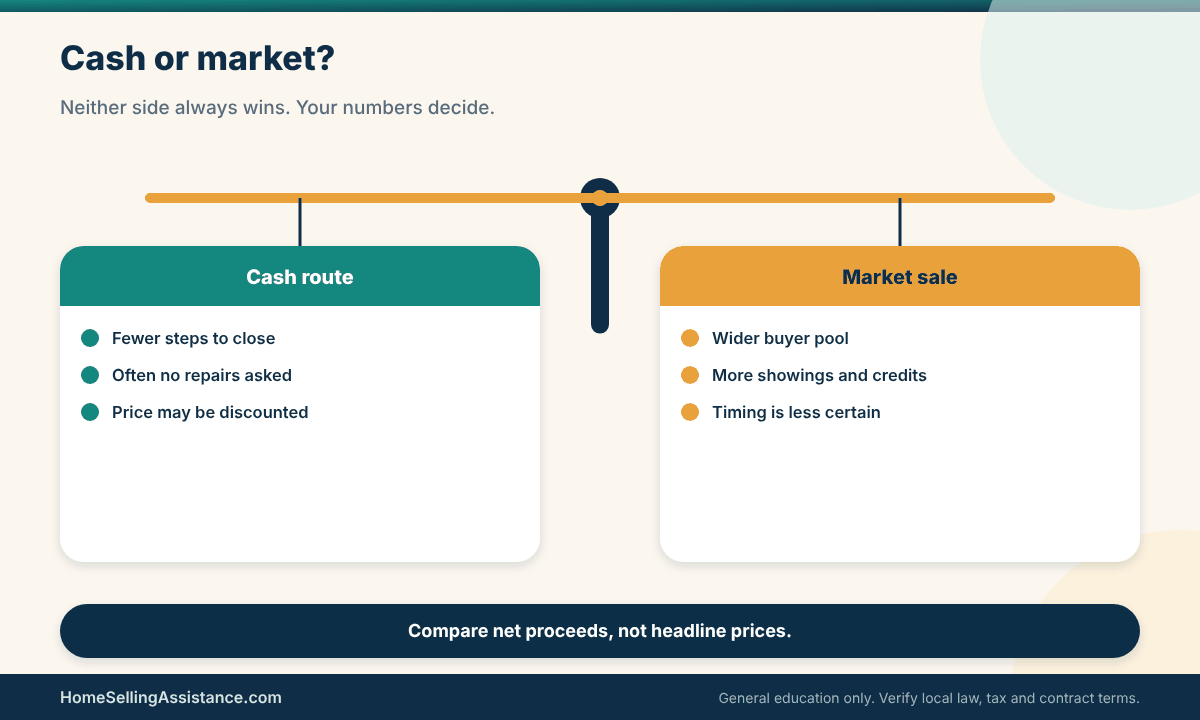
Condition variables decide how much of the buyer’s discount is actually repair money. Buyers often price a house as if everything unknown will go wrong, so documenting what you do know can narrow the gap. Receipts, permits, inspection reports and contractor quotes turn guesses into facts. A buyer who sees a documented new roof does not need to subtract a roof. A buyer who sees nothing may subtract a roof you do not need. The same logic applies to each cash offer for house seller you receive.
Presentation counts as well. A clean, decluttered house with working lights, clear access and a documented repair history gives a buyer fewer reasons to subtract. Even investors who buy houses in rough shape price risk, and uncertainty is a risk. A modest effort on cleaning and records can improve every cash offer for house seller comparison, because it narrows the assumptions a buyer has to make.
Contract variables are where cash offers differ most from one another. Look for the inspection or due diligence period, the right to cancel, the amount and refundability of the deposit, who chooses the title company, who pays closing costs, whether the buyer may assign the contract to someone else, and what happens if the closing date slips. Two offers with the same price can be wildly unequal once those terms are read.
Pay special attention to assignment. Some buyers sign a contract with the plan of passing it to another buyer for a fee, often called wholesaling. It is lawful in many places when disclosed and done properly, but rules differ, and the original buyer may have no intention of closing themselves. Ask directly whether the buyer will close in their own name. A clear answer belongs in every cash offer for house seller file.
Buyer variables are the final layer. Is the buyer an individual, a company, or a company that is itself backed by investors? How long have they operated? Can they show funds in the name of the entity that is signing? Are they using their own money or a short-term lender who might withdraw? Each answer shifts the real risk. Our guide on how to verify a cash buyer turns these questions into a checklist you can use.
Reputation is checkable. Ask for recent addresses the buyer has purchased, then look those up in county records, and speak with a title company that closed them. Online reviews can help but can also be curated. A buyer with real experience will not mind such checks. A cash offer for house seller negotiation with someone who resists verification is already telling you how the closing might feel.
Evidence to gather: comparing the offer to a market sale
To compare the offer with a market sale honestly, you need two documents that rarely exist at the start: a written offer and a written pricing opinion. Ask the buyer to put everything in a signed offer or letter of intent, including price, closing date, deposit, inspection rights, cost allocation and any fees. Ask an agent or appraiser for the recent comparable sales behind a market price. Without both, you are comparing a feeling with a sales pitch.
It may help to ask the buyer to explain how they arrived at their number. Investors often work backward from an expected resale price, subtract repairs, holding costs and a profit target, and offer what remains. If you understand that method, you can challenge individual assumptions. A cash offer for house seller discussion becomes a negotiation about inputs rather than a take-it-or-leave-it number.
Examine the comparables carefully. A comparable sale is useful only if it is similar in size, age, condition, lot and location, and recent enough to reflect current demand. If the comparables are in better condition than your house, subtract the cost to reach that condition. If they sold with concessions, note them. If the agent’s estimate leans on a single outlier, ask for more. This work protects you from both lowball offers and overoptimistic listings. That one habit improves nearly every cash offer for house seller comparison.
Pay attention to how recent and how local each comparable is. A sale from many months ago in a changing market may mislead, and a sale across a major road or school boundary may be a different market altogether. Ask your agent to explain why each comparable was chosen. Careful comparables make a cash offer for house seller analysis honest, and they protect you from relying on one flattering sale.
Next, ask what a market sale would realistically require from you. Would you need to repaint, fix a roof, remove stored items, replace flooring or provide a home warranty? Would buyers likely ask for repair credits after inspection? A buyer using a mortgage faces an appraisal, and an appraisal that comes in low can force a renegotiation. A cash buyer may not face an appraisal at all, though a cautious one may still order a valuation of their own.
Finally, separate verified facts from the buyer’s assumptions. If the offer reflects a repair estimate, ask for the itemized list. If it reflects resale expectations, ask what resale price they assume. You do not have to accept their numbers, but you deserve to see them. A buyer who will not explain a large discount is telling you something. A buyer who walks through it patiently, even if you disagree, is giving you data you can use. Few sellers do this, which is why it stands out in a cash offer for house seller review.
Keep notes on every conversation: date, name, what was promised, and what was put in writing. If a buyer says something verbally that matters, ask them to add it to the contract. Memory fades and pressure distorts it. A written record is the quiet backbone of any cash offer for house seller decision, particularly if a dispute arises later about what was agreed.
The table below turns the comparison into a decision aid for the most common seller situations. Each row names a situation, the one fact worth checking first, an action you can take this week, the trade-off you are accepting, and the document or source that backs it up. Read across the row that looks most like yours, then borrow the questions that fit. Ask the question plainly; a fair cash offer for house seller process can survive it.
| Situation | Key fact to check | Practical action | Trade-off | Source or document |
|---|---|---|---|---|
| House needs major repairs you cannot fund | Contractor estimates versus the buyer’s repair list | Get two written bids and ask the buyer to itemize their deductions | Lower price in exchange for no repairs or showings | Contractor bids; written offer |
| Clean, updated house in a busy market | Recent comparable sales and days on market | Treat the cash bid as a floor and test the market briefly | Carrying costs and showings versus a possible higher price | Agent pricing analysis; comparables |
| Hard move-out date or a next purchase | Buyer’s closing date and your payoff timing | Counter with the date you can truly meet, in writing | Buyer may lower the price for a later date | Payoff quote; contract closing clause |
| Little equity after the mortgage payoff | Payoff amount compared with the net from each option | Request a payoff quote and speak to your servicer early | Any discount may leave a shortfall at closing | Lender payoff letter; HUD-approved counselor |
| Estate or co-owned property | Who has legal authority to sign | Confirm authority with an attorney before accepting any offer | Fast buyers may not fit slow legal steps | Letters or court order; deed; trust papers |
| Unknown buyer with a rushed deadline | Entity name, funds and contract terms | Verify through the title company before signing or paying anything | Declining may mean losing a quick deal | Proof of funds; entity records; title company |
Use the table as a prompt, not a verdict. If you recognize two rows in your own life, such as little equity and a hard move-out date, combine their actions. Where a cell names a document you do not yet have, make getting it your first task. A decision built on documents holds up when the buyer’s story changes halfway through. This is the kind of detail a cash offer for house seller summary should never leave out.
A scenario with a repair-heavy house and an exception for hot markets
Imagine a seller with a house that has deferred maintenance throughout: old windows, a worn roof, a kitchen from another era. In this illustrative example, an investor offers a price well under a recently renovated house nearby. The seller prices a retail sale at the renovated number and then subtracts roof, windows and kitchen work, plus a modest allowance for buyers who will still ask for credits. The gap shrinks. The seller might still choose the investor for speed, but they now know what speed costs.
The exception arrives when the market is hot. In a market with strong demand, buyers often accept houses in rough shape and bid on them, because renovation is still profitable for them. A seller in that situation might do better exposing the house to many buyers, even without repairs, and selling “as is” through an agent. Our guide to selling a house as is explains how to disclose condition honestly while still marketing broadly. Put it on your checklist before the next cash offer for house seller call.
Even in a hot market, a quick cash sale can still make sense if you are short on time or have no funds for preparation. The key is to treat the offer as one bid among several. Letting a few qualified buyers see the home, even briefly, can reveal whether the cash offer for house seller you hold is competitive or merely convenient for the buyer.
Another exception: a seller whose house needs work but whose loan payoff leaves almost no equity. Any discount may push the sale below the payoff, which would require bringing cash or negotiating a short sale with the lender. A cash buyer who offers less than the payoff does not solve the problem, and a seller in that position should speak to the lender and consider a HUD-approved housing counselor before accepting anything. HUD’s counselor directory is a reasonable starting point.
Your next step here is to rank your priorities against the gap. If the gap between a discounted cash price and a market net is small, speed and certainty may be worth it. If it is large, ask whether a short, well-prepared listing or a negotiated counteroffer could close more of it. A good counteroffer asks for specific things: a higher price, a shorter inspection window, a larger deposit, or a clearer closing date. It costs little, and it protects the cash offer for house seller math you built.
Costs, legal and tax issues, logistics, and seller priorities
Money leaves a sale in several places, and cash offers rearrange where it goes. A traditional sale usually includes compensation to agents, repair credits, title and escrow charges, transfer or recording taxes in places that have them, and prorations of property taxes and association dues. A cash sale may remove some of these, shrink others, or shift them to the price. The label “no fees” deserves a direct question: whose fees, and where did they go? Notice how often this single point changes a cash offer for house seller outcome.
Remember that costs differ by region. Some places charge transfer or recording taxes, some split title fees by custom, and some expect the seller to cover specific items. A cash offer for house seller analysis that copies another state’s habits will mislead you. Your title or escrow company can provide an estimate of local seller charges and often does so at no charge before you sign.
Legal issues vary by state and by transaction. Disclosure duties may apply even to an as-is sale. Contract assignment may be allowed, restricted or regulated in your area. Some states regulate people who market contracts to other buyers. Rules about who must sign, how the deed is delivered and whether an attorney is required differ widely. We do not give state-specific legal advice here, but we can tell you how to find out: ask your state real estate commission, a licensed attorney in your state, and your title company.
Tax issues deserve respect too. Many homeowners can exclude part of the gain from a home sale if they meet the federal ownership and use tests: generally two of the last five years, with up to $250,000 of gain excluded for a single filer and $500,000 for joint filers who qualify. Whether that applies to you depends on your facts, including rental use, home office deductions, and prior sales. See IRS Publication 523 and consider a tax professional. Our guide to taxes when selling a home adds detail.
Logistics are the quiet cost. A buyer who offers a seven-day closing may expect you to be out in seven days. You may have belongings to move, a rental to find, pets, children, and utilities to switch. A buyer may agree to a rent-back or a flexible move-out date, but it should be in writing. If you need to stay longer, say so up front rather than after you sign. A slightly lower price with a comfortable move-out date can be worth more than a higher price that forces a scramble.
Think through the practical details: who will clear the house, what happens to items you leave behind, how utilities will be shut off and whether the buyer expects the home to be broom clean. Some cash buyers will take a house with belongings left inside, but that should be written down. A cash offer for house seller agreement that is silent about contents can create an argument at the final walk-through.
Seller priorities decide how all this balances. Someone who needs cash for a down payment on the next home cares about the closing date and the amount. Someone closing an estate cares about authority and documentation. Someone avoiding foreclosure cares about lender timelines and whether a sale will actually stop them. Our overview of home sale net proceeds shows how to line items up so priorities and numbers meet. Revisit it whenever a new cash offer for house seller term appears.
Evidence to gather: building the net proceeds sheet
A net proceeds sheet is a simple page with the same rows for every option. Start with the contract price at the top. Subtract your mortgage payoff and any other liens. Subtract the compensation you will owe any agent, if one is involved. Subtract your share of title, escrow and settlement charges. Subtract repair credits or the cost of repairs you will do yourself. Subtract prorated property taxes and association dues. Subtract any transfer taxes the seller customarily pays where you live. What remains is your estimate.
Keep a separate line for money you might receive after closing, such as a refund of prepaid insurance or a utility deposit. These amounts are usually small, but they belong in a complete picture. Another line to consider is the cost of any bridge or temporary housing you will need. Putting everything on one sheet turns a cash offer for house seller comparison into a decision you can explain to a spouse or co-owner.
The waterfall below shows the typical order. Each step is a quote or a document you can obtain, not a guess. Ask your title or escrow company for an estimated seller settlement statement, which many will prepare before you list or sign. It will list the charges that apply in your area. Our guide to seller closing costs explains the usual line items without assuming any percentage. Without it, a cash offer for house seller comparison is only a guess.

Then run the sheet at least three ways. Run it for the cash offer as written. Run it for a realistic market sale, with repairs and credits you would likely face. And run it for a low market sale, to see your downside. Seeing all three side by side reveals how sensitive your outcome is. If the cash offer lands inside the range of a market sale, the decision becomes about time, stress and certainty rather than money alone.
Be careful with fees disguised as services. A buyer may describe “closing cost coverage” while shaving the price by a similar amount. A service fee charged by an iBuyer may appear as a percentage or flat charge in the contract. A buyer may also reserve the right to renegotiate after inspection. None of these are illegal or necessarily unfair, but they should be visible. Add every one to the sheet so you compare like with like. The pattern repeats across almost every cash offer for house seller we see described.
Ask whether the offer includes any fee payable to a third party, such as a referral fee, a facilitation charge or a transaction coordinator. These may be legitimate, but they should be explained and disclosed in the contract. If a buyer is vague, ask the title company to confirm every charge on the settlement statement. A transparent cash offer for house seller deal has no mysteries on the closing paperwork.
A scenario on a tight move-out and how to handle it
Here is an illustrative example. A seller must relocate for work and has a new apartment lease beginning in three weeks. A cash buyer offers a closing in ten days, which is attractive, but the seller realizes they need at least two weeks to pack, hire movers and finish a short-term storage arrangement. Rather than accepting the date, the seller asks for a closing in three weeks and a modest rent-back of a few days. Many buyers will agree if asked early, because they want the deal too.
Now suppose the buyer refuses and insists on ten days. The seller has options. They can accept and rent temporary housing, which adds a cost to be subtracted from the offer. They can counter with a slightly lower price in exchange for the later date. Or they can compare the cash buyer to other routes and decide whether the ten-day schedule is worth the stress. The right move depends on how the numbers shake out, not on how urgent the buyer sounds.
It helps to remember that buyers also face constraints. An investor may have a contractor schedule, a short-term lender with a deadline or a resale plan that depends on timing. Understanding why a date matters to them can reveal room to trade. Offering a shorter inspection window in exchange for a longer closing, for example, may give both sides what they need in a cash offer for house seller contract.
Consider also the tax angle. If the sale closes in a different calendar year than expected, it can change reporting. Whether that matters depends on your facts, and a tax professional can say. Likewise, if you are buying a next home, a rushed sale without a plan for the proceeds can cause problems for your purchase. Our article on whether to sell first or buy first frames that choice, and it applies to cash sales too. This is why a cash offer for house seller plan should start with facts, not feelings.
Your next step is to build the timeline backward from your hard date. List the days needed for packing, moving, utility transfers, cleaning and final walk-through, then compare the total with the buyer’s proposed closing. If the dates do not fit, raise it at once. Asking early costs nothing, and a buyer who truly wants the house will often flex on dates before they flex on price. A buyer who will not discuss timing at all is giving you information about how the closing might go.
Turn the overview into a verification roadmap for your cash offer for house seller plan
Understanding the trade-offs is half the work. The other half is checking facts before they cost you money. A verification roadmap is nothing fancy: a list of things to confirm, in a sensible order, with a named person or document responsible for each. When a cash offer for house seller conversations start moving quickly, this list is what keeps you from skipping steps that feel optional but are not.
Verification is not a sign of distrust. Professional buyers and professional sellers do it as a matter of routine, and honest parties welcome it. If someone treats your questions as an insult, take note. The point of a roadmap is to make the cash offer for house seller process predictable, so surprises arrive early and cost little rather than late and cost a great deal.
The roadmap has three layers. First, confirm your side: who owns the home, what is owed, and what the house really needs. Second, confirm the buyer: who they are, whether the money exists, and what the contract allows. Third, confirm the process: which title or escrow company will handle the closing, which dates control, and what happens if one party cannot perform. The sections below take these in turn.
Documents and professionals to involve in a cash sale
You do not need a large team, but you do need the right few people. A title or escrow company holds the money and the deed in most transactions, runs the title search and prepares the settlement statement. A real estate attorney can review contracts, particularly in states where attorneys routinely handle closings. A licensed agent can price the house and run a competing path. A tax professional can answer questions about gain and reporting. Each plays a different part, and none replaces the others.
Be cautious with advice from people paid only if you pick a particular route. A buyer who earns a profit if you sell to them is not a neutral adviser about whether you should. An agent who earns compensation if you list is not neutral about listing either. That does not make either dishonest. It means you should ask each for the facts that would support their option and the facts that would argue against it, and then check independently.
One practical way to handle this is to ask each adviser for the strongest argument against their own recommendation. An honest professional will have one. A cash offer for house seller discussion that includes the downside of every option is far more reliable than one where every path sounds perfect, and you will find yourself trusting the people who answer plainly.
Documents come in two groups. Your documents establish what you can sell: the deed, the mortgage statement and payoff letter, property tax bills, association statements and rules if any, any survey you have, past inspection reports, receipts for work, permits and certificates of occupancy, warranties, lease agreements for tenants, and any trust or estate papers. Gathering them early shortens everything that follows and helps you answer a buyer’s questions without guesswork. Remember that a cash offer for house seller can be improved by asking, not only by accepting.
Keep both sets in a single place and share them with your title company early. Many sellers are surprised how much faster things move once the title company has the deed, payoff information and entity details in hand. A cash offer for house seller timeline depends heavily on how quickly these records flow, and the seller is often the only person who can start them.
The buyer’s documents establish what they can deliver: the full legal name of the buying entity, proof that funds are available in that name, the purchase contract with all addenda, and the name and contact details of the title company they propose. If the buyer is a company, you can check state business records for its registration. If the buyer uses a short-term lender, ask whether the funds are committed. Our guide on cash offer proof of funds explains what a credible document looks like and what it cannot prove.
If the buyer is a newly formed company, ask about the people behind it and whether the signer has authority to bind the entity. A one-person company with no track record is not necessarily a problem, but it raises questions about funds and follow-through. A cash offer for house seller deal with a thinly documented entity deserves extra verification from the title company before any money moves.
Evidence to gather: the paper trail on both sides
Begin with a folder, physical or digital, with a clear name for each document. Request your payoff letter, which lists the amount to satisfy the loan on a specific date and the instructions for wiring it. Request any association payoff or estoppel letter if applicable, which states dues and assessments owed. Pull your last property tax bill and note whether taxes are paid in advance or arrears in your area. These three items drive most of the numbers at closing.
Label the documents so a stranger could use them, because someone else will, whether it is an attorney, a title officer or an heir. Add the date you obtained each item, since payoff figures and estoppel letters expire. A tidy folder also signals seriousness to any buyer, and that tends to improve the tone of each cash offer for house seller conversation that follows.
The checklist below groups the documents most sellers need into three piles: ownership, money and condition. Gather what you can before the first showing or phone call, and mark what you still need to request. Keep a copy, since a cash offer for house seller dispute usually turns on paperwork.
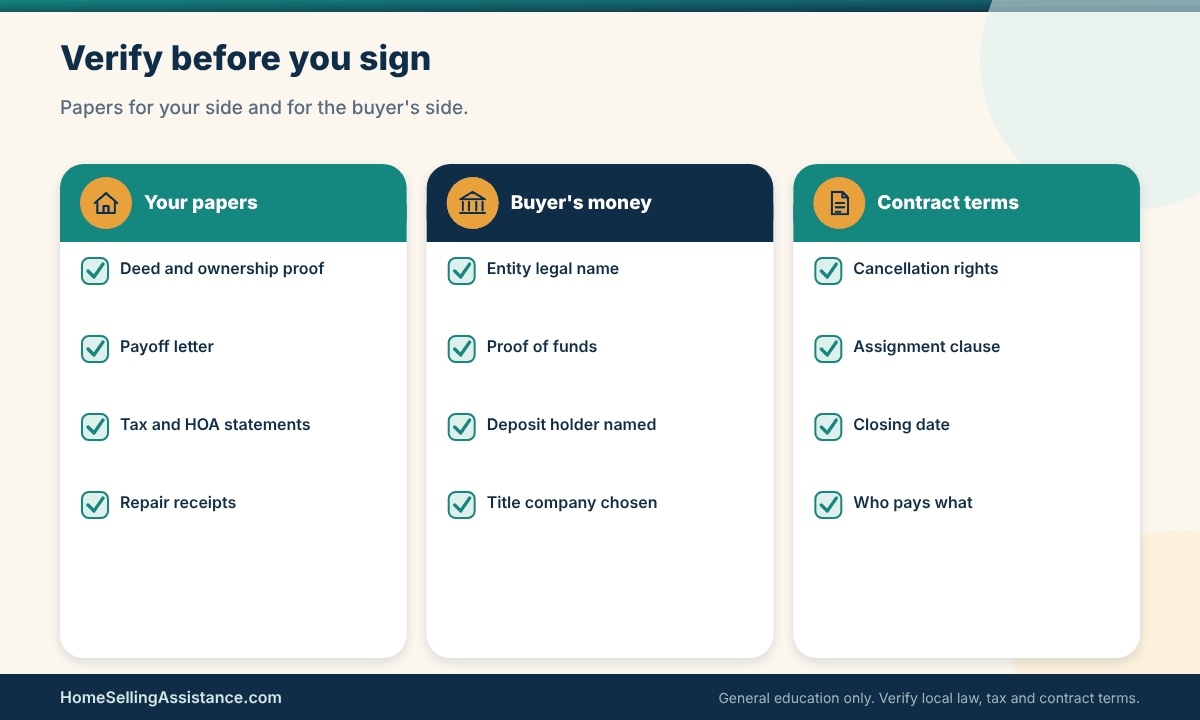
Then collect what shows condition. Gather inspection reports, repair invoices and permits. If you made changes without permits, find out what your local building department requires and whether the buyer or title company will care. If you know about a defect, such as a past leak or a pest issue, write it down. Disclosure rules differ by state, and cash or as-is does not always remove them. Our article on seller disclosure requirements explains how to find the rules for your location.
If your home was built before 1978, federal rules generally require you to provide buyers with a lead-based paint disclosure and an information pamphlet. Check the EPA page and your state requirements, and keep copies of what you provided. This applies whether the buyer pays cash or not, so a cash offer for house seller file for an older home should include it from the start.
Next, assemble the buyer’s file. Ask for the signed contract, the entity’s legal name and state of registration, the signer’s authority, and a proof-of-funds document. Compare names across documents: the buyer on the contract, the owner of the funds, and the party who will appear at closing should line up or have a clear explanation. Ask which title company will handle the closing and confirm it independently by calling a number you looked up yourself, not one the buyer gave you.
Be wary of last-minute changes to wiring instructions or payment details. Fraudsters sometimes impersonate title companies to redirect funds. Verify any change by phone using a number you found independently. The FBI’s Internet Crime Complaint Center collects reports of wire fraud. Protect every cash offer for house seller closing by treating payment instructions as sensitive.
Finally, add a timeline page. Put the effective date of the contract, the end of the inspection or due diligence period, the closing date, and your move-out date in a single list. Mark any date after which you lose money or rights. Share it with your title company and attorney so everyone works from the same dates. When dates drift, the page makes it obvious who caused the drift and what the contract says about it, which is where most disputes start.
A scenario with a title surprise and the next step
Consider an illustrative case. A seller accepts a cash offer on a house they have owned for decades. Midway through, the title company finds an old lien from a contractor who was never paid, plus a deed from a previous generation that was never recorded properly. The buyer, worried, cites a clause allowing cancellation if title is not clear by a certain date. The seller panics because they believed cash meant a simple closing. Calm questions like this are the backbone of a safe cash offer for house seller decision.
The tree below shows a simple fallback plan for the moment a buyer cannot close on schedule. It is worth sketching before you sign, because the contract language decides which branch you are on. Sellers rarely regret asking this during a cash offer for house seller review.

The next step is not panic but process. The seller asks the title company what is required to clear each item: a payoff and release for the lien, and perhaps a corrective document or court action for the deed. They ask how long each takes and what it costs. They share the answers with the buyer and propose an extension of the closing date in writing. Many buyers will agree if the path is clear, though nothing guarantees it, and a seller should read the contract for deadlines first.
An exception: some title problems cannot be fixed quickly, such as missing heirs or disputes between co-owners. In those cases a faster buyer is not the cure, because no buyer can close without clear title or without insurance that covers the defect. A seller facing this should consult a real estate attorney in their state. Our guide to title search for sellers explains what a search finds and why surprises are less rare than people expect. Take the time here, because a cash offer for house seller timeline rarely forgives gaps.
Some seller situations call for specific approaches. A property with a tenant, for example, brings lease rights that a buyer must respect or negotiate around. A cash offer for house seller plan that ignores the tenant’s rights may violate local law. Check tenant rules with your local housing authority or an attorney before promising vacant possession to anyone.
The transaction table below shows how stages and responsibilities fit together in a typical cash sale. Use it to see who must do what by when, and what your fallback is if a stage stalls. The details will differ with your contract and your state, so treat the rows as a framework to adapt rather than a promise of how your closing will run. It also gives you a fair benchmark for the next cash offer for house seller you see.
| Stage | Seller responsibility | Buyer or professional dependency | Typical deadline | Fallback if it stalls |
|---|---|---|---|---|
| Offer and contract | Compare terms and sign only what you understand | Buyer provides written terms and funds proof | Per offer expiry date | Counter, decline or request a different contract |
| Deposit and escrow | Confirm who holds the deposit and its refund terms | Title or escrow company receives funds | Soon after signing, per contract | Ask the company to confirm receipt in writing |
| Inspection or due diligence | Provide access and share known condition facts | Buyer inspects and may ask for credits or cancel | End of the contract review period | Negotiate credits, decline repairs or relist |
| Title and payoff | Order payoff letters; clear liens and defects | Title company searches and issues insurance | Before the closing date | Extend closing in writing while defects clear |
| Final figures and signing | Review the settlement statement line by line | Closer prepares documents; buyer wires funds | Days before closing | Delay signing until errors are corrected |
| Funding, recording, possession | Move out and hand over keys as agreed | Funds disburse; deed is recorded | Closing day or per rent-back | Hold keys until funds are confirmed received |
Read the table from left to right. The first column gives the stage, the next two show who is on the hook, the fourth shows timing and the last tells you what to do if things go wrong. If a row has a cell you cannot fill in for your own deal, such as who holds the deposit, that is a gap to close before you proceed. Our overview of home sale fraud and seller safety explains why unclear money steps deserve extra care.
What to decide before listing and what can wait until an offer
Decisions arrive in two waves. Some must be made before you speak to any buyer, because they shape every conversation. Others can wait until you hold a written offer, when you have real numbers to work with. Mixing the waves is a common source of stress: sellers either try to resolve everything in advance and never move, or leave key questions until the closing table, when options have vanished. That clarity is worth more than a slightly higher cash offer for house seller number.
Think of the first wave as building the table and the second wave as playing the game. If the table is rickety, no skill will help. A cash offer for house seller negotiation goes best when your goal, numbers and authority are settled, because then you can respond to terms calmly instead of improvising under pressure.
Before any offer, you should know your goal, your payoff, your realistic market range, your hard dates, and the list of people who must agree or sign. You should also decide who will speak for you in negotiations and how you will respond to unsolicited offers, which often arrive by mail, phone or text. A simple rule helps: never sign or pay anything on the first contact, and ask for everything in writing before discussing terms in detail.
After an offer arrives, you can decide the finer points: whether to counter on price or terms, whether to ask for a longer or shorter closing, how to handle repair requests, whether to accept a rent-back, and whether to bring in a competing offer. Those choices depend on the exact document in front of you. A well-prepared seller can answer in a day or two, which also signals to a buyer that you are serious and informed rather than rushed or naive.
It is fine to ask for time. A day to review is normal, and a few days to consult an attorney is reasonable for a contract of this size. If a buyer insists on immediate signature, ask why. Most legitimate deals can wait while you read. A cash offer for house seller agreement signed in a hurry is the one most likely to be regretted.
Fair housing applies to every sale. Choosing a buyer because of race, color, religion, sex, disability, familial status or national origin is unlawful, and local laws may add more protected classes. Evaluate offers on price, terms, certainty and the buyer’s ability to perform. If you want more information, HUD’s fair housing resources explain the basics and how to find help if you suspect a violation. Plan for it now, and the cash offer for house seller closing will feel far less rushed.
Evidence to gather: your decision list and walk-away line
Create a one-page decision list with two columns. In the first column, list what you will decide before talking to buyers: goal, deadline, payoff, minimum acceptable net proceeds, who has authority to sign, and which professionals you will consult. In the second column, list what you will decide after seeing an offer: counter strategy, repair responses, closing date flexibility and rent-back terms. Writing it down prevents a sales call from rearranging your priorities. A short note on this saves long arguments later in a cash offer for house seller deal.
Share this list with the professionals you consult. It saves time, because they can answer the questions you actually have rather than generic ones. It also helps you spot advice that does not fit your priorities. When every cash offer for house seller option is measured against the same written page, disagreements become clearer and easier to resolve.
Your walk-away line is the lowest net outcome at which you would still choose to sell through any route, given your needs. Calculate it from your payoff, your required cash for the next step, and your tolerance for delay. This is not a prediction of what the house will fetch. It is a boundary that helps you say no with confidence, and it may change if your circumstances change, so revisit it when new facts arrive. Do this once, and every later cash offer for house seller step becomes easier to judge.
Revisit the line when facts change, such as a new payoff figure, a bigger repair estimate or a change in your own plans. It is not a promise to anyone. It is a private guardrail that stops you from drifting toward a deal because you are tired. Sellers who set a line early often feel steadier in every cash offer for house seller meeting.
Build a short list of questions for every buyer and ask them the same ones. Who exactly is the buyer? Where will the funds come from and in whose name? Which title company will close? What does the contract say about inspection, cancellation and assignment? Who pays closing costs? Can the closing date move? Comparing answers across buyers will reveal differences quickly and show you who answers directly. Our guide to fast home sale claims offers sharper questions for “close in days” marketing.
Finally, schedule check-ins. Review the decision list when the first offer arrives, when the inspection period ends, when title work is complete and three days before closing. A deliberate pause at each point gives you the chance to catch drift, ask questions and adjust. If the deal has changed from what you first accepted, a pause lets you respond rather than react. For federal consumer protections and scam warnings, the FTC’s consumer site is a useful reference.
A scenario, an exception, and a calm final step
Take an illustrative seller who writes down a goal, a deadline and a walk-away line, then receives three offers: an investor, an iBuyer and a listing agent’s projection. Because the seller has a decision list, they ask each source the same questions. One investor will not name the title company. One offer carries a service fee not mentioned at first. The agent’s projection depends on repairs the seller cannot fund. With the facts side by side, the seller chooses with a clear head, whichever option wins.
An exception is a seller facing a legal deadline, such as a foreclosure sale date. The decision list still helps, but time compresses and some steps must happen at once: speaking to the lender, a housing counselor and an attorney while also gathering offers. A cash buyer may help, but only if the closing can realistically beat the deadline, and a seller should confirm with the lender what a sale must achieve to stop the process. Our guide on selling a house before foreclosure goes into more detail.
There is also the seller who feels guilty about saying no. Declining an offer, even a decent one, is allowed. You do not owe a buyer a reply that same day, and a legitimate buyer will understand a request for a day to review. If someone pressures you with expiring deals, repeated calls or claims that the offer vanishes in hours, treat the pressure itself as information. The Consumer Financial Protection Bureau publishes plain guidance about pressure tactics in housing.
Politeness and firmness can coexist. You can thank a buyer, explain that you are comparing options and ask for their best written terms by a date. Most professional buyers hear this often. A calm, businesslike tone also tends to make a cash offer for house seller conversation more productive than an anxious one, and it keeps the buyer from sensing that urgency is your weak point.
Your calm final step is simple. Before you sign any contract, take it to a licensed real estate attorney or the title company you chose yourself, and ask them to point out the clauses that could cost you money or time. Wait for the answer. A good deal survives a day of review, and a bad one often depends on you skipping it. If something feels rushed, slow down and ask again.
Quick scenario
A seller receives a postcard, a text and a phone call within a week, each promising a fast cash offer for house seller needs like hers. She answers none of them directly. Instead she writes her goal, requests a payoff letter, gets one agent’s pricing opinion and asks two buyers for written offers and their standard contract. Four weeks later she has numbers she trusts, and she picks the route that fits her dates. The calm process, not the offer, did the heavy lifting.
Frequently asked questions about cash offer for house seller decisions
What does a cash offer for house seller situations actually mean?
It means the buyer plans to pay without a mortgage, using their own funds or a short-term source. That removes lender underwriting and usually the appraisal contingency, which can shorten the timeline. It does not remove title work, inspections, contract terms or the buyer’s duty to perform. Always read what the contract says about cancellation, deposit and closing date.
Is a cash offer always lower than a listing price?
No rule says so. Many cash offers come in below what a well-prepared listing might bring, because the buyer is paying for speed, certainty or a house that needs work. But some sellers net as much or more after repairs, fees, carrying costs and delays are counted. Only a line-by-line comparison using your own quotes can tell you, and no national average can.
How fast can a cash sale close?
It can be quicker than a financed sale because there is no loan process, but the speed depends on title work, payoff letters, the buyer’s due diligence and your own readiness. A buyer who promises a specific date should explain what must happen first. If the title company has not confirmed the schedule, treat the date as a hope rather than a commitment.
How do I know the buyer really has the money?
Ask for a proof-of-funds document in the name of the buying entity, then confirm it through the title or escrow company rather than relying on a screenshot. A bank letter shows a balance on a date, not a commitment to your deal. Compare names carefully, and see our guide to cash offer proof of funds for what to look for.
Do I still need to disclose problems in a cash or as-is sale?
Often yes. Disclosure duties depend on state law, and an as-is clause may not erase them. Some states require a standard form, and federal law requires lead-based paint disclosure for most homes built before 1978. Check with your state real estate commission or a licensed attorney, and review EPA’s lead disclosure rules if your home is older.
Can a cash buyer back out after I accept?
Possibly, depending on the contract. Many cash contracts include an inspection or due diligence period during which the buyer can cancel, and some allow cancellation for other reasons. The deposit terms matter: a small or refundable deposit gives the buyer little to lose. Read these clauses before signing and ask an attorney to explain anything unclear.
What is the difference between an investor and an iBuyer?
Both may offer cash, but they work differently. Investors usually negotiate case by case and price around repairs and resale profit. iBuyers typically use data-driven pricing, may charge a service fee and may adjust the offer after an inspection. Our guide to iBuyers versus agents compares them in detail.
Will I owe taxes on the sale?
It depends on your gain and your facts. Federal rules allow many homeowners to exclude part of the gain if they meet ownership and use tests, generally two of the previous five years, with limits of $250,000 for single filers and $500,000 for qualifying joint filers. Rental use, prior sales and other factors can change the result. See IRS Publication 523 and speak with a tax professional.
Should I accept the first cash offer?
There is no rule, but a first offer is rarely the full picture. You can ask for a written offer, compare it with at least one other route and counter on price or terms. A reasonable buyer expects negotiation. If someone says the offer disappears today, that urgency is a signal to slow down, not speed up.
Who should review the paperwork before I sign?
A real estate attorney licensed in your state is the strongest choice, particularly for unusual contracts. A title or escrow company you choose independently can also explain the process and the settlement statement. An agent can help with market questions. If a buyer insists you use only their professionals and refuses a review period, treat that as a reason for caution.
Choosing with a clear head
The strongest cash offer for house seller decisions are rarely the ones with the biggest number or the fastest promise. They are the ones you have compared fairly, verified carefully and fit your real goal and calendar. Use this guide as a map, explore the linked articles for the route you are weighing, and bring in licensed local professionals where the stakes are high. This article is general education, not legal, tax or financial advice, and it cannot predict what your house will sell for.