Seller disclosure requirements are the rules, forms and habits that decide what you have to tell a buyer about your home before the sale closes, and the honest starting point is that no single national checklist covers all of it. Federal law speaks to a few topics, such as lead-based paint in older housing and fair housing in how you market and sell. Almost everything else, from the form you sign to the questions it asks, is set by your state, shaped by your contract, and tested by what you actually knew.
That mix of federal floor, state detail and personal knowledge is why generic advice goes wrong so often. A blog post written for one state can send a seller in another state straight past a required form. A buyer-friendly rule in one place becomes a non-issue in another. And a sentence that sounds harmless, like “we never had any problems,” can turn into the centerpiece of a dispute if a stain behind the dishwasher tells a different story two years later.
This guide is the big-picture map for sellers. It does not replace your state’s real estate commission, your agent, a real estate attorney or your title company, and it does not give legal advice about your situation. What it does is show you how to think: what you know, what the law probably asks of you, what has to be verified locally, and how to put your paperwork in order before the first showing instead of during a frantic contract week.
Along the way we link out to deeper articles on lead paint disclosure, material defects, unpermitted work and other topics, so you can go as far into each one as your own house demands.
Key takeaways
- Seller disclosure requirements are mostly state law. A federal floor exists for lead-based paint in older homes and for fair housing, but the form, the questions and the deadlines usually come from your state and your contract.
- Seller disclosure requirements are about knowledge. The safest sellers write down what they actually know, with dates and documents, rather than relying on memory or on how things “seemed fine.”
- Selling as-is changes the repair conversation, not necessarily the honesty duty. Whether an as-is sale narrows seller disclosure requirements depends on where you live, so check before you assume.
- An inspection report does not satisfy seller disclosure requirements. The buyer’s inspector and the seller’s statement answer different questions, and mixing them up is a classic mistake.
- Verify locally, in writing. Your state real estate commission, a local attorney, your title company and the county recorder can confirm what applies to your property.
- Everything is easier before listing. Completing forms and gathering records early gives you time to correct errors, ask professionals and price the house with the facts in view.
Why seller disclosure requirements start with a decision, not a form
Most sellers meet the disclosure form the way they meet a tax form: late, a little annoyed, and wanting it to be over. That timing is the problem. The form is only the last step in a process that begins with deciding how you want to sell, what you know about the property, and how much risk you are willing to carry after closing. Get those decisions straight and the form mostly fills itself in.
Think of seller disclosure requirements as a three-layer cake. The bottom layer is federal law, which is narrow but firm. The middle layer is state statute and regulation, which is where most of the real variation lives. The top layer is your own contract and your own knowledge, which no statute can fill in for you. A mistake in any layer of seller disclosure requirements can cause trouble, but the top layer is the one you control completely.
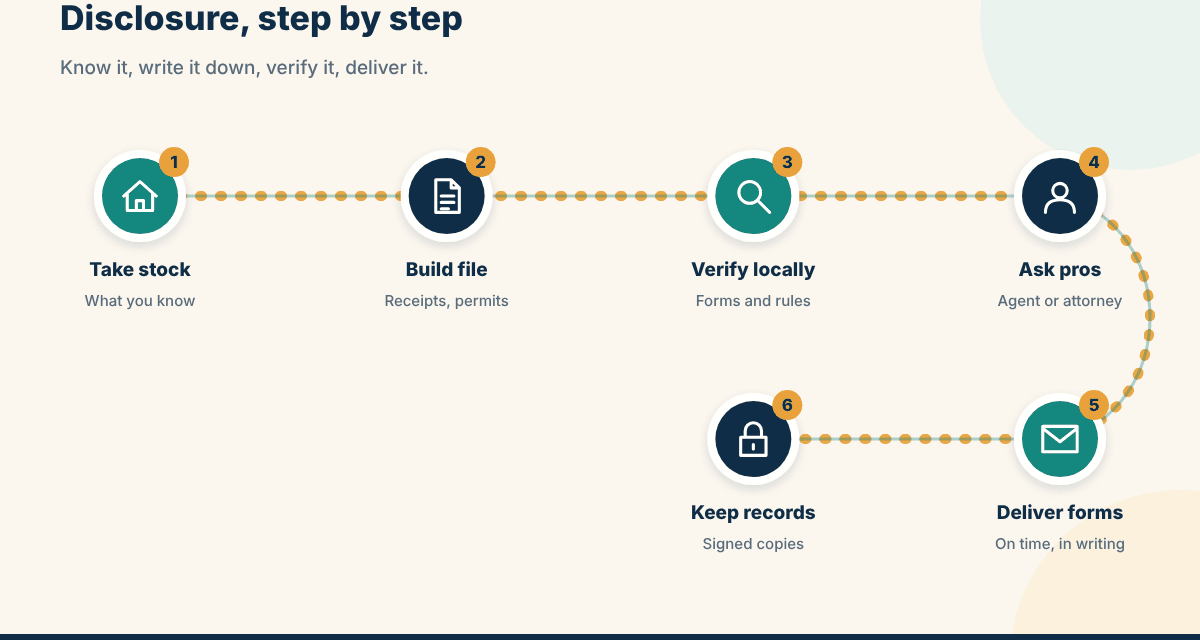
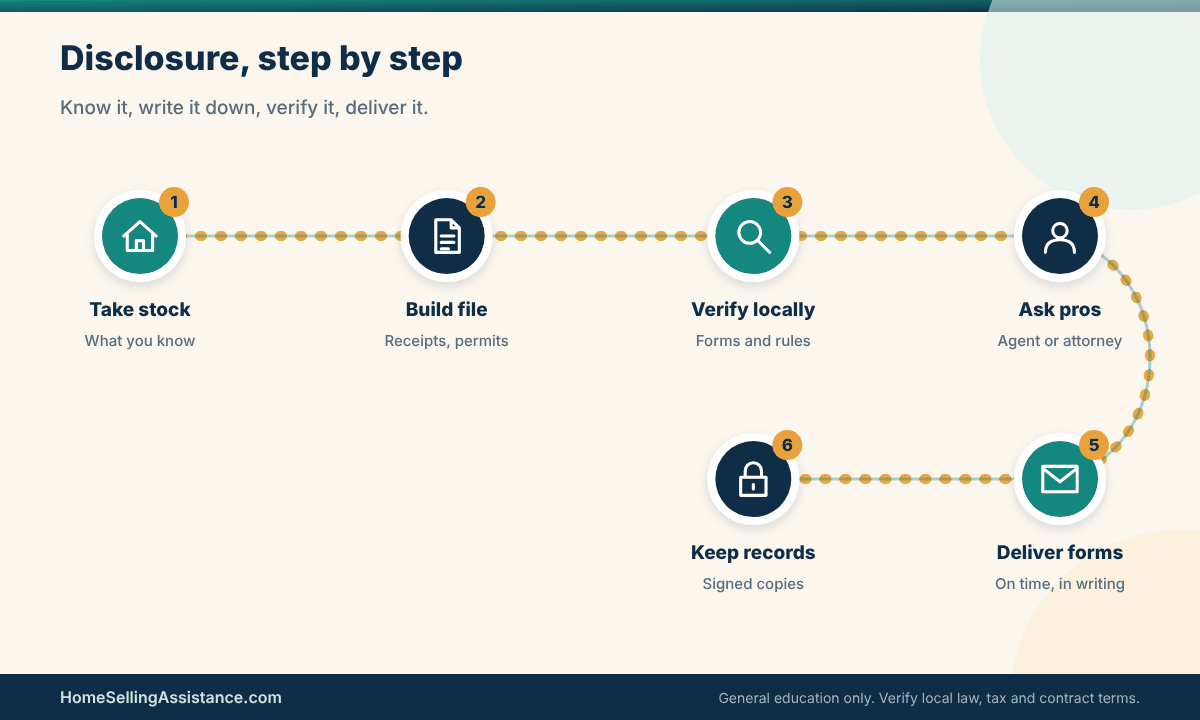
The picture below lays out the usual journey a seller takes through this territory, from taking stock of the house to keeping records after closing. Use it as a mental road map for seller disclosure requirements while you read the rest of the guide.
Pin down your goal, your timeline and what you actually know about the house
Before you open any form, answer three questions on paper. What matters most about this sale: top price, speed, certainty, or a clean break from the property? How long have you owned and lived in the house? And what do you personally know about its condition, history and surroundings? The first question shapes your sales path. The second determines how much firsthand knowledge you can claim. The third is the raw material of every disclosure.
Be honest with yourself about the difference between knowing, suspecting and assuming. Knowing means you saw it, paid for it, were told by a professional, or received a notice about it. Suspecting means you noticed something odd but never confirmed it. Assuming means you never looked. Seller disclosure requirements generally care most about the first group and sometimes about the second, which is why a careful seller records all three and asks a professional how to word each.
Constraints matter too. A seller facing a job start date has different pressure than one waiting for a better market. A seller with a mortgage payoff, an estate to settle or a co-owner who disagrees will need more lead time for paperwork. Writing those constraints down helps you decide how much time you can spend on records now, and how much risk you would rather remove before a buyer ever sees the house.
Evidence to gather: your own memory, receipts and paperwork
Start by building what we might call a knowledge file. Collect purchase documents, any prior inspection report from when you bought, repair invoices, warranty papers, insurance claim records, utility bills that hint at problems, permits and final inspection sign-offs, and correspondence with your homeowners association if there is one. Add photographs you took during past repairs, because a dated photo of a repaired crack is worth more than a vague recollection of fixing something.
Then write a plain timeline of the home’s life under your ownership. Note when the roof was last worked on, when the water heater was replaced, whether the basement ever took on water, whether pests have been treated, and whether any project was done without a permit. You do not need to be elegant. A dated list that says “kitchen sink drain leaked, plumber replaced trap, receipt attached” is exactly the kind of record that protects you.
Finally, note what you do not know. If the house was inherited, or if you rented it out for years, say so in your file. A seller who writes “owned since the estate settled, never lived here, no firsthand knowledge of the 1990s addition” is in a very different and often better-defined position than one who guesses. Whether you can check a “no knowledge” box in your state depends on local rules, so bring this note to your agent or attorney.
A scenario, an exception, and your next step: the seller who moved out years ago
Picture a seller who lived in a house for eleven years, then rented it out for six. The tenants mentioned a musty smell in the basement twice and the property manager sent a handyman. Now the seller is listing and wants to answer the form based on what they remember from living there, which was nothing wrong.
The trap is that the seller’s knowledge did not stop when they moved out. Messages from tenants, invoices from the handyman and notes from the manager are all part of what the seller reasonably knows or can find out. In many states the form asks about conditions “known to the seller,” and what the seller’s own agents and managers reported can count. An exception might apply if a state allows an owner to say they lack knowledge, but that is a question for a local professional.
Your next step in a situation like this is simple. Gather the rental file, read every maintenance note, and give the full set to your listing agent or attorney before you complete the form. If you need to understand how those records fit the broader sale, our guide to documents needed to sell a house walks through the full pile.
Map the main selling paths and the paperwork each one invites
You can sell through a listing agent, on your own, to a cash buyer, at auction, or through an estate or other fiduciary process. Each path touches seller disclosure requirements in a different way. An agent often hands you the state form and may add a seller questionnaire. A for-sale-by-owner seller has to locate and complete everything personally. Cash buyers sometimes say paperwork is optional. Auctions often use shortened contracts. Estate sales may use special forms or special language about the seller’s knowledge.
The principle that holds across all of them: the path changes who prompts you and how fast things move, not whether your state has rules. If a statute sets seller disclosure requirements for a residential sale, it usually does not exempt you because the buyer paid cash or because there was no listing agent. Some states do carve out particular transfers, such as certain estate, foreclosure or between-relatives sales, but those exemptions are narrow and should be confirmed locally.
The decision picture below compares the common paths. Notice that every branch ends with a sentence about paperwork. That is deliberate, because choosing a path without thinking about seller disclosure requirements is how sellers end up with surprises.

Evidence to gather: how each path routes the paperwork
Ask each professional you interview the same short list of questions. Which state-required forms apply to my sale type? Who supplies them and who delivers them to the buyer? When must the buyer receive them: before an offer, before the contract, or within a window after? What happens if I discover a new problem after I signed the form? Their answers tell you how experienced they are with your local rules, and the written answers become part of your file.
If you plan to sell without an agent, add two more questions for a title company or attorney. Does my state publish an official seller disclosure form, and where? And are there any recording, tax or local-ordinance disclosures that a seller must supply in addition to the main form? Municipalities sometimes require point-of-sale inspections or certificates, and those requirements are easy to miss when no professional is guiding the listing.
For agent-assisted sales, read the listing agreement closely. Our article on the listing agreement explains the clauses that matter, and a good agent will tell you which disclosure forms they will prepare and which you must complete yourself. Keep copies of every version you sign, because the dates and the exact wording can matter later.
Scenario: the cash buyer who says you can skip the form
A seller receives a cash offer from an investor who says, in a friendly way, that the contract is “as-is” and the disclosure form is unnecessary since he plans to renovate anyway. The seller is relieved, because the form felt like a liability. Should they skip it?
Not on that reasoning. An investor’s plans do not control the statute. In many states the duty to give the form runs from seller to buyer regardless of buyer type, and a contract clause cannot always waive a duty that exists to protect buyers. In others, a waiver may be allowed with specific wording. The seller cannot know which applies without checking, and the cost of checking, usually a short call to a title company or attorney, is tiny compared with a post-closing claim. Seller disclosure requirements are exactly the kind of rule worth a short call.
The sensible next step is to ask the buyer’s side to put the request in writing, then ask your own agent or attorney whether your state permits it. Our deeper look at how selling a house as-is works explains why the label changes repair negotiations more than it changes honesty obligations.
What moves your risk, your timing and your proceeds when disclosure is involved
Seller disclosure requirements sound like paperwork, but they touch money in three ways. They can change what buyers offer, because a known issue priced in at the start is cheaper than a surprise discovered during inspection. They can change how long a deal takes, because late-revealed facts restart negotiations. And they can change what you keep after closing, because a claim after the sale is a cost the closing statement never shows. Seller disclosure requirements are a risk-management tool as much as a legal duty.
None of this means more disclosure always equals a better outcome, and none of it promises any particular price or result. It means the facts you hold are going to surface sooner or later, and the real choice is whether you shape that moment or let it happen to you. In the sections below we look at the variables that decide how much weight your disclosures carry, and then at the costs and logistics that sit around them.
Condition, contract and buyer variables that reshape seller disclosure requirements
Four things tend to decide how heavy the burden of seller disclosure requirements feels. The first is the home’s condition and age: a house built before 1978 triggers federal lead paint steps, and an older house has more history to describe. The second is the contract structure, including inspection periods, as-is language and any state-mandated forms. The third is the buyer’s financing, since lenders and appraisers can raise condition questions of their own. The fourth is the buyer’s own diligence, which varies from a cursory walkthrough to a full set of specialist inspections.
Market conditions affect all four in subtle ways. When buyers compete, some waive inspections or accept shorter timelines, and sellers may feel pressure to skip or rush the paperwork. When buyers have leverage, they ask more questions and expect more documentation. Neither situation changes what the law asks of you. Both change how much conversation happens around your answers, and a seller who has the documents ready can respond calmly in either market.
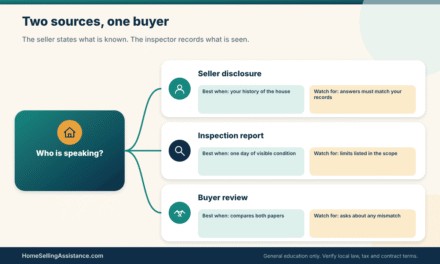
It helps to keep a clear line between three different documents that often get blurred together: the legally required disclosure form, the optional seller questionnaire your agent or buyer might request, and the inspection reports produced by professionals. Our article comparing a seller disclosure and an inspection report shows how each one is used, and why a clean inspection never cancels a seller’s own duty to speak up about what they know.
Evidence to gather: reports, repairs and neighbor facts
For the condition side, collect every report that concerns the structure or systems. That includes past home inspections, roof reports, sewer scope results, radon or termite findings, chimney inspections, and any repair estimates you received but never acted on. Unacted-on estimates matter because they show you knew about a problem even if you did not fix it. Keep the pages together with the date, the company and a short note on what you did in response.
For the surroundings, think about facts that sit outside your walls but still affect enjoyment or use. Examples include recurring flooding in the street, a shared driveway, a neighbor’s boundary dispute, a nearby commercial project you were notified about, or a planned assessment from your association. Whether each of these must go on a state form depends on how the form is written, so write them down anyway and let a local professional decide where they belong.
For the contract side, read the sample contract your state or local board uses before you receive any offer. Note the inspection window, the repair-response steps and how the contract treats a seller’s statement. Our overview of the real estate sales contract explains the common sections. The aim here is to know which parts of your disclosure will be incorporated into the agreement, because that is when it becomes binding rather than informational.
Scenario: the buyer who finds the problem after closing
Imagine a seller whose finished basement flooded once, three winters ago. A contractor installed a sump pump and the basement stayed dry. On the state form the seller ticked “no” to the question about water intrusion, reasoning that the problem was fixed. A year after closing, a heavy storm brings water in again, and the buyer finds the old contractor’s invoice in a drawer the seller left behind.
Whether the seller faces a claim depends on the exact wording of the question, the state’s standard for what counts as a misstatement, and what was knowingly concealed. Many forms ask whether there has ever been water intrusion, not whether there is a current one, and a repaired past leak is often still something to report with an explanation. The safer habit is to answer yes, describe the repair, and attach the invoice, which lets the buyer decide how much it matters. That is how seller disclosure requirements usually reward openness.
Your next step is to read each question as literally as a stranger would. If the form says “ever,” think about the entire time you owned the house. If you are unsure whether a repaired past event belongs, ask your agent or attorney instead of guessing. The wider topic of known defects gets full treatment in our article on material defects and seller disclosure.
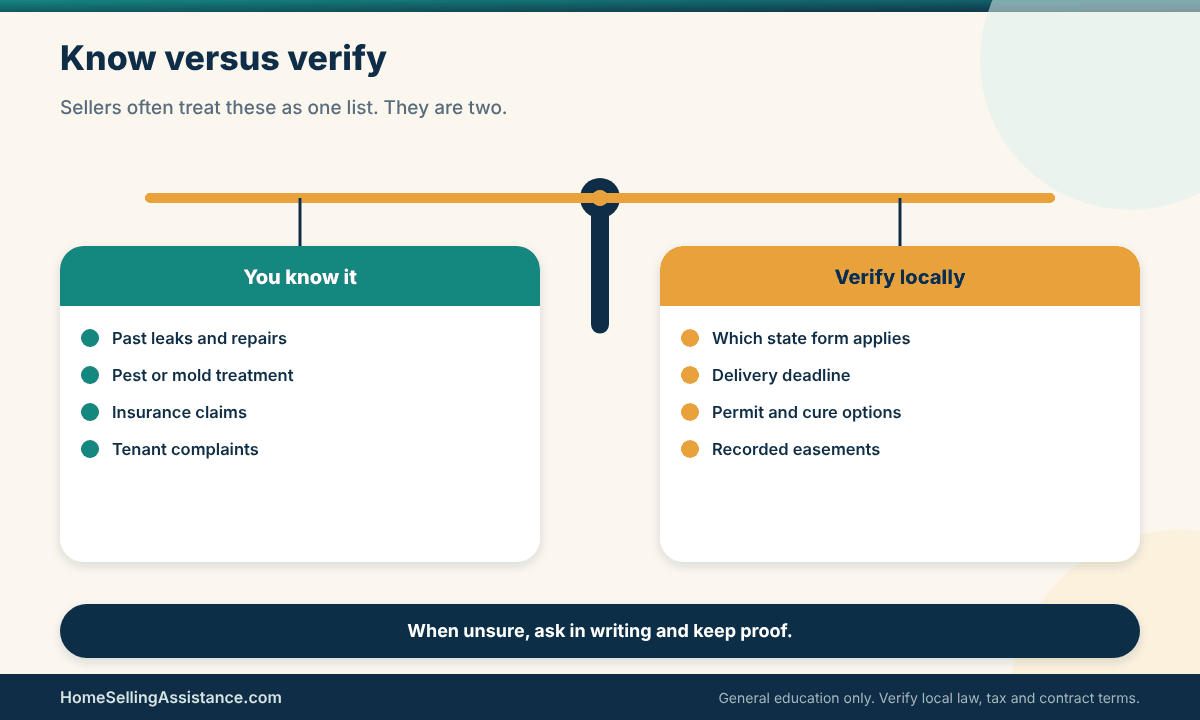
The picture below sets out a simple way to think about the difference between facts you hold personally and facts you need to verify elsewhere. Sellers often treat these as one category, and that is where gaps appear.
Costs, timing and logistics around seller disclosure requirements
Meeting seller disclosure requirements has a price tag, though it is rarely printed on any invoice. There are small direct costs, such as paying for a pre-listing inspection, ordering a survey, pulling permit records or obtaining a homeowners association resale package. There are medium costs, such as the repairs or credits you choose to offer once you know what an inspection would find. And there are indirect costs, such as the time you spend gathering paperwork while also packing a house.
Timing matters as much as cost. State rules often say when the buyer must receive the form: before the buyer makes an offer, at or before contract signing, or within a certain number of days after. Missing that window can give the buyer extra rights, such as the ability to cancel. Because the deadlines vary and sometimes have consequences, treat the date your state sets as a hard stop and confirm it with a professional rather than a search engine. Deadlines inside seller disclosure requirements are where good intentions often fail.
Logistics bring a quieter set of questions. Who completes the form if there are two owners? Who signs when one owner lives out of state? Where do you store the signed copy so you can find it two years later? A simple system, like a single folder containing every signed form and a note of when each was delivered, solves most of those problems before they start.
Evidence to gather: costs of correcting, curing or disclosing
When you find an issue, you usually have three paths. You can correct it, by repairing the item and keeping the invoice. You can cure it in a legal sense, for example by obtaining a missing permit or a closing sign-off. Or you can disclose it and let the price or terms absorb it. Each path has a cost, and the cheapest may be simply meeting seller disclosure requirements while the most expensive may be a rushed repair done badly. Get quotes for the first two before deciding.
For homes with an older roof or aging systems, an inspection before listing can reveal what a buyer might find and let you plan. Our piece on whether a pre-listing home inspection makes sense lays out the trade-offs. One caution applies across the board: once you have a report, you generally know its contents, and what you know belongs in your disclosure thinking, so decide on a plan before you order it.
Ask contractors for written, dated estimates and keep them even if you decide not to hire anyone. If a buyer later asks what you knew, a file showing you investigated, priced the work and told the buyer promptly shows good faith. A file showing nothing at all shows only silence, which is much harder to defend and much harder for your agent to explain to the other side.
Scenario: an estate sale, a rental and a stale form
Consider three sellers using the same blank form. The first inherited a house and never lived there. The second has rented the home for years through a property manager. The third lived in the house, finished the attic without a permit, and filled out a form two years ago for a sale that fell through. Each faces a different version of the same question: what exactly do I know, and is my old paper still accurate?
The estate seller may be allowed to limit statements to personal knowledge, or may be exempt from the form altogether, depending on state law. The landlord seller must consider what tenants and managers reported. The third seller must not simply sign last year’s form again, because time passes, conditions change, and a form is a snapshot, not a permanent certificate. In most places a stale form is a risk, not a shortcut, because seller disclosure requirements apply to the sale in front of you.
Your next step in each case is the same: update the knowledge file, ask the local professional which questions apply, and complete a fresh form dated for this sale. If the home has changes made without proper approvals, read our guide on selling a house with unpermitted work before you decide how to address them.
The table below turns these threads into a decision tool. Each row is a common seller situation, with the key fact to hold in mind, a practical action, the trade-off, and the document that backs it up. It is a prompt for conversations with your professionals, not a ruling on your property, so read it as a starting list of questions to bring to your agent, attorney or title company.
| Situation | Key fact | Practical action | Trade-off | Source or document |
|---|---|---|---|---|
| House built before 1978 | Federal lead paint steps may apply | Ask your agent for the federal forms early | Extra paperwork versus a missed legal step | EPA real estate disclosure rule |
| Past leak, since repaired | Forms often ask about “ever” | Describe the repair and attach the invoice | A buyer may ask for a discount versus later dispute risk | Contractor invoice and photos |
| Rented out before sale | Tenant reports count as knowledge | Review the full maintenance file first | More time up front versus unseen surprises | Property manager records |
| Work done without a permit | Local rules on cure and disclosure differ | Ask the building department what is possible | Cost of cure versus a lower price | Permit history from the city or county |
| Selling as-is | Label may not waive duties | Confirm with a local professional | Fewer repair requests versus unchanged honesty duty | State form and contract |
| Estate or inherited property | Some transfers have narrower duties | Ask counsel which form applies | Simpler statements versus buyer caution | Letters of authority and state statute |
To use the table, find the row that sounds most like your house, then read across. The “key fact” column tells you what to verify, “practical action” gives a first move, and the last column points you toward the paper you will likely need. If none of the rows fits, that is also useful information, because it suggests your situation is unusual and worth a short consult with a local attorney.
A verification roadmap for seller disclosure requirements you can follow this week
Everything so far points to one practical conclusion: you cannot learn your local seller disclosure requirements from a national article, including this one. What you can do is build a short verification roadmap, a list of who to ask, what to ask for, and what to keep. The roadmap works whether you sell with an agent, on your own, to a cash buyer or through an estate, because it is built around facts and records instead of around a particular sales channel.
Think of the roadmap as two lists that meet in the middle. One list holds the documents you already have or can request. The other holds the professionals and offices that can confirm what applies to your property. When a document and a professional answer line up, you have a verified fact. When they conflict, or when neither exists, you have an open question worth resolving before you list, not after you accept an offer. That habit is the core of managing seller disclosure requirements.
Documents and professionals to involve before the first showing
Start with the people, because they save the most time. A listing agent in your market will know which state and local forms apply and how local practice handles them. A real estate attorney can tell you what the statute actually says and can review unusual facts. A title company or closing attorney knows recording, lien and deed issues. Your state real estate commission publishes forms and rules for licensees. And your county recorder, building department and homeowners association can each confirm one slice of the property’s record.
Do not feel obliged to hire all of them. Many straightforward sales need only an agent and a title company. But the moment something unusual shows up, such as a boundary question, a past insurance claim, a death on the property, a missing permit or co-owners who disagree, the value of a short attorney consult rises sharply. A one-time conversation to learn what the law expects of you can cost far less than correcting a misstatement later.
On the federal side, two official sources are worth bookmarking. For older homes, the EPA real estate disclosure page explains the lead-based paint rules for sellers and landlords. For how you advertise and treat buyers, the HUD Fair Housing and Equal Opportunity pages explain your obligations under the Fair Housing Act. Neither replaces your state’s rules, and neither covers everything, but both are reliable primary sources.
Evidence to gather: forms, records and official sources
Create a folder, paper or digital, with five sections. The first holds forms: your state’s seller disclosure form if one exists, any local addenda, and any questionnaire your agent uses. The second holds ownership records, such as your deed, title policy, survey and any easement documents. The third holds condition records: inspections, repair invoices, warranties and permits. The fourth holds association records, if applicable. The fifth holds correspondence, including emails with neighbors, insurers and contractors about the house.
For ownership questions, a title search shows recorded liens, easements and ownership history, and it often surfaces facts you have forgotten. Our article on the title search in a home sale explains what appears and why sellers sometimes find surprises there. If a recorded easement or a fence in the wrong place exists, our guide to easements, encroachments and seller disclosure covers how those are usually handled.
For condition records, ask yourself who else may hold the proof. Contractors keep copies of invoices. Municipal offices keep permit files. Insurers keep claim files, and in many places buyers can order a loss-history report on the property anyway. If the same fact will probably reach the buyer through another route, it is almost always wiser for it to arrive through you first, with context and documents attached.
For lead-based paint, if your home was built before 1978, ask your agent or attorney for the federal disclosure forms and the required pamphlet. As a general rule, sellers of most pre-1978 housing must share known information about lead-based paint, provide available records, include a warning statement in the contract, and give the buyer a default window, commonly ten days, to inspect unless both sides agree otherwise. Our article on lead paint disclosure for sellers covers the steps in depth.
A scenario, an exception, and your next step: the two-owner sale across state lines
Two siblings co-own a house inherited from a parent. One lives in the home’s state and handled repairs for years. The other lives across the country and has barely visited. They want to sell, and the local sibling plans to complete the disclosure form alone, since the other sibling knows nothing about the house.
The complication is that seller disclosure requirements usually attach to the seller, and with co-owners each owner is a seller. The distant sibling may be able to state limited knowledge, but only if the form and state law allow it, and both signatures may be needed. Another exception worth checking: if the estate is still in probate and a personal representative is selling, the rules and the form may differ again. The local sibling should not guess about what the other can sign.
Your next step in a situation like this is to ask the agent or attorney how the form handles multiple sellers and whether a representative can sign. Then give each owner a copy of the knowledge file well before signing, so nobody is surprised by a statement made in their name. For the estate version of this problem, our overview of selling an inherited house explains the added layers, and the disclosures and seller paperwork category collects the rest of this topic.
The second table puts the same roadmap on a calendar. It follows the transaction from before listing to after closing and shows what you usually carry at each stage, what you depend on other people for, when deadlines tend to arrive, and what to do if something slips. Treat the deadlines column as general patterns, since your contract and state set the real dates.
| Stage | Seller responsibility | Buyer or professional dependency | Typical deadline | Fallback if it slips |
|---|---|---|---|---|
| Before listing | Build the knowledge file and complete the forms | Agent or attorney confirms which forms apply | Before marketing begins | Pause the listing until forms are ready |
| Marketing and showings | Keep statements consistent in ads and conversations | Agent reviews listing text for accuracy | Ongoing | Correct the listing text promptly |
| Offer and contract | Deliver required forms by the state’s timing | Buyer acknowledges receipt in writing | Set by state law or contract | Ask counsel about extending the buyer’s review |
| Inspection period | Respond to findings and update disclosures if needed | Inspector report and buyer’s repair request | Contract inspection window | Negotiate credit, repair or termination terms |
| Appraisal and lender review | Supply permits and records the lender requests | Appraiser and underwriter | Per financing contingency | Provide proof of repair or discuss price |
| Closing | Confirm nothing new has arisen since signing | Title company and closing agent | Closing date in contract | Notify the buyer in writing before closing |
| After closing | Keep copies of every form and report | Agent or attorney if a claim arises | Records kept for years | Contact counsel promptly about any notice |
Read the table from left to right as a sentence: at this stage, I am responsible for this, I depend on these people, the clock usually looks like this, and here is my plan B. The “appraisal and lender review” row is the one sellers most often skip over, because they assume only the buyer deals with the lender. In practice, permits and repair proof requested by the lender land in your lap.
One more habit belongs on this list: updating when facts change. If you learn something new after signing the form, such as a new leak after a storm, the safest path is to tell your agent or attorney right away, in writing, and ask how the contract and your state handle an update. Quiet fixes and silence are where most disputes begin, and seller disclosure requirements usually expect timely updates.
A well-organized file also helps in a less obvious way, which is that it shortens every conversation. When a buyer’s agent asks about the roof, you can answer in one sentence and hand over a page. When the lender asks about a permit, you can reply the same day. Speed in those small exchanges builds trust, and buyers who trust the seller tend to negotiate more calmly, though no one can promise a particular result.
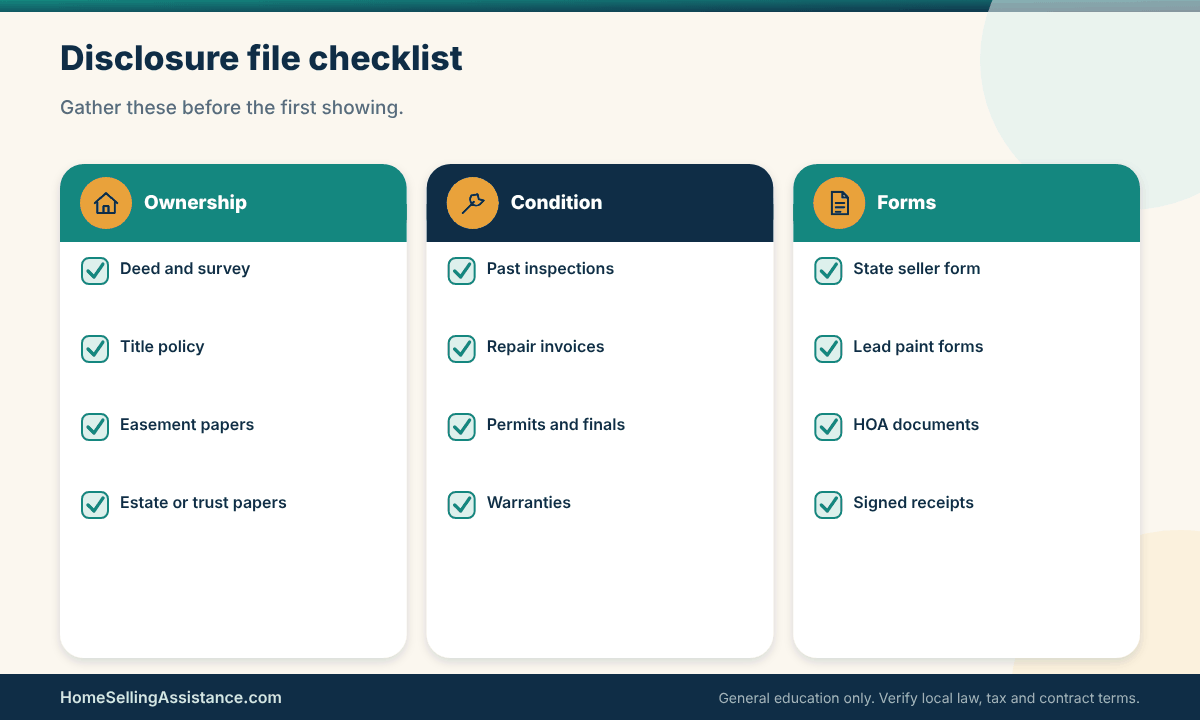
The next picture condenses the file into a checklist you can print. It shows the main groups of documents sellers usually gather: ownership and title, condition and repairs, and required forms and notices. Tick off what you already have, and mark the rest with the name of the office that holds it.
Which seller disclosure requirements to settle before listing and which can wait for an offer
Not every decision has to be made on day one, but a handful really do belong before the sign goes up. Settle first what you will say publicly, since your listing text, photos and verbal answers all become statements a buyer can rely on. Settle which forms apply and who completes them. Settle your approach to known problems: repair, credit, price adjustment or plain disclosure under your state’s seller disclosure requirements. And settle who speaks for you, so that questions from buyers and their agents get consistent answers.
What can wait until an offer arrives is mostly negotiation detail. The exact credit you will accept for a repair, the terms of an extended inspection window, whether to accept a buyer’s request to amend the contract: these depend on the buyer, the market and the numbers, and deciding them too early can box you in. The facts, however, cannot wait. A fact you knew on listing day does not become less relevant because a buyer has not yet appeared.
There is a useful rule of thumb here, which is to separate what you know from what you will do about it. Knowing is not optional and cannot be postponed. Doing something about it is a choice that can reasonably follow the offers, as long as the buyer receives accurate information at the point the law or contract says they must.
Evidence to gather: the decisions worth making in writing
Write a one-page decision memo for yourself before listing. It should list the known issues with the house, what you plan to do about each, and which documents prove it. For each issue, note whether it is repaired, in progress, unrepaired or unknown. Add the date, and give a copy to your agent. This memo is not a legal document, but it keeps your answers consistent across the form, the listing text and the conversations that follow.
Add a short section on neighborhood and community facts. Think about things like a homeowners association with special assessments, a shared well or road maintenance agreement, a flood zone designation, or noise from an airport or railroad. Whether each belongs in a formal disclosure depends on your state, but agents often recommend mentioning facts a reasonable buyer would want to know, and an association’s resale documents will usually reveal many of them anyway. See our guide to HOA resale fees for sellers for how association paperwork enters the sale.
Finally, decide how you want to handle questions of a sensitive nature, such as a death in the home. Some states have specific rules about whether and when a death must be revealed, and others say little. Our article on death in the house and seller disclosure explains why this varies so much and how to ask the right local professional. The point of writing down your approach is to avoid improvising an answer in front of a buyer.
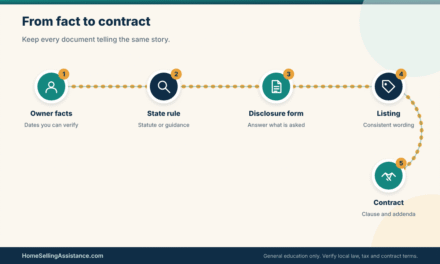
For the questionnaire side, some agents and buyers use a longer document than the state form. Our guide to the seller property questionnaire explains how it differs from the official form, and why the answers you give on either one should match. Inconsistent answers across documents are one of the easiest things for a buyer’s attorney to point to later, since seller disclosure requirements assume your documents tell one story.
A scenario, an exception, and your next step: the listing text that promised too much
A seller lists a home with the phrase “fully renovated, everything updated,” because the kitchen and bathrooms were redone. The listing agent copies it into the description. During showings, a buyer asks about the roof and the seller says it is “great.” In truth, the roof is older than the renovation and has a known leak over the garage that the seller patched twice.
The renovation phrase may be mostly harmless puffery, but the answer about the roof is a specific statement of fact, and it conflicts with what the seller knows. In many states, a misstatement to a buyer can create liability even if a form contains the correct information, depending on the circumstances. An exception might apply to general opinions, such as “lovely backyard,” which are usually treated differently from claims about condition. The line between them is not always obvious.
The next step is to review the listing text with your agent before it goes live, and to prepare a short, accurate answer for the questions you know will come, like the age of the roof and heating system. A line such as “roof is about twenty years old, patched over the garage twice, invoices available” is truthful, calm and far more useful to a serious buyer than a vague reassurance.
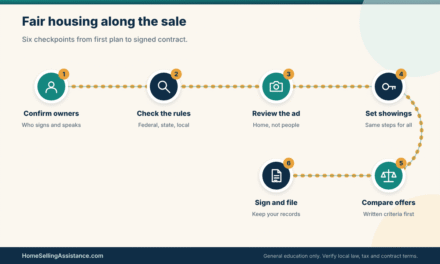
Many sellers also ask whether fair housing rules touch any of this. They do. Seller disclosure requirements have to work the same way for every buyer. You should not answer questions differently, offer more documents to one prospect, or steer conversation about neighborhoods based on who someone is. Our article on fair housing for home sellers explains the protected classes and the habits that keep you safely on the right side. HUD also publishes plain-language material and a directory of HUD-approved housing counselors.
Common mistakes that turn simple paperwork into a dispute.
Before the closing material, one more practical section: the mistakes we see repeated, because knowing them in advance is cheaper than discovering them later. None of these is exotic. Each one comes from a normal human instinct, such as wanting the sale to go smoothly, hoping a problem will stay quiet, or trusting a form that looked official. Understanding the instinct helps you resist it.
The first mistake is answering from memory. Memory edits the past, usually in the seller’s favor. Check dates against receipts. The second is treating “as-is” as a magic phrase, which we covered earlier. The third is relying on the buyer’s inspection to catch everything, which confuses the buyer’s due diligence with your duty. The fourth is leaving the form until the contract is signed, when stress is high and time is short.
The fifth is making informal side promises, such as telling a buyer in a text that you will leave the washer or replace a window, without putting it in the contract. The sixth is hiding or patching a problem cosmetically, for example painting over a stain, while saying nothing. Courts and regulators in many places treat concealment more harshly than an honest failure to repair, and a simple disclosure would have cost far less.
The seventh mistake is reusing a form from a previous failed sale without rereading it. The eighth is letting a friend, relative or neighbor answer buyer questions on your behalf, since their statements may be attributed to you. The ninth is failing to update the disclosure after learning something new before closing. A short written update to the buyer through your agent or attorney is almost always the safer path than assuming the earlier form still covers it.
If you want a broader look at how disclosure fits into every stage of a sale, our overview on how to sell a house places it alongside pricing, marketing and closing, and our explainer on home sale contingencies shows how the buyer’s rights tie back to what you say.
Scripts for what to ask and what to say.
Plain language protects you, so rehearse a few sentences. To your agent: “Which disclosure forms does our state require for this sale, who delivers them, and by when?” To an attorney: “Here is my knowledge file. Is there anything here that must appear on a form, and anything you would word differently?” To a buyer who asks about a past problem: “Yes, that happened in a certain year, here is the invoice, and I can introduce you to the contractor if you want.”
When you do not know the answer, say so plainly. “I do not know when the previous owner did that work, and I have not seen a permit” is a perfectly acceptable statement and is very different from “no problems.” If the buyer wants to investigate, the contract’s inspection period exists for exactly that purpose. Resist the urge to fill silence with reassurance, because reassurance is what turns into a quoted sentence. Seller disclosure requirements reward plain statements.
When a buyer asks about neighbors, schools or crime, a respectful and consistent approach is to point them to official and public sources instead of offering personal impressions. This is partly a fair housing habit and partly good risk management. It keeps your statements factual and keeps conversations about people and neighborhoods out of the transaction. If you are unsure, ask your agent how they handle those questions in your market.
The final picture is a fallback tree for the moment sellers dread most: learning about a problem after the form is signed but before closing. It does not replace advice from your attorney, since contract language and state rules control. What it does is show the questions to ask in order: is the problem new, is it serious, and what does the contract say about updates.
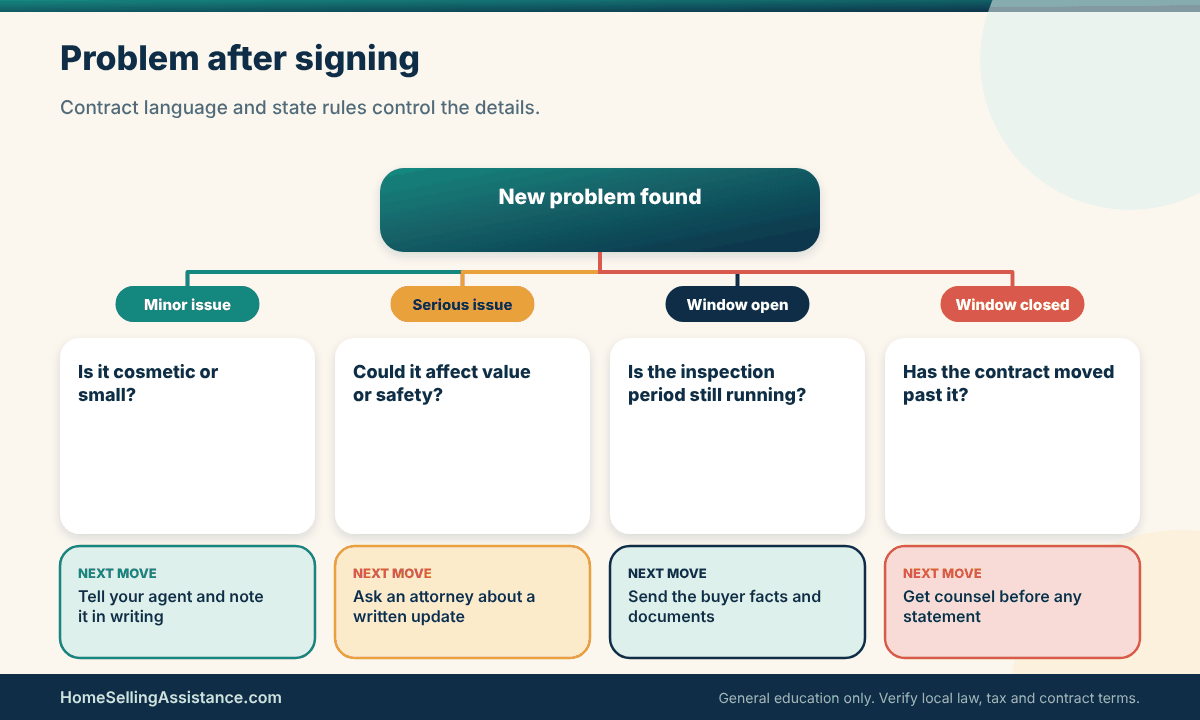
Notice that every branch of the tree leads to a written notice and a professional conversation. That is the pattern across this whole guide. Whether the issue is a lead paint question on a 1960s house, an easement on a rural lot, or a new leak found while packing, the sequence stays the same: document it, ask a local professional, tell the buyer in writing, and keep the proof.
How state approaches to seller disclosure requirements differ. States tend to fall into a few broad patterns, and knowing which pattern you live in helps you ask better questions. Some states require a standardized written form on most residential sales, with a list of specific questions. Some require a more general statement about known material facts.
A few have historically leaned toward the principle of buyer beware, with narrow statutory duties, though even there, actively hiding a serious defect you know about can still lead to a fraud claim. Treat this as a general sketch, not a map of any particular state.
Within each pattern, the details diverge. One state’s form may ask about the roof, another’s may not. One may allow an owner to check “no knowledge,” another may expect reasonable inquiry. One may set a deadline measured in days before closing, another may tie delivery to the offer. These differences are exactly why a seller moving across the country cannot reuse what they learned the last time. The only reliable approach to seller disclosure requirements is to read your own state’s form and ask a local professional what it means.
To find the authoritative source, start with your state’s real estate commission website, which usually posts forms and guidance for licensees. Then ask a local attorney or title company to confirm. Be cautious with online templates, because they are often written for another state or an earlier year. A form that looks official but is out of date can create exactly the problem you were trying to avoid.
What “known” and “material” usually mean. Two words carry most of the weight in seller disclosure requirements: known and material. Known generally refers to what you actually know, and in some states what you reasonably should know after ordinary inquiry. Material generally refers to facts that would affect a reasonable buyer’s decision or the property’s value. Each state and each court fills in those meanings differently, so the practical test is a cautious one: if you would want to know it before buying this house, tell your professional about it.
The practical effect is that small things and big things are treated differently, but not always the way sellers expect. A cosmetic scuff is rarely material. A repeated pest problem, a history of water entering the basement, a boundary dispute or a structural repair often is. When in doubt, the cost of describing something minor is low, while the cost of omitting something a court later calls material can be high. This is a general principle, not a promise about how a particular dispute would end.
Where agents and attorneys fit. Licensed agents generally have their own professional duties, which in many states include disclosing material facts they know about a property, regardless of what the seller prefers. That is one reason a good agent will press you for the full story. An attorney’s role is different: to explain the law and protect your interests. Neither one can change the facts. If you are working with both, share the same knowledge file with each, so their advice rests on the same information and your forms stay consistent.
Be neutral about whom to hire. Some sellers do well with an agent alone, others want an attorney for the contract and seller disclosure requirements, and some states routinely involve attorneys in every closing. What matters is that someone with local knowledge reviews your paperwork before a buyer relies on it. If you are paying a commission or a flat fee, ask in writing what the service includes with regard to forms, because the scope differs between providers.
The federal floor, revisited. Federal law touches seller disclosure requirements in a few places. The lead-based paint rule applies to most housing built before 1978 and asks sellers to share what they know, provide records, include a warning in the contract and allow the buyer an opportunity to inspect. The Fair Housing Act forbids discrimination in the sale of housing and in advertising, on grounds that include race, color, religion, sex, national origin, familial status and disability. Beyond these, much of the detail is left to the states, and some states add protections of their own.
Federal rules also sit in the background of many other topics, from tax treatment of the sale to wire fraud warnings at closing. For tax questions, such as the home sale exclusion, the IRS publishes Publication 523 on selling your home, which is a useful primary source. It does not address seller disclosure requirements, but reading it early helps you understand how repairs, credits and selling costs may later appear in your records, and a tax professional can confirm how it applies to you.
Timing: before the offer or after it. Because the delivery deadline is where many sellers slip, it deserves its own look. In some places the buyer must receive the form before making an offer. In others, the buyer receives it as part of the contract package. In others still, the form is delivered within a set number of days after the contract is signed, and a late delivery can give the buyer a right to withdraw. The safest practice is to deliver early and keep proof of delivery, such as a signed acknowledgment or an email trail.
Early delivery has a side benefit: it tends to shorten the negotiation, because the buyer can price in what they already know. Late delivery, on the other hand, tends to create friction, since a buyer who feels surprised is more likely to ask for concessions or to question everything else you have said. Neither outcome can be promised, but most professionals prefer the first scenario. If your state allows early delivery, ask whether you should use it. Early delivery is one of the simplest ways to meet seller disclosure requirements well.
Keeping records after the sale. Do not throw anything away at closing. Keep the signed disclosure forms, the listing text, the buyer’s acknowledgment, inspection reports, repair receipts, correspondence about the property, and the closing documents. Federal rules for lead-based paint require sellers and agents to keep their lead disclosure records for three years, and many professionals suggest holding all sale records considerably longer. Your closing papers also matter for taxes, so our article on the seller closing statement explains how to read and store that key document.
Digital storage is fine, as long as the files are backed up and labeled with the property address and the closing date. A single folder with a short index sheet at the front is enough. If a buyer or their attorney contacts you years later, being able to produce the exact form you signed on the date you signed it is worth far more than a confident memory.
Quick scenario
A seller finishes the state form on a Monday, lists the house on Wednesday, and accepts an offer on Saturday. On Sunday, while moving boxes, she sees a damp patch on the garage ceiling. She tells her agent that evening, who asks her to put it in writing and sends it to the buyer’s agent on Monday morning with a photo and a plan for a roofer to look at it.
The buyer is not thrilled, but the inspection period is still open, and the matter is handled inside the contract. Prompt, written updates are what keep a small surprise from becoming a large dispute.
A simple seven-day plan. If all of this feels like a lot, break it into a week. On the first day, gather ownership documents and prior inspection reports. On the second, write the timeline of the home’s history and list what you do not know. On the third, contact your agent or attorney to confirm which forms apply in your state and what the deadlines are. On the fourth, request permit records and association documents. On the fifth, read the form line by line and note every question where you are unsure.
On the sixth day, meet with your professional to review the draft answers and decide how to handle each known issue: repair, credit or disclose. On the seventh, finalize the forms, sign them, store copies, and review the listing text for accuracy. A week is not always realistic if records are scattered, but even a rough version of this plan puts you far ahead of a seller who sees the form for the first time during a negotiation.
The plan works for every seller type. If you sell to a cash buyer, you still gather the records, because the buyer may ask about them and because your state may still require the form. If you sell at auction, you still need to know what your contract says about seller disclosure requirements. If you are a personal representative selling an estate property, you still check which forms apply and what you can truthfully say. The paperwork changes shape, but the habit of knowing, writing down and verifying does not.
Finally, a note on attitude. Following seller disclosure requirements is not a confession and it is not a trap. It is a way of putting the same accurate picture in front of the buyer that you would want if the roles were reversed. Sellers who approach it that way tend to find the process less stressful, and professionals tend to find the sale easier to manage. That is a general observation, not a guarantee, but it holds up in most of the transactions we have seen.
Five myths about seller disclosure requirements. The first myth is that seller disclosure requirements only exist to catch dishonest sellers. In practice they mostly protect honest sellers, because a completed form with attached records shows what you said and when you said it. The second myth is that a new buyer cannot complain if the inspector missed something. Inspectors and sellers have different roles, and a missed item does not automatically excuse a misstatement. Neither myth is a legal rule, but both lead sellers to relax at the wrong moment.
The third myth is that a friendly handshake covers what the paperwork leaves out. Seller disclosure requirements are tested by documents, emails and texts, and an oral promise rarely survives an argument about who said what. The fourth myth is that fixing a problem makes it disappear from the story. Repairs are good news, but the history often still belongs in your statement, with an invoice to back it up. The fifth myth is that every seller faces identical rules. Your state, your property type and your sale route can all change the details.
Reading the form the way a stranger would. One of the best exercises is to hand your draft to someone who has never seen the house and ask them to read it aloud. Do the answers match the photos in the listing? Does any sentence sound too certain? Do the seller disclosure requirements in your state call for explanations when you tick “yes,” and have you written them? A stranger reads literally, and so will a buyer’s attorney. Fixing a vague sentence now costs a minute, while defending it later costs far more.
Also read your answers against each other. If you say there were no roof problems in one place and mention a patch in another, the inconsistency will stand out. If the listing says “quiet street” and the form notes a recurring noise issue, the mismatch matters. Consistency is the quiet backbone of seller disclosure requirements, because the law mostly cares whether the buyer received an accurate, coherent picture. A calm review with your agent usually catches these gaps before anyone else does.
Special situations that deserve an extra look. Newly built or recently renovated homes raise their own questions. Warranties, builder documents and permits for recent work should all be in the file, and whether a new-construction seller has additional duties varies by state. Condos and townhomes add association rules, assessments, and sometimes separate resale packages that sit alongside your state’s seller disclosure requirements. Rural homes add wells, septic systems, access roads and sometimes shared agreements. Each of these is a place where a local professional can quickly tell you what applies.
Landlords selling a rented home have a few more steps. Tenant rights, lease terms and notice periods can affect showings and the timing of closing, and tenants’ repair requests are part of what you know about the property. Sellers moving out of state, or living out of state already, should confirm how signatures, notarization and power of attorney work in the property’s state. And sellers who are executors or trustees should confirm what authority documents the title company needs before any form is signed on behalf of an estate.
What happens if a buyer raises a claim. Even careful sellers sometimes hear from a buyer after closing. The first rule is not to argue in writing. Do not send angry texts or emails, and do not offer to fix things without advice. Contact your attorney, and check whether any insurance or home warranty you hold could respond. Gather your file, including the forms, receipts and correspondence. How a claim proceeds depends on state law, the contract and the facts, and no article can say who would win. A well-organized file simply gives your attorney a better starting point.
Some contracts contain dispute-resolution steps, such as mediation, that must be followed before going to court. Others set time limits for bringing claims. These details are in the contract you signed, which is another reason to keep copies. Our broader overview of the sales contract from the seller’s side explains the typical sections. If you are unsure, an hour with a local real estate attorney is usually a modest cost compared with mishandling a notice.
How to think about the cost of getting help. Sellers sometimes skip professional advice about seller disclosure requirements because it feels like an extra expense during an already expensive process. A better way to frame it is as a comparison between a known, limited cost now and an unknown, possibly larger cost later. We cannot quote prices, since they vary by market and provider, but you can ask any agent, attorney or title company for their fee structure in advance and compare. Many offer a short first consultation.
If money is tight, prioritize. Use your agent or title company for the standard forms and deadlines, and save the attorney’s time for the unusual facts: a death in the house, a boundary question, an estate, a divorce or a property with unpermitted work. For sellers under financial stress, the Consumer Financial Protection Bureau offers general consumer resources, and HUD-approved counselors can help with housing decisions, though neither replaces advice about your specific disclosure duties.
A final checklist of questions. Before you sign anything, ask yourself whether you have confirmed which seller disclosure requirements apply in your state, whether you know the delivery deadline, and whether you have shared your full knowledge file with your professional. Ask whether each answer on the form is something you can support with a document or a date. Ask whether your listing text and your spoken answers match the form. And ask whether you have a plan for updating the buyer if something new appears before closing.
If you can answer yes to all of those, you have done what most careful sellers do, and you have given yourself a good foundation for the rest of the sale. If you cannot, the gaps tell you where to spend your next hour. Seller disclosure requirements may never feel simple, but they become manageable once you stop treating them as a form and start treating them as a habit of honesty, record-keeping and local verification.
A worked example with round, illustrative numbers. Suppose two sellers list similar houses. Both have a ten-year-old water heater, an older roof and a basement that once took on water. Seller A completes the form carefully, attaches the sump pump invoice and the roofer’s note, and lists accurate information from day one. Seller B ticks “no” on the water question, hoping to avoid questions.
These are invented figures for illustration only: say a buyer asks A for a modest credit toward the roof, and A agrees. B’s buyer discovers the water history in inspection and asks for a larger credit, plus extra time.
Neither outcome is guaranteed, and a different buyer might have reacted in the opposite way. The point is the shape of the risk. Under seller disclosure requirements, the cost of an honest answer is usually visible and limited, such as a credit or a price conversation. The cost of an inaccurate answer is hidden until it is not, and then it can include a renegotiation, a canceled contract, a relist, or a claim after closing. Sellers who understand that shape tend to make steadier choices.
Now add the timing dimension. If seller disclosure requirements in your state call for delivery before the buyer signs, Seller A’s early paperwork lets the buyer finish due diligence inside the normal contract window. Seller B’s late discovery may push a closing date, which can disrupt your own move, a bridge loan, or a purchase you were counting on. Again, we cannot predict the exact effect, but sellers who rely on a tight schedule have more reason than most to front-load honesty and records.
Why consistent answers protect your proceeds. Net proceeds are what remains after the mortgage payoff, fees, credits and other deductions, and our guide to home sale net proceeds shows how to estimate them. Seller disclosure requirements affect that arithmetic at three points: repair credits you agree to after inspection, price changes you accept after a buyer learns something, and any claim you face after closing. By putting accurate facts in front of buyers early, you give yourself the best chance to handle those three items at the cheapest point in the process.
That does not mean volunteering opinions or speculating. It means answering the questions on the form accurately, supplying records, and correcting the record when facts change. Seller disclosure requirements ask for facts, not guesses, and a seller who sticks to facts rarely finds themselves defending a statement they cannot support. If you are ever unsure whether a statement is a fact, an opinion or a guess, say so to your agent or attorney and ask for help rewording it.
Choosing between repair, credit and plain disclosure. Once you know about an issue, you have three broad choices, and each interacts with seller disclosure requirements differently. Repairing it can remove the problem, but you may still need to describe the history and keep the invoice. Offering a credit lets the buyer choose their own contractor, though it usually belongs in the contract and does not erase what you must say. Disclosing and pricing accordingly can speed things up, especially in an as-is sale, but it is not a substitute for any form your state requires.
Which path is wise depends on the problem, the market, your budget and your timeline. An agent can estimate what buyers in your area tend to accept, and a contractor can price the work. For items that affect safety, such as electrical hazards, gas smells, active leaks or mold, consider professional advice quickly, because both the practical and the legal stakes are higher. The details of what to repair first are covered in our repairs and selling as-is category.
Keeping the conversation honest and calm. Most disputes start with a feeling that someone was not straight. Buyers rarely sue over a problem the seller described openly and documented; they tend to sue over a surprise. That is why many experienced professionals describe seller disclosure requirements as the seller’s best protection, not their greatest burden. The rules ask you to tell the truth in a specific format, at a specific time, and to keep proof. Following them does not guarantee a smooth sale, but it removes a major source of conflict.
Frequently asked questions about seller disclosure requirements
Do seller disclosure requirements apply in every state?
No two states are identical. Many require a written form on most residential sales, some require a narrower statement, and a few lean toward buyer beware with limited statutory duties. Even where the form is optional, concealing a known serious defect can still create legal risk. Check your state real estate commission and ask a local attorney or agent what applies to your sale.
What federal seller disclosure requirements exist?
The best-known is the lead-based paint rule for most housing built before 1978, which involves sharing known information, available records, a pamphlet and a warning statement, plus a default window for the buyer to inspect. Fair housing law also applies to how you market and sell. Other duties are mainly set by states, so confirm the details locally.
Does selling as-is remove my duty to disclose?
Not automatically. An as-is clause often limits what a buyer can demand in repairs, but in many places it does not erase statutory seller disclosure requirements or protect against fraud. A few states may treat the issue differently. Ask a local professional how the clause interacts with your state form before you rely on it.
Do I have to disclose a problem I already fixed?
Often the answer depends on how the question is worded. Forms that ask whether something has ever happened can cover repaired problems. A common safe habit is to describe the issue, state what was done and attach the invoice. Your agent or attorney can confirm how your state treats repaired conditions under its seller disclosure requirements.
What if I truly do not know about a condition?
Many forms are based on actual knowledge, and some allow a statement that you lack knowledge, especially for owners who never lived in the home or who inherited it. Others expect reasonable inquiry. Say plainly what you do not know and let the buyer investigate during the inspection period. Do not guess in either direction, because seller disclosure requirements usually turn on actual knowledge.
Can an inspection report replace my disclosure?
No. An inspection is the buyer’s investigation of visible and testable conditions on one day. Your disclosure is a statement of what you know about the home over time. Each answers different questions, and neither one cancels the other. Your own statements remain your responsibility even when the inspection is clean, since seller disclosure requirements stay with the seller.
When must I give the buyer the disclosure form?
The timing is set by state law and your contract. Some states require delivery before an offer, others at contract, and others within a set number of days after. Late delivery can give the buyer extra rights in some places. Deliver early, keep proof of delivery, and ask your professional to confirm the deadline, because timing is a central part of seller disclosure requirements.
What should I do if I discover a new problem after signing?
Tell your agent or attorney right away and put it in writing. Ask how your contract and state handle updates to the disclosure, and whether the buyer must receive a revised form. Quiet fixes or silence are where many disputes begin. A prompt written update is usually the safer path under most seller disclosure requirements.
Do fair housing rules affect what I disclose?
Yes. Seller disclosure requirements and conversation should work the same way for every buyer, and you should not steer or treat people differently because of a protected characteristic. When buyers ask about neighbors or neighborhoods, pointing them to official public sources is a common and careful approach. HUD publishes plain-language material on your obligations.
How long should I keep my disclosure records?
Keep them for as long as you can reasonably store them. Federal lead paint rules require a three-year retention period for those records, and many professionals suggest holding all sale documents much longer. Keep the signed forms, reports, receipts, listing text and closing papers together, labeled by address and closing date. Good records make it far easier to show you met seller disclosure requirements.
Before you list
Seller disclosure requirements are less frightening once you treat them as a set of habits: know what you know, write it down, ask a local professional how your state treats it, and tell the buyer in writing and on time. This guide is general education, not legal, tax or financial advice, so confirm every state-specific point with your real estate commission, a local attorney or your title company. Then start your knowledge file today, while there is still time to fix what you find.