Selling house during divorce is one of the few real estate transactions where the legal question, the money question and the emotional question all land on the same kitchen table, and the sale goes best when you separate them and answer them in the right order.
Most couples who reach this point are not shopping for a sales strategy. They are tired, stretched, and often living under one roof or two rent payments while the paperwork moves along. Someone says “we’ll just list it,” and a week later nobody can say who gets to approve a price, who pays the mortgage in the meantime, or whether a judge has to sign off before a buyer can close. None of that is unusual. It simply means the house is not yet a clean product you can put on the market.
This guide is the cornerstone of our divorce and co-ownership library. It stays at the roadmap level on purpose: who owns the home and who can sign, how a court order or settlement agreement shapes the sale, what the mortgage allows, how to price when two people have to agree, and how to estimate what each person actually walks away with. When a single step deserves its own page, we point you to a deeper article, such as our guide to whether to buy out your spouse or sell, and you can return here for the big picture.
A few honest limits before we start. Divorce law is state law, and it is also local practice. Whether a house is treated as shared property, whether a court must approve a sale, how fast a case moves and how a judge divides equity all vary. The numbers in this article are round, clearly labelled examples that show how the arithmetic works. They are not predictions for your house, and nothing here is individual legal, tax or financial advice.
Key takeaways
- Decide the goal before the listing price. Speed, top dollar, a clean break and housing stability pull in different directions, and two spouses rarely rank them the same way until they say so out loud.
- Title and court orders decide who can sign. The name on the deed, any temporary order, and the final decree or settlement agreement matter more than who has lived in the house the longest.
- The mortgage does not divorce along with you. Both borrowers usually stay liable until the loan is paid off or formally released, so a sale or refinance is often the cleanest way to separate financially.
- Net proceeds are not the sale price. Payoff, closing costs, credits, taxes and any court-ordered split come out first, so estimate them early with real quotes.
- Verify, then list. A short document file and a conversation with a family law attorney, a title company and a tax professional can prevent most mid-sale surprises.
Selling house during divorce starts with a decision, not a listing
Before a camera comes near the living room, two people need to agree on what the sale is for. That sounds obvious, and it is the step that gets skipped most often. A couple that has never discussed whether they want the highest possible price or the fastest clean exit will argue about every offer, every repair and every showing, because each of those choices quietly favors one goal over the other.
This first section helps you name your goal, your constraints and the facts about the property, and then lays out the main routes a divorcing couple can take. If your co-owner will not cooperate at all, our article on what happens when a co-owner refuses to sell the house covers the options in more depth.
People often ask whether selling house during divorce is simply a normal sale with extra signatures. Mostly yes, with three differences. Authority is less certain, because a court order or a spouse’s marital rights can limit who may sign. Timing is less flexible, because a hearing date or a lease can set the pace. And the money has a second destination, because the net is often divided under an agreement before either person touches it.
Think of selling house during divorce as two projects running side by side. One is the ordinary sale: price, condition, offers, inspection, closing. The other is the divorce itself: orders, agreements, support and the division of property. The projects touch at three points, namely permission to sell, the handling of the money, and the date by which the house must be empty. Keeping a short list of those three touchpoints makes the rest far easier to manage.

Name your goal, your limits and the property facts first
A useful goal is specific enough to settle an argument. “Get the most money” is not specific, because most money in how many months, and at what cost to your sanity? Try instead a one-sentence version for each spouse: “I need to be out and paid by a certain season,” or “I want the house sold at a price that lets me buy a smaller place nearby,” or “I want my name off the loan as soon as the court allows.”
Constraints come next. These are the things you cannot change by wanting them to be different: a court deadline, a lease that ends, a job start date in another city, a child’s school year, a cash shortage that makes carrying two homes impossible, or a lender that will not allow one borrower to remove the other. Write them down together. Constraints are not a negotiation, they are the walls of the room you are negotiating in. Honest constraints make selling house during divorce far less tense.
Then gather the property facts. How is title held, and whose names appear on the deed? Is there one mortgage or several, such as a home equity line? Is the house in good enough shape to show, or does it have deferred repairs that a buyer will notice in the first five minutes? Are there liens, unpaid taxes or HOA charges? Selling house during divorce is far easier when both spouses are looking at the same one-page summary of these facts instead of arguing from memory.
Evidence to gather: the papers and numbers behind your goal
Start with the deed or the title documents, because they answer the most basic question of all: who legally owns the property. Many couples assume both names are on it and are surprised to find one name, a trust, or a former co-owner such as a parent. Your county recorder or clerk keeps recorded deeds, and a title company can pull a title report that shows ownership, mortgages, judgments and other recorded claims.
Next, request a current payoff statement from each lender. A payoff figure is different from the balance on your monthly statement, because it includes interest through a specific date and may include fees. Your most recent statement is a starting point, and a written payoff quote is what a closing agent will actually use. If there is a home equity line or a second loan, get a separate quote for each. Every plan for selling house during divorce starts from that figure.
Then pull together the carrying costs: the mortgage payment, property tax, homeowner’s insurance, HOA dues, utilities and ordinary upkeep. Add up what the house costs to hold per month, because that monthly number is the price of waiting. When two spouses see it in black and white, conversations about “just holding out for a better offer” often get more realistic on both sides. The monthly cost of holding the home is a quiet driver of selling house during divorce.
Finally, collect whatever shows what the house is worth. A broker price opinion or comparative market analysis from a licensed agent is free in many markets, and an appraisal by a licensed appraiser is a paid, formal opinion of value. They are different tools. Our article on how to price a house to sell explains how they compare, and why a couple may want two independent opinions rather than one.
If the divorce case is already open, add one more item to the pile: every court document that touches the house. That includes any temporary order about who lives there and who pays what, any restraining or exclusive-use order, and any draft settlement agreement. These documents may control what can be listed, who has to consent, and when. Do not guess at their meaning. Bring them to your attorney and ask exactly what they allow. Selling house during divorce while a case is pending always begins with those papers.
A last word on gathering evidence. Selling house during divorce rewards the spouse who keeps tidy records and shares them freely, because shared facts shrink arguments. If your spouse is slow to hand over documents, ask the attorneys to exchange them formally. Many couples find that agreeing on a neutral document folder, which both can see and neither can edit, removes a surprising amount of suspicion before the listing is even discussed.
A scenario, an exception and your next step when goals differ
Here is an illustrative scenario. One spouse wants to sell this spring and split the cash. The other spouse has primary care of the children and wants to wait until the school year ends. Neither is wrong. The disagreement is really about timing and housing stability, and it can often be solved with a dated agreement rather than a fight over the list price: list in a set month, with a minimum acceptable price range agreed in advance, and a move-out date that respects the school calendar.
An exception worth knowing about: if one spouse is unsafe in the home, the timeline and the privacy rules change completely. Safety comes before any sale strategy. Legal aid organizations and domestic violence hotlines can help with protective orders and safe housing, and your attorney can tell you what the court can do. Showings, lockbox access and shared decision-making may need to be handled through counsel or a neutral third party. Safety planning comes first, and selling house during divorce can follow.
Your next step in either case is small and concrete. Each spouse writes down a goal, a hard constraint and a number they cannot go below, separately, then exchanges the notes. If you cannot do that without conflict, a mediator, a collaborative-divorce professional or the attorneys can run the exchange for you. The point is to get disagreements onto paper before they show up in the middle of an offer.
Keep the tone of the exchange practical. A note that says “I need to know I can buy something by August” is easier to work with than one that says “you always drag your feet.” The first is a constraint you can plan around, and the second is a grievance that will leak into every later decision. If a draft feels like an accusation, rewrite it as a need and a date. Cool, factual notes make selling house during divorce feel like a project.
There is a quiet fifth consideration that affects all four routes, and that is how much cooperation you can realistically expect. Selling house during divorce works best on a cooperative footing, but it can also be done with distance, through attorneys and written instructions. Be honest about which describes you. A plan built for two people who talk easily will fail for two who do not, and a plan built for conflict can feel stiff when you are actually getting along.
Four ways a divorcing couple can handle the house
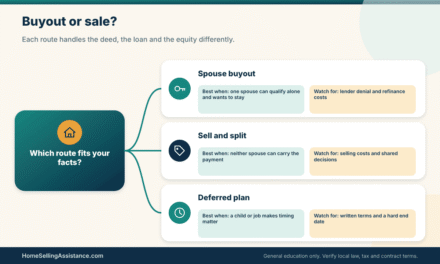
There are really only four routes, and the rest is variation. The couple can sell the house to a third party and divide the proceeds. One spouse can buy the other out and keep the home. The couple can keep owning it together for a defined period, often called a deferred sale, which may be used while children finish a school year or while the market recovers. Or a court can order the sale or division if the spouses cannot agree.
Each route trades price, time, risk and stress differently, and each has its own paperwork. A sale to a third party is the cleanest financially, because the loan is paid off and both names come off the property. A buyout can be a good fit when one spouse can qualify for a new loan alone and wants to stay, but it requires a real refinance or lender permission, and a fair value for the house. Which route you choose shapes the whole experience of selling house during divorce.
Staying co-owners after the divorce is the route that most needs a written plan. Who pays the mortgage? Who pays for a new roof? What happens if one spouse stops paying or wants out sooner than agreed? Without written answers to those questions, a deferred sale can turn a financial agreement into a long-running dispute. Our guide to selling a house while separated looks at how this works before the divorce is final.
Evidence to weigh: what each path requires from both of you
For a third-party sale, the evidence you need is the same as for any listing, plus authority: proof that everyone with an ownership interest will sign, and a clear statement of how proceeds are held. Many closing agents and title companies will want to see the divorce judgment, a settlement agreement or a court order if the file mentions one, because they are protecting the buyer’s title. The earlier you ask, the less likely a closing is to stall. That is the most common version of selling house during divorce.
For a buyout, the evidence is a value both spouses accept, the loan payoff, and a lender’s answer. Value can come from an appraisal chosen jointly or two agent opinions averaged. The lender’s answer matters most, because the remaining spouse typically has to qualify on one income. Our walkthrough of the divorce house buyout calculation shows how equity, closing costs and the buyout payment fit together. A buyout is an alternative to selling house during divorce, not a shortcut around its paperwork.
For a deferred sale or continued co-ownership, the evidence is the agreement itself. It should say who lives in the house, who pays each bill, how repairs are funded, how and when the house will be listed, how the price is set, and what happens to the proceeds. It should also say what triggers the sale early, such as remarriage, a missed payment or a child’s graduation. Have an attorney review it. Casual understandings do not hold up well when emotions change.
For a court-ordered sale or partition, the evidence is the court’s order and the procedure it sets out. This is the slowest and least flexible path, and it often leaves less money for both spouses after legal costs and a faster, lower-priced sale. If you are weighing it, read our overview of a partition sale of a co-owned house and ask an attorney what is realistic where you live.
Whichever route you lean toward, ask one extra question: what does this path require me to trust? A third-party sale requires trusting the process and the closing agent. A buyout requires trusting a valuation and a lender. A deferred sale requires trusting your former spouse to keep paying. If that last trust is thin, the agreement needs stronger protections or a different path. Trust is a practical input when selling house during divorce.
A scenario, an exception and your next step when one spouse wants to stay
Picture a couple with a modest amount of equity. One spouse wants to keep the house because the children are settled in the neighborhood. The other wants a clean break and cash. On paper, a buyout looks like the obvious answer. In practice, the staying spouse has to refinance alone, pay the departing spouse an agreed amount, and keep affording the home on one income. That last part is where many good intentions fall apart.
An exception to keep in mind: some loans may be assumable, and some lenders may allow one borrower to be released after review, but neither is guaranteed. Whether you can remove a name from a mortgage without a full refinance depends on the loan type, the servicer’s policy and your financial profile. A divorce decree that says “the wife keeps the house” does not change what the lender can enforce against both borrowers. Ask the servicer in writing what it will accept. Lender rules often decide whether selling house during divorce is avoidable at all.
The next step is to test the buyout before anyone promises anything. Ask a lender for a realistic pre-qualification for the staying spouse, using one income and the likely support obligations. Ask the attorneys how the buyout payment is treated in the settlement. Then compare the result with a straightforward sale on a rough net-proceeds worksheet. Seeing the numbers side by side usually settles the debate faster than another round of opinions.
If the buyout fails the test, it does not mean anyone lost. It means the sale is the more practical path, or that a short deferred sale can bridge the gap while the staying spouse builds a stronger application. Either of those is a legitimate outcome, and both are better than a buyout that closes on shaky financing and unwinds a year later. Plenty of couples end up selling house during divorce after a buyout test fails, and that is fine.
The picture below puts the four routes side by side so you and your spouse, or your attorneys, can see in one glance where each fits. It is a conversation starter rather than a verdict, because the right path depends on your state, your court and your finances.

Notice what the fork does not show: a “right” answer. A neutral view of the paths is useful because each one looks best to someone. The spouse who wants cash likes the sale, the spouse who wants stability likes the buyout, and the spouse who fears the market likes waiting. Putting all four in front of both people at the same time makes it easier to compare them on facts rather than feelings. Comparing paths side by side is a sound habit when selling house during divorce.
Now we turn to the first of two reference tables. It summarizes common situations a divorcing seller runs into, the key fact to establish in each, the practical action that usually follows, the trade-off and the document that typically proves the point. Use it as a checklist when you meet with your attorney, your lender or your title company. If a row matches your situation, the last column tells you what to bring to the conversation.
| Situation | Key fact to establish | Practical action | Trade-off | Source or document |
|---|---|---|---|---|
| Both spouses on title and loan | Both must sign and both remain liable | Agree on listing price range and who pays carrying costs | Needs cooperation, but cleanest exit | Deed, mortgage note, settlement agreement |
| Only one spouse on title | Marital rights may still require the other spouse’s consent | Ask a family law attorney and title company before listing | May slow listing, but avoids a failed closing | Recorded deed, state law, court order |
| One spouse wants to keep the home | Can that spouse qualify or assume alone? | Get a written lender answer and fair valuation | Keeps stability, adds risk and a payment to the other spouse | Lender letter, appraisal, buyout terms |
| Little or no equity | Payoff plus costs may exceed likely price | Run a net sheet; ask lender about options early | Selling may mean bringing cash to closing | Payoff statement, net proceeds estimate |
| Court order restricts the sale | Terms of the order control who may list and sign | Follow the order; ask the court or attorney for any needed approval | Less flexibility, but protects both parties | Court order, divorce judgment |
| Spouse is uncooperative or absent | Authority to convey cannot be assumed | Discuss court-supervised options with an attorney | Slower and costlier, but more defensible title | Docket records, service documents, title report |
To use the table, find the row that sounds most like you and read across. The “key fact” column is the question to answer first, because everything else depends on it. The “trade-off” column is a reminder that no choice here is free. If two rows apply, such as a co-owned home with little equity, treat the stricter row as the one that controls your plan, and bring both sets of documents to your meetings. Selling house during divorce rarely fits one row perfectly.
One more point before the next section. Nothing in the table assumes your marriage is ending badly. Plenty of couples sell cooperatively, agree on an agent in a single afternoon and split proceeds without a single argument. The table is meant for the less comfortable cases, where a missing signature, a stubborn lender or a vague order is the thing that stops a sale. Plenty of couples find selling house during divorce calmer than they feared.
Before we move to price and proceeds, a short reminder about expectations. Selling house during divorce rarely produces a perfect result for both people, and it does not need to. A realistic goal is a fair, documented outcome that both of you can live with and that ends the shared financial tie. If you aim for a win over the other person, you will pay for it in legal fees and in months of carrying costs.
What changes price, speed, risk and net proceeds in selling house during divorce
Every sale is a trade among four things: the price you receive, the time it takes, the risk that it falls apart, and the money you keep after everything is paid. A divorce adds a fifth pressure, which is that two decision-makers have to agree on every trade. This section looks at the market and property variables that move the first three, then at the costs, taxes and logistics that shape what is left at the end. Selling house during divorce adds a joint-approval layer to all four.
If you want a wider view of how the whole process runs outside of divorce, our cornerstone guide on how to sell a house covers the standard sequence, and the pieces here fit inside it. What changes in a divorce is who has authority, how quickly decisions can be made, and how the cash is divided. What differs about selling house during divorce is authority, speed of decisions and the split of cash.
Market, condition, financing, contract and buyer variables
Buyers do not know or care that the sale is part of a divorce, and in many states you are not required to tell them. What they see is a house, a price, a condition and a contract. The market sets the range in which a buyer will pay. The house’s condition decides how close to the top of that range you land. The contract decides whether the price you agreed on turns into money in a bank account.
The twist in a divorce is that each of these variables has to be handled jointly. One spouse may want to fix the roof and the other may want to sell as is. One may accept a lower offer that closes quickly and the other may want to wait for a better one. Agreeing in advance on a decision process, such as a price floor, a repair budget and a response time for offers, takes most of the heat out of the variables. Agreeing on rules ahead of time makes selling house during divorce more predictable.
Evidence to gather: comparable sales, condition notes and buyer financing
For price, ask a licensed agent for a comparative market analysis built from recent nearby sales of similar homes. Look at what sold, not what is merely listed, and at how long it took. If the two of you disagree on value, getting a second analysis from a different agent or an independent appraisal can settle the argument with evidence. Agree beforehand that you will both accept the average or the appraisal, so the exercise ends the debate instead of starting a new one. Price evidence matters most when selling house during divorce, because two people must accept it.
For condition, walk the house together with a notebook, or hire a pre-listing inspector so the findings come from a neutral source. Sort the list into three groups: safety and function items that buyers will insist on, cosmetic items that affect first impressions, and items you will leave alone and disclose. Our guide to repairs before selling a house helps you decide which are worth doing, and that decision is much easier when both spouses are looking at the same list.
For buyer financing, remember that a financed offer is only as strong as the lender behind it. Ask for a pre-approval letter, not a casual statement, and have your agent or attorney review it. A cash offer removes the financing step but still needs proof of funds, and our article on cash offers for a house explains how to check them. In a divorce, a slow or failed closing is expensive, because each month of delay means more carrying costs for two people. Delays cost more when selling house during divorce, since two households carry them.
For the contract, the evidence is the document itself. Contingency dates, earnest money terms, repair credits, the closing date and the possession date all affect risk. If your sale is under any court order, make sure the contract language is consistent with it. For example, if a judge has ordered that proceeds be held in a particular account, the contract and the closing instructions must reflect that. Consistency between the contract and any order is central to selling house during divorce.
Finally, keep a simple log of every price opinion, inspection note and offer. In a divorce, memory is unreliable and trust may be thin. A shared folder with dates and documents lets both spouses, and their lawyers, see how each decision was made. If a dispute ever arises about why you accepted one offer over another, the file will answer it faster than an argument.
Price pressure deserves its own comment. When one person feels rushed, selling house during divorce can drift toward a quick, lower sale that the other person later resents. When one person digs in, the house sits and the carrying costs grow. A written price schedule, such as a starting range and a review date after a set number of weeks, protects both of you from the extremes without anyone having to concede in the heat of the moment.
Showings are another place where the variables bite. Selling house during divorce often means a home that is occupied by one spouse and children while the other lives elsewhere. Agree on showing hours, on how much notice the occupant receives, on who prepares the house, and on what happens if a showing is cancelled. A predictable routine is kinder to everyone and makes the house look better, because it is clean and ready when buyers arrive.
A scenario, an exception and your next step when the offers arrive
Imagine two offers on a house listed at a round figure. The first is higher but depends on the buyer selling their own home first. The second is slightly lower, comes with a pre-approval from a lender and closes in a shorter window. One spouse sees the higher number and the other sees the certainty. This is where a pre-agreed decision rule pays off, such as “we weigh certainty and closing date equally with price, and we decide within forty-eight hours.” Choosing between them is where selling house during divorce tests a couple most.
An exception: if the house has little equity, a lower offer may fall below what is owed, which turns the question from “which offer is better” into “can we afford to close at all.” Selling for less than the mortgage is called a short sale, and it needs the lender’s approval. Our guide on selling a house before foreclosure explains what is involved if payments are already behind, and a HUD-approved housing counselor can help at no cost. You can find one at HUD’s housing counselor search.
Your next step when offers arrive is to compare them on a one-page sheet: price, financing, contingencies, closing date, possession date, and the estimated net after costs. Put the sheet in front of both spouses and, if you have counsel, the attorneys. Do not accept or reject anything until both have seen it. If one spouse is unreachable, ask your attorney what the court order or agreement allows before you respond. This habit keeps selling house during divorce orderly under time pressure.
Costs, legal and tax issues, logistics and the priorities behind them
Once the price is set, the next question is what remains. Sellers often focus on the headline number and are surprised by the gap between it and the check. In a divorce, the gap matters twice, because the remaining money may be divided between two people according to a court order or agreement, and because a surprise at closing can reopen a settlement that everyone thought was finished. Selling house during divorce makes the net figure matter twice.
The deductions fall into a few families. There is the mortgage payoff and any other lien. There are the closing costs that sellers commonly pay, which may include broker compensation, title and escrow charges, transfer taxes where they apply, and prorated property taxes and association dues. There are credits you may agree to in negotiation after an inspection or appraisal. And there are legal and tax items that depend on your facts. Our guide to seller closing costs walks through the usual line items.
Broker compensation deserves a brief word. Since the industry changes that followed the NAR settlement, compensation is negotiable and has to be written down, and the structure varies by listing agreement. Ask any agent you interview to explain in plain language what you would pay, what is offered to a buyer’s agent, and what happens if the listing runs long. Our article on the seller’s listing agreement explains the terms to read twice.
The waterfall below shows the general shape of the arithmetic. It uses no real figures, because every sale is different. What it does show is the order in which the money flows out, and why the number you can divide between two people is usually the last one on the page rather than the first.

Read the picture from left to right. The contract price starts the chain, the payoff takes the first and often the largest bite, and each later step is a smaller bite that is easy to underestimate. In a divorce, the last box is where the settlement agreement does its work, because a court order or agreement may say how the net is divided, who covers a shortfall, and which expenses are paid before the split.
Evidence to gather: payoff quotes, a net sheet and the tax basics
Ask the closing agent or an agent you trust for a seller net sheet. It is an estimate, not a promise, and it should show each deduction as its own line. Ask them to run it at three price points, a low, a middle and a high, so you can see how sensitive your result is. Our overview of home sale net proceeds explains how to read a net sheet and where the estimates are likely to be off. A net sheet is the plainest tool for selling house during divorce with open eyes.
For taxes, there are a few federal rules worth knowing in outline. A transfer of a home between spouses, or between former spouses when it is incident to the divorce, is generally not a taxable event at the time of the transfer.
When the home is later sold to a third party, the gain may be eligible for the home sale exclusion, which can shield up to $250,000 of gain for a single filer or $500,000 for joint filers if the ownership and use tests are met. Those tests generally ask whether you owned and lived in the home for at least two of the five years before the sale.
Divorce can affect those tests, and it can affect which dollar limit applies. There are special rules that may let a spouse count a former spouse’s period of ownership, or count time that a former spouse was allowed to use the home under the divorce instrument. The IRS explains these in Publication 504 for divorced or separated individuals and in Publication 523 on selling your home. Because filing status in the year of sale changes the limit, a tax professional should check your facts. Our article on capital gains when you sell a house in a divorce goes further.
Basis matters too. Your gain is generally the amount realized minus your adjusted basis, which starts with the purchase price and is increased by qualifying improvements. Keep the closing statement from when you bought the home and receipts for major projects. If one spouse handled the paperwork and has moved out, ask for copies now. It is much easier to collect records during the divorce than a year after it. Our guide to adjusted basis in a home sale lists what usually counts. Good records make selling house during divorce less costly at tax time.
Finally, ask the title company to run a title search early. Judgments, liens from unpaid taxes or contractors, and old mortgages that were never released can surface, and each has to be cleared before closing. Discovering a lien at the closing table is expensive and stressful. Discovering it before you list gives you time to deal with it. Our article on the title search for sellers explains what is checked and why. Early title work is cheap protection when selling house during divorce.
Costs also include the things nobody budgets for. Selling house during divorce can involve legal fees for reviewing a contract, a fee to order certified court documents, storage for furniture, a short-term rental for the spouse who moves first, and the cost of cleaning or minor repairs. None of these is large alone. Together they can shave a meaningful amount off your net, so add a modest cushion to your estimate and treat it as a planning habit, not a prediction.
Taxes deserve a final caution. Selling house during divorce can change your filing status from one year to the next, and that can change the dollar limit on any exclusion you hope to use. Timing the closing before or after the year ends, or before or after the decree, may matter. It may also matter very little. The honest answer is that it depends on your facts, which is the reason a short conversation with a tax professional is worth scheduling before you sign a contract.
A scenario, an exception and your next step on costs and taxes
Here is an illustrative round-number example, not a prediction. Suppose a house sells for a contract price of $400,000, and the payoff on the mortgage is $240,000. Suppose that closing costs, broker compensation, prorations and a small repair credit together come to $30,000. The net before any court-ordered adjustments is $130,000. If the settlement says the spouses share equally after paying a $10,000 shared credit-card balance, each would receive $60,000.
Change one number and the picture shifts. If the sale price drops by $20,000 because the house sits on the market, and the costs stay the same, the net falls to $110,000 and each person’s share falls by $10,000 after the same credit-card payment. The shape of the arithmetic stays, but a small change in price can produce a larger change in the net. This is why a net sheet at several price points is more useful than a single estimate. Small shifts in price matter a lot when selling house during divorce.
An exception: if the home was owned for less than two years, or if one spouse moved out long ago, the exclusion may be reduced or unavailable, and the tax consequence of the sale could be larger than the couple expected. Another is a home that was once rented out, which can bring depreciation recapture into the picture; the IRS covers that in Publication 527. Neither is a reason to panic, but both are reasons to ask before listing, not after.
Your next step is to book a short consultation with a tax professional who works with divorcing clients, and to bring the deed, the purchase closing statement, a list of improvements and any draft settlement terms. Ask how the exclusion applies to your facts, who is expected to report the sale, and whether the timing of the closing matters for your filing status. A single hour of that advice can be cheaper than one avoidable mistake.
The last piece of this section is logistics, and it is the one that causes the most day-to-day friction. Who is living in the house during the listing? Who handles showings, utilities and lawn care? Who signs for repairs? If the spouses are living apart, which one keeps the keys and the lockbox code? Put these decisions in a short written plan, and share it with the agent, so there is one set of instructions rather than two competing ones. Daily logistics decide how smoothly selling house during divorce feels.
Priorities sit under all of this. A spouse who needs cash for a deposit on a new home will weigh a fast closing more heavily than a spouse who is staying in the area. A spouse who is paying the mortgage alone will feel the monthly cost of delay more sharply. Naming those priorities openly is not a weakness.
It lets each of you see why the other is pushing for a particular offer, and it makes it easier to trade, such as accepting a slower closing in return for a more favorable split of the credits. Open priorities make selling house during divorce a negotiation instead of a standoff.
Privacy and tone belong here too. Many divorcing sellers prefer that neighbors and buyers do not hear details of the case. A listing agent has no need to know why you are selling beyond what is required to represent you, and you generally do not owe buyers an explanation. Agree on a short, neutral line, such as “we are making a move,” and use it consistently. It protects both of you and keeps showings focused on the house. Discretion is part of selling house during divorce for many families.
Verification sounds slow, but in practice it speeds things up. Selling house during divorce stalls most often when someone discovers a missing document or an unclear authority after an offer is accepted. Checking the same items before listing costs days instead of weeks, and it lets you choose a closing date with confidence. Think of verification as an inexpensive insurance policy against the most common reasons for delay.
Turn the selling house during divorce overview into a verification roadmap
Understanding the moving parts is useful, but a sale only closes when the facts have been checked. This last main section turns everything above into a working plan: which documents to gather, which professionals to involve and in what order, and which decisions must be made before the house is listed versus which can wait until you hold an offer. Selling house during divorce closes only when each fact has been checked.
The theme is verification. A confident claim from a friend, a neighbor, a website or even a well-meaning agent is a prompt to check, not a reason to act. Divorce, title, lending and tax rules vary by state and by contract, and a single wrong assumption, such as who may sign or what the lender will allow, can stop a closing. The sources worth trusting are the actual documents, state agencies, licensed professionals and primary government sources.
Documents and professionals to involve in a divorce home sale
Start with the documents because they cost almost nothing and they tell you which professionals you need. A seller file for a divorce sale looks like an ordinary seller file with a few additions: the deed and any trust or title documents, loan statements and written payoff quotes, tax bills, insurance declarations, HOA information if it applies, repair records and warranties, and then every court document, agreement or draft that touches the property. A document file is the cheapest tool for selling house during divorce.
The professionals fall into two groups. The first group advises you personally and, ideally, each spouse has their own: a family law attorney, and a tax professional. The second group serves the transaction, and the couple can share them if both are comfortable: a listing agent, a title or escrow officer, a lender if there is a buyout, and sometimes a neutral appraiser or mediator.
Sharing a transaction professional is efficient, but it is worth asking each one who they represent and what their duty is to each of you. Choosing them well is part of selling house during divorce responsibly.
The next table gives the transaction view. It follows a sale from preparation to closing and shows, for each stage, what the seller is responsible for, what depends on a buyer or professional, the typical deadline pattern, and a sensible fallback. Treat the deadline column as a pattern rather than a rule, since dates come from your contract, your lender and your court.
| Stage | Seller responsibility | Buyer or professional dependency | Deadline pattern | Fallback |
|---|---|---|---|---|
| Preparation | Gather deed, payoff, court papers, repair list | Attorney, title company, tax professional | Before listing; court calendar may set limits | List later or delay price decisions until facts are verified |
| Pricing and listing | Agree on price range, agent and showing rules | Agent’s market analysis, appraiser if needed | Set by listing agreement terms | Second opinion or independent appraisal |
| Offer and negotiation | Compare offers jointly; sign counters | Buyer’s lender, buyer’s agent | Offer expiration dates in each counter | Backup offer or short extension in writing |
| Contract to closing | Respond to inspection, appraisal and title issues | Inspector, appraiser, underwriter, title examiner | Contingency dates in the contract | Renegotiate, credit, or relist per contract terms |
| Closing and funds | Sign, confirm payoff and how proceeds are paid | Closing agent, lenders, county recorder | Closing date in the contract | Extend with written agreement; verify wire instructions by phone |
| After closing | Keep closing statement, report sale, update records | Tax professional, attorney, lender confirmation | Tax filing and settlement deadlines | Request written payoff confirmation and release if missing |
Use the table by walking down the “fallback” column before you need it. Most sellers only think about fallbacks after a problem appears, when they are already under pressure. If you and your spouse agree on the fallback for each stage in advance, a failed inspection or a delayed lender becomes a planned detour rather than an argument. Planned fallbacks keep selling house during divorce moving after a setback.
The checklist below gathers the documents most closing teams ask for in a sale like this. You do not need every item for every house, and some will not apply. The idea is to open a shared folder, put each document in as you find it, and let the missing items tell you who to call.

Evidence to gather: who each professional is, and what to ask them
A family law attorney can tell you what a court order or settlement means for the house, whether a court must approve the sale, and who needs to sign. Ask them: what does the current order allow me to do with the house? What happens to the proceeds, and when? What would a judge expect if my spouse refuses to cooperate? If you cannot afford separate attorneys, ask about limited-scope services, legal aid clinics or a mediator. A bar association referral line is a reasonable place to begin. Authority questions come first when selling house during divorce.
A listing agent handles pricing, marketing and negotiation. When you interview agents, ask for a written comparative market analysis, how they communicate with two clients who may not be speaking, what they charge and how that is negotiated, and what the listing agreement allows you to cancel. Experience with divorce sales is helpful but not required. Our guide on how to choose a listing agent includes interview questions that apply well here, and our article on listing a home during divorce covers the practical side.
A title or escrow officer confirms ownership, finds liens, and runs the closing. Ask them early what documents they will want from a divorce, such as a recorded judgment or a letter from the court, so you can order certified copies. The officer represents the transaction, not either spouse, so questions about your personal rights belong with your attorney. If a buyer is financing, the lender and title company will each want to see that the person signing has the legal right to sell. Their early review helps selling house during divorce avoid last-minute holds.
A tax professional, such as a CPA or enrolled agent, can explain how the exclusion applies and who reports what. Ask: will our filing status in the year of sale change the limit? Is any part of the gain likely to be taxable? Do we need to make estimated payments? You can read the primary source yourself in IRS Publication 523, which is a good preparation for the conversation, but it does not replace advice on your own return.
If money is tight or you are behind on payments, add a HUD-approved housing counselor to the list. They offer free or low-cost guidance on budgeting, loan options and avoiding foreclosure, and you can search for one on the HUD housing counselor page. Be careful with anyone who charges an upfront fee to “save” your home or asks you to sign over the deed. The Federal Trade Commission publishes warnings about those schemes.
A last note on fair treatment. Agents and buyers must follow fair housing laws, and a seller should never give instructions that screen or steer buyers by race, religion, sex, family status, disability or any other protected class. In a divorce, one spouse sometimes has strong feelings about who should or should not buy the house. Keep those feelings out of the process. The HUD fair housing page explains the rules.
Cost is a fair concern when you are assembling a team. Selling house during divorce does not require a large entourage. For many couples the essential team is a family law attorney or mediator, one listing agent, a title company and a tax adviser consulted once. Add a lender only if there is a buyout, and add a housing counselor only if money is tight. Ask each professional for a written fee estimate so there are no surprises.
Communication is the other half of a good team. Selling house during divorce goes better when messages go through a single channel, such as a shared email thread or a short weekly call, instead of scattered texts. Ask the agent to copy both spouses on important updates, and ask each attorney to confirm what may be shared directly. Clear channels reduce the chance of conflicting instructions, and they leave a paper trail if memories later differ.
A scenario, an exception and your next step for the team
An illustrative case: two spouses meet three agents, an attorney each, and a title officer, and quickly collect conflicting advice. One agent says to list immediately. The attorney says wait for a hearing. The title officer says a lien needs clearing first. The conflict is only apparent. Each person is answering a different question. The right sequence is usually legal authority first, title and payoff facts second, price and listing third. Sequence matters when selling house during divorce.
An exception: some courts require approval, a signed stipulation or a formal order before a sale can be completed, and some do not. Where an order sets a sale process, such as a named real estate agent, a price range or a deadline, the order controls. If you are unsure, ask your attorney to confirm in writing what you may do without further court approval. That email is worth keeping in the seller file.
Your next step is a short kickoff meeting, in person or on a call, with each spouse, their attorneys if they have them, and the agent. Share the document file, agree who will be the single point of contact for the agent, confirm how decisions will be made and how fast, and set the date by which the first set of facts will be checked. A one-page minutes note afterward keeps everyone on the same page, and nothing about it is complicated. One meeting can set the tone for selling house during divorce.
It also helps to decide, at that meeting, how disagreements will be resolved. Some couples agree that a tie goes to a mediator, others that they will follow the agent’s written recommendation on price, and others that a specific attorney will break the deadlock. Any method works if both people accepted it beforehand. The absence of a method is what turns a fifty-dollar disagreement about a lockbox into a three-week standoff. Tie-break rules are a practical part of selling house during divorce.
What to settle before listing and what can wait until an offer arrives
A common mistake in selling house during divorce is trying to decide everything at once. The result is a stalled project that looks organized and goes nowhere. A better approach is to sort decisions into two piles: the ones that must be settled before the first showing because they affect authority, price and safety, and the ones that can wait until a real offer exists because the answer depends on the offer.
The first pile is short. The second is longer, and it is a relief to realize how many of the hard questions, such as how to split a repair credit or whether to accept a particular closing date, can be answered later with real numbers on the table. Our guide on how to divide home sale proceeds in a divorce covers one of the biggest items that can wait, within limits set by your agreement. The second pile is where selling house during divorce gets easier.
The picture below maps a few common fallback paths when the sale hits a snag. It is not a legal flowchart, because courts and contracts differ, but it shows the kind of question to ask at each fork and the person who should answer it. If you are already worried about a specific snag, find it in the branches before you call anyone.
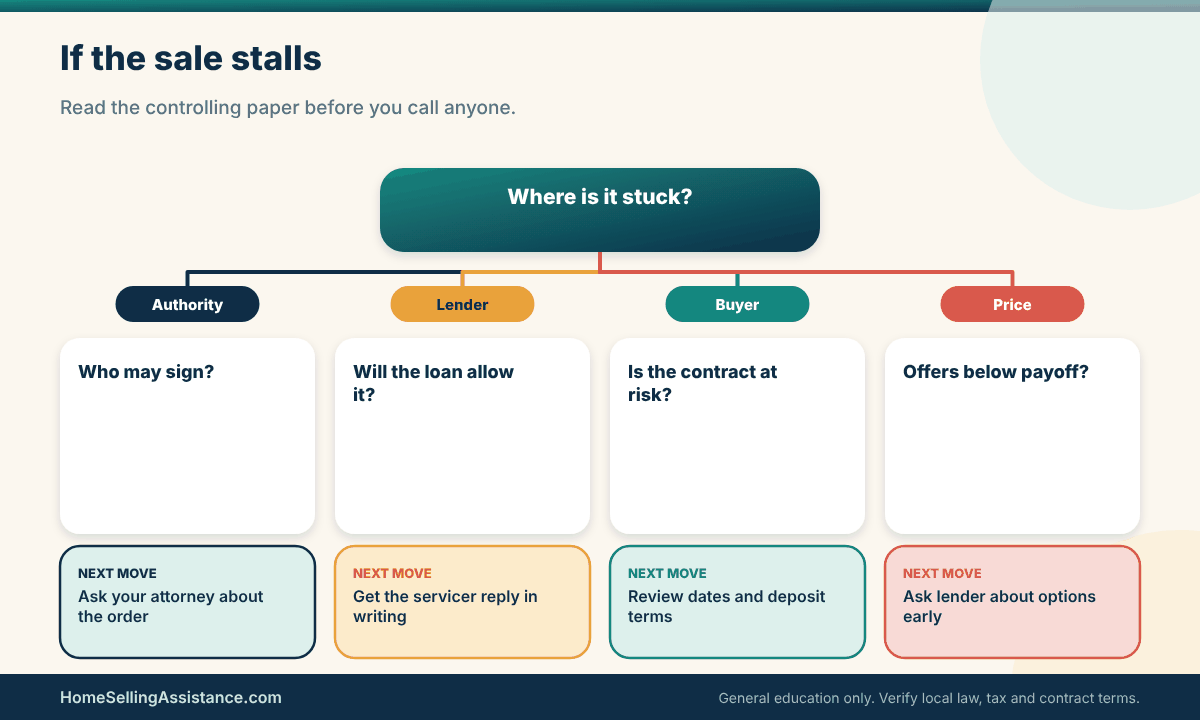
The tree is meant to be read as a sequence of questions. At each branch, the first thing to do is look at the document that controls the answer: the contract for a buyer problem, the court order for an authority problem, the loan papers for a lender problem. Only then do you call the professional who can interpret it. That order saves time and money, and it prevents the common mistake of acting on a verbal assurance. That order keeps selling house during divorce grounded in documents.
Evidence to gather: the mortgage, the order and the money trail
The mortgage is the item that surprises people most. When two spouses signed the loan, both are generally liable for it until it is paid off, regardless of what a divorce decree says about who will make the payments. A decree can allocate responsibility between the spouses, but it does not bind the lender. If the spouse who was assigned the payments stops paying, the lender can look to both borrowers, and both credit reports can be affected. It is the first fact to check when selling house during divorce.
That is why many couples choose to sell or refinance rather than leave both names on a loan for years. If one spouse will keep the house, ask the servicer in writing about three possibilities: a refinance in one name, an assumption of the loan, or a formal release of liability. Some loans may allow an assumption and some do not, and the servicer’s answer, not a friend’s story about a cousin’s loan, is what counts. Our article on the mortgage during a divorce home sale explains the questions to ask.
If you are selling, the loan simply gets paid at closing from the proceeds. That makes the payoff quote the most important number on the sheet. Ask the servicer how long a quote stays valid, what the daily interest is after that date, and how they will confirm the payoff in writing after closing. Our guide on mortgage payoff when selling a house and our overview of selling a house with a mortgage explain how this works.
During the case, the question of who pays the mortgage matters a great deal. A temporary order or an agreement may assign the payments, and it may say how those payments will be credited against the equity later. Unless you have written terms, assume that the payments are a topic for the attorneys, and keep records of every payment: who made it, from which account, and when. Missed payments hurt both borrowers’ credit and can add late fees to the payoff.
Then trace the money. Where will the sale proceeds go? Some agreements direct the closing agent to pay specific amounts to each spouse, others to deposit the net into an attorney’s trust account or a court registry, and others to hold back a portion for a pending issue. The closing agent will need written, signed instructions from both spouses, so settle this before the closing date, not on it. Never change payment instructions based on an unverified email. Money handling is a core part of selling house during divorce.
Wire fraud is a real risk in any closing, and it is worse when two people are communicating through messages and forwarded emails. Always confirm wire instructions by calling a phone number you already trust, and never use a number from the message itself. The FBI’s Internet Crime Complaint Center takes reports, and our article on home sale fraud and seller safety lists the warning signs. Fraud awareness belongs in any plan for selling house during divorce.
The last piece of evidence is insurance and utilities. Keep the homeowner’s policy active until closing, even if one spouse has moved out, and make sure the insurer knows if the house is vacant, because a vacant house can have different coverage rules. Confirm who is named on the utilities, since the closing agent may need final readings. A lapse in coverage or an unpaid utility bill can create liens or claims that show up at the worst moment.
If emotions run high, pace the work. Selling house during divorce does not need to be finished in a weekend, and a handful of short, focused sessions usually beat one long, tense meeting. Pick one topic per session, such as price range, repairs or showing rules, write down what you agreed, and stop. Short agreements that both people honor are worth more than sweeping ones that nobody follows.
Remember the children, if there are any. Selling house during divorce affects their routines, their school and their sense of home. Many families find it helps to share a simple, honest explanation of the timeline and to keep the house as calm as possible during showings. A predictable plan for when they will move and where they will go lessens the stress for them, and that peace tends to spill over to the adults.
A scenario, an exception and your next step before you list
Here is an illustrative scenario. Two spouses agree to list, but the settlement agreement is still being negotiated and does not say how proceeds will be divided. They list anyway, receive a good offer, and then stall for three weeks because neither side will sign closing instructions without knowing the split. The buyer, whose rate lock is expiring, walks away. The fix was not complicated. A short interim agreement, signed by both, directing proceeds into a trust account until the split is final, would have let the sale move forward.
An exception: if one spouse has the right to live in the home for a defined period under a court order, that right may affect when the house can be listed and shown. It may also affect buyers’ ability to take possession on the closing date. A buyer will expect the home to be vacant and in the condition shown unless the contract says otherwise. Check the order with your attorney before you promise any possession date in writing.
Your next step is a one-page “before we list” checklist that both spouses sign or initial. It should include the agreed price range and the process for changing it, the agent and listing terms, who is authorized to sign counters, the repair budget, the showing schedule, how proceeds will be held until the final split, and who will talk to the agent. A one-page agreement is not a substitute for legal documents, but it prevents most of the daily friction that sinks cooperative sales. A signed page like this has steadied many couples selling house during divorce.
Another useful step is to choose a target list date and work backward. If the plan is to list in six weeks, what must be done by then: documents gathered, a title report ordered, a net sheet run, decluttering and cleaning done, and photographs scheduled? A date focuses effort, and it gives both spouses something neutral to organize around. Our guide on home staging for sellers has practical advice for presenting a house that is also a home people are living in.
It is tempting to decide in advance every detail of how you will respond to every possible offer. Resist it. The right answer to a request for a repair credit depends on the amount and on the rest of the offer. The right closing date depends on when each of you needs to move. The right response to a buyer who asks you to leave the appliances depends on who wants the appliances. Decide how you will decide, and leave the answers until you have the facts.
What you can usefully settle before listing is the process: who reviews offers, how quickly, and with what information. It can be as simple as “both of us review every offer within a day, with a net sheet, and we reply together.” If one spouse is traveling or hard to reach, name an alternate, such as an attorney with written authority, so a good offer does not expire because one person did not answer a text.
Another category that can wait is the final split of small items, such as furniture left in the house, the lawn equipment, or the appliances that convey. Make a short list of anything that will stay with the home and anything that will not, and decide on the larger items before photographs are taken, since buyers may assume that what they see is included. The list can be attached to the listing agreement and the contract so there is no confusion at the walk-through. Small-item lists keep selling house during divorce free of walk-through arguments.
Also worth postponing is any promise about the future that is not necessary for the sale itself, such as who will take over a shared account or a shared vehicle. Those belong in the settlement agreement, not in the listing plan. Keeping the sale narrow, a single transaction with a defined start and end, makes it easier to finish. The more topics you attach to it, the more reasons there are for it to stall. Narrow scope helps selling house during divorce reach a finish line.
Finally, give yourselves permission to adjust. Markets move, offers come in lower than hoped, inspections find surprises, and a lender may take longer than promised. A plan that allows for a reduction after a set number of weeks, with a price range agreed in advance, is much easier to follow than one that requires a fresh argument at each stage. Our article on the home selling timeline shows how the schedule usually unfolds, so you can set expectations that fit it. Flexibility is a strength when selling house during divorce.
A final practical thought on keeping momentum. Selling house during divorce is a project with a finish line, and it helps to mark progress. Check off the document file, the title report, the net sheet, the listing agreement and the first showing, one by one. Each completed item reduces uncertainty for both people. When you reach the closing table, the work you did on authority, price and proceeds will have turned a painful event into an orderly one.
If you take only one habit from this guide, make it this one: write down agreements and confirm them with the person who can enforce them. Selling house during divorce involves a lot of verbal understandings that feel solid at the time and dissolve under stress. A short email that says what you agreed, sent the same day and answered by the other person, is simple and costs nothing. It has saved many couples from a second dispute inside the first.
Frequently asked questions about selling house during divorce
Can one spouse sell the house without the other’s signature?
It depends on how title is held, your state’s marital property rules and any court order in place. Even when only one name is on the deed, many states give the other spouse rights that a title company will want resolved before closing. A buyer’s lender and title insurer usually insist on clear authority to sell. Ask a family law attorney and the title company before you sign anything, because a sale made without proper authority can be challenged later.
Do we have to tell buyers that the sale is part of a divorce?
Disclosure rules vary by state, and most focus on the property’s condition and legal status rather than your personal reasons for selling. In general, a seller has no duty to explain why they are selling, but a seller must not lie when asked a direct question about material facts. If a court order or pending case affects your ability to convey title, that is a legal fact worth discussing with your attorney. Our guide to seller disclosure requirements explains the basics.
Who pays the mortgage while the house is for sale?
Unless an order or written agreement says otherwise, both borrowers stay liable to the lender, and the lender will take payment from whoever sends it. Courts and settlements often assign the payments temporarily and may credit them against each person’s share of the equity later. Keep records of every payment and ask your attorney how they will be treated. Missed payments can damage both borrowers’ credit and add costs to the payoff.
What if we owe more than the house will sell for?
Then a standard sale may require cash at closing to cover the gap, or the lender may agree to a short sale, which needs its approval and can have credit and tax consequences. Start with a written payoff quote and a net sheet, then ask the servicer what hardship options exist. A HUD-approved housing counselor can help you compare choices at no or low cost. Do not sign over a deed or pay a stranger to “rescue” the home.
Is it better to sell now or wait until the divorce is final?
There is no single answer. Selling during the case can reduce carrying costs and end a shared financial obligation sooner, but it may need the court’s or both spouses’ consent and clear instructions on how proceeds are held. Waiting can give you a cleaner agreement but may mean months of payments on a house nobody wants to keep. Compare the monthly cost of holding the house with the risk of a rushed sale, and ask your attorney about timing.
How are the proceeds divided?
The split is set by your settlement agreement or by the court, not by the closing agent, and rules about dividing marital property vary by state. The closing agent will follow written instructions signed by the people entitled to the money. Many couples direct specific amounts to each person, or hold the net in an attorney’s trust account until the final division is settled. Our article on dividing home sale proceeds gives more detail.
Will I owe taxes on the sale?
Maybe, maybe not. Many home sellers owe no federal tax on the gain because of the home sale exclusion, which is up to $250,000 for a single filer or $500,000 for joint filers when the ownership and use tests are met. Divorce can affect which limit applies and how those tests are counted, and state taxes may differ. Read the IRS publications on selling your home and on divorce, and ask a tax professional about your own facts.
Should we use the same agent and the same attorney?
Sharing a listing agent is common and can work well when both spouses trust the agent and communicate clearly. A shared attorney is a different matter, because lawyers generally cannot represent both sides of a contested divorce, and a mediator is a neutral who does not give either party legal advice. If you are unsure whether your interests align, hire separate counsel. You can still share the transaction professionals, such as the agent and the closing agent.
What if my spouse refuses to cooperate with showings or signing?
Start by documenting what you asked and when. Then ask your attorney about the options available where you live, which may include a motion in the divorce case, a mediated agreement or, for co-owners generally, a court-supervised sale. These routes take time and cost money, so they are usually a last resort. Our guide on a co-owner who refuses to sell outlines the choices at a general level.
How can I avoid scams and fraud during the sale?
Verify every set of wire instructions by phone using a number you already trust, work only with licensed professionals you have checked, and be wary of unsolicited offers that pressure you to act quickly or skip inspections. Distressed sellers are a favorite target for fake rescue schemes and fake cash buyers. The Consumer Financial Protection Bureau publishes plain-language guidance on mortgage and closing fraud.
A calmer way to finish
Selling house during divorce is hard because it asks two people to cooperate at the moment cooperation is most difficult. It gets easier when you replace assumptions with documents, replace arguments with written rules, and bring the right professionals in at the right time. Start with your goal, your constraints and the facts, check each step against the real papers, and let the offers decide the details.
This article is general education, not legal, tax or financial advice, so confirm your own situation with a licensed attorney, a tax professional and the lender or title company handling your sale. For related decisions, browse our divorce and co-owned homes library and our guides to closing costs and net proceeds and home sale taxes.