If you are searching for a way to sell house before foreclosure, you are probably holding a letter you did not want to receive, and you may be doing the math on a kitchen table late at night. This guide is written for that moment. It explains how the clock works, who controls it, what a sale can and cannot fix, and how to compare your options calmly instead of reacting to whoever calls first.
Foreclosure is not one event, and that matters for anyone who wants to sell house before foreclosure. It is a process that starts with a missed payment, passes through notices, a stretch of phone calls and paperwork with your mortgage servicer, and only later reaches a legal action or a sale date. The rules for that process differ by state, by loan type and by who owns your loan. Because of that variation, the most useful thing a general article can do is teach you which questions to ask and which documents to put on the table.
We will walk through the decision in three parts. First, how to define your goal and map the real paths in front of you. Second, what moves your price, your timing, your risk and the money you walk away with. Third, how to turn all of it into a verification roadmap of documents, professionals and decisions. Along the way we link to deeper pages in our foreclosure and financial hardship library for the specific situations that deserve their own treatment.
A plain word about tone and limits. Nothing here can promise that a sale will stop a foreclosure, that a lender will agree to anything, or that a buyer will perform. We will not tell you what to do with your own home, and we are not a law firm, a lender or a tax adviser. What we can do is give you a clear map, honest trade-offs and a list of people whose job it is to read your actual paperwork. Many of them, including HUD-approved housing counselors, cost little or nothing to talk to.
Key takeaways
- Foreclosure is a process with stages, not a single date. Your notices, your loan documents and your state law decide how much time you actually have, so read the paper before you trust any rule of thumb.
- A sale works only if the numbers close. The sale price has to cover the payoff, the past-due amounts, the costs of selling and any liens, or you need your lender’s written approval for a shortfall.
- Talk to your servicer early, in writing. Ask for the payoff, the reinstatement figure, the current status and every loss-mitigation option that applies to your loan.
- Get free or low-cost help first. A HUD-approved housing counselor can review your situation without selling you anything, and an attorney can explain what your state allows.
- Be wary of anyone who wants your deed, an upfront fee or your silence. Rescue scams target exactly this situation, and a legitimate buyer or agent will put terms in writing and let a lawyer read them.
- Compare paths side by side. A traditional listing, a cash sale, a short sale, a loan workout and a negotiated exit each trade price, speed, credit impact and certainty differently.

Start with the decision: should you sell house before foreclosure, and on what terms?
Before you list anything or sign anything to sell house before foreclosure, decide what you are actually trying to accomplish. Some people want to keep the house and need breathing room. Others know they cannot afford it long term and want the cleanest exit, which makes the decision to sell house before foreclosure the central question. A third group is not sure, and that is fine, because the first week of work is the same for all three: collect facts, get the servicer talking and learn what each path would cost you.
The phrase sell house before foreclosure sounds like a single plan, but it covers a wide range of situations. A homeowner with plenty of equity and three months of runway is in a very different position from one whose balance exceeds the home’s value and whose sale date is weeks away. Treat this first section as a way to place yourself on that range honestly.
Your goal, your deadline and the property facts that frame everything
Start with three questions you can answer without any professional. What do you want your life to look like in six months? What is the most urgent date on any paper you have received? And what do you believe the property is worth to a buyer today, not what you paid or what you hoped? Write the answers down. They will shape every conversation that follows, and they will keep you from drifting into someone else’s plan.
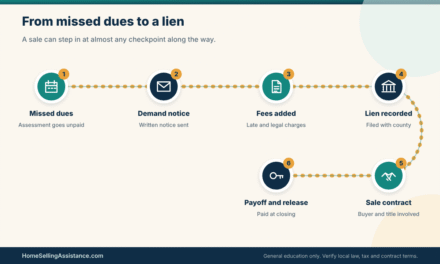
Then look at constraints that could block your plan to sell house before foreclosure. Is anyone else on the title or the loan, such as a spouse, an ex-spouse or an heir? Is the home occupied by you, a tenant or no one? Is there a second mortgage, a home equity line, an HOA, a tax lien or a contractor’s lien? Each of those adds a person whose consent, payoff or paperwork you will need.
Missing them early is the most common reason a workable plan stalls late. Our overview of selling a house with a lien shows how those claims get found and paid.
Evidence to gather: the letters, dates and balances that set your clock
To sell house before foreclosure with confidence, build a single folder, paper or digital, and put these items in it before you make a decision. Gather every letter from your servicer and any law firm or trustee acting for it, especially anything titled notice of default, notice of intent to accelerate, notice of sale, or summons. Collect your most recent mortgage statement, your note and mortgage or deed of trust if you have copies, and the last twelve months of payment history. Add property tax bills, HOA statements, homeowner insurance declarations and any second-loan statements.
Two documents deserve special attention. The first is a written payoff statement, which tells you what it would take to pay the loan off in full on a specific date, including interest, fees and sometimes legal costs. The second is a reinstatement quote, which tells you what it would take to bring the loan current and stop the process if your loan and state allow that. Those two numbers are different, and the gap between them often explains which path is realistic.
Federal servicing rules generally keep a servicer from starting the formal foreclosure process until a loan is more than 120 days delinquent, with some exceptions, and they give you certain rights when you apply for help. State law then layers on how notices work, whether a court is involved and how long each step takes. You do not need to memorize any of that. You need your own notices, your own dates and a professional who can say what they mean in your state.
Finally, write a one-page timeline of your effort to sell house before foreclosure, from the first missed payment to today. Include phone calls, who you spoke with, what they said and what they promised to send. Servicers handle large volumes, and records of your own often resolve disputes about what was agreed. Keep the log going from now on. If you later speak with a counselor or attorney, that page saves an hour of questions and probably improves the advice you get.
When you call the servicer, a short script keeps the conversation useful. Open with your loan number and the sentence, “I want to understand every option and the exact dates, and I would like each answer confirmed in writing.” Then ask what the loan’s status is, what the total past-due amount is, what the payoff would be on a specific date, whether any application is open and what the next legal step is. Ask for the name and direct line of the person handling your file.
Because you want to sell house before foreclosure, take notes during the call, then send a short follow-up message restating what you were told and asking the servicer to correct anything wrong. This does two jobs. It gives you a written record, and it quietly shows the servicer that you are organized. Avoid arguing about fault on the phone. The goal of the first call is information, not a verdict, and calm questions get better answers than anger, even when anger is deserved.
Ask one more question that many homeowners skip: what is the servicer’s process if a sale is pending? Some servicers have a named team or a form for borrowers who have a purchase contract, and knowing that in advance lets you build the request correctly later. If the answer is vague, ask who can answer it, and ask for the reply by email. A plan to sell house before foreclosure runs much more smoothly when the servicer already knows a sale is possible.
A scenario, an exception and your next step: the household that waited a month too long
Consider an illustrative household, not a real one, that later tries to sell house before foreclosure. A couple falls behind after one income drops. They hope the problem will fix itself, ignore two letters and avoid the servicer’s calls because the calls feel like pressure. By the time they open the mail properly, a notice of default has been issued and the clock is running. Nothing is lost yet, but the number of comfortable options has narrowed, and every week of silence has added fees.
The exception worth knowing is that timing is not purely a matter of how long you have been behind. A recent loan modification, a pending loss-mitigation application, a bankruptcy filing or a servicer error can each change what the servicer is allowed to do and when. That is why an attorney or counselor is worth consulting even if you think your case is simple. They can see rights you would not know to claim.
Your next step toward a plan to sell house before foreclosure is modest and concrete. Call the servicer’s loss-mitigation department, ask for a payoff quote and a reinstatement figure in writing, ask whether any application is pending, and ask what the next legal step is and on what date. Then book a free session with a HUD-approved counselor through the HUD housing counselor locator. Those two calls are low risk and give you facts to stand on.
Mapping the main paths: sale, short sale, workout, cash buyer or something else
To sell house before foreclosure or choose another route, with your goal and your documents in hand, you can lay out the realistic paths. There are fewer than people fear, and they fall into a handful of families. You can keep the loan and catch up through a repayment plan, forbearance or modification. You can sell traditionally at a price that covers what you owe. You can ask your lender to approve a sale for less than the balance, which is a short sale.
You can transfer the property to the lender in a deed in lieu. Or you can let the process run.
Each path has a different effect on your credit, your cash, your timeline and your legal exposure, and each depends on cooperation from the servicer or a buyer. Our deeper pages on the pre-foreclosure home sale, the short sale process for sellers and the comparison of a short sale versus foreclosure take those paths one at a time. Here we place them next to each other so you can see where you stand.
Evidence to compare: what each path requires and what it can deliver
For every way to sell house before foreclosure and every alternative, ask the same five questions and write the answers beside it. Who has to approve it? What has to be true about the numbers? How long does it usually take in your area, as told to you by a local professional rather than a national statistic? What does it do to your credit and your future borrowing, as described by the servicer or a counselor? And what happens to any shortfall, since some states allow a lender to pursue a deficiency and others restrict it?
To sell house before foreclosure traditionally, the approving party is you, plus any lienholder who must be paid at closing. The numbers must cover the payoff, the arrears and the costs of selling. For a short sale, the approving party is the lender, and in some cases a mortgage insurer or investor too, and the numbers include a negotiated shortfall. For a modification or repayment plan, the servicer approves, and the evidence is your income and expenses. Each path has a paper trail that you will have to produce, and producing it early shortens everything.
Do not treat any way to sell house before foreclosure, or any alternative, as better in the abstract. A traditional sale usually preserves the most value when equity exists, but it needs time and a marketable property. A short sale can resolve a balance larger than the home is worth, but it needs lender patience and buyer patience at once. A workout keeps the house but requires income that supports the new terms. The right choice is the one your numbers and your timeline support, which is why we keep returning to evidence.
It helps to know the vocabulary servicers use, because the words signal different outcomes. Forbearance pauses or reduces payments for a set period, but the missed amounts usually still have to be dealt with afterward. A repayment plan spreads the past-due amount over future payments. A modification changes the loan terms, such as the rate or length, to make the payment more affordable. A partial claim, available on some government-backed loans, can set part of the arrears aside. Which of these exist for you depends on who owns or insures the loan.
Selling shows up in the same conversation under two names. A traditional or pre-foreclosure sale means you sell at a price that covers what you owe. A short sale means the lender agrees to accept less than the full balance from a sale, and the lender usually must approve the buyer’s contract and the closing figures. A deed in lieu means you give the property to the lender instead, which only works under conditions the lender sets. Our page on the underwater mortgage sale explains how the numbers behave when the balance is higher than the value.
Credit effects of an effort to sell house before foreclosure differ by path and by servicer reporting, and scoring models change, so no article can give you a reliable number of points. What you can do is ask each party how they would report the account and what waiting periods future lenders may apply after each outcome. Mortgage programs set their own waiting periods, and they differ by loan type. A counselor can walk you through the ones that matter for your goals, such as buying again someday.
Deficiency deserves its own paragraph. That word means the remaining balance after a sale or foreclosure when the home brought less than the debt. Some states allow lenders to pursue it, some limit it, and some bar it for certain loans. A short-sale approval may waive it or may not, and the letter controls. If a document mentions release of liability, read it with an attorney. Never assume that a sale ends every obligation unless the paper says so in plain words.
If a short sale becomes the path, it helps to understand how lenders usually work through one. The servicer asks for a package that typically includes a hardship letter, income and asset documents, recent statements and a signed purchase contract from a buyer. A negotiator reviews it, orders their own opinion of value and decides whether the offer is acceptable. Each of those steps takes time, and each can restart if a document goes stale, so a complete first submission is the best way to sell house before foreclosure when the price falls short.
Ask the servicer, before you try to sell house before foreclosure through a short sale, for a written checklist of required items and a single point of contact. Send documents in the order and format requested, and keep proof of delivery. If you have a second loan, its holder may need to approve separately, and its demands can differ from the first lender’s. A mortgage insurer or investor can also have a say. These layers explain why short sales are described as slow, and why you should start the conversation as early as the facts allow.
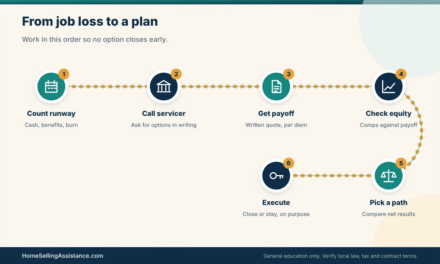
Household changes matter here as well. Job loss, a divorce or an inherited property each add steps, such as proof of authority or the signature of a former spouse. Our pages on selling a house after job loss and on a house facing foreclosure after an inheritance or divorce cover those wrinkles. Read the one that matches your life, because the missing signature or the missing authority is often what holds a closing hostage.
A scenario, an exception and your next step: when two paths run at the same time
It is common, and often wise, to run paths in parallel. An illustrative homeowner might apply for a loan modification while quietly preparing the house for sale, so that if the modification is denied the property is already photographed and the paperwork is gathered. The exception is that some servicers and some programs have rules about how a pending sale interacts with a pending application, so the homeowner should ask rather than assume.
Parallel planning also protects any effort to sell house before foreclosure from a single point of failure. A buyer can disappear, an appraisal can come in low, a lender can take longer than promised. If you have already explored a second route, you can pivot without losing weeks. We cover how to spot unreliable buyers in how to verify a cash home buyer, which is worth reading before you speak to any investor who contacted you first.
Your next step is to build a one-page comparison of the paths that apply to you, including a plan to sell house before foreclosure, using the five questions above. Keep it short, share it with your counselor or attorney, and revise it as facts arrive. If a path needs a decision by a specific date, write that date at the top of the page in bold so it cannot be forgotten.
What changes price, time, risk and net proceeds when you sell house before foreclosure
Once you know the paths, the next question is what actually moves the result. Four things matter most when you sell house before foreclosure: how much time you have, what the property will fetch from real buyers, what you owe in total, and what the contract and the lender will allow. Time and price pull against each other. A longer runway usually supports a better price, while a short one tends to push you toward buyers who offer certainty in exchange for a discount.
Risk is the third dimension when you sell house before foreclosure, and it is easy to overlook. A deal that looks good on paper can fail if the buyer cannot close, if a lien surfaces at the title search, or if the servicer will not pause its schedule. Net proceeds, the fourth, are the money that is left after every payoff, fee and credit. In a distressed sale those can be small or zero, and a clear picture of them early prevents bad surprises.
Market, condition, financing and buyer variables on a short clock
A short clock does not make the market irrelevant to anyone trying to sell house before foreclosure. If homes in your neighborhood are selling quickly, a conventional listing may attract offers fast enough to fit inside your timeline. If the market is slow, the same listing may sit for weeks, and you will need a plan for what happens if no acceptable offer arrives before a key date. A local agent can tell you how long comparable homes took to sell recently. Ask for actual examples, not a general promise.
Condition matters when you sell house before foreclosure because buyers price what they see. A home that needs a roof, has deferred maintenance or smells of smoke will draw lower offers or none from buyers using certain loans, since lenders and appraisers can require repairs. Financing matters because a buyer using a mortgage adds an appraisal and underwriting, and either can delay or derail closing. A cash buyer removes those steps but may ask for a discount, so the trade is speed and certainty against price.
Pricing to sell house before foreclosure on a deadline calls for discipline. A price set too high feels safe because you can always lower it, but each week at the wrong price burns time you may not have. A price set well can bring several showings quickly and a stronger chance of competing offers.
Ask any agent you interview to show the sold comparables they would rely on, how they adjust for differences and how many days those homes took to sell, and compare that with a second opinion. Our guide to pricing a house to sell covers the method in depth.
Condition decisions follow the same logic. With limited money and limited time, spend where buyers and lenders will notice: safety items, obvious leaks, functioning systems, cleanliness and clutter. Skip cosmetic projects with uncertain payback. If the home needs more than you can fund, say so honestly in the listing and price accordingly. Selling as is can be a legitimate choice, and buyers who want a project exist, though the offers will reflect the work they expect to do.
Market timing is the variable you control least as you sell house before foreclosure. Seasons, rates and local inventory all shift buyer behavior, but you cannot wait for a better month if a sale date is approaching. What you can control is how well the home is presented, how easy it is to see, and how clear your terms are. Flexible showing hours, a complete document packet and quick replies to questions often matter more than a perfectly timed launch, especially when you have a short runway.
Equity is the number that decides whether you can sell house before foreclosure at a profit, so estimate it carefully and conservatively. Start with a realistic sale price from sold comparables, not from a home-value website alone. Subtract the payoff figure from your servicer, then subtract any other loans and liens, then subtract a fair estimate of costs of selling. What remains is your approximate equity, and if it is negative you are looking at a short sale or another path. Anyone trying to sell house before foreclosure should redo this estimate whenever a new fact arrives.
Be careful with two common errors. The first is using the price you paid or the price a neighbor claims to have received. Neither measures what a buyer will pay now. The second is forgetting costs that accumulate while you wait, such as interest, late fees and legal charges added by the servicer. A payoff that was correct last month can be higher today. Ask for an updated quote with a per-day figure so you can plan around the closing date.
When equity is thin, small choices matter more. A repair credit, a modest concession on closing costs or a few extra weeks of interest can wipe out what you would have kept. That is not a reason to give up. It is a reason to compare offers on net proceeds, and to ask the title company to run an estimated statement for each offer you are seriously considering. The page on mortgage payoff when selling a house explains how payoff letters work and why they expire.
Evidence to gather: a decision-support view of the situations you may be in
The table below sets out common situations a seller may be in, the key fact that defines each one, a practical action and the trade-off to expect. It is a thinking tool, not a diagnosis, and your own loan and state may change any row. Use it to find the line closest to yours, then take the listed document to a counselor or attorney and ask what differs in your case.
| Situation | Key fact to confirm | Practical action | Trade-off | Source or document |
|---|---|---|---|---|
| Home worth more than the total owed | Payoff plus costs is below likely price | List with time to market properly | Needs weeks, not days | Payoff statement, local comps |
| Close to break-even | Little or no margin after costs | Price carefully; ask about fee flexibility | Small surprises erase proceeds | Estimated closing statement |
| Owe more than the home is worth | Shortfall exists after all costs | Ask the servicer about a short sale | Lender approval and possible deficiency | Hardship letter, financials |
| Behind but income has recovered | Reinstatement figure is within reach | Request reinstatement or repayment plan | Keeps the loan and the payment | Reinstatement quote, pay stubs |
| Sale date already scheduled | Exact date and your state’s cure or redemption rules | Call an attorney now; ask about postponement | Very little room for error | Notice of sale, loan file |
| Other liens or owners on title | Claims found in a title search | Order title early; plan payoffs | Added consents and cost | Title commitment, lien letters |
Read the table from left to right as a set of questions. If you recognize your situation, confirm the key fact with the named document, not with memory or a rumor. Then compare the practical action against what your counselor says. The trade-off column is there to remind you that every route costs something. Treat any adviser who describes a path with no downside as a signal to ask more questions.
Most homeowners who sell house before foreclosure fit more than one row at the same time, which is normal. Someone close to break-even may also have a second lien and a scheduled sale date. When that happens, work on the most time-sensitive row first, which is usually the one with a date on it. A written hardship letter that explains the cause of the problem, what has changed and what you are asking for gives every row a stronger start.
A scenario, an exception and your next step: the buyer who needs a mortgage
Imagine an illustrative seller who must sell house before foreclosure with six weeks before a key date. A buyer offers a fair price but needs a mortgage, and the contract includes an appraisal and a financing contingency. If the appraisal arrives below the price, the buyer may renegotiate, bring cash to cover the gap or walk away, depending on the contract. With six weeks, that is survivable. With three, it may not be.
The exception is that some buyers with strong preapproval and a large down payment close faster than the average mortgage buyer, and some cash buyers are slower than advertised because of their own funding steps. Do not assume a type of buyer predicts speed. Ask each buyer for evidence, including a lender letter or proof of funds, and ask your agent to talk to the lender directly. Our guide to verifying a cash buyer covers what real proof looks like.
Your next step to sell house before foreclosure on schedule is to write down the latest date by which you need a signed contract and the latest date by which you need to close, working backward from the servicer’s schedule. Share those two dates with any agent you consider hiring and ask how they would meet them. A candid answer, including what could go wrong, is a good sign. A promise to hit any deadline you name is not.

Costs, legal and tax issues, logistics and the priorities that decide the trade-offs
Costs when you sell house before foreclosure come from several directions at once. There is the mortgage payoff, which includes unpaid principal, accrued interest and often late fees and legal charges. There are any junior loans or liens. There are the normal costs of selling, such as agent compensation if you use one, title and escrow fees, transfer taxes where they apply and prorations of property tax and HOA dues. And there are the quieter costs of repairs, cleaning, moving and storing belongings.
The sale price minus all of that is your net, and it is the only number that tells you whether a path works. Our page on home sale net proceeds explains how to build that estimate, and the companion guide to seller closing costs lists the usual line items. Whatever the estimate says, treat it as a range until the closing company issues a real statement.
Broker compensation deserves one clear sentence. After the changes that followed the industry settlement, compensation is negotiable and has to be agreed in writing, so you should ask any agent to spell out what you would pay, to whom and under which conditions. Do not accept a standard figure as though it were fixed by law or custom.
Evidence to gather: an illustrative walk from sale price to what you keep
Here is a worked example to sell house before foreclosure, using round numbers that are illustrative only. Suppose a home sells for 300,000 dollars. The loan payoff, including past-due interest and fees, is 262,000. Agent compensation, title, escrow, transfer charges and prorations together come to 21,000. A small unpaid tax bill and a home repair credit add 6,000. The remaining 11,000 would be proceeds. Change any one figure and the result moves, which is the point of testing it.
Now run the same house with a 270,000 sale price and everything else unchanged. Costs of selling are lower because some charges scale with price, say 19,000, but the payoff and the tax bill do not move. That leaves a gap of about 17,000 between what the sale brings and what is owed. A gap is not the end of the road. It is the starting point for a short-sale conversation, where the lender decides whether to accept less than the balance.
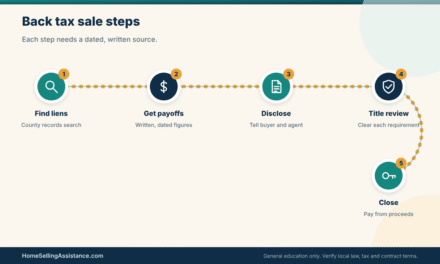
The lesson for anyone who wants to sell house before foreclosure is that small shifts in price can swing a result from positive to negative, so sellers in this position need a cautious estimate, not an optimistic one. Ask a title company for a written estimate of costs and a payoff letter for the date you expect to close, and leave a cushion for a late closing, since interest keeps accruing. We pick up how liens complicate this in the guide on selling a house with back taxes.
Legal and tax questions sit on top of the arithmetic. If a lender forgives part of a debt in a short sale or a deed in lieu, the forgiven amount can have tax consequences that depend on the year, the type of debt and your financial position, and the rules have changed over the years. The IRS explains the sale-of-home rules in Publication 523, and a tax professional can say how debt cancellation applies to you.
Logistics are the quiet half of the cost when you sell house before foreclosure. If you will move, plan where you will live and when, because a sale usually ends with a handover date and you need somewhere to go. Moving, storage, a temporary rental and utility transfers all take money and time. Ask the buyer whether a short rent-back, meaning a brief stay after closing, is acceptable, and check that your lender and the contract allow it. A rent-back can ease the move, but it also keeps you responsible for the home until you leave.
If the home is rented, tenants complicate the picture. A lease can continue after a sale, and federal law gives certain protections to tenants in foreclosed homes, with state and local rules on top. Tell tenants about the sale in writing, follow your lease and local landlord-tenant rules, and ask an attorney before asking anyone to leave. Some buyers want a vacant home and some want a tenant in place, so the occupancy plan should be settled before marketing begins. The deeper guide on selling a house with an HOA lien also covers dues and fees that follow the property.
Leave time for cleanouts. Belongings left in a vacant property create risk, and a home that is cluttered shows poorly. If help is needed, a friend, a family member or a hired service can clear rooms in stages while the home is being prepared. Keep valuables and important papers with you, and photograph anything the buyer might later question. A neat house and a tidy folder of documents together signal a seller who is easy to deal with, which supports a smoother closing.
A scenario, an exception and your next step: the lien nobody mentioned
An illustrative seller accepts a good offer, orders title and learns that an old contractor filed a lien after a dispute years ago. The lien has to be paid or released before the buyer will close. That adds a negotiation, perhaps a payoff from the sale proceeds and certainly a delay. In a normal sale it is an annoyance. On a tight foreclosure schedule it can be the difference between closing in time and missing the date.
The exception is that not every claim is valid, and not every claim has to be paid in full. Some liens are disputed, expired or subordinate, and an attorney or title officer can tell you how yours is treated locally. Do not pay anyone based on a letter alone. Ask for the underlying document, confirm the amount, and make sure any payment results in a recorded release.
Your next step to sell house before foreclosure without surprises is to order a title search before you accept an offer, or at the latest the day you do. It costs little compared with the cost of discovering a problem three weeks into a contract. The deeper article on title searches for sellers explains what comes back and how to read it.

Turn the overview into a verification roadmap you can follow week by week
Everything so far is context for your effort to sell house before foreclosure. This last major section converts it into actions, in an order that protects you. The principle is simple: verify before you commit. Verify the numbers with documents, verify the rules with professionals who are licensed to apply them in your state, and verify every buyer, lender and helper before they touch your money or your title.
Two kinds of mistakes dominate when people try to sell house before foreclosure. The first is waiting, which shrinks your options. The second is rushing into the first offer of help, which sometimes costs more than the problem. A roadmap lets you move at a steady pace between those two, doing the cheap, reversible things first and saving the irreversible ones, like signing a deed or a contract, until you have checked them.
Documents and professionals to involve in a plan to sell house before foreclosure
A plan to sell house before foreclosure typically touches five kinds of people. There is the servicer, who controls the loan. There is a housing counselor, who helps you understand the options. There is an attorney, who applies state law to your facts. There is a real estate professional, who prices and markets the home, and there is a title or escrow company, who confirms ownership and moves the money. A tax professional is a sixth, called in when forgiven debt or a large gain may be involved.
You do not need all six on day one. To sell house before foreclosure sensibly, start with the counselor and the servicer, add an attorney if any legal notice has been served or if you have a sale date, and add the others as the plan firms up. Keep a short contact sheet with names, direct numbers, email addresses and the date of every conversation. Servicers often reassign accounts, and a record of who said what is worth more than it seems.
Evidence to gather: what each professional will ask you for
A HUD-approved housing counselor will ask about your income, your monthly expenses, your debts and the hardship that caused the problem, and they will want to see your mortgage statement and any notices. Bring pay stubs, a recent bank statement, a list of monthly bills and a one-page summary of the hardship. Counselors are trained to help you prepare a loss-mitigation application, which servicers expect in a particular format. You can find one through HUD’s counselor search.
An attorney will want every legal paper you have received, the loan documents, the deed and anything about prior bankruptcies, divorces or probate matters that touch the property. Many state bar associations and legal aid groups can point homeowners to free or reduced-fee help, and the consumer finance agency lists resources at consumerfinance.gov. Ask the attorney which rights you have in your state, what deadlines apply and what happens to any shortfall.
If you sell house before foreclosure with an agent, a real estate professional will want the property’s address, a description of its condition, your timeline and your payoff figure. Interview more than one, ask each to show the comparable sales behind their price opinion, and ask how they would market the home with your deadline in mind. Our guide to how to price a house to sell lists the questions that expose a flattering price from a defensible one.
A title or escrow company will want your name as it appears on the deed, the legal description, the loan numbers and the contact for every lien. They produce the commitment that shows what must be cleared and the closing statement that shows where each dollar goes. Ask early whether they have handled sales with short-sale approval or with multiple payoffs, because the sequence of funds and releases in those closings is more careful than in an ordinary one.
Finally, keep every document for your sell house before foreclosure file in two places. A phone photo of each page, backed up, protects you if mail goes missing or a servicer says it never received your package. When you submit anything to a servicer, use a method that gives you a receipt, and write the date on your log. This sounds fussy until the one time it matters, which in foreclosure cases comes up more often than people expect.
Beyond paperwork gathering, verification of the other side matters just as much, so here is how to check a buyer before you celebrate.
When an offer arrives, ask for proof of funds that names the buyer and shows an available balance, or a preapproval letter from a lender you can phone. Confirm that the entity is registered where it says it is and that the person signing has authority. Ask who the title company is and call that company directly, using a number you found yourself. Ask what happens to the earnest money deposit if the buyer fails to close.
When you sell house before foreclosure, compare more than one offer if time allows, and compare them on net proceeds and certainty, not on headline price. An offer of a lower price with no financing contingency, a short closing and a buyer who pays certain costs may leave you with more than a higher offer that carries more risk. Our guide to the cash offer for house sellers explains how to compare these, and the cash offers and alternative sales category collects the related pages.
Look closely at assignments in any offer to help you sell house before foreclosure. Some investors sign a contract to buy and then sell their position to another buyer, which is legal in many places but can add uncertainty about who will actually close. Ask whether the contract can be assigned, whether you must approve it and whether the first buyer remains responsible. If the answers are vague, treat that vagueness as information. Good counterparties answer plainly because they have nothing to hide.
One more verification step concerns your own paperwork. If you are on a loan with more than one borrower, make sure every borrower and every owner is part of the conversation. A sale generally needs every owner of record to sign, and a servicer will generally speak only to authorized parties. If one owner is out of reach, consult an attorney about how to proceed, since the answer depends on state law and on what the deed says.
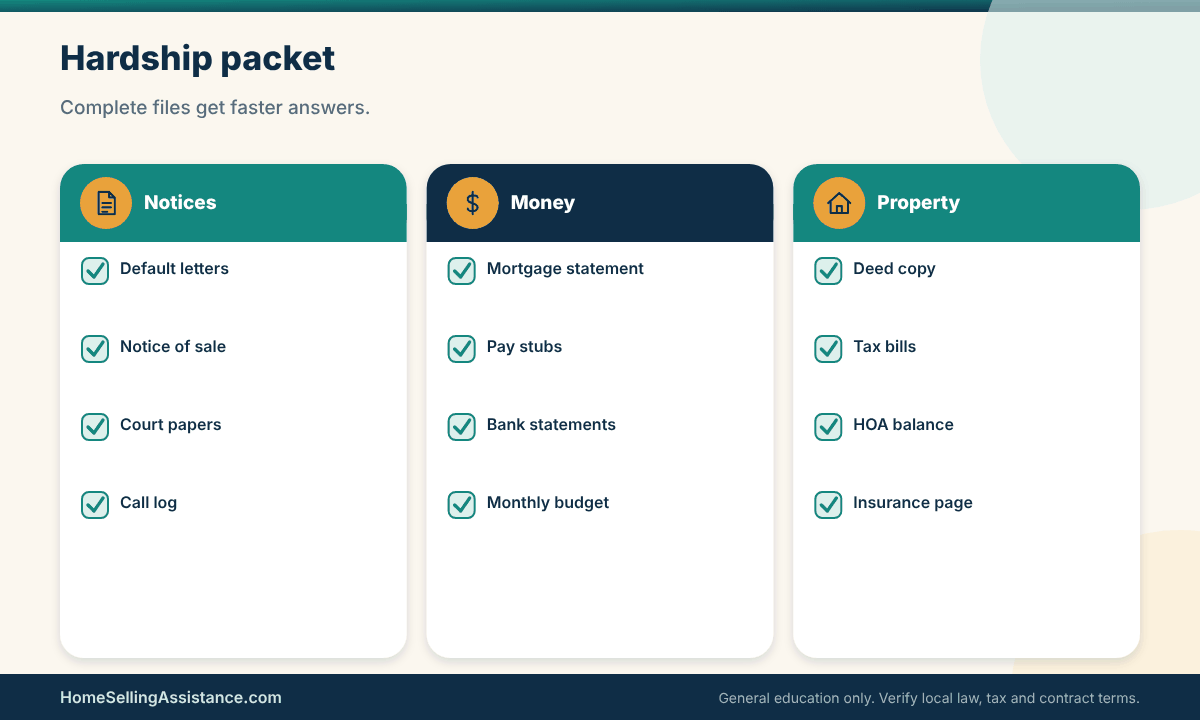
A hardship letter is worth drafting carefully if you plan to sell house before foreclosure, because servicers and lenders read it alongside your financial documents. Keep it short, factual and specific. Say what changed, such as a job loss, illness, divorce or a rise in costs, when it happened and how it affected your income. Say what you have done since, such as new work, cut expenses or counseling. State what you are asking for, whether that is time, a workout or approval of a sale. Sign and date it, and keep a copy.
Avoid exaggeration, and avoid blame. A clear, accurate letter is more credible than a dramatic one, and any statement in it must match your documents. If your pay stubs show income that your letter says you do not have, the mismatch raises doubts and delays review. Ask your housing counselor to read the draft. Counselors see many of these letters and can tell you what servicers usually look for, which is more reliable than guessing.
Three short, illustrative households that sell house before foreclosure show how the same decision can land differently. The first has substantial equity, six months before any sale date and a home in good condition. For them, a conventional listing with a well-chosen agent is the natural route, and the main task is to price well and keep the servicer informed. Their plan to sell house before foreclosure is mostly a matter of discipline and calendar management, not rescue.
The second household is near break-even with eight weeks before the next step and a leaking roof. For them, every dollar counts. They compare an as-is sale at a lower price with a repaired sale at a higher one, and they ask a title company for estimated proceeds under each. They also apply for a loan workout in parallel, just in case. Because their margin is thin, they ask the servicer about a short sale early, so the lender is already familiar with the file.
The third household owes more than the home is worth and has a scheduled sale in four weeks. They need an attorney this week, a counselor this week and a servicer conversation about postponement this week. Their realistic paths are a short sale on a compressed schedule, a deed in lieu if the lender agrees, or a legal remedy their attorney identifies. They are the hardest case, and they are also the ones for whom good advice and calm records matter the most.
Interviewing a listing agent to sell house before foreclosure is different from an ordinary listing, so adjust your questions. Ask how many sales with a lender-approval step or a foreclosure deadline the agent has closed, and ask for the outcomes in plain terms. Ask how they would price and market to meet your date, what they would do if no acceptable offer arrived by a set point and how they communicate with servicers. Ask how they are paid, in writing, and whether the fee changes if the sale requires lender approval.
Agree on a communication plan as well. Decide how often you will talk, who will speak to the servicer and how documents will move. A good agent will also tell you what they cannot do, such as promise a postponement or predict an appraisal. Be cautious about any professional who guarantees a price or a closing date, since neither is in their control. The point of the interview is to find someone whose experience, honesty and availability fit your clock.
If you prefer to work without an agent, or with a flat-fee service, the same rules apply. You will still need a price opinion backed by comparables, a contract reviewed by an attorney or a title company, and a way to reach buyers. The state of the paperwork often matters more than the choice of channel. Pick the route that you can carry out reliably in the time you have, and be honest with yourself about how much time and skill each route needs.
A scenario, an exception and your next step: the helper who wanted the deed
Picture an illustrative homeowner who receives a friendly call from someone who says they can stop the foreclosure for a fee. The caller asks the homeowner to sign a form that transfers the title temporarily, promising a lease back and a later buyback. The homeowner is relieved. Months later, the new owner of record evicts them, because the transfer was a real sale and the buyback was never legally binding.
The exception to treating every offer of help as a scam is that legitimate buyers and legitimate counselors exist, and some investors do pay fair prices and treat sellers well. The difference lies in transparency. A trustworthy buyer will let a lawyer read the contract, will not ask for an upfront fee to help you, will not ask you to stop talking to your servicer and will not rush you to sign a deed on the first call. Read our guide to foreclosure rescue scams before you answer any unsolicited offer.
Your next step as you sell house before foreclosure is a standing rule. Do not sign a deed, a power of attorney, a quitclaim or a lease-back agreement without a licensed attorney in your state reading it first. Report suspected scams to the Federal Trade Commission, and if money moved by wire, contact your bank at once and file a report at the FBI’s internet crime portal. The wider safety picture is in our cornerstone on home sale fraud and seller safety.
What to decide before listing and what can safely wait until you have an offer
Sellers who try to sell house before foreclosure often try to decide everything at once, and that is how mistakes happen. A better habit is to sort decisions into two piles. The first pile holds choices that shape the whole plan and are hard to reverse, so they belong before you list. The second holds choices that depend on facts you do not yet have, such as the buyer’s terms or an appraisal, so they can wait until an offer is on the table.
The sorting matters for another reason when you sell house before foreclosure. Every day spent debating a decision that can wait is a day taken from the clock. When you separate the two piles, you spend your limited time where it counts and you stop worrying about questions that have no answer yet. The table below shows how responsibility passes between you and the other parties from the first week to closing, along with the deadline to watch at each stage and a fallback.
Evidence to gather: a transaction map from first call to closing day
Use this table as a transaction map. It lists each stage, what you are responsible for, who else has to act, the deadline that usually matters and a sensible fallback if something stalls. Dates are described in general terms because real dates come from your notices and contract. Fill in the actual dates in your own copy, and share it with your agent or attorney so everyone is working from the same sequence.
| Stage | Seller responsibility | Buyer or professional dependency | Deadline to watch | Fallback if it stalls |
|---|---|---|---|---|
| Status and payoff | Request written payoff and reinstatement figures | Servicer must respond and post fees | Next legal step on your notices | Escalate in writing; ask a counselor to intervene |
| Hardship and options | Submit a complete loss-mitigation package | Servicer reviews and decides | Application and document deadlines | Run a sale plan in parallel |
| Pricing and listing | Agree on price, access and condition plan | Agent supplies comps and marketing | Date you need a signed contract | Adjust price or widen buyer types |
| Offer and contract | Compare net proceeds, certainty and terms | Buyer proves funds; attorney reviews | Contingency and deposit dates | Back-up offer or short extension |
| Title and approvals | Disclose liens; sign payoff authorizations | Title company; lienholders; possibly lender approval | Commitment and approval dates | Negotiate payoffs; seek postponement |
| Closing and after | Review statement; hand over keys and records | Escrow funds and records the deed | Closing date versus sale date | Ask servicer for written postponement |
Read across a row to see who can slow you down. In the first two rows it is mostly the servicer, which is why early written requests matter. In the middle rows it is the market and the buyer. In the last rows it is the title company and any lienholders, whose releases arrive on their own schedule. If you know which row you are in, you know whom to call.
Now apply the two piles to your plan to sell house before foreclosure. Before listing, decide your goal and your walk-away number, meaning the lowest net result you would accept versus pursuing another path. Decide who speaks for the household and who has authority to sign. Decide how you will handle showings and occupancy, which may involve tenants or family. Decide which professionals you will hire and in what order. These choices set the frame, and changing them later is expensive.
After an offer, you can decide the finer points. Choose between competing offers based on net proceeds and certainty. Decide whether to ask for a rent-back, which is a short period of staying after closing, if the buyer agrees and your lender permits it. Decide how to handle inspection requests, whether to repair or credit, and how to respond to an appraisal gap. Those depend on the buyer’s terms, so there is no value in guessing now.
A few decisions live in between and are worth settling before you list. Choose how to price against the clock, since a price that is too high wastes the weeks you cannot spare. Decide whether you will accept an offer subject to the servicer’s approval, which is the structure of a short sale, and whether you will accept one contingent on the buyer selling another home, which adds risk you may not have time to absorb. Write those rules down now and you will not have to improvise under pressure.
Confirm in writing what the servicer will do with a pending effort to sell house before foreclosure. Some servicers will agree to pause or slow the foreclosure while a purchase contract is in place or under review, and others follow a fixed schedule regardless. Ask what documents they need to consider a postponement, how far in advance they need them and who has authority to grant one. Do not rely on a verbal promise, and ask your attorney whether a state rule affects it.
Disclosure is a decision to settle early as well. Sellers generally have to disclose known material defects and certain federal items, such as lead-based paint in homes built before 1978, which the EPA explains here. Distress does not remove those duties, and some states add their own forms. Our cornerstone on seller disclosure requirements shows how to find what applies where you live.
Equal treatment of buyers is not optional either when you sell house before foreclosure. Fair housing law prohibits steering or refusing buyers because of protected characteristics, and a rushed sale is no exception. The agency that enforces the federal rules explains them at HUD’s fair housing page. Treat every serious buyer the same way, apply the same criteria to every offer and keep your communication in writing.
Finally, as you sell house before foreclosure, decide how you will keep records of everything that happens from now on. Save every offer, every counteroffer, every email with the servicer and every receipt. If a dispute arises about what was agreed, or if you later need to show a lender or a tax professional what happened, a clean file will be the most valuable thing you own after the deed. It also lowers stress, because you will always know where the answer is.
Most costly mistakes when you sell house before foreclosure are avoidable, and they tend to follow a pattern. The first is delay: ignoring mail and calls until options shrink. The second is verbal agreement: accepting a promise on the phone that never appears in writing. The third is a hasty signature on a deed, a lease-back or a contract nobody has reviewed. The fourth is trusting a price opinion that flatters you. The fifth is overlooking a lien or a co-owner until late in the process.
You can spot each of these mistakes early as you sell house before foreclosure. If a person tells you not to talk to your servicer, step back. If anyone asks for a fee before doing any work, step back. If an offer expires in a day, ask why. If a buyer will not name the title company, will not show proof of funds or will not let a lawyer read the contract, step back. Each of these is a sign that the other side prefers speed over your understanding, and that preference rarely serves you.
The remedy is the habit this guide keeps repeating: write it down, verify it and involve a licensed professional before anything irreversible. It is slower than saying yes on the spot, but only by days, and those days are often the cheapest ones in the whole process. When in doubt, ask your counselor for a second set of eyes. They are used to being asked, and the question rarely goes unanswered.

A scenario, an exception and your next step: an offer arrives two weeks before the sale date
Take an illustrative case of a seller trying to sell house before foreclosure. A seller who has been working with a counselor receives a full-price offer from a buyer using a mortgage, with a closing date six weeks away, while the servicer’s sale date is in two weeks. Nothing about the offer is unreasonable, but the schedules do not fit. The seller has to choose between accepting and hoping for a postponement, seeking a cash buyer who can close faster, or pursuing another route to buy time.
What can move the picture is the servicer, so the first call goes there with the signed contract or a strong draft in hand. Ask for a written postponement while the sale proceeds, and ask what the servicer needs to grant one. If the servicer refuses and the date stands, an attorney can explain whether any state right, motion or bankruptcy protection is available. Those tools are specialized and have consequences, which is why they belong in a lawyer’s hands.
The exception to any plan to sell house before foreclosure is that some states give owners a period after a foreclosure sale to redeem the property, and others do not. Where redemption exists, it is usually expensive and strictly timed. Where it does not, the sale date can be final. You cannot tell which applies to you from a general article, and getting this wrong is costly. Ask your attorney directly, and ask for the answer in writing.
Your next step to sell house before foreclosure here is to call three people on the same day: the servicer, an attorney and a title company. Tell each the same facts, ask each what they need and by when, and write the answers on one page. You will often find that the true constraint is a document, not time, and a document can be produced.
Quick scenario
A homeowner we will call Dana, an illustrative example, owes more than she can pay after a job loss. She calls her servicer, gets payoff and reinstatement figures in writing, books a free session with a housing counselor, and asks a local agent for comparable sales. The numbers show equity of a modest size after costs. She lists with time to spare, keeps the servicer informed in writing, and closes before any sale date. A different homeowner with the same steps but a shortfall would pursue a short sale instead. Same process, different result.
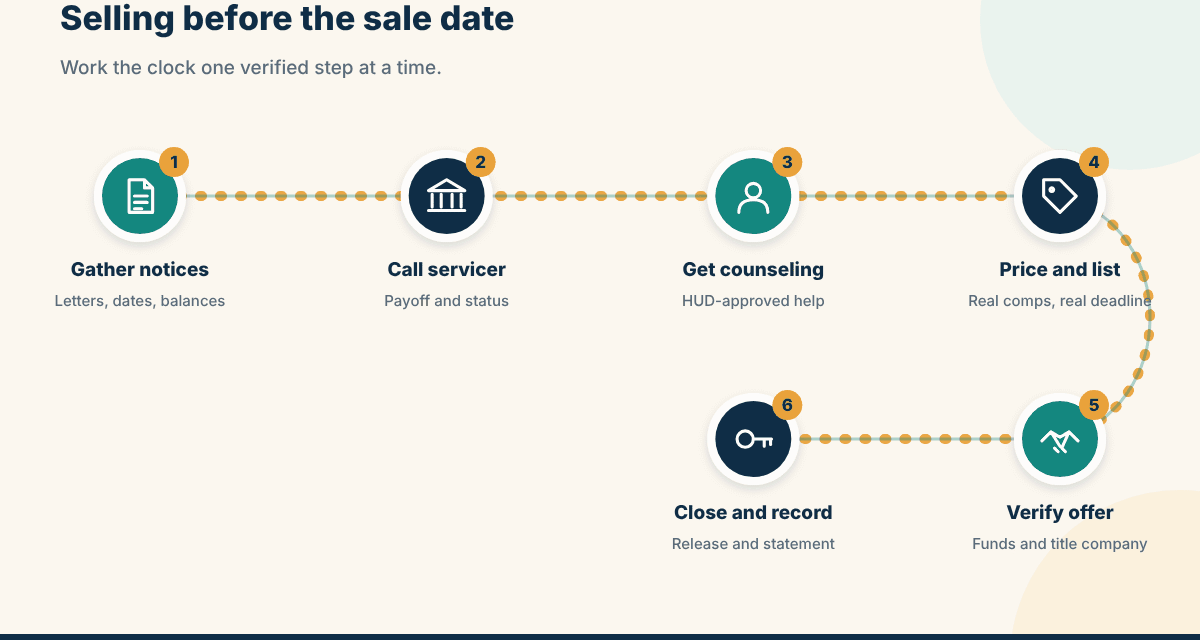
A simple week-by-week routine keeps the work moving without overwhelming you. In the first week, gather documents, call the servicer, book counseling and note every date. In the second, get payoff and title information, interview agents and, if legal notices exist, meet an attorney. In the third, decide your primary path and one backup, set your price and walk-away number, and prepare the home. From the fourth week onward you are executing, monitoring dates and answering requests quickly.
Throughout your effort to sell house before foreclosure, check yourself against three questions. Is every claim I rely on written down, from a source I can name? Has a licensed professional in my state confirmed anything that involves law, tax or title? And am I being pressured by anyone to act before I have done both? If the answer to the third is yes, slow down on that one decision and speed up everything else. Pressure is usually a sign that someone else benefits from your haste.
Frequently asked questions about sell house before foreclosure
Can I really sell house before foreclosure is finished?
In many situations yes, because ownership generally stays with you until a foreclosure sale is completed or you transfer the property. How much time you have depends on your notices, your loan and your state. A sale that pays off the loan, or a lender-approved sale for less, can resolve the debt. Confirm your own dates with your servicer and an attorney before relying on that.
How long do I have before the lender takes the house?
There is no single answer. Federal servicing rules generally prevent the formal process from starting until a loan is more than 120 days delinquent, with exceptions, and state law then controls notices and steps. Some states run through courts and take longer, while others move faster through non-judicial procedures. Your own notices will show the next date, and an attorney can explain what it means.
Will it hurt my credit less if I sell house before foreclosure than if the lender forecloses?
It can, but the effect depends on how the loan is reported, how many payments were missed and what the lender agrees to. A traditional sale that pays the loan in full ends the debt cleanly, while a short sale or a foreclosure can be reported differently. Credit scoring models and lender rules change, so ask your counselor and your servicer how each path would be reported.
What if I owe more than the house is worth and still want to sell house before foreclosure?
Then a sale at market price will not cover the loan, and you need the lender to agree to accept less, which is a short sale. The lender usually asks for a hardship explanation, financial documents and a purchase contract. Whether the lender can pursue the remaining balance depends on state law and on what the approval letter says. Read that letter closely and have an attorney confirm it.
Do I have to pay an agent or a consultant upfront to sell house before foreclosure?
Be very cautious about any upfront fee for foreclosure help. Federal and state consumer authorities warn that rescue scams often collect fees and deliver nothing, and some states restrict or regulate such fees. HUD-approved housing counselors offer help at no or low cost. Agent compensation, if you use an agent, is negotiable and written in the listing agreement, and it is normally paid at closing.
Can a cash buyer help me sell house before foreclosure on a tight schedule?
Sometimes, but not always, and speed depends on the buyer’s actual funds and the title work, not on advertising. Ask for proof of funds, check the title company yourself and confirm what happens to the deposit if the buyer does not close. A faster closing often comes with a lower price, so compare net proceeds. Our guide to verifying buyers can help you check the claims.
What is the difference between a short sale and a deed in lieu?
In a short sale you sell to a third-party buyer with the lender’s agreement to accept less than the balance. In a deed in lieu you transfer the property to the lender voluntarily, which avoids a sale. Lenders have their own conditions for each, such as marketing efforts or no other liens. The tax and credit effects differ, so ask a tax professional and a counselor before choosing.
Do I owe taxes if the lender forgives part of my loan?
Possibly. Forgiven mortgage debt can be treated as income in some situations and excluded in others, depending on the tax year, the type of debt and your financial condition, and the rules have shifted over time. You may receive a form from the lender showing the canceled amount. Review IRS guidance and speak with a tax professional before you file.
What happens to tenants if I sell or the house is foreclosed?
Tenants may have rights that survive a sale or a foreclosure, and federal law gives certain protections to tenants of foreclosed homes, with state and local rules on top. Do not try to remove tenants informally. Ask an attorney how your lease and your local law work, and give clear written notice of the sale to anyone living in the property.
Who can I call for free help right now?
Start with your servicer’s loss-mitigation department and a HUD-approved housing counselor, whom you can locate through HUD’s website. Your state’s housing finance agency, legal aid organizations and the consumer finance agency also publish resources for homeowners in trouble. Be wary of anyone who contacts you first and asks for money or your deed, since that is the pattern of scams.
Take the next step on your own terms
You do not have to solve everything this week. You have to learn your dates, know your numbers and talk to the right people before anyone else sets the pace. A calm plan to sell house before foreclosure starts with a payoff quote, a counselor and a lawyer’s read of your notices, then moves to the path your facts support. This article is general education, not legal, tax or financial advice. For decisions about your own home, speak with your servicer, a HUD-approved housing counselor, a licensed attorney and a tax professional.