A divorce house buyout calculation answers one practical question: if one spouse keeps the home, how much does that spouse owe the other to make the exchange fair? The arithmetic looks simple on a napkin. Value, minus debt, divided between two people. In real life, each of those three steps hides a decision, and most buyout arguments start with a number that nobody checked.
If you are reading this, you may be holding a stack of statements while also trying to keep a household running, which is a hard combination. Take a breath. A divorce house buyout calculation does not have to be done in one sitting, and it does not have to be perfect. It has to be built from sources you can point to, dated so you know how stale they are, and tested against a few reasonable what-ifs.
This guide walks through the method in the order we would use it: choose the inputs, date them, put the keep-the-house path and the sell-the-house path on the same footing, adjust for risk, and then stop pretending the answer is exact. We use clearly labelled round figures for teaching. They are not predictions about your home, your lender, your court or your state.
One honest limit before we start. Whether the home counts as shared property, how equity is divided, who gets credit for earlier payments and what a court or settlement agreement can require all vary by state and by the facts of your marriage. This article is general education, not legal, tax or financial advice. For the bigger picture of ending a shared ownership, our cornerstone guide on selling a house during divorce covers the whole process, and the comparison in house buyout vs sell in a divorce helps you decide which path to run the numbers on first.
Key takeaways
- A buyout number is only as good as its inputs. Home value, loan payoff, other liens, costs and credits each need a named source, not a guess from memory.
- Date everything. Payoff figures, market evidence and tax or insurance amounts all expire, so write the as-of date next to every figure you use.
- Compare buying out and selling on the same basis. A fair comparison puts both paths in the same units: cash in hand, risk carried and months of delay.
- Show a range, not a single figure. A low, middle and high case tells you which assumption matters most and where to spend your effort.
- Some numbers need a live source. Lender payoff and refinance quotes, a CMA or appraisal, title results and the final agreement cannot be replaced by an article, including this one.
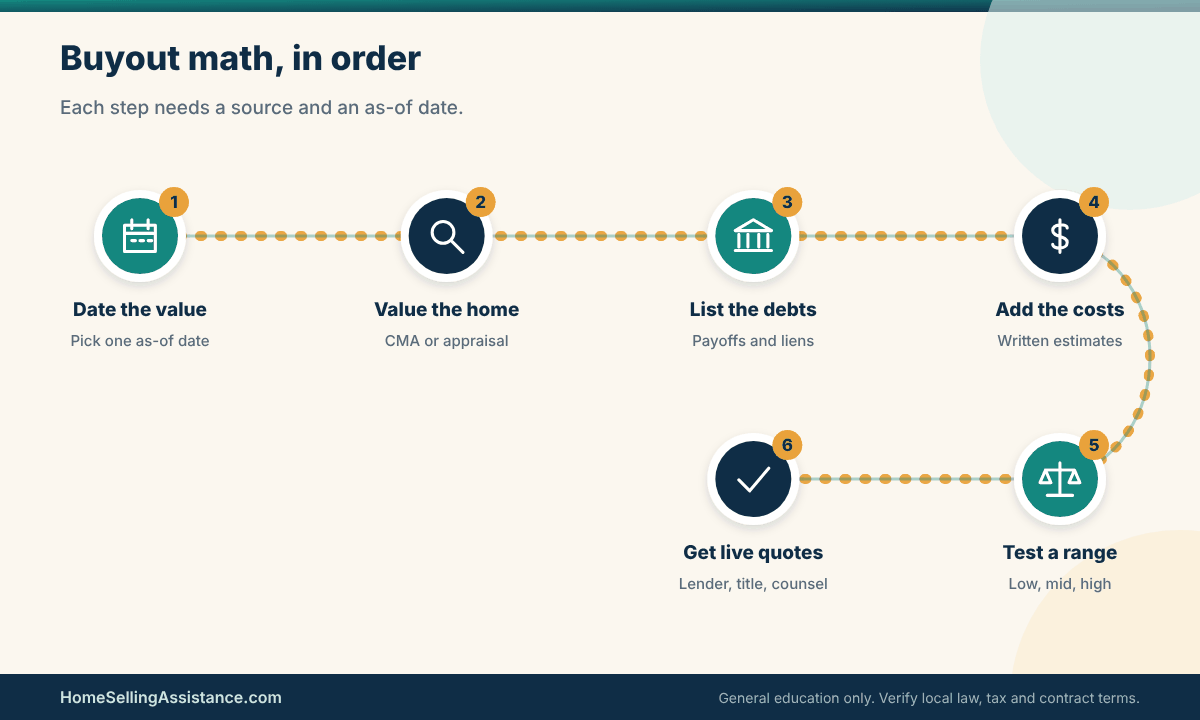
Before we get to method, here is the shape of the whole job. Think of it as six small tasks done in order, with the last two being the ones people most often skip.
The divorce house buyout calculation method, step by step
Every divorce house buyout calculation, however elaborate, is built from the same skeleton. You estimate what the home would sell for, subtract what has to be paid off, adjust for items the spouses have agreed or been ordered to treat differently, and divide what remains according to the split that applies in your situation. The buyer then either refinances, pays cash, or arranges a note or other structure for the other spouse’s share.
The skeleton of a divorce house buyout calculation is the easy part. The work is in deciding which version of each number to put into it, and in being honest about how certain you are. Let us take the inputs first, and then the dates attached to them.
Inputs and assumptions that drive a divorce house buyout calculation
Start a divorce house buyout calculation by writing down five inputs on one page: an agreed value for the home, the payoff on each loan secured by it, any other liens or unpaid obligations tied to the property, the costs that would apply under each path, and the split percentage or formula. Then, beside each, write the assumption behind it. A figure with no assumption attached is a rumor.
Assumptions come in two flavors. Some are factual, such as the amount owed on the first mortgage. Others are judgments, such as whether the home would sell at the high or low end of the comparable sales. Treat the factual ones as things to verify and the judgment ones as things to test, because a divorce house buyout calculation that mixes the two without saying so will look more solid than it is.
Evidence to gather: value, loan balances, liens and cost inputs
For value, gather evidence rather than opinions. A broker price opinion or comparative market analysis shows recent nearby sales with adjustments, and our explainer on the difference between a CMA and an appraisal shows how each is built and what each is good for. Online estimates can be a starting point, but they do not see your kitchen, your roof or the condition of the garage.
For debt, request a written payoff statement from each lender, not just the balance printed on a monthly statement. The payoff includes interest accrued to a specific day and sometimes fees, so it differs from the balance. Add any second mortgage, home equity line, tax lien or judgment lien that a title search would reveal. Our guide to mortgage payoff when selling a house explains what a payoff statement contains and why the date on it matters.
For costs, list only the ones that apply to your chosen path. A refinance has its own closing charges. A sale has commissions that are negotiable and must be written down, title and escrow charges, transfer taxes where they exist, and prorations. Do not borrow percentages from an article. Ask a lender, a title company or a listing professional for a written estimate, and note who gave it and when.
Finally, write down the split. Some couples divide equity equally, some use a formula from a settlement agreement, and some adjust for contributions made before the marriage or for a down payment from separate funds. Which of these is available depends on your state and on what the two of you or a court decide. This input comes from your agreement or your attorney, not from a calculator.
A scenario, an exception, and your next step
Here is an illustrative case with round numbers, not a forecast. Suppose a couple agrees the home is worth 400,000 dollars. The first mortgage payoff is 240,000 and a home equity line carries 20,000. Equity is 400,000 minus 260,000, which is 140,000. If they split equally, the spouse keeping the home owes the other 70,000 before any adjustments for costs or credits.
Now the exception. Suppose one spouse put 30,000 of money they owned before the marriage into the down payment, and their state lets that be credited. The split is no longer a clean half. That single fact could move the buyout by thousands, and it is a legal question, not a math question. The next step is to write it on the one-page input sheet as an open item and ask an attorney how your state treats it.
Notice what this divorce house buyout calculation example does not do. It does not assume a buyer’s agent fee, a refinance charge or a repair credit, because none of those is known yet. A divorce house buyout calculation grows in layers, and it is fine to start with the bare skeleton as long as you label it that way. For a sense of what a full proceeds picture looks like once a sale is on the table, see our overview of home sale net proceeds.
Data source and date: which figures expire fastest
Numbers in a buyout go stale at different speeds. A recorded deed does not change next month. A payoff figure changes every day interest accrues. A comparable sales set changes as new homes close and as mortgage conditions shift buyer behavior. Treat the date next to each figure as part of the figure itself, because a divorce house buyout calculation built on mismatched dates can be off in ways nobody notices.
A simple habit solves most of this. Create a column called “as of” and a column called “source.” If you cannot fill both for a number, that number goes on the to-do list rather than into the total.
Evidence to gather: payoff letters, comparable sales dates and statement cut-offs
Payoff statements usually state a good-through date and a per-day interest amount. Keep both. If the buyout closes three weeks after the date on the letter, the payoff will be a little higher, and you will want to know by roughly how much. Ask the servicer how long the figure is valid, and what happens if the closing date moves.
Comparable sales are dated by their closing dates. A sale from several months back may reflect a different set of buyers than one from last week, especially if the neighborhood has few transactions. When your comparable set is thin, say so in your notes and widen the date range openly rather than quietly. Your local MLS-based report will usually show closing dates, so ask for them.
Statements also have cut-off dates. A monthly mortgage statement shows the balance after the last payment posted, not the balance on the day you read it. Property tax bills may cover a period that ends before the buyout closes, and homeowners insurance renews on its own calendar. Write each of these dates down so that prorations and reserves can be handled consistently later.
A scenario, an exception, and your next step
Imagine two spouses in a divorce house buyout calculation who each pull their own number. One uses the balance on a statement from the first of the month, and the other uses a payoff letter dated two weeks later. The difference is a few hundred dollars of interest, and it ignites an argument about who is hiding something. Nobody was. The numbers were simply taken on different days.
The exception is a loan in forbearance, modification or a payment dispute, where the balance and the payoff can differ in less obvious ways. If that is your situation, ask the servicer for a written explanation of what the payoff includes. The next step in any case is to agree on a single valuation date and a single payoff date, then ask every professional you consult to use them.
Agreeing on dates does more for peace than it seems to. When both people sit with the same sheet and the same as-of column, the conversation shifts from “whose number is right” to “what do we do with this number,” which is the only conversation that helps.
Our claim and evidence matrix below turns that habit into a tool. Each row states a claim you might make in a buyout discussion, the metric or source that would support it, what the evidence actually proves, where it falls short, and what that means for you as the person deciding. Use it to check every number in your divorce house buyout calculation before it reaches the final sheet, and add rows for claims specific to your case.
| Claim | Metric or source | What it supports | Limitation | Seller implication |
|---|---|---|---|---|
| “The house is worth this much” | CMA, broker opinion or appraisal with date | A defensible value range | Opinion on one date; condition may be unseen | Agree one source and date before debating |
| “We owe this on the loan” | Written payoff letter with good-through date | Exact debt to retire at closing | Changes daily with interest | Refresh near closing; plan a cushion |
| “Nothing else is attached” | Title search or lien report | Confirms second loans, liens, judgments | Shows recorded items only | Unlisted debts become a negotiation item |
| “Selling would cost about this” | Written estimates from title company and agent | Cost of the sale path | Fees are negotiable and vary locally | Never import percentages from articles |
| “We split it this way” | Settlement language, court order or counsel | The division applied to equity | Rules differ by state and facts | Treat as legal input, not arithmetic |
| “I can refinance and keep it” | Lender pre-qualification in writing | Whether one income may carry the loan | Not a commitment; rates and rules move | Get the quote before you promise a buyout |
Read the divorce house buyout calculation table from left to right for each number you plan to use. If the third column does not actually prove your claim, or the fourth column describes a limitation you cannot live with, the claim needs better evidence before it goes into the buyout figure. The last column is a reminder of what to do about it, in plain terms.
With inputs and dates settled, we can turn to the part where most divorce house buyout calculation mistakes actually happen. A buyout number sits in a sentence like “I’ll pay you 70,000 and keep the house.” To judge whether that is fair, you have to compare it with what each person would walk away with if the house were sold instead. That comparison only works when both sides are measured in the same way.
Normalizing the buyout and the sale so you can compare them
Normalizing a divorce house buyout calculation sounds technical, but the idea is homely. You would not compare a price per pound with a price per box without converting one of them. Keeping the house and selling the house produce different kinds of value: one leaves a person with a home and a debt, the other leaves two people with cash. A fair divorce house buyout calculation converts both into the same units before drawing any conclusion.
If you are still weighing the choice itself, our guide to buying out a spouse versus selling walks through the decision from the lifestyle side.
Browse the broader topic area under divorce and co-owned homes if you want to see how this piece fits with the others in the cluster.
Like-for-like price, cost and time inputs for both paths
Three kinds of input need to match across the two paths: price, cost and time. On price, use the same valuation for both. If you assume the home sells for 400,000 in the sale scenario, then the buyout scenario must use 400,000 too, even if one spouse privately thinks the house is worth more to them. Emotional value is real, but it is not a number you can ask the other spouse to pay.
On cost, list every expense that appears on one path but not the other. A sale carries listing and closing costs, possibly repairs or credits to a buyer, and moving costs for both people. A buyout carries refinance costs, possibly a new appraisal, and the extra monthly carrying cost for the person who keeps the home. Put them side by side with the same labels, and mark which are quotes and which are placeholders.
On time, count months. A sale takes however long preparation, marketing, a contract and closing take, and during those months someone is still paying the mortgage, taxes, insurance and utilities. A buyout takes however long a refinance takes. Those carrying costs belong in the comparison, because delay is not free, and our guide to the home selling timeline shows why the sale path usually needs more calendar than people expect.
Evidence to gather: estimates for sale costs, refinance costs and carrying costs
For a divorce house buyout calculation, ask for three written estimates. First, ask a listing professional for a net sheet that shows the sale costs under your own assumptions, and ask who prepared it and what price it assumes. Compensation in today’s market is negotiable and must be put in writing, so the estimate should say what is being assumed, not just print a percentage. Our overview of seller closing costs breaks down the line items you will see.
Second, ask a lender or mortgage broker for a written loan estimate for the refinance the keeping spouse would need. It should show the interest rate, the loan amount, the monthly payment and the closing costs. A quote tied to a date is far better than a rate remembered from a friend, because rates and underwriting rules change over time and differ by borrower.
Third, total the monthly carrying costs. Add the mortgage payment, property taxes, homeowners insurance, any HOA dues, utilities and routine upkeep, then multiply by the number of months each path realistically takes. Keep the divorce house buyout calculation honest. If a sale could drag on for several months in your market, say so in the sheet rather than assuming the quickest case.
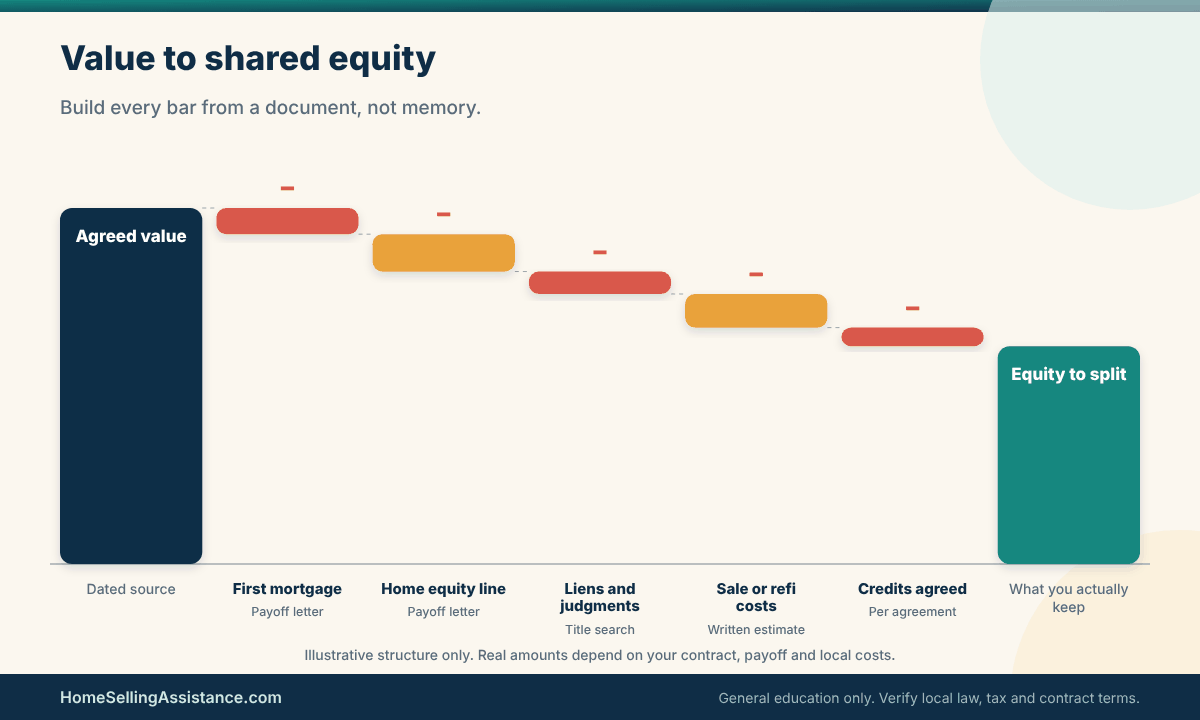
The waterfall picture below shows how a sale price shrinks on the way to the equity that two people actually divide. Your own bars will be different, and some may not apply at all, but the order of the steps is a useful reminder: debts and costs come off before the split, not after it.
A scenario, an exception, and your next step
Take our illustrative home again in a divorce house buyout calculation, worth 400,000 with 260,000 of debt. In the buyout version, the keeping spouse owes 70,000 and also pays refinance costs of, say, 6,000 for illustration. If the couple agrees to share that cost, each bears 3,000, so the real transfer might be 70,000 less 3,000 in credit, or some other arrangement they negotiate.
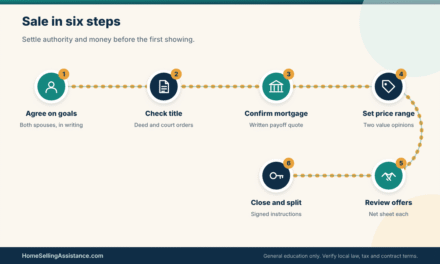
In the sale version, suppose estimated sale costs total 28,000, again as a round example. Equity after costs is 400,000 minus 260,000 minus 28,000, which is 112,000. An equal split gives each person 56,000 in cash. The buyout figure of 70,000 is not comparable to 56,000 until you notice that the sale figure already absorbed costs the buyout did not.
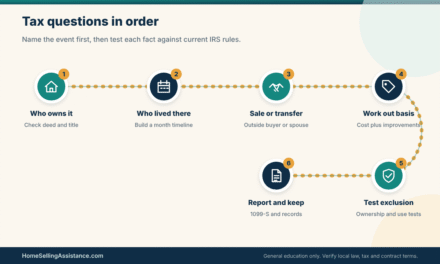
The exception is a home with a large gain, where the tax treatment of a sale may differ from a transfer between spouses as part of a divorce. That depends on your facts, so read our explanation of divorce home sale taxes and ask a tax professional. Your next step is to build both columns with the same price and the same list of costs, then compare cash to cash.
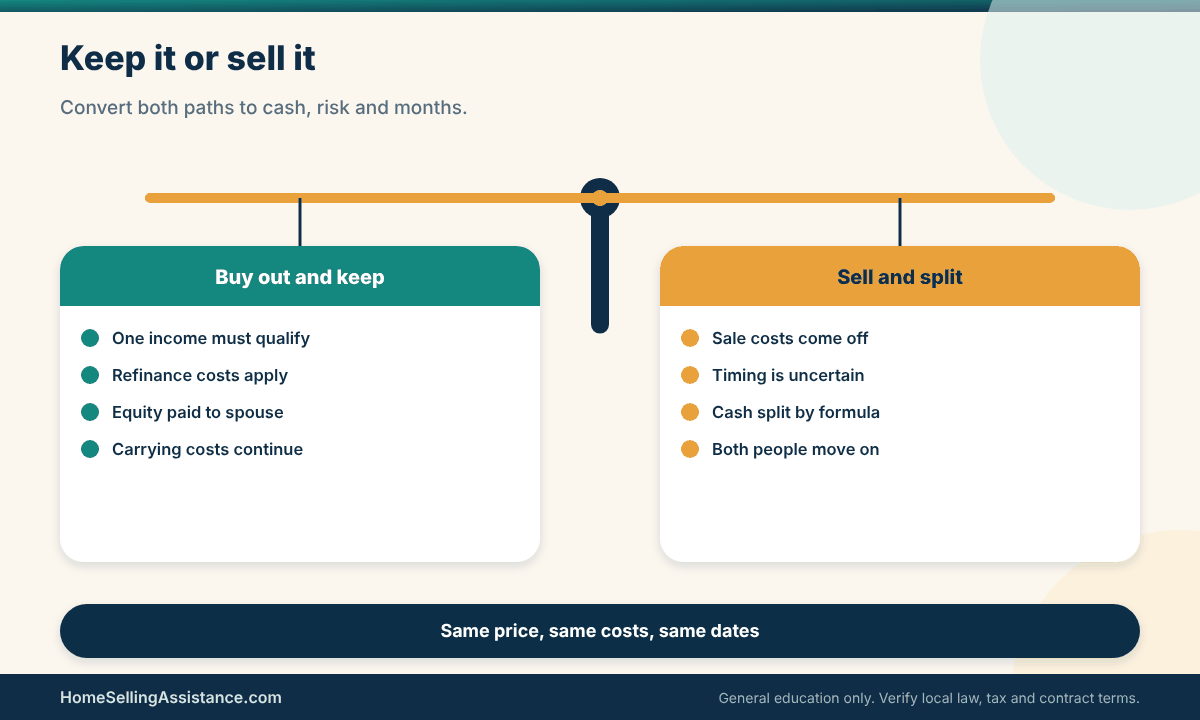
The balance below puts the two paths side by side in the terms that matter to the person deciding. It is not a verdict, since the right side depends on income, credit, children, timing and what each person wants from the next few years.
Risk and uncertainty adjustments that change the buyout figure
After the paths are comparable, add the risks. A risk adjustment is not a prediction that something will go wrong. It is a way of admitting that some outcomes are uncertain and that the two paths are uncertain in different ways. The buyout path carries financing risk, because the keeping spouse might not qualify, and valuation risk, because the home might appraise lower than agreed. The sale path carries market risk and timing risk.
The simplest adjustment is a cushion. Instead of using the single best-guess figure, choose a modest haircut for the risky items and see how far the buyout moves. The size of the cushion is a judgment for you and your advisers, not a universal rule, which is why we avoid giving a percentage here.
Evidence to gather: qualification, appraisal and market-time signals
For the keeping spouse, the key evidence is a written lender pre-qualification based on one income, including any support the lender can count under its own rules. Lenders differ on what they count, how long they require support to continue, and how they treat debts. Our walk-through of the mortgage during a divorce home sale explains how a joint loan interacts with a buyout.
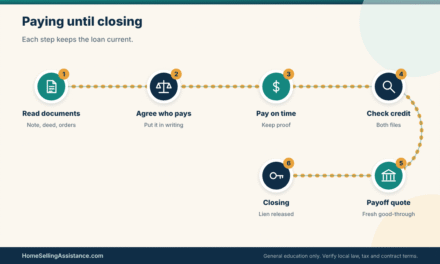
Also ask whether the existing loan can stay in place. Some loans can be assumed and some cannot, and removing a spouse from a deed does not remove that spouse from the loan. A lender may need to release the leaving spouse, or the loan may need to be refinanced into one name. Ask the servicer in writing what its process is, since the answer varies by lender and by loan type.
For valuation, ask the appraiser or agent how confident they are in the comparables and what could push the number up or down. A home with unusual features, deferred maintenance or few nearby sales deserves a wider cushion than a tidy three-bedroom in a busy subdivision. Our piece on adjusting comps for home value shows how differences between homes are priced.
For market time, ask for the average and recent days on market for similar homes in your area, and the typical gap between list and sale prices. Do not generalize from the national headlines. Local conditions swing widely, and a data point from your own price band and neighborhood is worth much more than a broad statistic.
A scenario, an exception, and your next step
Picture a keeping spouse who has a verbal assurance from a lender that “it should be fine.” The buyout is agreed at 70,000, and then the written pre-qualification arrives with a lower maximum loan than hoped. Now the payment to the other spouse must come from savings, a smaller refinance or a different structure. A cushion built earlier would have flagged the risk instead of allowing a surprise.
The exception is the home that is worth less than the debt on it. Then there is no equity to divide, and the question becomes who carries the shortfall and how a lender will treat it. See our discussion of an underwater mortgage when selling a house and speak with an attorney before agreeing to anything.
Your next step is to write two or three risks beside each path, name the document that would reduce each risk, and decide which ones you will pay to resolve before the numbers are signed. A short list, honestly kept, is more useful than an exhaustive one that nobody reads.
Liens deserve their own sentence here, because they can turn a tidy sheet into a surprise. A judgment, a tax lien or an unpaid contractor claim can attach to the property and must be paid or resolved before a clean sale or a clean refinance. Our guide to selling a house with a lien explains how those are found and cleared, and the finding usually starts with a title search, which you can request before you finalize the buyout.
Once both paths are comparable and risk is on the page, the temptation is to compute a final figure to the dollar and print it in bold. Resist that. A divorce house buyout calculation is an estimate built from other estimates, and writing it with false precision can cause real harm, because a number that looks exact is harder to renegotiate when reality turns out to be slightly different.
Keeping a divorce house buyout calculation honest about what it can know
False precision shows up in small ways. A value written as 401,250 dollars when the underlying evidence supports “somewhere between 385,000 and 415,000.” A split written to the cent while the legal question about a separate-property contribution is still open. A payoff typed from a statement six weeks old. None of these is dishonest, but together they create confidence the evidence cannot support.
The remedy is to present ranges, to say which inputs are firm and which are soft, and to name the documents that will firm them up. Let us look at how to build the range, and then at the numbers that simply cannot be settled without a live quote or a signed document. If you want to see how the final division fits into the larger picture, our piece on how to divide home sale proceeds in a divorce picks up where this one stops.
Sensitivity range: how far the buyout moves when assumptions change
A sensitivity range answers a very practical question: if one assumption turns out wrong, how much does the buyout change? You answer it by recalculating with a low, middle and high version of each uncertain input, one at a time. This is not advanced math. It is the same subtraction you already did, repeated a few times, and it reveals which assumptions deserve your attention and which barely matter.
Try it on a divorce house buyout calculation with value first, because value usually moves the most. If the home’s value is 20,000 lower, equity falls by 20,000, and an equal split changes each person’s share by 10,000. If the payoff is 2,000 higher, each share changes by 1,000. So you learn quickly that arguing over a small interest difference matters less than getting a solid valuation.
Evidence to gather: low, middle and high cases tied to named sources
Build each case from a named source rather than a mood. The low value case might use the lowest well-adjusted comparable, the middle might use the average of your best comps, and the high case might use the strongest sale, with the reasons written next to each. If a licensed appraiser or agent supplies a range, use theirs. Our guide to how much your house is worth shows how such ranges are built.
For debt, the range is narrow, since it comes from a payoff letter, but add a small amount for interest to the likely closing date and any unpaid fees. For costs, use the low and high ends of the written estimates. For timing, use a short and a long case, and multiply the monthly carrying cost by each. Write the six or seven resulting figures in a grid so you can see them together.
The sensitivity table below summarizes the property and market assumptions most likely to move a buyout, the effect you might expect, a common confounder that can make the effect look bigger or smaller than it is, and what to verify in your own area. Treat it as a prompt for local questions rather than a source of answers, since the right direction and size depend on your market.
| Assumption | Expected effect | Confounder | What to verify locally |
|---|---|---|---|
| Home value is higher or lower than agreed | Moves equity and each share the most | Condition, updates and thin comparable sales | Recent nearby closings and an agreed valuation date |
| Loan payoff is higher than the statement | Reduces equity slightly | Accrued interest, fees, a missed payment | Written payoff with good-through date and per-day amount |
| Sale costs are heavier than assumed | Shrinks cash on the sale path | Negotiated compensation, repairs, credits | Written net sheet from a local professional |
| Refinance rate or terms differ | Changes affordability and keeping cost | Credit, income documentation, loan type | Dated loan estimate from a lender |
| Sale takes longer than planned | Adds carrying costs for someone | Price strategy, season, local demand | Days on market for similar homes nearby |
| Separate-property credit is allowed | Shifts the split away from half | Records of source and commingling | State rules, with an attorney, plus bank records |
Use the divorce house buyout calculation sensitivity table as a checklist after you have a first draft. For each row, ask whether your sheet has an answer, who gave it, and what its date is. Where a row shows an unresolved confounder, write a sentence about it in your notes. That sentence will be valuable when you sit down with a mediator, attorney or lender, because it shows exactly what you did and did not verify.
A scenario, an exception, and your next step
Let us run the illustrative home through the divorce house buyout calculation with three value cases: 380,000, 400,000 and 420,000. With 260,000 of debt, equity is 120,000, 140,000 and 160,000. An equal split produces buyout payments of 60,000, 70,000 and 80,000 before any adjustments. The gap between low and high is 20,000, which is a real sum, and it is entirely driven by one input.
Now add a long-sale case for the comparison path. If an extra three months of carrying costs run about 2,500 per month, that is 7,500 in additional cost, again as an arbitrary round figure. Seeing both effects on the same page helps the couple decide where to spend effort, such as paying for a full appraisal, rather than haggling over small items.
The exception is a market that is moving quickly in either direction. In that case, a valuation that is a few months old may be worth less as evidence than it looks, and it may make sense to update the range closer to signing. The next step is to choose a valuation date both people accept, and a date after which the number gets refreshed if the agreement has not been signed.
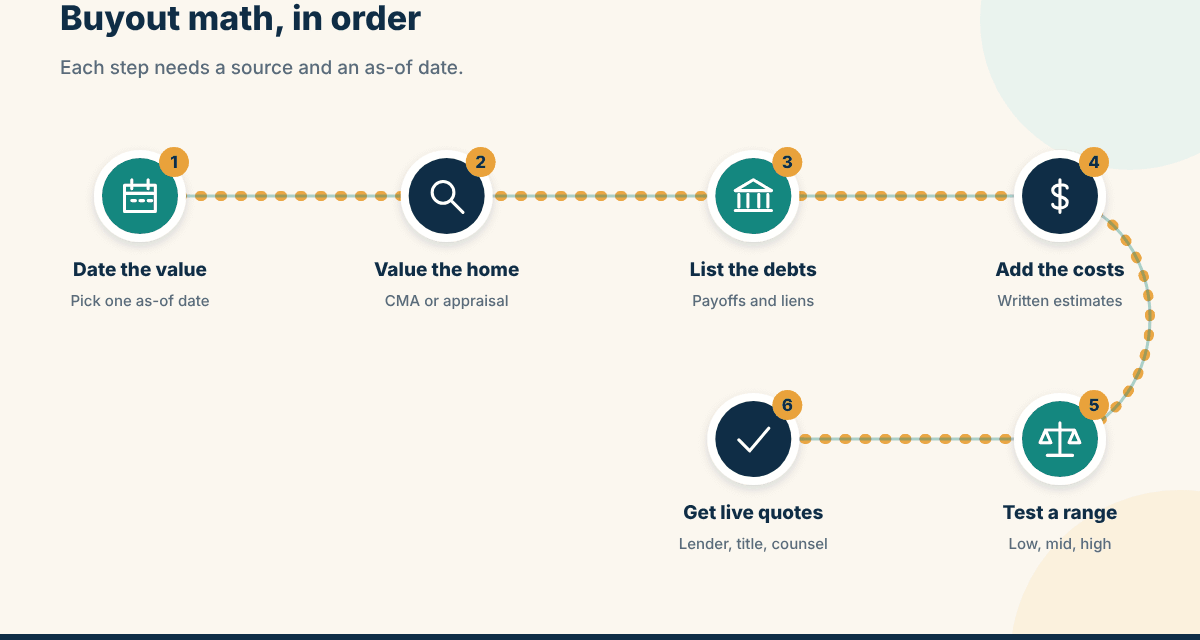
The roadmap below pulls the whole divorce house buyout calculation method into one path, from dating the value to getting live quotes. Notice that the last two stops are about verification, not arithmetic, which is the real message of this section.
What needs a live quote, CMA, appraisal, policy or contract
Some numbers cannot be produced by a worksheet, however careful. A lender’s payoff and a lender’s refinance terms are live quotes. A value opinion is a CMA or an appraisal, prepared for a particular date and purpose. Title insurance and lien status come from a title company’s search and policy. The division of equity comes from a signed agreement or a court order. Any article that gives you those numbers, including this one, is guessing.
That is not a gap in the divorce house buyout calculation method. It is the method. The worksheet tells you what to ask for, in what order, and how to read the answers when they come back. A well-built divorce house buyout calculation is a list of questions with provisional answers, and each provisional answer is replaced by a documented one before anyone signs.
Evidence to gather: who can supply each live number, and in what form
Ask the servicer for a payoff letter and ask the lender for a loan estimate. Ask a licensed agent for a CMA, or a licensed appraiser for an appraisal, and ask what date the opinion is as of. Ask a title company for a title search and for a preliminary report showing recorded liens, and ask a local attorney how your state treats the home in a divorce. Each of these is a document you can file with your worksheet.
For tax questions, general federal guidance appears in IRS Publication 523 on selling your home and IRS Publication 504 on divorced or separated individuals. These are general references, and your facts may lead to a different result, so confirm with a qualified tax professional. Our article on capital gains when selling a house in a divorce explains the common questions to bring to that conversation.
For records that affect your tax basis, such as improvement receipts and closing statements from the original purchase, start gathering them now. Our guide to home improvements and cost basis shows what counts and how to keep proof. Basis questions can feel distant from a buyout calculation, but a shared home’s tax picture can change who ends up better off.
If money is tight and you need independent help understanding a mortgage or a housing budget, HUD maintains a directory of HUD-approved housing counselors, and the Consumer Financial Protection Bureau publishes plain-language material on mortgages. Neither replaces a lawyer, but both can help you ask better questions of the professionals you do hire.
A scenario, an exception, and your next step
Suppose a couple signs a handwritten buyout based on an online estimate and a monthly statement balance. Weeks later, the lender’s refinance appraisal comes in lower and the payoff letter is higher. The refinance can no longer cover the agreed payment. They now renegotiate under stress, with a deadline, and with less goodwill than they had at the start.
The exception is a case where both spouses are cooperative and the home is simple, with one loan and no liens. Even then, a payoff letter and a value opinion take little time and prevent most surprises. Ask yourself which unknown could embarrass the agreement and spend your effort there.
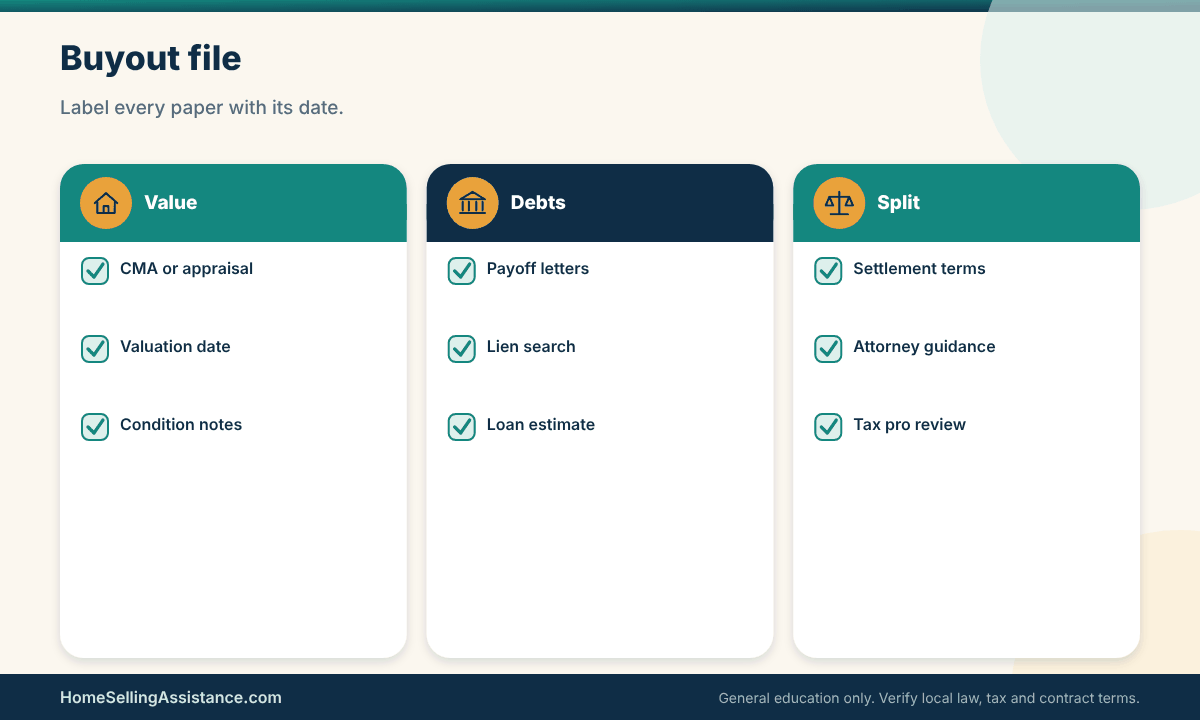
Your next step is to turn each open item on your sheet into a request. If something can fail, ask who can confirm it, in what document and by what date. The final picture shows what to do if a key assumption fails after you have already agreed on a number, which is the case people least like to plan for.
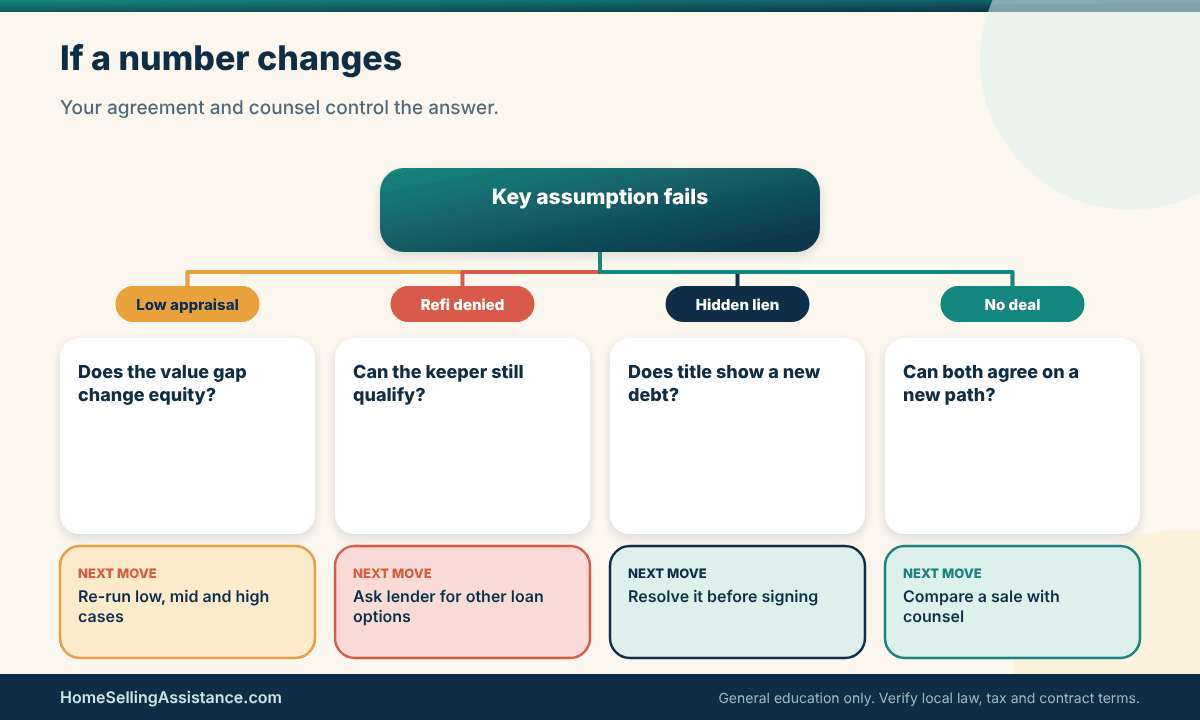
When you reach the end of the worksheet, read it aloud as if explaining it to a neutral friend. Any sentence you cannot say without hedging belongs on the to-do list, not in the agreement. Also look at the mortgage and closing-cost pieces in closing costs and net proceeds if you want to understand how a sale statement is built before you compare it with a buyout.
If you share ownership with someone who will not cooperate, the calculation may not be enough, and a different process may be needed. Our articles on a co-owner who refuses to sell a house and on partition sales of co-owned houses explain what the options look like in general terms. Both are starting points for an attorney conversation, not substitutes for one.
A few habits separate a divorce house buyout calculation that survives contact with reality from one that falls apart. The first is keeping a single master copy of the sheet. When two spouses each keep a private version, the versions drift, and the argument becomes about the sheets instead of the home. One shared file, with a change log of who edited what and when, keeps a divorce house buyout calculation honest.
The second habit is separating facts from wishes in plain view. Put verified items in one column and open questions in another. A divorce house buyout calculation that shows its open questions earns more trust than one that hides them, and trust matters when two people who are ending a marriage still have to agree on a large financial transaction.
The third habit is naming the mistakes before they happen. Common ones include using a listing price as if it were a sale price, forgetting a second loan, leaving out the other spouse’s earlier payments that the agreement credits, ignoring that a payoff changes daily, and treating a verbal lender comment as a commitment. Each one can quietly distort a divorce house buyout calculation by thousands of dollars.
The fourth habit is asking what happens if the plan fails. If the refinance falls through, does the sale path start automatically? If the appraisal is low, who pays the difference? An agreement that answers those questions in advance spares both people a second round of conflict. This is exactly the kind of drafting question an attorney or mediator handles well, and a divorce house buyout calculation gives them better facts to work from.
Finally, be kind to your future self. Save the payoff letters, the valuation, the lender estimate and the title report in one folder, labelled with dates. Months later, when a question comes up about how a figure was reached, that folder is your memory. A divorce house buyout calculation is a record as much as a calculation, and a good record protects both people, whichever path they choose.
If children, a family business, retirement accounts or support payments are tied up with the home, the picture gets richer, and a single worksheet will not capture it. In those cases the home is one asset among several, and the fairness of a buyout may depend on trades across the whole settlement. That is a good reason to treat your divorce house buyout calculation as one input to a conversation with professionals, not the whole conversation.
Quick scenario
In a divorce house buyout calculation, two spouses agree the home is worth 400,000 dollars for illustration, owe 260,000 across two loans, and plan an equal split. On paper the keeping spouse owes 70,000. After a written refinance estimate, a title search that finds a small lien, and a valuation range of 385,000 to 415,000, the sheet shows a buyout between roughly 62,500 and 77,500 before costs and credits. That range, not the first figure, is what they carry into mediation.
Frequently asked questions about divorce house buyout calculation
What is the basic formula for a divorce house buyout calculation?
Estimate the home’s value, subtract the payoff of every loan and lien secured by it, adjust for agreed costs and credits, then apply your split to what remains. The spouse keeping the home pays the other spouse their share of that equity. The divorce house buyout calculation formula is simple, but each input needs a source and a date, and the split comes from your state’s rules, your agreement or a court order.
Who decides how much the home is worth for a buyout?
Spouses can agree on a value, often supported by a CMA or an appraisal, and a court may decide if they cannot agree. A shared appraiser chosen by both sides tends to reduce arguments, because neither person feels the number was picked against them. Whatever method you use, write down who produced the value and the date it applies to.
Do I use the loan balance or the payoff amount?
Use the payoff amount from a written statement, since it includes interest through a specific day and sometimes fees. The balance on a monthly statement is usually lower. The difference can be small, but it grows if closing is delayed, so ask the servicer how long the figure is good for and how much it changes each day.
Should selling costs be subtracted if we are not selling?
Not automatically. Some couples deduct a share of hypothetical selling costs to reflect that the keeping spouse avoids a sale, while others treat the figure as equity without that deduction. Which approach is fair or required depends on your agreement and on local practice, so raise it with your attorney or mediator and keep the divorce house buyout calculation consistent once chosen.
Does removing a spouse from the deed remove them from the mortgage?
No. A deed controls ownership, while the loan is a separate contract between the borrowers and the lender. The leaving spouse generally stays liable unless the lender releases them, the loan is assumed, or it is refinanced into one name. Ask the servicer what its process requires before you agree on a timeline.
What if the keeping spouse cannot qualify to refinance?
The buyout may need a different structure, such as a longer timeline, a smaller payment funded in another way, a co-signer, or a sale instead. A written pre-qualification before signing prevents this surprise. A lender can say what income and debts it will count under its own rules, which differ across lenders and loan types.
Are there tax consequences to a buyout?
Possibly. Federal tax rules treat some transfers between spouses in a divorce differently from ordinary sales, and a later sale by the keeping spouse may have its own consequences. The details depend on your facts, so read the IRS publications on selling your home and on divorce, and ask a qualified tax professional before you sign anything.
How often should the numbers be updated?
Refresh your divorce house buyout calculation whenever a key input ages enough to matter, and always before signing. Payoff letters and loan quotes go stale quickly, while a value opinion can lose strength if the local market is moving. A simple rule is to agree in advance on a refresh date and who is responsible for it.
What if we disagree about the value?
Start by looking at the evidence together: the comparable sales, their dates and the adjustments applied. If you still differ, a neutral appraisal, an average of two opinions or a short listing test may be options, depending on what your agreement and your state allow. An attorney or mediator can advise which methods are acceptable in your situation.
Can an online calculator replace professional advice?
No. A calculator can show how the arithmetic behaves, but it cannot see your loan terms, liens, state rules or the details of your agreement. Treat any divorce house buyout calculation tool as a way to rehearse questions, then replace each provisional figure with a documented one before you decide.
A steadier way to finish
A good divorce house buyout calculation is modest about itself: sourced inputs, dated figures, a low-to-high range and a clear list of what still needs a live quote. Build it slowly, share it openly and let professionals fill the gaps. This article is general education, not legal, tax or financial advice, and your state, lender and agreement will decide the details that matter most.