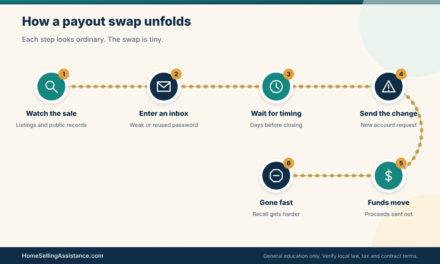
Treating home sale fraud seller safety as a normal part of selling, and not as a rare horror story that happens to other people, is the single habit that protects most sellers: your sale concentrates a large amount of money, a pile of personal documents, an empty or semi-public house and a flood of email into a few weeks, and anyone who wants to exploit that combination only needs one careless moment.
Most of us picture fraud as something loud, like a stranger breaking in or a stolen credit card. Real estate fraud is usually quiet, which is why home sale fraud seller safety is mostly about habits and not heroics. It looks like a polite email from the title company with a small change to the wiring details. It looks like a buyer who is delightfully easy, never asks for a discount and sends proof of funds that is a little too tidy. It looks like a friendly visitor at an open house who asks to use the bathroom upstairs.
None of these moments feels dangerous while it is happening, and that is exactly the design.
This guide is a complete, calm walk through home sale fraud seller safety from the first conversation about listing to the day the proceeds land in your account. It covers four things you are protecting: your funds, your identity, your property and your communications. It also explains how those four risks shift depending on how you sell, how fast you need to move, and who is on the other side of the table. Where one topic deserves a deeper page, we point you to it inside our closing fraud and seller safety library.
A note on what this is and is not. It is general education, written for homeowners in the United States, where rules on attorneys, escrow, notaries, disclosure and recording differ from state to state and sometimes from county to county. It does not replace your settlement agent, your attorney, your bank or your agent, and it will never ask you to share a password, an account number or a verification code. Any numbers you see are round illustrations, not statistics.
Key takeaways
- Verify money instructions by voice. Any wiring detail, payoff figure or change of payee should be confirmed by calling a phone number you already had before the sale began, never one printed in the email that carries the instruction.
- Protect the email account first. Your inbox is the key to your listing, your signing links and your bank resets, so a strong unique password and app-based or key-based verification matter more than almost any other step.
- Guard identity in layers. Share the minimum document set at each stage, to the right party, through channels that your settlement agent or attorney actually uses.
- Treat the house as a place strangers will enter. Showings, open houses and vacancy are physical security events, and valuables, medication and mail should be handled before the first visitor arrives.
- Judge buyers by proof, not charm. Funds, identity and authority to sign can all be checked through independent sources before you grant access or sign anything binding.
- Know your fallback. If something goes wrong, speed matters, and a written plan for calling your bank, your settlement agent and the right reporting agencies beats improvising under stress.
Why home sale fraud seller safety starts with the decision, not the jargon
Before any warning sign or checklist of home sale fraud seller safety makes sense, you need a picture of your own sale. A seller who plans to list with a full-service agent in a busy market faces different risks from a seller who is renting out an inherited house to a cash investor, and different again from someone selling without an agent while living out of state. The same fraud tactic can be nearly harmless in one setting and devastating in another. So we start with the situation, then the tactics.
Think of this first section of home sale fraud seller safety as taking inventory. You will list what is exposed, decide who needs which piece of information, and see how the basic selling routes change the places an attacker can reach you. Once that map exists, the rest of home sale fraud seller safety is just a matter of guarding each point on it.
Know what you are protecting: money, identity, property, and conversations
A useful way to organize home sale fraud seller safety is by what a criminal actually wants. There are four targets, and most schemes aim at one of them while borrowing access from another. Money is the obvious one: your down-stream proceeds, your earnest-money handling, any payoff figure sent to your lender. Identity is next, because a name, a date of birth, a Social Security number or a signed form can be turned into fraudulent loans, forged deeds or hijacked accounts long after the sale ends.
Property is the third target. That includes the physical contents of the house, meaning jewelry, cash, prescription medication, firearms, keys, garage openers, and also the title to the land itself, which is a legal asset that can sometimes be targeted on paper. The fourth target, conversations, gets overlooked, yet it is the doorway for the other three. Email threads, text messages, shared document links and listing inquiries tell an attacker who is selling, when they are closing, who is handling the money and what the next step looks like.
When you see these four as a set, you stop thinking of home sale fraud seller safety as one giant task. You see that a locked-down email account protects money, identity and conversations all at once, while a lockbox protocol protects property and identity together. That overlap is good news, because a handful of home sale fraud seller safety habits cover a great deal of ground.
Evidence to gather: your own list of exposed assets
For a practical home sale fraud seller safety start, take twenty minutes and write down, in plain language, everything about your sale that someone else could touch. Start with accounts: the email address you gave your agent or listing platform, the phone number tied to your bank, the bank account that will receive proceeds, the mortgage servicer portal that issues your payoff statement. Then list documents: your deed, your closing disclosure, loan statements, tax bills, identification, any power of attorney or trust paperwork.
Next, list the physical side. Which rooms hold valuables or medication? Where does mail pile up? Who has a key, a garage code or a smart-lock credential? Many sellers discover during this exercise that a former contractor, a neighbor, a prior tenant or an ex-partner still holds working access. Changing those codes is one of the cheapest steps in the entire process, and it costs nothing but a moment of awareness.
Finally, list the people. Your agent, the buyer’s agent, the settlement agent or closing attorney, your lender, the notary, an inspector, a stager, a photographer. For each, write down how you first reached them and what phone number you hold from before the transaction. That last column becomes your verification phone book, and it is the most important part of the list because it is what you will use to confirm anything that smells off.
Keep this home sale fraud seller safety page somewhere safe, offline if you can, or in a password manager note rather than in an email draft. You will reuse it later in the verification roadmap, and a family member who may help you during the sale can use it as well, which brings us to the next point.
Once the list exists, rank it. Not every item deserves equal worry, and trying to defend everything equally is how people end up defending nothing well. A simple method is to ask two questions of each item: how bad would it be if this were lost or misused, and how easy would it be for a stranger to reach it. Your proceeds account scores high on harm and moderate on reach. Your email scores high on both. A spare key under a flowerpot scores moderate on harm and very high on reach. Start where both numbers are high.
Include the people who help you in this ranking. An adult child who manages your email, a relative who handles your finances or a neighbor who waters the plants all touch the sale in small ways. That is fine, but it means your home sale fraud seller safety plan has to include them. Tell each helper which tasks they may do, which they may never do, and who to call if something feels off. A shared understanding beats a private assumption every time.
Older sellers and sellers under stress deserve a special mention, because scammers target both. Grief after a death, a health scare, a divorce or a looming deadline all narrow attention, and criminals know it. If you are in one of those seasons, consider naming a trusted second pair of eyes who reads every money-related message before you act on it. That is not a loss of independence. It is the same logic as a co-pilot, and many professionals work this way by default.
Finally, remember that your plan can be modest and still effective. Nobody needs a security operations center to sell a house. A password manager, a second verification step, a phone book of verified numbers and a rule that money instructions are confirmed by voice will address a surprising share of the realistic threats.
A scenario, an exception, and your next step for the first week
Picture a seller we will call Dana, who has owned her home for about fifteen years and plans to list in the spring. In week one she does three small things. She changes the password on her main email account to a long unique passphrase and turns on app-based verification. She writes down the phone numbers of her mortgage servicer and her bank from old paper statements. And she asks her listing agent how the brokerage handles wire instructions and what the firm’s verification step is. None of this takes more than an afternoon.
Now the exception. Suppose Dana is selling from out of state because a parent passed away and the house belongs to an estate. Her exposure differs: the estate documents, letters of authority and a lawyer’s trust account are all in play, and an attacker can pose as any of those parties. In that case her first step is to confirm, by phone, who the attorney is and how funds will move, before any buyer even appears. Our guide on selling an inherited house explains how authority and probate shape that handoff.
Your next step is the same whichever scenario looks like yours: finish the inventory, secure the email account, and build the verification phone book. Those three items form the foundation of home sale fraud seller safety and every other protection in this article, and they can be done in a single evening before the house is even photographed.
If you finish the inventory and discover that something is already wrong, such as an unfamiliar login alert or a rental ad using your photos, jump ahead to the fallback section later in this guide. Acting early is almost always cheaper than acting late.
Map the main selling paths and the places scammers can enter each one
For home sale fraud seller safety, sellers generally use one of a handful of routes: a full-service listing agent, a discount or flat-fee arrangement, a for-sale-by-owner approach, a direct sale to a cash buyer or investor, or an auction or negotiated private sale. Each route changes who answers your phone, who handles funds and how much verification the process builds in for you. This is not a ranking. A route with built-in professional checks is not automatically safer if you ignore the checks, and a route with fewer parties is not riskier if you apply the same discipline yourself.
With a licensed agent and an established title company or attorney, your home sale fraud seller safety setup usually inherits a layer of procedures: the brokerage has a wire verification policy, the settlement agent has a secure portal, and the signing happens with an officer who checks identification. Those layers help, but they depend on your cooperation. You still have to read the instruction to call, then actually call.
With a for-sale-by-owner approach, you may be the only person in the transaction who knows what the normal communication pattern is. That freedom is real, and so is the responsibility. Our overview of selling for sale by owner describes what you take on, and the same list applies to home sale fraud seller safety: you may need to screen buyers, host showings and confirm funds without a brokerage backstop.
Direct cash sales deserve their own home sale fraud seller safety paragraph. When a buyer offers cash and a fast closing, the excitement can crowd out verification of identity, proof of funds and the buyer’s legal authority to sign. Our guide to a cash offer for a house compares the trade-offs, and the fraud-specific side appears later in this article and in the article on fake cash buyer warning signs.
Evidence to gather: where the listing and your contact details travel
For home sale fraud seller safety, note that the moment a house goes live, details spread. Photos, the address, a description and often a lot of metadata move from the agent to the multiple listing service, then outward to portals, social posts, email blasts and syndication sites you have never heard of. Scammers scrape these feeds. That is how a listing can be copied and reposted as a fake rental with a lower price and a story about the owner being abroad.
To see your own exposure, search your address a few days after you list. Look at the first pages of results and at map-based listing sites. Note which sites show the home, what contact information appears and whether any listing is not yours. Keep screenshots with dates. If you find a duplicate posting, report it to the platform and tell your agent so the brokerage can file its own complaints as well.
Check what your own photos reveal about your home sale fraud seller safety habits. Mail on a counter, a prescription label, a family calendar, a visible house number next to a school pickup schedule, a whiteboard with an alarm code or an open safe can all make it into a listing gallery. Our home seller privacy checklist walks through photo, floor-plan and smart-device exposure in more detail.
Finally, decide which contact details are public. Many sellers let the agent’s office phone and email serve as the listing contact, rather than a personal number. If you list without an agent, consider a separate email address and a call-forwarding number that you can retire when the sale ends.
A scenario: the same sale, three different attack surfaces
Imagine one house, sold three ways. In the first version, a listing agent markets it, and the main attack surface is email: a spoofed message to the seller or the buyer that mimics the title company. In the second version, the owner sells without an agent, so the main attack surface is the open house and the inbound inquiry stream, where fake buyers, advance-fee schemes and overpayment checks tend to appear. In the third, the owner accepts a cash offer from a company, and the attack surface moves to identity, proof of funds and contract assignment.
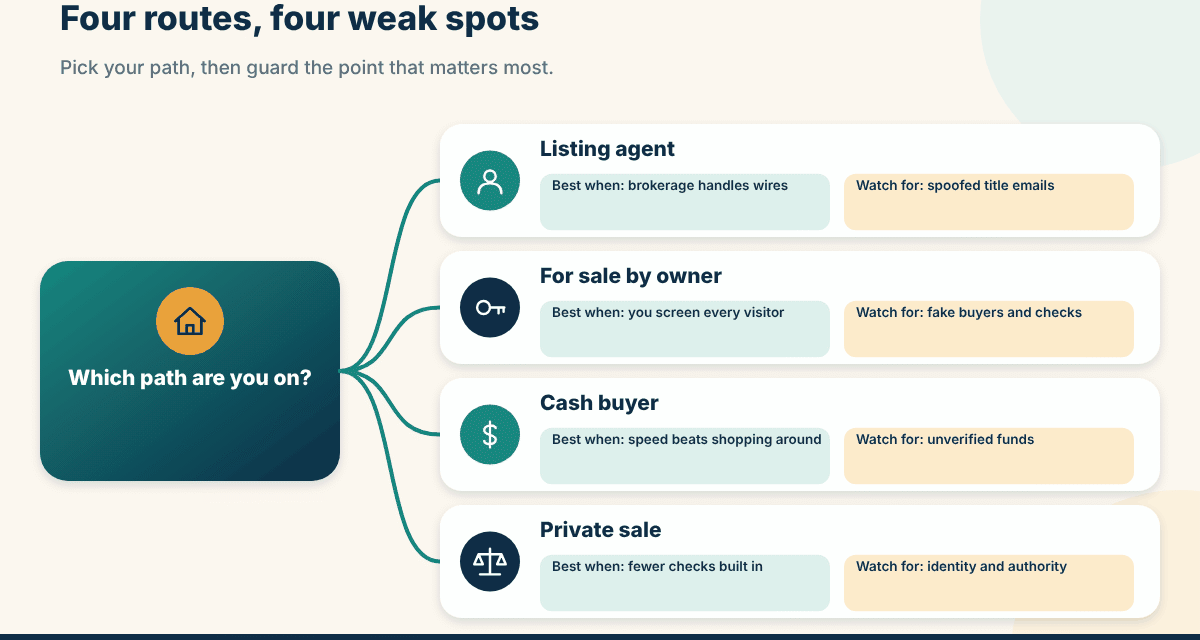
The takeaway for home sale fraud seller safety is not that one path is dangerous and another is safe. It is that the weak spot moves. If you know which path you are on, you can aim your home sale fraud seller safety effort where it counts, instead of spreading worry evenly across every possible scam.
Here is a simple exercise. Write the name of your selling path at the top of a page. Underneath, write the two moments you expect to be most exposed, for example “wire instructions from title company” and “first weekend of showings.” Those two moments get the best of your home sale fraud seller safety attention and your verification habits.
One more piece of the first section deserves attention before we move on: what you say in public while you sell. Social posts about a move date, a trip to celebrate, a job transfer or a new address all give outsiders a timeline. A post announcing that the house will be empty next weekend is an invitation. A photo of closing paperwork, a celebratory picture with a key or a screenshot of an email can leak account details, names and signatures without anyone noticing at first glance.
The simplest rule is to wait. Keep announcements until after the sale has closed and the funds have arrived. If you want to tell friends, do it privately and without specifics. Ask family members to follow the same rule, especially teenagers and relatives who may not realize that a cheerful update can double as a map for someone with bad intentions.
The same caution applies to the phone. Voicemail greetings that state your full name and address, call-back numbers left on yard signs and automated messages that identify when you will be away can all be avoided. A listing sign usually carries the agent’s information, and that is plenty. If you sell without an agent, consider a dedicated number that forwards to your phone and can be shut off when the sale is over, so that your personal number does not live permanently in public records.
Good habits here are cheap and invisible. Sellers who practice them rarely notice any benefit, which is exactly how successful home sale fraud seller safety looks from the inside: nothing happens.
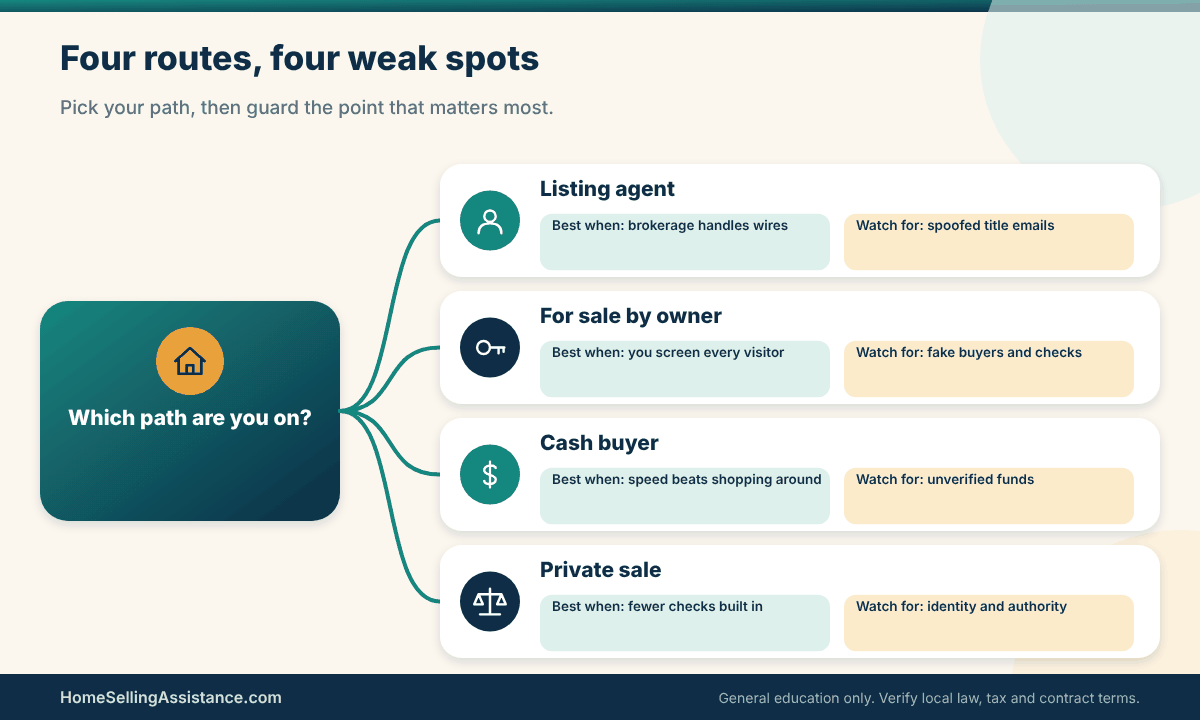
The picture above lays out the same idea as a decision fork, so you can see how each route changes who handles your money and where to focus your checks. Use it as a quick reference when a new party joins the transaction.
What changes your exposure: price, time, risk, and net proceeds
Your home sale fraud seller safety needs are not a fixed number attached to every sale. It rises and falls with the circumstances around your listing, and several of those circumstances are things you can influence. A tight timeline makes people skip verification. A high price attracts more attention. A confusing contract gives imposters more places to hide. A rushed buyer, a distant seller or an empty house each tilts the odds a little in the wrong direction.
This section looks at those variables one at a time and then ties them to what you ultimately care about, which is the net amount that reaches your account. Home sale fraud seller safety is not separate from net proceeds. A single redirected wire can erase the entire gain from a sale, no matter how well you negotiated the price.
Market, condition, financing, contract, and buyer variables that attract fraud
Let us begin with the things buyers and markets do. In a fast market, offers come quickly, deadlines are short and everyone is tempted to answer messages in minutes. Speed is where mistakes breed. In a slow market, sellers sometimes feel grateful for any interested party, which lowers their guard against odd requests. Neither condition causes fraud, but each one changes how likely you are to pause and verify, and the pause is the whole defense.
Condition matters as well in home sale fraud seller safety. A house that needs work, sits vacant or belongs to an elderly owner or an estate can attract scammers who hope the paperwork is messy and the owner is overwhelmed. Financing matters because a buyer who needs a loan involves a lender, an appraiser and an underwriter, all of whom add legitimate communications that imposters can mimic. A cash buyer removes the lender but replaces it with a need to verify funds directly.
In home sale fraud seller safety, the contract is the map of who is supposed to say what and when. A contract with clear deadlines, named parties and a defined settlement agent gives you a baseline for spotting an email that does not fit. If the message claims a new closing agent, a different bank or an urgent change in timing, you can compare it to the signed document. Our explanation of home sale contingencies shows how those deadlines are set up and why they matter.
Evidence to gather: the signals that separate normal friction from a red flag
Every real transaction has friction, and home sale fraud seller safety starts with knowing the difference. Lenders ask for another document. A title company sends a late update. The buyer’s agent forgets to confirm a time. So how do you tell friction from fraud? Look for the pattern of pressure plus change. Genuine friction usually arrives through the channel you expect, from a person you can reach, and asks you to do a normal task. A red flag usually adds urgency, secrecy or a request to move money or share a code outside the normal channel.
Collect a short list of home sale fraud seller safety signals and keep it near your desk. A request to change wiring instructions that were already delivered is one. A sender address that is off by one character, a new domain or a free webmail address posing as a company is another. A message that says do not call, the office phones are down, or only reply by email should raise suspicion.
So should a buyer who wants to pay more than the asking price and have you send back the difference, or a party who insists on an unusual payment method.
Also note what correct looks like, so you recognize a deviation. Ask your settlement agent at the start how they deliver instructions, which portal or secure method they use and what phone number you should call to verify. Write the answers down. If a message later arrives by a different route, you already know it is out of pattern.
The table below turns these ideas into a quick decision-support reference. Read the situation column first, find the one that resembles your moment, and use the practical action and trade-off columns to choose a response without having to improvise.
| Situation | Key fact | Practical action | Trade-off | Source or document |
|---|---|---|---|---|
| Email says wiring details have changed | Real changes are rare and should be confirmed by voice | Call the number you had before the sale; do not reply to the email | A short delay while you wait for confirmation | Your original instructions and settlement agent contact |
| Buyer sends proof of funds | A tidy PDF can be edited or fabricated | Ask the settlement agent or lender to confirm through their own channels | May slow an excited buyer | Bank letter verified by call; contract terms |
| Buyer overpays and asks for a refund | The original payment can fail later | Decline; do not send money back before funds clear | You may lose a pushy buyer | Your bank’s funds-availability policy |
| Visitor asks to see upstairs alone | Showings are access to your valuables | Keep a host present and valuables locked away | Less casual, more planning | Showing protocol agreed with agent |
| Message asks for ID or SSN by email | Email is a weak container for sensitive documents | Ask which secure portal the closing office uses | Extra steps to upload | Settlement agent’s secure portal |
| Unknown party offers to buy before you list | Cold offers can be legitimate or predatory | Verify the company, ownership and funds before signing anything | Time spent on checking | State licensing and business records; cash offer comparisons |
To use the table, treat it as a prompt and not a script. Pick the row that resembles your situation, then ask whether your actual circumstances match the key fact. If they do, take the practical action. If you are unsure, call your settlement agent or attorney using the phone number from your phone book, and tell them what you received. They see these attempts often and would rather answer a question than clean up a loss.
A scenario, an exception, and your next step for a fast-moving offer
Consider a seller who receives an offer within days of listing, from a buyer who skips the usual negotiation and says the funds are ready. The agent is pleased, and the seller is relieved. The closing date is set for two weeks out. In the middle of that stretch an email arrives from what appears to be the title office, asking the seller to confirm bank details for proceeds by replying with a photo of a voided check.
A seller who has done the first-week preparation recognizes the pattern. The settlement agent had said instructions go through a secure portal, and this message came by plain email with a hurried tone. The seller calls the known office number and learns that no such request was made. The attempt is reported to the agent and the title company, and the portal is used instead. Nothing was lost because verification took ten minutes.
An exception worth noting: sometimes a legitimate office really does need to change a process, for instance if its portal is down. The answer is still voice confirmation to a number you already hold, ideally from two people, and written confirmation inside the portal once it is back. A real office will not mind the extra step.
Your next step is to ask, today, how your settlement agent delivers instructions and how they would notify you of a change. Write the answer on the same page as your phone book. That one conversation does more for home sale fraud seller safety than almost any app, because it prevents an entire class of attack.
Costs, legal and tax issues, logistics, and seller priorities when money is at risk
For home sale fraud seller safety, remember that net proceeds are the sum of many pieces: the sale price, minus the mortgage payoff, commissions that were negotiated and written down, title and escrow charges, prorations, credits and any liens or taxes that apply. Each piece is a number that travels in a document, and each document is a chance for tampering. Good home sale fraud seller safety here is mostly about keeping the numbers in channels you control and checking them against sources you trust.
Our explanation of seller closing costs shows how to build an estimate from actual line items, and the guide to your seller closing statement shows how to read the final figures. When you know what the totals should look like, a surprise at the last minute stands out. A payoff figure that is unusually high or a fee you never heard about is a prompt to call, not to pay.
Legal and tax issues sit on top of the money. Whether a transaction requires an attorney, how funds are held, who signs, and what gets recorded all depend on state law and local custom. Taxes on the sale depend on your own facts, and general rules like the federal home-sale exclusion have conditions. Our overview of taxes when selling a home explains the structure, and the IRS publishes its own guidance in Publication 523 on selling your home.
Scammers like tax season language because it sounds official, so be skeptical of any message that claims you owe an urgent transfer tax payment outside the closing statement.
Evidence to gather: payoff statements, closing figures, and where each number comes from
Your mortgage payoff is a good home sale fraud seller safety example. Your lender or servicer issues a payoff statement with a good-through date and a daily interest amount. That statement normally goes to the settlement agent directly from the servicer, often through a request you authorize. You can also see the loan balance on your own account portal. If a message arrives claiming the payoff changed or must be sent to a new account, compare it with what the portal shows and call the servicer on the number printed on your own statement.
The same method applies to every line item. Taxes and HOA amounts should match official bills. Commission terms should match your signed listing agreement and the contract. Title and escrow charges should match the fee schedule the settlement agent gave you earlier. If any figure does not match, ask for a written explanation from the person who sent it and verify that person by voice.
Create a simple home sale fraud seller safety tracking page with one row for each number: the amount, the source document, the date you received it and the name of the person you verified it with. This is less work than it sounds, and it makes the last forty-eight hours before closing much calmer. For more detail on how long money takes to reach you after signing, see our article on when a seller gets money after closing.
For a deeper look at the choice between receiving funds by wire or by check, including bank holds and verification, our article on seller proceeds by wire versus check covers the mechanics and the trade-offs.
A scenario, an exception, and your next step for a mortgage payoff mismatch
Suppose the closing statement draft shows a payoff amount that is noticeably different from what your own portal displayed the week before. There are innocent explanations: a few more days of interest, an escrow balance adjustment, a fee posted late. There are also less innocent ones, such as an altered statement. The safe response is the same in both cases. Ask the settlement agent for the payoff letter, call the servicer on a known number, and ask them to confirm the amount and the good-through date.
If the servicer confirms the figure, you have lost a day and gained certainty. If the figure is wrong, you have caught an error or an attack before money moved. Either way you are the person who asked, and the people on the other end of the line will remember that you did.
An exception: if your sale involves a lien, a judgment or an unpaid contractor, the payoff may include more than one party. Our article on selling a house with a lien explains why multiple payees complicate things, and it is wise to confirm each one separately.
Your next step is to ask your settlement agent for a preliminary estimate of all your costs and payoffs as early as possible. Having the expected shape of the numbers in your hands makes any unexpected change obvious.
It also helps to understand how your own bank treats incoming money, because that knowledge shapes the verification you ask for. Banks differ in how they treat incoming wires, cashier’s checks and ordinary checks, and in when funds become available to withdraw. Some will place holds on large deposits for a period set by their own policy and by federal and state rules. A deposit that appears in your balance is not always final money. Ask your bank before closing how it handles an incoming wire, how it handles a large check and what a hold would look like.
Ask a second question too: what is the bank’s procedure if you report a fraudulent transfer? Find out the fraud line, the hours and what information they will need from you, such as the amount, the date, the receiving bank and the confirmation number. Save this in your phone book. When you need it, you will not want to search through a website with a racing heart.
Third, consider the account that receives proceeds. Some sellers choose an account that is separate from their daily spending, with stronger alerts and fewer connected apps. Others keep it simple and use the primary account. Either choice is reasonable, but turn on transaction alerts either way, and review who has online access. If you have joint owners on the account, make sure both know the plan.
The point of all this is not to scare you away from wires, which are a normal and legitimate part of closings. It is to make the verification proportionate. The larger the amount and the harder the transfer is to reverse, the more careful the confirmation should be, and the more your home sale fraud seller safety routine should lean on voice and on written records.
A worked example with round, purely illustrative numbers shows why home sale fraud seller safety belongs in the same conversation as net proceeds. Suppose a house sells for 400,000 dollars, the mortgage payoff is 150,000, and the combined commissions, title charges, prorations and credits come to a figure that leaves you about 220,000 in proceeds. That 220,000 is the number you planned your next home, your savings or your estate around. If a fraudulent wire diverts it, the sale price you negotiated, the staging you paid for and the weeks you spent keeping the house tidy all become irrelevant.
Now compare that with the cost of prevention. A verification call takes ten minutes. A hardware key or authenticator app costs little or nothing. A lock change is a modest expense. Even a day of delay because a closing office wants to confirm your instructions twice is cheap next to the potential loss. This is the arithmetic behind every home sale fraud seller safety habit in this article: small, predictable costs paid early to avoid a rare but very large loss.
The same logic applies to the smaller targets. Losing a piece of jewelry from an unlocked bedroom during a showing is a real harm, but the replacement cost is a fraction of a stolen identity that takes months to untangle. Home sale fraud seller safety is therefore about proportion: protect the largest and least reversible things most carefully, and protect the rest with sensible, low-effort habits.
It also explains why the order of your actions matters. If you only have one hour before your first showing, spend it on your email and your valuables. If you only have one hour before closing, spend it on verifying the settlement agent and your proceeds instructions. Home sale fraud seller safety is not about perfection, it is about putting your limited attention where a mistake would hurt most.
One more point about timing. Fraud attempts cluster around moments when money or documents are about to move: just after a contract is signed, just before closing, and just after funds are disbursed. These are the moments when your home sale fraud seller safety routine should be at its strongest. Sellers who treat the days around closing as a protected window, with a slower pace, an extra call and a clear head, tend to avoid the errors that criminals count on.
If your schedule is hectic, consider blocking an hour on the calendar the day before closing purely to confirm numbers and contacts.
Finally, remember who else is working on your behalf. A listing agent, a settlement officer and a bank each have their own fraud procedures, and a good home sale fraud seller safety approach lets those procedures do their job. Ask what they do, follow what they ask, and report anything that looks out of step. You are the one person in the transaction whose interests are fully aligned with protecting your own money, so you are also the one best placed to notice when something feels wrong.
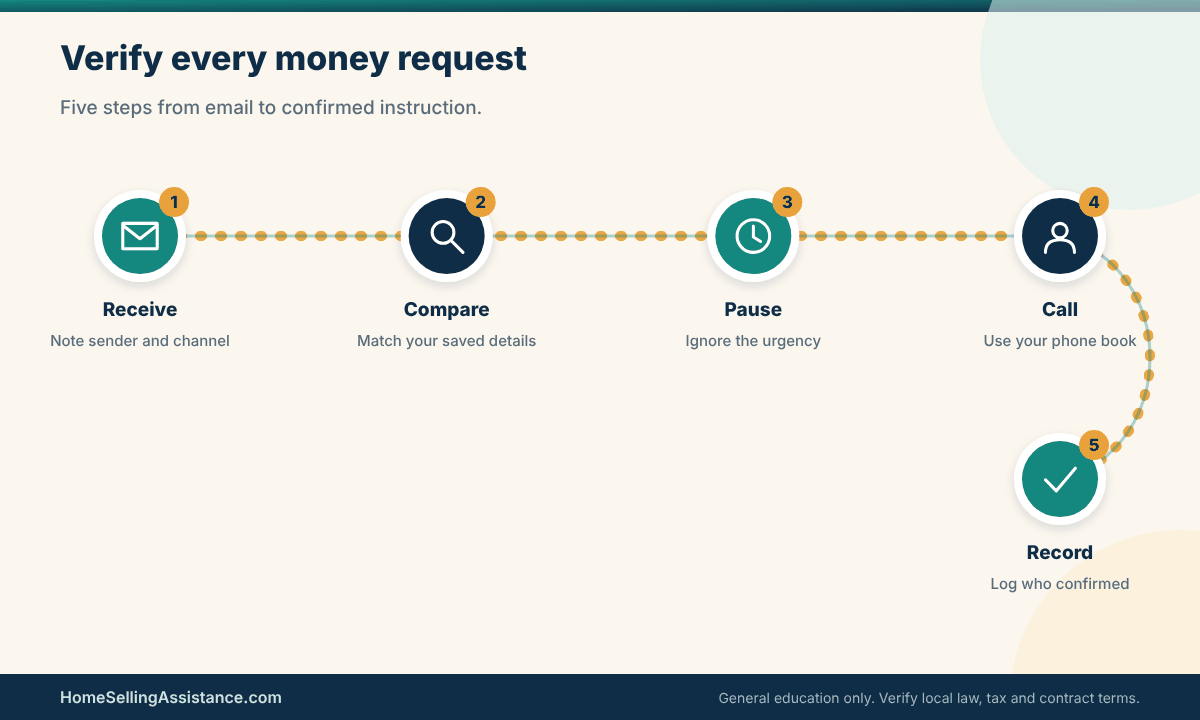
The roadmap above shows the verification path for any money instruction, from receipt to voice confirmation to written record. Use the same five steps whether the request concerns a payoff, a proceeds wire or a change in payee, and your home sale fraud seller safety routine will cover the most common ways sellers lose funds.
Turn the overview into a verification roadmap for home sale fraud seller safety
So far we have looked at what is exposed and what raises the stakes. Now we put those pieces into a working plan. A good plan for home sale fraud seller safety is short enough to remember under pressure and specific enough to follow when an urgent email lands at five on a Friday. It names the people you will rely on, the documents you will protect, the channels you will use and the decisions you can make early so that you are not making them in a hurry later.
Think of this home sale fraud seller safety roadmap as two lists. One list is who and what: the professionals and documents that make up your verification network. The other is when: which choices belong before listing and which can safely wait until an offer arrives. Together, the two lists turn home sale fraud seller safety from vague worry into a sequence of small, doable steps.
Documents and professionals to involve in your verification network
Your home sale fraud seller safety network starts with the settlement agent, who may be a title company officer, an escrow officer or a closing attorney depending on where you live. This person or office usually holds the money and records the deed, which makes them the most important contact for fund security. Ask for a direct name, a direct line and a description of how they deliver instructions. If there is a secure portal, ask to be set up on it early, before any money is due.
Next are the people who fill out the rest of the circle: your listing agent if you have one, your mortgage servicer, your bank, your attorney if you hire one, a notary if signing is remote or mobile, and your insurance agent. For each, the goal is the same. Have a verified phone number from a source that predates the transaction, and know what normal communication from that party looks like.
In home sale fraud seller safety terms, the documents that deserve extra care are the ones that carry identity or authority. These include government identification, your Social Security number on tax forms, the deed, any power of attorney, trust certificates, letters of authority from a probate court, and the closing disclosure with account details. For a broader look at the paperwork a seller handles, see our article on the real estate sales contract from the seller’s side.
Evidence to gather: who confirms what, and through which channel
Build a small home sale fraud seller safety matrix on paper. Down the left side, list each party. Across the top, list three columns: how they contact you, how you verify them and what they are allowed to ask of you. The settlement agent may send a secure link and may ask for identification and wiring information for your proceeds. A lender may ask for payoff authorization. An agent may send contract documents through an e-signature platform. None of them should ask for a password, an authentication code or a password reset link.
The email account that ties your home sale fraud seller safety together deserves its own paragraph. If someone takes over your inbox, they can read your messages, learn your timeline, send convincing replies from your address and reset passwords on other accounts. Use a long, unique passphrase and turn on a second step using an authenticator app or a hardware key where possible, rather than a text message code if your provider offers better.
Review forwarding rules and connected apps, because attackers sometimes hide a rule that quietly copies your mail. Our article on email account security during a home sale goes through these settings step by step.
Identity verification during signing is a separate piece of home sale fraud seller safety. Remote and mobile notarizations are legitimate in many places, and the rules vary. A careful process checks identification, confirms that you are the signer and records what happened. If someone asks you to sign blank pages, pre-signed forms or documents you have not read, stop. Our guide to seller identity theft at closing explains what a proper identity check looks like and what an improper one looks like.
Finally, document the contact information your home sale fraud seller safety plan relies on. Take a photo of your settlement agent’s business card, save the phone number under a clear name in your contacts, and write the address of the office. If a message ever claims to come from that party, you can compare the sender, the phone number and the signature block against what you already have.
A scenario, an exception, and your next step if something looks wrong
Even careful sellers run into suspicious moments, and home sale fraud seller safety is mostly about handling them calmly. Imagine you notice that an email you were about to open came from an address with a slightly different domain than the one you saved for your title office. Or your bank sends an alert about a login you did not make. Or a buyer’s agent says the buyer wired earnest money to a different account than the contract specified. These are the moments to slow down, not speed up.
For home sale fraud seller safety after a scare, start with containment. Do not click links or open attachments in the message. Call your settlement agent on the known number and ask whether they sent it. If you suspect an account compromise, change the password from a device you trust, sign out of other sessions and enable the stronger second step. Tell your bank if any money may have moved.
In the United States, you can report internet-enabled fraud at the FBI’s Internet Crime Complaint Center and report scams to the Federal Trade Commission’s consumer site, and your local police can take a report as well.
The exception to the “call the known number” rule is when the known number itself may be compromised, for example if your own phone was cloned or forwarded. If anything about your phone behaves oddly, use a second device and a published number for the institution, and consider a visit in person to your bank branch or the settlement office.
Speed helps if money has actually left your account. Banks have procedures for attempting to recall wires, and the earlier you ask, the more options exist, though no outcome can be promised. Keep the evidence: the original email with full headers if you can, the wire confirmation, the names and times of every call. Your next step now, before anything goes wrong, is to write a one-page response plan with the numbers to call in order: bank fraud line, settlement agent, agent, local police, then the reporting sites above.
If you want to see the fallback logic laid out at a glance, the diagram below shows how a seller can sort a suspicious moment into the right next action.
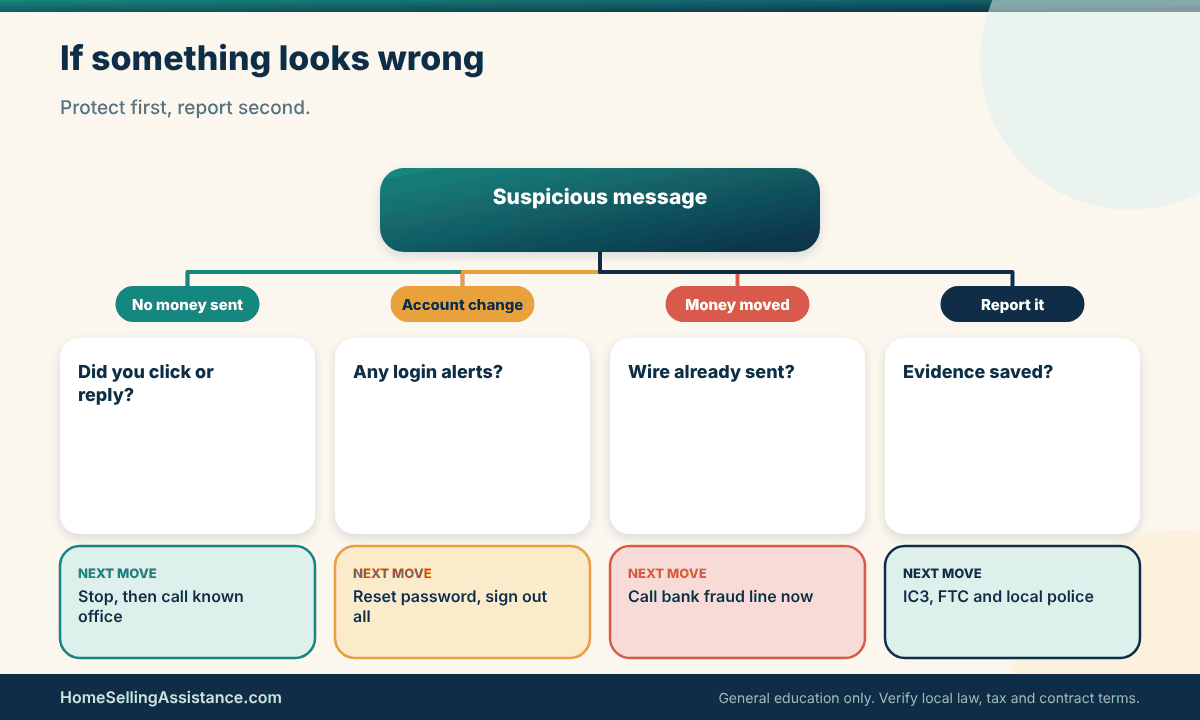
Notice that every branch begins with a pause and a voice check, and that reporting comes after protection. The order matters. A frightened seller who reports first and calls the bank second may lose the window that matters most, so keep the bank at the top of your list.
What to settle before listing and what can wait until an offer
Some home sale fraud seller safety decisions are better made while nobody is pressuring you. Others cannot be made until you know who the buyer is. Sorting them correctly keeps you from over-preparing for details that will change and under-preparing for the ones that will not.
Before listing, decide your selling path, your contact setup, your showing rules, your house-security measures and your document handling. After an offer, decide your verification of the buyer, the closing arrangements, the way proceeds will be received and the final signing method. The first group is about your habits and your house. The second group is about a specific counterparty and a specific contract.
If you hire an agent, bring up security in the interview. Ask how the brokerage verifies wire instructions, how showings are screened, how lockboxes and keys are managed and what happens to your listing data. Our guide on how to choose a listing agent includes other interview questions, and security fits naturally among them.
Evidence to gather: your pre-listing safety decisions on paper
Start with showings. Decide whether you want appointments only, whether buyers must be accompanied by an agent and whether they need to show pre-approval or proof of funds before entering. Open houses are a separate decision. They bring many strangers through the house at once, and some sellers decide to skip them or to limit them for security reasons. Our article on open house safety for sellers lists what to remove or lock up beforehand.
Then decide what leaves the house before the first photo, since physical home sale fraud seller safety begins there. Prescription medication, jewelry, cash, passports, financial statements, checkbooks, mail with your name and account numbers, spare keys and firearms are common candidates. Take them off site or into a locked space that is not obviously a safe. Do not leave a list of what you moved in an obvious place. Consider documenting the condition and contents of the house with dated photos for insurance purposes and keep that record private.
Lock decisions come next in home sale fraud seller safety. Changing locks or codes before listing is simple and inexpensive compared with the risk of an old key floating around. If you use a lockbox or smart lock, ask who has access, how entries are logged and how the code is changed after each showing window. For houses that will sit empty, our article on vacant home security while listed covers insurance questions, utilities, lighting and inspection routines.
The last pre-listing decision is the one many people skip: the title. Look at your county’s property records or ask your title company what monitoring options exist, and understand how recorded documents appear. Deed and title fraud is uncommon relative to other scams, but it is damaging, particularly for owners of vacant lots, second homes or properties with no mortgage. Our article on title and deed fraud warning signs explains the pattern and what monitoring can and cannot do.
Pull these home sale fraud seller safety decisions together on a single page and share it with your agent, so that everyone follows the same rules. Consistency matters because a gap in one person’s habits is a gap in all of them.
A word on screening visitors, because it is easy to do badly. You can reasonably ask that buyers come with a licensed agent, that they show pre-approval or proof of readiness, that they sign in at showings and that they leave bags and photography rules as set by you and your agent. These are neutral, practical requirements applied to everyone.
What you must not do is decide who gets to see the house based on race, color, religion, sex, disability, familial status, national origin or any other protected characteristic. Security measures and fair housing obligations work together when the rules are the same for everyone. HUD’s fair housing resources describe the federal framework, and your state may add more protections.
Cameras need a similar thought. Many sellers use doorbell or interior cameras for peace of mind, and rules about disclosure and recording differ across states, particularly for audio. Buyers often feel uneasy when they discover hidden recording, and some states require notice. A visible sign and a conversation with your agent about what is on and what is off will usually settle the question. Many agents ask sellers to turn off interior devices during showings.
Smart-home devices are another quiet exposure. Thermostats, locks, voice assistants, garage openers and connected speakers may hold accounts and access codes tied to you. Before showings, remove personal accounts, sign out of linked services and, where possible, reset what a visitor could trigger. When the house sells, plan how you will transfer or reset each device so that your login does not travel with the property.
Keep a simple written showing protocol and share it with your agent. It might say appointments only, an agent present at all times, no unaccompanied upstairs visits, no photography of documents or valuables, and a sign-in sheet. Having it on paper makes it easier to enforce politely and takes the personal edge off saying no.
A scenario, an exception, and your next step for what can wait until an offer
Now consider what is better postponed. You cannot verify a buyer before there is a buyer, and you cannot confirm the exact wiring path before a closing office is chosen. Trying to arrange those details early often produces confusion and sometimes opens a door for imposters who read your public posts. Instead, prepare the questions you will ask and the checklist you will use when the moment arrives.
When an offer comes in, your agent or attorney will review terms, and you can ask how funds will be proven. For cash offers, ask the settlement agent to confirm funds through the bank directly. For financed offers, look at the lender’s pre-approval and ask that the lender’s contact be verified. If the buyer is an entity, ask for the exact legal name and the person with signing authority and look the entity up in your state’s business records.
An exception: if a buyer pressures you to sign before you have had time to review, or asks you to skip the usual settlement agent, that is a reason to slow down further, not a reason to give in. A legitimate buyer will accept a reasonable review period. You can always say that you need your attorney or agent to look at the paperwork, and that you will respond in the time the contract allows.
Your next step, once an offer is accepted, is to hold a short call with your settlement agent and agent together. Confirm who is responsible for what, how you will receive documents, how you will receive proceeds and what phone numbers everyone will use. Write them down and treat them as the only valid ones for the rest of the transaction.
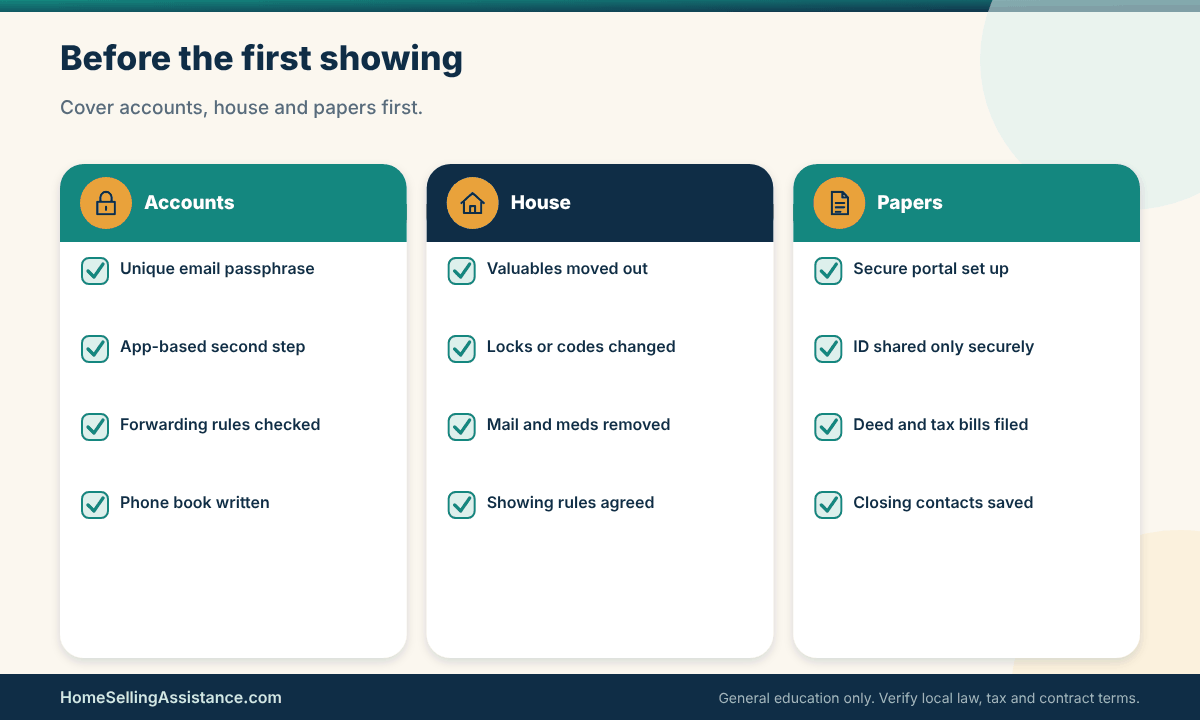
The checklist above groups the pre-listing items by what they protect, so you can tick them off before the first showing. If you only have time for a few home sale fraud seller safety steps, choose the ones that cover money and email first, then the house.
With the pre-listing decisions done and the offer-stage decisions queued, it helps to see the whole sale laid out as a sequence of stages, each with its own owner, its own safety job and its own fallback. The next table does that. It follows a typical transaction from listing to funding and shows what falls to you, what depends on a buyer or a professional, roughly when it happens and what to do if the step goes sideways.
| Stage | Seller responsibility | Buyer or professional dependency | Typical deadline | Fallback |
|---|---|---|---|---|
| Pre-listing | Secure email, remove valuables, set showing rules | Agent explains brokerage security practices | Before photos and first showing | Delay listing until basics are done |
| Showings and offers | Screen visitors and keep documents out of sight | Buyer agents confirm identity and readiness | Each showing window | Cancel the appointment or require an agent present |
| Contract signed | Verify settlement agent by phone and set up portal | Title or escrow office issues contacts and instructions | Within days of acceptance, per contract | Ask attorney or agent to confirm office details |
| Inspection and appraisal | Confirm who is coming and secure personal items | Inspector, appraiser and buyer schedule access | Dates set by contract | Reschedule with a verified contact |
| Final figures | Compare payoff and fees to source documents | Servicer, settlement agent and lender supply numbers | Shortly before closing | Ask for written corrections and call to confirm |
| Signing and funding | Give proceeds instructions through the verified channel only | Settlement agent, notary and your bank | Closing day and the following banking days | Contact bank fraud line and settlement agent immediately |
Use the table as a rolling home sale fraud seller safety checklist. At each stage, ask three questions. What is my job right now? Who am I depending on, and have I confirmed that person independently? What would I do if this step failed? If you can answer all three, you are covered for that stage. If you cannot, that stage becomes your next phone call.
Deadlines in the table are deliberately general. Contract timelines vary by state, local custom and the language you and the buyer agreed to, and some places schedule signing and funding on the same day while others separate them. Use your actual contract and settlement agent’s calendar for real dates.
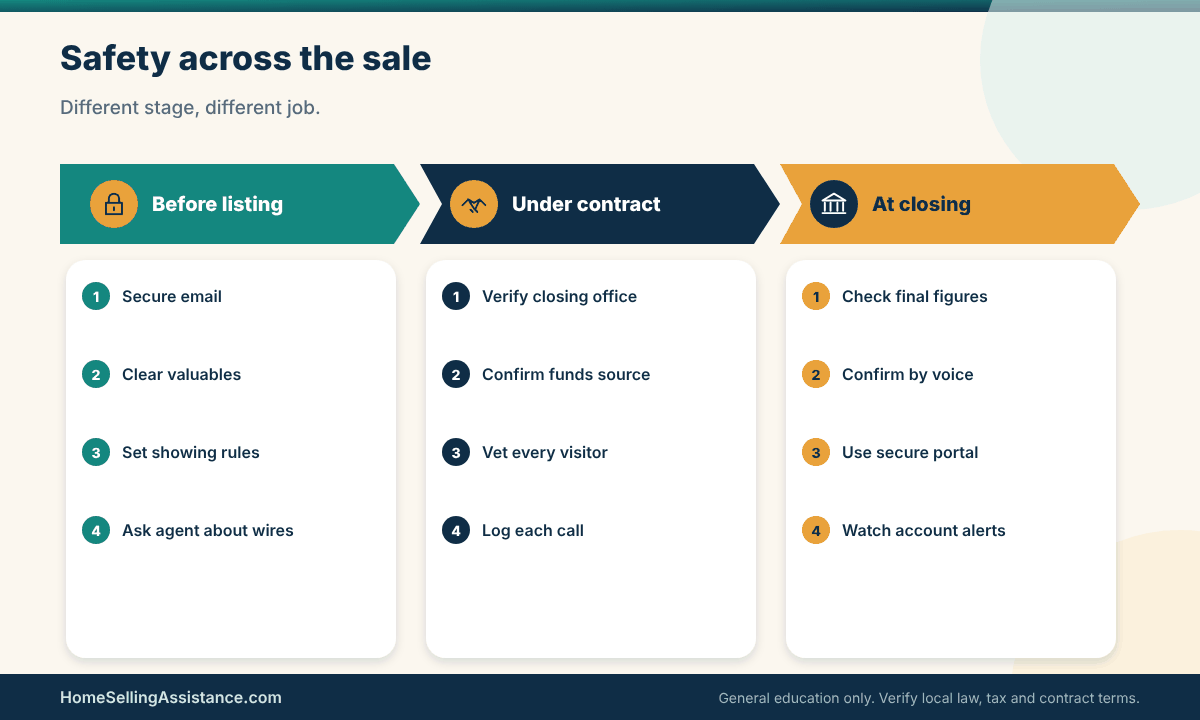
The three-phase picture above shows the same story visually: what to do before listing, while under contract and at closing. Pinning it near your desk can be useful when a stressful week crowds out your memory of the plan.
Now let us look more closely at the most common scams that test home sale fraud seller safety, because recognizing the script makes it harder to be pulled into it. These are descriptions of patterns, not predictions about what you will see.
The first home sale fraud seller safety pattern is the business email compromise, often called wire fraud in real estate. An attacker gains access to or imitates an email account involved in the deal. They watch the thread, wait for a payment moment and send a message that looks like it came from the settlement office with new wiring details. The tone is normal and the logo is right. The only thing wrong is the account number.
The defense is voice verification and a rule that instructions are never changed by email alone. Our dedicated guide on real estate wire fraud for sellers goes deeper.
The second pattern targets sellers by impersonating them, and it is a serious home sale fraud seller safety concern for absentee owners. Someone with a stolen identity, sometimes using a vacant property or a house with no mortgage, poses as the owner to a title company, signs with a forged document and tries to receive the proceeds. Settlement offices use identification checks and, in many cases, extra scrutiny for absentee owners, but you can help by telling your agent if anything about your information seems to have been misused and by monitoring your credit and property records.
The third home sale fraud seller safety pattern is the fake or unqualified buyer. Sometimes the person is real but the funds are not, and the contract is a tool to tie up your house while they shop it to others. Sometimes the person is not who they say, and the goal is access to the property or to collect a deposit. Our article on fake cash buyer warning signs shows the signals around proof of funds, assignment clauses and pressure tactics.
The fourth pattern is the advance-fee or overpayment scam. A buyer or a third party sends a check or payment for more than the agreed amount and asks you to return the difference. When the original payment fails, which can take days to appear, the money you sent is gone. The rule is simple: do not send funds back to anyone until you are certain the original funds have fully and finally cleared, and ask your bank what that means for your account.
The fifth home sale fraud seller safety pattern preys on distress. Homeowners behind on payments, owners of inherited houses and sellers in a hurry are targeted by offers that sound like help and work like theft, such as asking for an upfront fee, asking you to sign over the deed temporarily or promising to stop a foreclosure. Our guide on selling a house before foreclosure explains legitimate options, and HUD maintains a directory of approved housing counselors at hud.gov/findacounselor. The Consumer Financial Protection Bureau also publishes consumer resources at consumerfinance.gov.
The sixth home sale fraud seller safety pattern is the listing hijack. A scammer copies your photos and description, posts them as a rental at a bargain price and collects deposits from people who never see the inside. You may only learn about it when strangers show up at the door. If this happens, report the posting, tell your agent, make a note of the date and consider adding a visible note in your own listing that the property is not for rent.
Quick scenario
A seller accepts an offer and gets a friendly email that reads, “Please send your wire details to this new closing contact, our usual office is closed this week.” The seller replies to the sender, gets a quick reply and almost sends the information. Instead, the seller remembers the phone book, calls the title office on the number from the contract and learns the office is open and sent no such message.
The suspicious address is forwarded to the agent, the bank and the reporting sites, and the real office adds a note to the file. The whole detour costs about fifteen minutes.
Having walked through the patterns, one more home sale fraud seller safety habit deserves emphasis, and it is the one that makes all the others work: write things down. People who keep a short log of every call, every verified number and every instruction received have a much easier time spotting a mismatch. If you ever need to give a statement to a bank, a lawyer or the police, the log is also what you will want to hand over.
Another home sale fraud seller safety habit worth building is the family briefing. If a spouse, an adult child or a friend helps with your sale, they need to know the rules too. Agree in advance that nobody changes payee details, shares passwords or sends identification without checking the plan, and agree that any of you can say stop and ask for a verification call without anyone feeling insulted.
Finally, accept that home sale fraud seller safety will sometimes make you feel rude. Asking a title officer to confirm their phone number or telling a buyer that you need independent confirmation of funds feels awkward in the moment. Professionals who do this work expect it. The awkwardness lasts seconds, while the consequence of skipping the step can last years.
The home sale fraud seller safety work does not stop when the keys change hands. The weeks after closing are a quieter but still useful period for protecting what the sale produced. Start by keeping your own copies of the signed closing documents, the final settlement statement, the recorded deed confirmation when it becomes available and any payoff confirmation from your lender. Store them securely, preferably offline or in an encrypted location, rather than in a shared email thread.
Confirm that your mortgage was actually paid off and that any lien release is recorded as expected. Your servicer and your settlement agent can tell you how that is handled where you live and when you should expect confirmation. A missing payoff is rare but is much easier to fix in the first weeks than years later.
Watch your accounts and credit. Consider placing a fraud alert or a security freeze on your credit files through the credit bureaus, which is a free protective step in the United States that you can lift when you need credit. The FTC’s consumer site explains the options. Review statements for a few months and keep alerts on for the account that received proceeds.
Finally, close the loop with the house itself. Change forwarding for your mail, update your address with the institutions that matter, cancel or transfer utilities, remove your devices and accounts from the property and shred papers you no longer need. Retire the temporary email address or phone number you used for the sale. A clean ending is part of home sale fraud seller safety too, because loose ends are where problems tend to appear months later.
Frequently asked questions about home sale fraud seller safety
What does home sale fraud seller safety actually cover?
It covers protecting four things during a sale: your money, your identity, your property and your communications. That includes wire and payoff verification, email security, careful document sharing, showing and open house rules, vacant-house security and buyer verification. It is general education and does not replace advice from your settlement agent, attorney or bank.
How can I tell whether a wiring instruction is real?
Do not judge it by how professional it looks. Call the settlement office on a phone number you had before the sale, such as one from your contract or the office’s own website that you found independently, and read the instruction back to a person. If anything differs, treat the message as suspicious and do not act on it until a person you verified confirms it.
Should I receive my proceeds by wire or by check?
Both methods have trade-offs, and the right choice depends on speed, bank holds, your bank’s rules and what your settlement agent offers. A wire is faster but harder to reverse if sent to the wrong place, while a check may take longer to clear. Whichever you choose, verify the instructions by voice and read our article on proceeds by wire versus check before deciding.
What should I do if I think I sent money to a scammer?
Call your bank’s fraud line immediately and ask about a wire recall or other recovery steps, then tell your settlement agent and agent. Report the incident to the FBI’s Internet Crime Complaint Center and the Federal Trade Commission, and file a police report. No one can promise recovery, but speed gives you the best chance of options.
Are open houses unsafe for sellers?
For home sale fraud seller safety purposes they are not inherently unsafe, but they bring many unvetted visitors into your house at once. Many sellers remove valuables, medication and documents, lock interior rooms and ensure a host is present at all times. Some decide to skip open houses entirely and use private appointments instead. The choice is yours and your agent’s, and it is a fair question to raise during the listing interview.
How do I protect my email during a sale?
For home sale fraud seller safety, use a long unique password, turn on a second verification step with an authenticator app or security key where available, review forwarding rules and connected apps and keep your phone number current with your provider. Avoid sharing sensitive documents as plain attachments if a secure portal exists. If you suspect a takeover, change your password from a trusted device and tell your bank and settlement agent.
Can someone really steal my house with a fake deed?
Deed and title fraud happens, although it is uncommon relative to other scams, and rules for recording, notarization and correction vary by state. Owners of vacant land, second homes and unencumbered properties are often described as more exposed. Monitoring property records where offered, keeping your mailing address current and acting quickly on any unfamiliar filing are sensible habits, and your title company or attorney can explain local options.
How can I verify a cash buyer or an investor?
Ask for the exact legal name of the buyer, the name of the person who can sign, and a way to verify funds through the settlement agent or the buyer’s bank directly, not through a document the buyer sends. Check state business records and any required licenses, and read the contract for assignment language. A legitimate buyer will usually accept reasonable verification.
Is it safe to share my ID and Social Security number with the closing office?
Settlement offices often need identification and tax information, but how you send it matters. Ask which secure portal or method the office uses and avoid sending documents by ordinary email or text. Confirm the office through a known phone number first, and ask how long they keep the documents and how they protect them.
Where can I find trustworthy help if I am being pressured to sell quickly?
For home sale fraud seller safety under pressure, HUD-approved housing counselors can discuss options at no charge or low cost in many cases, and the CFPB and FTC publish consumer guidance on foreclosure and mortgage-related scams. A real estate attorney in your state can explain the rules that apply to you. Be cautious of anyone who asks for an upfront fee, asks you to sign over the deed or tells you to keep the arrangement secret from your lender.
A calm way to finish your sale
Good home sale fraud seller safety is mostly a matter of order and patience: know what you are protecting, verify every money instruction by voice, keep your email locked down, treat your house like a place strangers will enter and judge buyers by proof. This article is general education, not legal, tax or financial advice, and rules differ by state, so confirm the details that apply to you with your settlement agent, your attorney, your bank and your state real estate commission before you act.