When a co owner refuses to sell house plans that everyone else has already agreed to, the sale does not simply stall; it moves into a different kind of problem, one where the deed, your state’s property law and sometimes a judge decide what happens next, and the most useful thing you can do early is learn which of those three actually controls your situation.
The usual co owner refuses to sell house story goes like this. Two or more people own a home together. Maybe it is spouses who are separating, siblings who inherited a parent’s house, an unmarried couple who bought with two names on the deed, or a friend and a relative who pooled money years ago. One owner wants to sell. Another says no, or says nothing, or says “not now” for the fourth month in a row. The listing agent cannot list, the buyer cannot be promised clear title, and the house keeps costing money every month it sits.
This guide is for the owner who wants out and for the owner who does not, because the same facts help both. We will look at how ownership is actually held, which documents show it, what the common legal routes look like when negotiation fails, and how title companies and buyers react to a split ownership group. We stay at the education level. Your state’s rules, your deed and your mortgage paperwork decide your real options, and a local attorney is the right person to read them.
If your co-owner is a spouse, our cornerstone guide on selling a house during divorce covers the wider picture, and the deeper article on partition sales of co-owned houses explains the court route in more detail. Think of this page as the pre-court companion for any co owner refuses to sell house problem. Here, the focus is the standoff itself: why it happens, what you can verify yourself, and how to move toward a clean closing with as little damage as possible.
Key takeaways
- Read the recorded deed before anything else. The way title is held, and who is named on it, decides whether one owner can sell alone, whether every owner must sign, and what a court could do later.
- A signature from everyone on title is the normal requirement. A listing agreement, a purchase contract and a deed generally need every owner, or someone with legal authority for that owner, so one refusal usually blocks a conventional sale.
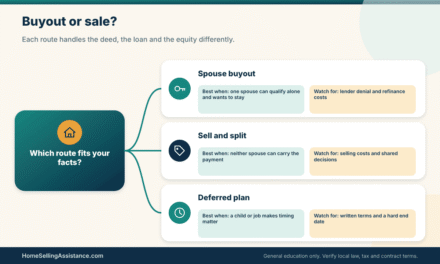
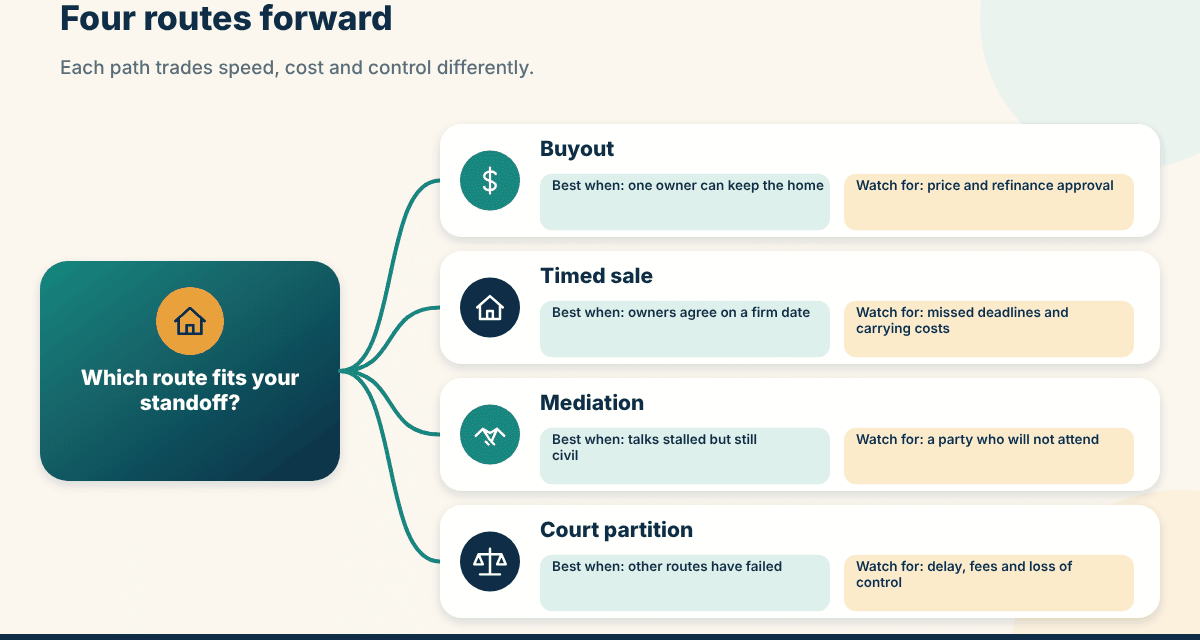
- Negotiation and documented offers come before court. A buyout, a fair-price sale split, a delay with a firm date, or mediation can resolve a refusal faster and cheaper than a lawsuit, though no route is guaranteed.
- A partition action is a legal tool, not a quick fix. Rules, timing, costs and outcomes vary by state and by the facts, and only a local attorney can tell you how it applies to you.
- Title companies decide what is closable. Early contact with a title or escrow company tells you what they will require to insure a sale when ownership is divided or disputed.
- Keep every step in writing and calm. Dated offers, dated replies and a paper trail protect both owners and make later mediation or court steps simpler.

Identify ownership first when a co owner refuses to sell house plans
Before you argue about price or timing, pin down the legal facts. People often believe they know how the house is owned because of who pays the mortgage, who lives there or what was said at the closing table years ago. None of those things decides ownership. The recorded documents do, and sometimes a court order, a divorce decree, a trust or an estate does too. Every co owner refuses to sell house conflict we have seen gets easier to talk about once the facts are on one page.
This section has two jobs. First, work out who owns the house and which document controls the right to sell. Second, separate what federal rules say, which is very little about forcing a sale, from what your state and county decide, which is most of it. After that, the practical steps in the later sections will make more sense.
Who owns the house and which document controls
Ownership of a house is a bundle of rights, and a deed, a trust document, a court order or an entity agreement says how that bundle is divided. When people say “we both own it,” they could mean several different legal arrangements, and each one gives a different answer to the question of whether one owner can sell without the other. A co owner refuses to sell house disputes usually start with a misunderstanding about which arrangement applies.
Evidence to gather: the recorded deed and how title is held
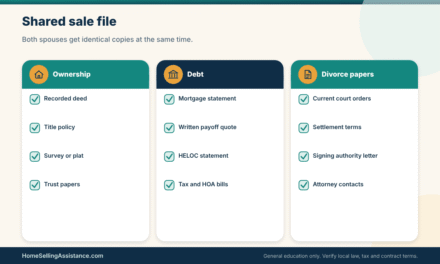
Start with the most recent recorded deed. You can often get a copy from the county recorder, county clerk or register of deeds, either online or at the counter, and many offices let you search by owner name or parcel number. Your closing paperwork from the purchase may include a copy too, but the recorded version is the one that matters. Look for the names of the owners and for words describing how they hold title.
Those words matter. Many states recognize forms such as tenancy in common, joint tenancy with right of survivorship and, in some places, tenancy by the entirety for married couples. Community property states add another layer for spouses. Each form describes shares and survivorship differently, and the exact names and effects vary by state. In general, co-owners holding as tenants in common each own a share that can be sold or inherited separately, while some other forms treat the owners more like a single unit.
Also check whether the deed names a person or an entity. A house owned by a trust, an LLC or an estate is signed for by whoever has authority under that document, and that person may or may not be the one you have been arguing with. Then look at the mortgage, if there is one. A loan is a separate contract. Being on the loan does not prove you are on the deed, and being on the deed does not make you responsible for the loan, so confirm each fact separately.
A co owner refuses to sell house dispute can look very different once you notice a transfer nobody mentioned. So finally, ask whether anything changed after the deed was recorded. A divorce decree, a quitclaim deed, a death, a trust transfer or a court order can all alter who may sign. If you suspect a change, a title company can run a title search to show recorded transfers, liens and judgments. That report is often the quickest way to replace guesses with facts.
A scenario, an exception, and your next step: three siblings on one deed
Picture a house inherited by three siblings, with the parent’s estate settled and a deed recorded naming all three. Two want to sell. The third lives in a different state, likes the idea of keeping the house in the family, and keeps saying he will think about it. This is a classic co owner refuses to sell house case, and the first thing the two siblings need to know is that his name on the deed generally means his signature, or a court order, is required for a clean sale.
Now add a twist, which is the kind of exception that surprises people. Suppose the deed was never updated after the parent died, and the estate is still open. Then the people who can sign may be an executor or administrator and not the siblings personally, and the court overseeing the estate may need to approve the sale. Our guide to selling an inherited house explains how that route differs from a simple co-ownership.
The next step in either version is the same. Collect the recorded deed, any estate or trust papers and the latest property tax and mortgage statements into a single folder, then write down three facts in plain language: who is named on title, how title is held, and whether anyone has authority to sign for someone else. Those three facts guide every decision in a co owner refuses to sell house situation, and they including whether to approach the reluctant owner yourself or have an attorney do it first.
Federal rules versus state and local rules in a co owner refuses to sell house dispute
There is no federal law that lets one co-owner force another to sell a house. Property ownership, co-ownership rights and court procedures for dividing property are largely state matters, and counties and local courts add their own practices. Federal rules do show up around the edges of a co owner refuses to sell house dispute, mostly in taxes, lead paint disclosure and fair housing, and a good plan keeps those separate from the question of who can force what.
Where the rules actually sit: statutes, court rules and county records
Think of three layers. The first is your state’s property statutes and court decisions, which describe what co-owners may do about a shared home, including whether a court can order a sale or a division and on what grounds. The second is the local court system and its procedures, such as which court hears the case, how notice is given and how long things tend to take. The third is the county record, where deeds, liens, lawsuits that affect title and court notices may be indexed.
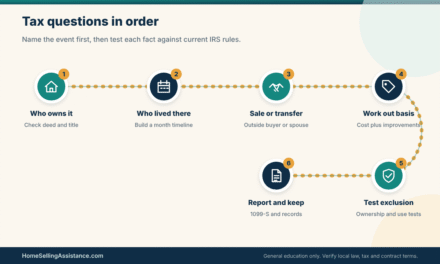
Federal sources matter for narrower questions. The IRS explains home sale tax treatment in Publication 523, Selling Your Home, including the exclusion rules that apply to many owners who meet the ownership and use tests. Lead-based paint disclosure for homes built before 1978 comes from federal rules that the EPA summarizes. Fair housing law applies to how a home is marketed and shown. None of these tells a reluctant owner to sign, and none of them tells you how a state court will treat your dispute.
To check your own state, begin with its real estate commission or department of real estate for licensing and disclosure basics, then the state court website for self-help material on property disputes, then a local real estate attorney for what applies to your deed. Be careful with generic internet summaries of “what the law says” about a co owner refuses to sell house question. A paragraph that is accurate in one state can be wrong in the next, and the differences often sit in the details that matter most.
One practical habit helps here. Whenever you read a claim about co-ownership law, write down the state it describes and the date it was written. If the source cannot tell you either, treat it as background reading and not as a basis for a decision. Statutes change, and so do court procedures.
The table below lines up the main issues you will meet, the document or authority that controls each one, and what a seller usually has to decide. It is a map for asking better questions, not a legal opinion. Use the last column as a to-do list of things to verify locally, because each co owner refuses to sell house case turns on local detail.
| Issue | Controlling document or authority | Seller obligation or choice | Deadline | Verify locally |
|---|---|---|---|---|
| Who must sign a sale | Recorded deed and state property law | Get every owner or authorized signer | Before listing and before contract | County recorder, title company |
| Form of ownership | Deed wording, trust or entity papers | Confirm shares and survivorship effects | Before any offer to the other owner | Local attorney |
| Mortgage payoff | Loan documents and lender payoff statement | Request a payoff figure, keep payments current | Payoff letters expire, so ask close to closing | Lender or servicer |
| Listing authority | Listing agreement | No listing until all owners agree to terms | Before marketing begins | Listing broker, state commission |
| Court-ordered sale or division | State partition statute and local court | Decide whether to ask a court after other steps | Set by court rules and filings | Local attorney, court clerk |
| Tax reporting | IRS rules and each owner’s own facts | Each owner reports their own share | Tax filing deadlines | Tax professional, IRS Publication 523 |
To use the table, pick the row that matches your biggest question and read it from left to right. Who is the authority, what must you do, when, and who can confirm it? If any cell is a blank for you, that blank is your homework before you contact the other owner or any professional.

A scenario, an exception, and your next step: unmarried partners on a deed
Take two unmarried partners who bought a home together and are now splitting up. One wants to sell and the other wants to stay and keep the house. Divorce courts are not involved, so the usual divorce tools do not apply. The relationship ending does not change the deed, so a co owner refuses to sell house conflict can outlast the romance by years, and the usual co-ownership rules for the form of title they chose will apply instead. That is the heart of many a co owner refuses to sell house conflict among people who were never married.
The exception to watch for is a written agreement. Some partners signed a co-ownership agreement when they bought, covering who pays what, what happens if one wants out and how a buyout price is set. If one exists, it can shape the path far more than general rules do, and a court may look at it closely. Others have no agreement at all, which leaves the statutes and general fairness arguments to fill the gap.
The next step is to find out whether any such agreement exists, along with the deed and a record of who paid what toward the down payment, mortgage, taxes and repairs. Those records can matter if the dispute reaches a buyout negotiation or a court. If the other person is a spouse, a related option is covered in our article on house buyout versus selling during divorce, which compares keeping the house with selling it.
Turn a co owner refuses to sell house disputes into a seller workflow
Once you know who owns what, you can build a workflow. This is where many people lose momentum, because the standoff feels personal and the next step feels like a confrontation. A workflow turns a co owner refuses to sell house standoff into a list of steps instead of an argument. Each stage has a purpose, a document and an owner, and you can move through it without needing the other person to agree on everything first.
The sequence we will follow has two parts. First, the written steps between owners: how to ask, what to offer, what to put in writing and which approvals and disclosures the sale will eventually need. Second, the handoffs to outsiders who will have a say: buyers, title companies, courts, homeowners associations and attorneys. Doing the first part well often makes the second part unnecessary.
Written offers, approvals and the paperwork a sale will need
A sale of a jointly owned house is a chain of approvals, and the chain is only as strong as its weakest signature. Before the house goes anywhere near the market, you want a written record of what each owner wants, what has been offered and who has agreed to what. That record is useful in friendly negotiation and just as useful if the case later reaches a mediator or a court. Think of it as the seller file for a sale that has an extra step in front.
Evidence to gather: a dated offer letter and a short ownership summary
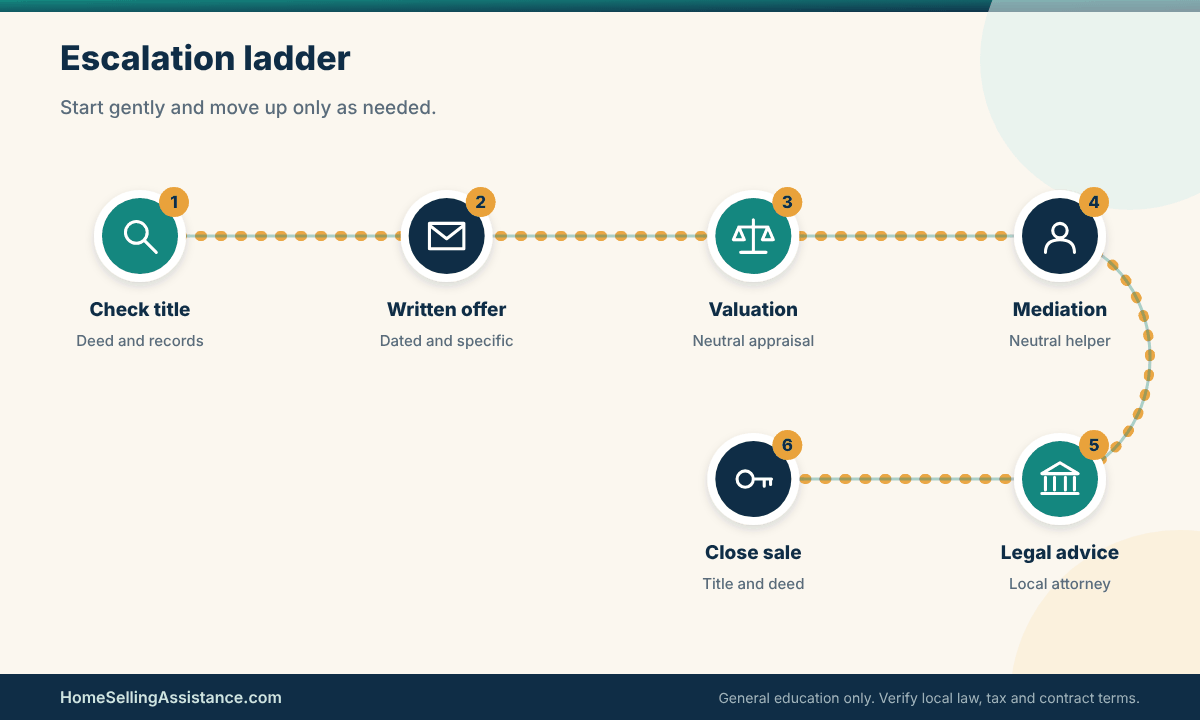
The most useful document you can create is a calm, dated letter or email proposing a specific path. Keep it factual. State that you want to sell, name the date you would like to decide by, and offer at least one concrete option, such as a sale on agreed terms, a buyout of your share at a price set by an independent appraisal, or a short holding period with a firm end date. Attach nothing aggressive. A letter that sounds fair reads well to a mediator and to a judge.
Pair the letter with a one-page ownership summary. List the owners, the form of title, the mortgage balance as of the latest statement, annual property tax, insurance cost and any recurring HOA charges. If one owner has been paying more than the others, record the amounts and dates, because contribution questions often come up in buyout talks. Do not inflate or guess. Use statements and receipts.
On value, one broker opinion is a starting point, and a licensed appraisal is a stronger neutral reference when owners disagree about price. Many a co owner refuses to sell house standoff is really a disagreement about what the house is worth or what each owner will keep, so a neutral valuation can lower the temperature. In a co owner refuses to sell house negotiation, our article on how a divorce house buyout is calculated shows the arithmetic with clearly labelled round numbers, and the same logic applies to non-married co-owners.
When the other owner replies, record it. If the reply is a refusal, ask politely for reasons, because the reasons tell you what might change the answer. Some owners refuse because they fear losing a home, some want more money, some distrust the process and some simply have not looked at the numbers. Each reason behind a co owner refuses to sell house stance points to a different fix, and the written record keeps the conversation from circling.
A scenario, an exception, and your next step: the owner who lives in the house
Suppose one owner lives in the house, pays most of the bills and has no wish to leave, while the other owner lives elsewhere and wants cash. The occupant may fear that a sale means a forced move. The other owner may feel stuck, because the money is tied up and the occupant pays nothing for the other half. This is a very common shape for a co owner refuses to sell house case, and it deserves patience before anyone reaches for a lawyer.
An exception worth knowing: depending on the state and the facts, one co-owner may have claims against another for sharing costs, or for use of the property, and a court may weigh these when dividing money. We cannot tell you how your state treats them, only that they exist as questions. Ask an attorney early whether they might apply to you, because the answer changes how a buyout should be priced.
The next step for the owner who wants out is to propose a buyout or a timed sale in writing and to give the occupant a realistic period to arrange financing. A buyer who is also a co-owner often needs a lender, and lenders have their own underwriting and documentation timelines. For the occupant, the next step is to price what a refinance would cost and whether the loan terms are workable. Our guide to handling a mortgage during a divorce home sale covers the loan side in more depth.
Buyers, title companies, courts, associations and attorneys
Once a sale is on the table, other parties get a vote in practice, even if they never sign anything. A buyer wants clear title and a firm closing date. A title company wants every owner accounted for. A court wants proper notice and proof. An association, if there is one, may want its own forms. Each handoff is a point where an unresolved ownership dispute can quietly stop the process.
The main lesson is to talk to the outsiders before you need them. A short call to a title or escrow company about your situation, with the deed in hand, can reveal what they would require. It costs little and prevents a cancelled contract later.
Evidence to gather: a title report and a title company’s written requirements
Ask a title or escrow company to run a title search on the property. The report shows recorded owners, mortgages, liens, judgments and sometimes lawsuits that affect the property. It also shows what the company would need before it will insure a buyer. In a co owner refuses to sell house file, typical requirements include signatures from every record owner, payoff of mortgages and liens, and in some situations a court order or certified documents when an owner cannot or will not sign.
Get the requirements in writing, even if it is just an email. Ask specifically what the company would need if one owner does not sign, if one owner has died, or if a court has issued an order. The answers differ by company, state and circumstance, but the questions help you hear what is realistic.
If the property is in an association, request the governing documents and any resale or estoppel paperwork the association provides, along with a statement of fees owed. Association timelines can run longer than people expect, and forms may need a specific owner’s signature. Our article on seller disclosure requirements explains why disclosure forms can also need every owner’s cooperation, since each seller may have to complete or sign statements about what they know.
The table below compares common scenarios, the options a seller usually has, the main risk and the document that deserves the closest reading. It is not advice for any one household. It is a way to think through where your situation sits and who to call first.
| Situation | Seller options | Main risk | Document to review | Escalation point |
|---|---|---|---|---|
| Siblings inherited the home, one refuses | Offer buyout, timed sale or mediation | Family conflict and carrying costs grow | Deed, estate or trust papers | Probate or real estate attorney |
| Spouses separating, one will not list | Negotiate in settlement, ask for court orders | Acting before the divorce case sets terms | Divorce filings, deed, mortgage | Family law attorney |
| Unmarried partners, one wants to keep it | Buyout with refinance, or agreed sale | Buyout price disputes | Deed, any co-ownership agreement | Real estate attorney, mediator |
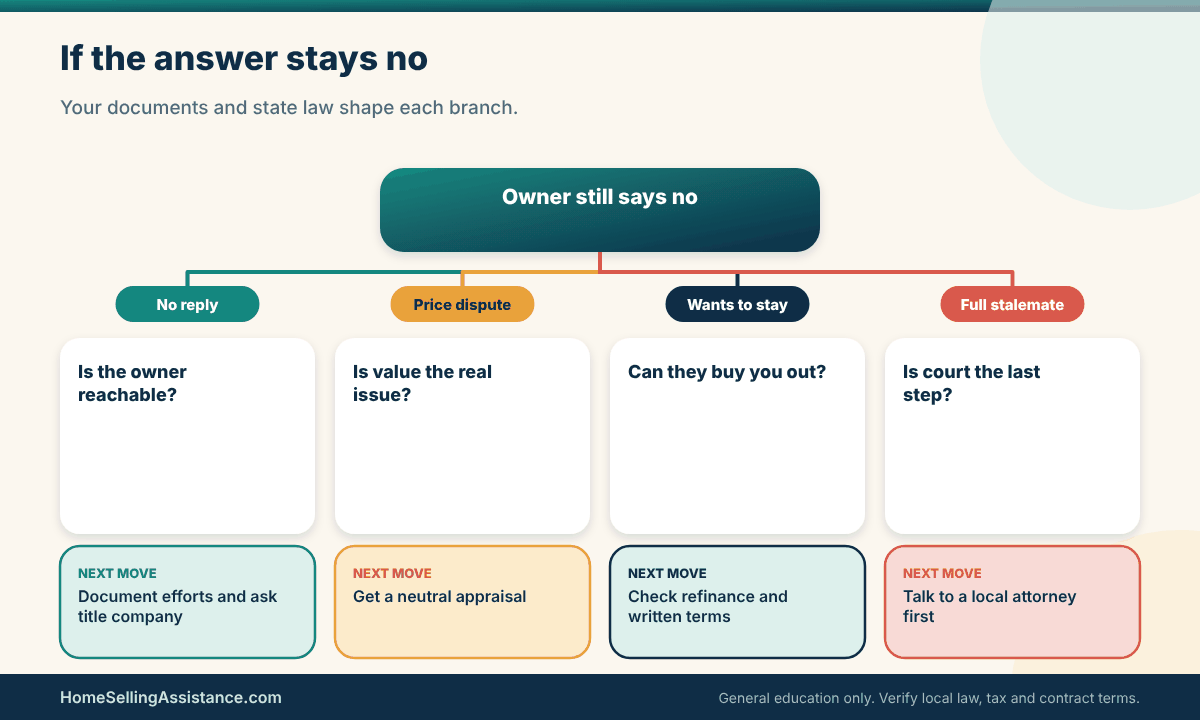
| Co-owner cannot be reached | Document search efforts, seek legal advice | Sale cannot close without authority | Search records, deed, title report | Attorney, title company |
| One owner on the loan, both on the deed | Refinance, assume or pay off at sale | Missed payments damage both credit files | Note, mortgage, payoff statement | Lender, attorney |
| Owners agree on selling but not price | Neutral appraisal, listing at agreed price range | Contract stalls over counteroffers | Appraisal, listing agreement | Listing agent, mediator |
Use the table as a conversation starter with professionals about your co owner refuses to sell house question. Find the row closest to your case, note the document column, and bring those papers to the meeting. A professional who sees the right papers on day one gives better answers than one who hears a summary.
A scenario, an exception, and your next step: when talks break down
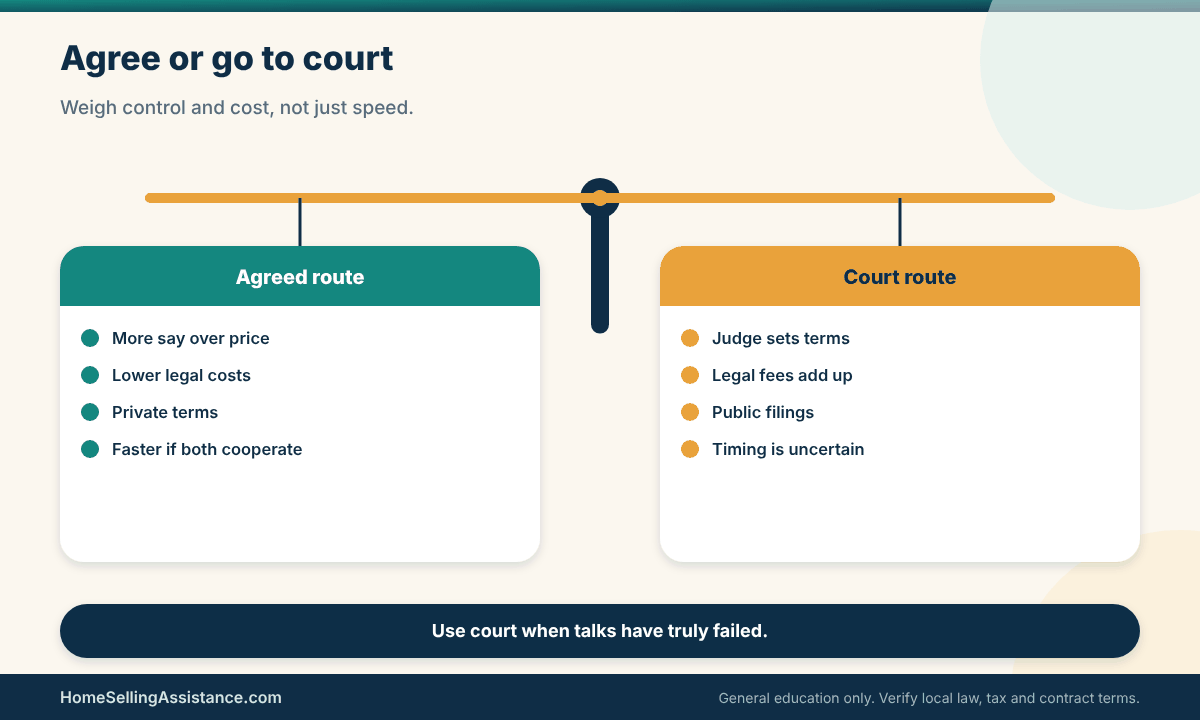
Say months of polite letters have not moved the other owner, and the carrying costs are piling up. The next route in many states is a court action to divide or sell the property, often called partition. The details differ widely. Some courts can order the property physically divided if that is practical, though for a single house that is rare. More often the question is whether to order a sale and how to split what comes in. Expect legal fees, delay and a loss of control over timing and price compared with an agreed sale.
A notable exception is a recorded notice of a lawsuit affecting title. In some places, filing certain cases can create a public record that appears in a title search, and a buyer may hesitate to proceed while it sits there. Ask your attorney how that works in your county, and what it means for listing during the case.
The next step in a co owner refuses to sell house case is to speak to a local real estate or litigation attorney about the strengths and weaknesses of your position, the likely sequence and the cost range, before you file anything. Our deeper article on partition sales of co-owned houses explains the typical stages. Many courts also encourage or require mediation, and a mediator can sometimes reach a deal that a judge would have imposed anyway, but with more say for everyone involved.
Build a verification checklist before you sign anything
By this point you have a picture of who owns the house, what each owner wants and who else has a stake. The last stage is checking that picture against official sources and making sure nothing has changed by the time pen meets paper. Sellers who skip this stage tend to discover problems at the closing table, where fixing them is slowest and most expensive. A little discipline here pays for itself.
We split verification into two questions. Where can you see the truth for yourself, in official or recorded documents? And which facts have to be fresh on the day you sign, because they expire or change quickly? Treat the answers as a co owner refuses to sell house checklist you can carry to any meeting with an attorney, a lender, a title officer or a mediator.
Official sources and recorded documents to check yourself
You do not need a law degree to read the main public records about your house, and doing it yourself gives you a baseline to compare against what anyone else tells you. Most counties now offer at least some of these records online, and the rest are available at the recorder, assessor or clerk’s office. Where a fee applies, it is usually modest, though amounts vary by county.
Evidence to gather: recorder, assessor, court and lender records
Begin at the county recorder or clerk for the deed, any mortgages or deeds of trust, liens, releases and recorded lawsuit notices. Then look at the assessor or tax collector for the owner of record on the tax roll, the assessed value and the status of property taxes. A mismatch between the deed and the tax roll is not unusual, and it can simply mean a recent transfer that has not been processed.
Next, check court records if there has been a divorce, a probate case or any lawsuit involving the property or its owners. Court clerks can tell you how to search, and many states offer an online docket. A decree or an order may restrict what an owner can do with the house, and a buyer’s title company will find it, so you should too. Federal resources can fill in the background: the IRS explains the tax side for divorced or separated owners in Publication 504.
Finally, contact the lender or servicer for an account history and a payoff statement, and ask what the loan allows. Some loans have rules about transfers of the property or changes in who is on the loan. If the standoff involves unpaid payments, ask about hardship options early, and consider talking with a HUD-approved housing counselor, whom you can find through HUD’s counselor search. Counseling is general guidance and does not replace a lawyer, but it can help you understand choices before a co owner refuses to sell house talks turn into a missed-payment problem.
A co owner refuses to sell house file should be organized like evidence, so keep copies of everything you pull, with the date you retrieved it. Printing or saving a PDF of each record gives you a snapshot, and the date proves when you saw it. If a record looks wrong, ask the office how to request a correction, and let a professional handle anything that affects ownership.
A scenario, an exception, and your next step: a name that does not match
Imagine your deed lists a middle initial that differs from the name on your driver’s license, or a former spouse’s name appears on the tax roll. Small mismatches like these are common, and often they are harmless clerical issues. But a title company may ask for an affidavit or a corrective document to confirm that two names are the same person, and that paperwork needs signatures.
The exception to watch for is a lien or judgment that sits under one co-owner’s name. A creditor of one owner may have recorded a claim that attaches to that owner’s interest, which can make a clean sale harder and can affect how the other owner views the situation. Whether and how that happens in a co owner refuses to sell house case depends on state law and the type of claim, so treat any surprise on the title report as a prompt to call an attorney.
Your next step is to compare every name and number across your documents in a simple side-by-side list: deed, tax record, mortgage, insurance, driver’s license and any court papers. Highlight differences and ask the title company how it would resolve each one. Fixing a small mismatch in week one is far easier than fixing it the week before closing.
Quick scenario
In this co owner refuses to sell house example, two owners agree to sell, but the third has not replied to emails for six weeks. Rather than listing and hoping, they send a dated certified letter with the same offer, ask the title company what it would need if that owner never responds, and book a consult with a local attorney. When the third owner calls two days later, the conversation starts with real options on paper instead of rumors.
What must be current before signing
Some facts age out. A payoff figure goes stale. An appraisal reflects the market on one day. An owner’s circumstances shift, and a court order may be issued after you last checked. Before anyone signs a listing agreement, a purchase contract, a buyout agreement or a deed, you want a fresh look at the items that move.
Evidence to gather: payoff, title update, taxes and authority to sign
Because a co owner refuses to sell house timeline can stretch for months, request a new payoff statement close to the signing or closing date, and read the per diem interest line so you know how the number changes each day. Ask the title company to update the search or to confirm nothing new has been recorded since the first report. Confirm that property taxes and any association dues are current, because unpaid amounts come out of the sellers’ proceeds and may need to be split among owners under whatever arrangement you have.
Then confirm authority. If an owner signs through a power of attorney, ask the title company whether it will accept the document and whether the underlying authority is still valid. If a trust or entity is the seller, get proof of who can sign, such as a certification of trust or an entity resolution, and ask the title company which version it prefers. A document that was fine last year may not satisfy a buyer’s insurer now.
Finally, review the money. Our guide to seller closing costs lists the line items sellers commonly see, and the tax overview in taxes when selling a home explains why each owner may face a different result depending on their own history. The IRS describes the ownership and use tests for the home sale exclusion in Publication 523, and a tax professional can apply them to each owner’s facts.
Ask for a draft settlement statement as early as the title company will provide one, and have every owner read it before closing day. When owners see the same numbers at the same time, there are fewer surprises and fewer accusations. If the split of proceeds is already agreed, write it down in a signed document that the closing agent can follow, and keep a copy for each owner.
A scenario, an exception, and your next step: an agreement that no longer fits
Picture owners who agreed months ago to a buyout at a set price, and the refinance has dragged on. Meanwhile the market moved, the appraisal came in differently or one owner’s finances changed. The old agreement may not fit the new facts, and the temptation is to either hold everyone to the original numbers or walk away entirely. Both can be costly.
The exception is an agreement with a clear deadline or an extension clause. If your document says the buyout must close by a certain date and what happens if it does not, that wording controls more than anyone’s memory of the conversation. Read it closely before sending a message that might be seen as breaking it, and ask an attorney whether an extension, an amendment or a new agreement is the safer path.
The next step is to write down what has changed, propose the smallest amendment that fixes it and have every owner sign and date it. Keep the tone practical, since a co owner refuses to sell house dispute is usually resolved by small, boring documents. A short signed amendment, reviewed by a lawyer if the amounts are large, gives everyone a current set of rules and can rescue a deal that was close to closing.
The same habit applies if you are protecting yourself from fake payoff instructions or last-minute wiring changes, which our guide to home sale fraud and seller safety explains.
Several of these topics sit inside our broader divorce and co-owned homes library, where related guides cover separation, proceeds and listing decisions in more detail.
Frequently asked questions about co owner refuses to sell house
Can I sell the house if my co-owner refuses?
In most places you cannot sell the whole property without every owner of record, or someone with legal authority for them, signing. You may be able to sell your own share if your form of ownership allows it, though buyers for a partial interest are few and the price is often lower. When a co owner refuses to sell house terms, the lawful routes are an agreed sale, a buyout or a court process.
Ask a local attorney which of these your state supports for a co owner refuses to sell house problem like yours.
Can a court force a sale when one owner says no?
Many states allow a co-owner to ask a court to divide or sell jointly owned property, commonly called partition. The court looks at the type of ownership, the facts and the law of that state before deciding. Outcomes, timing and costs vary and cannot be promised. If a co owner refuses to sell house offers and you are thinking about this route, read our article on partition sales and speak with an attorney before filing anything.
What if the other owner will not answer messages at all?
Silence is different from refusal, and you should document your efforts. Send the same proposal by more than one method, keep dated copies and note any replies. A title company can tell you what it would require if an owner cannot be reached, and an attorney can explain what the law allows when someone is missing. Avoid signing for another person or guessing at their wishes, even when a co owner refuses to sell house messages for weeks.
Should I stop paying the mortgage to pressure my co-owner?
That is risky for everyone on the loan and the deed. Missed payments can damage credit for all borrowers, trigger fees and lead the lender toward default steps. In a co owner refuses to sell house standoff, talk to the servicer and, if you need help understanding options, a HUD-approved housing counselor before making any choice about payments. An attorney can explain how missed payments might affect your position in a dispute.
Can I make the other owner move out so I can list?
Generally, a co-owner has the right to occupy a shared home, and forcing someone out without legal authority can create serious problems. Rules depend on the state, the relationship and any court orders. If safety is a concern, contact local authorities or a lawyer right away. Otherwise, in a co owner refuses to sell house dispute, work through written offers, mediation or a court process instead of trying to remove an owner yourself.
How does a buyout work if one of us wants to keep the house?
Usually the owner who stays pays the other for their share, often by refinancing and using the loan proceeds, sometimes by other agreed payments. The price rests on the home’s value, the mortgage balance and any agreed adjustments for costs paid. Our guides on divorce house buyouts show sample arithmetic with round numbers. The key points are a neutral valuation, written terms, lender approval and a recorded deed when the transfer happens.
Do both owners have to sign the listing agreement?
Typically yes. A listing agreement is a contract with the owners, and most brokers want every record owner to sign it, or proof that someone has authority to sign. If one owner will not sign, a reputable agent should not market the house as if the sale were approved. In a co owner refuses to sell house case, our piece on listing a home during divorce explains how agents handle shared decisions between separating owners.
What happens to the sale proceeds if owners disagree on the split?
The closing agent generally follows a signed agreement, a court order or the deed’s ownership shares. If owners have not agreed, the title company may hold funds until they sign instructions or a court rules. Our guide to dividing sale proceeds in a divorce explains the common approaches. Each owner should talk to a tax professional too, since reporting depends on personal facts.
Is mediation worth trying before court?
For many a co owner refuses to sell house dispute, it is worth a try. Mediation is usually private, faster and cheaper than a contested case, and you keep more say over the result. It does not work when someone refuses to take part or when safety is a concern, and a mediator cannot give either side legal advice. Ask your attorney whether a local program or a private mediator is available, and whether the court requires it.
Where can I check the rules for my own state?
Start with your county recorder or clerk for the documents, your state court’s self-help pages for process, your state real estate commission for licensing and disclosure basics, and a local real estate attorney for advice on your facts. Federal sources such as the IRS, HUD and the FTC cover tax, housing counseling and scam warnings. Anything that affects your rights in a co owner refuses to sell house matter deserves a licensed professional’s review.
Aim for a clean closing
When a co owner refuses to sell house plans, the best outcomes usually come from steady, documented steps: confirm who owns what, put a fair offer in writing, bring in the title company early, and use mediation or the courts only when you have to. Look after your own paperwork, keep the tone calm, and check every fact against an official record before you sign. This article is general education, not legal, tax or financial advice. For decisions about your own house, ask a licensed attorney, tax professional or other qualified adviser who can read your documents.