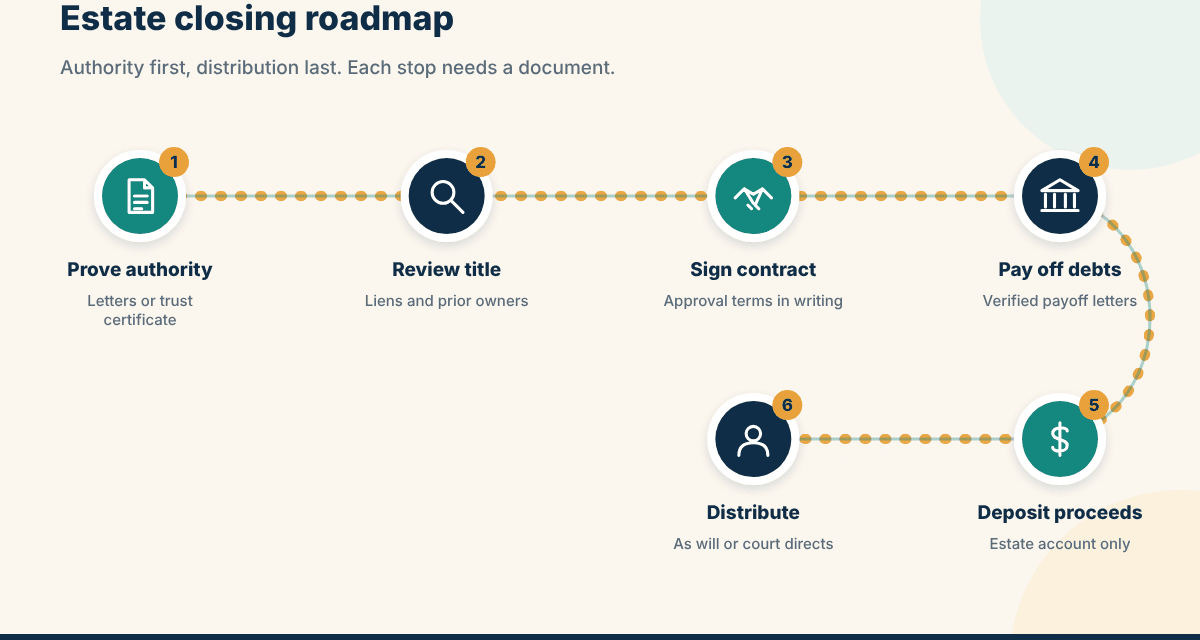
An estate home sale closing looks like an ordinary closing from the outside, yet underneath it answers three questions that a regular sale never asks: who has legal authority to sign for someone who has died, where the money is allowed to go once the title company releases it, and who gets paid first when the estate owes debts, taxes and heirs all at once.
Most families meet the hard parts of an estate home sale closing at the worst possible moment, usually a few days before the scheduled closing, when a title officer asks for a document nobody has heard of. A buyer is waiting, a moving truck may already be booked, and one heir is quietly worried that a check will be written to the wrong person. None of this means the sale is in trouble. It means the file was started late.
This guide follows the money and the signatures from the first call to the title company through the final receipt from the last heir. It is written for personal representatives, executors, administrators, successor trustees and family members who want to understand the shape of an estate home sale closing before they sit across the table from a closing officer. We stay neutral on agents, attorneys and buyer types, and we point you to the places where only your state’s law, your court, or your own advisers can supply the final answer.
Because inherited sales sit at the crossroads of probate, title, tax and family relationships, this article is a companion to our cornerstone, selling an inherited house. Read that first if you are still deciding whether to sell at all. Read on here if the decision is made and you want the closing to be orderly, documented and fair to everyone with a stake in it.
Key takeaways
- Authority comes first. A title company will not close an estate home sale closing until it sees proof that the person signing is the person the law or the court recognizes, and that proof is often a certified court document or a trust certificate.
- Proceeds belong to the estate, not to you personally. After an estate home sale closing, in most cases the money is deposited into an estate account under the estate’s own tax number, then paid out in a legally required order.
- Debts and expenses usually come before heirs. Mortgage payoff, liens, property taxes, administration costs and valid creditor claims are generally resolved before distribution, and the order and timing depend on your state.
- Tax paperwork starts at the closing table. The settlement agent typically reports the sale to the IRS, and the heir or estate still has to know the basis, the holding period and which return the sale belongs on.
- Get every handoff in writing. For any estate home sale closing, payoff letters, wire instructions confirmed by phone, a signed settlement statement and heir receipts protect the person who signed.
- Rules vary. Probate procedure, court confirmation, deadlines and forms differ by state and sometimes by county, so verify locally before you rely on any general description, including this one.
Build the file for your estate home sale closing before an offer arrives
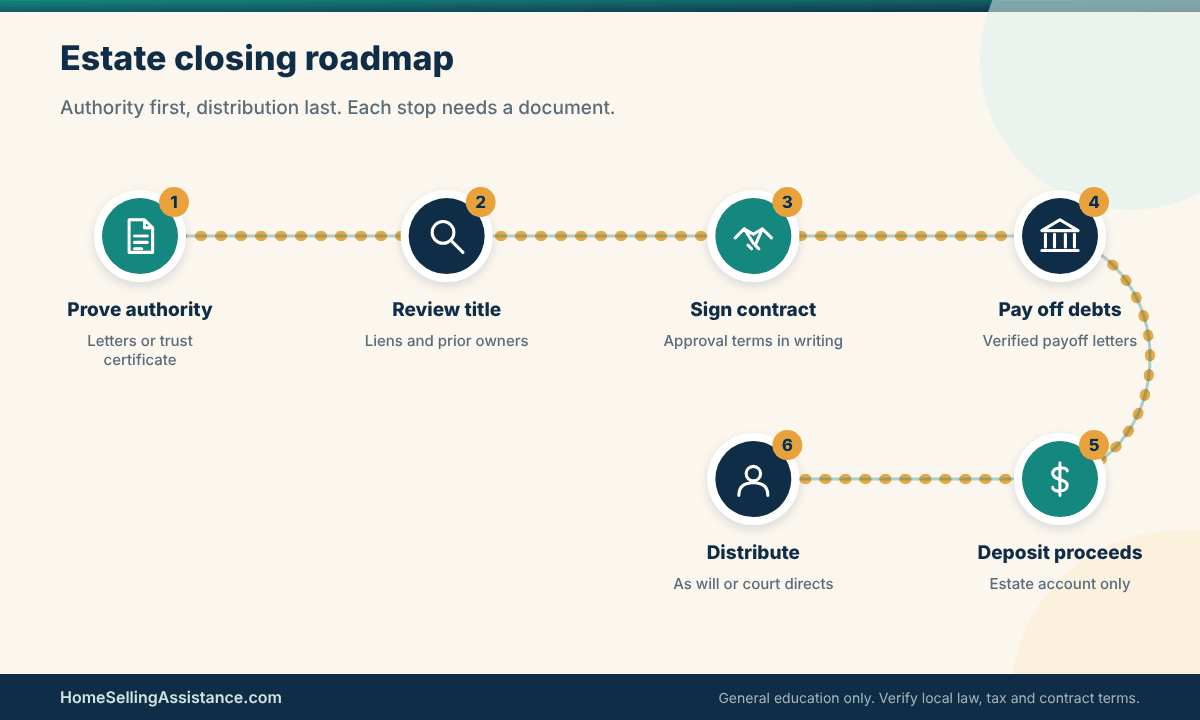
The best time to prepare for an estate home sale closing is before the house is even listed. A complete file for your estate home sale closing lets you answer a title officer within an hour instead of within a week, and it lets you accept a good offer without wondering whether you can really deliver clean title by the date in the contract. The picture above shows the road from signing authority to final distribution, and the first stretch of that road is paperwork.
Documents, numbers, and contacts that decide who signs
Start with the question the closing officer will ask first: who is the seller? When someone dies owning a home in their own name, the seller is usually the estate, acting through a court-appointed representative. When the home was held in a living trust, the seller is the trust, acting through a successor trustee. When the home passed to a surviving co-owner or a beneficiary by a recorded transfer-on-death instrument, there may be no probate seller at all, and the new owner signs.
In an estate home sale closing these paths feel similar to families but look very different to a title company, which insures the buyer against anyone else claiming an interest in the house. It wants a clean paper trail from the last recorded owner to the person now holding the pen. That trail is built from a handful of documents, a handful of numbers, and a short list of people who can confirm each piece.
The documents usually include a certified death certificate, the recorded deed into the decedent, the will if there is one, and the court order or certificate that names the representative. Trust sales substitute a copy of the trust or a certification of trust and a death certificate for the trustee who is stepping aside. The numbers include every loan balance, the current property tax status, any association dues, and a rough count of other debts. The contacts are the probate attorney or clerk, the title officer, the lender’s payoff department and the county tax office.
Evidence to gather: letters, deed, death certificate, and payoff figures
Think of the evidence as four stacks. The first stack proves who died and who owned the house: certified death certificates (order several, because every institution wants an original) and a copy of the vesting deed from the county recorder. The second stack proves authority: the will, if any, and the court’s letters or similar certificate. Names for that certificate vary by state, and some states let a representative act without a fresh court order once appointed, while others require approval for certain sales.
The third stack proves the money picture. Request written payoff figures from each lender, a statement from the property tax collector, and the latest statement from any homeowners association. The fourth stack proves who else may have a say: a list of heirs or beneficiaries with current addresses, and any written agreements among them. Keep scans of every page in one folder with consistent names, because you will email the same documents to the agent, the title officer and the estate attorney more than once.
If you are unsure which papers your state requires, ask the probate court clerk what a title company usually asks for in an estate sale, and ask the title company directly as well. Neither will give legal advice, but both can tell you what has been accepted in similar files. A local probate attorney can then confirm whether your particular situation needs more than that. Our guide for the executor selling a house goes deeper on what that role can and cannot do.
A scenario, an exception, and your next step for the signing authority
Here is a simple illustration of how authority plays out in an estate home sale closing. A mother dies owning a house in her own name, with a will naming her daughter as executor. The daughter assumes she can sign the listing agreement right away. The listing agent asks for letters from the court. The daughter has filed the will but the court has not yet appointed her, so she cannot sign for the estate. The listing waits, nothing is lost, and the daughter learns the appointment date before anyone starts talking about closing dates.
An exception arises when the home sits in a trust. The successor trustee may be able to sign within days, supported by a certification of trust rather than a court order. Another exception appears when state law allows small estates or non-probate transfers that skip formal appointment. These shortcuts exist, but they differ widely in what they permit and what a title insurer will accept.
Your next step is to write down, in one sentence, who the seller will be on the contract and which single document proves that person’s authority. If you cannot fill in both blanks, that is the first task. Our article on whether you can sell an inherited house before probate explains when, and under what conditions, a sale can start before formal appointment.
Information still missing from the picture
Even a well-organized file usually has holes. Some are obvious, like a mortgage statement that has not arrived. Others only show up when a title search is run, such as a recorded lien, an old easement, or a second deed that was never filed. The goal of this section is not to scare you, but to help you hunt for gaps on purpose instead of discovering them at the table.
Missing information in an estate home sale closing tends to fall into four groups: money the estate owes, claims against the title, people who may have an interest, and facts about the property itself. You will not resolve all four before listing, and you do not need to. You do need to know which ones are open, who is responsible for closing each gap, and the date by which each answer must arrive to protect your closing day.
Where to look for gaps in debts, titles, and heirs
For debts, collect the decedent’s mail for several weeks and note every statement, including utilities, medical bills, credit cards and tax notices. Ask the lender whether a home equity line exists alongside the first mortgage, because a second loan can hide behind a different servicer. For title, ask the title company to run its search early. A preliminary report lists liens, judgments, easements and prior owners, and it is often the first honest picture of what stands between the estate and a clean transfer.
For heirs, confirm names and relationships against the will, or against your state’s default inheritance rules if there is no will. A missing or estranged heir is not a reason to panic, but it is a reason to speak with the estate attorney before anything is promised to a buyer.
For the property itself, assemble repair history, permits and any known defects, since your state’s disclosure rules may apply to an estate seller in a different way than to an owner who lived in the home. Our guide to title searches for sellers explains what the report shows and how to read it.
A scenario: the lien nobody mentioned
Consider an heir who believes the house is mortgage-free because the father always said it was paid off. The preliminary title report shows a recorded home equity line opened years earlier. The balance is modest, but the lender has to be paid from proceeds, and the payoff letter takes ten days to arrive. Because the family found the lien during preparation, the closing date in the contract can allow for that wait. Had they found it three days before closing, the buyer’s lender might have refused to extend.
The exception to watch for is a debt that is not a lien at all. An unsecured credit card balance does not attach to the house, yet it may still be a valid claim against the estate that has to be handled before distributions. Your next step is to keep two lists. One list holds debts secured by the property and paid at closing. The other holds claims against the estate generally, handled through the estate account and the creditor process your state sets out.
Before moving on, it helps to see the preparation stage as a workflow rather than a pile of papers. The table below lays out the stages you are likely to pass through, what to collect at each one, what action to take, the deadline that usually forces a decision, and who receives the baton next. The deadlines are described in general terms because your contract and your state set the real dates.
| Stage or symptom | Information to gather | Action | Decision deadline | Next handoff |
|---|---|---|---|---|
| Death certified, no appointment yet | Will, deed, certified death certificates | Consult a probate attorney or the court clerk | Before any listing agreement is signed | Court, then estate attorney |
| Representative appointed | Certified letters, estate tax ID, list of heirs | Open an estate account, secure the home | Before the first offer is accepted | Listing agent and title officer |
| Title report shows a lien | Lender name, loan number, written payoff request | Order a payoff letter and note its expiry date | Before the contract closing date is fixed | Title company and lender |
| Offer received | Contract terms, contingencies, approval requirements | Confirm court or heir consent needs, then respond | Offer expiration in the contract | Estate attorney and buyer’s agent |
| Clear to close | Draft settlement statement, wire instructions | Verify wiring by phone, review every line | Day before signing | Closing officer |
| Funds disbursed | Final statement, tax reporting information | Deposit proceeds into the estate account only | Same day or next business day | Estate attorney and accountant |
| Creditor and tax steps done | Claims list, receipts, accounting | Distribute as the will, court or law directs | Set by your state’s probate timeline | Heirs, then court for closing the estate |
Use the table as a prompt, not a promise. If you find yourself at a row where the left column describes your situation but the middle column feels unfinished, stay on that row until it is complete. Skipping ahead is the most common reason an estate home sale closing is delayed, and a delayed estate home sale closing is hard on buyers and heirs alike. The sale does not usually fail because of one big problem, but because three small gaps arrive on the same afternoon.
Moving an estate home sale closing through the contract in order
Once the house is on the market and an offer arrives, the work shifts from gathering to sequencing. A contract for an estate home sale closing has a few built-in tensions. The seller may need approval from a court or from heirs before committing. The buyer wants speed. The representative has a legal duty to treat the estate fairly, and that duty can pull against a family’s wish to wrap things up quickly.
Early actions and decision points after the offer
The first decision point is whether the offer can be accepted as written. In some states a representative with broad authority can accept any reasonable offer. In others, the representative may need court confirmation, and in a few, certain sales require notice to interested persons. Even where no approval is required, many representatives choose to share the offer with heirs, since a surprised heir is more likely to object later.
The second decision point is timing. A buyer’s lender and a buyer’s inspection both run on clocks. Your side of the estate home sale closing runs on different clocks: court calendars, lender payoff processing and the time a bank needs to issue a certified check or open an account. Reconciling those clocks is mostly a matter of writing realistic dates into the contract, not hoping that everything lines up.
Evidence: how authority and approval requirements shape the contract
What evidence should you have before you sign a purchase agreement for an estate home sale closing? Ask three questions of your attorney or the court clerk. Does this sale need court approval, notice to heirs, or neither? If approval is needed, how long does it typically take in this county? And does the buyer need to be told in the contract? Many agents add language that makes the sale subject to any required court approval, which gives the buyer clarity and gives you protection.
You can also ask the title company for its written requirements for an estate seller. These requirements vary by company and by state, and a short checklist from the title officer is worth more than any general article. Our article on the broader steps after accepting an offer shows how an ordinary timeline works, which helps you see where an estate adds extra steps.
Finally, confirm in writing how long the buyer will wait. A contract that sets a closing date shorter than your realistic approval timeline puts the representative in the awkward position of either asking for extensions or risking default. It is better to negotiate a date with room in it at the start.
Scenario: court confirmation, a short deadline, and a backup plan
Imagine a buyer offers a fair price with a thirty-day closing. The representative’s attorney says that, in this state, a sale of this kind needs court approval, and the nearest hearing is several weeks out. If the contract says nothing about it, the representative could be stuck. If the contract says the sale is subject to court approval and allows a reasonable extension, the plan holds even if the hearing moves.
The exception is a buyer who will not accept that kind of condition. Cash buyers sometimes move on quickly to the next property, and a financed buyer may have a rate lock that expires. In that case, the representative has to weigh the offer against waiting for a different buyer who can live with the process. A backup offer can help here, as our guide on the backup offer explains.
Your next step is to write down, before accepting anything, the latest closing date you can truly deliver given court, lender and heir timelines. Share that date with the agent as a firm constraint, not a preference.
Handoffs, negotiations, and contingencies in an estate sale
An estate home sale closing passes through more hands than most people expect. The agent hands the executed contract to the title company. The title company orders the search, requests payoff letters, and asks the estate attorney for authority documents. The buyer’s lender wants a copy of whatever the title company approves. Each handoff is a place where a document can sit in someone’s inbox for three days.
Negotiations matter as well, because estate sellers often hear requests that sound routine but land differently for them. A buyer may ask for repairs after inspection. A representative has to think about whether spending estate money on repairs is prudent, whether a credit is simpler, and whether the heirs agree. Our article on repair credits versus seller repairs compares the two in detail.
Evidence: how title, buyer, and agent inputs fit together
It helps to see who knows what. The title company knows what the record says. The buyer’s agent knows what the buyer wants. Your listing agent knows how the market responds to a given concession. The estate attorney knows what authority you hold and what the court will accept. No single person holds all four pieces, so the representative is the connector who makes sure the right question reaches the right person.
Sellers in an estate home sale closing commonly face questions about disclosures. Some states relax disclosure duties for estates or representatives who never lived in the property, while others expect the same forms as any seller, and federal lead-paint rules for homes built before 1978 still apply. The EPA describes the federal requirement at its lead-based paint disclosure page. Ask your agent or attorney which forms your state expects, and answer honestly about what you know and what you do not.
Scenario: an heir who changes their mind
Suppose three siblings agree to sell, and a contract is signed. A week later one of them says they would rather keep the house. If the representative holds proper authority and the will or law allows the sale, the sibling’s change of heart may not stop the closing. Even so, a representative who presses ahead without talking to the sibling may face an objection filed with the court, which can delay the sale and cost the estate money.
The exception is when title is held by the heirs themselves, for example after a probate is closed or when the home passed outside probate. Then each owner may need to sign, and one refusal can stop the transaction. Our guides on multiple heirs selling an inherited house and on what happens when one heir wants to sell walk through these situations step by step.
Your next step is to document every heir conversation in a short note: who was told what, on what date, and what they said. Estate work is partly a communication task, and notes protect everyone.

The picture above sketches how a representative’s decisions in an estate home sale closing branch after an offer arrives. Keep it in mind as you read the closing-day sections below, because most of what follows is about confirming that each branch ended where you expected.
Closing the loop on estate home sale closing: funds, debts, taxes, and distribution
Closing day feels like the finish line of an estate home sale closing, but for an estate it is closer to the halfway mark. The sale converts a house into cash, and that cash then has to move through a sequence of obligations before anyone is paid as an heir. A careful estate home sale closing is one where the representative can later explain, line by line, why each dollar went where it did.
This part of the guide covers what to confirm before and during signing, how to read the transaction from the buyer’s and title company’s side, how debts and taxes interact with the proceeds, and what records to keep once the keys are handed over. Nothing here replaces advice from an attorney or tax professional who knows your state and your facts.
What to confirm in writing before and at the table
Verbal assurances are cheap at any estate home sale closing, and they evaporate when the person who gave them changes jobs. Anything that affects who signs, how much is paid, or where money lands should exist as a document you can retrieve in two years. The closing officer will prepare most of it, but the representative is responsible for checking it.
Start with the settlement statement. Compare the sale price, the payoff amounts, the transfer charges, the prorations and the commissions to the contract and to each payoff letter. If a number surprises you, ask for the source document before signing. Our article on the seller closing statement explains each section, and the guide to mortgage payoff when selling covers the payoff letter and its per-day interest in detail.
Evidence: the settlement statement, payoff letters, and wire instructions
Gather the settlement statement draft, every payoff letter, the estate’s account details, and the title company’s written instructions for how proceeds will be paid. Ask whether the title company will issue a check payable to the estate or send a wire to the estate account, and ask who must be present to sign. Representatives often sign in their official capacity, and the signature block should reflect that capacity, not just a personal name.
Wire fraud targets closings of every kind, and an estate home sale closing are attractive because the people involved are grieving, busy and unfamiliar with the process. Never act on emailed changes to wiring details. Call the title company at a phone number you found independently and confirm the instructions aloud. The FBI’s Internet Crime Complaint Center takes reports if something goes wrong, and our guide to wire fraud and sellers lists warning signs.
Confirm, finally, that the estate’s bank account exists before closing day. Most banks require the court’s certificate, the estate’s tax identification number and the representative’s identification. Opening that account can take several days, and a closing that needs it urgently can stall.
Scenario: proceeds that arrive before the creditor period ends
Picture an estate home sale closing that happens within two months of the representative’s appointment. The proceeds are sitting in the estate account, and the heirs are asking when they will be paid. The state, however, gives creditors a period to present claims, and that period has not ended. Distributing everything now could leave the representative personally exposed if a valid claim shows up later.
The exception is a state that allows partial or interim distributions with court approval or with a protective reserve, or an estate that is clearly solvent with a small number of known obligations. These options exist, but they are decisions for the estate attorney. The next step is to ask, before closing, how long proceeds are expected to remain in the estate account and what the attorney recommends holding back.
Explaining that timeline to heirs early prevents hard feelings. Many families assume that closing equals payday, and a calm explanation of why the money has to sit for a while usually lands better when it comes before the sale rather than after.
The next table looks at the same transaction from the other side. Instead of asking what you need to do, it asks which issues commonly arise in an estate home sale closing, what evidence the seller side should hold, what the buyer, agent or title company will bring to the issue, what risk is created, and what fallback is available.
| Issue | Seller evidence | Buyer, agent or title input | Risk | Fallback |
|---|---|---|---|---|
| Who signs for the seller | Certified court letters or trust certificate | Title officer reviews authority | Closing refused for defective authority | Short extension while the missing document is obtained |
| Mortgage or equity line | Written payoff letters with expiry dates | Title company requests and verifies payoffs | Stale payoff leaves a balance unpaid | Request updated letters before funding |
| Recorded liens or judgments | Preliminary title report, lien releases | Title company lists exceptions to coverage | Buyer’s lender refuses to fund | Pay from proceeds or obtain a release |
| Court or heir approval | Order, consent forms, hearing notice | Buyer’s agent confirms contract condition | Contract deadline passes first | Written extension or backup offer |
| Property taxes and association dues | Tax statements, association payoff request | Title company prorates at closing | Unpaid amounts become buyer’s claim | Hold funds in escrow for late bills |
| Wire or check delivery | Estate account details, verified by phone | Title company issues funds to the estate | Fraudulent instructions redirect funds | Pick up a check in person if unsure |
| Tax reporting | Date-of-death value support, sale records | Settlement agent prepares sale reporting | Wrong basis or wrong return | Ask the estate’s tax professional before filing |
You do not need to resolve every row of your estate home sale closing on the same day. What the table shows is that each risk has an owner and each owner has a fallback. If you cannot name the person responsible for a row, ask the title officer or the estate attorney who that is. Our guide to wire versus check proceeds weighs the delivery choice in more depth. For more on how the numbers fit together, browse our closing costs and net proceeds guides.
Look also at how the rows of an estate home sale closing connect. A defect in the first row, authority, can freeze every other row. A problem in the court approval row can run into the payoff row, because letters expire. When you read your own file, try asking which row would hurt the most if it failed, and give that row the earliest attention.

The illustration above follows the money in an estate home sale closing, from sale price from the contract to the estate account to the people who receive it. Notice that heirs sit at the end, not the start. That order surprises many families, and it is the reason documentation matters so much at the closing table.
What you confirm in writing also has to account for debts and taxes, because the closing statement pays only part of what the estate owes. Secured debts attached to the house, such as a mortgage or recorded lien, are normally paid from proceeds at closing because the buyer’s title insurance depends on it. Property taxes and association dues are usually prorated and settled at the same time. After that, the remaining cash belongs to the estate, and the estate still has to deal with everything else.
Those other items often include funeral expenses, final medical bills, credit cards, income tax for the final year, estate administration costs, and attorney and court fees. State law sets the order in which claims are paid and how long creditors have to come forward. The representative’s job is to follow that order, because paying one creditor out of turn can create personal liability.
Documentation is the safeguard here. Keep a ledger from the day you are appointed. List every bill that arrives, whether you believe it is valid, the date you received it, and what you did about it. Save the notice you published or mailed to creditors if your state requires one, and save each response. Your attorney can explain which claims rank ahead of others and which can be denied, and many courts expect a written accounting that matches your ledger.
The tax side of an estate home sale closing has its own sources. The IRS explains the treatment of property from a decedent in Publication 559 for survivors, executors and administrators, and its basis guidance in Publication 551. In general, property inherited from a decedent receives a basis tied to its fair market value at the date of death, which often reduces or eliminates gain on a prompt sale, but the details depend on the facts and on whether any special valuation date applies. Our articles on inherited house cost basis and inherited home sale taxes explore this carefully.
Estates can also owe income tax on income they earn, such as interest on proceeds held in the estate account or rent collected before the sale. The estate generally needs its own tax identification number to report that income, and an accountant familiar with fiduciary returns can say whether a return is required. Do not guess on this point, because penalties are real.
A short example shows how this plays out. A representative sells a house for an illustrative round figure of three hundred thousand dollars. The title company pays the mortgage payoff and the transfer-related costs at closing, leaving a lesser sum for the estate. A funeral home bill, a credit card statement and a county tax notice for a different year then show up in the same week. The representative checks the ledger, confirms each one, and pays them in the order the attorney recommends.
The exception is an insolvent estate, where debts exceed assets. In that case state law sets a strict priority list, and paying favorites can cause trouble. The next step for any estate is to ask the attorney, before listing the house, whether the estate is expected to be solvent and what that means for how proceeds can be used. Our guide to inherited houses with a mortgage describes the lender side in plain language.
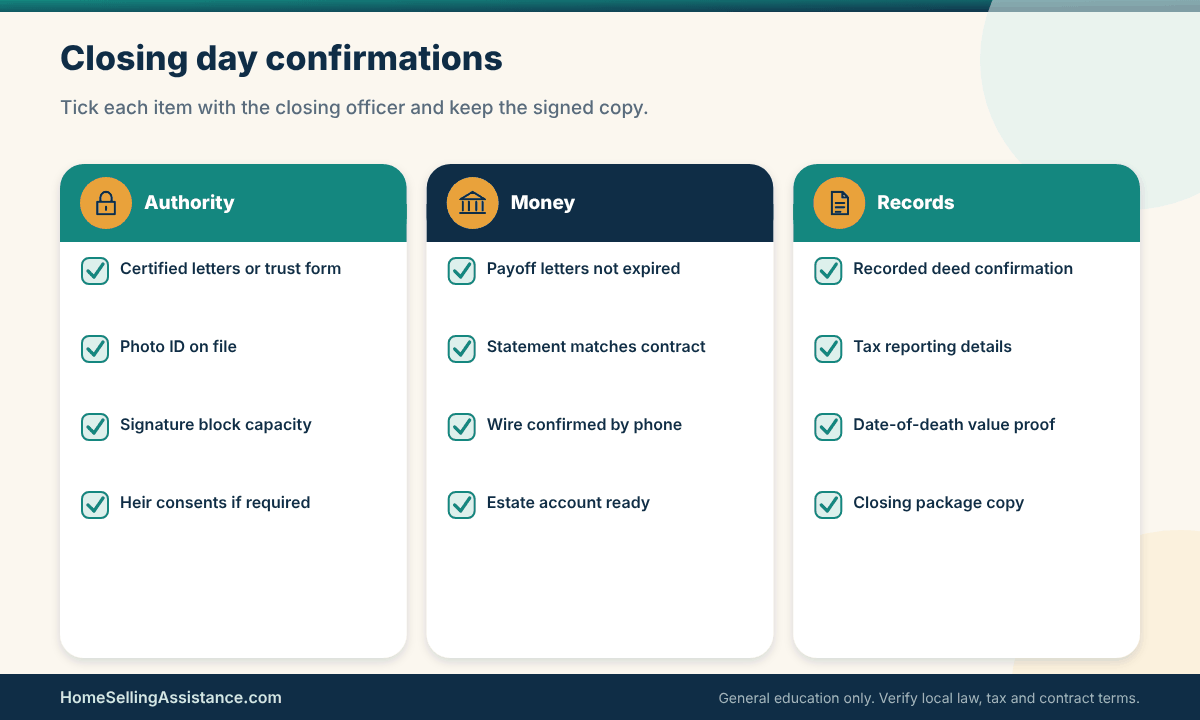
The checklist above groups the confirmations for an estate home sale closing that matter most on closing day into ownership, money and condition. Print it, tick through it with the closing officer, and keep the signed copy with the estate file. A representative who can show a completed checklist and a matching settlement statement has already answered most of the questions a court, a beneficiary or an auditor might later ask.
Quick scenario
A successor trustee signs a contract for a trust-owned house, and the title company asks for a certification of trust and the trustee’s identification. The trustee brings both, along with the death certificate of the original owner. The closing is smooth because the file was assembled two weeks earlier. The trustee deposits proceeds in the trust account, not a personal account, and later writes distributions according to the trust terms.
Records and follow-up after the estate home sale closing
When the title company records the deed and funds the transaction, the buyer gets the keys and the estate gets cash. What remains is a set of follow-up duties that determine whether the representative can close the estate cleanly and whether anyone can later challenge the sale. People often relax at this point, and that is when small mistakes creep in: a deposit into the wrong account, a missing receipt, an unfiled form.
The estate home sale closing itself is documented by a handful of papers that you should receive within days or weeks: the final settlement statement, the recorded deed or confirmation of recording, the payoff confirmations, and any title insurance paperwork. Ask for all of them if they do not arrive on their own, because an estate home sale closing generates paper that you will need later. Many title companies will email a closing package, but few volunteer to explain what each page is for, so ask.
Evidence: tax forms, account records, and the accounting
Several tax and accounting items normally follow. The settlement agent generally reports the sale to the IRS on a form that lists the proceeds, and the estate or heir should reconcile it against their own records of basis and sale costs. The representative should keep the date-of-death value support, such as an appraisal made near that date, because it is the foundation of the basis calculation. Your tax professional will tell you where the sale is reported and whether any gain or loss is involved.
Account records matter just as much after an estate home sale closing. Keep bank statements for the estate account, canceled checks or transfer confirmations for every payment, and copies of all creditor correspondence. If the court requires an accounting, these papers become its source material. If heirs ask how the house sale affected their shares, the same papers let you answer in minutes rather than weeks. The IRS survivor and executor publication mentioned earlier also outlines which returns an estate may need to file.
Insurance is a quiet item on this list. The estate’s homeowners policy usually should stay in place until closing is complete, and the representative should cancel it only once ownership has transferred, then ask for any refund to be sent to the estate account. Utility accounts, final readings and any mail forwarding should also be addressed, since an unpaid utility bill at a sold house can still land on the estate.
Scenario: the last heir receipt and closing the estate
After the creditor period ends and taxes are settled, a representative distributes the remaining proceeds to three heirs under the will. Each heir signs a receipt that states the amount received and acknowledges the distribution. The representative files the required closing documents with the court, which may include an accounting, receipts and a request to be discharged. Once the court approves, the estate can formally close.
An exception arises when an heir cannot be located or declines to sign. In that situation the attorney may recommend depositing the funds with the court or following the state’s unclaimed property procedure, rather than holding money indefinitely. Another exception is a state that allows informal closing with fewer steps. Both paths are legitimate, and the estate attorney can say which one fits.
The next step is to calendar the follow-up dates immediately after closing: the end of the creditor period, tax filing deadlines for the estate, and the date by which any court report is due. Dates set at closing are far less likely to be missed than dates remembered later. Our cornerstone guide to selling an inherited house gives the wider context for each of these steps. The full inherited homes and probate category collects related guides.
Do not forget the emotional side of an estate home sale closing. Closing a family home, even a sale you agreed with, can leave people raw. Representatives who send a simple written update to heirs after closing, with the final numbers and the expected timeline for distribution, usually find that questions drop sharply and relationships hold up better.
If you need help with the physical contents of the home, whether to donate, sell or discard them, that is a separate project with its own rules about who may remove what and when. Our article on cleaning out an inherited house before sale covers the practical sequence, and it fits naturally before an estate home sale closing, not after.
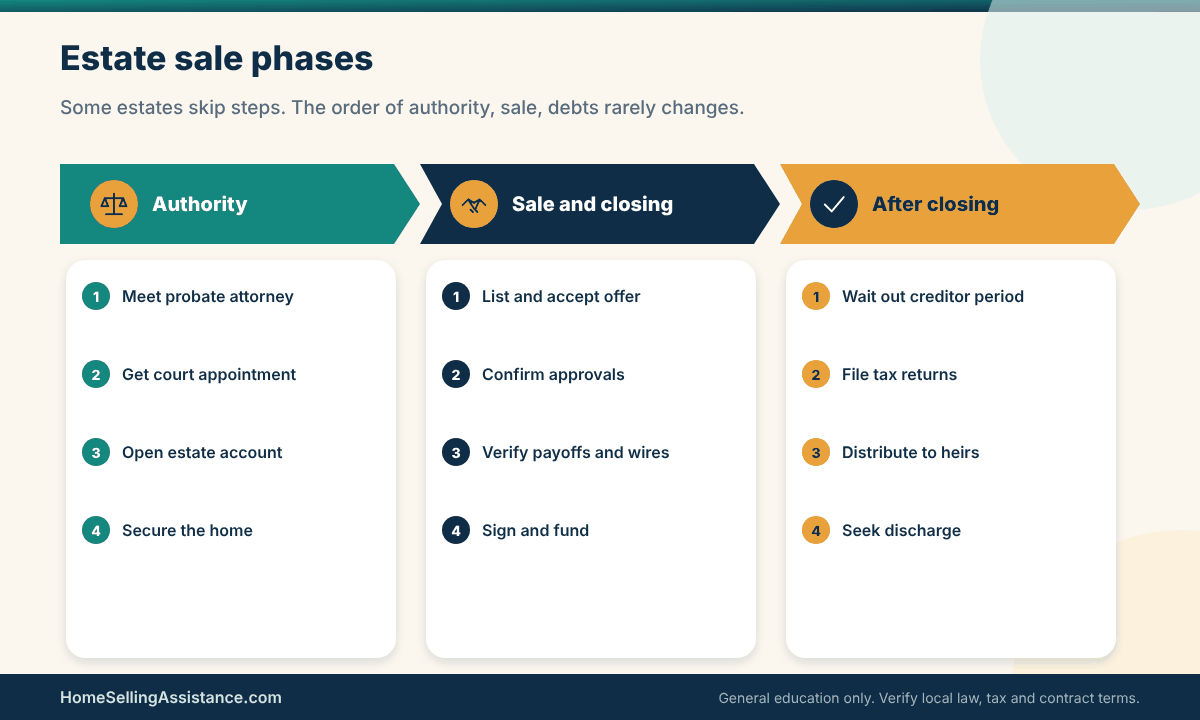
The final graphic summarizes the phases of an estate home sale closing from the first meeting with an attorney through the court’s discharge of the representative. Treat the phases as rough, because some estates skip steps and others add them, but the order of authority, sale, debts and distribution stays remarkably consistent across states.
Most problems in an estate home sale closing are not dramatic. They are small mistakes that repeat across thousands of estates. Naming them is the cheapest form of insurance, so here are the ones we see most often, along with the habit that avoids each.
Mixing personal and estate money is the classic error. A representative who deposits proceeds into a personal account, even briefly, can face questions from heirs and the court and can complicate the tax picture. Open the estate account first, and use only that account for estate business.
Accepting an offer before checking approval rules is the second. A signed contract that required court confirmation, but did not say so, can leave the estate in breach or force an expensive renegotiation. Ask first, then sign.
Third is trusting emailed wiring instructions. Verify by phone using a number you found yourself, and do it every time the instructions change. Fourth is distributing too early. Paying heirs before the creditor period ends or before taxes are known can make the representative personally responsible for a shortfall. Fifth is letting records scatter. Put every paper in a single folder, digital and paper, from the first day.
Finally, avoid unfair treatment of heirs, even by accident. A representative owes duties to the estate and to those entitled to it, so selling to a friend or relative below market value, or favoring one heir in scheduling, can attract objections. Fair housing law also applies to the sale itself, and the HUD fair housing page explains the basics: choose buyers on the terms of their offers, not on who they are.
Frequently asked questions about estate home sale closing
Who signs at an estate home sale closing?
It depends on how the home is owned and how it passes. If the house is in the decedent’s name and goes through probate, the court-appointed personal representative usually signs for the estate. If it is in a trust, the successor trustee signs. If it passed outside probate to a named owner, that owner signs. The title company will tell you what proof it needs.
Can I close before the court appoints a representative?
Generally no, if the estate owns the home. Without appointed authority, no one can convey the estate’s title in a way a title insurer will accept. Some states offer simplified procedures for small estates or non-probate transfers, so ask the court clerk or a probate attorney what applies where you live. Do not sign a contract as seller before you know.
Where should the proceeds of an estate home sale closing be deposited?
In most cases into an account opened in the name of the estate, using the estate’s own tax identification number, or into the trust account for a trust sale. Depositing into a personal account can create tax and legal confusion. The bank will usually want the court certificate and the representative’s identification before opening the account.
Do heirs have to approve the estate home sale closing?
It varies. A representative with full authority may be able to sell without each heir’s consent, while some states require notice, consent or court confirmation. If the heirs themselves hold title, each owner generally has to sign. Even where approval is not required, sharing the offer with heirs often prevents objections, so ask your attorney which approach fits your estate.
Are debts paid at an estate home sale closing?
Debts secured by the house, such as a mortgage or recorded lien, are normally paid from the proceeds at closing. Other debts are handled through the estate under your state’s claims process, which may include a creditor notice period. Your attorney can explain the payment order, because paying out of sequence can create personal liability for the representative.
Will the estate owe tax after an estate home sale closing?
Sometimes, and sometimes not. Property inherited from a decedent generally receives a basis based on fair market value at the date of death, which often reduces gain on a prompt sale, but the facts matter. The estate may also owe income tax on interest or rent. IRS Publications 551 and 559 explain the rules, and a tax professional can apply them to you.
How long before heirs receive their money?
There is no universal answer. Proceeds usually stay in the estate account until creditor periods run, taxes are understood and the court or law allows distribution. Some states allow partial distributions earlier. Ask the attorney for an expected timeline before closing so you can give heirs an honest estimate, and avoid promising a date you cannot control.
What if a buyer wants to close faster than the estate can?
Be candid about your constraints and write a realistic date into the contract, including any court approval condition. A buyer who cannot wait may walk away, which is disappointing but better than a default. A backup offer or a short extension can sometimes bridge the gap. Do not promise a date that depends on a court calendar.
Do I need an attorney for an estate home sale closing?
Many estates use one, and many title companies expect an attorney’s involvement when authority is complicated. Simple situations, such as a trust with a clear successor trustee, may need less. Because authority, creditor claims, taxes and distribution are legal questions that vary by state, a consultation is a sensible precaution even when you plan to handle most steps yourself.
What records should I keep after the closing?
Keep the settlement statement, recorded deed confirmation, payoff letters, estate account statements, creditor correspondence, date-of-death value support, tax forms and heir receipts. Many professionals suggest holding them for several years, though the right period depends on your state and tax situation. Ask your attorney and tax professional how long to keep each category.
Closing the loop
An orderly estate home sale closing rests on a short chain: proof of authority, a clean title trail, verified payoffs, an estate account, a settlement statement you have actually checked, and a record of what you paid and to whom. If one link is weak, fix it before the date in the contract, not after. This article is general education, not legal, tax or financial advice, so confirm the details with your probate attorney, title company and tax professional.