A partition sale co owned house is what happens when two or more people hold title to the same home, at least one of them wants out, and nobody can agree on how, when or for how much, so a judge is asked to order the property sold and the money divided.
Most people never expect to be in this spot. You bought with a partner, inherited with siblings, put a parent on the deed, or invested with a friend, and for years the shared title was a footnote. Then one owner needs cash, another refuses to leave, a relationship ends, or the carrying costs start to sting. Quiet conversations stop working, and someone mentions the word “partition.”
We want to be plain about what this article is. It explains how a partition sale co owned house case generally works, why courts treat it as a last resort, what you can do before and during one, and how to check the rules that apply where the property sits. It is not a substitute for a local real estate or property attorney, and partition law is state law, so details differ a lot.
A word on terms. People say “forced sale,” “court sale” and “partition” almost interchangeably, but a partition sale co owned house order is a specific kind of judgment. It ends the co-ownership by converting the property into money. It is different from a foreclosure, where a lender is the one asking, and different from a tax sale, where a government is. Keeping those apart will help you read documents that arrive in the mail.
If your co-ownership grew out of a marriage, our cornerstone guide on selling a house during divorce covers the family-court side. If the real problem is a stubborn co-owner and you have not yet decided whether to sue, read what to do when a co-owner refuses to sell the house alongside this page. Any dollar figures below are round illustrations, not predictions.
Key takeaways
- Partition is a legal remedy, not a sales method. A court can order a sale or, rarely, a physical split, and it usually prefers that owners settle first.
- Your deed and the state statute decide your rights. How title is held, whether the owners are married, and whether the property is heirs property can change the process entirely.
- A negotiated sale usually beats a forced one. Before a partition sale co owned house order, a voluntary listing, a buyout or mediation often costs less and gives owners more control than a court-supervised sale.
- The mortgage and liens do not disappear. Whatever is recorded against the property is paid from the sale money before owners share anything.
- Owners may get credits and charges. Who paid the mortgage, taxes and repairs, and who lived there, can shift each person’s share, depending on local law.
- Verify before you file or sign. Check the recorded deed, the statute, the court’s local rules and your tax position with an attorney or tax professional.

Sorting out ownership and jurisdiction before a partition sale co owned house is even possible
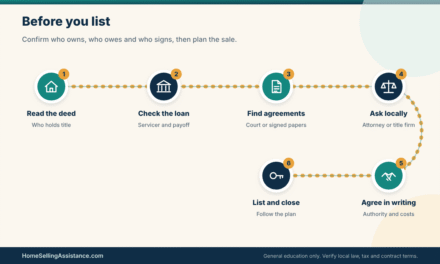
Every partition sale co owned house conversation begins with two plain questions that sound easy and often are not: who legally owns this house, and which court has power over it? Skip them and you can spend months and real money pursuing a remedy that does not fit your situation.
This section walks through the ownership side first, then the question of which rules apply. The map is simple, but the details live in documents you can actually pull and read, so we will keep pointing back to them.
It also helps to understand why judges hesitate. Courts generally see a home as more than an asset, so a partition sale co owned house petition often meets questions about whether the owners tried to settle, whether one of them lives there, and whether a sale would cause unfair hardship. The right to ask is usually strong. The outcome still depends on facts, paperwork and the judge, which is why a calm, documented approach tends to serve you better than an angry one.
Deed language, mortgages and who actually holds title
Title is not the same as living in the house, paying the bills or being named on the loan. Title is what the recorded deed says. A person can sign a mortgage without being on the deed, and a person can be on the deed without having signed the mortgage. For any partition sale co owned house purpose, the deed is the main character, and the loan is a separate subplot that still has to be resolved.
Evidence to gather: the recorded deed and the loan papers
Start by getting a copy of the current recorded deed from the county recorder, clerk or register of deeds, depending on what your area calls the office. Many counties let you search and download online for a small fee. Read the vesting language slowly. Phrases such as “tenants in common,” “joint tenants with right of survivorship,” “tenants by the entirety” or “community property” matter, because they affect who can ask a court to divide the property and what each owner’s share looks like.
Next, collect the latest mortgage statement, any home equity line paperwork, and a recent property tax bill. These show what must be paid out of any sale. If you suspect other claims, order a title report or ask a title company about a search, and read our explainer on the title search for a home sale so you know what the results mean.
Finally, note whether the deed states fractional shares. When it does not, courts in many places start from an assumption of equal shares among co-tenants, though contributions may adjust the result. Do not assume; confirm.
Pay attention to the loan, too, because a partition sale co owned house case is only as clean as its payoffs. If only one owner signed the mortgage, the lender still has a lien on the whole property, and a partition sale co owned house case does not erase that claim. If every owner signed, each is generally liable for the debt, no matter who actually makes the payments. Lenders are not usually parties to the lawsuit, so you should plan for a payoff at closing and keep the account current while the case is open.
A scenario, an exception, and your next step: the quiet name on the deed
Picture three siblings who inherited a house from a parent. One lives in it, one has moved across the country, and the third is “on title” only because the parent added the name years ago for convenience. The sibling in the house assumes it is theirs to keep. The distant sibling wants the money. The third has never visited and does not respond to calls.
The exception is that not every co-owner enjoys the same rights. A joint tenancy with survivorship can sometimes be severed by one owner, turning it into a tenancy in common, while tenancy by the entirety, available in some states only to married couples, generally blocks one spouse from forcing a partition on their own. Whether a quiet co-owner can be bound by a case depends on proper service of notice.
Your next step is a written ownership summary: every name on the deed, how title is held, what is recorded against the house, and who lives there. Our guide for heirs, multiple heirs selling an inherited house, shows how the same questions play out when an estate is involved.
Keep that summary honest and short, one page if you can. Include facts that cut against you, such as a period when you stopped paying your share. Your attorney will find them anyway, and a partition sale co owned house dispute rewards the owner whose story matches the documents. If you are the one who lives in the property, add the date you moved in, who else lives there and any rent or contributions exchanged. Those details often become important later.
Federal baseline, state partition statutes and local court habits
There is no federal partition statute for ordinary houses. Federal law touches the story at the edges, such as tax reporting, fair housing, and consumer protections around mortgage servicing, but the right to ask for a partition, the procedure and the standards for ordering a sale come from each state’s statutes and case law, and from the way the local trial court runs its docket.
Where to read the actual statute and court rules
Your state legislature’s website publishes the statutes online, and a search for “partition of real property” plus your state’s name usually lands on the right chapter. Read the definitions, who may petition, whether the court may divide the land physically or must consider a sale, how a referee or commissioner is appointed, and how costs and fees are allocated. Then look up the county or district court’s local rules and forms page. Many courts publish self-help guides for property disputes.
A good number of states have adopted a version of the Uniform Partition of Heirs Property Act, which adds protections when the property passed down through family without a clear will or deed plan. If you believe your house is heirs property, ask an attorney whether your state’s version applies and whether it gives other co-owners a chance to buy out a petitioner before any sale.
If the statute language feels thick, that is normal. A short paid consult with a local attorney can save you from filing the wrong kind of case.
One concept appears in almost every state: division in kind versus division by sale. Division in kind means physically splitting the property, which works for a large parcel and almost never for a single house or condo. Because a house cannot be cut in half, a partition sale co owned house order is the usual result when owners will not settle. Some statutes tell the judge to prefer a physical division unless it would greatly prejudice the owners, so expect your attorney to ask how the property could be divided before talking about a sale.
When a family court, not a partition court, is in charge
If you and a spouse are divorcing, the house is usually part of the marital property division inside the family court case, and a separate partition sale co owned house lawsuit is generally not the path. A judge in the divorce can order the home listed, order one spouse to buy out the other, or set a schedule for sale. Separation without a divorce filing is more uncertain, and the answer depends on the state and on how title is held.
The same caution applies to unmarried couples with a shared purchase, registered partners, and former spouses whose decree left the house undivided. In those situations, the decree, settlement agreement or cohabitation agreement can control, and a partition sale co owned house action may be a fallback rather than the starting point. Our article on selling a house while separated explains why timing and paperwork matter before the divorce is final.
Whenever more than one court or order might apply, ask your attorney which one actually has authority over the title, and in what order.
Contracts matter here too. Some co-ownership agreements, operating agreements for investment property and even informal cohabitation agreements contain a clause that waives the right to partition, requires mediation first, or sets a buyout formula. Courts in many places respect those clauses, but not all and not in every situation. Before you file a partition sale co owned house petition, read every signed document that touches the property and ask an attorney whether a waiver or a notice requirement could stop the case.
The first reference tool is a requirement matrix. Use it as a way to organize your own questions, not as legal advice. Each row names an issue, the document or authority that usually controls it, what the seller or owner must do or may choose, the sort of deadline to look for, and how to check locally.
| Issue | Controlling document or authority | Owner obligation or choice | Deadline to look for | How to verify locally |
|---|---|---|---|---|
| Who may petition | State partition statute and recorded deed | Confirm you hold a share and the right to sue | Statute of limitations varies | Attorney review, county recorder copy |
| Notice to co-owners | Court rules on service of process | Serve every owner and interested lienholder | Service window set by court | Clerk’s office, local rules page |
| Division in kind or by sale | Statute and judge’s findings | Argue for or against a physical split or sale | Hearing dates in scheduling order | Statute text, court docket |
| Mortgage and liens | Recorded loan, lien records, payoff letter | Keep payments current, request payoff figures | Loan due dates continue | Servicer, title report |
| Credits for costs | Statute and accounting rules | Document payments for taxes, loan, repairs | Claim before judgment is final | Attorney, court accounting forms |
| Sale approval | Court order or confirmation hearing | Attend, object or consent to terms | Short objection windows | Referee instructions, docket |
| Tax reporting | IRS rules and closing statement | Each owner reports own share of the sale | Filing season following the sale | Tax professional, IRS publications |
Read across a row to see where an owner has no choice and where there is room to negotiate. The “how to verify” column is where most mistakes begin, because people trust a friend’s story about “how it worked in my county.” Treat the matrix as your homework list, and bring your filled-in version to the first attorney meeting so the hour goes further.
Turning a partition sale co owned house case into a workable seller workflow
Once ownership is clear, the abstract legal remedy has to become a list of things people actually do: sign, serve, document, price, show, close. A partition sale co owned house case has two parallel tracks. One is the court track, with petitions, hearings and orders. The other is the real estate track, with buyers, inspections, payoff letters and a closing table. Good outcomes tend to come from keeping both tracks moving without letting either one surprise the other.
We will take the paperwork and notice steps first, then the handoffs to the people who will physically carry the sale forward.
Notices, pleadings and the paper trail that protects each owner
A partition sale co owned house case starts with a petition or complaint, sometimes with a notice recorded against the property so a later buyer or lender knows a lawsuit is pending. The exact name of that notice varies, and some places call it a lis pendens. Every owner and every party with a recorded interest must be told about the case in a way the court accepts, and a missed party can undo months of work.
Documents to keep: service, filings and written offers
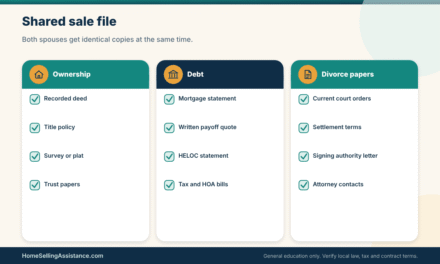
Keep a single folder, paper or digital, for the whole matter. In it, place the petition and any answers, proof that each owner was served, the scheduling order, every hearing notice, and every written offer or settlement proposal exchanged between owners. Date-stamp things yourself. A one-page running log of phone calls, texts and who said what, kept in the moment, is far more useful than memory two years later.
Also keep the financial records that could matter for credits: mortgage statements, property tax receipts, insurance bills, invoices for repairs and improvements, and proof of who paid each. If one owner covered all the costs while another lived there rent-free, those records are the evidence for any adjustment. Without them, a judge may default to simple shares.
If you are tempted to sign something quickly to end the stress, pause. Settlement papers, quitclaim deeds and agreements to list can all change your rights, and they are hard to reverse. Our piece on listing agent versus real estate attorney for sellers helps you decide who to call first for which job.
Mediation deserves a place in the file, too. Many courts require or encourage it, and some run low-cost programs for property disputes. A mediator cannot force anyone to agree, but a neutral voice can shift a partition sale co owned house dispute from blame to numbers. Bring your documents, a realistic walk-away figure, and a list of things that matter besides price, such as move-out dates or who keeps family items. Agreements reached there can usually be written up and approved by the court.
Worked illustration: three owners, one house, two opinions
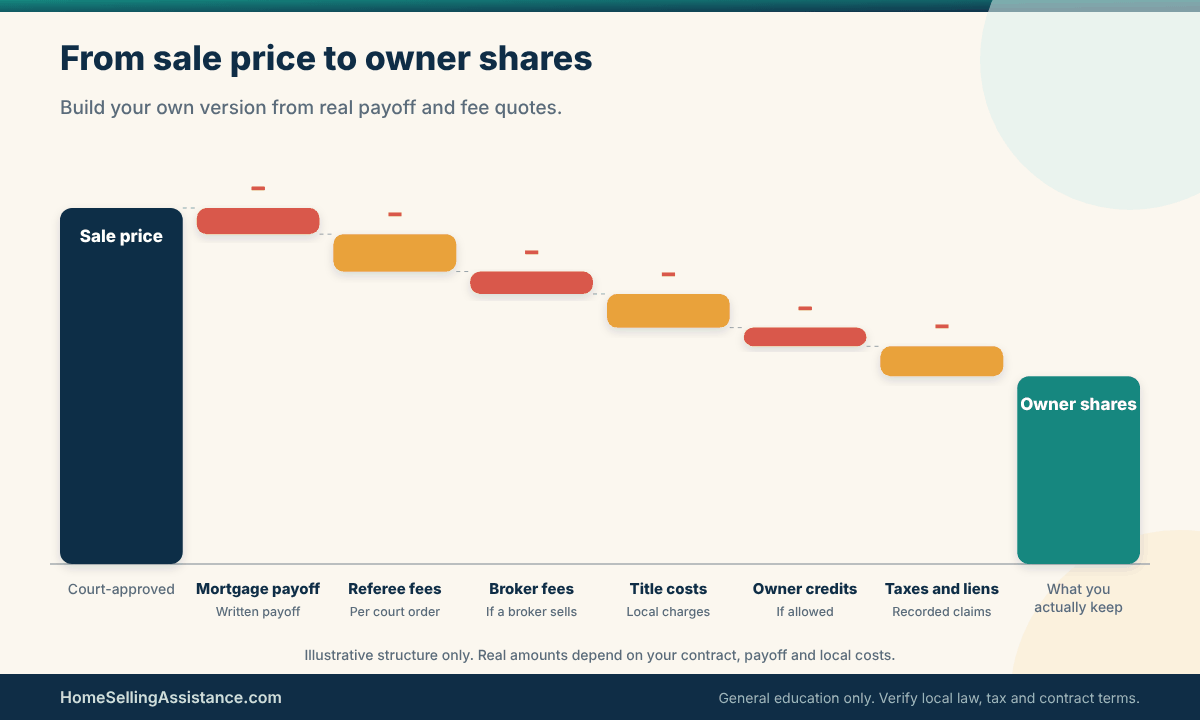
Take an illustration with round numbers. Three adult siblings each own one third of a house. Suppose the house sells for 300,000, the mortgage payoff is 90,000, and sale costs and court-approved fees total 24,000. That leaves 186,000 before any credits, or 62,000 per sibling on equal shares.
Now add a twist. One sibling lived there and paid 6,000 of property tax and 4,000 of repairs out of pocket, with receipts. Another sibling paid nothing and stayed away. Depending on the state, a court may credit the paying sibling for a portion of those expenses and may or may not charge them a fair rental value for exclusive use. The final split could be lopsided in either direction, so these are issues to raise early, not on hearing day.
Round numbers also show why timing matters. If a partition sale co owned house case drags on for a year and the mortgage interest and taxes keep accruing, the cost of delay is real money taken from everyone’s share. Each owner should ask what a month of delay costs in carrying expenses and put that number in front of the others. It is often the most persuasive argument for settling, and it requires no legal theory at all.
The point of the arithmetic is not the answer, which is made up. The point is that each line item has to be provable with documents, and that fees and costs come out before anyone gets a check. For help thinking about the proceeds side, see how to estimate home sale net proceeds.
Try a second illustration for the occupant. Suppose one owner has lived in the house alone for a year, and a fair rental for the home is round-number 1,500 a month. Some courts consider whether an occupying owner owes the others a share of that value, particularly if the others were pushed out, and some do not unless the occupant excluded them. Neither rule is universal. In a partition sale co owned house case, ask your attorney whether occupancy charges are possible, and keep proof of who was actually shut out.
Referees, buyers, title companies, lenders and condo boards
After a judge orders a sale, the property is rarely sold by the owners themselves. Someone else is put in charge, and several outside parties have to be satisfied before the deed can transfer. Knowing who they are and what each one wants helps you stay useful instead of getting in the way.
How the handoff to a court-appointed seller or referee works
Courts commonly appoint a neutral person, often called a referee, commissioner, receiver or special master depending on the state, to carry out the sale. That person may hire a real estate broker, set a list price based on an appraisal or broker opinion, and handle showings and offers. Some courts require a public auction on the courthouse steps. Others allow an ordinary listing on the local multiple listing service. Which one applies is a local rule, not a personal choice.
Owners usually lose control over day-to-day decisions at this point, though many can still provide access, keys and information about the property. If you live in the house, you may be asked to keep it showable and to move out by a set date. A cooperative occupant often helps the price. A hostile one can cost everyone money, because buyers notice and referees watch the calendar.
Owners can still be a help. Offer the referee a written list of known issues, such as a slow roof leak, the age of the water heater, the location of the shutoff valves and any unpermitted work. A partition sale co owned house referee cannot disclose what nobody tells them, and buyers who find surprises later tend to renegotiate or walk away. Giving the referee accurate information early supports your own share of the proceeds. For general background on what sellers normally disclose, see our guide to seller disclosure requirements.
Ask the referee’s office, in writing, how offers will be handled, how the price will be set, and whether owners may bid. Rules on whether a co-owner can buy at the sale differ, and some places allow it only under court supervision.
The method of sale matters for the number you finally see. A traditional listing lets many buyers visit, request inspections and finance the purchase, which can broaden demand. A public auction can be faster, but bidders often need cash, and the pool may be smaller. A partition sale co owned house order may allow either, and judges usually look at which method is likely to bring a fair price. If you have a view, put it in writing before the order is entered, not afterwards.
What buyers and title insurers look for at a court-ordered closing
A buyer in a court-ordered sale wants to know that the person selling has real authority and that the title will be clean. Title companies usually want a certified copy of the order of sale, proof that all owners and lienholders were properly served, the court’s confirmation of the sale where required, and a payoff letter for every recorded loan. If any of those is missing, the closing may stall.
Possession is the other buyer concern. A buyer who wins a partition sale co owned house auction or listing wants to know when the house will be empty, and whether the court will help remove an occupant. If you still live there, ask the referee in writing what move-out date is expected and whether any deposit or key return is required. Leaving the home clean, with utilities on and keys accounted for, tends to protect your share and avoids charges.
Court-ordered sales are sometimes sold without the usual seller disclosure forms, or with limited representations, because the referee has no personal knowledge of the home. Buyers may also factor the process into their offer. That does not mean prices are always low, but it does mean buyers sometimes ask for a discount to cover uncertainty. Condo or HOA properties add another layer: the association may need to issue a resale certificate or payoff for dues, as covered in our guide to selling a house with an HOA.
If you are an owner in a partition sale co owned house sale, your job is to answer the referee’s questions quickly, turn over documents, and avoid side deals with buyers that could look like interference.
The second tool is a scenario table for a partition sale co owned house. Use it to see how different co-ownership situations change your options and where the risk sits. It is a conversation starter, not a verdict about your house.
| Situation | Owner options | Main risk | Document to review | Escalate to |
|---|---|---|---|---|
| Unmarried partners split up | Buyout, voluntary listing, partition | Unequal contributions disputed | Deed, cohabitation or purchase agreement | Property attorney |
| Siblings inherit a house | Buyout, sale, heirs property protections | Forced sale below market | Will, deed, probate order | Probate or heirs attorney |
| One owner stops paying share | Cover costs and claim credit, mediate | Lender default affects all owners | Mortgage, payment records | Attorney, loan servicer |
| Owner cannot be found | Court-approved alternate service | Defective notice voids steps | Service attempts, affidavits | Attorney, court clerk |
| Spouses in divorce | Division in the divorce case | Wrong court, wasted fees | Decree, settlement agreement | Family law attorney |
| Investors co-own a rental | Operating agreement exit, buyout, partition | Contract may limit partition | Operating agreement, lease | Business or real estate attorney |
Notice how often the same pair of rows repeats: a document that controls and a person who can interpret it. When you find your row, read the document in the fourth column first, then book time with the person in the last column. A written agreement between owners can waive partition rights in some states, so check any shared-ownership contract before assuming a court can step in at all.
Quick scenario
Two former partners co-own a condo. One moved out two years ago and has kept paying half the mortgage, while the other has lived there alone and pays the rest. After a fight, the departing partner files for partition. A mediator suggests a buyout based on an appraisal, with the resident paying the other’s share over a short period, or a listing with a deadline. The resident takes the buyout, refinances in their own name, and the case is dismissed. Nothing here is a promise about your case; it just shows why settlement is often cheaper than a judge’s order.
Build a verification checklist for your partition sale co owned house plan
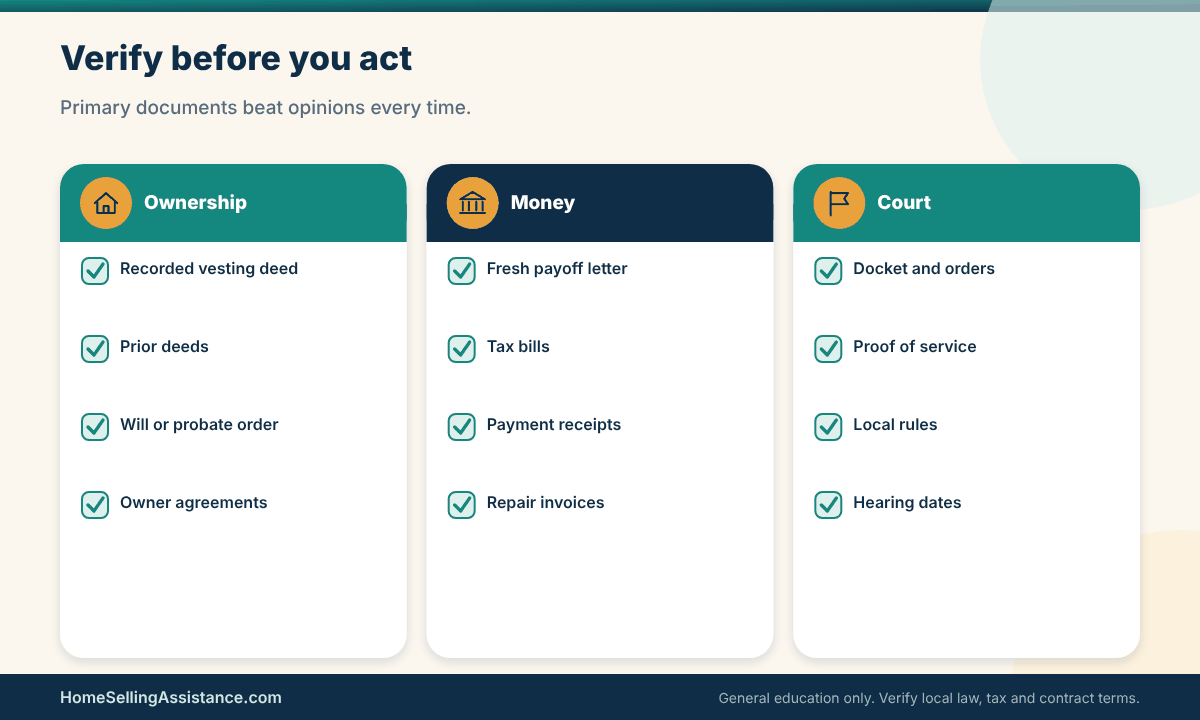
Partition disputes are full of confident opinions: a cousin who “went through this,” a forum post, a website promising a quick forced sale. Very little of it is checkable. A verification checklist replaces secondhand stories with primary documents, and it is the single habit that most reliably protects owners from expensive surprises.
Think of the partition sale co owned house checklist in two halves. The first half is about where the facts live, meaning recorded documents and official sources. The second half is about timing, meaning which of those facts must be fresh when you sign or appear in court.
Official sources and recorded documents worth pulling yourself
A recorded document is public, dated and stamped by a government office. That makes it stronger than an email, a text or a sentence in a family group chat. Before you hire anyone, before you file anything, and before you agree to a price, pull the documents that show what is actually true.
Evidence to gather: the county record set and court docket
At the county recorder or land records office, request the current vesting deed, any prior deeds that show how each owner came to hold title, every recorded mortgage or deed of trust, and any liens, judgments or tax notices that attach to the property. If a case has already been filed, look up the docket on the court’s public portal or at the clerk’s counter. The docket lists filings, hearing dates and orders, which is the quickest way to see what a judge has actually decided.
Do not rely on a single database. Online land records sometimes lag, and a partition sale co owned house petition may be recorded under a case number rather than a street address. Ask the clerk how to search by owner name and by parcel number, and confirm whether older records are indexed online or only on paper. If a surname changed through marriage or divorce, search under each name that has ever appeared on the deed.
Request the county assessor or tax collector record too. It shows current ownership for tax billing, assessed value and whether taxes are paid. A delinquent tax balance can jump the line ahead of everyone else, and some states have short windows after a tax sale. If a recorded claim looks unfamiliar, our article on selling a house with a lien explains how liens are generally handled at closing.
Finally, ask the loan servicer for a written payoff statement and a copy of the note and mortgage. Payoff figures change daily with interest, so request a fresh one every time you need it.
Budget time for this research. Pulling the record set for a partition sale co owned house case can take a few days, mostly because offices respond at their own pace and some documents are mailed. Start early, request certified copies when a court or title company will need them, and keep every receipt. A tidy record set also lowers legal bills, because your attorney is not paying hourly rates to hunt for papers you could have collected yourself.
A scenario, an exception, and your next step: the judgment nobody mentioned
Imagine that you and your brother co-own a house, and a title search shows an old judgment against him from an unrelated debt. The judgment is recorded and attaches to his share. You hadn’t known about it, and he assumed it had expired. Nobody can close cleanly until that claim is paid, released or otherwise addressed by the court.
The exception is that the rules on how long a judgment lasts, and whether it follows his share into a sale, vary by state. Some claims attach only to the debtor’s interest, which can complicate a sale of the whole property. Others can be paid from his share of the proceeds at closing. Either way, the title company will usually not insure over it without a plan.
Your next step is to ask the title company or your attorney for a written list of every recorded claim, who holds it and what it would take to clear it. Then discuss with your co-owner who bears the cost. If tax questions come up around the sale, the IRS has plain-language guidance in Publication 523 on selling your home.
What must be current before you sign or appear
Some information keeps. A deed from fifteen years ago is still a deed. Other information goes stale quickly: payoff figures, appraisals, tax balances, court schedules and agreements between owners. Before any signature or hearing, decide which items must be refreshed so you are not relying on yesterday’s picture of a moving target.
Evidence to gather: fresh payoffs, valuations and written agreements
A payoff letter is generally good for a limited number of days and includes a per-day interest figure, so ask for a new one as closing approaches. A valuation, whether an appraisal or a broker opinion, reflects the market on a certain date. If the case drags on for months, ask whether the court or referee will update it. Prices and conditions can change, and nothing guarantees a particular result.
Written agreements between owners also age. A handshake deal about who pays what, or a buyout offer from last spring, may no longer fit reality. If you intend to rely on a settlement, put it in a signed document, ideally reviewed by an attorney, and have it filed with the court if a case is open. Then check that the final settlement statement matches the numbers: our guide to the seller closing statement shows what each line normally means.
Last, confirm wiring and payment instructions by phone with a number you already trust. Closing-money fraud is real, and a sale with several owners involves lots of emails. The FTC publishes consumer guidance at consumer.ftc.gov that is useful before any money moves.
A scenario, an exception, and your next step: the stale buyout offer
Suppose two co-owners agreed in the spring that one would buy out the other for a figure based on a spring appraisal. The buyer-owner’s lender then needed several months to approve a refinance. By autumn, the local market had shifted, and the selling owner now believes the number is too low. Neither side wants to restart the case.
The exception is that a signed, enforceable agreement may still bind both of them, and a court may enforce it, while an informal understanding may not. Which one you have depends on the writing, the signatures and local contract law. That is why vague agreements are risky: both owners can honestly remember different deals.
Another habit worth building is a short decision memo. Before any hearing, write one page that states what you want, the minimum you would accept, what you can prove and what you cannot. For a partition sale co owned house hearing, that memo keeps you from reacting to pressure and gives your attorney a clear brief. Update it whenever a payoff, valuation or agreement changes, and date every revision.
Your next step is to ask the lender and your attorney whether the original numbers can be updated by a short written amendment. Then make sure the deadline, the price formula, who pays closing costs and what happens if financing fails are all written down. Taxes also deserve a look: the person who sells may owe tax on a gain, and the person who keeps the house gets a different basis, as the IRS explains in Publication 551 on basis of assets.
Communication style matters in these disputes more than most people expect. Short, polite, written messages that name a date and a decision, such as “please confirm by Friday whether you will accept the appraisal figure,” create a clear record and take the heat out of the exchange. In a partition sale co owned house conflict, you may someday need to show a judge that you tried to settle fairly, and a calm email chain is the best evidence.
One more tax note, kept general. Under federal law, an owner who sells a main home may be able to exclude some gain if they meet the ownership and use tests, which look at two of the last five years. Co-owners are treated individually, and a partition sale co owned house is no different, so each owner’s situation can produce a different result. If a divorce is involved, see our overview of divorce home sale taxes and speak with a tax professional.

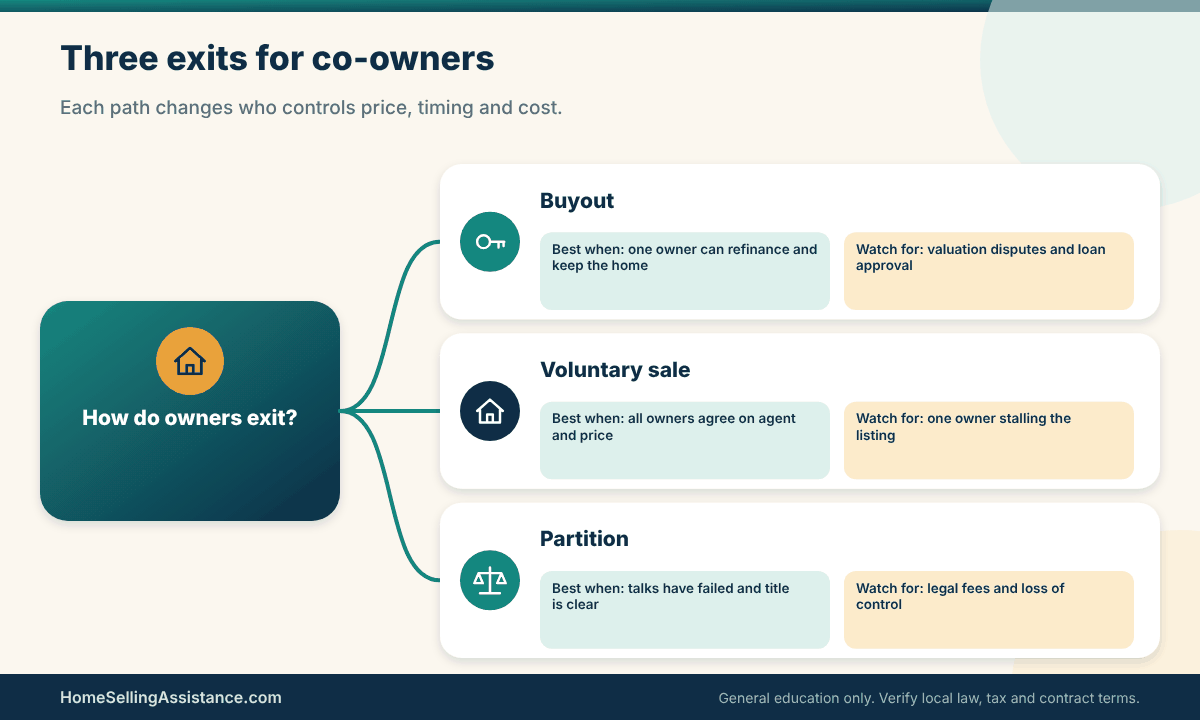
One last point belongs on your checklist: deciding whether the legal remedy is even your best tool. The legal remedy is always available in theory, but the better question is whether it is the best tool for your situation. A partition sale co owned house case usually costs time, legal fees and some control. Owners who want a faster, cheaper or friendlier result have several other options, and judges often encourage them to try.
Consider these in order of how much control you keep. A voluntary sale on the open market, agreed by all owners, lets you choose the agent, set the price and time the closing. A buyout lets one owner keep the house by paying the others their fair share, usually with a refinance. Mediation can unlock both. A court-ordered sale is the last stop because the judge or referee, not the owners, then makes the key decisions.
If you are weighing a buyout, our guides to house buyout versus selling in a divorce and the buyout calculation show how equity and payoff figures fit together, even if you are not divorcing. If you are trying to split sale money after a sale, dividing home sale proceeds covers the common questions.
When tensions run high, cooling off and using a neutral third party often works better than another round of messages. If emotions or safety are a concern, a counselor or attorney can help you set boundaries. For housing counseling in difficult financial times, the HUD housing counselor finder lists approved agencies.
Whatever you choose, ask your attorney two direct questions. First, what is the realistic cost range of each path in this court? Second, what happens to my share if I do nothing? Those answers, in writing, make the next partition sale co owned house conversation with your co-owner more honest and more grounded. You can also browse our divorce and co-owned homes library and our closing costs and net proceeds articles for the surrounding topics.
A few scripts can help when you are stuck for words. To a co-owner you might say, “I would rather agree on a listing price than let a court choose one, can we get two broker opinions and meet in the middle?” To an attorney you might say, “What would a partition sale co owned house filing cost me here, and what is the likely timeline?” To a title company, “What documents will you need from a court-ordered closing?” Plain questions get plain answers, and the answers become your plan.
Frequently asked questions about partition sale co owned house cases
What is a partition sale of a co-owned house?
A partition sale co owned house case is a court-ordered sale of a property that several people own together, usually requested by one owner who wants out. The judge decides whether the property can be divided physically, which is rare for a single house, or whether it should be sold and the money split. The details of the process and the standards for ordering a sale come from state law.
Can one co-owner force the others to sell?
In many places, yes, a co-owner has a right to ask the court to divide jointly owned property, and a sale is a common result for a house. There are exceptions, such as tenancy by the entirety for married couples in some states, agreements that waive partition, and special protections for heirs property. Because it varies, ask a local attorney before assuming anything.
How long does a partition sale co owned house case take?
There is no universal timeline. A case with cooperative owners and a clean title may move faster than one with a missing owner, disputed credits or an appeal. Court calendars, service of notice, valuation disputes and the sale process itself all add time. Ask the clerk or your attorney what is typical in your county without relying on guesses.
Who pays the costs of a partition sale co owned house case?
It depends on the state and on the judge. Some courts take court costs, referee fees and reasonable attorney fees from the sale proceeds before the owners share what is left. Others allocate fees according to ownership shares or the conduct of the parties. Ask for the cost rules in your state’s statute and for an estimate in writing.
Will a partition sale co owned house bring a lower price?
Not necessarily, but it can. Buyers sometimes expect a discount when a property comes with a lawsuit, an unavailable seller disclosure or a short timeline. A well-run sale, with an agent, good photos and a realistic price, can still do well. Nobody can promise a result, so ask how price will be set and how offers will be handled.
What happens to the mortgage in a partition sale co owned house case?
The loan is paid from the sale proceeds at closing, and the lender receives its payoff before the owners receive anything. If the sale price is lower than the payoff, owners may still owe the difference, depending on the loan terms and state law. Keep making payments while the case is open, because missed payments can hurt everyone’s credit and complicate the sale.
Can I buy out the other owners instead?
Often you can, and many courts encourage a buyout before any partition sale co owned house order. A buyout generally requires agreement on a value, a way to pay, and usually a refinance or release of the departing owner from the loan. Some states give co-owners a statutory chance to buy before a forced sale. Ask whether your state does, and get the value process in writing.
Do I owe taxes on my share of a partition sale co owned house?
Possibly. Each owner generally reports their own share of any gain or loss, and the federal exclusion for a main home can apply to an owner who meets the ownership and use tests. Whether it applies to you depends on your facts, so speak with a tax professional. The IRS explains the basics in Publication 523.
What if a co-owner cannot be found or will not respond?
Courts have procedures for serving notice on missing owners, such as publication after reasonable searches. These steps are strict, and a mistake can cause delays. Keep a record of every attempt to reach the person. An attorney can tell you which steps your court requires and how long they usually take.
Should I hire a lawyer for a partition sale co owned house dispute?
Most people do, because the rules are state-specific and the money at stake is often large. Even a single consultation can show you whether a partition sale co owned house case fits your situation, what documents matter and what alternatives exist. Choose someone who handles real property disputes locally, and ask about fees up front.
A calmer way forward
A partition sale co owned house case is hard because it mixes family, money and law in one place. The steadiest approach is to pull the recorded documents, learn your state’s rules from official sources, keep a clean paper trail, and treat settlement as the first option and a court order as the backup. This article is general education, not legal, tax or financial advice, so please confirm the details with a local attorney and a tax professional before you sign or file anything.