If you need to sell house while separated, you are standing in a gap that real estate paperwork does not describe very well: you are still married, the divorce has not been filed or finished, and yet the house that used to be one shared plan is now a shared problem with a mortgage attached.
Most advice about how to sell house while separated is really written for one household, and most home-selling advice assumes one household, one decision-maker and one set of goals. Separation breaks all three. One of you may still be living in the house while the other pays half the bills from a rental across town. One of you may want a quick sale and a clean start, while the other wants to wait for a better market, or for the children to finish the school year, or simply for the dust to settle.
The good news is that the mechanics of a sale do not change just because the relationship did. A buyer still needs clear title, a lender still needs to be paid off, and a closing agent still needs every owner’s signature. What changes is the number of people whose consent you need, the sensitivity of every conversation, and the way taxes, proceeds and ongoing costs get shared before any court order exists.
This guide is general education, written the way an experienced friend might explain it over coffee. It will not tell you what your own situation requires, because that depends on your state, your deed, your loan and your agreement. It will help you ask better questions, gather the right documents and spot the places where a short consultation with a family law attorney, a tax professional or a title company can save you real trouble.
If you want the bigger picture of divorce and home sales, our cornerstone guide on selling a house during divorce covers the full range of paths, and our divorce and co-owned homes section collects the related guides.
Key takeaways
- Ownership comes first. Who is on the deed, who is on the mortgage and what any written agreement says decide who must sign, and those are three separate questions.
- Separation is not divorce. In most places you remain legally married until a court says otherwise, so both spouses often have rights in the home even when only one name is on the title.
- Put the plan on paper. A signed written agreement about listing, price authority, expenses and proceeds prevents most of the fights that stall a sale.
- Money keeps moving. The mortgage, taxes, insurance and utilities continue during separation, so decide in writing who pays what and how it will be credited later.
- Taxes depend on facts. The federal home sale exclusion has ownership and use tests, and filing status for the year of sale matters, so confirm your own numbers with a qualified tax professional.
- Protect the proceeds. A neutral closing agent, clear written instructions and verified payment details guard against disputes and fraud on closing day.

Start by identifying who owns the house and which rules apply when you sell house while separated
Before you talk about price, listing agents or moving dates, and before you decide to sell house while separated, spend an hour working out the legal shape of the house. That sounds dull, and it is, but almost every serious delay we see in a separation sale traces back to a surprise at this stage: a name nobody remembered, a loan nobody read, or a rule that turned out to be different in the next county or state.
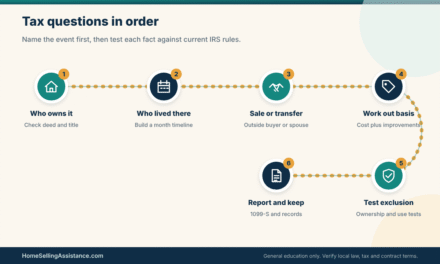
The picture above gives you the order of operations. If you plan to sell house while separated, establish who owns the property, find out what documents control the sale, work out which legal system applies, and only then move to the agreement, preparation and numbers. Skipping ahead is tempting, especially when emotions are running high, but a sale built on a wrong assumption about title tends to fall apart late and expensively.
Title, the mortgage, and the paper that actually controls the sale
Three documents answer most of your early questions. The deed tells you who holds legal title. The mortgage or deed of trust, together with the promissory note, tells you who owes the lender and what the lender may do. A separation agreement, postnuptial agreement, prenuptial agreement or court order, if one exists, tells you what the two of you have promised each other. These can point in different directions, and the plan to sell house while separated has to satisfy all of them.
People often assume that the name on the deed is the whole story. It is not. A spouse who is not on title may still hold marital or community rights, sometimes called homestead or dower-type rights depending on the state, that require a signature or at least a waiver before a buyer’s title company will insure the sale. Whether those rights exist and how they work is a state law question, so ask a local attorney or title company rather than relying on a general rule.
Evidence to gather: the deed, the loan file and any agreement already signed
Start with the recorded deed. You can usually get a copy from the county recorder or land records office, often online, and it shows how title is held. Wording such as “joint tenants,” “tenants in common,” “tenants by the entirety” or a trust name matters, because each form carries different rules about survivorship, transfer and the ability of one owner to act alone. If the words are unfamiliar, bring the deed to a title company or attorney and ask them to explain it in plain terms.
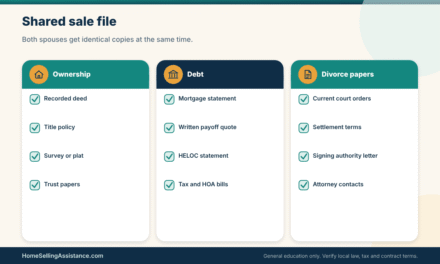
Next, pull your latest mortgage statement and, if you can find it, the closing documents from when you bought. The statement gives the current servicer, the approximate payoff and whether there is a second loan or home equity line. Then collect any signed agreements, including a postnuptial agreement, a temporary court order about the home, or even an informal email exchange where both of you agreed to something. Informal messages may not be binding, but they show intent and are worth keeping.
Finally, order or request a title report or preliminary title commitment before you list, since an owner who wants to sell house while separated cannot afford a title surprise. It surfaces liens, judgments, unpaid taxes, old easements and name discrepancies that a seller would rather learn about now than three days before closing. Our guide to the title search for sellers explains what the report contains and how to read it.
A scenario, an exception, and your next step: one name on title, two names on the loan
Picture a couple where the house was bought before the marriage and only one spouse is on the deed, while both signed the mortgage after a refinance. The titled spouse might assume they can list alone. The other spouse might assume they have no say at all. Both assumptions could be wrong, since the non-titled spouse may hold marital rights in the home, and the lender’s loan terms may restrict transfers or require a payoff either way.
The exception to watch for is a recorded document you have forgotten about: a quitclaim deed from years ago, a trust transfer made for estate planning, or a lien from a contractor. Any of these can change who must sign. Your next step in this scenario, as you prepare to sell house while separated, is simple. Get the deed and a title commitment, then ask a family law attorney in your state a narrow question: “Who must sign to convey clear title, and does my spouse’s consent matter even though they are not on the deed?”
Federal rules, state rules, and the courts that may get involved
There is no single national rulebook for how to sell house while separated. Federal law touches a few pieces, mainly income tax treatment of the sale, the federal lead-based paint disclosure for older homes, and fair housing rules that apply to how you market and show the property. Almost everything else, including marital property rights, whether a separation is formally recognized, disclosure forms, agency rules and closing customs, comes from state law and local practice.
That split matters because advice you read online often blends the two. A statement like “you need both signatures” may be true in one state and false in another. A statement like “separation is the same as divorce for property purposes” is almost always wrong, although a few states do recognize a legal separation that can change property and tax treatment. When you read anything about how to sell house while separated, ask which state it is describing.
Where to check: the sources that carry real authority
For federal tax questions, the primary source is the IRS, and IRS Publication 523 on selling your home is the place to start. For questions about how separation or divorce affects your return, IRS Publication 504 on divorced or separated individuals is the companion document. Both are written for the general public, though they will not replace a tax preparer who has seen your actual records.
For state rules, your best sources are the state real estate commission or department of real estate for disclosure and agency rules, the county recorder for title documents, the court clerk’s self-help pages for family law procedures, and a licensed attorney for anything that touches your specific rights. A title or escrow company in your area can also tell you, usually for free, what they will require from both spouses before they will close. Call them early. They know the local customs better than any article can.
A scenario, an exception, and your next step: moving between states or owning in a different state
If you sell house while separated across state lines, imagine one spouse has already relocated for work to another state while the house remains in the original state. Which state’s rules govern the sale? Generally, property law follows the location of the real estate, so the house is governed by the law where it sits, while a divorce case may be filed in the state where one spouse now lives. Those can create friction, and a title company will focus on the state where the property is located.
An exception worth knowing about is that some states treat property very differently when a couple lived in a community property state at any point. Another is that remote signing and notarization rules vary, which matters if one spouse is far away. Your next step is to ask the title or escrow company how they handle an out-of-state seller who is not present, and to ask a family law attorney which court is likely to handle your case, so you do not sign something that a later court order contradicts.
If one spouse refuses to cooperate, the picture changes quite a bit, and options like court-ordered sales exist in many places. We cover that situation separately in our guide to a co-owner who refuses to sell, and in the overview of a partition sale of a co-owned house.
Build the written plan that lets you sell house while separated without a daily fight
Once you know who owns what, the next job is agreeing on how a plan to sell house while separated will actually work. This is where a decision to sell house while separated succeeds or stalls. Two people who are no longer making joint decisions in daily life are being asked to make a very large joint decision, and without a framework even small questions, like which weekend to hold an open house, can become arguments about everything else.
A written plan fixes that by moving decisions out of the moment. When the rules are on paper, you are no longer negotiating each step with someone you may not want to text. You are simply following what you both already signed. Even a short agreement to sell house while separated beats none, and a well-drafted one by an attorney or mediator beats a short one, especially when children, retirement accounts or business interests are tied to the home.
Turn your separation decisions into a clear written agreement
The agreement you use to sell house while separated does not need to resolve the whole divorce. It only needs to cover the house: whether you will sell, how, who has authority to approve what, how costs and proceeds are handled, and what happens if someone changes their mind. Many couples treat it as a standalone sale agreement that sits alongside, and later folds into, a broader marital settlement.
The matrix below is meant to help anyone planning to sell house while separated spot which issues need an answer before a listing goes live. It lists common issues, the document or authority that usually controls each, what you are obliged to do or free to choose, the typical timing, and who to ask locally. Treat the deadline column as a prompt to look up your own dates, not as a rule.
| Issue | Controlling document or authority | Seller obligation or choice | Deadline to check | Local verification |
|---|---|---|---|---|
| Who must sign the deed | Recorded deed, state marital property law | Obtain every required signature or waiver | Before listing and again at closing | Title company, family law attorney |
| Mortgage payoff or transfer | Note, mortgage, servicer rules | Request payoff figure; keep payments current | Payoff quotes expire; ask the servicer | Loan servicer, closing agent |
| Listing authority and price changes | Written separation or sale agreement | Agree who signs the listing and approves offers | Before the listing agreement is signed | Attorney or mediator |
| Interim bills and repairs | Agreement, temporary court order | Decide who pays and how it is credited | Monthly, until closing | Family court self-help center |
| Disclosure forms | State disclosure law, EPA rule for pre-1978 homes | Complete honestly based on what you know | Before or soon after contract, varies by state | State real estate commission |
| Proceeds distribution | Agreement, court order, closing instructions | Sign clear written instructions to the closing agent | Before closing day | Title or escrow company, attorney |
To use this table, copy the first column into a notebook or shared document and add the answers you find next to each row. If you cannot fill a row, that is your homework before listing. A short call to the title company often clears several rows at once, because they handle these questions every week.
What the agreement should cover: authority, price, expenses and proceeds
Start with the decision to sell house while separated itself. State whether both of you agree to sell, and whether you are committing to sell by a certain date or only to try for a set period. Then, since a plan to sell house while separated needs a clear chain of command, name who will have authority to sign the listing agreement, approve offers, accept repair requests and sign closing documents. Many couples agree that both must approve any price below a set floor, while one of them may handle routine matters such as scheduling showings.
Next, set the price range and the process for changing it. You might agree to review the price together after a fixed number of weeks on the market, or to follow the listing agent’s written recommendation if you both agree to hire one. The key is that you decide the review process now, rather than trying to agree on a price drop in the middle of a stressful month. For help thinking about agents and listing terms during a divorce, see our guide to listing a home during divorce.
Then cover money. List who pays the mortgage, taxes, insurance, utilities and maintenance until closing, and whether those payments are shared, credited back at closing or treated as a gift. Finally, describe how proceeds will be divided, or state clearly that the proceeds will be held in a neutral account until a later agreement or court order. Our article on how to divide home sale proceeds in a divorce walks through common approaches.
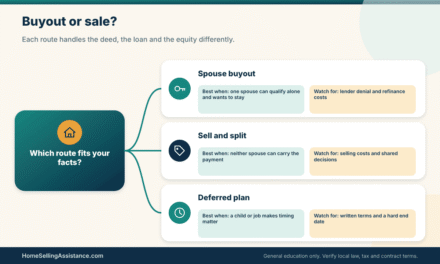
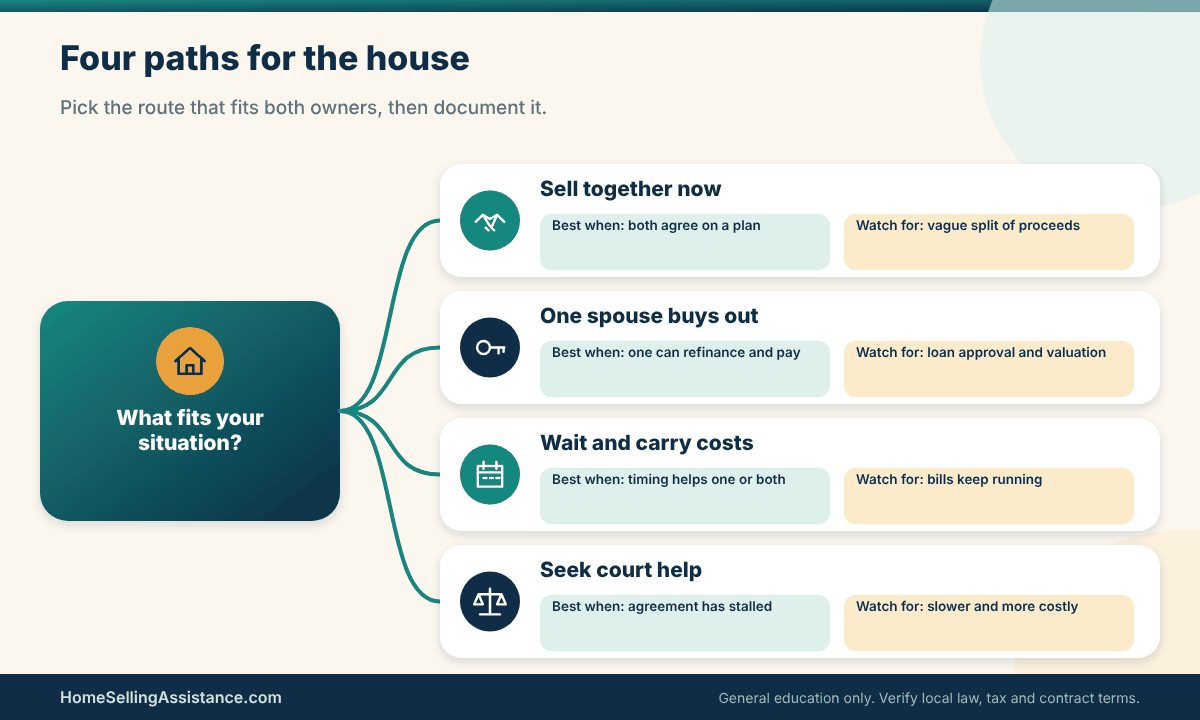
One more clause earns its place: what happens if the house does not sell. Say whether you will reduce the price, switch agents, take it off the market for a defined period, or revisit a buyout. Our comparison of a buyout versus selling in divorce explains how that alternative works and what it demands financially.
When agreement stalls: mediation, attorneys and a clear escalation point
Even with the best intentions, some couples cannot agree. Common sticking points include listing price, the timing of the sale, who stays in the house until closing, and credits for the person who has been paying more than their share. Before this turns into a standoff, decide in advance how you will break a tie.
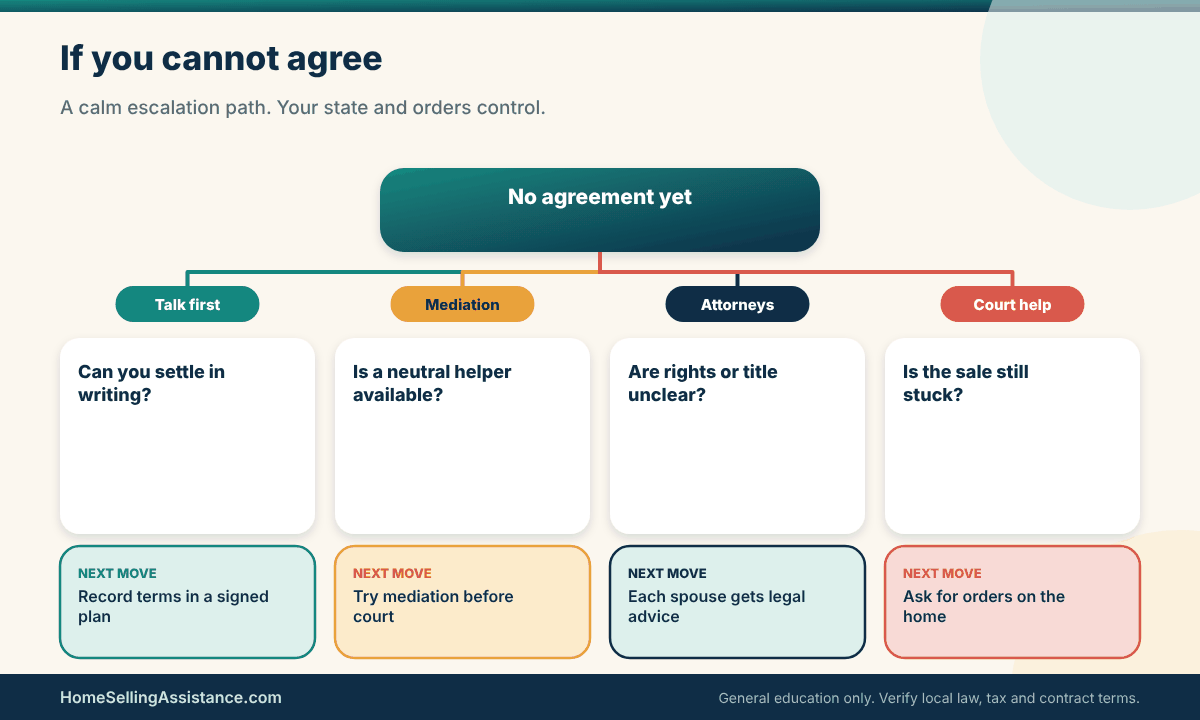
Mediation is often the first and cheapest step when you sell house while separated and disagree. A neutral mediator, sometimes a family law attorney or a trained professional, helps both of you reach terms without a judge. Many courts and community programs offer low-cost or sliding-scale mediation. If mediation fails, each spouse may consult their own attorney, and the court can be asked to issue temporary orders about the home, such as who pays what or whether the property may be listed or sold.
A practical tip: put the escalation ladder in your written plan. For example, you will first discuss in writing, then meet with a mediator within a fixed number of days, and only then involve attorneys. This turns a vague threat into a process and often calms things down. If you reach the point where one of you simply will not move, read our guide on a co-owner refusing to sell before taking any step you cannot reverse.
If safety is a concern in your relationship, put that ahead of everything on this page. Local domestic violence hotlines and family courts have procedures for exactly this, and a sale can wait until you are safe.
Living in the house, paying the bills and getting it ready to sell
Between the decision to sell and the closing date lies a stretch of weeks or months where the house still has to function as a home, a financial obligation and a product for sale. Separated owners often feel this phase most sharply, because it involves shared money and shared space at a time when neither feels generous.
Plan the stretch before you sell house while separated like a small project with owners, deadlines and rules. Decide who lives in the house, who handles which tasks, how decisions get recorded and how disputes get resolved. The more specific you are, the less each choice feels like a personal statement and the more it looks like routine project management.
Who pays the mortgage, taxes and insurance while the house is on the market
The mortgage does not pause because the marriage has, and that is true even if you sell house while separated within weeks. Missed payments damage the credit of everyone on the loan, no matter who was supposed to pay, and a lender will not care about your informal arrangement. That is why many attorneys encourage separated spouses to keep the mortgage current from a clear source, document who is paying, and keep records of every payment. Our guide to a mortgage during a divorce home sale goes deeper on this.
Property tax and homeowners insurance deserve the same attention. If taxes and insurance are paid through an escrow account with the mortgage, they are bundled into the monthly payment. If you pay them directly, make sure someone is responsible for the due dates. Also tell the insurer about the change in occupancy if one spouse moves out, because some policies have conditions about vacant or partly occupied homes. Ask your insurance agent what applies to you.
To keep resentment down, many couples use a simple ledger. Each month, they record who paid which bills and from which account, then agree in writing whether these amounts will be reimbursed at closing, offset against each other, or left alone. An attorney can tell you how a court in your state typically treats such payments, which can differ depending on whether the payer was the person living in the house.
Showings, privacy, safety and fair housing basics
Preparing to sell house while separated has practical wrinkles. Staging may require moving one person’s belongings, photos may need personal items put away, and showings mean strangers in a house where someone may be living through a painful time. Agree on a showing schedule with reasonable notice, who will be present, and what happens to items that are disputed. Photograph valuables before they move, and agree who keeps what until property is divided.
Safety matters too. Whoever is home during showings should follow ordinary precautions: let the agent screen visitors, remove prescriptions and documents, and avoid being alone with strangers. If the separation is hostile, consider asking the listing agent to handle access through a lockbox schedule so neither spouse has to coordinate with the other directly.
Finally, treat every buyer equally. Federal fair housing law prohibits discrimination based on protected classes, and your marketing, showings and decisions about offers should not treat buyers differently for those reasons. If you want to read the official guidance, HUD’s fair housing and equal opportunity pages explain the basics. Your listing agent or attorney can help if a question comes up.
Communication ground rules deserve a place in your plan as well. Many separated owners find that a shared email thread or a scheduling app used only for the sale keeps things businesslike. Agree to answer within a set number of days, keep messages about the house and nothing else, and let the listing agent relay routine news so you do not have to. These small habits make it far easier to sell house while separated without every update becoming a conversation about the relationship.
Decide in advance how you will handle offers, because offers tend to arrive at inconvenient moments. A workable approach is to agree that the agent sends every offer to both of you at the same time, that each of you replies in writing within a day or two, and that silence is not treated as consent unless you both said so beforehand. Separated owners who sell house while separated successfully usually treat the offer process as a procedure, not a verdict on each other.
Last, think about the belongings. Furniture, art, tools and family items often move during a sale, and disputes over them can poison an otherwise smooth listing. List anything that is contested, photograph it, and agree where it will be stored until you divide it. If you plan to sell house while separated and still keep your options open on property division, a dated inventory with photos protects both of you and takes an afternoon to prepare.
Understand the tax picture and the proceeds before you sell house while separated
Money is the part of a separation sale that people most often postpone and most often regret postponing. Taxes, mortgage payoff, closing costs and the final split of proceeds all feel abstract until a closing statement lands in your inbox with real numbers. By then, the choices that shaped those numbers, such as when you sell, who is on the title and how you file, may be hard to change.
This section is a map, not a calculation, for anyone who plans to sell house while separated. Tax law has details, and your own facts, including how long you owned and lived in the home, your filing status and whether a court order exists, can move the outcome in either direction. We will explain the structure so that your conversation with a tax professional starts from a useful place.
How taxes and filing status interact with a separation sale
Two federal ideas do most of the work when you sell house while separated. The first is the home sale exclusion, which lets many homeowners exclude part of the profit on the sale of a main home from income. The second is your filing status for the year of sale, which affects the size of that exclusion, your tax brackets and what you can claim. Separation touches both, which is why the timing of a decision to sell house while separated can matter.
For the exclusion, the IRS rules require that you owned the home and used it as your main home for at least two of the five years before the sale. The maximum exclusion is generally $250,000 for a single filer and $500,000 for a married couple filing jointly, when both spouses meet the use test and at least one meets the ownership test. If you do not meet those tests, a partial exclusion may be available in some situations. Publication 523 lays out the rules, and our overview of the home sale capital gains exclusion adds examples.

How the exclusion and filing status can work when you are still married
Generally, your marital status on the last day of the tax year determines whether you can file jointly or separately for that year. If you are still legally married on December 31, you are usually considered married for the whole year unless a specific legal separation exists under your state’s law. That is why the closing date, and the year it falls into, can change the numbers, and why a few weeks sometimes matter.
Spouses who file jointly may be able to use the larger exclusion if both meet the use requirement. Spouses who file separately may each be limited to the single amount, applied to their own share of the gain. A spouse who moved out earlier may still count time toward the use test in some circumstances, especially when a divorce or separation instrument gives them a right to remain in or use the home. These rules have conditions, and the details are in the IRS materials.
Whether it is better to close this year or next, or to file jointly or separately, depends on your income, your deductions and any agreements about who bears which tax. That is a question for a qualified tax professional, not an article. Our guide to capital gains on a house sale in a divorce describes the issues that commonly come up.
Records that protect you: basis, improvements and selling costs
The gain on a home is not simply the sale price minus what you paid. It is the amount realized, which is the sale price less selling costs, minus your adjusted basis, which starts with what you paid and is increased by capital improvements and decreased by certain items. If the exclusion covers the entire gain, the paperwork matters less. If your gain might exceed the exclusion, records matter a great deal.
Gather the original purchase closing statement, receipts and permits for major improvements such as a new roof, an addition or a renovated kitchen, and any records of casualty losses or insurance reimbursements. Routine repairs generally do not increase basis, but improvements that add value or extend the life of the home may. IRS Publication 551 on basis explains the distinction, and our article on adjusted basis in a home sale gives practical examples.
Make copies for both spouses, because records matter long after you sell house while separated. A common mistake when you sell house while separated is leaving all the records with the person who stays in the house. Years later, when someone gets a tax notice, the missing paperwork becomes a problem for both of you. Scan the documents and store a copy in a shared folder or give each spouse a drive.
Mortgage payoff, closing costs and splitting what is left
After the sale price is agreed, the money flows in a predictable order. The closing agent pays off the mortgage and any liens, deducts closing costs, brokerage fees if any, prorated taxes and credits, and then distributes what remains according to written instructions. Understanding that order helps you estimate your own share and avoid surprises when you meet the number at the table.
The following table shows several common situations that arise when you sell house while separated. Use it as a way to think through risk and decide when to escalate to a professional. Each row names the situation, the options a seller usually has, the typical risk, what to review, and where to go if the problem grows.
| Situation | Seller options | Main risk | Document to review | Escalate to |
|---|---|---|---|---|
| Both agree to sell and share proceeds | List together under a signed plan | Vague split leads to later dispute | Written sale agreement, listing contract | Attorney or mediator to review terms |
| One spouse lives in the home and resists showings | Set a showing schedule in writing | Delay, lost buyers, rising carrying costs | Agreement, any temporary court order | Mediator, then family court |
| Only one spouse is on title | Obtain the other spouse’s signature or waiver | Title company refuses to insure | Deed, title commitment | Title company and family law attorney |
| Mortgage payments falling behind | Bring loan current; contact servicer early | Credit damage, possible foreclosure steps | Mortgage statements, servicer letters | HUD-approved housing counselor, attorney |
| Sale gain may exceed the exclusion | Plan timing and records with a tax professional | Unexpected tax bill | Closing statements, improvement receipts | Tax professional |
| Spouses disagree on how to split proceeds | Hold proceeds in escrow until resolved | Prolonged conflict, legal costs | Closing instructions, court order | Attorney, court |
To use the table, find the row closest to your situation and read across. Then write down the one document you need to find and the one professional you would call if the risk becomes real. If none of the rows fit, that is useful too, because it suggests your situation has an unusual feature that deserves an hour with a local attorney.
How the payoff, costs and credits reduce what you receive
Let us walk through an illustration with round numbers, clearly made up. Suppose a house sells for $400,000, the mortgage payoff is $240,000, and closing costs, fees and prorations together come to $24,000. The remaining amount would be $136,000 before any credits or adjustments. This is not a forecast of what you will receive. It simply shows how quickly a headline price becomes a smaller net number.
Now add the separation layers that come with a plan to sell house while separated. Suppose one spouse paid the full mortgage for several months while the other lived elsewhere. Your written plan might credit that spouse at closing for half of those payments. Or one of you might owe the other for a share of repairs. These adjustments come out of the net before the split, which is why you should settle them in writing in advance, not argue about them while the closing agent waits.
If you want to sell house while separated with fewer surprises, ask the title company for an estimated closing statement early in the process, then update it as offers come in. Our guides to home sale net proceeds and the seller closing statement show what each line means, so you can check the numbers with confidence.

Liens, judgments, wire fraud and closing-day protections
Not every claim on the sale money comes from the mortgage, and the owners who sell house while separated should look for them early. A judgment against one spouse, an unpaid tax debt, a contractor’s lien or a child support lien can attach to the property or the proceeds depending on state law and timing. The title commitment is where these show up, and they must usually be paid or resolved at closing before the buyer’s title insurer will clear the sale.
If you are surprised by a lien, ask the closing agent exactly what must be paid, to whom, and by when. Sometimes a payoff can be handled from proceeds, with the responsible spouse bearing that cost according to your agreement. Sometimes the lien needs negotiation or legal help first. Do not ignore it and hope, because a title problem tends to appear at the worst moment, often days before the scheduled closing.
Your agreement can help here too. A clause saying that each spouse is responsible for debts in their own name, and that any such payoff will be taken from that spouse’s share, avoids a fight and a delay. An attorney can adapt the wording to your state. Our guide on selling a house with a mortgage explains how payoff mechanics work in the ordinary case.
Keep a clean paper trail from the first day. Save the listing agreement, every offer and counteroffer, inspection reports, repair receipts, the closing statement and every message where you agreed to a credit or a payment. If a later disagreement lands in front of a mediator or judge, a tidy file is the strongest thing you can bring. It is also the easiest way to show that you acted fairly when you chose to sell house while separated instead of waiting for a final decree.
Finally, remember that nothing in this process requires you to decide everything at once. You can agree to sell now and settle the division later, using escrow to hold the money. You can agree on a price floor today and revisit it in a month. People who sell house while separated and stay flexible about the order of decisions generally spend less on legal fees than those who try to resolve the whole marriage before the first showing.
Closing day brings its own protections to think about, and spouses who sell house while separated have a particular reason to take them seriously. When two people are communicating less, a fraudster impersonating the title company or an agent can slip into the gap. Wire fraud targets sellers as well as buyers, and the money at stake after a sale is usually the largest sum a household sees in years.
Use a simple rule whenever you sell house while separated. Verify wire or payment instructions by calling a phone number you already trust, never one in an email, and never change payment details because of a last-minute message. Our guide to real estate wire fraud for sellers explains the warning signs. If you suspect you have been targeted, report it quickly to the FBI’s Internet Crime Complaint Center and contact your bank and the closing agent immediately.
Another protective step is to give the closing agent written, signed instructions about how proceeds will be disbursed. If you agree on a split, the instructions say so. If you do not yet agree, the instructions can direct that the funds be held in escrow or a trust account until you both sign a release or a court issues an order. A neutral third party holding the money is far safer than either spouse holding it, even temporarily.
On the morning of closing, when you sell house while separated, check that every signer has valid identification, that any power of attorney is accepted in advance by the title company, and that the final figures match your estimate. Ask for a copy of the final statement and read it together, or at least read it on the same day, so you each know what you signed. If the two of you cannot be in the same room, most title companies can arrange separate signings, sometimes at different times or by mobile notary.
Quick scenario
Dana and Chris separated in spring and agreed in writing to list in June. They chose a floor price, agreed that Dana would live in the house until closing, and told the title company to hold the proceeds in escrow until their settlement was signed. An offer arrived below the floor, so each consulted their own attorney by phone, countered together, and closed in August. Nothing dramatic happened, and that was the goal. All names and numbers here are invented for illustration.
Frequently asked questions about sell house while separated
Can I sell house while separated if my spouse is not on the deed?
Possibly, but do not assume you can do it alone. Many states give a non-titled spouse marital rights in the home, and a title company may require that spouse’s signature or a written waiver before insuring the sale. Whether that applies to you depends on your state and your facts, so ask a family law attorney and a title company before you sign a listing agreement.
Do both spouses have to agree to sell?
If both are on the title, the answer is usually yes for a voluntary sale, because both signatures are normally needed to convey clear title. If only one is on title, state law on marital rights may still require consent. When one spouse refuses, a court can sometimes order a sale, which is a slower and more expensive route, so many couples try mediation first.
Is it better to sell now or wait until the divorce is final?
There is no universal answer. Selling now can stop ongoing carrying costs and give you cash for housing elsewhere, while waiting may suit children, the market or your finances. Tax timing, including your filing status at year end, can also tilt the choice. Weigh the trade-offs with a family law attorney and a tax professional who can look at your numbers.
What happens to the mortgage if I sell while we are separated?
The mortgage is paid off from the sale proceeds at closing, and the servicer provides a payoff figure good for a limited date range. Until then, the loan stays in force and payments should continue from a clearly agreed source. Missed payments can affect the credit of everyone on the loan regardless of who was supposed to pay.
Who pays the mortgage and bills before the house sells?
That is for the two of you to decide, ideally in writing. Some couples split costs, some have the spouse who stays pay and credit it later, and some follow a temporary court order. Keep records of each payment so that credits at closing or in the divorce are based on documents instead of memory.
How is the profit taxed if we sell before the divorce?
Federal rules let many sellers exclude part of the gain on a main home, up to $250,000 for a single filer and $500,000 for joint filers who meet the tests. Your eligibility depends on ownership, use, timing and filing status. Review the IRS home sale publication and ask a tax professional how your facts apply, since this is general education and not tax advice.
Can one spouse stay in the house during the listing?
Yes, and it is common, though it needs rules. Agree on showing times, cleanliness standards, who is present, and what happens if showings are refused. A spouse who blocks reasonable access can slow the sale and raise costs for both of you, which is why a written showing plan is worth the effort.
Where should the sale money go at closing?
Options include splitting it per a signed agreement, holding it in escrow until you settle the division, or following a court order. A neutral closing or escrow agent is a safer holder than either spouse. Whatever you choose, give the agent written instructions signed by both owners before closing day.
Do I need a real estate agent or an attorney?
Neither is legally required in every state to sell, but they do different jobs. An agent handles marketing, pricing and negotiation, while an attorney protects your legal rights in the separation and reviews contracts. Some states customarily involve attorneys in closings. Choose based on cost, complexity and how much conflict there is between you.
What if my spouse and I cannot agree on anything?
Start with mediation, which is often faster and cheaper than court. If that fails, each of you can speak with an attorney and, if necessary, ask the court for temporary orders about the home or for a court-supervised sale. Escalate step by step, and put safety first if the relationship involves threats or abuse.
A calm way forward
The decision to sell house while separated is rarely only about real estate, and it helps to treat the sale as a project you can finish even when the rest of life is still unsettled. Confirm who owns what, put your plan on paper, protect the money and verify every instruction. This article is general education, not legal, tax or financial advice, so use it to prepare good questions for your attorney, tax professional and title company, who can answer for your state and your facts.