
Sorting out repairs before selling house is rarely about the repair itself. It is about deciding which problems are worth your money and your calendar, which ones are better handed to a buyer through a price change or a credit, and which ones you are legally or practically required to tell people about no matter what you choose. This guide walks through that whole decision, from the first walk-through of your own home to the final days before closing, without leaning toward any one agent, contractor, investor or sales route.
Most sellers meet this topic in a stressful way. A friend says to paint everything, a neighbor says never to touch anything, a contractor quotes a roof that costs more than the family car, and an online article promises that a certain upgrade always pays back. None of that helps much, because none of it knows your house, your loan, your timeline or the buyers who are likely to walk through your door.
What helps is a method. You collect facts about the home’s condition, you sort the findings by how much they matter to buyers, lenders and insurers, you price out the realistic ways to handle each one, and you choose a path while the choice is still yours. Waiting until an inspector hands a buyer a long report is the most expensive way to learn about your own property, so we will spend real time on what to do before that moment.
This is a cornerstone article, which means it covers the full terrain and then points you to deeper guides for single topics such as roofs, HVAC systems, foundations, mold, credits and pre-listing inspections. Where numbers appear, they are round illustrations that show how the arithmetic works. They are not prices you should expect, and your own quotes will differ. Rules about disclosure and contracts vary by state, so we will tell you how to check them rather than pretend one rule fits everyone.
Key takeaways
- Know what you are solving for. Speed, top price, certainty and low effort pull in different directions, and your repair plan should follow your priority rather than a generic rule.
- Disclosure is separate from repair. Fixing a problem does not erase the duty to mention what you know in many places, and leaving it unfixed does not remove that duty either.
- There are four honest paths. You can fix before listing, disclose and price accordingly, offer a credit after the inspection, or sell as-is. Each shifts cost, control and risk to a different party.
- Get evidence before you decide. Written quotes, permits, receipts and sometimes a pre-listing inspection turn guesses into numbers you can compare.
- Safety, water and structure come first. Cosmetic work is optional. Problems that affect safety, insurability or financing are the ones that tend to reshape a deal.
- Verify locally. Disclosure forms, contractor licensing, permits and contract timelines depend on your state and county, so confirm them with a licensed professional.
If you want the whole sale in view before we focus on condition, our cornerstone on how to sell a house shows where this decision sits in the larger sequence. Everything below assumes you are still deciding, not yet under contract. If you already have an accepted offer and an inspection report in hand, skip ahead to the sections on credits, repair requests and contract deadlines, and then return for the rest. Plan the evidence first, since repairs before selling house go better when numbers come before opinions.
The roadmap below shows the order we will follow: set your goal, list what you know, sort the problems, choose a path for each, and verify before you act. That is why planning repairs before selling house should begin with questions rather than with a contractor’s phone number.

Repairs before selling house: start with the decision you are really making
The phrase “repairs before selling house” sounds like a construction topic. In practice it is a money and risk topic that happens to involve hammers. Every defect in a home creates a small fork in the road. You can remove it, you can price around it, you can tell buyers about it and let them decide, or you can leave it unmentioned. The last of those is the only one that is never a good plan, and in many states it is not even a legal one.
Before you call a single contractor, it helps to write down what you want from the sale and what limits you. That sounds obvious, yet most repair regrets come from skipping it. People spend a month and a large sum on a kitchen refresh when their real constraint was a closing date set by a job transfer. Others list a home with an old furnace and a leaking window because they could not face the work, then lose weeks to renegotiation.
Set your goal, your budget ceiling, and your house’s real story
Start with the goal. Most sellers want some blend of four things: a strong price, a short timeline, a sure close and a low-effort process. You rarely get all four. A seller who needs certainty and speed will usually accept more discounting and fewer repairs. A seller who has time and cash may do more work to draw a wider pool of buyers. Name your top priority and your second priority in plain words, because later choices get easier when you can test them against that sentence.
Next, set a budget ceiling for condition work. This is the amount of cash you can spend without hurting your next purchase, your moving costs or your emergency reserve. Remember that repair money is spent before you are paid, while a price reduction or credit is paid out of proceeds at closing. If cash is tight, that difference matters more than the headline cost of the work. Sellers who treat repairs before selling house as a sequence of small, documented choices tend to feel more in control.
Then tell the house’s real story. Walk through it as if you were writing a letter to a stranger who is considering buying. Note every leak you have seen, every repair that was done and by whom, every appliance or system that is aging, every room that was altered, and every odd smell or stain. Include things that were fixed long ago, because buyers and inspectors often find the old patch and wonder what you did not say.
Finally, note anything that limits your choices. A mortgage with a payoff quote that leaves little equity, a co-owner who must agree to spending, an estate where the executor needs court approval, a tenant in the property, an HOA that controls exterior work, or a home in a historic district can all change what you are allowed or able to do. Sellers in those situations should read the related guides in our repairs and selling as-is library and confirm authority before spending anything.
Evidence to gather: what you know about the house today
Good decisions run on documents. Pull together anything that shows the age and history of major systems: roof, furnace, air conditioner, water heater, electrical panel, windows, plumbing, and any foundation or drainage work. Collect receipts, permits, warranties and contractor names. If you cannot find paperwork, write down approximate years and mark them as estimates. A buyer’s inspector will estimate remaining life anyway, so your notes help you see what they will see. Many sellers find that repairs before selling house are easier once a second pair of eyes has walked the property.
Also gather information from outside the house. Your homeowner’s insurance declarations page may list the roof’s age or exclusions that hint at what the insurer worries about. If you have filed claims, find the claim papers, because water and fire claims are often asked about on disclosure forms. Your county’s permit office may let you look up past permits by address, which can reveal finished work that was never signed off. Ask your agent how recent buyers have reacted to repairs before selling house in your price range.
If you are unsure what the house is hiding, consider a pre-listing inspection, covered in detail in our guide to the pre-listing home inspection. It costs money and it can create knowledge you must then disclose, so it is a real decision, not a free peek. We come back to that trade-off later. For now, simply note that guessing about a house you have lived in for years is often less accurate than sellers expect.
A scenario, an exception, and your next step for goal setting
Picture a seller we will call Dana, with a thirty-year-old house, a closing date she cannot move because of a new job, and a modest amount of savings. For illustration, suppose she has an old water heater, a cracked bathroom tile and a roof with several years of life left. Her priority is certainty and timing. She does not need to chase every detail. She needs to fix anything that threatens safety or financing, disclose honestly, and price so buyers feel room to handle the rest.
An exception would be Dana’s cousin Luis, who has a year to sell and a house with tired finishes. His priority is a stronger price, so a few targeted cosmetic repairs and a thorough clean could make sense if the quotes are small compared with the buyer appeal they add. The same house, two different sellers, two different plans. Neither is wrong. A clear view of repairs before selling house also makes your first conversation with an agent far more productive.
Your next step is simple. Write a three-line summary with your top priority, your budget ceiling for condition work, and your hard deadline if you have one. Keep it where you can see it. Every time a contractor or a friend suggests a project, ask whether it serves those three lines. If it does not, it can wait or be skipped. Keep in mind that repairs before selling house are only one part of the sale, so give them a budget and a deadline.
The four repair paths: fix, disclose, credit, or sell as-is
Sellers often talk as if the choice is “repair or don’t repair.” There are actually four separate paths, and they can be combined. Understanding what each one asks of you, and what it hands to the buyer, is the heart of this topic. If you only remember one framework from this guide, make it this one. Few sellers regret writing things down early, and repairs before selling house are a good place to start the habit.
The first path is to fix before listing. You hire the work, you control quality and timing, and you present a home with fewer visible problems. The cost is up front and the payoff is uncertain. You may also still need to disclose what was wrong and what was done, since the history of a defect can matter even after it has been repaired. The same logic applies whether you are weighing one small repair or a full list of repairs before selling house.
The second path is to disclose and price for the condition. You leave the defect in place, you describe it truthfully on the forms and in conversation, and you set an asking price that reflects it. Buyers who are comfortable with projects see it, price it themselves and decide. This keeps your cash in your pocket but moves the repair burden, and some of the fear, to the buyer. If you remember nothing else about repairs before selling house, remember that facts beat guesses every time.
The third path is the credit or price adjustment after the inspection. You list without major repairs, a buyer inspects, and the parties negotiate a reduction or a closing credit instead of repairs. Our guide to repair credits versus seller repairs explains how that conversation tends to go. The fourth path is selling as-is, where you state that you will make no repairs, which we cover below and in the deeper article on how to sell a house as-is.
Here is the part many sellers miss. These paths are not mutually exclusive, and they are not all-or-nothing. You can fix a leaking faucet, disclose an old roof, offer a credit for a failing window and still list the home as-is for everything else. Mixed plans are normal, and they usually come from sorting problems into groups rather than choosing one philosophy for the entire house. This is where many people discover that repairs before selling house cost less in money than in attention.
A useful way to sort is by consequence. Group one holds items that can stop a sale: active leaks, structural movement, unsafe wiring, no working heat in cold climates, and anything a lender or insurer might refuse to finance or cover. Group two holds items buyers will argue about but rarely walk away over: aging appliances, worn flooring, dated fixtures. Group three holds purely cosmetic items. Most money and attention belong to group one, some to group two, and little to group three.

The picture above shows the four paths as a fork. Notice that each branch has a different party carrying the risk. When you repair, you carry the cost and execution risk. When you disclose and price, the buyer carries the repair risk but you carry the pricing risk. With credits, both sides share negotiation risk. As-is shifts inspection risk to the buyer but narrows your buyer pool, since some loan types and some buyers are uncomfortable with it.
Evidence to gather: what each path asks of you on paper
Each path leaves a paper trail, and it is worth knowing it in advance. Fixing before listing means written estimates, signed work orders, licenses, permits where required, final invoices and any warranty from the contractor. Keep every document, because you may need to show them to a buyer or an inspector, and some states ask whether repairs were done with permits. Ask each professional how their advice on repairs before selling house would change if your deadline moved by a month.
Disclosing and pricing means completing your state’s seller disclosure form or its equivalent with care, adding written notes where the form allows, and keeping a copy of exactly what you gave to whom and when. Our cornerstone on seller disclosure requirements explains why the version you sign matters later if a dispute arises. If you are unsure whether something counts as a defect worth mentioning, ask your agent or a real estate attorney before the form is signed.
Credits and as-is sales rely on the purchase contract. Credits show up as lines on the closing statement and in written amendments. As-is language lives in the contract or an addendum, and its effect varies. In some places it limits repair negotiations but does not cancel disclosure duties. In others, it carries more weight. Never assume the words mean what a neighbor says they mean. Read the actual clause with a licensed professional in your state.
A scenario, an exception, and your next step when paths overlap
Imagine a home with three findings. A bathroom fan vents into the attic, a few fence boards are rotted, and the air conditioner is old but working. The seller fixes the fan because it is cheap and affects moisture, leaves the fence and discloses it, and lists the air conditioner’s age plainly while pricing with that in mind. One house, three different paths, chosen by consequence and cost. Local custom matters here, so ask what buyers in your area expect from repairs before selling house.
An exception worth knowing: if a repair would involve areas that require a permit or licensed trade in your location, such as electrical panel changes or structural work, a quick unpermitted fix can create a bigger problem than the original defect. In that case the better path may be disclosure plus a credit rather than a rushed repair that cannot pass inspection. Most disagreements over repairs before selling house start with a missing document rather than a missing repair.
Your next step is to take the house story you wrote earlier and sort every item into one of three groups: can stop a sale, will be argued about, or cosmetic. Then pencil one path next to each item. You are not committing yet. You are building the draft plan that the rest of this guide will help you test. Treat every quote for repairs before selling house as a starting point and compare it with a second written opinion.
What repairs change: price, time, risk, and net proceeds
Every repair decision moves four dials at once: the price you can reasonably ask, the time the sale will take, the risk that a contract falls apart, and the amount you actually keep. A project can help one dial and hurt another. A new roof might reduce the risk of a failed inspection and cost you three weeks. A discount might speed a sale and lower your proceeds. Seeing the dials together keeps you from celebrating one gain while ignoring the loss next door.
It also helps to separate what you spend from what buyers value. Money you put into a house is a cost. Whether buyers pay more because of it is a market question, and the answer differs by neighborhood, price range and season. Online claims about how much of a repair’s cost “comes back” are averages across very different homes, and averages do not tell you what will happen in your zip code. Ask local professionals what comparable homes with and without that work have recently done, then treat the answer as an informed opinion rather than a promise.
Buyer, lender, appraiser, and market forces that react to condition
Several groups look at your home’s condition, and each cares about something different. Understanding their concerns tells you which repairs matter beyond looks. Do not assume that your neighbor’s experience with repairs before selling house will match yours.
Buyers care about safety, money and fear. A buyer can forgive an old kitchen and still panic at a stained ceiling, because a stain suggests unknown costs. Many buyers also have limited cash after the down payment and closing costs, so even a modest project can feel unmanageable. That is why visible deferred maintenance can cost more than its repair estimate: it changes how the buyer interprets everything else about the house. Check your insurance and lender papers before committing to repairs before selling house that touch major systems.
Inspectors work for the buyer and write down what they see, often including minor items. Their reports are long by design. The important skill is separating the handful of findings that matter from the dozens that do not. An inspector noting a loose cabinet handle and a failing roof in the same report does not mean they carry equal weight, and a calm seller response helps the buyer keep that perspective. Keep photos of every stage, because repairs before selling house are easier to explain with before-and-after pictures.
Lenders and appraisers add another layer. Some loan programs have minimum property standards, and an appraiser may flag peeling paint, missing handrails, a non-working heat source or a damaged roof as items that must be corrected for the loan to move forward. Which standards apply depends on the loan type and the lender, so ask your agent or the buyer’s lender what is likely to be required rather than guessing. Our guide to home sale contingencies for sellers explains how appraisal and financing conditions can interact with repair issues.
Insurers matter too. A buyer who cannot obtain homeowner’s insurance at a workable price may not be able to close, and an old roof, outdated wiring or certain plumbing materials can make that harder in some areas. Ask your own insurance agent how they view the age of your major systems. It is a quick call that can reveal a problem long before a buyer discovers it. Good records turn repairs before selling house from an argument into a checklist.
Finally, the market itself matters. When many buyers compete for few homes, they tolerate condition issues and often skip inspections or repair requests. When inventory is high, buyers are choosier and compare your home with nearby alternatives that look better kept. The same repair list can be sensible in one market and unnecessary in another, which is why pricing a house to sell and condition decisions should be made together, not one after the other.
Evidence to gather: what lenders, inspectors, and comparable sales reveal
Three sources of evidence are worth the effort. First, ask a listing agent or two for comparable sales that include homes with visible condition problems and homes that were updated, within a reasonable distance and time. Look at what they sold for and how long they took. You are not looking for a formula, only for a pattern: did buyers in your area reward work, or did they price around it? If co-owners disagree, settle the budget for repairs before selling house before any work starts.
Second, read a sample inspection report if one is available, or at least read what typical inspectors flag. Sellers who have never seen one are often shocked by length, and the shock leads to over-repair. A calm reading helps you see that most reports contain a mix of safety items, maintenance notes and “monitor this” comments. A calm, written plan for repairs before selling house also helps the people around you, such as co-owners and family members.
Third, ask your agent or a mortgage professional which common loan programs apply to buyers in your price range, and whether any of those programs would raise condition requirements. Do not ask for legal certainty. Ask for a general picture of what appraisers in your area tend to flag. That conversation can move a repair from “nice to have” to “must do before listing” without you needing to become a loan expert. Be realistic about your own skills; repairs before selling house that need a licensed trade should go to one.
The table below puts several common situations side by side so you can see how the key fact, the practical action and the trade-off line up. Use it as a conversation starter with your own professionals, not as a ruling. The right-hand column points to the kind of paper you should look for in your own file. When in doubt about repairs before selling house, choose the option that keeps your facts clear and your record honest.
| Situation | Key fact to confirm | Practical action | Trade-off | Source or document |
|---|---|---|---|---|
| Active roof leak | Where water enters and how long | Get a licensed roofer’s written diagnosis | Repair cost now versus a larger credit later | Roofer estimate, insurance policy |
| Aging furnace or air conditioner | Age, service history, working order | Service it and disclose its age | Service fee versus buyer fear of replacement | Service invoice, warranty papers |
| Foundation cracks | Whether movement is ongoing | Hire a licensed engineer for an opinion | Report cost versus unknown worst case | Engineer letter, prior repair records |
| Past water damage or mold | Source fixed and area tested | Fix source, document remediation, disclose | Cleanup cost versus long-term disclosure duty | Remediation invoice, test results |
| Unpermitted work | What was built and when | Ask the permit office about options | Permit cost versus a smaller buyer pool | County permit file, contractor records |
| Dated but working finishes | Condition of comparable listings | Clean, declutter, repaint selectively | Low cost versus limited price effect | Comparable sales, agent opinion |
Read the table from left to right. Start with the situation that looks most like yours, confirm the key fact before you spend anything, choose an action that fits your priority, and be honest about the trade-off. The last column reminds you to collect proof. A seller who can hand over an invoice, a permit or an engineer’s letter often spends less time arguing, because the document answers questions before they turn into fear. Hold a short weekly check-in while repairs before selling house are underway so slips are caught early.
A scenario, an exception, and your next step for buyer and lender reactions
Consider a seller whose home has a peeling porch rail and a missing handrail on the basement stairs. The cost to fix both is small. For illustration, imagine a few hundred dollars and a weekend. These are the kind of items that a lender’s appraiser, an inspector and a nervous buyer all notice, and they cost far less to fix before listing than to negotiate after. The seller fixes them, photographs the finished work and moves on.
An exception: sometimes the repair that looks cheap is not. A handrail attached to crumbling concrete stairs may call for masonry work first. When a “small” fix turns out to sit on top of a larger problem, pause, get a professional opinion and rethink the path. Stacking cheap fixes on unknown structure can hide the real issue instead of solving it. Different sellers can make different choices about repairs before selling house and still act sensibly.
Your next step is to call your insurance agent, ask one lender or agent what appraisers in your area tend to flag, and write down the answers. Two short calls can reshape your list more than a week of online reading. Sorting problems by consequence keeps repairs before selling house from turning into an endless project.
It is also worth saying a word about emotions. A home you have lived in carries memories, and criticism of its condition can feel personal. Buyers and inspectors are not judging you; they are pricing risk. Sellers who step back and treat the house as a product with a condition report, instead of a verdict on how well they cared for it, usually negotiate better and sleep better. If that is hard, let your agent or a trusted friend handle the first read of the inspection report.
Costs, legal and tax questions, and logistics of repairs before selling house
Now to money, rules and scheduling. These are the three practical limits that decide whether a plan survives contact with reality. Revisit price and condition together, because repairs before selling house and asking price influence each other.
Start with cost. A repair estimate has several layers: materials, labor, permits where required, cleanup, and the cost of delay. Delay matters. A mortgage, taxes, insurance and utilities keep running while the work drags on, and a home that sits unlisted loses weeks. Ask contractors for a written scope, a start date, an expected finish date and what happens if hidden damage is found once walls are opened. Compare at least two quotes for any significant job, and check that the person is licensed where licensing is required. State contractor boards usually publish license lookups.
Be careful with sources of pressure. A contractor who creates urgency, asks for a large deposit before starting, or offers a discount for a quick decision deserves extra scrutiny. Our fraud guide, home sale fraud and seller safety, covers common warning signs, and the Federal Trade Commission’s consumer advice pages explain how to spot and report home-improvement scams. It also keeps the cost of repairs before selling house tied to something you can measure.
Next, the legal questions. Disclosure rules differ widely. Some states require a detailed form about known defects. Others lean more heavily on the buyer’s own inspection. Some ask about repairs, past claims and permits, and some allow sellers to pay a credit instead of providing a form in limited circumstances. None of this can be answered with a single rule, so check with your state’s real estate commission, a licensed agent or a real estate attorney.
One federal rule applies broadly: for homes built before 1978, sellers generally must disclose known lead-based paint and provide the buyer with an EPA pamphlet and an opportunity to test. The EPA’s real estate disclosure page explains the requirement. Leave a few days of slack after repairs before selling house finish, so photos and cleaning are not rushed.
Then taxes. Tax treatment of home repairs and improvements is a separate subject, and the details depend on your situation. In general, money spent on lasting improvements can affect your cost basis, while ordinary repairs usually do not, and certain fix-up costs tied to a sale may be treated differently from either. The IRS Publication 523 covers selling your home, and our overview of taxes when selling a home explains the basics. For personal advice, speak with a qualified tax professional.
Last, logistics. Repairs need access, permits take time, materials arrive late, and weather interrupts exterior jobs. If you are living in the home during work, remember that showing photos taken mid-project will not help you. Plan the sequence so that messy jobs finish first and cosmetic touches come last. Leave a few days of cushion between “work done” and “photographer arrives.” Write the cost, the date and the document next to each item, and your plan for repairs before selling house becomes easy to review.
Evidence to gather: quotes, permits, and the real cost of delay
For each significant item, build a one-page file. At the top, write the problem and what you know. Below it, add two written quotes with scope, price, start and finish dates, and the contractor’s license number if applicable. Add a line for permits needed and who pulls them. Then add your own estimate of carrying costs per week while the work happens, using your real mortgage, tax, insurance and utility figures. Share the final invoices for repairs before selling house with your agent so they can answer buyer questions accurately.
That last line is the one sellers skip. Suppose, purely as an illustration, that your monthly carrying costs are about a few thousand dollars. A repair that delays listing by one month has a hidden cost close to that amount, which may be larger than the difference between a cheap fix and a credit. The point is not that delay costs more than repairs. The point is that you should see the figure before you decide.
Keep an eye on warranties and documentation. A repair with a written warranty and invoice is worth more to a buyer than the same repair with no paper, because it shows quality and gives the buyer someone to call. Store the files digitally and in a folder you can share quickly when an inspector or buyer’s agent asks. If your plan for repairs before selling house depends on a single assumption, test that assumption first.
A scenario, an exception, and your next step for costs and rules
Here is a short example with round numbers that are purely illustrative. A seller gets two quotes for a failing deck: one to repair, one to replace. The repair is moderate, the replacement is much larger, and both take about three weeks. The seller weighs three options: repair and disclose the age, replace and market the new deck, or leave it and offer a credit if the buyer asks.
With a hot market and little time to spare, the seller chooses the repair, takes photos of the work and keeps the invoice. In a slower market with more time, the same seller might choose differently.
An exception arises when the deck is attached to the house and the work would require a permit in the seller’s area. If the permit process alone takes longer than the seller’s timeline, a credit or price adjustment could be the practical route, with plain disclosure of the deck’s condition. Sellers often find that repairs before selling house look smaller once every cost and deadline is written in one place.
Your next step is to build the one-page file for your top three items, include the cost of delay, and then re-sort your list. You will often find that one or two items clearly deserve action and the rest belong to disclosure or negotiation. Share this page of notes with your agent or attorney, since repairs before selling house touch both pricing and contracts.
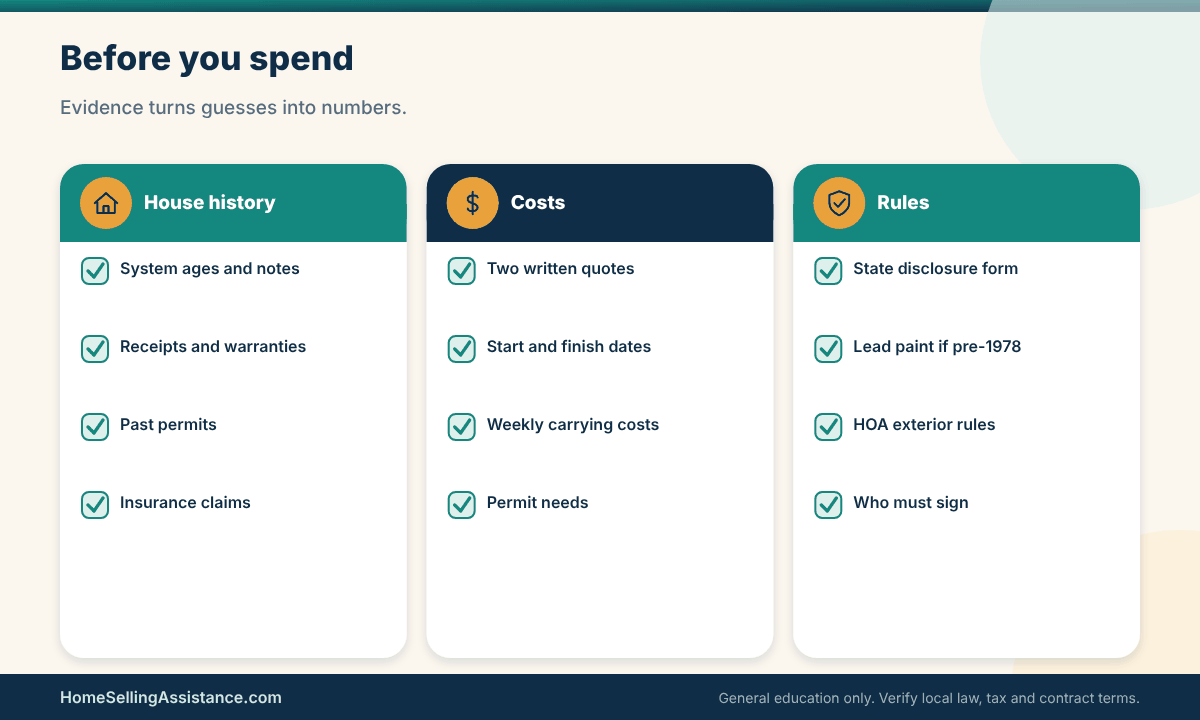
The checklist-style picture above is a reminder of the order that tends to work: confirm facts, get quotes, compare delay costs, check rules and then act. Skipping to the last step is how people end up paying twice. Do not let repairs before selling house push you into skipping the basics, such as authority to sign and an honest disclosure.
A verification roadmap for repairs before selling house decisions
By now you have a goal, a sorted list and a feel for how buyers, lenders and the market react to condition. The last stretch is about verification: turning opinions into documents, choosing the right professionals for each question, and deciding what must happen before you list versus what can safely wait for an offer. Think of it as a short project plan with owners and dates. Revisit the plan whenever new information arrives, because repairs before selling house rarely stay static for long.
The reason to be strict here is that repair decisions create records. A quote, a disclosure form, an inspection report, a text message to a contractor, an email to a buyer’s agent: each one can matter later if there is a disagreement about what was known or promised. Sellers who treat the paper as part of the job tend to have calmer closings, even when the house itself is far from perfect. Check that any warranty on repairs before selling house is transferable before you promise it to a buyer.
Documents and professionals to involve
Start with the documents, because they decide which professionals you need. The core file for condition decisions usually includes your deed and loan statement (so you know who has authority and what you owe), your insurance declarations page, receipts and warranties for major work, any permits and final inspection sign-offs, past inspection reports from when you bought, appraisal or claim papers if you have them, and your state’s seller disclosure form once you have it. If you are in an HOA community, add the governing documents and any rules about exterior changes.
Then match professionals to questions. A listing agent helps with comparable sales, pricing and how buyers in your area react to condition. A home inspector, hired before listing if you choose, tells you what a buyer’s inspector is likely to find. A licensed contractor or specialist, such as a roofer, HVAC technician, plumber, electrician or structural engineer, answers narrow questions about cause and cost.
A real estate attorney, or a title or escrow officer where those play the legal role, answers questions about disclosure, contract language and who must sign. A tax professional answers questions about basis, improvements and sale-related costs. An insurance agent tells you how the condition affects coverage.
You do not need all of them for every house. A modest home with ordinary wear may need only an agent, a handyman and a clear disclosure form. A home with water history, an estate owner or a major system failing may need several. The skill is asking the right professional the right question, and not asking a contractor for legal advice or an agent for an engineering opinion. Buyers rarely see your effort on repairs before selling house, but they do notice clear records and calm answers.
When you talk to professionals, a few scripts help. To a roofer you might say: “Please write down the cause of the leak, the area affected, the repair you recommend and the remaining life of the rest of the roof, and tell me whether a permit is needed.” To an inspector: “I am deciding what to fix before listing.
Please separate safety and structural items from maintenance items, and note anything an insurer or lender might care about.” To an agent: “Show me recent sales of homes like mine in both fixed-up and unfixed condition, and tell me how long each took.”
For the agent you can add a direct question about their own interest, since any listing agent benefits from a faster, simpler sale: “Which of these repairs would you do if it were your house and your money, and why?” Their answer will not be neutral, but it will be informative, especially if you ask two or three agents and compare. Our guide on which repairs are worth making before you sell goes deeper on the items that tend to matter most.
Be careful with professionals who also do the work. A contractor who finds a “serious” problem and immediately offers to fix it has a financial interest in the finding. That does not make them wrong, but it is a reason to get a second opinion for expensive jobs. The same applies to an inspector who also sells repair services in some places. Independent opinions are worth the extra call. Expect questions about repairs before selling house from showings, inspectors and appraisers alike, and prepare short, factual answers.
Fair housing is also part of verification. The way you describe your home and screen your buyers must never steer people by race, color, religion, sex, disability, familial status or national origin, and your agent should know this well. The HUD Fair Housing and Equal Opportunity pages explain the protections. For repairs, the practical point is simple: if you make an accessibility or safety modification, apply it consistently, and do not make decisions about who is welcome to view or buy your home.
Finally, keep one person in charge of the timeline. In many sales that is the listing agent. In a for-sale-by-owner sale, it is you. Either way, someone should maintain a running list of items, quotes, dates and decisions. A single shared document that everyone can see prevents the common problem where the contractor, the inspector and the buyer each believe a different thing has been agreed. A short list of firm limits makes decisions about repairs before selling house much easier under deadline.
Evidence to gather: the seller file, the disclosure form, and written quotes
Organize your seller file into three folders. The first holds ownership and money: deed, payoff information, tax bills, HOA statements and insurance papers. The second holds condition history: receipts, warranties, permits, old inspection reports, claim documents and photos of work done. The third holds the current decision file: quotes, notes from professionals, your sorted list and your draft disclosure. Remember that the cheapest option for repairs before selling house today is not always the cheapest by closing day.
The disclosure draft deserves special care. Write it in plain language, from your own knowledge, before anyone suggests wording. Then compare it with your state’s form. If a question on the form is unclear, do not guess. Ask a licensed professional what the question means in your state, and write the answer in your notes. Sellers who fill the form out in a hurry often leave out things they know, and those omissions are what buyers later point to.
For quotes, insist on written scope and price. A verbal estimate of a roof repair means little if the final invoice includes extra items. If a contractor will not put a scope in writing, treat that as information. Also ask whether materials are included, whether debris removal is included, and what the process is if hidden damage appears. The answers will help you compare quotes fairly. Compare options for repairs before selling house on net proceeds and timing, not on repair price alone.
The following table shows the transaction side of the same plan. It lists the stages of a typical sale, what you are responsible for at each stage, what you depend on others to provide, the kind of deadline that usually applies, and what to do if something slips. Actual deadlines come from your contract and local practice, so use the table to know which questions to ask, not to read off dates. Finally, store every record of repairs before selling house in one folder you can open in a minute.
| Stage | Seller responsibility | Buyer or professional dependency | Typical deadline | Fallback if it slips |
|---|---|---|---|---|
| Before listing | Decide repairs, gather records, complete disclosures | Agent, contractors, optional inspector | Your own listing date | List with clear disclosure and price for condition |
| Offer review | Compare price, repair terms and as-is language | Agent or attorney review of contract | Offer expiration set in the offer | Counter on terms or ask for more time in writing |
| Inspection period | Give access, answer questions, respond to requests | Buyer’s inspector and specialists | Contract inspection window | Offer credit, price change or limited repairs |
| Appraisal and lending | Allow access, address required items if agreed | Appraiser, underwriter, lender conditions | Financing and appraisal dates in the contract | Fix flagged items, renegotiate or consider other buyers |
| Agreed repairs | Complete work with receipts and permits | Contractors, buyer verification | Date set in the repair addendum | Convert remaining work to a closing credit if the buyer agrees |
| Final walk-through | Deliver the home in agreed condition | Buyer and agent inspect | Shortly before closing | Escrow holdback or credit, with written agreement |
| Closing | Review figures, sign documents, deliver keys | Title or escrow, lender, recording office | Closing date in the contract | Written extension signed by both parties |
To use the table, find the stage you are about to enter and read across. If your next stage is the inspection period, you can see that the buyer’s inspector and any specialists drive the timing, your job is access and responses, and the fallback is usually a credit, price change or limited repair. Ask your agent or attorney which of these fallbacks are common in your area and how they are documented. Many disputes arise because a fallback was agreed verbally and never written down.
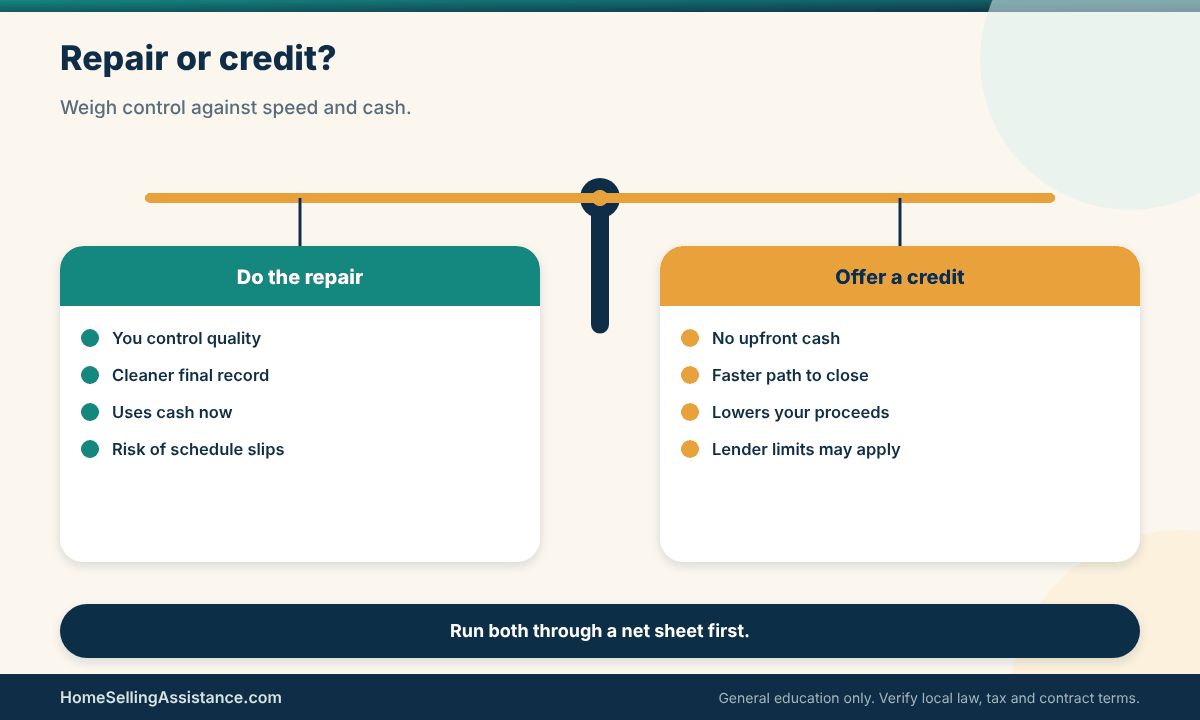
The balance picture above compares two common ways to resolve an inspection finding: you do the work, or you pay a credit and let the buyer do it. Neither side is always heavier. Doing the work gives you control and a cleaner final report, while a credit saves time and avoids rushed repairs. The right answer depends on the size of the item, how much time remains before closing, and how willing the buyer is to take on the work.
A scenario, an exception, and your next step for building the seller file
Imagine a seller named Marcus, a few days from listing. His agent asks for the seller file. Marcus finds the deed and a mortgage statement, but no paperwork for a bathroom he remodeled years ago, and he is unsure whether a permit was pulled.
He does three things: calls the county office to ask whether a permit exists, asks the contractor he used for an invoice, and writes an honest note on his disclosure draft that the work was done by a contractor and he does not know whether a permit was issued. That one note, written early, prevents an awkward surprise later.
An exception: if Marcus learns that no permit was issued, he should not quietly try to fix history on his own. In many places there are formal ways to legalize past work, and in others there are risks. Ask the permit office what the process is, then ask a real estate attorney or agent how to handle disclosure while it is pending. The goal is a truthful record, not a clever workaround.
Your next step is to assemble the three folders, even if parts are empty. Empty slots show you exactly what to hunt for, and the hunt itself often turns up useful paper in a drawer, an email account or a contractor’s records. Be as specific as you can when discussing repairs before selling house, since vague terms invite later disputes.
One more point on timing deserves a mention. Many sellers assume the best moment to deal with condition problems is right before photos, but weather, contractor schedules and permit queues often push work into the weeks you wanted for marketing. Starting the evidence gathering several weeks earlier costs nothing and leaves room to choose a path calmly. If you only find time for one early task, make it the contractor diagnosis for your largest unknown, because that single answer often decides whether the rest of the plan is simple or complicated.
What to settle before listing and what can wait for an offer
Not every decision has to be made on day one. Some choices are cheaper and safer before listing. Others become clearer only when a real buyer and a real inspection report appear. The skill is knowing which is which. There is no single right answer on repairs before selling house, only a better fit for your priorities.
Settle these before you list: any safety hazard, active leak or system that does not work; anything a lender or insurer is likely to require; your disclosure form and the facts behind it; whether you will allow a pre-sale inspection and what you will do with the results; the minimum price you would accept and the repair terms you are willing to offer; and who has authority to sign for the property. Those items shape your price, your marketing and your risk, and they are hard to fix once buyers are reading the listing.
Let these wait for an offer: large cosmetic projects whose payoff is uncertain; the choice between a repair and a credit for mid-sized findings, since the buyer’s preference and timeline will inform it; replacement of aging but working systems; and negotiation over items that an inspector flags as maintenance. Waiting keeps your cash flexible and lets the market tell you what matters. The trade-off is that it exposes you to negotiation pressure when time is short, so you should know your limits in advance.
A helpful rule of thumb is to ask, “If a buyer finds this, will they feel surprised or scared?” If yes, it belongs in the before-listing group, either fixed or clearly disclosed and priced. If a buyer is likely to shrug, it can wait. This is not a legal test, only a way to organize your effort. Your disclosure duties are set by your state, not by how a buyer would feel.
It also helps to decide your negotiation boundaries before the first offer arrives. Write down which items you would repair if asked, which you would credit, and which you would refuse. Sellers who decide these points under deadline pressure, with an inspector’s list in one hand and a closing date looming, tend to concede more than they intended. A short written plan removes the emotion and gives you a script. Check that every step of your plan for repairs before selling house has an owner and a date.
For deeper background on specific items, our guides cover whether to replace a roof before selling, whether to replace HVAC before selling, how to approach a house with foundation problems, and how to handle a house with mold. Each one walks through the same fix, disclose, credit or as-is logic for a single big-ticket item. Use the same standard of evidence for every item on your list of repairs before selling house.
Evidence to gather: what to confirm before the first showing
Before the first showing, confirm six things in writing. One, that every owner on the deed agrees with the plan and the price. Two, that your disclosure form is complete and reviewed by a licensed professional if you have any doubt. Three, that major safety items are fixed or clearly documented. Four, that you have recent photos of any completed work. Five, that you know your payoff and your minimum acceptable net figure. Six, that your insurance remains active and you understand any vacancy rules if the home will be empty.
Add a seventh item if the home was built before 1978: confirm that you have the federal lead-based paint disclosure materials ready, including the EPA pamphlet. This is a federal requirement for most sellers of homes of that age, and your agent or attorney should be able to supply the standard forms. The sooner you decide on repairs before selling house, the more options you keep open.
These checks take an afternoon and prevent weeks of trouble. They also give you something solid to point to if a buyer later claims you did not mention a problem. A complete file does not guarantee a smooth sale, but it makes your position clear and your actions defensible. Treat repairs before selling house as a project with a start date, an end date and a named person in charge.
A scenario, an exception, and your next step for timing decisions
Take a seller who lists in a busy season and receives two offers within days. One offer is slightly higher but asks for several repairs after inspection. The other is slightly lower, as-is, with a short inspection window. If the seller has already decided which repairs they would do and which they would refuse, the comparison is quick: the higher offer may shrink once repair requests are handled, while the lower one may hold. Without that homework, the seller would be guessing under pressure.
An exception arises when the market turns slow mid-listing. Items you once planned to leave for negotiation may become reasons buyers pass entirely. In that case it is reasonable to revisit your list, possibly fix a few visible items or adjust the price, and ask your agent what recent buyers have objected to. Your plan should be a living document, not a vow. Staying honest about repairs before selling house is both the ethical choice and, in many states, the legally safer one.
Your next step is to write your negotiation boundaries on one page: repair if asked, credit if asked, refuse. Share it with your agent or attorney, and keep it private from buyers. Update it whenever your timeline or the market changes. If a number looks too good to be true on repairs before selling house, ask for it in writing and get a second opinion.
Before we close the roadmap, it is worth walking through the moment most sellers dread: the day an inspection report arrives and it is longer and scarier than you hoped. Having a plan for that day is one of the most valuable things this guide can give you, because the choices you make in the following forty-eight hours often decide whether the sale survives. The picture below shows one way to organize the decision when a buyer’s inspection finds something significant.
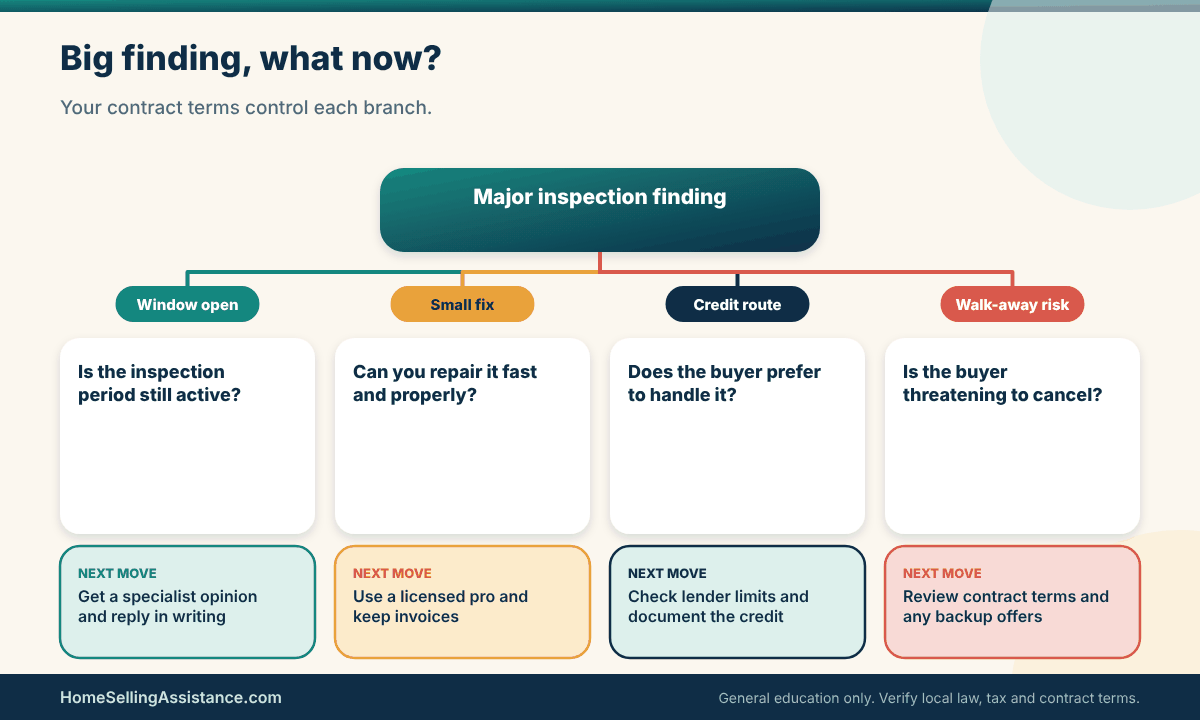
The branches in that picture are not legal categories. They are practical questions. Is the item still open to negotiation under the contract’s inspection terms? Has the buyer’s deadline passed? Do you have another buyer waiting? Is the problem something you can fix quickly? Your purchase contract controls the answers, so read the inspection and repair sections with your agent or attorney before you reply to anything. The deeper article on repair credits and seller repairs walks through typical responses.
Start by reading the entire report once without reacting. Then highlight only the items in the first group we described earlier: safety, water, structure, and anything that could stop financing or insurance. Ignore the rest for a day. Buyers often send a long list as an opening position, and the items that truly matter are usually few. A calm, organized response signals that you are reasonable and that the sale is worth completing.
Next, decide how you will respond item by item. For each significant finding, you have four responses: agree to repair, offer a credit, offer a price adjustment, or decline. Which one you choose depends on the cost, the deadline and the buyer’s priorities. A buyer using a loan with strict condition rules may need repairs rather than a credit. A buyer paying cash may prefer a credit and handle the work later. Ask your agent what the buyer’s side has signaled.
If you agree to repairs, put the details in writing: who performs the work, what standard it must meet, by what date, and how the buyer can verify it. Vague promises such as “seller will fix the roof” cause disputes. A better version names the scope, requires a licensed contractor where applicable, and attaches the invoice at closing. If time is short, a credit or an escrow holdback agreed in writing may be cleaner, but the mechanics depend on the title company and the lender, so ask them what they accept.
If the buyer is asking for more than seems reasonable, you can respond with evidence. A quote from your own contractor that is lower than the buyer’s number, an engineer’s letter explaining that a crack is cosmetic, or a service record for an aging system can change the conversation. You are not trying to win an argument. You are trying to replace fear with facts, which is often enough to bring the number down.
Finally, keep the larger goal in view. A modest credit that saves a sale is usually better than a stubborn refusal that sends a buyer away when your own timeline is firm. On the other hand, giving up everything to keep one deal can leave you with less than a patient re-listing would have. Your written priorities from the start of this process are the tiebreaker. Think of each decision about repairs before selling house as reversible until you sign a contract or pay a deposit.
Common mistakes with repairs before selling house plans, and how to spot them
Experience across many closings shows the same mistakes appearing again and again. Knowing them in advance is a cheap form of protection.
The first mistake is over-improving. A seller spends on high-end finishes that the neighborhood does not reward, then cannot recover the cost. You can spot it when a project’s price is large compared with anything buyers in your price range expect. Comparable sales and a candid agent opinion help here. After you list, keep updating your notes on repairs before selling house with what buyers actually say.
The second is under-disclosing. A seller fixes a problem and then leaves the history off the form, assuming that a repaired defect is no longer a defect. Many states still ask about known past problems. Buyers who find out later may feel misled, and that feeling can become a legal dispute. If you know about it, ask a professional how it should be described. Buyers’ feedback after showings can tell you whether repairs before selling house are worth revisiting.
The third is relying on unlicensed or unpermitted work. A quick fix by a friend may look fine and cost little, but it can fail a buyer’s inspection, create insurance trouble or require removal. Where licensing and permits are required, use them, and keep the paper. The cost of doing it properly is usually less than the cost of redoing it under deadline. Stay flexible, because repairs before selling house sometimes need to change after an inspection or an appraisal.
The fourth is cosmetic cover-ups. Fresh paint over a stain, a new floor over a damp slab, or a rug over a squeaky, sagging area can hide evidence without solving the cause. Inspectors have seen these tricks many times, and so have moisture meters. A concealed defect that you knew about is the kind of thing that leads to real trouble. Fix the cause, or disclose it plainly. A written summary of repairs before selling house also helps if you later need to explain your choices to a lender or a co-owner.
The fifth is paying for a pre-listing inspection and then ignoring the findings. Once you know, you generally cannot claim you did not. If you order an inspection, plan in advance how you will handle what it finds, including whether you will share the report with buyers, a choice that varies by strategy and by state practice. Neighbors can offer opinions on repairs before selling house, but their houses and timelines are not yours.
The sixth is losing time. A project that overruns can cost more than the project itself. Set a firm decision date for each item, and if a contractor cannot meet the schedule, change the plan rather than hoping. Prioritize safety and water first in any plan for repairs before selling house, then move on to appearance.
The seventh is skipping the owner conversation. When a home has more than one owner, an estate, a trust or an agent acting under power of attorney, authority to spend and to sign must be clear. Confirm it before the first dollar goes out. Our category pages on disclosures and seller paperwork collect more on who has to sign what. Be wary of any advice on repairs before selling house that ignores your state, your price range or your deadline.
Evidence to gather: red flags in quotes, reports, and promises
Red flags are easier to spot when you know what normal looks like. A normal quote has a written scope, a total price, a payment schedule tied to progress and a license or registration number where required. A worrying quote has a large deposit demand, pressure to decide the same day, vague wording, or a price far below every other bid. The Federal Trade Commission and the Consumer Financial Protection Bureau both publish guidance for homeowners, and the CFPB’s consumer pages are a good place to start for questions about financing home work.
A normal inspection report lists many items, categorizes some as safety or major concerns, and recommends specialists for a few. A worrying report is vague, alarmist about everything or makes sweeping claims without evidence. If a report seems exaggerated, a second opinion from a qualified specialist can calm the situation. It helps to keep a dated log of every conversation about repairs before selling house.
A normal buyer request names specific items, asks for reasonable remedies and sets a deadline that matches the contract. A worrying request demands sweeping repairs, changes terms without writing them down, or threatens to cancel for minor findings. In those cases, your agent or attorney can help you reply in a measured, written way that preserves your rights. Fair, consistent treatment of all buyers matters while you discuss repairs before selling house, and your agent can help with that.
A scenario, an exception, and your next step for avoiding costly mistakes
Consider a seller who notices a damp patch on a basement wall two weeks before listing. The tempting move is to paint it. The better move is to find out why it is damp. A drainage fix may be simple and cheap. A foundation issue may need an engineer. Either way, the seller documents the finding, fixes or discloses it, and avoids a story that starts with a buyer’s moisture meter and ends in a lost trust. Sellers who follow the better path usually spend somewhat more early and far less later.
An exception: if the damp patch appears only after unusual weather and your professional says the cause is minor, a disclosure with details of the observation and the fix may be enough. The point is not that every damp spot is a disaster. The point is to know the cause and keep the record. Ask what changes in repairs before selling house plans if the buyer uses a loan with stricter condition rules.
Your next step is to review your list against the seven mistakes above and mark any that apply to your plan. Then adjust. It takes ten minutes and can save weeks. The best time to talk about repairs before selling house with your agent is before photos and pricing are set.
A few words about selling as-is, since it appears so often in this topic. Selling as-is generally means you are not offering to make repairs after the buyer’s inspection. It does not usually mean you can hide known problems, and it does not automatically make the house sell faster. Some buyers love the clarity, some lenders have rules that can complicate it, and some buyers will simply price in the unknown generously. Our in-depth guide to selling a house as-is covers how the language works and the trade-offs.
Cash buyers and investors are a related option for sellers who cannot or will not repair. They often buy in present condition and may close quickly, with the trade-off that offers are usually discounted to cover their work and risk. Compare any such offer with your net from a conventional sale after repairs, credits and fees, and verify proof of funds. The overview of a cash offer for a house seller explains how to compare them fairly without assuming that cash is always better or worse.
Renovation before selling is a bigger version of the same question. If you are considering a major project, such as a kitchen or bathroom update, you are no longer making repairs but investing in improvements, and the logic is different. Our guide on renovating before selling versus selling as-is offers a framework for comparing the cost, time and risk of each. Improvements may also affect your tax basis, which is another reason to keep receipts and ask a tax professional.
A final word on closing costs and net proceeds. Whatever path you choose, the number that matters is what you keep after the mortgage payoff, fees, credits and prorations. A repair that costs a few thousand dollars may be better than a credit of the same size, or worse, depending on how it affects price and timing. Build a simple net sheet for each path using real quotes, and review our overview of seller closing costs so you know which line items to include.
Quick scenario
Illustrative round numbers only. A seller expects an offer near a certain price. The inspection finds a failing water heater and a rotting section of siding. The seller can repair both before closing, give the buyer a credit equal to the quotes, or lower the price. On paper the three options look similar, but they differ in timing, financing rules, who controls quality and what the closing statement shows. Compare the net figure and the deadline, not just the repair cost.
To make the comparison concrete, here is a simple worked example with invented figures that you should replace with your own. Suppose a contract price of an even round number, a repair quote of a few thousand dollars for the siding and a smaller quote for the water heater. If you repair, you pay the contractors from your own funds before closing, so your net at closing stays roughly the same but your cash is out earlier.
If you credit, the buyer receives the quoted amount at closing, which reduces your net by that amount, but you spend no cash up front and avoid the schedule risk.
Now add the details that people forget. Repairs done by you may carry a warranty and let you control quality, but they delay closing if the work slips. A credit lets the buyer choose the contractor and timing, though some lenders limit how large a credit can be or require certain repairs to be completed first.
A price reduction is simplest on paper, yet it can affect the appraisal and the loan amount, and it changes the base number used for some closing costs and prorations. None of these effects is large in every case, which is exactly why you should ask your title or escrow officer how each version would appear on the final statement.
Build a one-page net sheet for each path. List the contract price, the loan payoff, the expected agent and title charges, the repair or credit amount, and any prorated taxes or HOA dues, then subtract to reach the net. Use real quotes for repairs and real payoff figures from your lender. Sellers who do this exercise are often surprised that a modest repair beats a credit, or the reverse, depending on the specific numbers and how much time is left. It is arithmetic, not opinion, and it takes less than an hour once you have the quotes.
One more habit is worth building. After every conversation with a professional, send a short written summary by email: “Thanks for the call. My understanding is that you recommend X, the estimate is Y and the work would take Z.” Written confirmations create a record, reveal misunderstandings early and keep everyone aligned. If you work with an agent, ask that your agent also keeps a log of buyer requests and your responses, so the final file is complete.
Taking care of repairs before selling house plans is ultimately an exercise in staying organized under mild pressure. The sellers who feel best at closing are rarely the ones who spent the most or the least. They are the ones who knew their priorities, collected evidence, told the truth, wrote things down and chose among the four paths on purpose. If you have done those five things, you have done most of the work, whatever the final repair list looks like.
Frequently asked questions about repairs before selling house
Do I have to make any repairs before selling my house?
In most places there is no blanket rule that says every defect must be fixed before a sale, but several things can effectively require action. Buyer financing, insurance and local safety codes can make certain repairs necessary for a deal to close. Disclosure duties also apply whether or not you fix something. Ask your state real estate commission, agent or attorney which rules apply to repairs before selling house plans where you live.
Which repairs are usually worth doing first?
Safety, water and structural items tend to come first, because they affect inspections, lending and insurance. Think active leaks, unsafe wiring, missing handrails, non-working heat and obvious moisture problems. Cosmetic work like paint, deep cleaning and decluttering often costs little and helps photos and showings. Large upgrades are different, since their payoff varies by neighborhood and season, so test them against comparable sales.
Should I get a pre-listing inspection?
It can be useful if you suspect hidden problems or want to avoid surprises after an offer, but it is a real decision with trade-offs. You pay for it, and once you know about a defect you generally must treat it as known. Some sellers share the report with buyers and some do not, and local practice varies. Our guide on the pre-listing home inspection explains how to decide.
What does selling as-is actually mean?
Usually it means you will not make repairs or give credits after the buyer’s inspection. It generally does not erase your duty to disclose known material problems, and the legal effect of the phrase varies by state and by contract wording. Some buyers and loan programs are less comfortable with as-is sales. Read the actual clause with a licensed professional before relying on it.
Is a repair credit better than doing the repair myself?
Neither is always better. A credit saves time and avoids rushed work, but it reduces your proceeds and some lenders limit how credits can be used. Doing the repair gives you control and may produce a cleaner inspection record, but it uses your cash and your calendar. Run both through a net sheet using real quotes before you answer a buyer.
Do I need to disclose a problem I already fixed?
Often you do, or at least you should ask. Many state disclosure forms ask about known past problems, repairs and insurance claims, not just present defects. Describing what happened, what was done and who did it is usually safer than silence. Check your state’s form and ask your agent or attorney how to word the answer.
Can unpermitted work stop a sale?
It can complicate one. Buyers, lenders, appraisers and insurers may ask about permits, and unpermitted work can lead to requests for corrections, price changes or a smaller buyer pool. Start by asking your county permit office what options exist for the work you did. Then ask a licensed professional how to disclose the situation accurately.
Are there tax effects of repairs and improvements?
There can be. In general, lasting improvements may affect your cost basis, while ordinary repairs usually do not, and some sale-related fix-up costs may be treated differently. Your own facts matter, including how long you owned and lived in the home. Read IRS Publication 523 and speak with a tax professional.
How do I choose between a cash offer and repairing for a regular sale?
Compare your expected net from each path, not the headline prices. A conventional sale after repairs may bring a higher price with more time and effort, while a cash offer may skip repairs and close faster at a discount. Verify the buyer’s proof of funds and read the contract terms carefully. Both can be reasonable depending on your priorities.
What if the inspection finds something much bigger than I expected?
Stay calm, read the contract’s inspection terms and get a specialist’s opinion on the largest items. Then respond in writing with a repair, a credit, a price change or a refusal, depending on cost, time and the buyer’s needs. Having your negotiation boundaries written down beforehand makes this much easier.
Make the repair decision on purpose
Handling repairs before selling house is less about spending and more about choosing: what to fix, what to disclose, what to credit and what to leave. Gather your evidence, keep honest records, and ask the right professionals the right questions. This article is general education, not legal, tax or financial advice, and rules vary by state, so confirm the details with a licensed agent, attorney, tax professional or your state’s real estate commission before you act.