Yes, you can sell house with mortgage debt still attached to it, and millions of homeowners do exactly that every year, because almost nobody owns a home free and clear on the day they list it. The loan does not block the sale. It simply gets paid off from the money the buyer brings to the closing table, and whatever is left after that payoff and the other costs of selling is yours.
The part that worries people is the word “left.” If your home is worth comfortably more than you owe, the process feels almost routine: your title or escrow company asks your lender for a payoff figure, wires that amount at closing, and sends you the difference. If your equity is thin, or if the market softened after you bought, the same process can feel like a trap door. That is why this guide to sell house with mortgage debt spends as much time on arithmetic and risk as it does on paperwork.
We will walk through the numbers that matter, the promises you still owe your lender while the house is on the market, the fees and credits that nibble at your proceeds, and what actually happens when a sale will not cover the loan. Along the way you will see worked examples built from clearly labelled round numbers. They are not predictions about your house or your lender, only a way to see how the pieces fit together.
One honest limit before we start. Loan documents, state closing customs, lender procedures and tax rules differ, and this article cannot read your note or your contract. Treat it as a map. Your payoff statement, your closing statement and a licensed professional in your state are the ground truth.
Key takeaways
- Owing money does not stop you from being able to sell house with mortgage balances. The mortgage is paid from the sale proceeds at closing, and the lender then releases its lien on the property.
- Your payoff is not your loan balance. It includes interest accrued up to the payoff date and sometimes fees, so request a written payoff statement early and refresh it near closing.
- Equity is a range, not a number. Sale price minus payoff minus selling costs, credits and prorations gives your real cash, and every one of those inputs can move.
- Keep paying until the loan is actually paid off. Missed payments during a listing can add late fees and credit damage and can complicate the closing.
- If the sale will not clear the loan, talk to the lender before you accept an offer. Short sales, bringing cash to closing and loan workouts are different paths with different consequences that vary by state and contract.
If you are earlier in the process and want the full sequence from decision to keys, the complete guide to how to sell a house covers every stage at roadmap level. This article zooms in on one slice of it: the loan, the payoff and the money.
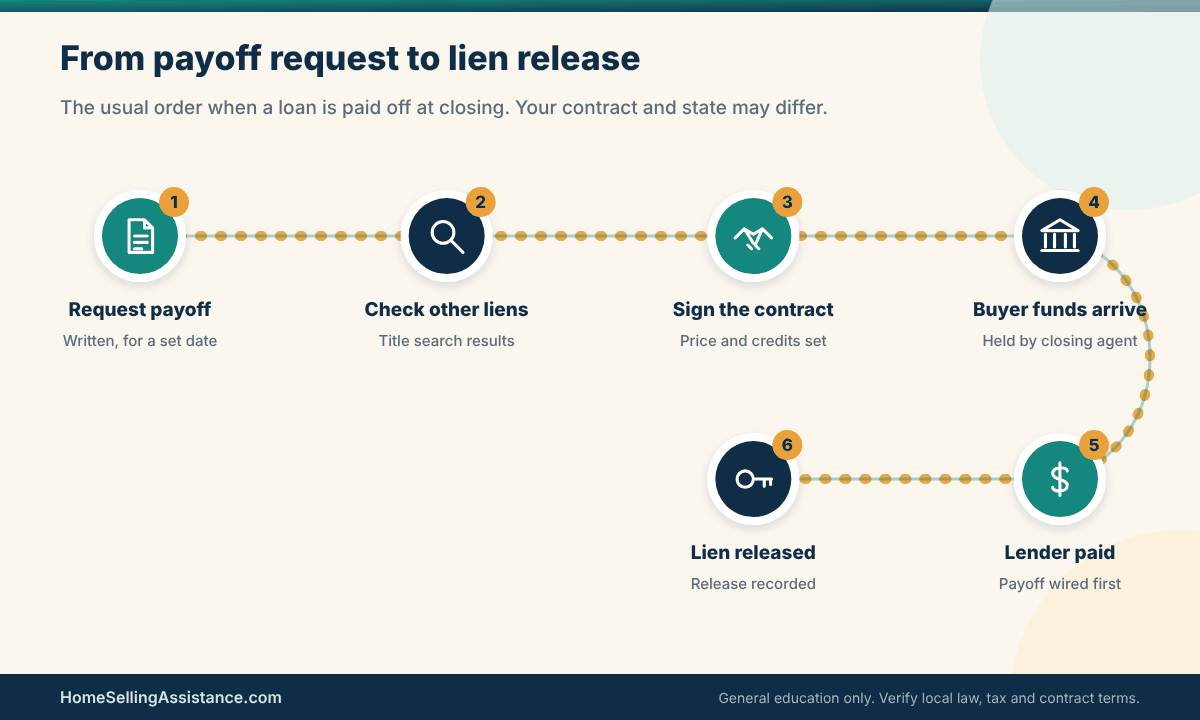
Before you sell house with mortgage debt: start with payoff and cash flow
Most people who sell house with mortgage loans begin with a list price and work forward. Lenders, title companies and closing agents think in the opposite direction. They start from what must be paid off and ask whether the buyer’s money covers it. If you adopt that backward view early, you will make better decisions about price, timing and even which offers to accept.
The picture above shows the basic flow. A buyer’s funds arrive at closing, the loan payoff comes off the top, other costs follow, and your net proceeds are whatever remains. Nothing about that sequence is unusual when you sell house with mortgage debt, but each step has details that can surprise you.
The numbers that decide your cash at closing
Four inputs control almost everything: the sale price, the payoff amount, the costs of selling and any credits or adjustments negotiated along the way. People tend to know the first one best and the second one worst, which is backward, because the payoff is the only input you can pin down with a document today.
Your monthly statement shows a principal balance, and it is natural to treat that as the amount you owe. It is close, but it is not the payoff. Interest on most home loans accrues daily and is paid after it accrues, so the payment you made last month covered the interest from the month before. On the day of closing there is usually some stretch of unpaid interest sitting on top of the principal, and the payoff has to include it.
Evidence to gather: payoff statement, escrow and per diem
Ask your servicer, in writing, for a payoff statement for a specific closing date. Many servicers offer an online request tool, and your title or escrow company will also request one directly once the contract is signed. Anyone who wants to sell house with mortgage numbers in hand can ask for one earlier, and doing so before you list gives you a firm figure to build a price floor around.
The consumer-protection agencies publish plain-language material on mortgage servicing, and the Consumer Financial Protection Bureau is a sound place to read about your rights when you ask a servicer for documents.
Look for three things on the statement. First, the good-through date, because a payoff figure is only valid up to a certain day. Second, the per diem, which is the daily interest amount added if closing slips past that date. Third, any itemized fees, such as recording or statement charges, that are bundled into the total. Keep the statement with your other papers; the documents needed to sell a house list is a useful checklist for the rest of the pile.
If you pay property taxes and insurance through an escrow account, remember that this account is a separate pocket. The cash sitting in it is not subtracted from your payoff. After the loan is paid off, the servicer typically refunds any remaining escrow balance to you, often a few weeks later, so treat it as a delayed bonus rather than part of closing-day cash. Ask your servicer how and when that refund is issued.
A scenario, an exception, and your next step on a thin-equity sale
Picture a homeowner who bought a few years ago with a small down payment, and who now sees comparable homes selling for roughly what they paid. Here is an illustration with round numbers: a likely sale price of $300,000, a payoff of $270,000 and selling costs of around $27,000 once agent compensation, title charges and transfer costs are counted. That leaves about $3,000 before moving costs, and any price reduction or repair credit pushes it toward zero. These figures are examples only; your own costs may be lower or higher.
The exception to watch for when you sell house with mortgage plus other debt is any lien beyond the first mortgage. A home equity line, a second loan or an unpaid tax or contractor lien must also be cleared from proceeds, and it changes the arithmetic sharply. The guide to selling a house with a lien explains how those claims are found and settled.
Your next step in a thin-equity situation is to build a floor price before you list: the lowest sale price at which you walk away with zero shortfall, given your real payoff and realistic costs. Knowing that number turns every later offer into a simple comparison instead of a stressful guess.
Here is one way to build that floor. Take your payoff figure, add every other lien you know about, then add a realistic block for selling costs and a cushion for credits. The total is your break-even price. Many people who plan to sell house with mortgage balances close to their value discover that the break-even sits uncomfortably near the neighborhood’s recent sale prices. That is useful news at the start, because it tells you to shorten the timeline, trim extras and rank offers by certainty.
If the break-even sits well below any realistic price, you have room to think about other goals: a faster sale, a flexible closing date or a smoother move. Equity buys options. Sellers who want to sell house with mortgage debt and still keep flexibility usually owe that flexibility to a cushion they measured before listing, not one they assumed.
Timing and liquidity constraints when a loan is still open
Selling is not instant, and your mortgage is not on pause while you wait. From listing to closing you may owe several monthly payments, plus utilities, insurance, upkeep and possibly a second set of housing costs if you have already moved or bought. When you sell house with mortgage payments still due, liquidity, meaning how much cash you can reach without selling the house, often matters more than equity on paper.
A seller with plenty of equity but no spare cash can still be squeezed. Repairs requested by a buyer, a gap between move-out and closing, or a deposit on the next home all need money before the sale proceeds arrive. Mapping those cash needs on a calendar is a quieter, more useful exercise than staring at the list price.
What the lender expects from you until the day of closing
When you sell house with mortgage obligations, your duties under the loan continue until the payoff is received. That means the monthly payment keeps coming due on schedule, even if you have signed a contract and the closing is two weeks away. A payment due the day before closing is still due. Ask your closing agent whether the payoff statement already accounts for a payment you are about to make, so you do not overpay or leave a gap.
Insurance matters here too. Most lenders require continuous homeowners coverage until the loan is satisfied, and an empty or newly vacant house can trigger special conditions on a policy. If you are planning to move out before the closing, read the guide to moving out before selling and call your insurer to confirm what a vacancy does to your coverage.
If money is already tight and a payment looks at risk, call the servicer before it is late, not after. Servicers have workout and forbearance procedures, and the earlier you raise the issue, the more options exist. A late payment does not cancel your ability to sell, but it can add fees to the payoff and complicate the closing timeline.
When the closing date and your next purchase collide
Many people who sell house with mortgage balances are also buyers. If you plan to use your equity as a down payment on the next home, you are depending on the proceeds arriving before you must pay. That creates timing risk, because the sale might close later than hoped or for less than expected. The full trade-offs live in the sell first or buy first guide, and the broader schedule is covered in the home selling timeline.
Bridge loans, home equity lines drawn before listing and rent-back arrangements are all tools people use to smooth the overlap. Each one adds its own cost and its own risk, and a line of credit on the house you are about to sell becomes another payoff you must settle. If you are weighing one of these, read the lender’s terms on early repayment before you commit.
Talk to the lender early about how they handle payoffs for a pending sale. Some servicers have a dedicated payoff department with a standard turnaround, and some require a signed authorization from you before they will release figures to a title company. A short phone call at the start of the listing, rather than the week of closing, removes a surprising number of last-minute delays. The seller checklist before listing includes this call alongside the other early tasks.
A practical habit helps: write down the earliest and the latest realistic closing dates and ask, for each, whether you could cover every payment and deposit you owe between now and then without the sale proceeds. If the answer is no for the late date, you have found the weak spot in your plan while it is still cheap to fix.
To pull the first section together, the table below is a seller money matrix. Use it as a worksheet for your plan to sell house with mortgage payoff included: for each input, write down your own number, note where it came from, and mark whether it is a firm document figure or a guess. The “uncertainty” column is the one most people skip, and it is the one that tells you where to spend your effort.
| Input | Assumption or source | Cash-flow or tax effect | Uncertainty | Verification document |
|---|---|---|---|---|
| Sale price | Recent comparable sales and offer terms | Largest driver of proceeds | High until an offer is signed | Comparable sales report; purchase contract |
| Mortgage payoff | Principal plus accrued interest to closing date | Comes off proceeds first | Low once a dated payoff is in hand | Written payoff statement with per diem |
| Second loan or credit line | Balance plus interest and any closing fee | Reduces proceeds dollar for dollar | Medium if the line is still being used | Lender payoff letter; title commitment |
| Selling costs | Written compensation terms, title, escrow, transfer charges | Reduces proceeds; varies by contract and state | Medium until the closing statement | Listing agreement; estimated closing statement |
| Credits and repairs | Negotiated after inspection or appraisal | Lowers cash at closing | High before the inspection period ends | Signed amendment or repair addendum |
| Taxes on any gain | Ownership and use history; basis records | May reduce or remove taxable gain | Depends on your facts | IRS Publication 523; your tax records |
Read the table from top to bottom as the pecking order whenever you sell house with mortgage liens attached. The payoff and any other liens are paid before you see a dollar, so they set your floor. Selling costs and credits then shave the middle, and taxes, if any, arrive later when you file. If you are thinking of the table as a spreadsheet template, our deeper walkthrough of home sale net proceeds builds the same picture with more line items.
One habit makes this worksheet far more useful: date every entry. A payoff figure from last spring, a price estimate from an online tool and a repair guess from a friend are three very different kinds of evidence. When you sell house with mortgage obligations behind the scenes, an estimate you cannot trace to a document should be treated as a placeholder, and you should be ready to replace it before you make a decision that depends on it.
Total financial risk when you sell house with mortgage balances
Once the basic arithmetic is clear, the next question is how wrong it can go. The honest answer is that most sales land close to the plan, a few land much better, and a small number go sideways in ways the seller could have seen coming. The goal of this section is to help you spot the sideways ones early.
Risk when you sell house with mortgage debt comes from two places. The first is cost leakage: small fees, credits and adjustments that each look harmless and together move your proceeds by thousands. The second is the shortfall, where the sale simply does not generate enough to pay the loan. We take them in that order.
Fees, credits, carrying costs and taxes on the way out
Selling costs are not a single fee, and that holds whenever you sell house with mortgage balances. They are a bundle of charges that different parties assess for different reasons, and some of them depend on the contract you negotiate rather than on any standard schedule. Because customs vary by state and even by county, the only reliable figures are the ones on an estimated closing statement prepared for your transaction.
Carrying costs are the quiet part. Every month the house stays unsold, you pay interest, taxes, insurance, utilities and maintenance. Those costs do not appear on the closing statement, yet they reduce the real value of a slow sale just as surely as a lower price would.
Reading the line items: what the closing statement will show
If you sell house with mortgage balances, expect to see the mortgage payoff first, usually as a single line with the lender’s name. Below it you will often find compensation for the brokers involved in the sale, title and escrow or settlement charges, recording or transfer fees, any prorated property taxes or association dues, and credits to the buyer.
Which items appear, and who pays them, depends on your state, your contract and local custom, so ask your closing agent for a draft well before signing day. The seller closing costs guide goes line by line, and how to read the seller closing statement shows what each section means.
Prorations deserve a special mention if you sell house with mortgage escrow accounts. If your taxes are paid through escrow, the escrow account handles the lender side, but the contract still divides the tax year between you and the buyer. You may owe the buyer a credit for taxes you have not yet paid, even though your escrow account holds money for that bill. The cash in escrow comes back to you from the servicer later, which creates a temporary mismatch between what you owe at closing and what you receive afterward.
Compare the estimated statement to the one you receive shortly before closing. Small differences are normal, since interest, per diem and prorations move with the date. A large unexplained jump is a reason to ask questions before you sign, and a reputable closing agent will walk you through each line. If something still looks off, the closing statement guide and your own contract are the next places to check.
Prepayment terms, second liens and other surprises
Most modern home loans can be paid off early without a penalty, but not all, and a few older or specialty loans carry one. Read the note you signed, or ask the servicer in writing whether any prepayment charge applies if you pay the loan off on your target date. Do this before you list, because an unexpected charge changes your floor price. Similarly, ask whether any mortgage insurance refund is owed back to you and how it is handled, since that varies by loan type and servicer.
Second liens are the most common surprise for anyone trying to sell house with mortgage and equity-line debt. A line of credit opened years ago for a kitchen remodel and barely touched since still shows up in the title search, and the lender will want it paid and often closed. If you have one, make that lender part of your plan on day one. Your title company’s early search, described in more detail in the mortgage payoff when selling house guide, will reveal anything you forgot.
Another early question for the title company is how and when the lien release is recorded after payoff. Practices differ by state: in some places the lender sends a release to the county recorder within a set period, and in others the title company handles the recording. You will not usually need to chase this yourself, but you should know what to expect, and you should keep the confirmation letter the lender sends you. It is proof that the loan is satisfied if the question ever comes up again.
Finally, remember that a few loan types behave differently. A reverse mortgage must be repaid when the home is sold, and some government-backed loans may be assumable by a qualified buyer, which changes the conversation entirely. Neither is automatic, and both need written lender confirmation. If you hold either type, speak with your servicer and a housing counselor early, because the standard payoff-at-closing script may not fit.
Inherited and shared homes add their own twists. If a loved one’s loan is still open, the guide on an inherited house with a mortgage explains who can talk to the servicer and how the payoff usually works. If two people are on the loan and their relationship has changed, the article on mortgages during a divorce sale covers why both names matter at closing. In both cases, anyone who plans to sell house with mortgage ties like these should expect extra paperwork and plan extra time.
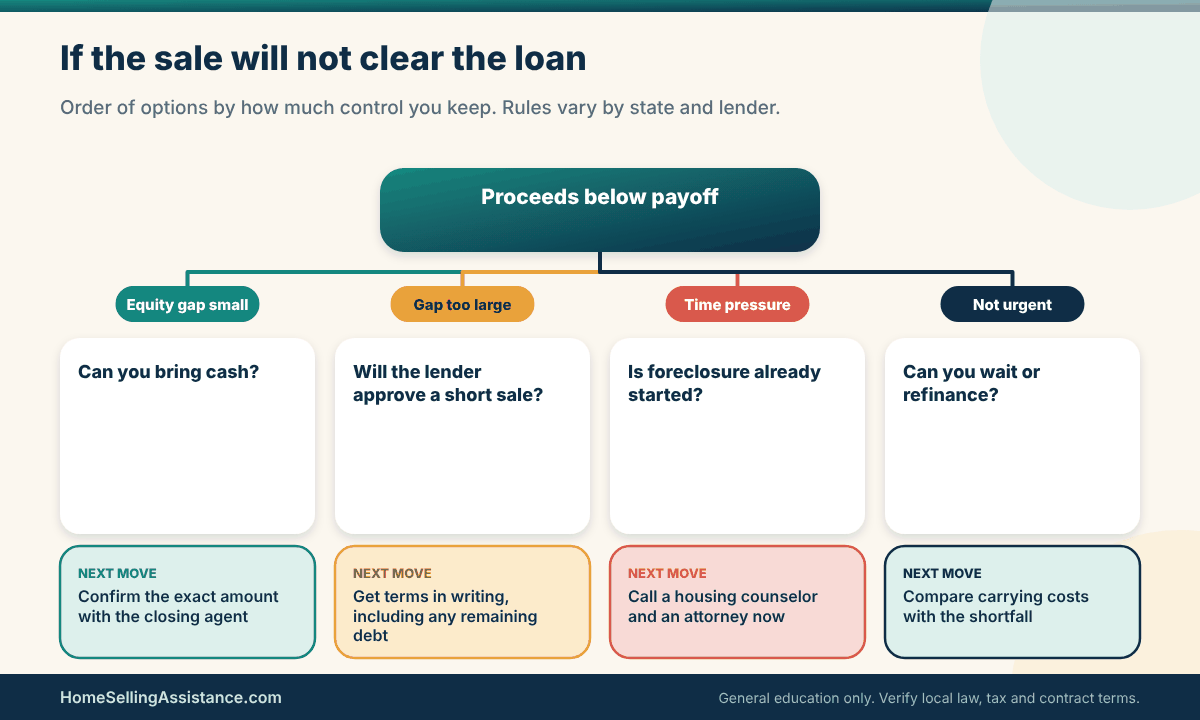
Shortfall, fallback and collateral risks in a sale
A shortfall, when you sell house with mortgage debt, happens when the sale price, after costs, is less than the total you owe against the property. It is the scenario people fear most, and it is also the scenario where early action changes the most. The picture above lays out the fallback logic: start with the numbers, then move down the options in order of how much control you keep.
The home itself is the lender’s collateral. That fact gives the lender a strong voice in anything that might leave the loan only partly repaid, and it explains why most lenders will not release their lien unless they are paid in full or have agreed in writing to accept less.
How a shortfall shows up and who has to cover it
Sellers who sell house with mortgage debt usually discover a shortfall in one of three ways. A pricing review shows that comparable homes sell for less than you owe. An offer arrives that is lower than your floor. Or a repair credit or appraisal problem erodes a price that looked safe. In each case of trying to sell house with mortgage debt this size, the closing agent will tell you what the lender needs, and the lender will not release its lien for less unless it agrees to do so.
If the proceeds fall short, the seller can bring cash to the closing table to cover the difference, which some sellers do when they have savings and a strong reason to sell. Alternatively, the seller can ask the lender to approve a short sale, meaning the lender agrees in writing to accept less than the full balance. Whether the lender can later pursue the remaining amount, called a deficiency, depends on state law and on the exact terms the lender approves. Nobody should assume the answer; ask for it in writing and run it past a local attorney.
The tax side is a separate question. In some situations, debt a lender forgives can be treated as income, and certain exclusions may apply. The rules are technical and have changed over time, so start with the IRS guidance on selling your home and a qualified tax professional rather than any rule of thumb you find online.
Options when the sale will not clear the loan
If you must sell house with mortgage trouble looming, start by getting more information, not by panicking. Ask the servicer what hardship programs they offer, whether any repayment plan or modification fits your situation, and what their short-sale process looks like. Learn who must approve a short sale, how long approval typically takes and what documents they want. The short sale guide for sellers and the article on an underwater mortgage go into the process step by step.
If a foreclosure notice is already on the table, timing becomes the central issue. The rules on how long you have, and what a sale can still accomplish, differ by state and by loan. See the article on how to sell a house before foreclosure and the wider foreclosure and hardship category for related reading. A HUD-approved housing counselor is a free or low-cost resource; you can locate one through HUD’s counselor search.
One warning applies in every distressed situation. People who contact you offering to “rescue” your home, especially if they ask for upfront fees or for you to sign over the deed, may be running a scam. The FTC’s consumer site describes the common patterns. Verify anyone who contacts you, and talk to your lender or a counselor before signing anything.
Counselors and servicers will ask for documents, and having them ready speeds everything. Typical requests include recent pay stubs or income proof, bank statements, a hardship letter explaining what changed, and the most recent mortgage statement. Prepare a simple timeline of events in your own words: when income dropped, what you have tried, and what you hope to do. A clear, honest summary helps a decision-maker see a path. Nobody can promise an outcome, but a prepared file avoids avoidable delay for anyone trying to sell house with mortgage trouble in the background.
Quick scenario
A seller lists at a price that looks safe, accepts an offer, and then learns after the inspection that the buyer wants a credit. The credit alone turns a small profit into a small shortfall. Because the seller had already calculated a floor price, the decision takes ten minutes: counter with a smaller credit or a repair, and if the buyer will not move, decide whether to bring a modest amount of cash or let the contract lapse and relist. Without the floor, the same seller would have spent days guessing.
Worked scenarios for the sell house with mortgage question
Abstract advice about how to sell house with mortgage payoffs only goes so far. Numbers make the mechanics visible, so this section runs two scenarios with explicit assumptions. Every figure is an illustration chosen for easy arithmetic. None of it reflects typical costs in any market, and none of it is a forecast for your home.
The aim is not to predict your outcome. It is to give you a template you can fill with your own payoff statement, your own contract terms and your own local quotes, so that the next time someone says “you should net plenty,” you can check.
A worked example with round, illustrative numbers
To see how a plan to sell house with mortgage payoff works, assume a house under contract at $400,000. The principal balance on the first mortgage is $280,000, and the lender’s payoff statement for the closing date shows $281,200 once accrued interest is included. The seller agreed in writing to total broker compensation of $20,000, a round figure used only for the arithmetic. Title, escrow and recording or transfer charges come to $4,000.
Prorated property taxes owed to the buyer are $1,800, and after the inspection the seller agrees to a $3,000 repair credit. The graphic below shows the same example as a build-down from price to cash.

The arithmetic, line by line
Start with the $400,000 price. Subtract the $281,200 payoff, which leaves $118,800. Subtract the $20,000 compensation, leaving $98,800. Subtract the $4,000 in title and recording charges, leaving $94,800. Subtract the $1,800 tax proration, leaving $93,000, and finally the $3,000 credit, leaving $90,000. In this example, the seller walks away with about $90,000 at closing, with a possible escrow refund arriving later from the servicer.
Notice what dominated the plan to sell house with mortgage payoff first in line. The payoff took about seventy percent of the price, and the selling costs and credits together took about seven percent. Those proportions come from the example, not from any market rule. A seller with a different loan, different compensation terms or a different tax situation would see a different picture.
Also notice what is missing. Moving costs, carrying costs during the listing, and any tax on gain are all outside the closing statement. For many sellers a primary residence qualifies for a federal exclusion on gain, up to $250,000 for a single filer or $500,000 for a married couple filing jointly, if the ownership and use tests are met (generally two of the last five years). Details and exceptions are in IRS Publication 523, and the capital gains exclusion guide explains the tests in plain language.
What changes if the buyer asks for a credit
Suppose the buyer’s inspector finds an aging water heater and a few other items, and the buyer asks for an additional $5,000 credit. In the example above, the net drops from $90,000 to $85,000, a change that is easy to absorb. Now run the same request through the thin-equity sale from earlier, where the net was only $3,000. The same $5,000 credit turns a small gain into a $2,000 shortfall that someone has to cover.
That contrast is the whole point of planning to sell house with mortgage numbers in hand. A negotiation tactic that feels routine on a fat margin becomes a deal-breaker on a thin one, and the person who knows the floor price in advance can respond calmly. Options include countering with a smaller credit, doing a limited repair, accepting the credit and bringing cash, or declining and moving on. Our guide on what happens after accepting an offer shows where these requests arise in the timeline, and seller concessions explains how credits are structured.
It helps to decide your response rules before the request arrives. Some sellers set a maximum credit they will give at any price. Others prefer to do a repair rather than hand over cash, because a repair costs the seller only what it costs and not whatever number the buyer proposes. A third approach is to ask for a repair estimate from a licensed contractor so both sides negotiate from the same figure.
Whichever style you choose, tie it to your floor price so a quick yes does not quietly erase your cushion in a plan to sell house with mortgage payoff in hand.
The second table collects several common seller situations in one place. It is built for comparison, so read across a row to see how the same sale mechanics play out under different assumptions, and use the last column as a list of questions to bring to your professional.
| Seller situation | Sale, loan or tax assumption | Estimated effect | Key risk | Professional question |
|---|---|---|---|---|
| Large equity, one loan | Price well above payoff; primary residence | Healthy net; routine payoff at closing | Small timing slips and per diem | When will the escrow refund arrive? |
| Thin equity | Price slightly above payoff plus costs | Net near zero after credits | A modest credit creates a shortfall | What is my floor price and bring-cash limit? |
| Second loan or credit line | Two payoffs, both paid at closing | Net falls by the second balance | Forgotten line surfaces in title search | Are all liens listed in the title commitment? |
| Underwater, savings available | Price below total debt; seller covers gap | Cash due at closing | Draining reserves before the next move | Is a short sale a better option here? |
| Short sale approved | Lender accepts less than balance in writing | No proceeds; debt resolution varies | Deficiency or tax treatment unclear | What does the approval letter say about the remaining debt? |
| Buyer assumes the loan | Assumable government-backed loan | Lender approval decides everything | Release of liability not automatic | Will the lender release me in writing? |
Use the table as a prompt for conversation, not a verdict. Two sellers in the same row can end up in different places because of state law, loan terms or the details of the contract. The last column is the most valuable one: each question can be put to an attorney, title officer, tax professional or housing counselor. If your situation resembles the third row, the lien guide is the closest match.
Sensitivity and break-even: how far can the price fall?
A sensitivity check for anyone who needs to sell house with mortgage debt asks a simple question: if one assumption moves, how much does the result move? For a mortgage seller, the most useful version is the break-even check, which finds the sale price at which your net proceeds hit zero. Below that price, you owe money at closing. Above it, you keep the difference.
The process of testing a plan to sell house with mortgage takes about fifteen minutes with a payoff statement and an estimated closing statement, and it replaces anxiety with a number. It also helps when you decide between two offers, because a higher price with more contingencies can have a lower break-even cushion than a lower, cleaner offer.
Finding your break-even sale price
Take the example from before and hold every cost fixed. Total deductions were $281,200 payoff, $20,000 compensation, $4,000 title charges, $1,800 tax proration and $3,000 credit, which adds up to $310,000. The break-even sale price is therefore $310,000, and the cushion between the $400,000 price and break-even is $90,000, or 22.5 percent of the price in this illustration.
That cushion is large. Even if the buyer’s appraisal comes in well below the contract price and the deal is renegotiated, the seller in this example still clears the loan. Compare that with the thin-equity case, where the price is $300,000 and the deductions are around $297,000, leaving a cushion of $3,000 or about one percent. Same math, completely different risk.
If your compensation to brokers is tied to the sale price rather than a flat amount, the real break-even is slightly lower than a fixed-cost estimate suggests, because a lower price also lowers that cost. Check your listing agreement to see how yours works, and read the seller real estate commission guide for how those terms are commonly structured. The picture below shows the cushion idea in one image: what protects you on one side, what threatens it on the other.

A scenario, an exception, and a decision rule
Imagine two offers on a house where the owner must sell house with mortgage payoff first. Offer A is $395,000 with a financing contingency and a repair request likely to follow. Offer B is $388,000, all cash with no contingencies and a quick closing. In the break-even frame, A’s expected net is lower once you subtract probable credits and add the risk of a financing delay, and B’s net is steadier.
For a seller with thin equity, the steadier offer may be worth more than the headline suggests. For a seller with a wide cushion, the higher offer might win. The comparison of cash and financed offers goes further.
One exception to remember: time can erode your cushion even when price does not. Each month of delay adds interest, taxes, insurance and upkeep. If the house sits for months, the cushion shrinks without any single dramatic event. The guide to how long it takes to sell a house and the notes on mortgage rates and sellers explain how market conditions affect that clock.
A decision rule that works for many sellers is to set three numbers before listing: a target price, a comfortable price and a floor. Know your break-even, add a buffer for credits and surprises, and treat anything below the floor as a signal to pause and talk to the lender, not to accept by default. Revisit the floor after every inspection and appraisal event. The last graphic sketches that decision when an offer lands under your floor.

A related question is when the money actually reaches you. After closing, funding and recording steps must finish before the closing agent disburses, and the lender’s payoff must be received. In many transactions the seller’s funds arrive the same day or shortly after, but that is not guaranteed. The article on when the seller gets money after closing explains the usual steps, and wire versus check for proceeds covers the delivery choices and how to make them safely.
Finally, keep a short record of the decisions you made and why: the payoff date, the per diem, the credits you agreed to and the final statement figures. Those notes help at tax time, help if a question arises about the lien release, and help you learn from the process. Anyone who intends to sell house with mortgage loans again in the future will find the file useful, and so will a tax preparer who needs your selling costs and closing documents.
Frequently asked questions about sell house with mortgage
Can I really sell house with mortgage debt still on it?
Yes. The loan is a lien on the property, and a sale simply pays it off at closing out of the buyer’s funds. The title or escrow company requests a payoff statement from your lender, wires that amount, and the lender then releases its claim on the property. What you receive is whatever remains after the payoff, selling costs, credits and prorations.
How do I find out what I owe if I want to sell house with mortgage payments still running?
Request a written payoff statement from your servicer for a specific closing date, rather than relying on the balance printed on your monthly statement. The payoff includes interest accrued to that day and may include small fees. It is only valid until the good-through date, so your closing agent will usually order an updated figure shortly before the closing.
Do I keep making payments while the house is listed?
Yes. Your loan stays in force until the payoff is received, so every monthly payment that comes due before closing is still your responsibility. Missing one can add late fees and may harm your credit, and it can complicate the payoff. If money is tight, contact the servicer before a payment is late and ask what options exist.
What if I owe more than the house will sell for?
You generally have three paths: bring cash to the closing to cover the gap, ask the lender to approve a short sale in writing, or wait and see whether the market or a workout changes the picture. The consequences of each, including whether any remaining debt can be pursued, depend on state law and the lender’s written terms. A local attorney and a HUD-approved housing counselor are sensible first calls.
Will the buyer’s lender deal with my lender?
Not directly in most cases. The title or escrow company sits in the middle: it collects the buyer’s funds, pays your lender the payoff and sends you the remainder. You may need to sign a payoff authorization, but you rarely need to negotiate between lenders yourself. After payment, your lender records or delivers a release or satisfaction, and your closing agent can confirm how that is handled locally.
Can a buyer take over my loan instead?
Sometimes, but not by default. Many conventional loans contain a due-on-sale clause, which lets the lender demand full repayment when the property is transferred. Certain government-backed loans can be assumed by a qualified buyer with the lender’s approval. Even then, you should get written confirmation that you will be released from liability, because an assumption without a release can leave you exposed.
Is there a penalty for paying off my mortgage early by selling?
Most modern home loans do not charge one, but some do, particularly older or specialty products. Check your note or ask the servicer in writing before you list. The same applies to any home equity line, which may carry a closing fee or require the account to be closed. Knowing this up front keeps your floor price honest.
When do I get my escrow balance back?
If your taxes and insurance were paid through an escrow account, the servicer typically refunds the remaining balance after the loan is paid off. That refund is separate from your closing proceeds and usually arrives some time afterward, by check or deposit. Ask your servicer how long it takes, and do not count on that money for closing-day needs.
Do I owe tax when I sell house with mortgage balances paid off?
The mortgage payoff itself is not what gets taxed. Tax, if any, depends on your gain, which is based on the sale price, your adjusted cost basis and your selling costs. Many homeowners qualify for a federal exclusion on gain from a primary residence if they meet the ownership and use tests, but your facts may differ. Read IRS Publication 523 and speak with a qualified tax professional.
How can I protect myself from payoff-wire fraud?
Anyone who plans to sell house with mortgage proceeds coming by wire should know that criminals sometimes impersonate title companies or lenders and send fake wiring instructions. Confirm any change in instructions by calling a phone number you already trust, not one from the email. If you suspect fraud, contact your closing agent and your bank immediately and report it at the FBI’s Internet Crime Complaint Center. Our guide on real estate wire fraud has more detail.
A calm way to approach this
Selling a home that still has a loan is ordinary, and the process rewards people who do the arithmetic early. Get a written payoff, build a floor price, keep paying the loan until it is paid off, and ask questions about every line of the closing statement. If you decide to sell house with mortgage balances larger than you hoped, talk to your lender before you accept an offer, not after. This article is general education, not legal, tax or financial advice. Your contract, your loan documents and a licensed professional in your state are the final word.