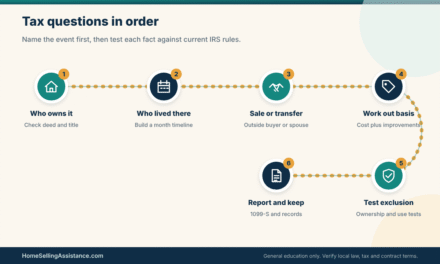
Listing home during divorce is a sale with two decision-makers who may not want to sit in the same room, and that single fact changes almost every step: who picks the agent, who answers the phone, who says yes to a price drop, and who receives the money at the end.
Most couples who go through listing home during divorce do not fail because the market is bad. They stall because nobody agreed, early and in writing, on how decisions would be made. One spouse wants the house gone by spring, the other wants to wait for a better offer, and the listing sits with a stale price while both of them quietly resent each other and the mortgage keeps accruing interest.
This guide is about the mechanics of listing home during divorce once the two of you (or your attorneys) have decided that a sale is the direction. If you are still weighing a buyout against a sale, our companion piece on buying out a spouse versus selling is the better starting point. If you want the full overview of the topic, the cornerstone article on selling a house during divorce covers the legal and financial landscape in more depth.
Here we stay practical about listing home during divorce. We look at the paperwork to collect, how to choose and manage an agent when two people share the decision, how to handle showings in a home where one or both spouses may still live, how to set rules for price changes and offers, and what to confirm in writing so the closing is not the first time anyone discovers a disagreement. Nothing here is legal, tax or financial advice.
Divorce law, property rules and disclosure duties differ by state, and your own attorney is the person who can apply them to your facts.
Key takeaways
- Agree on decision rules before you agree on a price. Write down who can approve a price change, an offer, a repair credit and a closing date, and what happens if you disagree.
- Check authority first. Titled owners, court orders, a pending case and a lender’s requirements decide who may sign a listing agreement and a sale contract. Your attorney confirms this, not the listing agent.
- Choose one agent, one point of contact and one shared record. Two separate instructions to the same agent is the quickest way to a messy listing.
- Plan showings like a project. Fixed windows, a neutral presentation and a clear rule about who is present protect both the sale and the people living there.
- Put every money decision in writing. Who pays carrying costs, how repair credits are shared, and where proceeds go at closing should be settled before an offer is accepted.
Prepare the file before listing home during divorce
A good file for listing home during divorce does two jobs. It lets an agent price and market the property accurately, and it gives both spouses the same facts so that arguments are about choices, not about whose memory of the loan balance is right. In a calm marriage this is a weekend project. In a divorce it can take several weeks, mostly because the documents are scattered across two inboxes and one filing cabinet.
Start by deciding who will assemble the file. If communication is strained, a neutral person can do it: an attorney’s paralegal, a mediator’s assistant, or the listing agent once one is chosen. What matters is that both spouses get an identical copy of everything that is gathered, at the same time.
Documents, numbers, and contacts that listing home during divorce depends on
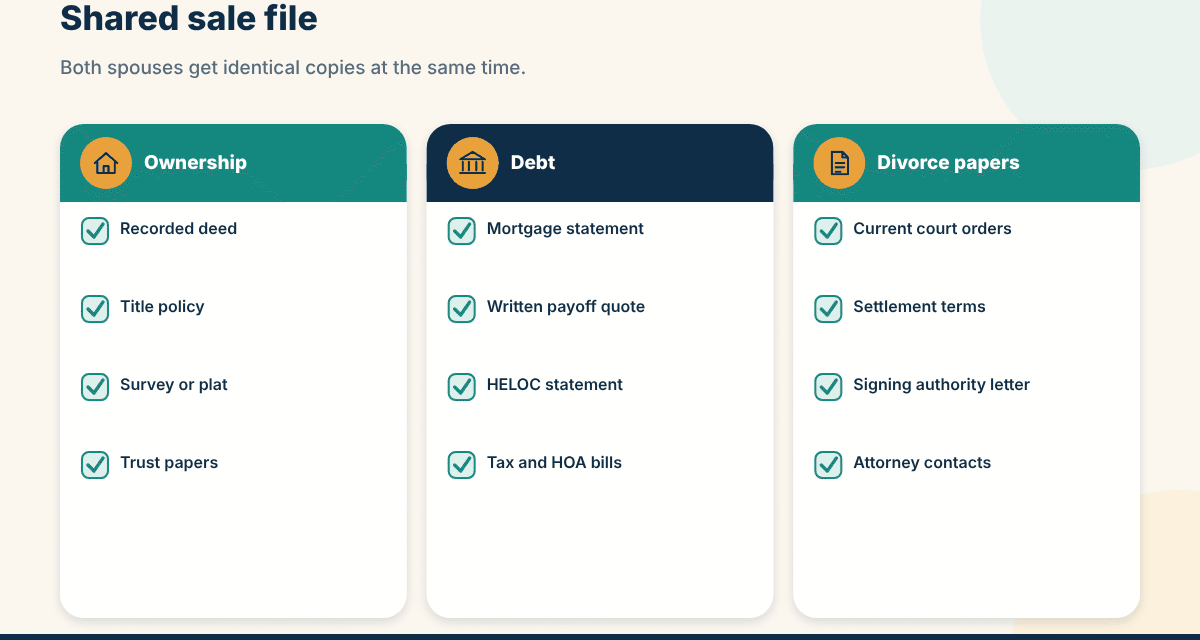
Think of the file for listing home during divorce in four layers: ownership, debt, condition and the divorce itself. Each layer answers a question a buyer, a title company or a court will eventually ask. Gathering all four before the first photo is taken costs a little time and saves a lot of reworking later. Our general list of documents needed to sell a house covers the standard items. The divorce adds a few more, and listing home during divorce depends on them.
Evidence to gather: the ownership and loan paper trail
Ownership comes first in listing home during divorce. Locate the recorded deed and read how title is held, because the names and the form of ownership matter. Some deeds name both spouses together, some name only one, and some name a trust. A deed does not tell the whole story in every state, since marital property rules can give a spouse an interest even when the name is not on title, but it is the starting document a title company will ask for. Your county recorder’s office usually provides copies, often online.
Next, the loan. Gather the latest mortgage statement, the lender’s customer service number and any home equity line of credit statements. Ask the servicer for a written payoff quote that is good through a specific date, since the statement balance is not the same as the payoff. Our article on mortgage payoff when selling a house explains why. Note who is named on the loan, because being on the loan and being on the deed are two separate questions.
Then the divorce papers. If a case is filed, ask your attorney for the current orders that touch the house: temporary orders about who lives there and who pays what, any restriction on selling or borrowing against the property, and any filed notice of the case in the property records. Some places allow a notice that warns the public a court case affects the property. A buyer’s title company will find it, so you want to know about it before they do.
Finally, collect the numbers that shape a sale: property tax bills, homeowners insurance declarations, HOA statements and contact, utility averages, and a list of recent repairs with receipts. The seller checklist before listing goes through the home-condition side in more detail. Put the contacts in one sheet: both spouses, both attorneys, the lender, the insurance agent, the HOA manager and, later, the agent and title company.
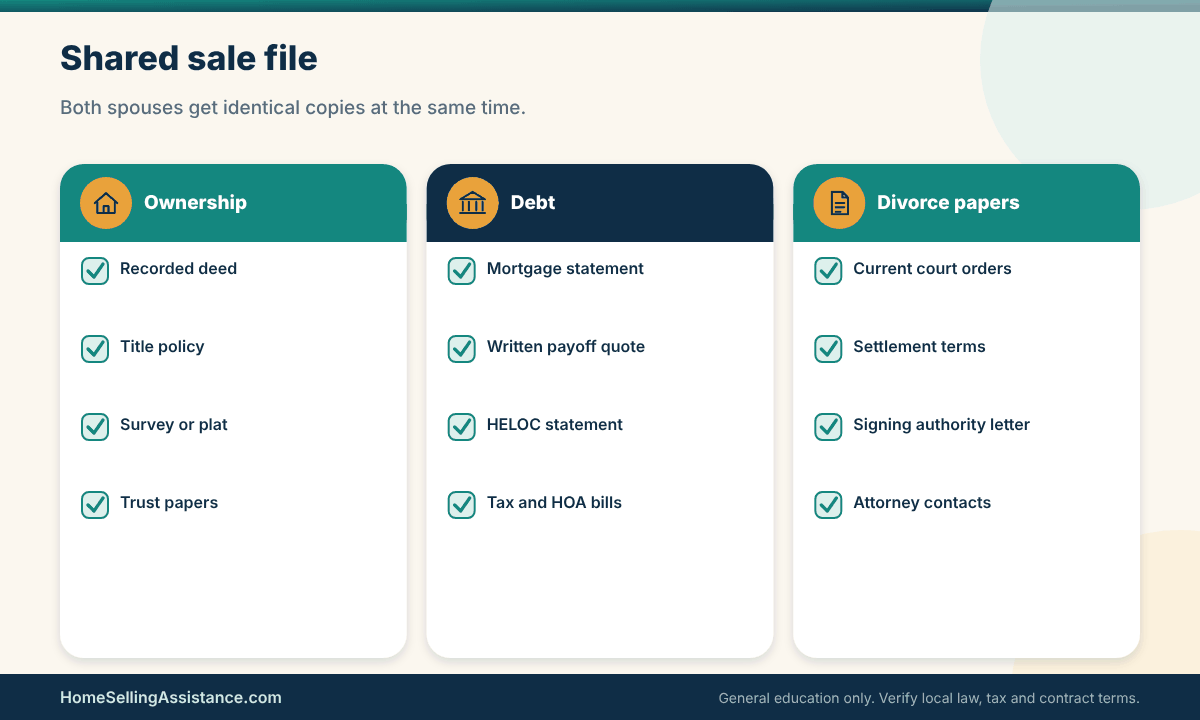
The checklist in the graphic above groups the file by the question each document answers. It is not a legal requirement, only a way to avoid the common problem where the sale is delayed because one spouse thought the other had the survey.
A scenario, an exception, and your next step: the missing signature
Consider an illustrative case. A couple bought a house together eight years ago, but a few years later one spouse refinanced and, as part of that refinance, the other spouse signed a document giving up their name on title while remaining on the original relationship. Neither remembers exactly what was signed. The spouse who is still on title assumes they can list alone.
The exception is that even a sole name on title may not be enough. In many states, a spouse may hold marital rights in a home, and a title company may ask for that spouse’s signature, or for a court order, before it will insure the buyer. Whether this applies, and how, is a legal question about your state and your divorce stage.
The next step is simple: before signing anything with an agent, ask your attorney two things in writing. Who must sign the listing agreement, and who must sign the sale contract and closing documents? Then share the answer with the agent, so nobody finds out at the closing table.
Information still missing when the listing date approaches
Even with a tidy file, listing home during divorce will have gaps, and in divorce the gaps tend to be social, not just clerical. Perhaps one spouse has been handling the mortgage and does not want to share logins. Perhaps a repair was done by a relative with no invoice. Perhaps nobody knows whether the unpermitted deck was ever signed off. None of this blocks a sale, but unanswered questions turn into price reductions and renegotiations once a buyer finds them during an inspection.
Make a short list titled “unknowns” for listing home during divorce and share it. Assign each one to a person and give it a due date. A list that two people can see tends to shrink faster than a list that one person keeps in their head.
Evidence to gather: facts you can verify this week
Several unknowns can be closed quickly with public or official sources. The county assessor’s website often shows square footage, lot size, tax history and recorded permits. The county recorder shows the deed, any recorded mortgages, and sometimes liens or notices tied to the property. A request to the servicer for a payoff and a request to the HOA for a resale or status letter will produce dated, written answers that no one can dispute.
If the house was built before 1978, remember that federal rules require sellers to give buyers certain lead-based paint information and a disclosure form, as described on the EPA real estate disclosure page. Other seller disclosure duties vary by state, so ask your agent which form your state uses, and check it against your state real estate commission’s guidance.
For the disclosure form itself, one practical rule helps in a divorce: both spouses should read the draft and agree on the answers. If one spouse lived in the home and knows about a past leak while the other does not, the form should reflect what the owners know, not what the more optimistic spouse prefers. Incomplete disclosure is a common source of disputes after closing, and it can create exposure for both owners.
Scenario and next step: when the other spouse will not share information
Imagine one spouse refuses to hand over the mortgage login, the insurance policy or the repair records, perhaps out of distrust. The sale cannot move without this information, and arguing about it is slow.
The usual fix is to route the request through attorneys, in writing, with a clear list and a deadline. Many requests can also be answered by third parties without either spouse’s help: the servicer can send a payoff to a person who is on the loan, the county provides property records, and the insurer can reissue a declarations page. Ask your attorney what is appropriate in your case, particularly if there is any concern about safety or about accessing accounts, since the right approach depends on your circumstances and local rules.
Whatever happens, keep a dated log of what you asked for and what you received. If the sale is delayed, that log helps your attorney explain why. It also helps you avoid blaming the wrong person for a delay that actually came from a lender or an office that was slow to answer.
Move through the sale in order, from agent choice to accepted offer
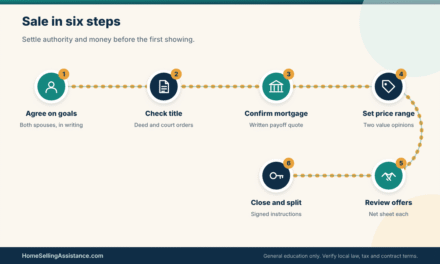
Once the file is in decent shape, listing home during divorce follows a fairly predictable order: pick the agent, sign the listing agreement, prepare and photograph the home, open it to showings, review offers, negotiate, and move into the contract period. A divorce does not change that order for listing home during divorce. It changes who has to agree at each step, and how fast disagreements can be resolved. The table below turns that order into a workflow you can adapt.
Read it as a sequence of handoffs in listing home during divorce. For each stage, it lists the sign that the stage has arrived, the information you need before acting, the action itself, a sensible decision deadline and who receives the work next. The deadlines are suggestions for planning purposes, not rules. Your attorney, agent and contract set the real dates.
| Stage or symptom | Information to gather | Action | Decision deadline | Next handoff |
|---|---|---|---|---|
| Both spouses agree to sell | Deed, loan payoff, court orders, signing authority | Attorney confirms who signs; write a short sale agreement | Before any agent interview | Agent interviews |
| Spouses disagree on agent | Written proposals from two or three agents | Score each on a shared sheet; use a tie-break rule | Within one week of interviews | Listing agreement review |
| Home not photo-ready | Repair list, quotes, who lives there | Agree a spending cap and who pays up front | Before photography is booked | Photographer and stager |
| Showing friction or tension | Showing windows, access rules, safety needs | Fix a schedule; use lockbox or agent-led access | Before the first showing | Showing agent or service |
| Little activity after a few weeks | Showing counts, feedback, nearby sold homes | Review price and condition with the agent together | Date set in advance, such as day 21 | Price decision meeting |
| Offer arrives | Net sheet, buyer financing proof, contingencies | Both owners review the same summary; counter or accept | Before the offer’s stated expiry | Contract and escrow |
The most useful column is probably the second one. It reminds you that every stage has a fact that should be on the table before anyone votes. If you are asked to decide on a price change and nobody has shown you the showing count or recent sales, ask for them first. A divorce adds emotion to every decision, and facts are the best way to cool it down.
Agent selection, communication rules, and early decisions
Choosing an agent is the first joint decision in listing home during divorce, and it often sets the tone for the rest. Some couples interview together, some separately, and some bring in their attorneys to review the paperwork. All of those can work. What does not work well is each spouse privately promising something different to a different agent. If you are new to the topic of choosing one, the article on how to choose a listing agent explains the general process, and the list of questions to ask a listing agent about price is useful in the interview.
For listing home during divorce, add a few questions to the standard ones. Has the agent handled sales where owners were separating, and how did they manage communication? Are they comfortable sending every update to both owners at the same time? How do they handle showings where one owner still lives in the home? And will they refuse to take instructions from only one spouse on price, terms or the listing agreement? An agent who answers with specifics is usually more useful than one who simply says it will all be fine.
Evidence to gather: how to compare the agents you interview
When listing home during divorce, ask each agent for a written pricing opinion that shows the recent comparable sales behind the number. A range with reasoning is more honest than a single number delivered with confidence. If one agent’s opinion is far above the others, ask for the specific sales that support it. A high number can feel good in the moment, but a listing that starts too high often has to be cut later, and in a divorce each month of delay has a real cost in carrying expenses and in patience.
Ask for the proposed listing agreement in advance and read it in full, ideally with your attorney. Look at the length of the term, the compensation terms, what happens if you cancel, and whether the agreement addresses a change of circumstances. Compensation in residential sales is negotiable and must be written down, so confirm exactly what is proposed, what each owner is agreeing to, and whether the agreement offers anything to buyer-side agents. Our overviews of the seller listing agreement and of cancelling a listing agreement will help you ask good questions.
Finally, ask how the agent will communicate. A clear answer might be: one weekly summary by email to both owners, urgent matters by text to both, and offers delivered to both at the same moment. If either spouse needs communication to go through an attorney, say so at the start, and make sure the agent knows whom to copy.
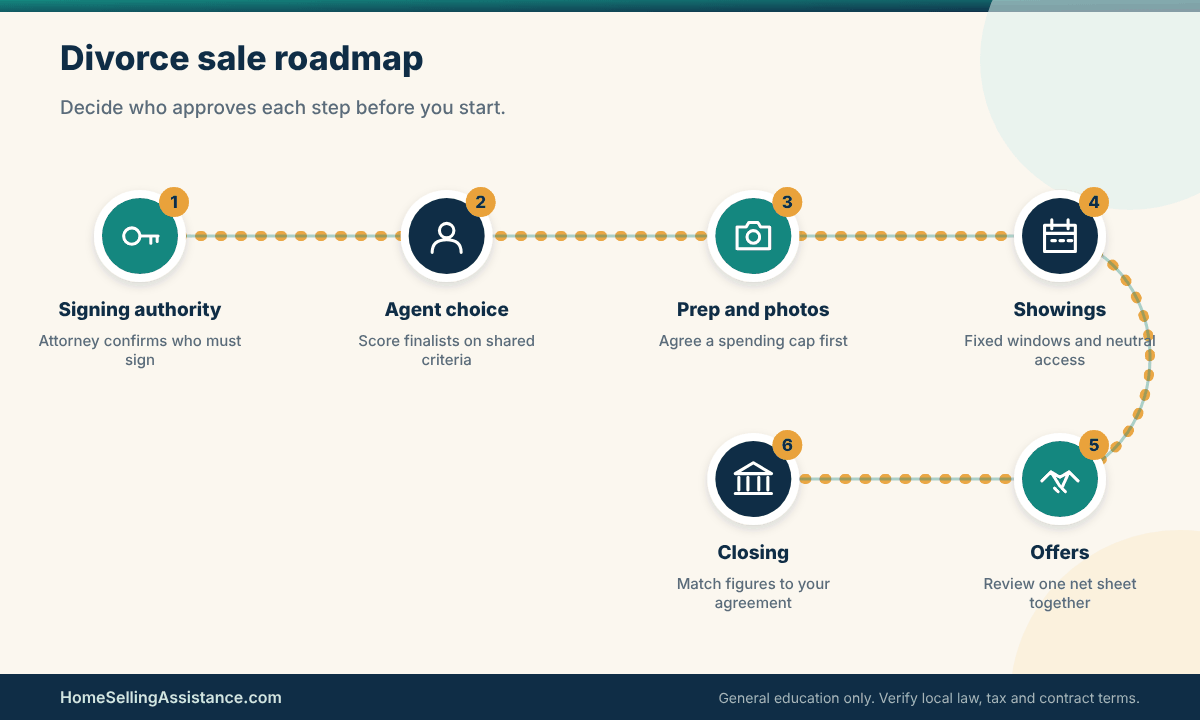
The roadmap above shows the order in which listing home during divorce typically moves. Notice how many stages need a written agreement between the spouses before the next one starts. That is the pattern to protect, because a decision made verbally in week one is often remembered differently in week six.
Scenario, exception, and next step: two spouses, two favorite agents
Here is an illustrative situation. One spouse likes an agent who is a family friend and has offered flexible terms. The other prefers an agent recommended by their attorney who has divorce sale experience. Both are sincere, and the conversation has turned into an argument about loyalty.
A fair way through is to define criteria first, then score. Pick five or six that matter to both of you, such as local sales record in your price range, a clear marketing plan, a communication style you can both live with, a reasonable agreement length and comfort with a two-owner listing. Each spouse scores each agent separately, then you compare. If the totals are close, a tie-break rule agreed in advance, such as asking a mediator or letting the attorneys choose among the finalists, keeps the choice from becoming personal.
The exception to watch for is a conflict of interest. An agent with a personal relationship to only one spouse may not be able to serve both comfortably, and some states have rules about disclosing dual or limited agency. Ask the agent to explain in writing whom they represent and how, and check your state real estate commission’s guidance. Your next step is to hold one more short interview with the two finalists, using the same questions, before any signature.
Showings, price changes, offers, and contingencies
After the listing goes live, listing home during divorce brings two very different problems. The first is logistical: strangers will be walking through a house where emotions may be high and where the people who live there are going through a stressful period. The second is strategic: you will see data about how buyers respond, and you will have to agree on what to change. Both are easier with rules written in advance.
For showings, many agents recommend fixed windows, such as two or three set blocks a week plus occasional short-notice appointments, so that the household can plan. The occupants leave during the showing, pets are secured, and personal papers are put away. If the spouses are not on good terms, the agent or a showing service can manage access through a lockbox, which lets neither spouse be the gatekeeper. See our article on selling a house while living in it for practical routines that apply even when the household is under strain.
Once an offer is accepted, listing home during divorce becomes a contract with deadlines, and the pressure shifts from marketing to follow-through. Inspections, appraisals, lender conditions, title work and repair negotiations all happen in a few weeks, and each can reopen the price. In a divorce, each also requires two owners to respond promptly, sometimes within days, so it helps to know the sequence and to decide in advance who handles what.
The inspection usually comes first. The buyer’s inspector reports on the condition of the home, and the buyer may then ask for repairs, a credit or a lower price. The appraisal follows when a lender is involved, and if the appraised value is lower than the contract price, the parties may renegotiate, the buyer may bring more cash, or the deal may end, depending on the contract. Title work runs in the background and can uncover liens, recorded notices or ownership questions that the owners did not know about.
Plan how the spouses will respond to a buyer request while listing home during divorce. One approach is a shared decision sheet with three columns: what the buyer asked, what the agent recommends, and what each owner decides. Another is to give the agent a written limit, for example authority to agree to small repair items up to a set amount without calling, while anything above requires both owners. Choose what suits your relationship and put it in writing.
The graphic below sets out four common ways couples handle listing home during divorce and the authority question during a sale. None is right for everybody. The best choice depends on trust, on how well you communicate, and on what your attorneys advise.

Whichever arrangement you choose, notice the shared thread: nobody is left guessing who can say yes. If an arrangement involves one spouse acting for both owners on the contract, expect that the title company, the lender or your attorney may want that authority documented, such as through a power of attorney or a signed agreement. Ask early whether this is needed in your state, because having to arrange it in the final week can derail a closing date.
The next table is a transaction check table for listing home during divorce. Use it once you are under contract, or even before, to see where problems commonly appear, which evidence supports your position, what you need from the buyer side, agent or title company, and what the fallback looks like. It is deliberately general, since the actual risks depend on your contract.
| Issue | Seller evidence | Buyer, agent or title input | Risk | Fallback |
|---|---|---|---|---|
| Signing authority questioned | Attorney letter, court order or signed owner agreement | Title company states what it will accept | Closing delayed at the last minute | Agree a signature plan before listing; extend closing by contract |
| Inspection repair request | Past receipts, contractor quotes, photos | Buyer’s inspection report and agent’s advice | Owners disagree on credit or repair | Pre-agreed repair limit; counter with a credit |
| Appraisal below contract price | Recent comparable sales, upgrade list | Lender’s appraisal and agent’s analysis | Renegotiation or a cancelled contract | Counter, split the gap, or relist under the contract terms |
| Lien or notice found in title work | Payoff letters, court order, release documents | Title commitment and requirements list | Cannot deliver clear title on time | Pay from proceeds at closing; ask attorney to clear notices |
| Buyer financing falls through | Proof of pre-approval requested earlier | Lender status and contract deadlines | Lost weeks while carrying costs continue | Back-up offer or relist; agree who pays holding costs |
| Occupant not ready to move | Written move-out plan and date | Contract possession terms | Possession dispute at closing | Short rent-back or a flexible closing date |
Use the table for listing home during divorce as a conversation starter with your agent and attorney. If a row seems to apply, ask what documents or deadlines are involved, and who is responsible for each. The “fallback” column is the one most people skip. Knowing in advance that a short extension, a credit or a back-up offer is possible makes the problem feel manageable when it actually happens.
Timing flexibility deserves particular attention. When one spouse lives in the home and has not yet found housing, an unrealistic closing date creates conflict that has nothing to do with the buyer. Our articles on flexible closing dates for sellers and on move-out date versus closing date discuss common ways to build in room, such as a short post-closing occupancy period agreed in the contract. Discuss any such option with your agent and attorney before you include it, as the terms affect insurance and risk.
Finally, remember the lender. If the mortgage is joint, the loan stays joint until it is paid, regardless of what the divorce decree says about who pays. Missed payments during the sale damage both borrowers’ credit and can complicate closing. Our article on the mortgage during a divorce home sale covers payment responsibility, and the guide to selling a house with a mortgage explains the payoff mechanics in plain language.
Evidence to gather: market feedback and price-change triggers
In listing home during divorce, the most valuable agreement you can make on price is an agreement about triggers. Before the listing starts, write down what evidence would lead you to change the price.
For example: if after three weeks the property has had very few showings, review the price and the photographs; if showings are strong but no offers come, review condition and terms; if there is a clear pattern in feedback, such as concern about a specific repair, decide whether to fix it or price around it. These examples are illustrative, not rules, and the right timing depends on your local market.
Ask the agent for a short report on a regular schedule showing online views, showing counts, written feedback, and any new listings or sales that have changed the comparison. A decision based on a report that both owners have read is far easier than a decision based on one spouse’s impression. The local market sets the pace, so be wary of any claim that a given number of days always means a price cut.
Also decide how a price change will be approved. Some couples agree that any change within a set range can be made by the agent after notifying both owners, while changes outside that range require both signatures. Others require both approvals every time. Either approach can work, as long as it is written, and as long as the agent confirms they will follow it. If your listing agreement has a clause about changes, have your attorney review it.
Scenario and next step: a low offer and a spouse who wants to accept
Imagine an offer arrives, below the listing price, with a quick closing. One spouse wants to accept because they need to move on. The other believes a better offer will come. Under time pressure, this can become the worst argument of the sale.
The first step is to look at the offer as a whole, not just the price. Check the financing type, the size of the deposit, the contingencies for inspection, appraisal and financing, any request for repair credits, and the proposed closing date. Our article on home sale net proceeds shows how to translate a price into an estimate of what each owner actually receives. Ask the agent for a net sheet for this offer and for a plausible counteroffer, using the same assumptions.
The exception is that the offer has an expiry. If the owners cannot agree before it lapses, the buyer may walk. If you cannot decide together, ask your attorneys whether the deal can be structured so that one spouse’s preference is accommodated, for instance through the way proceeds are divided, without blocking the sale. That conversation belongs to the lawyers, but the agent’s net sheet gives them something concrete to work from.
Close the loop on listing home during divorce
The closing is where listing home during divorce either finishes cleanly or becomes a new argument. By this point the two of you have made dozens of small decisions, and some were made verbally, some by email, and some by an agent who was trying to be helpful. Before the closing date, take an afternoon to make sure that what you think was agreed is what is actually written. The effort is small compared with the cost of discovering a mismatch at the title company.
Careful listing home during divorce means treating the final weeks as a reconciliation exercise. You compare the contract, the closing figures, the divorce orders or settlement terms, and the instructions you have given for the money. If they match, you sign and move on. If they do not, you want to learn that while there is still time to fix it.
What to confirm in writing before closing day
Three documents matter most: the sale contract with any amendments, the draft closing statement, and whatever document governs how the proceeds are shared, whether that is a court order, a settlement agreement or a written agreement between you. Your seller closing statement shows every credit and charge. Request the draft several days ahead, and read it with the same care you would give a tax return.
Compare the line items against what you expect. Check the payoff amounts for the mortgage and for any home equity loan, the commission and fee amounts that match the signed listing agreement, the property tax and HOA prorations, and any credits to the buyer that were negotiated. If something does not match, ask the settlement agent to explain it in writing before you sign anything.
Evidence to gather: closing figures, payoff letters, and distribution instructions
Gather three sets of evidence. First, the written payoff letters from every lender, dated for the closing date. If closing slips, the payoff will need updating, since interest continues to accrue. Second, the final closing statement, with each owner’s share clearly identified. Third, written distribution instructions: who receives how much, by what method, and to which account.
Distribution is the point where listing home during divorce changes a standard closing most. In an ordinary sale, the proceeds go to the sellers according to their ownership. In a divorce, the proceeds may need to be divided in a specific way, or part may be held back, for example for a debt, an unpaid tax or a pending court decision.
Some attorneys arrange for the settlement agent to hold funds in escrow, or to send specified amounts to each spouse or to an attorney’s trust account. Whether and how this is allowed depends on your state, your court orders and the settlement agent’s own policies.
Ask the settlement agent early what they require for listing home during divorce. Many need written instructions signed by both owners, and some require identification and wiring verification in person. The method matters for security as well. Wire fraud is a known risk in real estate closings, and the Federal Trade Commission’s consumer site and the FBI’s Internet Crime Complaint Center both publish warnings about closing-related scams. Always confirm wiring details by calling a phone number you already know to be correct, never one from an email.

The waterfall above is illustrative only. It shows the typical categories that come out of a sale price before proceeds reach the owners, and then a split of what remains between the spouses according to whatever agreement or order applies. Your actual lines will differ, and our article on how to divide home sale proceeds in a divorce explains some of the common ways the second step is handled, always subject to your state’s law and your attorney’s advice.
Scenario and next step: the figures do not match the agreement
Picture this illustrative case. The settlement agreement says each spouse will receive half of the net proceeds after the mortgage and costs, but one spouse also agreed to reimburse the other for some earlier repairs from their share. The draft closing statement shows the proceeds going to one account in a single amount. Nobody noticed until two days before closing.
The exception to remember is that a settlement agent usually follows written instructions signed by the owners and does not interpret a divorce agreement. If the instructions are silent, the funds usually go according to the title and the contract. That may not match your agreement.
The next step is to ask your attorney to review the draft statement and to prepare written disbursement instructions that both spouses sign and the settlement agent confirms. Do it as soon as the draft arrives, not on closing morning. If the arrangement is complicated, ask your attorney whether a hold-back or a direct payment from closing is appropriate.
Records and follow-up after listing home during divorce is complete
Once the sale closes, listing home during divorce still leaves a few things to do. People often forget them, because the stress is over and the money has arrived. But the records you keep and the follow-up you do protect you if a question arises months or years later, from the buyer, from a tax office, from a lender or from the other spouse.
Keep a complete closing file from listing home during divorce. That means the final closing statement, the recorded deed or a copy of it when available, the payoff confirmations showing the mortgage was satisfied, the contract and amendments, the disclosures you signed, and the settlement or order that governed the distribution. Store copies where both spouses and their attorneys can reach them if needed, and keep them for as long as your tax adviser and attorney recommend.
Evidence to gather: proof that debts were paid and title was released
After closing, the mortgage lender should record a release or satisfaction, or send a confirmation that the loan is paid in full. The timing and method vary by state and lender. Check your credit report or your online account some weeks later to confirm that the loan shows a zero balance and, where it applies, that the home equity line is closed. After listing home during divorce, a lien that remains on record after a sale is rare but can create trouble, and it is easier to fix if you notice quickly.
Also confirm the final utility bills, the insurance cancellation and any refund, and the property tax proration. Some people forget that homeowners insurance is a separate contract that must be cancelled, and that a refund may be due. If you are on a shared account, update autopay and the account holders so that nobody is charged for the buyer’s usage.
For taxes, the IRS publishes general information on selling a home, including the exclusion of gain for many sellers who owned and used the home as a main home for two of the five years before the sale. The details, including how the rules apply when spouses divorce or live apart, are in IRS Publication 523 and in Publication 504 for divorced or separated individuals. Our article on capital gains when selling a house in a divorce gives more background. Because the answer depends on your facts, ask a qualified tax professional how the sale affects your return.
Scenario and next step: a surprise after the sale
Consider another illustrative case. Several months after closing, one former spouse receives a letter saying a small balance remains on a home equity line that was thought to be paid. The payoff letter at closing listed only the first mortgage.
This kind of mistake usually comes from an incomplete payoff list, and the fix is to gather your closing file and contact the settlement agent or title company that handled the closing. Title companies often have processes for resolving payoff errors, though the details and the time involved vary. Tell your attorney as well, because the divorce agreement may say who is responsible for a missed debt.
The lesson of this listing home during divorce story is a small one. When you gather the file at the start, list every loan and credit line secured by the property, not only the first mortgage. Ask the title company to confirm the list when it issues its commitment, and compare that list with your own. A short comparison at the start of the process can prevent a long conversation at the end.
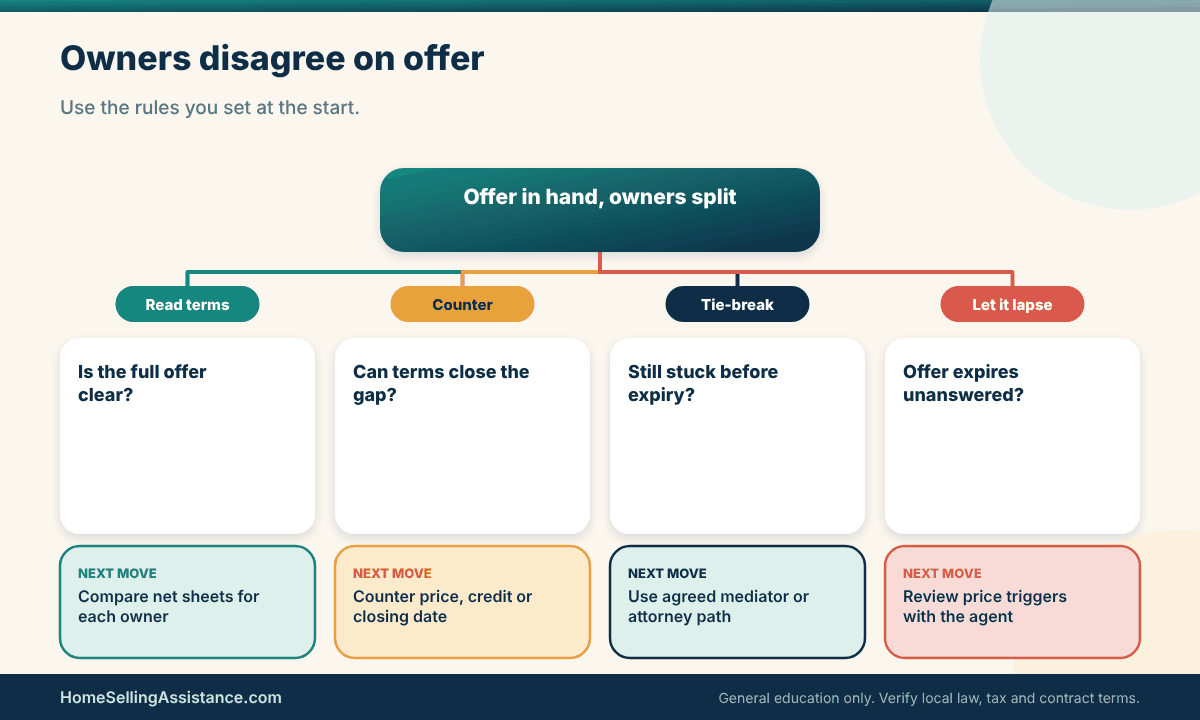
The final graphic shows how listing home during divorce handles a typical disagreement about an offer can be resolved, step by step, using the rules you set at the start. It is a reminder that the best time to decide how to resolve a deadlock is long before the deadlock happens, when you are both still willing to be reasonable. If you want more on what to do when one owner will not cooperate at all, read our article on what to do if a co-owner refuses to sell, and its companion on a partition sale of a co-owned house.
For the broader picture of local services, you can also browse our divorce and co-owned homes category, and the staging, photos and showings category for the practical side of preparing the home. Fair housing rules also apply to listing home during divorce, to every showing and every offer, and the HUD fair housing page explains the basics. Your agent should treat every buyer equally and should never be asked to prefer or avoid buyers based on protected characteristics.
Quick scenario
Two owners agree to sell. They sign a one-page working agreement that names one agent, sets a weekly update to both, fixes showing windows, and says that any price change needs both approvals within 48 hours. On day 21 the agent’s report shows steady showings but no offers, so they meet, review it and agree to a modest reduction. Nothing dramatic happened, and that is the point: listing home during divorce goes better when the decisions are boring and written down.
Frequently asked questions about listing home during divorce
Can one spouse start listing home during divorce alone?
It depends on how title is held, what your state’s marital property rules say and whether a court case or order is in place. Even a spouse who is the sole owner on the deed may face a title company that wants the other spouse’s signature or a court order. Ask your attorney who must sign the listing agreement and the sale contract before you speak to an agent. Do not rely on the agent for the legal answer.
Should we use one agent or two for listing home during divorce?
A single listing agent is the usual arrangement, because two agents for one property create confusion over who speaks for the sellers. Some couples worry that one agent will favor the spouse who found them. Ask any candidate how they approach listing home during divorce with two owners, ask them to put communication rules in writing and ask them to send all updates to both of you. If trust is very low, your attorneys can agree on the agent together.
How should we handle showings if one of us still lives there?
Set fixed showing windows and agree that the occupant leaves during each one. A lockbox or agent-led access takes the gatekeeping out of the spouses’ hands. Remove personal papers, medications and valuables before the first showing. If safety is a concern, tell your attorney and your agent privately, since there may be steps that fit your circumstances, such as accompanied showings or a different access arrangement.
Who decides when to lower the price?
You do, together, unless your agreement or a court order says otherwise. The best approach to listing home during divorce is to set triggers in advance, such as a review date and the information both owners will look at. Many couples agree that both must approve any change, and some allow small adjustments after notice. Whichever you choose, write it down and ask the agent to follow it. Market conditions vary, so avoid any rule that says a certain number of days always requires a reduction.
What if we disagree about whether to accept an offer?
When listing home during divorce, look at the whole offer, not just the price: financing, deposit, contingencies, credits and closing date. Ask the agent for a net sheet showing what each owner would receive. If you remain stuck, decide in advance on a tie-break method, such as mediation or an attorney recommendation. The offer’s expiry date is real, so agree on a process before offers arrive, not after.
Who pays the mortgage and carrying costs while the house is listed?
That is a question for your divorce agreement or temporary orders, and it varies. What does not vary is that a joint loan stays a joint obligation to the lender until it is paid off, whatever the two of you have agreed between yourselves. Missed payments can hurt both credit histories. Put the payment arrangement in writing, and keep proof of each payment until closing. Our article on mortgage payments during a divorce home sale covers the topic in more depth.
How are the sale proceeds divided?
Division depends on your settlement, a court order and your state’s law. It is not decided by the agent or the title company. The settlement agent usually follows written instructions signed by the owners, and may require extra paperwork for a split payment or a hold-back. Ask your attorney to prepare the instructions, and review the draft closing statement several days before closing to make sure the figures match your agreement.
Do we owe tax on the sale?
It depends on your facts. Federal rules allow many sellers to exclude a portion of the gain on a main home if they meet ownership and use tests, with different limits for single and joint filers, and the rules have special provisions for divorce and separation. The IRS explains the basics in Publications 523 and 504. A qualified tax professional can tell you how those rules apply to your situation, including the timing of the sale in relation to the divorce.
Can the buyer or agent see anything about the divorce?
In listing home during divorce, court records and any recorded notices may be visible to a title company, so you should not assume the situation is invisible. Ask your attorney what is public in your state. Your agent does not need to share private details with buyers, and you are not obliged to explain why you are selling. You are required to give honest answers on required disclosures about the property, and both owners should review those answers together.
What if the house does not sell?
An unsold house in listing home during divorce still has costs, and each month adds stress. Review the evidence with the agent: showing counts, feedback and comparison sales. Options may include a price change, repairs or staging, a different marketing approach, or a different plan for the property, such as a buyout. Discuss each option with your attorney, because a change in plan may affect the divorce agreement. Before changing agents, read your listing agreement for its cancellation terms.
A calmer way to finish
Listing home during divorce is rarely easy, but it can be orderly. Gather the same facts together, choose decision rules while you still agree, write down who pays and who receives what, and keep a clean file after closing. This article is general education, not legal, tax or financial advice. Rules about ownership, disclosure and the division of property vary by state, so check with your attorney, a qualified tax professional and your state real estate commission. A little structure now can spare both of you a lot of regret later.