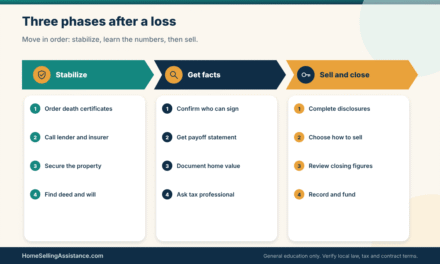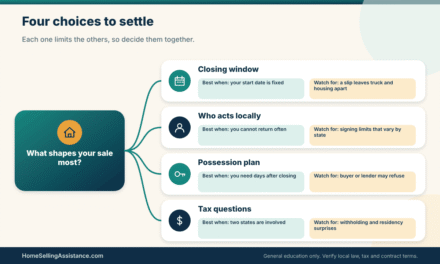
If you need to sell house for relocation, the hardest part is rarely the listing itself. It is the way a fixed start date at a new job, a lease or a family deadline presses against a sale whose timing you only partly control. This guide walks through the whole stretch, from the first conversation with an employer to the day the keys change hands in a city you may have already left, and it does so without steering you toward any single agent, buyer type or moving company.
Most relocating sellers describe the same knot. The new role begins on a specific Monday. The old house has a mortgage, a roof that is not quite new and a buyer pool you cannot predict. Somewhere in the middle sits a stack of questions about temporary housing, movers, utilities, a second household and who will hand over the keys if you are already four states away. Sellers who sell house for relocation do best when this is settled early.
It helps to name what is truly fixed and what only feels fixed. A start date written into an offer letter is one thing. A vague sense that “we should be there by summer” is another. When you sell house for relocation, separating the immovable dates from the preferred ones is the single most useful thing you can do before you pick a price or an agent.
This is the cornerstone of our relocation, downsizing and life-event library. It stays at roadmap level on purpose and links out to deeper guides on employer programs, job transfers, out-of-state moves and the sell-first-or-buy-first choice. You will find a way to map your calendar, a fair comparison of the main selling paths, a plain look at what changes price, time, risk and net proceeds, and a verification roadmap that sorts what to settle before listing from what can wait until an offer arrives.
Key takeaways
- Sort your dates into fixed and flexible. A written start date, a lease end or a school deadline is fixed. Everything else can usually be negotiated, which gives you more room than the first panic suggests.
- Pick the selling path that matches your calendar. Listing on the open market, accepting a cash buyer, using an employer program or renting the house out each trade price against certainty and effort in different ways.
- Plan the housing gap before the listing. Where you sleep between the day you leave and the day you close is a budget line, not an afterthought, and it is the line most often left blank.
- Price for the timeline you actually have. A house priced for a leisurely sale can miss a hard deadline, while a house priced too aggressively gives away money you may need later.
- Read every agreement that touches your money. Employer repayment terms, listing agreements and moving contracts all contain deadlines and conditions that deserve a careful look before you sign.
- Ask local professionals about local rules. Disclosures, remote signing, taxes and closing practices differ by state, so confirm with a licensed agent, attorney, tax professional or title company.
Why you need a plan to sell house for relocation before you call anyone
The instinct is to start with action: call an agent, scrub the kitchen, book a truck. That instinct is understandable, and it often leads to rework. A short planning session first, even an hour at the kitchen table, tends to save weeks later because it tells you what you are optimizing for. Speed, price, certainty and low stress compete with one another, and a relocation usually makes certainty and timing weigh more than usual. That habit pays off whenever you sell house for relocation and the calendar leaves little slack.
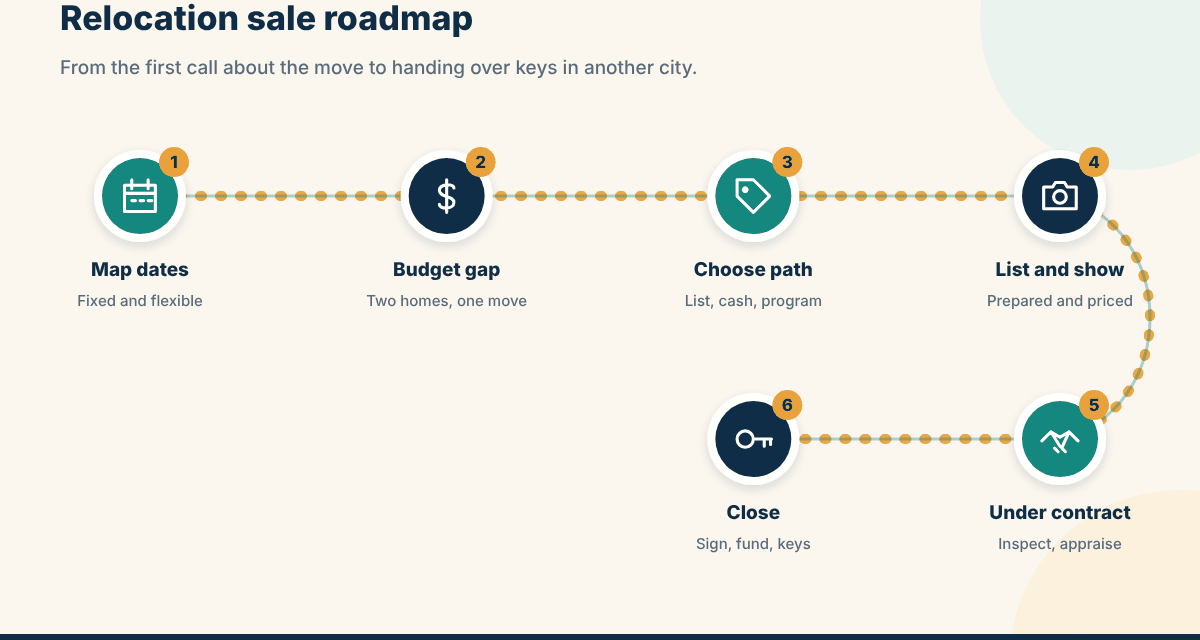
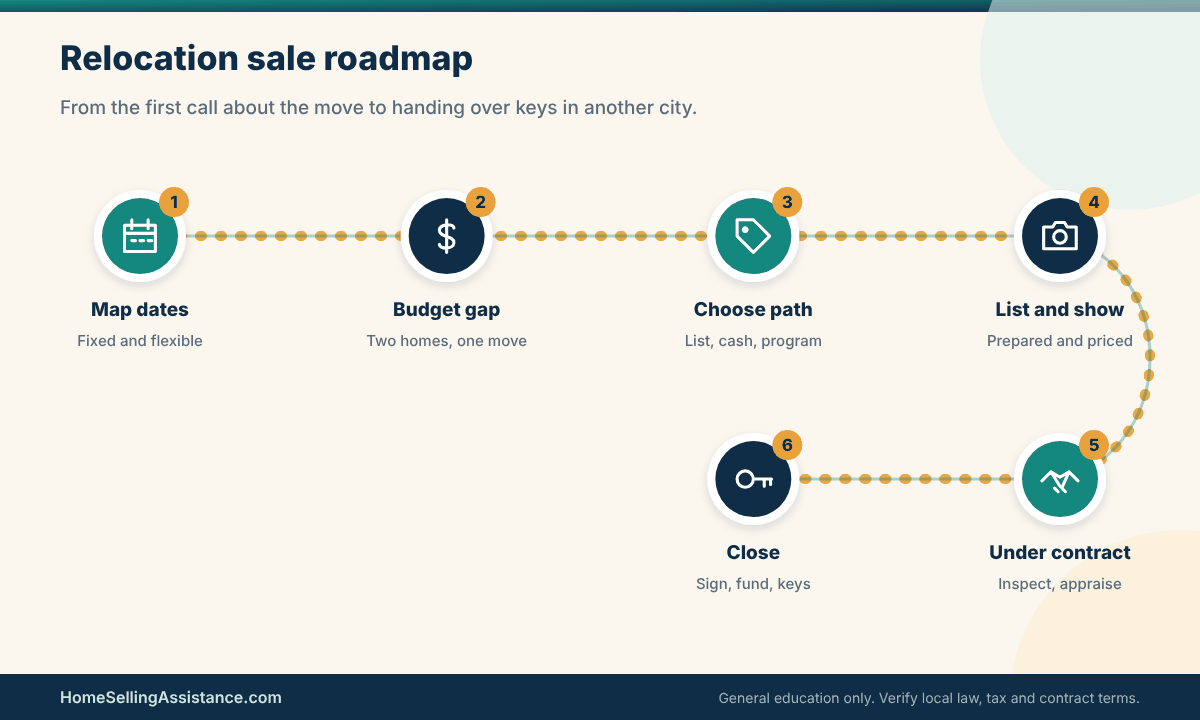
The first image above sketches the sequence most relocating sellers follow, from the decision and the dates through preparation, listing, contract and closing. Treat it as a map rather than a rule. Some sellers begin cleaning out the garage months before an offer letter arrives, while others have only three weeks between the phone call and the first day. The order stays similar even when the pace does not. Check it again before you sell house for relocation in earnest.
Your start date, your housing gap, and the house itself
Three things collide in every relocation: a date at the destination, a stretch of time when you may live in two places, and a house that must be prepared, marketed and closed. Looking at them as three separate problems makes each one smaller. The date tells you how much time you have. The gap tells you what that time costs. The house tells you how realistic the plan is. Sellers who sell house for relocation tend to feel calmer once this piece is written down.
Start with the date and ask who set it. An employer may give a firm first day but allow a remote start, a delayed reporting period or a short trip to find housing. A spouse’s job, a child’s school year or a lease expiring at the destination may add their own clocks. Write every date down, note who controls it, and mark whether anyone has ever bent it before. Often the real answer is that a date is firmer on paper than in practice.
Then look at the gap. If the whole household moves on the same day and the sale closes the same week, there is almost no gap. In most real relocations, however, someone leaves first, the house is listed after the move, or closing lands weeks after arrival. That interval needs a place to live, a way to keep the vacant or part-time house safe, and money for a mortgage on a home you no longer occupy. The cost of that overlap often dwarfs smaller decisions people agonize over, like paint colors.
Finally, be honest about the house. A recently updated home in a steady neighborhood behaves differently from one with deferred maintenance, a quirky layout or an unresolved permit. Condition changes how long it takes to prepare, how many showings you will need and how much negotiation to expect. A house that needs six weeks of work cannot realistically sell on a three-week calendar, and it is far better to learn that now than after the listing goes live. That detail quietly decides how well you sell house for relocation.
Evidence to gather: the dates that are really fixed
Before you plan around any date, collect the paper behind it. The offer letter or relocation agreement shows the reporting date and any flexibility. Your lease or the purchase contract on a new home shows hard deadlines at the destination. School enrollment windows and a spouse’s start date add more. Put them on one page with the source and the person who can change each one. This is not busywork, because it turns anxious guessing into a short list you can act on.
Next, gather the numbers that set your housing gap. You need your current mortgage statement, an honest estimate of monthly carrying costs such as taxes, insurance, utilities and lawn or snow care, and a rough idea of temporary housing costs at the destination. Add the cost of storing belongings if they leave before you do. These figures do not need to be perfect. They need to be good enough to compare, for example, one extra month of owning the old house against one extra month of renting.
Third, check who else has a say. If the house is owned jointly, every owner generally has to agree and sign. If a trust, an estate or a power of attorney is involved, the signing authority is a legal question to settle early, because a missing signature can stall a closing. A call to a title company or real estate attorney in the state where the house sits is usually the quickest way to learn what they will need, and they can tell you whether remote signing is common locally.
Lastly, read your employer paperwork carefully if relocation help is offered. Programs differ widely, and some require repayment if you leave within a stated period, require approved vendors or cover only certain costs. Our guide to relocation package home-sale assistance explains the kinds of terms to look for and the questions worth asking human resources before you commit to a plan. Most advice skips this, yet it matters when you sell house for relocation.
A scenario, an exception, and your next step: the flexible start date
Picture a couple, Priya and Marcus, who receive an offer with a start date eight weeks away. They assume the house must close before they leave, so they plan a rushed sale. A single conversation with the hiring manager reveals that Priya can start remotely for the first month and report in person afterward. Suddenly the plan changes from a frantic eight-week sprint to a more comfortable window. This example is illustrative, but the pattern is common: asking costs nothing.
The exception is the date that truly cannot move, such as a position with a mandatory on-site orientation or a lease that expires with no extension option. In that case, the house must work around the date. You might list earlier than you wanted, accept a shorter closing period, rent the house temporarily or arrange for a trusted representative to handle the final steps. The strategy is the same, find the real constraint and design around it. Give it real attention before you sell house for relocation and sign anything.
Your next step is small and concrete. Write down every date, call the person who owns the most stressful one and ask whether there is any flexibility. Then ask the same question of the date at your current end, such as whether a mortgage servicer, landlord or school can adjust. A single honest conversation often buys more time than any listing tactic. If the answer is no, you at least know what you are solving for. It is easier to handle now than after you sell house for relocation.
Four ways to sell house for relocation and which fits your calendar
There is no universal best route, only a route that suits your dates, your equity and your appetite for effort. The four most common paths are a traditional listing, a sale to a cash buyer or investor, a sale supported by an employer or third-party relocation program, and holding the property as a rental while you establish yourself in the new city. Each has a different relationship with time, price and risk, and the second image shows them side by side.
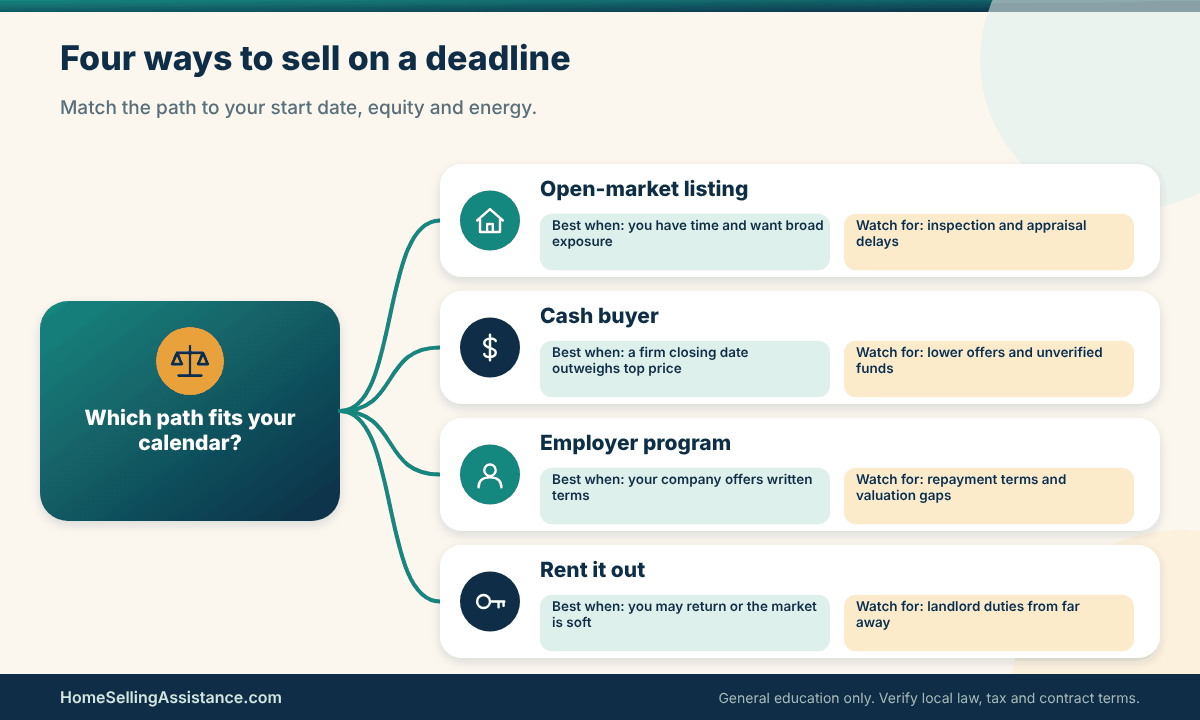
A traditional listing exposes the house to the widest group of buyers and generally gives the best chance at a strong price, but it asks you to prepare the house, allow showings and wait through inspections, appraisals and financing. A cash buyer can often close on a date you choose and may skip some contingencies, which is attractive when the calendar is tight, though offers are frequently below what the open market would produce. Our overview of a cash offer for a house compares what to check.
Employer or third-party programs vary so much that it is wrong to describe a typical one. Some arrange a home-value process and a guaranteed purchase; others reimburse certain closing costs; many offer nothing for the sale at all. If your employer provides one, request the full written terms and compare the outcome with simply listing the house yourself. The program may win on certainty and lose on price, or the reverse. You will not know without numbers. A calm, written approach helps whenever you sell house for relocation.
Renting the property out is a fourth option that deserves honest treatment. It can make sense if you expect to return, if the local rental market is strong or if selling would trigger a painful loss on the timing. It also makes you a landlord from afar, with insurance, tax, mortgage and maintenance consequences that depend on your situation. Rental income and later sale tax treatment are worth reviewing with a tax professional, and IRS Publication 527 introduces the basic rules for residential rental property.
Not every move is driven by an employer. Some households sell house for relocation because they are retiring to a different region, while others are leaving because homeowners insurance has become costly or hard to find, or because wildfire, flood or storm exposure has changed how they feel about the property. A retiree may care most about unlocking equity and simplifying life, which our guide to selling a house after retirement explores.
A household worried about hazards may need to think harder about what must be disclosed, a topic covered in our pieces on selling because insurance became too expensive and on wildfire, flood and climate risk.
Other moves arrive with grief or change. Someone who has lost a spouse may need to sell house for relocation closer to family while sorting out ownership, estate paperwork and the mortgage at the same time, and we discuss that in selling a house after a spouse dies. Older households who are moving to a smaller place often face the sequencing question in a sharper form, and our guides on downsizing a home and on selling before buying the smaller home take it up. The broader relocation and downsizing category gathers these pieces in one place.
One principle applies whatever the reason: be fair to every buyer. Federal fair housing law prohibits discrimination in housing based on protected characteristics, and agents and sellers alike must avoid steering, preferences or comments about who would be a good fit for a neighborhood. When you sell house for relocation, keep your marketing and your conversations focused on the property, the price and the terms. HUD explains the basics at its fair housing and equal opportunity page, and your state or local law may add further protections.
X you have lived in for years, especially for a move you did not fully choose, can make decisions feel heavier than the numbers suggest. Allow yourself some time to grieve the house while you work the plan. Sellers who acknowledge that feeling tend to negotiate more calmly, because they are not trying to prove something through the price. If the process is overwhelming, say so to your agent or attorney, since a good professional will adjust the pace and explain steps more simply.
Evidence to gather: how each path treats time and certainty
To compare paths fairly, ask each one the same four questions. How soon could closing happen? How firm is the price? What could cause the deal to fall apart? What will I personally have to do, and from where? Write the answers in your own words. A listing agent can estimate a realistic marketing period based on local activity, a cash buyer can state a closing timeline, and an employer program can send its process in writing. None of those answers is a promise, but together they reveal differences.
Ask for specifics instead of impressions. For a listing, request recent comparable sales and the average time those homes took from listing to contract in your neighborhood. For a cash buyer, ask for proof of funds and how the offer price was calculated. For an employer program, ask whether you can still sell on the open market if the program’s number is lower. Specific answers let you compare real alternatives, while vague enthusiasm tells you almost nothing. Ask about it up front if you plan to sell house for relocation.
Pay attention to how each path handles the house’s condition. Some buyers accept a property as it is, while a conventional sale may produce an inspection request that adds negotiation time. Your repair-versus-credit decision becomes more important on a deadline, because a long list of repairs after an inspection can eat the exact weeks you do not have. Decide in advance how far you are willing to go, and tell your agent. It is a small step, yet it shapes how you sell house for relocation from the first week.
Finally, ask what each path means for the days after you leave. A traditional listing may require you to be reachable and to arrange for showings in your absence. A sale with a flexible closing date might let you finish packing without a stranger walking through. A rental needs a property manager or a very patient neighbor. Think about your own energy as part of the comparison, because a path that is theoretically cheaper but exhausts you may not be the right one.
A scenario, an exception, and your next step: the split household
Consider a family where one parent moves in January for the job while the other stays with two school-age children until June. They are not racing a closing date. Instead, they have a long, uneven runway. In that situation, listing in spring, when the family is still present to manage showings, may suit them better than a rushed fall sale, and the house stays furnished and lived in, which often helps buyers picture it. The numbers here are only illustrative, but the logic holds.
The exception arises when the stay-behind parent cannot manage the sale alone. Maybe showings disrupt work, or the house needs repairs that require supervision. Then it may be sensible to pay for help, move the listing date or consider a different path entirely. A split household is not a weaker position; it simply needs a plan that does not depend on one person doing everything. Experienced agents know how it affects owners who sell house for relocation.
The next step is to decide who the household’s decision-maker is for the sale, who holds signing authority and who handles day-to-day contact. Put that on paper, share it with your agent or attorney, and check that your documents, from deeds to powers of attorney, match the plan. Clear roles prevent the quiet frictions that surface at closing, usually at the least convenient moment. Our guide on a job transfer sale goes deeper on the sell-first, buy-first, rent or temporary-housing questions that follow.
Before moving on, one table is worth having beside you. The next one pulls the situations relocating sellers most often describe into a single view, with the key fact that drives each, a sensible practical action, the trade-off you accept and the document or source that backs the answer. It is meant as a starting point for a conversation with your agent, attorney or tax professional, not as a verdict on your case. Nobody enjoys this part, but it supports any plan to sell house for relocation.
| Situation | Key fact | Practical action | Trade-off | Source or document |
|---|---|---|---|---|
| Firm start date, house not yet listed | Timeline is shorter than a typical marketing period | Interview agents on realistic time to contract | Faster pricing may lower the offer you attract | Offer letter, local comparable sales |
| Employer offers a relocation package | Terms and repayment clauses vary widely | Request the full written policy before deciding | Convenience may cost some price or flexibility | Relocation agreement, HR policy |
| One spouse moves ahead of the other | Two households overlap for a period | Budget both housing costs and assign sale duties | Staying furnished helps staging but delays your move | Mortgage statement, lease, budget |
| Buying at the destination before selling | Two mortgages may be carried at once | Ask a lender how both loans would be qualified | Certainty at the new home against carrying risk | Lender pre-approval letter |
| House needs repairs and time is short | Inspection requests can add weeks | Decide in advance between fixing, crediting or selling as-is | Repairs protect price but use time and cash | Past inspection reports, contractor quotes |
| Moving before the sale closes | Vacant homes can carry insurance conditions | Tell the insurer and ask about vacancy rules | Leaving early frees you but raises house risk | Homeowners policy, insurer letter |
Use the table by finding the row closest to your life, then reading across. If your row says the key fact is a short timeline, the action tells you where to push. If the trade-off column feels uncomfortable, that is useful information, because it points to the decision you may want a professional to help with. None of the rows is advice for your exact circumstances, and the right answer in your state or contract may differ. Keep a copy handy while you sell house for relocation across distance.
What moves price, time, risk, and net proceeds when you relocate
Every relocation sale is a negotiation between four forces. Price is what buyers will pay. Time is how long you can wait. Risk is the chance that something delays or ends the deal. Net proceeds are what remains after the mortgage, fees, credits and taxes. A relocation tends to squeeze time harder than an ordinary sale, which in turn pushes on the other three, so it is worth understanding how each force responds. If you sell house for relocation, this is one of the places where a short call saves long delays.
One mistake to avoid is treating the listing price as the finish line. A higher price with a long closing period, a financing contingency and a buyer who must sell their own home first may deliver less certainty than a slightly lower price with clean terms. The comparison belongs in dollars and days, not in pride. Our guide to evaluating a home offer shows how to read an offer as a package. Compare notes with your co-owner as you sell house for relocation.
Market, condition, financing and buyer variables on a deadline
Four groups of variables shape how a sale behaves: the market you are selling into, the physical condition of the house, how the buyer is paying, and the specific terms in the contract. You control some of them and influence others. A deadline simply raises the stakes of each one, because there is less slack to absorb a surprise. Keep it in view as you sell house for relocation, since small gaps grow when you are far away.
The market is the least controllable. In a market with plenty of active buyers and few homes for sale, a well-priced house may attract offers quickly and sellers tend to have more room to set terms. In a slower market, homes sit longer, buyers ask for more concessions and a deadline can feel punishing. The honest answer to how long it will take is that it depends on local conditions at the moment you list. Our piece on the best time to sell a house explains why timing advice should come from local data, not a universal rule.
Condition is where you have the most control. A clean, decluttered, well-presented house tends to show better, and photographs shape first impressions online before anyone steps inside. That does not mean pouring money into renovations, which rarely pay back dollar for dollar on a short timeline. It means fixing the items buyers fixate on, such as a leaking faucet or a sticking door, and being ready to explain anything larger. Staging in a relocation often has to be simple and fast, and our home staging guide covers low-cost priorities.
Financing affects both certainty and speed. A buyer using a mortgage will usually go through an appraisal and underwriting, and either can add time or change the numbers. A buyer paying cash generally skips those steps. Neither type is inherently better for you, but a deadline makes the difference matter more. Ask for proof of funds or a lender’s pre-approval, and ask what the buyer’s own timeline requires, since a buyer who must sell a home first adds a dependency you may not control.
Contract terms tie it together. The closing date, the earnest money amount, the contingencies and any request for possession after closing or before it all affect your plan. A contingency is a condition that lets a party step away or renegotiate under stated circumstances, and common ones involve inspection, appraisal, financing and the sale of another home. Our guide to home sale contingencies explains how each works and how deadlines inside the contract interact with your move. It is one more reason to start early if you must sell house for relocation.
A closer look at buyer types helps, because the buyer in front of you shapes how your deadline plays out. Buyers using conventional or government-backed loans will generally need an appraisal, a lender’s underwriting and clear title, and each step has its own clock. Buyers who already own a home may need to sell it first, which links your closing to a stranger’s sale. Buyers paying cash can often move faster, but cash on its own is not proof of a clean deal, so verify the funds through the title company.
An appraisal deserves its own paragraph for sellers on a timeline. A lender usually orders an appraisal to confirm that the home supports the loan amount, and if the appraised value comes in below the contract price, the parties have to decide how to respond. The buyer may bring more cash, the price may be renegotiated, a challenge may be filed or the deal may end, depending on the contract.
If you sell house for relocation, ask your agent early how often appraisals in your area have matched contract prices lately, and whether the buyer has savings to cover a shortfall.
Inspections create their own detour. A buyer’s inspector may find issues that range from trivial to serious, and the requests that follow can be a list of small repairs, a request for a credit or a demand for substantial work. On a tight calendar, a seller who has already thought through what they will agree to responds in a day instead of a week. A seller who sells house for relocation with no plan for repair requests tends to lose days to hesitation, and days are exactly what a deadline does not offer.
Do not forget the buyer’s own constraints. A family with children may need to close before a school year begins. A buyer relocating for work may have the mirror image of your problem, with their own start date and their own housing gap. Understanding that constraint can turn a rigid negotiation into a cooperative one. If their deadline is flexible where yours is not, you may be able to trade price for control over the closing date, or the reverse. Ask your agent to find out what the buyer needs most.
Local custom matters more than most sellers expect. In some states a closing attorney leads the process, while in others a title or escrow company does. Earnest money practices, standard contract forms, the timing of inspections and even the expected length of a closing period vary across the country. When you sell house for relocation, ask the people closest to the transaction how things usually run in that county, and treat what you read online as general background only. Local professionals see the patterns every week.
Evidence to gather: how to read your local market quickly
You do not need to become a market analyst. You do need a few trustworthy facts. Ask your agent for a short list of recently sold homes similar to yours, the active listings that compete with you and the typical time between listing and accepted offer in your area. Ask how many sold close to their list price and how many needed reductions. A good agent will give you these and explain the pattern. Be cautious about anyone who promises a price or a sale date before seeing the house.
Compare at least two views. Different agents may arrive at different numbers, and the difference is information, not a flaw. If one estimate is far higher than the rest, ask why and what evidence supports it. Inflated pricing to win a listing is a known tactic, and on a deadline it can cost you weeks before a reduction. Our guide to pricing a house to sell shows how comparables, competition and condition combine into a defensible range. The cost of ignoring it shows up late when you sell house for relocation.
Look at the specific calendar as well. Some local markets slow around holidays or school breaks, while others stay steady. Ask your agent whether the weeks you are targeting tend to bring more or fewer buyers, and whether there are local quirks, such as a seasonal rental market or a major employer’s hiring cycle. These are not rules, only context, and a good professional will frame them as such. Spend a little time here and the plan to sell house for relocation firms up.
Finally, build a simple written record. Note the date of each valuation, who gave it and what it was based on. If the market moves while you wait, the record helps you decide whether to adjust the price or hold. It also keeps you from relying on memory when emotions run high. Sellers on a deadline often change strategy abruptly, and a short written file makes sure the changes are deliberate rather than reactive. The same logic applies each time you sell house for relocation, whatever the size of the house.
A scenario, an exception, and your next step: the price that misses the date
Imagine a seller with a start date ten weeks away who lists at a price slightly above what comparable homes suggest, hoping for a strong offer. Three weeks pass with a few showings and no offers. A reduction now leaves seven weeks, and a contract plus a normal closing may not fit. The numbers are illustrative, yet the pressure is real: each week spent testing a high price is a week removed from a deadline that does not move. Local practice varies, so confirm it before you sell house for relocation.
The exception is when you have genuine flexibility. A seller who can rent the house out, delay the move or carry two mortgages for a while can afford to test the market. That is a legitimate choice if the carrying costs are budgeted and the downside is understood. The key is that the decision is made on purpose, with eyes open, rather than discovered at week six. Real numbers beat guesses when you sell house for relocation.
Your next step is to set a review point before the listing goes live. Decide, with your agent, how many days you will wait for activity before revisiting price, terms or presentation. Write it down. A pre-agreed trigger takes emotion out of the moment and helps you adjust early, when a smaller change can still work. Think of it as insurance for the day you sell house for relocation and something shifts.
Costs, taxes, employer help, and logistics to sell house for relocation
Money in a relocation comes from several directions at once, which is why a clear picture matters. Some costs belong to the sale, such as agent compensation, title and escrow charges, transfer taxes where they apply and any repair credits. Others belong to the move, such as movers, travel, temporary housing and storage. A third group belongs to carrying the old house for as long as you own it. Mixing them up leads to unpleasant surprises. It shapes the choices that follow if you sell house for relocation.
The third image shows how a sale price turns into net proceeds, with deductions peeling away step by step. It is a structure, not a forecast, because every sale has its own mortgage payoff, its own fees and its own local charges. Build your version from real quotes: a payoff statement from your servicer, a net sheet from your agent or title company and the estimated closing figures once you have a contract. Sellers rarely regret clarity when they sell house for relocation.

Seller closing costs differ by state and by contract, and they are often negotiated. Agent compensation is likewise negotiable and must be documented in writing, a point that has become more visible since the industry’s recent rule changes. We avoid quoting percentages because any single number would mislead someone, and our seller closing costs guide shows how to build an estimate from actual line items. Few sellers who sell house for relocation regret asking this question early.
Taxes are a separate layer. Federal law allows many homeowners to exclude a certain amount of gain from the sale of a main home if they meet ownership and use tests, generally owning and living in the home for at least two of the five years before the sale. The exclusion is up to $250,000 for a single filer and up to $500,000 for joint filers who qualify.
A relocation after less than two years may still allow a reduced exclusion in some cases, which a tax professional can confirm. IRS Publication 523 explains the rules, and our guide to taxes when selling a home adds context.
Employer help adds another wrinkle. Some employers reimburse moving costs or pay vendors directly, and the tax treatment of those benefits depends on current law and your own situation. Ask your employer and a tax professional how any reimbursement will be reported to you, so a payment you expect to be tax-free does not arrive as a surprise on a pay stub. Never assume. Ask for the answer in writing from the people responsible for it. Each time you sell house for relocation, this is worth a second look.
Logistics round out the picture. Movers, utilities, mail forwarding, vehicle registration, school records, medical files and the keys, garage openers and manuals that must change hands at closing all need owners and dates. When you sell house for relocation across a long distance, a short written logistics plan with a person responsible for each item prevents the last-week scramble that causes most of the regrets sellers describe.
The housing gap deserves a closer look, because it is the part of a relocation that most people underestimate. Between the day you leave and the day the sale closes, you may be paying for two places to live, or for a house that is empty. Some households bridge the gap with a short-term rental or furnished apartment at the destination. Others stay with family. Some negotiate a rent-back, in which the seller stays in the home for a short period after closing under a written agreement. Each option has its own cost and its own paperwork.
The sell-first-or-buy-first question sits right inside this gap. If you sell first, you know your proceeds before you commit to a new home, but you may need temporary housing and you may feel rushed to buy. If you buy first, you can pick the new home carefully, but you may carry two housing costs and need a lender who will qualify you with both. Some buyers use bridge loans or home equity borrowing, products with their own costs and risks.
Our guide to selling first or buying first compares these routes without picking a winner, and the sell first or buy first category collects related articles.
Some sellers consider a contingency that links the sale of the old house to the purchase of the new one. That kind of contract term can protect a buyer, but it can also make an offer less attractive to a seller on the other side, so it is a negotiation, not an entitlement. A seller who needs to sell house for relocation before buying elsewhere may prefer to separate the two transactions, accept the lower stress of a rental and then shop calmly.
Another seller may have so much equity that carrying both homes is perfectly comfortable. Your cash cushion decides.
The fifth image shows a fallback tree for the situation sellers fear most, which is reaching the start date with the house still unsold. It is a thinking tool, not a script. Each branch asks a simple question and points to a next move, from lowering the price and widening your marketing to renting the house or handing the day-to-day to a trusted person. The point is to decide in advance what you will do, so that a stressful week does not push you into the most expensive option.
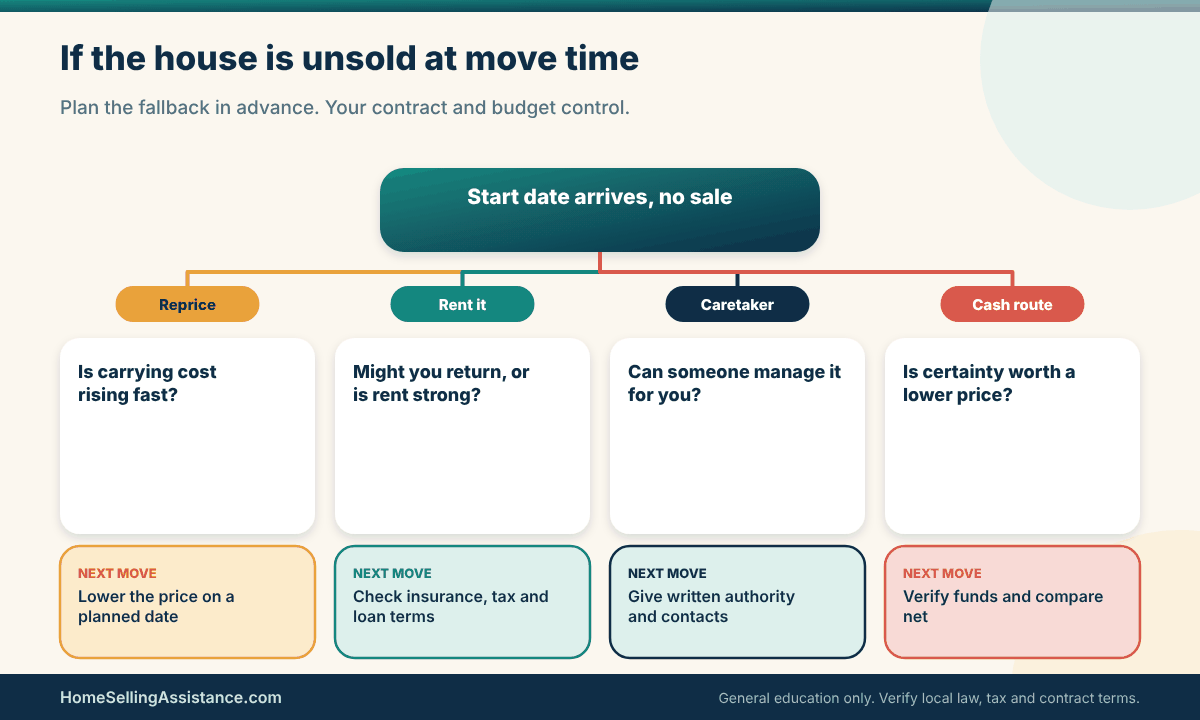
Renting the house out is the fallback that surprises people most. It can keep you from a forced sale in a weak market, and it may preserve the option to return. It also changes your tax picture and your risk. Landlord insurance, local rental registration rules, tenant law and mortgage terms all come into play, and the ability to claim the federal home-sale exclusion later depends on how long the house was your main home. IRS Publication 523 explains the basic ownership and use tests, and a tax professional can say how renting would affect them.
Another fallback is to reduce the price in a planned way. Sellers sometimes resist this because they feel they are losing money, but a house that sells ten days before your deadline at a modest discount may leave you better off than one that sits and costs you carrying expenses every month. This is where the carry-cost number from earlier earns its keep. When you sell house for relocation, the price that nets you the most is not always the highest price on the list.
A last fallback is to change who handles the sale. A trusted friend, a family member with a power of attorney or a property manager can keep the process moving after you leave, if you give them clear written authority and the right contact list. An agent experienced with out-of-town sellers can be a real asset here. Whoever you choose, put expectations in writing: who responds to offers, how quickly, what the limits of their authority are and when they must call you. Our guide to moving out of state after selling covers more of the practical hand-offs.
Evidence to gather: the numbers behind your net
Begin with a payoff statement for each loan or lien on the house. Your servicer can provide one, and it will usually show per-diem interest so you can see how a few days of delay change the amount. Ask for it early, because the figure on your monthly statement is not the number you will owe at closing. Home equity lines, second mortgages and any tax liens must also be accounted for, since each must be paid from the proceeds in most sales.
Ask your agent or a title company for a seller net sheet, an estimate of the charges and credits at closing based on your expected price. Request two versions, one at your hoped-for price and one lower, so you see how sensitive your proceeds are. Then check what is negotiable and what is fixed. Transfer taxes and recording fees follow local rules, while agent compensation and certain credits are matters of contract. A net sheet is an estimate, not a promise.
Add the relocation costs on top. Get at least two written moving estimates and read what type of estimate each is and what happens if the shipment weighs more or takes longer than quoted. The Federal Trade Commission publishes consumer guidance on avoiding moving scams, available through consumer.ftc.gov, and it is worth skimming before you hire anyone. Include temporary housing, storage, travel and any double utility bills in the same sheet. Plan around it instead of hoping, especially if you sell house for relocation.
Finally, build a carry-cost line for the old house, a monthly figure covering mortgage payment, taxes, insurance, utilities, lawn or snow service and maintenance. Multiply by the number of months you might own the home after you leave. This single number shapes the whole decision: it tells you what an extra month of waiting for a better offer really costs, and whether a slightly lower, faster offer might leave you ahead. This matters more than usual when you sell house for relocation instead of an ordinary move.
A scenario, an exception, and your next step: the employer program that looks free
Suppose an employer offers a home-sale program that handles the process and promises a fast closing. A seller named Dana is relieved until she reads the terms: the program’s purchase offer is based on an internal valuation process, fees apply in certain cases and she must repay some benefits if she leaves the company within a set period. The numbers are illustrative, but the lesson is common: convenience has terms, and the terms decide whether the offer is generous. This one habit can make your effort to sell house for relocation smoother.
The exception is a program that really is straightforward. Some employers offer clear, competitive terms with an independent appraisal process and no repayment trap. If that is your situation, the program may be a sound choice, especially on a hard deadline. You will not know which type you have until you read the document and compare it with a market-based net sheet. Document it, so your choice to sell house for relocation stays organized.
Your next step is to request the policy in writing, ask which costs are covered, which are taxable to you and what happens if you decline the program’s offer. Then compare it with your own market estimate side by side. If you cannot tell which is better, an hour with a tax professional or an attorney familiar with relocation agreements is a small price compared with the amounts involved. Our relocation assistance guide lists further questions to bring. Use it as a checkpoint while you sell house for relocation.
A verification roadmap for your sell house for relocation plan
By this point you have a calendar, a comparison of paths and a sense of what moves your numbers. The last step is verification, which means turning every assumption into a document, a phone call or a written quote. Sellers who sell house for relocation without a verification pass often discover problems late, when options are fewest: a lien nobody mentioned, a signature that cannot be gathered remotely, a mover who quoted something different from the invoice.
Verification does not need to be exhausting. It is a short list of questions asked of the right sources in the right order. Some answers come from your own files, some from your lender or title company, and some only from a licensed professional in the state where the house sits. The goal is not to eliminate uncertainty, which no seller can do, but to make sure the uncertainty left over is the ordinary kind. It is the sort of detail that helps you sell house for relocation with fewer surprises.
Documents and professionals to involve in a relocation sale
A relocation sale brings together people in at least two places, and the paperwork has to travel with you. The fourth image groups the main documents into ownership, money and condition. Gathering them before the first showing saves the frantic hunting that tends to happen after an offer arrives, when every day matters and a lender or buyer is waiting for something you cannot immediately find. Talk it through with your family before you sell house for relocation.
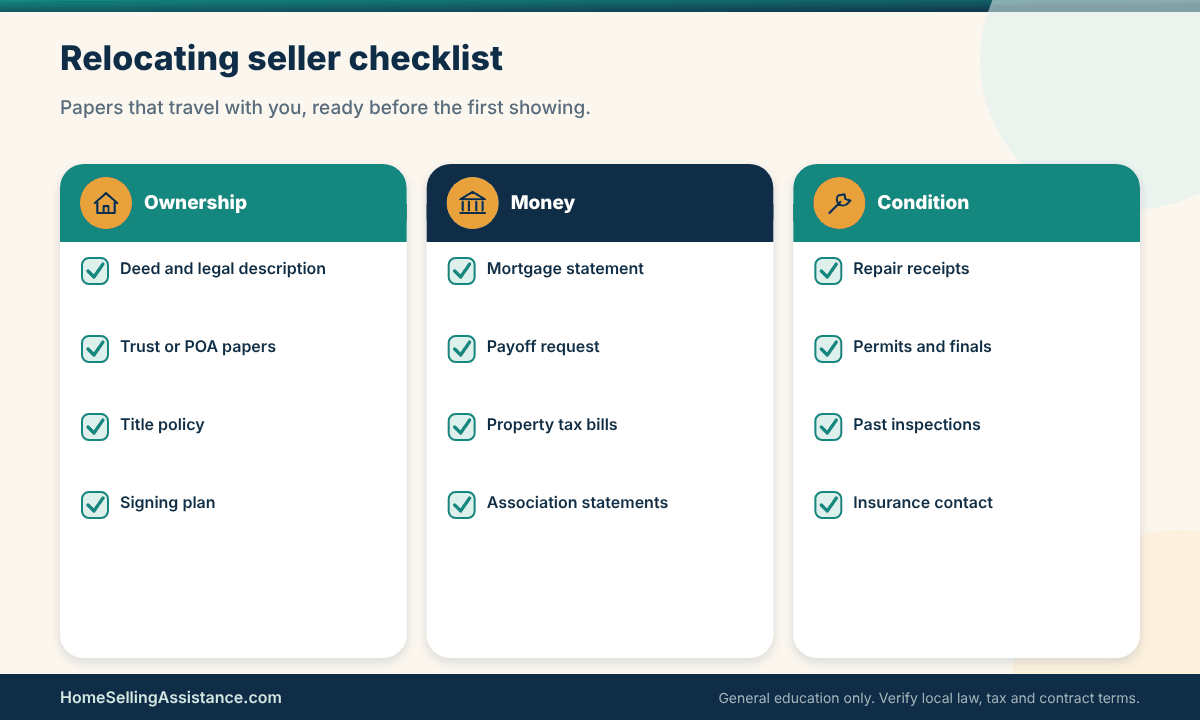
Ownership papers come first. These include the deed, the legal description and any trust, estate or power-of-attorney documents that affect who can sign. If you bought with a title insurance policy, keep it. If there is a survey or plat, locate it. These items matter in every sale, but they matter more when you will be away, because a title company that needs a missing document cannot walk down the hall and ask you for it. Keep it simple and written, and the plan to sell house for relocation travels well.
Money papers come next: the latest mortgage statement, a payoff request, recent property tax bills and, for condominiums or planned communities, current association statements and governing documents. If the house sits in a community with dues, ask the association how long it takes to produce the documents a buyer will request, since some take longer than a typical relocation calendar allows. Our guide to selling a condo explains what those documents usually contain. Write the answer down, because the plan to sell house for relocation will lean on it later.
Condition papers round out the file. Gather repair receipts, permits and final inspections for past work, warranties, manuals and previous inspection reports. If the house was built before 1978, federal law requires sellers to provide buyers with certain lead-based paint information and an EPA-approved disclosure, described by the EPA at its real estate disclosure page. Beyond that federal rule, disclosure forms and obligations vary by state, a topic our guide to seller disclosures covers in general terms.
On the professional side, most sellers who sell house for relocation draw on four kinds of help: a licensed real estate agent or a broker if you list, a title company or closing attorney who handles the closing, a tax professional for gain and employer-benefit questions, and a mover or moving broker. Each has a distinct job, and none should be chosen on a whim. Ask how each will communicate with you across distance, how quickly they respond and who is their backup when they are away.
Evidence to gather: credentials, references and written terms
Start with licensing. Real estate agents and brokers are licensed by the state, and most state real estate commissions let you look up a license and any disciplinary history online. Title companies and attorneys are also regulated at the state level. A quick lookup takes minutes and confirms that the person you are about to trust with a major transaction is who they say they are. Do the same for anyone who contacts you out of the blue promising a fast sale.
Ask for written terms before you sign anything. A listing agreement spells out the length of the contract, how the agent is paid, what happens if you cancel and whether you owe anything after the agreement ends. Because relocation sellers sometimes need flexibility, ask whether the agreement can be ended early and under what conditions. Our guide on how to choose a listing agent offers questions to bring to interviews, including how the agent handles out-of-town clients. The earlier you face it, the easier it is to sell house for relocation.
For movers, check registration and complaint history. Interstate movers are generally required to be registered with the federal government, and consumer agencies publish tips on verifying a company and spotting warning signs. Get written estimates, ask whether each is binding or an approximation, and read the section on liability and insurance for your belongings. Be wary of a quote that is far below the others or a company that asks for a large cash deposit upfront. Good professionals will walk you through it when you sell house for relocation.
Finally, ask each professional about their experience with sales where the owner is absent. How do they handle remote signing? Do they accept electronic signatures for the documents that allow it? Is a mobile notary available, or will a power of attorney be needed? Local practice differs, and the answers often reveal whether someone is comfortable with the very situation you are in. Comfort with remote closings is not universal, and it is better to learn that early. Take this seriously whenever you sell house for relocation on a firm date.
A scenario, an exception, and your next step: the missing signature
Take a seller who relocates before closing and assumes that signing documents can be mailed. Two weeks before closing, the title company explains that a specific document must be signed before a notary in person, and the seller is now in another time zone. The example is illustrative, yet this situation is very common. Planning for it in advance, by asking the title company early what can be signed remotely, avoids the pressure of finding a notary at the last minute.
The exception is when you use a power of attorney, a legal document that lets another person sign for you. These are sometimes used in relocation, but they come with rules that vary by state and title company, and a lender or title insurer may require specific wording or review. A power of attorney can solve a real problem, and it can create one if it is poorly drafted or rejected at the last minute. This is a point for an attorney, not guesswork.
Your next step is a single phone call. Ask the title company or closing attorney in the state where the house sits: what do you need from me, what can be signed remotely, and what must be done in person? Write down the answers and share them with your agent. If someone else will sign for you, ask what they need to see and whether they have handled a similar situation before. It will not feel exciting, but it keeps you on track as you sell house for relocation.
The table below describes the same journey from the transaction side. Each row is a stage, who carries the responsibility, who else the stage depends on, a rough deadline logic and a fallback if the stage goes sideways. Because deadlines depend on your contract, we describe their logic instead of inventing dates. Use it to see where the hand-offs are, and which stage deserves a backup plan. It is easy to skip, and it is often the thing that decides how smoothly you sell house for relocation.
| Stage | Seller responsibility | Buyer or professional dependency | Deadline logic | Fallback |
|---|---|---|---|---|
| Preparation and listing | Gather documents, prepare the house, set price | Agent supplies comparables and marketing | Set before the start date minus marketing time | Adjust price or list earlier, or consider another path |
| Offer and negotiation | Compare terms, counter, accept in writing | Buyer’s agent and financing documentation | Offer response windows in the listing and contract | Ask for backup offers or revised closing dates |
| Inspection and repairs | Respond to requests, decide on credits or repairs | Buyer’s inspector and any contractors | Contract inspection period | Offer a credit, or reprice the deal |
| Appraisal and financing | Provide access, answer lender questions | Appraiser, lender and underwriter | Financing and appraisal dates in the contract | Renegotiate price, or accept a backup buyer |
| Final steps and moving out | Pay bills, schedule movers, confirm utilities | Mover, utility companies, title company | Possession date in the contract | Agree to a short post-closing stay or storage |
| Closing and funding | Sign, deliver keys, confirm payoff | Title company, lender and recorder | Closing date set by contract | Ask for a short extension in writing |
Read the table from left to right for any stage you are worried about, then ask which person can open up the fallback. If the dependency column shows a party you cannot control, such as a lender, that stage deserves a conversation with your agent about contract protections. Remember that a fallback is not a guarantee, only a path worth asking about. The exact rights and remedies in your sale depend on your contract and your state. Pencil it into your calendar as you sell house for relocation.
What to decide before listing and what can wait until an offer
One reason relocations feel overwhelming is that sellers try to decide everything at once. In reality, a handful of decisions must be made before the listing goes live, because they affect pricing, marketing or timing from day one. Other decisions can wait until a buyer appears and the contract is on the table. Sorting them is a gift to your future self, and it is a skill that experienced sellers develop quickly. Doing this well is a quiet advantage when you sell house for relocation.
Decisions that belong before listing include your price strategy, how you will be reached for offers, who has authority to sign, what you will do about repairs and what your realistic closing window looks like. If you plan to sell house for relocation while living elsewhere, add how showings will be arranged, who will keep the house presentable and how the house will be secured. Settling these early prevents delays when a buyer finally calls.
Decisions that can wait include the exact closing date, the details of a post-closing stay, most of the moving logistics and the final choice among competing offers. You can prepare for them, for example by deciding which terms matter most, without locking them in. Keeping flexibility on closing and possession is often what lets you respond when a good offer arrives at an inconvenient time. A short note on this now keeps your effort to sell house for relocation organized.
Showings are the practical headache for sellers who have already moved. A house that is empty can feel cold and echoing, while one that is half-packed can feel chaotic. If you stay until the house is listed, you can keep it lived in and tidy, and an agent can coordinate showings around your schedule. If you leave first, you may want light staging, a cleaner on call and a lockbox arrangement your agent controls. Discuss security openly, including who has keys, who gets notified of a showing and how doors are checked afterward.
Insurance is a hidden pitfall for a house that sits vacant. Many homeowners policies treat an unoccupied property differently after a set period, sometimes limiting or excluding certain kinds of loss such as water damage or vandalism. The terms differ by policy and insurer, so call your insurer or agent and ask directly: what counts as vacant, when does that status begin and is there an endorsement available for a house being sold? Put the answer in writing.
A surprise gap in coverage is one of the worst possible discoveries when you sell house for relocation, because the loss would land on you.
Utilities and upkeep matter as well. Keep heat or cooling running at a safe level, keep water on if the buyer’s inspection or the house’s systems require it and arrange lawn, snow or pool service if the property needs it. Someone should check the house regularly for leaks, pests or signs of a break-in. Ask your agent who will do this and how often. If the answer is vague, hire a property caretaker or ask a reliable neighbor. Small lapses in upkeep can reduce buyer interest or even create a repair request that costs real money.
Possession and rent-back arrangements are common relocation tools. A seller might ask to stay a few days or weeks after closing to finish the move, or a buyer might ask to move in before closing. Both need written agreements, because ordinary insurance, mortgage and liability rules do not always cover them. A lender may restrict early occupancy, and a seller staying on may need to pay an agreed daily amount and keep insurance current. Ask an attorney or title company to confirm what is allowed in your state, and never rely on a handshake.
Finally, think about the closing itself. If you are away, ask how documents will be delivered and signed, what identification the notary requires and whether wiring or check instructions will come through a secure channel. Wire fraud targets people in precisely this position, hurried, distant and relying on email. Call the title company at a phone number you found independently to confirm any payment or wiring information. The FBI’s Internet Crime Complaint Center describes the scheme, and our guide to home sale fraud and seller safety adds protective habits.
Evidence to gather: your priorities, ranked in writing
Take a sheet of paper and rank what matters most to you in this sale, such as price, speed, certainty, low effort or the ability to stay in the home a few extra weeks. Ranking forces trade-offs into the open. Most sellers want all of them, but a relocation rarely delivers everything, and the order of your priorities determines which offers look good. A seller who ranks certainty first will judge a clean cash offer differently from one who ranks price first.
Share the ranked list with your agent and ask them to restate it in their own words. If their summary differs from yours, you have found a misunderstanding early. Then ask how each offer structure would score against your priorities. A good professional will welcome this exercise, because it makes their advice more useful, while a defensive response suggests they prefer to decide for you. You are the client, and the priorities are yours. Bring it up at your next call about how to sell house for relocation.
Check any priority that depends on a rule. If you hope to stay after closing, ask whether a rent-back is allowed under your mortgage, insurance and contract, and whether the buyer’s lender will permit it. If you hope to close quickly, ask whether any step, such as an association document or a payoff, has a fixed waiting period. A priority that conflicts with a rule is better discovered now than after you have promised it to a buyer. Better to know now than to learn it while you sell house for relocation.
Finally, revisit the ranked list at each major milestone, such as after the first offers or after the inspection. Priorities shift under pressure, and what felt like a minor preference in week one may become essential in week six. Writing the list down and updating it gives you a steady reference point, which is valuable when the process gets noisy and everyone around you has an opinion. Treat it as part of the work to sell house for relocation, not as an optional extra.
A scenario, an exception, and your next step: offers that trade price for timing
Imagine two offers on the same house. One is higher but contingent on the buyer’s financing and an appraisal, with a closing date a few weeks after your move. The other is a bit lower, with proof of funds and a closing date you choose. The numbers are invented for illustration. A seller who ranked price first might lean toward the first offer, while a seller who ranked certainty first might prefer the second. Neither is wrong; the ranking decides.
The exception is when the higher offer is stronger than it looks, perhaps because the buyer has a large down payment and a lender known for reliable closings, or when the lower offer is weaker, perhaps because the proof of funds is thin. Look under the headline number. Ask for documentation, check how the buyer’s agent communicates and weigh the risk that a contract falls apart late, because that is when relocating sellers are least able to start over. It all comes back to preparation when you sell house for relocation.
Your next step is to prepare an offer comparison page before the first offer arrives, with columns for price, closing date, contingencies, deposit, financing and any requests. When an offer comes in, fill it in. The structure keeps emotion from distorting the decision, and it makes the conversation with your agent or attorney faster and clearer. It also gives you something to show a spouse or co-owner who is not in the room.
Quick scenario
Elena accepts a job that starts in nine weeks, in a city she has visited once. Her house is in good shape but has an older furnace. She spends one evening listing fixed dates, asks her new employer for a remote first two weeks, and gets two agent opinions and one cash-buyer estimate. The numbers are illustrative: the cash estimate is lowest but fastest, and the listing estimate is highest but slowest.
Because her carrying costs are modest and she can rent a small apartment, she lists on the open market with a review point at day twenty-one and keeps the cash estimate as a fallback. She does not know how it will turn out, but she knows what she will do at each stage.
Frequently asked questions about sell house for relocation
How early should I start if I have to sell house for relocation?
As soon as the move is likely, not only when it is certain. Preparation steps such as gathering documents, decluttering and talking to a few agents cost little and can be paused if plans change. Starting early gives you options like a longer marketing period or a rent-back. How long a sale takes depends on your market, your price and your contract, so no one can honestly promise a fixed number of weeks.
Should I sell first or buy first when I relocate?
It depends on your cash cushion, your lender, your risk tolerance and the market at both ends. Selling first gives you known proceeds but may mean temporary housing, while buying first gives you the new home but can mean carrying two housing costs. Neither path is right for everyone. Our guide to sell first or buy first walks through the trade-offs, and a lender can tell you what you would qualify for.
Will my employer pay for my home sale?
Some employers offer help, many do not and the terms vary enormously. Programs may reimburse certain costs, arrange a purchase process or offer only moving allowances. Ask for the policy in writing and read repayment conditions, covered costs and any tax treatment. A tax professional can explain how employer benefits might be reported. Never assume a benefit exists until you see it in a document you can keep.
Is a cash buyer a good idea when I am short on time?
It can be, because some cash buyers can close on a date you choose and may waive certain contingencies. The trade-off is that offers are often lower than open-market prices, and not every buyer is reputable. Verify proof of funds through a title company and compare the net result with a listing. Our cash offer guide lists what to check before you accept.
Can I close on my house from another state?
Often yes, but the rules and practices depend on the state, the title company and the lender. Some documents can be signed electronically, others need a notary and some sales use a power of attorney. Ask the title company or closing attorney early what they will accept, and confirm any wiring instructions by phone. Do not wait until the last week to learn that a signature must be notarized in person.
Do I owe taxes if I sell my home because of a job move?
Possibly, though many sellers owe nothing on the gain from a main home because of the federal exclusion, which can be up to $250,000 for a single filer and $500,000 for joint filers who meet the ownership and use tests. If you lived there less than two years, a reduced exclusion may apply in some circumstances. IRS Publication 523 explains the rules, and a tax professional can apply them to your facts.
What happens if the house is still unsold when I start the new job?
You have several routes: lower the price, widen the marketing, rent the house, hire a caretaker or let a trusted representative manage the sale with written authority. Each has costs and risks, and your carry-cost budget helps you choose. Tell your insurer if the house will be vacant, and keep the house maintained. Planning this fallback before listing makes it a decision rather than a panic.
Should I make repairs before listing if I am short on time?
Fix what is cheap, quick and visible, and decide in advance how you will respond to inspection requests. Large projects take time you may not have, and a credit or an as-is sale can sometimes be faster. The right answer depends on the house and the market. Our repairs before selling guide compares fixing, crediting and selling as-is.
How do I protect myself from scams when I am moving?
Verify movers through official registration and complaint records, avoid large upfront cash deposits and be skeptical of quotes far below the rest. For the sale, confirm wiring instructions by calling a number you found independently, and be wary of buyers who rush you or ask for fees. The Federal Trade Commission publishes consumer tips on moving and fraud.
Do I need a real estate agent to sell house for relocation?
No law says every seller must use one, and some sellers sell on their own or to a direct buyer. Others value an agent’s help with pricing, marketing and negotiation, especially when they are far away. Compensation is negotiable and should be put in writing. Compare options honestly, and read our guide to choosing a listing agent before you sign anything.
Turning a hard deadline into a workable plan
A relocation feels like a race, but most of it is sequencing. Sort your dates, compare your paths, price for the calendar you really have, verify the documents and decide what can wait. When you sell house for relocation with that kind of order, the process stops feeling like a pile of emergencies and starts feeling like a list. For the wider picture, our guide to how to sell a house and the selling process timeline category sit alongside this article.
This article is general education, not legal, tax or financial advice, and your facts, contract and local law will control. For decisions about your own sale, talk with a licensed real estate professional, an attorney or a tax adviser who can read your documents and who knows your state.