Whether to sell first or buy first is the question that keeps more homeowners awake than almost any other part of moving, because both answers feel risky and neither one is free. Sell first, and you may land in a gap with nowhere to live. Buy first, and you may carry two homes at once while the old one waits for a buyer. This guide lays out how each path really works, what it costs in cash, time and stress, and how to decide without anyone pushing you.
We are going to treat this as a decision about cash flow and calendar, not as a contest between two slogans. You will hear confident advice from friends, neighbors and online forums, and most of it is based on one person’s market in one particular year. A path that worked beautifully for your coworker in a fast neighborhood can be painful in a slower one. So this article gives you a way of thinking, with plenty of worked examples, rather than a verdict.
Throughout, the numbers we use are round, made-up figures meant to show how the arithmetic behaves. They are not predictions, and they are not typical prices anywhere. Your own figures will come from your mortgage statement, your lender, your contract and local professionals. Rules about contingencies, possession, disclosure, closing and taxes also vary by state and sometimes by county, so treat everything here as general education and verify the specifics where you live.
Key takeaways
- The sell first or buy first choice is mostly a cash-flow question. Equity, income, lender rules and your tolerance for overlap decide what is workable more than any market slogan does.
- Selling first trades price certainty for housing risk. You usually know your proceeds sooner, but you may need temporary housing, a flexible closing date or a rent-back to bridge the gap.
- Buying first trades housing certainty for carrying risk. You secure the next home, but you may pay two housing costs and qualify with both obligations on paper.
- Contingencies shift risk instead of removing it. A home-sale contingency protects the buyer and can weaken an offer, so test how it would land in your local market before relying on it.
- Dates are the real currency. Closing date, possession date and the date funds arrive can all differ, and aligning them is often cheaper than any financing product.
- Decide the big items before listing. Your fallback housing, your minimum acceptable timeline and your lender conversation should be settled before the first showing.
Sell First or Buy First? Start With the Decision, Not the Jargon
Before you compare financing tools or contract clauses, it helps to pin down what you are actually trying to protect. Some sellers care most about never being without a home. Others care most about not paying twice. A few care mostly about winning a specific house that may not come around again. The right answer to the sell first or buy first question depends on which of those worries is loudest, and a surprising number of people never say it out loud before they start.
This first section builds the foundation for the sell first or buy first decision. We will define your goal and constraints, list the evidence worth collecting, and then map the main paths available. If you want the full sale process in the background, our overview of how to sell a house covers the steps that surround this decision, and you can browse every related article in our sell first or buy first category.
Define your goal, your cash position, and your property situation
A good sell first or buy first plan starts with three honest descriptions: what you want, what you can afford to carry, and what your current home is likely to do on the market. If any of the three is vague, the plan will be built on guesses. Spending an hour on these descriptions is the cheapest risk reduction in the entire process.
Start with the goal. Write one sentence that finishes the phrase “Success means…”. Maybe it says you move once, into a home you chose carefully, without borrowing against anything stressful. Maybe it says you keep your children in the same school year. Maybe it says you do not lose a specific house. That sentence becomes the tie-breaker when two reasonable sell first or buy first options conflict later.
Evidence to gather: the five numbers behind your sell first or buy first choice
Five figures do most of the work when you weigh the sell first or buy first question, and you can collect all of them within a week. The first is your mortgage payoff, which is different from the balance on your statement because it includes interest through a specific date. Ask your servicer for a payoff quote in writing so you are working from a real number, not a rounded memory.
The second figure is a realistic range for what your home might sell for. A listing agent’s comparative market analysis, an appraiser’s opinion or your own careful study of recent nearby sales can all feed that range. Notice the word range.
A single number gives a false sense of precision, and a plan that only works at the top of the range is a plan with a hidden weakness, and a sell first or buy first plan with a hidden weakness tends to reveal it at the worst time. Our guide to home sale net proceeds shows how to turn a price range into a cash range.
Third, estimate your selling costs in dollars, not percentages from the internet. Broker compensation is negotiable and must be written down, title and escrow charges depend on your area, and prorations depend on your closing date. Fourth, list the monthly cost of owning the home you hope to buy: principal, interest, taxes, insurance, any association dues, and the maintenance you expect. Fifth, estimate your monthly cost of the home you own today if it sits unsold for a while.
Here is a small illustration with deliberately round figures. Suppose your current home costs 3,000 per month to own, and the next one will cost 3,800. If you buy first and your old home takes four months to sell, the overlap period carries 6,800 per month of housing cost for those months, minus whatever you save by not renting elsewhere. These are example numbers only, but doing this arithmetic with your own figures is exactly the exercise worth doing before you sign anything.
Add two more items to the list if they apply. One is the money you need from the sale to fund the next purchase, such as a down payment and closing costs. Many buyers who sell first can say precisely how much cash they will have. Buyers who buy first often cannot, and that uncertainty is the root of most buy-first stress. The other item is your reserve: how many months of overlapping costs you could pay without selling anything at a bad moment.
Finally, gather the documents that prove these numbers: the latest mortgage statement, the property tax bill, the homeowners insurance declarations page, recent utility bills and any association statements. Having them in one folder makes lender conversations faster and helps a professional give you a sharper opinion. It also shows you quickly whether any figure is a guess you had mistaken for a fact.
A scenario, an exception, and your next step for the first sorting pass
Consider Dana and Marcus, a hypothetical couple with substantial equity, steady incomes and a home that is in good shape. They are moving up to a larger place in the same school district. Their equity means they could carry two homes for several months if they had to, and their lender has indicated they could qualify with both obligations counted. For a pair like this, buying first is a realistic option, and it may let them shop without a ticking clock.
Now change the facts. Suppose Dana and Marcus have thin savings, their income would not support two mortgages, and the proceeds of their sale are needed for the down payment. The same market, the same house and the same dream move now point toward selling first, or toward buying with a sale contingency, because the old home must convert to cash before the new one can be funded. Nothing about the market changed. Their cash position did, and that is why the sell first or buy first answer changed with it.
An exception worth knowing: some sellers have a second place to land. A family member’s spare room, a seasonal rental, a second property or an employer’s relocation housing can turn the housing-gap risk of selling first into a small inconvenience. If you have a reliable landing spot, selling first becomes much less frightening, and you can choose the path with the better price discipline instead of the one that merely feels safer.
Your next step after this sorting pass is simple. Write down which of the two worries is louder, the gap or the overlap, and note whether your cash position is thick, thin or unknown. If it is unknown, your first conversation should be with a lender, not a real estate agent, because the lender’s answer changes which options exist. People are often relieved to find that the answer is clearer than they feared.
One more caution at this stage. Do not let a deadline you invented harden into a fact. Sellers often say they must be moved by a certain month when the real constraint is softer, such as a school start, a lease end or a family preference. Ask yourself which dates are truly fixed by outside parties and which are preferences. Preferences can bend at a modest cost, and bending them may unlock a much calmer sequence.
One more habit belongs in this first pass: say your plan out loud to someone who will question it. A friend, a relative or a housing counselor will ask the obvious questions you have stopped hearing yourself, such as where the money for the down payment comes from or what happens if the buyer asks for more time. People who rehearse the sell first or buy first plan this way tend to find its weak joint while fixing it is still cheap.
It also helps to separate the facts you know from the facts you are assuming. A payoff quote is a fact. A neighbor’s quick sale is an anecdote. A lender’s written estimate is a fact. A cousin’s story about a bridge loan is an anecdote. When a sell first or buy first decision rests mostly on anecdotes, slow down and convert the important ones into documents before you commit to a listing date or an offer.
Finally, notice who benefits from each answer. An agent paid at closing, a lender selling a product and a moving company selling a service each have reasons to prefer a particular sequence, even when they are honest and careful. That is normal in any market. The remedy is not suspicion but triangulation: compare what two or three people tell you and let your own written numbers break the tie.
Map the real paths: sell first, buy first, or sync the two
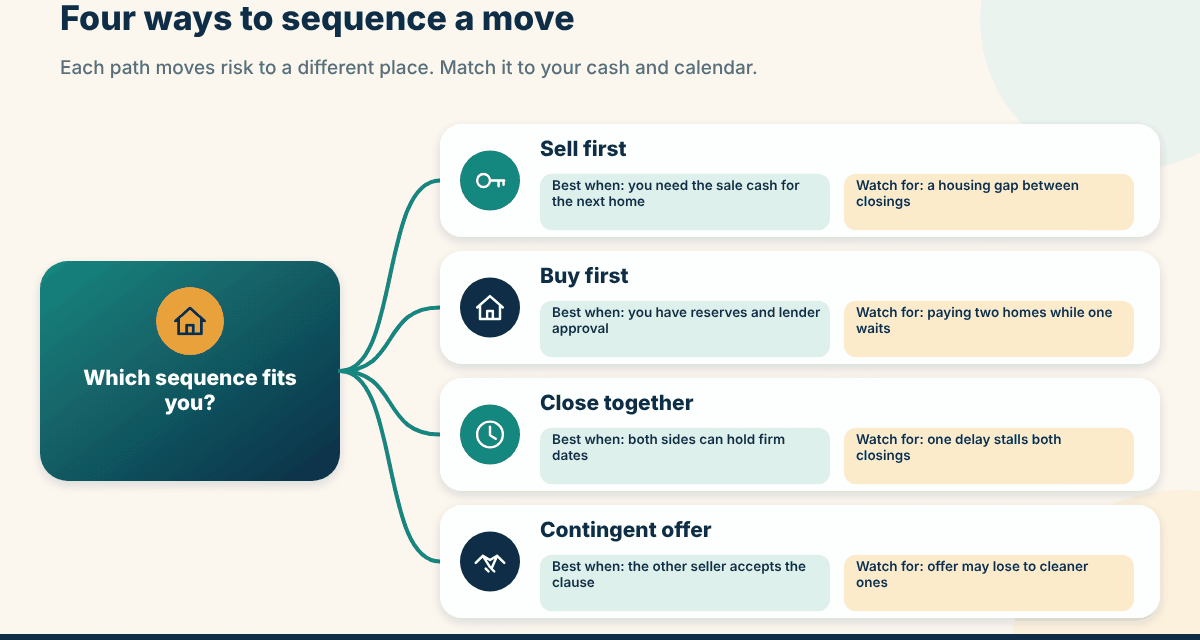
Most people weighing sell first or buy first think there are two options, but there are really at least five. You can sell and then buy. You can buy and then sell. You can try to line the two closings up on the same day or within a few days. You can buy with an offer that depends on selling your current home. Or you can sell and rent for a while on purpose, treating the rental as a planned stage rather than a failure. Each has a different shape of risk.
In the sell first or buy first comparison, selling first usually means a marketing period, an accepted offer, and then a contract period in which you hunt for your next home with a firm sale in your pocket. The detail that matters most is the closing and possession schedule you negotiate, because it sets the length of any housing gap. Our guide on how to sell a house before buying another goes deeper on that sequence.
On the other side of the sell first or buy first choice, buying first means you make an offer on the next home while you still own the current one. You may have enough equity and income to hold both, you may borrow against the current home, or you may make your offer contingent on selling. We cover the carrying side of this path in our piece on how to buy a house before selling your current home, including how lenders tend to view two obligations.
Syncing the two halves of a sell first or buy first move sounds ideal and is sometimes possible, but it needs cooperation from two other parties you do not control: your buyer and the seller of the home you want. It also depends on lenders, title companies and appraisers all finishing on schedule. A chain with two links and two sets of deadlines is more fragile than a single sale, which is why sellers who sync often negotiate a cushion, such as a few days of free occupancy after closing.
Evidence to gather: what each path asks of your calendar and your lender
Each side of the sell first or buy first choice puts a different demand on your calendar, and writing those demands down side by side makes the comparison concrete. For the sell-first path, ask yourself how long you can live somewhere temporary, how many moves you can tolerate and what you will do with your belongings during the gap. Estimate the rent for a short stay, the cost of storage and the cost of an extra move, because those items are the price tag on this path.
For the buy-first path, the demands fall on your lender and your reserves. Ask a lender how they would count your current mortgage when qualifying you for a second one, and whether any expected rent or sale proceeds can be considered. Lenders differ on this, and the answer depends on loan type, documentation and your overall profile, so get the answer from the lender you may actually use rather than from a general article.
For the sync path, the evidence is mostly about reliability. How quickly does the local title company usually close? Is your buyer financing the purchase, and how strong is their pre-approval? Does the seller of your target home have flexibility? A few phone calls can reveal how realistic a same-week closing would be, and an honest answer of “not very” tells you to build in a cushion or choose another path.
For the contingent-offer path, the evidence is local competition. Ask a buyer’s agent how contingent offers are being received where you want to buy. In some areas and seasons sellers accept them readily, and in others they are routinely set aside in favor of cleaner offers. You can learn more about how that clause works for the other side in our guide to buying with a home sale contingency from the seller’s perspective.
For the sell-and-rent path, gather rental data: what a short lease costs, whether landlords nearby accept shorter terms, and whether furnished options exist. Our article on selling versus renting out your house covers the related question of whether to keep the home as a rental instead, which is a different decision with its own tax and landlord considerations worth reading separately.
It helps to put all five paths on one sheet of paper with four rows beneath them: the cash you need up front, the largest thing that could go wrong, the date that matters most, and the fallback if it does. Seeing the weaknesses in one place often makes the choice obvious, and it gives you something concrete to discuss with a lender, an attorney or an agent instead of a vague worry.
A scenario, an exception, and your next step when the paths blur
In real life the sell first or buy first paths often blend. A seller might list the house, begin touring homes at the same time, and decide whichever of the two happens first sets the sequence. This flexible approach is common and sensible, as long as you know in advance what you will do in each case. If an offer on your home arrives first, you move into sell-first mode. If the right home appears first, you decide whether you can carry both.
Picture Priya, a hypothetical seller who lists in spring with a plan: if her home sells quickly, she will negotiate a longer closing and shop with a firm sale in hand. If a perfect house appears before she gets an offer, she will go to her lender with a prepared list of questions. By writing the two branches before listing, she turned an anxious unknown into a pair of ready responses.
An exception: some sellers find that the path they would choose in a normal market is closed by a local quirk. A tight rental market may make a gap very costly. A competitive purchase market may make a contingent offer almost useless. A slow selling market may make any plan that depends on a fast sale fragile. Check the quirks where you live, because they can reorder your preferences entirely.
Your next step in the sell first or buy first process is to pick a primary path and a backup path, and to write one sentence for each describing what would make you switch. That sentence, which we might call a trigger, saves you from rethinking everything every time a showing goes badly or a house disappears from the market. We will return to triggers when we build your verification roadmap near the end of this guide.
A final word on how to read the paths. None of them is a moral choice. People who sell first are not more careful than people who buy first, and people who buy first are not bolder. They are simply carrying different risks with different resources. If you catch yourself judging a path as responsible or reckless, bring the conversation back to cash, calendar and tolerance, because those three things decide whether a sell first or buy first plan holds together.
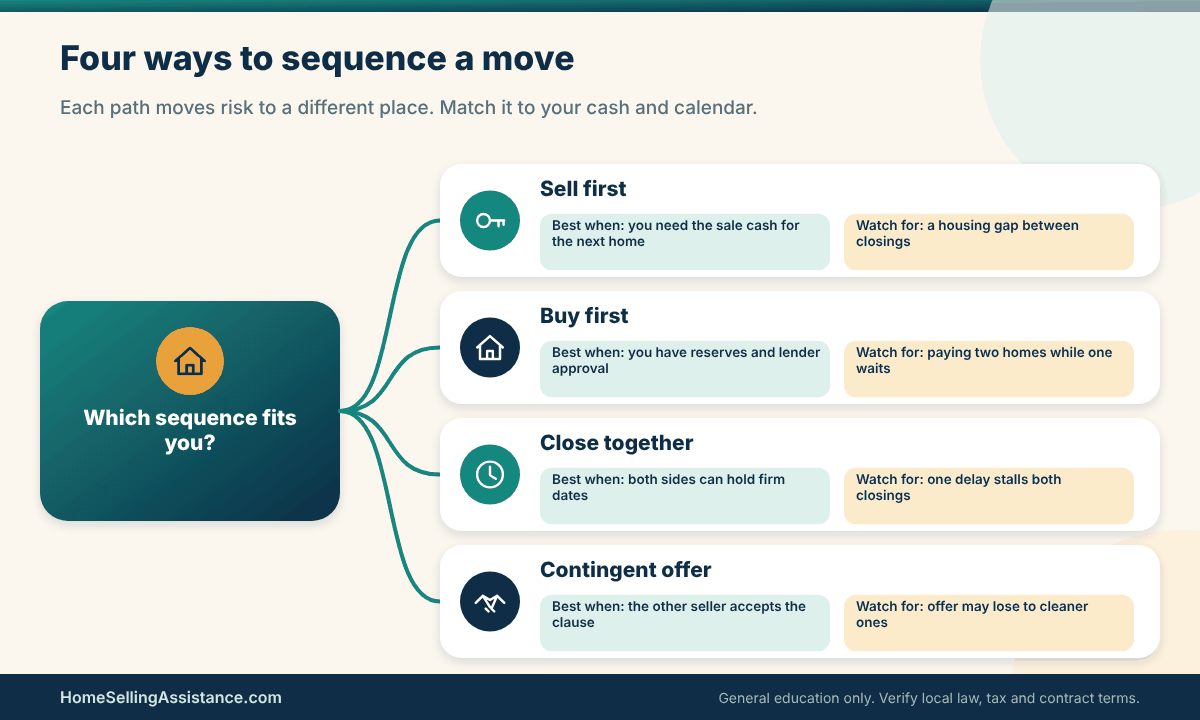
The figure above summarizes the sell first or buy first path map in a single picture, and it is worth bookmarking as a quick reference as you move into the details of price, time and risk that follow.
What Moves Price, Time, Risk, and Cash Flow in a Sell First or Buy First Plan
Once you have a path in mind, the next question is what could push it off course. Every sell first or buy first plan rests on assumptions about price, time and money, and the useful exercise is to find the weakest assumption before the market finds it for you. This section walks through the variables that change outcomes, then the costs, tax questions and logistics that sit underneath them.
We will keep returning to one idea: you rarely control the outcome, but you can often control how much a bad outcome costs. A plan with a cushion survives a slow sale, a low appraisal or a delayed closing. A plan without one works only when everything goes well, and a sell first or buy first plan that works only when everything goes well is a hope, not a plan.
Market, condition, financing, contract, and buyer variables
Five families of variables shape how a sell first or buy first plan plays out. The market sets how fast and at what price your home might sell. The home’s condition affects buyer demand and inspection outcomes. Financing, yours and your buyer’s, decides who can close and when. The contract sets the dates and the exits. And the buyer’s own situation, including a possible sale of their own home, adds a link to your chain.
The table below collects common situations, the key fact that matters in each, what a seller can practically do, the trade-off involved and the document or source to check. Use it as a prompt for your own planning, not as a rulebook, because your facts will differ. Read across a row to see how one situation connects to a decision, then pick the rows that resemble your own.
| Situation | Key fact | Practical action | Trade-off | Source or document |
|---|---|---|---|---|
| Thin savings, need sale proceeds for the next down payment | Cash arrives only at your closing | Sell first, or buy with a sale contingency | Housing gap or a weaker offer | Lender estimate, payoff quote |
| Strong equity and income, reliable reserves | You may qualify with two obligations | Consider buying first with a cushion | Overlap costs if the sale drags | Lender pre-approval letter |
| Competitive market for the home you want | Contingent offers can be set aside | Shop with a firm sale or a financing plan | Less time to search calmly | Local buyer’s agent feedback |
| Slow market for your own home | Sale timing is uncertain | Avoid plans that depend on a fast sale | Possible longer wait or lower price | Local sales data, listing agent view |
| Need a few weeks between closings | Possession can differ from closing | Negotiate a rent-back or flexible date | Buyer may want a concession | Purchase contract addendum |
| Home needs work before it can list | Condition affects offers and appraisal | Decide repair scope before choosing a path | Cost and delay versus price | Pre-listing inspection, contractor quotes |
After reading the table, circle the one situation closest to yours and highlight its trade-off. That trade-off is the price you are agreeing to pay for the path you choose, and naming it in advance means it will not surprise you later. If two rows both apply, you probably need the more conservative action from each, and a conversation with a lender and a local professional will sharpen the picture.
Evidence to gather: market data, buyer financing, and the contract dates that decide your gap
Start your sell first or buy first research with the market, but be skeptical of national headlines. National averages blend places that behave very differently, and your decision depends on your neighborhood and price band. Look instead at how many comparable homes are currently for sale near you, how long recently sold ones took to find a buyer, and how often sellers reduced prices. A local agent can pull these facts quickly, and you can sanity-check them against listing sites. Our guide to seller markets and buyer markets explains how to read the signals.
Condition comes next. If your home has deferred maintenance, expect buyers to price it in and expect inspectors to find it. Decide early whether you will repair, offer a credit or sell as is, because that choice changes your timeline and your net. A home that shows well tends to attract more offers sooner, which shortens the stretch of uncertainty that makes a sell first or buy first plan nerve-racking.
Financing deserves the most care, because it affects both sides of the transaction. On your side, a lender can tell you whether you can hold two obligations, what documentation they will want, and how a bridge product or a home equity line might fit. The Consumer Financial Protection Bureau offers plain-language material on mortgages and borrowing at consumerfinance.gov, which is a good neutral place to read before you talk to anyone selling a product.
On the buyer’s side, financing risk shows up as appraisal shortfalls, slow underwriting and last-minute changes in a buyer’s circumstances. When you evaluate offers, a strong pre-approval and a reasonable timeline can matter as much as the price, particularly if your own purchase depends on the date your funds arrive. Our article on the financing contingency from the seller’s side explains how that protection works and what to watch.
The contract is the document that turns every sell first or buy first assumption into dates. In a sell first or buy first plan, look for the closing date, the possession date, any inspection and appraisal deadlines, any financing deadline, the earnest money terms and what happens if a deadline passes. If your buyer has a home to sell, look for a contingency on that sale and for any right you have to keep marketing. Our overview of home sale contingencies explains the family of clauses in more detail.
Gather these facts into a one-page summary before you commit to a sell first or buy first path. The summary should list your payoff, your price range, your estimated net, your monthly costs under each path, your reserves and the key dates you could negotiate. When a lender or advisor asks what you know, you will have an answer, and gaps in the summary will point to the questions worth asking next.
One practical habit: keep a short log of every assumption and its source. If you assumed a four-week sale because a neighbor sold in four weeks, write that down. If you assumed a rate from a news site, write that down too. Later, when something moves, you will know which assumption broke and which parts of your plan depended on it, and that makes adjusting far less chaotic.
A scenario, an exception, and your next step when a variable moves against you
Imagine a seller named Elena who chose to sell first and accepted an offer quickly, with a closing date of thirty days. Midway through, the buyer’s appraisal came in below the contract price. Elena’s plan assumed a certain net, and the shortfall threatened her down payment on the next home. Because she had built a modest reserve and had negotiated a few days of flexibility, she could renegotiate calmly instead of panicking.
Contrast that with a seller who bought first, counting on a quick sale to cover the overlap. When the sale took longer than expected, the overlap costs grew each month, and the stress began to push decisions: a larger price cut than the market justified, a rushed acceptance of a weaker offer. The mechanism is worth noticing. A variable moved against the plan, and the lack of a cushion converted a delay into a price concession.
An exception: sometimes a variable moves in your favor and creates its own problem. A fast, strong offer may arrive before you have found anywhere to go. Sellers in that position can still protect themselves by negotiating possession terms, asking for a longer closing, or accepting a rent-back. Our guide to offering a flexible closing date as a seller shows how sellers use time as a negotiating tool and what buyers tend to expect in return.
Your next step is to run a simple stress test on your own sell first or buy first plan. Imagine the sale taking twice as long as you hope, imagine the price landing at the low end of your range, and imagine one deadline slipping by two weeks. If your plan survives all three at once, it is sturdy. If it survives only one, you now know where to add a cushion, whether in reserves, in contract terms or in the choice of path itself.
Write down the result of the stress test in a sentence or two, such as “We can handle a slow sale or a low price, but not both.” That sentence turns a vague fear into a specific boundary. It also tells you what to say to an agent or lender: instead of asking whether you should sell first or buy first, you can ask which path best respects the boundary you have found.
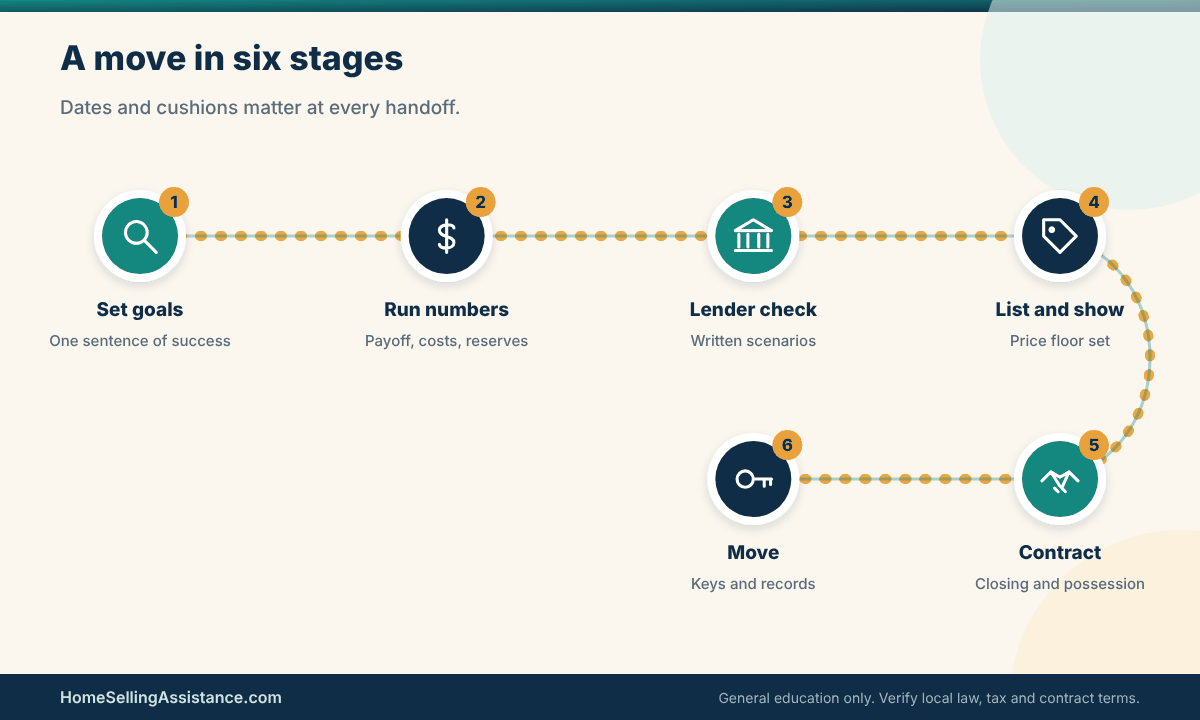
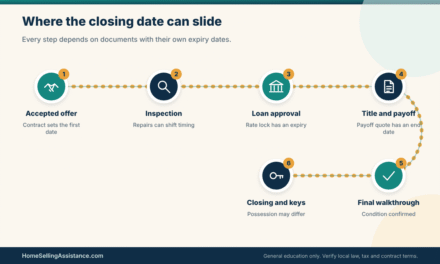
The roadmap in the figure above shows how the stages of a typical sell first or buy first sequence connect, and where the dates and cushions we have been discussing fit into the flow of a move.
Several myths deserve a quick correction before we move on. The first is that selling first always means a rushed, stressful scramble. It can, but a long closing, a rent-back or a prepared temporary home turns the scramble into a plan. The second is that buying first always means paying double for months. It can, but a short overlap with strong reserves is sometimes cheaper than two moves. Both myths survive because people remember the worst stories.
The third myth is that a contingent offer is a free safety net. It protects the buyer, yes, but the other seller may price that protection into their decision by choosing a cleaner offer. The fourth is that the market always tells you which path is smarter. Markets set the terms, but your finances set your options. The fifth is that someone can promise you a result. No one can promise a price, a closing date or a buyer, and any professional who does is overreaching.
If a statement about your sell first or buy first choice sounds universal, test it by asking when it would be false. “Sell first, always” fails for the household that has nowhere to land. “Buy first, always” fails for the household without reserves. Statements that survive that test are usually conditional, and conditional advice is the only kind that helps you decide.
Costs, tax questions, logistics, and your own priorities
Money questions in a sell first or buy first decision fall into three groups: the one-time costs of each path, the recurring costs of overlap or temporary housing, and the tax and legal questions that sit in the background. Logistics, meaning the actual movement of people and belongings, add costs of their own. Finally, your priorities decide how much of each cost you are willing to bear in return for certainty or time.
One-time costs include selling costs, buying costs, moving costs and any fees for short-term financing. Recurring costs include the mortgage, taxes, insurance, utilities and upkeep on a home you own, plus rent and storage if you are in temporary housing. The cheapest sell first or buy first path is rarely the one with the lowest single number. It is usually the one with the shortest overlap or gap, because time multiplies recurring costs. Our guide to seller closing costs explains the one-time side of the ledger in detail, and our closing costs and net proceeds articles go further.
Evidence to gather: a cost build-up for each path, with real quotes
Build the sell first or buy first cost picture path by path, using real quotes instead of rules of thumb. For the sell-first path, collect a quote for short-term housing, a quote for storage if you will need it and an estimate for a second move. For the buy-first path, collect the carrying costs of the old home, the lender’s estimate of any bridge or equity-line costs, and your insurance company’s guidance on an unoccupied property.
That last item deserves attention. A home that sits empty can be treated differently by insurers than an occupied one, and some policies limit coverage after a stretch of vacancy. Call your insurance company, describe your plan and ask in plain terms what changes. You are not looking for advice, only facts about your own policy, and those facts can reshape the economics of buying first. Utilities, lawn care and winter protection of an empty house belong on the list too.
For short-term financing, find out the actual fee structure, the interest cost, the repayment trigger and what happens if the home does not sell on schedule. Our explanation of bridge loans for a home sale walks through the typical mechanics and the questions worth asking. A bridge product can solve a timing problem, but it adds cost and a repayment deadline, so it should be weighed against free alternatives like negotiated possession dates.
Prorations and payoffs also depend on dates. Property taxes and association dues are usually divided between buyer and seller as of the closing date, and your mortgage payoff includes interest through the payoff date. A closing that slips by a few days changes the numbers slightly, which is another reason to treat any estimate as a range. Our piece on mortgage payoff when selling a house explains how the payoff figure works and why it differs from your balance.
Tax questions should be raised with a qualified professional, but you can prepare by learning the broad outline. For most people selling a main home, the federal exclusion of gain can be significant if ownership and use tests are met: generally two of the five years before the sale, with limits of $250,000 for a single filer and $500,000 for joint filers. IRS Publication 523, available at irs.gov, explains the rule and its exceptions.
The five-year window matters for a sell first or buy first choice in one specific way. If you move out and rent the home for a long stretch before selling, the use test can become harder to meet. A short, deliberate gap rarely raises the issue, while a long one can. This is exactly the kind of detail to confirm with a tax professional who knows your whole situation. Our guide to taxes when selling a home covers the general framework.
Add a line to your cost build-up for the value of your own time and stress. That sounds soft, but it is real: two weeks of living in boxes in a rented apartment has a price, even if no one sends you a bill. Some sellers decide to pay a little more in direct cost to avoid a second move. Others accept a second move to avoid paying double housing. Neither sell first or buy first choice is wrong, and writing both costs down makes the choice deliberate.
Finally, compare the totals as ranges, not points. For each path, write a low, middle and high estimate of total transition cost. The path with the lowest middle estimate may not be the one with the lowest high estimate, and the high estimate is the one that tests your reserves. If a path’s high estimate would force you to sell something at a bad moment, that is a real warning about the plan’s resilience.
A scenario, an exception, and your next step for costs you can control and costs you cannot
Take a hypothetical seller, Tom, who compared the two sell first or buy first paths using round numbers. Selling first meant about two months of short-term rent and one extra move, with an estimated cost he could write down exactly. Buying first meant carrying both homes for an uncertain period, with a cost that depended on how long the old home took to sell. The sell-first cost was smaller on average, but the buy-first path let him choose his next home without a deadline.
Tom decided that certainty mattered more than the likely extra cost, and he chose buying first with a reserve large enough to cover six months of overlap. That reserve was his cushion. He also set a trigger: if the home had not sold by a specific date, he would reduce the price on a schedule he agreed with his agent in advance. Pre-committing took emotion out of the decision when the date arrived.
An exception worth noting: costs you think you control can still surprise you. Repair requests after an inspection, a buyer asking for a credit after an appraisal, or a closing delayed by a paperwork issue can each add cost or time. This is why experienced sellers keep a contingency fund for the unexpected and why professionals suggest reading every contract date as a possible slip rather than a promise. A cushion is cheaper than a crisis.
Your next step in weighing sell first or buy first is to separate your list into costs you can control, such as price decisions and possession dates, and costs you cannot, such as market speed and a buyer’s lender. Spend your effort on the first group and build reserves for the second. If you are unsure whether your plan has enough cushion, an hour with a housing counselor can help; HUD lists approved counselors at hud.gov/findacounselor.
One more consideration is the emotional side of the sell first or buy first choice. Selling first can feel like losing control of where you will live, and buying first can feel like betting on a future sale. Neither feeling is a reason to ignore the numbers, but both are legitimate inputs to the decision. If a path would keep you up at night, its real cost to you is higher than the spreadsheet says, and it is fair to weigh that when you decide.
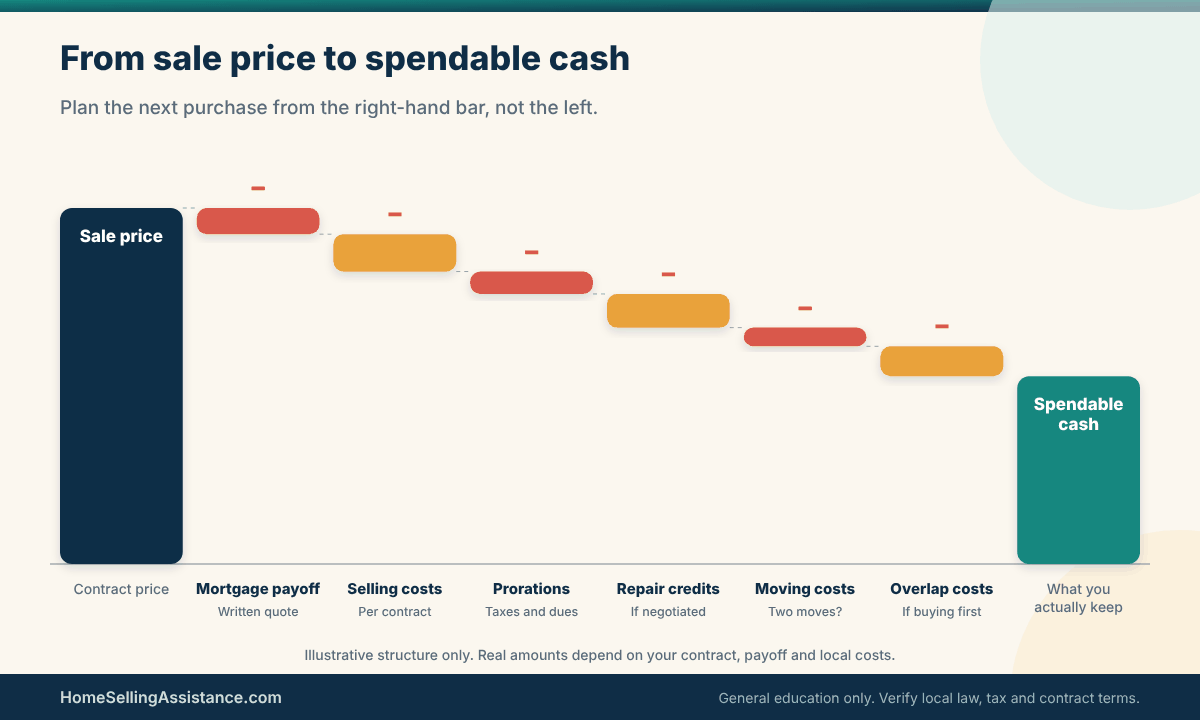
The figure above shows how a sale price shrinks on the way to your spendable cash, which is the number every sell first or buy first plan ultimately depends on.
Market risk deserves its own few paragraphs in any sell first or buy first discussion, because it changes in different directions for the home you are selling and the home you are buying. If prices soften while you are waiting, your sale may bring less, but the home you hope to buy may also become more affordable. If prices rise, the reverse happens. The effects partly offset each other only if you own both at the same moment, which is one reason some sellers like buying first even though it carries overlap costs.
Interest rates add another layer. A change in rates alters what buyers can afford, which can influence how quickly your home sells and at what price. It also alters your own borrowing cost on the next home. You cannot predict rates, and nobody else can reliably do it either, so the sensible approach is to plan around a range and keep some flexibility. Our article on the best time to sell a house discusses how seasonality and timing interact with these forces.
Market risk also shows up as speed. A home that sells in days leaves little room to find your next place, while one that sits for months strains your carrying budget. In a sell first or buy first plan, speed is both an opportunity and a hazard. Quick sales favor sellers who prepared their fallback housing in advance, and slow sales favor sellers who built reserves. Preparing for both is less work than it sounds, because the same documents and conversations serve either case.
A related risk is the chain effect. If your buyer needs to sell a home before they can close, your closing depends on a third transaction you cannot see. If the seller of your target home also needs to buy, their closing depends on yours. The longer the chain, the more fragile it becomes. When a chain looks long, ask for earlier deadlines, clearer contingencies and a written plan for what happens if one link breaks, so that one delay does not become a cascade.
Same-day closings deserve a quick explanation, since they are the tidy answer many sellers hope for. In a coordinated closing, the sale of your home and the purchase of the next one are scheduled close together, often on the same day, so that proceeds from the first fund part of the second. This can work well, but it depends on every party finishing paperwork in time, and a delay at any point can leave you with money in transit and nowhere to sleep. Ask the title company how they handle it locally.
A Verification Roadmap for Your Sell First or Buy First Decision
By now you have a goal, a set of paths, a view of the variables and a cost picture. The last job is to turn all that into a short list of things to verify, people to talk to and dates to protect. A sell first or buy first decision feels enormous because it is made once, under pressure, with incomplete information. A roadmap makes it smaller by breaking it into checks you can complete one at a time.
Think of this section as a pre-flight routine. Pilots do not trust memory for the important things; they use a checklist, and the checklist is boring on purpose. Your sell first or buy first routine should be boring too: confirm the documents, confirm the people, confirm the dates, and decide in advance what you will do if one of them fails. The excitement can come at the closing table.
Documents and professionals to involve in a sell first or buy first plan
Different professionals answer different pieces of the puzzle, and none of them can answer all of it. A lender speaks to what you can borrow and how two obligations would be counted. A real estate agent speaks to local pricing, buyer demand and contract norms. An attorney or title company speaks to your state’s closing and contract rules. A tax professional speaks to the tax side. Your job is to ask each one the question only they can answer.
Be wary of anyone who answers every question confidently, including questions outside their role. A salesperson for a financing product may downplay its costs. An agent may favor the path that makes a listing more likely. Those incentives do not make them dishonest, but they do mean you should collect more than one view and keep your own written numbers as the anchor for every conversation about your sell first or buy first plan.
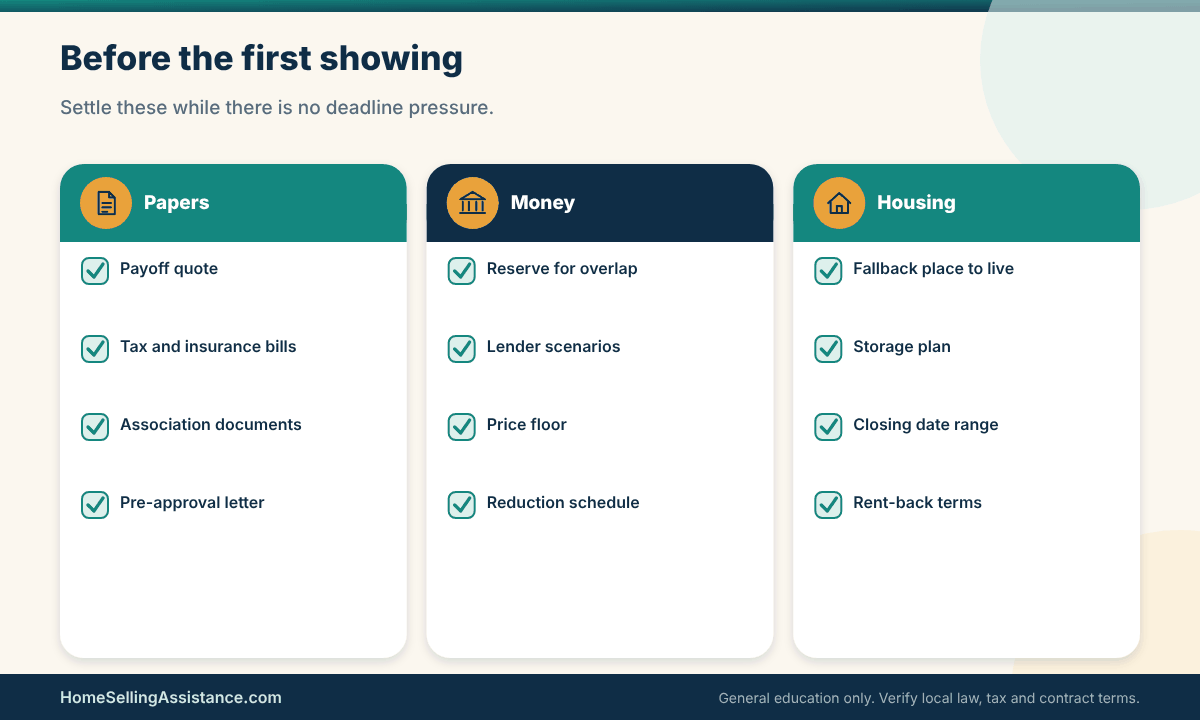
The documents matter as much as the people. Having your papers organized speeds every step of a sell first or buy first move, makes you look prepared and exposes gaps early. The checklist figure later in this section lists the core items, and the paragraphs below explain why each one matters and who needs to see it.
Evidence to gather: the paper trail and the professionals who can verify each piece
Begin your sell first or buy first paperwork with ownership and mortgage papers: your deed, your current mortgage statement and a written payoff quote. The payoff quote is essential because it determines how much of your sale price goes to the lender, and it tells you the exact proceeds a buyer’s purchase will create for you. If you hold a second lien, such as a home equity line, include it, because it must also be paid at closing and can affect your options.
Next, gather the property tax bill, the insurance declarations page and association documents if you have an association. These show your recurring costs, and the association documents may be needed by a buyer within a certain period after an offer. Association rules can also limit short-term rentals or restrict timing of moves, which affects any plan involving a rent-back or temporary occupancy in a sell first or buy first move. Check them before you promise anything to a buyer.
For the home you hope to buy, collect the listing details, any seller disclosures, and a pre-approval letter from a lender. The pre-approval tells you the loan amount you may qualify for, but read what it assumes. Some letters assume your current home has been sold. Others count both obligations. Ask the lender to explain exactly which scenario the letter reflects, and ask for a written estimate under each scenario you are considering.
Now consider who should verify what. Ask the lender to verify qualification scenarios and short-term financing. Ask a local agent to verify market speed, likely price range and how contingent offers are treated. Ask the title company or attorney to verify the closing timeline, the mechanics of a same-day or back-to-back closing and any state-specific rules about possession. Ask a tax professional to verify anything involving rental use or gain.
The table below follows a typical transaction from start to finish and lists, for each stage, what you are responsible for, who else must act, the deadline that usually matters and a fallback if something slips. Use it to see where a sell first or buy first plan has dependencies on other people, because dependencies are where plans break. The deadlines are generic categories, since the actual dates come from your contract.
| Stage | Seller responsibility | Buyer or professional dependency | Deadline to watch | Fallback |
|---|---|---|---|---|
| Before listing | Set path, gather papers, price with evidence | Lender conversation, agent opinion | Your own target list date | Delay listing until reserves and papers are ready |
| Offer and acceptance | Compare price, dates and conditions | Buyer pre-approval, agent or attorney review | Offer response date | Counter on possession or closing date |
| Inspection and repairs | Respond to repair requests | Inspector, contractors, buyer decisions | Inspection response window | Offer a credit instead of repairs |
| Appraisal and financing | Provide access, answer questions | Appraiser, buyer’s lender, underwriter | Appraisal and financing dates | Review options if value falls short |
| Your own purchase | Keep your offer dates aligned with your sale | Your lender, the other seller | Your financing and closing dates | Negotiate extension or rent-back |
| Closing and possession | Review final figures, sign, hand over keys | Title company, both buyers, lenders | Closing and possession dates | Short written extension with agreed terms |
To use this table, find the stage you are in and read across to the fallback column before problems appear. Then check whether your fallback depends on a person who has agreed to it. A fallback that exists only in your head is not a fallback. Where possible, convert each fallback into a written term in the contract, such as a rent-back addendum or an agreed extension fee, so that it is available when you need it.
Wire fraud deserves a specific mention in this stage, because large sums move quickly around closing. Fraudsters sometimes impersonate title companies or agents and send changed wiring instructions. Always confirm instructions by calling a phone number you already trust, not one in an email. The FBI’s Internet Crime Complaint Center at ic3.gov takes reports, and the Federal Trade Commission publishes consumer guidance at consumer.ftc.gov.
A scenario, an exception, and your next step for building your professional team
Consider Ruth, a hypothetical seller facing a sell first or buy first choice, who assembled her team in a sensible order. She started with a lender, who told her she could qualify with both obligations but would prefer to see a certain amount in reserves. She then spoke with two local agents, compared their market views and their contract suggestions, and asked a title company about same-day closings in her county. By the time she listed, she knew which path she would take and what she would do if it slipped.
The exception: Ruth’s plan changed when her lender explained that a certain loan type would require her to occupy the new home within a window stated in the loan documents. That rule did not affect her original plan, but it did limit how long she could use a rent-back after closing on the new place. Because she asked early, she adjusted the sale contract instead of discovering the conflict after signing.
The lesson is that small rules in documents you have not read can reshape a plan. Before you sign a purchase contract or a loan estimate, read the dates, the occupancy terms and the penalty clauses, and ask a professional to explain anything unclear. If you want a second pair of eyes on your overall finances, a HUD-approved counselor can talk through the numbers without trying to sell you anything. That kind of neutral review is worth an hour.
Your next step for a sell first or buy first plan is to write a one-page team sheet: the name and phone number of your lender, your agent or attorney, your title company and your tax professional, with one question next to each. The questions might be about qualification, local contingent offers, same-day closing mechanics and rental-use tax questions. Seeing the questions on one page makes it clear which professional you have not yet consulted, and that is usually where the gap in your plan sits.
Keep a copy of every written answer. If a lender emails you about how they would count your income, save it. If an agent writes that contingent offers are being accepted in your area, save that too. These records protect you from fuzzy memory later and let you compare what you were told with what actually happened, which is useful if a professional’s advice proves unreliable. A tidy folder of answers is the best insurance a seller facing a sell first or buy first decision can have.
A short word on the practical side of the move itself. Even with perfect timing, a move involves packing, scheduling movers, transferring utilities, forwarding mail and updating records. When two homes are involved, the work doubles. Many sellers who choose to sell first before buying find that they pack in stages, moving seasonal items and extra furniture early, so the final move is lighter. Staged packing also helps the home show better, which is a small bonus.
If you choose to buy first and you have both homes for a while, the opposite approach often works: move gradually, keep the old home staged and show-ready, and avoid leaving it empty any longer than necessary. Empty homes can feel less welcoming to buyers and can create insurance and maintenance questions. Some sellers rent a small amount of furniture to stage a vacant home, and the cost should be part of your sell first or buy first budget.
Children, pets and work schedules also matter. A move in the middle of a school year may be harder than one at a natural break, and a household with pets may need specific arrangements during showings. These details seem minor but they influence how much stress a given path creates. When two paths look similar in cost, the one that fits your family’s rhythms is usually the better choice.
What to settle before listing and what can wait until an offer
Not every question needs an answer before the sign goes in the yard. Some choices must be made early because they shape how you present and price the home, while others can wait until you see an actual offer and its real terms. Knowing which is which keeps you from paralysis on one side and from rushed commitments on the other, and it is one of the most practical skills in any sell first or buy first plan.
The general rule is that anything that changes your risk if the market reacts quickly should be decided early, and anything that depends on specific contract terms can wait. A fast, strong offer will arrive on its own schedule, and you want to be able to respond calmly. A slow market will test your reserves, and you want to have defined your triggers before the pressure arrives. Let us look at both groups in turn.
Evidence to gather: the decisions worth making before the first showing
Settle your fallback housing first, since it shapes every sell first or buy first option. If you sell first and the offer arrives quickly, where will you live between the closing of your sale and the closing of your purchase? Possible answers include a rent-back with the buyer, a short-term rental, a family member’s home or an extended-stay arrangement. Our guide to temporary housing between selling and buying compares these options and the questions worth asking each provider.
Settle your minimum acceptable timeline next. What is the earliest closing you could handle, and what is the latest? Many sellers discover that their range is wider than they assumed once they list the real constraints. Knowing your range lets you respond instantly to an offer with a closing date that is slightly different from your plan, because you will already know whether it fits. Our piece on the move-out date versus the closing date explains how the two interact.
Settle your price floor and your reduction schedule. A price floor is the lowest net you could accept and still complete your plan, calculated from your payoff, costs and the cash you need for the next step. A reduction schedule is a set of dates and thresholds, agreed with your agent, at which you will review the price. Setting both in advance protects you from emotional decisions, whether the emotion is optimism in week one or panic in week eight.
Settle your lender conversation. Before listing, have a clear written understanding of how the lender would treat your situation under each path, and of what any short-term financing would cost. If buying first is on the table, know your limits for overlap costs. If a contingent offer is on the table, understand what the lender requires when your own purchase depends on a sale. This is the single most valuable pre-listing conversation for most sellers.
Settle your repair and presentation plan. Decide which repairs you will complete, which you will leave to a credit and which you will disclose and sell as is. Repairs take time, and time is the scarce resource in a sell first or buy first plan. Many sellers shorten their overall sell first or buy first timeline by deciding quickly what not to repair. If your home was built before 1978, remember the federal lead-based paint disclosure; the EPA explains it at epa.gov.
Settle how you will handle showings while you are also house-hunting. Showings often arrive on short notice, and you may be away touring homes at the same time. Decide who will keep the house ready, how you will handle a pet or a young child, and what hours are reasonable. Fair housing rules also apply to how sellers and agents treat prospective buyers, and HUD explains them at hud.gov.
Finally, settle who decides when you disagree. If two owners are selling, agree in advance how you will handle a split opinion about an offer, a price cut or a path change. Many couples find that deciding the process while calm is easier than deciding the outcome under pressure. Write the process down, even informally, and refer to it when the moment comes. It will not remove the stress, but it will keep the stress from turning into conflict.
A scenario, an exception, and your next step for what can wait until an offer arrives
Several choices can safely wait. The exact closing date can wait until you see an offer, as long as you know your range. The details of a rent-back, such as its length and daily fee, can be negotiated once a buyer shows interest. The final choice between two competing offers can wait until you can compare them on net proceeds, dates and risk, not just price. Our guide on rent-back agreements for sellers explains what to negotiate.
Consider Neil, a hypothetical seller who settled his sell first or buy first plan and listed with a clear range: closing between thirty and sixty days, a price floor calculated from his numbers and a plan to ask for up to two weeks of post-closing occupancy. An offer arrived at a slightly lower price but with the closing window and occupancy he wanted. Because he had defined his needs, he could compare it quickly with a higher offer that required a fast closing, and he chose the one that fit his plan.
The exception: sometimes an offer arrives that is attractive on paper but incompatible with your plan, such as an all-cash offer with a closing in ten days when you have nowhere to go. In that case you can counter on the closing date, ask for post-closing occupancy or decline. Having a fallback housing plan makes all three options available. Without one, the decision is forced, and forced decisions tend to be more expensive than considered ones.
Your next step is to write two lists for your sell first or buy first plan. On the first, put everything that must be decided before listing, and give each item a date. On the second, put everything that can wait for an offer, and next to each write what information you will need. Then share the lists with your agent or advisor and ask what is missing. A short conversation can catch gaps that would otherwise surface at the worst possible time.
A last practical point is to review your decision on a schedule instead of continuously. Choose two or three check-in dates, perhaps after the first weekend of showings, after two weeks and after a month, and revisit the plan only at those times unless something major changes. Reviewing constantly feeds anxiety, while never reviewing lets a failing plan drift. Scheduled check-ins on a sell first or buy first plan give you the benefits of flexibility without the cost of constant second-guessing.
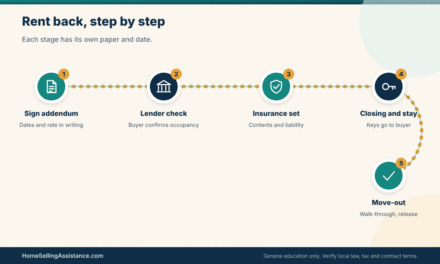
Because this topic comes with its own vocabulary, here is a quick plain-language glossary for anyone new to a sell first or buy first move. Payoff means the exact amount needed to clear your mortgage on a given day. Proceeds are what remains from the sale price after the payoff, costs and credits. Closing is when ownership transfers and funds are distributed, while possession is when the buyer can actually occupy the home. Those last two can be separated by agreement, which is the whole idea behind a rent-back.
Carrying costs are the recurring expenses of owning a home while it is not your main residence, such as the mortgage, taxes, insurance and utilities. A contingency is a condition that must be satisfied for a contract to proceed, such as an inspection result, an appraisal value or a financing approval. A bridge loan is short-term borrowing meant to span the time between buying and selling. Each term appears on paperwork you will be asked to sign, and knowing them makes the sell first or buy first conversation much easier to follow.
Two more terms are worth knowing. A kick-out clause lets a seller who accepted a contingent offer keep marketing and give the first buyer a short window to remove their contingency if a better offer arrives. A closing disclosure or settlement statement is the document that lists every credit and charge at the end of the sale. If a word on any document confuses you, ask your agent, attorney or title company to explain it in plain language before you sign, because that question costs nothing and may save a great deal.
Quick scenario
A hypothetical household has equity but little cash, loves a particular home and expects their own house to sell within a few weeks. The sell first or buy first decision here comes down to reserves. If they can fund two months of overlap without stress, buying first may be viable. If not, a contingent offer or a sale-first plan with a rent-back protects them better. The point is to decide with numbers, not with hope.
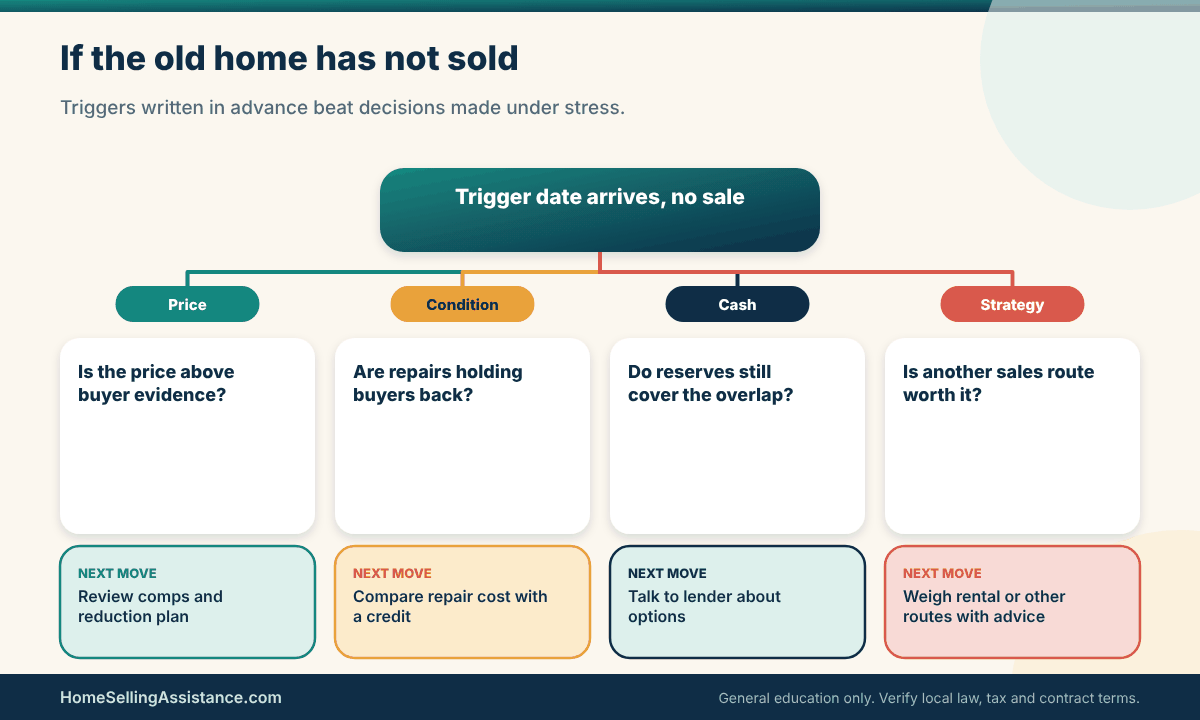
The two figures above show the fallback logic and the document checklist for a sell first or buy first plan in one view, which is a good way to review your readiness before you commit to either path.
Before the questions, a short list of mistakes worth avoiding in any sell first or buy first plan. Do not make an offer on a new home before you know in writing how a lender will count your current mortgage. Do not assume a quick sale because a neighbor’s home sold quickly. Do not skip the insurance call about a home you will leave empty. Do not agree to a closing date without reading what happens if it slips. And do not rely on a verbal promise about possession or repairs that is not in the contract.
Another common mistake is treating the first plan as final. Markets, offers and lenders change, and a plan that made sense in April may need revision by June. Sellers who succeed usually hold the plan firmly enough to act and loosely enough to adapt. They keep their triggers written, they review them on a schedule and they change paths when the evidence changes instead of when their mood does. That discipline matters more than the path itself in many sell first or buy first stories.
A last mistake is going it alone. You do not need a large team, but you do need at least one professional who will tell you when your plan has a hole. A lender, an agent, an attorney or a counselor can each play that role. Choose someone who explains their reasoning, welcomes questions and is comfortable saying “I do not know, let me check.” That kind of honesty is more valuable than confidence, and it is the best defense against expensive surprises.
Frequently asked questions about sell first or buy first
Is it better to sell first or buy first?
Neither is better in every case, because the answer depends on your cash position, your lender’s rules, your local market and how much risk you can tolerate. Selling first reduces the chance of carrying two homes but may create a housing gap. Buying first reduces the gap but may create overlap costs. Many sellers find the better choice becomes clear once they price each risk in dollars.
Can I buy a house before selling mine?
Often yes, if a lender can qualify you with both obligations or if you use short-term financing, equity or a contingent offer. Whether it works for you depends on your income, savings, loan type and the lender’s policies. Ask a lender to give you written scenarios before you make an offer, and do not rely on general rules of thumb.
What is a home sale contingency?
It is a clause in a purchase offer that makes the purchase depend on the buyer selling their current home. It protects the buyer but adds risk for the other seller, so it can make an offer less attractive in competitive markets. The details, including deadlines and any right to keep marketing, vary by contract and local practice.
How long should I plan to be without a home if I sell first?
There is no universal answer, because it depends on how your closing and possession dates line up with your purchase. Some sellers manage a same-day move, while others negotiate a short rent-back or use temporary housing. A realistic plan includes a fallback for a few extra weeks, and it treats that cushion as a normal part of the budget.
What is a rent-back and how does it help?
A rent-back, sometimes called post-closing occupancy, lets the seller stay in the home for an agreed time after closing, usually under a written agreement with terms for rent, insurance and condition. It can bridge the gap between closings. Buyers must agree to it, and their lender may have rules, so it needs to be negotiated and put in writing.
Are bridge loans a good idea?
They can solve a timing problem, but they cost money and have a repayment trigger, so they are rarely free. Whether one makes sense depends on the fees, the interest, how quickly your home is likely to sell and what happens if it does not. Compare the total cost with free alternatives such as negotiated possession dates before choosing.
Will selling my home first affect my taxes?
It can, depending on your ownership and use history and whether you meet the federal tests for excluding gain on a main home. Generally the tests involve two of the last five years, with exclusions of up to $250,000 for single filers and $500,000 for joint filers. Confirm your own situation with a tax professional and the IRS materials.
What if my home does not sell after I buy a new one?
You would carry both homes until it sells, so the plan needs reserves and a pricing schedule agreed in advance. Options include price reductions, improved presentation, a rental arrangement, or a different sales strategy. Each has costs and tax or insurance consequences, so talk with your agent, insurer and a tax professional before choosing.
Does the market matter more than my finances?
Your finances usually set which paths are possible, while the market affects how well each path performs. A hot market can make selling first easier and contingent offers harder to win, while a slow market reverses that. Look at both, but start with the cash flow, because a plan you cannot afford is not a plan.
Who should I talk to first?
For most sellers a lender is the best first call, because their answer decides which options exist. A local agent or attorney then helps with price, contract norms and closing mechanics. A tax professional helps with questions about gain or rental use. Collect written answers from each, and keep your own numbers as the reference for every conversation.
Make the sell first or buy first choice with numbers in hand
The sell first or buy first decision rarely has a single right answer, but it does have a right process: define your goal, price each risk, protect your key dates and verify the facts with the professionals who can answer them. Start with your payoff, your reserves and your lender’s written scenarios, then choose the path that survives your own stress test. This guide is general education, not legal, tax or financial advice, so confirm the details for your state and your situation before you act.