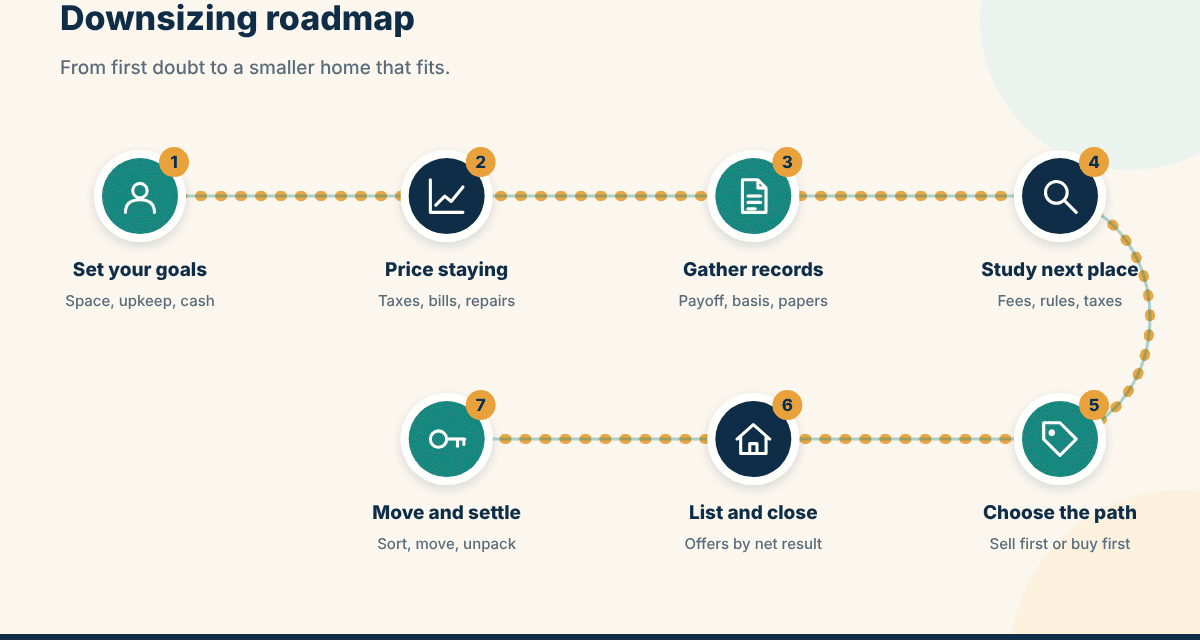
Done well, downsizing home selling is less about shrinking square footage and more about turning a house that no longer fits your life into a place, a budget and a routine that do. This guide walks through the decision from the first doubt to the day you hand over the keys, and it does so without pushing you toward any particular agent, buyer type or timeline.
Most people who start thinking about a smaller home begin with a feeling rather than a spreadsheet. The stairs are getting harder, the yard eats every weekend, two bedrooms have been empty for years, or the monthly cost of owning the place has crept up faster than you expected. Those feelings are valid, but they do not tell you whether to sell this year, next year or never. Treat this as one input to your downsizing home selling decision, not the whole answer.
The sale itself is only one piece. A smaller home has its own price, its own condition issues, its own association rules and its own closing costs. Your current house has a mortgage balance or none, a tax basis, a pile of belongings and a set of neighbors, doctors and habits attached to it. Good decisions come from laying those pieces side by side before a sign goes in the yard. Few people plan for this when downsizing home selling begins.
This article stays practical and neutral. It explains how to define the real choice you face, how to compare the realistic paths, and how to use a simple net-result rule so you can judge offers and plans on what you keep, how long it takes, and how much can go wrong. It also tells you when to stop and ask a licensed professional, because tax, legal and financing rules vary by state and by household. It pays to check this before downsizing home selling goes any further.
Key takeaways
- Start with the life you want, then the house. Space, stairs, upkeep and location matter as much as the sale price in a downsizing decision.
- Count the cost of staying as well as the cost of moving. Taxes, insurance, utilities, repairs and your own time are real numbers you can estimate before you list.
- Equity is not cash. Payoff, selling costs, moving costs and the price of the next place all sit between your estimated value and what you actually keep.
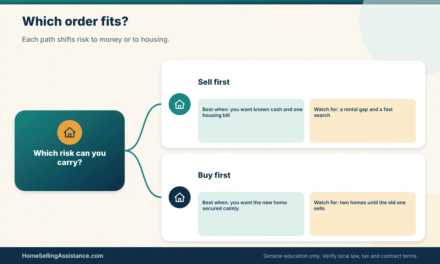
- The order of sale and purchase is a risk choice. Selling first, buying first or bridging the gap each trade certainty, stress and cost differently.
- Rules vary. Property tax reassessment, home-sale taxes, association rules and contracts depend on your state and your facts, so verify before you commit.
Why downsizing home selling is a decision before it is a listing
A listing is the visible part of the process. The decision behind it is quieter and more important. If you do not know what you are trying to get from the move, you cannot tell a good offer from a bad one, a good timeline from a rushed one, or a smaller home that suits you from one that merely looks tidy on a tour. Local custom can change how downsizing home selling plays out here.
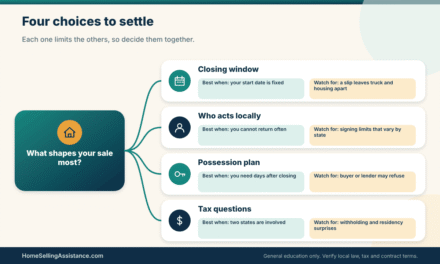
Think of the first stage as defining your real choice. For some households the choice is between staying put with some modifications and moving. For others it is between selling now at a decent price and waiting for a hoped-for improvement. For many it is a choice about the order of events, meaning whether the old home sells before the new one is secured. Naming the actual choice keeps you from comparing things that are not comparable. Revisit this point whenever your downsizing home selling plan shifts.
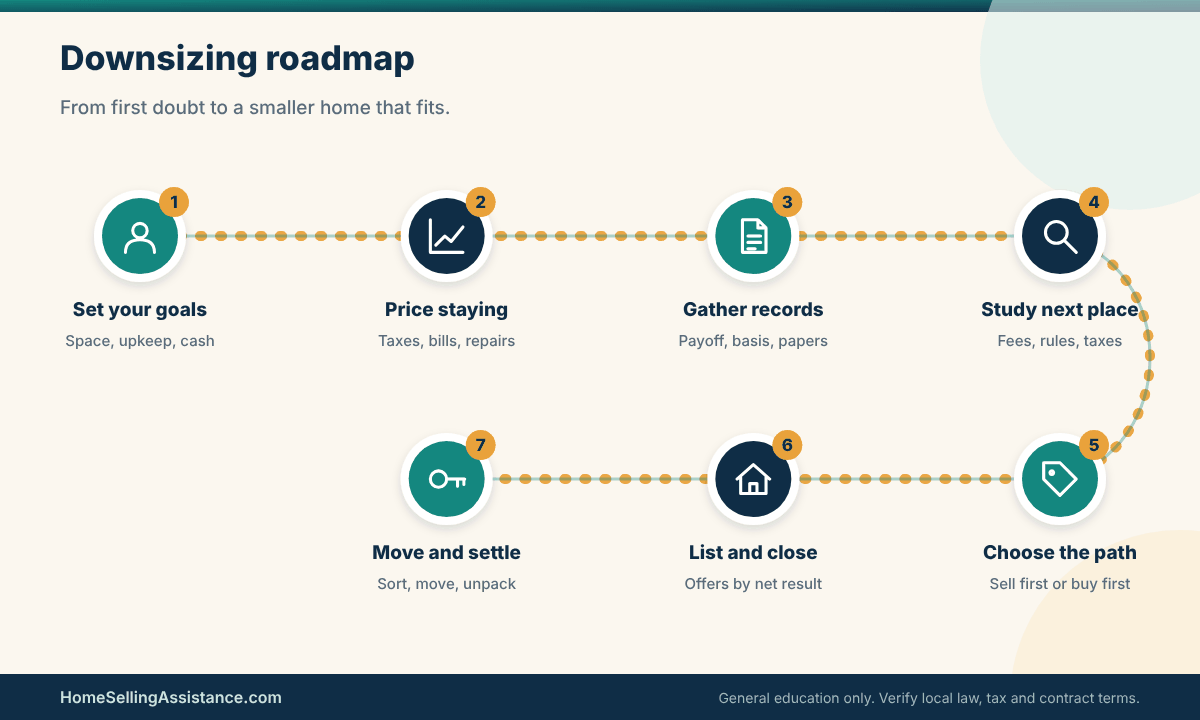
The sections below cover the facts that shape that choice. The first looks at your own goals, timeline, cash position, home condition and tolerance for risk. The second looks at the outside facts that can quietly flip a plan: loan terms, tax basis, local rules and the real cost of the home you want next. For the wider relocation picture, our guide to selling a house for relocation covers the logistics that overlap with a smaller-home move. Your own numbers matter more than any rule of thumb in downsizing home selling.
Your goals, timeline, cash, home condition and risk tolerance
Start with a plain list of reasons. People downsize for many reasons: fewer rooms to clean, lower monthly bills, a single-level layout, being closer to family, freeing up money for retirement, or simply wanting less stuff. Rank the reasons. If maintenance is the top reason, a newer, low-upkeep home or a condo may fit even if it costs more per square foot. If cash is the top reason, a smaller price tag and a lower cost of living matter most. Calm preparation tends to help most in downsizing home selling.
Next, set a timeline with honest edges. Is there a date that cannot move, such as a lease start, a health event, a school year for a grandchild you help with, or a mortgage rate lock? Or is the timeline flexible enough that you can fix up, wait for a better season, and sort belongings slowly? A flexible timeline is one of the most valuable assets a seller has, because it lets you say no to a weak offer without panic.
Then look at cash and condition together. Your cash position includes savings, the expected equity from the sale, and any income you rely on. Your home’s condition includes the roof, heating and cooling, plumbing, windows, and the cosmetic items buyers react to. A house that needs significant work may sell as is, which is covered in our guide to repairs before selling a house, but the discount or credit affects how far your equity goes. Share this with family so downsizing home selling stays a joint decision.
Finally, be honest about risk tolerance. Some people sleep fine owning two houses for a month. Others lose sleep at the thought of an unsold home and a signed contract on another. Neither temperament is wrong, and neither is a flaw to fix. Your tolerance should shape which path you choose, because a plan you cannot emotionally sustain tends to unravel under pressure. Few mistakes in downsizing home selling are as easy to avoid.
Evidence to gather: what staying actually costs you
Before you decide to leave, price the alternative of staying for the next three to five years. Pull your last twelve months of utility bills, your property tax bill, your homeowners insurance declaration page, any association dues, and a rough list of maintenance you paid for. Add what you expect to need soon, such as a roof, a furnace, exterior paint or a driveway. These are your records, so no estimate is needed, only arithmetic. Think of it as a checkpoint for your downsizing home selling plan.
Now add the costs that do not appear on a bill. Lawn care or snow removal you pay for, or time you spend doing it yourself. Cleaning help for rooms nobody uses. The cost of stairs if mobility is changing, such as a stair lift, a first-floor bedroom conversion or a bathroom remodel. A fair way to see these is to sort them into recurring costs, upcoming one-time costs, and costs of adapting the house to your future needs. It helps to remember that downsizing home selling is personal.
Compare that total with a realistic budget for the smaller place. Here is an illustrative exercise with round numbers, not a forecast. If your current home costs about 2,400 a month to carry including taxes, insurance, utilities and set-aside for repairs, and a smaller place would cost about 1,700 a month, the monthly difference is about 700 before moving costs. Run that figure with your own numbers and compare it with one-time costs of selling and moving. This detail often decides how well downsizing home selling goes.
The point of the exercise is not to prove that moving is smart or foolish. It is to replace a vague sense of burden with figures you can discuss with a family member, a financial professional or a housing counselor. If your reasons are not mostly financial, the numbers still help, because they show how much money you are willing to trade for the lifestyle change. Plan for it early and downsizing home selling feels more manageable.
A scenario, an exception and your next step
Picture a couple in their late sixties in a four-bedroom house. They love the neighborhood, the kids are grown, and they use perhaps half the rooms. Their worry is the upkeep and a roof that will need replacing soon. In an illustrative version of their math, selling a house with an aging roof may mean a credit or a lower price, while moving into a smaller home nearby may keep their social life intact. Professionals can help here, since downsizing home selling mixes money, law and family.
The exception is the couple whose house is paid off and whose costs are modest. For them, downsizing home selling may not save much monthly money at all, especially if the smaller place is in a higher-priced area or carries association dues. They might still choose to move for convenience, but they should do it knowing the savings are small. Treat the exception as a reminder that downsizing is a lifestyle decision first and a money decision second.
Your next step in either case is to write a one-page summary: your top three reasons, your fixed dates, your current monthly carrying cost, and your target carrying cost for the next place. Share it with the person you trust most about money. If you want a structured way to think through related life-stage choices, our article on selling a house after retirement looks at cash flow and location through that lens. Ignoring it is a frequent reason downsizing home selling disappoints.
Facts that could change your downsizing home selling plan
Some facts sit outside your preferences and can flip the economics. The biggest are the loan balance on your current home, the tax consequences of selling, the rules and costs of the home you want next, and how the local market treats homes like yours. You may feel certain about wanting a smaller place, yet find that the numbers behind the move look quite different from your assumptions. Keep that in mind as you plan your downsizing home selling timeline.
The key habit is to verify early. Ask your lender for a payoff figure rather than reading your balance from last month’s statement. Ask a tax professional how the sale might be treated rather than assuming a result. Ask about property tax rules in the area you are moving to, because in some places the bill for a newly purchased home can differ sharply from the bill of the long-held home you are leaving. A written note on this keeps downsizing home selling honest.
It also helps to separate what you know from what you hope. You know your mortgage statement. You hope your house will sell for a number a neighbor mentioned over the fence. Treat hoped-for figures as ranges, and plan so that the low end of the range still gives you a workable result. That one habit protects against the most common downsizing disappointment, which is a net result smaller than expected. Most sellers find this part of downsizing home selling the least obvious.
Evidence to gather: payoff, basis, and the rules of the next place
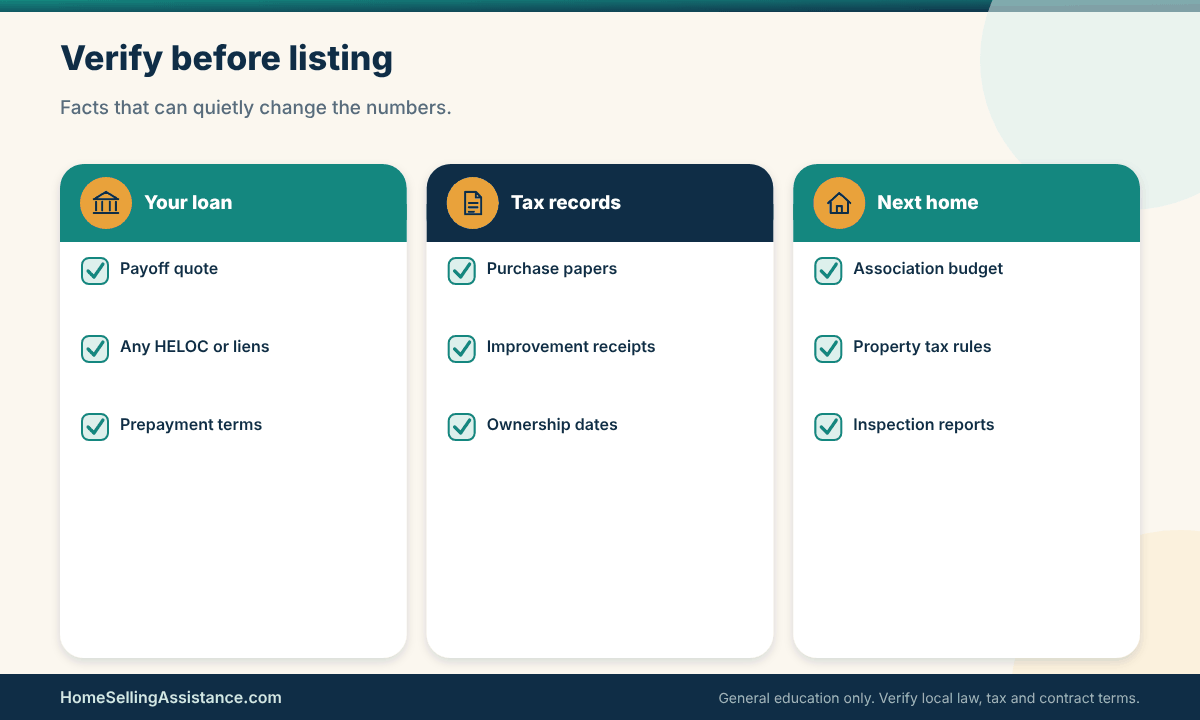
Start with the payoff statement. Your lender can give you a payoff quote that includes interest through a specific date, and that number, not your last statement balance, is what comes out of the sale. If you have a home equity line of credit, a reverse mortgage or any lien, add those. Ask whether there is any prepayment fee, though many modern loans do not have one. Reading your note and closing papers will tell you. Check it twice, because downsizing home selling leaves little room for surprises.
Next, gather what you need for basis, which is generally what you paid for the home plus qualifying improvements, reduced by certain items. The IRS explains how to figure gain in Publication 523 on selling your home. A well-known federal rule allows many sellers to exclude up to 250,000 of gain, or 500,000 for qualifying joint filers, if ownership and use tests are met, but your result depends on your facts, so confirm with a tax professional. Small gaps here can grow during downsizing home selling.
Then look at the next place. If it is a condo or a home in a planned community, request the governing documents, budget, reserve study and any special assessment notices. Ask what the association fee covers and what it does not. If it is a single-family home, ask about the age of major systems and request any past inspection reports. For senior communities, learn the entry rules, fees and refund policies in writing before any commitment. Use it as a reality check on your downsizing home selling budget.
Also check how the property tax is set. Some counties reassess a property when it sells, while others cap increases for a period or offer exemptions for age or income. Do not guess. Call the county assessor or look at its public website, and ask what the bill on the smaller home would likely be for a new owner. A mistake here can erase the savings you were counting on. That is a common sticking point in downsizing home selling.
An exception and your next step when the facts shift
Imagine a seller who planned to sell and buy a smaller house a few miles away. When the payoff quote arrived, it showed a home equity line they had forgotten, which trimmed the expected equity. At the same time the county assessor explained that the smaller house would be reassessed at its purchase price. The monthly savings they pictured shrank to something much smaller. Do not skip it, even if downsizing home selling feels urgent.
Did that kill the plan? Not necessarily. They could consider a less expensive home, a condo with lower taxes, a rental while they decide, or staying put for a year while they address the cost drivers. The lesson is that new facts should lead to a reasoned adjustment, not to ignoring the numbers or giving up on the plan. Discuss it openly, because downsizing home selling affects the whole household.
Your next step is a short verification list. Get the payoff quote. Ask a tax professional about your basis and the exclusion. Confirm property tax treatment for the target home. Request association documents. Then revisit the one-page summary and see whether the plan still holds. If you are unsure whether the money works, a HUD-approved housing counselor can be a neutral resource, and you can find one through the HUD counselor locator. This is the kind of fact that reshapes downsizing home selling.
Comparing the realistic paths in downsizing home selling
Once you know what you want and what could change the numbers, you can compare actual routes. Most downsizers end up choosing among a few paths: sell the current home first and then find the smaller one, secure the smaller home first and sell afterward, or stage the move in a way that bridges the two, such as a temporary rental or a flexible closing date. Each has a different shape of risk. Make a note of it for your downsizing home selling folder.
The honest comparison is not about which path is best in the abstract. It is about which path matches your timeline, cash and temperament. The table below lays out the usual paths against the factors that matter most. Read it as a prompt for questions rather than a verdict, and replace its general statements with quotes, contract terms and local facts as you collect them. Good records here make downsizing home selling smoother for everyone involved.
| Factor | Sell first, then buy | Buy first, then sell | What to verify | Main execution risk |
|---|---|---|---|---|
| Price and net proceeds | Known sooner, so the next budget is firm | Unknown until your home sells | Payoff quote, cost estimates | Selling under pressure after buying |
| Time | Possible gap before you move in | Overlap of two homes | Closing and possession dates | Gap or overlap longer than planned |
| Contingencies | Buyer may ask for a long closing | You may need a sale contingency | Contract language, lender terms | Contingencies weaken your offers |
| Workload | Pack and move once, maybe twice | Pack in stages, stage the old home | Movers, storage, timing | Two homes to maintain at once |
| Financing | Cash from the sale supports the next home | May need bridge or second financing | Lender options in writing | Carrying two loans if the sale drags |
| Flexibility | Can rent briefly while you look | Can move on your own schedule | Short-term housing availability | Limited choices if you must move fast |
| Stress level | Housing gap anxiety | Unsold-house anxiety | Your own tolerance | Decisions made in a hurry |
Use the table by filling in your own column. Beside each factor, write what you know today and what you still need to find out. The cells with the biggest unknowns are the ones to research first. If your largest unknown is financing, talk to a lender early. If it is time, look at the likely closing windows for your home and for the smaller one. Our detailed comparison in sell before downsizing or buy the smaller home first goes deeper on this exact trade-off.

Path one: sell the larger home first
Selling first is the path many advisors describe as the simplest from a financial standpoint, and many sellers find it the calmest. You list, negotiate and close on the larger home, and you know exactly what you walked away with. That number then drives the budget for the smaller home. There is no worry about owning two mortgages at once, and you can shop for the next place with real cash in hand. Ask for this in writing before you commit to a downsizing home selling plan.
The cost of that calm is the gap. After closing you need somewhere to live, and the timeline for finding and closing on a smaller home may not line up. Some sellers negotiate a rent-back, where they stay in the home for a short period after closing under a written agreement. Others rent short term, stay with family or use a furnished rental. Each of these has a cost and an annoyance that belongs in your net-result math.
There is a second subtle cost, which is that buyers of your larger home know it. If your closing date is firm and your buying plan is shaky, you may negotiate from a weaker position on the sale. Strong planning can offset this. Having your next home partly lined up, or having a clear rental plan, lets you answer a buyer’s questions about possession dates without scrambling. A clear view of this makes downsizing home selling far less stressful.
Evidence to gather: sale timeline, rent-back terms and the gap budget
Begin with local time-to-sell evidence from a source you trust, such as recent sold listings for similar homes in your area and the days those homes spent on the market. This is a better guide than any national average. Ask more than one agent how they would price and time your listing, ask what has happened to similar homes this season, and treat any single confident answer with caution.
Then look at the contract structures that help with the gap. A rent-back, sometimes called a post-closing occupancy agreement, typically sets a daily or monthly fee, a deposit, an end date, an insurance requirement and rules about who pays for what. The terms are negotiated and written down, and the rules around them vary. A licensed agent or real estate attorney in your state should review the document before you sign.
Build a gap budget. Add up short-term housing, a second set of moving costs if you will move twice, storage for belongings, and any extra utilities or deposits. Here is an illustrative figure only: if you expect two months in a rental at 2,000 a month, plus 1,500 for a second move and 600 for storage, your gap budget would be about 6,100. Your actual numbers will differ, and the point is to write them down.
Finally, check the closing cost estimate for your current home. Our guide to seller closing costs explains the usual line items so you can ask for a written estimate from a title company or agent rather than relying on a rule of thumb. Closing costs depend on state custom, the contract and your loan, and a reliable quote beats a general guess.
A scenario, an exception and your next step for selling first
Take a seller whose home is paid off and who has no particular date pressure. Selling first suits that person well. After closing, they can rent for a few months in the area they are considering, visit neighborhoods at different times of day, and buy the smaller home with cash or a modest loan. The flexibility is worth a lot, and the gap costs are small relative to the peace of mind.
The exception is the seller in a tight rental market or a fast-moving purchase market. If rentals are scarce or the smaller homes they want sell within days, a sale that closes before the next home is found can leave them racing. In that case, a longer closing period, a rent-back or a purchase of the next home in parallel may fit better, with the extra cost and complexity understood in advance. Sellers who skip this step often find downsizing home selling harder than expected.
Your next step is to write two timelines on a single page. The first shows the earliest and latest closing dates for your current home. The second shows what you would do if the next home is not ready on closing day. If the second timeline makes you uneasy, you have just discovered what to fix before listing, not after. A rent-back clause, a rental lined up in advance or a longer closing window may all be worth discussing.
Path two: secure the smaller home first, or bridge the gap
The other realistic route is to buy the smaller home before the larger one is sold, or to build a bridge between the two. Buying first gives you choice: you can take your time to find a place you love, move in gradually, and prepare the old house at your own pace. For people with a strong attachment to a specific community or building, being able to grab the right unit when it appears may matter more than anything else.
The challenge is financing and risk. If you need the proceeds from your current home to complete the purchase, you may need a contingency that depends on the sale of your house, which sellers of the smaller home may see as a weakness. Some buyers use savings, a home equity line, a bridge loan or a temporary arrangement to avoid that contingency. Each option has costs and limits, and lender terms vary, so do not assume they are available or cheap.
Bridging can also mean non-purchase options, such as a rental that lets you try the area and then buy, or a flexible lease on the larger home if it will be rented rather than sold. Some owners keep the larger house for a time because of tax or family reasons, but that creates landlord duties and different tax questions, so it deserves its own professional advice before you commit.
Evidence to gather: lender options, carrying costs and contingency terms
Talk to at least two lenders before you make an offer on the smaller home, and ask them in writing how they treat a purchase made before your current home sells. Ask whether your existing mortgage payment counts against you when they calculate your debt load, whether there are bridge or equity products, what the fees would be and how long approval typically stays valid. Do not rely on a general description. Ask for the specific terms for your situation.
Next, estimate the carrying cost of owning both homes. Add the mortgage payments, property taxes, insurance, utilities, upkeep, lawn or snow service and the cost of keeping the larger house presentable. Here is an illustrative example: if the larger house costs 2,400 a month to carry and the smaller one 1,700, two months of overlap would be about 8,200 before any other costs. A longer overlap multiplies the figure, so decide in advance how many months you can tolerate.
Read the contract terms that deal with sale contingencies. Our guide to home sale contingencies for sellers explains how a contingency works from the other side of the table, which can help you see how the seller of your target home might react. A contingency often includes a deadline, a right for the seller to keep marketing and sometimes a right to demand that you proceed. Terms vary by state and contract form.
Last, consider the insurance and utility details. Vacant or partly furnished homes can trigger insurance conditions, and policies often have rules about how long a home can sit unoccupied. Call your insurer, describe the plan, and ask what is covered during the overlap. Ask the same about the new home from the day you close. These details are easy to miss and costly when ignored.
A scenario, an exception and your next step for buying first
Consider an owner who finds a single-level condo in a building they have loved for years, and a unit rarely comes up. They have strong savings and a manageable mortgage. Buying first, then preparing the larger home for sale over several weeks, lets them move calmly and stage the house when it is empty or lightly furnished. For them, the extra cost of overlap is a fair trade for getting the right unit.
The exception is the owner who needs the sale proceeds to close and has no cushion. If the old house sits longer than expected, they may be forced to cut the price or accept a weak offer to ease the overlap. The more the plan depends on a specific sale date and price, the more risky buying first becomes, and the more a contingent offer or a sell-first approach may serve.
Your next step is a stress test. Imagine your larger home takes twice as long to sell as you expect, and that the final price is lower than your hoped-for range. Can you still afford the overlap and still make the plan work? If the answer is yes, buying first may be a comfortable choice. If the answer is no, treat that as a signal to adjust the plan before you sign anything, and to speak with a lender and a licensed agent or attorney.
A net-result rule for downsizing home selling
After you have compared paths, you need a way to decide. The simplest rule is to judge every option by what you keep, how long it takes, what it costs and how much can go wrong. This is a net-result rule, and it works for choosing between offers, between timelines and between two homes. Headline price alone is a poor measure, because a higher number with heavy credits, a long timeline and a shaky buyer can leave you worse off.
The rule has four parts. Net proceeds tell you what lands in your account after payoff, costs, credits and prorations. Time tells you how long you will carry costs and uncertainty. Cost covers the money you spend along the way, including moving, storage, short-term housing and double carrying. Risk covers what happens if something fails, such as a buyer who cannot close, a repair surprise or a gap in housing.
Different households weigh the four parts differently, which is why the table below sorts common situations by the route that tends to be favored and the fact that could flip the answer. It is a thinking aid, not a prediction, and the right choice for you depends on your contract, your finances and your local market.
| Situation | Route often favored | Reason | Trade-off | Fact that changes the choice |
|---|---|---|---|---|
| Paid-off home, flexible timeline | Sell first, then buy | Firm cash makes the next budget clear | Possible rental gap | Scarce rentals or fast-selling targets |
| Rare unit in a loved building | Buy first | Right place may not return | Two homes for a time | No cushion if the old home lingers |
| Home needs major repairs | Sell as is or repair first | Condition drives buyer pool and price | Discount versus time and cash spent | Contractor quotes and inspection findings |
| Mobility is changing soon | Faster, simpler move | Safety and ease outweigh a small price gain | May accept less negotiating room | Medical timeline and available housing |
| Large gain on a long-held home | Get tax advice before listing | Exclusion limits may matter | Time spent on planning | Basis records and ownership dates |
| Moving to a senior community | Coordinate sale with entry date | Fees and deadlines are fixed | Less flexibility on closing | Contract refund and entry terms |
| Co-owners or family involved | Agree on a plan in writing first | Everyone must sign eventually | Slower start | Authority to sign and any estate or trust duties |
To use the table, find the row closest to your situation and read across, then challenge it. Ask whether the stated reason applies to you, whether the trade-off is one you can live with, and whether the final column describes a fact you have not yet checked. If a row does not match, write your own. The goal is to get the unknowns on paper before they appear in the middle of a contract deadline.

The price, time, cost and risk framework for downsizing home selling
Put the framework to work with a simple worksheet. Create one column per option, whether that is two different offers on your home or two different paths. In rows, list the contract price, each credit or concession, estimated selling costs, payoff, estimated net proceeds, closing date, contingencies and the cost of any gap or overlap. Then add a final row for the scenario in which something goes wrong, and fill in how you would respond.
Be careful with comparisons that mix certain numbers and hopeful ones. A cash offer with a fixed date may look smaller on paper than a financed offer with a contingency, yet the financed offer can fall through and cost you weeks. On the other hand, a quick cash offer that carries a steep discount may cost more than a few extra weeks of marketing. The worksheet cannot tell you which is right, but it keeps you from choosing on one number.
Include your own time and stress as costs, quietly but honestly. If one option demands months of showings, repairs and staging while you sort a lifetime of belongings, that effort has a value. If another option is simpler and costs a bit more, it may be the better choice for you. Writing it down avoids regret later, because you chose with your eyes open. It is a small detail, yet downsizing home selling often turns on details like this.
Evidence to gather: a net proceeds worksheet you can trust
Gather the real inputs. Get the payoff quote from your lender. Ask a title or escrow company, or your agent, for an estimated seller closing statement based on a sample price. Ask whether property taxes, association dues and utilities will be prorated and in which direction. Request any repair estimates from licensed contractors, and keep them in writing. These documents turn a guess into something you can defend.
Then run three price scenarios, low, middle and high, using round numbers. This is an illustrative approach, not a market prediction. Suppose you test sale prices of 380,000, 400,000 and 420,000. For each, subtract payoff, estimated selling costs, any repair credit and prorations. Compare the three results. You will probably see that a change in price does not move your net by the same amount, because some costs are fixed and others scale with price.
Add the cost of the move itself. Collect at least two written moving quotes, price storage for the period you might need it, and estimate disposal or donation costs for belongings you will not keep. Include the first-year costs of the smaller home that are not obvious, such as a move-in deposit, new window coverings, furniture that fits a smaller space and any association move-in fee. Treat this as one input to your downsizing home selling decision, not the whole answer.
Keep your documents organized. A folder, paper or digital, with the payoff quote, estimates, contractor bids, tax records and association papers saves you from scrambling when an offer arrives. The documents also help a tax professional or attorney give better general guidance. For tax topics, our overview of taxes when selling a home explains what records tend to matter, and our home sale taxes category collects related guides.
A scenario, an exception and your next step with the framework
Picture two offers on a smaller home that you are selling. Offer A is higher by an illustrative amount of 8,000, but it includes a financing contingency, a request for a repair credit and a closing 60 days out. Offer B is lower but has a shorter closing, a larger deposit and few requests. After you subtract expected credits and the extra carrying cost, the difference between the two may be small, or the lower offer may come out ahead.
An exception arises when your own costs are very low. If you have no mortgage, no pressure and no purchase that depends on the sale, the extra time for a higher offer may cost you little, and the higher number may be the right pick. Conversely, if you have a closing date on the next home that cannot move, the lower, faster offer may protect you from a far costlier mistake. The framework gives different answers for different people, which is the point.
Your next step is to build the worksheet this week, before any offer exists. Fill it in with sample numbers so the structure is ready, then replace estimates with real quotes as they arrive. Ask your agent, your attorney if you use one, or your title company to check the line items for gaps. When an offer comes in, you will compare it to a plan, not to a feeling.
When new evidence should change the plan
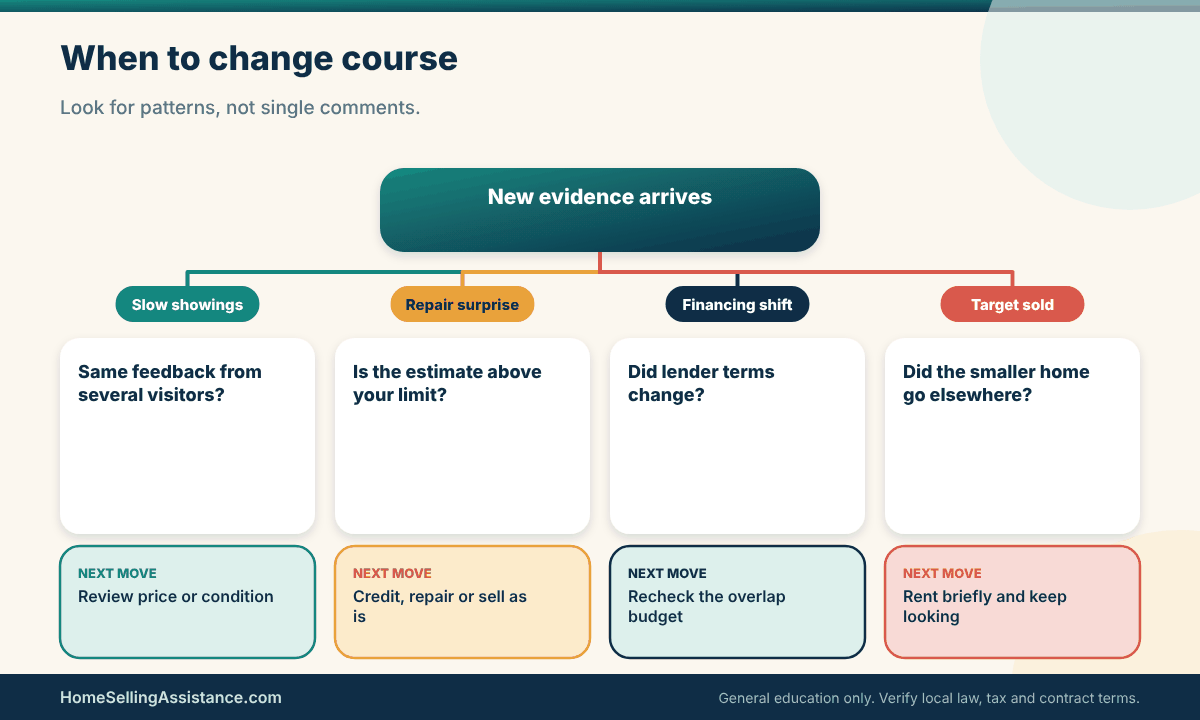
Plans are not promises. The point of the net-result rule is that you keep updating it as facts come in, and sometimes the facts say to change course. A home inspection can reveal repair costs, a lender can change terms, a market can slow, a family member’s health can shift, or the smaller home you wanted can be sold to someone else. A sensible downsizing plan expects some of this and leaves room to respond.
Decide in advance what would change your mind. Pick two or three tripwires, such as a price floor below which you would rather wait, a date after which you would consider a rental, or a repair estimate above which you would choose a different approach. Write them where you can see them. Tripwires are not rigid rules, but they protect you from sliding from one concession to another without noticing. Many households only notice this halfway through downsizing home selling.
Also keep an eye on information you cannot control, such as interest rates, local inventory and seasonal patterns. These matter at the margin, and they can matter a lot for timing, but you should not build your whole plan around guessing them. Our article on the best time to sell a house explains how seasonal and market factors interact with personal timing, and why personal circumstances usually outweigh the calendar.
Evidence to gather: signals worth tracking after you list
Once your home is on the market, track a few simple signals. How many showings are you getting in the first two weeks? What feedback do visitors give about price, condition or layout? How do similar homes nearby fare, both active and recently sold? These signals tell you whether your pricing and preparation match what buyers see. A quiet start is information, not a verdict, but it should prompt a conversation with your agent.
Review the signals on a schedule, such as weekly, rather than reacting to each phone call. Ask your agent to share a short summary of activity and comparable listings, and ask what they would change and why. If you are selling without an agent, track the same signals yourself and consider asking a licensed appraiser or another professional for an independent view. Our guide to how to price a house to sell explains how to read comparable sales.
Keep tracking the other side of the plan as well. If you are buying, watch how the target home or similar homes are moving, and revisit your financing documents as dates approach. Rates, approvals and deadlines have a way of shifting when you are busy with other tasks. A weekly fifteen-minute review with a short list can catch an expiring approval or an overlooked document before it becomes a problem.
Finally, keep a record of decisions and why you made them. If you lower the price, note the evidence that led you there. If you accept a credit, note what it covered. A simple log helps you stay consistent, helps you explain choices to family members who share the outcome, and gives your advisors a clear picture if questions arise at closing.
A scenario, an exception and your next step when evidence changes
Imagine a seller whose first month on the market brings plenty of showings but no offers. Visitors compliment the location and criticize the dated kitchen and the price. That evidence points to a few options: lower the price, offer a credit, make selected updates, or wait for a different season. Each choice has costs, and the right one depends on the seller’s tripwires and cash. Writing it down early keeps downsizing home selling on track.
The exception is evidence that looks bad but is not. A slow first weekend in a quiet week, a single harsh comment or one strange comparison should not trigger a major change. Look for patterns. If three different visitors raise the same concern, take it seriously. If a single visitor raises an unusual one, consider it, but do not reshape the plan around it. Judgment is the skill here, and it improves with a second opinion.
Your next step is to schedule a decision point before listing, perhaps three or four weeks after the first showing. At that meeting with yourself, your family or your agent, review the signals and your tripwires. Decide whether to hold, adjust or pivot, and write down why. The date is your protection against drift, and it is far easier to hold a plan than to keep rebuilding it from scratch.
Quick scenario
A widowed seller with a paid-off three-bedroom house wants a one-level condo. She rents for a few months after closing, tours buildings at different times of day, and buys the unit that fits. Her costs are modest, and her calm timeline lets her choose a buyer on terms rather than speed. Your facts will differ, which is why the worksheet matters more than any example. For help with related ownership questions, see selling a house after a spouse dies.
Frequently asked questions about downsizing home selling
How early should I start planning a downsizing home selling project?
Many people benefit from starting several months before they want to list, and some start a year ahead. That window lets you gather documents, sort belongings, get repair quotes and tour smaller homes without pressure. If a health event or deadline forces a faster timeline, a shorter plan is still possible, but it usually costs more in convenience and options.
Will downsizing home selling automatically save me money?
No. A smaller home can cost less to heat, insure and maintain, yet it may carry higher association dues, higher property taxes after a purchase or a higher price per square foot. Selling and moving also cost money. Compare your actual current costs, your expected costs in the new place and your one-time expenses before assuming savings.
Should I sell first or buy first?
It depends on your cash, your risk tolerance and your market. Selling first gives you firm numbers but may create a housing gap. Buying first gives you choice but can mean carrying two homes. Our article on whether to sell first or buy first goes through the trade-offs in more detail.
How do taxes work when I sell a long-held home?
A federal rule lets many sellers exclude up to 250,000 of gain, or 500,000 for qualifying joint filers, if ownership and use tests are met. Whether it applies, and how basis is calculated, depends on your facts. The IRS explains the rules in Publication 523. Ask a tax professional about your situation before you list.
What happens to my property taxes if I buy a smaller home?
It varies by state and county. Some places reassess a home at the purchase price, while others limit increases or offer exemptions based on age or income. Contact the county assessor for the home you want and ask how the bill would be set for a new owner. Do not assume your current bill will follow you.
Do I need to fix everything before I sell?
Not always. Some sellers make targeted repairs, some offer credits, and some sell as is. The right approach depends on the cost of the work, the likely buyer pool, your timeline and your cash. Get written estimates and compare the cost of repairs with the likely discount or credit. A local agent or contractor can help you see what buyers in your area expect.
How do I handle a lifetime of belongings?
Start early and work room by room. Sort into keep, give, sell and discard, and share the plan with family so nobody is surprised. Consider a professional organizer or estate-sale service if the volume is large, and get written quotes. Keeping only what fits the new space, and measuring that space first, saves both money and regret.
What if I cannot find a smaller home I like?
Do not let the sale outrun the search without a plan. Consider a short-term rental, a rent-back after closing or staying in the home a bit longer while you keep looking. Each choice has a cost, and a written plan helps you pick one on purpose. Widening the search to different property types, such as a condo or a villa, may also help.
Are there resources for people worried about the cost of moving or staying?
Yes. HUD-approved housing counselors offer guidance, and you can find one through HUD. The Consumer Financial Protection Bureau publishes general information about mortgages and housing costs. Both are starting points, not substitutes for professional advice on your own facts, and you should always be cautious of anyone who pressures you to act quickly.
Should I talk to family before I list?
Usually yes. Family members may have views, may expect to inherit or may be helping with the move. A frank conversation early can avoid conflict and delays later. If title is shared or a trust or estate is involved, confirm who has authority to sign. A real estate attorney can help clarify ownership questions where the facts are complicated.
A calmer way to approach downsizing
Downsizing home selling works best when you decide what you want first, price both staying and moving honestly, compare realistic paths and judge offers by what you keep, how long it takes and how much can go wrong. For more context, browse our relocation and downsizing guides, or read about selling when insurance costs rise. This article is general education, not legal, tax or financial advice, so check the rules in your state and talk with licensed professionals about your own situation.