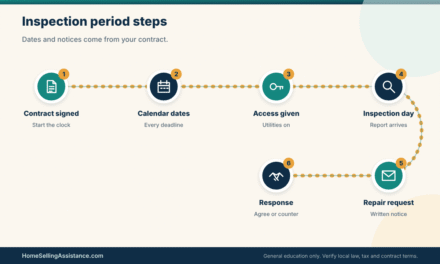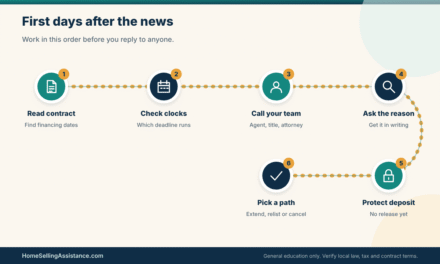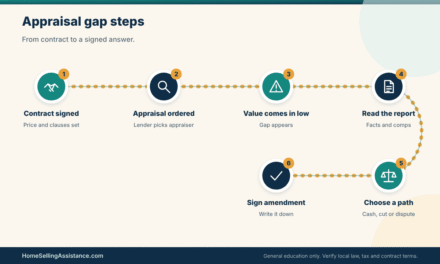
Understanding home sale contingencies seller terms is the difference between an accepted offer that closes and an accepted offer that quietly falls apart three weeks later. A contingency is a condition written into the purchase contract. If the condition is not met by its deadline, one side, usually the buyer, gains the right to renegotiate or walk away. The five you will meet most often are inspection, appraisal, financing, sale of the buyer’s current home, and title.
Most home sale contingencies sellers hear these words for the first time while an offer sits on the kitchen table and a response deadline is ticking. That is a poor moment to learn vocabulary. A price on a page tells you very little until you know how many conditions stand between that price and a closing, who controls each one, and what you are allowed to do if one goes sideways. This home sale contingencies seller guide is meant to be read before you list, then reread when the first offer arrives.
We will take the contingencies one at a time, then look at how they interact, what they can cost you in rough illustrative numbers, and which papers and professionals to line up. Nothing here is legal, tax or financial advice, and nothing here is tailored to your state. Contract forms, deadlines, deposit rules and attorney involvement differ widely, so treat every general statement as a prompt for a question to your agent, attorney or title company.
One more note on tone. We are not trying to talk you into more contingencies or fewer, into using an agent or avoiding one, into taking the cash offer or declining it. The goal of any good home sale contingencies seller education is simpler: you should be able to read an offer and say, in your own words, what could still go wrong, who decides, and by when.
Key takeaways
- A contingency is an exit door, not a formality. Each one gives somebody a defined way to renegotiate or leave the contract if a condition fails by its deadline.
- Deadlines matter more than labels. Many problems start when a seller misses a response window written in the contract, not when the inspection itself goes badly.
- Price and certainty trade off. A higher offer loaded with conditions can be worth less to you than a slightly lower offer that is likely to close.
- Appraisal and financing are linked but different. A low appraisal can strain a loan, yet each has its own clause, its own timeline and its own fallback options.
- Title is your side of the table. Liens, ownership gaps and unpaid balances are usually the seller’s to clear, so check them before you list, not after you sign.
- Write everything down. Waivers, extensions, credits and repairs belong in a signed amendment, because spoken agreements rarely protect anyone.
Why every home sale contingencies seller decision starts with your own goals
Before anyone reads a purchase contract, the seller has to know what a good outcome looks like. A contingency clause is neutral. It becomes helpful or harmful depending on what you need from the sale: a specific closing date, a specific net figure, a smooth handoff of a house you have lived in for twenty years, or a quick exit from a property you inherited and cannot maintain.
Think of the contract as a series of gates. The buyer walks through the inspection gate, the appraisal gate, the loan gate and the title gate, and the sale only completes when every gate is open on the same day. Your job is not to remove gates at all costs. Your job is to understand which gates are likely to stick for your particular house and your particular buyer, and to plan for that.
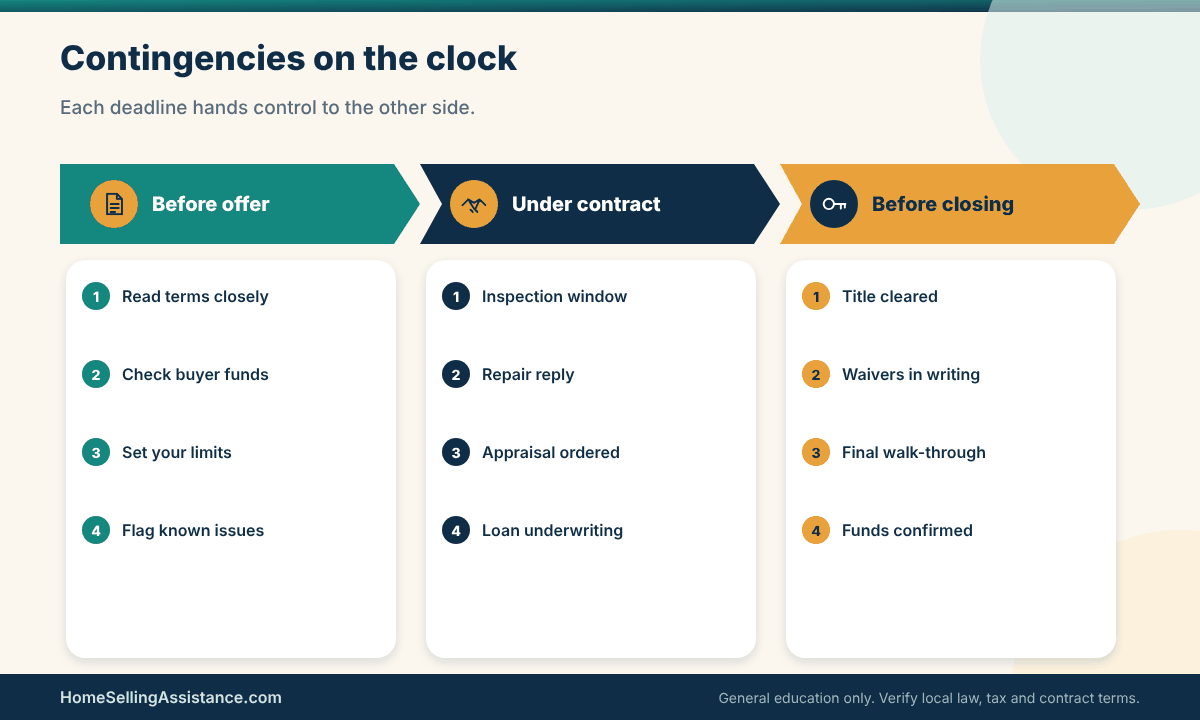
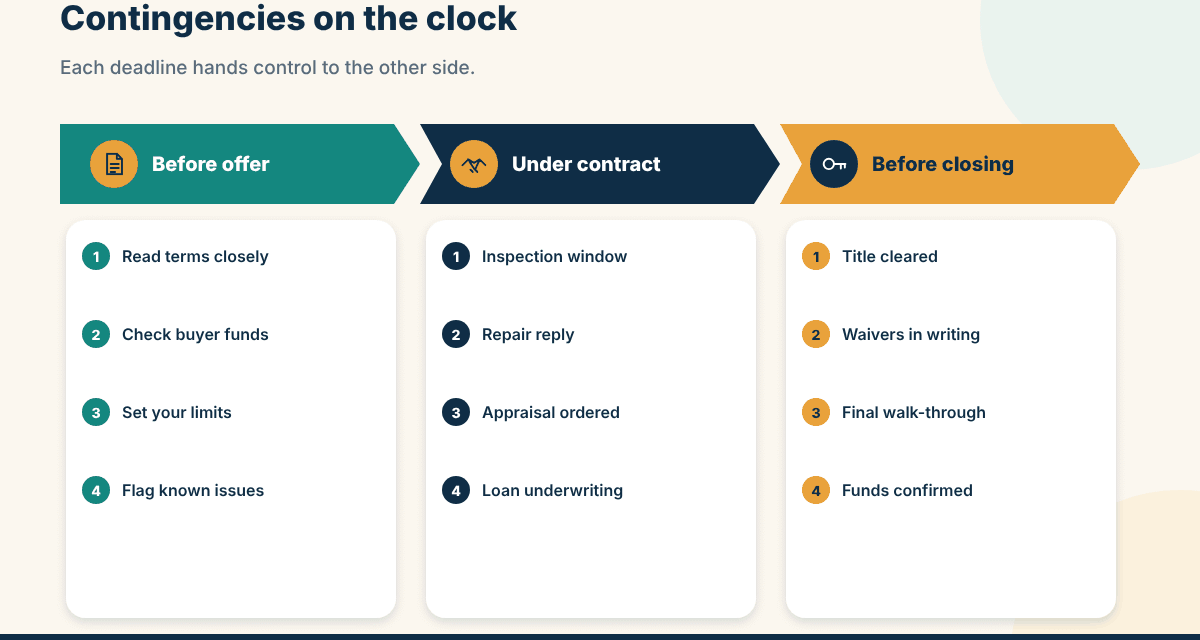
The picture above shows the three phases a contingency-based sale passes through: the period before you accept an offer, the contract window where most conditions are tested, and the final stretch before closing. Keep it in mind as you read, because the same contingency feels very different depending on which phase you are in. Early, you hold the most leverage. In the middle, the deadlines hold it. Late in the process, the lender and the closing agent hold most of it.
Define your goal, your cushion, and your property’s quirks
Start with the goal that cannot bend. For some sellers it is the date, because a new home purchase, a job start or a lease ending sits behind it. For others it is a net-proceeds floor, because the money has to pay off another debt or fund the next down payment. A few sellers just want the least possible hassle. Write the one or two non-negotiables on paper, because they decide which contingencies you can live with.
Next, assess your cushion. If you have another place to stay, no overlapping mortgage and a flexible calendar, you can tolerate a longer contract and a buyer who needs time. If you are carrying two housing payments or have already committed to a purchase, a delayed closing costs real money every week. That cushion, more than the headline price, is what a smart home sale contingencies seller conversation with your agent should begin with. We cover the sequencing problem in more depth in our guide to the home selling timeline.
Then look at the property itself. A newer house in a tidy subdivision rarely produces dramatic inspection findings. An older house with deferred maintenance, a private well or septic system, a flat roof, an unpermitted addition or aluminum wiring is a different story. None of these make the house unsellable. They simply make an inspection contingency more likely to produce a negotiation, so you should expect it rather than be surprised by it.
Finally, think about who might buy. A first-time buyer using a low-down-payment loan and a limited cash reserve behaves differently from a buyer who is selling a house first, and both differ from an all-cash investor. You cannot, and legally should not, choose among buyers based on who they are as people. Fair housing rules protect buyers from that kind of treatment, and the HUD fair housing office explains those protections. You can, however, compare offers on their written terms: financing type, contingency list, deadlines and proof of funds.
Evidence to gather: your payoff, your calendar, and your own risk tolerance
Gather three things before you list, and keep them in one folder. First, a recent mortgage statement and, if possible, a payoff estimate from your lender. Contingency outcomes usually change your proceeds, and you cannot judge a repair credit or a price reduction without knowing how much of the sale price goes straight to the lender. Request the payoff in writing close to closing, since the figure changes daily with interest.
Second, build a simple calendar of your own constraints. Mark the date your next lease or purchase starts, the last day you can comfortably stay, and any date when you would have to pay a penalty or a second housing cost. Hold that calendar next to every offer. An offer with a thirty-day inspection and financing timeline that lands after your constraint date is not a better offer, whatever the price says.
Third, be honest about your risk tolerance, because it will be tested. Some home sale contingencies sellers sleep fine with a buyer who has a ten-day inspection window and a pre-approval letter. Others lose sleep until the loan is fully approved and the appraisal is back. Neither temperament is wrong. Knowing yours helps you decide, calmly and early, how much uncertainty a particular offer is worth. Our overview, how to sell a house, places this self-assessment in the larger sequence.
If your house has features that commonly raise questions, collect the paperwork now: permits and final inspection sign-offs for additions, receipts for the roof or furnace, well and septic records, and warranty information. Documents like these do not eliminate inspection findings, but they shorten arguments about them. A buyer who can read the permit history is less likely to assume the worst.
A scenario, an exception, and your next step for first-time listers
Picture a seller we will call Dana, with a modest house and a loan she has paid for years. She receives two offers at close to the same illustrative price. One comes from a buyer with a conventional loan, a standard inspection window and an appraisal contingency. The other is a bit lower, from a buyer who has already completed the loan underwriting and waives the financing contingency but keeps inspection rights. Dana’s calendar has a hard stop in six weeks.
For Dana, the second offer may be the stronger one, even at a slightly lower number, because it removes a gate that might not open in time. That is a judgment call, not a rule. If her calendar were looser, the higher price might win. The point is that she compares offers against her own constraints, not against a universal ranking of contingencies. This is the habit to build.
Now the exception. Some home sale contingencies sellers believe that removing contingencies from a counteroffer makes a deal safe. It does not. A buyer who waives a contingency still has the rest of the contract, and a buyer who cannot perform may simply default. The remedy then depends on the deposit terms and the contract language, which differ by state and form. A cleaner offer is not a guaranteed offer. We explain how deposits and defaults interact in our article on what happens when buyer financing falls through.
Your next step is small and concrete. Before you list, write down your non-negotiable date, your minimum comfortable net, and the contingencies you are willing to accept without discussion. A short list taped to your monitor will keep the first excited reaction to an offer from setting your strategy for you. The rest of this guide helps you fill in the details behind that list.
A quick word on vocabulary. Different regions use different names for the same ideas, so a home sale contingencies seller who moves between states, or who reads advice written for another market, should expect labels to shift. A due diligence period, an option period, an attorney approval and a review period can all behave like contingencies. Judge a clause by what it allows, not by what it is called, and ask for a plain-language explanation whenever a label is unfamiliar.
Map the five main contingencies and how each one actually works
Contingencies sit in a purchase agreement as short clauses, often with fill-in blanks for the number of days. They are easy to skim and expensive to misunderstand. The five below cover most residential contracts, though your state form may add others such as attorney review, homeowners association document review, survey approval, insurance availability or a seller’s right to find replacement housing. Read the actual contract; never rely on a summary, including this one.
An inspection contingency lets the buyer have the home professionally examined and then respond within a set window, by accepting the condition, asking for repairs or credits, or terminating. An appraisal contingency protects a buyer whose lender will only lend against appraised value. A financing contingency covers loan approval. A sale-of-home contingency ties the purchase to the buyer’s own sale. A title contingency covers whether ownership can be transferred cleanly.
For a deeper look at the first, our article on the home inspection contingency walks through seller responses to repair requests and credits. For the second, see the guides on low appraisal options for sellers and the appraisal gap. Each of those goes beyond what a cornerstone page can cover, so this guide stays at the level of how the pieces fit together.
The table below puts the five on one page. Use it as a quick reference: read across a row to see who controls the contingency, what the seller can do, and where the common trap sits. It does not replace your contract’s own wording, and the typical timing noted is illustrative only, since actual windows are set by the agreement you sign.
| Situation | Key fact | Practical action | Trade-off | Source or document |
|---|---|---|---|---|
| Inspection | Buyer reviews condition, then responds by a deadline | Pre-gather permits and receipts; plan a written reply | Pre-listing inspection can reveal issues you must then address or disclose | Contract inspection clause, inspection report |
| Appraisal | Lender values the home before lending | Share a list of upgrades and recent comparable sales with your agent | Appraisal outcomes are not controllable and may lag the market | Appraisal clause, lender appraisal report |
| Financing | Buyer must secure loan approval by a date | Ask for a lender letter and watch interim deadlines | Strong pre-approval is not a final approval | Financing clause, lender letters |
| Sale of buyer’s home | Your sale depends on their sale closing first | Negotiate a kick-out clause and keep marketing | Longer exposure and less certainty for you | Addendum, listing agreement |
| Title | Ownership must transfer free of problems | Order or review a title report early | Clearing liens or defects may take time and money | Title commitment, recorded deed |
After you have scanned the table, notice the pattern. Three of the five contingencies, inspection, appraisal and financing, depend on third parties who have their own calendars: inspectors, appraisers and underwriters. The fourth depends on another transaction entirely. Only title sits mostly in your own court. That pattern explains why sellers often feel they are waiting on strangers, and it is the reason a clear calendar helps so much.
Many home sale contingencies sellers worry that each clause is a trap. Mostly they are not. They are risk-allocation tools that both sides accept. The goal is not to avoid them but to understand them, so that the home sale contingencies seller sitting across from a buyer’s agent knows which items are routine and which deserve a question or a counter.
What each contingency protects, and who controls the clock
Take the inspection contingency first. Its purpose is to let the buyer learn what they are buying. The clock usually starts on the contract’s effective date and runs for a number of days written into the agreement. When the window closes without a buyer response, the contract typically treats the contingency as satisfied or waived, but the exact consequence differs by form. Read how your form handles silence, because it can cut in either direction.
The appraisal contingency protects the buyer from paying more than the property is worth to the lender. The lender orders the appraisal, usually through a management company, so neither you nor the buyer picks the appraiser. The home sale contingencies seller’s role is to make the home easy to appraise: access, a clean and uncluttered interior, and a one-page summary of improvements with dates. Timing is controlled by the lender’s process, not by the contract date alone.
The financing contingency protects a buyer who cannot get the loan they applied for. Control sits with the underwriter, who may ask the buyer for more documents right up to the final days. A pre-approval letter is a starting point, not a promise. The Consumer Financial Protection Bureau publishes plain-language material on how the mortgage process works if you want to understand what a buyer is going through.
The sale-of-home contingency, sometimes called a home-sale or house-to-sell contingency, protects a buyer who needs proceeds from their current home to afford yours. You inherit their risk: if their sale fails or drags, your closing stalls. Home sale contingencies sellers commonly negotiate protections such as a kick-out clause, which lets you keep marketing and give the buyer a short window to remove the contingency if a better offer arrives. Our article on the buyer home-sale contingency covers the mechanics.
The title contingency protects the buyer from inheriting somebody else’s debt or ownership dispute. A title company searches public records and issues a commitment listing what it found, including liens, easements, open permits in some places and judgments. You, the seller, are generally responsible for delivering ownership that can be insured, though who pays for what and which exceptions are acceptable are matters for your contract and local custom.
Across all five, one truth repeats: the party with the contingency usually controls the exit, but the party without it controls the paperwork. The home sale contingencies seller who stays organized, responds in writing and keeps copies tends to turn contingency periods into routine checkpoints. The home sale contingencies seller who treats them as background noise tends to discover, on day eight of ten, that something needed an answer on day three.
If you are selling a condo or a home in an association, add another layer. Some contracts give buyers a review period for association documents, budgets, rules and any pending assessments, and a home sale contingencies seller in that position should request the resale package early. Our overview of selling a condo explains what those documents usually contain, and a missed association deadline can delay an otherwise healthy contract.
A scenario, an exception, and your next step for the contingency map
Imagine a contract with a ten-day inspection period, a thirty-day financing period and a title review that runs until a few days before closing. These numbers are illustrative only. On day four the buyer’s inspector finds an aging water heater and a drainage issue. On day nine the buyer sends a repair request. On day fourteen the lender says the appraisal is on the schedule. On day twenty-six the title company finds an old, unreleased home equity line.
Four different contingencies, four different calendars, one seller. The home sale contingencies seller who has the payoff statement, the old equity line’s release paperwork and the repair receipts in a single folder can answer each issue within a day. The home sale contingencies seller who has to hunt for each document loses days, and in a tight market days can matter. This is the practical argument for the folder, the calendar and the written replies we keep returning to.
Here is an exception worth knowing. In some places the form used for the contract, or local practice, shifts certain duties to different parties. In a state where attorneys draft and review contracts, the attorney-review window functions as a contingency of its own. In states with a separate escrow process, more of the title and closing work happens at the escrow company. If you are not sure which pattern applies to you, ask your agent or attorney to describe the process in one paragraph.
Your next step: print your contract’s contingency clauses and highlight three things on each, the number of days, the trigger that starts the clock, and what the contract says happens if the other side stays silent. If any of those three items is unclear, write the question down and ask before you sign, not after. Our contingencies, inspections and appraisals section collects deeper guides on each clause.
What moves price, timing, and net proceeds once contingencies enter the contract
Home sale contingencies sellers often rank offers by price alone, then feel blindsided when a high offer shrinks during the contract period. The shrinkage is rarely mysterious. It comes from the interaction of conditions, deadlines and the people operating them. A home sale contingencies seller strategy therefore begins with a simple idea: every offer has an expected value, and that value is the price discounted by the chance each condition fails and by what a failure would cost you in time and money. That is the practical core of home sale contingencies seller risk.
You do not need to calculate the chance precisely, and nobody can. What you can do is rank offers by how many independent things must go right. An offer with a strong pre-approval, a modest inspection window and no sale-of-home contingency has fewer moving parts than an offer with a loan that is only pre-qualified, a buyer who must sell first and an appraisal that must land on the number. More moving parts means more ways to lose time.
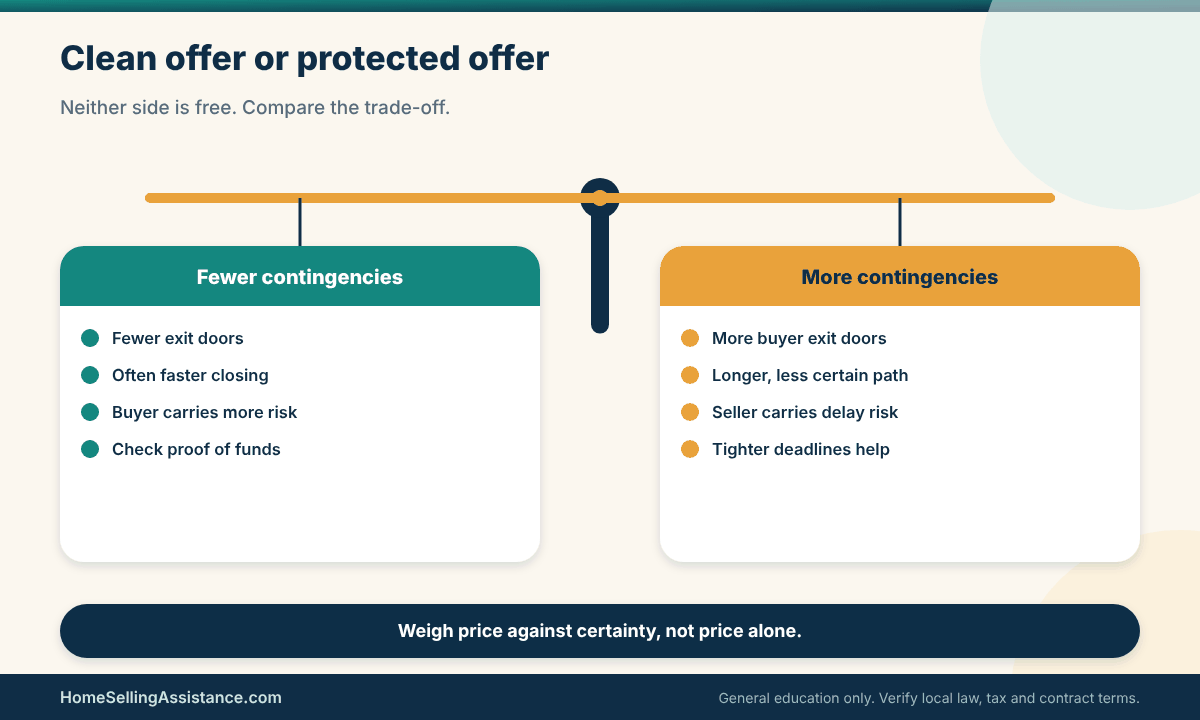
The scale above frames the trade-off. A clean offer with few contingencies gives the buyer fewer exit doors, which usually helps the seller, though it also shifts risk onto a buyer who may be less able to carry it. A protected offer does the opposite. Neither is automatically better. What matters is whether the price difference between two offers is big enough to pay you for the added uncertainty, and only your calendar and cushion can answer that.
Our guides on how to evaluate a home offer and on highest versus best offer take this comparison further. Here, we focus on the contingency-specific levers: what changes the odds that each gate opens, what each outcome costs, and how to recognize, ahead of time, which levers your own house is likely to pull.
Before the detail, one reassurance. Most home sale contingencies seller transactions that begin with a signed contract do reach closing, though outcomes vary by market, price range and the quality of preparation on both sides. That is not a promise about your sale. It is a reminder that contingencies are ordinary checkpoints, and that a home sale contingencies seller who prepares for them is usually dealing with routine steps, not emergencies.
How home sale contingencies sellers face shift with the market, the home, and the buyer
Three variables decide how heavily contingencies weigh in a given sale. The first is the market, meaning how many buyers are competing for homes like yours and how quickly. The second is the home, meaning its age, condition and any history that an inspector or appraiser might poke at. The third is the buyer, meaning their financing type, their savings and whether they depend on another sale. Change any of the three and the negotiating picture changes with it.
Market conditions are local and shift over months, not just years. When buyers are scarce, they ask for more protection and sellers accept more of it. When buyers are plentiful, some waive inspection rights, shorten windows or promise to cover an appraisal shortfall. Do not rely on a national headline to guess your own market. Look at how long similar homes near you took to go under contract and what the signed terms looked like, which your agent can usually describe.
The home itself is the variable you influence most. A well-documented house with maintenance records and a tidy condition tends to produce shorter negotiations. A property with visible deferred repairs or unusual features tends to produce longer ones. This is not about perfection. It is about how many surprises are left for the buyer’s inspector to find, because a surprise is what turns a routine inspection into a renegotiation.
The buyer is the variable you read, not control. Loan type shapes the paper trail. Government-backed loans can come with property condition requirements and required contract addenda that conventional loans do not, so an appraisal might flag peeling paint, a missing handrail or a roof near the end of its life. A buyer relying on a down payment gift or on the proceeds of another sale has more steps that could slip. None of this is a reason to refuse such buyers. It is a reason to read their terms.
Evidence to gather: market signals, condition records, and buyer documents
For the market, ask your listing agent, or any agent you interview, to walk you through recent sales near you in plain terms: how long homes took to sell, how many went under contract with inspection contingencies intact, and how many closed near their listing price. Ask for the underlying listings, not just a conclusion. If you are selling without an agent, the same data is available through public records, local listings and a local appraiser or broker opinion. Our guide to selling for sale by owner explains where to find it.
For the home, build a condition file. Include receipts for major systems, any prior inspection reports, permits and final sign-offs for additions or remodels, warranties still in force, and notes about repairs you made. If your house was built before 1978, remember the federal rule that sellers must give buyers a lead-based paint disclosure and an information pamphlet before the contract binds them. The EPA’s real estate disclosure page explains the requirement, and our article on lead paint disclosure for sellers goes further.
For the buyer, ask for proof of funds and a current lender letter, then read it with care. A good letter states the loan type, the amount, whether income and assets were verified and what conditions remain. A pre-qualification based on a phone call is a weaker signal than a pre-approval backed by documents, and a letter that says approval is subject to appraisal and underwriting tells you the work is not finished. These details are not meant to disqualify anyone. They tell you how much risk to price in.
Keep a one-page tracker for each live offer: purchase price, loan type, deposit, contingency days, requested credits, proposed closing date and any special terms. Seen side by side, two offers that looked close often turn out to differ in meaningful ways. A tracker also helps you remember, three weeks later, exactly what each party agreed to, which is invaluable if a dispute arises.
One caution on evidence. A real estate professional’s opinion about local custom is helpful, but it is not the contract. If an agent says, “that’s how it always works here,” ask where that is written. Local custom can fill gaps, yet the signed paper controls. If something matters to you, such as who pays for a particular report or what happens to the deposit if a contingency fails, get it into the contract text.
A useful habit is a short home sale contingencies seller checklist for each offer: list every contingency, its length in days, who controls it and what you would do if it failed. Ten minutes with that list turns a confusing contract into a short set of answers, and the home sale contingencies seller who keeps it updated is rarely caught off guard by a deadline.
Scenario: two offers at the same price with very different risk
Consider two illustrative offers at the same price of $400,000. Offer A is conventional, with a modest deposit, a standard inspection window, an appraisal contingency, a financing contingency, and a requirement that the buyer first sell their current home. Offer B is also conventional, with a higher deposit, a shorter inspection window, a lender letter showing documents were verified, and no sale-of-home condition.
On paper the price is identical. In practice Offer A has at least four independent ways to stall, including a dependency on a transaction you cannot see. Offer B has fewer, and its larger deposit suggests the buyer is more committed. If your calendar is tight, Offer B is likely more valuable even if its price is somewhat lower. If your calendar is loose, Offer A with a kick-out clause might still be attractive.
Now add a twist. Suppose Offer A comes from a buyer whose current home is already under contract with a clean inspection and a firm closing date. That fact changes the picture, since the sale-of-home risk has partly shrunk. This is why a careful seller asks questions instead of assuming. An agent can often ask the other agent how far along the buyer’s sale is and report back, and you can write that answer into an addendum so it is not just a promise.
The exception to watch: a buyer who offers to waive many contingencies in a competitive moment, then asks for concessions after the inspection. Waivers differ in what they cover. A waiver of the inspection contingency may not remove the buyer’s right to ask for things, only their right to terminate over them, depending on the language. Read what exactly is waived and what is merely shortened. Your next step is to ask your agent or attorney to explain each waiver in plain words before you sign.
Finally, remember that deposits matter. A larger earnest money deposit signals commitment, but who gets it if a contingency fails depends on whether the buyer terminated properly and on time. Home sale contingencies sellers sometimes assume a deposit is theirs the moment a buyer walks. Often it is not. Our guide to the contract that fell through after inspection explains how deposits, relisting and disclosure intersect.
Home sale contingencies sellers sometimes ask whether more contingencies always mean more risk. Not always. A protective clause, such as a kick-out clause, can reduce home sale contingencies seller risk because it gives you an exit of your own. The right question is who holds each option, and what a home sale contingencies seller receives in return for granting it.
Costs, legal and tax issues, and the logistics that decide what you keep
Contingencies cost money in three ways: direct payments such as repair credits and price reductions, indirect costs such as carrying the house for extra weeks, and opportunity costs such as losing a better buyer while you wait. Home sale contingencies sellers tend to count only the first. A sound home sale contingencies seller plan weighs all three, because a small credit paid quickly can cost less than a large price held out for a delayed closing.
Legal issues sit underneath every clause. Disclosure duties, agency relationships, deposit handling, remedies for default and the role of attorneys all vary by state. Some states require attorney involvement. Some give buyers a statutory review period. Some place particular disclosure duties on sellers regardless of what the contract says. We cannot summarize your state, and a generic article should not try. Your state real estate commission and a local attorney are the right authorities.
Tax issues are narrower than people fear but worth a look. Contingency outcomes such as repair credits and price reductions can affect the amount realized on the sale, which feeds into any gain calculation. The federal home-sale exclusion allows eligible single owners to exclude up to $250,000 of gain and eligible joint filers up to $500,000, if ownership and use tests are met. The IRS publication on selling your home explains the details. Your own situation needs a tax professional.
Logistics are where time disappears. Inspectors, appraisers and title agents all have schedules. Lenders have queues. Repairs need contractors. The fewer last-minute handoffs your contract requires, the smoother closing tends to be. We explore the cost side in the guides on seller closing costs and home sale net proceeds, which are worth reading alongside this section.
Putting numbers on it: an illustrative net-proceeds comparison
Numbers make the trade-offs concrete, so here is a worked example with clearly illustrative round figures. They are not typical, not predictions and not advice. Real payoffs, fees, credits and prorations depend on your loan, your contract, your county and your closing agent. The only purpose is to show how a home sale contingencies seller decision can move the bottom line even when the headline price barely changes.
Suppose a seller owes an illustrative $210,000 on a mortgage. Offer A is $400,000, and during the contract it produces a $3,000 repair credit after inspection and a $5,000 price concession after a low appraisal. Offer B is $392,000 from a buyer who keeps only a light inspection right and has verified financing. Assume, for both, an illustrative $20,000 of combined agent, title, escrow and transfer charges, plus $1,000 of tax and fee prorations.
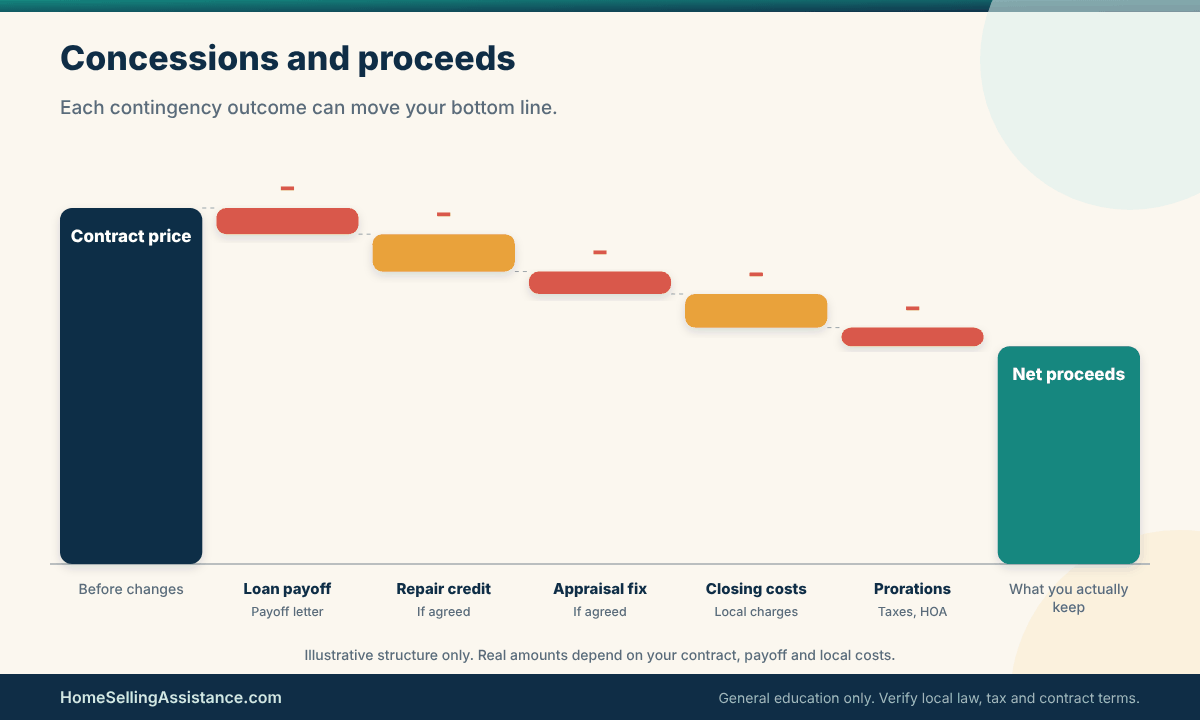
The waterfall shows the structure: a contract price at the top, then deductions for the payoff, credits, concessions, closing costs and prorations, ending in net proceeds. Run Offer A through it. Start at $400,000, subtract $210,000 for the payoff, $3,000 for the repair credit, $5,000 for the appraisal concession, $20,000 for closing charges and $1,000 for prorations. The result is $161,000. Now run Offer B: $392,000 minus $210,000, minus $20,000, minus $1,000 equals $161,000 as well.
Same net, different journeys. Offer A carries an inspection negotiation and an appraisal problem that might not resolve at all. Offer B carries less of both. If the closing in Offer A slips two weeks and you pay an illustrative $1,800 in carrying costs, Offer B comes out ahead. If Offer A closes cleanly and without concessions, it would have netted more. That uncertainty is the whole point: the better offer depends on the odds, and the odds depend on the terms and people involved.
A few notes on reading your own figures. Ask for a seller’s net sheet from your agent or closing agent, and ask them to run it at several prices and with and without credits. Request an actual payoff statement, because balances include interest and sometimes fees. Check your tax bill and any association dues for proration dates. Our article on home sale net proceeds goes line by line through a full worksheet.
One more way contingencies move proceeds: repairs you choose to make yourself. If an inspection finds a failing component and you fix it before closing, the cost is yours, but you may avoid a larger credit. Whether to repair or credit depends on cost, speed, the buyer’s lender requirements and how the contract treats work done. Compare two written quotes and avoid doing work informally without receipts, because the buyer’s agent or lender may ask for proof.
Be careful about carrying costs, which home sale contingencies sellers tend to underestimate. A mortgage payment, insurance, utilities and taxes continue until closing. Some sellers also face a second housing payment on their next place. A one-week delay might cost little. A one-month delay on a tight budget costs real money, and a lost buyer costs more. That is why a realistic home sale contingencies seller approach prices time as well as dollars.
Finally, do not assume credits are the only tool. Depending on your contract and the buyer’s loan, you could offer a price reduction, a repair completed by a licensed contractor with a receipt, a home warranty, or a combination. Each has different consequences for the lender, for taxes and for future disclosure. A lender may limit how large a credit can be or how it can be applied, so involve the buyer’s lender early when credits are on the table.
Keep in mind that home sale contingencies seller education is not the same as legal representation. An article can describe patterns; it cannot read your contract. For anything involving a deposit dispute, a termination notice or a title defect, a home sale contingencies seller should speak with a licensed attorney in the state where the property sits.
Legal, tax, and logistics wrinkles that rarely show up in the listing
Start with disclosure. Most states require sellers to disclose known material defects in some form, and the specific form, the threshold and the consequences of an omission differ. Inspection findings do not erase your own obligations. If you already know about a leak or a past flood, an inspection that misses it does not release you from disclosing it. We explain the principles in our guide to seller disclosure requirements, and the topic has its own disclosures and seller paperwork section.
Next, think about what you say after an inspection. If the buyer’s inspector finds something and the buyer asks for a repair, the repair reply is a negotiation document, and in some states it can also change what you must disclose to the next buyer if this deal collapses. Keep the report, the request and your response together. If a deal falls through, you may be required to disclose what you learned, and a clean paper trail helps you do so accurately.
Now consider timing and contract language. Many forms state that time is of the essence, which means missed deadlines can have consequences. Some forms treat silence as acceptance, others as termination, and others as an extension. A home sale contingencies seller who misses a response window can lose the chance to counter or can trigger a buyer right to cancel. Read the sentence about what happens at the deadline, and put your deadlines in your phone with a reminder two days ahead.
Agents and attorneys matter here, though neither is mandatory in every case. A listing agent typically handles the calendar and communications. An attorney can interpret an addendum, advise on a termination notice or review an unusual clause. In states where attorneys are customary, they often review the contract before binding acceptance. Whichever professionals you use, ask who is responsible for tracking each deadline and how you will be told when something is due.
On tax, keep records of what you actually paid and received. The IRS explains how basis and amount realized work in its selling-your-home guidance, and the details for your situation belong with a tax professional. Repair credits, price reductions and closing charges affect the numbers, so retain the final settlement statement, receipts for improvements and any invoices for repairs tied to the sale for as long as your tax advisor recommends.
For logistics, the most overlooked item is access. Appraisers, inspectors, surveyors, termite inspectors, contractors and the buyer’s final walk-through all need entry. Offer reasonable windows and keep the house showable. If you have pets, tenants or an occupied home with children or shift workers, say so in advance and propose realistic slots. A missed appointment can push an entire inspection or appraisal timeline back by days, and no contingency clause forgives a closed door.
Prorations deserve one more sentence. Property taxes, association dues and sometimes utilities are split between you and the buyer as of the closing date, and the numbers on a settlement statement can differ from your expectations if a bill is paid in arrears or in advance. A home sale contingencies seller who has the latest tax bill and dues statement on hand can check those lines quickly and ask questions before the closing appointment.
Scenario: the repair credit that the lender would not allow.
Picture a home sale contingencies seller who agrees to a $6,000 credit toward closing costs after inspection. The buyer’s lender then explains that the loan program caps how much of the purchase price can be returned to the buyer in credits, and the combined credit exceeds that cap. The deal does not necessarily die, but the structure must change: a smaller credit, a price reduction, a repair completed before closing or a different split. All of this happens against the clock.
The takeaway is simple. Before you sign a credit amendment, ask the buyer’s agent whether the lender has approved the structure in writing. This takes one email and can spare everyone a last-week scramble. If a credit might be disallowed, a price reduction may be cleaner, though it affects the appraisal math. If you are unsure which is better, ask your agent to compare the two outcomes for your net and for your timeline.
The exception is that some lenders and some programs treat credits differently, so you cannot generalize. A seller in one transaction may have no trouble with a credit another seller cannot use. This is why a home sale contingencies seller who stays in contact with the buyer’s lender through the agents tends to fare better than one who guesses. The conversation costs nothing, and the answer is specific to the actual loan.
Your next step: when any credit is on the table, request the buyer’s lender’s written confirmation that the credit is permitted, how it will appear on the closing statement and who needs to sign the amendment. Then read the amendment aloud, slowly, before signing. The extra five minutes catch the errors that otherwise surface at the closing table, when time and goodwill are shortest.
A verification roadmap for home sale contingencies seller paperwork
An overview is only useful if it turns into action. The final section of this guide converts everything above into a roadmap you can work through: which documents to assemble, which professionals to involve, which decisions to make before you list, and which can safely wait until an offer arrives. The common thread is verification. Each claim a buyer, an agent or an article makes should be traced to a document, a deadline or a person who can confirm it.
Verification sounds heavy, but in practice it is a habit of small questions. Where is that written? Who is responsible for it? By what date? What happens if it does not occur? When a home sale contingencies seller asks those four questions about every clause, most misunderstandings surface while they are still cheap to fix, which is long before a closing table or a termination notice. Verification is the quiet engine of every home sale contingencies seller success story.
There is also a protective reason to document carefully. Real estate transactions attract fraud, including impersonation of title companies, fake wire instructions and pressure to act immediately. The FBI’s Internet Crime Complaint Center and the Federal Trade Commission’s consumer site both describe these schemes. Our article on real estate wire fraud for sellers explains how to protect yourself, and every contingency deadline is a moment when scammers hope you will be rushed.
Three habits define a well-prepared home sale contingencies seller: keeping a single file, writing down every agreement and asking for dates in plain language. None needs special skill. Each can save a week or a deposit dispute, which is why we repeat them throughout this home sale contingencies seller guide.
Documents and professionals to involve, and when each one earns its place
Different contingencies call on different professionals. For inspection, the buyer hires an inspector, but you may consult a contractor to price a repair. For appraisal, the lender engages an appraiser, and your agent supplies comparable sales and a list of improvements. For financing, loan officers and underwriters work with the buyer, while you and your agent watch deadlines. For title, a title company or closing attorney does the research, and you provide payoff and ownership documents.
Your own team may include a listing agent, a real estate attorney, a tax professional and a closing agent. You do not need every one of them for every sale. A straightforward sale with a clean title and a conventional buyer may need little beyond an agent and a title company. A sale involving a trust, an estate, a divorce, an unpermitted addition or a tax question may justify an attorney or accountant early. Use the complexity of your situation as the guide, not a fixed rule.
The table below lays out the transaction as a sequence of stages. Read it left to right for a given stage: what you are responsible for, what the buyer or a professional must do, the typical deadline pattern and a fallback when something slips. Deadlines are described in general terms because your contract sets the real ones. The table is a map for your questions, not a substitute for the contract in front of you.
| Stage | Seller responsibility | Buyer or professional dependency | Deadline pattern | Fallback if it slips |
|---|---|---|---|---|
| Offer accepted | Confirm terms, deposit and contingency list in writing | Buyer delivers deposit; agents circulate the contract | Deposit due soon after acceptance | Ask agent or attorney what the contract allows |
| Inspection window | Provide access; respond to any repair request in writing | Inspector reports; buyer decides | Short window set in the contract | Negotiate credit, repair, or price change by amendment |
| Appraisal | Allow access; supply improvement list and comparables | Lender orders appraiser and reviews value | Set by lender process and contract | Renegotiate price, request reconsideration, or buyer adds cash |
| Loan approval | Watch dates; respond to lender-related requests quickly | Underwriter reviews buyer documents | Financing deadline in the contract | Agree to a written extension or prepare for termination |
| Title review | Provide payoff and ownership documents; clear liens | Title company searches records and issues a commitment | Review and cure period before closing | Start the cure early; ask the title agent about options |
| Final walk-through and closing | Complete agreed repairs; remove belongings; sign documents | Closing agent prepares statement; lender funds | Closing date in the contract | Written extension, or follow contract default terms |
When you use the table, look first at the right-hand column. Every stage has a fallback, and the fallbacks cluster around the same few tools: a written amendment, an extension, a renegotiated price or a termination under the contract. Knowing that list in advance removes much of the panic from a snag. A snag becomes a question of which tool fits, which your agent or attorney can help you choose.
Notice also how often the word written appears. Whether it is a repair reply, an extension or a waiver, oral understandings tend to fade or conflict. Email can be a record, but a signed addendum is better when a contract term changes. Ask who drafts the amendment, who must sign and how you will receive the final version, so nothing remains a casual understanding.
Evidence to gather: the contingency file you build before the first showing
Create one folder, physical or digital, and treat it as the file for the sale. Begin with the ownership documents: the recorded deed, any trust or estate papers if relevant, and the title insurance policy from when you bought, if you still have it. Add the survey or plat, the property tax bill, association information with dues and any special assessments, and the mortgage statement. These papers answer most title and financing questions before they are asked.
Add the condition papers: permits and final inspection records, receipts for major repairs and replacements, warranties, prior inspection reports, pest reports where relevant, and records for well, septic, oil tank or other systems. Add notes on anything you disclosed or intend to disclose. A record showing you replaced the roof, with the date and the contractor’s name, is more persuasive than a spoken claim and costs nothing to produce.
Finally, add a calendar page that you update after every accepted offer. Record the effective date, every contingency deadline, the closing date and the names and phone numbers of the agents, lender contact and title officer. Keep a log of conversations with date and summary. When a question arises about who said what, the log answers it, and a home sale contingencies seller who keeps one tends to resolve disagreements in minutes rather than weeks.
Be cautious about originals. Make copies of anything you send, and share documents through channels you trust. Never send ownership documents or bank information to an address you have not verified by calling a number you already know. If you are asked to change wiring or payment instructions at any point, stop and call your closing agent using a number from your original paperwork before doing anything.
A final note on professionals. Ask each one three questions at the start: what will you do for me, what will you need from me and when, and how will you tell me if something is going wrong? The answers are more informative than the credentials. A professional who answers clearly and in writing is easier to rely on than one who is vague, regardless of reputation.
Documentation is also how you show good faith. If a buyer later alleges that a repair was never made or a disclosure was incomplete, dated receipts, signed addenda and saved messages are the evidence. A home sale contingencies seller with a tidy file tends to settle those questions quickly and calmly.
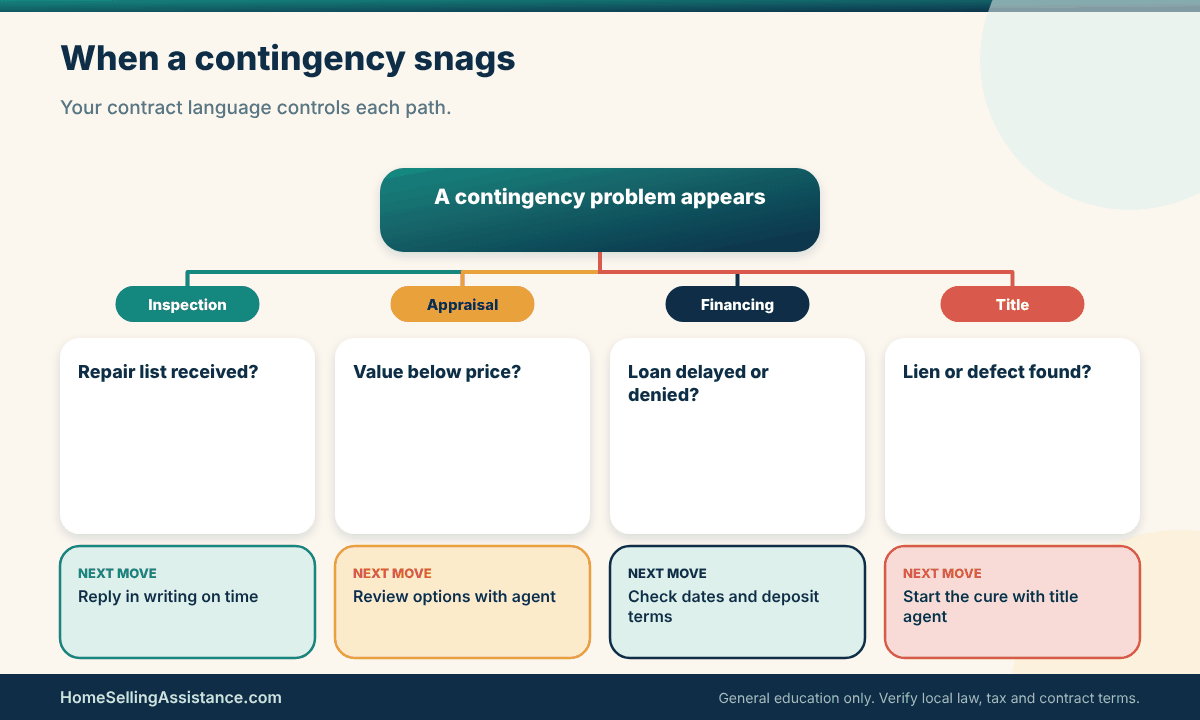
The diagram above is a map of the four most common contingency snags: an inspection request, a low appraisal, a financing delay and a title defect. Each branch starts with a question and ends with a next move. We deliberately keep the next moves modest, such as reply in writing or ask the title agent, because the right answer for you depends on your contract and your state. The diagram is meant to be a prompt for the right conversation.
Hire help on purpose. A real estate attorney, a closing agent or a tax professional each answers a different question, and none replaces the others. Ask for fee structures in writing before you begin. A home sale contingencies seller who understands what each professional is for tends to use them sparingly and at the right moment, which is usually cheaper than calling for help after a dispute has already hardened.
Scenario: when the contract and the summary disagree
Imagine a home sale contingencies seller who is told, informally, that the buyer has twelve days for inspection. The contract says ten, with the clock starting on a different date than the seller assumed. The seller relaxes on day eleven and misses a buyer’s repair request that arrived on day nine, with a response deadline already passed. Nothing malicious happened. Two people simply worked from different summaries of the same document.
The fix is to calculate dates from the contract itself and to confirm them in a short message to everyone involved: “Our inspection period ends on this date and the response is due by that date. Please confirm.” This feels fussy, and it prevents precisely this kind of drift. If a mistake has already happened, tell your agent or attorney immediately, because some contracts allow cure or extension if all parties agree.
Consider the exception. Occasionally the contract itself is ambiguous, with blanks left empty or conflicting dates in different places. In that case, a quick written clarification signed by both sides is worth more than an argument later. Ask your agent or attorney to draft a short addendum that fixes the dates. Parties who want the deal to close almost always agree to clarify, and a signed clarification is far safer than a shared memory.
Your next step: open the contract today, even if you have not yet received an offer, and read a sample or a blank copy of your local form. Knowing where the dates, deposit terms and waiver language sit means you will recognize them quickly when pressure is on. If you are working with an agent, ask for a walk-through of the form. A good agent is happy to explain it, and that walk-through is often the best education you can get.
What to decide before listing, and what can safely wait until an offer arrives
Preparation has a sweet spot. Decide too little before listing and you will improvise under pressure, which is when sellers accept terms they later regret. Decide too much and you will lock yourself into positions that do not fit the first real offer. A useful home sale contingencies seller plan separates standing positions, which you can settle in advance, from case-by-case choices that depend on who makes the offer and what it says.
Standing positions are rules of thumb you set for yourself. They include your minimum acceptable net, your latest acceptable closing date, whether you will accept a sale-of-home contingency, how much time you will give for inspection and financing, and whether you would rather repair or credit. Setting these in advance, calmly, protects you from the excitement of a first offer. They are your own guardrails, not rules the market imposes.
Case-by-case choices wait. Which counteroffer to send, how much to concede on a repair request, whether to extend a financing deadline and whether to agree to a kick-out clause all depend on the specific buyer, the specific numbers and the specific day. Trying to settle them before you know the facts only creates false confidence. What you can do is prepare the questions you will ask when the time comes.
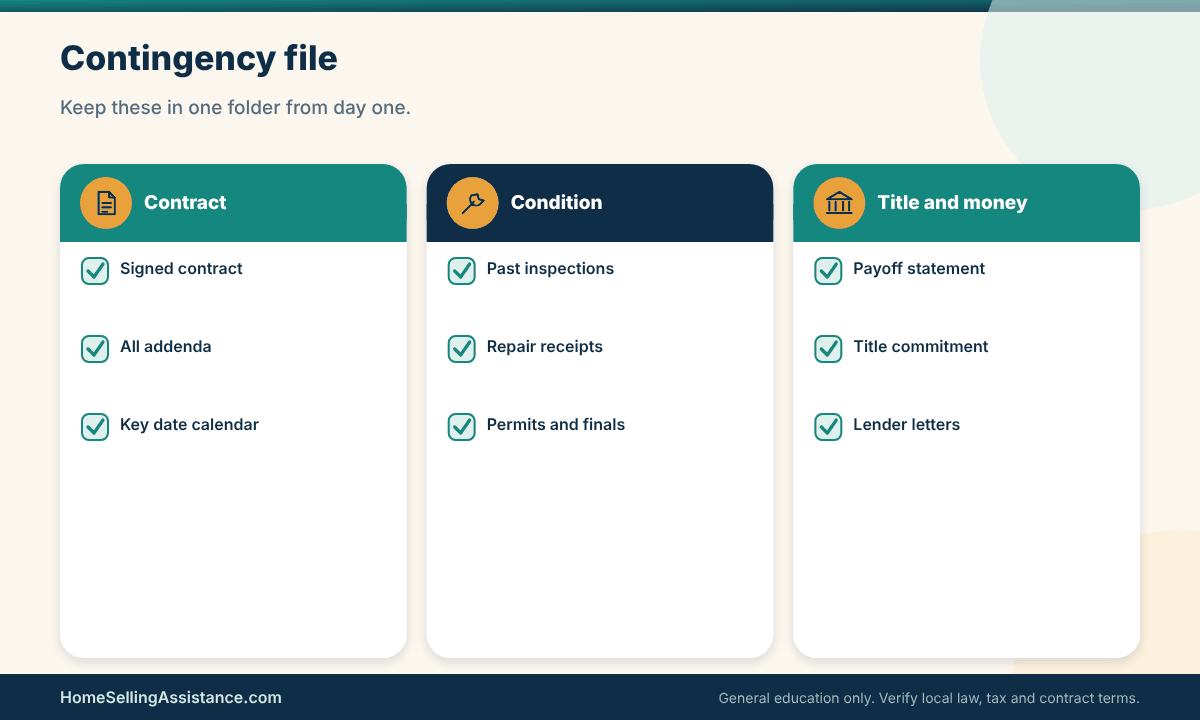
The checklist above groups the papers that make those decisions easier: the contract and its dates, the condition records and the title and money documents. Think of it as the toolbox you open when an offer lands. Having it ready does not commit you to anything, yet it lets you answer questions the same day, which sometimes matters when a buyer is choosing between several homes. Preparation is quiet leverage.
One more habit before you list: read the whole contract form, not just the blanks. Boilerplate paragraphs often carry the real rules on deposits, default remedies, mediation, attorney fees and possession. A home sale contingencies seller who has read those paragraphs once, calmly, understands the stakes far better than one reading them for the first time under a deadline.
Decide before listing: your standing positions on every contingency
On inspection, decide how you will respond to a repair request in general terms. Some sellers prefer to fix safety and system issues and decline cosmetic ones. Others prefer a flat credit to avoid contractor coordination. Others hold firm on price and offer nothing. Each approach has costs, and you do not have to choose one rigidly, but knowing your leaning helps. Our guide to the inspection repair request works through the choices, and the article on selling as is explains what that phrase can and cannot do.
Consider a pre-listing inspection carefully. It can reveal problems early, give you time to price repairs and reassure buyers. It can also produce a report you may need to disclose, and it can create a to-do list you might not otherwise face. Whether it is worth it depends on the age and condition of the house, the local market and how comfortable you are with the findings. There is no universal answer, and an agent can describe local habits.
On appraisal, decide how you would respond to a low value. Options generally include asking the lender for a reconsideration with better comparable sales, negotiating a price reduction, asking the buyer to cover the difference with cash, splitting the difference or ending the contract if your contract allows. Think about your floor in advance. Our articles on appraisal reconsideration of value and on the appraisal gap describe each path.
On financing, decide how much interim proof you want, such as a lender update after the application and another after underwriting begins, and how long you are willing to extend a deadline, if at all. Some sellers require a prompt written update; others are relaxed if the buyer has a strong history. Decide whether you would accept a buyer who is still shopping for a loan. Our article on the financing contingency explains what sellers should watch.
On sale-of-home contingencies, decide in advance whether you would ever accept one, and on what terms. If you would, think through the protections you want: a deadline for the buyer’s own listing, proof that their home is priced realistically, a kick-out clause with a short response window and a requirement to keep their home on the market. If you would never accept one, tell your agent so offers that include one can be screened quickly.
On title, take care of what you can control. Order a title search or ask your title company to run a preliminary report. Look for unpaid liens, old mortgages that were paid but never released, judgments, unrecorded deeds, boundary questions or a deceased owner still on title. Fixing these takes time and sometimes court or lender involvement, so earlier is better. The CFPB offers plain-language background on closing and title matters.
Decide how you will handle communication. Choose one person, you, your agent or your attorney, to receive notices and one place where the latest version of every document lives. Agree how fast you will answer messages during contract periods. Decide also how you will verify any change to payment or wiring instructions, and write that rule down. Clear communication rules cost nothing and prevent a surprising share of disputes.
Finally, decide what you will say about your motivation. Home sale contingencies sellers sometimes reveal a tight deadline or a desperate need in casual conversation. That information can reduce your leverage. You do not need to lie, and honesty obligations apply, but you can simply decline to volunteer your constraints. A good home sale contingencies seller keeps the focus on the written terms, which is where the negotiating belongs.
Market data changes quickly, so check local figures again before you set standing positions. The National Association of Realtors publishes existing-home market information, and local boards report neighborhood trends. Use those sources to test any claim about what a home sale contingencies seller can expect to negotiate in your area, then confirm with a local agent.
Post-closing matters belong on your list too. Keep the settlement statement, repair receipts, the final contract and any addenda in a safe place, and note the date you move out. Your tax professional may want them, and a future dispute may require them. A home sale contingencies seller who files these papers on closing week rarely has to reconstruct anything years later.
What can wait until an offer: the negotiable items and the questions to ask
Several choices should wait until you see a real offer. The size of a counter, the length of an extension, whether to accept a credit instead of a repair, how to answer an unusual request, and whether a particular buyer’s financing seems solid enough all depend on the facts. Postponing them is not procrastination. It is the recognition that a decision made with information is better than one made without it.
When an offer arrives, ask a standard set of questions. What is the loan type and how far along is approval? Is the deposit delivered, and where is it held? What does each contingency allow, and for how many days? Does the buyer need to sell another home? What happens if the appraisal comes in low? Are there any requests for credits or personal property? Does the closing date fit my calendar? Write the answers on your tracker.
Use your agent or attorney to translate anything unclear. Phrases like “subject to buyer’s satisfaction” or “contingent upon review of documents” can be vague, and vague clauses cause trouble. Ask for specifics, such as a number of days and a clear condition, and have them written in. If the buyer resists specifics, that tells you something about how the rest of the transaction may go, though it does not necessarily mean bad faith.
Negotiate with the whole offer in view. A buyer asking for a longer inspection window might accept a larger deposit. A buyer asking for a repair credit might accept a later possession date. A buyer with a sale-of-home contingency might agree to a kick-out clause. Our articles on offers and negotiation describe the give-and-take, and each concession should be tied to something you receive in return, not merely traded away.
Keep notes on what you decided and why. If a disagreement arises later, a short entry such as “agreed to a credit in exchange for a shorter inspection” shows your reasoning. It also teaches you for next time. Over a long ownership, many sellers sell only a handful of times, so these notes are a rare chance to learn from your own experience, and they can help a family member who sells after you.
Scenario: a buyer who asks for everything, and the plan that keeps you steady.
Imagine an offer that arrives with an inspection window longer than you would like, a request for a repair credit pre-agreed in the offer, an appraisal contingency, a financing contingency and a sale-of-home condition. The price is attractive, the buyer is friendly and your agent says the market is slow. It is tempting to accept everything and hope. A steadier approach is to respond with a written counter that addresses each item.
For example, you might shorten the inspection window, remove the pre-agreed credit and offer to address specific findings after inspection, keep the appraisal and financing contingencies with firm dates, and agree to the sale-of-home contingency only with a kick-out clause and proof that the buyer’s home is listed at a realistic price. Each change is modest and each is tied to a reason. The buyer may accept some and reject others, which is how negotiation works.
The exception to prepare for is a buyer who refuses all changes. In that case, compare what you would be accepting against your standing positions. If the offer fits your calendar and your floor, you may accept. If not, you may decline and keep marketing, accepting the risk that a better offer does not arrive. Neither choice is wrong, but each should be made deliberately, with your calendar and cushion in hand, not out of fatigue.
Your next step is to run a short rehearsal. Ask your agent to simulate an offer with several contingencies and walk you through how you would respond to each. If you are selling on your own, ask a trusted friend or an attorney to play that role. Rehearsal feels slightly silly and works well. By the time a real offer arrives, the vocabulary will be familiar and your decisions will come more naturally.
A last thought. Contingencies are not villains. They exist because buying a house is a large and partly unknowable commitment, and buyers need ways to protect themselves while information arrives. A home sale contingencies seller who understands that, and who prepares in the ways described here, tends to negotiate from steadiness instead of fear. That steadiness is the real benefit of knowing home sale contingencies seller terms before you need them, and it is available to every seller willing to do the preparation.
A final reminder before the questions. Education is a starting point, and the contract in front of you is the authority. If anything here conflicts with your signed paper or your state rules, trust the paper and the rules, and ask a licensed professional to explain the difference. That discipline is what separates a prepared home sale contingencies seller from one who relies on generalities.
Frequently asked questions about home sale contingencies seller decisions
What are the most common home sale contingencies sellers will see?
Most residential contracts include some mix of inspection, appraisal, financing, sale-of-home and title contingencies. Some states and forms add attorney review, association document review, survey approval or insurance availability. Every clause sets a condition and a deadline, and each gives a party a way to renegotiate or exit if the condition fails. Your signed contract controls, so read the exact wording and ask your agent or attorney to explain any term you do not understand. That habit is the core of home sale contingencies seller preparation.
Can a seller refuse to accept an offer that has contingencies?
Generally, a home sale contingencies seller may accept, reject or counter any offer, as long as the decision does not violate fair housing law, which prohibits treating buyers differently based on protected characteristics. Many sellers counter by shortening deadlines or adding protections instead of refusing outright. Whether a particular term is wise depends on your calendar, your cushion and the market.
Compare offers on written terms such as price, financing, deposit and contingency list, and ask for a professional opinion on any unusual clause. A thoughtful home sale contingencies seller counters with specifics instead of refusing by reflex.
What happens if the buyer’s inspection finds problems?
The buyer usually has a defined window to accept the findings, request repairs or credits, ask for a price change or terminate, depending on the contract. You can generally agree, counter or decline. Respond in writing within the deadline, because silence can have consequences under some forms. If the deal ends, you may need to disclose what you learned to the next buyer, so keep the report and the request. Documentation is a quiet strength for any home sale contingencies seller. Our guide to inspection repair requests goes deeper.
What if the home appraises for less than the contract price?
The lender usually lends against the lower of price or appraised value, so a low appraisal can leave the buyer short. Typical paths include asking for a reconsideration with better comparable sales, renegotiating the price, having the buyer bring extra cash, splitting the difference or ending the contract if the contingency allows. Nothing is automatic, and results are never guaranteed. Read the appraisal clause and talk through options with your agent before replying.
Few home sale contingencies seller situations feel as tense as a low appraisal, which is why a calm plan helps.
How is a financing contingency different from a pre-approval?
A pre-approval is an early lender opinion based on the buyer’s documents, and it can change as underwriting continues. A financing contingency is the contract clause that lets the buyer exit or renegotiate if the loan is not approved by the deadline. Strong pre-approval lowers the risk without removing it. Ask for lender updates at defined points and check the contract for what happens if the deadline passes without approval. Good home sale contingencies seller practice treats lender updates as scheduled checkpoints.
What is a sale-of-home contingency and should a seller accept one?
It makes your sale depend on the buyer selling their current home first. That adds uncertainty because you cannot control their sale. Home sale contingencies sellers who accept one often negotiate a kick-out clause, a deadline for the buyer to list at a realistic price and a short window to remove the condition if another offer arrives. Whether to accept depends on your timeline and the strength of the alternatives, and many sellers decline it. In home sale contingencies seller terms, this one clause carries unusually high uncertainty.
Who is responsible for clearing title problems?
Home sale contingencies sellers are generally expected to deliver ownership that can be insured, so liens, unreleased mortgages and judgments are commonly the seller’s to resolve, though contract terms and local custom vary. A title company searches the records and issues a commitment that lists what it found. Order or review a preliminary report early, because curing a defect can take weeks. Ask your title officer or attorney what applies in your state. A home sale contingencies seller who starts early usually has more options.
Do deadlines really matter if everyone is cooperating?
Yes. Even in friendly deals, a missed deadline can shift rights, trigger a termination window or lead to arguments about who agreed to what. Many forms say time is of the essence. Put each date in your calendar with reminders, confirm dates in writing at the start and sign any extension as an amendment. Cooperation is wonderful, but the paper is what protects both sides if memories differ. Every home sale contingencies seller benefits from that discipline.
Does selling as is remove the buyer’s inspection contingency?
Not by itself. An as-is sale usually means you are not agreeing to make repairs, yet the buyer may still inspect and may still have a right to terminate under the contract. As-is wording also does not erase your disclosure duties, which vary by state. If you plan to sell as is, ask your agent or attorney how your contract treats inspection, termination and disclosure so expectations are clear from the start. Clarity of this kind is basic home sale contingencies seller protection.
What should a seller do if a buyer asks to cancel and wants the deposit back?
Do not guess. Read the contract provisions on termination, deposits and notices, and confirm who holds the deposit. Many states require written instructions or a signed release before an escrow holder pays out. Whether the buyer terminated properly and on time is usually the key question. Ask your agent or attorney to review the paper trail before you agree to anything. Our article on a contract that fell through after inspection covers the next steps.
Carry the contract, not the jargon
The point of learning home sale contingencies seller vocabulary is not to collect terms. It is to read an offer with calm eyes, know which gate each clause represents, and keep your own goals, calendar and cushion in front of you. Build the contingency file, write your standing positions, put every deadline in your phone and confirm every change in writing. This guide is general education, not legal, tax or financial advice, and rules differ by state, so check specifics with your agent, attorney, title company and tax professional before you act.