Selling house moving out of state is the same sale you would run down the street, with one difference that changes almost everything: you will not be standing in the kitchen when the questions arrive. Every decision about taxes, the closing table, the movers, the cars and the paperwork has to be made earlier, in writing, and often from a different time zone.
Most people picture selling house moving out of state as two separate projects, a sale and a move. One is a listing, an inspection and a closing. The other is boxes, a truck and a new address. In practice they share a single calendar, and a slip in one pushes the other. A closing that moves by four days can leave a truck waiting, a lease starting early, or a child’s first day of school in a house that no longer belongs to you.
This guide treats selling house moving out of state as one connected workflow. We start with the file you assemble before you list, then walk the transaction in order, then cover what to confirm and keep once the keys change hands. It builds on our broader guide to selling a house for relocation, so we skip the basics of pricing and offers and stay with what is different when the next home sits in another state.
A word about posture. We have no stake in whether you hire a listing agent, sell on your own, or accept a cash offer, and the steps below work for any of them. Rules on taxes, disclosure, closing customs and vehicles differ from state to state, so wherever the answer depends on your location we say so and tell you who can confirm it.
Key takeaways
- Build one calendar for the sale and the move. Closing, possession, truck pickup, delivery and the start of your new housing should sit on the same page, with the dates that can slip marked clearly.
- Ask about taxes in both states early. Federal home-sale rules are one layer; your old and new states may add their own income, withholding or residency rules that vary widely.
- Plan the closing for someone who is not in the room. Mobile notaries, mail-away signings, powers of attorney and electronic closings all exist in some places and not in others.
- Treat movers and wire instructions as fraud targets. Verify companies yourself and confirm every set of payment instructions by a phone number you looked up independently.
- Keep the paper trail. Closing documents, improvement receipts, address-change confirmations and vehicle records will matter for months, sometimes years.
Prepare the file for selling house moving out of state
The sellers who have the calmest move are rarely the ones with the best house. They are the ones who spent a weekend collecting facts before the sign went up. Distance punishes improvisation, because every missing document turns into a phone call, a courier or a delay.
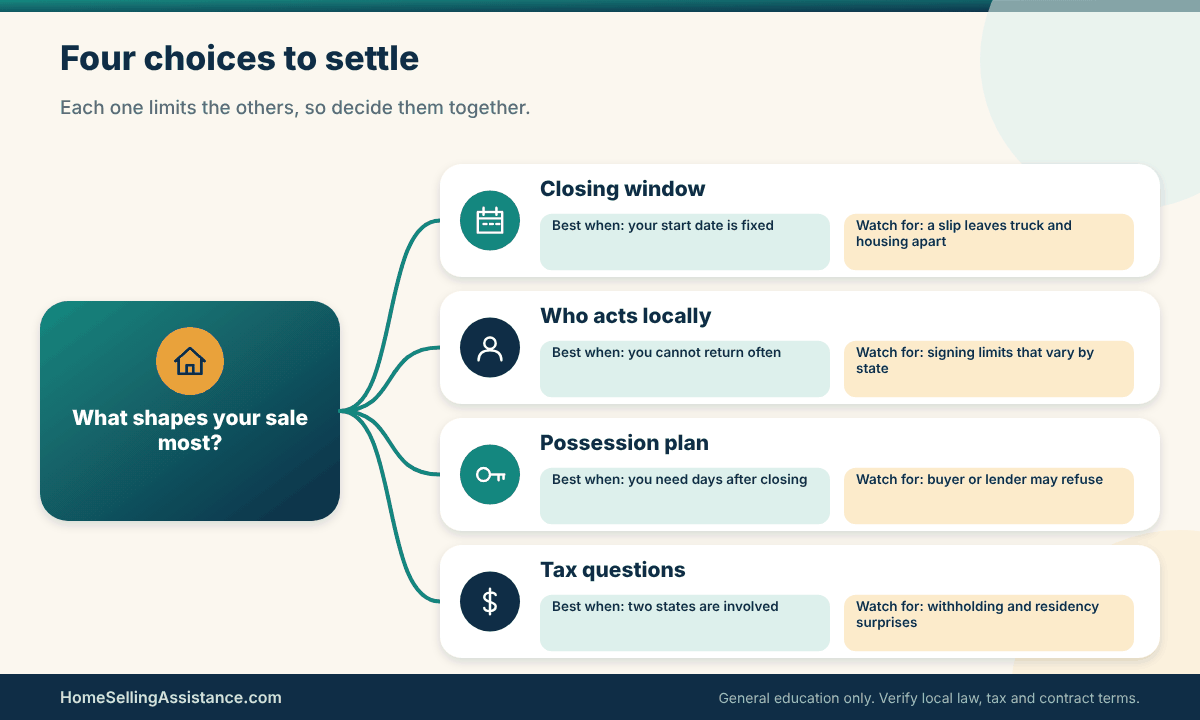
The diagram below shows the main choices that shape a long-distance sale, so you can see where your own decisions sit before we go into the detail.
Think of this first section as building a binder, physical or digital, that a stranger could use to run the sale on your behalf if you were suddenly unreachable for a week. That is closer to the truth than it sounds, since you may be driving, flying or sitting in a hotel on closing day.
It helps to be honest about why distance changes the work. When you live nearby, a small problem costs you an afternoon. When you are selling house moving out of state, the same problem costs you a flight, a courier fee or a week of silence. Good preparation is cheap insurance against all three, and it is the one part of selling house moving out of state that sits entirely in your control.
If you are weighing whether the move itself is the right moment to sell, our related guides on selling for a job transfer and on employer relocation assistance cover the decision, while this article stays with execution. Check whether an employer program changes your timeline or paperwork before you sign a listing agreement.
The documents, numbers, contacts and deadlines you need from a distance
Four kinds of information belong in the file: ownership papers, money figures, people to call, and dates that cannot move. Sellers who stay local can sometimes leave these loose, but selling house moving out of state does not forgive loose ends. Sellers who are leaving the state cannot, because they will not be able to walk into the county office or knock on a neighbor’s door to fill a gap.
Evidence to gather: payoff, tax, title and contact records
Begin with the deed or whatever shows exactly how title is held, including every name and the spelling of each. Add your most recent mortgage statement, the servicer’s payoff request process, any home equity line, and the latest property tax bill. If a homeowners association exists, collect its contact details and ask how long it takes to produce a resale or payoff package, since that timeline varies by community.
Next, list the money questions you will need answered by someone with authority before selling house moving out of state. What will the payoff be on the closing date? Which property tax and utility items will be prorated, and under which local custom? Which charges, if any, does your state place on a seller at closing? The county recorder, your title or escrow company and the contract itself are the sources, not a national rule of thumb.
Finally, write down the people. You want the listing agent or your own contact if you are selling alone, the title or escrow officer, the closing attorney where one is used, the lender’s payoff department, the HOA manager, and the mover. Put a direct phone number and an email beside each name, plus the hours that person is reachable in your new time zone.
Showings are the other practical gap. Ask how the house will be shown while you are away: by appointment with a lockbox, by an agent present at each visit, or by video tours first. Each approach has trade-offs for security, convenience and buyer access. Whichever you choose, treat showing access and buyer selection fairly and consistently, and follow fair housing rules, which the US Department of Housing and Urban Development explains.
A vacant house also changes your insurance picture. Many homeowners policies limit coverage when a property sits empty for an extended period, and the definition of vacant varies by insurer. Call your insurer, describe the plan, and ask in writing what coverage applies between move-out and closing. Also decide who will keep the lawn cut, the heat on and the mail picked up, because a neglected house can undermine both showings and the inspection.
A scenario: the seller who lists from two time zones away
Picture a seller who has accepted a job three states away and starts in six weeks. The house is vacant, the keys are with a neighbor, and the seller can fly back for only one weekend. This is an illustration, not a prediction, but it shows how a file for selling house moving out of state earns its keep.
With a complete binder, the seller can authorize a local contact to meet the photographer, approve repair quotes by email, and sign addenda electronically where the contract and local practice allow it. Without the binder, each of those steps turns into a question that waits for the seller’s next free evening, and the six weeks start to feel short.
The next step is to decide, before listing, who in the local market is allowed to act for you and what they may sign. Any signing authority should be written down, kept narrow, and checked with your title company or attorney before you rely on it, because rules for who may sign for a seller differ by state.
The first table below pulls these threads into a selling house moving out of state workflow you can reuse. Read across each row to see what to gather, what to do with it, when a decision falls due and who receives the work next. Then adapt the dates to your own contract, since the deadlines in your signed agreement always control.
| Stage or symptom | Information to gather | Action | Decision deadline | Next handoff |
|---|---|---|---|---|
| New job or lease date is fixed | Start date, housing start date, flexibility | Set a target closing window | Before choosing a list date | Agent or your own planner |
| Preparing to list | Deed, mortgage statement, tax bill, HOA contacts | Build the seller file | Before photos are booked | Listing professional or title company |
| Choosing who acts locally | Names, phone numbers, signing limits | Write down authority in plain terms | Before you leave the state | Title company or attorney |
| Offer accepted | Closing date, possession terms, contingencies | Match the move date to the contract | Within the days your contract allows | Mover and new landlord or lender |
| Contract period | Inspection, appraisal and loan deadlines | Track each date and confirm changes in writing | Each deadline in the contract | Buyer’s side and title company |
| Final week | Payoff figure, closing statement, wire details | Verify instructions by phone | Day before signing | Closing officer and your bank |
| After closing | Recorded deed, receipts, address confirmations | File records and update accounts | First weeks in the new state | Tax preparer and agencies |
A single glance at that table will tell you where your own file is thin. If the second column has gaps, the rest of the row stalls. Fix those cells first, and the later rows tend to go quietly.
Many sellers also ask whether they should handle the sale from the new location or return for the final stretch. There is no universal answer. Some prefer to stay near the house through closing, while others leave early and rely on a local professional. What matters is that your plan for selling house moving out of state matches your budget, your family’s needs and the availability of people you trust. If you want the wider relocation picture, see our relocation and downsizing library.
The questions an out-of-state move leaves open
Even a well-organized seller carries a short list of unknowns. Some are about money, some about law, and some about the new place. Naming them early is half the work, because an open question with a date attached is manageable, and an open question you forgot is how people end up paying twice for something.
Evidence to gather on state taxes, withholding and residency
Federal tax rules for selling a main home are set nationally, and the IRS explains them in Publication 523. The general exclusion allows up to $250,000 of gain for a single filer or $500,000 for qualifying joint filers, provided the ownership and use tests are met, which generally means you owned and lived in the home as your main home for at least two of the five years before the sale. Exceptions and partial rules exist, so read the publication or ask a professional.
The state layer is where selling house moving out of state adds questions. States differ on whether they tax capital gains as ordinary income, how they treat a seller who changes residency during the year, and whether a closing agent must withhold money from certain nonresident or departing sellers. Do not guess. Ask your title or escrow officer what withholding, if any, applies to your sale, and ask a tax professional how a part-year return works for your two states.
You should also find out which date counts as your move for tax residency in each state. Some people assume it is the day they sign the sale papers, others the day they cross the border. The answer can depend on where your home, job, driver’s license and family are. This is one question where a short appointment with a qualified preparer is cheaper than a wrong assumption.
Housing in the new state is the other major unknown. Some sellers rent for a few months while they learn the area, others buy before they sell, and others sell first and take the proceeds into the next purchase. Each path affects your timeline for selling house moving out of state, because a purchase may depend on your sale funds, and a lease may begin before your closing. Choose with a clear head about cash flow, not with optimism about dates.
If you plan to use proceeds from the sale for the next home, ask your lender and title company how soon funds will be available, and whether your new contract should include a timing cushion. A short gap between sale and purchase can be handled with temporary housing, but it should be budgeted rather than assumed. We cover that tension in our guide to downsizing and selling, where the same questions come up on a smaller scale.
A scenario and a next step when the new state’s rules are unclear
Suppose a seller sells in a state with an income tax and relocates to a state without one, or the reverse. The seller reads three blog posts, each confident, none identical. This kind of disagreement is common, and it is a signal that the facts depend on residency dates and state rules rather than a national formula.
A practical next step is a one-page question list for a tax professional: when you expect to close, when you will change your address and license, whether you will file a part-year return, and whether the closing agent expects to withhold anything. Bring the list before you accept an offer. If the answer might change your net, you want to know before the closing date, not after.
You do not need to resolve everything about selling house moving out of state at once. You need a dated list of what is unresolved, an owner for each item, and a date by which each answer must arrive. That small habit, more than any clever tactic, keeps a long-distance sale from drifting.
Move through selling house moving out of state in the right order
Once the file exists, selling house moving out of state becomes a sequence. The order matters more than the speed. A seller who books the truck before the contract is signed, or signs a lease before the loan deadline passes, has quietly taken on risk that belongs to nobody else.
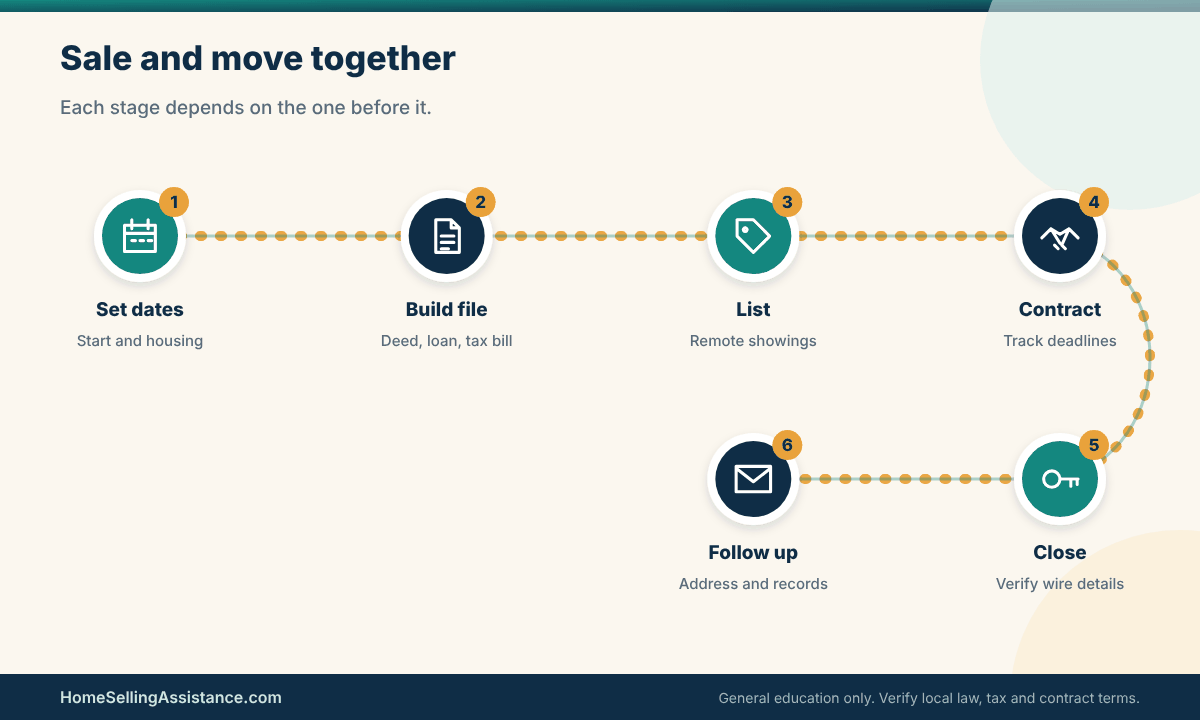
The roadmap below lays out the stages from first plan to final handoff. Read this picture of selling house moving out of state as a spine, not a schedule. Your contract, your lender and your buyer set the real dates, and the picture only helps you remember which stage depends on which.
Early actions and decision points before you list
Before the listing goes live, three choices deserve attention: how you will market and show the house from afar, which closing window you can live with, and how much slack you are willing to build between closing and your move. Selling house moving out of state works best when those three choices are made together, because each one limits the others.
Evidence behind the early timeline: closing date, possession and move date
Start from the dates you cannot change: a job start, a lease start, a school term. Work backward to the latest closing you can accept, then ask your agent, title company or attorney how long a typical sale takes in your area from signed contract to closing. Use a local professional’s current experience, not a national average. Time to closing depends on financing type, appraisal scheduling, title work and local custom.
Then separate three dates that people constantly blur together when selling house moving out of state. The closing date is when documents are signed and funds move. The possession date is when the buyer receives the keys, which is sometimes the same day and sometimes not. Your move date is when the truck leaves. A contract can place possession after closing, or before it, and each choice changes insurance, risk of loss and who pays utilities.
If you need to stay in the house after closing, ask about a written post-closing occupancy agreement. Terms vary: daily charges, a deposit, insurance duties, and what happens if you overstay. Some buyers and lenders will not allow it. Others will, with conditions. Never rely on a friendly handshake, because a verbal promise does not bind a lender or protect either side.
You should also decide how much slack you want. A seller with a hard start date might choose a tighter closing window and accept fewer buyer options. A seller with flexibility might allow a longer window and welcome stronger terms. Neither is wrong. What matters is that you choose on purpose, and write the dates into your own calendar next to the contract’s.
A scenario with two possible move dates and a decision rule
Imagine a seller who must start work on the first of the month. A buyer offers a closing four days before that date, and another offers a closing two days after it, with a short rent-back for the seller. This is a hypothetical comparison, and the right answer depends on terms you have not seen yet.
A decision rule helps when selling house moving out of state under a hard start date. Ask which offer leaves you with the least damage if the closing slips by a week. If the early offer slips a week, you may be paying for temporary housing in the new city while owning the old house. If the later offer slips, you may be in the new job while still arranging the old house. Neither is free. Put a rough price on each outcome, using real quotes for temporary housing and storage.
Also consider what each buyer’s financing looks like, as far as the contract and your agent can tell you, and how much time the lender will need. A cash buyer may close sooner, but a faster closing is not guaranteed, and proof of funds should be checked. For more on aligning the two dates, see our guide on move-out date versus closing date.
It is worth stating plainly how negotiation changes when you are far away. Sellers who cannot attend inspections or walk-throughs sometimes accept requests they would otherwise question. Before you respond to a repair request, ask for the inspector’s report, a written scope, and at least one local contractor’s estimate. You may decide to fix, to credit or to decline, but decide from evidence. Selling house moving out of state should not mean giving up your judgment because you are busy.
Handoffs, negotiations and contingencies during the contract period
After an offer is accepted, selling house moving out of state shifts from deciding to handing off. Your mover, your lender or landlord in the new state, your title company and the buyer’s side all depend on your dates. This is also when contingencies, which are conditions in the contract that let a party step back, can reshape the plan.
Evidence to gather: movers, estimates and written terms
Moving companies deserve the same scrutiny you give a buyer, since a mover is a key partner in selling house moving out of state. Ask for an in-person or video survey of your belongings, get the estimate in writing, and learn whether it is binding, nonbinding or capped. A low quote from a company that never saw your home is a warning sign. Check that the company is properly registered to move household goods across state lines, using the federal and state sources your state’s consumer office can point you to.
Ask what the company’s valuation or liability coverage actually pays if something is lost or damaged, and whether you can buy more. Ask when the truck will pick up, when it will deliver, and what happens to your belongings if the delivery window moves because your closing moved. Get storage terms and fees in writing as well. Ambiguity about timing is where most moving disputes begin.
The Federal Trade Commission publishes consumer material on moving scams at consumer.ftc.gov, and it is worth reading before you sign anything. The common patterns include a quote that rises sharply on moving day, a demand for a large cash deposit, and a company that holds your belongings until you pay more. A clear written contract, and a company you verified yourself, protects you from most of them.
Build flexibility into the booking. Ask whether you can move the pickup date without a penalty if closing slips, and what notice the company needs. Some sellers pay a bit more for a flexible date, others for packing help so the house is ready earlier. Whatever you choose, treat the mover’s terms as one more contingency in your calendar.
A scenario where closing slips and the truck is already booked
Say your closing is set for a Friday and the truck is booked for Thursday, a classic trap in selling house moving out of state. On Wednesday the buyer’s lender says the appraisal is not back, and the closing might move by several days. This kind of slip happens, and it does not mean anyone acted in bad faith. It means a date you treated as fixed was never fully in your control.
Your options are practical rather than dramatic. You can ask the mover to hold the load or reschedule, move to temporary housing, ask the buyer for a short possession arrangement, or pause packing the last rooms. Each has a cost and a risk. The question to ask first is what your contract says about extensions, and whether any change must be signed by both sides before it counts.
A simple safeguard is to book the truck for after the closing date you can verify, not the date you hope for. Some sellers load a day after signing, with a short written occupancy period. Others ship household goods ahead and live out of a suitcase for a few days. Both are reasonable ways to protect the move from the sale, and you can discuss the choice with your agent, title company or attorney.
Contingencies deserve one more look because they sit at the center of timing. An inspection contingency, a financing contingency and an appraisal contingency each give the buyer a window to renegotiate or leave, as written. Learn your own contract’s deadlines, mark them on the shared calendar, and read our guide to home sale contingencies for the mechanics.
The second table below is a transaction check for selling house moving out of state. It sets issues side by side with the evidence you hold, the input you should expect from the buyer, agent or title company, the risk if something is missing, and a fallback. Use it as a review sheet each time the contract changes.
| Issue | Seller evidence | Buyer, agent or title input | Risk | Fallback |
|---|---|---|---|---|
| Closing date drifts | Signed contract with dates | Lender and title timeline updates | Truck and housing out of sync | Flexible mover booking or short stay |
| Possession after closing | Written occupancy terms | Buyer and lender approval | Insurance or damage dispute | Move out before signing |
| Withholding at closing | Residency facts, tax questions list | Title officer’s state rule check | Unexpected holdback | Ask a tax professional beforehand |
| Signing from afar | ID, authority papers, availability | Notary or e-closing options | Rejected signature or delay | Sign early by mail-away or signing agent |
| Wire instructions change | Verified phone number for the title company | Confirmation by call | Funds sent to a fraudster | Stop and call the known number |
| Mover price rises | Written binding or capped estimate | Company’s licensing record | Held goods, surprise fees | Another verified mover |
Notice how often the fallback in selling house moving out of state is simply another phone call to a verified number. Long-distance sellers rarely get hurt by exotic problems. They get hurt by ordinary ones that nobody caught because the right person was not in the room.
Close the loop after selling house moving out of state
The last stretch of selling house moving out of state is shorter than the first two, but it carries the highest stakes. Money moves, title transfers and the details you confirmed, or did not, become permanent. Treat the final week the way a pilot treats a checklist: boring on purpose.
Before the closing documents arrive, it helps to see the arithmetic. The waterfall below shows how a sale price turns into the cash you actually receive, with the usual categories laid out from top to bottom. Your own deductions will differ, so build yours from real quotes rather than from the picture.

Before any of that, close out the home itself. Cancel or transfer utilities with a date that matches possession, not the move date, so the buyer is not left in the dark and you are not billed for weeks you do not own the house. Take dated photos of the empty home, the meter readings and the condition of any items that stay. These simple records have settled many small disputes.
What to confirm in writing before you leave town
Anything that affects money, access or timing in selling house moving out of state should exist in a document you can find later. A text message saying the buyer is fine with a few extra days is not the same as a signed addendum. When you are far away, written confirmations are the only way to prove what was agreed.
Evidence to gather: closing statement, possession terms and wire instructions
Ask the title or escrow officer for a draft closing statement as early as they can provide one, and compare it with your contract line by line. Check the payoff figure against the servicer’s letter, the prorations against the tax bill and your contract’s rules, and every fee against what you were told. Where numbers differ, ask why, in an email, so the answer is on record. Our guide to seller closing costs explains the usual categories.
Then confirm possession. Does the buyer take the keys at signing, at funding, or at recording? Does your contract say what condition the house must be in, whether anything stays, and when utilities are transferred? Confirm who holds copies of keys, garage openers and any gate codes, and how you will hand them over when you are not there, perhaps through the agent, the title office or a prearranged courier.
Wire instructions deserve their own discipline. Fraudsters watch for closings and send fake emails that look like the title company’s, asking the seller or buyer to send money or change payment details. If you are receiving proceeds, you will give your own bank details, and you should do that only through a channel you confirmed by phone. The FBI’s Internet Crime Complaint Center takes reports of wire fraud, and our guide to seller fraud and safety covers the warning signs.
Ask, too, how and when you will receive your money from selling house moving out of state. Funding and recording rules vary, and so does the time between signing and cash in your account. Ask the closing officer whether proceeds will arrive by wire or check, whether your bank has a cutoff time, and whether a holdback applies. You can read more about timing in our article on when the seller gets money after closing.
A scenario with a remote closing and a power of attorney
When selling house moving out of state, take a seller who has already started a new job in another state and cannot take time off to return for the closing. The seller has three realistic options, and which are available depends on the state and the buyer’s lender. This is an illustration, not a statement of what your state allows.
One option is a signing by mail-away or with a mobile notary, where the closing documents are sent to the seller’s new location and notarized there. Another is an electronic closing, where permitted. A third is a power of attorney, where a trusted person signs for the seller. Lenders and title companies often have strict rules about powers of attorney, and some will not accept one at all.
Before choosing, ask the title company or closing attorney which methods they accept, which documents they need in advance, and how long the process takes. If a power of attorney is under consideration, ask what form is required and whether it must be recorded. A document prepared in one state is not always accepted in another, so get the title company’s approval before it is signed.
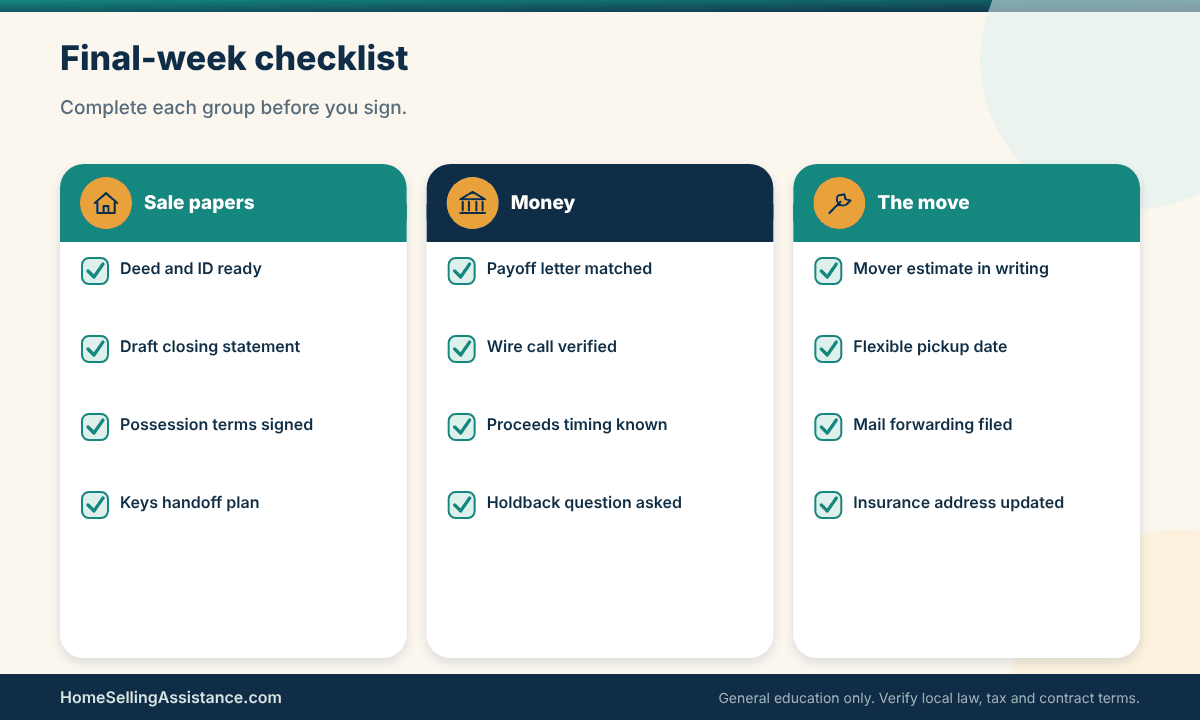
The image below turns the usual paperwork into a checklist. Use it the week before closing to see which categories are complete and which are still waiting on someone else.
It also helps to set a date for a calm review of the whole sale. A few weeks after closing, compare the final statement with your records, confirm the old mortgage shows paid, and check that your escrow refund, if any, arrived. If something looks off, contact the title company or servicer in writing while the file is fresh. Sellers who wait months often discover that the person who handled their file has moved on.
Records and follow-up after closing in your new state
Closing is not the finish line in selling house moving out of state. The weeks that follow involve a long list of small updates, most of them in a new state with new offices and new deadlines. Handle them in a sensible order and they feel routine. Skip them and they can turn into fines, lapses or confused mail.
Evidence to keep: tax records, vehicle, license and address changes
After selling house moving out of state, keep the final closing statement, the deed you signed, the payoff confirmation, your mortgage interest statement and every receipt for improvements you paid for while you owned the home. These support your reporting of the sale and your adjusted basis, which the IRS explains in Publication 551. Store a copy somewhere that will not vanish with an old email account.
Vehicles are the next item. States set their own deadlines for registering a car after you establish residency, and the rules cover titles, emissions or safety checks, insurance requirements and fees, all of which differ. Ask the new state’s motor vehicle office, not a forum, what you need and by when. If a lender holds your car title, find out how that affects registration, and remember to update your insurer with the new garaging address.
Driver’s licenses, voter registration, professional licenses and children’s school records follow their own timelines. Create a short list with the agency, the document it requires and the deadline it states. Proof of residency is often needed, and a lease or closing statement for your new home may be accepted, though each office decides what it takes.
Update your address with the post office, banks, credit cards, insurers, employers, medical providers and anyone who sends tax forms. Keep forwarding active for as long as the postal service allows, because year-end tax documents arrive late. Also cancel or transfer utilities and subscriptions at the old house, and keep the final bills in case a proration question arises. For paperwork lists tied to the sale itself, our guide to documents needed to sell a house may help.
A scenario and next step for the first ninety days
Imagine a seller finishing selling house moving out of state who closes on a Friday, arrives in the new state the next week, and feels finished. Three weeks later a county notice arrives at the old address, the car insurance still lists the old garage, and the new employer needs proof of residency for a payroll form. None of this is dramatic. All of it was avoidable.
A ninety-day plan for selling house moving out of state fixes that. In week one, file the forwarding order and update insurance. In the first month, handle the license and vehicle registration according to the state’s deadline. Within the first couple of months, meet with a tax professional about part-year filing, and store a complete sale file. At the end of ninety days, review the list and cross off what is done.
If you sold a home with gain that may exceed the exclusion, or you owned it for less than two years, the tax picture can be more complicated. Our overview of taxes when selling a home goes deeper, and the IRS publication linked above remains the primary source. When the numbers are close, a qualified professional is worth the fee.
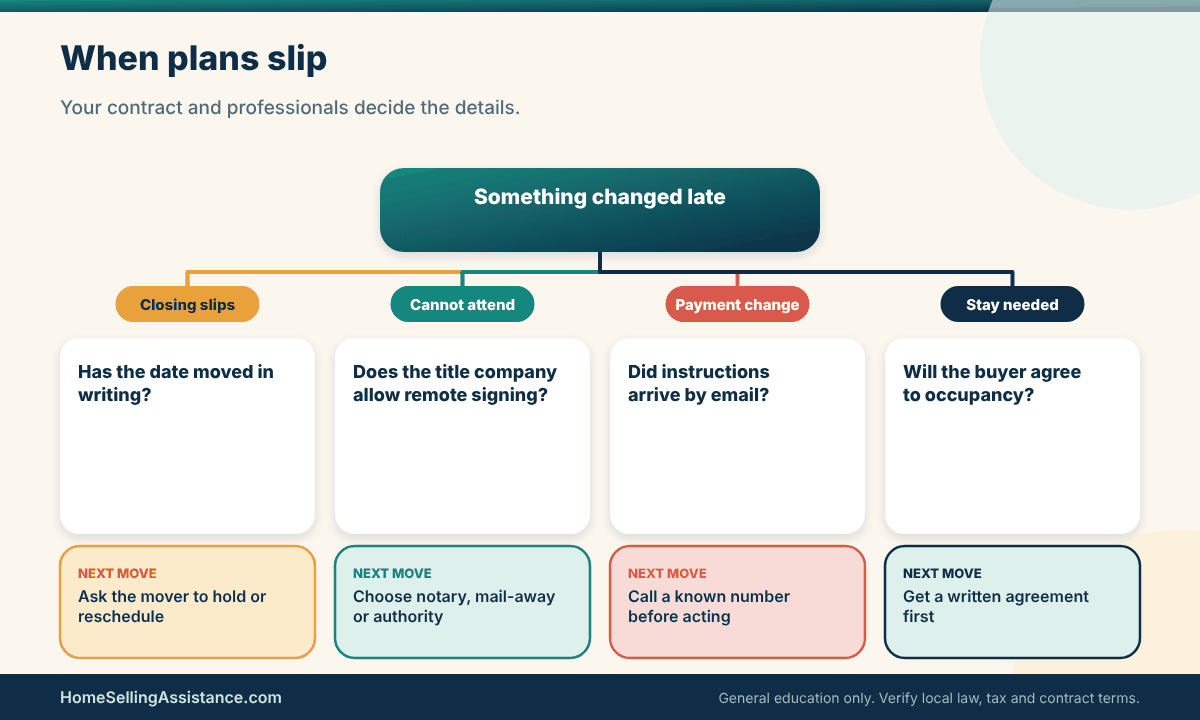
The final image sets out a simple fallback tree for selling house moving out of state for the most common long-distance problems, such as a delayed closing, an unreachable signer or a suspicious payment request. It is a prompt for conversations with your professionals, not a replacement for them.
Retirees and downsizers often face the same logistics with higher emotional stakes, since years of belongings and a long-held home are involved. If that is your situation, our guide on selling a house after retirement covers cash flow and location decisions, and our home-sale tax library goes deeper on the numbers. Keep the sale and the move on one calendar either way.
If you take only one habit from this article, make it this one: verify by phone, confirm in writing, and date everything. Selling house moving out of state is a project of small confirmations, and the people who finish it calmly are almost always the ones who kept asking boring questions. Our wider relocation selling guide pulls the pieces together, and you can return to the sections above whenever a new question appears.
Quick scenario
A seller in a hurry agrees to a closing date, books a nonrefundable truck and signs a lease before the buyer’s loan approval arrives. When the lender asks for more time, the seller pays for two places at once. The fix would have been cheap: a flexible mover date, a lease that starts after the loan deadline, and a calendar that shows every dependency.
Frequently asked questions about selling house moving out of state
How early should I start selling house moving out of state?
Start as soon as you know your target move date, because the paperwork and tax questions take longer than the listing. Many sellers begin assembling the file several weeks before they list. How long the sale itself takes depends on your local market, financing type and contract, so ask a local professional about current timing rather than relying on a national figure.
Do I owe tax in both states when I sell and move?
Not necessarily when selling house moving out of state, and the answer depends on both states’ rules and on your residency dates. Some states tax gains as income, others do not, and a part-year resident may file in more than one place. A tax professional familiar with both states can explain how your sale would be treated. Bring your closing date and your move date to that meeting.
Can I still use the federal home-sale exclusion if I am moving away?
The exclusion depends on ownership and use tests, not on where you are going. In general you need to have owned the home and used it as your main home for at least two of the five years before the sale, and the limits are $250,000 for a single filer and $500,000 for qualifying joint filers. Exceptions exist, so read IRS Publication 523.
Can someone else sign my closing documents for me?
Sometimes in selling house moving out of state. Some states, lenders and title companies accept a power of attorney, while others restrict it or refuse it. Many also offer mobile notaries, mail-away signings or electronic closings. Ask the title company or closing attorney which options they accept before you decide, and have any authority document reviewed in advance so it is not rejected at the last minute.
What if my closing date moves after I booked movers?
Read the mover’s cancellation and rescheduling terms before you sign, and ask for flexibility in writing. If the date moves, call the mover immediately, check what your contract says about extensions, and consider temporary housing or a short written occupancy period. Avoid committing to nonrefundable dates until your key contingencies have passed.
How do I avoid moving scams?
Get a written estimate based on a survey of your belongings, confirm the company is registered to move household goods between states, and be wary of large cash deposits or quotes that sound too good. Read the consumer guidance from the Federal Trade Commission and check reviews from sources you trust. Keep valuable documents and medications with you, not on the truck.
What should I do with my car after I sell and move?
Contact the new state’s motor vehicle agency to learn its deadlines, title requirements, inspections and insurance rules. They differ by state, and some places set short windows. If a lender holds your title, ask how that affects registration. Update your insurer with the new address, and keep proof of registration and license changes in your records.
How do I protect myself from wire fraud when I am not at the closing?
Treat any email about payment details as suspicious until you verify it by phone. Use a phone number you found independently, not the one in the message, and never accept a last-minute change to wire instructions without calling. Report suspected fraud to your bank and to the FBI’s Internet Crime Complaint Center right away.
Should I rent back my house after closing?
A rent-back can bridge a gap between closing and your move, but it requires the buyer’s agreement and often the lender’s. Terms might cover daily charges, a deposit, insurance and what happens if you stay longer than agreed. Put everything in a written agreement and ask the title company or an attorney to review it. Never rely on a verbal promise.
Which records should I keep after the sale?
After selling house moving out of state, keep the closing statement, the signed deed, payoff confirmation, improvement receipts, the mortgage interest statement and any tax forms related to the sale. Also keep proof of address and vehicle changes in your new state. The IRS explains how basis and gain are figured, and a tax preparer can tell you how long to hold specific documents.
Before you hand over the keys
Selling house moving out of state rewards the seller who writes things down, verifies by phone and keeps the sale and the move on one calendar. None of it requires special skill, only patience and a list. This article is general education, not legal, tax or financial advice, and rules differ by state and by contract, so check the specifics with your title company, an attorney or a tax professional before you act.