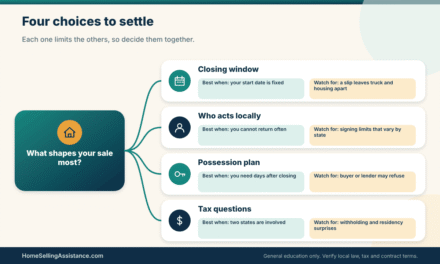
A job relocation sell house decision usually arrives on a bad schedule: the offer letter has a start date, the current house has a mortgage, and nobody has told you how the two will line up. This article lays out the real options (selling first, buying first, renting out the old home, or bridging with temporary housing) and gives you a way to compare them without leaning on slogans.
Most advice on a job relocation sell house decision is written as if every seller has the same budget, the same house and the same employer. They do not. A transfer that comes with a generous relocation package is a different problem from a new job that pays nothing toward moving. A house with a low mortgage rate and heavy equity behaves differently from one that was bought two years ago with a small down payment.
So we will treat the job relocation sell house question as a set of trade-offs you can measure. You will see how to define your real goal, which facts can flip the answer, what each path costs in money and stress, and how to apply a simple net-result rule. We stay neutral on agents, buyers and sales channels, because the right choice depends on your numbers and your contracts.
One honest limit before we start. Rules on contracts, disclosures, landlord duties, taxes and lender approval vary by state and by lender, and your situation may have details we cannot see. Everything here is general education. Use it to ask sharper questions of the professionals who can read your actual documents.
Key takeaways
- Start with the start date. Your employer deadline, not the housing market, usually sets the hardest constraint, so write it down before you compare anything.
- Four paths, four different risks. Selling first, buying first, renting the old house and bridging with temporary housing each shift risk between carrying costs, contingencies and workload.
- Net result beats sale price. Compare what you keep after payoff, fees, carrying costs, moving costs and taxes, not the headline number.
- Check the relocation package early. Reimbursement rules, tax treatment and repayment clauses sit in your own paperwork and change which path is affordable.
- Plan the fallback now. Decide in advance what you will do if the house sits, an offer falls apart or the start date moves.
- Get local and personal advice for the final call. An attorney, tax professional and lender can confirm what applies to your state and your finances.
Define the choice behind your job relocation sell house plan
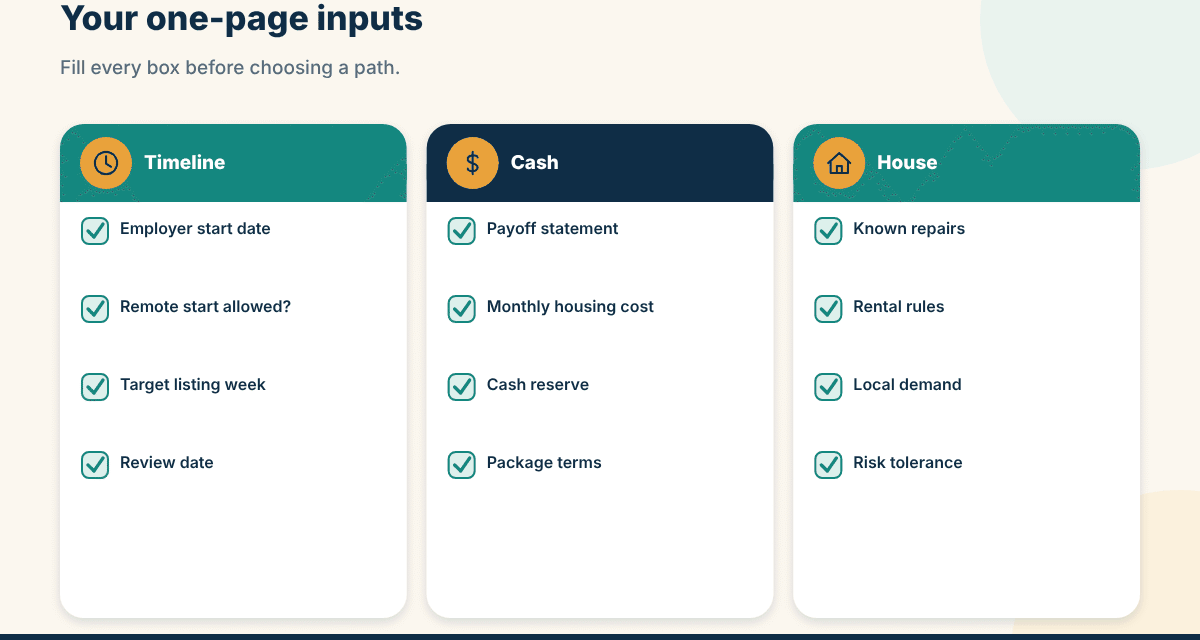
Before you compare options, it helps to say out loud what you are actually deciding. Many sellers frame it as “should I sell or keep the house?” when the real question is closer to “how do I protect my start date, my savings and my sanity while two homes overlap?” The sections below turn that vague worry into five concrete inputs you can write on one page.
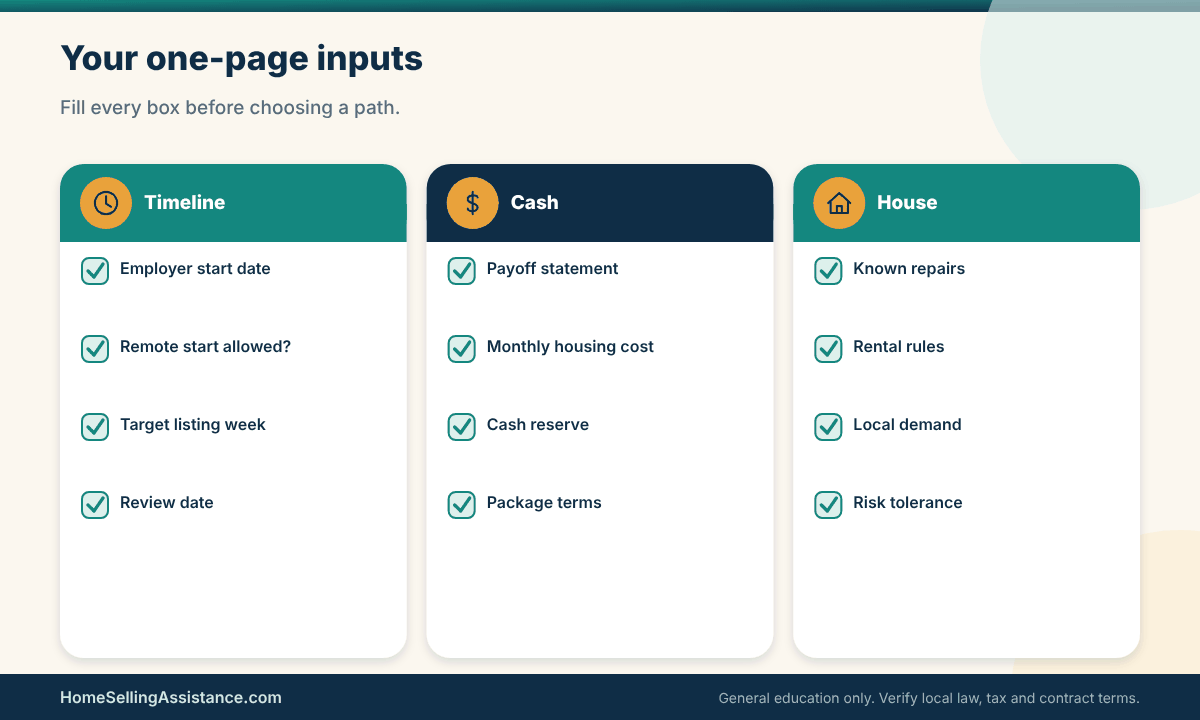
Goal, timeline, cash, condition and risk tolerance in a job relocation sell house decision
Think of these five job relocation sell house inputs as the legs of a stool. If one is badly out of balance, the whole plan wobbles. A tight timeline and thin cash reserves, for example, make some paths nearly impossible no matter how appealing they sound on paper.
Evidence to gather: numbers, dates and documents
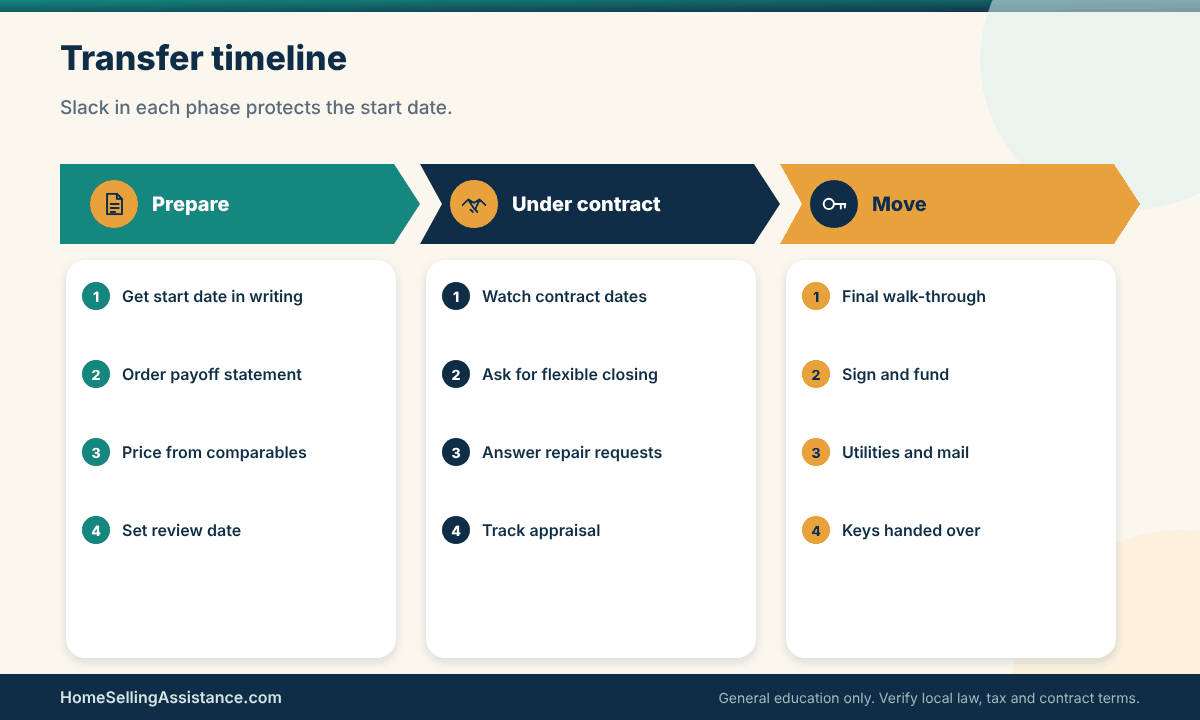
Start your job relocation sell house research with the dates. Your employer may have given you a report date, a “must relocate by” date, or a softer window. Ask your hiring contact to put it in writing, including whether remote or hybrid arrangements are possible for the first few months. A date that looks fixed on a phone call sometimes has more give once the manager sees an email asking for clarity.
Next, pull your money facts. You want your current mortgage payoff figure (a formal payoff statement from the lender, not the number on last month’s bill), your monthly housing costs including taxes, insurance and any HOA dues, and your cash reserves outside retirement accounts. If you have a home equity line, note the balance, because it will be paid at closing along with the first mortgage.
Then gather condition facts. Open permits, known repairs, an aging roof or furnace, a septic system, deferred maintenance: these shape how fast and at what price the house can sell, and they shape how comfortable you are leaving it empty while you work in another city. A walk-through with a candid friend can be as useful as any report at this stage.
Finally, read the relocation package line by line if you have one. Look for who pays what, whether the benefit is a lump sum or reimbursement against receipts, whether it comes with a repayment clause if you leave the company early, and whether any sale-assistance program is offered. Our guide to relocation home sale assistance explains how those programs are usually structured and what to question before you accept one.
A scenario, an exception and your next step
Picture a seller we will call Dana, who is working through a job relocation sell house decision. Her new employer wants her in another state in ten weeks. She has a conventional mortgage, a modest amount of equity and about four months of expenses saved. Her goal ranks like this: keep the start date, avoid paying two full housing costs for more than a few months, and avoid a rushed sale at a steep discount. Those priorities, ranked, already rule some routes in and others out.
An exception worth remembering: if your employer will let you start remotely, your timeline may be looser than it looks. Dana could ask whether a three-month remote start is allowed. If yes, she gains time to prepare and list the house properly, and the whole comparison changes.
Your next step in a job relocation sell house plan is small and concrete. Write one page with five headings (goal, timeline, cash, condition, risk tolerance) and put a number or a date under each. If a heading stays blank, that is your first research task. Every later comparison in this article refers back to that page.
Facts that could change your job relocation sell house decision
Some facts in a job relocation sell house decision work like switches. Flip one, and the best path changes. It pays to hunt for these early rather than discover them after you have signed a contract or a lease.
Documents and market evidence worth checking
The first switch is equity. Your mortgage statement and a rough estimate of value tell you whether a sale would leave you with cash, break even, or require you to bring money to closing. Our walkthrough on how to price a house to sell shows how to build that estimate from comparable sales instead of from an online guess. Treat any early figure as a range, not a promise.
The second switch is your loan. Some mortgages have features that matter here, such as an assumable structure, a prepayment penalty on older loans, or an occupancy requirement. Occupancy clauses in particular matter if you plan to rent the house out. Read the note and mortgage documents, or ask your servicer in writing what the loan requires of the borrower after you move.
The third switch is local demand. How quickly comparable homes in your area have been selling, and how many are listed right now, affects how risky a sell-first plan feels. A local agent, a county data portal or the market-activity pages of a real estate association can provide that. Be careful with national headlines. Your block is not the national average, and a sale that took weeks in one neighborhood can take months in the next.
The fourth switch is the property itself. A house that is clean, priced near market and easy to show has more options than one with an unfinished basement and a pending code issue. Be honest about which one you own.
Scenarios, exceptions and a decision checkpoint
Consider two sellers with the same job offer and the same job relocation sell house question. Marcus owns a home with substantial equity and a strong rental market nearby. Priya owns a home bought recently with a small down payment in a slower area. For Marcus, keeping the house and renting it out may be a serious option. For Priya, a rental might not cover the mortgage, taxes and insurance, and a quick sale could leave her short of cash. Same job, opposite logic.
There are exceptions inside the exceptions. A strong rental market does not help if the lender or an HOA restricts renting. A low mortgage rate is valuable, but it does not pay for repairs on a vacant house you cannot easily check on. Equity looks comforting until you subtract selling costs and a price cut you did not plan for.
Set a decision checkpoint to keep your job relocation sell house plan from drifting. For instance: “By the end of week two, I will have a payoff statement, a price range, a rental-feasibility answer and my employer’s written date.” If any of those are missing at the checkpoint, you are still gathering facts, not choosing a path. Our broader guide to selling a house for relocation covers the surrounding steps if you want the full picture.
Compare realistic paths for a job relocation sell house move
There are really four ways to handle the overlap between two homes, and they fall into two families. In the first family you sell before you commit to the next place. In the second you take on the next place while the old house is still yours. Neither family is automatically wiser. The better one is the one whose worst case you can afford to live through.
The table below puts the main job relocation sell house routes side by side. Use it as a first screen: read across a row to see what each path tends to demand, then mark the cells that worry you most. The figures you will plug in later come from your own quotes, so the table speaks in tendencies, not numbers.
| Path | Price and net proceeds | Time and contingencies | Workload | Main execution risk |
|---|---|---|---|---|
| Sell first, then rent or stay with family | Time to prepare may support a fuller price | Sale needs no purchase contingency; closing date can be negotiated | Heavy: prep, showings, two moves | Housing gap if the new city search runs long |
| Buy first, sell later | Pressure to sell can lower leverage if the house lingers | No buyer contingency on your side, but double carrying costs | Heavy: long-distance sale management | Two payments with an uncertain end date |
| Buy first with a sale contingency | Contingent offers can weaken your bid in a busy market | Seller of the new home may decline or set a deadline | Moderate | Contingency may cost you the new house |
| Keep and rent the old house | No sale proceeds now; income depends on rent | Ongoing landlord duties and lease terms | Moderate to heavy, depending on management | Vacancy, repairs and loan or HOA restrictions |
| Bridge with temporary housing | Protects the sale price by avoiding a rushed listing | Extra lease or short-term rental, often month to month | Moderate: two moves | Costs creep if the sale slips |
| Employer or third-party sale program | Offer may differ from open-market price; read terms | Can be quicker; depends on program | Lighter | Fees, repayment clauses and fine print |
After reading the table, circle the one risk in each row you would find hardest to absorb. Someone who dislikes uncertainty about timing will react differently from someone who dislikes carrying two payments. That reaction is information. The next two sections go deeper into each family, so you can see how the risks behave in real life.
Selling first: the cleanest break and its trade-offs
Selling before you buy in a job relocation sell house move gives you something valuable: certainty about your finances. Once the house closes, you know your cash, your mortgage is gone, and your next purchase can be shaped around real numbers. The price you pay is flexibility. You may have to live somewhere temporary, and you may have to find the next house on someone else’s schedule.
How the numbers and the timeline work
Start the job relocation sell house proceeds math here. Take the expected sale price, then subtract your mortgage payoff, any home equity loan, agent or marketing costs you have agreed to, title and closing charges, transfer taxes where they apply, and prorated property taxes or HOA dues. Add or subtract credits for repairs that buyers negotiate. The remainder is the cash you could put toward the next home or hold in reserve. Our guide to home sale net proceeds walks through each line of that calculation.
Illustrative example with round numbers: suppose a house sells for $400,000, the mortgage payoff is $250,000, and combined selling costs and credits come to $30,000. The cash left before taxes would be about $120,000. If a price cut of $15,000 became necessary to meet your deadline, that same sale would leave roughly $105,000. These figures are only a demonstration of the arithmetic, not a forecast for any property.
On timing, a sell-first plan has two clocks. The first runs from listing to accepted offer, which depends on price, condition and local demand. The second runs from accepted offer to closing, which depends on the buyer’s financing, inspection and appraisal. Neither clock is fixed, and published averages are weak guides to your specific house. A reasonable plan builds in slack on both, so a late appraisal or a repair negotiation does not collide with your start date.
Contracts offer tools to manage the gap. A seller can sometimes negotiate a later closing date, or a short post-closing occupancy period, often called a rent-back, so you can stay a few days or weeks after the sale. Details differ by state and by contract, so read our pieces on flexible closing dates for sellers and rent-back agreements before you ask for one.
A scenario, a catch and the next action
Take Elena, whose job relocation sell house plan begins with a transfer that begins in three months. She lists the house, receives an offer in the second week, and negotiates a closing date six weeks out. She rents a furnished apartment near the new office for two months while she house-hunts. Her trade-off is clear: two moves and a short lease, in return for knowing exactly what she can spend on the next house.
The catch appears if the sale is slower than she expected. If the house sits for ten weeks, she may have to accept a lower price or start the new job while still owning the old home. That is why a sell-first plan needs a trigger, not just hope. Elena could decide in advance that if there is no acceptable offer after a set number of weeks, she will review price with her agent and compare it against the cost of one more month of carrying the house.
Your next action if this job relocation sell house path appeals: ask two local agents or a real estate attorney how long homes like yours have taken from list to close recently, what pricing strategy fits your deadline, and what closing-date flexibility is realistic. Compare the answers for consistency rather than picking the most optimistic one.
Buying first, renting out or bridging: the overlap paths
The second family keeps the old house in play while you set up the new life. Some sellers buy first because they cannot risk missing the right home. Others rent the old house because they like its mortgage rate or expect to return. Others simply rent short-term and sell after the move, when the house can be staged and shown without rush.
Costs, contingencies and rules to verify
Buying first means carrying two housing costs at the same time. Add up both mortgage payments, both property tax bills, both insurance policies, utilities in two places and basic upkeep on a house nobody lives in. Then multiply by the number of months you can realistically imagine the overlap lasting, plus a cushion. A lender will also look at the old mortgage when it calculates your debt-to-income ratio for the new loan, which can limit how much you can borrow. Our article on buying a house before selling your current home covers the lender side in more detail.
A sale contingency, where your offer on the new home depends on selling the old one, can reduce risk but may weaken your offer. Some sellers of the new home will not accept one, and others will accept it only with a short deadline. See buying with a home sale contingency for how those clauses tend to work. Bridge loans and home equity borrowing are other tools, with their own costs and qualification rules, discussed in our guide to bridge loans for a home sale.
Renting out the old house during a job relocation sell house move brings a different list of checks. Read your mortgage terms on occupancy, your homeowner’s insurance policy (a landlord policy is usually different), any HOA rental rules, local registration or licensing requirements, and landlord-tenant law in your state. Our guide to selling versus renting out a house compares the two long-term. The IRS also explains how rental use affects a later sale in Publication 527 on residential rental property, so ask a tax professional how a rental period could change your tax picture on a future sale.
If you choose temporary housing, treat it as a tool with a price tag. Our overview of temporary housing between selling and buying explains common formats, from extended-stay hotels to furnished month-to-month rentals. Ask each landlord about minimum stays, early-exit fees and what happens if your timeline shifts.
Scenarios, exceptions and how to choose
Consider Jordan, whose job relocation sell house move lands in a hot market and fears losing out on the right house. Jordan buys first and keeps the old home on the market. The risk is plain: if showings are slow, two payments run for months. Jordan’s protection is a written cash cushion and a price-review date. Without those, the plan relies on luck.
Now consider Sam, who has a low mortgage rate, strong equity and a nearby property manager recommended by a friend. Sam rents the house out, understanding that vacancy and repairs will come out of pocket. For Sam, the long-term math may justify the work. For a seller with thin reserves, the same plan could turn a stressful move into a financial strain.
Exceptions deserve a mention. Military moves, certain government transfers and some employer programs have their own rules about timing, reimbursement and housing allowances, so read those documents before assuming any general rule applies. A rental plan can also be disrupted by a lender who objects to non-owner occupancy, so confirm that early.
To choose among overlap paths in a job relocation sell house plan, ask three questions. How many months of double costs can I carry without borrowing against my future? What is my plan if the house does not sell or rent on schedule? And who will handle repairs and showings when I am a long drive away? Honest answers usually point toward one family or the other.
Use a net-result decision rule for your job relocation sell house choice
By now you have a list of options and a pile of facts. The last job is turning them into a decision you can defend a month later. The cleanest way is to stop asking “which path is best?” and ask instead “which path leaves me with the most acceptable net result, after price, time, cost and risk are all counted?” That sounds abstract, so we will make it concrete.

The diagram above shows the basic idea. Every path starts with the same sale price or rental income and then runs through a series of deductions and extra costs. The path with the biggest headline number is not always the one that ends with the most in your pocket, and the one with the lowest cost is not always the one you can live with.
A price, time, cost and risk framework for your job relocation sell house plan
The job relocation sell house framework has four columns for each path: price, time, cost and risk. You fill each one with a range, not a single number, and you write down what could push the range in the wrong direction. The goal is not a perfect forecast. It is a fair comparison between paths that behave differently.
How to calculate the net result for each path
Begin with price in your job relocation sell house comparison. For a sale, this is your expected sale range based on comparable homes. For a rental, it is expected monthly rent minus vacancy, management fees, repairs, taxes, insurance and any mortgage interest you would pay anyway. Be conservative here. People tend to remember the best neighbor’s rent and forget the empty month.
Next, add time. Convert every delay into dollars by multiplying the months of overlap by your monthly carrying costs. If a sell-first plan needs a two-month furnished rental, that rental is a cost of the plan. If a buy-first plan means three months of two mortgages, that is a cost of the plan. Our guide to the move-out date versus the closing date shows how small differences in those dates change the bill.
Then list direct costs. These include moving expenses, storage, travel back and forth to manage the old house, utilities in both places, repairs the buyer will ask for, and professional fees. Some of these may be covered by your employer, so subtract anything the package truly pays after reading the fine print. Reimbursements and their tax treatment are set by your employer and by tax law, so confirm the details with a tax professional rather than assuming.
Finally, price the risk. This is the hardest column, so use scenarios instead of formulas. Write a good case, an expected case and a bad case for each path. In the bad case, how many extra months of costs do you face, and could you fund them without borrowing at a painful rate? If the answer is no, that path has a risk you cannot absorb, no matter how good its expected case looks.
Illustrative example, with round figures: Path A (sell first) shows $120,000 expected cash, $6,000 of temporary housing and $4,000 in moving costs, for a net of about $110,000. In a bad case where the sale needs a $15,000 price cut and two more months of rent, net drops to roughly $93,000. Path B (buy first) shows the same sale but adds three months of double housing costs at $4,500 per month, or $13,500, and the bad case adds three more months.
Seeing both columns makes the trade-off visible: certainty at a modest cost versus flexibility at a wider range of outcomes. These numbers only show the method. Use your own quotes.
For taxes, remember the basics. The IRS explains in Publication 523 on selling your home that many homeowners can exclude up to $250,000 of gain, or up to $500,000 for a qualifying married couple filing jointly, if they meet the ownership and use tests (generally two of the last five years). Whether and how that applies to you, especially if you rent the house out or move sooner than two years, depends on your facts.
Our guides on the home sale capital gains exclusion and partial exclusion for sellers under two years explain the general rules, and a tax professional can apply them to your case.

A scenario, an exception and the decision to write down
Imagine two paths with almost identical expected outcomes. The first is cheaper in the good case but has an ugly bad case. The second costs a little more up front but caps the downside. If your emergency savings are thin, the second path usually wins, because the bad case of the first would force you into expensive borrowing. If your savings are healthy and your job is stable, the first may be fine.
An exception: if your employer offers a program that buys or guarantees the sale of your house, the price column may be fixed, but the fees and conditions may not be. Compare the program’s net result with the open-market net result, including the cost of time, and read every clause on repayment if you leave the company.
Write your job relocation sell house decision down in one paragraph: “I choose path X because its expected net is Y, its bad case is Z and I can afford it. I will review at week N.” A written rule protects you from second-guessing when a friend says “I would never do that” or a listing in the new city tempts you to change course.
To see how common situations tend to line up, the next table links typical seller circumstances to the route they often favor. Read it as a conversation starter with your advisers, not as a verdict. Each row shows a reason, a trade-off, and the single fact that would most likely change the answer.
| Situation | Route often favored | Reason | Trade-off | Fact that changes the choice |
|---|---|---|---|---|
| Short start date, thin savings | Sell first, temporary housing | Limits double costs and gives cash certainty | Two moves, short lease | Employer allows a remote start |
| Flexible start, strong equity | Prepare, then sell at a steady pace | Time to repair, stage and price well | Longer period of living apart or commuting | Market slows or repairs grow |
| Competitive new-city market, healthy cash | Buy first, sell after the move | Lets you act quickly on the right house | Two payments, remote management | Old house sits past your cushion |
| Low rate, solid rental demand, reserves | Keep and rent | Preserves a valuable loan and asset | Landlord duties, vacancy, repairs | Lender, HOA or local rental rules |
| Employer sale program offered | Compare program against open market | Convenience and speed may matter | Price or fees may differ from market | Fine print on fees and repayment |
| Co-owners or family involved | Slower, documented decision | Everyone must agree on a plan | Takes longer to align | Disagreement about timing or price |
Use the table by finding the row nearest your life, then reading the last column first. If that fact is something you can check this week, check it. If it is something you cannot control, such as a market shift, plan for both outcomes and decide which one you can live with.
When new evidence should change your job relocation sell house plan
A plan made in week one is a guess made with week-one knowledge. Real plans meet surprises: a buyer’s loan falls through, an inspection finds a costly problem, a lender changes a condition, an employer moves a date. The skill is not in predicting these events but in deciding ahead of time what would make you change course.
Triggers, signals and documents to watch
Pick a few measurable triggers for your job relocation sell house plan. For a listing, a common set is: number of showings in the first two weeks, number of offers, feedback patterns from visitors, and days on market compared with your plan. If showings are strong and no offers arrive, price may be the issue. If showings are weak, presentation, photos or visibility may be the issue. Our guide to days on market explains what that count does and does not tell you.
Watch the contract. Under contract, the signals are financing deadlines, inspection response dates and appraisal results. A buyer’s financing contingency, covered in our article on the financing contingency from the seller’s side, can allow a buyer to exit under conditions the contract spells out. Read the actual dates in your agreement, because they differ from deal to deal, and ask your agent or attorney what your options are if one is missed.
Watch your own finances throughout the job relocation sell house process. If the overlap lasts longer than planned, track the monthly drain against your reserve. Define a floor, for example “if cash falls below X, I move to Plan B,” and keep that number somewhere you will see it.
Watch the people side too. A spouse’s job, a child’s school year or an aging parent’s care can shift timing in ways no spreadsheet predicts. These are legitimate inputs. Add them to your page of five inputs, and revise the plan when they change.
Scenarios, fallbacks and the next step
Suppose your job relocation sell house plan was to sell first, and an accepted buyer’s financing falls through three weeks before closing. Your fallback might be to relist at once, to approach a backup buyer if your contract allows it, or to ask your employer for a short extension of the start date. The right choice depends on your contract, your deposit terms and how much time you have left. Plan the sequence now, so you are not inventing it in a panic.
Suppose instead you chose to buy first, and the old house gets no offers after a month. Your fallback might be to reprice with data, adjust terms such as closing date flexibility, offer a rent-back, or convert to a rental for a defined period while you reassess. Each step has a cost, and each deserves a number.
Suppose a different kind of news arrives in your job relocation sell house journey: the employer cancels the relocation, or changes the location. Then your sell-or-keep decision should be rebuilt from scratch, because the original reason may be gone. It is fine to stop a plan that no longer fits, and it is cheaper to stop early than late.
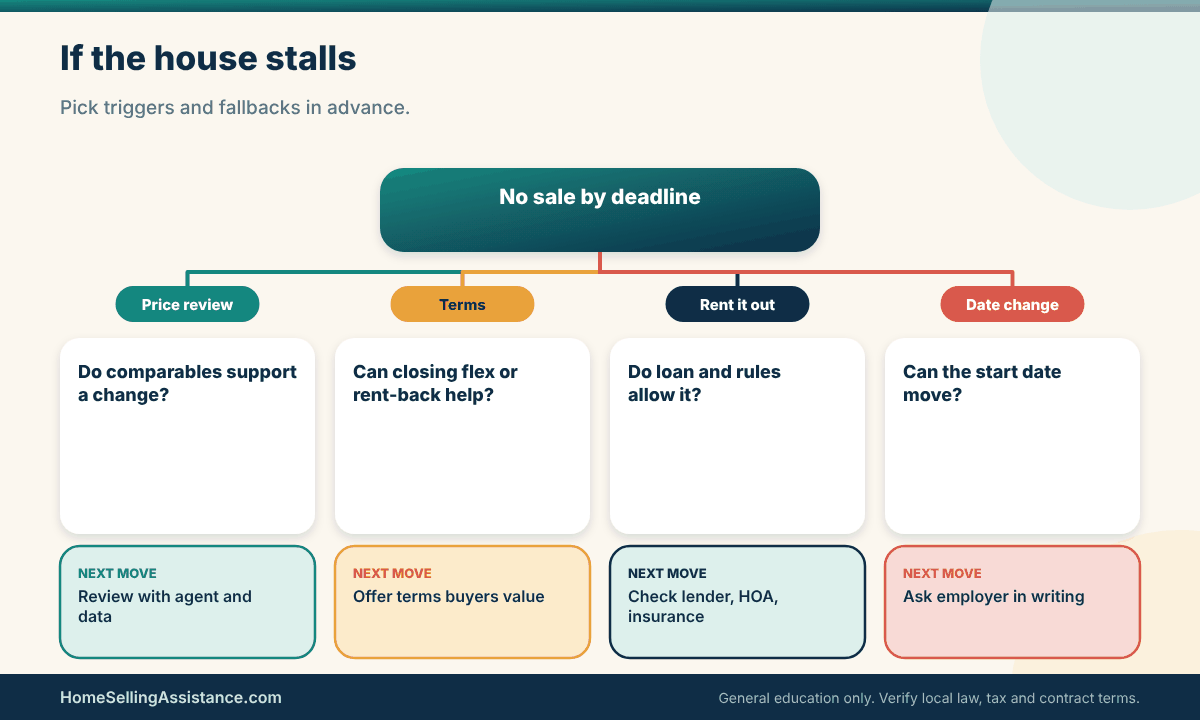
A few habits separate calm moves from chaotic ones, and most of them cost nothing. The first is to keep a single running document for your job relocation sell house plan, with dates, quotes, phone calls and decisions in one place. Transfers generate paperwork from the employer, the lender, the agent, the movers and the landlord, and it is easy to lose a number that matters. A simple note with the date, the person and what they said is enough.
The second habit is to ask every professional the same core questions, so you can compare answers. To a listing agent or attorney, you might ask: what price range do you expect and why, what would you change about the house before listing, what contract terms would help my timeline, and what are the fees and how are they written down?
To a lender: how will my current loan be treated if I buy first, what documents do you need, and what could change my approval? To a tax professional: how does my plan affect the exclusion, and what records should I keep?
The third habit is to separate what you know from what you hope. In a job relocation sell house plan, hope tends to hide in words like “should,” “probably” and “usually.” When you catch one of those in your notes, ask what evidence sits behind it. If the answer is a friend’s story, treat it as a story. If the answer is a comparable sale, a written quote or a contract clause, treat it as a fact.
Common mistakes are worth listing plainly. One is choosing a path because it feels responsible rather than because it fits your numbers; selling fast can feel prudent and still cost you if it means a discount you did not need. Another is ignoring the cost of distance: every trip back to show, repair or inspect the old house has a price in time and money. A third is forgetting that a mortgage payoff statement is different from your balance. A fourth is signing a lease or a purchase contract before you have a realistic view of the sale.
A fifth mistake is trusting averages. Headlines about how long homes take to sell can mislead a seller whose house is priced, presented or located differently from the typical listing. A sixth is skipping the written agreement: if an employer, agent or buyer promises something that affects your plan, ask for it in writing. Verbal assurances fade, and contracts are what a court or a closing agent will read.
Last, remember the human side. A job relocation sell house decision affects partners, children, pets and friends, and the best financial plan can still fail if it ignores them. Build in rest, decide which tasks to outsource, and give yourself permission to change the plan when the facts change. Good decisions are rarely perfect ones. They are the ones that leave you with options when something goes wrong, and with a clear head to use them.
If you are comparing agents during this process, ask each one how they would handle a seller who is already living in another city. A job relocation sell house listing often runs on video calls, digital signatures, a lockbox and a trusted local contact, so the agent’s communication habits matter as much as the sales pitch. Ask who will meet inspectors, who will receive offers, how quickly you will hear about feedback, and what the listing agreement says about ending the relationship if service falls short. Written answers beat verbal ones.
It also helps to think about the old house as an asset you are managing remotely until the sale closes. Keep utilities on so the home can be shown and inspected, maintain the yard, and check your insurer’s rules about vacant homes, since some policies limit coverage after a property has been empty for a stated period. Ask your insurance company directly and keep the answer in writing. A small gap in coverage can turn into a large problem, and it is a cheap one to prevent while you are still organizing your job relocation sell house timeline.
For your next job relocation sell house step, schedule a review date in your calendar now, one to two weeks after you list or after you sign a lease. At that review, ask three questions: what changed, what did it cost, and what would I do differently if I started today? Keep the answers brief and write them down. That habit alone prevents most expensive drift.
If you want to see how all of this fits into the full relocation process, our main guide on how to sell a house for relocation covers the surrounding steps, and our pieces on selling a house when moving out of state and sell first versus buy first explore neighboring decisions. The category page for relocation and downsizing collects the rest, and the page on sell first or buy first gathers the sequencing guides.
Quick scenario
A couple receives a transfer offer with a start date eleven weeks away. They rank their goals: keep the start date, avoid more than two months of double housing, and avoid a deep discount. They gather a payoff statement, two price opinions and the employer’s written date. Their job relocation sell house comparison favors listing at once, asking for a flexible closing and renting a furnished place for the gap. A review date four weeks out tells them when to adjust price. The plan is not perfect, but every step has a number, a trigger and a fallback.
Frequently asked questions about job relocation sell house decisions
Should I sell my house before or after a job relocation?
There is no universal answer, because it depends on your start date, savings, equity and comfort with risk. Selling first gives financial certainty at the cost of a possible housing gap. Selling after the move keeps your options open but means paying for two homes while the old one is on the market. A written job relocation sell house comparison using your own numbers is more reliable than any rule of thumb.
How long does it take to sell a house when I have a job transfer?
The timeline varies by market, price, condition and the buyer’s financing, so no honest answer fits every case. Think in two clocks: time to find an accepted offer, and time from acceptance to closing. Ask local professionals what comparable homes have done recently, then add slack. If your employer’s deadline is tight, build the plan around the slower case rather than the best one.
Will my employer pay for my relocation and the sale of my house?
Some employers offer lump sums, reimbursements or sale-assistance programs, and some offer nothing. Terms differ widely, including what is covered, what must be repaid if you leave early and how benefits are taxed. Ask HR for the policy in writing and read it before you commit to any housing path. Our guide to relocation home sale assistance explains common program types.
Is it smart to keep my house and rent it out after a transfer?
It can be, if your numbers work and your rules allow it. Check your mortgage terms, insurance, any HOA restrictions and local rental regulations first. Then estimate rent after vacancy, repairs, management and taxes, and compare it to your costs. A tax professional can explain how rental use may affect a future sale, which the IRS discusses in its rental property guidance.
Can I buy a new home before my old one sells?
Many people do, using savings, equity borrowing, bridge financing or a sale contingency. The lender will count both mortgages when judging your ability to repay, which can limit how much you can borrow. Ask a lender early how the old loan will be treated, and run the cost of two payments over a cautious number of months. A job relocation sell house plan that depends on a quick sale is a plan with hidden risk.
What if my house does not sell before my start date?
Have a fallback in advance. Options include a price review with comparable sales, adjusting terms such as closing flexibility, renting the house for a defined period or asking your employer about a later start. Each has costs and rules, so put numbers on them. Choose a review date and a cash floor, so you act on a trigger instead of a feeling.
Do I owe taxes when I sell a house because of a job move?
Possibly, but many sellers owe nothing on the sale of a main home thanks to the federal exclusion, which the IRS describes in Publication 523 as up to $250,000 of gain for a single filer or up to $500,000 for qualifying joint filers who meet the ownership and use tests. Exceptions and partial exclusions exist, and state rules differ. Talk to a tax professional about your facts.
Is temporary housing worth the cost?
It can be when it protects you from a rushed sale or a rushed purchase. Weigh the monthly cost, minimum stays and exit fees against the price of a poor decision under pressure. Furnished month-to-month places cost more per month than a standard lease, but they carry less long-term commitment. Compare them with staying with family or friends if that is realistic.
How do I decide between a quick sale and a higher price?
Use the net-result approach: estimate what you keep after all costs in each case, including the cost of extra months. A lower price that closes cleanly may beat a higher price that drags on and drains your reserves, or the reverse. Your job relocation sell house timeline and your cash cushion decide which side of that balance you can afford.
Who should I talk to before I decide?
A local real estate agent or attorney can speak to your market and your contracts, a tax professional can speak to your tax picture, and a lender can speak to financing. For consumer guidance on mortgages, the Consumer Financial Protection Bureau offers general resources. Compare more than one source, and be cautious of anyone promising a particular price or speed.
Your next move
A sound job relocation sell house decision is built from a ranked list of goals, a few verified facts and a net-result comparison you wrote down before emotions took over. Choose a path you can afford in its bad case, set a review date, and keep a fallback ready. This article is general education, not legal, tax or financial advice, so confirm the details with qualified professionals who can read your actual documents.