Deciding to sell house climate risk has pushed you toward is rarely a single moment. It is usually a slow pile-up: an insurance renewal letter with a number you did not expect, a smoky summer, a street that flooded twice in three years, a neighbor who quietly listed and left. This guide helps you sort the facts from the dread and decide whether to sell, when, and by which route.
We want to be plain about what this page is. It is general education for homeowners, written by people who have watched many closings. It is not legal, tax, insurance or financial advice, and it cannot tell you what your particular house will sell for or what your insurer will do next year. What it can do is show you which questions matter, where the real documents live, and how to compare your options with honest arithmetic instead of fear or hope.
A sell house climate risk situation is different from an ordinary sale in three ways. First, the thing worrying you may also worry buyers, lenders and insurers, so it can show up in price and in terms. Second, disclosure questions get sharper, because what you know about floods, fires or claims matters. Third, your emotional timeline and the market’s timeline may not match. Calm planning helps with all three, and it is the whole purpose of a good sell house climate risk plan.
Throughout, we use round, clearly labelled illustrative numbers, never predictions. Rules about disclosure, insurance, flood zones and contracts vary by state and sometimes by county, so we tell you how to check each one. If you are also weighing cost pressure, our companion guide on selling a house because of insurance costs pairs well with this one, and the broader sell house for relocation cornerstone covers the move itself.
Key takeaways
- Separate the risk from the feeling. Write down what has actually happened to the property, what your policy says today, and what is only a fear. The decision gets clearer when the three are not mixed together.
- Insurance is a fact you can price. Get written renewal terms, quotes and exclusions before you decide. A premium you can verify beats a rumor about what neighbors pay.
- Disclosure is your protection. What you know about floods, fires, claims and repairs should be disclosed the way your state requires. Candor now is cheaper than a dispute later.
- Buyers will price the risk their own way. Some walk away, some bargain, some do not care. Plan for all three reactions rather than assuming one.
- Compare routes by net result. Price, time, cost and risk belong in one frame. The highest headline offer is not automatically the best outcome.
- New evidence should be allowed to change the plan. A mitigation upgrade, a new insurer or a bad season can all shift the answer, so build review points into your timeline.
Define your sell house climate risk choice before you list
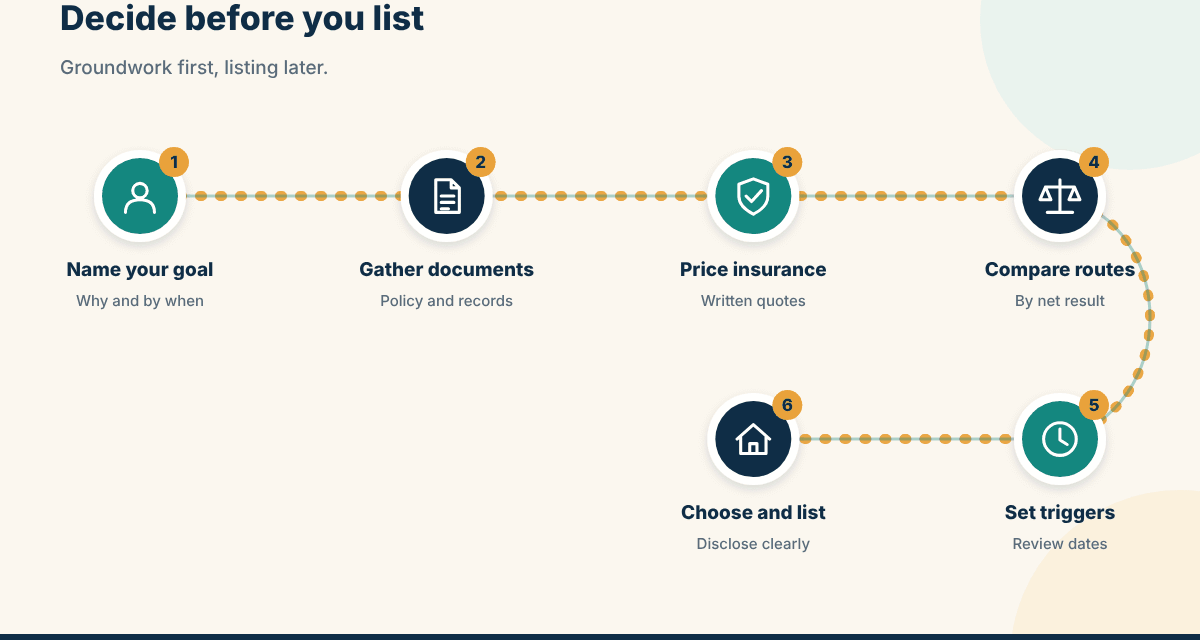
Before you call anyone, it helps to see the whole decision as a sequence. You clarify what you want, you collect documents about the property and the hazard, you compare routes, you test the numbers, and you set points at which you will reconsider. The picture above lays out that order. Notice that listing comes late. The groundwork is mostly reading and phone calls, and it keeps you from selling in a panic or staying out of habit.
Many sellers skip straight to asking what the house is worth. That question matters, but it comes after a more basic one: what is your real choice? Staying and mitigating, selling on the open market, selling quickly as-is, and renting the place out are all different decisions with different costs. A sound sell house climate risk plan names which of those you are actually weighing and why.
Your goal, timeline, cash position and tolerance for another bad season
Start with the human questions, because the market cannot answer them for you. Do you want out because of cost, safety, stress, or a combination? Is there a date by which you must be somewhere else, such as a job start, a school year, or the end of a lease on your next home? How much cash can you commit to repairs or a gap between mortgage payments? And how many more fire seasons, storm seasons or high-water years can you tolerate living with the worry?
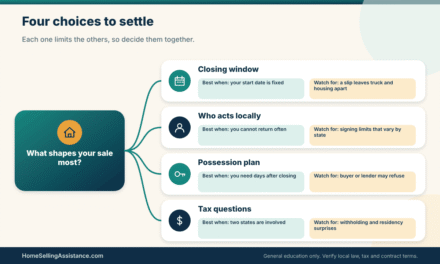
These answers shape everything that follows. A seller with deep reserves and a flexible schedule can afford a slower, higher-priced listing. A seller facing a nonrenewal notice and a closing deadline needs a different plan. Neither is wrong. What matters is that you decide on purpose, because your risk tolerance is part of the price of any sell house climate risk choice, even though it never appears on a listing sheet.
Evidence to gather: policy, premium history and hazard records
Pull together the paper trail that describes your current situation. That means your homeowner policy declarations page, the most recent renewal notice, any nonrenewal or cancellation letter, and the last few years of premium amounts. If you carry a separate flood or wind policy, gather that too. Add your mortgage statement so you know the payoff, plus any lender letters about required coverage. These documents turn a vague worry into numbers you can compare.
Then collect hazard records. Check your flood zone designation through the official mapping resources your county or state publishes, look at any elevation certificate you have, and note whether a wildfire or storm authority has labelled your area. Keep photographs and invoices for past damage and repairs. Rules and map names differ by place, so ask your county planning office or a local insurance professional which sources apply. For a sell house climate risk file, specific dates and amounts always beat memory.
One more habit pays off: write down the questions you cannot answer yet. Perhaps you do not know whether a nearby project will change drainage, or whether your insurer plans to leave the area. List them. Each unanswered question is a place where a quick phone call can change your plan, and having the list in front of you keeps you from deciding as if you knew everything.
A scenario, an exception, and your next step for goal-setting
Consider an illustrative homeowner, call her Dana. Her renewal premium has more than doubled over two cycles, and a smoky season left her sleeping badly. She has solid equity, no deadline, and a mortgage she can carry. Her goal is a calmer life within a year, not a fast exit. That points toward a patient, well-prepared listing and a careful look at insurance options for buyers rather than a rushed discount sale.
Now change one fact. Suppose Dana received a nonrenewal notice with thirty days left and her lender requires coverage. The exception is time. Her priority shifts to securing replacement coverage or planning a faster sale, because lender requirements do not wait for a perfect listing. Her next step in either version is the same: gather the documents above, then talk to a licensed insurance professional and a local agent or attorney before committing to a route.
If you are not sure which version of Dana you resemble, treat the first week as pure information gathering. Make no irreversible moves, such as signing a listing agreement or accepting an investor offer, until you can answer three things in writing: what you want, what your coverage will cost or whether it continues, and what you owe. Those three answers are the foundation of every comparison later in this guide.
One more framing point before the details. Sellers sometimes feel that a sell house climate risk decision must be either brave or foolish, and that anyone who stays is in denial while anyone who leaves is overreacting. Neither reading helps. Households stay for good reasons, such as community, affordability and affection, and leave for equally good ones. A sell house climate risk review should respect both, and simply make sure the choice rests on documents and numbers.
It also helps to know who else is in the conversation. Your insurer, your lender, your agent, a buyer’s inspector and a buyer’s insurer will each look at the same house from a different angle. Understanding what each one cares about makes a sell house climate risk sale less mysterious, and it shows you where a single well-prepared document, such as a mitigation invoice or a written quote, can answer several questions at once.
Facts that could flip the decision between selling and staying
Some facts matter more than others because they can reverse your choice. A realistic sell house climate risk review looks for those swing factors first, and it treats the rest as detail. Three categories deserve early attention: whether you can keep affordable insurance, whether the hazard is likely to change your daily safety or the home’s usability, and whether mitigation could realistically reduce the exposure at a cost you can afford.
It also helps to separate hazard from market reaction. A house can face real risk and still sell well in a market where buyers are less worried, and a house with modest risk can sit if a headline scared the neighborhood. You will not control that gap, but you can learn how wide it looks in your area by asking local professionals how recent comparable homes fared. Keep both layers in view.
Evidence to gather: maps, claims and mitigation records
Maps first. Flood zone designations, wildfire hazard classifications and local hazard overlays are public in many places, though the names and update schedules differ. Print or save what applies to your parcel and note the date you pulled it, because maps get revised. If you have an elevation certificate, a defensible-space inspection, a roof or vent upgrade record, or a sump and drainage report, add it. These documents show a buyer you have paid attention.
Next, claims. Insurers share claims history through databases that lenders and other insurers can see, and sellers are often asked about past claims on disclosure forms. You can usually request your own claims history report so you know what is on file. Compare it with your memory and your repair invoices. If something was paid but never fully repaired, that is a disclosure and a pricing issue you want to understand before a buyer’s inspector finds it.
Finally, mitigation. List what you have already done, such as clearing vegetation, upgrading a roof, adding flood vents, raising equipment or improving grading, and what you have considered but not done. Ask whether any of it qualifies you for insurer discounts, and ask your insurer in writing. A buyer’s agent may well ask the same questions, so having tidy answers helps your negotiating position without any exaggeration. The checklist pictured below groups all of these records so you can see at a glance what is still missing.

A scenario with a hard exception to test
Here is an illustrative case. A couple in a flood-prone neighborhood has a policy that renews at a manageable price, a home that has taken water once, and a basement they finished before that event. They lean toward staying and adding drainage work. The facts that could flip them: a quote that shows the work will cost far more than they expected, or a renewal letter that drops a key coverage. Either one moves the math toward selling.
The exception to test is whether the earlier water event was fully repaired and documented. If it was, they can disclose it with receipts and treat it as a managed history. If repairs were partial or unpermitted, they have a bigger issue, and our guide on selling a house with unpermitted work is worth reading before any listing. The next step is to price the fix, confirm the documents, and decide with real figures rather than worry.
Use this kind of two-fact test on your own sell house climate risk situation. Pick the one or two numbers that would most change your mind, such as a premium ceiling you cannot exceed or a repair cost beyond which staying stops making sense. Write them down now, while you are calm. When the quote or the letter arrives, you will already know what it means, and you will be less likely to bargain with yourself under stress.
Compare realistic paths for a sell house climate risk move
Once the groundwork is done, you can compare routes without guessing. Most homeowners facing a sell house climate risk decision end up choosing among a handful of paths: list on the open market as the house stands, make targeted improvements first and then list, sell as-is to a buyer who accepts condition and risk, or hold the property for a while and sell later. Each one spreads price, time and effort differently, and each depends on facts only you can check.
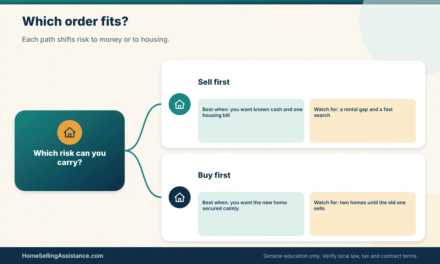
The fork pictured below shows two of the most common branches side by side. Think of it as a sketch, not a verdict. Which branch suits you depends on your deadline, your reserves and how the market in your area is treating homes with your hazard profile. We stay neutral on agents, investors and do-it-yourself routes, because each can be right in a particular sell house climate risk situation.

The table that follows lines up the routes against the factors that tend to decide outcomes. Read it row by row, and then replace our general descriptions with what your own quotes and contracts say. Where a cell says a factor varies, that is deliberate. Any claim about price or speed in this field depends on local demand, on the specific hazard and on the terms a buyer’s lender will accept.
| Route | Price and net proceeds | Time | Contingencies | Workload and execution risk |
|---|---|---|---|---|
| List as-is on the open market | Widest buyer pool; risk may be priced in | Varies with demand | Inspection, financing, insurance | Moderate; insurance questions can delay |
| Mitigate, then list | May widen appeal; cost reduces net | Adds weeks or months | Same, fewer surprises | Higher; contractors and permits |
| Sell as-is to a cash buyer or investor | Often discounted for speed | Can be short | Fewer, but check each one | Lower workload; verify buyer funds |
| Private sale to a neighbor or known buyer | Negotiated; needs fair evidence | Depends on the buyer | Terms are whatever you agree | Paperwork and fairness risks |
| Auction | Result varies; reserve rules matter | Fixed date | Usually few | Fees and terms need careful reading |
| Hold or rent, then sell later | Unknown; exposure continues | Open-ended | None until you list | Landlord duties and ongoing premiums |
To use the matrix, circle the two rows that fit your deadline, then ask a local agent, attorney or title company to confirm what each route actually requires in your state. Compare the rows on net outcome, not on headline price. A smaller offer with fewer delays can leave you better off than a larger offer that depends on a lender, an insurer and an inspector all cooperating.
Path one: list on the open market and disclose openly
The open-market route is what most people picture, and it remains a common way to sell house climate risk exposure to a buyer who understands it. You hire a listing agent or use another listing method, price the home against recent sales, market it widely and negotiate. Its strength is exposure: more buyers see the home, and competition can support price when the market is healthy. Its weakness is that the buyer pool includes lenders, insurers and inspectors, each of whom can reopen questions about the hazard after you think a deal is done.
For a sell house climate risk listing, the details of the pitch matter. Buyers tend to ask the same questions in the same order: what does insurance cost, has the house been damaged, and what has been done about it. Sellers who answer those questions with documents tend to keep deals together better than sellers who answer with reassurance. You are not required to sound alarmed, but you are well served by sounding specific.
Evidence to gather: insurance quotes, disclosures and comparable sales
Before you list, get at least a couple of insurance quotes for the property as a buyer would see it, using the address and the home’s features. Ask an independent insurance agent to explain what is excluded, what the deductibles are and whether coverage depends on mitigation work. Keep the written quotes. A buyer who can see a real number is less likely to invent a frightening one, and an estimate in writing is more persuasive than an assurance.
Then work on disclosure and comps together. Ask your agent or attorney for your state’s required forms and for any local addenda about flood, fire or other hazards, since requirements differ widely. Ask for recent sales of similar homes in comparable hazard conditions, including days on market and whether the sale price differed from list. Our guide on seller disclosure requirements explains the general logic. The point is to price from evidence, not from either optimism or dread.
If you are preparing a sell house climate risk listing, consider asking a lender-side contact how buyers financing the purchase might be treated. Some lenders require specific coverage and escrow arrangements in higher-risk areas, and a buyer who cannot get coverage cannot close. You are not advising the buyer, but understanding the likely requirements helps you spot trouble early, set a realistic closing timeline and decide which contingencies to accept.
A scenario, an exception, and your next step for the open-market route
Picture an illustrative seller with a well-kept home in an area where wildfire has become a regular topic. She lists at a price supported by sales that already reflect the concern, attaches defensible-space documents and two insurance quotes, and receives a handful of showings. One buyer’s insurer declines coverage after an inspection. Because she had backup quotes and a patient timeline, she pauses showings for a week, relists, and a second buyer closes.
The exception is the seller who has a hard deadline. If she must close within a few weeks, a slower open-market process may collide with a lender or insurer timeline she cannot control. In that case she should ask her agent how backup offers work in her state and consider whether a faster route deserves a place in her plan. Your next step is to write down the latest date you can accept a closing and to test every route against it.
If you are moving far away, selling a house when moving out of state covers the logistics. Whatever your timeline, treat every offer as an offer to be understood and not as a verdict on your house. A low offer might reflect a buyer who needs insurance to be cheaper, or an investor who prices every sale the same way. Ask what is driving the number, and which of those drivers you could change with a document, a repair or a concession, before you decide the market is rejecting your home.
Path two: sell as-is to a cash buyer, investor or other flexible buyer
The second path trades breadth for certainty, which can matter when a sell house climate risk deadline is close. Cash buyers and investors generally do not rely on a mortgage appraisal or a buyer-side insurance approval in the same way, so they can sometimes close more quickly and accept condition and hazard as they stand. That convenience usually comes with a discount, and the size of the discount varies by buyer, area and property. We are neutral on whether it is worth it, because for some sellers the answer is clearly yes.
The key is to verify the buyer and read the contract, not to assume the pitch is true. Our articles on evaluating a cash offer and on selling a house as-is go deeper. In a sell house climate risk setting, as-is buyers may build the hazard into their price from the first call, so ask them to explain how they calculated the number and what costs they expect you to bear.
Evidence to gather: proof of funds, contract terms and the real net
Start with proof of funds. A legitimate cash buyer can show a recent bank or brokerage statement or a lender letter that matches the buyer’s name or entity. Ask who the actual purchasing entity is and who will sign. Beware of vague promises, requests for fees up front, or pressure to sign before you have read everything. The Federal Trade Commission’s consumer site publishes general guidance on recognizing pressure tactics and scams.
Then read the contract with care. Look at the deposit terms, the inspection or due-diligence period, any right for the buyer to cancel or renegotiate, who pays closing costs and what happens if the buyer cannot close. Some investor contracts contain assignment clauses that let the buyer pass the contract to someone else, which changes who you are actually dealing with. Have an attorney or title professional review anything you do not fully understand before you sign.
Finally, calculate the real net. Compare the as-is offer with a realistic open-market net, after commissions if any, repairs you would likely make, carrying costs while you wait, and the cost of risk you carry during a longer sale. Our article on home sale net proceeds shows how to build that comparison. If a quick sale leaves you with less money but removes months of premium payments and anxiety, that may be a rational trade. You decide.
A scenario and an exception for the as-is path
Imagine a homeowner whose area flooded in a recent storm and whose insurer has issued a nonrenewal notice. He needs a clean break within a short window and cannot afford repairs. He collects two or three as-is offers, verifies proof of funds, reads each contract and chooses the one with the shortest due-diligence window and clearest closing terms, even though another bid was a bit higher on paper. He judges the certainty worth the difference.
The exception is the seller who has a good chance of a higher open-market result and the cash to wait. If the premium is manageable and the property is salable, jumping at the first discounted offer may leave money behind. Your next step is to ask two or three buyers for written offers, compare each one against your open-market net, and hold the decision until you can see the trade in plain numbers.
A related caution concerns urgency. Distressed-property marketers sometimes use a recent disaster as a reason to press for an immediate signature. A genuine buyer can usually survive a day or two while you read the contract and, if you wish, ask an attorney to review it. If anyone insists you cannot take that time, treat the insistence itself as information, and slow down until the pressure lifts.
Use a net-result rule for every sell house climate risk offer
Offers in this field can be confusing because they differ on several things at once. One has a higher price and a longer fuse. Another has a lower price, no inspection period and a faster date. A third asks you to credit the buyer for insurance costs. The simplest way to sort them is a net-result rule: for each offer, estimate what you would keep, how long it would take, what could go wrong, and what it would cost you to wait. Then compare the totals. A sell house climate risk decision made this way is easier to defend later.
The net-result rule for a sell house climate risk choice does not tell you which option is correct, and it cannot account for feelings such as relief or attachment. What it does is stop a single flashy number from deciding for you. It also gives you a way to explain your choice to a spouse, a co-owner, an heir or a lender without relying on vague claims about the market.
Price, time, cost and risk in one frame
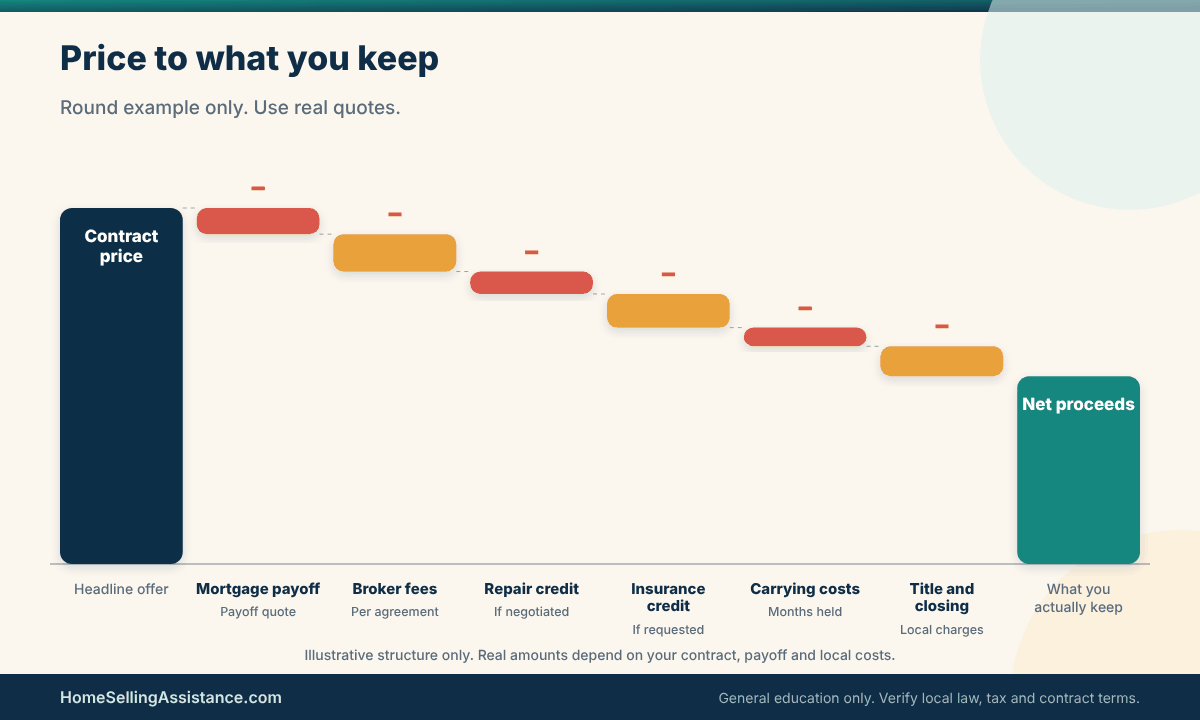
Think of four buckets. Price is the contract figure. Time is how long you will carry the home, with its taxes, insurance, utilities and upkeep, until money lands in your account. Cost covers the items that come out of the sale, from payoff to fees to repairs or credits. Risk is the chance that the deal changes or collapses and what that would cost you. Everything you compare should land in one of the four.
The waterfall pictured below shows the cost bucket in action, using round example numbers that are not forecasts. Starting from a contract price, each deduction narrows the result until you reach the amount you would actually keep. Build your own version with real quotes. Sellers who are also downsizing may want our guide on downsizing and home selling for the next-home side. A sell house climate risk sale tends to include a few unusual lines, such as an insurance credit or a mitigation repair, and those lines are exactly what a quick glance at headline price hides.
Evidence to gather: payoff figures, quotes and carrying costs
Begin with your payoff. Ask your mortgage servicer for a written payoff quote and for any per-day interest after the quote date. Add other liens you know about, such as a home equity line, then total your property tax and insurance cost per month for the likely holding period. Our guide on mortgage payoff when selling a house explains the process. Without these numbers, any net estimate is a guess dressed up in tidy figures.
Next, price the repairs and credits that realistically belong in each route. If a buyer will ask for a roof or vent upgrade, get a contractor estimate now instead of relying on a buyer’s number. If you might offer an insurance or repair credit, decide in advance the largest one you would accept. For a sell house climate risk listing, the line items to watch are credits, escrow holdbacks, post-closing repair promises and any price reduction tied to coverage.
Finally, put a rough price on waiting, because a slow sell house climate risk sale has its own cost. Ask yourself what another six months of premium, mortgage interest, maintenance and stress would cost, in dollars and in other ways. Then compare that with the amount a slower or more mitigated route might add to your net. If waiting costs more than it earns, speed has value. If it earns more than it costs, patience does. Use illustrative round figures to test both outcomes, and revisit them as real quotes arrive.
A tidy way to keep this honest is a one-page worksheet with one column per route and one row per bucket. Fill each cell with a number or a short phrase such as “unknown until quote.” Unknown cells are useful, because they show you which phone call to make next. When every cell has a real figure or a clearly bounded range, you are ready to compare, and not before.
A scenario and an exception for the net-result rule
Here is an illustrative comparison with deliberately simple round numbers. Offer A is an open-market contract at 400 (in thousands) with a buyer’s financing contingency, and you expect to carry the home for several more months. Offer B is an as-is cash offer at 370 with a short closing. After fees, repairs and months of carrying costs, the gap between the two nets may be much narrower than the 30 difference in price suggests, or it may be wider, depending on your actual figures.
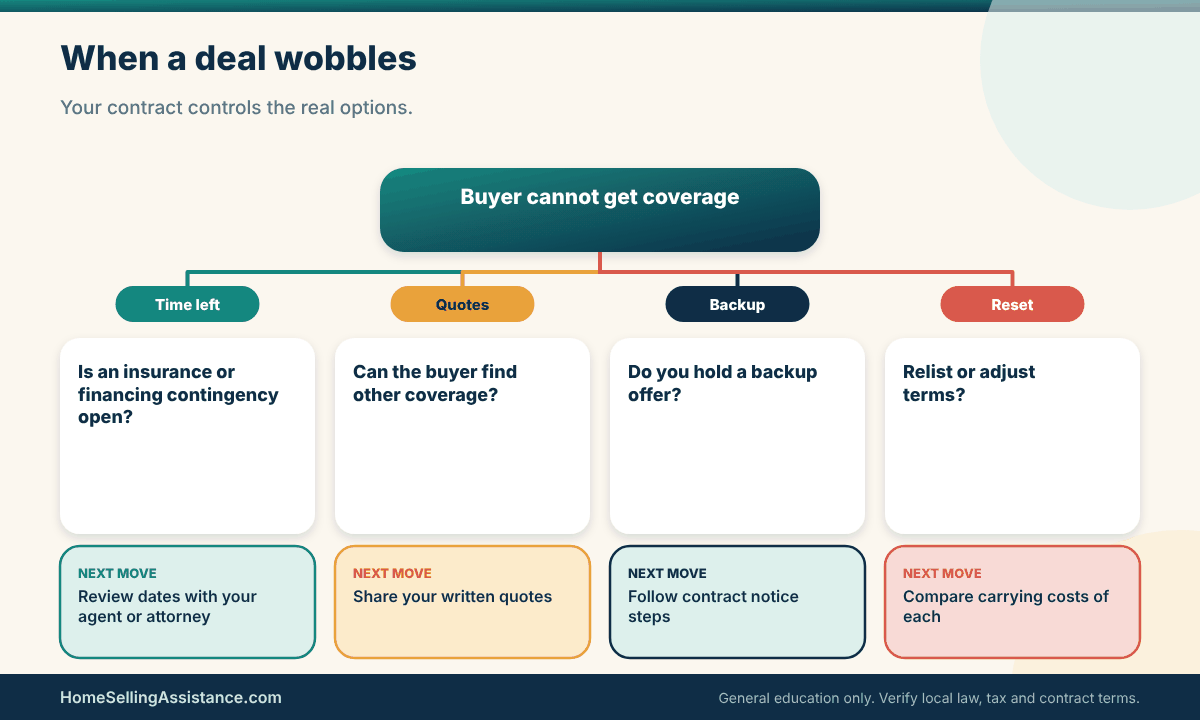
The exception is risk of failure. If Offer A depends on a buyer getting insurance that may not be available, its expected net should be discounted for the chance that it collapses and you start over, probably during a worse season. That is not arithmetic you can do precisely, but you can reason about it in ranges. Your next step is to ask your agent or attorney what happens to your timeline and your deposit if the first buyer cannot close.
Resist the temptation to turn that risk into a false percentage. Nobody can honestly say there is a particular chance a given buyer will fail to get coverage. You can, however, describe the downside in plain language: how many weeks it would cost, what the premium would be during that time, and what you would do next. A concrete fallback plan is more useful than a number that only looks scientific.
The table below turns the same logic into a quick reference for common situations. It is general and cannot replace local advice, but it shows how the preferred route changes when a single fact changes. Use it to spot which of your facts is the swing factor and then verify that fact with a professional or a primary document.
| Situation | Route favored | Reason | Trade-off | Fact that changes the choice |
|---|---|---|---|---|
| Premium rising but still affordable, no deadline | Mitigate, then list | Time lets you improve appeal | Upfront cost and delay | A contractor quote far above budget |
| Nonrenewal notice with a lender coverage rule | As-is sale or fast replacement coverage | Coverage gap is a hard deadline | Possible discount | Finding affordable replacement coverage |
| Recent flood damage, repairs incomplete | As-is route with full disclosure | Buyers can price repairs themselves | Lower price likely | Insurance claim still unresolved |
| Strong equity, calm timeline, mild exposure | Open-market listing | Widest buyer pool | Contingency risk | Local buyers pricing the hazard heavily |
| Co-owners disagree on selling | Negotiate before any listing | Everyone must sign eventually | Slower start | Whether the deed or a court order controls |
| Second home with no one living there | Open-market or as-is, by workload | Vacancy adds risk and upkeep | Premium and security costs | Vacancy clauses in the policy |
When you read the table, look for the rightmost column first. It names the fact that would flip the answer, which is the one worth confirming before you commit. If you cannot yet verify that fact, treat the route in the second column as provisional. The sell house climate risk plan that stays flexible until the key fact is confirmed is usually the sturdier one.
Keep one practical rule in mind as you compare offers. Ask each buyer, in writing, which conditions must be satisfied for closing, who controls each condition, and by what date. In a sell house climate risk transaction, the conditions most likely to move are insurance approval, a lender’s appraisal and the inspection response. If you can see who controls each one, you can judge which offers are firm and which only look firm.
Similarly, ask each agent or advisor how they would test a sell house climate risk offer against your four buckets. A good answer names specific documents and dates. A weak answer repeats general reassurance. You are not looking for a prediction, only for a process you can follow and verify, and for professionals who are willing to put their reasoning in front of you.
When new evidence should change the plan
Good plans have review points. A sell house climate risk decision made in spring may look different after a storm season, a new insurer filing, an updated flood map or a buyer’s inspection report. The goal is not to be indecisive. It is to define in advance which new facts would cause you to change course, so that you respond to evidence and not to a mood.
Write your sell house climate risk triggers down. A trigger might be an offer below a floor you set, a premium quote above a ceiling, an insurer’s formal nonrenewal, a mitigation estimate beyond a limit, or a change in your own deadline. When a trigger fires, you pause and run the four-bucket comparison again. That habit keeps you from either clinging to an old plan or abandoning it too early.
Evidence to gather: new quotes, map updates and buyer feedback
Several kinds of fresh information deserve attention. New insurance quotes may be better or worse than the last ones, and a different insurer may treat your mitigation work differently. Map or zoning updates can alter lender and insurer requirements, so check the official source for your area periodically. Buyer feedback from showings and inspections shows you which concerns are real in your market and which are noise.
Pay particular attention to patterns in buyer feedback. If several visitors mention insurance, that is a pricing signal and a reason to have quotes ready. If they mention smoke smell, water stains or a specific defect, you have a fixable presentation or repair problem. If feedback is mostly about price, compare your list price to recent sold prices, not just to other asking prices, and review our article on home price reduction strategy.
Keep a simple log of dates and what changed. When an offer arrives, look at what has changed since the last time you compared routes. Did your premium quote change? Did a buyer’s inspection find something new? Has the calendar shifted your deadline? The log makes it easy to see whether you are reacting to a real change or to anxiety, and it will be handy if you work with an agent or attorney.
A scenario and an exception for changing course
Consider an illustrative seller who listed at a price he thought fair and received one offer with a long financing contingency. At the same time his insurer raised the renewal quote. His triggers were an offer below his floor and a premium above his ceiling, and both fired. He reviewed the options, accepted a shorter-fuse offer from a verified buyer, and negotiated a modest closing date extension so he could move calmly.
The exception is changing course too often. A seller who reacts to every comment may lose momentum, relist repeatedly and wear out his own patience. Decide on a minimum review interval, such as after a set number of showings or weeks, and stick to it unless a hard trigger fires. Your next step is to write your triggers and review dates now, then share them with whoever is helping you.
If you need a fallback structure for a deal that wobbles, the tree pictured below shows one way to organize the questions. It does not replace your contract, which controls what you can do, and it does not replace advice from an attorney or agent who has read the documents. It simply shows that every branch has a next question, which is often enough to turn panic back into a plan.
Quick scenario
A retired couple owns a home they love in an area where insurers are pulling back. They do not want to rush, but they also do not want a coverage gap. They get written quotes, ask a local agent for recent comparable sales, price repairs, and set two triggers: a premium ceiling and a deadline. With those in hand, a sell house climate risk plan becomes a calm checklist rather than a series of anxious phone calls. Their story is illustrative, not typical.
Frequently asked questions about sell house climate risk
Do I have to disclose flood, fire or storm history when I sell?
Disclosure duties differ by state, and some places also add local requirements for specific hazards. In general, sellers are often asked about known past damage, claims and repairs, and being truthful protects you. Ask your state real estate commission, a local agent or a real estate attorney which forms apply to your sell house climate risk sale. Our guide to material defects and seller disclosure explains the broader idea.
Will buyers pay less because of climate exposure?
Sometimes, but nobody can honestly give you a universal figure. Some buyers will bargain hard, some will walk, and some will care very little, depending on the area, the hazard and what insurance costs there. The best way to learn how your market reacts is to ask a local agent for recent comparable sales and days on market. Any sell house climate risk price estimate should be treated as a range, not a promise.
Can I sell a house that I cannot insure?
It is often possible, but it narrows your buyer pool, because buyers using a mortgage usually need coverage to close. Cash buyers may be more flexible, though they will price the problem. Some states offer insurers of last resort, and your agent or an independent insurance professional can explain what exists locally. If you are in this position, ask early whether a sell house climate risk buyer can actually obtain a policy.
Should I repair or mitigate before I list?
It depends on cost, time and what buyers in your market seem to value. Some improvements can ease insurance questions and widen appeal, while others cost more than they return. Get contractor quotes and compare them with the likely effect on your net. Our guide on repair credits versus seller repairs helps you think about that trade-off before spending money on a sell house climate risk property.
Is an as-is sale to an investor a bad idea?
Not necessarily. For a seller who needs speed or cannot afford repairs, it can be a reasonable choice, even at a discount. The risks come from unverified buyers, vague contracts and pressure to sign fast. Check proof of funds, read every term and consider an attorney review before you commit. A fair sell house climate risk comparison treats the as-is route as one option among several, not a trap or a rescue.
What if my insurer cancels or does not renew my policy?
Read the notice carefully for dates, reasons and any appeal or replacement options, and contact your state insurance department or an independent agent about alternatives. If you have a mortgage, tell your servicer what you are doing, because lenders often require continuous coverage. Our guide on selling because of insurance costs covers the cost angle. Act early, since timelines in a sell house climate risk case can be short.
Can I sell to a neighbor or family member?
Yes, and some sellers find it comfortable, but fairness and paperwork still matter. Use written terms, a clear price supported by evidence and a title or closing professional to handle the transfer. Family sales raise special questions about gifts, taxes and lender rules, which vary by situation, so get professional advice. Our article on selling a house to a family member offers more background for a sell house climate risk transfer.
How do taxes work if I sell at a loss or a gain?
Tax outcomes depend on your own facts, including how long you owned and lived in the home, your basis and any insurance proceeds you received. The IRS explains the general rules in Publication 523, Selling Your Home. A qualified tax professional can apply them to you. Nothing about a sell house climate risk motive changes the need for careful records.
Where can I find help if I feel overwhelmed or pressured?
Start with people who have no stake in your sale. HUD maintains a directory of housing counselors, and the Consumer Financial Protection Bureau publishes general guidance on mortgages and scams. A real estate attorney can review contracts. If anyone pushes you to decide immediately, slow down, because a sound sell house climate risk plan survives a day of reading.
A calm way forward
Choosing to sell house climate risk has worried you about does not mean you are panicking or giving up. It means you are paying attention. Gather your documents, price your options on net results, disclose what you know, and keep review points on the calendar. For the wider move, see our sell house for relocation guide and the relocation and downsizing category. This is general education, not legal, tax or financial advice, so check the details with licensed local professionals.