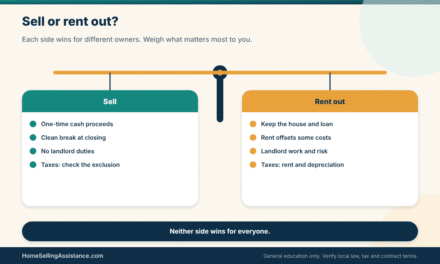
Every offer on your house comes with a price and a date, and a flexible closing date seller is simply someone who treats the date as something they can spend, the way they would spend a repair credit or a concession, to make the whole package more attractive or more useful to themselves. Sometimes that means closing sooner than a buyer expected. Sometimes it means closing later, giving the buyer room to sell a house or finish a lease, or staying in the home for a few days or weeks after the deed changes hands.
Most sellers think of the closing date as a calendar fact, something that falls out of the contract like a delivery estimate. In practice it is one of the most negotiable terms in the deal. Buyers have clocks of their own: a rate lock that expires, a lease that ends, a school year, a job start, a house they still have to sell. A flexible closing date seller who can bend toward those clocks often has something worth real money to offer, and a seller who cannot bend may be giving up leverage without noticing.
The catch is that time is never free. Every extra week between signing and closing is a week in which the buyer’s loan can wobble, the market can shift, the roof can leak, the insurance can lapse and your own plans can change. What works for one flexible closing date seller can quietly cost another. In short, the flexible closing date seller question is really a question about leverage and limits.
The goal of this guide is to help you work out which kind of flexible closing date seller you are, if any, what each kind of flexibility is likely to buy you, and what it may cost.
We will keep this general and practical. You will see how to separate the closing date from the possession date, how to compare a firm early close with a flexible window, how to put price, time, cost and risk on the same page, and when new evidence should make you change course. Nothing here replaces your contract, your title company or your attorney, but it should help you ask sharper questions of all three.
Key takeaways
- Time is a term you can trade. A flexible closing date seller can offer an earlier close, a later close, a buyer-chosen window or post-closing occupancy, and each one is worth something different to different buyers.
- Closing date and possession date are separate. Moving one without the other changes who carries insurance, utilities, risk of damage and the keys, so write both down.
- Compare offers by net result, not headline price. A slightly lower price with a clean, well-timed close can leave you in a better position than a higher price with a long, fragile timeline.
- Your own next move sets your limits. If you are buying, your purchase contract and your lender’s deadlines decide how flexible you can safely afford to be.
- Flexibility needs guardrails. Outside dates, per-day extension terms, deposit rules and written occupancy terms keep a generous timeline from turning into an open-ended risk.
- Rules and customs vary. Contract forms, escrow practices and occupancy rules differ by state and county, so confirm the details with local professionals.
What a flexible closing date seller is really choosing
Before you can decide how flexible to be, it helps to see what is actually on the table. The closing date is the day the deed is signed, funds move and ownership transfers under the contract. Everything that surrounds it, such as the title work, the buyer’s final loan approval, your payoff statement and the walkthrough, is built to land on or before that day. Change the date and you change the whole chain.
Many sellers also tie the date to a feeling: “I want this over with.” That is understandable, and it is a legitimate goal. It just is not a plan yet. A plan names a date range you can live with, the costs of each end of that range and the facts that would push you toward one end or the other.
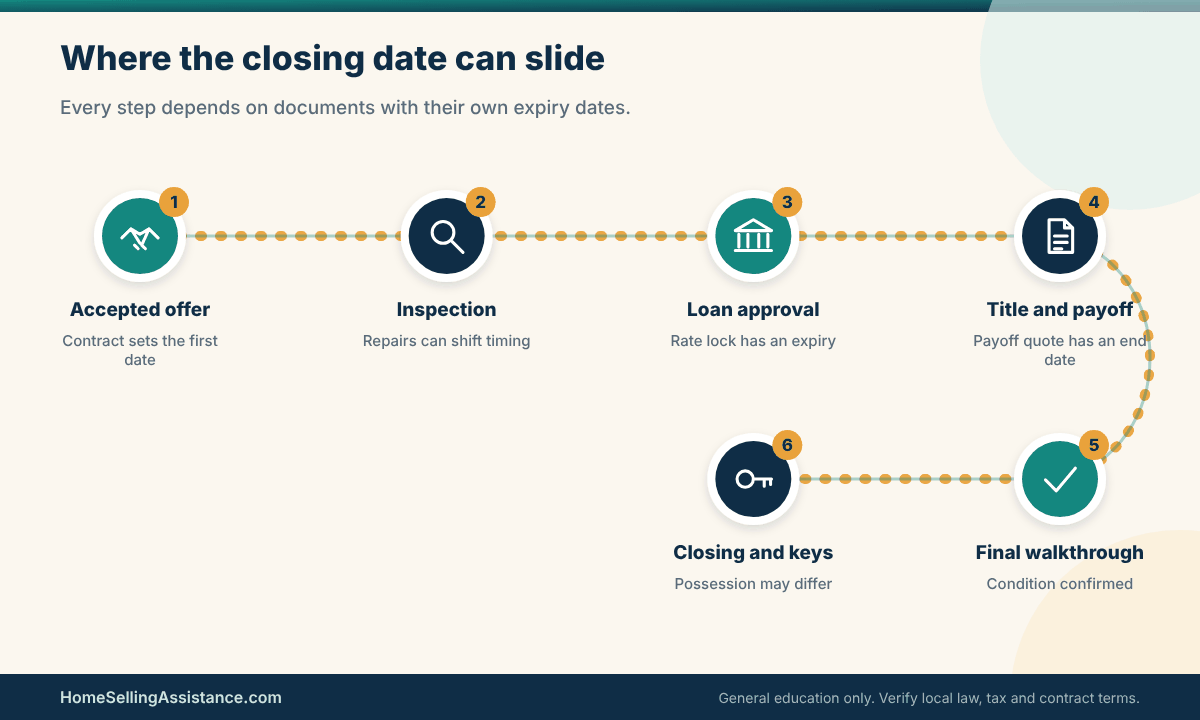
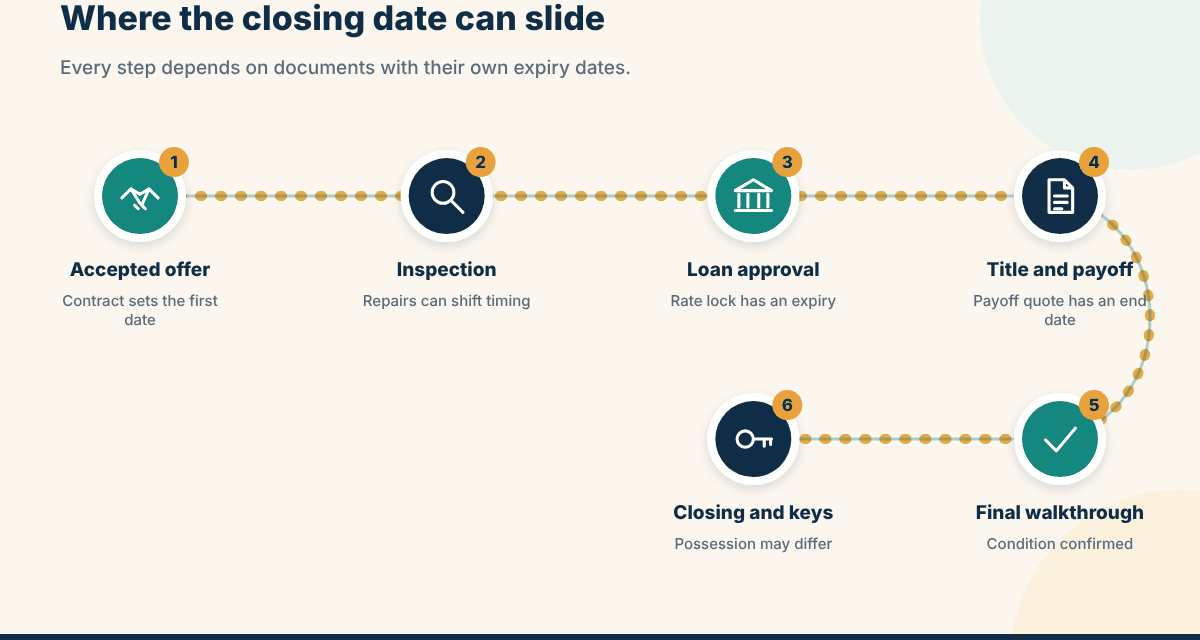
The picture above shows the basic sequence of a sale and the points where a date can slide. Notice how many steps depend on documents with their own expiry dates. We will keep coming back to that idea, because the clocks that sit inside the contract are usually what turn a flexible date from a convenience into a risk.
How a flexible closing date seller weighs goal, timeline, cash, condition and risk
Start with five questions that every seller can answer before listing. What is the goal of this sale, in plain terms? What is the earliest and latest date you could close without hardship? How much cash cushion do you hold if the sale runs long? What condition is the home in, and does it need anything finished before a buyer arrives? And how much uncertainty can you tolerate before you would rather take a simpler offer?
Those answers work together. A flexible closing date seller with a paid-off house, a comfortable cushion and no purchase to coordinate can be very flexible at low cost. A seller carrying a mortgage, buying a replacement home and relying on sale proceeds for the down payment has much narrower room. The same offer can be a gift to the first seller and a trap for the second.
If you are in the second group, read our companion guides on selling a house before buying another and on the opposite sequence in buying before selling your current home. They cover the cash-flow side of timing in more detail than this article can. Our sell first or buy first category gathers the rest of that series.
Evidence to gather: your payoff, your next contract, your calendar
Your standing as a flexible closing date seller is only as real as the paperwork behind it, so gather the documents that set your outer limits. First, request a payoff statement from your mortgage servicer. It shows the principal balance, the daily interest that accrues and the date through which the quoted figure is good. Interest keeps running each day until the loan is paid off, which is one reason a later close is not free for you even if the buyer asks nicely. Our guide to mortgage payoff when selling a house explains how the figure is built.
Second, if you are buying, pull your own purchase contract and mark its closing date, financing deadline, inspection deadline and any extension rights. Your sale date and your purchase date have to fit together. Third, check your calendar for the dull but decisive things: lease or notice deadlines if you rent temporarily, school registration windows, a job start date, a family event, a movers’ booking you cannot easily change.
Finally, ask your insurance agent how coverage works if you close later than planned, or if you stay after closing. Policies differ, and some insurers want to be told about vacancy or a change in occupancy. Write down what you learn, with names and dates. When an offer arrives, this one-page summary lets you answer in minutes instead of guessing, and it keeps you from agreeing to a date that your own paperwork cannot support.
A scenario, an exception, and your next step for the planning seller
Picture a flexible closing date seller we will call Dana, who owns a home with a mortgage and plans to buy a smaller place. Dana’s purchase contract closes on the 20th of the month. An offer arrives that is strong on price but asks to close on the 5th, two weeks earlier. On paper Dana is being asked to be flexible in the fast direction, and Dana has no cushion for temporary housing.
The exception is that early is not always the easy direction. If Dana’s buyer is willing to let Dana stay in the home for those two weeks under a short written occupancy agreement, the early close could work, because the proceeds arrive in time and the housing gap disappears. The terms for that stay matter, so see the guide on a rent-back agreement after closing before agreeing to anything verbally.
Dana’s next step is not to say yes or no. It is to counter with a date and possession combination that fits the real constraints: close on the 5th, occupy through the 20th, with a daily charge, a deposit held by the title company and clear insurance responsibilities. Whether the buyer accepts is up to the buyer, and nothing guarantees they will. But the counter keeps the price strength of the offer while protecting Dana’s next purchase.
Facts that can change what flexibility is worth
For a flexible closing date seller, flexibility has no fixed price. Its value depends on who is across the table and what their clock looks like. A buyer who must be out of a lease by the end of the month may pay in price, in fewer demands or in speed for a seller who can match that date. A buyer who has to sell a house first may value a longer window more than a small price increase, although a longer window also adds uncertainty for you.
Some facts push the value up: a tight local market with several competing offers, a buyer with a deadline they cannot move, or a buyer whose financing is already strong. Other facts push it down: a buyer whose financing is thin, a long window with no extension fee, or a house whose condition could change while it waits. Your agent or attorney can help you read these signals, though neither can promise how any particular buyer will behave.
Evidence to gather: buyer-side clocks you can verify
When an offer asks for a particular date, find out why. A direct question to the buyer’s agent is polite and ordinary: what is driving the date? The answer tells you whether the date is firm or a preference. A lease ending on a fixed day is firm. A hope to be settled before the holidays is softer and may flex if you offer something else.
Next, look at the financing documents that come with the offer. A pre-approval letter or a lender’s verification is not a guarantee of a loan, but it tells you who the lender is and gives you someone to contact through the proper channels. Rate locks usually have an expiry date, and extending a lock often costs the buyer something, which can make a long closing window less attractive to a buyer than it first sounds. Our guide to the financing contingency from the seller’s side covers what to watch while the loan is processed.
If the buyer has a house to sell, ask to see the status of that sale: is it listed, under contract, or not yet on the market? A buyer whose own sale is already under contract has a clock you can reason about. A buyer who has not listed yet has an open-ended one. See the article on a buyer’s home-sale contingency for the clauses that protect you, such as kick-out rights and deadlines.
A scenario where flexibility backfires, and what to do
Now picture the other side. A flexible closing date seller agrees to a 75-day closing to win a buyer who says they need time to sell their current home. Nothing in the contract limits the extension, and no one asks about the status of the buyer’s listing. Two months in, the buyer’s own sale falls through, and the seller discovers that the market has softened since the original price was set.
The seller is not necessarily stuck, but they are in a weaker position than if they had asked for guardrails at the start. A firm outside date, a requirement that the buyer provide updates on their sale, a clause allowing the seller to keep marketing and accept a backup offer, and an extension fee per day would have changed the picture. Compare the options in our guide to a backup offer.
The lesson is not that long closings are bad. Plenty of them go smoothly. The lesson is that flexibility should arrive with conditions, so that if the buyer’s plan changes, yours does not have to collapse along with it. Before you offer or accept an unusual timeline, ask yourself what you would do on day 30, day 60 and the last day if nothing had improved.
Comparing a firm date with the flexible closing date seller approach
Once your limits are clear, the real comparison is between two broad paths. In the first, you hold a firm date, usually an early or on-schedule one, and let the buyer adapt. In the second, you offer room: a window, an extension right, a later date or occupancy after closing. Neither path wins for every flexible closing date seller. Each trades something you may care about for something the buyer cares about.
The matrix below sets the two paths side by side across the dimensions most sellers actually argue about. The cells are written in general terms because your numbers depend on your contract, your market and your loan. Read it as a prompt for questions rather than a verdict, and fill in your own figures from real quotes before you rely on any row.
| Factor | Path A: firm date | Path B: flexible window | What to check |
|---|---|---|---|
| Price and net proceeds | Often simpler to compare; may draw fewer buyers with timing needs | May support a stronger price or fewer demands from a buyer who needs time | Net after payoff interest, carrying costs and prorations |
| Time to money | Predictable if the buyer can meet the date | Later or open-ended; depends on the window and outside date | Your next purchase deadline and payoff good-through date |
| Contingencies | Tighter deadlines can leave less room for loan or repair surprises | More slack for buyers, but more time for conditions to change | Financing, appraisal, inspection and home-sale deadlines |
| Your workload | Compressed packing, moving and utility changes | Looser, but may mean showing, insuring and maintaining longer | Movers, storage, utilities and insurance notice |
| Execution risk | Missed date can trigger disputes or extension requests | Rate-lock, market and buyer-circumstance changes over a longer period | Outside date, extension fee, deposit and default terms |
| Fit with your next home | Works when your purchase can absorb the date | Works when you need overlap, occupancy or a later move | Your purchase contract and lender timeline |
To use the matrix, pick the two rows that matter most to you and write one honest sentence under each path. A flexible closing date seller who cares most about certainty and has a fixed purchase date will usually find the firm path easier to defend. A seller whose priority is a clean overlap between homes, or who wants the strongest possible offer from a time-pressed buyer, may find the flexible path more useful. Keep the other rows as a checklist for the contract.
Path one: a firm, early or on-schedule closing date
A firm date means you tell buyers that you plan to close by a certain day, and you hold that line. For a flexible closing date seller who holds firm, the advantage is clarity. Everyone works backward from the same deadline, the title company schedules the signing, and your own purchase and movers can be lined up around it. If you have a purchase contract with its own date, this is often the most comfortable path to start with.
The trade-off is that a firm date screens out some buyers. Someone who needs sixty days to finish a lease or sell their house will pass or ask for a discount elsewhere. In a busy market that may cost you little. In a slower market it can shrink the pool of buyers who would otherwise make a serious offer. A firm date also leaves less cushion if the loan or the inspection process runs long.
Evidence to gather: what the contract says about “on or before”
Read the closing clause the way a lawyer would, even if you are not one. Does the contract say the closing will occur “on” a date or “on or before” it? Does time matter as an essential term, so that missing the date is a breach, or is there a grace period? Some forms allow a short automatic extension if the lender needs a few more days to deliver documents. Others do not. The wording can change what a one-day delay means.
Look next at the ties between the date and other deadlines. The inspection period, appraisal deadline and financing deadline are usually counted from the contract date, while the closing is a calendar date. If any of those earlier deadlines slide, the closing date may have to move with them. Ask your agent or attorney to show you where each deadline sits on a calendar so you can see how little slack exists.
Also confirm what the contract says happens if the buyer cannot close on time. Is there a notice requirement, a cure period, a per-day charge or a way to terminate? Our guide to earnest money from the seller’s side explains how deposits interact with default, though the actual outcome depends on your contract and state law. Do not assume a deposit will automatically come to you.
A scenario with a quick close and a late-moving seller
Consider Marcus and Priya, who accept an offer with a firm closing in thirty days. They have not packed, their next home is still two weeks from being ready, and they are counting on a long weekend to move. The inspection, appraisal and loan all proceed smoothly, and the title company schedules the signing for the agreed day.
With a few days to go, they realize that their move-out cannot happen on time. If they stay after closing without an agreement, they may be occupying a house they no longer own, which can create insurance, liability and legal problems. The fix, which they should have raised weeks earlier, is to ask the buyer for a written short-term occupancy agreement or a closing extension, and to do so before the deadline, not on it.
Their story shows the hidden cost of a firm date: if your own preparation slips, you may have to ask for flexibility at a moment when the buyer holds the leverage. A realistic firm date is one you have checked against your movers, your next home and your cushion. For help with that overlap, see the article on move-out date versus closing date.

Path two: how a flexible closing date seller uses a window, extension or rent-back
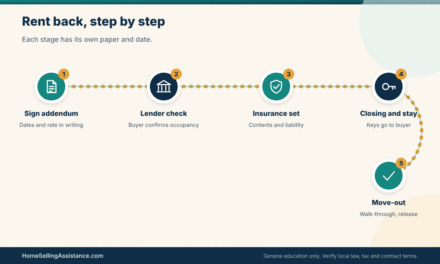
The second path covers several tools that sometimes get lumped together. A flexible window lets the buyer choose a closing date within a range. An extension right allows either side to push the date by a set number of days, often for a fee. A later fixed date simply picks a date farther out. A rent-back, in which you stay after closing, keeps the closing date where the buyer wants it while giving you time to move.
These tools suit different buyers, so a flexible closing date seller should pick one by name. The graphic above shows how a window can widen the pool of buyers you can say yes to, but also how it adds checkpoints that need protecting. Because each tool changes risk in a different way, it helps to name the one you are offering instead of saying “we’re flexible” and hoping the paperwork will sort itself out.
Evidence to gather: the terms that turn flexibility into something enforceable
Informal flexibility is a handshake. A flexible closing date seller who wants to be protected needs it in writing. Start with the window itself: the earliest date, the latest date and who chooses within it. Add an outside date after which either side has defined rights. Then address money: is there a per-day charge for closing later in the window, and who pays it? Does the buyer’s deposit increase for an extension?
For a rent-back, gather the pieces that a title or escrow company or attorney would normally want to see: the number of days, the daily amount, the security deposit, who pays utilities, who insures what and what happens if you stay past the agreed date. The Consumer Financial Protection Bureau publishes general consumer information on mortgages and closing that can help you ask the right questions, though it does not replace advice for your state.
Finally, ask the title company how it handles holdbacks, because some use them to guarantee that the home is left in agreed condition or that the occupant moves out on time. Practices vary by region, and so do the forms, so ask early. A written, specific agreement is often the difference between a helpful accommodation and a dispute about who owes what.
A scenario in which a window helps a flexible closing date seller and the buyer
Take a flexible closing date seller named Elena who has no purchase to coordinate and a buyer, Tom, who has a lease ending in six weeks and a lender who has quoted a typical processing time. Elena offers a window of thirty to forty-five days, Tom’s choice, with a modest per-day charge after day forty. Tom’s date stays comfortable, Elena’s price holds, and both sides know what happens if the loan runs late.
Elena also adds an outside date and a short notice requirement. If Tom has not scheduled a signing by a certain day, she may resume marketing or accept a backup offer under terms the contract describes. She does not promise herself that this will never happen, but she has a plan if it does. That plan costs the buyer very little when everything goes well.
In another market, with less competition, Elena might have to offer more, such as a longer window or a smaller extension charge. In a busier one she might offer less. The exact mix depends on local conditions and on what the buyer’s agent says in response. A well-written counteroffer, as described in the guide to counteroffer strategy for sellers, lets you test those limits without losing a good buyer.

A net-result rule for the flexible closing date seller
Comparing paths is useful, but eventually you need a rule that turns a pile of offers into a decision. The simplest one we know is to ask what you would actually have in hand, and by when, under each realistic version of each offer. That means converting price, time, cost and risk into one view, then adjusting for the things that could go wrong. A flexible closing date seller who skips this step often chases the highest number on the first page of the offer.
A flexible closing date seller has an extra variable to price: the value of their own time. Sometimes a date change saves real money, such as avoiding a second housing payment. Sometimes it costs real money, such as extra interest on a payoff. The rule below tries to make both visible, using round example numbers only to show the logic. Your real figures will come from your own documents.
Putting price, time, cost and risk into one framework
Think of four buckets. Price is what the contract says the buyer will pay. Time is how long until funds reach you, and how well that fits your plans. Cost is everything that changes with the date: daily mortgage interest, taxes and insurance you keep paying, utilities, storage, movers, temporary housing and any occupancy or extension charge. Risk is the chance that the deal changes or ends before closing, and what that would cost you.
For each offer, write one line per bucket in plain words and put a rough dollar figure where you can. Then look at the gap between offers. If the higher offer needs forty more days, ask whether forty days of carrying cost and risk eat the difference. If the lower offer closes quickly, ask whether a faster close lets you do something valuable, such as avoid a bridge loan. Our guide to home sale net proceeds shows how to build the bottom line.
Evidence to gather: the numbers that move with the calendar
Gather figures that change by the day or the week. From your servicer, get the per-day interest figure on your payoff. From your tax bill and insurance policy, estimate the monthly cost of holding the home. From your utility accounts, note typical bills. From the contract, find any per-day extension amounts or rent-back charges. These are the numbers that scale with time, so they are the ones a flexible date will touch.
Then collect the figures that do not scale with time but may shift with the date: prorations of property tax and any association dues, which depend on the closing day. The guide on property tax proration for sellers explains why a closing near the end of a billing period can look different from one near the start. The closing costs and net proceeds category has more on how these items are split. Your closing statement will show the final split, so ask the title company for a draft as early as they will provide one.
Last, estimate the cost of failure. If this buyer drops out on day sixty, what would relisting cost you in time, price pressure and carrying costs? You are not predicting that it will happen. You are measuring how much damage a long timeline could do so you can decide how much protection to ask for. The flexible closing date seller who knows that figure can negotiate guardrails calmly.
A worked example with illustrative round numbers
Here is a simple example, and the numbers are made up for illustration only. Offer A is for a higher price with a closing in thirty days. Offer B is for a slightly lower price with a closing window of thirty to seventy-five days. Say your carrying cost is a few hundred dollars a week, which you have confirmed from your own bills, and the lower offer would add several weeks to the likely timeline.
If the price gap between A and B is smaller than the added carrying cost, plus a fair allowance for the added risk, then A comes out ahead even with its higher headline demands. If the gap is much larger, B may deserve a counter that shortens the window or adds an outside date. If the gap is about equal, other factors decide it, such as the buyer’s financing strength or whether you need the overlap.
The point of the exercise is not accuracy to the dollar. It is to stop a single large number from hiding several small costs. Two or three honest lines on a page can change a decision. For more on weighing competing proposals, read how to evaluate a home offer as a seller, which looks at price, terms and buyer strength together.

Once you have the framework, the next step is to match it to your own situation. A flexible closing date seller rarely faces the abstract case, so the table below lists common situations, the route that tends to be favored in each, the reason, the trade-off and the one fact that could change the answer. We wrote it to help you see where you might sit, not to tell you what to do.
| Situation | Route often favored | Reason | Trade-off | Fact that changes it |
|---|---|---|---|---|
| Buying next, closing date fixed | Firm date, or close early with short rent-back | Proceeds must arrive before your purchase closes | Less room if the buyer’s loan slips | Whether your lender allows a short extension |
| No next purchase, house paid off | Flexible window for a time-pressed buyer | Low carrying cost makes time cheap to offer | Longer exposure to market or buyer changes | Local demand and how strong the buyer’s financing is |
| Buyer must sell their house first | Longer window with outside date and updates | Matches the buyer’s clock, widens your options | Open-ended risk if their sale stalls | Whether their home is already under contract |
| Need extra weeks to move out | Rent-back after a normal closing | Keeps buyer’s date, gives you time | Insurance, deposit and holdover issues | Buyer’s lender or insurer restrictions on occupancy |
| Competing offers, close prices | Offer the date the strongest buyer needs | Timing can break a tie without cutting price | You may give up a backup or a later date | Whether another buyer offers more certainty |
| Tenant still in the home | Date tied to the lease end and notice rules | Possession depends on legal notice periods | Delay if notice or lease terms are unclear | Lease terms and local landlord-tenant rules |
Use the table by finding the row closest to your situation, then check the last column first. That is where the answer most often changes. If you cannot answer the last column yet, that is your next task before you sign anything. The flexible closing date seller who does well is rarely the most generous one; it is the one whose terms were thought through. The rows are examples; if none of them fit, build your own row with the same five columns and fill it in with your agent, attorney or title officer.
When new evidence should change your flexible closing date seller plan
A plan made on day one rarely survives untouched. The buyer’s lender may ask for new documents, an appraisal may come back low, your own purchase may shift, or the market may move. The skill is not in predicting these events but in deciding in advance what each one means for your date. A flexible closing date seller who decides ahead of time tends to respond calmly, while one who does not often reacts under pressure.
Write a short list of triggers: events that would make you ask for a shorter window, invoke an outside date, request an extension or reach for a backup buyer. Share the plan with your agent and, if you use one, your attorney, so that when something happens you already have a pre-agreed response. Your contract, not your preference, sets what you may do, so confirm each trigger against the actual language.
Evidence to gather: signals that the timeline is slipping
Watch for signs that the timeline is under strain. A lender that is slow to return conditions, a request to extend a rate lock, a pending appraisal that has not been ordered, a buyer’s agent who goes quiet, or a house sale on the buyer’s side that has lost its contract: each one is a clue. None proves a deal will fail, but together they tell you when to ask for an update or exercise a contractual right.
On your own side, signals include a delay in the home you are buying, a mover who cancels, a repair that takes longer than expected or a change in your finances. If any of those happen, tell your agent promptly so you can discuss options while you still have them. Waiting until the last week often shrinks the list of choices.
Keep a simple log with dates: what was requested, what was sent and what was promised. If a dispute comes up, a clear record is more useful than memory. Official sources such as the CFPB and the National Association of Realtors publish general consumer material about the closing process, though your contract and state rules control the details.
A scenario in which the plan changes, and the next step
Imagine you are a flexible closing date seller who agreed to a forty-five day window and, at day thirty, the buyer asks to extend by two weeks because their lender is behind. You have a contract with an outside date, an extension fee and a right to keep showing the home. You also have a purchase of your own that closes in three weeks. Same facts, very different options than if you had no outside date.
One possible response is to accept a shorter extension in exchange for a larger deposit or a per-day fee, and to ask the buyer to document the lender’s expected timeline in writing. Another is to decline and invoke your rights if the contract allows it. A third is to ask your own seller to move your purchase date. Which one fits depends on your documents, so lean on your agent or attorney instead of improvising.
Whatever you choose, put the new terms in a signed amendment. Verbal promises about dates are among the most common sources of closing-day trouble. If you are in the situation of needing your sale proceeds to buy, the guide on bridge loans for buying before selling explains one tool some sellers consider, along with its costs and qualification hurdles.
One last practical layer is the checklist you carry into negotiation. The graphic below turns the earlier points into three groups: what to settle in writing before you agree to a flexible date, what to confirm with third parties such as your lender and insurer, and what to keep on file in case the timeline changes. Most closing-week surprises trace back to a line that sat in one of those groups, unchecked.

Quick scenario
A seller receives two similar offers. One closes in thirty days and the other offers a slightly higher price but wants the closing date to be “whenever the buyer’s home sells.” The seller counters the second with a hard outside date, a daily fee after day forty-five and the right to accept a backup offer. If the buyer agrees, the flexibility has limits. If the buyer declines, the seller has learned how much of the extra price was really a request for free time.
Frequently asked questions about flexible closing date seller decisions
What does it mean to be a flexible closing date seller?
It means you are willing to adjust the closing date, the possession date or both to fit a buyer’s needs, usually in return for a better price, cleaner terms or a stronger offer overall. The flexibility can run in either direction, earlier or later. A flexible closing date seller still protects themselves with written deadlines, because flexibility without limits is just exposure.
Will a flexible closing date get me a higher price?
Sometimes it helps, and nothing guarantees it. A buyer with a firm deadline may value a seller who can meet it, and that may show up as price, fewer repair requests or fewer contingencies. In another market the same flexibility may change nothing. A flexible closing date seller should treat it as one negotiating tool among several, and compare offers by net result rather than assuming timing always earns a premium.
What is the difference between a closing date and a possession date?
The closing date is when ownership transfers and funds move. The possession date is when the buyer gets the keys and the right to occupy. They often fall on the same day, but they do not have to. A flexible closing date seller who stays after closing needs a written occupancy agreement that covers rent, deposit, utilities, insurance and what happens if the move-out date is missed.
How long a closing window is reasonable?
There is no universal answer. Loan processing times, local customs, the buyer’s own sale and your next purchase all matter, and they differ by market and over time. A useful approach for a flexible closing date seller is to ask the buyer’s lender and the title company what timeline they expect, then add a modest cushion and an outside date. Your agent or attorney can tell you what is common in your area.
Can I charge a fee if the buyer needs more time?
Often yes, if the contract says so. A per-day extension amount, a larger deposit or a rent-back charge are common ways a flexible closing date seller offsets the added carrying cost. The right figure depends on your costs and local practice, and the terms must be in a signed amendment. Ask your attorney or agent how such fees are normally handled where you live.
What if I am buying another home at the same time?
Then your purchase contract sets your limits, and the timing of your sale has to fit inside them. Some sellers close on the same day, some negotiate a short rent-back, and some arrange temporary housing. The articles on temporary housing between homes and on whether to sell first or buy first cover those paths in more detail.
Does a longer closing add risk for me?
Usually it adds some. More time means more chances for rate locks to expire, appraisals to age, markets to shift or a buyer’s plans to change. It also means more weeks of insurance, taxes and upkeep for you. A flexible closing date seller can lower exposure with guardrails such as an outside date, regular updates and a backup offer clause reduce the exposure, though they cannot remove it entirely.
Should I accept a later closing from a cash buyer?
For a flexible closing date seller, cash removes loan risk, which can make a longer or looser date more tolerable, but it does not remove every risk. Verify the funds and the buyer’s identity before you agree to long timelines. The guide on cash offers versus financed offers explains how to compare them fairly.
What happens if the buyer misses the closing date?
It depends on the contract and state law. Some contracts give a short cure period, some allow extensions by agreement and some let the seller terminate after notice. Whether the buyer’s deposit is affected depends on the wording, so do not assume. If your date as a flexible closing date seller is at risk, tell your agent or attorney right away and document everything in writing.
Who should I talk to before agreeing to an unusual date?
A flexible closing date seller should start with a listing agent or attorney, your title or escrow officer, your mortgage servicer and your insurance agent. Each sees a different part of the timeline. If you are buying, add your lender. For general consumer information, the Consumer Financial Protection Bureau is a useful public starting point.
A date is a term, not a destiny
Being a flexible closing date seller does not mean saying yes to every request. It means knowing which dates you can afford, what each option costs and what you would do if the plan slipped. Compare offers by net result, write every promise down and keep your own next move in view. This article is general education, not legal, tax or financial advice; for your situation, talk with a licensed professional in your state.