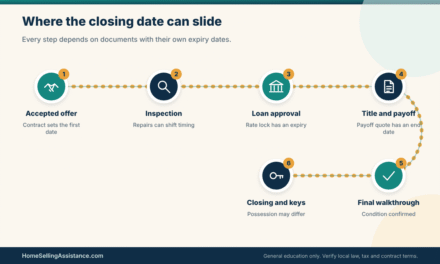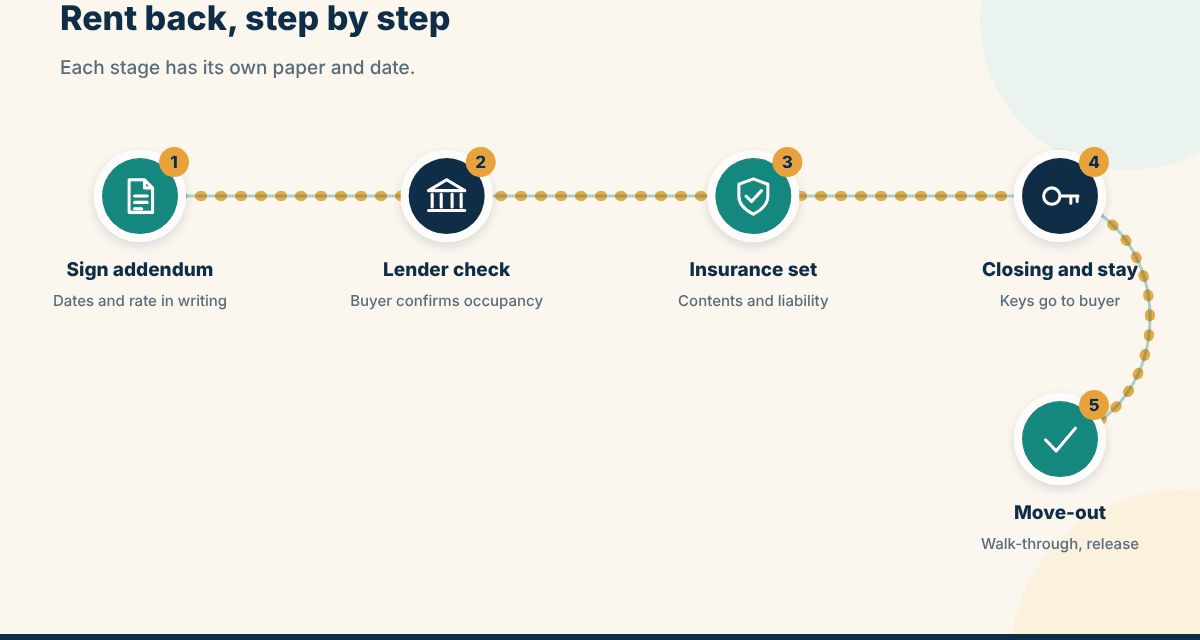
A rent back agreement seller signs is a short, written deal that lets you keep living in the house for a set number of days after the sale has closed and the new owner holds the deed, and it only works well when every term about rent, deposit, insurance and move-out is spelled out before anyone hands over a key.
Most sellers meet this idea at the exact moment they need it. The offer is in, the price is fine, and then it becomes clear that the home you are buying will not be ready on the day your sale closes. Or the school year ends in three weeks. Or the movers are booked for a date that sits a few days after funding. The deal a rent back agreement seller signs looks like a tidy bridge across that gap, and often it is, but it is also a landlord and tenant arrangement squeezed into a few paragraphs.
That is why we want to slow down here. A rent back agreement seller negotiates changes who owns the risk. Before closing, the house is yours, and so is the insurance, the repair bill and the legal duty to hand over possession. After closing, the buyer owns all of that, and you are a temporary occupant who must follow a document you may have read once, quickly, at a title office. Understanding the mechanics beforehand is far cheaper than learning them during a dispute.
This guide is about the seller’s side of the table. We will look at who holds which rights, how daily rent and deposits are usually built, what insurance does and does not cover, and what happens when move-out goes smoothly or does not. It sits inside our wider sell first or buy first guide, and it pairs well with our article on choosing a flexible closing date, because a flexible date and a rent back often solve the same problem in different ways.
Every state, county and contract differs, so treat example numbers here as round illustrations, not as predictions or advice for your house.
Key takeaways
- A rent back agreement seller signs is a separate contract. It is usually an addendum or standalone occupancy agreement, and it should state the start date, the end date, the daily or monthly charge, and who handles every cost in between.
- The buyer’s lender may have a say. Loan documents often require the buyer to move in by a certain time, so the buyer should confirm with the lender that your stay fits within the loan’s rules before you rely on it.
- Money is held back for a reason. A deposit or holdback from your proceeds, handled by the title or escrow company, is how buyers protect themselves, so ask exactly when and how it is released.
- Your old policy will not cover everything. After closing, the buyer insures the structure, and you generally need your own coverage for belongings and liability. Ask both insurers in advance.
- Staying past the end date is expensive. Holdover charges, loss of the deposit and a possible eviction process are all real outcomes, and the remedy depends on state law and the exact wording.
- Get review for anything unusual. An attorney, your agent or the title company should look at the document when terms are long, vague or different from the standard form.

What a rent back agreement seller is really signing
It helps to start with a simple picture. Two contracts exist whenever a rent back agreement seller is part of the sale. The first is the purchase contract, which transfers the house. The second is the rent back or post-closing occupancy agreement, which governs your stay after the transfer. They are linked, but they do different jobs, and a problem in one can spill into the other. If the purchase contract is cancelled, for example, the rent back agreement seller signed usually goes with it, because there is no new owner to rent from.
Many standard forms include a short occupancy addendum with blanks for dates and money. Some states and some brokerages have a longer, more formal version that reads like a mini lease. Neither is better in every case. A short form is easy to read but leaves gaps, while a long form covers more situations but can contain duties you did not expect, such as restrictions on pets, guests or storage. Whoever is the rent back agreement seller on the deal should read whichever form arrives in full, including the parts that look like boilerplate.
We will break the contract into two questions. The first is who has the right to stay and who carries the obligations. The second is which dates, amounts and remedies the document actually fixes. If you can answer both from the page, in plain words, you understand your deal. If you cannot, that gap is the thing to fix before closing, not after.
Who holds the right to stay, and who carries the duty
A rent back agreement seller usually receives a limited right: the right to occupy the home as a temporary tenant, for a defined time, on defined conditions. The buyer, as the new owner, retains almost everything else. That includes the right to enter in an emergency, to inspect at agreed times, and to end the arrangement if you break its terms. Think of it as renting your own former house, except the landlord is a stranger who has already paid a large sum for it.
Duties run in both directions. You are generally expected to pay the agreed charge, keep the property in the same condition apart from ordinary wear, keep the utilities on, avoid alterations, and leave on time. The buyer is generally expected to honor your right to stay, avoid interfering with your possession, and return the deposit when the terms are met. Whether the buyer must make repairs during your stay is a point many forms leave open, so ask about it.
Evidence to gather: the purchase addendum, the loan occupancy rules and the title company’s role
Start with the paper trail. You want the signed purchase contract, the signed rent back addendum or occupancy agreement, and any counteroffers that touched possession. Compare them line by line. It is common for a possession date in the main contract to conflict with the date in the addendum, and when two documents disagree, the contract usually says which controls. Find that sentence, highlight it, and ask your agent or attorney what it means in your state.
Next, ask how the buyer’s financing treats a post-closing stay. Many mortgages for owner-occupied purchases expect the buyer to move in within a certain window after closing, and that window differs by lender and loan type. A short stay under a rent back agreement seller proposes is often workable, but it is the buyer’s lender that decides, not you. Ask the buyer’s agent whether the lender has been told and whether anything needs to be signed. A written yes from the lender’s side is worth more than a verbal assurance.
Finally, find out who will hold any deposit or holdback. In many transactions the title or escrow company holds it under written instructions. Ask for those instructions in advance. They should say how much is held, which event releases it, who can authorize release, and what happens if the two sides disagree. Escrow holders generally will not pick a winner in a dispute, so the instructions matter more than anyone’s memory of a conversation.
A scenario, an exception, and your next step on occupancy rights
Picture a seller we will call Dana, who closes on a Friday and needs to stay for nine days while the home she is buying finishes a final inspection and a closing of its own. The purchase contract says possession happens at closing. The rent back addendum says Dana may stay until the following Sunday. Nobody noticed the conflict, because both documents were signed in different weeks, and the buyer’s moving truck is booked for Saturday.
That is the classic gap between two documents, and it is easy to fix in the first week and painful to fix on moving day. The exception to watch for is language such as “possession at closing unless otherwise agreed in writing.” If the rent back is a signed writing that says otherwise, it likely controls, but only a professional who reads your actual documents can say so. Dana’s next step is simple: ask for one clean amended page that lists a single possession date and is signed by both parties.
A second exception appears when the buyer’s loan requires fast occupancy. If the lender will not accept more than a short stay, a nine-day rent back agreement seller offered might need to shrink, or the closing date might need to move instead. Raising that early gives everyone room to adjust. Raising it two days before closing leaves only unpleasant options. When in doubt, ask the question sooner and put the answer in an email you can find later.
Dates, money and remedies: what the document must state
The second question is about numbers and consequences. A good agreement answers five things without any guessing: when the stay begins, when it ends, what you pay, what is held back, and what happens if something goes wrong. Vague words like “reasonable time,” “a few days” or “normal condition” feel friendly when everyone is cooperating and become arguments when someone is stressed. Aim for calendar dates, dollar amounts and named documents.
Rent in a rent back agreement seller negotiates is usually calculated per day for short stays. A common approach is to base it on the buyer’s carrying costs, such as the loan payment, property taxes, insurance and any HOA dues, divided by the number of days in a month, though other methods exist and the parties are free to negotiate. Some sellers pay nothing extra for a very short stay, and others pay a daily rate that rises after the agreed end date. Whatever you choose, the formula should be written down, not just the result.
Evidence to gather: the per-day rate math and the deposit holdback
Let us work an illustrative example with round numbers, which are not a benchmark for any real market. Suppose the buyer’s monthly carrying cost, including loan payment, taxes, insurance and HOA dues, comes to a round $3,000. Divide that by 30 and the buyer’s daily cost is $100. A seven-day rent back agreement seller prices on that basis would be $700. Some deals use a rate above or below carrying cost, and some give a short stay at no charge in exchange for other terms.
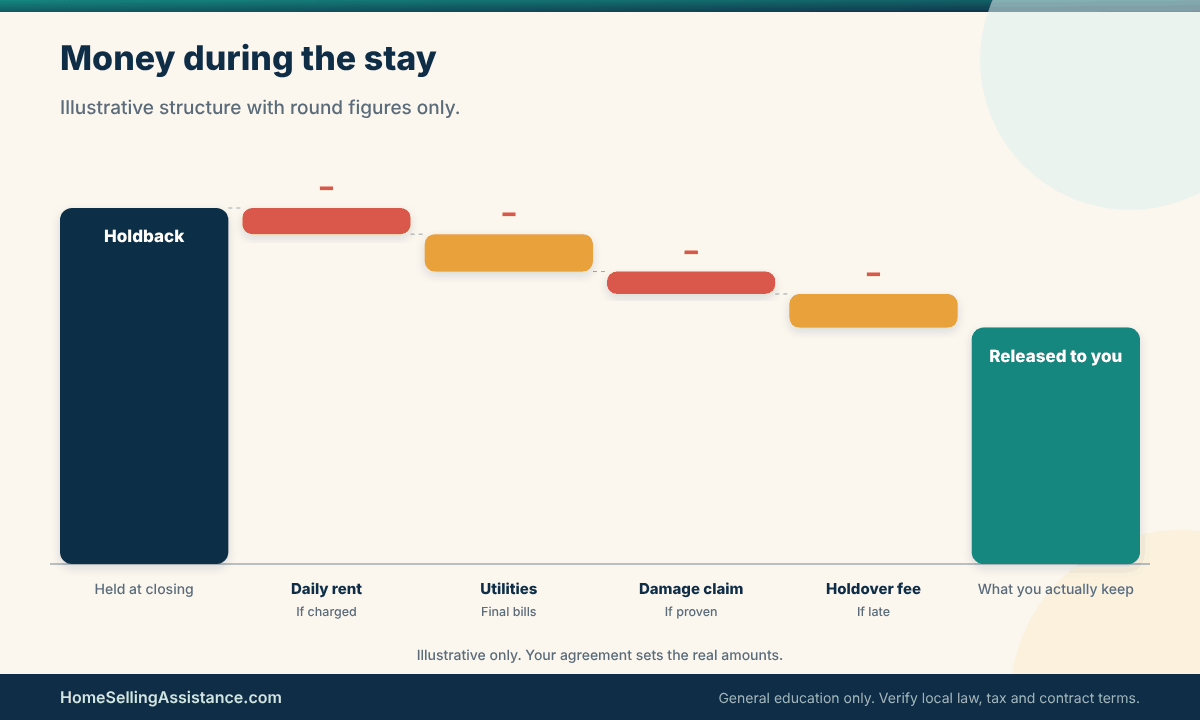
The holdback is a separate number. Imagine the parties agree to hold $5,000 out of your proceeds at closing, to be released after a clean move-out inspection. The amount does not have to relate to the daily rent. It is meant to cover things that could go wrong, such as damage, unpaid utilities, trash left behind or a delayed departure. Ask whether the money is held as a security deposit under landlord and tenant law or as a contract holdback, because the rules that apply can differ.
Ask also about interest, timing and itemization. Some states regulate how long a landlord may keep a deposit and require a written list of deductions, while others leave short-term occupancy agreements to the contract alone. You cannot assume either way. A line that says “released within a stated number of days after the buyer confirms possession and condition” is far better than silence. Your state real estate commission, a local attorney or the title company can tell you which rules apply.
For a broader view of how holdbacks and credits show up in your final numbers, our guide to seller closing costs shows where these lines appear on a settlement statement.
A scenario with a missed move-out date
Now imagine that Dana’s new home closes two days late. Her rent back ends Sunday, and by Sunday she has no place to go. This is the single most common fear behind every rent back agreement seller signs, and it deserves a plain answer. What happens next depends on the document, on state law, and on the buyer’s attitude. Some agreements charge a steep daily holdover fee. Some allow the buyer to keep the deposit. In many places, the buyer who wants possession back may need to follow a formal legal process.
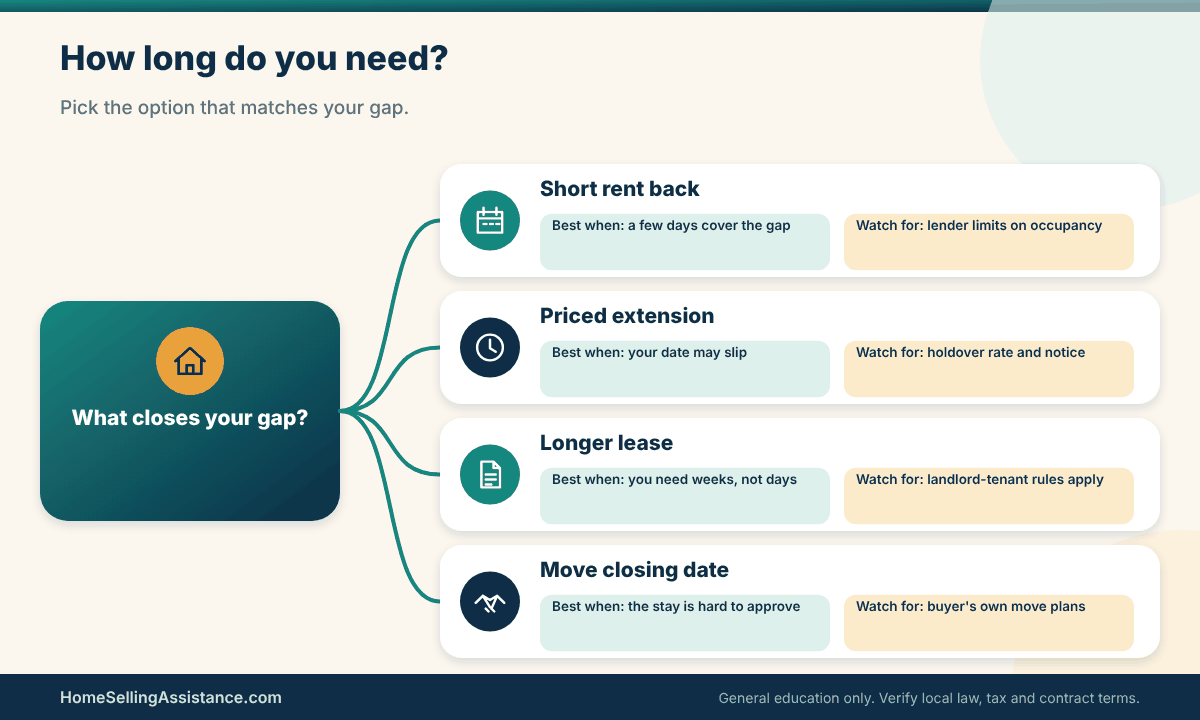
The key lesson is to negotiate for a buffer before you need one. Dana could have asked for two extra days at a stated, reasonable rate, or for a written right to extend once if she notified the buyer by a certain date. Buyers often agree to a modest, priced extension, because it costs them less than a fight. They rarely agree to an open-ended promise.
If the date is about to be missed, call the buyer’s agent right away and put any new arrangement in a signed amendment. A friendly text that says “sure, stay till Tuesday” is better than nothing, but a signed one-line amendment protects both sides. Do not assume that goodwill survives stress, a lender’s deadline or a buyer’s own moving problem.
The table below pulls together the main issues, which document usually controls each one, what you can choose, the deadline to watch, and where to confirm the local rule. Use it as a checklist when you read your own paperwork, and fill in the blanks with real dates before you sign.
| Issue | Controlling document or authority | Seller obligation or choice | Deadline to watch | Local verification |
|---|---|---|---|---|
| Right to occupy | Rent back addendum or occupancy agreement | Request clear start and end dates | Before signing the addendum | Agent or attorney |
| Lender occupancy rules | Buyer’s loan documents | Ask buyer to confirm lender approval | Before the loan is finalized | Buyer’s lender, via buyer’s agent |
| Daily or monthly charge | Written formula in the addendum | Negotiate rate and payment method | Due at closing or on a stated day | Title company statement |
| Deposit or holdback | Escrow instructions and state deposit rules | Agree amount and release trigger | Release after move-out check | State commission or attorney |
| Insurance | Buyer’s policy and your renter’s policy | Buy contents and liability coverage | In force on closing day | Your insurance agent |
| Holdover remedy | Addendum wording and landlord-tenant law | Negotiate a priced, short extension | Before the end date | Local attorney |
To use the table, copy the six issues onto a page and write the actual answer next to each one using your documents. Any cell you cannot fill with a date, a dollar figure or a named authority is a question for your agent, the buyer’s agent, the title company or an attorney. Doing this exercise early often reveals that the contract is silent on something important, and silence is cheaper to fix before signing than after.
If you are still deciding which closing date and possession date to ask for in the first place, our piece on move-out date versus closing date compares the two levers and explains how they interact.
Modeling common outcomes when a rent back goes well or badly
Contracts make more sense when you walk them through a few endings, and a rent back agreement seller has only a handful to consider. A rent back agreement seller can expect one of two broad outcomes: the terms are satisfied and everyone moves on, or something is disputed, missed or waived and the document has to do real work. Most sellers never see the second outcome. Still, the way the agreement handles it is the reason it exists, so it deserves as much attention as the happy path.
We will model each outcome with plain steps and round, illustrative figures. None of them predicts what will happen to you. They show the kind of reasoning that helps, so you can run the same reasoning on your own paperwork with your own professionals.
When every term is satisfied
The good outcome is almost boring. You pay the agreed charge, stay inside the dates, keep the utilities active, leave the house clean and empty, return the keys and garage openers, and the buyer confirms the condition. The holdback is released, perhaps through the title company, and the file closes. Boring is the goal. A well-written rent back agreement seller keeps is meant to make the stay uneventful for both sides.
Even in the smooth case for a rent back agreement seller, a few details decide whether the release is quick or slow. Who confirms the condition, and how? How many days does the buyer have to respond? Is a missing response treated as approval, or does the money sit until someone acts? A release clause with a clear trigger and a clear deadline keeps your funds from going into limbo, and it keeps the buyer from feeling pressured to sign off on a house they have not seen.
Evidence to gather: the move-out walk-through and the release of the deposit
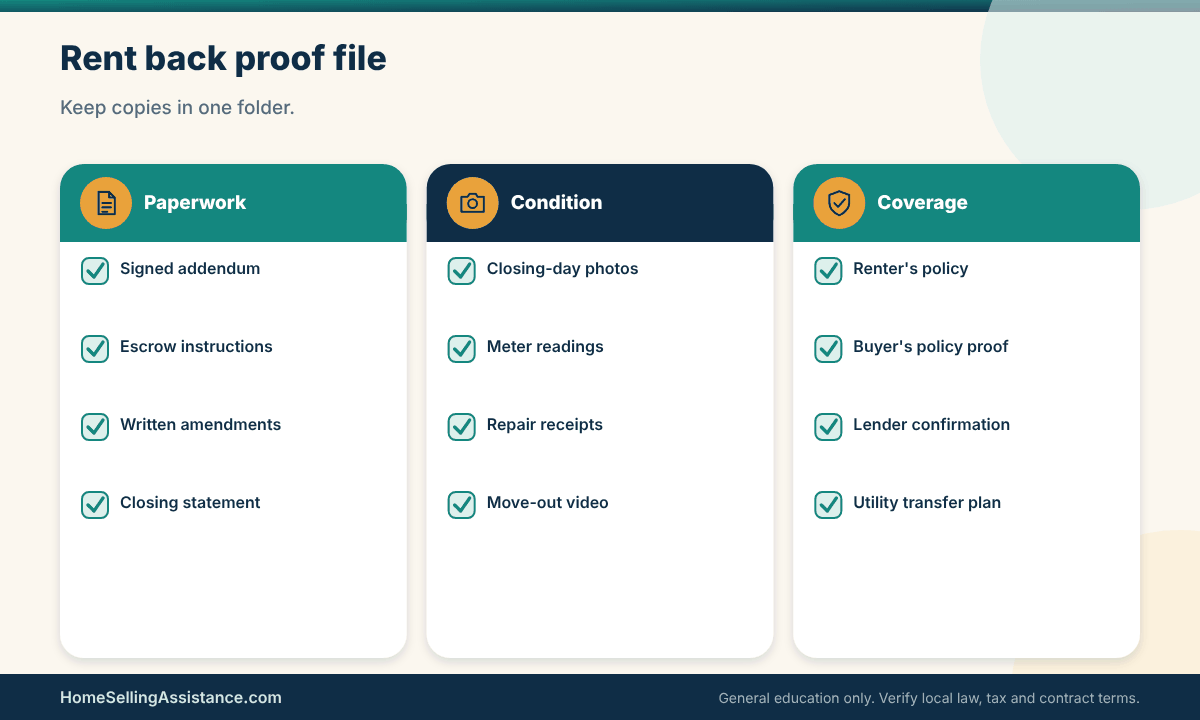
Begin documenting before you start packing. Take dated photos or a short video of each room on the day of closing, because that is the condition the buyer accepted and the baseline for any later claim. Keep copies of the final inspection report and any repair receipts that were part of the sale. If the buyer did a walk-through before closing and signed anything, save it. These records cost nothing and are the best protection a rent back agreement seller has against a claim of damage that never happened.
Plan a joint walk-through on the final day if the buyer or the buyer’s agent is willing. Bring the agreement, the photos and a short written list of items you removed or repaired. Ask the buyer to sign a simple confirmation, even on a single page, that possession was returned and nothing is outstanding. Where a joint visit is not possible, send your own dated photos and a note by email and ask the buyer to reply with any concerns by a stated date.
Finally, confirm the release mechanics with the title or escrow company. They may need a written instruction from both parties, a signed release form, or the passage of a set number of days. Ask what they need and in what format. A holdback that is technically yours but stuck because one form was missing is a common and avoidable frustration.
A scenario, an exception, and your next step on a clean exit
Consider a seller named Marcus whose rent back agreement seller paperwork runs for five days. He pays a round $500 for the stay at closing, with a $3,000 holdback to be released after move-out. He leaves on day four, cleans carefully, photographs every room, and emails the buyer’s agent. The buyer replies that everything looks fine, and the title company releases the holdback after receiving both parties’ signed instruction. Total friction: a few emails.
Here is an exception to keep in mind. Suppose the buyer reports a scuffed floor that Marcus believes was there at closing. His closing-day photos now matter a great deal. If they show the scuff, the discussion ends quickly. If they do not, the question becomes who can prove what, and whether the agreement sets a threshold for what counts as damage versus ordinary wear. Many agreements say that normal wear and tear is not chargeable, which is a helpful phrase to look for.
Marcus’s next step, if a disagreement does arise, is to respond in writing, calmly, with evidence, and to offer a specific resolution rather than a general complaint. Ask your agent whether the brokerage has a dispute process, and keep the title company informed. Escalate to an attorney only if the sum is large or the other side stops responding. Most small disputes settle once both parties see the documentation.
When the term is disputed, missed or waived
Now the harder side. Disputes tend to cluster around a short list of causes: staying past the end date, damage or missing items, unpaid utilities, disagreement over what was promised verbally, and a buyer who wants the house sooner than agreed. A waiver is quieter. It happens when one side lets a term slide, such as accepting rent a few days late, and later argues about whether that changed the deal. Written amendments prevent most of those arguments.
The first principle for any rent back agreement seller is simple: the document wins over memory. If you were told that you could stay a little longer, that promise has value only if it is written and signed. The reverse is also true. If the buyer allowed something informally and later insists on the original text, a court or mediator will usually look at the writing first. Treat every informal change as something that needs a one-line email at least, and preferably a signed amendment.
Evidence to gather: photos, messages and utility records
If a dispute starts, gather four types of proof. First, the signed documents: purchase contract, the rent back agreement seller signed, any amendments and the closing statement. Second, condition records: your photos, the home inspection report and any move-out pictures. Third, communication records: emails and texts with dates, kept in their original form. Fourth, money records: proof of payment for rent, utilities and any repairs you made during your stay.
Utilities deserve a special note. Many agreements make the seller responsible for utilities during the stay, and the buyer then transfers service at the end. Take meter photos at the start and end if you can, and keep final bills. An unpaid final water or electric bill can become a claim against the holdback. The same applies to HOA fees, gate access, parking passes and any move-in or move-out deposits an association might charge.
If a claim against your deposit seems inflated, ask for an itemized list with receipts or estimates. A legitimate claim for a real repair is usually easy to document. A claim that arrives as a round number with no support is a signal to slow down, ask questions and, if necessary, seek advice. Do not threaten or accuse. Ask for backup in a neutral tone and keep the thread of messages tidy.
A scenario, an exception, and your next step on a holdover or damage claim
Take a seller named Priya whose rent back agreement seller term ended on a Sunday. Her new home closed late, and she stayed through Wednesday without a written extension. The buyer’s agent is polite on the phone but, a week later, the buyer sends a demand for a daily holdover charge from the agreement, plus a repair estimate for a damaged closet door. Priya believes the buyer agreed verbally to the extra days.
This is the waiver problem in action. A verbal okay may be hard to prove, and the contract may require amendments to be in writing. Priya’s best evidence would be any text message where the buyer acknowledged the new date. If she has one, she should present it along with the agreement. If she does not, she should still respond calmly and ask whether the buyer will accept a reduced charge, since the buyer was able to get the house back without a legal process.
The exception is a lengthy delay or refusal to leave. At that point the matter moves from a contract disagreement to a possession dispute, where state landlord and tenant rules, local courts and attorneys’ fees may come into play. Nobody can promise how it ends. If you ever approach that line, speak to a local real estate attorney before taking further steps, and keep every document in order. The cheapest time to settle is almost always before a formal filing.
Scenarios like Priya’s explain why every rent back agreement seller should think about the whole range of situations before signing. The next table lays out several common ones in a format you can reuse: what the contract or legal situation is, what you can do, where the risk sits, which document to review, and when to escalate. The rent back agreement seller scenarios here are general education, not a map of your state’s rules.
| Situation | Seller options | Main risk | Document to review | Escalate to |
|---|---|---|---|---|
| Your new home closes late | Ask for a priced extension in writing | Holdover charge, lost deposit | Rent back addendum | Attorney if buyer refuses |
| Buyer’s lender objects to your stay | Shorten stay or move closing date | Delayed or failed closing | Loan terms via buyer’s agent | Agent and buyer’s lender |
| Damage claim after move-out | Share dated photos and ask for itemization | Deductions from holdback | Addendum and photos | Title company, then attorney |
| Fire, storm or pipe leak during stay | Notify buyer and insurers at once | Coverage gaps, safety, possession | Both insurance policies | Insurance agents, attorney |
| Buyer wants you out early | Point to the written end date | Pressure, informal promises | Signed agreement terms | Agent, then attorney |
| Verbal extension offered | Ask for a signed amendment | Unwritten promise fails | Amendment clause | Agent or title company |
Use the table by finding the row that looks most like your worry, then reading the last two columns first. They tell you which paper to pull out and who to call. If your situation does not match any row, that is useful information too: write your own row, with a short note on who you would call, and share it with your agent so nothing is left to chance on closing week.
Sellers who are weighing whether to buy first and then rent back, or to sell first and then rent temporary housing, may find our guide on temporary housing between selling and buying a useful comparison, since the costs and risks look quite different side by side.
Control the risk of a rent back agreement seller deal in writing
Everything we have covered comes down to one habit: write it down, and write it specifically. A rent back agreement seller relies on is only as protective as its least precise sentence. The good news is that you do not need legal training to spot weak sentences. You need a list of questions, a calm review and a willingness to ask for changes before signing, when the other side is still motivated to keep the sale on track.
This section gives you the questions, explains what good answers look like, and shows when the situation is complicated enough that you should pay for professional review. Think of it as a short pre-flight routine for a rent back agreement seller. None of it takes long, and most of it can be done in one evening with the documents in front of you.
Questions to ask before you sign
Good questions are specific and answerable in a sentence or a number. Ask them of your agent, the buyer’s agent, the title company and, for insurance, your own insurance agent. Write the answers next to each question and keep the page with your closing file. If any answer is “I think” or “it depends,” ask who can say for sure and what document would show it.
Here is a short starter set for any rent back agreement seller, in prose rather than a checklist so the reasoning stays attached. When does my stay begin and end, in calendar dates? What exactly do I pay, and when? How much is held, who holds it, and what releases it? Who is responsible for utilities, trash, lawn care and repairs? What happens if I need a few extra days? Does the buyer’s lender know about this? What insurance will each of us carry? Who can enter the home, and with what notice?
Evidence to gather: insurance confirmations, lender confirmation and utility transfer plans
Insurance is the area where sellers most often assume rather than check. Once the sale closes, your homeowner’s policy on that address commonly ends or changes, and the buyer’s policy takes over the structure. That leaves a rent back agreement seller with two gaps to ask about: coverage for your belongings, and liability if a guest is hurt during your stay. A renter’s policy, sometimes called a tenant policy, is one common way to cover those gaps, and some insurers have specific rules for short stays. Call your agent and say exactly what you are planning.
Ask the buyer to tell you, in writing, that their policy is active on closing day and that the insurer knows the house may be occupied by the seller for a set period. Some insurers treat a house occupied by someone other than the owner differently from a vacant or owner-occupied home. That is the buyer’s job to resolve, but it affects you if a claim is denied during your stay. A one-line email from the buyer’s agent confirming coverage is cheap protection.
For the lender and the utilities, ask for a short written confirmation as well. The buyer’s agent can usually say whether the lender has approved the post-closing occupancy. For utilities, decide who will keep each account active through the end date, and who will transfer it afterward. Take meter readings on closing day and move-out day if you can. Small bills left in your name or in theirs are the most common source of friction in otherwise smooth rent backs.
One more item that is easy to forget is your mail, packages and address change. If your new home closes late, your forwarding plans may need to start later than you expected, and a buyer receiving your mail for weeks can become a quiet irritation. Agree on who forwards what, and give the buyer a way to reach you after the move.
A scenario, an exception, and your next step before you sign
Imagine a seller named Elena who has a draft addendum that says she may stay “approximately two weeks” for a flat round fee of $1,400. It does not name a deposit, an end date, or a holdover rate. Her agent says the buyer is nice and nothing more is needed. Elena has a gut feeling that something is missing, and she is right. Approximately two weeks could mean twelve days to the buyer and seventeen to her, and the document has no remedy for either reading.
Her next step is to ask for specific edits: a calendar end date, a short holdover rate, a clear deposit or holdback amount with a release rule, and a sentence that says utilities remain her responsibility until the end date. None of these is unusual. Most buyers expect such requests, and a reasonable buyer will agree to the ones that cost them nothing. If the buyer refuses to put any end date in writing, that refusal tells Elena something worth knowing before closing.
An exception worth noting is the buyer who wants a formal lease instead of a short addendum. A longer lease can be fine, but it may include extra duties and local landlord and tenant rules. If you receive one, treat it with the same care as any lease and ask for review. Do not sign it on closing day at the title office without having read it, and remember that you can ask for time to review.
It is also fine to ask whether the agreement can be shorter. A tighter rent back agreement seller deal reduces the chance of lender trouble, buyer anxiety and holdover disputes. If you only need five days, ask for five days plus a small, priced extension option, not thirty days just to be safe. Pad your plan with a place to stay for a night or two instead of padding the contract with weeks you may not need.
When to bring in an attorney, your agent or the title company
Not every rent back agreement seller needs a lawyer. A short stay on a standard form, with clear dates and a modest holdback, is often handled by your agent and the title company. But some features are warning lights, and it is wise to decide in advance which ones would make you stop and ask for a professional opinion. Doing so removes the pressure of deciding under a deadline.
The roles differ. Your agent knows the local forms and customs and can usually suggest standard wording. The title or escrow company handles money and signing instructions, but it generally cannot give legal advice. An attorney can explain your rights under your state’s law and draft or amend language. If you are working without an agent, the attorney role matters even more, and a flat-fee review is often a reasonable cost compared with the risks. Our overview of how to sell a house explains how these roles fit together.
Evidence to gather: forms, state guidance and professional credentials
Before you call anyone, collect the documents so the conversation is short and focused. Bring the purchase contract, the draft or signed addendum, the escrow instructions if you have them, and a list of your questions. Also bring the dates for your own purchase closing, because they often explain why you need the rent back agreement seller route at all and which parts of the plan have slack.
Look for official or neutral sources too. Your state real estate commission or department often publishes forms and consumer guides, and some states have specific rules about post-closing occupancy or security deposits. The Consumer Financial Protection Bureau has plain-language material about mortgage closings that helps you understand the buyer’s side of the process, and the National Association of Realtors publishes consumer information about transactions. These sources explain general principles, not your state’s exact rule.
When choosing a professional, ask directly how often they handle post-closing occupancy, what they would charge for reviewing a short addendum, and how fast they can respond. A review that arrives after closing is useless. If cost is a concern, ask whether a limited review of only the occupancy document is possible. Many attorneys and some title companies are willing to do a narrow review for a modest, quoted fee.
A scenario, an exception, and your next step on review triggers
Here are the situations in which we would pause before signing. The stay is longer than a few weeks. The buyer is an investor who plans to rent the house out. The agreement is a full lease with attached rules. Someone else besides the named sellers will live in the home, such as a relative or tenant. A deposit is larger than you can comfortably lose. The buyer’s lender has not confirmed anything. Or the buyer wants you to sign something at the last minute that was not in the earlier drafts.
Consider a seller named Tom whose buyer, an investor, asks for a thirty-day rent back agreement seller stay at a below-market rate, with a clause allowing the buyer to enter at any time. Tom is tempted because the price is good. His agent is not sure the clause is reasonable. Tom books a short attorney review and learns that the entry clause is much broader than he is comfortable with. The attorney suggests a notice period, and the buyer accepts it. The review cost less than a single month of storage fees.
The exception is the family sale, where trust is high and the stay is short. Even then, a one-page written agreement is wise, because memories drift and circumstances change. Whatever your situation as a rent back agreement seller, your next step is to ask your agent or title company, today, which documents are still draft and which are final. Anything still draft is where your leverage lives.

Quick scenario
A seller closes on Friday with a $2,500 holdback and a six-day stay, using round numbers. She photographs the home, buys a short renter’s policy, pays a day-by-day charge at closing, and moves out on day five. The buyer replies “all good” by email, the title company releases the holdback, and the whole file is closed within the week. What made it easy was not luck. It was a written end date, written money terms and a written release rule.
Frequently asked questions about rent back agreement seller terms
What is a rent back agreement seller arrangement in plain words?
It is a short contract that lets you stay in the house after you have sold it and closed. You become a temporary tenant of the new owner, usually for days or a few weeks. The agreement sets the dates, the charge, any deposit, who pays utilities and what happens if you leave late.
How long can a rent back agreement seller stay in the home?
There is no single answer, because it depends on the contract, the buyer’s loan and sometimes state or local rules. Short stays are the easiest to approve. Longer ones may need lender permission or a more formal lease. Ask the buyer’s agent early and get the limit in writing.
How is rent set for a rent back agreement seller?
Many deals use the buyer’s carrying costs, such as the loan payment, taxes, insurance and any HOA dues, divided into a daily figure. Others use a flat fee or a market rental rate, and some waive rent for a very short stay. The method is negotiable, so ask to see the math written into the agreement.
Do I have to pay a deposit or holdback?
Often yes, because the buyer wants protection against damage or a late exit. The amount and release rule are negotiable and vary by state, contract and local custom. Ask who holds the money, what triggers release and how soon after move-out you will receive it.
Does my homeowner’s insurance still cover me after closing?
Usually not in the same way, because the buyer now owns the structure and their policy covers it. You commonly need a separate policy for your belongings and liability during the stay. Call your insurer, explain the plan and ask for written confirmation of what is covered.
What if I cannot move out on time?
Contact the buyer’s agent immediately and ask for a written extension, ideally at a stated rate. Staying past the end date without agreement can mean holdover charges, loss of your deposit and, in some places, a formal legal process. The remedy depends on your state and the exact wording, so ask an attorney if the delay is more than a few days.
Can the buyer’s lender stop a rent back agreement seller from staying?
It can affect it. Many loans for owner-occupied homes expect the buyer to move in within a certain period, and the lender may need to know about your stay. That is the buyer’s responsibility to confirm, but you should ask for written assurance. A rent back agreement seller deal that conflicts with the loan rules can delay the closing.
Who handles repairs during the stay?
The agreement should say. Many forms expect the seller to keep the home in its closing condition and report problems promptly, while the buyer handles major systems or structural repairs. Ask what happens if the furnace or a pipe fails during your stay, and who pays the first emergency call.
Is a rent back agreement seller deal the same as delayed possession or a flexible closing date?
They are close cousins but legally different. With delayed possession before closing, you still own the house. With a rent back agreement seller deal, closing has already happened and you rent from the new owner. Our guides on flexible closing dates and the home sale contingencies sellers face explain related options.
When should I ask an attorney to review the agreement?
A rent back agreement seller should ask when the stay is long, the buyer is an investor, the document reads like a full lease, the holdback is large or the terms are vague. A narrow review of the occupancy document is often affordable. Your title company and agent are helpful, but they usually cannot give legal advice.
Before you sign the occupancy page
A rent back agreement seller can negotiate well is specific about dates, money, insurance and consequences, and it leaves little to memory or goodwill. Photograph the house, confirm coverage, get lender confirmation and ask for a written release rule before closing day. If you still feel unsure, our sell first or buy first library and closing costs and net proceeds guides can help you plan further. This article is general education, not legal, tax or financial advice, so confirm details with a licensed professional in your state.