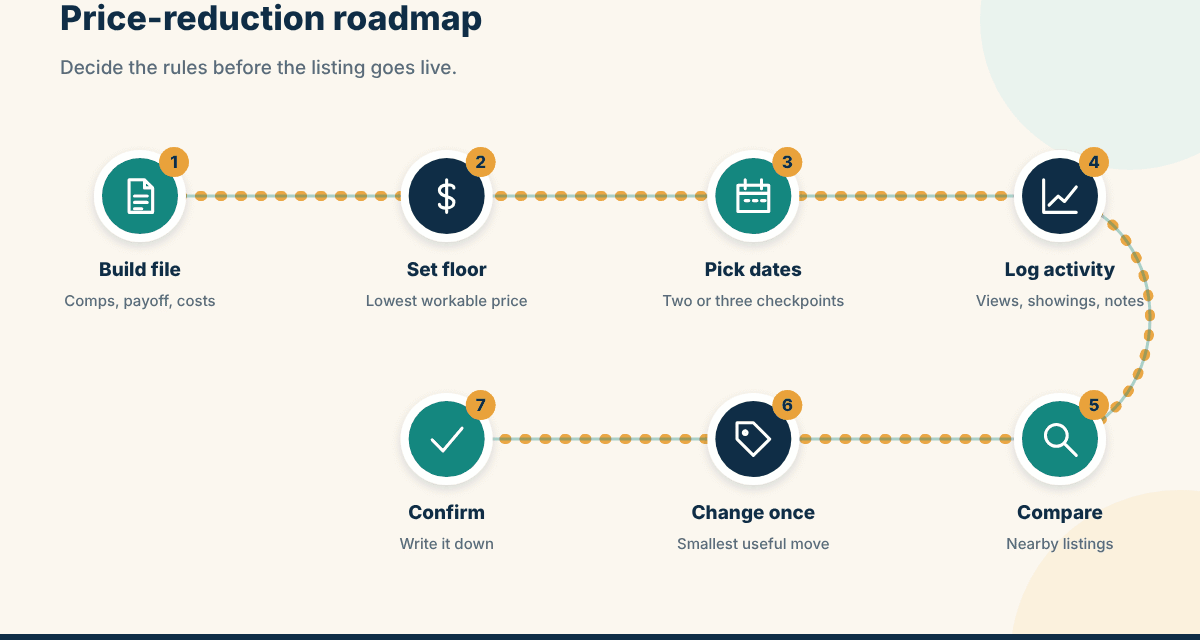
A sound home price reduction strategy is a plan you write down before the listing ever goes live, not a reaction you improvise on the day you start to feel nervous about the sign in the yard. This guide shows you how to decide in advance what evidence will trigger a price change, how large a change should be, who has to be told, and what paperwork follows, so the listing does not drift into the stale zone where buyers quietly stop looking.
Most sellers meet the idea of a price cut for the first time when they are already unhappy. The house has been listed for a few weeks, the phone has gone quiet, and a relative suggests “just drop it ten thousand.” That is the worst moment to design a plan. You are tired of showings, you are comparing yourself to a neighbor who sold quickly, and every number feels personal. A home price reduction strategy made calmly beforehand takes the emotion out of it.
Here is what we will do. First, we build the seller file: the documents, numbers and contacts that make a price decision defensible. Second, we walk through the listing in order, from the first weeks of activity to the first change, to the offers that follow. Third, we close the loop with the written confirmations and records you will want later. If you have not yet settled on your starting number, read our guide to how to price a house to sell first, because a home price reduction strategy only works when the starting price was set with evidence.
You can browse the rest of our home pricing and value guides for more background. One honest limit before we begin. Nobody can tell you from a blog post exactly when or how far your price should move. That depends on your neighborhood, your price band, the season, your mortgage payoff, your move date and the contract you signed. What we can do is show you the questions to ask, the numbers to collect and the traps to avoid, so that the decision you make is yours and is based on something firmer than a hunch.

Key takeaways
- Write the plan before you list. A home price reduction strategy decided in advance is calmer, cheaper and easier to defend than a cut made out of frustration.
- Tie every change to evidence. Showings, saves, feedback, nearby new listings and closed sales justify a move. The calendar alone does not.
- Know your floor. Your mortgage payoff, selling costs and any must-have proceeds set the lowest number you can accept before the sale stops making sense.
- No universal percentage exists. How much and how often to cut varies by market, price band and season, so ask for local data rather than a rule of thumb.
- A cut is a paperwork event. Your agent or attorney, the listing agreement, the MLS entry and any pending buyers all need to be handled in writing.
- This is general education. It is not legal, tax or financial advice, and your contract and local rules control.
Why does a written home price reduction strategy matter so much? Because the pressure to cut arrives from three directions at once: the calendar, the mortgage payment and other people’s opinions. A seller without a written strategy tends to respond to whichever voice is loudest that week. A seller with a written home price reduction strategy can say, “that is interesting, and my next review date is Friday.” That one sentence saves a surprising amount of money and stress.
Build the file behind your home price reduction strategy
A price change is a decision, and decisions need inputs. Before you list, or as soon as you decide to revisit a stalled listing, gather the materials that will let you judge calmly. This does not take long, and most of it is stuff you already have in a drawer or an email folder. What matters is having it in one place, dated, so that you are not guessing at 9 p.m. when an agent texts you a suggestion.
Think of this file as your insurance against two opposite mistakes. One is cutting too early, too deeply or too often because you did not have the facts. The other is holding a number for months because you could not face the facts you had. A clear file behind your home price reduction strategy keeps you between the two.
The documents, numbers and contacts to line up first
It helps to be honest about why people skip this step. Writing a floor feels pessimistic, as if naming the lowest acceptable price invites buyers to find it. In fact the floor is private. Nobody sees it except you and, if you choose, your agent. Its job is to keep a hard decision from being made under pressure. A home price reduction strategy without a floor is a plan that can be argued out of existence by the first persuasive buyer.
Start with what the sale must produce. Your mortgage statement, a recent payoff quote and any home equity line balance tell you what has to be paid off at closing. Add an estimate of selling costs from your agent or a title company: commissions as negotiated in your written agreement, transfer taxes and fees where they apply, title and escrow charges, and any repairs or credits you expect. From those pieces you can sketch a floor, meaning the lowest price at which the sale still meets your needs.
Next, add the market side. Keep the comparable sales your agent used to set the original price, with dates and addresses. Keep a running list of competing homes that come on the market near you, because they change the story weekly. Finally, line up your contacts: the listing agent or your own contact if you are selling without one, the closing attorney or title company, and the lender if you are buying again and need your proceeds by a certain date.
The checklist below pulls these items into one picture so you can see at a glance what you have and what is still missing.

Evidence to gather: the comps, the activity log and the payoff figure
Three items carry most of the weight in any home price reduction strategy. The first is the comparable-sales set. Ask for the closed sales and pending sales your price was built on, plus any that have closed since you listed. Note the sale date, the condition, the size and what concessions were involved. A comparable that closed eight months ago in a different season tells you less than one that closed last month, and a good agent will say so unprompted.
The second is an activity log. Start a simple note on day one: date, number of online views and saves if your listing site shows them, showings booked, showings completed, and the feedback you received. You are building a timeline of how interest rose and fell. Without a log, sellers remember the first weekend as busier than it was and the last two weeks as quieter than they were.
The third is the payoff figure, which people forget until the first offer arrives. Request a written payoff statement from your lender, because the number on last month’s statement leaves out accrued interest and any fees. Ask your lender how long a payoff quote stays valid, since quotes expire. Then write down a rough illustrative net: say a sale at one price, minus payoff, minus costs, equals what lands in your account. We will build one example in a later section.
One more line belongs in the log: the original list date and the date of any change. Many listing sites and MLS systems track cumulative days on market, and some reset the clock when a listing is withdrawn and relisted, while others carry the original count forward. Rules differ by local system, so ask your agent how yours works. For deeper reading on how long listings sit and what that count means, see our article on days on market for sellers.
A scenario, an exception and your next step: the owner who cannot find the paperwork
Picture a seller who inherited a house, never kept the closing papers and cannot say what the original purchase cost. Is that a problem for a price change? Not directly, because a list price is about what buyers will pay, not what you paid. Basis matters for taxes later, but it should not drive your asking price. The exception is when a seller anchors on a past number, whether purchase price or a tax assessment, and treats it as a floor. Neither is a market value.
The next step for that seller is simple. Ask the county recorder or the title company for a copy of the deed and the legal description, and ask the agent for an up-to-date comparable set. If taxes are a concern, the IRS explains the basics of gain and basis in IRS Publication 523 on selling your home, and a tax professional can apply it to your facts. Keep the tax question separate from the pricing question.
Notice how each item in this list feeds your home price reduction strategy in a different way. The payoff and cost figures define the floor. The comps and competing listings define the market. The contacts define who gets told. Missing any one of them does not stop you from listing, but it does mean your home price reduction strategy has a gap you should name, so that you do not mistake a guess for a fact later.
The information you will not have on day one
Some of the most useful facts only appear after the house is on the market. You cannot know how buyers react to your photos, your street, your kitchen or your price until they have seen all four. That is not a flaw in your planning. It is the reason a home price reduction strategy has checkpoints built into it, rather than a single fixed number carved in stone.
What you can do on day one is decide what you will watch for and when you will look. Choose two or three check dates, such as the end of the first full week, the end of the second week and the end of the fourth, and agree with your agent or yourself that you will review the log on those dates and no others. A scheduled look prevents daily second-guessing.
Evidence to gather: what buyers and agents can tell you
Feedback is imperfect, but patterns in it are useful. When three different visitors say the price felt high compared to a nearby house, that is a signal. When one visitor says the carpet is dated, that is a taste. Ask your agent to collect comments from buyer agents after each showing and to give you the raw words, not a summary that softens them. If you sell without an agent, a short follow-up message to each visiting buyer or their agent can serve the same purpose.
Pay attention to who is not showing up as well. If the listing gets many online views but few requests to tour, the photos and price are drawing curiosity that the price then cools. If it gets showings but no offers, buyers are seeing the house and choosing something else. Those are different problems with different fixes, and we will separate them in the next major section. You can also read our piece on overpricing a house to sell for how a number above the market tends to behave.
Your agent also knows things that never show in public data, such as which nearby sellers have accepted offers that are not yet reported, or whether a large employer announcement has changed buyer demand. Ask directly: “What are you hearing from other agents about this price band this month?” Treat the answer as one input and ask for the supporting examples.
Sellers sometimes ask whether they should also order a formal appraisal before listing, to settle the number. That can be useful in some cases and unnecessary in others, and our article on whether a pre-listing appraisal is worth it weighs both sides. An appraisal is one opinion on one day. It does not replace watching how real buyers respond once the home is visible.
If you sell without an agent, you carry the research yourself, and that makes the file more important, not less. Use public sold-listing data, county records and any free tools your local MLS-connected sites offer, and treat online estimates as rough starting points only. A flat-fee service or an attorney can help you keep your home price reduction strategy honest. Whoever helps, keep the sources in the file, not in your head.
A scenario, an exception and your next step: the thin comp set
Suppose your home is unusual: a large lot, an older custom build, or a style that rarely sells in your area. Comparable sales may be few, old or far away. In that case, a home price reduction strategy built on a tight band of comps will be shaky, and you should say so openly. The exception to the usual approach is that a thin comp set widens the range of reasonable prices, which makes watching real buyer behavior even more important than usual.
Your next step is to ask for adjustments and ranges, not a single number. Our explainer on how to adjust comps for home value shows the logic behind that. With a wide range, you might decide to start near the upper part, set an earlier first checkpoint, and agree in advance on a modest first move if activity is quiet. Early checkpoints make a thin-data listing safer, because you learn faster.
Work the plan in order, from week one to the first price change
With the file built, the plan itself is a sequence. Each stage has something to look at, something to decide and someone to tell. The table below lays that sequence out in the order most listings move through it. Read it as a template, not a rulebook. Your dates, your agent’s habits and your local market will stretch or shrink every stage.
| Stage or symptom | Information to gather | Action | Decision deadline | Next handoff |
|---|---|---|---|---|
| Before listing | Comps, payoff quote, cost estimate | Write floor, checkpoints and triggers | Before the listing agreement is signed | Agent or attorney receives the written plan |
| First week of activity | Views, saves, showings, first feedback | Log it; fix photo or access problems | End of week one, review only | Agent reports feedback in writing |
| Views but few showings | Price versus nearby listings, photo quality | Test photos and description, then price | Checkpoint two | Agent updates the MLS entry |
| Showings but no offers | Visitor comments, condition notes | Compare to competing homes; consider a cut | Checkpoint two or three | Seller approves change in writing |
| Offer below ask | Buyer terms, financing type, timeline | Counter, hold, or reset the price | Offer expiration time | Agent sends counter; title company alerted if accepted |
| Price change made | New list price, date, listing history | Re-announce; watch two weeks | Two weeks after the change | Marketing refreshed; log updated |
| Stale after two cuts | All data plus condition and terms | Reassess strategy, not only price | Before the agreement end date | Meeting with agent about options |
To use the table, copy its column headings into a notebook, fill in your own dates at the top, and add a row for anything specific to your sale, such as a move date, a lease end or a closing you need to make before buying elsewhere. Rows are not meant to be walked through quickly. The point is that every row names a person who receives the result of your decision, because a price change that no one is told about does nothing.
Notice that the table does not contain a single percentage or a single number of days. That is deliberate. Any such figure would be a guess dressed as a fact, and it would be wrong in many places. What stays constant across markets is the order: gather, log, compare, change one thing, wait, and repeat. A good home price reduction strategy is mostly discipline about that order.
Early action and decision points in a home price reduction strategy
The early weeks of a listing are the cheapest source of information you will ever have, and they are the part of a home price reduction strategy that sellers most often waste. The first stretch usually brings the highest concentration of interested buyers, especially those who were already watching for a home like yours. After that, new interest tends to come only from fresh listings alerts and from buyers who widen their search.
Decision points are the dates you set in advance. At each one you ask the same three questions: what has the evidence shown since last time, does it point to the price, the presentation or the terms, and what is the smallest change that tests that explanation? Keeping the question the same each time makes the process steadier. If you want help judging when to act, our article on when to reduce your house price covers the timing question in detail.
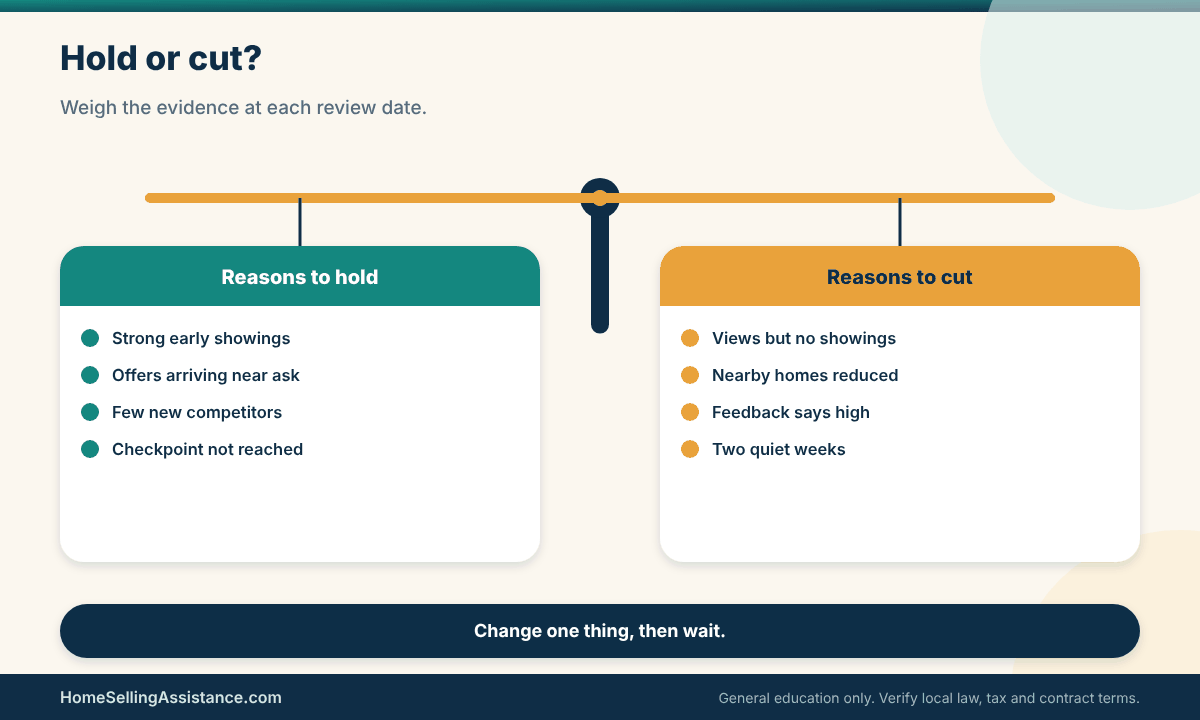
The balance sheet below shows the two sides of a typical checkpoint: reasons that point toward holding the price and reasons that point toward moving it.
Evidence to gather: how to read the first weeks of listing data
Begin with the shape of the activity, not the totals. A strong first weekend followed by a sharp drop suggests the house attracted the buyers who were waiting but did not hold the wider market. A slow, steady trickle with no peak suggests the listing was never quite in the right band. A burst of showings with nothing after suggests buyers saw it and compared it unfavorably. Each shape points in a slightly different direction.
Next, compare with nearby listings on the same dates. Ask your agent for a short list of active, pending and recently sold competitors, each with its list price, any price changes, days on market and what it offers that yours does not. You are looking for a gap: perhaps yours has a lower price per square foot but fewer bedrooms, or a better kitchen at the same price as a house with a larger yard. Our guide to price per square foot and home value explains why that single figure can mislead if you use it alone.
Third, note what moved after anything you changed. If you swapped in better photos on day nine, did views rise? If you opened up showing times, did bookings rise? Changes in presentation are cheaper to test than changes in price, and they separate two explanations that otherwise get mixed up. Be careful with small numbers. Three showings versus five is not a trend. Two weeks of data at a low volume tells you less than the same two weeks in a busy season.
Keep an eye on external timing too. Holidays, school calendars, weather and local events all shift buyer attention, and a quiet week in the middle of a long weekend says little about your price. Write the context next to the numbers in your log so that you can read the quiet weeks fairly. This is also where our reading on National Association of Realtors research and market data can give national context, but remember that national figures are not a forecast for your street.
One more way to use the log: look for the question your home price reduction strategy is not yet answering. If your notes say views are high and showings low, the strategy has an answer ready. If your notes say showings are high and offers are absent, the strategy needs a different branch, one that looks at condition and terms before price. Gaps like this show you where your home price reduction strategy needs another line.
A scenario, an exception and your next step: the listing with views but no showings
Here is an illustrative case, with made-up round numbers. A house lists at 450,000 dollars. After two weeks the listing shows a healthy number of online views and saves, but only a couple of showings have been booked. What does that pattern mean? Buyers are curious, which suggests the photos and headline draw them in. Then something stops them from booking. A price that feels above comparable homes is the most common suspect, but it is not the only one.
Check the cheap explanations first. Does the description mention a feature that raises questions, such as a busy road or a dated bath? Are showings hard to book, for example because of a long notice requirement? Is a competing listing a few streets away newly reduced? If none of those explains it, a price move is reasonable. The exception is a market that is simply slow for every house, where a cut might not change anything.
In that case, your next step is to ask your agent for recent sold-to-list data in your price band, and to decide how much of your timeline you can afford to spend waiting.
Whatever you decide, write down the reason in the log: “Views high, showings low, three nearby comps lower, photos refreshed on day nine with no change, so reducing at checkpoint two.” That sentence will help you later, both in judging whether the cut worked and in talking to buyers if they ask why the price moved.
Different symptoms call for different responses, which is why the diagram below branches by what you are seeing and not by how long the listing has sat.

As you move through the sequence, keep asking one plain question: what would change my mind? If nothing could, you do not have a home price reduction strategy, you have a number you are attached to. If too many things could, you have no anchor and will drift. Two or three clear triggers, written down, are enough to give a home price reduction strategy its shape without making it rigid.
Handoffs, negotiations and contingencies after a price change
A price change is not a private choice you make once and forget. It passes through several hands: the listing agent or you, the MLS or listing site, buyer agents who may have been tracking your home for a client, and in some cases a buyer who has already made an offer or is under contract. Each handoff has a place where it can go wrong, usually because a step was assumed and not written down.
If you have a listing agreement, it governs who may change the price and how. Many agreements say the agent updates the price at your written direction, but terms differ, so read yours or ask the agent to point to the clause. Our guide to the listing agreement for sellers explains the sections to look for. If you are selling on your own, you hold both roles and the discipline of writing things down matters even more.
Think of this subsection as the part of a home price reduction strategy that happens after you press the button. The price change brings new eyes, and new eyes bring new offers and new questions. If you only planned for the cut and not for the response, you are doing half the job. Decide now how you will answer an offer that comes in below the reduced number, because it probably will.
Evidence to gather: how a lower price changes offers and appraisals
When the price drops, the offers that arrive afterward are shaped by it, but not in a simple way. A new price can bring in buyers who filtered you out earlier, and it can also tempt some buyers to offer less than the new number, reading the cut as a sign you are flexible. Both reactions are normal. What you can control is how you respond: whether you counter, how you weigh terms against price, and what you say about why the number moved.
Appraisals deserve a note. If a buyer uses a mortgage, the lender usually requires an appraisal, and the appraiser compares your contract price with comparable sales. A reduction does not guarantee the value will support the contract, and a low result can force a renegotiation. We cover this in your options after a low appraisal. The practical point for your home price reduction strategy is that it helps to know the strongest comps before an offer arrives, so a price you accept is one you can defend.
Gather three more pieces of evidence once offers begin: the buyer’s financing type and any pre-approval letter, the proposed closing date, and the contingencies requested, such as inspection, appraisal or sale of another home. A somewhat lower price with a clean contract and a firm date can be worth more to some sellers than a higher price loaded with conditions. That comparison is personal, so put numbers and dates on both before choosing. Our overview of counteroffer strategy for sellers goes further on weighing terms.
Sellers also ask whether they should announce the reason for a price change. Usually there is no need for a public explanation, but your agent should be ready to answer questions from buyer agents with facts: the new price, the date, and what has changed about the home or its marketing, if anything. Keep the tone plain. A home price reduction strategy that is explained calmly tends to attract calmer buyers, while defensive messages can invite lower offers.
A scenario, an exception and your next step: a cut, then an offer, then a low appraisal
Imagine a seller who lowers the price by a modest amount, receives an offer within days at the new price and signs a contract. The buyer’s lender then orders an appraisal that comes in below the contract price. The buyer asks the seller to reduce the price to match, or to split the difference. What now? Your contract spells out the options, which can include renegotiating, the buyer covering the gap, a challenge to the appraisal through the lender where that is allowed, or termination under the appraisal contingency.
The exception is a cash buyer or a buyer who waived the appraisal contingency, where the same pressure may not apply. The next step in any version is to call your agent or attorney the day the low value arrives, read the contingency language together and decide which of your options you actually want, before the buyer’s deadline. Acting on the deadline, not the mood, protects you from signing away more than you meant to.
Close the loop on your home price reduction strategy
Many sellers treat a price cut as finished once the new number appears online. In practice, a home price reduction strategy is only complete when the change is documented, the buyers on both sides know where they stand, and the final sale numbers match what you expected. This last part of a home price reduction strategy is less exciting than choosing a number, but it is where misunderstandings turn into disputes.
The table below is a transaction check table. It pairs common issues with the evidence you should hold, the input you need from the buyer, agent or title company, the risk if you skip the check, and a sensible fallback. Use it after a price change, again when an offer is accepted, and a third time a few days before closing.
| Issue | Seller evidence | Buyer, agent or title input | Risk | Fallback |
|---|---|---|---|---|
| New list price not recorded | Signed change form or email approval | Agent confirms MLS and portal updates | Buyers see old price; confusion at offer time | Ask agent to send a screenshot of the live listing |
| Offer below the reduced price | Comps, activity log, written floor | Buyer agent explains terms and financing | Accepting a number that misses your floor | Counter in writing with a short expiration |
| Appraisal below contract price | Strongest comps, upgrade list | Lender and appraiser report summary | Deal stalls or price is reopened | Review contingency; renegotiate or relist |
| Concessions asked after the cut | Net proceeds worksheet | Buyer request in writing | Double discount on price and credits | Trade credits for firm dates or clean terms |
| Closing figures differ from plan | Payoff statement, cost estimate | Title company draft closing statement | Surprise shortfall at the table | Request line-item explanation before signing |
| Listing agreement nearing end | Copy of agreement and change history | Agent’s marketing summary | Automatic renewal or lost leverage | Hold a review meeting before the end date |
The best way to use this table is to print it, fill in the seller evidence column with real documents from your own file, and highlight the rows that apply right now. Anything with an empty evidence cell is a gap. Ask for the missing paper before the next deadline, not after.
Treat the confirmations as part of the strategy itself, not as an afterthought. A home price reduction strategy that exists only in your head cannot be shared with an agent, a spouse, a co-owner or an attorney. Written, it can. If more than one person owns the home, make sure each owner has seen and agreed to the home price reduction strategy before listing, so that a cut does not become a disagreement.
What to confirm in writing when the price changes
Verbal agreements are fine for conversation and poor as records. When you change the price, write down who approved it, what the new price is, the date and time of the change, and any other terms that moved with it, such as showing instructions or a bonus offered to buyer agents. Ask for the agent’s confirmation by email or through whatever e-signature system your brokerage uses. If you sell without an agent, update your own listing channels and take dated screenshots.
Written confirmation matters most at three points. When the price changes, so everyone is working from the same number. When an offer is accepted, so that the contract price, credits and dates are exactly what you negotiated. And before closing, when the settlement figures need to agree with the contract. Consumers often skip the first one, then find later that a buyer relied on an outdated number.
Evidence to gather: the change record, the contract and the settlement draft
Three documents give you a trail. The change record is whatever shows the old price, the new price and the date, and it should be saved with your listing agreement. The contract is the signed purchase agreement with all addenda, because credits, repairs and dates often live in addenda that people forget. The settlement draft is the estimated closing statement from the title company or attorney, which lists payoff, fees, prorations and proceeds.
Compare the three. Does the price in the contract match the price you agreed? Does any credit you gave appear on the draft statement exactly once? Are property tax prorations, association dues and recording fees in line with what you expected? Our guide on list price, market value and appraised value explains why the number in the contract is just one of several that matter, and why a cut in list price is only the start of the money story.
Keep a small worksheet that carries the home price reduction strategy through to dollars. Here is an illustrative example with round, made-up figures: a sale at 400,000 dollars, a mortgage payoff of 220,000, selling costs of 28,000 and a buyer credit of 4,000. That leaves 148,000 before any taxes or other items. Change the sale price by 10,000 and every other line stays the same, so the whole change comes out of your proceeds. That is why a floor matters.

The waterfall above shows the same idea in picture form. Reductions in price and credits stack on top of costs, and each step reduces what remains. Your own figures will differ, and only your contract and closing statement are reliable.
A well-built home price reduction strategy anticipates this exact moment. It includes your floor figure and a short list of concessions you would trade for certainty. If you wrote those down before listing, you can answer the buyer without a sleepless night. If you did not, take a day, rebuild the worksheet with the new numbers and respond in writing. Fast answers help, but accurate ones matter more.
A scenario, an exception and your next step: the buyer who wants both a lower price and a credit
Imagine a buyer who offers close to your newly reduced list price and then, after inspection, asks for a repair credit on top. From the seller’s view, this can feel like being asked to cut the price twice. Is it unreasonable? Not necessarily, since inspection findings are a separate matter from market price, and buyers have a right to raise them under many contracts. But you are also entitled to weigh the cumulative effect on your proceeds.
The exception is when the inspection reveals something material that you were not aware of, or that you should have disclosed. In that case the conversation is about facts, not bargaining. Your next step is to compare the total after both adjustments against your written floor, then respond in writing. A counter that trades some credit for a firm closing date, or a smaller credit for a quicker close, is a common way to keep the deal alive without losing sight of your number.
Before moving on, a short word about fairness in how the home is marketed after any change. Whatever the price, describe the home and its features, not the kind of person who should live there. Fair housing rules apply to every listing, including relisted and reduced ones, and HUD explains the basics of fair housing for anyone who wants to review them. A fresh round of marketing is a good moment to read your listing text again with that in mind.
Records and follow-up after closing
Once the sale has closed, the work is not quite finished. A home price reduction strategy leaves behind a paper trail that you will need for taxes, for any later dispute, and for your own learning if you sell again. Take an hour after closing to gather it into a folder, digital or physical, while the details are still fresh in your mind.
Keep it for as long as it might matter. Tax records and the documents that support your purchase price, improvements and selling expenses are usually kept for years, and your tax professional can tell you how long applies to your situation. For the basics of how selling costs and basis fit into a home sale, see the IRS guidance on selling your home and our article on how much your house is worth for the value side.
If you only remember one thing from this section, remember that each piece of paper answers a different question. The change record answers “what did we decide and when?” The contract answers “what did we promise?” The settlement draft answers “what actually happens to the money?” A home price reduction strategy keeps all three consistent, and when they disagree, you want to discover it early.
Evidence to gather: the final statement, the listing history and the proof of payment
Collect the final settlement statement, the signed contract with all addenda, the listing history showing every price change and its date, and proof of how and where your proceeds were paid. Store the payoff confirmation or the release from your lender too. If the sale involved a buyer credit, a repair completion, or a seller-paid cost, keep the invoice or receipt that backs it up. These records answer questions that can surface long after closing.
The listing history is a record that many sellers do not think to save, yet it can help explain the sale if a question comes up. A screenshot of the listing with its price changes, or a printout from your agent, takes five minutes to get. Ask for it at closing while everyone is still working on your file. Also save your own log of showings and feedback, since a future agent or buyer may ask what happened.
If you are curious how reductions interact with other pricing decisions, our piece on underpricing a house as a strategy shows the opposite approach, and why starting low is a different plan with its own risks. Compare the two before you decide which fits your timeline.
Looking back is also how you improve. After closing, write three lines about what your home price reduction strategy got right and what you would change: how soon you reviewed, whether the first cut was enough, whether the terms mattered as much as the price. Those notes are worth more than any general advice if you sell again, and they cost five minutes while the memory is fresh.
A scenario, an exception and your next step: the question that arrives a year later
A year after closing, a tax preparer asks what you paid in selling expenses, or a buyer’s attorney asks about a disclosure. You go to your folder and find the settlement statement, the contract, the listing history and the repair receipts. That is the happy version, and it takes about ten minutes. The unhappy version is a search through old emails and a phone you have since replaced.
The exception is that some questions are outside your records, such as how your tax situation applies to your gain, or whether a statement you made in disclosures was complete. Those are for a tax professional or an attorney. Your next step is to bring the folder to that conversation instead of describing it from memory. A person with documents in hand gets a faster, more useful answer than one who is relying on recollection, and the folder costs nothing to build.
Before the questions, a few habits that tie the whole home price reduction strategy together. Set your floor before listing and review it when your circumstances change. Treat your agent’s recommendation as evidence to weigh, and ask for the comps behind it. Change one thing at a time when you can, so you know which change worked. And remember that a price cut is a message to the market, so make it once and clearly, instead of in several tiny steps that train buyers to wait for the next one.
Seen from far enough away, a home price reduction strategy is just a way of respecting two facts at once: you cannot control the market, and you can control how you respond to it. Sellers who accept both usually make steadier choices. They set their floor, choose their checkpoints, ask for evidence and then let the process work. That is the whole of a home price reduction strategy, and it fits on one page.
That last point deserves a word. Some sellers cut by a small amount every week, hoping to find the exact level where a buyer appears. The risk is that buyers who follow your listing notice the pattern and hold off, expecting another drop. Others prefer one decisive move at a checkpoint. Neither approach is right everywhere, and your agent may have a view based on how local buyers behave. Ask for it, and ask what examples they have seen. Our article on how much to reduce your house price looks at sizing a move in more detail.
A final thought on mindset. A price reduction is not a verdict on you or on the house. It is a response to information. Sellers who treat it that way tend to decide earlier, argue less with themselves and keep better records. If your home price reduction strategy is written, reviewed on its dates and confirmed in writing, you have done the part that is in your control, and the market will handle the rest on its own schedule.
If you are reading this because a listing has already gone quiet, you can still build a home price reduction strategy today. Gather the file, write the floor, mark your next two review dates and decide what evidence would trigger a change. Starting late is better than starting never, and a home price reduction strategy begun midway still keeps you from drifting. Do it this week, not next month, so the days on market stop doing the deciding for you.
Quick scenario
A seller lists with three written checkpoints and a floor. At checkpoint one the log shows steady views and a handful of showings, so nothing changes. At checkpoint two, showings have faded and two nearby homes were reduced, so the seller approves one move in writing and refreshes the photos. Two weeks later an offer arrives near the new price. Because the floor and net figures were already written, the seller answers in a day. The numbers here are illustrative, and your own market will differ.
Frequently asked questions about home price reduction strategy
What is a home price reduction strategy, in plain terms?
It is a written plan, made before or early in a listing, that says what evidence will cause you to lower the asking price, by roughly how much, and who must be informed. It includes your floor and your review dates. The purpose is to replace gut-driven reactions with a process, so each change has a reason you can explain later.
Is there a standard percentage for a home price reduction strategy?
No. Sellers sometimes hear a rule of thumb, but how far to move depends on your neighborhood, price band, season and how far you started above the market. Ask your agent for local data, such as recent reductions and what happened after them. Treat any universal number as a conversation starter, not a promise.
How long should a home price reduction strategy wait before lowering the price?
There is no single answer. Many sellers set a first checkpoint after a couple of weeks of real exposure, then another after a few more. If activity is strong, waiting makes sense. If showings are scarce and nearby homes are being reduced, an earlier move may be reasonable. Our guide on what to do when a house is not selling adds more.
Should a home price reduction strategy test photos before cutting the price?
Often it is worth testing the cheaper explanation first, especially if views are high but showings are low. Better photos, a clearer description and easier showing access cost less than a price cut. But do not delay too long, because a stale listing loses attention. Make the presentation changes quickly, then review on your next scheduled date.
Does a price cut make buyers think something is wrong with the house?
It can, in some cases, though many buyers simply see a new chance to afford a home they liked. How you present it matters. A clear, dated change with refreshed marketing reads as a seller who responds to the market. A series of small, unexplained drops can look like uncertainty. Your agent can advise how local buyers tend to read reductions.
Who has authority to change the price when I have a listing agreement?
That depends on the agreement. Commonly the listing agent changes the price at the seller’s written direction, but terms differ. Read the clause on price, or ask your agent to point it out. Our article on the listing agreement for sellers lists what else to check, and an attorney can explain anything unclear.
Can a home price reduction strategy rely on negotiation instead of a lower list price?
You can, and some sellers do. Holding the list price while negotiating on an offer keeps the public number steady. The trade-off is that a high public price may keep some buyers from ever making an offer. Compare both paths against your floor and timeline, and consider asking your agent how buyers have responded to each in your area recently.
Does my home price reduction strategy affect taxes?
Your sale price, selling costs and basis all feed into how a gain is calculated, but your own situation decides the result. The IRS explains the basics in its publication on selling your home, and a tax professional can apply them. Keep the closing statement and records of improvements and selling expenses so that advice can be based on real figures.
What if my home price reduction strategy brings no offers?
Then it is time to reassess more than the number. Look at condition, terms, marketing, timing and whether the original comps were right. You might also consider whether to pause and relist, as discussed in our article on relisting an expired home listing. Local rules on relisting and days-on-market counts vary, so ask your agent how they work where you live, and see our market conditions and timing section for related reading.
Where can I check facts about my market?
Start with your agent’s local data, county records and the sold listings in your MLS if you have access. National reports from organizations like the National Association of Realtors give context but not a local forecast. For state-specific rules on listing agreements and disclosures, check with your state real estate commission or an attorney.
Write your home price reduction strategy before you need it
A home price reduction strategy works best when it is calm, written and tied to evidence you can point to. Build your file, set your floor, schedule your checkpoints and confirm each change in writing. This article is general education, not legal, tax or financial advice, and rules and market conditions vary. For decisions that affect your money, talk with a licensed agent, an attorney, a tax professional or a HUD-approved housing counselor as appropriate.