Choosing to sell for sale by owner means you take over, personally, a long list of jobs that a listing agent usually carries: setting the price, getting the home in front of buyers, screening visitors, reading offers, writing or reviewing the contract, keeping the deal alive through inspection and appraisal, and coordinating the close. This guide lays that list out job by job, so you can see what you would really be signing up for and decide whether it fits your house, your calendar and your temperament.
People tend to arrive at this topic from one of two directions. Some have heard that skipping an agent can keep more money in their pocket and want to know whether that is realistic. Others have already tried a conventional listing, or watched a neighbor try one, and wonder whether they could do a decent job on their own. Both questions are fair, and neither has a universal answer. What helps is a clear picture of the work involved, the money that is genuinely in play, and the places where sellers without representation most often get hurt.
We will keep this practical and even-handed. Selling for sale by owner is a legitimate, legal way to sell a home, and plenty of owners do it well, especially when they have a buyer already in mind, a hot local market, a simple property, or a comfort with paperwork and negotiation. It is also a route where small mistakes carry real cost, because nobody else is checking your work. We will not tell you which side of that line you are on. We will give you the tools to tell for yourself.
Throughout, you will see round example figures marked as illustrative, never as predictions. Commission practices, disclosure duties, contract forms and closing customs differ from state to state and sometimes from county to county, so wherever a rule matters we tell you how to verify it with a state real estate commission, a local attorney, a title company or the county recorder. This article is general education, not legal, tax or financial advice.
Key takeaways
- For sale by owner is a bundle of jobs, not a single decision. You can keep the whole bundle, hire out parts of it, or hand it all to an agent, and each mix changes your price, time, risk and net proceeds.
- Savings are never automatic. Compensation is negotiable and must be written down, and a seller who skips a listing agent may still owe a buyer’s agent, attorney fees, listing-service fees and marketing costs.
- Disclosure, fair housing and contract duties still apply to you. Federal rules such as lead-based paint disclosure for older homes do not disappear because no agent is involved, and state rules vary widely.
- Pricing and exposure drive most outcomes. A well-supported price range and broad listing visibility matter more than any single marketing trick.
- Verify the unknowns early. Payoff figures, title status, local forms, taxes and buyer funds should be checked with official sources and licensed professionals before you accept an offer.
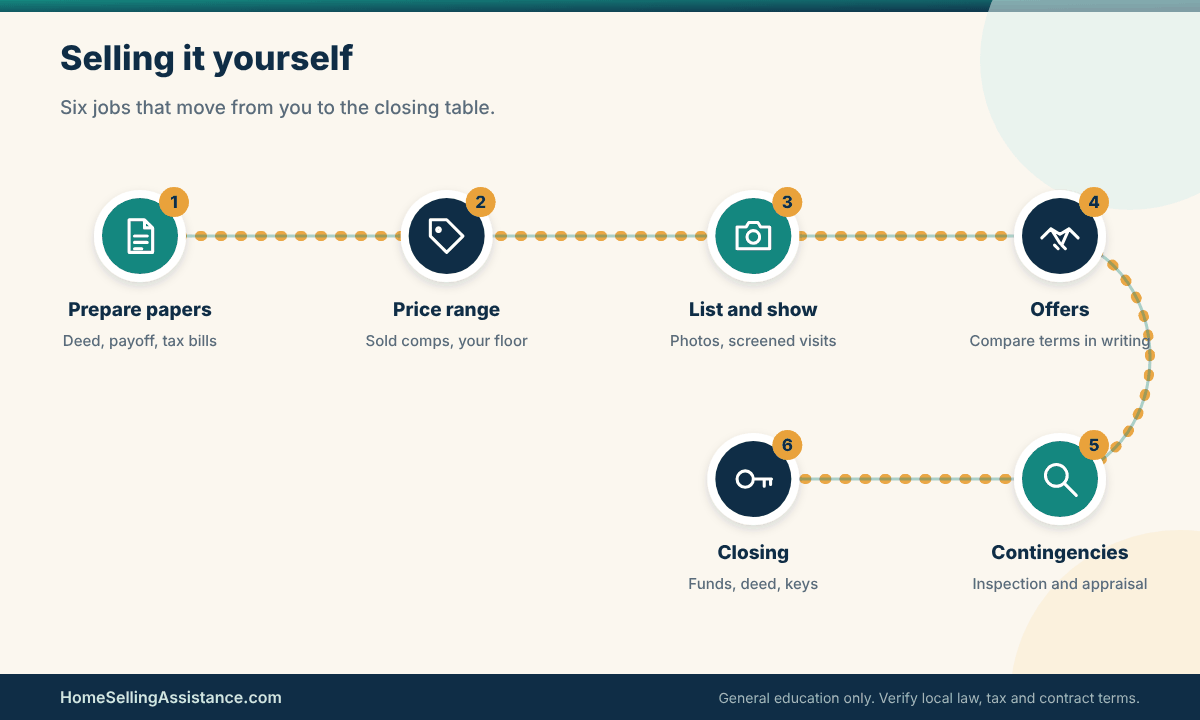
Deciding on for sale by owner before you decide on a price
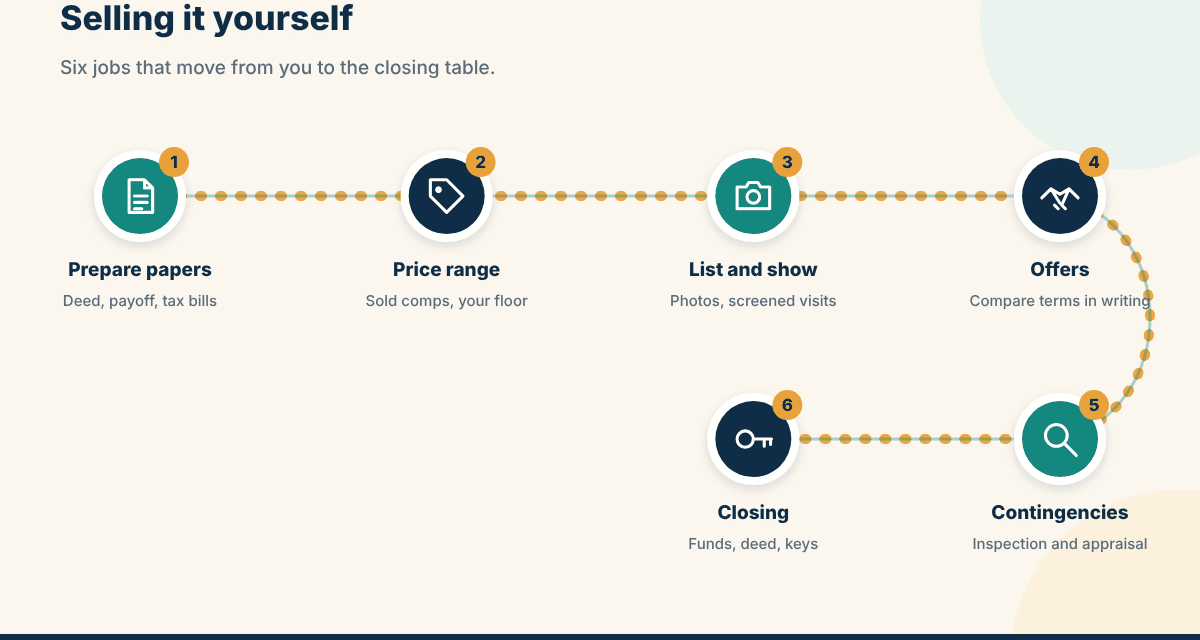
The picture above shows the usual order of work in a for sale by owner sale, from preparation through the closing table. Notice how much of it happens before a single buyer walks through the door. Sellers who struggle usually skipped something in the first half, such as an honest price study or a title check, and paid for it in the second half with a stalled contract or a late renegotiation.
So we begin with the decision itself. Before you pay for a sign or a listing service, work out what you want from the sale, what limits you, and what your property looks like to a stranger with a loan application. Everything else in this guide builds on those three answers.
Your goal, your constraints and your house, in plain terms
Most sellers carry two or three goals at once and have never ranked them. You may want the highest price, a quick closing, a clean exit with few showings, a sale to a particular person, or all of these. They conflict. Naming your top priority out loud, in a sentence you could say to a friend, is the first real step of a for sale by owner plan, and it will keep deciding things for you when the process gets noisy.
Constraints are the facts you cannot negotiate away. A mortgage balance sets a floor under what you can accept without bringing cash to closing. A job transfer sets a date. A co-owner who must sign, a tenant with a lease, a pending probate, a divorce order or an HOA with transfer rules each add steps and sometimes people whose approval you need. Write them all down, even the awkward ones, because every one of them affects timing and risk.
It also helps to be honest about why you are drawn to for sale by owner in the first place. Some owners like the control. Some want to avoid paying for services they believe they can do themselves. Some have a buyer lined up. Some simply had a poor experience with an agent once. Every one of those motives is understandable, and none of them proves the route will work for you.
A for sale by owner plan built on irritation tends to fall apart at the first awkward negotiation, while one built on a clear reading of your own skills tends to hold up.
Ask yourself a few direct questions. Are you comfortable talking about money with strangers, and saying no politely? Can you respond to messages within hours for several weeks? Do you read contracts slowly and completely, or do you skim? Can you hear that your price is too high without taking it personally? None of these questions is a test you can fail. They simply tell you which parts of a for sale by owner sale you will do well on your own and which parts you may want to share.
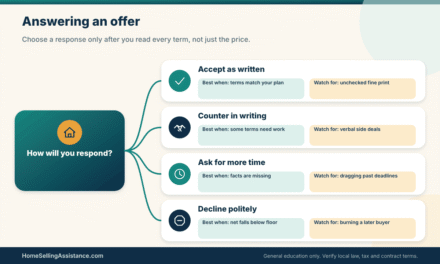
A fair way to test your readiness is to rehearse one hard moment. Imagine a buyer’s agent calls on day three and says the client loves the house but wants a lower price, a repair credit and a quick closing. Could you answer calmly, ask for the request in writing and take a day to respond? If so, you already have a core skill that a for sale by owner seller needs. If the call makes your stomach drop, notice that, and plan who you will lean on when it happens.
Evidence to gather: what you owe, what you own and what you need
Start with three documents, because they turn vague feelings into numbers. First, a current mortgage statement and, when you are closer to listing, a formal payoff quote from your lender, since the payoff includes interest through a closing date and can differ from the balance on your statement. Second, your deed, which shows exactly how title is held and who must sign. Third, your most recent property tax bill and any HOA statement, because those feed the closing prorations.
Next, pull together what you know about the house itself. Gather receipts for roof, heating and cooling, plumbing and electrical work, permits and final inspections for any renovation, warranties that transfer, and any past inspection or repair estimates. If the home was built before 1978, locate whatever lead-based paint records you have, because the federal rule discussed in the EPA real estate disclosure guidance asks sellers of most older housing to provide specific information and a pamphlet before a contract binds the buyer.
Then put a figure on the need side. If you are buying another home, ask what down payment your sale must generate and what happens if your closing slips. If you are relocating, find out how long your employer or your new lease gives you. If you are carrying two housing payments for any stretch, estimate what each extra month costs you. These are your own numbers, and they will tell you how much risk of delay you can afford, which is the most important input to the whole for sale by owner decision.
Finally, ask who else has a say. Look at the deed for every name on it. If one owner has died, if the property sits in a trust, or if a divorce is pending, the question of who can legally sign is a separate legal matter, and a probate attorney, family-law attorney or title company can tell you what paperwork a buyer’s title insurer will want. Getting this wrong is one of the slowest and most expensive ways to lose a buyer.
A scenario, an exception and your next step for the goal question
Consider an illustrative seller, Dana, who owns a three-bedroom house with a mortgage and wants to move within about four months for a new job. Her first instinct is to keep the commission she assumes an agent would take. When she lists out her constraints, she realizes that her real top priority is a closing date she can count on, because her new employer expects her on site. Price comes second. That ranking changes how she should judge every later choice, including whether to price slightly under the market to attract fast offers.
Here is the exception. Dana’s neighbor, Marcus, wants to sell to his nephew, who has already been preapproved and loves the house. Marcus does not need broad market exposure. His main questions are about paperwork, a fair price supported by something other than family opinion, and how to document the sale cleanly. For Marcus, a for sale by owner approach, perhaps with an attorney or a title company handling the contract and closing, can make good sense even though the same approach would be a gamble for Dana.
Your next step toward a for sale by owner decision is small and concrete. Write one sentence naming your top priority, a second sentence naming your hardest constraint, and a third naming the one piece of the sale you fear most. Keep that note nearby as you read the rest of this guide. When a later section describes a job that overlaps your fear, you will know it is a spot to consider hiring help, even if you decide to keep everything else in your own hands.
If you want the broader view of the full selling process alongside this one, our guide on how to sell a house walks through the same stages without assuming any particular route, and the FSBO and flat-fee MLS section collects the deeper articles that support this cornerstone.
The selling paths beside for sale by owner
Selling without an agent is one of several routes, and the cleanest way to judge it is to hold it next to the others on the same four yardsticks: what you keep, how long it takes, how certain the closing is, and how much work lands on you. The diagram below sets out the main forks. Notice that they are not mutually exclusive, and that the middle ground between them is where many sensible sellers end up.
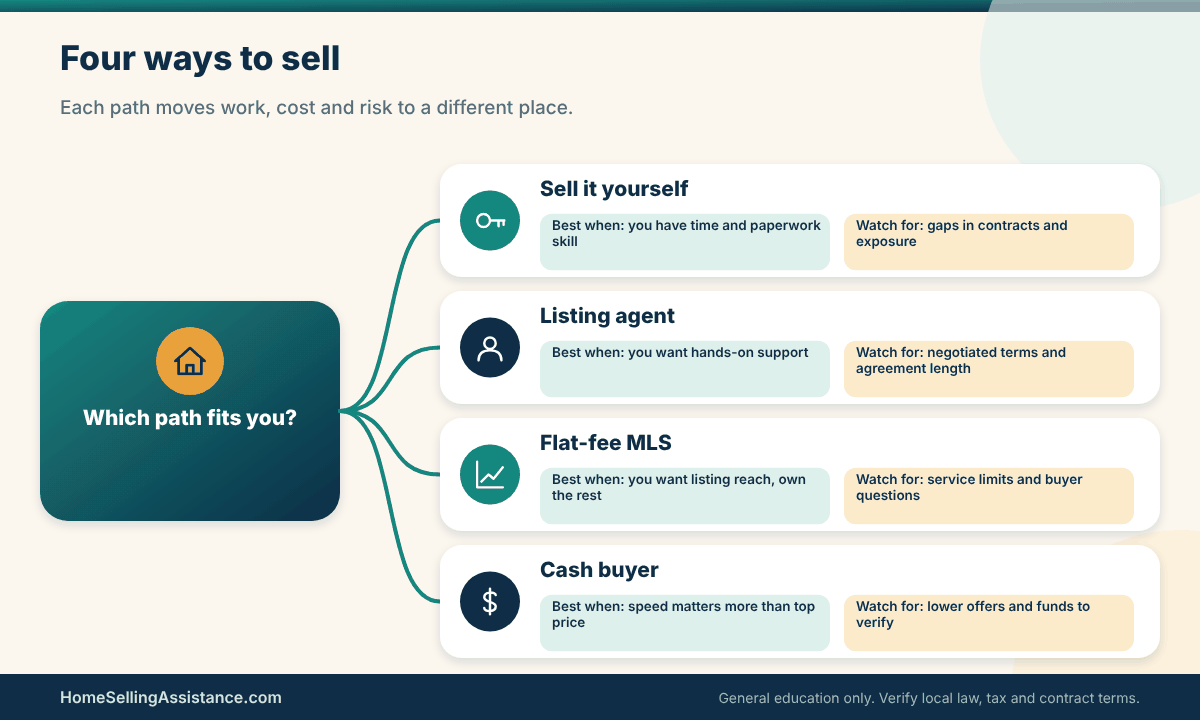
A traditional listing hands most of the marketing, screening and negotiation work to a licensed agent under a written agreement, in exchange for compensation you negotiate. A cash buyer or investor offers speed and fewer moving parts, usually at a price below what open-market competition might produce. An auction compresses the timeline and shifts price risk onto the day. A for sale by owner sale keeps you in the driver’s seat and keeps the work with you. If you want a head-to-head look, our piece on FSBO vs realtor compares the first two in more detail.
There are also in-between options that deserve a place on your list. You can sell on your own and hire a flat-fee service to place the home in the local multiple listing service, which we cover in the article on how a flat fee MLS seller works. You can pay an attorney to draft and review the contract and manage the closing. You can hire an agent for a limited task. Each of these keeps the label of a for sale by owner sale in everyday speech, even though some of the heavy lifting has been outsourced.
Think about time as well as money. A for sale by owner sale usually asks for more of your hours in the first two weeks, when inquiries and showings cluster, and again after you accept an offer, when deadlines arrive. If your job or family leaves you few free hours, the cost of your time belongs in the estimate, even though no invoice will ever show it. Some owners decide they would happily pay a professional for exactly those hours, and that is a perfectly reasonable conclusion.
Finally, consider how you feel about uncertainty. A traditional listing does not remove it, but it spreads responsibility across more people. With for sale by owner, you are the first person to see every problem, and the last person who can fix it. Some sellers find that thrilling, and others find it draining. Knowing which kind of person you are, before the sign goes up, is part of choosing a path rather than drifting into one.
Evidence to compare: net proceeds, time and effort across paths
The honest way to compare for sale by owner with other paths is to build a rough net-proceeds estimate for each one and set the results side by side. The structure is the same every time: expected sale price, minus your mortgage payoff, minus the fees that path involves, minus closing costs and credits you expect to give, minus any taxes or liens. What changes from path to path is the price you can realistically expect and the fees that apply. Anything you are not sure about should be a range, not a single number.
For a for sale by owner estimate, the fee side deserves a careful look, because it is where wishful thinking creeps in. List every cost you can imagine: a listing service if you use one, professional photos, a yard sign, an attorney or title company for the contract and closing, any compensation you decide to offer a buyer’s agent, repairs or credits that an inspection might trigger, and your own time. Seller costs vary by market, so get real quotes rather than borrowing a number from a stranger’s blog post, including this one.
For the agent-assisted path, ask two or three agents to put their proposed terms in writing, including the length of the listing agreement, the compensation offered to a buyer’s agent if any, the marketing they will actually do, and any cancellation terms. Broker compensation became more openly negotiable after the major industry settlement in recent years, and compensation has to be spelled out in a written agreement. Comparing written terms is far more useful than comparing remembered conversations. Our guide on how to choose a listing agent includes questions that help here.
It is worth spelling out what a listing agent typically does, so you can judge what you would be replacing. An agent usually prepares a price opinion, places the home in the local listing service, arranges photos, answers inquiries, screens and schedules showings, receives and explains offers, negotiates, drafts or fills in the contract, tracks deadlines and coordinates with the title company and lender. Not every agent does all of these well, and some of them you may handle perfectly.
The point of a for sale by owner decision is to match each job to the person best placed to do it.
For a cash or investor path, collect at least two written offers and read what each one requires: proof of funds, inspection rights, closing timeline, who pays which closing costs, and what happens if the buyer walks away. A headline price is not the same as the net you receive, and some offers lower the price after an inspection. We discuss this in the article on how to evaluate a cash offer for house seller decisions, which is worth reading before you sign anything.
The table below puts the decision-making pieces side by side for several typical seller situations. Treat it as a prompt for your own homework, not as a verdict. Read across a row to see the situation, the key fact you need to confirm, a practical action, the trade-off, and the document or source to check.
| Situation | Key fact to confirm | Practical action | Trade-off | Source or document |
|---|---|---|---|---|
| You already have a buyer in mind | Buyer’s funding and whether a lender is involved | Ask for a preapproval or proof of funds, then hire a closing professional | Less exposure, but price may go untested | Preapproval letter, bank statement, written offer |
| Strong local demand and a simple house | Recent sold prices of truly similar homes | Build a price range from sold comparables and list with wide visibility | Lower fees, but you handle every showing and call | Comparable sales, county records, listing service terms |
| Home built before 1978 | Lead-based paint disclosure duties | Prepare the federal disclosure form and pamphlet before a contract binds | Extra paperwork, but it protects you from a preventable claim | EPA real estate disclosure guidance |
| Mortgage balance close to expected price | Exact payoff amount and any prepayment terms | Request a written payoff quote and model several price levels | Little room for credits or price cuts | Lender payoff statement, loan documents |
| Title held by several people or an estate | Who has authority to sign | Talk to a title company or attorney before listing | Slower start, fewer collapsed contracts later | Deed, trust papers, court letters |
| Tight deadline for a move | How many months you can carry two payments | Decide in advance when you will switch to an agent or a cash offer | Self-managed timing is hard to guarantee | Your budget, employer letter, lease |
To use the table, find the row closest to your situation and then fill in the blanks for your own case. If you cannot name the document in the last column, that is your first task. Many stalled sales trace back to a missing paper that the seller could have gathered in an afternoon. If more than two rows describe you at once, the sale probably has enough complexity to justify paying for a legal or closing professional even if you keep everything else yourself.
A scenario with a hybrid path and a decision rule
Here is an illustrative case. Priya owns a condo with a clear title, a modest mortgage and no deadline. She likes the idea of selling on her own but is nervous about contracts. She pays a flat-fee service to place the condo in the local listing service, hires a real estate attorney for a fixed fee to prepare the contract and handle the closing, and keeps showings and negotiation for herself. She has built a hybrid path that keeps most of her control and buys professional help exactly where her anxiety sits.
Now picture the same plan with one change. Priya’s condo sits in a building with strict HOA transfer rules and an application process that takes weeks. A buyer’s loan may depend on documents only the association can supply, and she does not know what her association will require. For that reason she decides in advance that if she has no signed contract after a set number of weeks, she will interview agents. A decision rule written in advance beats a decision made in frustration.
Our overview of FSBO and flat-fee MLS articles can help you spot where your own rule should sit.
A good rule for a for sale by owner sale has three parts: a trigger, a time limit and a next action. The trigger might be a price you will not go below, a number of showings with no offers, or an inspection report with problems you cannot afford to fix. The time limit gives you a date, not a mood.
The next action names what you will do, for example “call two agents” or “ask the attorney to review the counter.” Write all three on paper before you list. It will feel formal and a little silly, and it will save you from drifting.
One more point about for sale by owner and other paths. Switching routes midstream is allowed, but it has its own rules. If you have signed a listing agreement or a service agreement, read the cancellation and protection-period language before you change course. If a buyer found you through a particular agent or service, that relationship may carry obligations. The article on when to hire an agent after FSBO walks through the practical signals and contract traps.
What moves price, time, risk and net proceeds when no agent is in the middle
Four outcomes matter in any sale: the price on the contract, the time to closing, the chance that the deal falls apart, and the money you actually receive. They pull against each other. A higher asking price can lengthen the time on the market. A faster close may mean accepting weaker terms. A buyer with a large down payment can shrink risk and still ask for credits. When you sell for sale by owner, you are the one balancing these forces, and no one is nudging you back toward the middle when you drift.
The next two sections go through the variables behind those four outcomes. The first covers the things that mostly sit outside your control, namely the market, the condition of the home, how the buyer pays and what the contract says. The second covers what you can control a little more: your costs, the legal and tax questions, the logistics and how you rank your priorities.
Market, condition, financing, contract and buyer variables
Think of these five variables as dials on a for sale by owner sale. You rarely get to set them all, but you can read them accurately and make choices that fit. A seller who knows that the local market is slow, the roof is aging and the likeliest buyers need a mortgage with an appraisal will price, prepare and negotiate differently from a seller who simply hopes for the best.
Seasonality and local events also play a part, though sellers often overstate them. A school calendar, a major employer’s hiring wave, weather and holidays can all shape buyer traffic in one area and mean nothing in another. If you are weighing a launch date for your for sale by owner listing, look at how homes like yours behaved locally in recent years, using sold data, and do not rely on a national rule of thumb. A well-prepared home listed in an average week usually beats a rushed one listed in a famously good week.
Market conditions decide how much leverage a for sale by owner seller holds. When buyers are plentiful and homes are scarce, a thoughtfully priced home can draw several offers quickly, and the extra work of selling yourself feels lighter. When buyers are cautious and inventory is high, exposure, presentation and flexibility matter much more, and the tasks that an agent would normally manage, such as persistent follow-up and negotiation, become heavier. Local conditions can differ even between neighboring towns, so national headlines are a poor guide.
Evidence to check: comparables, condition reports and buyer funding
For price, the strongest evidence is recent sold prices of homes similar to yours in the same neighborhood, adjusted for the differences a buyer would notice: size, age, lot, condition, upgrades, garage, and location on the street. Asking prices tell you what other sellers hope for, not what buyers paid. Pending sales hint at demand. Listings that sat and were reduced show where the ceiling is.
Our guide on how to price a house to sell shows the step-by-step method, and the article on how to price a FSBO home adds the points that matter when no agent is running the numbers for you.
Keep in mind that the public data you can see online is not the complete picture. Sold data from the local listing service often includes details such as days on market, concessions and sold-versus-list differences, which are hard to get from public portals. County records show recorded sale prices but little about condition.
If you are a for sale by owner sale, consider paying a licensed appraiser for an independent opinion of value, or asking a local agent for a comparative market analysis, understanding that agents may hope to win your listing and that you are not obliged to hire them.
For condition, consider a pre-listing inspection from a licensed inspector. It costs money and it may reveal problems you would rather not know about, which is exactly why some sellers skip it. But a buyer’s inspector will find those problems anyway, and you will meet them in the middle of a negotiation, when you have less time and less leverage. Knowing in advance lets you choose between repairing, offering a credit or adjusting the price, and it gives you facts for your disclosure form.
Your listing description and photos are part of the same condition picture. Describe what is true and useful: the age of the roof if you know it, recent updates with approximate dates, the lot, the layout, the heating and cooling type, and anything a buyer would otherwise have to ask about. Photos should be bright, level and honest. A for sale by owner listing with accurate detail attracts fewer wasted showings, because the buyers who arrive have already seen what they are getting and have decided they are still interested.
For buyer funding, learn the difference between a prequalification, a preapproval and proof of funds. A prequalification is a quick estimate. A preapproval typically means a lender has reviewed documents, and even that is not a final commitment because the appraisal, the property and the buyer’s situation can still change before closing. Proof of funds for a cash purchase should show account ownership and available balance, and you should confirm it through a channel you trust, not just a document sent by the buyer.
Financing type also shapes your timeline and your repair obligations. Government-backed and conventional loans can carry different property condition standards and different appraisal sensitivities. A buyer’s lender may require that certain safety or structural defects be corrected before closing. Ask each prospective buyer what loan type they expect and what the lender’s property requirements might be. You are not giving financial advice by asking; you are gathering information that affects your own risk.
The contract is the last variable on the dial. Contingencies for financing, inspection, appraisal and the sale of the buyer’s own home all give the buyer ways to adjust or leave. Each one has a deadline, and each deadline is a point where your sale can wobble. Our article on home sale contingencies for sellers explains how these clauses work in general, and you should read the actual wording in your own state’s contract form.
A scenario, an exception and your next step for the market variables
Take an illustrative seller, Tom, whose home is in a neighborhood where, in his experience, homes sell quickly. He lists a little above his sold-price range and gets several showings the first weekend. One buyer offers close to asking with an inspection contingency and a loan. Another offers a bit less in cash with a faster closing. Tom now has two different bundles of price, time and risk, and no agent to help him weigh them. The decision is his, and the right answer depends on his top priority from the first section.
The exception to the “fast market” story is what happens if the first weekend passes without an offer. Many sellers who rely on a hot market feel pressure to cut the price quickly. A calmer approach is to look at activity data: number of online views and saves if your listing service provides them, number of showings, the feedback you collect and the competing listings that appeared since you launched. A price cut makes sense if the evidence points to price.
If the evidence points to photos, condition or visibility, cutting the price may only hand away money without fixing the cause.
Your next step in a for sale by owner plan is to build two lists. In the first, write every variable that could slow your sale or reduce your net: market softness, aging systems, a buyer pool that needs financing, a contract with several contingencies. In the second, write what you will do about each. A short list with a plain action beside each item is a better risk plan than a vague feeling of unease, and it makes later conversations with an attorney, a lender or an agent much more efficient.
If competing buyers do appear, your handling of the offers matters as much as the offers themselves. The guide on how to evaluate a home offer as a seller breaks down price, contingencies, deposit, timeline and buyer strength into separate questions, and the piece on how to negotiate a FSBO offer covers counteroffers, deadlines and the communication habits that keep a deal calm.
One last point on this variable set concerns fair housing. Federal law prohibits discrimination in the sale of housing based on protected characteristics, and many states and cities add more. That covers how you advertise, whom you show the home to, what you say to prospective buyers and how you evaluate offers. Do not assume that a for sale by owner sale places you outside these rules. The HUD fair housing resources explain the basics, and a local attorney can answer questions about your situation. Describe the home, not the neighbors or the kind of people you imagine living there.
Costs, legal and tax issues, logistics and seller priorities
If market, condition, financing and contract terms are the dials you read, costs and obligations are the ones you can partly set. A for sale by owner seller has more room than most to decide which costs to take on, which to share and which to avoid, and also more room to forget one. The waterfall below shows the general structure of a net-proceeds estimate. The amounts will be yours, built from real quotes, not from this picture.
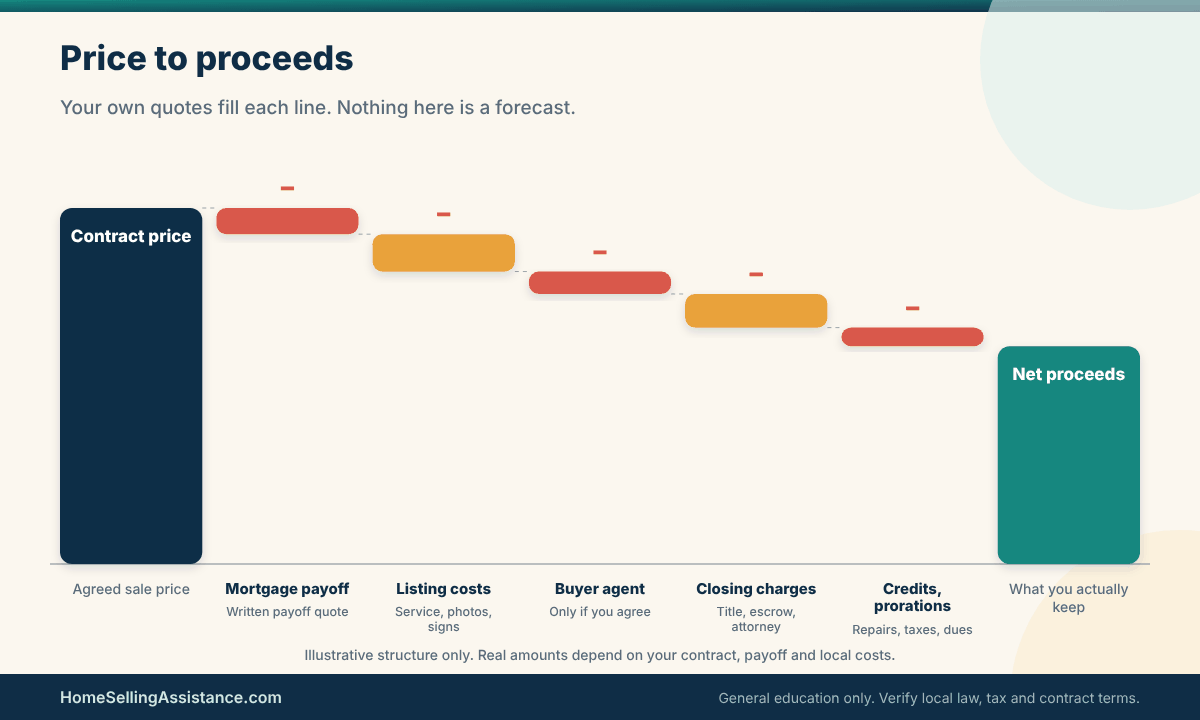
Read the picture from left to right. You start with a contract price, and then a series of deductions and credits take it down to what you receive. The first and largest line for most sellers is the mortgage payoff. Broker or service fees come next, and in a for sale by owner sale this line may be small, but it is rarely zero. Title, escrow or attorney charges follow, then credits you agreed to give, prorated taxes and association dues, and any taxes or liens. Our article on seller closing costs breaks these lines down further.
Legal duties sit alongside the costs. Sellers in most states must disclose known material defects, and many states use a prescribed form. Some states lean toward “buyer beware” and require less, but even there, hiding a known serious problem can create liability. A federal rule requires lead-based paint disclosure for most housing built before 1978. Our guide to seller disclosure requirements explains the general picture, and your state real estate commission or a local attorney can tell you what applies where you live.
Evidence to gather: quotes, forms and tax rules that fit your sale
Start with quotes. Call a local title company or closing attorney and ask what they charge to handle a sale where the seller has no listing agent. Ask what is included, who prepares the settlement statement, who orders the payoff and records the deed, and what they need from you. Ask a flat-fee listing service what their packages include, how long the listing lasts, and whether you can cancel. Ask a photographer for a price. Put each answer in a simple notebook with the date, so you can compare like with like.
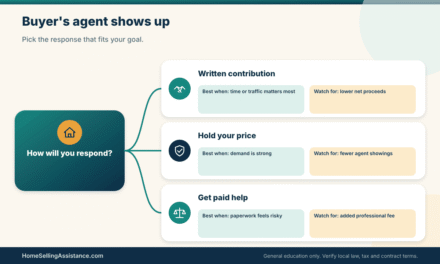
Ask about buyer-agent compensation, and do it early. Buyers who work with their own agent will ask whether you are offering any compensation to that agent. Practices have changed in recent years, and compensation is negotiable and has to be put in writing, either in the buyer’s agreement with their agent or in your contract.
It is a good idea to decide in advance how you want to handle this question, because a seller who has not thought about it will tend to answer in the middle of a negotiation. Our article on what happens when a FSBO buyer has an agent covers the options and the questions to ask.
Next, find the forms. Contract forms differ by state and sometimes by county. In some places, attorneys draft the contract. In others, standard forms are widely used through real estate associations, and non-members may need to buy or license them. Ask the real estate commission in your state what forms and disclosures are required of sellers, and ask a local attorney or title company what forms they will accept.
Do not download a generic contract from a random website and assume it fits your state. A form that omits a required disclosure or uses the wrong deadlines can cause real trouble. Our piece on FSBO paperwork lists the documents sellers typically meet.
Then look at taxes, carefully and without assuming. For many homeowners, federal tax law lets a seller exclude part of the gain on the sale of a main home: up to $250,000 for a single filer and up to $500,000 for most married couples filing jointly, if ownership and use tests are met, generally two of the last five years.
Many sellers owe nothing federally because of this rule, but gain can exceed the limits, rules for rental use or business use of part of the home differ, and state taxes vary. The IRS explains the details in Publication 523, and a tax professional can apply it to your facts. Our guide on taxes when selling a home gives a plain-language overview.
Basis matters in that calculation. Your basis starts with what you paid and can include certain improvements and closing costs, which reduces your gain on paper. Keep receipts for major projects, because a seller without records has trouble proving basis years later. IRS Publication 551 covers basis in detail. If you inherited the home or received it as a gift, basis rules differ, and an accountant familiar with your situation should guide you.
Finally, look at insurance and liability. A seller who holds open houses or hosts many strangers should ask their homeowner’s insurer whether anything about the policy changes while the home is on the market, especially if the property is vacant. Ask the insurer whether coverage continues, what is expected if the home is empty, and what happens to the policy at closing. These are questions for the insurer, not for this article, and the answers depend on the policy in your hands.
A scenario, an exception and your next step for the cost question
Here is an illustrative example of for sale by owner costs, using round numbers labelled so there is no confusion. Suppose a home goes under contract at $400,000, the mortgage payoff is $220,000, and the seller expects title and closing charges, prorations and a repair credit totaling something in the low five figures. After the payoff and those items, a large amount remains, but the amount depends on every line. If the seller has also agreed to pay a buyer’s agent, hired a flat-fee service and paid an attorney, the line for fees grows.
None of these numbers predicts what you will pay. The point is the method: write down every line, put a range beside it, and recalculate whenever an offer arrives.
The exception is the seller who assumes that skipping an agent means skipping a large cost. It may, but the savings can be smaller than imagined, or can be offset by a lower price if the home is not exposed to as many buyers, or by a legal mistake that costs far more than any fee saved. The reverse can also be true: a seller who prices well, sells quickly to a prepared buyer and uses a modest closing attorney may keep a meaningful amount. Neither result is guaranteed, and sellers should be cautious about anyone who promises one.
Your next step with for sale by owner costs is to make a one-page cost sheet. Use three columns: the item, a low estimate and a high estimate. Include payoff, any listing service, photos and signs, legal or closing fees, buyer-agent compensation if you choose to offer it, repair credits, prorations, moving costs and the cost of carrying the home for one extra month. Add the low estimates and the high ones separately.
Then ask whether the sale still meets your top priority at the high end. If it does not, that is a signal to change something, such as the price, the path or the timeline, before you list.
Logistics deserve their own thought, and they are where for sale by owner sales most often surprise people. You will be answering phone calls and messages at odd hours. You will need to schedule showings around your life and the buyer’s. You will need a safe way to screen visitors, which our guide to FSBO showing safety covers, including identification checks, never being alone and putting away prescriptions and valuables. Someone must also meet inspectors, appraisers and, sometimes, surveyors, and send documents quickly and keep a log of what was sent and when.
Staging and photos belong in this group too. Buyers see the listing photos before anything else, and unclear, dark or cluttered photos limit your audience. You do not have to hire a professional stager to make a home look orderly, bright and clean. Our home staging guide for sellers gives a realistic order of tasks, from decluttering to lighting, and explains where spending helps and where it does not.
Think also about paperwork flow. Offers, counteroffers, addenda, disclosures, inspection reports and repair requests all generate documents that need dates, signatures and copies. A for sale by owner seller should keep one clean folder, with a log of what was sent, to whom and when. Ask your closing professional which documents they want delivered directly to them. A tidy paper trail protects you if a buyer later disputes what was promised, and it speeds up the closing because nobody is hunting for the version that was actually signed.
The last piece of this section is the question of priorities again, because for sale by owner is a choice about priorities as much as money. By now you should have a sense of the work, the cost and the risk.
If your top priority is keeping as much of the sale price as possible and you have time, patience and some paperwork skill, a for sale by owner sale may suit you. If your top priority is certainty, you may prefer a more supported route. If your top priority is peace of mind, consider which jobs you would pay to avoid, and hire help for those. There is nothing wrong with any of those answers.
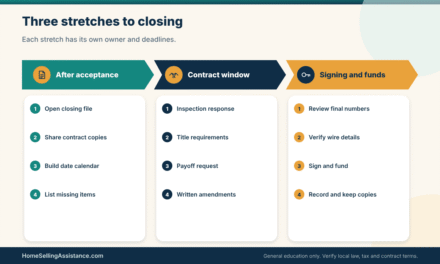
The second table puts the same story in sequence. It follows the transaction from the first decision to the keys, showing what you must do, which people or institutions your work depends on, the usual deadline pressure and a fallback if something goes wrong. Deadlines vary by contract, so the column describes the type of deadline, not a specific number of days.
| Stage | Seller responsibility | Buyer or professional dependency | Typical deadline | Fallback if it slips |
|---|---|---|---|---|
| Preparation | Gather deed, payoff quote, tax and HOA papers, repair records | Lender, county records, HOA manager | Before listing goes live | Delay launch until key papers are in hand |
| Pricing and listing | Set price range, write description, arrange photos and exposure | Listing service, photographer, appraiser or agent opinion | Launch date you choose | Adjust price or presentation using evidence |
| Showings and offers | Screen visitors, host showings, collect written offers | Buyers, buyer agents, lenders reviewing preapprovals | Offer response dates you set | Extend the offer window or counter on terms |
| Contract and contingencies | Sign a compliant contract, track every contingency date | Attorney or title company, buyer’s inspector, lender | Dates written in the contract | Negotiate an amendment in writing |
| Inspection and appraisal | Allow access, answer repair requests, respond to value gaps | Inspector, appraiser, buyer’s lender | Contingency deadlines | Offer a credit, repair or renegotiate the price |
| Closing and funding | Review final figures, sign documents, deliver keys | Title or escrow, lender, recording office | Closing date in the contract | Written extension, or the contract’s default remedies |
To use this table, mark the stage you are in and read across. The seller responsibility column tells you what is on your desk. The dependency column tells you who can slow you down. The deadline column shows where your calendar needs alarms, and the fallback column gives you the first option to discuss with your attorney or closing professional if something slips. Print it and keep it in the same folder as your contract. Many for sale by owner sellers find that a simple stage-by-stage view is what keeps a long transaction from feeling like a blur.
Turn the overview into a verification roadmap for a for sale by owner listing
An overview of for sale by owner is useful only if it turns into action. This last major section converts everything above into a checklist you can verify, with two parts: the documents and professionals you may need, and the decisions that belong before you list versus those that can wait until you hold an offer. The aim is to avoid two opposite mistakes, launching without the basics and spending weeks on perfect preparation while the season passes.
A roadmap also protects you from a quiet risk in the for sale by owner route: the sense that every question is urgent. Most of them are not. Some questions must be settled before the first showing, some before you sign a contract, and some only before closing. Sorting them into those three piles takes a lot of pressure off, and it shows you where a professional’s hour is worth the most.
Documents and professionals to involve in a for sale by owner sale
You do not need a large team, but you should know who the possible members are and what each one does. A real estate attorney reviews or drafts contracts and can handle the closing in states where attorneys play a central role. A title or escrow company holds funds, researches title, prepares closing documents and records the deed. A lender’s payoff department provides your payoff figure. An appraiser gives an independent view of value. An inspector describes the home’s condition.
A tax professional explains how the sale fits into your return. You may use some, many or all of these, depending on your state and your comfort.
The checklist below groups the paperwork that most sellers need into three families: ownership, money and condition. It is a starting point, and your state or situation may add items. Gather what you can before the first showing, because a buyer who is excited about the house is also impatient, and a slow response to a reasonable request is a common reason for a deal to cool.
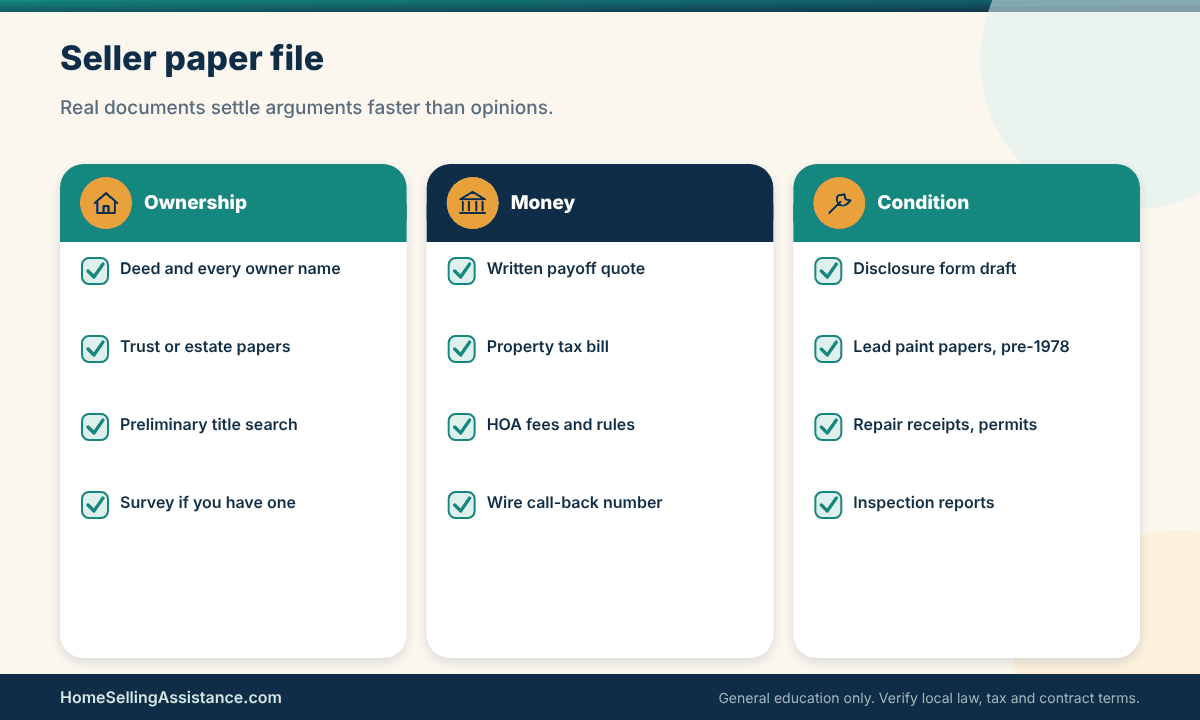
Notice what the checklist leaves out: opinions. Every item is a document or a fact you can verify. That is deliberate. Online forums and neighbors offer plenty of opinions, but a payoff letter, a recorded deed, a tax bill and a repair receipt are things you can hold, and they settle arguments quickly.
Evidence to gather: who signs, who holds funds and who checks title
Begin with signature authority. Look at the deed to see every owner named, then confirm that each one is alive, willing and legally able to sign. If a name has changed, if an owner has died, if the property is held in a trust or a business entity, or if a divorce or guardianship is involved, ask a title company or attorney early what documents the buyer’s title insurer will require. This one question can save months. A buyer cannot get clear title from someone who lacks authority, whatever the contract says.
Next, decide who will hold the buyer’s deposit and handle closing funds. In many places a title or escrow company does this as a neutral party. Holding a large deposit yourself, or accepting a check directly into a personal account, invites disputes and, in some states, legal problems. Ask your title company or attorney how deposits are usually handled locally, and use a neutral holder whenever you can. This is also a fraud-protection step, which we discuss in the article on home sale fraud and seller safety.
It also helps to confirm that your own mortgage allows a sale. Most do, but some loans carry terms about payoff timing or fees, and a for sale by owner seller who learns about them at the closing table has little room to react. Ask your lender for the payoff in writing and ask whether any prepayment terms apply. If you have a second loan, a home equity line or any lien recorded against the home, ask for payoff figures on those as well, because each one has to be cleared for the buyer to receive clear title.
Then plan title review. A title search looks for mortgages, liens, judgments, easements, unpaid taxes and recorded claims. Some of these can be cleared at closing from your proceeds. Others take time to resolve, such as an old unreleased mortgage or a lien from a contractor you thought you had paid. Ask your title company to run a preliminary search before you list, if they will, so that there are no surprises when a buyer’s search runs. Your county recorder’s office can also help you see what is recorded against the property.
Consider wire fraud and impersonation too. Criminals sometimes target closings, sending false payment instructions that look like they come from a title company or attorney. Always confirm wiring instructions by phone using a number you found independently, never one in an email. The FBI’s Internet Crime Complaint Center takes reports of this kind of fraud, and the FTC’s consumer site offers guidance on scams. Report quickly if something goes wrong, because speed matters.
Be wary of unsolicited contact. Owners who advertise a for sale by owner sale sometimes receive messages from people who offer to buy sight unseen, ask you to pay a fee first, send a check for more than the price and request a refund of the difference, or push you to move the conversation off the platform. Real buyers want to see the home, tour it, inspect it and work through a title company. A buyer who avoids all of that and pressures you for speed or secrecy deserves a firm no.
Finally, collect disclosure materials. Find out whether your state uses a standard seller’s disclosure form and whether your local contract form includes specific disclosures or addenda. Gather any HOA documents a buyer may need, such as governing documents, budgets and fee statements. If your property has a well, a septic system, a shared driveway, a pool or any unusual feature, collect documentation about it. The article on seller disclosure requirements gives a detailed overview, and the one on FSBO paperwork gives a practical list.
A scenario, an exception and your next step for professionals
Consider an illustrative seller, Elena, who inherited a house with her brother. She wants to sell for sale by owner to avoid a commission, and they have a neighbor interested. They have never opened probate, the title still shows their late parent, and the siblings do not agree on a price. Here the professional question dominates everything else. Without an attorney, the sale cannot move forward legally, whether or not an agent is involved. The first step is a consultation with a probate attorney, not a sign in the yard.
The exception comes from the other direction. Sam owns a townhouse outright, in a state where title companies routinely prepare the contract documents and run the closing. He has cleared title, collected his papers and has a preapproved buyer. He may need only a title company and perhaps a one-time attorney review. Sam should not feel pressure to assemble a large team just because a checklist exists. The right number of professionals is the number who answer the questions you cannot answer yourself.
Your next step before a for sale by owner listing is a short list of three calls. Call a title company or closing attorney to ask how sales without a listing agent are handled locally and what they charge.
Call your lender for a written payoff quote. Call a tax preparer or review the IRS guidance if you have any doubt about whether the gain might exceed the exclusion. Three calls, made before you list, will answer most of the questions that otherwise appear halfway through a contract. If you want counseling on housing decisions in general, the HUD housing counselor directory can point you to approved, free or low-cost help.
Keep a simple contact sheet with names, phone numbers and what each person is responsible for. When a buyer’s agent calls with a question about the survey or the HOA, you want an answer in minutes, not days. Fast, accurate responses are one of the quiet advantages a well-organized for sale by owner seller can offer. They show buyers that the transaction will be handled competently, and they keep momentum when the contract has tight dates.
It also helps to know the mistakes that come up most often, so you can watch for them. Sellers price from emotion or from asking prices. They skip the title check until a buyer finds the problem. They accept a verbal agreement, or use a contract that does not fit their state. They forget to track a contingency date. They hold a deposit themselves. They let a showing happen without any screening.
They also wait too long to ask for help. None of these is exotic. Each one can be avoided by the preparation described above, which is why a for sale by owner seller who prepares well often does better than one who simply starts.
The second group of mistakes is about communication. Sellers answer an offer emotionally and send a reply they regret. They tell a buyer too much about their deadline or their finances. They negotiate by text with no written record. They agree to a repair request on the phone and forget to put it in an amendment.
A short habit solves most of this: wait a few hours before replying to a hard message, keep every agreement in writing, and let your attorney or closing professional see changes before you sign. These habits cost nothing and protect your for sale by owner sale at every stage.
What to decide before listing and what can wait until an offer
Preparation has a cost in a for sale by owner sale, and so does delay. The smart move is to sort your decisions by when they need to be made. Some choices change how you launch, such as price, exposure, who handles showings, and whether you will offer buyer-agent compensation. Others only matter once a real offer arrives, such as how you respond to a request for repairs or how you weigh two competing bids. Settling the first group early and leaving the second group for later keeps your listing tight and your mind clear.
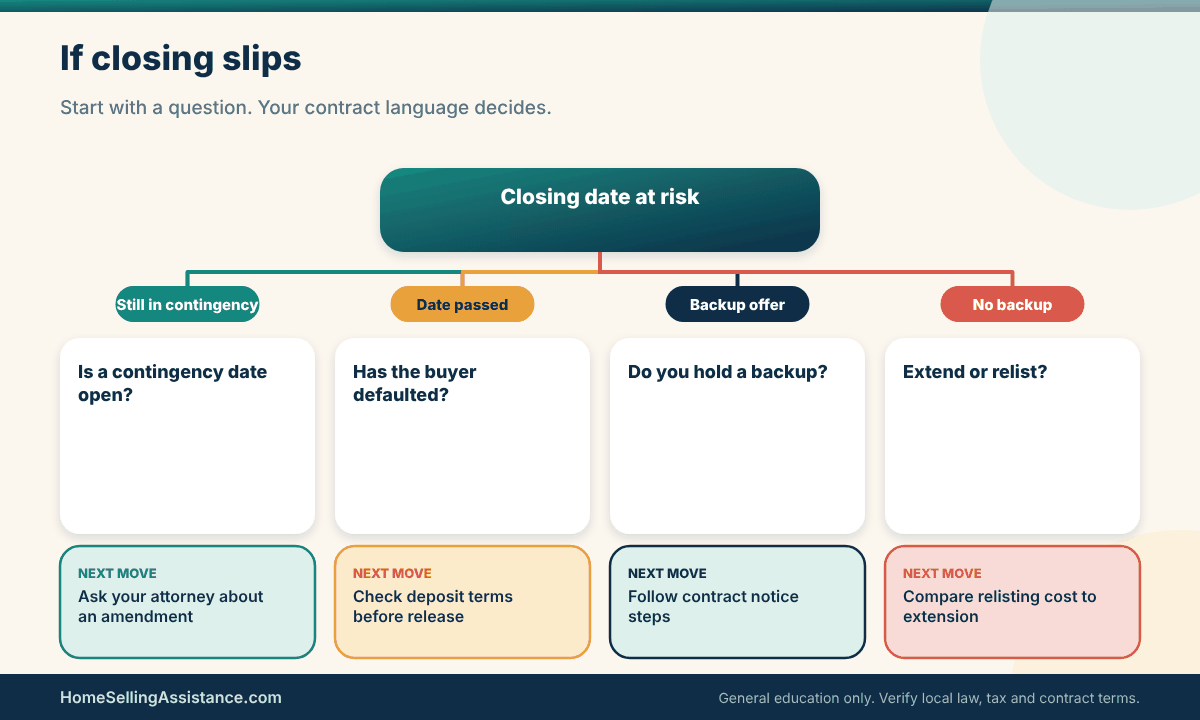
The diagram below shows a fallback tree for one of the most common problems in a for sale by owner sale: an offer that is accepted and then does not close on time. Notice how many branches exist and that each one starts with a question, not a reaction. Plan this before you need it, and your contract language will do much of the work for you.
Evidence to gather: what must be settled before the sign goes up
Before listing, settle your price range and your floor. The range comes from sold comparables, and the floor comes from your payoff, your costs and your top priority. You do not have to tell anyone your floor, but you should know it, because an offer that falls below it deserves a firm reply and not an anxious one. Settle also whether you will list at the top of your range, in the middle, or slightly below to draw attention. Each approach has trade-offs, and our article on pricing a FSBO home discusses them.
Settle how buyers will find you. If you want maximum visibility among buyers who work with agents, plan to appear in the local listing service, since most agents search there first. If you are selling to a known buyer, you may not need to. Either way, plan your photos, your description and your contact method. Keep the description factual and avoid language that hints at who should or should not live in the home, which matters for fair housing reasons and for simple good manners.
Settle your position on buyer-agent compensation. Some sellers choose to offer a stated amount, some choose to negotiate it case by case, and some choose to offer none and let the buyer arrange their own agent’s pay. Each has consequences for the size of your buyer pool and your net. Because compensation practices have changed and vary, talk to a local attorney or title professional about how to word this in your listing and your contract, and write down whatever you decide.
Settle your rules for showings. Decide the hours you will accept, how you will confirm visitors, whether you will require a preapproval letter before showing, and who will be present. Decide how you will handle security and valuables. Decide how you will handle open houses, if you hold them at all. These rules protect your safety and your time, and they are easier to set once, calmly, than to improvise with a stranger at the door.
Settle your plan for repairs and inspections as a policy, not a mood. Decide whether you will fix issues, give credits or hold your price, and under what circumstances you would change your answer. A seller who has a clear policy, such as repairing safety issues and discussing the rest, handles an inspection report calmly. A for sale by owner seller who has no policy often negotiates against themselves, conceding items before the buyer has even asked for them.
Settle your document packet. Make a folder, physical or digital, with the disclosure form, the lead-based paint paperwork if the home is old enough, the survey if you have one, utility cost summaries, HOA documents, warranties and repair records. Having this ready lets you respond to a serious buyer on the same day. It also forces you to see problems before the buyer does, which gives you time to decide how to handle them.
A scenario, an exception and your next step for timing
Here is an illustrative timeline. A seller named Ruth spends two weeks gathering papers and getting a payoff quote, one week on photos and a description, and then lists. She receives an offer in the second week, with a financing contingency and an inspection period. She does not need to decide today how she will respond to a repair request, because she does not have one.
She can spend that time reading the contract with her attorney, confirming the buyer’s preapproval and making sure the deposit will go to a neutral holder. Those are the decisions that belong to the offer stage, and she has the energy to make them well.
The exception is the seller who tries to decide everything after the offer arrives. When a real offer lands, there is a clock, an emotional pull and a buyer waiting. Sellers who have not set a floor, found a title company or read a sample contract tend to accept or reject offers for the wrong reasons. A few days of preparation before listing is cheap compared with a week of improvisation after a buyer appears.
Your next step for timing a for sale by owner sale is to write two lists in your notebook. The first is titled “Before the sign goes up” and holds price range, floor, exposure plan, buyer-agent compensation approach, showing rules and document packet. The second is titled “After an offer arrives” and holds repair response, counteroffer strategy, contingency tracking, deposit handling and closing coordination.
If an item on the second list feels too scary to wait, move it to the first list and handle it now. You are free to reshape the plan, as long as you do it on purpose.
When the offers come, you will want help comparing them. Our guides on how to evaluate a home offer as a seller and on the FSBO closing process take you from the first written offer to the closing table, including the steps that tend to surprise people: final walk-through, settlement statement review, payoff, recording and what to do with keys, utilities and mail. A little preparation here keeps the last days calm.
If you decide partway through that you want a professional after all, you are not failing. Many owners begin by selling on their own and later hire an agent, an attorney or a flat-fee service for a specific task. What matters is that you make that call with open eyes and a clear head, and that you read any agreement you sign. The second part of that sentence is the one sellers most often skip, and the one that most often matters.
For further reading across the whole topic, browse the offers and negotiation section, and revisit this roadmap whenever the sale changes shape.
Quick scenario
A seller lists the house on her own, gets a strong offer on day six, and feels the urge to accept at once. Instead she opens her notebook, reads her floor price, confirms the buyer’s preapproval, asks the title company to hold the deposit and calls her attorney to review the contingency dates. The offer is still there the next morning, and she accepts it with a clear head. Preparation did not slow the sale. It kept her from agreeing to terms she had not read.
Frequently asked questions about for sale by owner
What does for sale by owner actually mean?
It means you sell your home without a listing agent representing you, so you carry the pricing, marketing, showing, negotiating and closing coordination yourself or hire separate help for parts of it. A for sale by owner sale is still a normal legal sale, with a written contract, title work and a closing. The difference lies in who does the work and who gets paid for it. Many owners hire an attorney, a title company or a flat-fee listing service to fill gaps.
Is a for sale by owner sale legal in every state?
Yes, owners may generally sell their own property in every state, but the rules around contracts, disclosures, closings and required professionals differ. Some states expect an attorney to handle key steps, while others rely on title or escrow companies. Because a for sale by owner seller has no agent to catch local requirements, check with the state real estate commission, a local attorney or a title company before you list.
Will selling for sale by owner save me money?
It might, but nobody can honestly promise it. You may avoid a listing agent’s compensation, yet you can still owe a buyer’s agent, legal or closing fees, listing service charges and marketing costs. A lower price from weaker exposure, or a costly paperwork error, can erase savings. Build a written net-proceeds estimate with real quotes, and compare it with written terms from an agent before you decide.
Do I have to pay the buyer’s agent if I sell for sale by owner?
Not automatically, but you should expect the question. Compensation is negotiable, and it must be written down in an agreement, either between the buyer and their agent or in your contract. Some sellers offer a stated amount, some negotiate case by case and some offer nothing. Each choice affects your buyer pool, so decide your approach in advance and have a local attorney or title professional check the wording.
How do I get my for sale by owner home on the multiple listing service?
Most owners cannot post to a local listing service directly, so they use a flat-fee or limited-service broker who lists the home for a set fee. Packages, durations, cancellation terms and what the broker does after listing differ widely. Read the agreement closely, ask what is not included and ask who answers buyer-agent questions. Our article on the flat fee MLS seller option explains the usual structure.
What disclosures must a for sale by owner seller make?
Requirements vary by state, and many states publish a standard seller disclosure form. Federally, sellers of most housing built before 1978 must share known lead-based paint information and a pamphlet before a buyer is bound to a contract. A for sale by owner seller is not exempt from these duties, and hiding a known material defect can create liability almost anywhere. Ask your state real estate commission or a local attorney what applies to you.
How do I price a for sale by owner home without an agent?
Start with recent sold prices of truly similar homes nearby, adjust for differences a buyer would notice, and build a range, not a single number. Consider an appraisal or a comparative analysis from a licensed professional for an independent view. Watch showing activity after launch, and change price only if the evidence points to price. Asking prices of other listings show hope, not results.
Is it safe to hold showings myself?
It can be safe with sensible rules. Many sellers require a name and phone number in advance, check identification at the door, never show alone, remove prescriptions, jewelry and documents, and tell a friend when a showing is scheduled. Consider requiring a preapproval letter before showing. A for sale by owner seller should also ask the homeowner’s insurer about any coverage questions while the home is listed.
What taxes might I owe when I sell my home myself?
For a main home, federal law may let you exclude up to $250,000 of gain as a single filer or $500,000 for most joint filers if you meet the ownership and use tests, generally two of the last five years. Gains above the limit, partial rental use and state taxes can change the picture. The sale method does not change these rules, so read IRS Publication 523 and ask a tax professional about your facts.
When should a for sale by owner seller hire an agent?
Many sellers switch when showings dry up, offers stall, paperwork feels beyond their comfort or their deadline tightens. Decide your trigger and time limit before you list, so the decision is calm. If you have signed a service agreement, read the cancellation terms first. Our article on when to hire an agent after FSBO describes the signals that matter and the contract points worth checking.
Before you choose your route
Selling for sale by owner can be a sensible, rewarding choice when you know the jobs involved, price the home with evidence, protect yourself with the right documents and keep professional help close for the pieces you cannot judge alone. Write down your top priority, your floor and your fallback, and revisit them as offers arrive. This article is general education, not legal, tax or financial advice. Rules differ by state and by contract, so verify the details that matter with your state real estate commission, a local attorney, a title company and a qualified tax professional.