
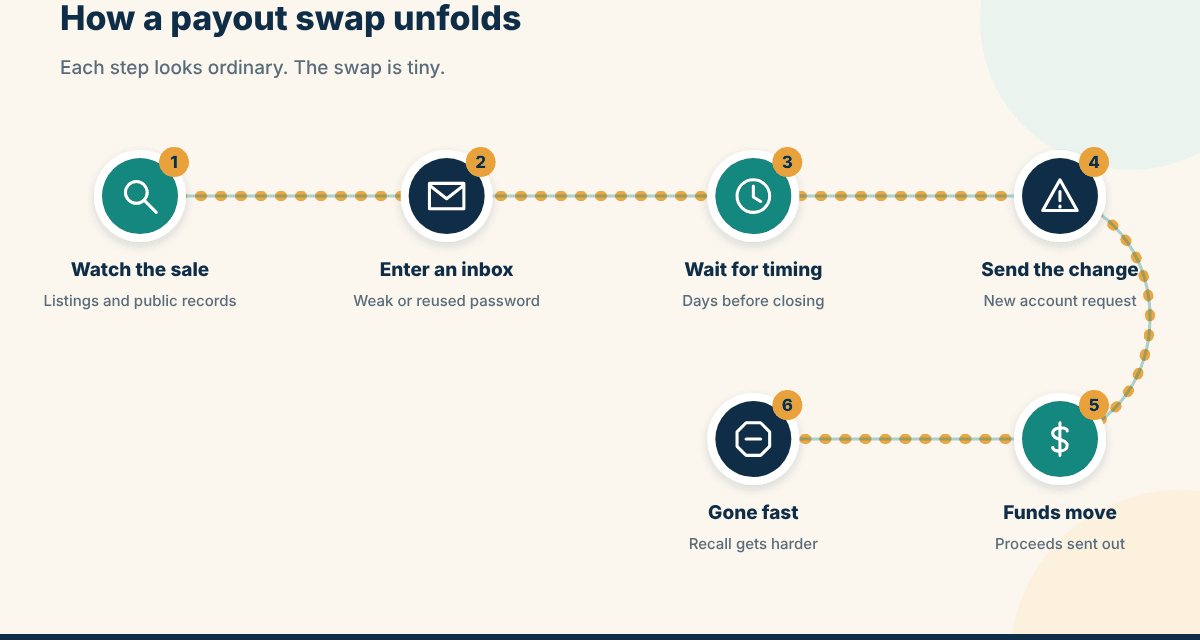
Real estate wire fraud seller cases tend to begin with something so ordinary that nobody pauses over it: an email that looks like it came from the title company, politely asking where your sale proceeds should go. This guide explains how that kind of scam works from the seller’s side of the table, what it puts at risk, how to build a simple habit of verifying every payout instruction, and what to do in the first hours if something has already gone wrong.
Most of the warnings you read about wire fraud are written for buyers, and for good reason. Buyers send the largest single transfer of their lives, often from a bank account they rarely use for anything that big. But sellers are targets too. Your closing proceeds may be the biggest sum you will ever receive, and criminals know that a seller who is about to be paid is watching email closely and expecting questions about bank details. Seen from the seller’s chair, real estate wire fraud seller risk is quieter and easier to miss.
We will keep this practical. You will see what a hijacked closing looks like, what information criminals collect and where they find it, which controls actually work, what you should never send by email, and how to respond if you suspect a problem. We will not tell you which agent, title company or bank to use, because that choice is yours, and the habits below work with any of them. A clear picture of real estate wire fraud seller tactics is the best protection you can build, and our fraud and seller safety library collects related guides.
One honest note before we start. Closing customs differ widely. In some states an attorney handles the closing, in others an escrow officer does, and the way proceeds are delivered, whether by wire, check, or something else, depends on the settlement agent and your instructions. Nothing here is legal or financial advice. It is general education to help you ask better questions of the professionals who are actually handling your file. You can also read our wider guide on home sale fraud and seller safety for the full picture beyond wires.
Key takeaways
- Treat any change to payout instructions as suspicious until proven otherwise. A real estate wire fraud seller attempt almost always arrives as a polite request to use new or different bank details.
- Verify by phone, using a number you already trust. Use the number from your signed contract, the settlement agent’s official website, or a call you placed earlier, never the number in the email asking for the change.
- Give bank details once, in the safest way available. Ask your settlement agent what secure method they offer, and confirm receipt by phone rather than sending account numbers through ordinary email.
- Keep your inbox in good order. Many scams succeed because a criminal reads real messages from a compromised account, so strong passwords and multi-factor sign-in matter long before closing week.
- Speed matters if something goes wrong. Call your bank, the settlement agent and, where appropriate, report the incident to law enforcement, and preserve every message exactly as received.
- Ask about alternatives. Some sellers prefer a check, in-person pickup or a callback process, and you are allowed to ask what is available and what it costs.

Why real estate wire fraud seller attempts work, and what they put at risk
A house sale is a perfect environment for impersonation. Several parties who have never met are exchanging documents, numbers and deadlines over a few busy weeks. Everyone expects emails with attachments. Everyone expects instructions to be updated. And everyone is a little anxious, which is exactly the state in which people click first and wonder second. That is why real estate wire fraud seller attempts find so many openings.
The fraud itself is not technically clever in most cases. It is social. A criminal gets into the conversation, copies the tone and formatting of a real professional, and waits for a moment when money is about to move. Understanding that shape, rather than memorizing a list of red flags, is the most reliable defense you have. Knowing how a real estate wire fraud seller message is built matters more than any list of tricks.
It helps to understand the mechanics in one sentence before going further. In a typical real estate wire fraud seller case, a criminal watches or reads a transaction, picks the moment when money is about to move, and sends a believable message that swaps one account number for another. Everything else, the logos, the signatures, the friendly tone, is decoration around that single swap.
Because the swap is so small, the defense can be small too. You do not need technical skill, special software or a lawyer on retainer to make a real estate wire fraud seller attempt fail. You need a list of trusted phone numbers, a habit of calling before acting, and a willingness to be slightly inconvenient to everyone around you for a few days. The sections below turn that idea into concrete steps.
It also helps to remember who actually holds the money. Your sale proceeds sit with the settlement agent, an escrow company, a title company or an attorney’s trust account, depending on your state and the way your closing is run. Those firms are regulated or licensed in different ways, and they are used to handling large sums. They are also frequent targets, which is why a well-run office will welcome your questions about how they protect payouts.
What a hijacked closing looks like from the seller’s chair
Picture a seller we will call Dana. Dana has accepted an offer, the inspection is done, and closing is a week away. Dana’s settlement agent mentioned that proceeds would be wired after signing. On Tuesday evening an email arrives that looks like it came from the closing office. It says the office has switched banks and asks Dana to confirm the account where she wants the money, or to use a new account for some other part of the file.
The email has the right logo, the right signature block, the right file number. It is polite and a little urgent: please reply today so the wire can be scheduled. Nothing about it is dramatic. Nobody threatens anybody. That ordinary tone is the whole trick, and it is why the real estate wire fraud seller pattern keeps working on careful, intelligent people.
There are a few common versions. In one, the criminal poses as the settlement agent and asks the seller to send or confirm bank details, then uses those details to redirect the payout. In another, the criminal poses as the seller and emails the settlement agent a fake “change of account” request, sometimes with a forged signature or a fake voided check. In a third, the criminal sits inside a real email thread and simply inserts one altered message at the right moment. Each of these is a real estate wire fraud seller pattern you can learn to recognize.
For sellers, the money at stake is the net proceeds: whatever remains after the mortgage payoff, fees, credits and prorations. If that sum is sent to the wrong account, you may discover the problem only when you ask why the money has not arrived. By then, the transfer may have moved through several accounts. Nobody can promise recovery, which is why prevention carries so much weight.
Evidence to gather: the email trail, the dates and the sender details
If something feels off, your first job is to stop reacting and start collecting. Save the suspicious message in its original form. Do not delete it, do not forward it to a long list of friends, and do not reply. If your email program allows it, save the message with its full technical header, because investigators and bank fraud teams can read details there that are invisible in the normal view, such as the true sending address and the route the message took.
Good notes turn a vague real estate wire fraud seller worry into something a bank can act on.
Write down the timeline in plain words: when you first spoke with the settlement office, who gave you which instructions, when the odd message arrived, and what it asked. Compare the sender address with a known good message from the same office, character by character. Criminals often use a domain that is one letter off, adds a hyphen, or swaps a letter for a lookalike. The display name may be perfect even when the address behind it is not. Facts like these help sort a genuine problem from a real estate wire fraud seller attempt.
Also check the content against your file. Does the message mention the right property address, file number and closing date? Real impersonators often have those details because they have been reading real messages. That is why correct details are not proof of authenticity. A message can be accurate in every particular and still be fake, because the only thing the criminal needs to change is the account number.
A scenario, an exception, and your next step on a late-night change email
Back to Dana. She notices the request arrived at an odd hour and that the wording is slightly different from earlier messages, but she cannot be sure. She does not reply. The next morning she looks up the settlement office’s number in the signed purchase contract and calls it. The agent she spoke with earlier says no change has been made and nobody sent that message. They thank her and start a security review of their own email. A real estate wire fraud seller message that fails a phone call has done no harm.
Here is the exception worth knowing. Sometimes the change is real. A settlement office may genuinely update a process, add a secure portal, or ask for a fresh verification step. A request that is legitimate will survive a phone call. If you call the trusted number and the office confirms the request, you have lost ten minutes. If you skip the call and the message was fake, you can lose the proceeds.
Your next step in any version of this story is the same: pause, call, confirm, and write down who you spoke with and when. If the call reveals that the message was fake, move straight to the response steps later in this guide and let the settlement agent know the same day. You can also read our related piece on real estate email phishing aimed at sellers to see how the first message in these scams is usually crafted.
The seller’s side of the transaction has its own quirks. A buyer is told to wire a down payment and closing funds, so buyer-targeted messages usually ask for money to be sent. A seller-targeted message tends to ask for information instead: where should the proceeds go, can you confirm the account, can you send a copy of a voided check. A real estate wire fraud seller message can therefore feel harmless, because you are not being asked to pay anyone. Think of real estate wire fraud seller scams as information-gathering first and theft second.
That is exactly the danger. The criminal does not need your money at that moment. They need an account number that they can place in front of the settlement agent, or they need to impersonate you convincingly enough that the settlement agent changes the destination without realizing it. In both cases the harm lands later, quietly, when the closing office believes it is following your instructions.
Another version is aimed at the settlement office. A criminal who has watched the transaction writes as the seller, perhaps from a lookalike address, and says, “I have a new bank account because the old one has an issue. Please use these details for my proceeds.” If the office accepts that without calling the real seller, the money goes out. This is why a real estate wire fraud seller incident can happen even when the seller never clicks anything or replies to anything.
Your protection there is to tell the office in advance that you will only ever give or change banking details in person or by a verified call.
Sellers also face a special timing problem. The proceeds usually become available at or just after closing, so there is a short window in which a payout is being set up and everybody is paying attention to the same numbers. Criminals aim for that window. If you know that the highest-risk days are the few days around signing, you can schedule your calls and your inbox checks accordingly, and you can ask the office to confirm each step in writing and by phone.
What information and property are exposed, and to whom
Wire fraud is not only about the wire. Before a criminal can redirect money, they need to know a sale is happening, who is involved, and roughly when money will move. Every one of those facts is available to someone who is patient. Some of it is public by design, and some of it leaks from ordinary accounts that were never meant to be shared. In short, real estate wire fraud seller exposure is wider than your bank account.
Think of your exposure in three layers: what the public can see, what lives in your inbox and cloud accounts, and what sits with the other professionals in your transaction. A weakness in any layer can be enough, which is why a real estate wire fraud seller incident sometimes starts at a company you have never heard of.
Where the data comes from: listings, public records and compromised inboxes
Listings tell the world that a property is for sale, who the listing agent is, and often when it goes under contract. County records show who owns the property and, in many places, the mortgage lender. None of this is secret, and none of it is dangerous on its own. But a criminal with a list of recent listings and a guess about timing has a starting point for targeted messages. Criminals use them as the first rung of a real estate wire fraud seller plan.
The more serious exposure is a compromised email account. If someone breaks into your inbox, or into the inbox of your agent, lender or settlement office, they can read the live conversation. They learn names, tone, document formats and, most importantly, timing. They can set up rules that quietly forward or hide messages so you never see the replies they delete. Weak or reused passwords, or accounts without multi-factor sign-in, are the usual door.
Another source is the documents themselves. Purchase contracts, payoff letters and closing disclosures all carry sensitive numbers. When they are sent as ordinary attachments through ordinary email, any one compromised mailbox in the chain exposes them. That is not a reason to panic. It is a reason to ask each party how they protect documents and to use the secure upload option whenever one is offered.
A scenario, an exception, and your next step when your own inbox is the weak spot
Imagine a seller named Marcus who uses the same password for his email and several shopping sites. One of those sites suffers a breach, and the password turns up in a list traded among criminals. Weeks later, while Marcus is selling his house, someone signs into his email, reads his messages with the title office and quietly creates a forwarding rule. Marcus notices nothing unusual until a friend mentions getting a strange message “from him.” This is a common real estate wire fraud seller entry point.
The exception here is that nothing is wrong with the other parties’ systems. The scam works because one inbox is open. The next step for Marcus, and for anyone who suspects the same, is to change the email password from a device you trust, turn on multi-factor sign-in, review forwarding rules and recent sign-in activity, and tell the settlement agent that the mailbox may have been exposed so they treat any change request with extra care.
If you are selling a home right now, doing this review before closing week costs very little. It is also a good moment to read our home seller privacy checklist, which covers the smaller leaks that tend to add up, from photographs that reveal too much to documents left in shared folders.
Reduce real estate wire fraud seller risk before the transaction step
The best time to defend a payout is weeks before it happens. Once the settlement agent is preparing to send funds, you have less time, more pressure and fewer choices. Before that moment, you can set the terms: how you will provide your details, how you will confirm any change, and which messages you will simply refuse to act on. A real estate wire fraud seller defense works best when it is set up early.
Think of the controls in this section as a short routine rather than a long checklist. Each piece is cheap on its own. Together they make it very difficult for a stranger to slip into your transaction unnoticed, and they give you a calm script to follow when a message makes your stomach drop. Each one narrows the space a real estate wire fraud seller attempt can use.
The table below puts the common claims a seller may receive next to the evidence worth checking, the safe action, the information you should never hand over, and the people to involve if the claim does not hold up. It is a general matrix, not a guarantee, and your own settlement agent may have a slightly different process. Use it as a starting point for the conversation with them.
| Claim or threat | Evidence to check | Safe action | Never share | Escalate to |
|---|---|---|---|---|
| “We changed banks; send new details” | Sender address, timing, wording against earlier mail | Call the office on a trusted number | Account number by plain email | Settlement agent, then your bank |
| “Confirm your account today or closing slips” | Pressure language, odd deadline, no named contact | Pause and phone the closing officer | Login codes or bank passwords | Settlement agent |
| “Reply with a voided check photo” | Whether the office offered a secure upload | Ask for the portal or an in-person option | Check images over ordinary email | Settlement agent and your agent |
| Message from your own agent with new wire steps | Agent’s usual address and style, reply-to field | Call the agent and the title office separately | Closing figures forwarded widely | Agent’s broker, then title office |
| Text message with a link to “update proceeds” | Unknown number, shortened link | Do not click; contact the office directly | Personal identifiers entered on a link | Settlement agent, FTC report |
| Caller claims to be your bank’s fraud team | Whether you started the contact | Hang up; call the number on your card | MFA codes, one-time passwords | Your bank’s official line |
To use the table, find the row closest to what you received, then follow the “safe action” column before you do anything else. The “never share” column is the one most people skip, and it is the one that causes the most damage. Notice also that every row ends with a human being you already know, not a link, a button or a number supplied by the sender.
Build a verification routine for every payout instruction
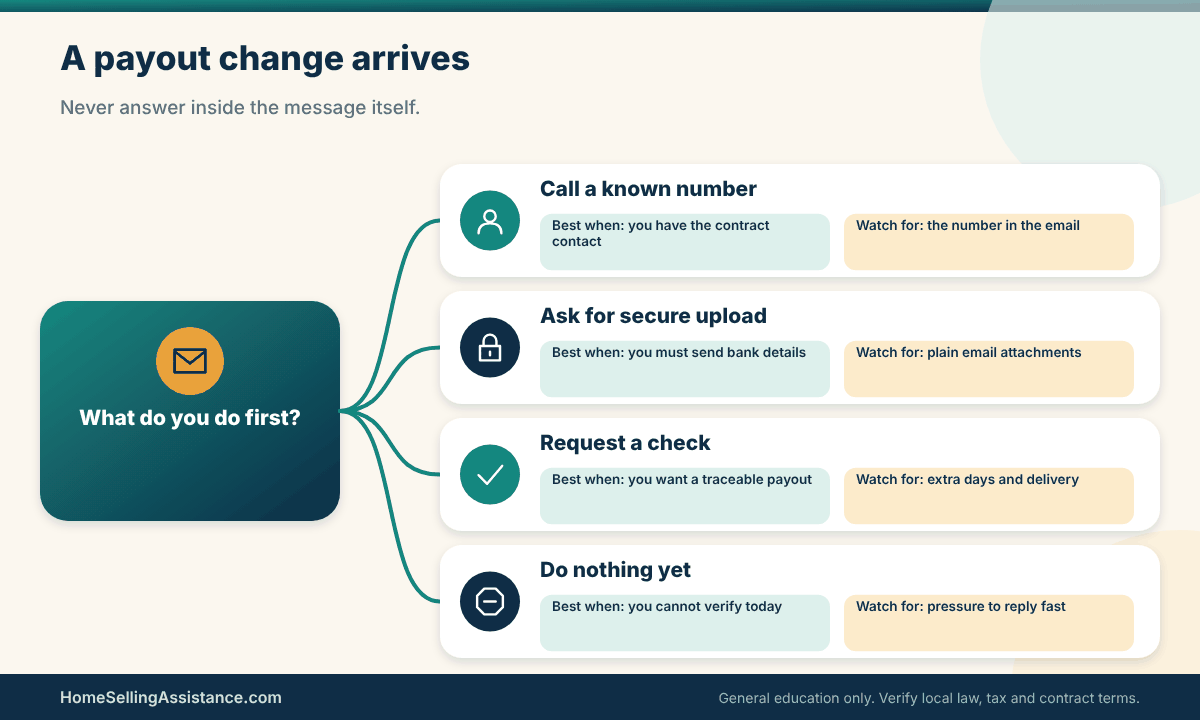
A routine beats a good memory. When you are tired, excited and juggling movers, memory fails first. A routine is a short sequence you can run without thinking: spot the request, stop, call a trusted number, confirm out loud, and write the result down. You can print it and tape it to the desk where you read email during the sale. A written routine is your strongest tool against any real estate wire fraud seller message.
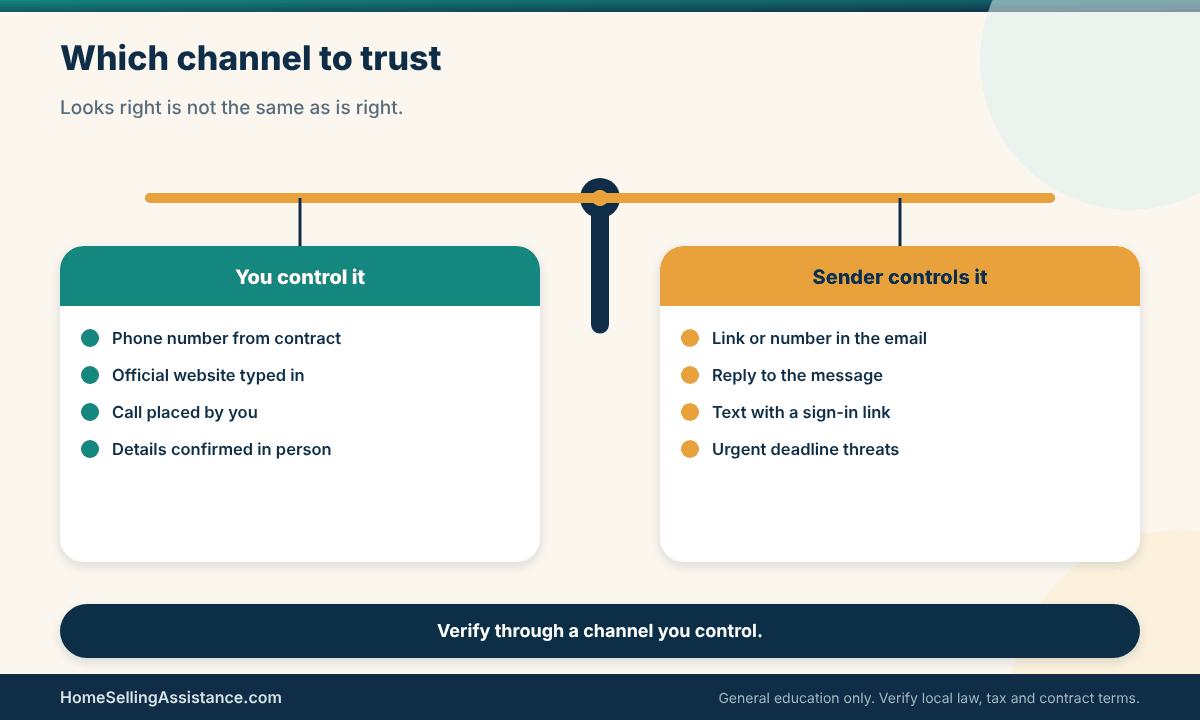
The core of the routine is a callback. A callback means you place the call, using a number you obtained independently of the request. That detail is what makes it work. If a criminal controls the email, they can also control any phone number that appears in it, and they can have a friendly voice waiting on the other end. A callback is the single most effective step against real estate wire fraud seller impersonation.
Evidence to gather: contract contacts, official websites and your callback list
At the start of the transaction, build a one-page contact list. Include the settlement agent or attorney, the closing officer, your listing agent if you have one, your lender’s payoff department, and your own bank. For each, record the phone number from a source you trust: the signed contract, the company’s official website typed into the browser yourself, or a business card you received in person.
Keep the list somewhere you control and that does not sit in the same inbox you are worried about, such as a printed sheet or a note on your phone. When a surprising message arrives, you will not have to hunt for a number under pressure, and you will be far less tempted to use the one in the message.
It also helps to ask the settlement office, at the first meeting, three plain questions. How will you send me documents that contain account numbers? How will you confirm my payout instructions? And if I ever receive a request to change them, whom should I call? A professional office will have ready answers, and the answers become part of your routine. Their answers become your real estate wire fraud seller protection plan.
A scenario, an exception, and your next step when the settlement office is slow to answer
Sometimes the real office is simply hard to reach. A closing officer may be at another signing, or on leave, and the phone rolls to voicemail. That gap is when a criminal’s urgency feels persuasive. A seller may think, “I cannot reach them, and the email is clear, so I will just reply.” A real estate wire fraud seller message often exploits exactly this kind of gap.
Resist that. Leave a voicemail that states your name, the property address and the specific question, then try a second route: the main line for the company, a different person on the file, or your own agent calling on your behalf. A delay of a few hours rarely costs anything. A wire sent to the wrong place can cost a great deal.
If the deadline really is tight, say so in your voicemail and ask the office to call you back on the number you already have. Real offices understand why you are being careful. Many will thank you for it. If a message tells you that being careful will cause a penalty, treat that threat as a warning sign in itself and bring it to the attention of the settlement agent. Our guide to the choice between wire and check for seller proceeds also explains why some sellers prefer a slower, more traceable option.
Information you never share, and assumptions you never make
Most people know not to give out a bank password. Fewer realize how many other small facts help a criminal. Account and routing numbers, the last digits of a Social Security number, a one-time code from a text message, the name of your first pet, the exact day of your closing: each is a piece of a puzzle. The rule of thumb is simple.
Do not share any of them by email, text or phone unless you started the contact and know exactly who is on the other end. Treat each of those as a possible real estate wire fraud seller ingredient.
Equally important are the assumptions. A message that looks right is not necessarily right. A familiar name is not proof. A professional logo is not proof. A correct property address is not proof. The only proof is a confirmation through a channel you control. Assumptions are what a real estate wire fraud seller plot relies on.
Evidence to gather: what each party actually needs from you, and what they never will
It helps to know what legitimate parties actually request. A settlement agent typically needs your identification, signed documents and payout instructions, and may ask you to provide those in person, through a secure portal or by a method of their choosing. A lender’s payoff department needs the loan information to produce a payoff figure and usually deals with the settlement agent rather than with you.
No one involved in your sale should ask for your online banking password, a code sent to your phone, or remote access to your computer. A request of that kind is not a procedural step. It is an attempt to enter your account. If you receive one, stop and report it to your bank and the settlement agent right away.
You can also ask each professional to tell you in advance what they will and will not ask for by email. Settlement companies often include a fraud notice in their paperwork that describes exactly this. Read it, keep it, and treat any later message that contradicts it as suspect. The Federal Trade Commission publishes plain-language material on avoiding scams at consumer.ftc.gov, which is a good place to refresh your sense of what a pressure tactic sounds like. This keeps real estate wire fraud seller warnings concrete rather than abstract.
A scenario, an exception, and your next step when someone you trust is the source
Consider a seller who receives a message that appears to come from her own real estate agent, asking her to forward her bank details so the closing office can “pre-load” them. The agent is a long-time acquaintance, the message sounds exactly like her, and nothing seems wrong. Here the assumption trap is strongest, because trust is real. The agent may truly be a good person whose mailbox has been compromised.
The exception is that this is not a reason to distrust the agent. It is a reason to confirm through another channel. Call the agent, then call the settlement office, and ask each directly. If both say the request is genuine, proceed using the secure method the office names. If either says it is not, tell both at once so the compromised account can be cleaned up.
Your next step is to tell your agent, and the title office, that you plan to confirm any banking request by phone. That one sentence, stated early and calmly, makes you a harder target and an easier client, and it sets expectations for every message that follows. For a deeper look at identity theft that can accompany these schemes, see our article on seller identity fraud at closing.
A few technical habits make every other control stronger. Use a unique, long password for your email account, ideally generated and stored by a password manager. Turn on multi-factor sign-in, and where possible choose an authenticator app or a hardware key over text messages, because phone numbers can be hijacked. Review your account’s sign-in history and forwarding rules once at the start of the sale and once more before closing.
Keep the devices you use for email up to date, and avoid reading closing messages on shared or public computers. If you use a work email address for your sale, think about who else may have access to that mailbox, such as an assistant or a company administrator. Using a personal address that only you control is often the simpler choice. These are small habits, but each one blocks a route a real estate wire fraud seller attempt might use.
Think also about how you will receive your money. Wire transfers are fast and common, but a wire is hard to reverse once it lands. Some settlement agents can send a check, or can prepare one for pickup in person, and some sellers prefer that route even if it takes a little longer. Neither is always right, so choose deliberately and tell the settlement agent in writing.
Our article on when you actually receive your money after closing explains how timing varies, so you can weigh speed against traceability, and our closing costs and net proceeds guides show how the final payout is built.
Finally, include your agent and your lender in the plan. Ask your listing agent whether their brokerage has a wire fraud notice and how they confirm account details with clients. If you are also buying a new home, remember that your outgoing and incoming money may both pass through settlement offices, so the same routine should apply to each. A single verified callback for each transfer, and a written note of who you spoke with, is a very small cost compared with the amounts involved. Include real estate wire fraud seller prevention in that conversation.

The second table looks at the same topic through the calendar. Real estate wire fraud seller attempts tend to cluster around certain moments of a sale, and each moment has its own warning sign and its own safe response. Read the rows as examples of situations rather than a complete list, and use the last column to decide what you should keep once the moment passes.
| Situation | Warning sign | Verification channel | Seller response | Record to preserve |
|---|---|---|---|---|
| Week after accepting an offer | New “secure link” asking for banking details | Phone call to the contract’s listed office number | Decline the link; ask for the office’s standard method | Original email with full header |
| Payoff letter arrives | Payoff account differs from lender’s usual details | Settlement agent calls lender at a known number | Ask the agent to confirm before relying on it | Letter, call notes, lender contact |
| Days before signing | Urgent request to confirm your proceeds account | Callback to closing officer, not the sender | Give details only by the agreed secure method | Name, time and result of the call |
| Signing appointment | Request to “sign a new wire form” sent by email | Ask the officer in person for the form | Sign only forms handed to you at the table | Copy of every signed form |
| Closing day, funds pending | Late message changing delivery of proceeds | Phone the office and your own agent separately | Pause the payout until both confirm | Timeline and confirmations |
| Days after closing | Funds not received; odd follow-up email | Call settlement agent and your bank | Start the incident steps immediately | Complete incident file with timestamps |
Use the table as a calendar of pressure points. The pattern is repeated in every row: a message arrives that asks you to change or confirm something about money, you refuse to answer inside that message, you verify by a channel you control, and you keep a record. If you can do those four things consistently, you have covered most of what a real estate wire fraud seller attempt relies on.
Respond to a real estate wire fraud seller incident without making it worse
If you suspect that something has gone wrong, the first few hours matter more than the next few days. The instinct is to feel embarrassed, hesitate, and hope the problem resolves itself. Resist that instinct. Banks, settlement agents and investigators see this pattern often, and none of them will think less of you for calling quickly. Acting quickly on a suspected real estate wire fraud seller incident is the most useful thing you can do.
The order of your actions also matters. Some responses help and some quietly harm: replying to the suspicious sender, deleting messages, or sending a second payment to “fix” the first can all complicate recovery. What follows is a calm sequence that protects your evidence and your money, and keeps every party informed. Nobody can guarantee a result, but a quick, organized response gives you the best realistic chance. A calm order of steps helps in any real estate wire fraud seller aftermath.
Confirm the facts through a channel you already trust
Your first move is not to accuse anyone. It is to find out what is true. Call the settlement office on a number from your signed contract. Ask whether they sent the message, whether any instructions have changed, and whether any money has already moved. Take notes during the call: the name of the person, the time, and what they said. Facts first keeps a real estate wire fraud seller response from turning into a quarrel.
If the office confirms that a message was fake, ask them to tell you right then whether any funds have been released and whether they have already alerted their own bank. If you were the one who sent information, say so plainly. Details like “I sent my account number at 4 p.m. by email” help everyone act faster.
Evidence to gather: call notes, screenshots and the transaction record
Create a simple incident file. It should include the suspicious messages in their original form, screenshots of anything on a phone, a short timeline in your own words, the names and numbers of everyone you spoke with, and any confirmation numbers from calls with your bank. If a wire has been requested or sent, add the confirmation, the amount, the date and the receiving bank details as shown. That file is the backbone of every real estate wire fraud seller report you may later make.
Do not edit these records or reorganize the original messages. Make copies if you need to work from them. Investigators and bank fraud teams tend to want the information exactly as it arrived, because small details like timestamps and routing headers are part of the evidence. A clean record makes any real estate wire fraud seller investigation easier.
Also take a snapshot of your own accounts. Note the current state of your email sign-in history, any unfamiliar forwarding rules, and any unrecognized devices. Those records help show how access occurred, and they may matter later if a bank, insurer or attorney asks for a clear sequence of events. This shows how access happened in a real estate wire fraud seller case.
A scenario, an exception, and your next step when the wrong account was already given
Suppose a seller named Priya replied to a convincing message and gave a criminal her routing and account number. The settlement office has not yet sent any funds. This is the best version of a bad situation. Priya calls the office, explains what happened, and asks them to hold the payout until a verified, in-person or secure confirmation is completed. She also calls her bank to flag the account and ask about monitoring. It is a good example of limiting a real estate wire fraud seller attempt early.
The exception is that the information she gave may not actually be enough to take her money out. A routing and account number are widely shared when people write checks, set up direct deposit or pay bills. Still, a criminal could use them to attempt fraudulent debits or to build a more convincing impersonation. Her bank can explain what protections or account changes make sense in her situation.
Priya’s next step is to document everything, follow the bank’s instructions, and keep an eye on her statements. If the receiving bank or settlement office asks her to sign a statement or an affidavit, she should read it carefully and consider asking an attorney to look at it before she signs. You can find out more about this kind of exposure in our guide to the risks of title and deed fraud, which can follow an identity leak.
Escalating to your bank, the settlement agent, law enforcement, your insurer and an attorney
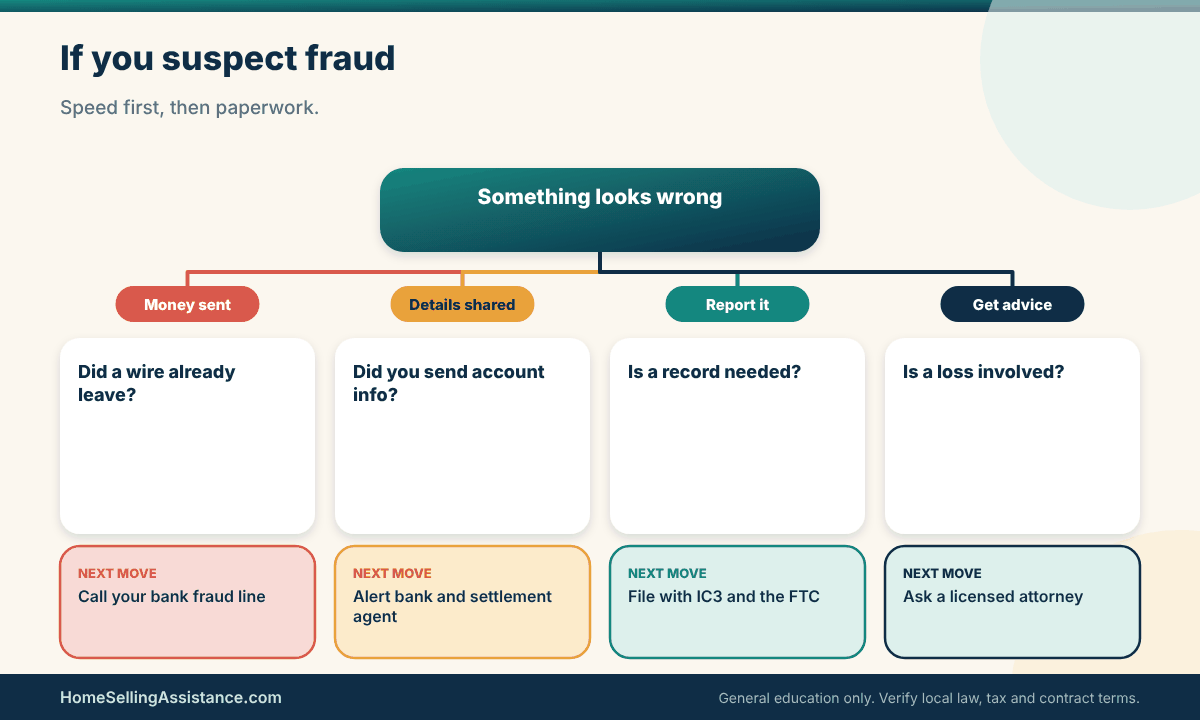
Escalation is a set of phone calls made in a sensible order. Each recipient can do something the others cannot. Your bank can try to stop or recall a transfer and secure your account. The settlement agent controls the closing funds and its own systems. Law enforcement can open a report and, in some cases, work with banks across jurisdictions. Your insurer may or may not cover certain losses. An attorney can explain your rights and obligations. Each call in a real estate wire fraud seller incident does a different job.
Think in terms of speed first, completeness second. Make the calls that can freeze or redirect money before anything else, then fill in the rest. For a wire that has already left, minutes can matter, and your bank’s fraud department is the first call. For a real estate wire fraud seller case, that order is the safest default.
Evidence to gather: bank reference numbers, reports and written confirmations
When you call your bank, ask for the fraud or wire department, not general customer service. Tell them plainly that you believe a wire transfer was sent to a fraudulent account, give the amount, date and receiving bank details, and ask what recall or investigation process they can begin. Write down the representative’s name, the case or reference number and what they told you to expect. Name the issue as a suspected real estate wire fraud seller case so the right team picks up.
Next, report the incident. In the United States, the FBI’s Internet Crime Complaint Center accepts reports of online fraud at ic3.gov, and the FTC accepts reports at its consumer site. Keep a copy of the confirmation. Some banks and insurers ask for a report number, and a written record helps show that you acted promptly. Reports on a real estate wire fraud seller case help the authorities see patterns.
Ask the settlement agent for a written account of what they know, what they have done, and whether their own insurance or protocols apply. Ask for it by a channel you trust. Keep every written reply together with the rest of your incident file. A short, factual paper trail often matters more than a long, emotional one, and it keeps conversations focused on what can actually be done.
A scenario, an exception, and your next step when the money has already moved
Consider a seller named Tom whose proceeds were wired to a fraudulent account on closing day. He learns of it two days later when the money has not arrived. Tom calls his bank, the settlement agent and law enforcement within the hour. The settlement agent starts its own recall request with its bank. Tom keeps calling the bank for updates and keeps his incident file current. Even a late real estate wire fraud seller discovery deserves the same organized response.
The honest exception is that recovery is not guaranteed. Whether any money can be returned depends on how quickly the fraudulent account was reached, whether the funds were still there, and how the banks involved responded. Sometimes a portion is recovered, sometimes all of it, sometimes none. Responsibility between the parties can also be complicated and varies by state, contract and the facts, so no article can say who bears the loss. No article can promise that any real estate wire fraud seller loss will be recovered.
Tom’s next step is to consult a real estate attorney in his state, ideally one who handles transaction disputes, and to ask his insurer and the settlement agent in writing about any coverage that might apply. He should also place fraud alerts or credit freezes if personal identifiers were exposed. For help with the money side of closing documents, our overview of the seller closing statement shows what the final numbers should look like before any payout is sent.
Quick scenario
A seller gets a text message that says her proceeds are on hold unless she logs in through a link. She does not click. She calls the settlement office from the number in her contract, learns the message was not theirs, and forwards a screenshot to the office and to the FTC. Total cost: ten minutes. Total money lost: none.
After the first wave of calls, the quieter work begins. Watch your bank and credit accounts closely for the next several weeks. Consider placing a fraud alert or a credit freeze with the credit bureaus if personal identifiers such as a Social Security number were exposed. The Consumer Financial Protection Bureau offers general guidance on protecting yourself at consumerfinance.gov, and it is a sensible place to learn how those tools work in plain terms.
Be careful about a second wave of scams. People who have lost money to a real estate wire fraud seller scheme are sometimes contacted by strangers who claim they can recover the funds for an upfront fee. Treat any unsolicited offer of that kind with deep suspicion. Real help comes through your bank, the settlement agent, law enforcement and a licensed attorney, and none of them will ask you to pay a stranger in advance for a promised recovery.
It is also worth telling the other parties in your transaction what happened, even if you think the problem is contained. Your agent, the buyer’s agent, the lender and the title office may all have been exposed, and any of them could be the original weak point. A short, calm message that states the facts and asks them to review their own security helps stop the same criminal from trying again with the next customer. Sharing a real estate wire fraud seller experience protects the next customer too.
Finally, give yourself some grace. Fraud of this kind is organized, patient and professional. It succeeds against lawyers, bankers and cautious people every year. If you were deceived, the useful question is not “how could I have been so careless” but “what do I do next, and what can I change.” Writing down the answer to the second question is the best way to turn a bad week into a safer routine, and it is the same attitude that makes a real estate wire fraud seller attempt much less likely to succeed against you a second time.
Frequently asked questions about real estate wire fraud seller risks
What is a real estate wire fraud seller scam in plain terms?
It is a scheme in which a criminal impersonates someone in your transaction, such as the settlement agent or even you, and uses a convincing message to redirect closing funds to an account they control. For sellers the target is usually the net proceeds. The scam depends on trust and timing more than on technology. Calling a number you already know is the simplest way to break it.
Can a seller really lose money if the buyer is the one sending the wire?
Yes, although the exposure is different. Your proceeds are paid out by the settlement agent, and a forged instruction can redirect them. A real estate wire fraud seller incident can also create delays in closing or title problems if the wrong account is involved. The details depend on your contract and your state, so ask an attorney if you are unsure.
How can I tell whether an email from the closing office is real?
You cannot always tell from the email alone, and that is the point. Check the sender’s exact address, look for unusual urgency, and compare the style with earlier messages. Then call the office using a number from your signed contract or the company’s official website. A confirmation by phone is worth more than any visual check.
Is it safe to send a voided check or bank statement by email?
It is safer to ask the settlement agent what secure method they prefer, such as a portal or in-person delivery. Plain email can be read by anyone who has gained access to either mailbox. If you must send bank details, confirm receipt by phone and ask the office to verify the account with you directly. Keep a note of what you sent and when.
Should I ask for a check instead of a wire?
You can ask. Some settlement agents can issue a check or prepare one for pickup, though availability, speed and cost vary by office and state. A check is slower and still has its own risks, but it can be easier to trace. Discuss the options early so the choice is written into your closing instructions.
What should I do first if I think I sent my details to a scammer?
Call your bank’s fraud line and the settlement agent right away, then save all messages unchanged. Change your email password from a trusted device and turn on multi-factor sign-in. Report the incident to the FBI’s IC3 and the FTC. Speed matters, even though no one can promise a particular outcome.
Will my insurance or the title company cover a loss?
Sometimes, but coverage depends on the policy, the facts, and the contract, so do not assume it. Title insurance usually addresses ownership defects, not stolen funds. Ask your insurer and the settlement agent in writing what applies, and consider a consultation with a real estate attorney. Any claim result is uncertain.
Do I need an attorney after a real estate wire fraud seller incident?
If money has actually been lost, speaking with a licensed real estate attorney in your state is a sensible step. They can explain who may be responsible, what deadlines apply, and what to sign or avoid signing. Some states already involve attorneys in closings, in which case you may already have one.
How can I protect myself if I am selling and buying at the same time?
Apply the same routine to every transfer. Keep a printed list of verified phone numbers for each settlement office and lender, confirm every banking instruction by phone, and tell each party you will not act on email changes alone. Keep separate notes for each transaction so details cannot get mixed up.
A calm way to finish your sale
Protecting yourself from real estate wire fraud seller schemes comes down to one repeatable habit: never act on a change to payment instructions until you have confirmed it by a phone call you placed yourself. Add strong email security, ask your settlement agent about secure delivery, and keep your records tidy. This article is general education, not legal, tax or financial advice, so talk with your settlement agent and a licensed attorney about your own closing.


