Handling multiple offers seller style, meaning with a calm process you can explain to anyone who asks, is mostly a matter of deciding the rules before the second offer shows up, writing them down, and then following them for every buyer in the same way.
Most sellers dream about the multiple offers seller moment three offers arrive at once. Then it happens, and the dream turns into a spreadsheet, a ringing phone and a deadline that seems to shrink by the hour. Which offer is actually best? Is the highest number really the highest once you subtract the credits and the repairs? What do you say to the buyers you are not choosing? And how do you stay fair, honest and legally comfortable while all of that is happening?
This multiple offers seller guide gives you a working order of operations. We start with the file you should assemble before any offer is opened, move through the decisions that come up while offers are competing, and finish with what to confirm in writing and what to keep afterward. If you want the wider framework for judging a single contract first, our cornerstone guide on how to evaluate a home offer as a seller is a good companion, and the offers and negotiation library collects the related topics in one place.
A word about honesty before we go further. Every state, and sometimes every county, has its own customs on how offers are delivered, how long a seller can sit on them, what an agent must disclose to other buyers and how contracts become binding. Brokerages also set their own policies. The numbers in this article are round, illustrative figures meant to show how the arithmetic works. They are not predictions for your house, and nothing here is legal, tax or financial advice for your situation.
Key takeaways
- Decide the rules first. A written offer deadline, a list of what you will compare and a single way of communicating with every buyer protect you from regret and from accusations of unfairness.
- Compare net and risk, not headlines. The highest price can lose to a slightly lower one once contingencies, credits, timing and the odds of the deal actually closing are counted.
- Treat every buyer the same way. Equal access to information and equal time to respond is good practice, and where fair housing rules apply, equal treatment is the law.
- Keep a backup alive. Offers that are not chosen can still be useful if you handle them politely and keep the conversation honest about their status.
- Get every change in writing. Verbal assurances, text messages and promises made at showings do not replace a signed contract and signed addenda.
- Keep records. The offer file you build now answers questions from buyers, lenders, tax preparers and sometimes lawyers months or years later.
Build your multiple offers seller file before the second offer arrives
The calmest multiple offers seller we have seen are not smarter than the frantic ones. They simply had their paperwork in one folder and their decision rules on one page before the first offer was opened. Preparation for a multiple offers seller scenario costs a few hours. Improvising during a compressed offer window can cost real money, because the pressure tempts sellers to accept whichever contract is easiest to read rather than the one that is strongest.
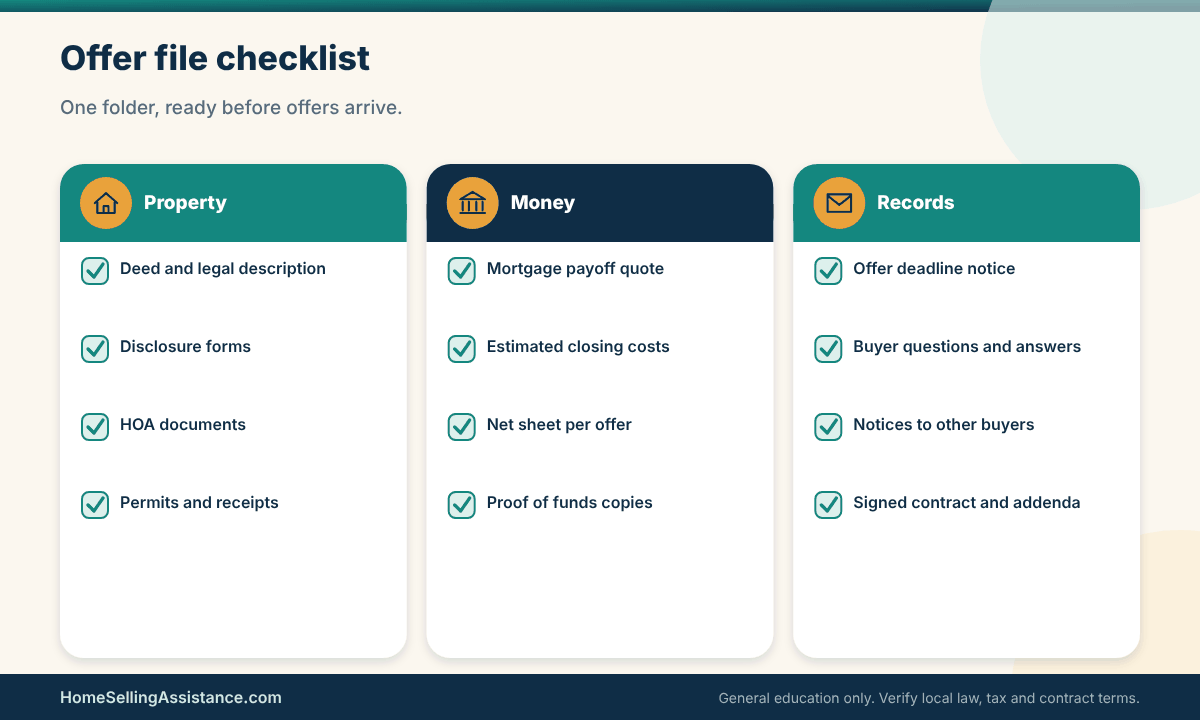
A good multiple offers seller file has two halves. The first half is facts: what you owe, what the sale will cost and which dates are fixed. The second half is rules: how offers will be received, how long buyers have, and what you will compare. Both halves should be written down and shared with whoever represents you, if anyone does.
The documents, numbers, and deadlines you need at hand
Think of this stage of the multiple offers seller process as building a dashboard you can glance at when your phone is buzzing. You are not trying to predict what buyers will offer. You are making sure that when offers arrive you can convert each one into a comparable bottom line in minutes instead of days.
Evidence to gather: payoff, costs, and the offer-handling rules in your listing agreement
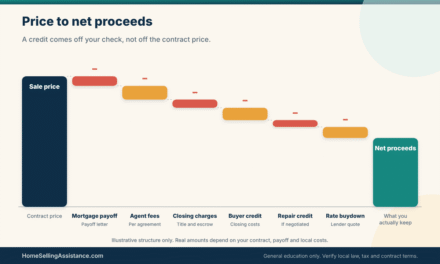
Start with the payoff. Call your mortgage servicer and ask for a payoff quote, noting that it is good only through a certain date and that daily interest keeps accruing. Add any second mortgage, home equity line, tax lien or other claim that has to be cleared at closing. You need this number because net proceeds, not price, determine whether an offer works for you, and a sale that nets less than you owe is a very different decision from one that clears comfortably.
Next, list the costs you will probably bear. These usually include a title or escrow charge, transfer or recording taxes where they apply, prorated property taxes and HOA charges, and broker compensation to whomever you agreed to pay. Compensation is negotiable and must be put in writing, so read your listing agreement for what it says about buyer-agent compensation, because an offer may ask you to pay a different amount than you planned.
Then read the parts of your listing agreement and local association rules that cover offers. Ask your agent, if you have one, how offers will be presented, whether you can choose to share the number of offers with other buyers, and whether your brokerage requires any specific notices. If you are selling on your own, ask a real estate attorney or your state real estate commission what is expected of you. Practices differ, and a short conversation now prevents an awkward surprise.
Finally, collect the property documents buyers will ask for the moment they become serious: the deed or legal description, a recent survey if you have one, tax bills, HOA documents with resale details, permits for past work and your disclosure forms. Providing these to every interested buyer at the same time is one of the simplest ways to keep a competitive situation clean. Our guide to seller disclosure requirements explains why the paperwork varies so much from state to state.
A scenario, an exception, and your next step when three offers land in one afternoon
Imagine a multiple offers seller case with purely illustrative numbers, a seller named Dana who owes a round amount on her mortgage and expects costs of a few percent at closing. She set an offer deadline of 6 p.m. on Sunday, and by Sunday noon three contracts are in. Because her file already shows a payoff figure and an estimated cost range, she can give each offer a rough net in the time it takes to finish lunch.
Here is the exception worth knowing. If one buyer insists on an answer before the deadline, perhaps with a note that the offer expires in two hours, you are not obliged to treat that pressure as a rule of the game. You may choose to honor your own deadline, tell the pressured buyer your timeline in the same words you gave everyone, and invite them to improve the offer in time. Our article on home offer expiration for sellers covers how those clocks work.
Your next step in a situation like this is simple. Open a one-page worksheet with a column per offer, fill in price, financing type, contingencies, credits requested, closing date and earnest money, and compute a net figure for each. Do the same arithmetic for every buyer. If you cannot complete a column because something is missing, write the question on the sheet. That list becomes your clarification call list.
What you still do not know, and how to find out
No matter how thorough your multiple offers seller file is, some unknowns will remain when the offers come in. The task is not to eliminate them but to name them, because a named unknown can be investigated, priced or protected against, while an unnamed one tends to surface as a surprise at the worst moment.
Evidence to gather: buyer financing proof and agent track records
The biggest unknown in most multiple offers seller situations is whether the buyer can really perform. A pre-approval letter is a start, but it is only a lender’s statement that, based on documents reviewed, the buyer is likely to qualify under certain conditions. Ask whether the lender has verified income, assets and credit, and whether the buyer needs to sell another home first. A cash offer versus a financed offer comparison is useful here, since cash is not automatically stronger unless funds are documented.
For cash buyers, request proof of funds from a bank or brokerage, with account details partially hidden if the buyer wishes, and confirm it is dated recently and matches the buyer’s name or the entity making the offer. Never assume a polished letter is genuine. Wire fraud and fake documents are real risks, and the Consumer Financial Protection Bureau publishes consumer material on mortgage and closing scams that is worth a read.
You can also learn something from the agents involved. A phone call to the listing side of other recent transactions, or a look at how an agent communicates, can tell you how quickly they respond and whether they tend to follow through. This is not about gossip or favoritism. It is about the practical question of whether the person on the other end will answer the phone on day twenty-five of a thirty-day closing.
A scenario and a next step when the details stay fuzzy
Suppose a multiple offers seller sees two offers that look almost identical on paper, but one buyer’s lender letter is vague about the loan type and the other buyer’s agent has not returned two calls. You do not have to guess. You can write the same short set of questions to both sides, such as the loan type, down payment source, appraisal assumptions and any home that must sell first, and give both a short, equal window to reply.
Sometimes fuzzy answers stay fuzzy. In that case, you can treat the uncertainty as a cost. A buyer who cannot or will not document funds may still be fine, but you may reasonably weigh that risk against an offer that is a little lower and much clearer. Neither choice is wrong. What matters is that you made it on purpose.
Your next step: make a short list headed “still unknown” for each offer and attach a due date to each unknown. If an answer has not arrived by that date, you will already know how much weight to give it. Keep the list with your offer file so you can show later what you knew when you decided.
Move through a multiple offers seller process one decision at a time
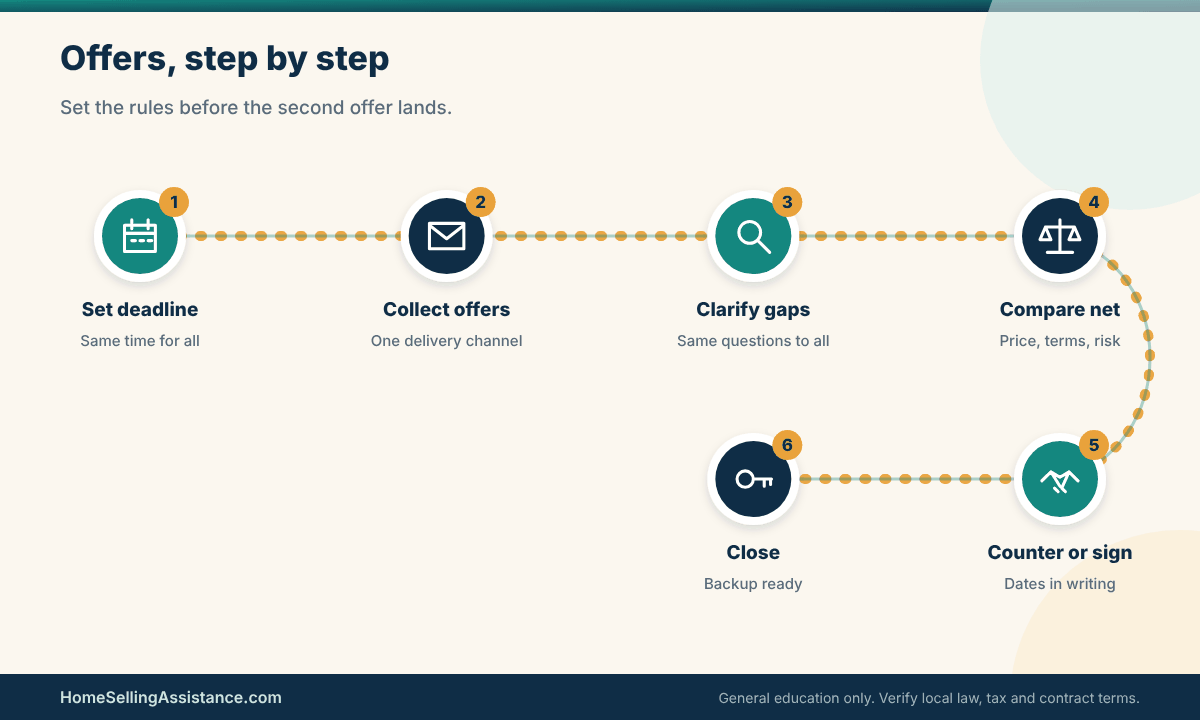
Once a multiple offers seller situation begins, the temptation is to treat the whole thing as one giant decision. It is better to break it into a short chain: set the ground rules, collect the offers, clarify what is unclear, compare, choose a direction, and then negotiate whatever remains. Each link has its own deadline, its own people and its own chance to go wrong.
The table below gives you a multiple offers seller workflow for a competitive situation. Read it left to right: the stage or symptom you are seeing, what to gather, what to do, when the decision is due and who receives the baton next. The cells are deliberately short, because you will want to reread it while busy.
| Stage or symptom | Information to gather | Action | Decision deadline | Next handoff |
|---|---|---|---|---|
| Second offer arrives early | Your deadline, listing-agreement rules, local custom | Decide whether to set a common deadline | Same day, before replying to anyone | Listing agent or attorney |
| Offers received by the deadline | Price, financing, contingencies, credits, dates | Fill one comparison sheet per offer | Within hours of the cutoff | You and your advisor |
| Unclear terms or missing proof | Lender letter, proof of funds, agent answers | Send the same questions to each buyer | A short, equal reply window | Buyer agents or lenders |
| Front-runner identified | Net estimate, risk notes, backup interest | Counter, accept, or ask for a best and final | Before any offer expires | Title or escrow, attorney |
| Contract signed | Signed copy, earnest money receipt, key dates | Calendar every contingency date | The day of signing | Lender, appraiser, inspector |
| Other buyers waiting | Written backup terms, status updates | Notify politely, offer backup status if wanted | Within a day or two of acceptance | Backup buyer and agent |
Use this multiple offers seller table as a prompt for questions rather than a script. If you are at the stage in the first row, for example, the most useful thing you can do is stop and ask who decides the offer deadline and whether it has to be shared with buyers. If you are at the fourth row, the question becomes whether a counter keeps your front-runner interested or invites them to walk.
Early action: set the rules, announce them, and keep them fair
Fairness in a multiple offers seller situation is partly a legal matter and partly a matter of simple decency. Buyers and their agents put real money and real hope into an offer. If they learn that another buyer received better information, or that your deadline moved only for one person, they will feel cheated, and in some cases they may have grounds to complain.
Evidence to use: deadlines, disclosure of the offer count, and written ground rules
The first rule a multiple offers seller should settle is the deadline. A common approach is to announce a specific date and time for offers to be submitted, and to tell every buyer and agent who has shown interest. A short written notice works well, since email leaves a record and cannot be misremembered. Include the time zone, the way offers should be delivered and what documents should accompany them, such as a pre-approval letter, proof of funds and an earnest money plan.
The second rule concerns disclosure. Some sellers choose to tell buyers how many offers they have received. Others say only that there are multiple offers. Practices vary by market and sometimes by brokerage policy or local rule, and a seller should not misrepresent the count, since a false claim of competition can lead to complaints or legal trouble. Ask your agent or attorney what is allowed where you live, and then apply it uniformly.
The third rule is about what is shared. If you answer a question for one buyer, such as whether the roof was replaced, put the answer in writing and consider sharing it with all participants. Equal information keeps the field level. It also helps you, since buyers who are all working from the same facts tend to make cleaner offers that are easier to compare.
Fair housing law prohibits discrimination in the sale of housing based on protected characteristics, and your decisions about which offer to accept should rest on price, terms and the buyer’s ability to close. The U.S. Department of Housing and Urban Development’s fair housing resources explain the federal rules in plain language. Be especially careful with personal letters from buyers, which may reveal protected information, and ask your agent or attorney how to handle them.
A scenario with a pre-emptive offer and what to do next
Picture a multiple offers seller who lists on Thursday and receives a strong offer on Friday morning that expires Friday night, well before the planned Sunday deadline. The buyer’s agent says the offer is meant to avoid a bidding war. It is a perfectly reasonable thing for a buyer to try, and you have real options.
You might accept it if it clearly beats anything you reasonably expect to see and the buyer looks solid. You might decline and keep the original schedule, telling the buyer that you will gladly consider an offer by the common deadline. Or you might move the deadline earlier for everyone, announcing the change to all interested parties at the same moment, so nobody is surprised.
The option to avoid is quietly granting one buyer an earlier look at the field than everyone else. Your next step is to ask your agent, or your attorney if you are selling on your own, how a pre-emptive offer should be handled under your listing agreement and local rules, and then write down your decision and the reason for it. A short note takes two minutes and could save you a long conversation later. For more on competitive pricing tactics, see our article on calling for highest and best offers.

Handoffs, negotiations, and contingencies once you pick a front-runner
After you choose a direction in a multiple offers seller process, the work does not stop. A competitive process hands you several negotiations at once, with the front-runner, with the buyers who might become backups, and sometimes with a buyer whose offer you want improved before you commit. Each conversation has to be handled so that it does not damage the others.
Evidence to compare: net sheets, contingencies, and the real strength of each buyer
A fair multiple offers seller comparison turns every offer into the same units. Start with price, then subtract what the buyer asks you to pay or fix: closing cost credits, repair promises, a home warranty, a rent-back or a long closing. Add anything beneficial, such as a larger earnest money deposit, a shorter inspection period or an offer to pay certain fees. Our guide to seller concessions on a home sale shows how those items change the real result.
Next, weigh the contingencies. A financing contingency, an appraisal contingency, an inspection contingency and a home-sale contingency each give the buyer a possible exit. They are normal, and a buyer without them is not automatically better, but each one adds a question about how likely the deal is to close and what happens if it does not. Our overview of home sale contingencies from the seller side explains how to read them.
Then consider the earnest money. A larger deposit can signal commitment, but what matters is the contract language that governs when it is refundable, who holds it and what happens on default. Our article on earnest money for sellers goes deeper. Remember that earnest money is rarely a seller’s compensation for a failed deal in any simple way, and the rules for releasing it vary.
Finally, look at timing. A buyer who wants to close in three weeks may be perfect for a seller who is already moving, and terrible for one who needs two more months. Compare each closing date with your own plans, and consider whether a flexible possession date, covered by a written agreement, could bridge the gap. A short note about each buyer’s apparent strength, written in plain language, finishes the comparison.
A scenario with a backup offer and counter strategy
Imagine a multiple offers seller choice between two buyers whose offers are close in price. Buyer A is financed with a small down payment, an appraisal contingency and a request for a modest credit. Buyer B is slightly lower in price, uses a larger down payment, and has a shorter inspection window. Using illustrative numbers, a seller might find that after credits the two offers net almost the same, and that the real decision comes down to risk and timing.
The seller could counter Buyer A, asking for a higher price or a smaller credit, while telling Buyer B that the offer remains under consideration. Some sellers prefer to ask both buyers for a final improvement by a stated time. Others sign with one buyer and ask the other to remain as a backup. Our guide to counteroffer strategy for sellers compares the approaches.
If you take the backup route, get the backup terms in writing and make sure the contract with the primary buyer allows a backup, since some contracts require specific language. See our article on backup offers for sellers for the mechanics. Your next step is to ask your agent or attorney exactly how the backup would be activated, by whom, and by what date, and to put those dates on your calendar.
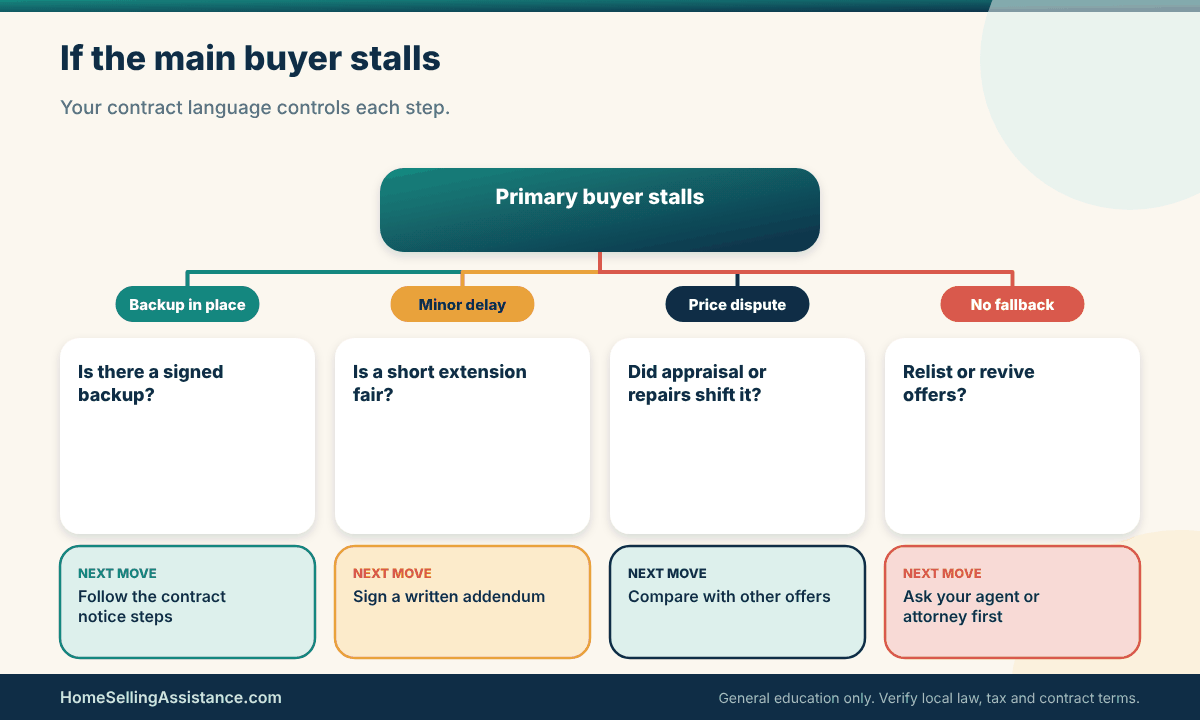
It helps to picture the whole multiple offers seller path as a funnel with a fallback underneath it. In a multiple offers seller case, many offers come in at the top, a few survive the first comparison, one or two earn a counter, and one becomes the contract. Underneath sits the fallback, which is the backup buyer, the relisting plan or the short extension you would grant if a deadline slipped. Sellers who sketch the fallback early rarely need to improvise it later.
The picture below shows the main forks in a multiple offers seller path. Notice that each fork is a question you can answer with evidence from your own file: price after credits, strength of financing, number and length of contingencies, timing that fits your move, and the quality of proof the buyer has provided. None of the forks asks you to guess what a buyer is thinking.
Notice also that the funnel does not require you to be harsh with anyone. You can decline a buyer politely, keep a second buyer warm and still be fair to both. A multiple offers seller process that treats people respectfully tends to leave doors open, and open doors matter when a primary contract wobbles. Buyers talk to their agents, agents talk to each other, and a reputation for straight dealing travels faster than a listing does.
One practical caution concerns escalation clauses, which automatically raise a buyer’s offer above competing bids up to a stated limit. They can be useful and they can be confusing. If you receive one, ask for verification of the competing offer that triggered the escalation, in the form your contract or local custom allows, and be clear about how the final price will be documented. Our article on the escalation clause from the seller’s view explains the pitfalls.
Another caution concerns offers that arrive with strings that are hard to price. A buyer might ask you to pay an unusual share of costs, to leave personal property in the house, to allow a long rent-free occupancy before closing or to accept a delayed closing with no written extension fee. Each of these can be reasonable, and each should be priced the same way you priced the price. Ask yourself what it would cost you in dollars, in risk and in flexibility, and write the answer on the comparison sheet.
If you are selling on your own without an agent, you carry more of this work personally, including receiving offers, sharing information evenly and tracking deadlines. That is entirely possible, but consider paying for a one-time review by a real estate attorney before you sign. Our guide to negotiating a for-sale-by-owner offer covers the added responsibilities, and many sellers find that a modest legal review is worth the peace of mind.
Finally, remember that your own multiple offers seller situation shapes what “best” means. A seller who must close quickly to fund a purchase elsewhere might sensibly choose a slightly lower offer with fewer contingencies. A seller with no deadline might prefer the highest price and accept more risk. Neither is more correct. The goal of a multiple offers seller strategy is not to win the biggest number. It is to reach the closing table with an outcome you understand and can live with.
Close the loop on your multiple offers seller decision
Choosing an offer feels like the finish line, but it is really the starting gun for the contract period. Most of the disputes that grow out of a multiple offers seller situation come from small ambiguities: a verbal promise that never made it into the paperwork, a date that two people read differently, or a buyer who thought they were a backup when the seller thought they were simply declined.
The second table is a multiple offers seller transaction check for the period after you pick a direction. It helps you spot the issues that most often cause trouble and pairs each with the evidence you hold, the input you need from the other side, the risk and a fallback. It is a thinking aid and not a legal checklist, so adapt it with your agent, attorney or title company.
| Issue | Seller evidence | Buyer, agent or title input | Risk | Fallback |
|---|---|---|---|---|
| Buyer financing is weaker than shown | Lender letter, loan type, down payment source | Lender confirmation of verified documents | Delay or failed closing | Backup offer or short extension in writing |
| Appraisal comes in below price | Comparable sales, your improvement records | Appraisal report and lender options | Renegotiation of price | Meet partway, request review, or relist |
| Inspection triggers repair requests | Past repairs, receipts, disclosure forms | Inspection report and contractor bids | Credit demands or cancellation | Offer credit, repair, or move to backup |
| Competing deadlines get confused | Dated emails, signed contract copy | Agent confirmation of key dates | Missed notice or default dispute | Written addendum restating dates |
| Earnest money not delivered | Receipt from the holder, contract deadline | Title or escrow confirmation | Contract weaker than it looked | Written notice under contract terms |
| Wire or document fraud attempt | Known phone numbers for title company | Verification by phone before any transfer | Loss of funds | Stop, call official numbers, report it |
To use the multiple offers seller table, pick the row that matches the risk you worry about most, then read across. If you are unsure whether the buyer’s financing is solid, for example, the seller evidence column tells you what to request and the fallback column tells you how to protect yourself. Revisit the table at each contingency date, because risks change as the contract moves forward.
What to confirm in writing with every buyer, chosen or not
People remember conversations differently, and under stress they remember them more differently still. The cure is boring and effective: put the important things on paper, in a form both sides have signed or acknowledged, and keep a copy where you can find it. This applies to the buyer you chose and also to the ones you did not.
Evidence to confirm: the signed contract, addenda, deadlines, and notices
For the buyer you chose, start with the signed contract and every addendum. Check the price, the closing date, who pays which costs, what is included with the house, the contingency periods and the earnest money terms. Make sure the signatures are dated and that any counteroffers are clearly superseded or incorporated. If something was agreed verbally during negotiation, such as a rent-back or a credit for a specific repair, it belongs in an addendum.
Then confirm the delivery of earnest money. The contract usually names who holds the deposit and by when it should arrive. Ask the holder, whether title company, escrow agent or broker, for a written receipt, and add the date to your calendar. If the deposit is late, read the contract for what notice is required before acting, and ask your agent or attorney how to proceed rather than guessing.
For buyers who were not chosen, confirm their status in writing. A short, courteous message that says the seller has accepted another offer, or that the seller is not moving forward, avoids ambiguity. If you are keeping them as a backup, say so in writing, describe the terms of the backup arrangement and state how long it remains in force. A buyer who is never told they were declined may keep waiting, and a buyer who thinks they are a backup but have no signed paper has no real position.
Keep your communication about the sale on channels that leave a record. If a buyer calls, follow up by email summarizing what was said. If an agent texts a question, answer by text and save the thread. This is not about distrust. It is about making sure that if something goes sideways, you can reconstruct events calmly, which also helps your agent, your title company and, if it comes to that, your attorney.
A scenario, an exception, and your next step when a buyer asks for more after signing
A common multiple offers seller situation is the buyer who asks for a price reduction or a bigger credit after the inspection or appraisal. In a competitive process, the buyer may know that you passed on other offers, and may suspect you are reluctant to go back to them. That is the moment your documentation pays off, because you already know what the other offers would have netted and whether any backup is still available.
The exception is when a request is reasonable and based on real findings. A failing roof or a safety issue identified by a licensed inspector is not the same as a buyer simply testing your resolve. Evaluate the request on its merits. Read the contract to see what remedies exist, how long the buyer has to cancel and what happens to the earnest money. Our article on responding to inspection repair requests gives a structured way to think about this.
Your next step is to respond in writing within the contract timeline, even if the response is only that you are reviewing the request and will answer by a stated date. Silence can look like refusal or acceptance depending on the contract, and neither is what you want by accident. If you are unsure, ask an attorney licensed in your state to explain how your contract treats the request.
Quick scenario
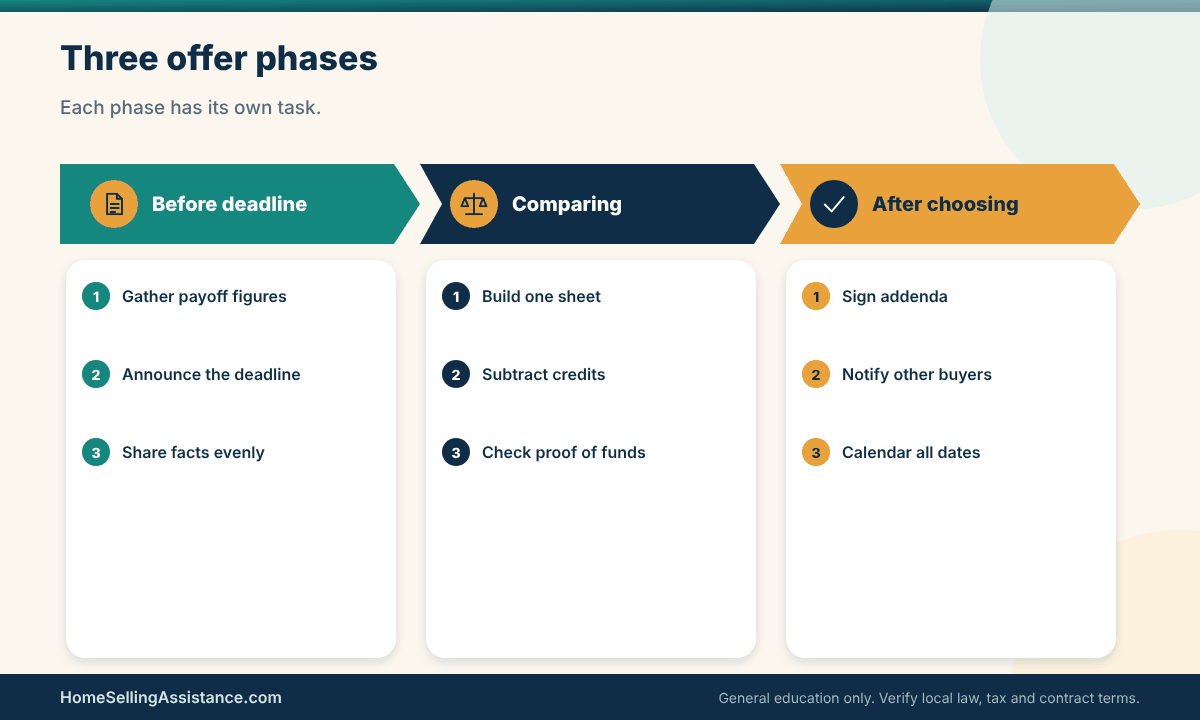
A seller received four offers over a weekend and accepted the one with the best net result. On Monday, the second-place buyer’s agent asked whether the house was still available. The seller’s agent replied in writing that the property was under contract, offered to hold the buyer’s terms as a backup and listed the dates on which the primary buyer’s contingencies would end. When the primary buyer’s financing stalled three weeks later, the backup was ready and the schedule moved only a few days. The documentation, not luck, made that possible.
Writing things down in a multiple offers seller sale works best when it is part of a few steady habits. They are not tied to one step and show up across all of them. None of them is complicated, though all of them become harder when the phone is ringing, which is why they are worth deciding in advance.
In a multiple offers seller setting, use one channel for offers. If buyers can deliver them through your agent, a shared email address or a document portal, tell everyone clearly which it is, and do not accept side-channel deliveries that bypass the process. Use one clock, which is the deadline you announced, and keep to it unless you extend it for everyone in writing. Use one comparison sheet, so that no buyer gets graded on a different scale from the others.
Be careful with enthusiasm, too. When an offer includes a heartfelt letter about how much the buyer loves the kitchen, it is easy to feel obligated. You are free to be moved, but remember that the contract, the financing and the numbers decide whether the sale closes. Decisions should rest on the terms and not on personal details about the buyer, which can also create fair housing problems if they influence your choice.
Keep your advisors in the loop on any multiple offers seller decision. If your agent or attorney suggests a step that seems unusual, such as asking for a best and final round or setting a very short deadline, ask them to explain the reasoning and the alternatives. A good professional will be glad to. If you feel pushed toward a decision that seems to help the professional more than you, say so and ask for the trade-offs in writing.
Imagine a multiple offers seller who has narrowed the choice to two buyers and feels pulled toward the one who has been friendlier. Before accepting, the seller reopens the comparison sheet and discovers that the friendly buyer is relying on a contingency to sell another home, while the other buyer has none. The friendliness was real. It just does not change the structure of the deal.
A warning sign worth taking seriously is any request to move money or documents outside the normal channel, or any change in wiring instructions late in the process. The FBI’s Internet Crime Complaint Center is the place to report suspected wire fraud, and our guide to home sale fraud and seller safety describes the patterns. Always verify instructions by calling a phone number you already know to be correct.
Your next step before accepting any multiple offers seller contract is a final pause. Reread the contract, confirm the net figure, check that your deadlines are in the calendar, and ask yourself what would make you regret this choice in a month. If the answer points to something you can still fix, fix it now. If nothing comes to mind, you have probably done the work.
Records and follow-up after closing
Once the deed is recorded and the funds arrive, it is natural to want to shove every folder into a drawer. Resist that for a little while. The records from a multiple offers seller sale are useful for tax preparation, for answering any later dispute, and for your own learning if you sell again.
Evidence to keep: closing statement, offer file, and proof of what was agreed
For any multiple offers seller transaction, keep the final closing statement, the signed contract with all addenda, the disclosure forms you delivered and any inspection reports. Also keep the offer file: the comparison sheets, the clarifying emails, the notices to unchosen buyers and the notes on how you reached your decision. These documents show that you handled the process in an organized and even-handed way, which is the best defense against any later complaint.
The closing statement is also the starting point for your tax records. The Internal Revenue Service explains how gain on the sale of a main home is generally treated, including the well-known exclusion of up to $250,000 of gain for a single filer or $500,000 for joint filers who meet the ownership and use tests, in IRS Publication 523. Whether any of it applies to you depends on your facts, so ask a qualified tax professional. Our overview of taxes when selling a home is a plain-language place to start.
Ask your title company or agent how long they keep their files, and whether you can receive electronic copies of the complete transaction file. Store your copies somewhere safe, in more than one place, and write down where they are. Many people keep documents like these for several years, and some keep home-improvement records for much longer because they bear on the basis of a property. Your tax professional can tell you what applies to you.
A scenario and a next step for follow-up questions, reviews, and referrals
After closing, you may hear from people you did not expect. A buyer might call about a utility account or a missing remote. A neighbor might ask who bought the house. An unchosen buyer might ask whether the home was sold at a price they could have matched. Some questions you can answer freely, others involve privacy or confidentiality, and some should simply be referred to your agent or attorney.
The principle is to be polite and brief. Answer questions about practical handoffs, such as manuals, warranties and the location of the water shutoff. Decline to discuss details of other offers or of your negotiation, since those details may be confidential and talking about them serves no purpose. If anyone raises a complaint about how the sale was run, stop and contact the professional who helped you with the contract before responding.
Your next step is to write a short note to yourself while the details are fresh. Which parts of the process helped? Which clarifying questions would you ask sooner? Which documents were slow to find? If you ever sell again, that note will be worth more than any general checklist.
Frequently asked questions about multiple offers seller decisions
Do I have to accept the highest offer when I have multiple offers as a seller?
No. Unless your contract or a specific obligation says otherwise, you choose the offer that best fits your goals, and the best fit is often not the largest number. Compare net proceeds, contingencies, financing strength and timing. If you have an agent, ask whether any duty under your listing agreement requires you to present every offer, and write down why you chose the one you did.
Can I tell buyers I have multiple offers if I only have one?
You should not. Misstating the number of offers can create legal and reputational trouble, and rules about what may be disclosed vary by state and brokerage. A safer approach is to describe the situation accurately and consistently to everyone. If you are unsure what wording is permitted where you live, ask your agent, your state real estate commission or an attorney before you speak.
How long should I give buyers to submit offers?
There is no universal period. Many sellers pick a deadline that gives buyers a reasonable chance to see the home, review the disclosures and consult their lenders, while avoiding so long a wait that the interested buyers lose interest. Local custom matters. Whatever you choose, announce it in writing to everyone at the same moment and keep it unless you change it for all.
Is it fair to ask for a highest and best round?
Many sellers do, and it is common in competitive markets. The key is that every buyer receives the same invitation at the same time with the same deadline. A highest and best request is not a promise to accept the top number, and buyers should understand that. Our guide on highest and best offers describes how to word the request neutrally.
What should I do with the buyers I do not choose?
Tell them promptly and politely, in writing, that you have accepted another offer or are not moving forward. If you want to keep one as a backup, describe the backup terms and the time frame in writing, and check how your primary contract treats backups. Silence leaves people guessing and can cause friction. A short note is professional and costs you nothing.
Can a buyer’s personal letter influence my decision?
You are free to read one, but be careful. Letters can reveal personal information, including details connected to protected classes under fair housing law, and basing a decision on those details can create problems. Many professionals suggest basing the choice on price, terms and ability to close. Ask your agent or attorney how they handle buyer letters and consider declining to accept them at all.
What if the highest bidder asks me to cover a large repair credit?
Treat it as part of the price. Subtract the credit from the offer to see the real number, and compare it with the other offers on the same basis. The credit may still be worth giving if the buyer is otherwise strong, but you should know the cost before you agree. Our article on seller concessions shows how to weigh them.
Is a cash offer always better when I have multiple offers as a seller?
Not automatically. Cash can be faster and simpler, but only when the funds are real and documented, and the price is competitive after you account for terms. A financed offer with solid verification and a reasonable appraisal outlook can be just as safe. Ask for current proof of funds, confirm it through reliable channels, and compare closing timelines.
Do I need an attorney for a competitive sale?
It depends on your state and your situation. Some states routinely involve attorneys in closings, while others rely on title or escrow companies. Even where it is not required, a short review of a complicated contract can be a smart safeguard, especially if you sell without an agent or if the offers contain unusual terms. Your state bar association can help you find a licensed attorney.
How can I tell whether an offer is a scam?
Warning signs include a buyer who will not verify funds, pressure to move quickly outside normal channels, requests to wire money to an unfamiliar account and changes to payment instructions late in the process. Verify every instruction by calling a number you already trust. The Federal Trade Commission’s consumer advice pages describe common fraud patterns and what to do if you suspect one.
Bringing it together
A good multiple offers seller process is built on preparation, equal treatment and written confirmation, not on speed or on luck. Gather your file, set the rules, compare offers by net result and risk, keep a backup in mind, and save your records. Treat this article as general education, not legal, tax or financial advice, and rely on a licensed agent, attorney, tax professional or title company for decisions about your own sale. For a broader view, return to the guide on evaluating a home offer as a seller.