Weighing FSBO vs realtor feels like a question about commission, but the money is only one slice of it. What you are really deciding is who will do the pricing, the marketing, the screening of buyers, the negotiating and the paperwork, how much of that work you want on your own calendar, and how much risk you are comfortable carrying if something goes sideways between the signed contract and the closing table.
Neither side of the FSBO vs realtor question is automatically the smart one. Some sellers sell by owner and keep the whole process tidy, quick and profitable. Others try it, discover that the hours and the legal exposure are heavier than they expected, and hire a professional three weeks in. A third group hires an agent right away and still ends up unhappy because nobody explained what the listing agreement did and did not cover. All three outcomes are common, and none of them says anything bad about the seller.
This guide compares the two paths across cost, time, pricing, marketing, negotiation and risk, using plain language and round illustrative numbers instead of universal percentages, because real fees, local customs and legal rules differ from state to state and even from county to county. We do not push you toward either side. We want you to finish with a short list of facts to verify and a clear sense of which scenario looks most like yours.
A quick word on vocabulary. Throughout this article, “realtor” is used the way most sellers use it, as everyday shorthand for a licensed real estate agent or broker who represents you under a listing agreement. Strictly speaking, Realtor is a membership designation of the National Association of Realtors, and plenty of licensed agents are not members. The rules that matter to you come from your license law and your contract, not from the label.
Key takeaways
- The real comparison is net proceeds, not sticker price. A higher sale price that took more of your time, more concessions or a longer listing can still leave you with less than a quieter sale handled by a professional.
- FSBO moves work to you, not away. Pricing, photos, showings, disclosures, negotiation and contract management all still happen. The only question is who performs them.
- Buyer-agent compensation is negotiable and must be written down. You can decide whether to offer it, how, and how much, whichever route you choose. Check the rules in your state and your local MLS.
- Risk sits in the paperwork and the fallback plan. Disclosure gaps, a vague contract, an unverified buyer and an unprepared plan for a failed closing hurt more than a modest pricing miss.
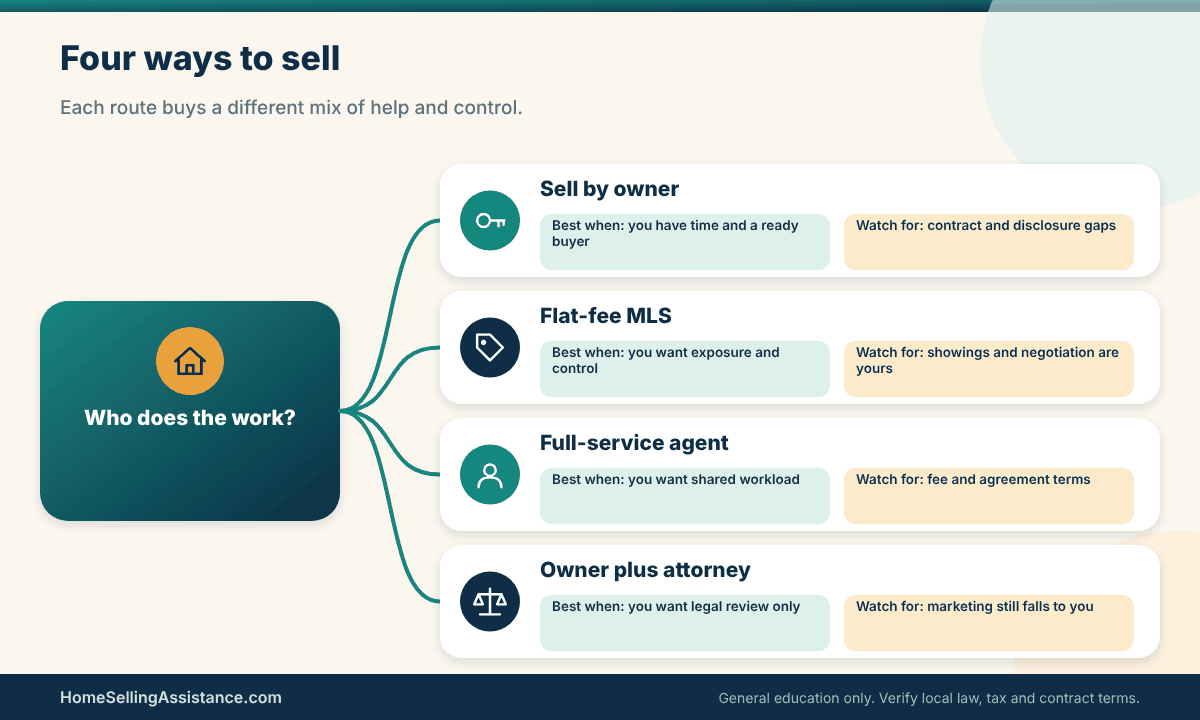
- Middle options exist. Flat-fee MLS listings, limited-service brokers and hiring an attorney for the contract let you buy only the pieces you need.
- Your scenario beats any universal answer. Timeline, property type, buyer pool, your experience and your tolerance for hassle should drive the decision.
What FSBO vs realtor is really a choice between
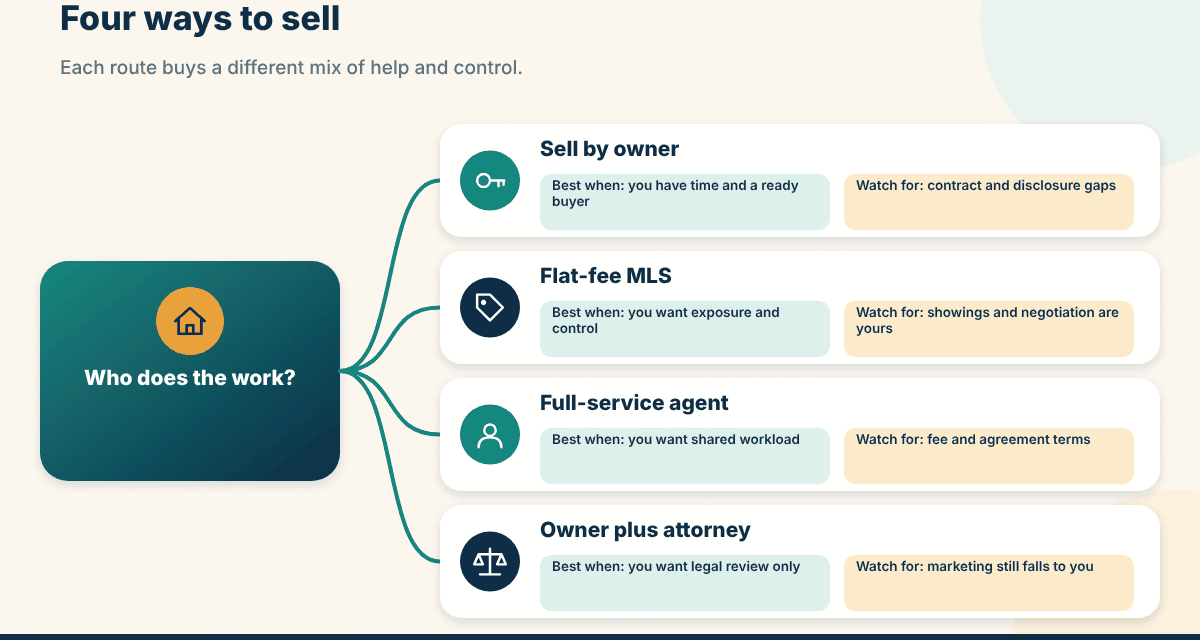
Before comparing numbers, it helps to define both options carefully. Many arguments about FSBO vs realtor go nowhere because one person is picturing a seller who posts a yard sign and hopes for the best, while the other is picturing a full-service agent with a professional marketing machine. Real sellers sit somewhere in the middle, and the cleanest comparison starts with a precise list of what each option includes. This section builds that list, then the next sections weigh it.
If you want the broader context for selling without an agent, our cornerstone guide to for sale by owner covers the whole route from preparation to closing. Here we stay focused on the head-to-head decision.
What selling by yourself actually covers in an FSBO vs realtor choice
For sale by owner means you act as your own listing agent. You decide the list price, you create the listing materials, you get the home in front of buyers, you answer inquiries, you host showings, you read and negotiate offers, you complete the required disclosures, you coordinate with the title or closing company, and you stay organized through every deadline in the contract. Nobody else is paid to remind you of a date or to notice that a form is missing.
That list sounds heavy, but it is not mysterious. Each task is learnable, and some are easier than people expect. The photography part of an FSBO vs realtor comparison is easier than it sounds, since taking decent photographs is a skill most patient sellers can pick up. Answering a buyer’s questions about the neighborhood, the utility costs and the age of the roof is something you are uniquely qualified to do, because you have lived there.
Other tasks are harder. Pricing a home against a changing market, reading an offer for hidden costs, and keeping a deal alive after a rough inspection require judgment that grows with repetition. Agents do this weekly. You may do it once in a decade. That gap in repetition, more than any gap in intelligence, is the heart of the FSBO vs realtor debate.
Evidence to gather: your own skills, hours and local comparables
Start with an honest inventory. How many hours per week can you realistically give to the sale for the next two or three months? Can you be reachable during business hours, or at least reply to buyers the same day? Do you have a flexible schedule for showings, including evenings and weekends? These are practical questions, and a candid answer often decides the matter before any dollar figure is discussed.
Then look at the market evidence. Pull recent sold prices for similar homes near yours, not just asking prices. County recorder or assessor websites often show sale records, and public listing portals show status and days on market. Our guide on how to price a house to sell explains how to read that evidence, and the later article on pricing an FSBO home goes deeper into the method.
Finally, collect your documents. A seller who can already find the deed, the payoff statement, the tax bill, any HOA rules and past repair receipts has cleared a hurdle that trips many solo sellers. If you cannot find these within an afternoon, treat that as useful information about how the next two months might feel.
A scenario, an exception, and your next step for solo sellers
Here is a simple illustration of how an FSBO vs realtor decision can play out. Maya owns a well-kept townhouse in a neighborhood where homes often sell within a few weeks, and she works from home. She has time for showings, she photographs well, and a neighbor has already mentioned a friend who wants to move to the area. On paper, she is a strong candidate for selling on her own, particularly if she hires an attorney or a title company to handle the contract and closing steps.
Now the exception. Suppose Maya’s neighbor’s friend is represented by a buyer’s agent, who asks whether Maya will compensate that agent. That is not a crisis, but it is a decision she should plan for before it arrives. The later guide on what happens when an FSBO buyer has an agent walks through the options calmly.
Her next step is small and concrete. She writes down her goals, her bottom-line net figure, and the date she needs to be out. She then drafts a rough task list with a name beside each item, either hers or a professional’s. Whether you end up selling solo or not, this one-page plan makes the rest of your FSBO vs realtor decision far clearer.
What a listing agent’s scope includes, and what it leaves out
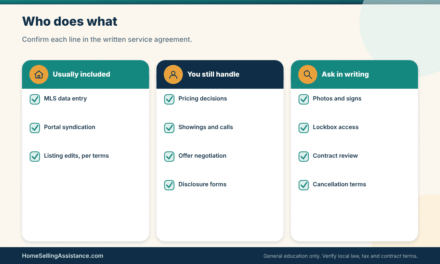
When you hire an agent, you sign a listing agreement that gives a brokerage the right, or sometimes the exclusive right, to market your home for a set period under written terms. In return you agree to pay compensation, the amount and timing of which should be spelled out. Our guide to the listing agreement explains the clauses worth reading twice, and it is a good companion to this section.
A typical agent scope includes a pricing opinion backed by comparable sales, listing the property in the local multiple listing service, professional photographs in many cases, online and sometimes print promotion, handling of buyer inquiries and showings, written offer review, negotiation, and coordination through inspection, appraisal and closing. The depth of each item differs. Some agents deliver a polished plan. Others do the minimum and wait for the phone to ring.
It is equally important to understand what the scope leaves out. An agent is not a lawyer, a tax adviser or a lender, and cannot promise a price, a closing date or a buyer’s financing. Agents also work for a brokerage that has its own policies, and your contract may limit your options if you later want to cancel or sell privately. Reading the agreement before you sign is part of choosing an agent, and it belongs in any honest FSBO vs realtor comparison.
When comparing FSBO vs realtor support, notice that the difference is not “knowledge versus no knowledge.” It is a bundle of services, a contract and an accountability structure on one side, and flexibility with full personal responsibility on the other. Both sides of the FSBO vs realtor choice are legitimate. They simply fit different people.
Evidence to gather: the listing agreement, scope and fee language
Ask any agent you interview for a blank copy of the listing agreement before you decide. Look for the length of the term, the compensation structure, what happens if you find your own buyer, how the agreement can be ended, and what the brokerage may charge in an early termination. Our deeper notes on seller real estate commission explain how compensation language is typically built and why it is negotiable.
Request a written marketing plan too. A useful plan names specific actions with dates, such as photography within the first week, an MLS entry on a stated day, and a promised update schedule. Vague promises like “aggressive marketing” tell you very little. You can compare several agents more fairly when each puts a similar plan on paper.
Finally, ask for examples of recent homes in your price range that the agent listed, how long they were on the market, and how the final price compared with the original asking price. Treat those answers as one input, not a guarantee. Past results never promise your outcome, but patterns in an agent’s pricing advice are worth noticing.
A scenario, an exception, and your next step with an agent
Consider Daniel, who is relocating for work in ten weeks and has never sold a home. He does not have the time for evening showings, and he is nervous about contract language. A full-service listing agent who handles scheduling, offers and deadlines is a sensible match for his situation, even though it costs money. He interviews three agents, compares marketing plans, and negotiates the compensation language before signing.
The exception is that hiring an agent does not remove every task. Daniel still has to prepare the house, keep it show-ready, make timely decisions on offers and review disclosures for accuracy. An agent can guide him, but the disclosure obligations and the final decisions remain his. Sellers who expect to hand over the keys and disappear are sometimes surprised by how many choices still need their attention.
His next step is to ask each candidate what the first thirty days look like, hour by hour if possible. If the plan is clear, the fee conversation becomes much easier, because he can see what he is paying for. You can use the same exercise whenever you compare FSBO vs realtor options.
Comparing the seller trade-offs in an FSBO vs realtor decision
Now that both options are defined, we can compare them on the factors that move your result. The two biggest are money and risk, but time, control and workload sit close behind. A useful habit in any FSBO vs realtor decision is to put every factor on a single page and ask, for each one, what you would need to believe for FSBO to win, and what you would need to believe for an agent to win. That keeps the debate honest.
The table below is a decision matrix. It is not a scoreboard, and it deliberately avoids numbers that would only be true somewhere else. Read it left to right for each factor, then add your own notes in the margin based on your market, your property and your calendar.
| Factor | Selling on your own | Hiring a listing agent | What to verify | Execution risk |
|---|---|---|---|---|
| Price and net proceeds | No listing-side fee to an agent, but buyer-agent cost and extra expenses may remain | Fee set by your agreement; possible stronger pricing advice and exposure | A written net sheet from real quotes | Pricing misses cost money either way |
| Time | You control the pace but carry every task | Tasks shared; pace depends on the agent | Hours per week you can truly give | Delays when tasks are missed |
| Pricing and marketing | Flat-fee MLS or paid add-ons may be needed for reach | MLS and promotion usually included, quality varies | Where buyers in your area search | Weak exposure lengthens the listing |
| Negotiation | You negotiate directly, often against an experienced buyer’s agent | Agent negotiates, you approve each step | Your comfort with price talks | Concessions you did not expect |
| Contingencies | You must read, track and respond to each one | Agent explains and tracks deadlines | Dates in the signed contract | Missed deadlines can change rights |
| Workload | Heaviest on your calendar | Lighter, but not zero | Showing availability and reply speed | Burnout and slow replies |
| Legal and paperwork | Attorney or title company strongly worth considering | Forms provided, you still sign and disclose | State disclosure and contract rules | Disclosure gaps create liability |
Use the FSBO vs realtor matrix by circling the two or three rows that worry you most. A seller who is anxious about negotiation and contingencies has a different answer than a seller who is anxious only about cost. The row you circle first usually tells you which direction your instincts lean, and the next two subsections test whether the instinct holds up.
Net proceeds, time, control, contingencies and workload side by side
Start with money, because it is the most common reason sellers open the FSBO vs realtor question. Skipping a listing agent can reduce what you pay in fees, and that is a real and legitimate attraction. What it does not automatically do is reduce all costs. You may still choose to offer compensation to a buyer’s agent, you may still pay for photography, advertising, a lockbox, a sign, attorney time and a flat-fee MLS entry, and you may still concede on price or repairs during negotiation.
Compensation rules have shifted in recent years, and the details vary by market and brokerage. Broadly, what you offer a buyer’s agent is negotiable, and arrangements are expected to be written down rather than assumed. Our article on whether a seller should pay the buyer agent commission explains the choices without telling you what to do.
Time and control point in opposite directions. Selling on your own gives you complete control over showing windows, offer timing and negotiating style, and nobody can overrule you. In exchange, every missed call is yours. An agent shares the load, but you accept a contract, a process and sometimes a pace that is not exactly what you would choose.
Workload is the factor sellers underestimate most. A single weekend of showings can mean cleaning the house before each visit, screening inquiries, meeting strangers, following up, and sending documents. Stretch that across two months and it becomes a part-time job. If you hold a demanding job or care for family members, weigh this honestly, because a stressed seller negotiates worse.
Evidence to gather: a net sheet built from real quotes
The single most useful document in any FSBO vs realtor comparison is a net proceeds sheet, built twice. Build one for selling on your own and one for hiring an agent, using real quotes wherever possible. Request a payoff statement from your lender, ask a title or escrow company for an estimate of its charges, and get written prices for photography, a flat-fee MLS listing or any services you plan to buy. Our guide to home sale net proceeds shows how the pieces fit.
The picture below shows the usual order of deductions between a contract price and the money you receive. It is only an outline, because every sale has its own mix. The point of the illustration is that the listing-side fee is one bar among several, and that some bars appear in both columns of your comparison.

To keep your FSBO vs realtor math honest, fill in the sheet with illustrative round figures first if you are still early. Imagine a home that sells for $400,000, a mortgage payoff of $200,000, and a few thousand dollars of title and recording charges. Then test two cases, one with a listing fee and one without. The goal is not to predict your exact number but to see which assumptions change the answer most. Replace each guess with a real quote as you collect them.
When the two sheets are side by side, look at the gap in your FSBO vs realtor numbers. If it is small, the decision should lean on time, stress and risk. If it is large, ask what additional exposure, extra price concessions or longer time on market would need to occur to erase the gap. That question is far more useful than a general rule about percentages.
A scenario, an exception, and your next step on net proceeds
Imagine two sellers with identical houses. The first sells on her own, saves the listing-side fee, but accepts a lower offer after six weeks because she is tired and a buyer pushes for a price cut and a repair credit. The second pays an agent, receives an offer in the second week, and negotiates fewer concessions. Which seller netted more? It is impossible to say without the actual numbers, and either result is plausible.
The exception is that the reverse story is just as likely. A seller with a ready buyer and clean paperwork can keep the whole fee, and an agent’s strong pricing advice does not guarantee a stronger sale. Anyone who tells you one side of FSBO vs realtor always nets more is giving an opinion, not a fact. Our cluster hub on FSBO and flat-fee MLS selling collects articles that help you test these claims.
Your next step is to build both net sheets this week, even roughly. Write down the point at which you would change your mind, for example a number of weeks without a serious offer. A pre-decided checkpoint prevents emotional decisions later and also makes it easier to ask for help without feeling that you failed.
Legal, financing, execution, exposure and fallback risk
Money differences in FSBO vs realtor choices are visible. Risk differences are quiet, which is why they cause so many regrets. Four kinds of risk deserve attention: legal risk from disclosures and contract wording, financing risk from a buyer who cannot close, execution risk from missed steps, and market-exposure risk from a listing that never reaches the right buyers. A fifth category, fallback risk, asks what you will do if one of the first four goes wrong.
Legal risk begins with disclosure. Most states require sellers to share known material facts about the property, and the form, the deadline and the consequences differ. Federal law also requires a lead-based paint disclosure for most homes built before 1978, as explained by the EPA real estate disclosure rule. These duties belong to you whether or not an agent is involved, so a seller who goes solo should read them directly.
Financing risk exists in every sale. A buyer’s pre-approval letter is not a guarantee, and appraisals or underwriting can cause surprises. Agents often have experience judging how strong a buyer looks. If you sell on your own, ask for a current lender letter, proof of funds when relevant, and a clear timeline, and consider asking your closing professional to review them. Our article on what to do when buyer financing falls through outlines the response options.
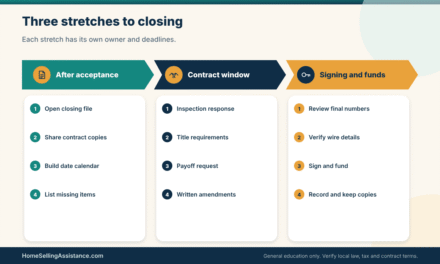
Execution risk is the day-to-day possibility that a date slips, a form is missed or a message goes unanswered. It rises when one person manages everything, and it is smaller when a professional runs a checklist. Exposure risk is subtler. A home that is hard to find online may attract fewer serious buyers, which can lengthen the time on market and weaken your leverage. Neither risk is fatal, but both are worth pricing into your decision.
Evidence to gather: disclosures, contract terms and buyer proof
Build a risk file before you settle the FSBO vs realtor question and list. Start with your state’s seller disclosure form, which a real estate commission, attorney or title company can point you toward, and complete it carefully. Gather any permits, repair invoices, inspection reports and warranty documents. If something is uncertain, such as an old unpermitted deck, write that down and ask a professional how to disclose it. Our overview of seller disclosure requirements explains the general logic.
Next, choose your contract path. Many states use standardized forms that agents are licensed to complete. If you sell alone, you may need a form from a state association, an attorney or the title company, and rules differ on who is allowed to prepare it. Read the real estate sales contract guide for the sections to understand, then ask a qualified local professional to review the actual document before you sign.
Finally, create a buyer verification routine. That means a written pre-approval or proof of funds, confirmation that a deposit will go to a neutral escrow or title account, and a quick look at the buyer’s timeline. These steps cost very little and block the most common avoidable problems. They are equally useful when an agent is representing you, because you should understand what is happening.
A scenario, an exception, and your next step on fallback risk
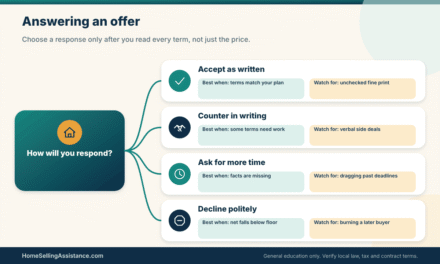
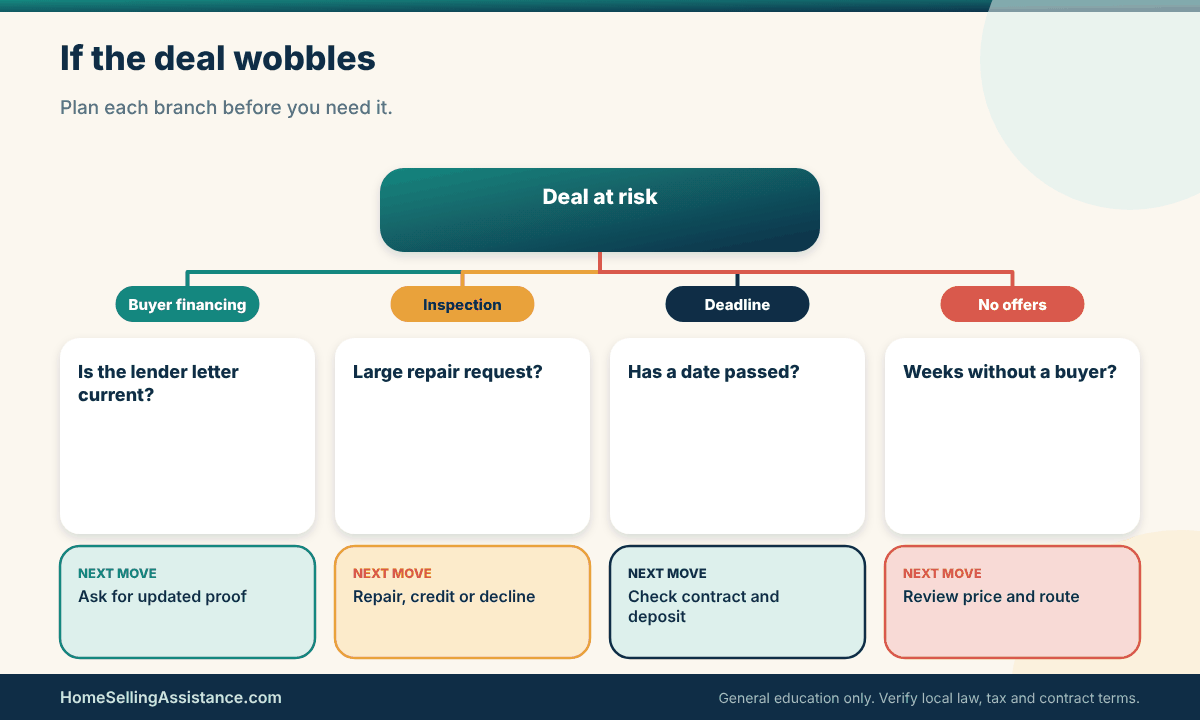
Suppose that in an FSBO vs realtor setting a buyer for your home signs a contract, then an inspection reveals a roof issue and the buyer asks for a large credit. If you have an agent, that person will likely guide the conversation and suggest options. If you are on your own, you have to read the inspection clause, decide whether to repair, credit or refuse, and respond within the contract deadline. Both paths are manageable, but the second needs preparation.
The exception is that some risks do not change with your route at all. A title problem, a lien, a co-owner who refuses to sign or an unresolved boundary question can derail a sale whether you sell by owner or list with an agent. Catching those early is the best protection, and a title search ordered before listing is a calm way to do it.
Your next step is a one-page fallback plan for your FSBO vs realtor decision. Write what you will do if the first buyer cannot close, if the inspection brings a large request, or if no offers arrive in a set number of weeks. The picture below shows one way to lay that out, and you can adapt the branches to your own contract.
Use seller scenarios instead of a universal winner in FSBO vs realtor choices
After all this FSBO vs realtor comparison, you may be hoping for a verdict. We would rather give you something more reliable: a way to match your situation to the route that usually fits it. The honest answer to FSBO vs realtor changes with the property, the buyer pool, the seller’s schedule and the seller’s comfort with risk. Seeing a handful of patterns makes your own pattern easier to recognize.
The second FSBO vs realtor table lists several common seller situations. Each row names the route that tends to be favored, the reason, the trade-off you accept, and a single fact that could flip the choice. Treat the rows as starting points for conversations with local professionals, not as rules, and remember that your state and your contract may change the picture.
| Situation | Route favored | Reason | Trade-off | Fact that changes it |
|---|---|---|---|---|
| Known buyer, clean title, flexible dates | Selling on your own with attorney or title support | Little marketing needed; paperwork is the main task | You carry contract and disclosure duty | Buyer financing turns out weak |
| Busy schedule, first-time seller | Full-service agent | Shared workload and guided deadlines | Fee and a binding agreement | Agreement terms you cannot accept |
| Hot, fast local market | Either, with prepared pricing | Strong demand can reduce marketing needs | Multiple offers still need careful handling | Market slows after listing |
| Unusual or complex property | Experienced agent or specialist | Pricing and buyer matching are harder | Fewer qualified agents to choose from | Strong local comparables exist |
| Wants control but needs exposure | Flat-fee MLS or limited service | Buys only the pieces you need | You still handle showings and negotiation | Buyer-agent compensation expectations |
| Tight timeline with a move date | Agent or cash-buyer comparison | Process support or certainty may matter more | Possible price trade for speed | Written offer terms and proof of funds |
To use the table well, find the row closest to your life, then read across to the last column. That final cell is the question to investigate first. If the fact that changes your choice is something you can verify in a week, such as a buyer’s financing or the exact language in a listing agreement, do that before you commit to any route. If it is something you cannot control, plan for both outcomes.
Scenario one in the FSBO vs realtor decision: a seller with a ready buyer, flexible dates and a clean file
Scenario one is the situation where the FSBO vs realtor answer tends to lean toward selling on your own. A relative, a neighbor, a tenant or a past inquiry has said they want the house. The seller owns the home free of unusual title questions, has a mortgage payoff that is easy to confirm, and can allow a reasonable closing date. In that setting the big job of marketing to find a buyer has already been done, which removes a large part of what an agent normally offers.
Even then, the paperwork matters. A friendly sale between people who trust each other still needs a proper contract, disclosures, a title search, and a closing handled by a licensed professional. Many sellers in this position hire a real estate attorney or use a title company to prepare and manage the transaction, and that cost is modest compared with the exposure. Our guide to selling a house to a family member covers the special considerations.

The visual above compares the workload of the two routes in a simple balance. Notice that the left side, selling on your own, gets lighter in this scenario because the marketing task is already complete. The same balance would tip differently in scenario two.
Evidence to gather: buyer proof, appraisal expectations and paperwork
Even with a ready buyer, collect proof. That includes a lender letter or proof of funds, a clear statement of whether the buyer plans to use a mortgage, and whether an appraisal could affect the price. If a loan is involved, remember that an appraisal below the contract price can create a gap that someone must resolve. Discuss that possibility openly before signing, and put the plan into the contract.
On the seller side, gather your own documents. Obtain a payoff statement, copies of the deed and tax bills, HOA information if relevant, and your state’s disclosure form. Our guide to FSBO paperwork lists the typical set, and the guide to the documents needed to sell a house adds a checklist you can reuse for any route.
Be careful about price. Selling to someone you know can tempt both sides to guess a number instead of testing it. A neutral comparison with recent sales, or a professional opinion of value, protects both parties and can help avoid later disputes or tax questions. If gift or below-market elements are involved, ask a qualified tax professional how they could affect either side.
A scenario, an exception, and your next step with a ready buyer
In an FSBO vs realtor example, take Priya, who has agreed to sell her condo to a coworker’s sister. They settle on a price that matches recent sales, the buyer is pre-approved, and both want a closing in about six weeks. Priya hires a local attorney for a flat fee, orders a title search, and completes the HOA resale paperwork. Her total effort is small, and she keeps the listing-side fee for herself.
The exception arrives when the buyer’s loan runs into an underwriting delay. With no agent and a tight deadline, Priya needs to decide whether to extend the closing or consider other buyers, and whether the contract allows that. Because she reviewed the contract language beforehand, she knows her options and can respond calmly, instead of discovering her rights during a stressful week.
Her next step, and yours in a similar case, is to write the fallback into the plan before the contract is signed. Ask your attorney or closing professional what happens if the closing date passes, what happens to the deposit, and how a backup buyer could be introduced. A thirty-minute conversation can save weeks.
Scenario two: a busy seller with a complicated property and a firm move date
Scenario two in the FSBO vs realtor decision looks very different. The seller works long hours, has a firm date to move, and owns a property that does not fit a standard mold: perhaps a house on a large rural lot, a home with an addition that was never permitted, or a unit in a community with unusual association rules. Here the value of experience rises, because pricing is harder, the buyer pool is narrower, and mistakes in disclosure carry more weight.
In this case, the FSBO vs realtor question often shifts from “can I save a fee” to “who can reach the right buyer and keep the contract on track.” A seasoned local agent who has handled similar properties may know which buyers look for them, how lenders and appraisers respond, and what contract language protects a seller. That knowledge is hard to replicate in a few weeks of research, which is why many sellers in this position choose professional help.
That does not mean agents are required. A motivated seller can still sell alone with an attorney, a good photographer, a flat-fee MLS entry and careful pricing. It simply means the workload and the margin for error are larger, so the choice deserves more thought. If you are unsure, interview two agents and one attorney, compare what each would do, and then decide, with no obligation to hire any of them.
Evidence to gather: property history, permits, comparables and buyer pool
Start with the property’s own history. Collect permits for additions, receipts for major work, survey documents and any past inspection reports. If you suspect that something was built without a permit, do not guess. Ask a local professional how the issue is typically handled, because the answer depends on the jurisdiction. Our article on selling a house with unpermitted work explains why early honesty tends to protect sellers.
Then study comparables carefully. For unusual properties, the nearest sold homes may be less similar than they look, so adjustments for size, condition, land and features matter more. Our notes on how to adjust comps to estimate home value show how professionals think about this, and they will help you judge whether an agent’s pricing advice rests on solid evidence.
Finally, think about who actually buys this kind of property. A buyer looking for acreage, a buyer with renovation plans and a buyer who wants a turnkey townhouse use different search tools and different lenders. A listing plan that matches the right audience matters more than a long list of generic promotion tactics, and you can ask each agent to explain exactly whom they would target.
A scenario, an exception, and your next step with a complex sale
Imagine Marcus, weighing FSBO vs realtor while he owns a home with a finished basement that a prior owner converted without permits. He needs to move in eight weeks for a job and has little time. He interviews two agents, one of whom has sold several similar homes and explains how that issue was handled in earlier deals. He signs a limited-term listing agreement and works with the agent and an attorney on disclosure wording.
The exception is that a listing agent still cannot promise results. If the market cools or buyers hesitate over the permit question, Marcus may need to adjust the price or offer a credit. The professional’s value lies in giving him options and context, not in guaranteeing the outcome. Choosing a route does not remove uncertainty. It simply decides who helps you through it.
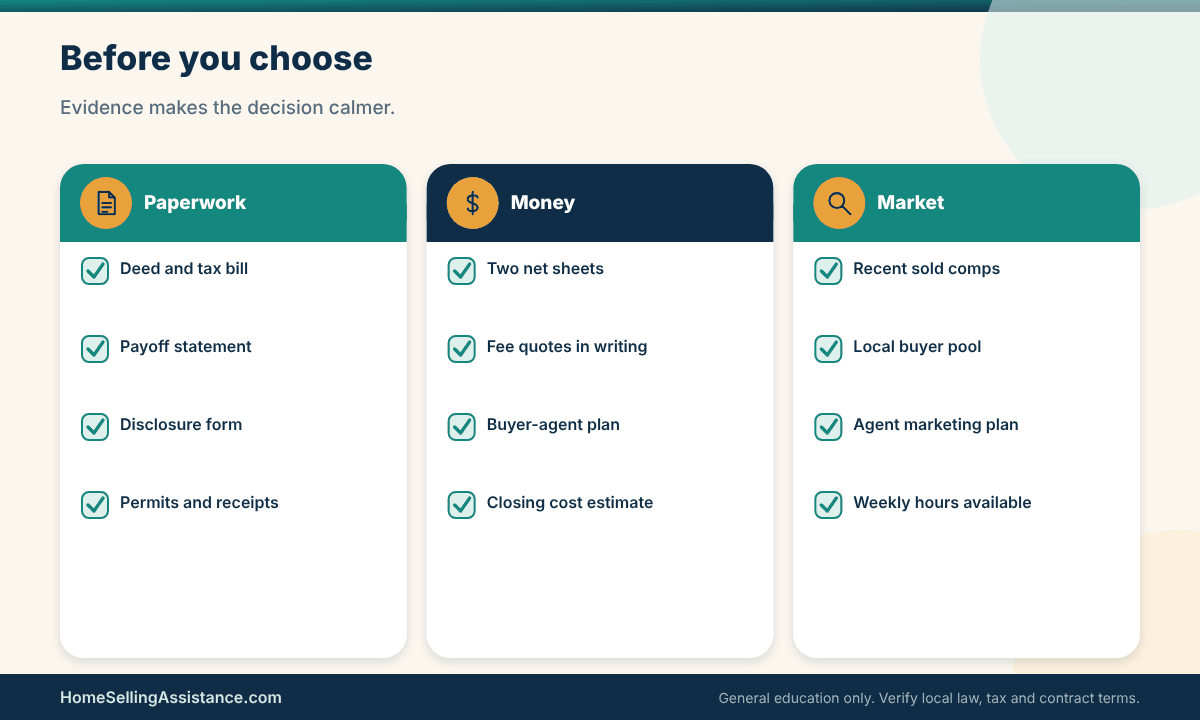
His next step, and yours in a similar case, is to prepare a written list of questions for each candidate: how they would price the home, how they would address any known issues, how often they would update you, and what the fee and termination terms are. A seller armed with these questions can compare people on substance instead of charm. A full checklist is shown in the final illustration.
If you decide partway through that the solo route is heavier than you expected, you have not failed. Our guide on when to hire an agent after FSBO explains how to change course without losing leverage, including what to ask about the listing agreement if you have already marketed the home yourself.
Before you move on, one more word about balance. Sellers sometimes treat FSBO vs realtor as a test of confidence. It is not. It is a practical decision about how to spend your time, how much risk to carry and how to use professionals sensibly. A seller who hires a closing attorney and sells alone is not doing less than a seller who hires an agent. They are making a different set of trade-offs.
Quick scenario
A seller lists on her own for four weeks and receives plenty of inquiries but no serious offer. Rather than guessing, she writes down what she has learned: showings, feedback, comparable sales and the cost of continuing. She then interviews two agents and compares their plans with her own notes. Whether she hires one or keeps going, she now decides with evidence. That habit is worth more than any rule about FSBO vs realtor.
Frequently asked questions about FSBO vs realtor
Is FSBO vs realtor mostly about saving commission?
Commission is the most visible part, but it is rarely the whole story. You also have to count buyer-agent compensation if you choose to offer it, marketing costs, attorney or title fees, and any price or repair concessions that arise. A fair comparison builds a net proceeds sheet for each route using real quotes. If the gap is small, time, stress and risk usually decide the matter.
Do FSBO homes sell for less than homes listed with an agent?
There is no universal answer, and you should be skeptical of anyone who gives one number for every market. Results depend on the home, the price, the exposure and the negotiation. Some owner-sold homes do very well, while others sit because of pricing or weak marketing. Look at recent local sales and ask professionals what they actually see in your area.
Can I list on the MLS without a full-service agent?
Often yes. Flat-fee and limited-service brokers can enter a listing in the local MLS for a set fee while you handle showings and negotiation. Services, prices and rules differ by company and state, so read the terms carefully. Our guide to the flat-fee MLS seller route explains what to ask before paying.
Do I still have to pay a buyer’s agent if I sell on my own?
Not automatically. Compensation is negotiable, and it is expected to be agreed in writing rather than assumed. Some FSBO sellers offer a stated amount, some negotiate case by case, and some decline. Each choice has trade-offs for buyer interest. Ask a local attorney or your state real estate commission how current rules apply where you live.
What is the biggest legal risk in an FSBO sale?
The most common problems come from incomplete or inaccurate disclosures and from a contract that does not clearly cover deadlines, contingencies and what happens if someone defaults. These risks exist with an agent as well, but a solo seller has to catch them personally. A review by a real estate attorney or a title professional is a practical safeguard.
How much time does selling by owner really take?
It varies with the market, the price and your availability. The visible tasks, such as photos and showings, are only part of it. Replying to inquiries, vetting buyers, tracking deadlines and coordinating inspections can add up. Many sellers find it helps to estimate weekly hours before deciding, and to revisit that estimate after a few weeks.
Can I switch from FSBO to an agent later?
Yes, and many sellers do. The key is to understand how any agent’s listing agreement treats buyers you have already talked to, and to avoid overlapping agreements. Read the terms, and ask directly how existing contacts would be handled. Our article on selling without an agent gives the wider context for making that change.
Does an agent guarantee a higher price or faster sale?
No. An agent can offer pricing advice, exposure and negotiation experience, but no ethical professional can promise a result. Market conditions, condition of the home and buyer demand still drive the outcome. Treat guarantees as a red flag and focus instead on the written plan, the fee terms and the agent’s track record in similar homes.
What about an attorney instead of an agent?
In some states attorneys play a large role in every sale, and in others they are optional. A seller on their own can hire one to prepare or review the contract and manage closing steps without paying a listing commission. Our comparison of a listing agent vs real estate attorney explains the difference in roles.
How should I decide between FSBO vs realtor if I am still unsure?
Build both net sheets, estimate your weekly hours, list your top three worries and match yourself to the closest scenario in the table above. Then interview at least two agents and one attorney without obligation. If the facts still feel even, choose the route whose worst case you can live with more comfortably.
Make the decision with facts, not slogans
The FSBO vs realtor question has no permanent winner, only a better fit for your property, your calendar and your tolerance for risk. Build your net sheets, gather your documents, write your fallback plan and talk to local professionals before you commit. This article is general education, not legal, tax or financial advice, and rules about disclosures, agency and compensation differ by state, so confirm the details with a licensed professional who knows your area.