A flat fee MLS seller pays a set amount to have a home listed on the local multiple listing service, then handles most of the selling work personally, and that single trade is worth understanding before you sign anything. The listing puts your house in front of the same agents and portals that traditional listings reach. What it does not do is price the home, host showings, negotiate, or steer the transaction to the closing table.
Plenty of sellers like the idea of keeping money in their own pocket and still getting real exposure. Plenty of others discover, halfway through a busy week, that the fee they saved was buying a second job. Neither outcome is a failure. It is a trade, and a flat fee MLS seller who understands the trade up front usually has a calmer experience than one who assumed the service would do more.
We wrote this article for the person comparing options, not for the person already sold on one. You will see what the package typically includes, what stays on your plate, which contract questions deserve a slow read, and how to judge the whole thing by the one number that matters, what you keep after closing. Where rules differ by state or by company, we say so and tell you how to check.
If you are still deciding whether to sell on your own at all, start with the broader guide to selling a house for sale by owner, then come back here for the listing-service piece.
Key takeaways
- It is a listing, not a representation. A flat fee MLS seller buys exposure and data entry, and usually does not buy negotiation, advice or transaction management unless a package says so in writing.
- Packages differ widely. Photos, showing coordination, lockbox access, contract review and cancellation terms vary by company and state, so compare the written service agreement, not the marketing page.
- Buyer-agent compensation is a separate decision. Whether and how you offer it is a negotiable term that you should put in writing, and it shapes how many agents bring buyers.
- Judge the route by net proceeds. Subtract your time, your own costs and the risk of mistakes, then compare against the other paths on the same footing.
- Plan your exit. Know whether you can upgrade to full service, cancel, or get a refund before the listing goes live.
- Rules vary. Licensing, disclosure and listing rules differ by state, so confirm details with your state real estate commission, a title company or a real estate attorney.
What a flat fee MLS seller is really choosing
Before comparing companies, it helps to describe the decision honestly. You are not choosing between saving money and spending money. You are choosing how much of the selling job you will personally do, and how much of it you will pay someone else to do or support. A flat fee MLS seller sits at one end of that scale, close to a pure do-it-yourself sale with one important piece outsourced.
The sections below separate your personal circumstances from the facts that could change your answer. Think of them as two filters. The first tells you whether this path suits your life. The second tells you whether it suits this particular house, in this particular market, right now.
Your goal, calendar, cash position and tolerance for risk as a flat fee MLS seller
Start with what you want out of the sale. Some sellers want the highest possible price and have months to wait for it. Some need a firm closing date because a job starts or a new mortgage rate lock expires. Others mostly want to avoid paying a large commission and are willing to trade time and effort for that. Each goal points toward a different route, and a flat fee MLS seller who has not ranked these goals tends to make inconsistent choices mid-sale.
Next, be honest about your calendar. Showings arrive at inconvenient times, buyer agents call with questions during your workday, and offers expect a prompt reply. If your schedule cannot absorb that, the lower upfront cost may not feel like a bargain after the third missed call.
Evidence to gather: your numbers, your time and your comfort level
Write down four figures before you shop. First, your mortgage payoff, which comes from a payoff statement your lender issues, not the balance on your last bill. Second, a realistic price range supported by recent comparable sales, which you can study in the guide on how to price a FSBO home. Third, the carrying cost of the house per month, including loan payment, taxes, insurance and utilities. Fourth, the cash you need from the sale by a certain date.
Then add a number people skip, the hours you can give. Count showing windows, phone calls, document handling and the closing period. If the honest total is more than you can spare, a flat fee MLS seller package with minimal support may be the wrong tool. If you enjoy the work and have flexible time, it may fit very well.
A scenario, an exception and your next step
Consider an illustrative seller with a paid-down mortgage, a tidy house and a flexible move date. She wants to keep as much as she can and does not mind answering calls. For her, a basic listing package could make sense, as long as she prices carefully and has a plan for contract review.
Now consider a seller with a tight relocation deadline and a house needing visible repairs. The same package could cost him weeks he does not have. The exception is that even a busy seller can sometimes buy extra support within the same company. Your next step is to rank your goals in order, then read every package with that ranking beside you.
It also helps to separate the wants from the musts. A must is something the sale cannot work without, such as a closing before a certain date or a minimum amount of cash to cover the next purchase. A want is a preference, such as a higher price or a quieter process. A flat fee MLS seller who lists the musts first will find that many choices make themselves.
Here is a small illustration with made-up round numbers. Suppose carrying the house costs about two thousand dollars a month and you could save an illustrative five thousand dollars in fees by choosing the do-it-yourself route. If that route adds even three months to the timeline, the savings are gone. The point is not that this will happen. The point is that time has a price, and your own monthly cost tells you what it is.
Risk tolerance deserves its own honest look. Some people sleep fine with a contract they read themselves, and others lose sleep until a professional has seen it. Neither temperament is better. It simply means one seller may be comfortable as a flat fee MLS seller while another should add paid review or choose a fuller service.
Facts that could change a flat fee MLS seller decision
Some facts sit outside your personal situation and still decide the answer. They include how quickly homes like yours are selling nearby, whether your property type attracts buyers who tend to use agents or pay cash, and whether anything about the title, the condition or the neighborhood will complicate a sale. None of these facts is visible on a company sales page.
The practical move is to check them early and then revisit them during the listing. Markets shift, and what looked like a comfortable do-it-yourself sale in spring can look different after a few quiet weekends.
Evidence to gather: local sales speed, property type and title questions
Look at recently closed and currently active listings in your area, not asking prices alone. Notice how long comparable homes sat before going under contract, how often prices were reduced, and whether sellers offered credits. You can see much of this on public listing portals, and a local agent can run a fuller report if you ask. A flat fee MLS seller does not need to hire the agent to learn from the data, though the report is a courtesy, not an obligation.
Also check the paperwork side. A title search will reveal liens, ownership gaps or easements that could slow a closing, and you can read how that works in the guide on the title search for a home sale. Surprises found early are inexpensive. Surprises found during a buyer’s title review are not.
Property type changes the picture too. Townhomes and condos bring association documents and sometimes restrictions on signs or showing hours. Rural properties may attract fewer casual visitors and more specialized buyers. A flat fee MLS seller with an unusual property should ask the company how it has handled similar listings, then confirm the answer in writing rather than trusting a friendly phone call.
A scenario, an exception and your next step: when facts shift mid-listing
Imagine a flat fee MLS seller who listed in a market where homes were moving quickly, then watched two weekends pass with light traffic. The facts changed. The exception is that a slow start does not always mean the price is wrong, since photos, season and presentation also matter. Before changing anything, compare your showing count and feedback with what you expected.
Your next step is to set a review date before listing, for example two or three weeks out, and decide in advance what evidence would make you adjust the price, upgrade your support or pause. Deciding the rules while you are calm beats deciding them while you are anxious.
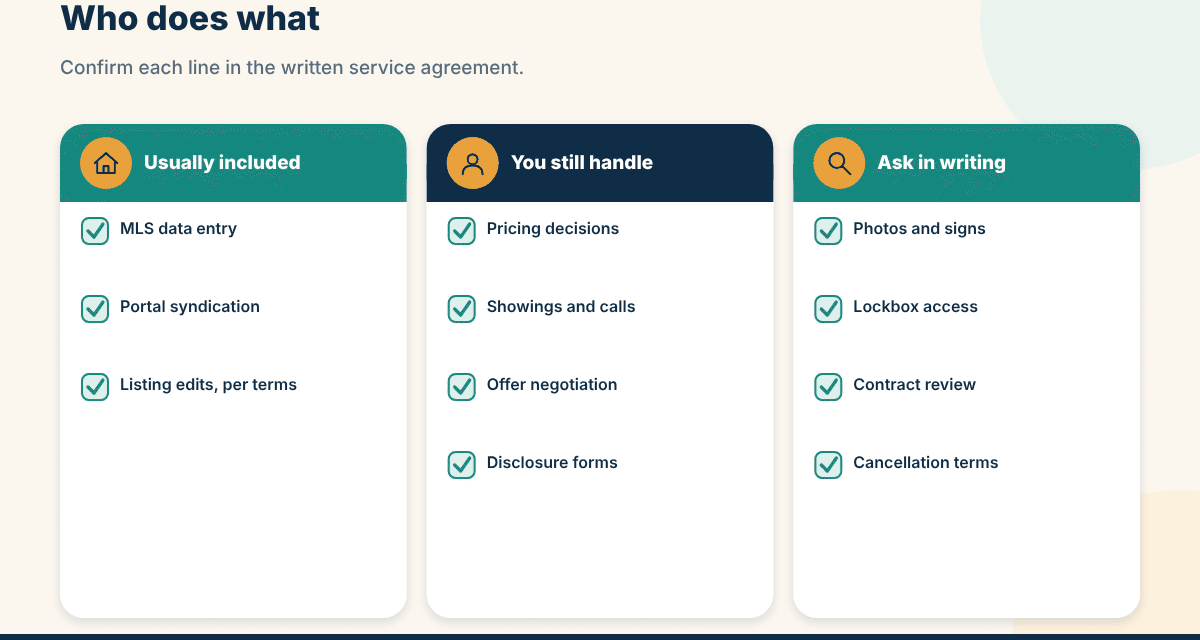
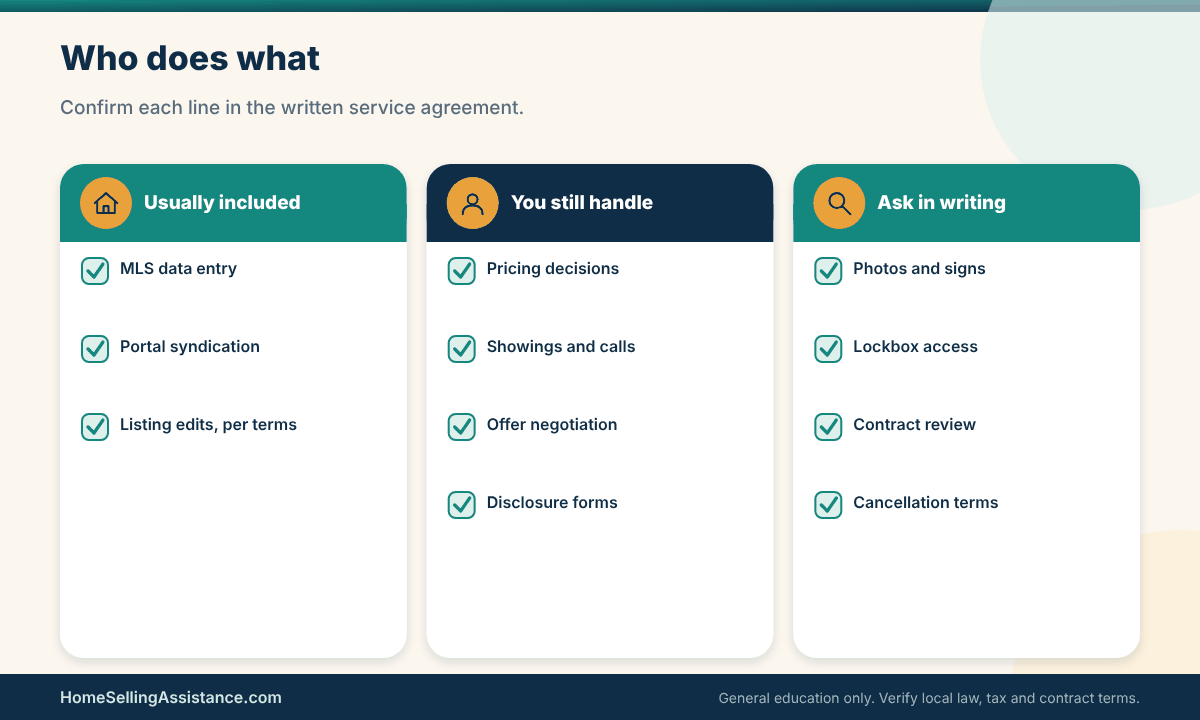
The checklist graphic below shows the usual division of labor for a flat fee MLS seller. It is a general picture, not a promise about any one company, so use it to build your own list of questions and then compare it with each written agreement.
Comparing realistic paths for a flat fee MLS seller
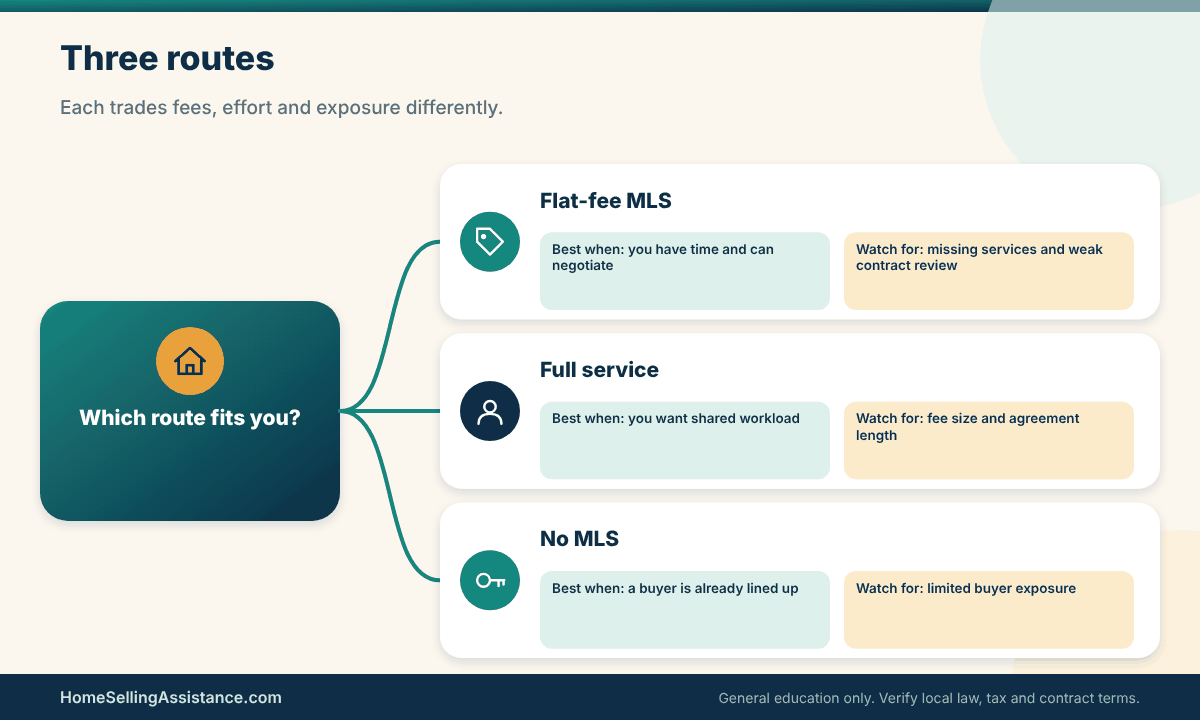
Once your goals and the surrounding facts are on paper, you can compare real routes. Three paths come up most often: a flat-fee listing where you do most of the work, a traditional full-service listing agreement, and a sale with no listing service at all. A fourth option, a cash buyer or investor, behaves differently enough that we cover it elsewhere, in the guide on getting a cash offer for your house.
The table below puts the three main paths side by side. Use it as a starting frame, then fill in the cells with actual quotes and written terms from the companies you are considering.
| Factor | Flat-fee MLS listing | Full-service listing | No MLS, own marketing | Check before choosing |
|---|---|---|---|---|
| Price and net proceeds | Lower upfront cost, but you set price and negotiate | Higher fee, support with pricing and negotiation | No listing fee, narrower reach | Written fee schedule and buyer-agent terms |
| Time to sell | Depends on your pricing, photos and responsiveness | Depends on market and agent process | Often slower for general buyers | Local days-on-market for similar homes |
| Contingencies | You review and respond yourself | Agent explains and tracks deadlines | You or an attorney handle all | State contract forms and deadlines |
| Workload | Heavy: showings, calls, paperwork | Shared with your agent | Heaviest, plus marketing | Which tasks are in the written package |
| Execution risk | Mistakes fall mostly on you | Agent carries professional duties | All on you | Insurance, licensing and contract review options |
| Flexibility | Often easy to cancel or upgrade, check terms | Contract length and release terms vary | Fully flexible | Cancellation, refund and extension language |
Read the table by columns, not rows. Pick the column that matches the way you want to spend your time and risk, then check the last column to see which written promises you still need to verify. No cell in the table is a prediction about your sale. It is a prompt for questions.
Option one: the listing-only package and its trade-offs
The classic flat fee MLS seller package is narrow. A licensed broker enters your property data into the multiple listing service, which then feeds the major real estate websites and local agent search tools. You provide the photos, the description and the price, or you pay extra for help with them. The company may offer a yard sign, a lockbox or a basic contract template as add-ons.
The appeal is clear. Your house appears where agents shop for buyers, and your upfront cost is a known figure rather than a share of the final price. The cost of that clarity is that nearly every judgment call lands on you.
Evidence to gather: the service agreement, line by line
Ask for the service agreement before paying. Read it for the term of the listing, the fee and when it is due, what happens if the home sells in a week or in a year, and whether the fee is refundable if you cancel. Check who handles inquiries from buyer agents, whether the listing displays your phone number or the company’s, and whether changes such as price edits are free or priced separately.
Look for the buyer-agent compensation language too. Brokerage practices on compensation have changed in recent years, and compensation is now a negotiated, written term. Your agreement should show where you state what, if anything, you offer, and how that appears on the listing. The National Association of Realtors publishes general information on current practices at nar.realtor.
A scenario, an exception and your next step for the listing-only route
An illustrative example: a seller pays a flat fee, lists at a price a neighbor suggested, and gets showings but no offers. Because nobody is reviewing the pricing with him, he waits six weeks before checking comparable sales again. The exception is a seller who already knows the local market well, perhaps a former agent or a longtime investor, for whom the package fits like a glove.
Your next step is simple. Request the agreement in writing, mark every task it does not mention, and decide for each one whether you will do it, hire it out or accept the risk. A flat fee MLS seller who does this exercise rarely gets blindsided by a missing service.
A few mechanics of the listing service are worth knowing before you buy. Each local multiple listing service sets its own rules about what a listing must contain, how photos are handled, how long a listing may run, and how changes are reported. Because those rules belong to the service, not to the flat-fee company, a listing that looks perfectly reasonable to you can be rejected or corrected if it breaks one of them.
That is one reason accuracy matters. Square footage, lot size, school information and the status of the home all feed into search tools, and mistakes can confuse buyers or cause a correction later. A careful flat fee MLS seller double-checks the data entry, keeps public records and measurements handy, and updates the listing promptly when the status of the home changes.
Photos deserve the same care. Buyers usually decide in seconds whether a listing is worth a visit, and the lead photo and the first few images do most of that work. If the package includes photos, ask what the photographer covers. If it does not, plan a clean, bright, uncluttered set of your own, and see the broader advice in the staging, photos and showings guides on the site.
Option two: a full-service listing, or selling without the MLS
The alternative paths sit on either side. A full-service listing agreement hands most tasks to a licensed agent in return for a negotiated fee. Selling without the MLS hands all tasks to you and takes the one thing a listing service gives you, broad visibility among agents and their buyers. Compare these honestly, because each beats the flat-fee route for certain people.
If you are weighing a traditional agent against doing it yourself, the detailed comparison in FSBO versus using a Realtor covers the trade-offs without pushing either one.
Evidence to gather: what an agent or a no-MLS plan really includes
For a full-service route, collect proposals from more than one agent and compare them on the written terms. Ask what marketing is included, who pays for photos, how the agent handles showings and offers, how long the agreement lasts, and how you can end it early. Every one of those terms is negotiable, so treat the first proposal as an opening, not a price list. The guide on how to choose a listing agent walks through the questions.
For a no-MLS plan, write out how buyers will find you. Yard signs and online classifieds reach some people. Agents working with buyers may never see the home. If you take this path, you are also taking on the work of explaining that decision to buyers who show up with their own agents.
Whichever route you lean toward, ask each provider the same short list. What exactly do I receive, and by what date? What do I owe and when? How do I end the agreement? Who answers my calls if something goes wrong? A flat fee MLS seller who asks these four questions of every company will quickly see which ones answer clearly and which ones change the subject.
Notice also how a company talks about risk. A trustworthy provider describes what its package does not cover without being asked twice. If every answer sounds like a sales pitch, treat that as information. Good businesses in this space tend to be comfortable saying that a particular home or situation is a better fit for someone else.
A scenario, an exception and your next step across the other paths
Picture a seller facing a complicated sale, such as a house with an unusual title situation or a pending estate. The full-service route may fit better because the extra support matters more than the saved fee. The exception is a seller who hires a real estate attorney for the legal side and handles everything else, which can bring a flat-fee listing back into the picture.
Your next step is to get at least one proposal from each path in writing, with the same property details given to everyone. Comparing like with like is the only way to see real differences.
A net-result rule and the contract questions every flat fee MLS seller should ask
Marketing pages talk about reach and savings. Contracts talk about obligations. The second kind of document governs your sale, so it deserves the more careful read. This section turns the comparison into a decision rule built on what you keep, then gives you practical contract questions grouped by money, timing and exit.
Contracts differ by company and by state, and some states regulate limited-service brokerage differently from full service. Your state real estate commission can tell you which rules apply, and a local real estate attorney can review an agreement for you if you want a professional view.
Price, time, cost and risk: the money terms in the contract
Money terms look simple on the surface because the fee is flat. Underneath, several smaller charges can change the picture: add-ons, rush fees, charges for edits or relisting, and costs that arise only if you need more help. Add them to the headline fee when you compare companies.
A second money question is buyer-agent compensation. As a flat fee MLS seller you decide what to offer, and you write it down. The decision affects how motivated agents are to show your house, and it affects your net result.
Evidence to gather: a fee worksheet you fill in yourself
Build a simple worksheet. In one column list the base fee, each add-on you expect to buy, the cost of professional photos if not included, sign and lockbox costs, and any cancellation or relisting fee. In a second column list the compensation you plan to offer a buyer’s agent, expressed in whatever form your contract requires. The total gives you a realistic upfront and back-end cost, which you can then compare with a traditional agent’s proposal.
For a broader view of how this fits into the final numbers, the guide to home sale net proceeds shows how fees sit alongside payoff, title charges and prorations.
Think about timing as well as totals. Some fees come due upfront and are not recoverable, while others arise only at closing. A flat fee MLS seller with limited cash before the sale may care more about when money leaves than how much does. Put the dates beside the amounts on your worksheet so that you see the cash flow, not just the sum.
A scenario, an exception and your next step on fees
An illustrative case: two sellers each pay a base fee that looks similar. One buys no add-ons. The other buys photos, a sign, a lockbox and a contract review, and ends with a total that closes much of the gap to a traditional proposal. Neither choice is wrong, but only one of them noticed before paying.
The exception is the seller who can do photos and signage well alone. Your next step is to total your own worksheet for each company and keep a copy, because it will also help you spot unexpected charges later.
To see how these pieces combine, the graphic below walks from the sale price down to what you keep. The steps are the ones a flat fee MLS seller is likely to meet, and every amount should be replaced with a real quote or statement before you rely on it.
Here is a deliberately simple illustration with round numbers that are not predictions. Imagine a sale price of four hundred thousand dollars and a mortgage payoff of two hundred thousand dollars. A flat listing fee, a few add-ons, an offered buyer-agent amount, title and escrow charges and a negotiated repair credit each come off the top. What remains depends on every line, and the lines depend on contracts and local custom.
The exercise matters more than any total. A flat fee MLS seller who builds this table before listing often finds that the biggest swing is not the listing fee at all. It is the buyer-agent amount, the repair credits and the time the house sits. That insight can redirect your energy toward preparation and pricing, where it counts.

When new evidence should change a flat fee MLS seller plan
A plan made before listing is a guess with good intentions. The listing then produces real evidence: how many people look at the online listing, how many book showings, what visitors say, and whether any offers arrive. A flat fee MLS seller who ignores that evidence is running the sale on hope, and one who overreacts to a single slow weekend is running it on nerves. The sensible middle is to decide ahead of time what you will measure and when.
Timing and exit terms matter here because they set how cheaply you can change course. Ask whether you can upgrade to a fuller service partway through, whether the fee is credited toward that upgrade, whether a refund exists if the listing never goes live, and how the company treats a listing you withdraw. Those answers tell you what changing your mind will cost.
The scenario table below gathers common seller situations and the route that tends to be favored, with the reason, the trade-off and the fact that could flip the answer. Treat it as a way to test your own situation against typical patterns, not as a verdict.
| Situation | Route often favored | Reason | Trade-off | Fact that changes the choice |
|---|---|---|---|---|
| Flexible timeline, comfortable with paperwork | Flat-fee MLS listing | Exposure at a known cost with control kept | More hours and more personal risk | A complicated contract or title issue |
| Tight deadline, busy schedule | Full-service listing | Shared workload and faster response | Higher fee, longer agreement | A willing, qualified buyer already in hand |
| Known buyer such as a neighbor or relative | Attorney-led sale, possibly no MLS | Marketing is less needed than clean paperwork | No broad exposure to test price | Uncertainty about fair value |
| Home needs visible repairs | Depends on budget and goals | Condition drives price more than the route | Repairs cost time and money before listing | An as-is buyer pool in your area |
| Inherited or estate property | Full-service or attorney support | Authority and title questions need guidance | Less seller control | Clear legal authority to sell |
| Condo or HOA community | Flat-fee MLS with careful HOA planning | Documents follow a set process | Resale document deadlines and fees | Association rules on signs or showings |
Use the table in two passes. First find the row that looks most like you, and note the route it favors. Second, read the last column and ask whether that fact is true for you. If it is, your answer may move to a different row. Many real situations touch two or three rows at once, which is normal and a good reason to get a professional opinion on the part that worries you most.
Evidence to gather: the signals that tell you the plan is working or not
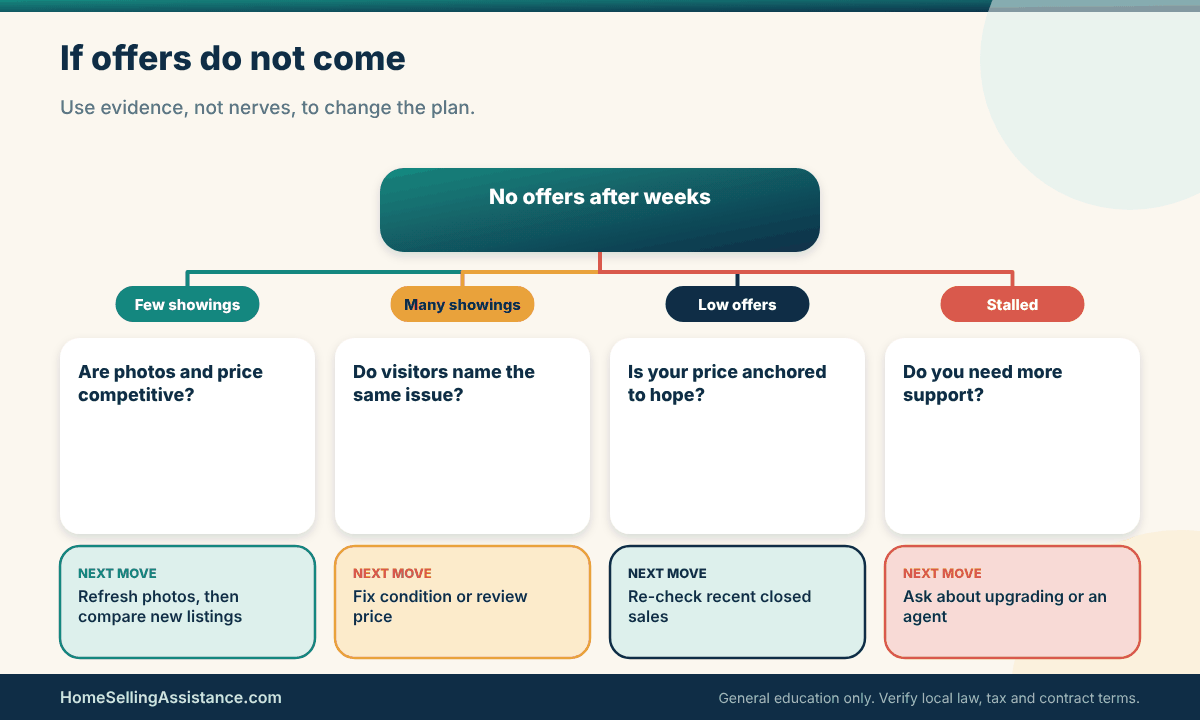
Pick a short list of signals before the listing goes live. Useful ones include the number of showing requests in the first two weeks, comments from agents and visitors, how your price compares with newly listed competing homes, and whether any buyer asks to come back for a second visit. Write the numbers down weekly. Memory softens bad news and inflates good news, so a simple log keeps you honest.
Be careful about what the evidence can and cannot say. Few showings may point to price, photos, or a weak listing description. Many showings and no offers often point to price or condition. Offers that come in low and keep coming in low point to a gap between your expectations and the market. A flat fee MLS seller can read these patterns without any special tools, as long as the data is collected consistently.
If offers do arrive, the work shifts from marketing to evaluating terms. The guides on negotiating a FSBO offer and on what to do when a FSBO buyer has an agent explain how to compare price with contingencies, closing date and financing strength.
Feedback itself needs interpretation. Agents are often polite, and visitors may say little. When you hear a comment, ask a follow-up question that invites specifics, such as which comparable home they preferred and why. A flat fee MLS seller who collects specific comparisons gets far more useful information than one who collects compliments.
Keep your emotions out of the log. It is natural to feel attached to a home you improved or raised a family in, and buyers do not share that history. The evidence you record should describe what buyers did, not what you hoped they would feel. That habit alone helps many sellers adjust sooner and with less frustration.
A scenario, an exception and your next step when the evidence turns
An illustrative case: a flat fee MLS seller logs her first three weeks. Interest is steady, but visitors keep mentioning the dim photos and the cluttered garage. She reshoots the photos and clears the garage rather than dropping the price, and showings pick up within a couple of weeks. A different seller, facing the same slow start, finds that three comparable homes just listed for less, and a price adjustment is the right call.
The exception is the seller whose house has a real structural or legal problem that no marketing fix will cure. For that seller, the useful move is to bring in a professional, an inspector, an attorney or a full-service agent, early. Your next step is to schedule the review date you set earlier and treat it as a meeting you cannot skip.
When offers do come in, resist the urge to judge them by price alone. Look at the financing type, the deposit, the inspection and appraisal terms, the closing date and any requests for credits. The strongest offer for a flat fee MLS seller is often the one that is most likely to close on schedule, not the one with the biggest headline number.
Quick scenario
Two sellers list at the same price on the same weekend. One logs showings and feedback, notices a pattern by week three and adjusts. The other waits for the feeling that something is wrong. Using illustrative round numbers, a short delay at a carrying cost of a couple of thousand dollars a month adds up faster than most people expect, so a calm, scheduled review is cheaper than a late reaction.
One more note about exit planning. If you decide to hand the sale to a traditional agent after trying the flat-fee route, read your listing service agreement for any clause that affects a new listing, such as a requirement to cancel the existing listing first. Then read the new agent’s agreement the same careful way. The change should be clean, with no overlap period where two companies each claim the right to be paid.
The same logic applies if you never switch. A well-run flat-fee sale still benefits from a professional check at the contract stage, and many sellers hire a real estate attorney only for that. The guide on the real estate sales contract explains the key clauses so that the attorney’s time is spent on judgment, not on basic explanations.
A last piece of evidence is the list of duties that stay with you. It helps to be concrete about what remains yours. A flat fee MLS seller usually handles pricing decisions, showing scheduling, answers to buyer agents, negotiation, disclosure forms, contract review, inspection and appraisal responses, and coordination with the title or escrow company. The listing service may touch some of those items, but only if the written package says so.
Knowing the list in advance lets you hire help for the pieces you dislike or fear, rather than discovering them under deadline pressure. We cover three of them here because they trip people up most often.
Disclosure first. Seller disclosure duties vary by state, and some sellers are surprised to learn that using a listing-only service does not remove them. You can read the basics in the guide on seller disclosure requirements, and for homes built before 1978 the federal rule on lead-based paint applies, with details at the EPA real estate disclosure page. A state real estate commission or attorney can confirm what applies to your property.
Showing logistics next. Decide how you will screen requests, whether you will use a lockbox, how you will confirm that a visitor is an agent or a real prospect, and what you will secure before people walk through. Fair housing rules apply to how you treat every visitor, so keep your standards consistent and neutral, and see the HUD fair housing resources if you have questions.
Closing documents last. Understand which papers the title company produces, which ones you must supply, and which fees you will owe. The overview in seller closing costs and the broader FSBO paperwork guide explain the sequence. A flat fee MLS seller who collects these documents early avoids last-minute scrambles.
To see how this plays out, imagine a seller who receives an offer on a Friday evening and has no idea how to respond. The agent on the other side expects an acknowledgment by Monday. Because the seller had already booked an hour with an attorney, she gets the contract reviewed over the weekend and replies in time. The same seller without that plan might have panicked or accepted something she did not understand.
The exception is the seller who is also a licensed professional or a seasoned investor and genuinely knows the process. Your next step is to write a one-page task list covering every duty above, and next to each item write who will do it and by when. Gaps on that page are the places to buy help.
For more on how the surrounding decisions fit together, browse the full FSBO and flat-fee MLS category, or compare compensation structures in the listing agents and commissions category.
Because decisions get harder once offers arrive, the tree graphic below sketches how a flat fee MLS seller might respond when the listing goes quiet. It is a thinking aid, and the right response depends on your evidence, your goals and your contract.
A word on safety and scams. Anyone selling online should be wary of requests that do not match a normal sale, such as buyers who refuse to meet, unusual payment methods, or urgent changes to wiring instructions near closing. Confirm instructions by phone using a number you already trust, and see the guidance from the Federal Trade Commission and the broader tips in the guide on home sale fraud and seller safety.
Finally, keep records. Save every message with buyers and agents, every version of the listing, every signed paper and every receipt. If a dispute or question arises months later, a clean file helps you, your attorney and your tax preparer. A flat fee MLS seller who stays organized tends to be the one whose closing goes quietly.
Before the questions, one last picture. The phases graphic below shows where the work of a flat fee MLS seller tends to land, from preparation through the live listing to the contract and closing. The central lesson is that preparation does most of the heavy lifting, which is the cheapest time to buy advice.
If you take only a few steps from this article, take these. Rank your goals. Read the written package line by line. Build your own net-proceeds worksheet. Set a review date and the evidence that will trigger a change. Each step takes an hour or two and can prevent weeks of drift later, which is an exchange most sellers would gladly make.
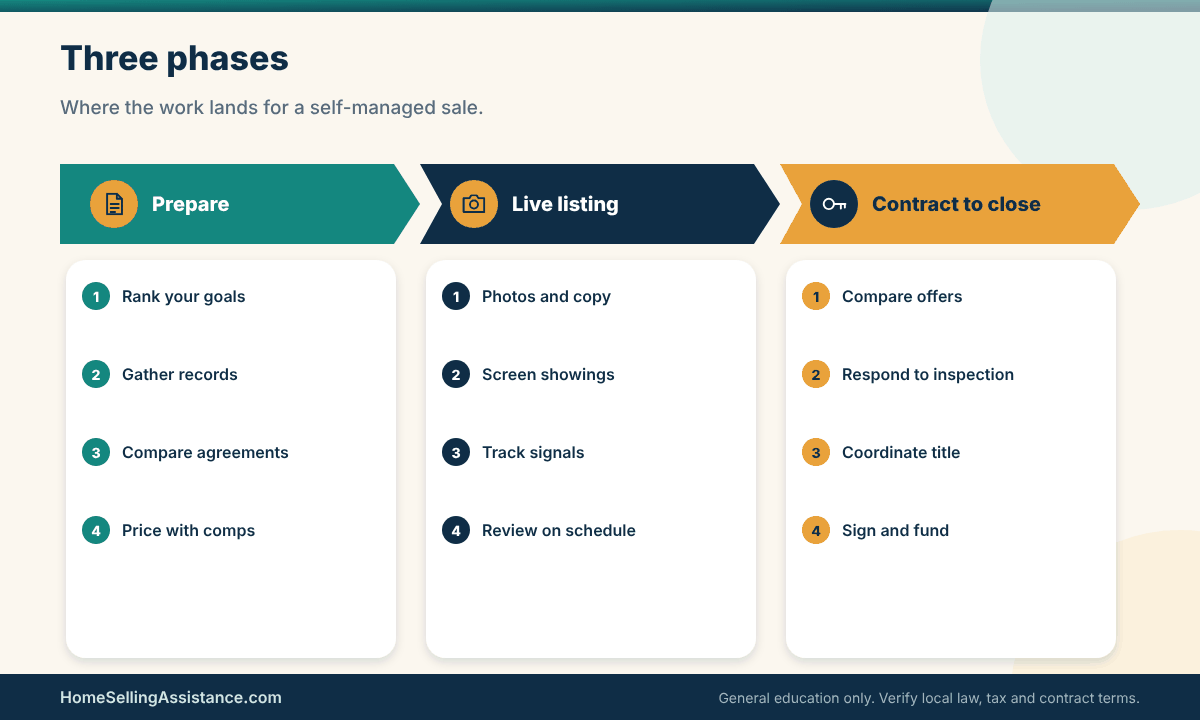
Think of the process as a series of checkpoints rather than a single leap. At each checkpoint, ask whether the evidence still supports the plan, whether your goals have changed, and whether help is worth buying. A flat fee MLS seller who keeps asking those three questions seldom drifts far from a good result.
Finally, give yourself permission to ask for help in small doses. A single hour with an attorney, a title officer or a trusted local agent can clarify a clause or a deadline that would otherwise cost you sleep. Paying for advice on the narrow piece you dislike is often what makes the flat-fee route workable for a thoughtful, busy seller.
Frequently asked questions about flat fee MLS seller listings
What does a flat fee MLS seller actually pay for?
A flat fee MLS seller pays a set price to have a licensed broker enter the home into the multiple listing service. Beyond that, the package depends on the company. Some include photos, a sign or a lockbox, and others charge for each. Always compare the written service agreement, because the marketing page rarely lists every limit.
Will my house appear on the big real estate websites?
In most cases, listings entered into the local multiple listing service are shared with the major portals and with agent search tools. The timing and the display details can vary by market and by site. Ask the company where and when your listing will appear, and check it yourself once it is live, since you are the one who benefits from catching errors.
Do I still have to offer a buyer’s agent compensation?
No rule says you must, but the decision is yours and it matters. Compensation is a negotiated term, and current practice expects it to be stated in writing. Offering something can bring more agents to your door, while offering nothing may narrow the buyer pool. Your state commission or an attorney can explain what your area requires.
Does a flat-fee listing mean I need no agent at all?
You will not have one representing you unless you hire one, though buyers often arrive with their own. That means you may deal with a professional on the other side while handling your side alone. Many sellers hire a real estate attorney or a flat-rate consultant for specific tasks to even out that imbalance.
Can I cancel a flat-fee listing early?
Often yes, but the terms vary. Some companies allow cancellation at any time with no refund, some offer partial refunds before the listing goes live, and some charge a fee for early termination. Read the cancellation clause before paying, and keep a copy of any confirmation if you cancel later.
Who handles the contract and the closing?
Usually you do, together with the buyer’s side and a title company or attorney, depending on your state. Some packages include a template contract or a review. Whether a contract template is appropriate for your state and situation is a question for your state real estate commission or a local real estate attorney.
How is this different from selling for sale by owner?
Selling for sale by owner can mean any sale without a listing agent, with or without the MLS. A flat fee MLS seller is a specific type of FSBO seller who adds the listing service. The broader guide on for sale by owner basics covers the full range of approaches and their trade-offs.
What costs could surprise me?
Add-on fees, photography, signs, lockboxes, relisting charges, attorney review, repair credits that a buyer negotiates, and the compensation you offer a buyer’s agent are common sources of surprise. Build a worksheet before you sign and compare it against a full-service proposal. The comparison is only fair when each side counts all of its costs.
When should I switch to a full-service agent?
Consider it when the evidence says the plan is not working, when your schedule changes, or when a complication appears that you do not want to manage alone. There is no shame in changing course. Check your listing agreement for any step you must take first, and read the new agent’s agreement carefully as well.
Where can I check the rules for my state?
Start with your state real estate commission, which usually publishes consumer guidance on listing agreements and disclosures. A title company can explain local closing customs, and a real estate attorney can review your documents. For general consumer protection information, the Consumer Financial Protection Bureau is another trusted starting point.
Choosing with your eyes open
A flat fee MLS seller trades some convenience for control and, often, for a lower upfront cost. That is a sound trade when you have the time, the skills and a plan for the hard moments, and a poor one when you do not. Compare the written terms, count every cost, and judge each route by what you keep after closing. This article is general education, not legal, tax or financial advice, so confirm state-specific rules and contract questions with a licensed professional.