The best questions to ask listing agent about price are not clever interview tricks; they are plain requests that make the agent show how a suggested list price was built, so you can tell the difference between a number backed by evidence and a number backed by enthusiasm.
Almost every seller sits through a pricing presentation at some point. An agent arrives with a folder or a screen full of photos, a short list of recently sold homes, a neat chart and a confident figure. It feels professional, and often it is. But a confident figure is not the same thing as a well-supported one, and the meeting is the cheapest moment you will ever have to find out which kind you are looking at.
This guide gives you a working script of questions to ask listing agent about price. We cover what to ask about the comparable sales, how adjustments are made, how the price will be launched and reviewed, what the number means for your net proceeds, and what a weak answer sounds like. It is written for sellers who are interviewing two or three agents, and it also works if you already hired one and want a better conversation about the list price.
We stay neutral on which kind of agent, brokerage or fee model you choose. If you are still comparing professionals, our cornerstone guide on how to choose a listing agent puts the pricing conversation inside the larger hiring decision. For more agent-side topics, browse our listing agents and commissions library. For the pricing method itself, from the seller’s side of the table, see how to price a house to sell.
One honest note before we start. Local markets differ, MLS data rules differ, and no agent can promise a sale price or a sale date. Any dollar figure below is a round example chosen to show the arithmetic, not a forecast and not a typical result for any place.
Key takeaways
- Ask for the evidence, not the opinion. The best questions to ask listing agent about price lead to documents. A sound list price comes with a dated list of sold and active homes, a clear reason for each pick, and adjustments you can follow line by line.
- Ask for a range and a plan. Your questions to ask listing agent about price should reach past the number. A single number with no reasoning is weaker than a range with a stated launch price, a review date and the signals that would trigger a change.
- Separate price from net. A higher suggested price is only better if the fees, concessions and time on market around it leave you with more usable money, so request a written net sheet.
- Notice how the agent handles doubt. Good agents say what they do not know, show the weak comps alongside the strong ones, and welcome a second opinion.
- Write the pricing plan down. Agree on review dates, reduction triggers and who makes the final call before you sign anything, then keep the notes.
- No one can guarantee a result. Treat promises of a specific sale price, speed or bidding war as a reason to ask more questions, not fewer.

Questions to ask listing agent about price before you look at a single comp
The meeting where you ask your questions to ask listing agent about price tends to move quickly toward the number, because the number is what you came for. Slow it down. The order in which you ask things matters, and the first group of questions to ask listing agent about price should be about the raw material, which is the set of sales the agent is relying on, before anyone says what the answer is.
Why the order matters is simple. If you hear the number first, every comparable sale that follows is going to sound like a confirmation. If you hear the evidence first, you can form a rough sense of your own and then see whether the agent’s figure lands near it. That small shift in sequence protects you from anchoring on a high or low figure that was chosen to win your signature.
Questions about the comparable sales the agent chose
Think of this first block as the foundation of every other one of the questions to ask listing agent about price. If the comps are weak, the strategy built on top of them is weak too, however polished it looks. If the comps are strong, the later conversation about launch price and review dates has something solid to stand on.
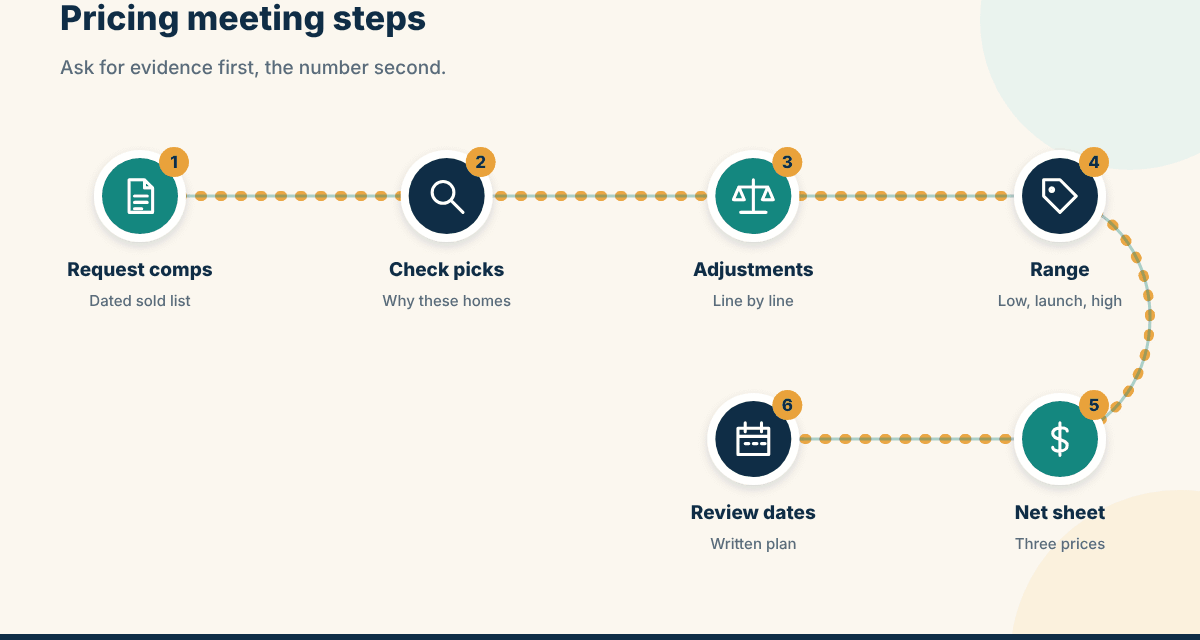
A comparable sale, usually shortened to a comp, is a recent sale of a similar home that helps estimate what a buyer would pay for yours. Everything in a pricing presentation rests on them. Your first job is to learn which sales were picked, which were left out, and who decided. Start with a few direct requests, because the best questions to ask listing agent about price are the ones with a document behind them, and write the answers in your own notes rather than relying on the handout.
Ask how many sold comps the agent reviewed in total and how many made the final list. A presentation built from three hand-picked sales and a presentation built from three picks out of thirty reviewed can look identical on paper. Then ask what the agent looked for: nearby location, similar size, similar age, similar style, similar lot, similar condition. A clear answer sounds specific. A vague answer sounds like “homes like yours in the area.”
Ask about the dates, too, since dates belong on any list of questions to ask listing agent about price. Sales from many months ago can be useful in a slow or steady area and misleading in a fast-moving one. You do not need a universal rule for how old is too old, because there is not one; it depends on how quickly your local market has been changing. What you need is the agent’s reasoning for including an older sale and what the agent would expect to be different today.
Evidence to gather: the sold list, the dates and the distances
Before you leave the meeting, ask for the comp sheet itself, in writing, as a document you can keep. At minimum it should show the address of each sold home, the sale date, the closing price, the list price it started at, the days it took to sell, the size, the bedroom and bathroom count, the lot or unit details and a short note on condition. If any of those columns are missing, ask for them. They are not unusual requests; they are the ordinary fields that MLS systems display to licensed agents.
Then do two quick checks yourself. First, use a public map to see how far each comp is from your home and whether it sits across a boundary that matters, such as a school attendance line, a busy road, a rail line, a flood zone edge, a different HOA or a different tax district. Second, compare the sale dates with any big local changes you know about, like a plant closing, a new employer, a rate change that slowed buyers, or a new development nearby.
A good habit among the questions to ask listing agent about price is to ask the agent which two comps they trust most and which two they trust least, and why. Agents who answer that honestly are showing you how they think. Agents who insist every comp is perfect are showing you something different.
A scenario: the best-looking comp that was not really comparable
Imagine, with illustrative numbers, that your home is a three-bedroom ranch with an older kitchen. The agent’s lead comp is a recently renovated three-bedroom home two streets away that sold for a round $450,000. It looks perfect on the sheet, because it is close, similar in size and recent. You ask the standard question: what was different about that home?
A weak answer is “not much, same neighborhood.” A strong answer is “it had a full kitchen and bath remodel, a finished basement and a newer roof, and it was priced to sell fast, so I would not use it as a straight match for yours.” The second agent has just taught you how to read the whole page.
Your next step in that scenario is simple. Ask for two or three comps that are closer to your home’s actual condition, even if they are a little farther away or a little older. Then ask the agent to explain, in dollars, how the remodeled sale differs from yours. If the agent cannot put a reasoned number on that gap, the price in the presentation is resting on a feeling.
Questions about adjustments and the condition of your home
No two homes are identical, so agents adjust comps for the differences. A comp with a garage might be adjusted downward when compared with your home that has none, a comp with a larger lot might be adjusted down because you have less land, and so on. These adjustments are where judgment enters, and where subtle differences in questions to ask listing agent about price pay off, because adjustments can quietly add or remove tens of thousands of dollars.
Ask the agent to explain each adjustment in plain language: what feature, which direction, how large and where the amount came from. Some agents use paired sales, meaning two otherwise similar homes sold close together where only one feature differs. Others use experience and local feel. Both can be reasonable. What you want to hear is that the amounts are tied to something observable, not invented to make the math land on a target figure.
Also ask how the agent has judged your home’s condition. Walk through the house with them as you put your questions to ask listing agent about price and say out loud what you know: the age of the roof, the furnace and the water heater, the repairs you have made, and the ones you have skipped. A price built on a house that does not exist is a price that will be corrected later by a buyer’s inspection or appraisal, usually at a more stressful moment.
Evidence to gather: how each adjustment was calculated
Ask to see the adjustment grid, which is the table that lines your home up against each comp and shows the plus or minus for each difference. Many agents already have this in their software; some do not use one at all and rely on a narrative. Either way, ask for the logic in writing. You are not trying to catch anyone out. You are trying to make the reasoning visible so a second agent, an appraiser or you yourself could check it.
Look for consistency. If one comp gets a large adjustment for a finished basement and another gets a small adjustment for the same feature, ask why. If a pool is adjusted as a large plus in one place and ignored in another, ask why. Inconsistency is not always a mistake, because features are worth different amounts in different settings, but the agent should be able to explain it.
Finally, ask what the adjustments add up to. If the total adjustments on a comp are large compared with the sale price, that comp is doing less work than it appears to. Many appraisers prefer comps that need few and small adjustments, and a seller can borrow that instinct. The fewer the adjustments, the more weight the comp deserves.
A scenario: the kitchen the agent loves and the buyers may not
Suppose, again with made-up round numbers, the agent says your updated kitchen deserves a premium of $20,000 over a comp with a dated one. Ask what that figure is based on. A thoughtful answer might be “two sales last spring on the next street, one updated and one not, differed by about that much, and I have seen buyers respond to this layout.” A thin answer is “kitchens are worth a lot.”
Now ask the harder question: would the buyer pool for a home at this price care about the kitchen the way you do? A kitchen that suits your taste may be only mildly valued by buyers who plan to redo it anyway. Honest agents will say that adjustments for taste-driven upgrades are less reliable than adjustments for size or bedroom count.
The next step is to ask the agent for one conservative version and one optimistic version of the same adjustment. Seeing both teaches you how much of the price comes from the strong parts of the case and how much from the shaky ones. If the whole number only works when the kitchen premium is at its highest, that is worth knowing before you sign a listing agreement.
Pricing strategy: the questions to ask listing agent about price and timing
Once you understand the evidence, the conversation shifts from “what are homes worth” to “what should we do about it.” Those are different questions. Worth is an estimate of what buyers might pay. Strategy is a decision about where to start, how long to wait and what to change if the market does not respond. The second group of questions to ask listing agent about price covers the strategy, and it is where good agents and merely pleasant ones tend to separate.
A common mistake is to treat the list price as a prediction. It is better understood as an opening move in a process that includes showings, feedback, offers, an appraisal and a closing. A price that looks fine on day one may need a review on day fourteen, and the agent who has a plan for that review is giving you more than the agent who simply names a figure.
Questions about the number itself and how it will be launched
Among your questions to ask listing agent about price, begin by asking whether the agent sees a single value or a range, and what separates the bottom of the range from the top. Most honest pricing conversations produce a range, because the evidence rarely points to one exact number. If the agent offers only a point figure, ask how wide the uncertainty is, even roughly, and what could push the result toward either end.
Next in the list of questions to ask listing agent about price, ask where in the range the agent would start and why. Some agents favor a launch at the market-supported figure to attract the widest pool of buyers early, others favor testing a higher figure with a plan to adjust. Neither approach is automatically right. Your circumstances matter: whether you can wait, whether you have a purchase waiting on this sale, whether the home is unusual, and how many comparable homes are competing right now.
Finally, ask what the plan is when the first weeks do not go as hoped. You want to hear about timing, such as a first review after a set number of days, and about signals, such as showing counts, online views, buyer feedback and offers. Our guide to the listing agent’s marketing plan covers how those signals tie in with the rest of the launch.

The picture above shows the most common launch approaches side by side, with what each is best for and what to watch for. Treat it as a menu for your questions to ask listing agent about price rather than a verdict, because the right approach for a quiet suburban street may be wrong for a downtown condo with five direct competitors.
Evidence to gather: a price range, the active competition and the absorption view
Ask the agent to show you the homes that are currently for sale and likely to compete with yours, not only the ones that sold. Buyers shop across active listings, and your home will be compared with them from the first day. Look at how many there are, how long they have been listed, whether their prices have been reduced and how they compare in condition and features.
Add to your questions to ask listing agent about price a request for the pending list, meaning homes under contract but not yet closed. These tell you what buyers are accepting right now, which is often closer to today’s market than closings that were negotiated months ago. If a lot of nearby homes went pending quickly, that points one way. If many sit for weeks and take cuts, that points another.
The agent may also talk about how fast homes in your price band and area are being absorbed, usually described as months of supply or a similar measure. Ask where that figure comes from, what area and price band it covers, and how recent it is. Averages across a whole county can hide a lot, so ask for the narrowest honest slice. For market-wide context you can also look at published research from the National Association of Realtors, bearing in mind that national data cannot tell you what your street will do.
A scenario: pricing at the top of the range and a plan to reduce
Picture two agents who both see a range of roughly $390,000 to $420,000 for your home, using round example figures. Agent A recommends listing at $415,000 and says the home will “probably get a lot of attention.” Agent B recommends $399,000 and gives a reason: two active listings priced lower have more updates, and the highest recent sale was a special case.
The useful comparison is not which agent is more optimistic. It is which one has a written plan. Ask Agent A what happens if there are few showings in the first two weeks, and what concrete step follows. Ask Agent B what happens if three offers arrive in the first weekend, and whether a higher result would be expected or whether there is a risk of leaving value on the table.
Both can be reasonable. A higher launch price carries the risk of a longer listing and a later reduction, which some buyers read as a signal. A lower launch carries the risk of an early sale at a figure that a slower approach might have beaten. Your next step is to choose with open eyes, tell the agent which risk you prefer, and put the review dates in writing.
Questions about fees, net proceeds and the agent’s incentives
Price is not what you keep. What you keep depends on the loan payoff, the fees agreed in the listing contract, any credits you give the buyer, title and escrow charges, taxes and prorations, and the cost of carrying the house while it sells. A pricing meeting that ignores these items has only answered half the question, so build them into your questions to ask listing agent about price from the start.
It is also fair to talk about incentives, without accusing anyone of anything. Every professional has a structure of rewards, and a sensible seller understands it. An agent paid a percentage of the sale price gains little from an extra few thousand dollars after splitting fees and costs, but gains a lot from a quick, certain sale. That does not make agents untrustworthy. It means you should ask questions that reveal how the plan treats time and certainty, not just price.
The questions to ask listing agent about price should therefore include fees. Compensation arrangements have changed in recent years, and they are negotiable and must be written down. Our articles on the seller’s real estate commission and on the listing agreement explain how to read those terms, so we will not repeat them here. For the pricing meeting, the point is that fees shape net proceeds and net proceeds are what you are really comparing.

The next image sketches how a sale price turns into money in your hands. The steps are illustrative and not every sale includes every one, so the blank spaces on your own version should be filled from real quotes, not from estimates in a brochure.
Evidence to gather: a written net sheet built on your payoff
Among the questions to ask listing agent about price, this one is the most underused: ask each agent to prepare a net proceeds estimate at three prices: the suggested list price, a price somewhat lower and a price somewhat higher. The sheet should start from your actual mortgage payoff, which you can request from your lender, rather than a guess. It should list the fees in the proposed listing agreement, an allowance for typical seller costs in your area, an assumption about any buyer credits, and the property tax and HOA prorations.
Be clear, when you ask these questions to ask listing agent about price, on what is estimated and what is known. Payoff, fee percentage or flat amount, and prorations can be calculated from documents. Title, escrow and transfer charges depend on local custom, and some states charge them very differently. Ask which lines are firm and which are placeholders, and ask who prepared the estimate: the agent, a title company, or a template.
Also check the arithmetic yourself. A net sheet is just addition and subtraction, so you can rebuild it on paper in a few minutes. If a line looks unusually small, ask about it. Our overview of seller closing costs lists the categories so you can see whether anything has been left off.
A scenario: two agents, two prices, one very different net
Take two proposals, both with example numbers. Agent A suggests $410,000 with a fee schedule that includes an administrative charge and a higher total commission. Agent B suggests $400,000 with a simpler, lower fee and a shorter listing term. At first glance A promises $10,000 more.
Run the net sheet. After the fee difference and the extra charge, the gap may shrink a lot or disappear, and that is before considering that a higher list price may take longer to sell. Each additional month of mortgage payments, taxes, insurance and utilities is real money, even if it does not appear on a closing statement.
The next step is not to pick the lower or higher number. It is to ask each agent why their approach should produce the better outcome for you, in terms of both net proceeds and timing, and to ask for the logic in writing. You may find the answer depends on how quickly you need to move, which is a personal fact no agent can decide for you.
Judging the answers: red flags, records and your next move
Asking good questions to ask listing agent about price is only half the job. The other half is deciding what the answers mean without turning the meeting into a courtroom. Most agents who give a weak answer are not trying to mislead you; they are rushed, working from a template, or unused to being asked for detail. A few may be shading the number to win the listing. You cannot always tell which is which, so the safest approach is to judge answers by whether they can be checked.
That principle keeps the conversation fair. You are not accusing anyone of anything. You are asking whether each claim can be matched to a document, a record or a second source, and whether the agent is comfortable with that. An agent who welcomes verification is behaving the way a good professional should, and that tells you more than any single figure.
Warning patterns in a pricing presentation
Quick scenario
You ask one of the questions to ask listing agent about price and the agent answers with a story about a neighbor’s house instead of a sale record. Nothing is wrong yet. Say, “That is helpful context. Can you also send me the recorded sale with the date and closing price?” A reply that arrives with the record attached is reassuring. A reply that never arrives is information, too.
A warning pattern is not proof of bad intent. It is a reason to slow down and ask another question. When several patterns appear together, they deserve more weight than any one alone. The table below lists the claims sellers commonly hear in pricing meetings, the evidence that would support them, a safe response, what you should keep to yourself, and when to seek a second opinion. Use it as a quick reference during and after the meeting, alongside your own list of questions to ask listing agent about price.
| Claim you hear | Evidence to check | Safe action | Do not share | When to escalate |
|---|---|---|---|---|
| “Your home will sell for this much” | Dated sold list, adjustment grid | Ask for a range and its drivers | Your lowest acceptable price | Agent refuses to show sold data |
| “Homes here sell in days” | Days-on-market for your price band | Request the narrow area figures | Your move-out deadline | Figures cover only a broad region |
| “List high, we can always cut” | Active competing listings, reduction history | Ask for written review dates | How much you need the money | No plan for a cut is offered |
| “The fee is standard” | The blank listing agreement | Ask for each fee in writing | Your other agent quotes in full | Fee terms differ from the pitch |
| “A buyer is already waiting” | Written, verifiable interest | Ask how interest was verified | Your reserve or net target | Pressure to sign today |
| “No repairs are needed” | Pre-listing inspection, condition notes | Walk the house together | Known defects you plan to hide | Disclosure advice seems vague |
Read across a row to see how a claim, its proof and your response fit together. The “do not share” column deserves attention. You are allowed to keep your bottom line private, and sharing a minimum price or a hard deadline with someone whose compensation depends on your decision weakens your position without giving you anything back.
What a thin answer sounds like
Thin answers to questions to ask listing agent about price share a few traits. They rely on adjectives instead of numbers, such as “hot,” “strong” or “very popular.” They point to general market conditions without tying them to your price band. They describe the comps as “great” without naming a single difference. They avoid dates, and they deflect requests for the underlying sheet with phrases like “I will send that later” that never turn into an email.
Another common pattern is the pressure answer, in which the agent suggests that you must decide today or lose a chance. Real markets move, but a pricing recommendation does not usually expire before you have had a night to compare notes. A professional confident in the work can usually wait a day for you to review it.
A thin answer does not mean a bad agent. Ask the question again in a different form. If you asked “how did you pick these comps” and got a shrug, try “which of these three would you drop first if I said I did not trust it?” People often reveal more when asked to rank than when asked to justify.
A scenario: the agent who will not show the sold data
Suppose an agent presents a confident list price but, when you ask for the sold comps, says the data is “proprietary” or that the number comes from “experience in the area.” This is worth pausing on. Licensed agents ordinarily have access to MLS sold data, and while rules about how that data can be shared with the public vary by area, the agent can usually discuss and show the supporting sales to a client or prospective client.
The fair response is to say so calmly: “I would like to see the sales behind this number before I sign anything. Can you send them with dates and prices?” Then watch what happens. An agent who sends the data within a day has answered the concern. An agent who keeps deflecting has told you something about how the working relationship may go.
Your next step might be to ask another agent for an independent opinion, or to order a professional appraisal if the stakes are high, as when the home is unusual or there is no strong comp. An appraisal is a separate service with its own cost and purpose, so ask what it would and would not tell you before paying for one.

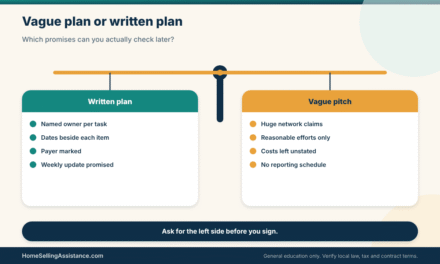
The image above contrasts how answers to questions to ask listing agent about price tend to look when they are stronger or weaker. It is a rough guide for note-taking, not a scoring system, and you should adjust it to your own priorities. Some sellers care most about speed, others about price, and the weighting is yours.
Writing the answers down: your questions to ask listing agent about price as a plan
By now you have put the questions to ask listing agent about price to two or three agents, and you may have heard with different prices, different strategies and different styles. That variety is normal and useful. The goal of this last stage is not to find the agent whose number is highest or lowest. It is to compare plans on the same terms and to put the chosen plan in writing, so you are not relying on memory or goodwill later.
This is also the right time for a few fairness checks. Pricing advice should rest on the home, the market and your goals, never on who the likely buyers are. If an agent frames the price around the kind of people who will or will not want the neighborhood, treat that as a serious concern and review the federal guidance on fair housing and equal opportunity. Good pricing talk sticks to features, condition, location facts and comparable sales.
Evidence to gather: review dates, triggers and who decides
A written pricing plan does not need to be long. One page is plenty. It should record the agreed list price, the date of the first review, the information that will be looked at in that review, and what kinds of results would lead to a change. Showing counts, online views, buyer feedback, active competition and offers are all fair inputs. Ask the agent to name the thresholds in advance, so a reduction feels like following a plan instead of losing an argument.
Also decide who has the final say. In most arrangements the seller sets the price and the agent advises, but it helps to say so out loud. Ask the agent to confirm that no price change will be made without your written approval, and ask how quickly they can act when you do approve. Many listing agreements also describe how long the agreement runs, and a long term with a high price and no review plan puts you in a tight spot. Our article on the exclusive right to sell listing agreement explains what that term commits you to.
Keep your notes, since the questions to ask listing agent about price lose their value if the answers live only in your memory. A dated email recapping the meeting is a simple way to do it: “Thanks for meeting today. To confirm, we discussed a list price of X, a first review on day Y, and these signals.” If the agent replies and agrees, you have a shared record. If the reply changes the plan, you have learned that before signing instead of after.
A scenario: choosing between two agents when neither is wrong
Now imagine the harder case for your questions to ask listing agent about price, where both agents did well. Both gave clear comps, honest ranges and written net sheets. One suggests a slightly higher launch price with a planned review at day fourteen. The other suggests a slightly lower price with a plan for a review at day ten. You like both, and neither has done anything wrong.
In that case the decision is about your own priorities, and the questions to ask listing agent about price have already done their job by making the choice visible. If you can wait and want to test the market, the higher launch may fit. If you have a purchase contract elsewhere or a firm moving date, a lower launch with early feedback may suit you better. Neither is a mistake.
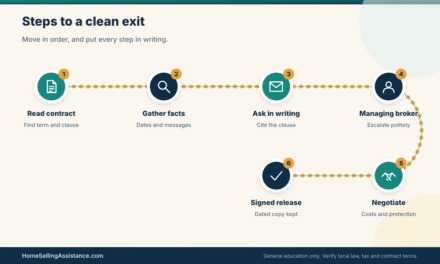
Your next step is to ask one last question of each: “If I follow your plan and it does not work, what will you do differently, and what will it cost me?” The quality of that answer to the last of the questions to ask listing agent about price, including any exit options in the contract, is often a better guide than the price itself. If you later need to leave an arrangement, our guide to how to cancel a listing agreement explains the usual routes.
The table below turns common situations into a short checklist you can use after the meetings. It lists what you might see, what should make you pause, where to confirm the facts, how to respond, and what to keep. Because every state and contract differs, treat the verification channels as starting points and confirm details with your state’s real estate commission, a real estate attorney or your title company.
| Situation | Warning sign | Verification channel | Seller response | Record to keep |
|---|---|---|---|---|
| Price far above other agents | No sold comps support it | Second agent, appraisal | Ask for the sales behind it | Comp sheets from each agent |
| Price far below other agents | Push to sign quickly | Active and pending listings | Ask why the gap exists | Dated notes of the answer |
| Net sheet missing | Only price is discussed | Lender payoff, title company | Request a three-price estimate | Signed or emailed net sheet |
| Fee terms unclear | Verbal quote differs from form | Blank listing agreement | Ask to see each line item | Copy of the draft agreement |
| Unrealistic promise | Guarantee of price or speed | State real estate commission | Ask for the promise in writing | Email recap of the meeting |
| Condition ignored | Repairs are never mentioned | Inspector, past reports | Walk the home with the agent | Repair receipts and photos |
Use the table as a prompt for follow-up emails. If a situation matches a row, send a short note asking for the missing item and file the reply. Keep asking the same questions to ask listing agent about price of every agent, and over a few days you will have a folder that makes the final comparison nearly automatic.

The last image is a short document checklist for the pricing stage. Gathering these items before the meeting means the agent spends the hour on your questions instead of hunting for your mortgage statement, and it shows you are serious about a careful decision. Your own state may add other items, so check locally.
Frequently asked questions about questions to ask listing agent about price
What are the most useful questions to ask listing agent about price in the first meeting?
Start with which sold homes the agent used and why, what the adjustments were, and whether the answer is a range or a single figure. Then ask what the plan is if the first two weeks go quietly. Those questions to ask listing agent about price show whether the number is built on evidence, and they take only a few minutes of the meeting.
Should I ask the agent to show me the comparable sales in writing?
Yes. A written comp sheet with addresses, dates, sale prices, days on market and condition notes lets you check the work later and share it with a second agent. Agents ordinarily have access to this information. If one will not provide it, you can calmly ask again or consider whether another professional is a better fit.
How do I know whether the suggested list price is realistic?
You cannot know for certain, even with careful questions to ask listing agent about price, because a market only reveals its answer through buyers. You can improve your odds by comparing at least two independent opinions, checking active and pending listings, and testing the adjustments. If the numbers are far apart, ask each agent to explain the gap, since those explanations are often the most useful part of the process.
Is it a red flag if one agent suggests a much higher price than the others?
It is a reason to ask more questions, not proof of anything wrong. Ask for the sold comps that support the figure and for the plan if buyers do not respond. A higher price can be defensible when a home has features other homes lack, but it deserves a written reason and a review date.
Should I ask about commission as part of the questions to ask listing agent about price?
Yes, because fees affect what you keep. Compensation is negotiable and must be put in writing, and the details differ by brokerage and area. Ask for the fee terms in the blank agreement and for a net sheet at several prices so you can compare outcomes in dollars, not only in list price.
Can an agent guarantee a sale price or a sale date?
No honest agent can, however good your questions to ask listing agent about price are. Markets, appraisals, financing and buyer behavior are outside anyone’s control. An agent can describe past results and give a reasoned range, but a guarantee should prompt more questions. If a promise matters to you, ask for it in writing and read the exact wording carefully.
Do I need an appraisal before listing?
Not always. A pre-listing appraisal is a separate paid service that gives an independent opinion of value, and it may help when your home is unusual or the agents’ prices are far apart. Ask what the appraiser would look at, how much it costs locally and whether the result is likely to change your decision before you order one.
What if I do not agree with the agent’s price?
Say so and explain why, using your own evidence, such as a comparable sale or a recent offer. In most arrangements the seller sets the price. Ask the agent to outline the risks of your preferred figure and to confirm the review dates, then decide. If the gap stays wide, you can look at other agents before signing.
When should we change the price after listing?
That depends on your plan, but the agreed review date and signals are the right place to start. Look at showings, online views, feedback and how nearby homes are doing. A change made on evidence at a planned review is easier to explain to buyers and to yourself than one made in a panic.
Bring the evidence to the table
The strongest questions to ask listing agent about price are the ones that turn a number into a paper trail: the comps, the adjustments, the range, the net sheet and the review dates. Ask these questions to ask listing agent about price calmly, write the answers down and compare plans side by side before you sign. This article is general education, not legal, tax or financial advice, so confirm state rules, contract terms and the tax effects of a sale with a licensed professional in your area.