A solid listing agent marketing plan seller can read, question and hold onto is one of the most useful documents you will see before you sign anything, and it is also one of the easiest to get wrong, because “we will market your home everywhere” sounds complete while saying almost nothing you could ever check.
Most sellers meet the plan during a listing presentation, and that first look shapes every listing agent marketing plan seller decision that follows. The agent arrives with a folder, a slide deck or a tablet, and the pages look polished: a map of syndication sites, a sample postcard, a promise of professional photos, maybe a line about social media. It feels like a lot. Then the listing agreement arrives, and you realize the plan on the screen and the contract on the table are two separate things.
This guide is about closing the gap between the pitch and the paper, which is where a good listing agent marketing plan seller review does its work. We will look at what a reasonable marketing plan contains, which promises belong in writing, how to verify claims without calling anyone a liar, and what to do when the plan on paper does not match what is happening on your street. None of it assumes your agent is dishonest. Most are not. But even honest agents describe their services in different ways, and you are the one who lives with the results.
We stay neutral on which route to market is best for you. A full-service agent, a discount broker, a flat-fee MLS service and a for-sale-by-owner sale each carry a different marketing workload, and each shifts who does what. If you are still choosing an agent (more articles live in our listing agents and commissions category), our guide to choosing a listing agent covers the wider decision. This article zooms in on one slice of it: what the marketing is supposed to be, and how to tell whether it is happening.
Key takeaways
- Putting a home on the MLS is the starting line, not the plan. A real marketing plan describes preparation, presentation, exposure, follow-up and reporting, with someone named as responsible for each.
- Promises belong on paper. If a service, a timeline or a budget matters to you, ask for it in the listing agreement or an attached addendum, not just in the pitch.
- Screenshots and big numbers prove very little. Impressions, “reach” and testimonials describe activity, not results. Ask what the activity was meant to change.
- Verify through channels you control. Check the live listing, the MLS printout, the brokerage’s own site and your showing records yourself instead of relying on a summary.
- Weak results call for a calm review, not an accusation. Compare the written plan to what happened, look at price and condition first, and use the agreement’s own terms for any change.
- Compensation is negotiable and must be written down. What you pay and what you get should be readable side by side in the same document.
Before the first section, a quick note on how to use this listing agent marketing plan seller guide. You do not need to memorize every item. Skim the headings, mark the two or three that match your situation, and come back to the rest when a real question appears, such as during the listing appointment, at signing, or three weeks into a quiet listing.
What a listing agent marketing plan seller should expect to receive in writing
The phrase “marketing plan” gets stretched. For some agents it means a one-page checklist. For others it is a twenty-slide deck. Neither is automatically better. What matters is whether the plan tells you who will do what, by when, at whose cost, and how you will know it was done. A listing agent marketing plan seller review is really a review of those four questions applied to every promise on the page.
The two subsections below separate the claims you hear from the evidence that should exist behind them. The first deals with the marketing claims and services themselves. The second lists the pieces a complete plan usually contains, so you can spot what is missing without being an expert.
Marketing claims versus services: what is actually being offered
Listen closely during any listing agent marketing plan seller presentation and you will notice that claims come in three flavors. Some describe a service (“we hire a professional photographer”). Some describe an outcome (“we will have your home sold in thirty days”). And some describe a capability (“our brokerage has a huge network”). Only the first kind is something an agent can simply do and you can simply verify. Outcomes depend on price, condition and the market. Capabilities depend on what the agent actually uses.
That distinction is not a trap. It is a sorting tool. Take each statement the agent makes, label it as service, outcome or capability, and ask for the service version of the others. “Huge network” becomes “which of these channels will you actually use for my home, and how?” “Sold in thirty days” becomes “what will you do in the first thirty days to get it in front of buyers?”
Evidence to gather: the written plan, sample listings and prior results
Start by asking for the listing agent marketing plan seller documents as something you can keep, not a presentation you only watch. Then ask for two or three recent listings the agent handled that are similar to yours in price range and property type, along with the marketing that was actually used for them. Not every agent will share everything, and some brokerages restrict what can be shown. What you are looking for is whether real examples exist.
When you look at those examples, look at them the way a buyer would. Open the listing page on your own phone. Count the photos. Read the description aloud and see whether it says something specific or could describe any house on any street. Check whether the floor plan, video or neighborhood information the agent mentioned is actually there. A sample is only useful if you can find it yourself rather than relying on a saved screenshot.
It also helps to ask about timing. How many days passed between signing the listing agreement and the home going live? A short gap is not always better, since photos and preparation take time, but the agent should be able to explain the sequence. If the answer is vague, that is information, not a verdict. You can ask again in writing, and a clear answer to a simple question tends to look the same whether you ask it in person or by email.
Finally, ask what “results” the agent is willing to share and how they define them. Days on market, final price compared with the original list price, and the share of listings that sold are all numbers an agent might quote. Each can be measured in different ways. A helpful follow-up is, “For homes like mine, what happened when the first two weeks were quiet, and what did you change?” The answer shows how the agent actually reacts, which is worth more than the average.
A scenario, an exception and your next step: the glossy brochure with no calendar
Here is an illustrative scene. A seller named Dana meets an agent who brings a beautiful brochure. It lists professional photography, a video, social posts, a mailer, an open house and “premium exposure.” Dana likes it and signs the next day. Three weeks later the listing has six photos taken on the agent’s phone, no video, and no mailer. When Dana asks, the agent says each item was “included where appropriate.”
Nothing in that listing agent marketing plan seller story requires bad faith. The brochure was a marketing document for the agent, not a commitment to Dana. Because nothing was written into the agreement, there is no obvious standard to compare against. The exception worth noting is that some agents deliver more than they write down, and some brokerages set a standard package for every listing. In those cases the brochure may be accurate, but you still cannot confirm it without a written list.
Your next step in a situation like Dana’s is simple. Before signing, turn the brochure into a short list of items with a “by when” beside each and ask the agent to attach it to the agreement or confirm it in an email you can save. If the agent resists the idea of writing anything down, you can ask what stops them, and then decide how that answer sits with you. Our guide to the listing agreement shows where such an addendum usually fits.
The pieces a complete plan usually contains
There is no single standard listing agent marketing plan seller template, and what suits a condo in a dense city differs from what suits a rural property with acreage. Still, most complete plans cover the same ground: getting the home ready, presenting it well, exposing it to the right buyers and their agents, handling showings and feedback, and reporting back to you. If one of those five areas is entirely missing, it is fair to ask where it went.
Think of a listing agent marketing plan seller as a chain. Strong photos do little if the price is off, and a well-priced home with weak photos still loses attention in the first scroll. When you read the plan, you are looking for the weak link, not trying to grade each piece in isolation.
Listing preparation: pricing support, photos, copy and disclosures
Preparation is the part of a listing agent marketing plan seller conversation that people often forget, because it happens before anything is public. A good plan explains how the list price will be supported, for example by a comparative market analysis prepared from recent nearby sales, and it shows the reasoning rather than a bare number. Our article on questions to ask a listing agent about price goes deeper on that conversation.
Photography is next. Ask who takes the photos, whether the cost is included or billed separately, how many images you can expect, and whether you will see them before they go live. Many sellers also want a say in which photo leads the gallery. Our guide to real estate photography for sellers explains what separates a strong set from a weak one and how to prepare the house for the shoot.
The listing description deserves a second look. It should reflect features buyers actually search for and avoid vague filler. It also must follow fair housing rules, which means no language that signals a preference for or against buyers based on protected characteristics. HUD publishes plain-language material on this at its fair housing pages. For writing tips from the seller side, see how to review a listing description.
Last in this group are disclosures. Your state sets which forms must be completed and when, and the plan should say who prepares them and when you will be asked to sign. Federal rules also require lead-based paint disclosure for most homes built before 1978. A plan that treats paperwork as an afterthought can slow the first week of the listing, so it belongs in the preparation timeline.
Exposure: MLS, syndication, signage, showings and open houses
Exposure is the part of any listing agent marketing plan seller proposal that everyone thinks of first. The MLS entry is the foundation because it feeds many consumer sites and other agents’ searches, but the details vary by area. Ask which MLS or MLSs will carry the listing, what search fields the agent fills in, and whether the listing will be syndicated to the major portals. Ask, too, about the brokerage’s own website. Agents sometimes promote their site as a key channel, and it is reasonable to ask for the page address once it exists.
Beyond the MLS, a plan might include yard signage, a lockbox, printed flyers, direct mail, email to local agents, social posts, a video tour, a floor plan or a 3D walkthrough. None of these is required, and several cost real money. What you want is clarity about which are included, which are optional, who pays, and what sets each one in motion. A sign that never goes up and a video that is “coming soon” for six weeks are the sort of gaps a written timeline prevents.
Showings and open houses deserve their own line. Ask how showings will be requested, who approves them, how quickly you will be notified, and how feedback will be gathered and shared. For a comparison of public events and by-appointment visits, see our piece on open houses versus private showings. If security matters to you, the notes in open house safety for sellers are a useful companion.
Finally, ask how the plan responds to what the market tells you. A plan that is identical in week one and week six is not really a plan, it is a template. Good agents describe checkpoints: a review after the first weekend, another after two weeks, and a price conversation if showing activity does not match expectations. We come back to that in the last section.
One more caution about exposure. More channels are not automatically better. A home that is shown to the wrong audience, or with the wrong price attached, gets plenty of views and few visits. Ask the agent to explain who the likely buyer is for your home, and how each channel reaches that buyer, in plain words. If the explanation is just a list of platform names, push gently for the reasoning. Good marketing is a series of choices, not a pile of tools.
How to verify a listing agent marketing plan seller can trust
Verification of a listing agent marketing plan seller sounds adversarial, but it is closer to proofreading. You are not auditing a suspect, you are checking that the pitch, the paper and the public result tell the same story. When all three agree, you can relax and let the agent work. When one drifts, you have a specific, polite question to ask rather than a vague unease.
The first subsection compares the plan with the listing agreement and your own records. The second covers the claims that look convincing but cannot, on their own, prove a thing. Between them you will find a table that matches common claims to the evidence worth checking and the safest response.
Checking your listing agent marketing plan seller notes against the agreement
The listing agreement is the document that governs the relationship: how long it lasts, what the agent is authorized to do, how compensation works and what happens if you want to end it. Marketing promises that never reach this document are hard to enforce and easy to forget. Read the agreement slowly, with the plan beside it, and mark every promise that appears in only one of the two.
Our deeper articles on the exclusive right to sell listing agreement and on the seller real estate commission explain the money and term sections in detail. Here we focus on where marketing language should live and how to ask for it.
Where the promises should live: addenda, service lists and timelines
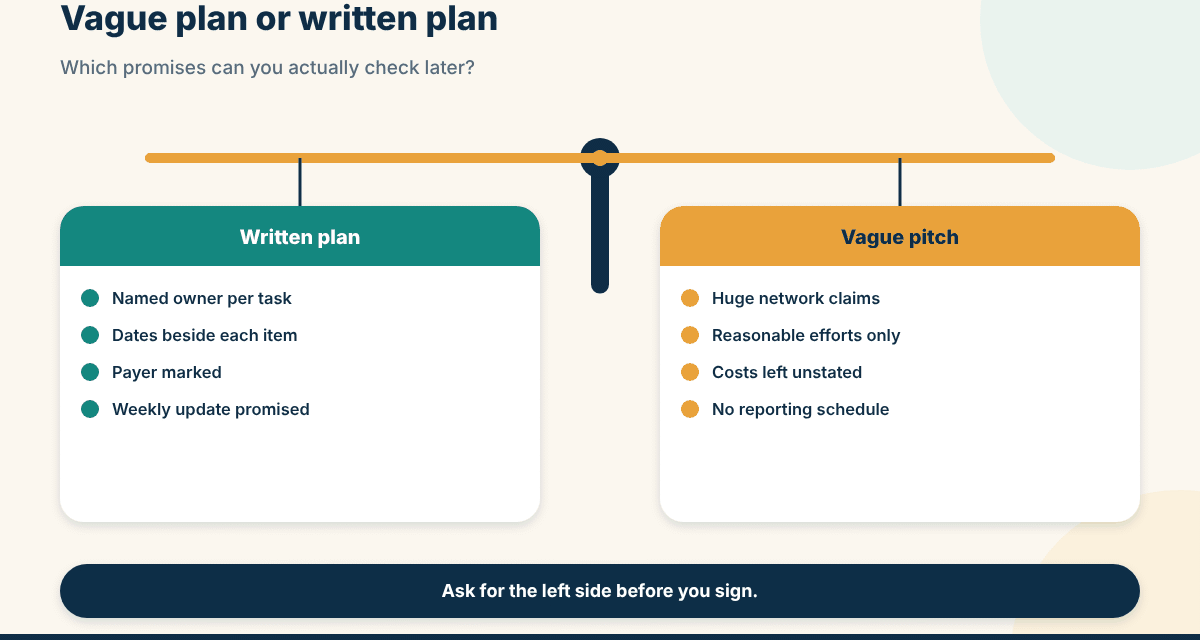
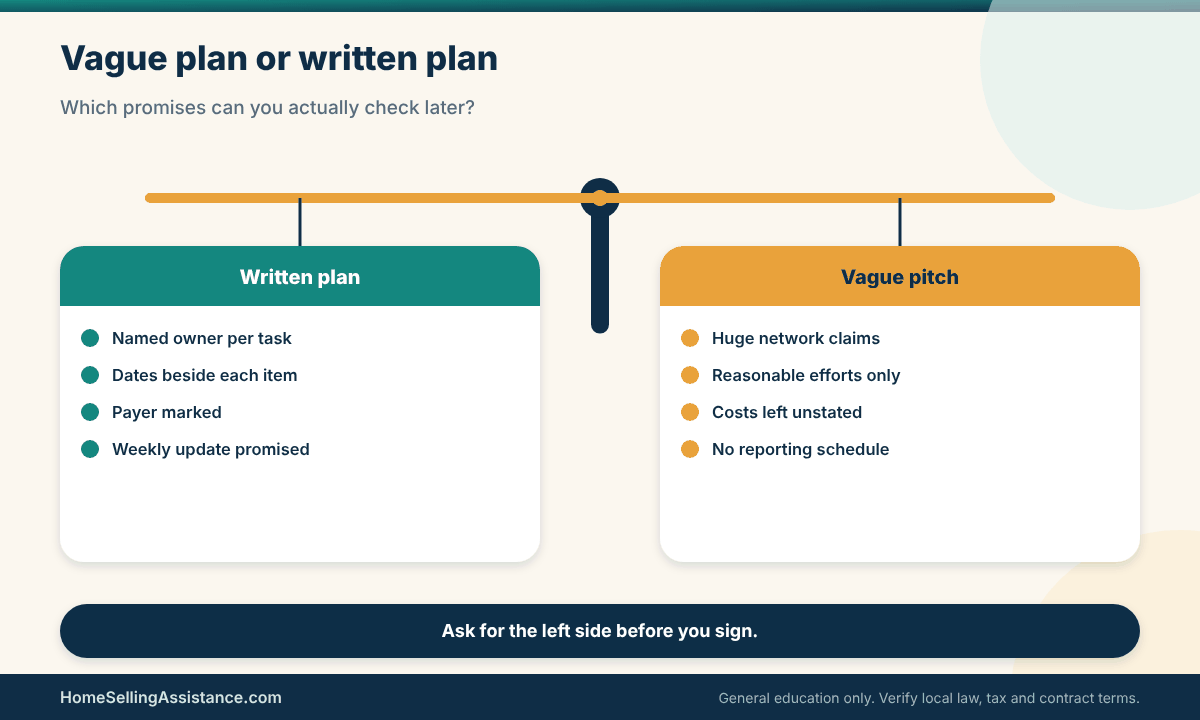
Many agreements that sit beside a listing agent marketing plan seller contain a general clause saying the agent will “use reasonable efforts” to market the property. That phrase is common, and it is not meaningless, but it is flexible enough to cover almost anything. If you want something specific, such as professional photography within a set number of days, a certain open house, or a brief weekly update, it helps to have it written in a short addendum or in a clearly labeled section of the agreement itself.
Ask the agent how they usually handle a listing agent marketing plan seller addendum. Some brokerages have a standard marketing addendum. Others are comfortable adding a few lines by hand. A few prefer to keep everything general, which is their right, but then it is fair for you to ask how you will measure whether the effort was reasonable. An email summarizing the plan, sent by the agent and kept by you, is a modest second choice when a formal addendum is not offered.
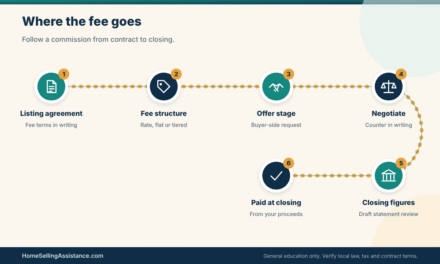
Pay attention to costs. Some marketing items are paid by the agent or brokerage out of their compensation. Others are billed to the seller, either upfront or at closing. Both arrangements exist, and neither is wrong, but the agreement or addendum should say which is which. A tidy way to check is to read your plan with a highlighter and mark every item as “agent pays,” “seller pays” or “not stated.” Anything in the third group deserves a question before you sign.
Also look for timing language. “Within five business days of signing” is clearer than “promptly.” You do not need to demand a rigid schedule, since delays for weather, access or a rescheduled shoot happen. But a range and a way to be told about changes are reasonable things to request. If your plan includes a launch date, ask what happens to that date if the photos run late and who tells you.
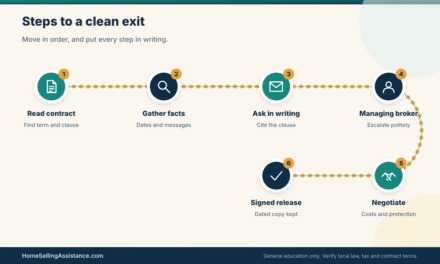
Finally, check the term of the agreement against the plan. If the plan describes a three-month campaign and the agreement runs six months, ask how the second half is handled. If you are concerned about being locked in, the article on how to cancel a listing agreement explains the usual mechanics and why the signed wording matters more than any conversation.
A scenario, an exception and your next step: promised in the pitch, missing on paper
Imagine a seller, Marcus, who was told in the pitch that the agent would pay for a drone video and a professional floor plan. The agreement Marcus signs mentions neither. A few weeks into the listing, an invoice for the floor plan arrives at the title company’s payoff estimate, labeled as a marketing charge. Marcus feels surprised, and the agent says it was always meant to be a seller expense.
Maybe the agent misspoke, maybe Marcus misheard, and maybe both remember the conversation honestly. That is the real lesson: memory is a weak record. There are exceptions, such as a brokerage that includes certain items as part of a standard package and mentions them in its own policy documents. If such a document exists, ask to see it. If it does not, the written agreement is what will be read by anyone reviewing the dispute.
Marcus’s next step is to ask, in writing and calmly, for the basis of the charge. He can ask which document says the seller pays, request any invoice, and ask whether the agent is willing to revisit the cost given the original conversation. If the answer is unsatisfying, contacting the managing broker is a normal next step, and a state real estate commission can explain how complaints are handled in your area. A real estate attorney can advise on your specific contract.
What screenshots, sample ads and sales language cannot prove
Any listing agent marketing plan seller pitch is full of things that look like evidence but are really illustrations. A screenshot shows that something existed at one moment. A sample ad shows what an ad can look like. A testimonial shows what one person felt. None of these shows that the same thing was done for your home, or that it worked. They are a starting point for questions, and treating them that way keeps you fair and well informed.
This part of the listing agent marketing plan seller process is not meant to make you cynical about every number. It is meant to teach you which question each kind of proof actually answers, so you can ask the next one.
Reach numbers, impressions and other measures of activity
“Your home will be seen by thousands of buyers” is a sentence with no checkable content. Impressions count how many times something was displayed, including to the same person repeatedly and to people who are not shopping in your price range or area. Clicks count taps, not intentions. Neither tells you how many qualified buyers walked through the door, which is what most sellers care about.
Better questions focus on the next link in the chain. How many showing requests did similar homes receive in the first two weeks? How many agents saved or shared the listing? What is the process for gathering feedback, and how often will it be summarized for you? If the agent can show a simple weekly report of views, saves, showings and feedback, that is far more useful than a large headline number.
It also helps to know where the numbers come from. Portal statistics are often available to the listing agent through a dashboard, and screenshots of such dashboards can be accurate, but they can also be cropped, outdated or about a different property. Ask whether you can receive the report directly by email or see it live on a video call. A screenshot is not wrong, it is simply a weaker form of evidence than a live view.
Finally, remember that attention follows price and photos more than it follows platform choices. If a home is priced above what buyers see as fair value, a very large audience may simply confirm that. We cover that tension in how to price a house to sell, and the table below shows how to line claims up with evidence.
The table below turns common marketing claims into a short verification routine. Read it left to right: the claim you hear, the evidence worth checking, the safe action, what you should never hand over along the way, and where to escalate if something still does not add up.
| Claim you hear | Evidence to check | Safe action | Never share | Escalation |
|---|---|---|---|---|
| “Professional photos and video included” | Written line item; sample gallery on a live listing | Ask for the photographer’s name and shoot date in writing | Alarm codes or key locations by email or text | Managing broker if items go unfulfilled |
| “Your home goes everywhere online” | MLS printout; live listing pages you can open yourself | Request the MLS number and check consumer sites directly | Logins to any of your own accounts | Brokerage compliance or state real estate commission |
| “Thousands of buyers will see it” | Weekly report of views, saves and showings | Ask what the numbers should lead to and by when | Personal financial details | Written request for a plan review |
| “We pay for all marketing” | Listing agreement or addendum; estimated closing figures | Mark each item agent-paid, seller-paid or unstated | Bank account details outside secure title channels | Managing broker, then an attorney if needed |
| “Sold in days” sample listings | Public sale record; original list price; days on market | Compare to homes like yours, not the best example | Your own sale price expectations before signing | Ask for a second reference or record |
| “Open houses bring buyers” | Sign-in sheet summary; follow-up notes | Agree who attends, who screens visitors and who follows up | Anything valuable left in view | Your agent first; the brokerage if safety is a concern |
To use the listing agent marketing plan seller table, pick the two or three claims your agent made most firmly and run each across the row. If you can fill in the evidence column with something real you looked at yourself, you are in good shape. If the cell stays empty, you have found the exact question to ask. The “never share” column is a reminder that verification should never require handing over sensitive information, and that legitimate checks almost never do.
A scenario, an exception and your next step: the testimonial and the “sold in days” claim
Picture a seller, Priya, who is shown a wall of five-star reviews and a sample listing that, according to the agent, sold in four days. Priya is impressed. The reviews are real, and the sample did sell quickly. What Priya cannot see is that the sample was priced well below comparable homes at the time, that it sat in a very active season, and that the reviews cover many kinds of transactions.
An exception worth keeping in mind is that a single fast sale can reflect real skill: strong preparation, accurate pricing and clear presentation. Agents who do this work well deserve credit. The point is simply that one example, however true, cannot be used to predict what will happen to your home. A fair-minded way to read it is to ask what was done for that home that would also be done for yours.
Priya’s next step is to ask for the context behind the example. What was the list price compared with recent nearby sales? How many offers arrived? What was the preparation timeline? If the agent answers openly, that is reassuring. If the answers are thin, Priya can still choose to hire the agent, now with realistic expectations and a written list of what will be done for her own home. A conversation about discount versus full-service service levels may also help Priya compare what different fee structures include.
One last point. Be careful with online reviews of your own agent, too. Reviews can be solicited, selective, or posted about different experiences than yours. They are worth reading, but they do not replace a conversation with a past client if the agent is willing to arrange one. Ask for two references from sellers whose homes were similar to yours, and ask those people what they would want to know in advance. Former clients tend to be remarkably practical about which promises were kept.
Reading the results of a listing agent marketing plan seller approved, without blaming anyone
Eventually the listing agent marketing plan seller promised meets the market. Some listings draw a flurry of showings in the first weekend. Others sit politely for two weeks. A quiet start does not prove the marketing failed, and a busy one does not prove it worked. The skill here is to separate what the agent controls, what you control and what the market controls, and to talk about each with the right person in the right tone.
This section describes warning patterns that justify a calm question, then walks through next steps that protect you without turning the relationship into a fight. We keep to wording that points to documents and events, not motives, because you rarely know why something happened until you ask.
Warning patterns that deserve a calm question
A warning pattern in a listing agent marketing plan seller arrangement is a gap between the plan and the evidence that persists after you have asked about it once. One missed item is usually a scheduling hiccup. Several missed items, no explanation, and a change in how quickly the agent answers messages is a pattern. Even then, the first move is a question, not a conclusion.
Common patterns include a listing that goes live much later than described, a photo set that differs from the one you approved, descriptions with errors you were never shown, showing feedback that never arrives, and reports that stop after week one. Another is an agent who responds to slow activity only by suggesting a lower price, without discussing what else might be changed. Price may be the right answer, but it should be the result of a conversation, not the only tool offered.
Evidence to check: the live listing, the showing log and the feedback trail
Start with what you can see yourself. Search for your home on the major consumer sites and on the brokerage’s own website. Check the address, price, square footage, bedroom and bathroom counts, photo order and description. Errors happen: a wrong lot size or a missing room can quietly steer buyers away. Take screenshots with dates, and compare them with what the agent sent you. A listing agent marketing plan seller checklist that includes this ten-minute review catches more problems than any sales call.
Next, in any listing agent marketing plan seller check, look at your showing log. Many showing systems record every request, approval and visit, and often a short feedback form. If the log shows a healthy number of showings and little interest, the issue may be price, condition or the first impression. If it shows very few requests, the problem may lie earlier in the chain: visibility, access rules or timing. Knowing which situation you are in changes the conversation entirely.
Third, ask how feedback is gathered. Some agents call every showing agent, others send an automated message, and others rely on whoever happens to reply. Ask for a summary at set intervals and for the raw comments if the agent is willing to share them. Keep a simple notebook of dates and observations. If a question ever needs to go to a managing broker or a regulator, a tidy record is far more persuasive than a recollection.
Finally, ask for the same kind of report you were promised, in the same form. If the plan said “weekly update,” and you received one in week one and none after, a short email asking for the missing weeks is both polite and informative. It gives the agent a chance to catch up, and it gives you a record of having asked. Resist the temptation to send a long message full of grievances. Short, specific and dated works better.
A scenario, an exception and your next step: the quiet second week
Take a seller named Elena, who followed a listing agent marketing plan seller closely, whose home went live on a Friday. The first weekend produced three showings and positive comments. By the second Friday there have been none, and the agent has not sent the weekly update that was part of the plan. Elena is anxious and wonders whether the marketing has stopped. She also wonders whether she is being unreasonable.
The exception to keep in mind is that a quiet second week can be completely normal. A home may simply have drawn the first wave of buyers who were already looking, with the next wave still weeks away, or a holiday, a storm or a competing open house may have pulled attention elsewhere. Nothing about quiet alone means the plan has failed, and agents cannot create buyers who are not searching.
Elena’s next step is to write a brief, friendly message: she noticed no update this week, she would like the showing log and any feedback, and she would like fifteen minutes to talk about what the first ten days suggest. That keeps the focus on facts, protects the relationship and leaves room for a pricing or presentation discussion with real data. If the agent cannot provide the log at all, that gap is worth noting in her record.
Safer next steps when the plan and the results drift apart
When results lag, a listing agent marketing plan seller tends to feel pressure to leap to the biggest levers: fire the agent, cut the price, or pour in more advertising. Each of those can be the right move in the right situation, and each can be expensive in the wrong one. A safer path is to move through the smaller levers first, in an order that costs little and teaches you something at every step.
For a listing agent marketing plan seller review, the order we suggest is: confirm the facts, check the written plan, talk with the agent about presentation, talk about price with comparable recent sales on the table, and only then consider changes to the agreement. Our article on price reduction strategy explains how to think about timing and size of a change, and the agreement guides linked above explain what the paper allows.
What changing course can cost: fees, extensions and price
Every option in a listing agent marketing plan seller review has a cost, and the costs are different in kind. Extra marketing may cost cash now. A price change costs potential sale proceeds. Ending an agreement can involve release terms or a protection period during which compensation may still be owed if you sell to someone the agent introduced. The listing agreement should say how this works, and it varies by state, brokerage and contract.
To make this concrete, here is an illustration with round numbers that are not typical of anything. Suppose a seller considers paying a one-time $600 for an additional professional video, and compares it with lowering the list price by $5,000. The video costs less today, but it works only if the problem was presentation. The price cut costs more, but it works if the problem was price. Neither number is a prediction. The exercise simply shows that the cheaper step is worth trying first only when the evidence points to it.
That is why the evidence behind your listing agent marketing plan seller matters. If the showing log is thin and the photos are weak, presentation is a strong suspect. If showings are plentiful and offers are absent, price or condition is a stronger suspect. If both are weak, it may be that the home is simply competing with better prepared or better priced nearby listings. Our home staging guide can help you judge whether the interior looks its best.
Also consider the cost of time. Carrying costs such as mortgage payments, utilities, insurance and taxes continue while the home is on the market, and those add up differently for every household. A realistic look at how many weeks you can comfortably wait can shape the decision. That is a personal calculation, and a financial professional can help you run your own numbers if you are unsure.
If the agreement does need to change, ask for the change in writing and read the new document before signing. Some agents will agree to a shorter term, a reduced scope or a mutual release if both sides feel the relationship is not working. Others will not, and the original terms apply. Keeping any listing agent marketing plan seller conversation respectful improves your odds of a smooth outcome, even when the answer is no, and it keeps your options open if you later need a favor.
A scenario, an exception and your next step: a respectful reset conversation
Consider a seller, Tom, whose listing has been active for five weeks. The showing log is thin, the agent is polite but slow to reply, and the description still has a typo that Tom pointed out twice. Tom is tempted to send an angry email. Instead, he asks for a meeting and brings a one-page list: three plan items that were promised, what he has observed for each, and two questions about price and presentation.
The agent explains that the shoot was delayed, apologizes for the typo and agrees to correct it that day. They also talk about whether the home should be repriced and decide to revisit in a week. This is the kind of reset conversation that works well when both sides want the home sold. Tom keeps his notes, and he sends a short email afterward summarizing what was agreed.
The exception is the reset that does not land. If the agent denies that the items were promised, avoids answering simple questions, or cannot show basic records, Tom can ask for a conversation with the managing broker. Beyond that, he can review the agreement’s termination terms and speak with a real estate attorney about his rights. A state real estate commission’s website is a good place to find how complaints are handled locally. Throughout, he should avoid public accusations, because they rarely help and can create new problems.
Quick scenario
A seller sees that the listing photos do not match the set she approved. She does not assume bad intent. She takes a dated screenshot, emails the agent asking which photos should be live and when the correct set will be uploaded, and checks the listing again the next day. The error turns out to be a syndication delay, and the correct photos appear within two days. Her record shows she asked, and the fix required no confrontation.

Real listings rarely match a listing agent marketing plan seller template, so it helps to have a second table that starts from what is happening rather than from a claim. The scenario table below lists situations that come up often once a listing is live, the warning sign worth noticing, the channel you can use to check it yourself, a measured response and the record to keep. A listing agent marketing plan seller can use this as a one-page companion during weekly check-ins.
| Situation | Warning sign | Verification channel | Seller response | Record to preserve |
|---|---|---|---|---|
| Listing goes live later than promised | No date given and no update offered | Search the MLS number and consumer sites yourself | Ask in writing for the new date and the reason | Dated screenshot and the email thread |
| Photos differ from the approved set | Fewer images, different order or wrong rooms | Live listing compared with your approved gallery | Ask which set should appear and when it is fixed | Both galleries with dates |
| Showings are requested but feedback never arrives | Empty feedback log after several visits | Showing system history and agent follow-up notes | Request a summary at an agreed interval | Showing log export or notes |
| Agent suggests a price cut with little discussion | No recent sales shown, no other options mentioned | Independent sold-data from public records or a second opinion | Ask for comparable sales and the reasoning first | Comparables and meeting notes |
| A marketing charge appears on estimated closing figures | Item not in the agreement or addendum | Listing agreement, addendum and the invoice | Ask for the basis in writing before closing day | Agreement pages and invoice copies |
| Weekly reports stop after the first week | No explanation and slower replies | Plan or addendum wording on reporting | Send a short reminder and propose a call | Plan wording and your reminder email |
| Open house safety concern | Valuables visible, no visitor sign-in | Brokerage open house policy | Agree on a sign-in and secure valuables beforehand | Written agreement on the arrangements |
Use this listing agent marketing plan seller table as a conversation starter, not a checklist to wave at your agent. Pick the row that matches your situation, do the verification step yourself first, and only then raise it with the agent in neutral language. Keeping the “record to preserve” column up to date takes minutes a week and spares you hours of reconstruction later if a question ever needs to go to a managing broker or an outside professional.
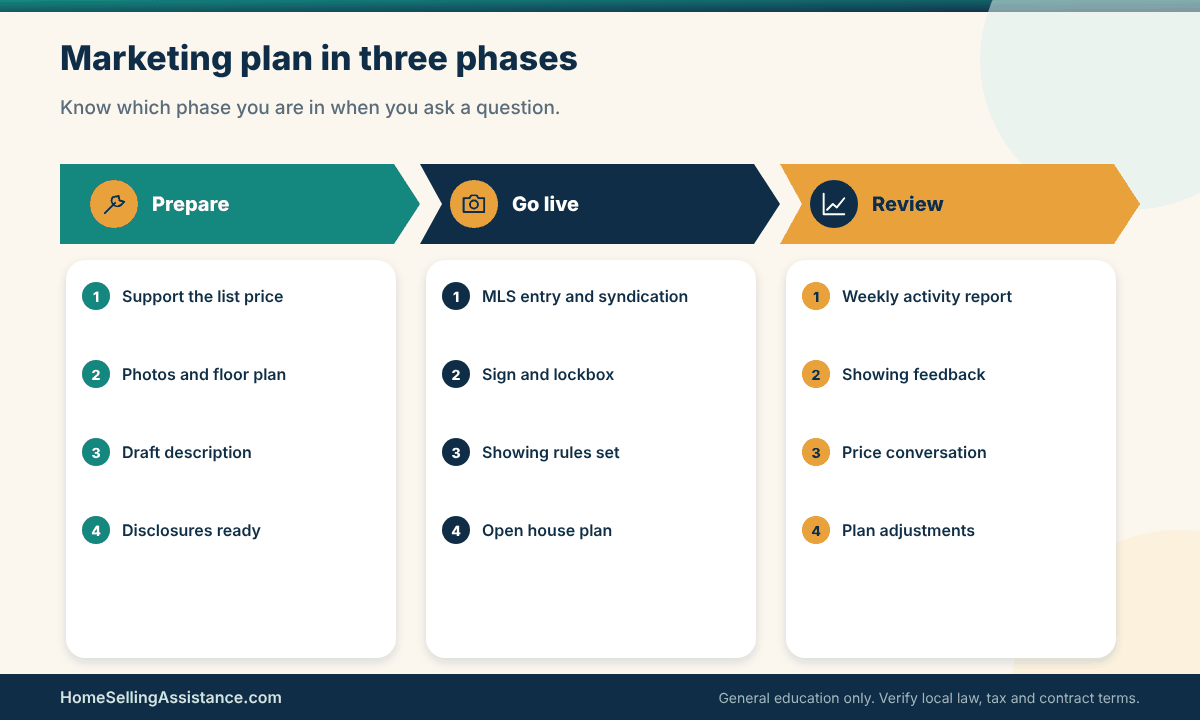
If you want to see a listing agent marketing plan seller as a whole, the picture below lays out the stages a typical campaign passes through. Treat it as a map of where promises should appear in time, so you know which stage you are in when you ask a question. The stages are general. Your agent’s order may differ for good reasons, and your local market may add steps of its own.

One more way to read a listing agent marketing plan seller is to ask who does what. Some tasks fall to the agent, some to you and some to third parties like photographers, title companies and showing services. Seller tasks usually include preparing the home, keeping it showable, responding to requests, and reviewing drafts of anything public. When a task has no named owner, it tends to slip, so assign one in your notes.
The last picture is a short list of what a seller can verify alone. None of these items needs special access, and all of them can be done in an afternoon. If your listing agent marketing plan seller routine includes them every week, you will catch most gaps early and with very little friction.

Fair housing deserves one final reminder in any listing agent marketing plan seller conversation. Descriptions, photos, targeted ads and open house arrangements must not express a preference or limitation based on protected characteristics, and agents are trained to follow these rules. If something in your marketing seems to cross that line, ask your agent or managing broker about it, and see the guidance at HUD’s fair housing page or your state’s fair housing agency. Your own requests, such as asking that buyers of a certain type be favored, should not be made at all.
For readers who want a neutral reference on industry practice, the National Association of Realtors maintains public material at nar.realtor, including information about changes to how broker compensation is negotiated and disclosed. Rules differ by market, brokerage and contract, so use such material to frame questions rather than to settle them. The documents you actually sign remain the main source of truth about your own deal.
Looking at the full sweep of this listing agent marketing plan seller guide, a few habits do most of the work. Ask for the plan in writing. Link each promise to a date and a payer. Verify with your own eyes through public channels. Keep records. Keep a tone that invites the agent to improve rather than defend. And remember that price and condition shape buyer interest at least as much as any campaign. When you apply those habits to your listing agent marketing plan seller conversations, the plan stops being a brochure and becomes a shared working document.
Frequently asked questions about listing agent marketing plan seller
What should a listing agent marketing plan seller receives actually include?
At a minimum, it should cover preparation, photography and copy, MLS and online exposure, showing and open house arrangements, and how you will receive updates. Each item should say who handles it, when, and who pays. If a piece is missing, ask where it went. A plan that lists only the MLS is a starting point, not a complete plan.
Is listing on the MLS the same as marketing?
No. The MLS entry is the foundation because many consumer sites and other agents draw from it, but marketing also covers presentation, pricing support, outreach and follow-up. A listing agent marketing plan seller can rely on should explain how the home will stand out once it is in the system. The details differ by area and brokerage.
Should the marketing promises be in the listing agreement?
If a service, timeline or cost matters to you, yes, it is wise to have it in the agreement or an attached addendum. Generic “reasonable efforts” wording is hard to measure. If the agent prefers not to add detail, ask for a confirming email. A listing agent marketing plan seller notes file with these papers makes later conversations simpler.
Who pays for photos, video and advertising?
It depends on the brokerage, the agreement and local custom. Some items are covered by the agent or brokerage, and others are billed to the seller upfront or at closing. Compensation is negotiable and should be written down. Mark each item as agent-paid, seller-paid or unstated in your listing agent marketing plan seller review before you sign.
How can I check that the plan is being carried out?
Search for your listing on the consumer sites and the brokerage website, compare photos and details with what you approved, and review your showing log. Ask for the updates that were promised. A short weekly check on the live listing is a practical part of any listing agent marketing plan seller routine, and it needs no special access.
Are impressions and views a good measure of success?
They describe activity, not results. Views can include repeat visits and people outside your price range. Better measures include showing requests, saves by agents, feedback and offers. When someone quotes a large number, ask what it should lead to. That one question keeps a listing agent marketing plan seller conversation grounded.
What if the home is quiet after two weeks?
A quiet stretch is not proof of a failed plan. Review the listing for errors, check the showing log, ask for feedback and talk about presentation and price with comparable sales in hand. Small, low-cost steps usually come before bigger ones. The listing agent marketing plan seller you agreed on gives you the reference point for that discussion.
Can I end the agreement if the marketing is not happening?
That depends on the wording of your agreement, the term and any protection period, and the rules in your state. Start by asking for the missing items in writing and, if needed, speaking with the managing broker. For contract questions, a real estate attorney can advise on your situation. A clear listing agent marketing plan seller record helps in every one of those conversations.
Do flat-fee or discount services have a marketing plan too?
They can, but the scope is usually narrower and more of the work may fall on you. The point is to know what is included before you pay. Compare the listing agent marketing plan seller expectations you have against the written service list of any provider, whatever the price. Neutral comparison beats assumptions about either approach.
Where can I report a problem with a real estate professional?
Your state real estate commission or licensing agency usually accepts complaints, and the brokerage’s managing broker is often the first stop. Keep your records of the plan, your questions and the replies. Bring that listing agent marketing plan seller file with you so the facts are easy to follow.
A plan you can actually hold
A good listing agent marketing plan seller can understand in one sitting is specific, dated, priced and written down. Ask for it, check it yourself, keep your notes, and keep your tone friendly and firm. This article is general education, not legal, tax or financial advice. Rules about agency, disclosure, compensation and contracts vary by state and brokerage, so confirm details with your state real estate commission, a licensed professional or a real estate attorney before you sign.