

The seller real estate commission is the fee your listing brokerage earns when your home sells, and for most of the last few decades sellers treated it as a fixed price tag that came with the territory. It never was. What you owe is whatever you agree to in a signed listing agreement, and since the industry changes of the mid-2020s that agreement has to say a lot more, a lot more plainly, than it used to.
This guide is written for the person staring at a listing proposal and wondering whether the number on it is normal, negotiable, or something they have to accept. We will go through what the commission actually pays for, who it flows to, what changed after the National Association of Realtors settlement, and which parts of the deal you can still shape. We will also show you how to turn a percentage into real dollars, because a rate on paper feels very different from a line on a closing statement.
A word on what we will not do. We will not hand you a “standard rate,” because there is not one. We will not tell you that paying more gets you a better agent, or that paying less gets you a worse one. Both claims show up constantly, and neither survives contact with real contracts. What you will get is a way of reading your own paperwork and a set of questions that put the choice back in your hands.
Everything here is general education. Brokerage rules, licensing law, contract forms and local custom differ by state and sometimes by county, so treat the checklists as a way to ask better questions of the people who can see your actual documents.
Key takeaways
- Compensation is negotiable. No law sets a seller real estate commission, and no rate is standard; the number is whatever the written listing agreement says.
- The agreement is the authority. Articles, ads and rules of thumb do not bind you. The compensation clause, term and exceptions in your signed contract do.
- The settlement era changed the paperwork. Offers of buyer-agent compensation no longer appear in MLS listing data the way they once did, and buyer-side arrangements are expected to be written down.
- Convert every rate to dollars. Ask for the total, the split, any flat fee and any add-ons on a sample sale price before you sign anything.
- Look for the fine print. Tail periods, cancellation terms and what happens if a buyer’s agent is not paid are where surprises hide.
- Recheck before you rely on any guide. Rules and practices keep moving, so verify with your state real estate commission, your brokerage and, where needed, an attorney.
For related guides on fees and agreements, browse the listing agents and commissions category, where each seller real estate commission topic gets its own deeper treatment.
If you are earlier in the process and still deciding whom to hire, our guide on how to choose a listing agent covers the interview side. This article stays focused on the seller real estate commission and the money around it. The picture below shows the path a fee takes from signed agreement to closing table, which we will fill in step by step.

Pinning down today’s seller real estate commission rules and practice
Advice about any seller real estate commission ages quickly. A sentence that was perfectly accurate in a blog post from a few years ago can now mislead you, particularly about who pays whom and where that information is allowed to appear. Before you weigh any proposal, it helps to separate three layers: what the law requires, what industry rules require, and what your own contract says. They are different layers, and sellers get into trouble when they blur them.
How a seller real estate commission works in current practice
At its simplest, a seller real estate commission is compensation that you agree to pay a brokerage, in writing, for marketing and selling your home. The listing agreement names the brokerage, describes the services, sets the term of the agreement, and states how the brokerage gets paid if the property sells. That payment usually happens at closing and comes out of your proceeds, which is why the figure shows up on your settlement statement rather than as an invoice.
The phrase “seller real estate commission” hides two separate questions. One is what you pay the brokerage that represents you as the seller. The other is whether you also agree to contribute toward the compensation of the brokerage that represents a buyer. In the older model those two were bundled together in a single number, and the listing brokerage advertised a share for the buyer’s side in the MLS. Today they are conceptually separate, and sellers are better off treating them as separate decisions.
Brokerages are independent businesses, and each prices a seller real estate commission its own way. Some quote one total and split it internally. Others itemize a listing fee, a transaction or administrative fee, and an optional contribution toward the buyer’s agent. Others work on a flat fee or a tiered structure that depends on the final price. None of these is automatically right. The useful move is to compare them on the same footing, in dollars, on the same assumed sale price.
It also helps to know what a seller real estate commission buys, because “commission” sounds like a single payment for a single act, and that is not how the work is spread. Listing-side work typically includes pricing analysis, preparing and publishing the listing, photography coordination, showings, fielding offers, negotiating, and managing the transaction through to closing. Which of those are done in-house, handled by assistants, or contracted out varies from firm to firm, and your agreement should say which are included. Our piece on a listing agent marketing plan explains how to ask for that in detail.
One more structural point. In most places the money does not flow from you to the individual agent. It flows to the brokerage, which then pays the agent under their own separate arrangement. That is why the agreement is signed with the brokerage, and why a conversation about splitting or reducing the fee is really a conversation about the brokerage’s business model, not just one person’s willingness.
Evidence to gather: the compensation clause and its neighbors
Start with the actual document. Ask any agent you are considering for a blank copy of the listing agreement they would ask you to sign, not just a summary. Read the compensation section, but also read the paragraphs near it, because the clauses that change what you pay are rarely headed “commission.” Look for definitions of the term, for what counts as a sale, and for any fees described as administrative, marketing, technology or transaction fees.
Then collect three more things. First, a sample net sheet that shows the total fee in dollars at one or two example prices. Second, written confirmation of whether any part of the fee is a flat charge that applies even if the home does not sell. Third, the brokerage’s policy on what happens if a buyer’s agent asks you to contribute. If the answers come back vague, ask again in an email so you have something to point to later.
Your closing statement is where a seller real estate commission finally turns into a dollar figure, and our closing costs and net proceeds category shows how it sits beside the other charges. Finally, keep a short list of the exact words that matter. Phrases such as “total compensation,” “plus,” “in addition to,” “retained,” “earned,” and “protected period” each change who owes what and when. If you cannot say in plain English what each one does, mark it and take it to an attorney or your state real estate commission’s consumer resources before signing.
A scenario, an exception, and your next step on commission wording
Picture a seller who is shown a proposal reading “a total fee that includes buyer-agent cooperation.” It sounds tidy. But after the settlement-era changes, the open question is whether that wording commits the seller to pay a buyer’s agent in every case, only if the buyer signed a written agreement requiring it, or only up to a stated amount. The same sentence can mean quite different things depending on the form.
Now the exception. If you sell without a listing brokerage, there is no listing-side fee at all, though you may still negotiate what, if anything, you will contribute toward a buyer’s agent. Our overview of FSBO versus using a realtor lays out that trade-off without picking a side.
Your next step in the first scenario is simple and low-key. Ask the agent to rewrite the clause so it states, in a sentence a stranger could follow, what you pay the listing brokerage, what you offer toward a buyer’s agent, whether that offer is a ceiling or a promise, and whether it can change once offers arrive. A good brokerage will not mind the question.
What changed after the NAR settlement and what stayed the same
The short version of the industry shift is this. A set of lawsuits challenged the long-standing practice of listing brokerages advertising, through the MLS, the compensation they were offering to the agent who brought the buyer. A settlement involving the National Association of Realtors, along with related settlements by large brokerages, led to rule changes that took effect in the middle of the 2020s. The details are on the NAR website, and you should read them there rather than trust anyone’s summary, including ours.
In general terms, the changes to the seller real estate commission landscape did three things. They removed the ability to publish offers of buyer-agent compensation in the MLS. They expected agents working with buyers to have a written agreement with those buyers before touring homes, one that states how the agent will be paid. And they reinforced a message that was always technically true but often glossed over: compensation is not set by law and is fully negotiable between the parties.
What did not change is just as important. Sellers still sign listing agreements. Brokerages still decide what to charge. Compensation can still be paid at closing from sale proceeds. Sellers can still choose to offer a contribution toward a buyer’s costs, including agent compensation, as part of how they structure an offer or a concession. The change was mostly about transparency, timing and where the offer can be displayed, not about whether anyone gets paid.
It is worth repeating that practice varies. Some markets adjusted quickly and some kept many old habits under new labels. State law, local association rules, and individual brokerage policies layer on top of the national picture, which is exactly why the freshness checklist later in this guide matters. If you want to see how the buyer-side question plays out in a real deal, our article on whether a seller should pay the buyer agent commission goes through the decision in detail.
Evidence to gather: how to tell old advice from new practice
Old advice about the seller real estate commission has some recognizable tells. It says “the seller pays both agents” as if that were a law. It refers to a “standard” total as if one existed. It describes the MLS as the place where the buyer-agent share is posted without qualification. And it rarely mentions a written buyer agreement. When you see these, check the publication date, then check whether the author cites a primary source.
Better evidence has a different shape. It points to the current rules of the organization that makes them, to your state real estate commission, or to a document you can hold in your hand, such as the actual contract form your brokerage uses. It uses cautious language about local variation. And it tells you what to verify instead of telling you what to believe.
A practical habit is to keep a small file with dated items: the date you read a rule, where you read it, and what the contract in front of you actually said. If a dispute ever arises, or if you simply want to compare two proposals a month apart, the file saves you from memory errors and from relying on whatever you read last.
A scenario with a pre-settlement habit in a new market
Imagine a seller who is trying to size up a seller real estate commission and whose neighbor sold a few years ago and told them, “Everybody just pays the buyer’s agent, it comes with the listing.” The seller assumes the same will happen to them, and the listing agent, hearing nothing contrary, writes the old habit into the form. Nothing illegal has happened, but the seller has made a significant financial commitment without noticing it was a choice.
The exception here is a market where buyers routinely ask sellers for help with their agent’s compensation as part of the offer. That can be perfectly reasonable, and in some price ranges or competitive periods it is how deals get done. The point is that it becomes a negotiation point you control, rather than a default you inherit.
Your next step is to decide, before listing, what your approach will be. Will you offer a stated contribution up front, wait and consider requests case by case, or decline? Whatever you choose, write the plan down and ask your agent to explain how it will be handled in marketing and in offer review. If it helps, our guide to seller concessions shows how contributions of this kind fit alongside other offer terms.
Before we move from rules to decisions, here is a table that pulls the pieces together. It is a contract matrix: for each issue that touches your seller real estate commission, it shows where the answer lives, what you are being asked to do or choose, when it matters, and how you check it locally. The rows are generic on purpose, so read them as a list of places to look in your own documents.
| Issue | Controlling document or authority | Seller obligation or choice | Deadline to watch | Local verification |
|---|---|---|---|---|
| Listing-side fee | Signed listing agreement | Agree to a rate, flat fee or tiered fee in writing | Before signing | Ask the brokerage for its blank form |
| Buyer-agent contribution | Listing agreement and the purchase contract | Offer, decline or negotiate a contribution | Before listing and again at offer stage | Check state commission guidance and your agent’s policy |
| Extra fees | Fee schedule inside the agreement | Accept, negotiate or remove admin or marketing charges | Before signing | Request a dollar total on a sample price |
| Protected period after expiry | Tail clause in the agreement | Limit the length and the buyers it covers | Term end date | Ask an attorney if the wording is unclear |
| Early termination | Cancellation or release clause | Negotiate an exit before you need one | Before signing | Confirm with the brokerage’s managing broker |
| Payment at closing | Settlement statement and instructions to the closing agent | Review figures before signing | Days before closing | Ask the title or escrow company for a draft |
How to use it: take the first column as your agenda for a conversation with each agent you interview. For each row, find the sentence in their paperwork that answers it and highlight it. Any row where you cannot find a sentence is a question to ask, and any row where the sentence contradicts what you were told verbally goes to the top of the list.
Applying a seller real estate commission to the choices you actually have
Understanding the rules is half the job of handling a seller real estate commission well. The other half is deciding what to do with them. A seller real estate commission is rarely a single yes-or-no matter. It is a bundle of smaller decisions, some of which you make before listing and some of which come up only when a buyer’s agent asks a question. Treating them one at a time makes the whole thing less intimidating.
The levers a seller really has
Most sellers have more than one lever over a seller real estate commission, though not every lever is available with every brokerage. You can compare structures, ask for adjustments, change the scope of services, set limits on what you will contribute toward a buyer’s agent, or choose a different route to market altogether. Which of these is realistic depends on your market, your home and how much the brokerage wants the listing.
Be careful about one common trap: negotiating the rate down while leaving everything else untouched. A lower listing-side fee can be partly or fully offset by fees elsewhere in the agreement, by a shorter list of included services, or by a different expectation about the buyer side. The reverse also happens. A higher fee might include services that you would otherwise pay separately for, such as certain photography, staging consultation or transaction coordination. The useful comparison of any seller real estate commission is the whole package.
You also have the lever of timing. You can negotiate up front, or you can agree to a base arrangement and revisit the buyer-side question when you see how interest develops. That second approach requires the agreement to say it is allowed. If the contract locks the buyer-agent piece for the life of the listing, you lose the flexibility, so ask directly. Our comparison of a discount broker versus a full-service realtor shows how different service structures change what you are really paying for.
Finally, there is the lever of leaving. Some sellers decide that traditional listing is not for them and explore a flat-fee MLS service or a for-sale-by-owner approach. Our explainer on flat-fee MLS listings walks through what that option does and does not include. Whether it suits you depends on how much of the pricing, negotiation and paperwork you are willing to handle, and on the risk you are comfortable carrying. The picture below lays out four common structures side by side, with a reminder of what to watch for in each.

Evidence to gather: turning a rate into dollars
A seller real estate commission is easy to quote as a percentage and hard to feel, so convert every proposal. Take a round example price that is close to your expectation, say $400,000, and ask each agent to fill in, in dollars, the listing-side fee, the buyer-side contribution if any, and every additional charge. Here, purely as an illustration with round numbers and not as a typical rate, a total structure of 5 percent on $400,000 would be $20,000 before any other fees.
Run a second example at a lower price and a higher one. If the structure is a flat fee, tiered, or has a minimum, the dollars will not scale the way a straight percentage does, and you want to see that clearly. Also ask what the dollars look like if the sale price comes in below your assumption, since your own net proceeds fall faster than the fee does in many structures.
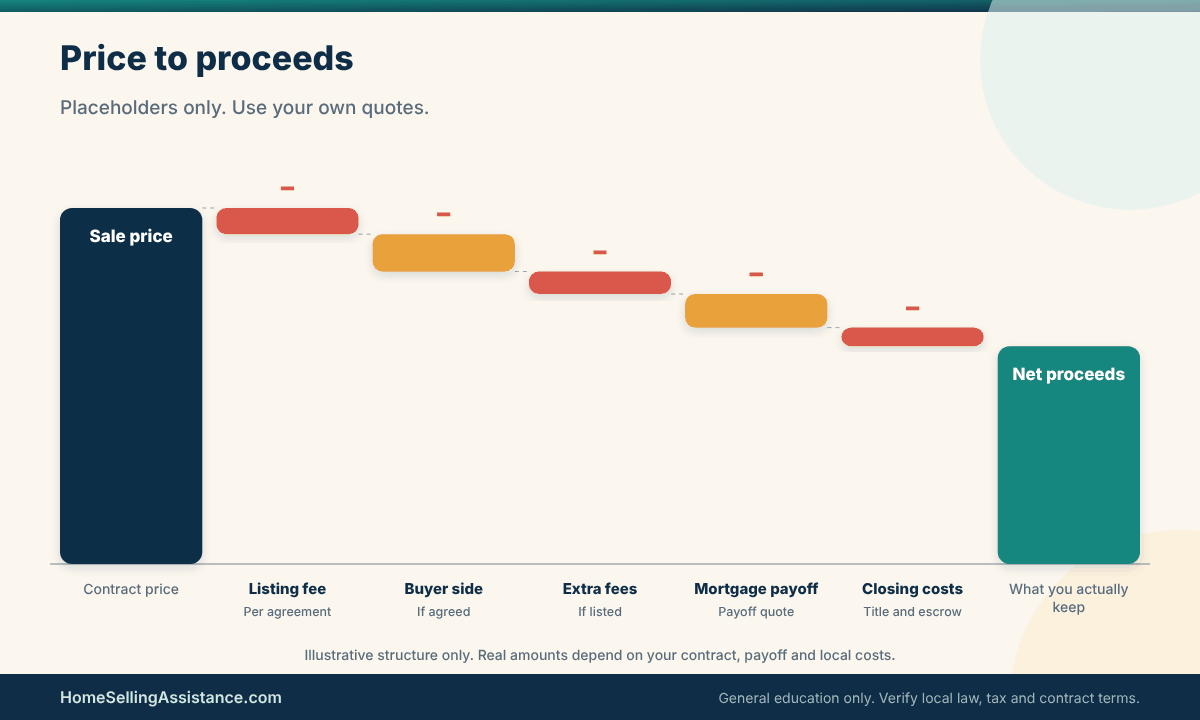
Last, put the fee next to everything else coming out of your proceeds. Our guide to how to price a house to sell helps with the top line, and a net proceeds worksheet from your title or escrow company covers the rest. The goal is to see the seller real estate commission as one line among several, not as the headline of the whole sale. The figure below shows how those deductions stack up between the contract price and your net proceeds, using placeholders instead of real amounts.
A scenario, an exception, and your next step: two proposals, same house
Suppose two agents give you proposals for the same house. One shows a lower headline rate with a separate administrative fee and no stated buyer-side contribution. The other shows a higher rate that includes professional photography, a marketing plan and a clearly written buyer-side offer. On paper, the first looks cheaper. After you convert both to dollars at your example price, the gap may shrink, vanish or reverse.
The exception is when you already have your own photography, staging and a strong view on pricing. Then the first proposal might fit you better because you are not paying for services you will not use. The honest answer is that neither proposal is right in the abstract. The right one depends on what you need done.
Your next step is a side-by-side sheet with the same rows for each proposal: listing-side dollars, other fees, buyer-side approach, services included, term, tail period and exit terms. Share it with each agent and ask them to correct any row they think you misread. That small step often produces the most candid conversation of the whole process.
Where disclosure, MLS rules and the contract set limits
Every choice you make about your seller real estate commission lives inside limits that you do not control. Some are legal, some are industry rules, and some are simply what your signed agreement says. Knowing where the edges are saves you from promising something you cannot deliver or from assuming a door is open that is actually shut.
Start with disclosure. Brokerage relationships, agency duties and compensation disclosures are governed in part by state law and licensing rules, which differ across the country. Your agent should explain who represents whom, how they are paid and what conflicts of interest exist. If the explanation is thin, your state real estate commission is the right place to learn what must be disclosed in your state.
Then consider the MLS. Under current industry rules, the way compensation can be displayed in a listing has changed, and each local MLS applies its own rules within the national framework. That can affect how you communicate a buyer-side contribution to the market, even if you decide to make one. Ask your agent how it will be communicated, where, and in what words, and whether it conflicts with any local rule.
Finally, the contract. The listing agreement controls what you owe the listing brokerage. The purchase contract controls what the buyer and you agree to, including any contribution toward closing costs or agent compensation. Neither one is changed by a conversation, a text message or an article. If something matters, it needs to be on paper. For a closer look at the document that sets the stage, see our explanation of the listing agreement.
A related point on fairness. Housing professionals and sellers alike are bound by fair housing law, which prohibits discrimination based on protected characteristics. A commission arrangement should never be used to steer buyers or to encourage or discourage showings for reasons connected to who the buyer is. If anything in a marketing or compensation plan feels that way, the HUD Fair Housing resources explain your rights and how to raise a concern.
Evidence to gather: the limits that apply to your listing
Create a short limits file for your listing. In it, write down the state in which the property sits, the name of the brokerage and the managing broker, the local MLS that will carry the listing, and the form of listing agreement that will be used. Then ask for three documents: the agency disclosure your state requires, the brokerage’s compensation policy, and any MLS rule sheet that touches how compensation is communicated.
Add to the file any statement you get from the agent about what is permitted, with the date and how it was delivered. If the agent says “the MLS does not allow that,” ask which rule says so. If the agent says “that is just how it works here,” ask whether it is a rule, a custom or a habit. The distinction matters, because customs can be negotiated and rules usually cannot.
If something looks inconsistent, you have several places to go. The managing broker handles complaints about an agent’s conduct inside the firm. The state real estate commission or equivalent regulator handles licensing questions. A real estate attorney can read the contract and tell you what it means for you. Which route is right depends on whether you have a question, a concern or a dispute.
A scenario, an exception, and your next step on contract limits
Consider a seller who decides to offer a modest contribution toward a buyer’s agent and wants it advertised. The agent explains that the local MLS does not allow the offer to appear in the listing data, but that the seller can still address it in conversations, flyers outside the MLS or through the agent’s own communications with buyers’ agents. Whether those channels are permitted, and how, depends on local rules, so the seller asks for the specific policy in writing.
The exception is a seller who prefers not to publicize anything and plans to consider requests as they come. That is legitimate, and it avoids locking in a commitment before any buyer exists. It does mean that buyers who expected a contribution may negotiate for one in their offers, which is something to plan for.
Your next step in either case is the same: ask the agent to document, in a short email, what the plan is and what rules it relies on. If you ever need to explain your approach to a buyer’s agent, a lender or a regulator, you will be glad the plan exists on paper.
The last part of the work is the one most people skip: building a habit of rechecking. A seller real estate commission arrangement that was accurate when you read about it can be out of date by the time you sign. The next table is a scenario guide for the situations that most often send sellers back to their paperwork, with the options, the risk, the document to review and where to take the question if you cannot resolve it yourself.
| Situation | Seller options | Main risk | Document to review | Escalation point |
|---|---|---|---|---|
| Buyer’s agent asks for a contribution | Accept, counter, decline or offer a credit | Committing money without comparing offers | Purchase offer and counter forms | Your listing agent, then an attorney |
| Agent proposes extra admin fee | Ask for it to be folded in, reduced or removed | Fee hidden outside the headline rate | Fee schedule in the listing agreement | Managing broker |
| Listing is not selling | Adjust price, scope or term; consider release | Being locked in with no leverage | Term and cancellation clauses | Managing broker, then an attorney |
| Buyer found before the listing expires | Check whether a tail clause applies | Owing a fee to two brokerages | Protected period wording | Attorney or state regulator |
| Selling without an agent | Decide on a buyer-agent contribution, if any | Unclear terms with an unrepresented side | Purchase contract and any buyer agreement shown to you | Real estate attorney or title company |
| Dispute over what was owed | Request an itemized accounting in writing | Paying before understanding the charge | Settlement statement and agreement | Attorney, then regulator or mediation program |
To use the table, find the row that sounds like your current problem and read across. Notice that the first escalation step is nearly always the person closest to the paperwork, and the later steps are people with authority to interpret or enforce. Going straight to the top rarely helps, and skipping the top when you truly need it can cost you time you do not have.
Building a freshness checklist for seller real estate commission advice
Keeping up with seller real estate commission rules is a skill, not a luck-of-the-draw matter. If you know where the authoritative answers live and what should make you recheck them, you can use any article, agent or social media post as a starting point without being captured by it. The checklist below is meant to be short enough that you will actually use it.
Official sources to recheck before you sign
Different kinds of questions have different homes. For questions about what the national industry rules say and how they have been described since the settlements, the National Association of Realtors site publishes its own summaries and updates. For questions about what a licensed agent can and cannot do in your state, the state real estate commission or equivalent regulator is the authority. For what a particular brokerage requires, the brokerage’s own forms and policies are the only reliable source.
For consumer protection more broadly, including how to spot misleading advertising or pressure tactics, the FTC’s consumer site is a sensible place to begin, and the Consumer Financial Protection Bureau covers mortgage and closing-related questions. Neither tells you what your commission should be, but both help you recognize when a pitch is bending the truth.
For local custom, the best source is not an article at all. It is a short conversation with two or three agents in your area, plus a look at recent listings and any written compensation notes visible to the public. Pair that with the freshness instinct: whatever you hear, ask when it was last true and how they know.
Finally, remember that attorneys are a legitimate source for a one-time document review. Many sellers assume lawyers are only for disputes, but a short consultation about a listing agreement is often inexpensive compared with the amounts at stake. Our comparison of a listing agent versus a real estate attorney explains when that extra layer makes sense. The checklist graphic below gathers the sources and habits in one place so you can keep it beside your documents.

Evidence to gather: a dated source log for your sale
Build a simple log with four columns written out in a notes app or on paper: the question, the source, the date you checked, and what it said. Add rows as you go. A typical log will have entries such as “Can offers of buyer-agent compensation appear in the MLS here?”, “local MLS rule sheet”, the date, and a one-line summary. Over a few weeks the log becomes a record of how your understanding evolved.
Set a reminder to recheck anything you rely on that is more than a few weeks old before you sign the listing agreement, and again before you accept an offer that involves compensation. Rules that shape a seller real estate commission can change between the listing date and the offer date, particularly during periods when industry practice is still settling.
Also log who told you what. If an agent says something material about compensation, a short follow-up email stating your understanding, “Just confirming that the fee quoted is the total with no additional charges,” gives them a chance to correct it and gives you a record if it matters later.
A scenario, an exception, and your next step on source rechecks
Imagine a seller who read a guide about the seller real estate commission six months ago and now sits across from an agent who describes a rule the guide did not mention. The seller is tempted to dismiss it, or to accept it without question. Neither is necessary. The calm move is to ask which organization or document the rule comes from and to look it up together.
The exception is when the source is an internal brokerage policy rather than a public rule. In that case you will not find it online, and it should be in writing in the agreement or an attached policy document. If the agent cannot show you where it is written, treat it as negotiable until proven otherwise.
Your next step is to ask for the source in a friendly way and then verify. If the answer holds up, you have learned something and lost nothing. If it does not, you have avoided a commitment based on an untrue statement, and you have learned something about the person you were about to hire.
Triggers that mean it is time to update your understanding
Some events should make you pause and recheck, whether you are in the middle of a sale or reading advice from last year. Training yourself to recognize those triggers is more reliable than trying to follow every headline in real estate news. The decision tree below shows what to do when one of them fires in the middle of a listing.
The first trigger is a rule or form change. If your brokerage, your local association or your state regulator changes its forms, that is a signal that practice has shifted. The second is a change in your own facts: a different price range, a different timeline, a move from listing with an agent to selling on your own, or a new co-owner or estate representative. Each of those can change which provisions in your agreement matter most.
The third trigger is market conditions. In a slow period, buyers and their agents may ask for more help with closing costs and compensation, and a plan that worked in a busy spring may not suit a quiet winter. In a competitive period, the reverse can be true. The same seller real estate commission structure behaves differently as conditions change, so a review at the first sign of a market shift is worthwhile.
The fourth trigger is anything that sounds too good or too sure. Promises of a guaranteed price, a guaranteed speed or a guaranteed saving should always prompt another look. We cannot promise any of those, and neither should anyone selling you a service. Our explainer on canceling a listing agreement is worth reading before you sign, so you know what the exit looks like if expectations and reality drift apart.
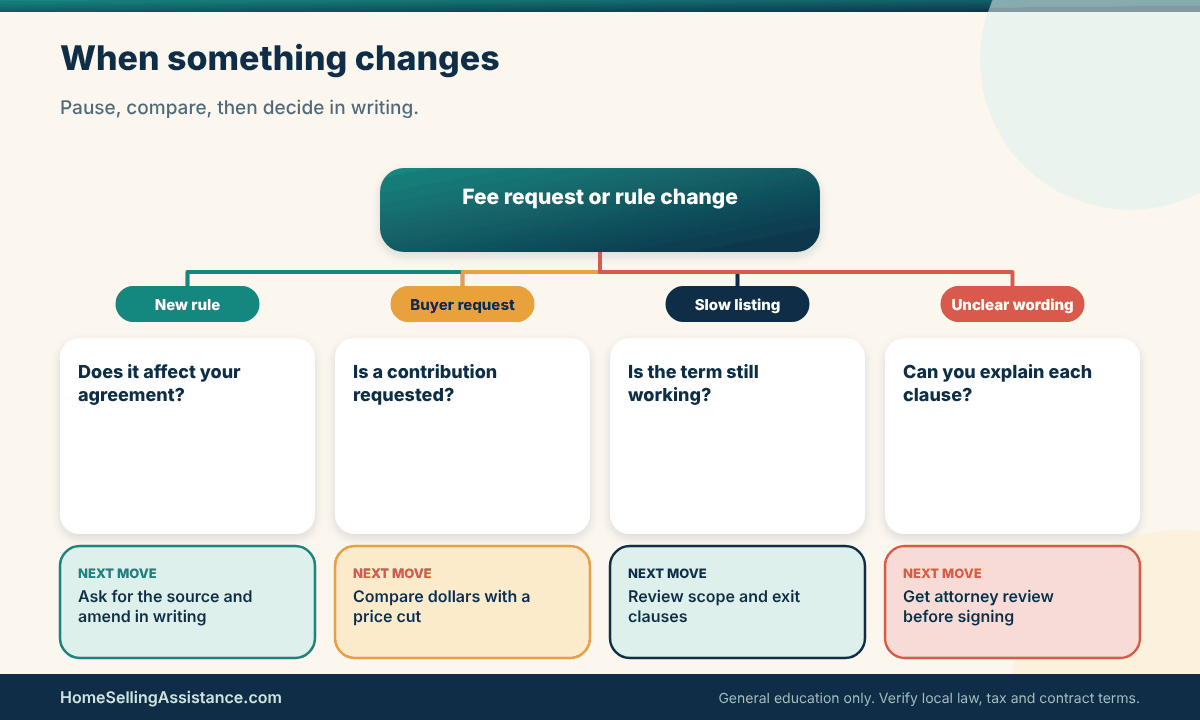
Evidence to gather: what to compare when something changes
When a trigger fires, compare three things. First, compare the new rule or fact with the version you wrote in your log. Second, compare your current agreement with what it would say under the new rule, if it were rewritten today. Third, compare the cost or risk of staying with the current arrangement against the cost or risk of changing it.
The third comparison is easy to skip. Sellers often assume that changing an arrangement mid-listing is free or impossible, and the truth sits in between. Some brokerages will agree to amendments readily, some will ask for a fee, and some will refuse. Your agreement and the brokerage’s policy decide which, so read the amendment and cancellation sections again before you raise the question.
If the change affects an offer already on the table, involve the person closest to the contract, usually your listing agent, and, if the amounts are large or the wording is unclear, your attorney. Do not rely on a phone call alone. Ask for any change to be documented, signed and dated.
A scenario, an exception, and your next step when a trigger fires
Take a seller, with a seller real estate commission plan already in place, whose home has been listed for several weeks without an offer. A buyer’s agent calls to say that their client would love the house but needs help with closing costs, including the agent’s compensation, because the buyer’s agreement with that agent requires it. The seller’s first instinct is to refuse, because the original plan was not to pay anything on the buyer’s side.
The exception is that sticking to the original plan makes sense if the price and terms are otherwise strong, and some sellers will happily walk away from a weak offer. But some will decide that a modest contribution is worth it to close a real deal, particularly if the alternative is another price reduction. Either choice is legitimate when it is made deliberately.
Your next step is to compare the contribution requested, in dollars, with the cost of a further price reduction or of continued carrying costs, using your own numbers. Then reply in writing through your agent. Our guide to counteroffer strategy can help you decide how to structure the response.
Quick scenario
A seller gets three proposals. One quotes a single total, one itemizes a listing fee plus an optional buyer-side contribution, and one offers a flat fee with a separate package of paid add-ons. The seller converts all three to dollars at the same example price, lists what each includes, and notices that the cheapest headline is not the cheapest total once the add-ons the seller actually wants are counted. The seller then asks the preferred agent to match the structure of the clearest proposal. Nothing about the exercise required expertise, only a calculator and patience.
Frequently asked questions about seller real estate commission
Is a seller real estate commission set by law?
No. No federal law fixes a seller real estate commission, and state licensing laws generally do not either. What you pay is what you and the brokerage agree to in the listing agreement. Brokerages may have habits or minimums of their own, but those are business decisions, not legal requirements, and you are free to ask for a different structure.
Is there a standard seller real estate commission rate?
There is no universal standard, and anyone who tells you otherwise is describing a local habit or their own pricing. Rates and fee structures vary by brokerage, by market, by price range and by what services are included. The only dependable approach is to ask several brokerages for proposals in writing and compare them in dollars on the same assumed price.
What changed for the seller real estate commission after the NAR settlement?
In broad terms, the industry rules changed so that offers of buyer-agent compensation can no longer be published in the MLS, and agents working with buyers are expected to have written agreements with them before touring homes. A seller real estate commission remains negotiable. For the exact wording and current status, check the National Association of Realtors site and your local MLS rules rather than relying on a summary.
Do I still have to pay the buyer’s agent?
Not automatically, and the seller real estate commission you owe your own listing brokerage is a separate matter. Whether you contribute toward a buyer’s agent is a decision you make, in writing, as part of your listing agreement or as part of negotiating a particular offer. Some sellers choose to offer something, some prefer to handle requests case by case, and some decline. Each approach has trade-offs, and your agreement should reflect the one you pick.
Can I negotiate my seller real estate commission with a listing agent?
Yes, and it is a normal part of the conversation. Be prepared to discuss scope as well as price, because a change to one often affects the other. A brokerage may agree to adjust the rate, restructure the fees, shorten the term, or add an exit clause, or it may decline. Asking politely and in writing costs you nothing.
What fees might appear besides the main commission?
Some agreements add administrative, transaction, technology or marketing charges, or ask you to pay for certain services separately. These are not necessarily unreasonable, but they should be disclosed clearly and counted in your comparison. Ask the agent for a dollar total on a sample price so that the full cost of your seller real estate commission is visible before you sign.
What is a tail or protected period?
It is a clause that says you may still owe the listing brokerage a fee if you sell, within a stated time after the agreement ends, to a buyer who was introduced during the listing term. The length and the rules about which buyers are covered vary by contract. Read it closely, ask for the buyer list to be defined, and consider having an attorney review it if the wording is unclear.
Can I cancel a listing agreement if I am unhappy?
It depends entirely on what your agreement says. Some brokerages allow release on request, some require a fee or a waiting period, and some insist the term must run out. It is much easier to negotiate an exit before you sign than after a disagreement. Ask the managing broker what the cancellation process looks like and get the answer in writing.
Does a lower seller real estate commission mean worse service?
Not necessarily, and a higher one does not guarantee better service either. Service depends on the individual, the brokerage’s systems, and what is included in the agreement. The way to judge is to compare the written scope of services, ask for references and recent examples, and look at how clearly each proposal explains who does what.
Where should I verify the current rules?
For any seller real estate commission question, start with your state real estate commission or equivalent regulator, your local MLS rule sheet, the National Association of Realtors site for national industry rules, and your brokerage’s own forms. For a contract interpretation, a real estate attorney is the right person. Keep a dated log of what you checked, so you can tell whether anything has changed by the time you list.
Before you sign anything
A seller real estate commission is not a tax or a toll. It is a price for a service, and like any price it can be understood, compared and discussed. Convert proposals to dollars, read the clauses around the compensation language, and recheck the rules that were current when you started reading. This guide is general education, not legal, tax or financial advice, and your state, brokerage and contract will decide the details, so involve a licensed professional or attorney where the stakes call for it.


