The discount broker vs full service realtor question sounds like a simple price comparison, yet most sellers who ask it are really asking something bigger: how much of the work of selling a house am I willing to buy, and how much am I willing to do myself?
The fee is the part you can see. A lower fee feels like an obvious win, and a higher fee feels like it ought to come with white-glove service. Neither assumption holds up reliably. Some reduced-fee brokerages deliver tidy, professional sales, and some full-service agents disappear after the sign goes in the yard. The label on the door tells you less than the written scope of work inside the agreement.
That is why this guide treats the discount broker vs full service realtor decision as a matter of scope, not slogans. We will look at what each model usually includes, what it tends to leave to you, where the money actually goes, and which seller situations lean one way or the other. We use clearly labelled round numbers in a few examples, and we point to the places where your state, your market and your contract decide the answer.
You will also find a few scripts for questions worth asking before you sign anything. If you want the wider picture of choosing representation first, our cornerstone guide on how to choose a listing agent pairs well with this comparison. Everything here is general education, not advice for your particular sale.
Key takeaways
- A discount broker vs full service realtor comparison is mostly about scope. Ask exactly which tasks are included, which are optional and which you will handle yourself, because the same word, such as “listing,” can cover very different amounts of work.
- Compensation is negotiable and must be written down. Neither a reduced fee nor a traditional fee is automatic, so compare the actual figures in each proposed agreement instead of what an advertisement implies.
- Net proceeds depend on the final price as well as the fee. A smaller fee can be outweighed by a lower sale price or a longer time on the market, and the reverse is also possible, so test both with your own numbers.
- Your time and comfort count as costs. Showings, buyer calls, negotiation and paperwork have to be done by someone, and a lean service model simply moves some of that someone onto you.
- Fallback terms matter more than they seem. Look at the length of the agreement, cancellation language and what happens if a buyer’s financing or inspection falls apart.
- Scenarios beat universal winners. A prepared seller in a lively market and a seller with title or co-owner complications can reasonably choose differently.
Defining a discount broker vs full service realtor before you compare fees
Before any comparison is fair, both options need a plain definition. In everyday speech, “discount broker” and “full-service realtor” are marketing labels, not legal categories. A brokerage can call itself either one, and the real content lives in the listing agreement, the service menu and the fee disclosure. So we start, for the discount broker vs full service realtor question, by describing the usual patterns and then show you how to test whether a particular company matches them.
One note on vocabulary. The word “Realtor” is a registered membership mark for members of the National Association of Realtors, while “agent,” “broker” and “salesperson” are licensing terms set by each state. Plenty of discount firms employ members, and plenty of independent agents are not members. We use the phrase “discount broker vs full service realtor” because that is how sellers search for it, and we use “agent” and “broker” in their plain sense below.
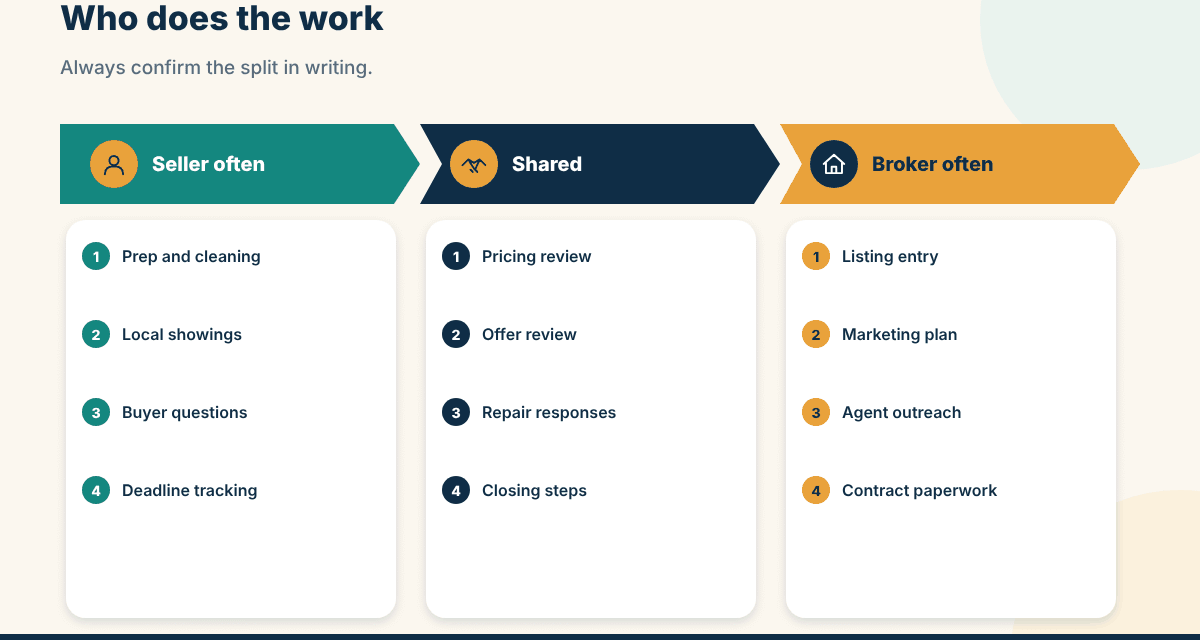
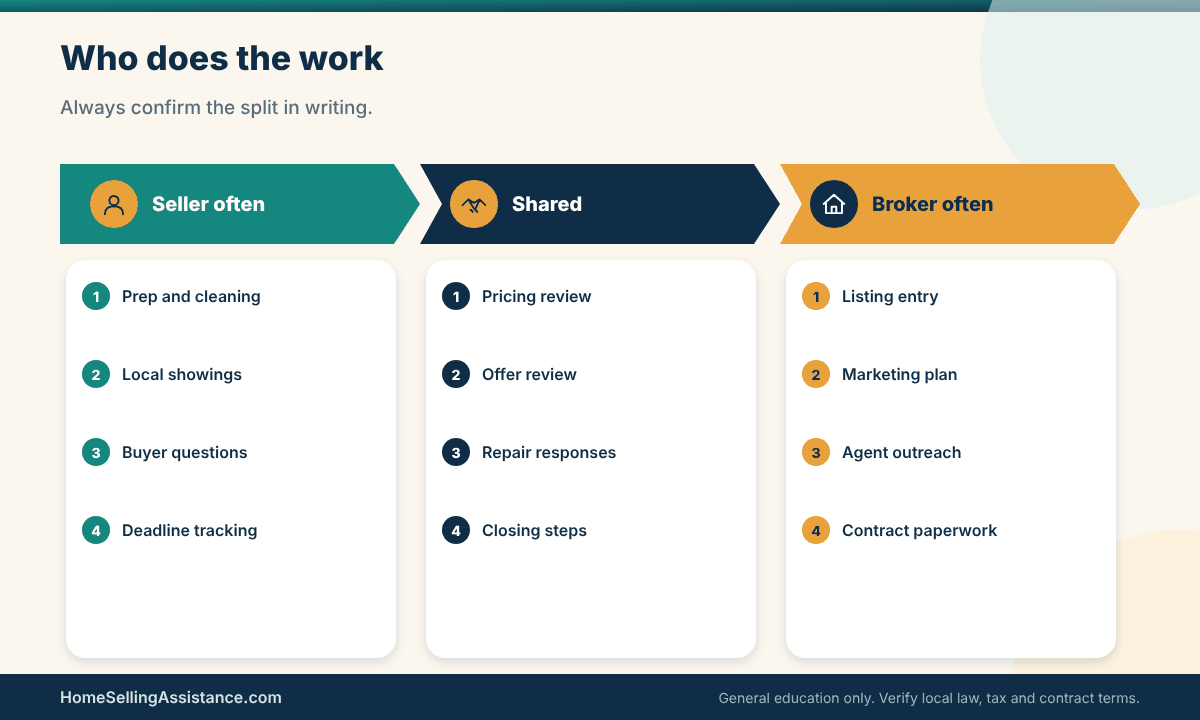
A good picture of the discount broker vs full service realtor models helps the numbers make sense later. The first picture shows how the work of a sale can be divided between you and a professional under each model.
What a discount broker actually offers sellers
A discount broker, in the loose sense, is a licensed brokerage that charges less than the local traditional arrangement or charges in a different way. The models vary. Some offer a flat fee for a defined package. Some offer a lower percentage-based fee. Some rebate part of their compensation back to the seller at closing, where state law allows it. Some sell services a la carte, such as entering the home into the multiple listing service, answering paperwork questions or reviewing offers, while the seller handles showings.
What tends to be trimmed is usually labor that happens on your schedule. Shorter menus often mean fewer personal showings, a lighter touch on staging advice and photography coordination, less hand-holding through negotiation, and fewer follow-up calls to buyer agents. Many discount models run on technology and standard forms, which can work well for a straightforward house and feel thin for an unusual one.
None of that makes the discount side of a discount broker vs full service realtor choice weaker by definition. A seller who has already done the pricing homework, can keep the house show-ready and is comfortable answering buyer questions may genuinely need less than a full-service package. The honest test is not whether the brokerage is cheap but whether the work you would be paying for is work you would otherwise do yourself.
Be careful with one specific trap: a low headline fee that comes with separate charges for things a seller assumes are included. Photography, lockbox use, transaction coordination, an administrative or “processing” charge, or a cancellation fee can each appear in the fine print. Add them up before comparing, and do not rely on the first number in the ad.
Evidence to gather: the written fee and service menu
Ask for the complete proposal in writing before you compare any discount broker vs full service realtor options. You are looking for a clear list of what the brokerage will do, what it will not do, what each item costs and when each fee is owed. A vague promise such as “full marketing” is worth much less than a named list: professional photos, a measured floor plan if offered, listing entry on the local multiple listing service, syndication to portals, and a written description of how showings will be scheduled.
Then collect the same document from at least one full-service agent so you are comparing like with like. Put both proposals side by side and mark every line as included, extra or seller’s job. Where the proposals use different words for the same task, ask each company to confirm in writing what the word means. This one step usually reveals more about the real discount broker vs full service realtor gap than any marketing page.
Also request a copy of the proposed listing agreement itself, not just a summary. Look for the term length, how and when you can cancel, what happens if you sell to a buyer you found yourself, and how long the protection period runs after the agreement ends. Our guide to the listing agreement for sellers walks through those clauses line by line.
A scenario, an exception, and your next step for reduced-fee listings
Picture a seller with a tidy, move-in-ready home in a neighborhood where similar houses have recently sold. She has looked at the recent sales herself, she works from home, and she is fine answering buyer-agent questions by text. A lean package that gets the house on the listing service and handles the paperwork may suit her well. Her next step is to confirm exactly which showings, calls and offer reviews belong to her.
Now the exception to this discount broker vs full service realtor example. If the same seller lives two states away, or works long hours with no flexibility, a model that leaves showing logistics to the owner may become a daily headache. The fee savings can shrink fast if buyers cannot get in to see the house or questions go unanswered for a day.
The next step in either case is the same: write down, before you sign, every task you expect to do personally, and give each one an honest hours-per-week estimate. If the total feels unrealistic, a middle option, such as a reduced-fee brokerage that includes more showing support, may fit better.
What a full-service agent typically covers
A full-service agent, in the traditional sense, handles the broad sweep of the sale. That usually includes a pricing conversation based on comparable sales, advice on preparing the home, arranging photography, writing and publishing the listing, hosting or coordinating showings, answering buyer inquiries, reviewing offers with you, negotiating terms, tracking contract deadlines and coordinating with the title or closing office, lender and inspectors. The agent is the day-to-day project manager of the sale.
The value of that coverage is partly skill and partly time. Skill shows up in pricing judgment, reading an offer’s real strength beyond the headline number, and handling the awkward moments, such as a low appraisal or a repair request that arrives on a Friday evening. Time shows up in everything you do not have to chase yourself. Neither is guaranteed in every transaction, and neither is a reason to assume the highest fee is the best purchase.
In a discount broker vs full service realtor search, full-service does not mean identical service. Two agents at the same brokerage can run very different campaigns, answer the phone with very different speed and negotiate with very different styles. That is the reason to interview more than one person and ask for specifics, as our piece on what belongs in a listing agent marketing plan explains in more detail.
A final note on compensation. Since the broker-compensation changes that followed the industry’s major legal settlement, practices around how buyer-side compensation is offered and disclosed have shifted, and written agreements now matter more than they once did. Compensation is negotiable. Whatever you agree to should appear in the listing agreement in plain terms, and local practice can differ from what you read online, so recheck current rules with your state real estate commission and the listing agreement itself.
Evidence to gather: the marketing plan and activity reports
The best evidence of what a full-service agent will really do is a written marketing plan and a track record you can check. Ask for a sample plan from a recent listing, with the client’s details removed. Look for specifics about photography, timing of the first public showing window, open-house approach if any, outreach to other agents and how often you will receive updates.
Ask how the agent reports activity. Some agents send weekly summaries of showings, inquiries and feedback. Others give a short phone update when something changes. Neither is wrong, but you should know which you are buying. If the agent uses online listing analytics, ask which numbers they will share, such as views, saves and showing counts, and how they interpret them.
For track record, ask for a few recent listings in your price range and area, then look the properties up on public sites yourself. Compare the original list price, any changes, and the time between listing and contract, keeping in mind that every house and season is different. This is evidence to weigh gently, not a scorecard to treat as proof. Pricing questions deserve their own script, which you can find in our guide to questions to ask a listing agent about price.
A scenario, an exception, and your next step for full-service listings
Imagine a seller with a larger home that needs some decluttering, has a few cosmetic issues and sits in a part of town where buyers expect polished photos and a flexible showing schedule. He is relocating for work and cannot be present. A full-service agent who coordinates cleaners, photography, showings and offer review can lift most of the load. His next step is to get the scope in writing, including who arranges and pays for each item.
The exception shows up when the service sounds comprehensive but the person delivering it is stretched thin. A busy agent may hand day-to-day tasks to an assistant or a team member. That is not automatically a problem, but you should know who your daily contact will be and how fast replies usually arrive.
The sensible next step is to ask the agent, in plain words, “Who will actually do each of these tasks, and how quickly will I hear back?” Their answer, and the way they give it, is useful information about what working together will feel like.
Comparing the trade-offs in a discount broker vs full service realtor decision
With the definitions in place, the real discount broker vs full service realtor comparison can begin. Most sellers focus on one dimension, the fee, when at least five matter: what you keep after costs, how long the sale might take, how much control you want, how contingencies and negotiation will be handled, and how many hours the work will cost you. A sixth sits in the background, which is how the arrangement behaves when something goes wrong.
The sections below take those pieces in two passes. The first looks at money, time, control and workload. The second looks at legal, financing, execution and fallback risk. Both passes use the same idea: every model moves some effort and some risk around, and your job is to decide where you would rather hold it.
Net proceeds, time, control, contingencies and workload side by side
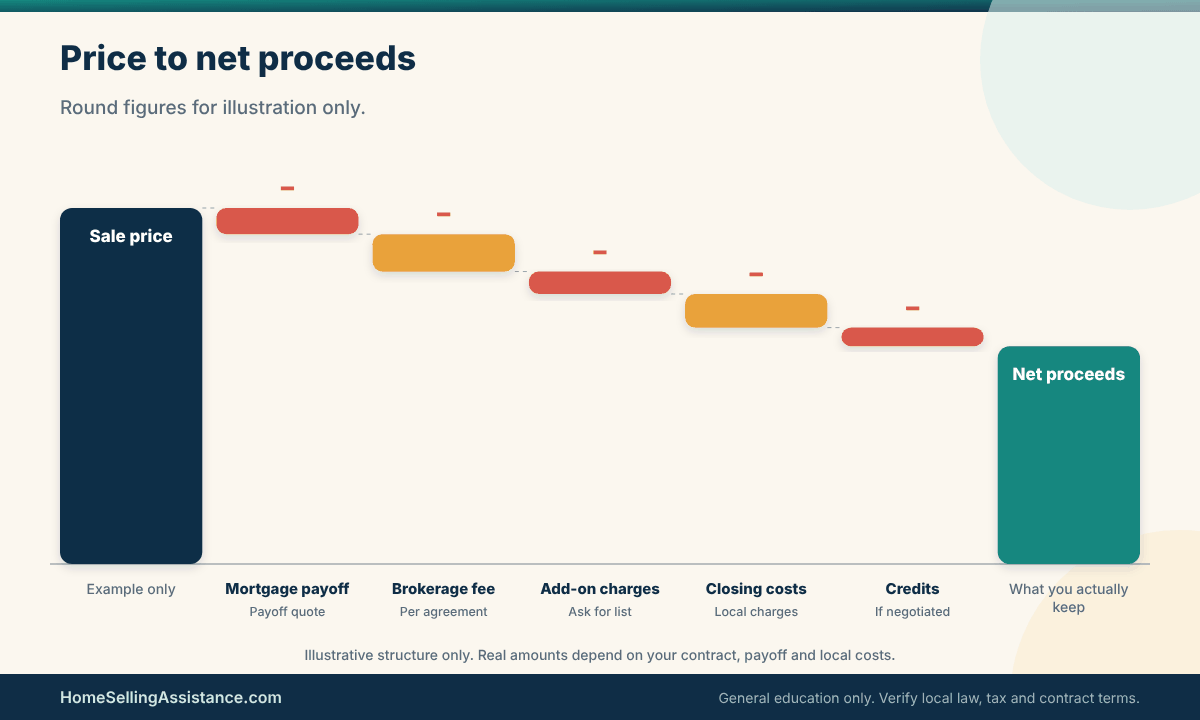
Start with the money, because it is what everyone remembers. Net proceeds are what you walk away with after the mortgage payoff, brokerage compensation, closing costs, repairs or credits and prorations. The fee is one line in that list. The sale price is another, and it is usually far larger. A discount broker vs full service realtor choice that saves a few thousand dollars in fees but costs a few thousand in price is a bad trade, and the reverse can be just as true.
The picture below shows the usual building blocks between a sale price and the money you actually receive. Notice how many lines are unrelated to the brokerage model at all.
Time works the same way in a discount broker vs full service realtor decision. A seller who prices well and presents the home well may sell quickly under either model. A seller who prices optimistically will usually see a slower sale under either. The model matters most when it changes how fast the property reaches buyers, how responsive the process is to feedback and how smoothly the contract moves toward closing.
Control is the part many sellers underrate when they compare a discount broker vs full service realtor. Under a lean model you often keep direct control of showings, communication and some negotiation choices, which some people love and others find tiring. Under a full-service model you hand more of that over and rely on the agent’s judgment, which is comforting when you trust the person and frustrating when you do not.
The matrix below puts the main factors in one place. Use it as a prompt for your own notes, not as a verdict, because each row depends on the specific company, agent and market.
| Factor | Discount broker (typical pattern) | Full-service agent (typical pattern) | What to verify | Execution risk to watch |
|---|---|---|---|---|
| Price and net proceeds | Lower or restructured fee, possible add-ons | Fee set by agreement, often higher | Every fee line, in writing | Savings erased by a lower sale price |
| Time on market | Depends on pricing and your availability | Depends on pricing and agent follow-up | Showing process and response times | Missed buyers from slow access |
| Contingencies | Seller may review more terms personally | Agent usually explains and tracks them | Who tracks each deadline | A missed inspection or financing date |
| Workload | More tasks may fall to the seller | Most coordination done by the agent | A task list with owners | Hidden hours or an unreachable agent |
| Negotiation | May be limited to advice or your own lead | Agent negotiates on your behalf | Who speaks to buyer agents | Weak counters or slow replies |
| Marketing | Standard listing and portal exposure | Broader plan if the agent delivers it | The written marketing plan | Promised steps that never happen |
| Agreement terms | Varies, sometimes shorter or limited | Often a longer standard term | Term, cancellation, protection period | Being stuck in a poor fit |
To use the matrix, copy it onto paper and fill in the two columns with the actual proposals you receive. Wherever you write “unclear,” that row is a question for the broker. Wherever the two proposals match, you can stop worrying about it. What remains is the true difference, and it is usually narrower than the marketing suggests.
Run the numbers: an illustrative net proceeds comparison
Here is a simple illustration, with round numbers chosen only for arithmetic, not as typical fees or prices. Suppose a home sells for $400,000 under both models. Under a traditional arrangement, the total brokerage compensation is $20,000. Under a reduced-fee arrangement, it is $12,000. All other costs, such as the mortgage payoff and closing charges, are the same. On those facts the lower-fee path leaves the seller $8,000 better off.
Now change one assumption. Suppose the home, under the lean model, sells for $392,000 because the pricing was a little too high at the start and a first round of offers was lower. The fee difference is still $8,000, but the price difference is also $8,000, and the advantage disappears. If the price gap grows, the lean model comes out behind. If the price gap is zero, it comes out ahead.
The takeaway from this discount broker vs full service realtor example is not that one model wins. It is that you should run both lines, fee and price, with your own conservative guesses. Ask yourself what price difference would erase the saving, and then ask whether that gap is plausible for your home and market. Our guide on seller real estate commission explains how the fee itself is structured, and the cornerstone on seller closing costs shows how the rest of the deductions stack up.
Also remember buyer-side compensation. Depending on how your agreement is written and how local practice runs, you may offer compensation to the buyer’s agent, offer none, or negotiate something in between. That choice can change what buyers see and how offers are shaped, so treat it as its own decision under either model rather than assuming it is tucked inside the headline fee. Our article on whether a seller pays the buyer agent commission covers the options.
A scenario: when the cheaper fee costs more time
Consider a seller weighing a discount broker vs full service realtor who picks a lean package because the fee looks attractive. The listing goes live, but the seller works days and can only show the house on weekends. Buyer agents get stuck in a loop of messages, and two interested buyers drift to other homes. Six weeks pass, the price is cut, and the eventual sale price lands below the original plan. The savings are real on paper and thin in practice.
The reverse can also happen. A different seller hires a full-service agent at a traditional fee. The agent is busy, replies slowly and does the minimum the agreement requires. The house sits, feedback is vague, and the seller wonders what the extra fee bought. The service was bundled in the contract but not delivered in the week-to-week reality.
The common lesson is that time on market follows from pricing, preparation and responsiveness far more than from the label on the brokerage. In either model, ask for a weekly update rhythm in writing, agree on when a price review will happen if showings are slow, and keep those dates on your own calendar.
Legal, financing, execution, market-exposure and fallback risk
The second pass looks at risk, which is the part that rarely makes it into advertisements. A sale can go sideways in several ways: a buyer’s loan can be delayed or denied, an appraisal can come in under the contract price, an inspection can reveal a costly issue, a disclosure can be missed, a title problem can surface, or a deadline can pass unnoticed. Every model has a way of handling those moments, and the quality of that handling is hard to see until you need it.
Legal risk in a discount broker vs full service realtor choice deserves a careful word. Neither a discount broker nor a full-service agent is a lawyer, and neither can give legal advice in most states. Both can explain standard forms and typical practice. If your situation involves co-owners, a trust, an estate, a lien, a boundary question or a tenant, a real estate attorney or the title company may need to be involved regardless of how you list. Our comparison of a listing agent vs real estate attorney for sellers explains the difference.
Financing risk and market-exposure risk deserve separate attention. A well-exposed listing tends to attract more buyers and therefore more choice among offers, which can reduce the chance of leaning on a fragile, thin-financed one. A listing with weaker exposure may leave you with fewer options when the first deal wobbles. Exposure, again, depends on delivery rather than on the brand.
Finally, there is fallback risk, meaning what you can do if the relationship or the deal does not work. A shorter agreement, a clear cancellation clause and a backup-offer process all give you room to adjust. A long agreement with a hard-to-exit term, or a service that vanishes after signing, narrows your choices at the moment you need them.
Documents to read before you commit
Four documents deserve a slow read before any discount broker vs full service realtor choice. First, the listing agreement, including the term, fee, cancellation language, protection period and any administrative charges. Second, the service or marketing addendum, if there is one, which should name who does what. Third, any state-required agency or brokerage-relationship disclosure, which explains whom the agent represents. Fourth, the seller disclosure forms your state requires, because you, not the brokerage, are generally the one who must complete them truthfully.
Look for words that move risk without announcing it. “Seller shall handle” may shift a task to you. “Best efforts” may be weaker than a specific commitment. “Reasonable” and “as needed” leave room for disagreement. Where a phrase is vague, ask for a specific replacement, such as a number of days or a named deliverable, and request that it be added in writing.
If something in the agreement worries you, pause before you sign and ask a real estate attorney, or at least the state real estate commission’s consumer resources, to explain it. A short consultation is often inexpensive compared with the size of the transaction. For the federal rules that apply to every seller, such as lead-based paint disclosure for older homes, the EPA real estate disclosure page explains what you must hand over before a buyer is bound.
A scenario, an exception, and your next step on risk
Say a buyer’s inspection, in a discount broker vs full service realtor example, turns up a roof problem three days before the inspection response deadline. Under a full-service model, the agent will usually explain the options, such as a repair, a credit or a price adjustment, and draft the response. Under a lean model, you may be the one reading the repair request, getting a contractor quote and deciding how to answer, with some guidance from the brokerage if it is included in your package.
Neither route is wrong. The risk is that a lean seller who has not planned for the moment loses a day, or answers in haste. The exception is a seller who has sold before, knows a roofer and is comfortable negotiating, who may handle it quickly and well.
The next step is to ask each broker, before signing, “If an inspection issue or a low appraisal appears, what exactly will you do, and what will I be expected to do?” Write the answer into your notes and, ideally, into the agreement. Our cornerstone on home sale contingencies for sellers covers these moments in more depth.
Using seller scenarios in the discount broker vs full service realtor choice
After the fees, the scope and the risks, a universal winner still does not appear, and that is the honest answer. The discount broker vs full service realtor choice depends on who you are, what the house is like and what the market is doing around it. A seller scenario is simply a short description of those facts, used to test which model fits. Two scenarios follow, and then a table that compares several more.
The picture below turns the choice into a fork. It is not a quiz with a right answer. It is a way to see which questions to ask yourself before you pick a route, and where a hybrid arrangement might fit better than either end.
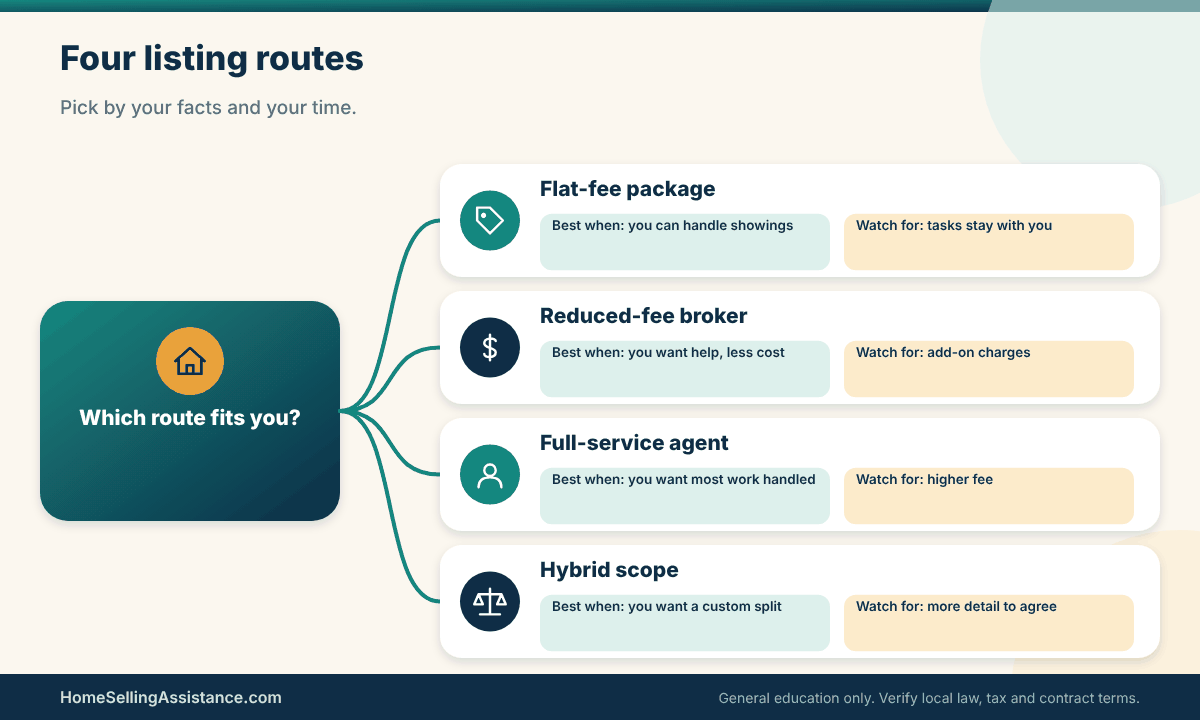
Whichever way the fork points for you in this discount broker vs full service realtor question, the steps stay the same. Collect at least two written proposals, compare them line by line, confirm the agreement terms, and then choose the option whose gaps you can live with. A discount broker vs full service realtor decision made from written facts rarely feels like a mistake later, even if the market surprises you.
Scenario one: the well-prepared seller in a busy market
Scenario one describes a seller who has done a lot of groundwork. The home is clean, repaired and ready. Similar homes nearby have sold within a short window, and the seller has studied those sales. They have time for showings, they are comfortable with email and phone calls, and they have no complicated ownership or title issues. For this person, a discount broker vs full service realtor comparison often leans toward the leaner model, because they would otherwise be paying for tasks they plan to do anyway.
That lean is a lean, not a rule, and the discount broker vs full service realtor choice stays open. Even a well-prepared seller can benefit from a skilled negotiator when several offers arrive at once. Comparing offers is not only about price. It includes financing strength, contingency terms, closing dates, and what each buyer asks of you after the inspection. Many sellers who handle the marketing alone still pay for a limited-scope review of the offers, which is something a few discount brokers offer as an add-on.
Busy markets also create their own risks. Fast timelines can compress inspection and disclosure steps, and a seller who is thorough but overloaded can miss a date. If you pick a lean model in a fast market, set up a simple tracking sheet for deadlines on the first day, and ask whoever is supporting you which items they will remind you about.
Evidence to gather: recent comparable sales and offer-handling steps
Two kinds of evidence support the lean side of the discount broker vs full service realtor choice in this scenario. The first is local sales data. Look at recently sold homes similar in size, age, condition and location, note how long each was on the market, and compare list prices with sale prices. Your county records, the listing service through a broker, and public portals can help. Treat portal estimates with caution, because automated values can miss condition, upgrades and local demand. Our cornerstone on how to price a house to sell shows how to read comparables carefully.
The second is a written description of how offers will be handled. Ask the brokerage who will receive buyer-agent inquiries, how offers will be delivered to you, whether the broker will review terms with you before you respond, and whether that review costs extra. Ask what the process is if two offers arrive on the same day, and whether the broker will help you set a clear response deadline for all buyers.
If you plan to handle negotiation personally, read about it first. Our cornerstone on how to evaluate a home offer explains how to compare offers on more than price. Consider practicing your replies out loud, or writing a few short responses in advance, so the first real counteroffer does not catch you unprepared.
A scenario, an exception, and your next step for the prepared seller
Here is a fuller version of the discount broker vs full service realtor story. A seller with a three-bedroom house in an area with steady demand decides to use a reduced-fee brokerage. She schedules showings herself, answers questions by text, and gets two offers in the first weekend. One is higher on price with a financing contingency. The other is slightly lower and cash. She pays for a one-hour offer review, makes a counter to both and picks the cleaner deal.
The discount broker vs full service realtor route worked because she knew what she would handle and bought help for the one task where she wanted a second opinion.
Now the exception. If that same seller discovered, during the first week, that she disliked dealing with strangers in her home, or if a work trip came up, the savings could turn into stress. She would then have a choice between switching to a more supportive arrangement, if the agreement allows it, and pushing through.
Her next step in any version is to decide, before listing, which tasks she will hand over if the plan does not work. A fallback script might read, “If I cannot manage showings after two weeks, what is the process to add showing support, and what would it cost?” Ask that question up front and it will never feel like a failure to use it.
Scenario two: the complicated sale in a slower market
Scenario two of the discount broker vs full service realtor choice sits at the other end. The home may be larger, older or unusual. It may need repairs or have a layout that takes explaining. The market may be slower, with longer times on market and buyers who negotiate carefully. Perhaps the owner lives out of town, or the ownership involves siblings, an estate or a divorce. In those conditions a discount broker vs full service realtor comparison often leans toward more support, because the work is heavier and the cost of a mistake is higher.
In a slower market, exposure and follow-up matter more. The agent’s job grows to include frequent price reviews, feedback gathering from buyer agents, adjusting the marketing and keeping the file moving after a contract is signed. Sellers sometimes underestimate how long this phase lasts, and how much of it falls on whoever is managing the transaction.
Complicated ownership changes the picture again. When several people must sign, when a trust or estate is involved, or when a lender has to approve something, the sale needs a steady coordinator. That person may be a full-service agent, an attorney, a closing officer or all three. A lean brokerage may handle part of this well, but you should ask directly rather than assume.
Evidence to gather: condition, ownership and market-pace facts
For the complicated scenario, the evidence is about facts that make the sale harder. Start with ownership documents. Gather the deed, any trust or estate papers, a recent mortgage statement and anything that shows liens, unpaid taxes or association dues. If you are not sure who must sign, ask a title company or a real estate attorney before listing, not after an offer arrives. Each of these steps can be cheap compared with a delayed closing.
Next, collect condition facts. Past inspection reports, repair receipts, permits and warranties help a buyer’s agent and help you complete your state’s seller disclosure form accurately. If a home was built before 1978, the federal lead-based paint disclosure applies, and the EPA guidance on lead disclosure explains the required steps. Do not guess at disclosure answers to save time. Your state’s real estate commission can point you to the form and the rules.
Finally, gather market-pace facts. Ask each broker for the average time on market and the average list-to-sale price gap for homes like yours in the past several months, and ask where those figures come from. Different brokers will give different numbers, and you may learn more from how openly they discuss the weak spots than from the numbers themselves. In slow conditions, a candid agent is worth hearing out.
A scenario, an exception, and your next step for the complex sale
Imagine three siblings who inherited a house, live in different states, and disagree mildly about price. The home needs a new furnace and has a cluttered basement. A full-service agent who can coordinate cleanup, bring in contractors for quotes, communicate with all three owners and manage the paperwork may be worth the higher fee. In this setting the discount broker vs full service realtor decision leans toward more support, because the coordination alone is real work.
The exception is that some discount brokerages offer extra support for a modest added charge, and some full-service agents are willing to negotiate their scope or fee. If the siblings are organized and one is local, a hybrid, such as a reduced-fee brokerage with a named point person and a transaction coordinator, might do the job. Compensation is negotiable, so ask.
Their next step would be to talk to a real estate attorney or title company about authority to sell, then request at least two written proposals. Our cornerstone on selling an inherited house covers the probate side, and a guide to canceling a listing agreement as a seller explains what to look for in case the fit goes wrong after signing.
The table below compares several more discount broker vs full service realtor situations in one place. It is meant to be a quick reference, not a rule, because the fact in the last column can change the answer for any row.

| Situation | Route favored | Reason | Trade-off | Fact that changes the choice |
|---|---|---|---|---|
| Move-in-ready home, active market | Often discount broker | Demand does much of the work | You handle more logistics | Your availability for showings |
| Out-of-state owner | Often full service | Someone local must coordinate | Higher fee | A trusted local helper |
| Home needing repairs and cleanup | Often full service | Vendors and timing need managing | Fee on top of repair costs | Whether you will manage vendors |
| Experienced repeat seller | Often discount broker | Fewer tasks to buy | Less backup in a surprise | How well you know current local custom |
| Inherited or co-owned property | Full service or hybrid with legal help | Many signers and documents | Slower, more coordination | Authority to sell and agreement among owners |
| Slow or shifting market | Often full service | Pricing reviews and follow-up matter | Fee is owed even if the sale is slow | Agreement length and exit terms |
To use this discount broker vs full service realtor table, find the row closest to your own situation, read across, and then check the last column against your facts. If your fact is different from the one listed, the answer may flip. A move-in-ready home in an active market with a seller who cannot be reached during the day, for example, drifts toward more support. Treat each row as a starting hypothesis to test with proposals, not a decision already made.
When you feel stuck, run a simple exercise. Write down the three tasks in the sale you would least like to do, and the three that would worry you most if done badly. Then ask each broker which of those six they would handle and what it costs. That short list often settles the discount broker vs full service realtor question faster than any spreadsheet.
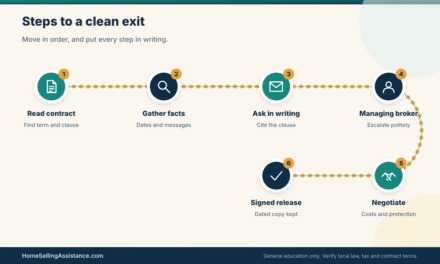
Before you decide, it helps to see the whole conversation as a short checklist. The picture below gathers the papers to collect and the questions to ask each broker, so that your discount broker vs full service realtor comparison rests on the same facts for every candidate.

A few common discount broker vs full service realtor mistakes are worth naming, because they show up again and again. The first is comparing a headline fee with a fully loaded one. The second is skipping the agreement’s term and cancellation language because the sales conversation felt friendly. The third is assuming a full-service label guarantees more effort, or that a lean label guarantees less. The fourth is forgetting that buyer-side compensation is a separate choice. The fifth is signing before talking to a second company.
Another quiet discount broker vs full service realtor mistake is treating the first proposal as the final one. Fees, scope and terms are open to discussion, and a polite request such as “Can the agreement be shorter, or can I cancel with notice?” costs nothing. Some sellers also forget to ask what happens when they find the buyer themselves, which is a common clause under many exclusive right to sell listing agreements. Read that clause twice.
If you are weighing a different path altogether, such as selling without an agent or paying a flat fee for listing-service access, the comparison changes again. Our cornerstone on for sale by owner and the category on FSBO and flat-fee MLS options lay out those routes. For more articles on choosing and paying an agent, see the listing agents and commissions category, and for the whole decision in one place return to choosing a listing agent.
Last, check that your plan respects fair housing rules. A broker or agent should never steer buyers or advise you to prefer or avoid buyers based on protected characteristics, and you should not ask for it. The HUD fair housing resources explain the basics. A sound discount broker vs full service realtor choice is made on service, fees and fit, never on who the buyers are.
Quick scenario
A couple is deciding between a flat-fee package and a traditional listing. They write down the three tasks they would dislike most, which are showings, negotiation and chasing paperwork. The flat-fee package leaves two of the three with them. They ask the full-service agent for a reduced fee in exchange for a shorter agreement, and the agent counters with a middle option. They choose it, because a discount broker vs full service realtor choice looked less like a fee contest once they counted their own hours.
Frequently asked questions about discount broker vs full service realtor
What is the main difference in a discount broker vs full service realtor choice?
The main difference is how much of the work of selling is bought and how much stays with you. A discount broker usually charges less or charges differently and may leave tasks such as showings or negotiation to the seller. A full-service agent usually coordinates most of the process for a higher or traditional fee. Check each proposal for the actual task list, since the labels alone do not tell you.
Will a discount broker get me a lower sale price?
Not necessarily, and no one can promise either way. Sale price depends mainly on pricing, condition, presentation, exposure and the market on the day buyers look. A lean arrangement that still lists your home on the local listing service and prices it well can do fine. Ask any broker how pricing will be set and reviewed, and compare their reasoning with recent nearby sales.
Is the discount broker vs full service realtor fee set by law?
No. Compensation is negotiable and must be put in writing in the listing agreement. Practices have shifted since the industry’s broker-compensation settlement, so older advice you read online may be out of date. Confirm current rules with your state real estate commission and the exact wording of the agreement you are offered.
What hidden costs should I look for with a discount broker?
Look for add-on charges that appear outside the headline fee. Examples include photography, signage, lockbox, transaction coordination, administrative charges, early-termination fees and fees for extra services. Ask for a full written list of anything you might be billed. Add it to the main fee and compare the total with the full-service proposal.
Can I switch from a discount broker to a full-service agent later?
Possibly, but it depends on the agreement. Some contracts allow cancellation with notice, and some require a mutual release or charge a fee. Read the term, the cancellation clause and any protection period before you sign. If you may want flexibility, ask for a shorter term or a clear exit option in writing.
Does a full-service agent always do more for my home?
Not always. Full service describes a menu, and the real effort depends on the agent, the workload and the agreement. Ask who will handle each task, how often you will hear updates and what the agent does if showings slow down. A written marketing plan makes it easier to hold anyone to what was promised.
Do I still need a real estate attorney with either option?
It depends on your state and your situation. In some places attorneys are a normal part of closing, and in others title or escrow companies handle it. A complicated sale, such as an estate, lien or co-owner dispute, may call for legal help whichever route you pick. Brokers generally cannot give legal advice, so ask an attorney when the question is legal.
How should I compare two proposals fairly?
Put them side by side and mark every item as included, extra or your job. Compare total fees, agreement length, cancellation terms and who handles negotiation and deadlines. Then run a simple net proceeds estimate for each at a conservative sale price. A discount broker vs full service realtor comparison done this way usually makes the better fit obvious.
Is a discount broker a good fit for a first-time seller?
It can be, if the seller is willing to learn and has time. First-time sellers often underestimate negotiation, paperwork deadlines and the emotional side of showings. Some choose a lean option with extra support for the parts they find intimidating. Others pick full service for the first sale and reconsider later, which is also reasonable.
Where can I check a broker’s license or complaints?
Your state real estate commission or licensing board usually lets you look up licenses and any public disciplinary history. That check applies equally to discount and full-service firms. It takes a few minutes and is worth doing before you sign. Also ask for references from recent sellers, and read recent public reviews with a critical eye.
A calm way to decide
There is no universal winner in the discount broker vs full service realtor debate, only a better fit for your house, market and calendar. Gather two written proposals, test the net proceeds with conservative numbers, read the agreement terms twice and choose the option whose gaps you can live with. This article is general education, not legal, tax or financial advice, so check state rules and talk to a licensed professional about your own sale.