A reconsideration of value seller plan starts with one uncomfortable fact: when an appraisal comes in below the contract price, you are usually not the person who can ask for a second look, and you are certainly not the person who gets to talk to the appraiser. The request normally travels through the buyer, the lender or an appraisal management company, and your job is to hand the right people the right evidence quickly and politely.
A reconsideration of value, often shortened to ROV, is a formal request that the appraiser take another look at the conclusion in a completed report. It is not an appeal to a judge and it is not a negotiation with a person who owes you a better number. It is a documented review, and it works best when the report contains something checkable: a factual error, a missing comparable sale, a feature that was overlooked, or an adjustment that does not match the market evidence.
Plenty of sellers lose a week to this reconsideration of value seller step because they treat it as an emotional dispute. They send long angry emails, paste in a listing-site estimate, or ask the appraiser directly for a favor. None of that moves a report. What does move it is a short, factual, well-organized package that points to specific lines in the report and supplies public or verifiable data the appraiser may not have seen.
This article walks through that package in the order you will actually need it: what to gather before anyone asks, how to behave in the first two days after a low value, how the request interacts with your contract deadlines, and what to confirm in writing once the dust settles. It is general education, not legal or financial advice, and the rules that govern appraisals, lenders and contracts differ by loan type, company and state.
When this article says “ask,” it means ask your agent, your attorney, the title or escrow company, or the lender, depending on who holds the answer where you live.
Key takeaways
- The request is usually not yours to file. A reconsideration of value seller effort typically runs through the buyer’s lender or the appraisal management company, so your role is to supply evidence through your agent or the lender’s contact.
- Facts beat feelings. Errors in square footage, bedroom or bathroom counts, lot details and missing sales are the strongest reasons for a second look. An estimate from a website is not.
- Never contact the appraiser to pressure a number. Appraiser independence rules exist for a reason, and an attempt to influence the value can damage the deal and the lender’s willingness to proceed.
- Watch the calendar, not just the comps. Your contract’s appraisal contingency dates keep running while a reconsideration of value seller review is pending, so ask early whether an extension in writing makes sense.
- Have a plan B before you submit. A review may change nothing, so decide in advance how you would handle a price reduction, a buyer gap payment, or a different buyer.
- Keep the paper trail. Save the report, the request, the response and every amendment, because they help at closing and when you answer later questions.
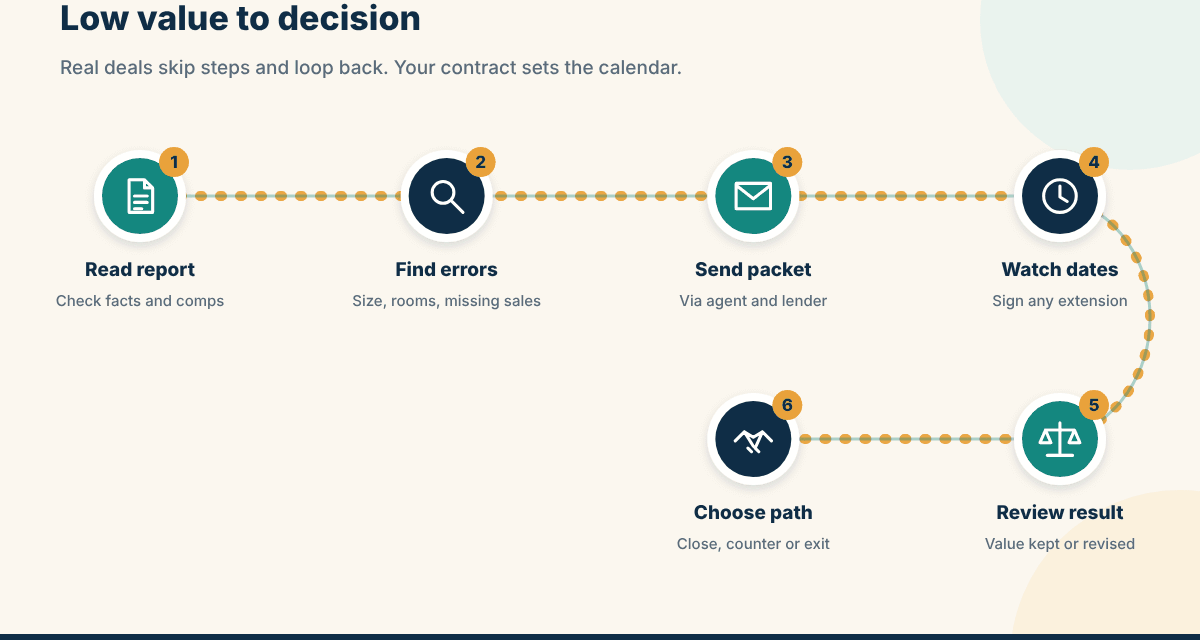
Before the detail, a quick map of the road ahead. The figure below shows the usual sequence from a low-value report to a decision. Real transactions skip steps and loop back, but the order is a good mental model while you read.
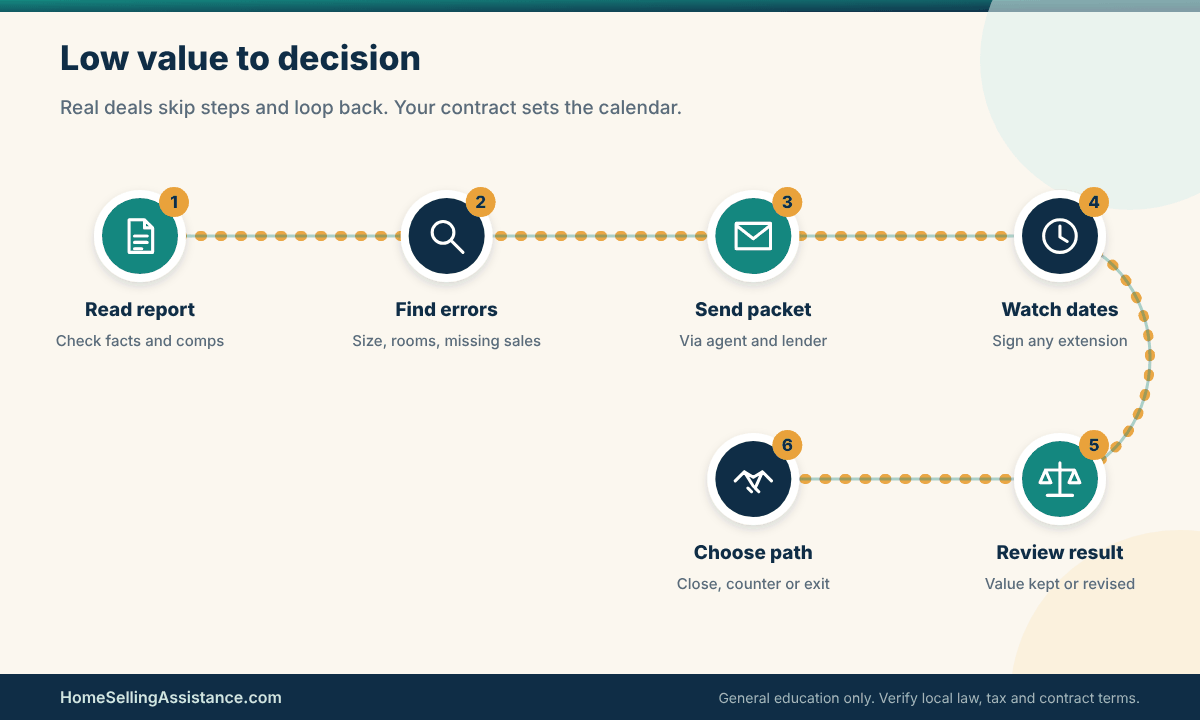
Prepare the reconsideration of value seller file before anyone submits a request
The best time to build a file is before you ever see a low number. Sellers who already have their paperwork in one folder can respond to a report within hours instead of days, and speed matters because most contracts attach firm dates to the appraisal. You do not need a complicated system. You need a short list of documents, a list of people who can receive them, and a clear idea of which dates in your contract are connected to the valuation.
Think of the file as two layers. The first layer is proof of what the house is: size, rooms, lot, permitted work, improvements and condition. The second layer is proof of what similar homes sold for nearby, recently, and under comparable circumstances. A reconsideration of value seller packet that covers both layers, in plain language and with sources, is far more useful to an underwriter than a stack of opinions.
Documents, numbers, contacts, and deadlines
Start with ownership and property facts. Most of what an appraiser records about your home can be checked against records you probably already hold or can request in an afternoon. Collect them now, even if the appraisal is still days away, because the same documents help with listing preparation, disclosures and title work.
For deadlines, read your purchase contract slowly and mark every date that touches the appraisal: the date the appraisal must be ordered or completed, the date the buyer must remove or waive the contingency, the date by which a price renegotiation must be proposed, and the closing date. If you cannot find them, ask your agent or the escrow or title officer to point them out. Do not guess, and do not rely on a friend’s contract; wording and timing vary widely.
Evidence to gather: records that support a reconsideration of value seller request
Gather the documents that prove physical facts first. These are the items most likely to be accepted without argument, because they come from sources the appraiser already trusts. Think about what a skeptical stranger would need in order to correct the report without calling you.
Useful property records include the deed and legal description, the most recent property tax bill showing lot size and assessed details, any survey or plat, floor plans, architect drawings, and listing photos with room dimensions. If a county assessor card lists a different square footage than your measured plan, keep both, and be ready to explain why they differ. Assessor data is often outdated, and so is the data many appraisers pull from public databases.
For improvements, collect permits with final inspection sign-offs, contractor invoices, receipts for major systems such as a roof or furnace, and dated before-and-after photos. Unpermitted work is a special case: it can raise questions rather than answer them, so talk with your agent or an attorney before presenting it as support for value. Where a finished space was legitimately built, a permit and a clear photo carry real weight; a verbal claim carries almost none.
Then add market evidence. Ask your listing agent for the comparable sales used to set your price, plus any others the agent believes fit better. Look for sales that closed recently, sit close to your home, and match on size, age, style, condition and lot. If you sell without an agent, a licensed local agent or appraiser can sometimes help for a fee, and a title company may be able to pull sales records. Keep the sources attached to each sale so someone else can verify it.
Finally, write down the people. You need the name and phone number of the buyer’s lender or loan officer, the buyer’s agent, your agent, the escrow or title contact, and, if it is known, the appraisal management company handling the file. You will probably never speak to the appraiser, and that is intentional.
A scenario, an exception, and your next step: the missing bedroom
Here is a made-up example with round numbers, for illustration only. Imagine your house has four bedrooms, including a converted garage room with a closet, window and permitted electrical work. The appraisal lists three bedrooms and gives no credit for the garage room. The contract price is higher than the appraised value by an amount equal to what you believe that room adds in your market.
The correction request here is factual: the report may have miscounted or may have treated the room as non-conforming for a reason you can address. You would collect the permit, final inspection, floor plan and photos, then ask your agent to send them to the buyer’s lender with a short note identifying the page of the report and the specific line you believe is incorrect.
The exception matters, though. If the room was built without a permit, or lacks a legal egress window, the appraiser may be right to count it differently, and pushing hard can backfire. In that case the better next step may be a straightforward conversation about price, not a longer review. Neither path is guaranteed, and the final judgment belongs to the appraiser and the lender, not to you.
A word on tone inside the file itself. Every note you write may eventually be read by someone on the other side of the table, so write as if it will be. A reconsideration of value seller packet that reads like a calm correction of the record is easier for a lender to forward, and easier for a buyer to accept, than one that reads like a complaint. Short sentences, page references and attached documents do most of the persuading.
It also helps to decide, before you need it, who in your household or ownership group speaks for the sale. If two owners, a trustee or an estate representative are involved, one person should coordinate the reconsideration of value seller documents so the lender receives a single, consistent set. Conflicting versions of the same fact, such as two different square footage figures, quietly undermine every other page you send.
Information still missing when the appraisal report arrives
Even a well-prepared seller rarely has the whole picture the day a low value lands. You may not have the full report. You may not know which comparable sales the appraiser used, whether the loan is conventional, government-backed or something else, or what the buyer’s lender will accept as a reason for review. Treat these gaps as a to-do list, not a crisis, and work through them in a sensible order.
The first gap is almost always the report itself. In many transactions the buyer receives the appraisal copy from the lender and can share it with the agents, but practices vary. Ask your agent to request a copy from the buyer’s side, with the buyer’s permission, as soon as the result is known. Without the actual pages you are arguing about a number rather than a set of statements you can check.
Evidence to gather: the report pages that decide a reconsideration of value seller review
When you finally hold the report, read it with a pencil. The pages that matter most are the subject description, the sales comparison grid, the adjustments, the appraiser’s comments and the final reconciliation. Everything else is background. Mark every statement of fact about your home and check each against your file.
On the subject description, confirm bedrooms, bathrooms, finished area, lot size, year built, garage, basement finish, recent updates and condition rating. On the comparison grid, look at where each comparable sits relative to your home, how long ago it sold, and how much the appraiser adjusted for differences. An adjustment that looks wildly out of line with market behavior is worth noting, but you should be ready to explain why with a data source, not a hunch.
Then ask what is absent. Are there recent sales of similar homes on your street or in your subdivision that the report does not mention? Did the appraiser choose comparables that sold under unusual conditions, such as a distressed sale, or that sit in a visibly different neighborhood? Gaps in selection are common reasons for a respectful request, provided you can name the specific sales and explain why they fit better.
Keep the tone neutral in your notes. The goal is a list of verifiable observations, such as “page 3 lists 1,750 square feet; our measured plan shows 1,910,” rather than judgments like “the appraiser was lazy.” Judgments get a form letter back. Observations with documents behind them get a real review.
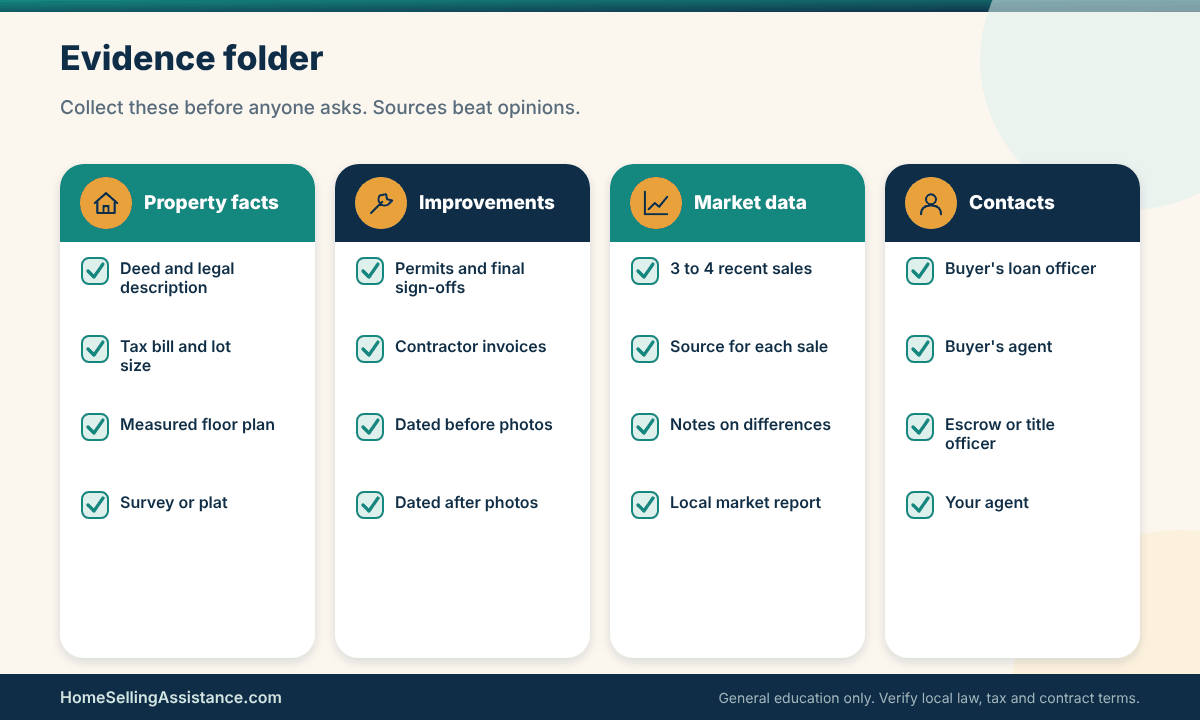
The figure below sums up the evidence folder in four groups. Print it, tape it to the folder, and tick items off as you collect them.
A scenario, an exception, and your next step: the loan type you did not know about
Another illustration, again with invented details. A buyer’s loan is government-backed, and the sellers assumed the appraisal works like any other. The report comes back low and also flags a condition item, such as peeling paint on an older home or a handrail the appraiser considered unsafe. The sellers plan a value review and forget that the condition item may need its own fix before the loan can move forward.
Loan programs carry different property standards, and the standards can be strict. Ask the buyer’s loan officer, in writing, which items in the report are value issues and which are condition issues, and whether any condition item can be cured by a repair and a reinspection instead of a review. This single question can save a week.
The exception is when the condition note is itself wrong, for instance a photo showing a defect that was fixed before the appraisal date. In that case, include dated proof of the repair in your reconsideration of value seller packet. Your next step is to ask the lender whether it will accept the repair proof as part of the reconsideration of value seller review or needs a separate reinspection. Either way, have the answer in an email, not only in a phone call.
One last preparation habit is worth building: keep a running log. A simple list with date, time, person and what was said turns scattered calls into evidence. When a reconsideration of value seller question comes up later, such as who promised an extension or when the report arrived, the log answers it in seconds. Keep it factual, avoid adjectives, and save the matching emails beside it.
If you are working without an agent, add a few extra steps. Ask the title or escrow officer who will receive notices, confirm in writing how documents should reach the lender, and consider asking a local licensed professional to review your comparable sales before you send them. A fresh pair of eyes often spots a mismatch you have stopped seeing. Your reconsideration of value seller packet will be stronger for it, and you will understand the report better when you read it yourself.
Fair housing principles apply to this reconsideration of value seller step as they do to every other part of a sale. A valuation review should rest on the property and the market evidence, never on who lives in the neighborhood or who is buying. If you see language in a report or in a conversation that seems to rely on the characteristics of people instead of the property, raise it with your agent or lender, and learn more from HUD’s fair housing resources.
Move through the transaction in order, from low value to a clear decision
Once the report is in hand, the sequence matters more than any single clever argument. Most of the damage in a low-appraisal situation comes from delay, mixed messages and missed contract dates, not from the number itself. A calm, ordered response gives the buyer, the lender and the appraiser room to do their jobs, and it keeps your own options open if the reconsideration of value seller review does not change the result.
If you want the bigger picture of how a valuation shortfall fits into a sale, our overview of low appraisal options for sellers covers the full menu of responses. This article stays focused on the reconsideration of value seller review step and how it connects to the rest of your contract.
Early action and decision points in the first two days
The first forty-eight hours after a low value are mostly about information and tone. You are deciding whether a reconsideration of value seller review is worth pursuing, who will carry it, and what you will do if it is not. None of those decisions requires you to announce a price position. They only require you to find out facts.
Begin with a short call or message to your agent, or to your attorney or escrow officer if you sell without one. Ask four things: has the report been shared, what does the contract say about timing, who at the lender handles review requests, and does the buyer want to pursue one. The buyer’s wishes matter because the buyer is typically the borrower, and many lenders only act on a request when the borrower or the lender initiates it.
Evidence to gather: a short comparison of what the report says and what you can prove
Build a one-page comparison in two columns. On the left, write what the report says about your home and the comparables. On the right, write what you can prove, with the document or source name beside each item. Anything you cannot prove goes in a third list called “opinion”, which you do not submit as fact.
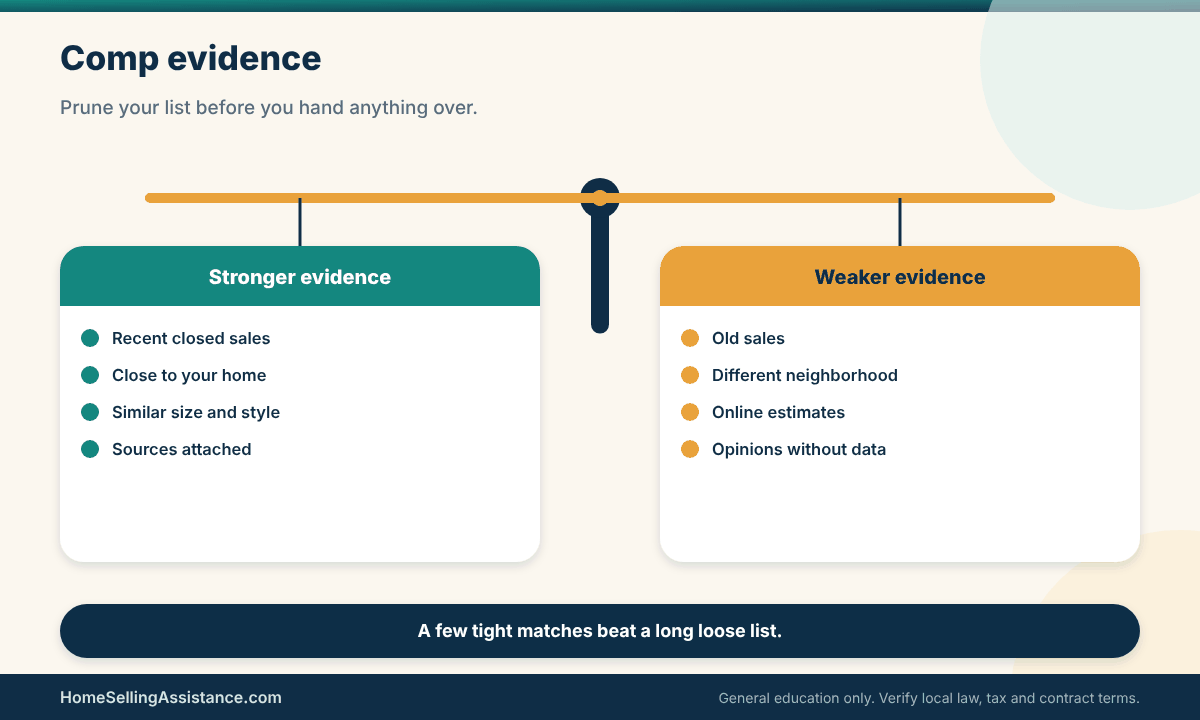
When selecting additional comparable sales, be disciplined. Choose a small number, often a handful at most, that sold recently and resemble your home in the ways buyers actually care about. A long list of loosely similar homes tends to look like advocacy, while three or four tight matches look like analysis. If you want to understand how professionals weigh differences between sales, our guide on adjusting comparable sales for condition, size, lot and features explains the logic in plain terms.
Be honest about weak spots. If your best comparable sold with seller-paid concessions, say so. If a sale you like was a cash purchase of a home in better condition, say so. Reviewers notice omissions, and a request that quietly hides an inconvenient fact loses credibility for everything else it says. A small number of well-chosen, honestly described sales is more persuasive than a big pile that overreaches.
Also check the dates. Sales that closed many months ago, in a market that has since moved, are weaker than recent ones. If you believe the market shifted in your area, you may mention it, but support it with local data from a source you can name, such as a local association report or MLS statistics your agent can pull. General national headlines do not help a specific property.
The decision scale below shows what generally makes comparable-sale evidence strong or weak. Use it to prune your list before you hand anything over.
A scenario, an exception, and your next step: the buyer who does not want to wait
Picture a buyer who is anxious about a rate lock and a moving date. The appraisal is low, and the buyer tells your agent, “I would rather just renegotiate than wait two weeks.” Your reconsideration of value seller packet is ready, but the person who must request the reconsideration of value seller review is lukewarm.
You cannot force a request. What you can do is make the choice easy: send a concise packet and ask whether the buyer’s lender can estimate how long a reconsideration of value seller review usually takes at that company. Some lenders turn them around quickly; others take longer. You can then compare that timeline with the dates in your contract and with the cost of a delayed closing to both sides.
The exception is when the buyer has already lost interest or the lender signals that a reconsideration of value seller review is unlikely to be considered. Then the productive next step is a price conversation, perhaps paired with a short extension, and your reconsideration of value seller packet becomes supporting material for a negotiated middle ground. In either case, record each conversation in an email so you can show later what was discussed.
Many sellers ask how long this takes. The honest answer is that it depends on the lender, the management company, the appraiser’s workload and the loan program, so any universal number would be a guess. What you can do is ask the buyer’s loan officer for the lender’s usual process and timing in your case, then write the answer down next to your contract dates. A reconsideration of value seller timeline built from real answers is worth more than an optimistic hunch.
Be ready for one more outcome: silence. Sometimes a request disappears into a queue and nobody tells you whether it was received. Politely follow up through your agent after a reasonable interval, and ask for a simple confirmation that the lender has the reconsideration of value seller packet and has passed it along. If you sell without an agent, send the follow-up yourself, in writing, to the contact you were given. A short confirmation request protects your reconsideration of value seller effort from being lost.
Handoffs, negotiations, and contingencies that run alongside the request
A review does not pause your contract. Unless both parties sign an amendment, appraisal contingency dates, financing dates and closing dates continue to run. This is the part sellers most often overlook, because the review feels like a separate, polite side conversation. It is not separate. It sits inside the same calendar as everything else.
Understanding how the appraisal contingency works for you and for the buyer is worth a few minutes. Our broader guide to home sale contingencies covers the full set of contract protections, and it helps to know which of them give the buyer a right to cancel or renegotiate if value falls short.
Evidence to gather: contract language, amendments, and the people who hold each piece
Pull the signed purchase agreement and every addendum. Look for the appraisal contingency clause, any language on what happens if the appraised value is lower than the price, a clause on a buyer’s gap payment, and the timelines for notice. Read for deadlines in days or hours and for how notice must be delivered, because a missed or improperly delivered notice can create problems for either side.
Write down who holds each piece of information. The lender holds the report and the reconsideration of value seller process. The buyer’s agent holds the buyer’s preferences. Your agent holds your comparable data and the negotiation history. The escrow or title officer holds the closing calendar and the instructions for any deposit. If one person is missing from your list, ask your agent how to reach them.
Appraiser independence deserves its own sentence. Rules designed to keep valuations honest generally bar anyone with an interest in the sale from pressuring an appraiser, and lenders enforce those rules closely. That is why your reconsideration of value seller packet travels through the lender or management company rather than to the appraiser directly. A seller who calls the appraiser, or who offers a bonus for a certain number, is putting the whole transaction at risk.
The consumer finance resources at the Consumer Financial Protection Bureau explain mortgage basics from the borrower’s side and can help you understand why the lender holds the controls.
When the lender asks for the review to be put in a particular format, follow the format. Some use a form, some an email address, some an online portal. A good packet submitted in the wrong format gets delayed, and delay is expensive when contingency dates are close.
Several related situations share this calendar. If the buyer offers to cover the shortfall with cash, read our explanation of the appraisal gap before you accept, because the paperwork matters. If the buyer’s loan approval itself looks shaky, our piece on the financing contingency shows what sellers can reasonably watch. And if an inspection request is also on the table, the guide to an inspection repair request explains how those negotiations can overlap with valuation questions. Handling the reconsideration of value seller step well is easier when you see the neighbors it sits beside.
A scenario, an exception, and your next step: the clock that kept running
Imagine a contract with a ten-day appraisal contingency, and a report that arrives on day eight. The sellers prepare a packet, the buyer agrees to ask for a review, and everyone assumes the clock is paused. It is not. On day ten, the buyer has a right, under the contract’s terms, to cancel or to ask for a renegotiation, regardless of whether the review is finished.
The simplest fix is a short written extension signed by both sides, before the deadline, stating the new date and confirming that the review is pending. Ask your agent or attorney to draft it, because the exact wording depends on your contract form and state. A text message saying “sure, take your time” usually does not substitute for a signed amendment.
The exception is when the buyer would rather not extend because their own rate lock or move date is tight. Then you may face a choice between a faster price discussion and a risky wait. Neither is right in every case. The decision depends on how much you value keeping this buyer, what backup interest exists, and what the contract allows.
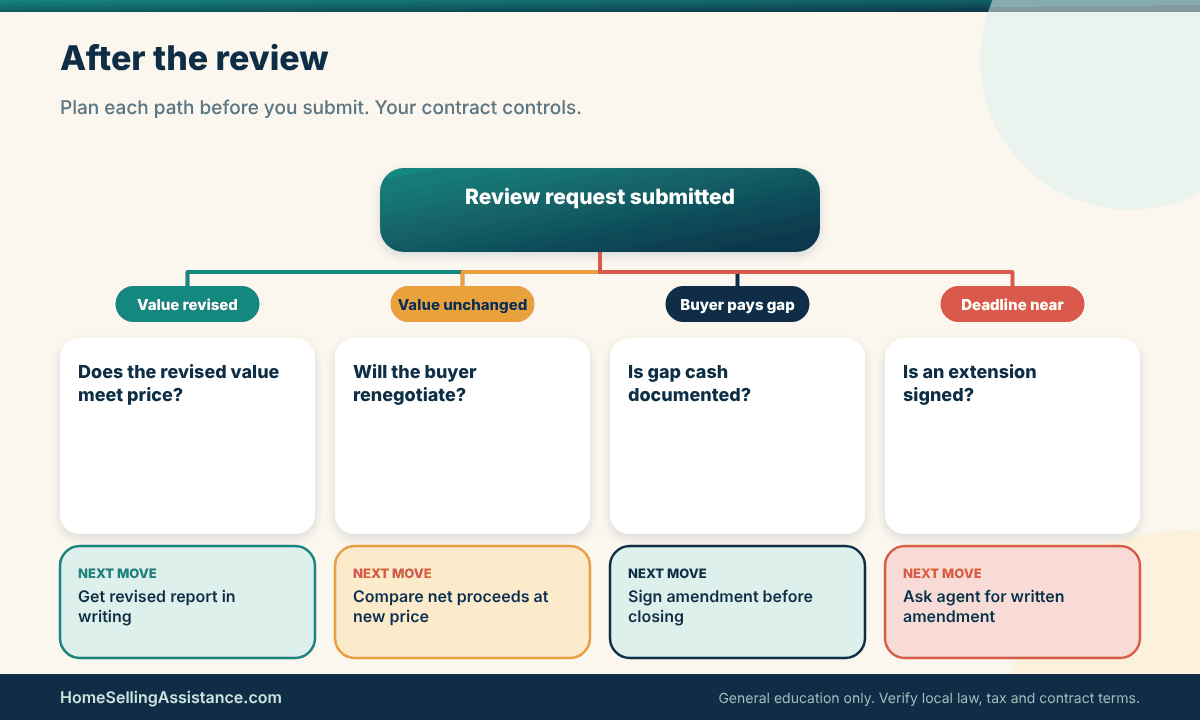
A timeline that includes your reconsideration of value seller steps and the contract dates side by side is the best way to see this clearly. The figure below shows the main outcomes after a reconsideration of value seller review request and the decision each one leads to.
To keep the moving parts straight, the next table lays out the seller workflow stage by stage. It is a planning aid, not a rulebook. Your contract, loan type and lender may add steps or change the order, so treat each row as a prompt to ask a question rather than as a promise about how things will go.
| Stage or symptom | Information to gather | Action | Decision deadline | Next handoff |
|---|---|---|---|---|
| Appraisal below price | Full report copy, contract dates | Read subject and comp pages | Before contingency date | Your agent, then buyer’s agent |
| Factual error spotted | Permit, plan, tax record, photos | Write a short correction note | Same day if possible | Buyer’s lender or AMC |
| Missing or weak comps | 3 to 4 recent, similar sales | Explain fit with sources | Within lender’s stated window | Lender submits review |
| Review pending | Written extension terms | Sign an amendment | Before original deadline | Escrow or title officer |
| Value unchanged | Net figures at lower price | Choose a path and counter | Per contract notice terms | Both agents, then escrow |
| Value revised | Revised report in writing | Confirm loan terms with lender | Before appraisal removal | Lender, then closing team |
To use the table, find the row that matches where you are today, then read across to see what to collect, what to do and who receives it next. If two rows apply at once, such as a reconsideration of value seller review pending alongside a looming deadline, handle the deadline row first, because a missed contract date is harder to repair than a delayed review.
Close the loop on a reconsideration of value seller request in writing
Whatever the outcome, finish the thread. A review that quietly ends, with an informal “they said no” and nothing on paper, leaves everyone with a different memory of what was agreed. Written confirmation protects you, the buyer and the lender (browse more in our contingencies, inspections and appraisals category), and it is far easier to gather it while the details are fresh than six weeks later when someone asks.
The last stage also includes a few quieter jobs: updating your net-proceeds estimate, making sure any price or credit change shows up on the closing documents, and saving a clean record in case a question appears after the sale. None of these is exciting, and all of them are the sort of work that prevents unpleasant surprises at the closing table.
What to confirm in writing before you move on
Confirmation has three layers: the valuation result, the contract consequence and the money. Each needs its own written line. A single email that says “all good” is rarely enough, because it does not say which number, which date or which amount you are agreeing to.
Evidence to gather: the revised report, the amendment, and the lender’s confirmation
If the appraiser revises the value, ask for the revised report in writing through the same channel that delivered the first one. If the appraiser stands by the original value, ask the lender to confirm that the review is complete and that the original figure stands. Either way, you want a dated record, not a verbal summary.
Next, check the contract consequence. If the buyer agrees to remove or waive the appraisal contingency, make sure the removal is in a signed document that names the date. If you agree to a price change, a credit or a closing-date shift, make sure there is a signed amendment that states the new price or credit, and who pays what. Your title or escrow officer should receive copies, because they build the closing statement from the latest signed version.
Then confirm the money. Update your estimate of net proceeds using the final agreed price and any credits. If you do not have a worksheet, our guide to home sale net proceeds shows how to build one from real line items. Ask the escrow or title officer for a preliminary settlement statement as soon as it is available, and compare it with your estimate.
One more item: ask the lender whether the loan approval still stands on the revised terms. A lower price can change the buyer’s loan amount, and a gap payment can change cash needed at closing. You are not the lender, and you cannot promise anyone’s approval, but you can ask whether anything on the buyer’s side has changed and request confirmation in writing.
A scenario, an exception, and your next step: the price changed but the paperwork did not
Here is a short illustration with made-up numbers. After a reconsideration of value seller review that left the value mostly unchanged, the sellers and buyers agree by phone to lower the price by a round sum. Everyone is relieved, and nobody signs anything. A week before closing, the lender’s file still shows the old price and the escrow officer is waiting for an amendment that was never written.
The fix is to put the agreed terms on paper right away. Ask your agent or attorney for a standard amendment and have both parties sign. Send it to the lender and the escrow or title officer with a simple covering message, and ask them to confirm receipt. A day of attention now avoids a scramble that can delay funding.
The exception is a state or contract form that requires a specific format, such as particular signatures, initials on each page or attorney review periods. In some states an attorney handles this reconsideration of value seller step, and the review period is part of the process. If your transaction works that way, build time for it into your plan, and do not treat the informal phone agreement as final.
Seen from the closing table, a reconsideration of value seller process leaves three kinds of trace: the valuation paperwork, the contract changes and the dollars. Make sure each trace points to the same story. If the report says one thing, the amendment another and the settlement statement a third, ask the title or escrow officer to reconcile them before you sign. Our walkthrough of the seller closing statement can help you read the final figures with confidence.
If the value question reshaped your price, remember that the same numbers feed other parts of the sale, such as prorations, transfer charges that some places base on price, and your own tax records. Ask a professional how a changed price affects those pieces where you live. A reconsideration of value seller outcome that lowers the price by a modest amount can still ripple through several lines of the settlement statement.
Records and follow-up after closing
When the sale closes, the file does not become useless. You may be asked questions months or years later by a tax preparer, a buyer’s insurer, a title company or even your own memory. A tidy folder takes a few minutes to assemble and can save hours. It also gives you a record of what you disclosed, what was agreed and what was paid.
Keep records in both paper and digital form if you can, and store them somewhere you will find again. Many sellers keep a single folder per sale, labeled with the address and closing date, and include everything from the listing agreement to the final settlement statement.
Evidence to gather: what belongs in the post-closing record
Save the signed purchase agreement and all amendments, the appraisal report and any review correspondence you received, the final settlement statement, and proof of any repairs or credits. Keep your improvement receipts as well, because the cost of capital improvements can matter when someone calculates gain on a sale. The IRS explains the basics in Publication 523, Selling Your Home, and a tax professional can explain how those rules apply to your own situation.
If your appraisal question involved your own prior valuation, keep that too. A pre-listing opinion, a broker price estimate or an earlier appraisal helps explain how you set your original price. Our article on the difference between a CMA and an appraisal shows why these numbers can differ without anyone being careless.
Plan how long you will retain the file. Tax-related records are often kept for several years, and the right period depends on your circumstances, so ask a tax professional. Legal and title-related papers may be worth keeping longer. Whatever you choose, do not throw away the closing statement and the deed copy.
A scenario, an exception, and your next step: the question that arrives later
Suppose a year after closing, a neighbor mentions that the buyers had a dispute with their lender about the home’s value. A short message arrives asking whether you remember a review process. Because you kept the report, the reconsideration of value seller packet and the lender’s response, you can answer plainly and accurately, with dates, without guessing.
An exception arises if the message looks suspicious. Scammers sometimes pose as agents, lenders or title officers and ask for documents or wire instructions. Do not send personal or financial information to a stranger who contacts you out of the blue. Confirm the request by calling a number you already trust, and see our guide to home sale fraud and seller safety for common warning signs. You can also report suspected internet fraud at the FBI’s Internet Crime Complaint Center.
Your next step in an ordinary case is simply to store the file and note its location. If a real question does arrive, forward it to the professional who handled your closing, such as the title company or your attorney, and ask whether they need anything else from you.
The figure below groups the closing-loop tasks into three phases so you can confirm that nothing is left open.

The next table is a transaction check table. It pairs common issues with the evidence you hold, the people who contribute their own input, the main risk, and a fallback if the first path fails. Use it as a conversation guide with your agent, attorney or title officer, not as a prediction of what any lender will do.
| Issue | Seller evidence | Buyer, agent, or title input | Risk | Fallback |
|---|---|---|---|---|
| Wrong square footage | Measured plan, permit, tax record | Lender confirms review format | Report stays unchanged | Negotiate price or credit |
| Missing recent sale | Sale record with source | Buyer agent checks fit | Sale judged dissimilar | Offer a short extension |
| Upgrade not credited | Invoices, permits, photos | Lender states what it accepts | Credit seen as cosmetic | Share cost data, then counter |
| Deadline running | Contract dates, signed amendment | Escrow tracks calendar | Buyer may cancel or renegotiate | Sign written extension |
| Buyer wants lower price | Net proceeds at new price | Both agents compare options | Deal ends without agreement | Keep a backup offer ready |
| Pressure on appraiser | None, and none should exist | Lender or AMC handles contact | Loan denied or voided | Route everything via lender |
To use this table, find the issue that looks most like your own, check that you hold the evidence in the second column, and then ask each person in the third column what they need. If the risk column describes something you cannot accept, read across to the fallback and plan it before you submit anything.
Quick scenario
Illustration only, with invented numbers. A seller finds that the report omits a recently finished basement bathroom. The agent sends the permit, final sign-off and photos to the buyer’s lender within a day, and the lender forwards the package. The seller also quietly asks the buyer’s agent whether the buyer would split a modest gap if the review changes nothing. Nobody is promised anything, but every path has been prepared.
Frequently asked questions about reconsideration of value seller requests
Can a seller ask for a reconsideration of value directly?
Usually not. The request normally goes through the buyer’s lender or the appraisal management company, because they ordered the report and own the review process. A reconsideration of value seller effort therefore works through your agent, who passes documents to the buyer’s side. Ask the lender early who accepts requests and in what format.
May I call the appraiser to explain my home?
You should not. Appraiser independence rules are meant to keep anyone with a stake in the sale from pressuring the valuation, and contact outside the lender’s channel can look like pressure even when your intent is innocent. Give your evidence to your agent or the lender’s contact instead, and let them decide how it is delivered.
What kinds of mistakes can a review fix?
Factual errors are the strongest category: wrong square footage, wrong bedroom or bathroom count, a missed garage, or a lot description that does not match records. Overlooked recent comparable sales and misread improvements can also be raised. Matters of opinion, such as how much a view is worth, are harder to change.
Will a review raise the value?
Nobody can promise that. Some reviews lead to a revised number, some confirm the original, and some produce a small adjustment. The appraiser makes the decision and the lender decides whether it accepts the result. Plan for both outcomes before you submit anything, so a refusal does not leave you without options.
How many comparable sales should I send?
A small, tight set usually works better than a long list. Many sellers send a few recent sales that closely match the home, each with a source and a short note on why it fits. Include honest notes about differences, such as a better lot or seller concessions. Credibility counts for more than volume.
Does my contract deadline pause during a review?
Not automatically. Unless the buyer and seller sign an amendment, the appraisal contingency dates, financing dates and closing date normally keep running. If a review is pending near a deadline, ask your agent or attorney about a written extension. The reconsideration of value seller timeline should always be compared with the contract calendar.
Can I use an online estimate as evidence?
It is rarely persuasive. Automated estimates use limited data, may not know about your upgrades and are not prepared to the standards of an appraisal. They can be useful for your own early thinking, but reviewers want recent, verifiable sales and documented facts. Our article on list price versus market value versus appraised value explains why the numbers differ.
What if the buyer will not request a review?
You cannot force it. You can offer a clear packet, ask whether the lender can describe its timing, and prepare a negotiation path, such as a price adjustment, a credit, a short extension or a buyer gap payment. Some sellers also keep a counteroffer ready so conversations move quickly.
Should I fix condition items the report mentions?
Sometimes, but it depends on the loan program and the item. Ask the lender whether a repair and reinspection would resolve the note, and whether it is a value issue at all. Keep receipts and dated photos in your file. If the repair is costly, discuss with your agent whether a credit would be a better option.
Who can help me decide what to do next?
Your listing agent, an attorney, the escrow or title officer and the buyer’s lender each hold part of the answer. For general homeowner guidance, HUD-approved housing counselors can explain options in plain terms. None of these sources can promise a specific appraisal result.
A calmer way to handle a low value
A strong reconsideration of value seller plan is mostly preparation: a tidy file of property facts, a short set of honest comparable sales, the right contacts, and a clear picture of your contract dates. Send evidence through the proper channel, keep everything in writing, and decide your fallback before the answer arrives. This article is general education, not legal, tax or financial advice, so confirm details with your agent, attorney, title company and the buyer’s lender.