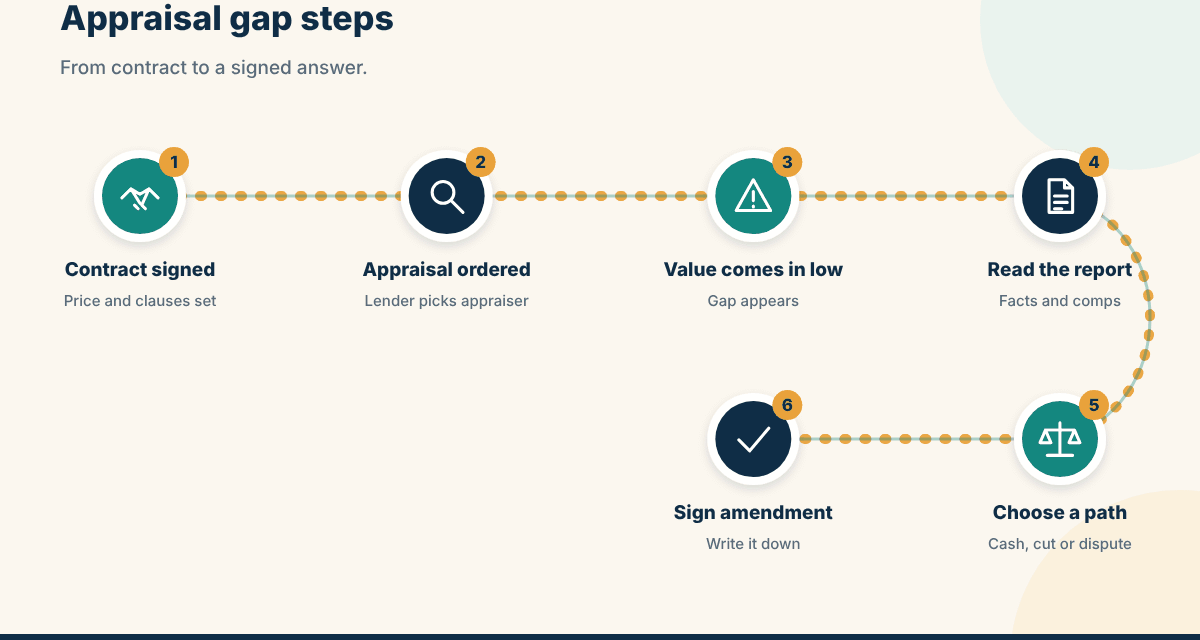
An appraisal gap seller is simply a seller whose buyer’s lender has valued the house below the agreed contract price, and the real work begins in the days after that number arrives, when someone has to decide who covers the difference or whether the deal bends, breaks or gets challenged.
Most sellers hear the word “appraisal” and think of a quick walk-through that either rubber-stamps the sale or ruins it. In practice, the appraisal is one gate among several that a financed buyer has to pass, and the gate is not controlled by you, your agent or even the buyer. The lender orders it, an independent appraiser performs it, and the lender then decides how much money it will lend based on the lower of the price and the appraised value.
That last sentence is the whole mechanism. If the appraisal comes in at or above the price, nobody notices. If it comes in below, the loan the buyer expected shrinks, and a hole opens in the financing that somebody has to fill. As an appraisal gap seller you are one of the people who might be asked to help fill it, so it pays to understand the choices before the call comes in.
This guide for the appraisal gap seller walks through the four realistic outcomes: the buyer brings extra cash, the price comes down, the value is disputed, or the contract language already decided the matter. We will stay general on purpose. Contracts, contingency periods and local customs differ by state and even by county, and nothing here replaces a conversation with your agent, a real estate attorney or your title or escrow company.
If you want the broader picture of how every contingency fits together, our cornerstone guide on home sale contingencies from the seller’s side is the place to start, and this page goes deep on one slice of it.
Key takeaways
- The gap is a financing problem first. A lender lends against the lower of price or appraised value, so a low appraisal shrinks the buyer’s loan even though your contract price has not changed.
- You have four main paths. The buyer covers the difference in cash, you reduce the price, you challenge the value with evidence, or you let the contract’s own wording decide what happens next.
- Your contract controls your leverage. An appraisal contingency, a gap-coverage clause or a waiver changes who bears the risk, so read the exact language before you reply to anyone.
- Judge every option by net, not headline. A smaller price with a firm closing can beat a higher price with a shaky buyer, but only after you count time, carrying costs and the chance of starting over.
- Evidence beats argument. A dispute works best when it rests on better comparable sales and documented facts about the home, not on frustration with the number.
- Know your exit before you need it. Dates, deposit terms and any backup offer decide how much patience you can afford.
Define your real choice as an appraisal gap seller
Before you compare tactics, it helps to be honest about what you want from this sale, because the best answer for one appraisal gap seller can be a poor answer for another. A seller who has already bought the next home and needs the proceeds on a fixed date faces a different problem from a seller who can wait out a relisting. The appraisal merely exposes the trade-offs you were already carrying.
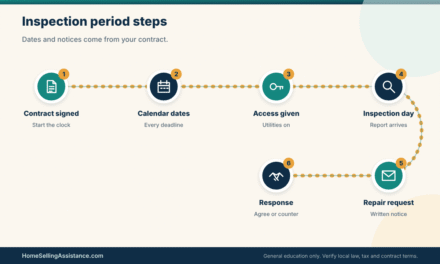
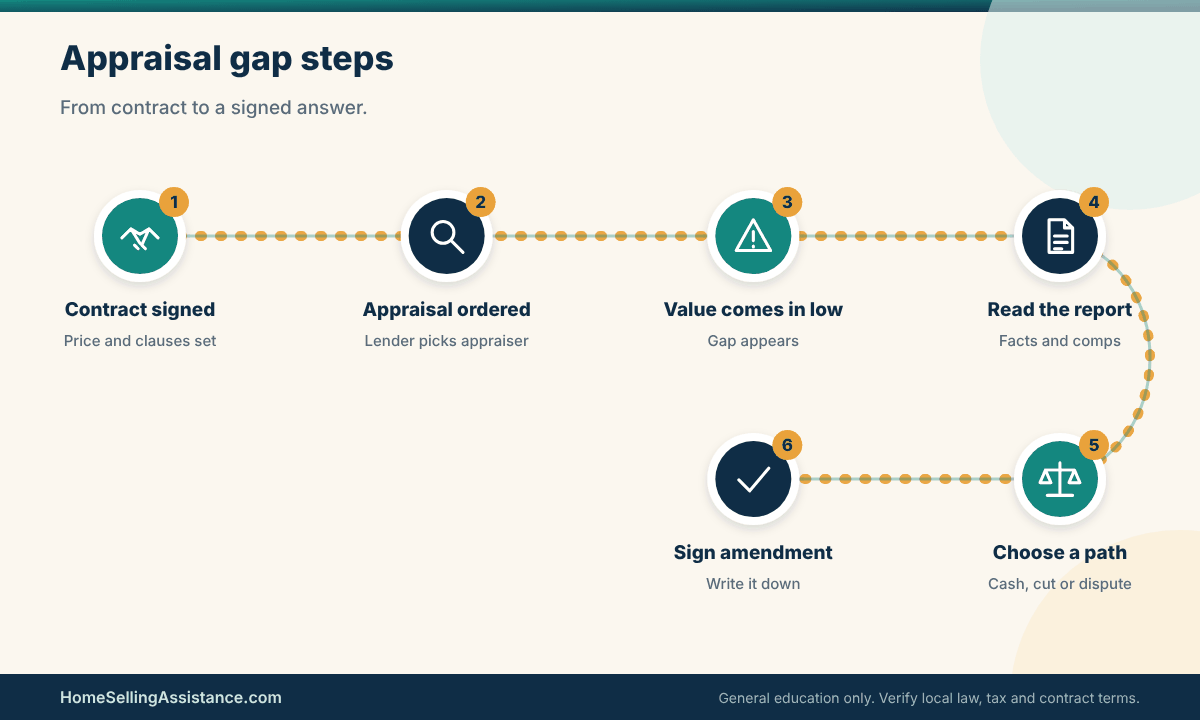
Think of the gap an appraisal gap seller faces as a question about who absorbs a risk. The buyer agreed to a price that their lender will not fully support. Either the buyer finds the money, you accept less, the number itself proves wrong, or the contract falls apart. Each outcome moves cost to a different person and a different date. The roadmap below shows how a typical gap unfolds, from the contract to the appraisal call to the choices that follow.
What you need from the sale before the appraisal number lands
Start with five plain questions. What is the goal: highest price, earliest date, least hassle, or a clean break? What is the timeline, including any purchase of your own that depends on this closing? How much cash do you truly need at the table, once the mortgage is paid off? What condition is the house in, and could a repair or an unusual feature have affected the value? And how much risk can you stomach if the buyer walks and you return to the market?
Write the answers down before the stress of a live negotiation arrives, because a calm appraisal gap seller bargains better. People who decide in the heat of a phone call tend to concede on the thing they care about least in hindsight. A one-page note with your minimum acceptable net, your latest workable closing date and the largest price cut you would consider keeps you steady when the buyer’s agent asks for an answer by tonight.
Evidence to gather: your contract, loan balance and comparable sales
Pull three documents together first. The first is the signed purchase contract with every addendum, because the appraisal clause, the financing clause and the deadlines all live there. The second is a current payoff estimate from your lender, so you know your floor. The third is the set of comparable sales your agent used to set the price, ideally with notes on why each was chosen.
If you have not seen that comparable set, ask for it now; every appraisal gap seller benefits from having it ready. A good agent will have it ready, and it becomes the backbone of any later discussion about value. For a plain-language look at how the different value figures relate, see our explainer on list price, market value and appraised value, which separates three numbers that people often blur together.
Also check whether the contract says anything about who pays for the appraisal and what happens to the buyer’s deposit if the buyer ends the deal over value. Those two details quietly decide how hard the buyer can push and how much it costs them to leave. If the language is unclear, that is a question for an attorney or the escrow officer rather than a guess.
A scenario, an exception, and your next step: the seller who must move
Picture an appraisal gap seller we will call Dana. Dana has a contract on her current home and a signed purchase on the next one, with a closing date she cannot easily move. Her buyer’s appraisal arrives below the price. For Dana, a long dispute is expensive, because every extra week threatens the other transaction. She may reasonably prefer a quick compromise even if it costs a little on paper.
Now take the opposite seller, Marcus, who owns the home free and clear and rents his next place month to month. Marcus can afford to hold firm, ask for a second look at the value, and even relist if the buyer insists on a deep cut. Same gap, very different best move.
The exception to watch for is any date in your contract that expires soon. If the buyer’s appraisal contingency window is closing, you may have days rather than weeks to respond, so your next step is always to read the calendar before you read the opinion pieces.
Facts that could change an appraisal gap seller decision
Not every low number is a true verdict on the home, and an appraisal gap seller should never assume it is. Appraisals are professional opinions built from limited data in a short time, and they can be wrong, incomplete or simply conservative in a shifting market. Sorting out which kind of gap you have is the most useful early step, because it tells you whether to negotiate, to challenge or to prepare for a different buyer.
Some facts push toward accepting the number. If your price was set aggressively, if several similar homes closed lower in the past few weeks, or if the home has deferred maintenance that a buyer would notice, the appraiser may simply be reflecting the market. Other facts push toward a challenge: a missed addition, an unpermitted-looking feature that is actually permitted, or comparable sales that are clearly farther away or less similar than better ones the appraiser ignored.
Evidence to gather: the appraisal report itself
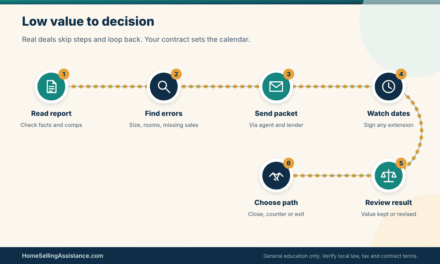
You will usually not see the report right away. The appraisal belongs to the lender and the buyer, and the buyer is generally entitled to a copy, so ask the buyer’s side to share it with your agent. Once you have it, read the comparable sales section, the adjustments the appraiser made, the square footage used and the list of features and updates credited to your home.
An appraisal gap seller should check the basic facts first. Is the living area measured the way local records and your own documents show it? Are bedrooms, bathrooms and finished basement space counted correctly? Were recent upgrades mentioned? Simple factual errors are the easiest to correct and the least likely to cause a standoff, because nobody has to change their opinion, only fix a mistake.
Then look at the comparables. Appraisers choose sales that are recent, nearby and similar, and they adjust for differences. You are looking for three things: sales they used that look weaker than they should, stronger sales they skipped, and adjustments that seem out of step with how buyers in your area actually behave. For more on how those adjustments work in general, our guide to adjusting comps for home value is a useful companion.
A scenario, an exception, and your next step: when the appraiser missed something
Suppose the report that landed on an appraisal gap seller’s desk leaves out a finished room over the garage that your own records show was built with permits. The lender’s appraiser may have measured only the main living area. If your agent can supply the permit, the final inspection record and a floor plan, a polite request to correct the square footage is reasonable, and it does not turn the conversation into a fight.
The exception is when the error is a matter of judgment rather than fact. If the appraiser chose a comparable sale you think is poor, that is an opinion, and persuading a lender to revisit an opinion takes stronger evidence and more patience. We cover that process step by step in our piece on requesting a reconsideration of value.
Your next step in either case is the same: put the findings in writing, give them to your agent, and let the right person route them to the lender through the proper channel rather than contacting the appraiser yourself.
Compare the realistic paths every appraisal gap seller faces
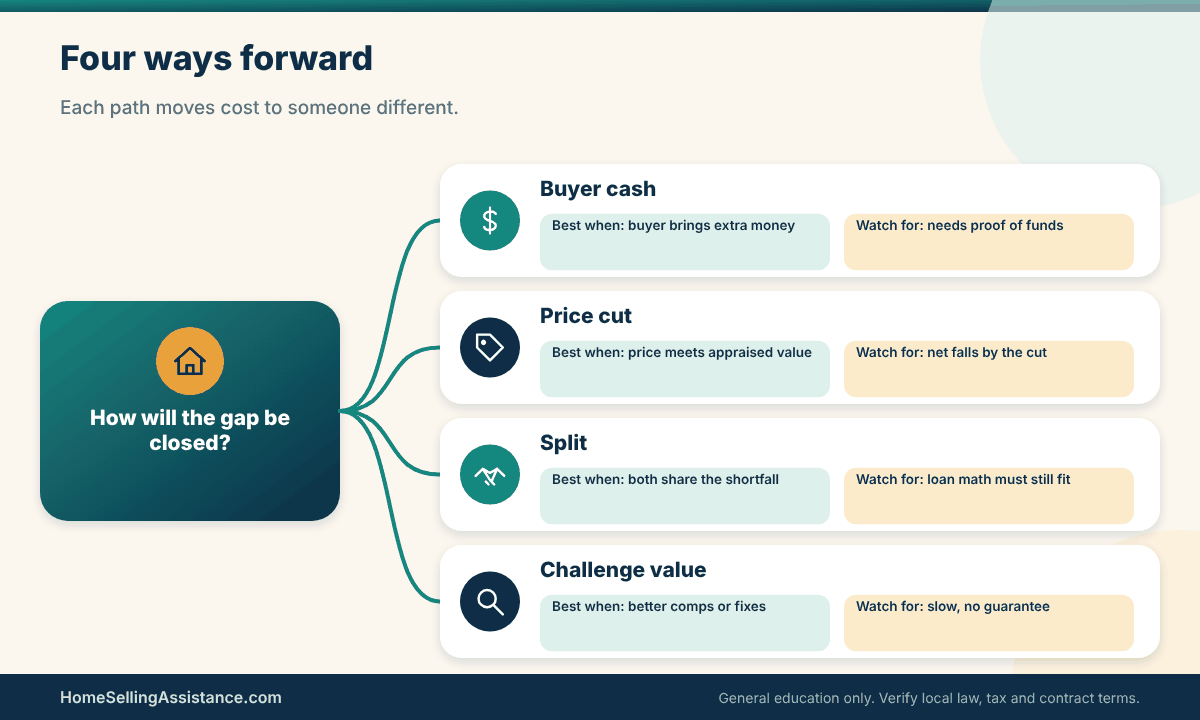
Once you know the gap is real, the appraisal gap seller question narrows to a handful of routes. The buyer can bring more cash, you can lower the price, the two of you can split the difference, or one side can challenge the number. If none of those work, the contract may end. Each route has a different effect on your net proceeds, your calendar and your exposure to something going wrong.
The table below lines up the common paths so you can see the trade-offs side by side. Treat this appraisal gap seller map as a set of questions to ask, not a ranking, because the right row depends on your contract and your situation.
| Path | Price and net proceeds | Time | Contingency effect | Workload and execution risk |
|---|---|---|---|---|
| Buyer covers the gap in cash | Contract price and your net stay the same | Usually quick if funds are real | Needs a written addendum or waiver | Low effort, but depends on the buyer’s cash |
| Price cut to appraised value | Net falls by the full gap | Fast, one amendment | Appraisal issue is resolved | Low effort, certainty rises |
| Split the difference | Net falls by your share only | Fast to moderate | Needs a new price and cash agreement | Moderate, both sides must stay solvent |
| Challenge the value | Could keep full price if it succeeds | Slowest, can run into deadlines | Clock may keep running or be extended | High effort, uncertain result |
| Credit instead of price cut | Net falls by credit, price stays | Fast | May not fix the loan amount | Moderate, lender rules can block it |
| End the contract and relist | Unknown until a new buyer appears | Longest, starts over | Depends on deposit terms | High, new inspections and new risk |
Read across a row instead of down a column. A path that looks cheap in the second column can look expensive in the third, because time has its own price: carrying costs, a second mortgage payment, a delayed purchase of your own. Then read the last column honestly. A buyer who promises cash but cannot document it is a risk that no price cut can fully offset.
The graphic below sketches the same fork visually, with the main questions each route raises.
Option one: the buyer covers the gap in cash
The cleanest outcome for an appraisal gap seller is that the buyer simply brings more money to closing. Your price and your net do not change, and the appraisal problem becomes the buyer’s problem. This is where most buyers in competitive markets end up when they truly want the house, and it is the reason some offers arrive with a promise to cover a certain gap in advance.
Cleanest does not mean riskless. A buyer who agrees to cover the difference has to find it, and if the money is needed for their closing costs or reserves, a thin cushion can snap later. Your job as an appraisal gap seller is to turn a verbal promise into a written one and to verify that the money exists.
Evidence to gather: proof of funds and the loan math
Here is how the arithmetic usually works, using round numbers for illustration only. Say the contract price is $400,000 and the buyer planned a 10 percent down payment of $40,000, which meant a loan of $360,000. The appraisal comes in at $380,000. The lender still lends the same percentage, but against $380,000, so the loan drops to $342,000. The buyer now needs $58,000 in down payment, which is $18,000 more than expected, even though the price gap is $20,000.
Real loan programs differ for each appraisal gap seller’s buyer in how they calculate and what they allow, so this is only a way to see why the buyer’s cash need can differ from the headline gap. Ask the buyer’s agent or lender, through your agent, for an updated figure.
Then ask for proof. A recent bank statement or a letter from the lender confirming that the extra funds are available is a reasonable request, because your sale now depends on it. The Consumer Financial Protection Bureau publishes plain-language material on how mortgage appraisals and lending work from the borrower’s side, which can help you understand what the buyer’s lender will and will not allow.
A scenario, an exception, and your next step: the buyer who can stretch, and the one who cannot
Imagine two buyers facing the same $20,000 shortfall. The first has savings well beyond what the deal requires and agrees within a day to pay the difference through a short written addendum. The second has been scraping together every dollar, and agrees quickly out of anxiety, only to discover at closing that the funds are gone. Both buyers said yes. Only one yes was worth anything.
The exception is a buyer who intends to pay the extra amount by borrowing it elsewhere, since many loan programs restrict that. If the source of the extra cash is unclear, ask your agent to confirm with the buyer’s side that the lender will accept it.
Your next step is a written amendment, signed by both parties, that states the gap amount, the buyer’s obligation to pay it, and the date by which funds must be verified. Our guide to the financing contingency explains how this type of promise fits alongside the buyer’s loan commitments.
Option two: a price reduction or a shared split
The second route for an appraisal gap seller is the most common compromise. You lower the contract price, wholly or partly, so that the loan the lender will make again covers what the buyer planned. If the price drops to the appraised value, the lender’s calculation lines up with the contract, and the file can usually move forward. A split means you cut some of the difference and the buyer covers the rest.
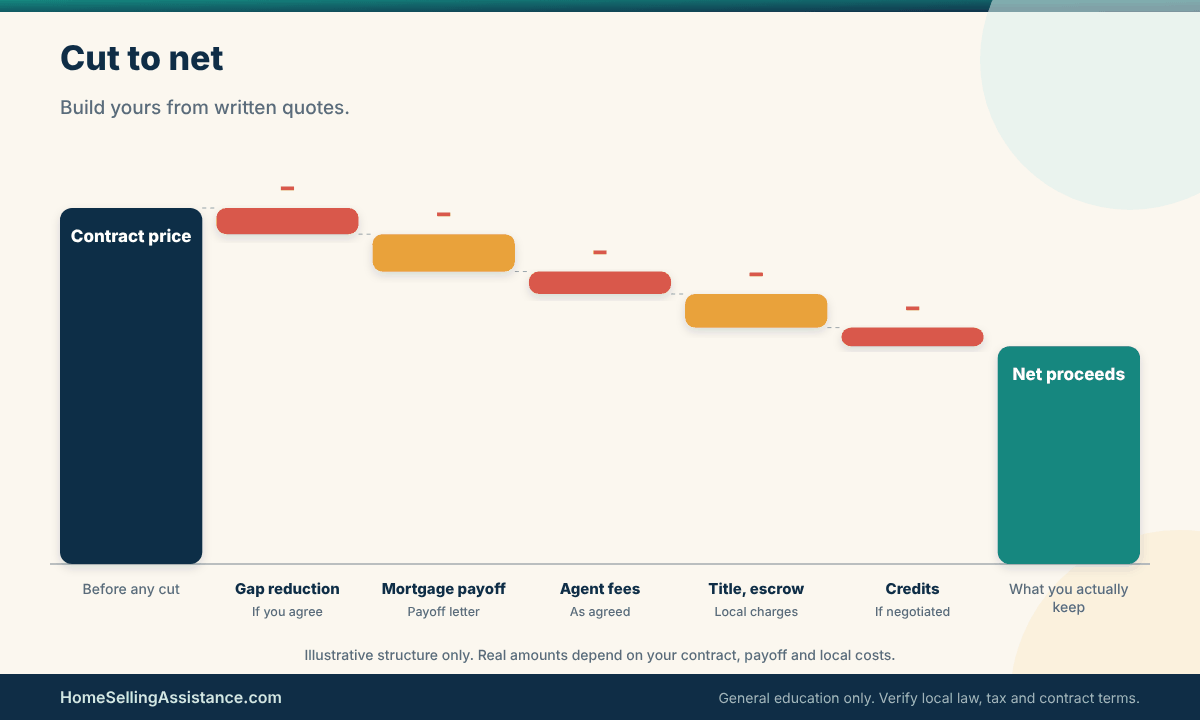
The cost of a cut to an appraisal gap seller is plain, since your net falls dollar for dollar. What is easy to miss is that a smaller price is not always smaller proceeds in the same proportion, because some of your costs, such as percentage-based fees, shrink slightly as well. Your closing statement, not a quick estimate, tells you the real figure.
Evidence to gather: a side-by-side net worksheet
Build a simple appraisal gap seller worksheet with one column per outcome: full price with buyer cash, price at appraised value, an even split, and a relist. For each, list the sale price, your payoff, agent compensation as written in your listing agreement, title and escrow charges, any agreed credits and your estimated carrying costs until a replacement closing. Our walkthrough of home sale net proceeds shows how to assemble those lines from real quotes.
Pay special attention to the last row. A relist rarely looks attractive in the first week, but a fair comparison includes mortgage interest, taxes, insurance and utilities for the extra months, plus the chance that the next offer is lower than this one. Put a realistic range on that, not a hopeful single number.
The worksheet also protects you from a common trap, which is treating the gap as a loss against the original list price. The relevant comparison is not what you hoped for in the spring but what each path will actually deliver to your bank account.
The next graphic shows, in illustrative form, how the price reduction flows down to what you receive.
A scenario, an exception, and your next step: a split, a credit and a pitfall
Take an appraisal gap seller with a $20,000 gap. A buyer proposes that you cut $10,000 and they bring $10,000 more. That feels fair, and it often is, but check the loan math before you sign. If the new price is still above the appraised value, the buyer’s cash requirement remains, and the lender will still lend against the lower figure.
The pitfall to avoid is a seller credit offered in place of a price cut. A credit toward the buyer’s closing costs reduces your net in the same way, but it does not raise the appraised value, and it does not shrink the price the lender is measuring against. Many lenders also cap the credits they accept, and the limits vary by loan type. If the buyer proposes one, ask the lender whether it actually solves the problem.
Your next step is to compare the offer with a straight price reduction using the worksheet. If a credit and a cut cost you the same but only one clears underwriting, the clearing one wins. For help with the negotiation side of this, our guide to counteroffer strategy for sellers covers how to respond without losing ground.
Use a net-result decision rule for any appraisal gap seller choice
By this point the appraisal gap seller has the contract, the report, the numbers and a list of paths. What is still missing is a way to choose. A simple rule keeps the decision from sliding toward whatever feels least uncomfortable: compare the realistic net you would receive on each path, adjust for time and for the chance that the path fails, and pick the one that leaves you best positioned against your own goals.
That sounds obvious, but an appraisal gap seller often compares the wrong things. They compare the new price to the original price, or one buyer’s promise to another’s, instead of comparing the money in hand at the end. A net-result rule fixes that by forcing every option onto the same scale.
The price, time, cost and risk framework
Use four lenses on every appraisal gap seller option. Price is the contract figure after any cut or credit. Time is how many days to a realistic closing, plus any days your own next purchase depends on. Cost is every dollar that leaves you between now and the end, including carrying costs and fees. Risk is the chance that the path breaks, which should lower the weight you give its best-case price.
A path with a higher price and a high chance of collapse is often worth less than a lower price with a firm buyer. You do not need an exact probability to use this idea. Even a rough sense of low, medium or high risk, based on documents rather than hope, will change how you rank the options.
Evidence to gather: the contract language that sets your leverage
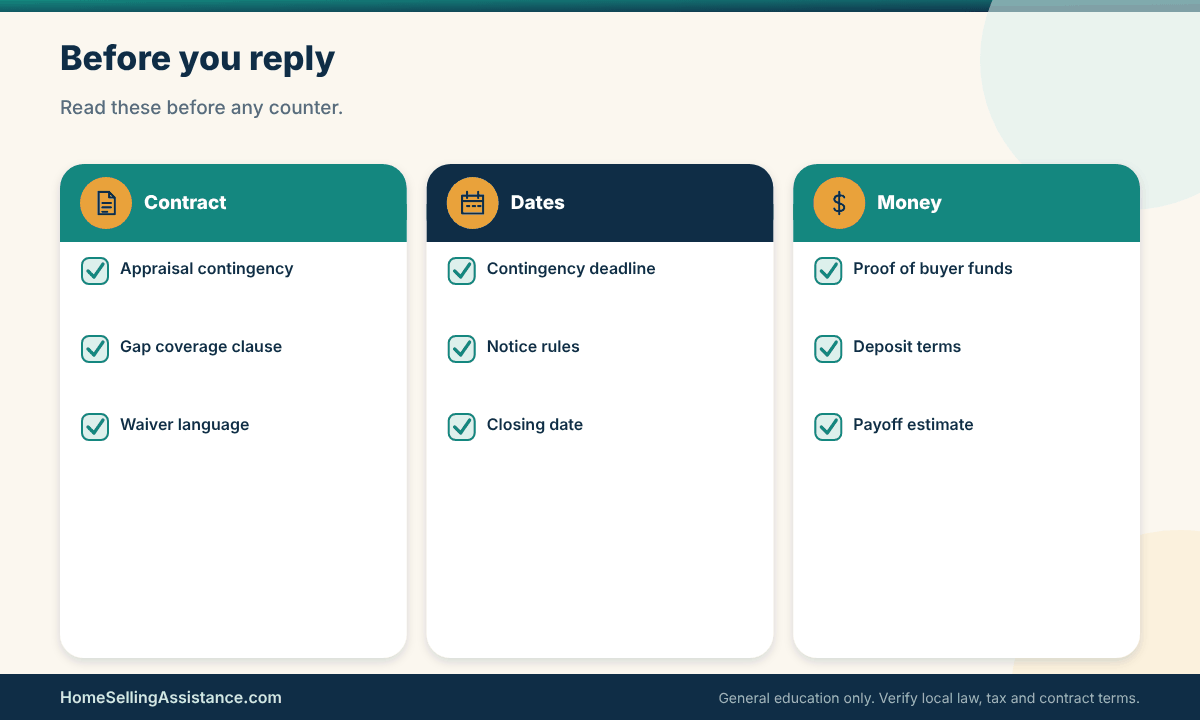
Contract wording decides how much bargaining power each side holds, so read it with a pencil. Look for an appraisal contingency, which usually lets the buyer renegotiate or end the contract if the value comes in low, within a set number of days. Look for a gap-coverage clause, in which the buyer promises to pay up to a stated amount if the appraisal is short. And look for a waiver, which may mean the buyer has given up the right to leave over value.
Each one shifts the risk differently. With a full contingency, the buyer has the stronger hand and you are negotiating from the back foot. With a gap clause, the buyer has already agreed to a ceiling, and your task is mostly to hold them to it. With a waiver, the buyer could lose their deposit by walking away, though how that works varies by state and contract wording.
Pay attention to three details inside any of these clauses. How many days does the buyer have to act after the report arrives? Does the clause require written notice, and to whom? And what happens to the earnest money if the buyer ends the deal on time versus late? Our primer on earnest money from the seller’s side explains why that last question matters so much.
Nothing in a general article can say how a court or title company in your area would read a specific clause. If the language is ambiguous or the stakes are high, a local real estate attorney is the right person to ask, and many of them will give a clear answer for a modest fee.
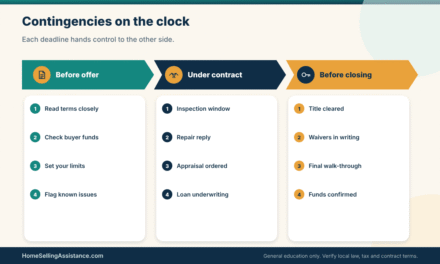
The checklist below puts the documents and dates in one place so that nothing is missed when the pressure is on.
A scenario, an exception, and your next step: three sellers, three clauses
Consider three appraisal gap seller cases with the same $20,000 gap. The first sold with a full appraisal contingency. The buyer asks for a $20,000 cut and has the right to leave if refused. That seller is bargaining against a real walk-away, so the net-result rule says to weigh the cut against the cost of relisting.
The second seller’s contract includes a clause under which the buyer agreed to cover a gap up to $15,000. The shortfall is $20,000, so there is a $5,000 remainder to settle. That appraisal gap seller has far more leverage: the first $15,000 is already promised, and the conversation is only about the last piece.
The third seller’s buyer waived the appraisal contingency entirely. The lender will still only lend against the lower value, so the buyer must cover the whole difference or risk default. That appraisal gap seller should still verify the buyer’s cash and avoid assuming the deal is safe.
The exception to all three is a contract that was drafted on a form you have not read closely. Get the full document in front of you, with every addendum, before you decide which seller you are.
Your next step is to write one sentence summarizing your leverage, for example “buyer has a contingency that expires on the 12th and no gap clause,” and share it with your agent so the negotiation plan matches the paperwork.
The second table brings these situations together. It is a quick reference for matching your circumstances to the route that tends to fit, and for noticing which fact could flip the answer.
| Situation | Route favored | Reason | Trade-off | Fact that changes the choice |
|---|---|---|---|---|
| Next home purchase depends on this closing date | Quick price cut or split | Time is worth more than the gap | Lower net proceeds | A flexible closing or bridge funds on your side |
| Buyer has a signed gap clause | Hold the buyer to the clause | The risk was already assigned to the buyer | Buyer may feel stretched | Proof of funds is missing or thin |
| Report has a clear factual error | Request a correction first | Fixes cost nothing and keep price intact | A few days of delay | Contingency deadline is about to expire |
| Recent nearby sales closed lower | Accept a cut or split | The market is the likely source of the gap | You give up some hoped-for price | Better comps appear or a backup offer arrives |
| Buyer is financing near the limit | Reduce price to the appraised value | The loan fits and the file can proceed | You absorb the full difference | Buyer shows verified extra cash |
| Strong backup offer in hand | Hold firm, allow the contract to end | You have a real alternative | Delay and new inspection risk | Backup buyer has weaker financing |
Use the appraisal gap seller table in two passes. First, find the row closest to your own case and read the route as a starting hypothesis, not an instruction. Second, read the last column and ask whether that fact is true for you. If it is, the row you chose may no longer apply, and the neighboring one may fit better.
The rows are deliberately general. They do not describe your lender, your buyer or your local customs, which is why the last column matters most.
When new evidence should change your appraisal gap seller plan
A plan made on Monday can look wrong by Thursday. The lender may agree to a second look, the buyer may produce more cash, or another interested buyer may reappear. A sensible appraisal gap seller treats the first plan as a working draft and sets in advance the few facts that would make a change worthwhile.
That discipline protects you from two opposite mistakes. One is clinging to a position after the facts have moved. The other is dropping a good position because someone pushed hard. Deciding ahead of time what would change your mind lets you tell a real development from pressure.
Evidence to gather: triggers that justify a new plan
An appraisal gap seller should write down four triggers. The first is the lender’s answer on any value challenge, whether it is a corrected number, a refusal or a request for more evidence. The second is any change in the buyer’s verified cash. The third is a deadline moving, either because both parties extended it in writing or because it is about to pass. The fourth is a fresh offer from another buyer, either a backup or a new inquiry.
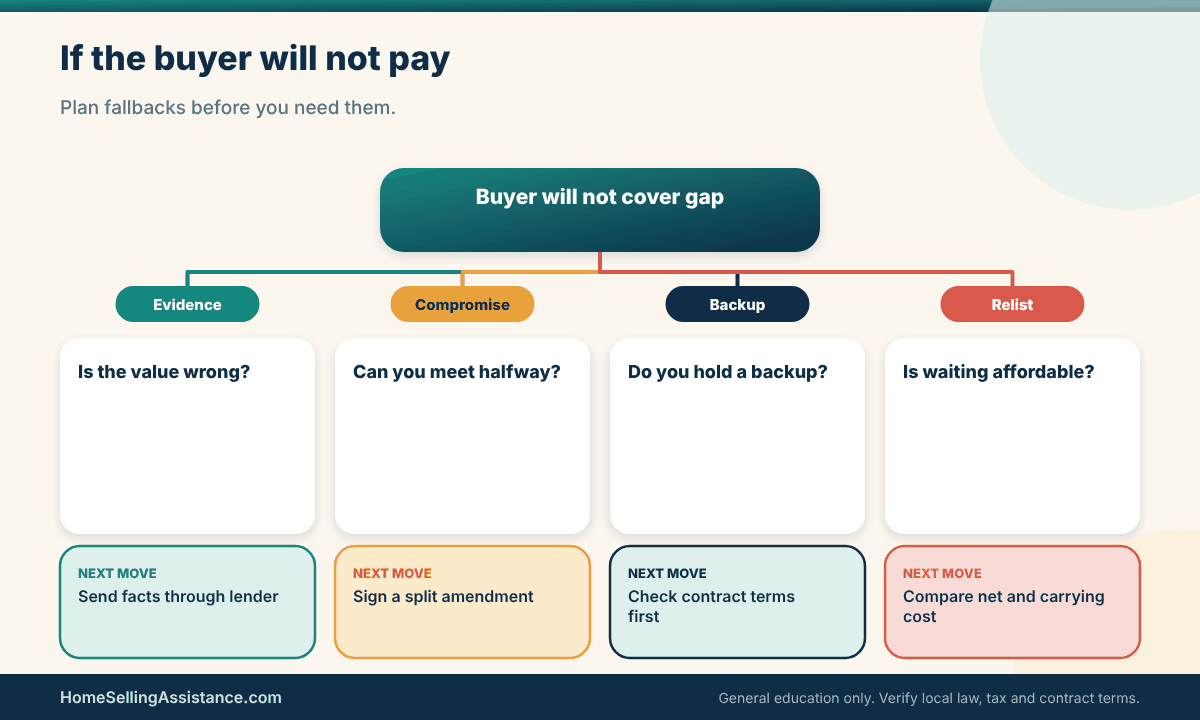
For each trigger, decide in advance what you would do. If the lender corrects the value upward, you might hold the full price. If the buyer’s cash shrinks, you might move toward a cut. If a deadline is about to pass without an extension, you might ask your agent to confirm in writing what the buyer intends. If a backup offer is stronger, you might consider whether the current contract allows you to move on.
Rules about backup offers and notification are set by the contract and local practice. Our guide to backup offers for sellers covers how they generally work and what to check before relying on one.
If you believe the number reflects something other than the property, such as an assumption about the neighborhood or the people who live in the home, you can raise that with your agent and the lender and learn more from HUD’s fair housing resources. Keep any such concern tied to documented facts, because evidence is what moves a review.
Whatever the trigger, your updated plan should be written down and shared with your agent or attorney, so that everyone on your side is working from the same version of events.
The decision tree below shows one way to organize fallbacks, from the point where the buyer will not or cannot cover the difference.
A scenario, an exception, and your next step: the plan that changed twice
Here is how an appraisal gap seller plan might evolve. A seller starts by asking for a $20,000 price hold with the buyer covering the gap. The buyer’s records show they can contribute only $8,000. The seller then requests a reconsideration of value, supplying two stronger comparable sales and a correction to the square footage. The lender returns a value that closes half the gap. Now the shortfall is $10,000, which the buyer’s $8,000 nearly covers, and a small seller concession finishes the job.
Notice that the seller never made a dramatic move. Each step followed a new fact. That is the pattern to aim for.
The exception is the situation where the clock is the enemy. If the buyer’s window to end the contract is about to close, a long review might not fit. In that case, ask your agent to propose a short written extension that covers the review period, and be ready for the buyer to say no.
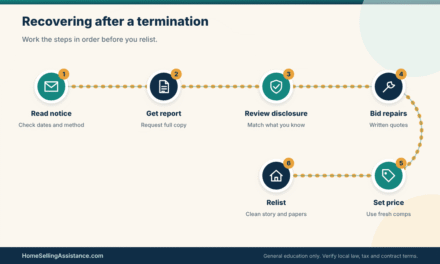
If the buyer does refuse and the deal ends, your next step is to understand what happens to the deposit under your contract, gather the same documents for relisting, and consider whether the price needs another look. Our piece on the home price reduction strategy explains how sellers often approach a reset, and what to do when a deal falls through covers the practical steps after a collapse.
What to say and ask in each conversation. Words matter in these conversations, and a few plain scripts keep them productive. To the buyer’s side, through your agent, you might say: “We have the appraisal. Can you tell us how much of the difference the buyer is prepared to cover, and can you send documentation that the funds are available?” That asks for a number and for proof without accusing anyone.
To your own agent, ask: “Which comparable sales did the appraiser use, and are there better ones we can point to? What would a reconsideration request need to include, and how long will it take compared with our deadline?” These questions turn a vague feeling into a plan with dates.
To the escrow or title officer, ask about the mechanics: “If we sign an amendment reducing the price, what else needs to change in the documents, and how does it affect the deposit?” This is the kind of detail that surprises sellers when they discover it late.
If you are an appraisal gap seller working without an agent, the same questions apply, but you will need to put more of the paperwork through an attorney or the escrow officer. A sale without an agent can still handle an appraisal gap, though the burden of reading and documenting each step falls on you.
Through all of this, resist the urge to negotiate by text message late at night. Every number you agree to should end up in a signed amendment, and anything that is not written down is, for practical purposes, not agreed.
When to walk away. Sometimes the net-result rule points the appraisal gap seller toward ending the contract. Suppose the buyer insists on the full gap as a price cut, the value dispute fails, and you hold a backup offer with a closing date you can live with. Walking away costs you some weeks, but the backup buyer’s terms might leave you with a better net than the compromise would.
The exception is when the backup is more fragile than the current buyer. A backup with a weak loan commitment or a request for large concessions can turn a hard decision into a worse one. Check that offer with the same care you gave the first.
Your next step is to confirm that ending the contract is permitted on your timeline, since improper termination can create disputes over the deposit. This is a good place to bring in an attorney. When you weigh offers more broadly, our cornerstone on how to evaluate a home offer and the explainer on cash versus financed offers show how financing type affects the odds of another appraisal gap.
For the full list of contingencies that can change a deal, return to the inspections, appraisals and contingencies library, and if the appraisal leaves you facing a low number rather than a gap negotiation, read your options after a low appraisal next.
One more layer of protection for any appraisal gap seller is to look at how future offers are structured. A buyer who offers cash, or one whose offer already includes a stated gap guarantee, reduces your chance of facing this problem again. That does not make them the better buyer automatically, because cash offers can carry their own discounts and verification needs, but it belongs in your comparison.
If you are weighing the costs of relisting, the guide to seller closing costs will help you see what a new closing would cost, and the National Association of Realtors, at nar.realtor, publishes general market data that can help you gauge whether conditions are shifting under your feet.
Quick scenario
An appraisal gap seller accepts $400,000 and the appraisal returns at $380,000. The buyer offers to cover $5,000 and asks the seller to cut $15,000. The seller checks the contract, finds a gap clause capping the buyer’s promise at $10,000, and counters: buyer covers $10,000, seller cuts $10,000. Both sides sign a one-page amendment the same day. The numbers here are illustrative only, but the order of operations is the point: read the clause first, then counter, then document.
Frequently asked questions about appraisal gap seller situations
What exactly is an appraisal gap?
It is the difference between the price in your contract and the value the buyer’s appraiser reports. The lender bases the loan on the lower of the two figures, so a lower appraisal means the buyer’s loan shrinks. Someone then has to bridge the difference, or the contract has to change. For an appraisal gap seller, the practical question is who covers it and by when.
Do I have to lower my price if the appraisal comes in low?
Generally, no appraisal gap seller can be forced to reduce a signed price simply because an appraisal is low. What the buyer can do depends on the contract, and a buyer with an appraisal contingency may be able to renegotiate or end the deal. Your leverage depends on that language, so read it before you respond. An attorney can explain how it applies in your state.
Can the buyer just walk away over a low appraisal?
It depends on the contract. If the buyer kept an appraisal contingency and acts within its deadline and notice rules, ending the contract may be allowed with the deposit returned. If the buyer waived it, walking away could put the deposit at risk, though outcomes vary by state and wording. Ask your agent or attorney how your own paperwork reads.
Who pays for the appraisal?
In many transactions the buyer pays for the appraisal as part of their loan costs, since the lender orders it for the buyer’s financing. Contracts can allocate this differently, and local custom varies. Check your agreement and your closing statement. If a second review or second appraisal is ordered, ask who bears that cost before it is requested.
Can I challenge a low appraisal?
The buyer’s lender, not you, controls the appraisal, but your side can usually supply evidence through the proper channel. The strongest requests point to factual errors or better comparable sales, with documents attached. Lenders have their own review processes and timelines, and there is no guarantee of a changed number. Our guide on reconsideration of value goes through the steps.
Should I accept a seller credit instead of lowering the price?
Not automatically. A credit lowers your net just as a price cut does, but it does not change the price the lender measures against the appraised value. Many loan programs also limit how much seller-paid cost a buyer can receive. Ask the buyer’s lender, through your agent, whether a credit will actually resolve the shortfall.
What if the buyer says they will cover the gap but has no proof?
Treat a promise without documents as an open risk for the appraisal gap seller. Ask for a bank statement or a lender letter showing the funds, and put the buyer’s commitment in a signed amendment with a verification date. If the funds cannot be shown, compare the offer to a modest price cut with a firm buyer. The weak yes is often worth less than the stronger, smaller one.
Does an all-cash buyer avoid the appraisal problem?
A true cash buyer has no lender requiring an appraisal, so the lender-driven gap disappears. The buyer may still choose to order one or may negotiate based on value in other ways. Cash offers have their own trade-offs, so see our explainer on cash versus financed offers.
Can a low appraisal affect other buyers if my deal falls through?
It can influence the conversation, since a new buyer’s agent may ask about prior contracts, and a documented value opinion can shape expectations. It does not set the market price. Your list strategy, condition and local comparable sales matter more, and a fresh appraisal for a new buyer could reach a different number. If you relist, revisit your price with current comps.
Should I talk to an attorney about an appraisal gap?
If you are an appraisal gap seller and the contract language is unclear, the sum is large or the buyer is threatening to cancel, a local real estate attorney is a sensible expense. Some states route most closings through attorneys already, and others rely on escrow officers and agents. Either way, general articles cannot interpret your specific contract, and a short consultation can prevent a costly misreading.
Before you answer the appraisal call
Every appraisal gap seller faces the same quiet question: what will I actually keep, and how sure am I of it? Read the contract, ask for the report, build the net comparison and write down your triggers. Then respond calmly, in writing, with a plan you can explain. This article is general education, not legal, tax or financial advice, and your contract, your state’s rules and your lender’s requirements decide what is possible in your situation.